
Discrete Finite-Time Convergent Neurodynamics Approach for Precise Grasping of Multi-Finger Robotic Hand

 , and
, and
Abstract
1. Introduction
- (1)
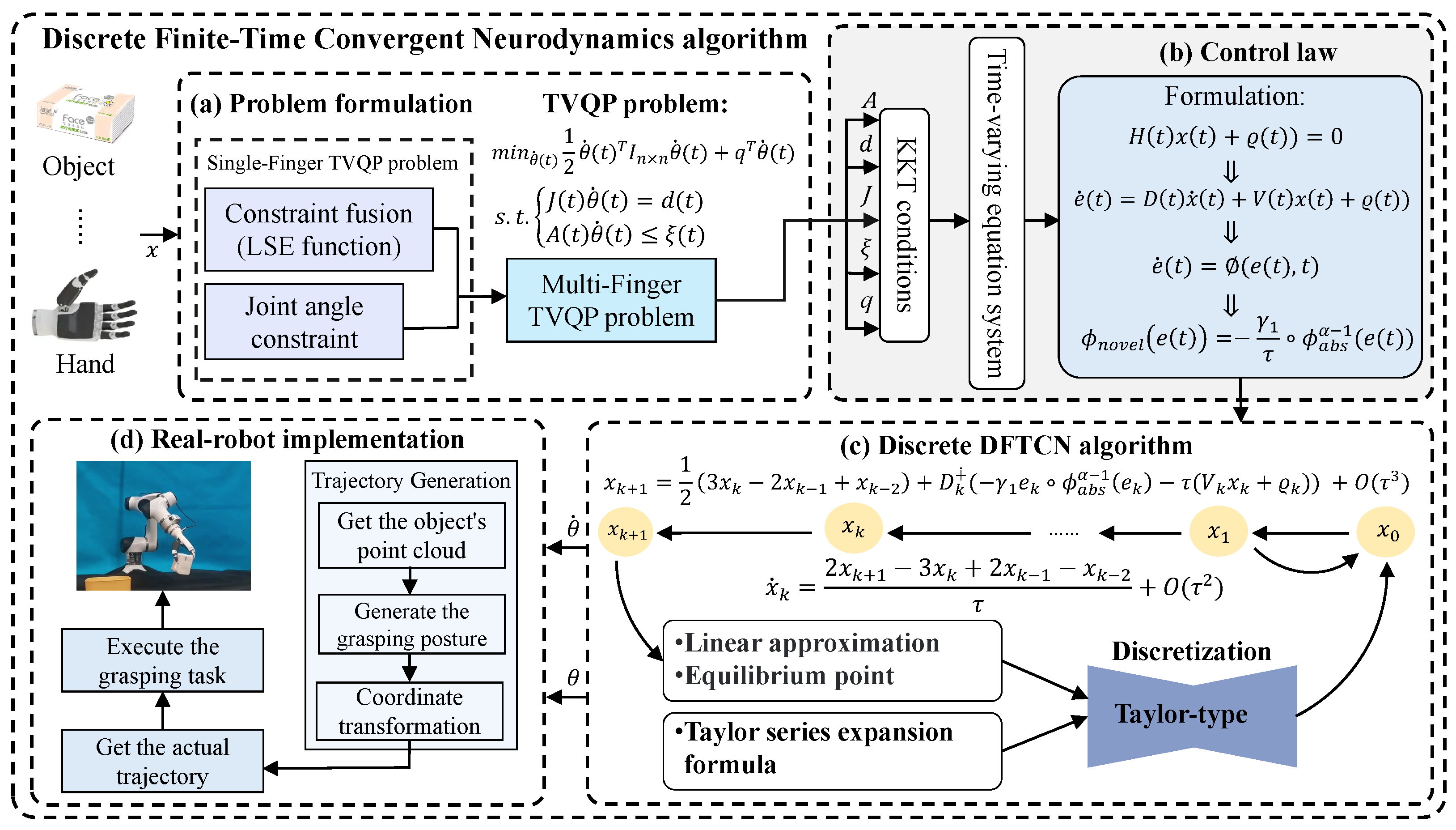
- The DFTCN algorithm is proposed, which is capable of effectively solving the trajectory tracking problem for a robotic hand with high DoFs. Detailed theoretical derivation and analysis are provided to support the validity and performance of the DFTCN algorithm.
- (2)
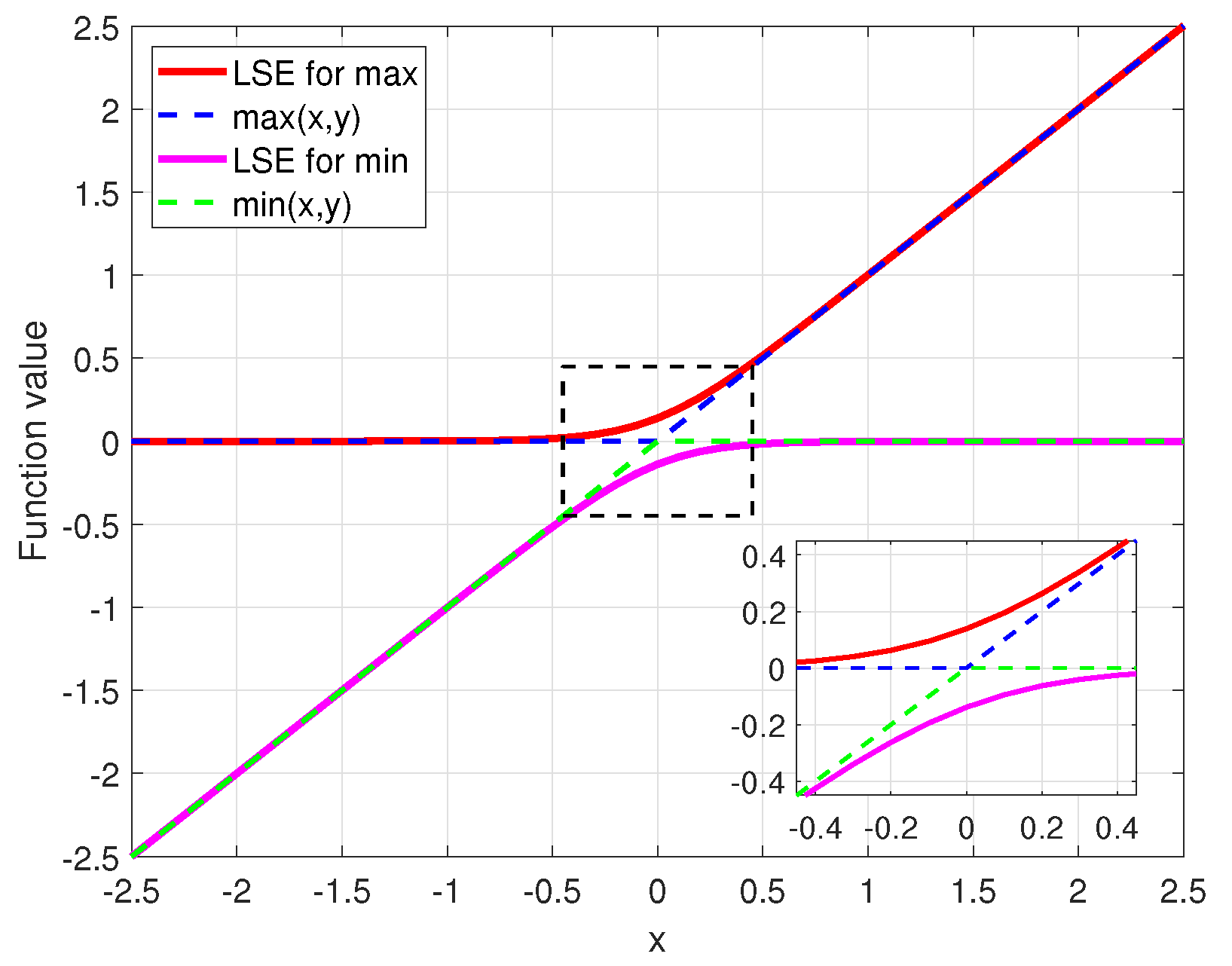
- The log-sum-exp (LSE) function is introduced to merge the inequality constraints of joint angles and angular velocities during the construction of the time-varying quadratic programming (TVQP) problem for each finger. This approach further improves the finite-time convergence and stability of the DFTCN algorithm.
- (3)
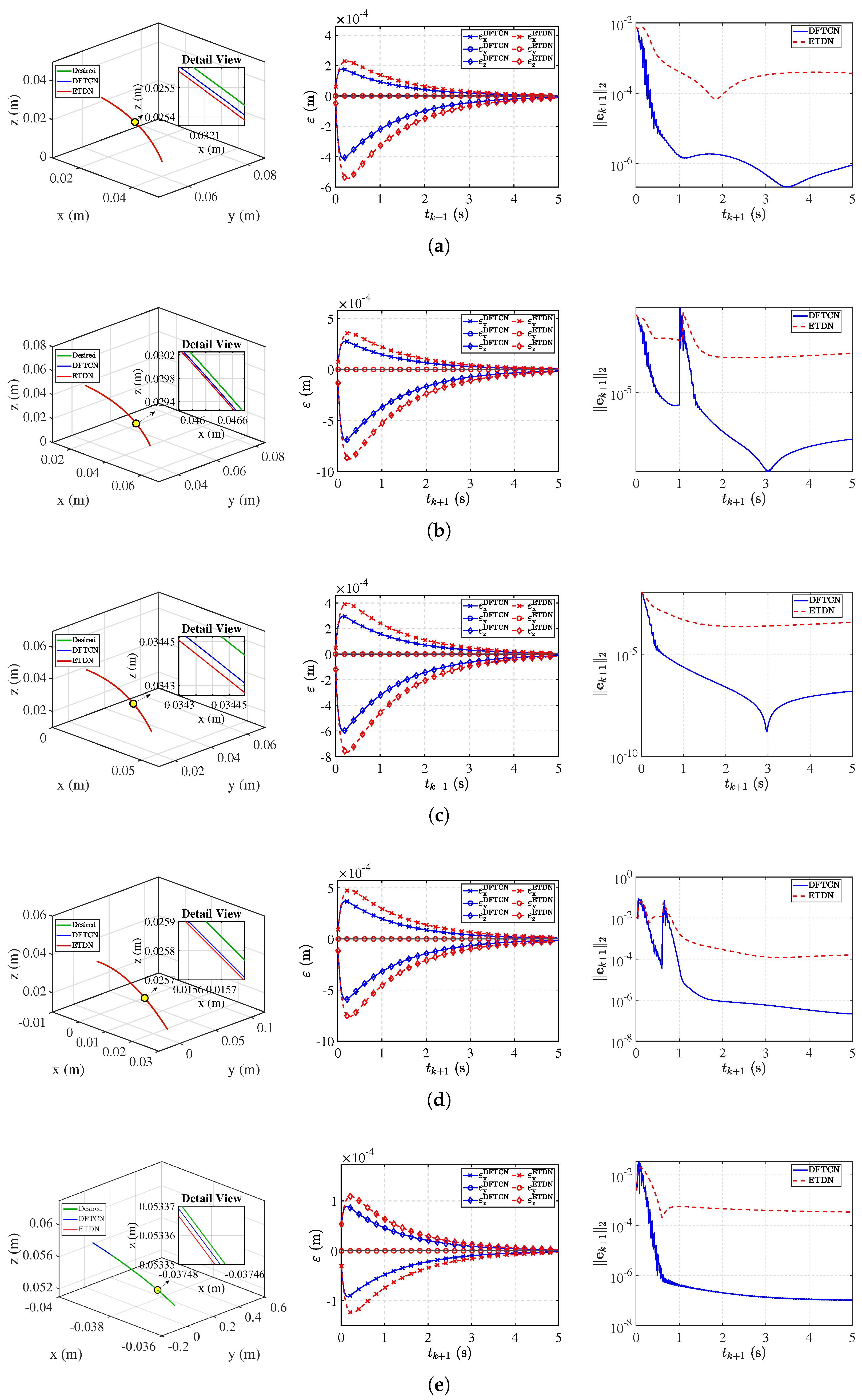
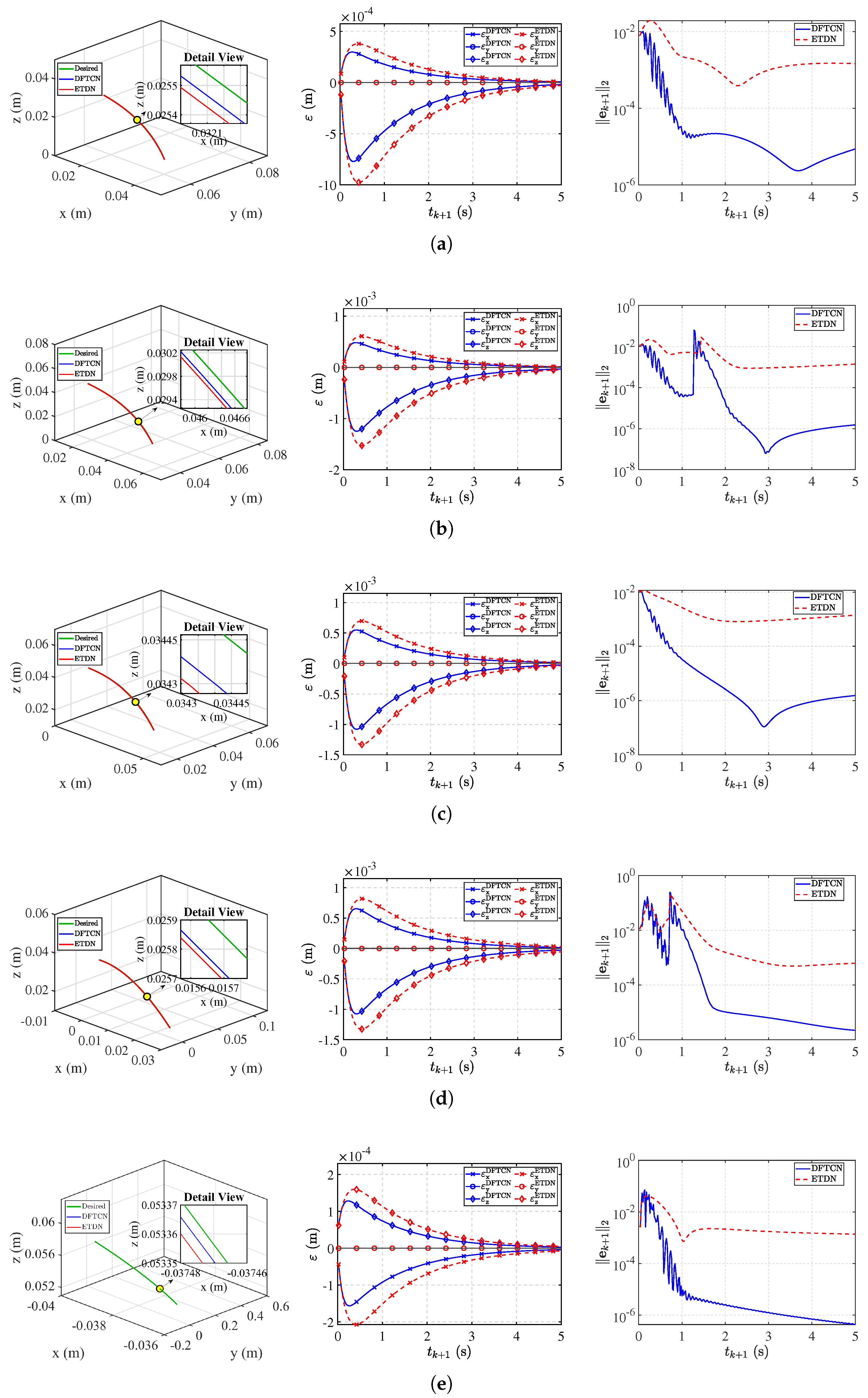
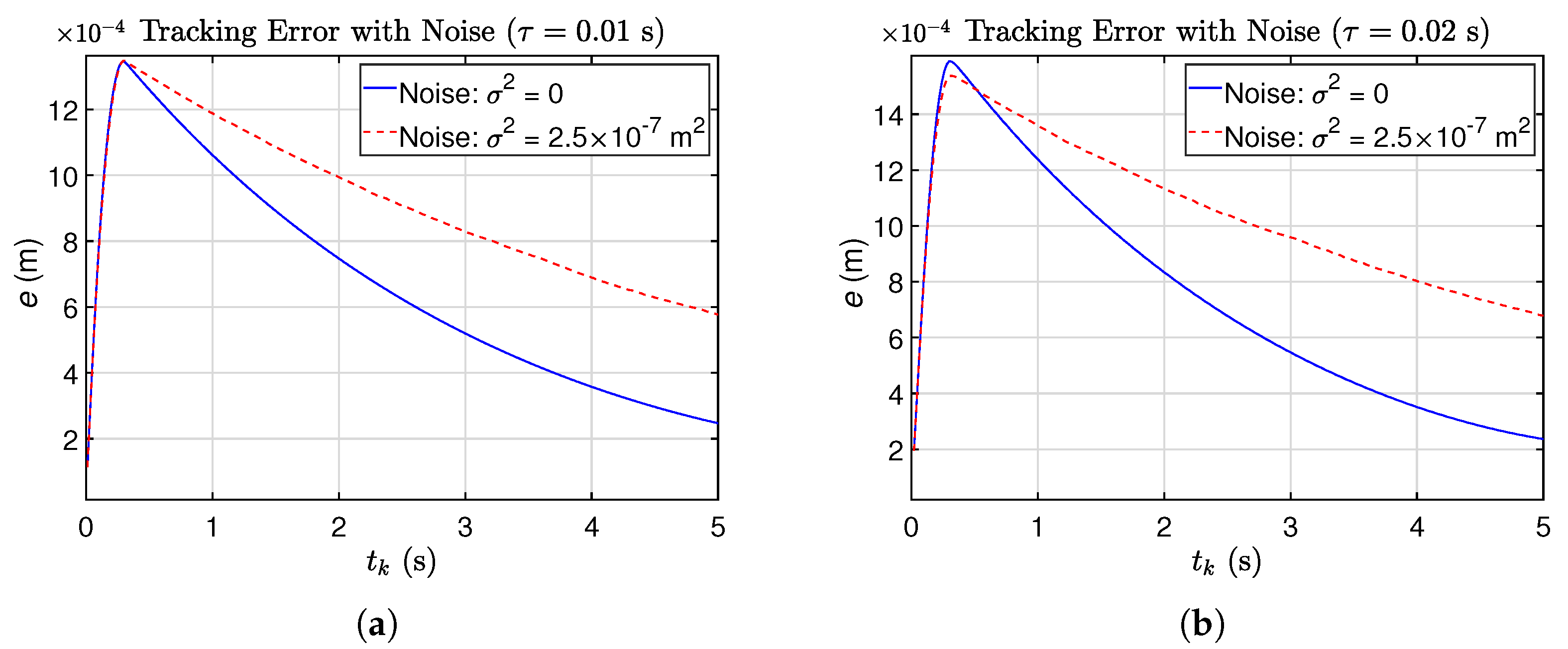
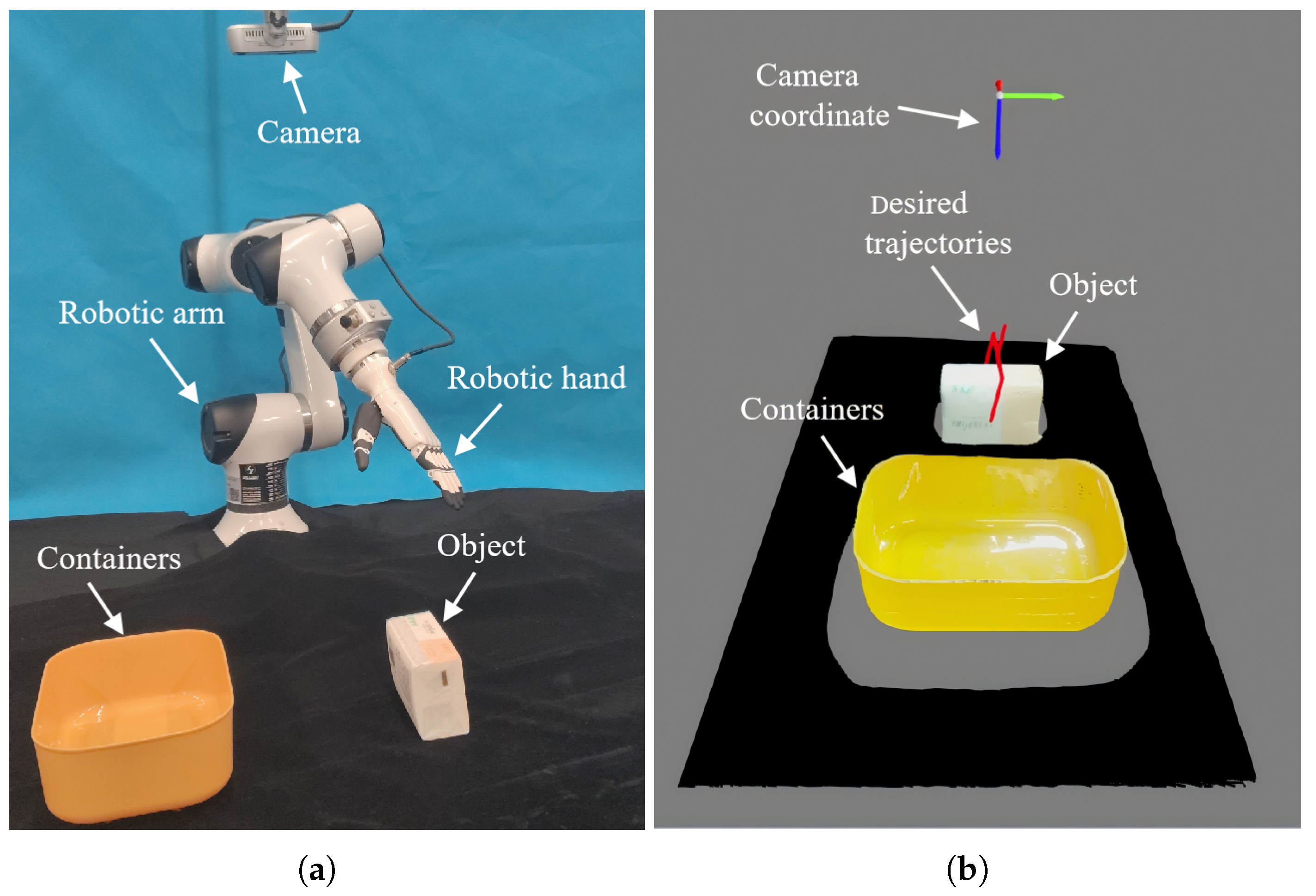
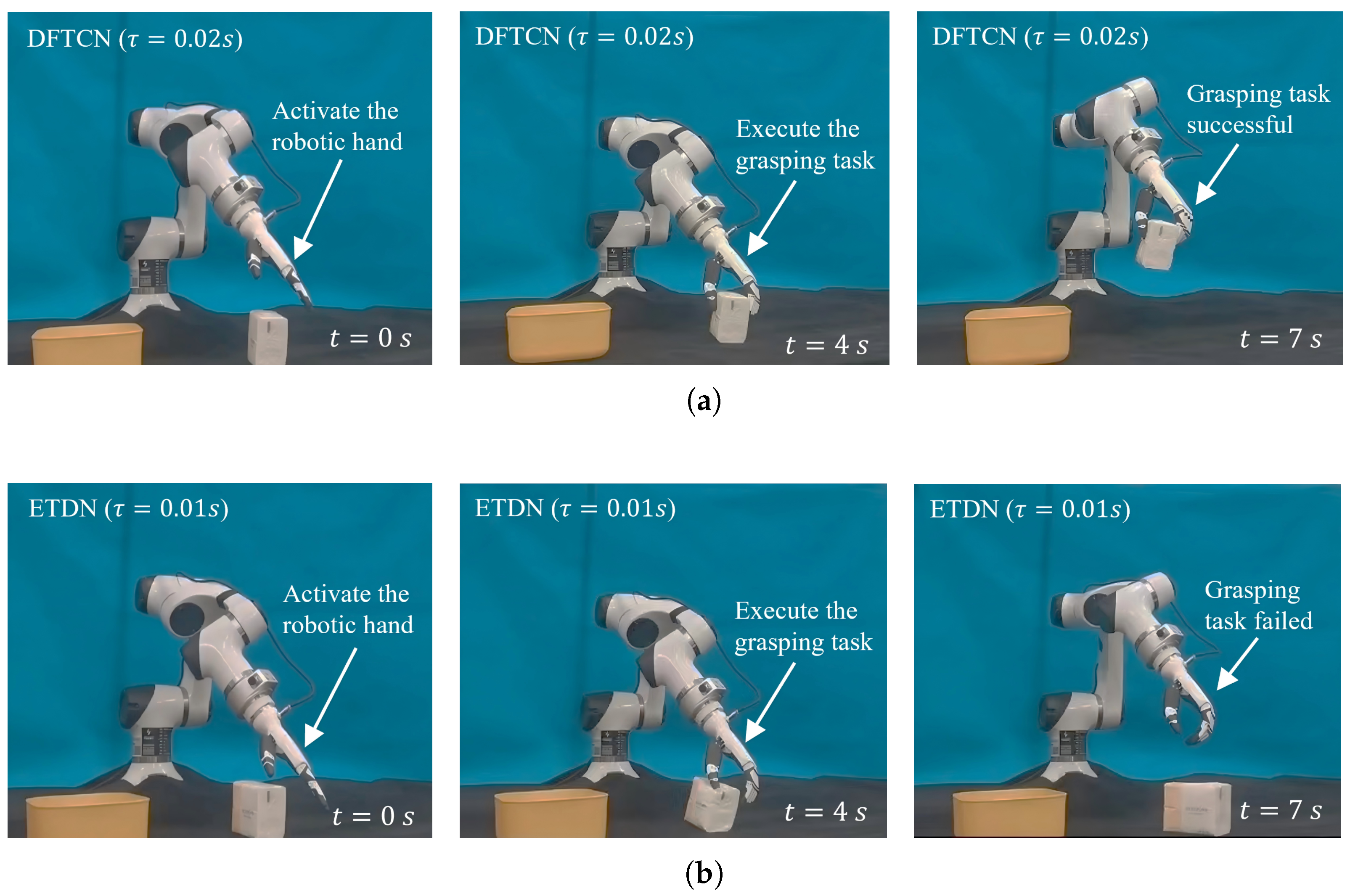
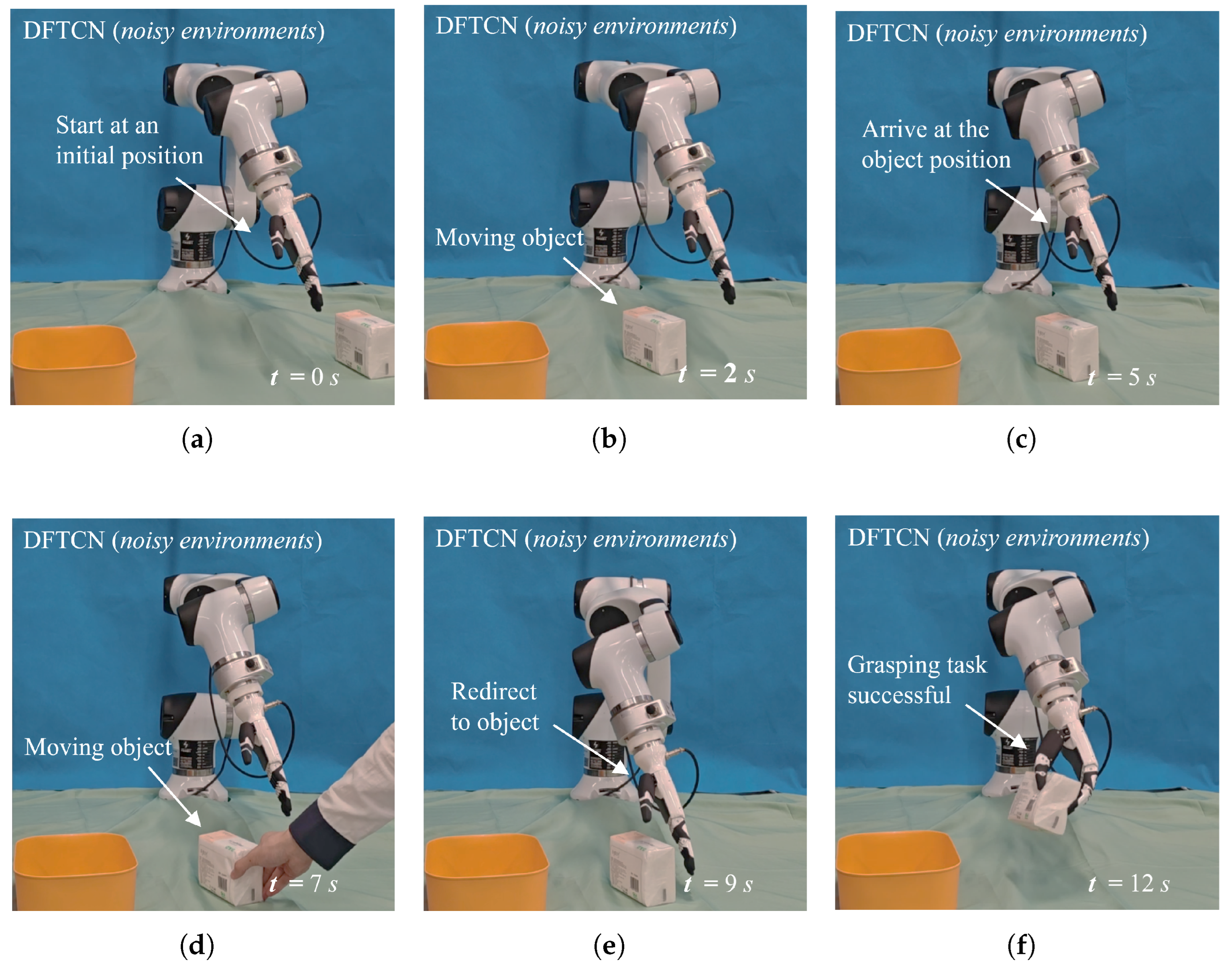
- Numerical simulations are performed to verify the convergence and accuracy of the proposed algorithm in solving the trajectory tracking problem. Furthermore, real-robot experiments are conducted in which the robotic hand successfully grasps and transports a tissue box. These results illustrate the DFTCN algorithm’s capability to achieve precise grasping in real robotic deployment.
2. Design and Analysis of DFTCN Algorithm
2.1. TVQP Problem
2.2. Control Law Design
2.3. Discrete DFTCN Algorithm
| Algorithm 1 DFTCN Algorithm |
|
2.4. Theoretical Analysis
3. Simulation and Experiment Verification
3.1. Numerical Simulations for Robotic Hand
3.2. Real-Robot Experiments
4. Conclusions
Author Contributions
Funding
Institutional Review Board Statement
Informed Consent Statement
Data Availability Statement
Conflicts of Interest
References
- Zhong, Y.; Jiang, Q.; Yu, J.; Ma, Y. Dexgrasp anything: Towards universal robotic dexterous grasping with physics awareness. In Proceedings of the Computer Vision and Pattern Recognition Conference, Nashville, TN, USA, 10–17 June 2025; pp. 22584–22594. [Google Scholar]
- Weng, Z.; Lu, H.; Kragic, D.; Lundell, J. Dexdiffuser: Generating dexterous grasps with diffusion models. IEEE Robot. Autom. Lett. 2024, 9, 11834–11840. [Google Scholar] [CrossRef]
- Reader, A.T.; Gaile, L.; Li, W.; Cheah Mc Corry, E.E.; Mackie, K. Multiple object handling: Exploring strategies for cumulative grasping and transport using a single hand. Exp. Brain Res. 2025, 243, 165. [Google Scholar] [CrossRef]
- Zhou, J.; Huang, J.; Dou, Q.; Abbeel, P.; Liu, Y. A dexterous and compliant (dexco) hand based on soft hydraulic actuation for human inspired fine in-hand manipulation. IEEE Trans. Robot. 2025, 41, 666–686. [Google Scholar] [CrossRef]
- Hu, W.; Huang, B.; Lee, W.W.; Yang, S.; Zheng, Y.; Li, Z. Dexterous in-hand manipulation of slender cylindrical objects through deep reinforcement learning with tactile sensing. Robot. Auton. Syst. 2025, 186, 104904. [Google Scholar] [CrossRef]
- Liang, H.; Cong, L.; Hendrich, N.; Li, S.; Sun, F.; Zhang, J. Multifingered grasping based on multimodal reinforcement learning. IEEE Robot. Autom. Lett. 2021, 7, 1174–1181. [Google Scholar] [CrossRef]
- Charlesworth, H.J.; Montana, G. Solving challenging dexterous manipulation tasks with trajectory optimisation and reinforcement learning. In Proceedings of the 38th International Conference on Machine Learning (ICML), Virtual, 18–24 July 2021; pp. 1496–1506. [Google Scholar]
- Mandikal, P.; Grauman, K. Dexvip: Learning dexterous grasping with human hand pose priors from video. In Proceedings of the Conference on Robot Learning, Auckland, New Zealand, 14–18 December 2022; pp. 651–661. [Google Scholar]
- Kim, H.; Ohmura, Y.; Kuniyoshi, Y. Gaze-based dual resolution deep imitation learning for high-precision dexterous robot manipulation. IEEE Robot. Autom. Lett. 2021, 6, 1630–1637. [Google Scholar] [CrossRef]
- Chi, C.; Xu, Z.; Feng, S.; Cousineau, E.; Du, Y.; Burchfiel, B.; Tedrake, R.; Song, S. Diffusion policy: Visuomotor policy learning via action diffusion. Int. J. Robot. Res. 2025, 44, 1684–1704. [Google Scholar] [CrossRef]
- Yang, L.; Huang, B.; Li, Q.; Tsai, Y.Y.; Lee, W.W.; Song, C.; Pan, J. Tacgnn: Learning tactile-based in-hand manipulation with a blind robot using hierarchical graph neural network. IEEE Robot. Autom. Lett. 2023, 8, 3605–3612. [Google Scholar] [CrossRef]
- Valencia, D.; Jia, J.; Li, R.; Hayashi, A.; Lecchi, M.; Terezakis, R.; Gee, T.; Liarokapis, M.V.; MacDonald, B.A.; Williams, H. Comparison of model-based and model-free reinforcement learning for real-world dexterous robotic manipulation tasks. In Proceedings of the 2023 IEEE International Conference on Robotics and Automation (ICRA), London, UK, 29 May–2 June 2023; pp. 871–878. [Google Scholar]
- Wang, Q.; Sanchez, F.R.; McCarthy, R.; Bulens, D.C.; McGuinness, K.; O’Connor, N.; Wüthrich, M.; Widmaier, F.; Bauer, S.; Redmond, S.J. Dexterous robotic manipulation using deep reinforcement learning and knowledge transfer for complex sparse reward-based tasks. Expert Syst. 2023, 40, e13205. [Google Scholar] [CrossRef]
- Duan, H.; Wang, P.; Huang, Y.; Xu, G.; Wei, W.; Shen, X. Robotics dexterous grasping: The methods based on point cloud and deep learning. Front. Neurorobotics 2021, 15, 658280. [Google Scholar] [CrossRef]
- Jin, B.; Ye, S.; Su, J.; Luo, J. Unknown payload adaptive control for quadruped locomotion with proprioceptive linear legs. IEEE/ASME Trans. Mechatronics 2022, 27, 1891–1899. [Google Scholar] [CrossRef]
- Luo, J.; Ye, S.; Su, J.; Jin, B. Prismatic quasi-direct-drives for dynamic quadruped locomotion with high payload capacity. Int. J. Mech. Sci. 2022, 235, 107698. [Google Scholar] [CrossRef]
- Peng, J.; Zhou, W.; Han, Y.; Li, M.; Liu, W. Deep learning-based autonomous real-time digital meter reading recognition method for natural scenes. Measurement 2023, 222, 113615. [Google Scholar] [CrossRef]
- Luo, J.; Gong, Z.; Su, Y.; Ruan, L.; Zhao, Y.; Asada, H.H.; Fu, C. Modeling and balance control of supernumerary robotic limb for overhead tasks. IEEE Robot. Autom. Lett. 2021, 6, 4125–4132. [Google Scholar] [CrossRef]
- Luo, J.; Zhao, Y.; Ruan, L.; Mao, S.; Fu, C. Estimation of CoM and CoP trajectories during human walking based on a wearable visual odometry device. IEEE Trans. Autom. Sci. Eng. 2020, 19, 396–409. [Google Scholar] [CrossRef]
- Peng, J.; Zhang, C.; Kang, L.; Feng, G. Endoscope FOV autonomous tracking method for robot-assisted surgery considering pose control, hand–eye coordination, and image definition. IEEE Trans. Instrum. Meas. 2022, 71, 1–16. [Google Scholar] [CrossRef]
- Cheng, X.; Patil, S.; Temel, Z.; Kroemer, O.; Mason, M.T. Enhancing dexterity in robotic manipulation via hierarchical contact exploration. IEEE Robot. Autom. Lett. 2023, 9, 390–397. [Google Scholar] [CrossRef]
- Ma, X.; Zhang, J.; Wang, B.; Huang, J.; Bao, G. Continuous adaptive gaits manipulation for three-fingered robotic hands via bioinspired fingertip contact events. Biomim. Intell. Robot. 2024, 4, 100144. [Google Scholar] [CrossRef]
- Ma, J.; Tian, Q.; Liu, K.; Liu, J.; Guo, S. Fully tactile dexterous hand grasping strategy combining visual and tactile senses. In Proceedings of the International Conference on Intelligent Robotics and Applications, Hangzhou, China, 5–7 July 2023; pp. 133–143. [Google Scholar]
- Li, S.L.; Zhang, A.; Chen, B.; Matusik, H.; Liu, C.; Rus, D.; Sitzmann, V. Controlling diverse robots by inferring Jacobian fields with deep networks. Nature 2025, 643, 89–95. [Google Scholar] [CrossRef]
- Altiner, B.; Saoud, A.; Caldas, A.; Makarov, M. Scenario convex programs for dexterous manipulation under modeling uncertainties. In Proceedings of the IEEE International Conference on Automation Science and Engineering, Bari, Italy, 28 August–1 September 2024; pp. 3490–3497. [Google Scholar]
- Kim, S.; Ahn, T.; Lee, Y.; Kim, J.; Wang, M.Y.; Park, F.C. DSQNet: A deformable model-based supervised learning algorithm for grasping unknown occluded objects. IEEE Trans. Autom. Sci. Eng. 2022, 20, 1721–1734. [Google Scholar] [CrossRef]
- Zhang, Y.; Jiang, D.; Wang, J. A recurrent neural network for solving Sylvester equation with time-varying coefficients. IEEE Trans. Neural Netw. 2002, 13, 1053–1063. [Google Scholar] [CrossRef]
- Sathya, A.S.; Carpentier, J. Constrained articulated body dynamics algorithms. IEEE Trans. Robot. 2025, 41, 430–449. [Google Scholar] [CrossRef]
- Qiao, Y.L.; Liang, J.; Koltun, V.; Lin, M.C. Efficient differentiable simulation of articulated bodies. In Proceedings of the 38th International Conference on Machine Learning (ICML), Virtual, 18–24 July 2021; pp. 8661–8671. [Google Scholar]
- Zhou, X.; Liao, B. Advances in Zeroing Neural Networks: Convergence Optimization and Robustness in Dynamic Systems. Mathematics 2025, 13, 1801. [Google Scholar] [CrossRef]
- Cui, Y.; Liu, K. Adaptive Fuzzy Fault-Tolerant Formation Control of High-Order Fully Actuated Multi-Agent Systems with Time-Varying Delays. Mathematics 2025, 13, 2813. [Google Scholar] [CrossRef]
- Stanimirović, P.S.; Ćirić, M.; Mourtas, S.D.; Brzaković, P.; Karabašević, D. Simulations and bisimulations between weighted finite automata based on time-varying models over real numbers. Mathematics 2024, 12, 2110. [Google Scholar] [CrossRef]
- Xiao, L.; Jia, L.; Wang, Y.; Dai, J.; Liao, Q.; Zhu, Q. Performance analysis and applications of finite-time ZNN models with constant/fuzzy parameters for TVQPEI. IEEE Trans. Neural Networks Learn. Syst. 2021, 33, 6665–6676. [Google Scholar] [CrossRef] [PubMed]
- Hu, Z.; Xiao, L.; Dai, J.; Xu, Y.; Zuo, Q.; Liu, C. A unified predefined-time convergent and robust ZNN model for constrained quadratic programming. IEEE Trans. Ind. Inform. 2020, 17, 1998–2010. [Google Scholar] [CrossRef]
- Li, C.; Zhang, H.; Chen, K.; Yang, M. Novel Noise-Tolerant Zeroing Neurodynamics Algorithms for Dynamic Nonlinear Least Square Problems with Robot Application. IEEE Trans. Ind. Electron. 2025. early access. [Google Scholar] [CrossRef]
- Liu, Y.; Liu, K.; Wang, G.; Sun, Z.; Jin, L. Noise-tolerant zeroing neurodynamic algorithm for upper limb motion intention-based human–robot interaction control in non-ideal conditions. Expert Syst. Appl. 2023, 213, 118891. [Google Scholar] [CrossRef]
- Qiu, B.; Li, X.D.; Yang, S. A novel discrete-time neurodynamic algorithm for future constrained quadratic programming with wheeled mobile robot control. Neural Comput. Appl. 2023, 35, 2795–2809. [Google Scholar] [CrossRef]
- Abbassi, R.; Jerbi, H.; Kchaou, M.; Simos, T.E.; Mourtas, S.D.; Katsikis, V.N. Towards higher-order zeroing neural networks for calculating quaternion matrix inverse with application to robotic motion tracking. Mathematics 2023, 11, 2756. [Google Scholar] [CrossRef]
- Jin, J.; Zhu, J.; Gong, J.; Chen, W. Novel activation functions-based ZNN models for fixed-time solving dynamirc Sylvester equation. Neural Comput. Appl. 2022, 34, 14297–14315. [Google Scholar] [CrossRef]
- Chen, J.; Kang, X.; Zhang, Y. Continuous and discrete ZND models with aid of eleven instants for complex QR decomposition of time-varying matrices. Mathematics 2023, 11, 3354. [Google Scholar] [CrossRef]
- Zhang, Y.; Li, Z.; Yang, M.; Ming, L.; Guo, J. Jerk-level Zhang neurodynamics equivalency of bound constraints, equation constraints, and objective indices for cyclic motion of robot-arm systems. IEEE Trans. Neural Netw. Learn. Syst. 2021, 34, 3005–3018. [Google Scholar] [CrossRef] [PubMed]
- Wu, Y.; Zhu, Z.; Liu, F.; Chrysos, G.; Cevher, V. Extrapolation and spectral bias of neural nets with hadamard product: A polynomial net study. Adv. Neural Inf. Process. Syst. 2022, 35, 26980–26993. [Google Scholar]
- Zhang, Y.; Ge, S.S. Design and analysis of a general recurrent neural network model for time-varying matrix inversion. IEEE Trans. Neural Netw. 2005, 16, 1477–1490. [Google Scholar] [CrossRef]
- Bhat, S.P.; Bernstein, D.S. Finite-time stability of continuous autonomous systems. SIAM J. Control Optim. 2000, 38, 751–766. [Google Scholar] [CrossRef]
- Guo, D.; Nie, Z.; Yan, L. Theoretical analysis, numerical verification and geometrical representation of new three-step DTZD algorithm for time-varying nonlinear equations solving. Neurocomputing 2016, 214, 516–526. [Google Scholar] [CrossRef]
- Yu, F.; Liu, L.; Xiao, L.; Li, K.; Cai, S. A robust and fixed-time zeroing neural dynamics for computing time-variant nonlinear equation using a novel nonlinear activation function. Neurocomputing 2019, 350, 108–116. [Google Scholar] [CrossRef]
- Biswas, B.N.; Chatterjee, S.; Mukherjee, S.P. A Discussion on Euler Method: A Review. Electron. J. Math. Anal. Appl. 2013, 1, 209–219. [Google Scholar] [CrossRef]
- Yang, M.; Yu, P.; Tan, N. Discrete integral-type zeroing neurodynamics for robust inverse-free and model-free motion control of redundant manipulators. Comput. Electr. Eng. 2024, 118, 109344. [Google Scholar] [CrossRef]
- Tan, Z.; Zhang, Y. Finite-time convergent gradient-zeroing neurodynamic system for solving temporally-variant linear simultaneous equation. Appl. Soft Comput. 2025, 170, 112695. [Google Scholar] [CrossRef]



| Algorithm | DoFs | Simulation Hardware Specifications | Software Platform | Sampling Gap (s) | Time (s) |
|---|---|---|---|---|---|
| DFTCN | 15 | 1. Intel Core i7-12700KF; 2. NVIDIA GeForce RTX 4070 SUPER. | MATLAB R2023a | 0.01, 0.02 | 5 |
| ETDN | 15 | Same as DFTCN | MATLAB R2023a | 0.01, 0.02 | 5 |
| Finger | |||
|---|---|---|---|
| Index finger | |||
| Middle finger | |||
| Ring finger | |||
| Little finger | |||
| Thumb |
| Algorithm | Convergence Time (s) | Convergence Rate | RMSE (m) | MAE (m) | Per-Iteration Time (s) |
|---|---|---|---|---|---|
| DFTCN | 0.740 | 0.0177 | 1.399 | 6.892 | 1.108 |
| ETDN | 3.220 | 0.0061 | 2.940 | 2.120 | 1.304 |
| GAGZNS | 2.048 | 0.0147 | 5.360 | 4.520 | 8.420 |
| DZN | 2.410 | 0.0095 | 9.020 | 4.070 | 4.300 |
| Algorithm | Convergence Time (s) | Convergence Rate | RMSE (m) | MAE (m) | Per-Iteration Time (s) |
|---|---|---|---|---|---|
| DFTCN | 1.290 | 0.0353 | 2.650 | 1.360 | 1.300 |
| ETDN | 4.320 | 0.0133 | 5.580 | 4.170 | 1.380 |
| GAGZNS | 2.050 | 0.0147 | 5.360 | 4.520 | 9.100 |
| DZN | 1.630 | 0.0086 | 6.290 | 4.170 | 4.600 |
| Algorithm | DoFs | Hardware Specifications | Sampling Gap (s) | Time (s) |
|---|---|---|---|---|
| DFTCN | 12 | 1. Han’s E03 robot; 2. Inspire hand; 3. Intel Core i7-12700KF; 4. NVIDIA GeForce RTX 4070 SUPER; 5. Intel RealSense D435if. | 0.02 | 5 |
| ETDN | 12 | Same as DFTCN | 0.01 | 5 |
Disclaimer/Publisher’s Note: The statements, opinions and data contained in all publications are solely those of the individual author(s) and contributor(s) and not of MDPI and/or the editor(s). MDPI and/or the editor(s) disclaim responsibility for any injury to people or property resulting from any ideas, methods, instructions or products referred to in the content. |
© 2025 by the authors. Licensee MDPI, Basel, Switzerland. This article is an open access article distributed under the terms and conditions of the Creative Commons Attribution (CC BY) license (https://creativecommons.org/licenses/by/4.0/).
Share and Cite
Chen, H.; Xin, Y.; Li, H.; Han, Y.; Zhang, Y.; Luo, J. Discrete Finite-Time Convergent Neurodynamics Approach for Precise Grasping of Multi-Finger Robotic Hand. Mathematics 2025, 13, 3823. https://doi.org/10.3390/math13233823
Chen H, Xin Y, Li H, Han Y, Zhang Y, Luo J. Discrete Finite-Time Convergent Neurodynamics Approach for Precise Grasping of Multi-Finger Robotic Hand. Mathematics. 2025; 13(23):3823. https://doi.org/10.3390/math13233823
Chicago/Turabian StyleChen, Haotang, Yuefeng Xin, Haolin Li, Yu Han, Yunong Zhang, and Jianwen Luo. 2025. "Discrete Finite-Time Convergent Neurodynamics Approach for Precise Grasping of Multi-Finger Robotic Hand" Mathematics 13, no. 23: 3823. https://doi.org/10.3390/math13233823
APA StyleChen, H., Xin, Y., Li, H., Han, Y., Zhang, Y., & Luo, J. (2025). Discrete Finite-Time Convergent Neurodynamics Approach for Precise Grasping of Multi-Finger Robotic Hand. Mathematics, 13(23), 3823. https://doi.org/10.3390/math13233823