Abstract
Using equivalent transformations, complicated circuits in physics that need numerous mathematical operations to analyze can be broken down into simpler equivalent circuits. It is also possible to determine the number of spanning trees—graph families in particular—using these adjustments and utilizing our knowledge of difference equations, electrically equivalent transformations, and weighted generating function rules. In this paper, we derive the exact formulas for the number of spanning trees of sequences of new graph families created by a Johnson skeleton graph 63 and a few of its related graphs. Lastly, a comparison is made between our graphs’ entropy and other graphs of average degree four.
Keywords:
number of spanning trees; electrically equivalent transformations; entropy; graph sequence Johnson skeleton graph MSC:
97K30; 05C63
1. Introduction
A spanning tree is a subgraph of an undirected, connected graph that has every vertex in the main graph but only employs the fewest required edges to construct a tree structure (i.e., no cycles). It essentially connects every node in a network without generating unnecessary loops.
These days, physics has a function τ where the number of spanning trees is employed as an invariant to calculate the entropy of certain networks associated with physical processes [1,2,3]. In the discipline of network analysis [4,5,6], is also used in relation to other metrics that show how reliable a network is when represented by graph . Furthermore, there are numerous mathematical uses for the number of spanning trees τ(G). The current fastest approach, for instance, employs the scaling factor of the coordinate system to embed a three-connected planar graph as a polytope. There are many subgraphs within a fixed graph . A graph with edges can actually have different subgraphs. Some of these subgraphs are obviously trees. We are especially interested in a subset of these trees known as spanning trees. The practice of counting the number of spanning trees of a graph dates to 1842, when German mathematician Gustav Kirchhoff [7] established a connection between the number of spanning trees of a graph and the determinant of a particular submatrix that is connected to it as follows:
For a connected graph with vertices, the Kirchhoff matrix is an characteristic matrix , where is the adjacency matrix of , and is the diagonal matrix of the degrees of , such that is defined as follows:
The number of spanning trees in a graph is equal to each co-factor of .
For big graphs, this approach is not practical. Because of this, people have devised ways to overcome challenges and have focused more on obtaining clear and straightforward formulas for certain classes of graphs. See [8,9,10]. Daoud [11] developed this technique and derived the explicit formula for counting the number of spanning trees of cartesian and composition products of complete and complete bipartite and tripartite graphs as well as the explicit formula for counting the number of spanning trees of classes of pyramid graphs generated by wheel and gear graphs [12].
Feussner’s recursive formula [13,14], the fundamental combinatorial concept for counting in a graph , is very simple to understand. Let be any edge of an undirected simple graph . Each spanning tree in can be divided into two sections: all spanning trees without as a tree edge are included in one section, and all spanning trees with as a tree edge are included in the other.
The subgraph that results from taking a graph and removing an edge while leaving all other edges and vertices intact is represented by the first section, which has the same number of spanning trees as the graph. In the second section, the graph (not a subgraph) is created by compressing the edge until the two vertices and meet, and it has the same number of spanning trees as the graph. This new vertex is identified by
Compared to , both and have fewer edges. Thus, it is possible to count the number of spanning trees in in a recursive manner. Assume now that represents the collection of all spanning trees of ; thus This set consequently broke down into two disjoint sets , one of which consists of trees containing selected edge , while the other consists of trees that do not contain . It is evident that since every edge of them matches a spanning tree of and , because every one of its edges is a spanning tree of and inversely, . In 1889, British mathematician A. Cayley [15] determined how many spanning trees there are in a full graph: . It was demonstrated using a variety of methods, including some combinatorial techniques [16]. The explicit formula for calculating the number of spanning trees of chain graphs and wheel-related graphs was derived by Daoud [17,18] using this technique.
2. Electrically Equivalent Transformations
Kirchhoff was inspired to study electrical networks through the idea that an edge-weighted graph, with weights representing the conductance of the corresponding edges, may be considered an electrical network. The effect conductance between two vertices can be expressed as the quotient of the (weighted) number of spanning trees and the (weighted) number of so-called thickets, spanning forests with exactly two components and the property that each component contains precisely one of the vertices [19,20]. Using this technique, Daoud [21] has determined the number of spanning trees for certain pyramid graphs based on Fritsch graphs.
A few simple changes and their effects on the number of spanning trees are listed below. Here, indicates the weighted number of spanning trees . Let be an edge-weighted graph and the electrically equivalent graph that goes with it.
- Parallel edges: The number of spanning trees in , , stays the same when two parallel edges in with conductances and are combined into a single edge in with a conductance of .
- Serial edges: The number of spanning trees in , , can be computed as multiplied by if two serial edges in with conductances and are joined to form a single edge in with a conductance of .
- Δ-Y Transformation: The number of spanning trees in , , can be calculated as multiplied by , when a triangle in with conductances and is converted into an electrically equivalent star graph in with conductances , and .
- Y-Δ Transformation: The number of spanning trees in , , can be calculated as multiplied by . when a star graph in , with conductances and , is converted into an electrically equivalent triangle in with conductances , and .
3. Main Results
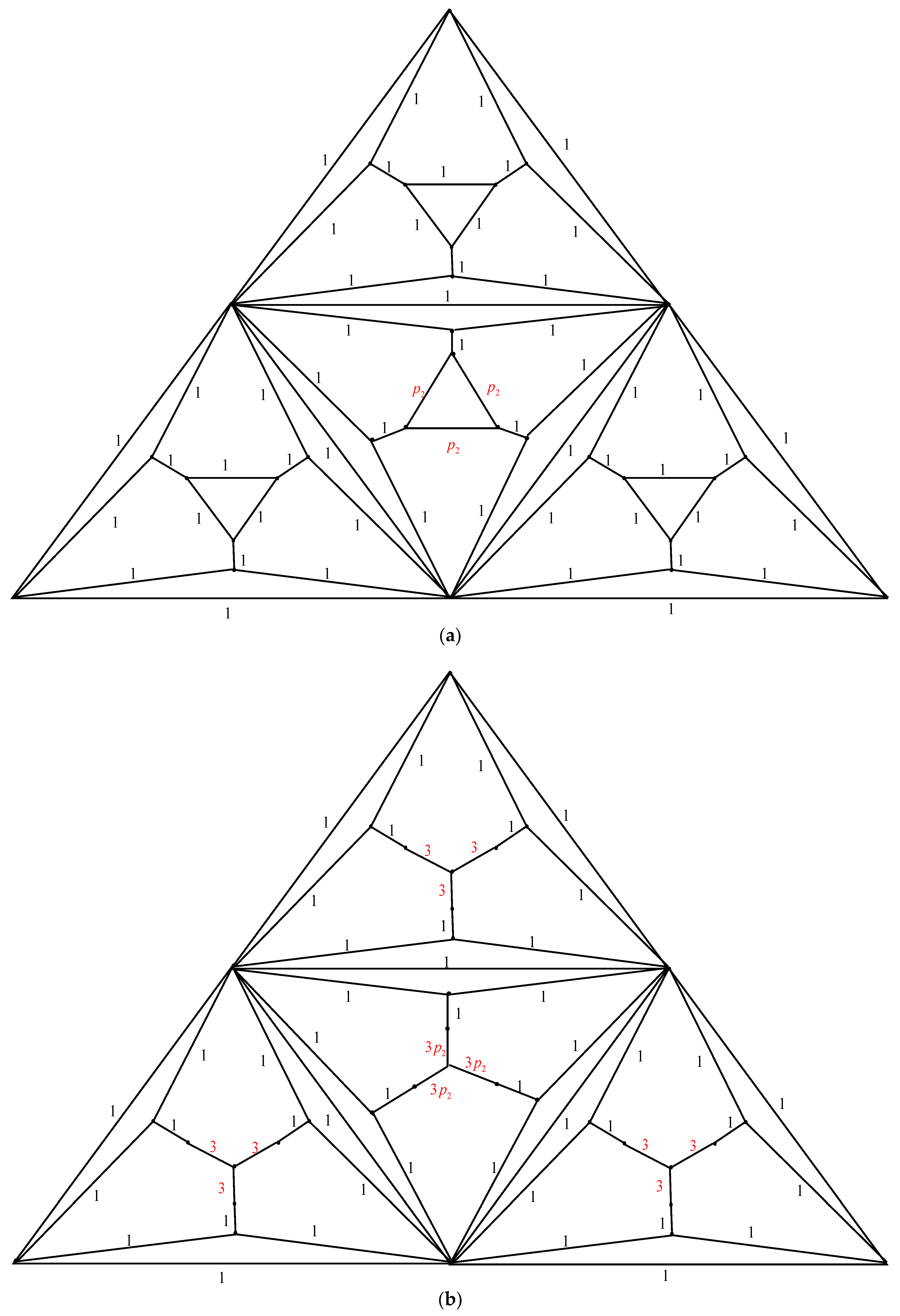
A Johnson graph is a specific kind of undirected graph that is defined using systems of sets. Two vertices (subsets) are close when they meet and contain -elements. The element subsets of an element collection are the vertices of the Johnson graph . In other words, the Johnson graph has vertices given by the k-subsets of , with two vertices connected if and only if their intersection has size . The Johnson skeleton graph is a minimal unit-distance forbidden graph.
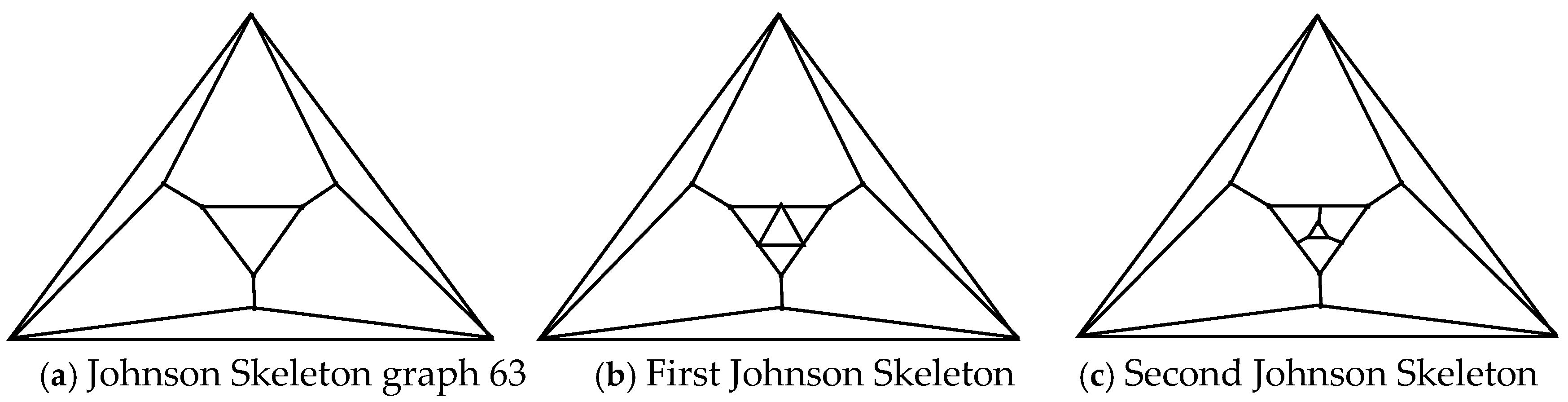
This study will identify the number of spanning trees in the graph sequences, , generated by the Johnson skeleton graph 63 and two related graph sequences, and , generated by two graphs associated with Johnson skeleton graph 63; these are defined as follows:
The first Johnson-skeleton-related graph is a graph that is produced by replacing the internal triangle of Johnson skeleton graph 63 with a star (3,3)-gon graph. See Figure 1b.
Figure 1.
Johnson Skeleton graph 63 and two related graphs.
The second Johnson-skeleton-related graph is a graph that is produced by replacing the internal triangle of Johnson skeleton graph 63 with another Johnson skeleton graph 63. See Figure 1c.
3.1. The Number of Spanning Trees in the Graph Sequence
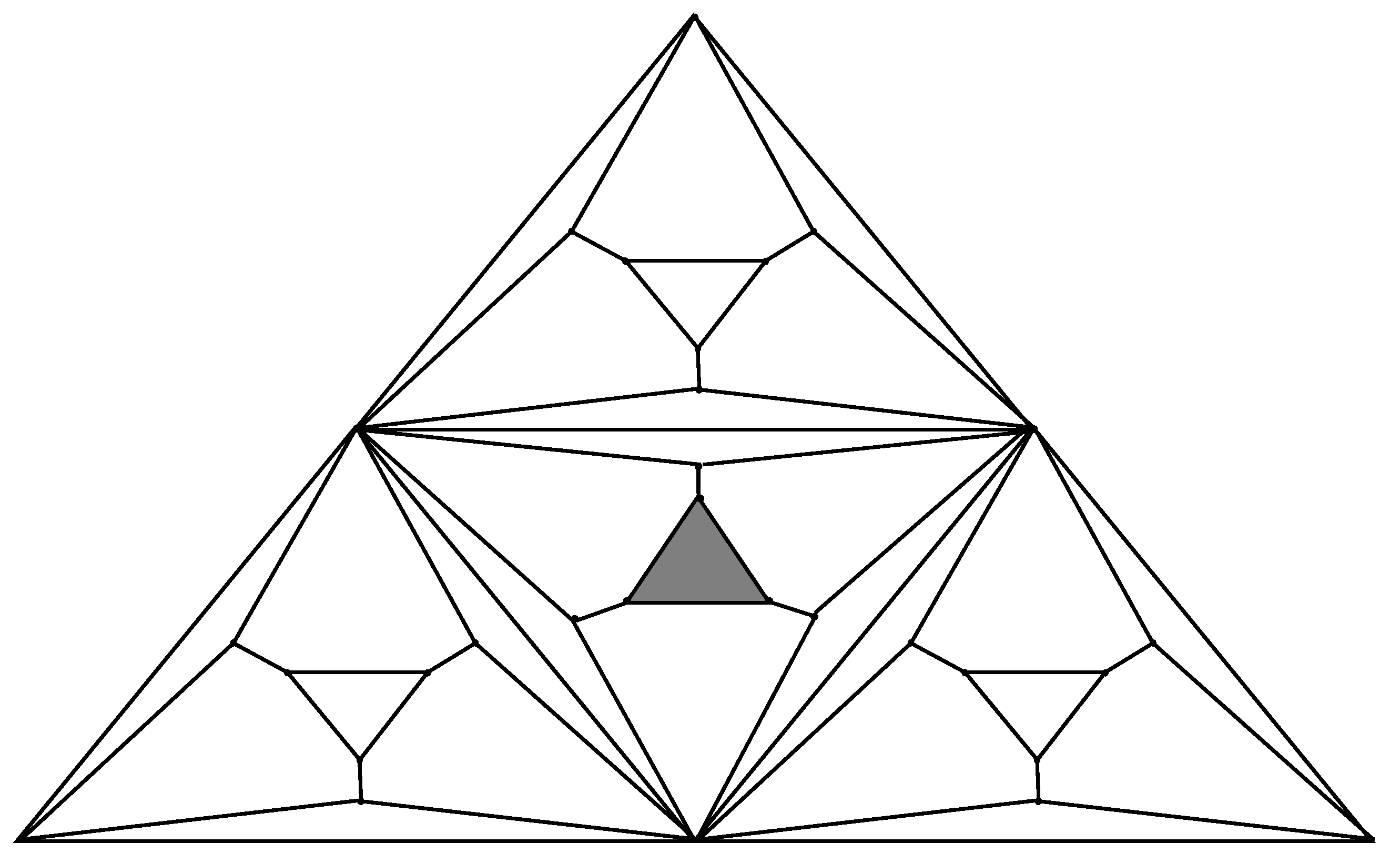
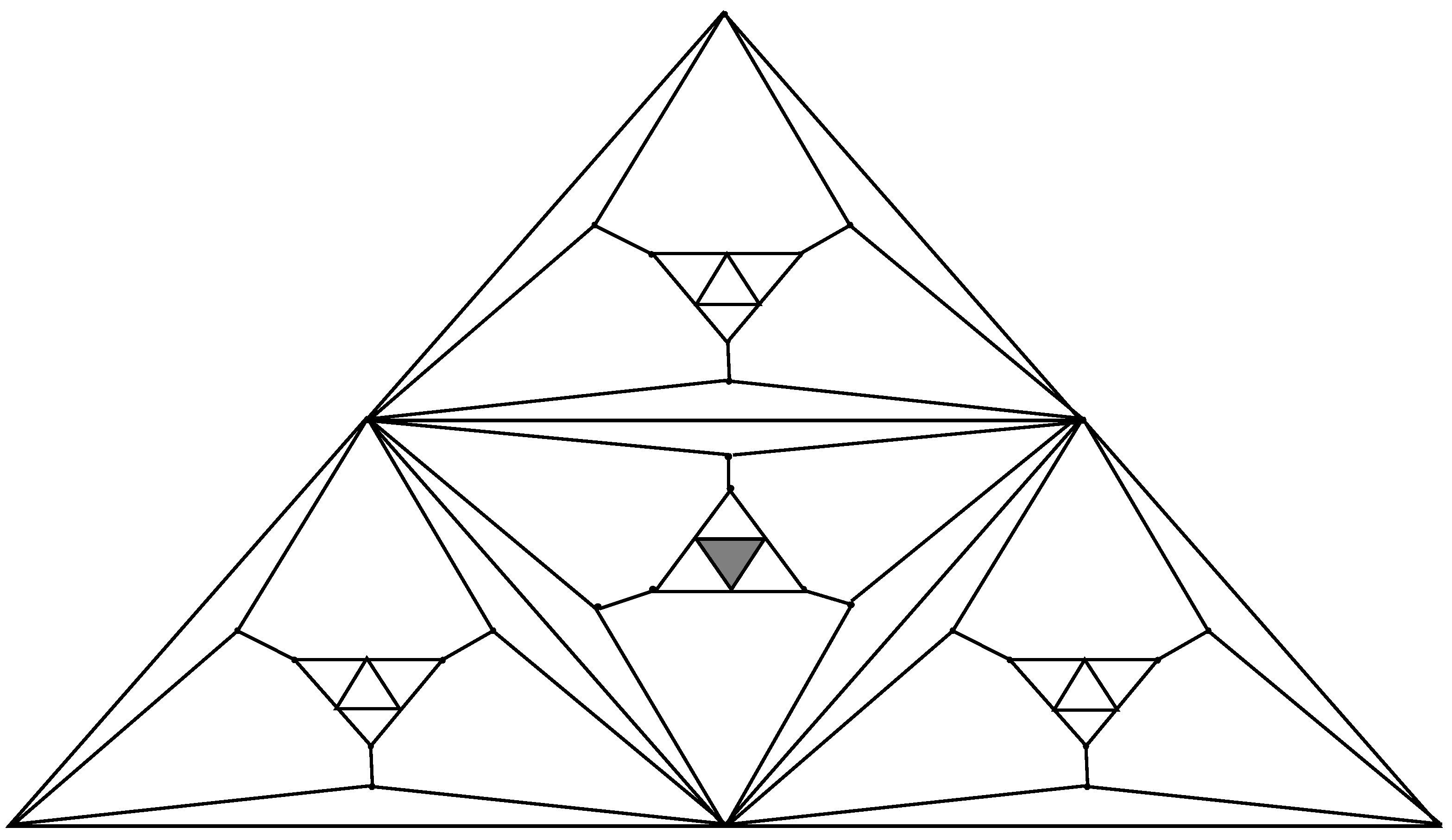
The graph sequence is a recursive definition using the graphs and (triangle or ): A replica of is used in place of the middle triangle of to create the graph . The central triangle in the graph is typically swapped out for to make as shown in Figure 2. and are the total vertices and edges of , respectively. According to this architecture in the large limit, the average degree of is 4.
Figure 2.
The graph .
Theorem 1.
For , the number of spanning trees in the graph sequence is determined by
Proof.


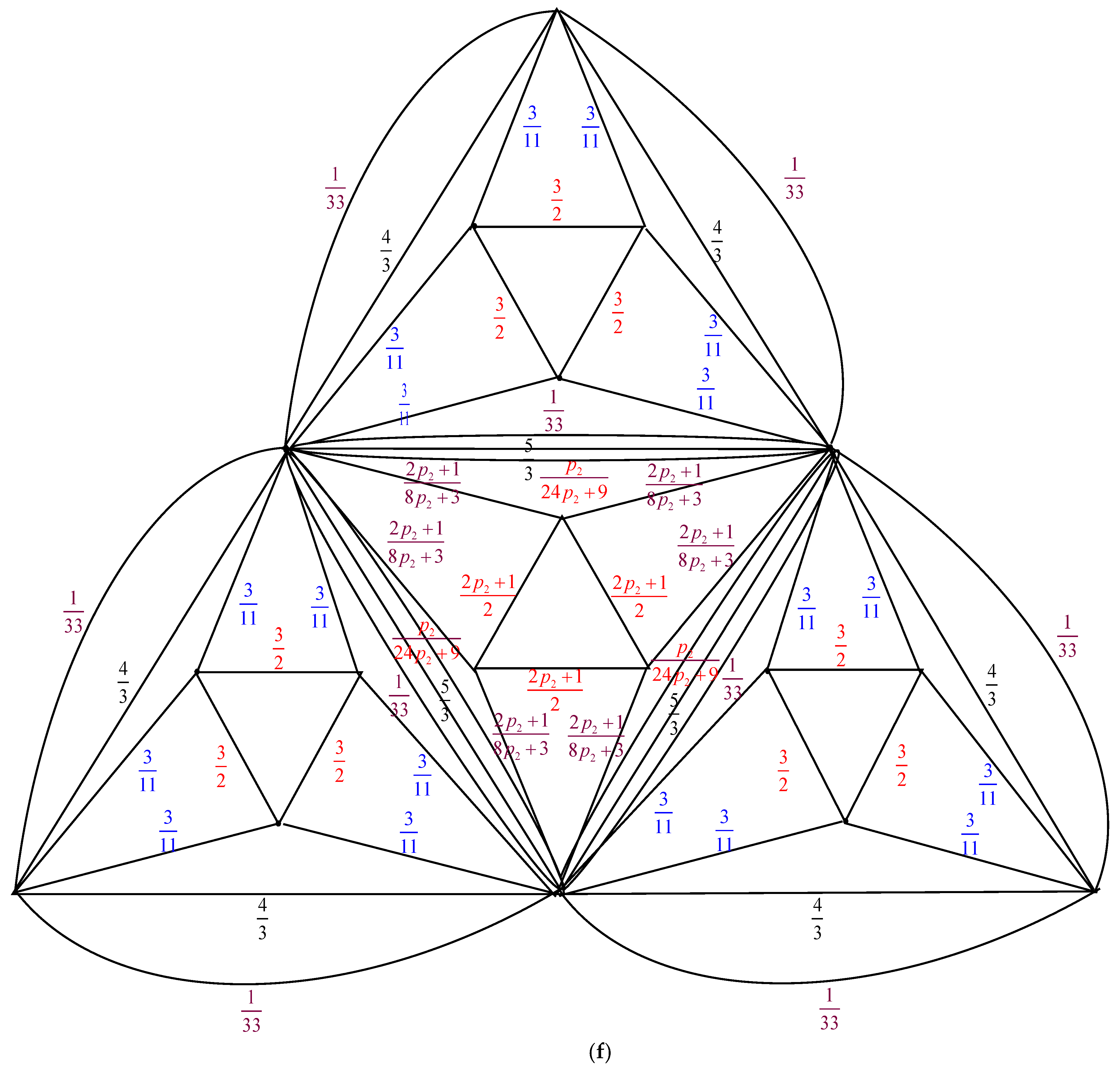
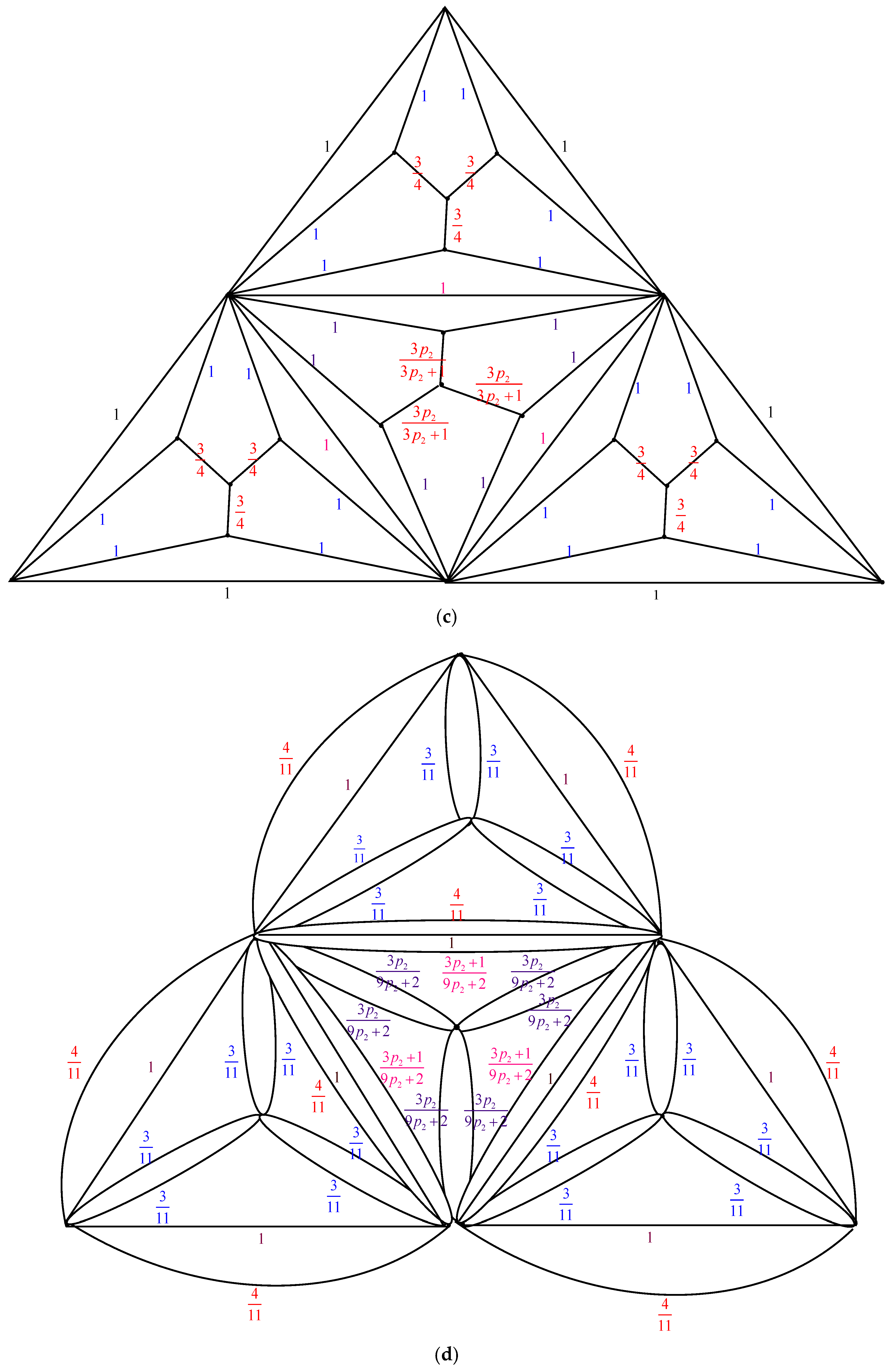
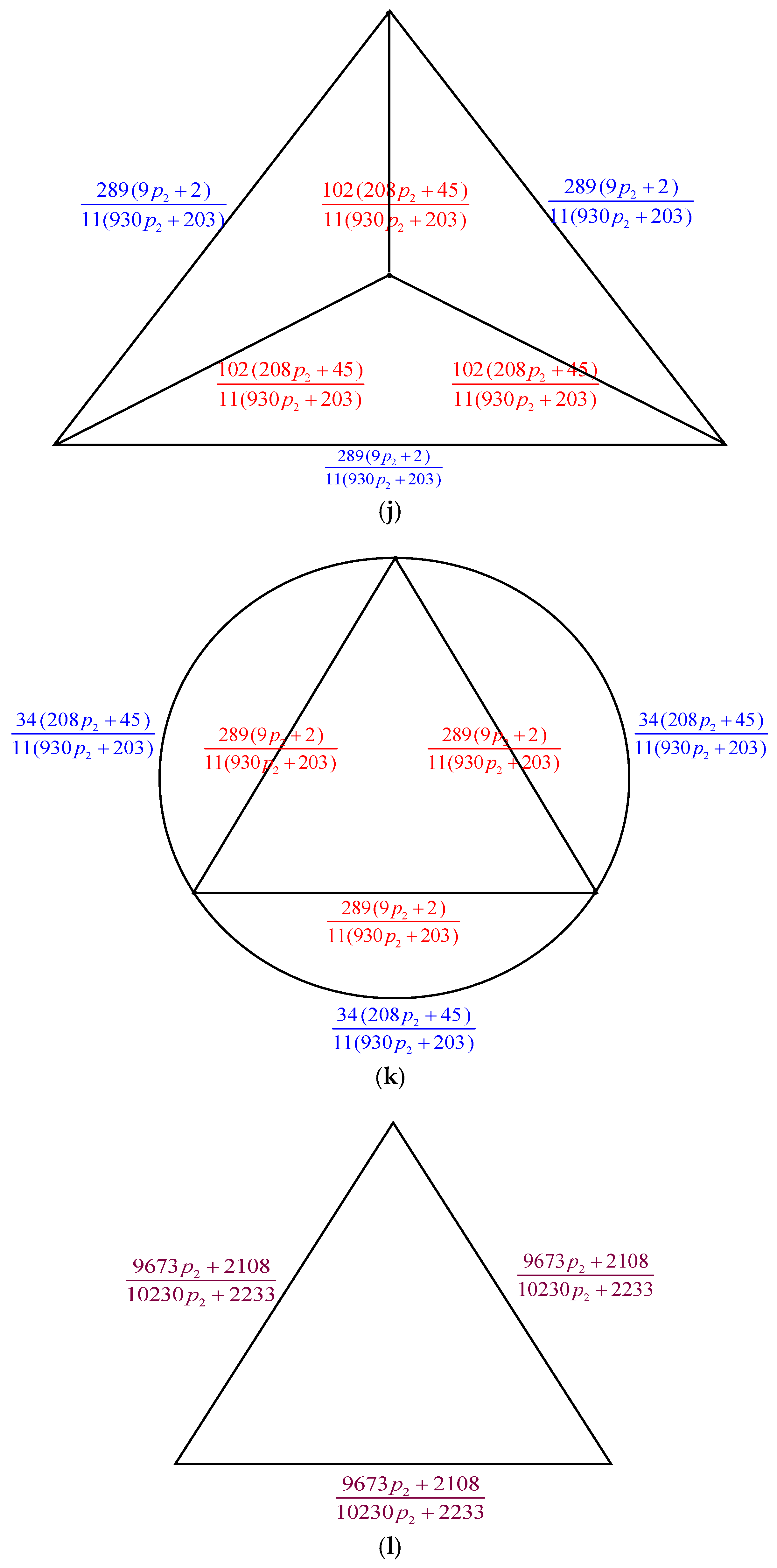
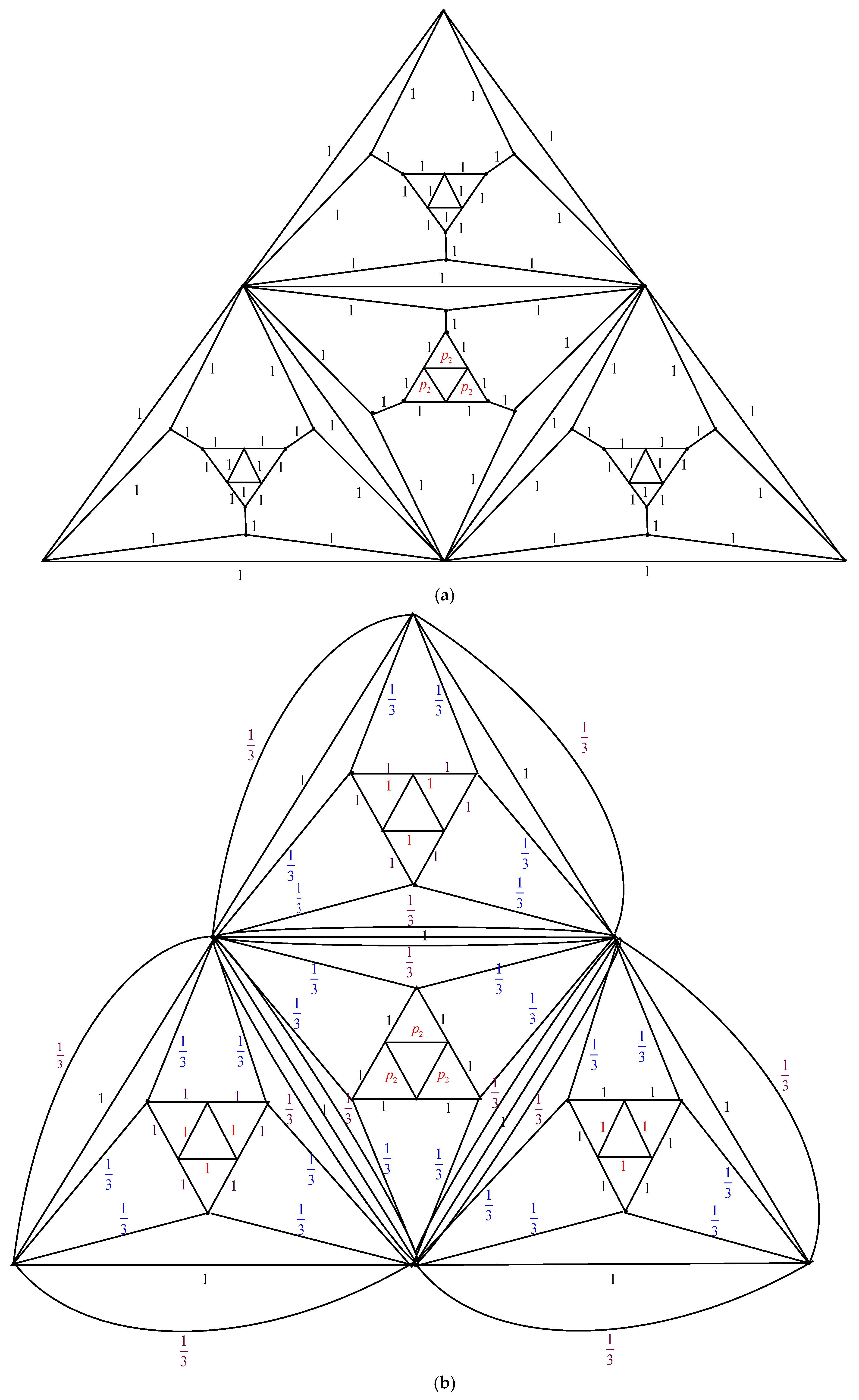
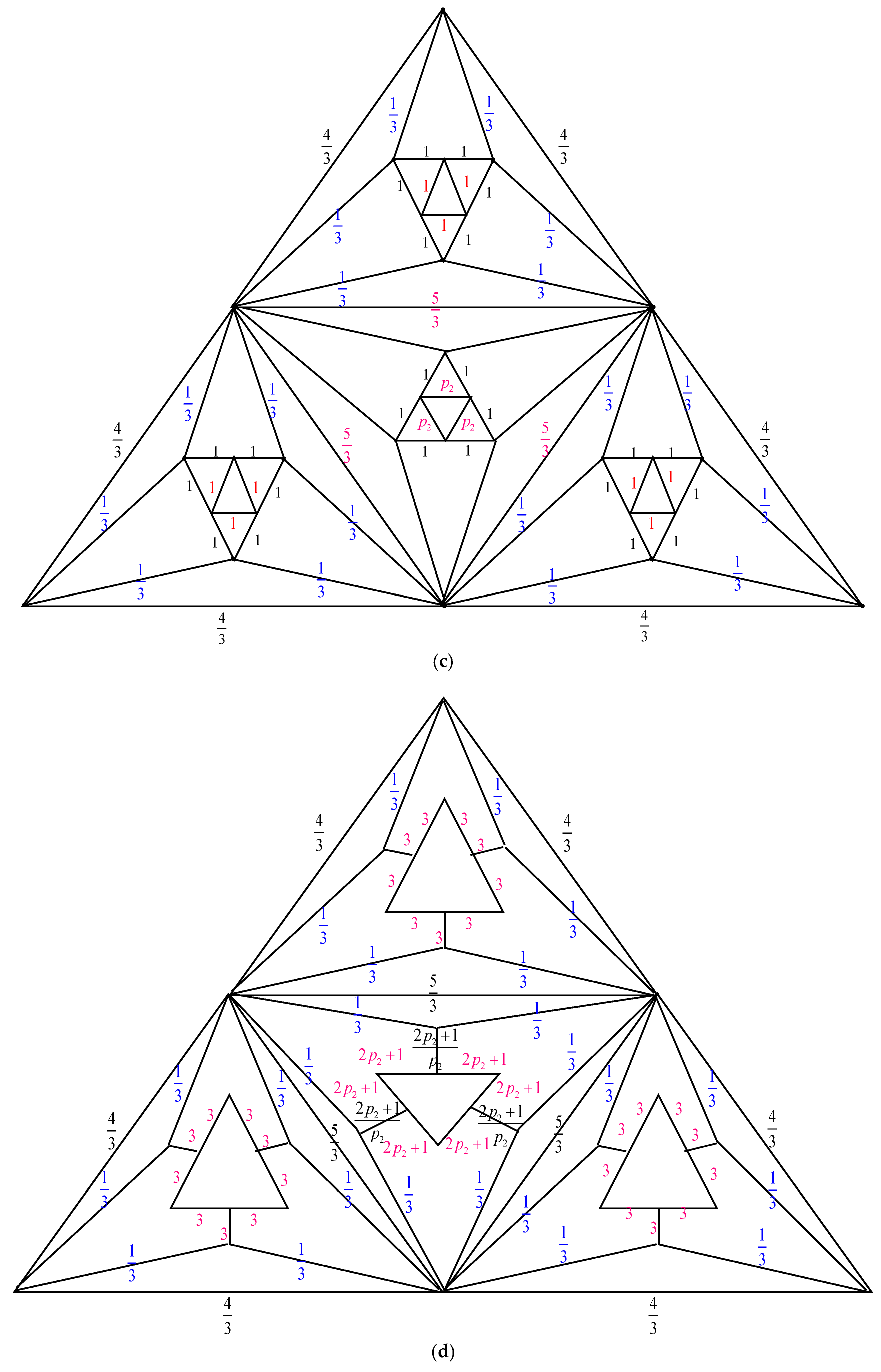
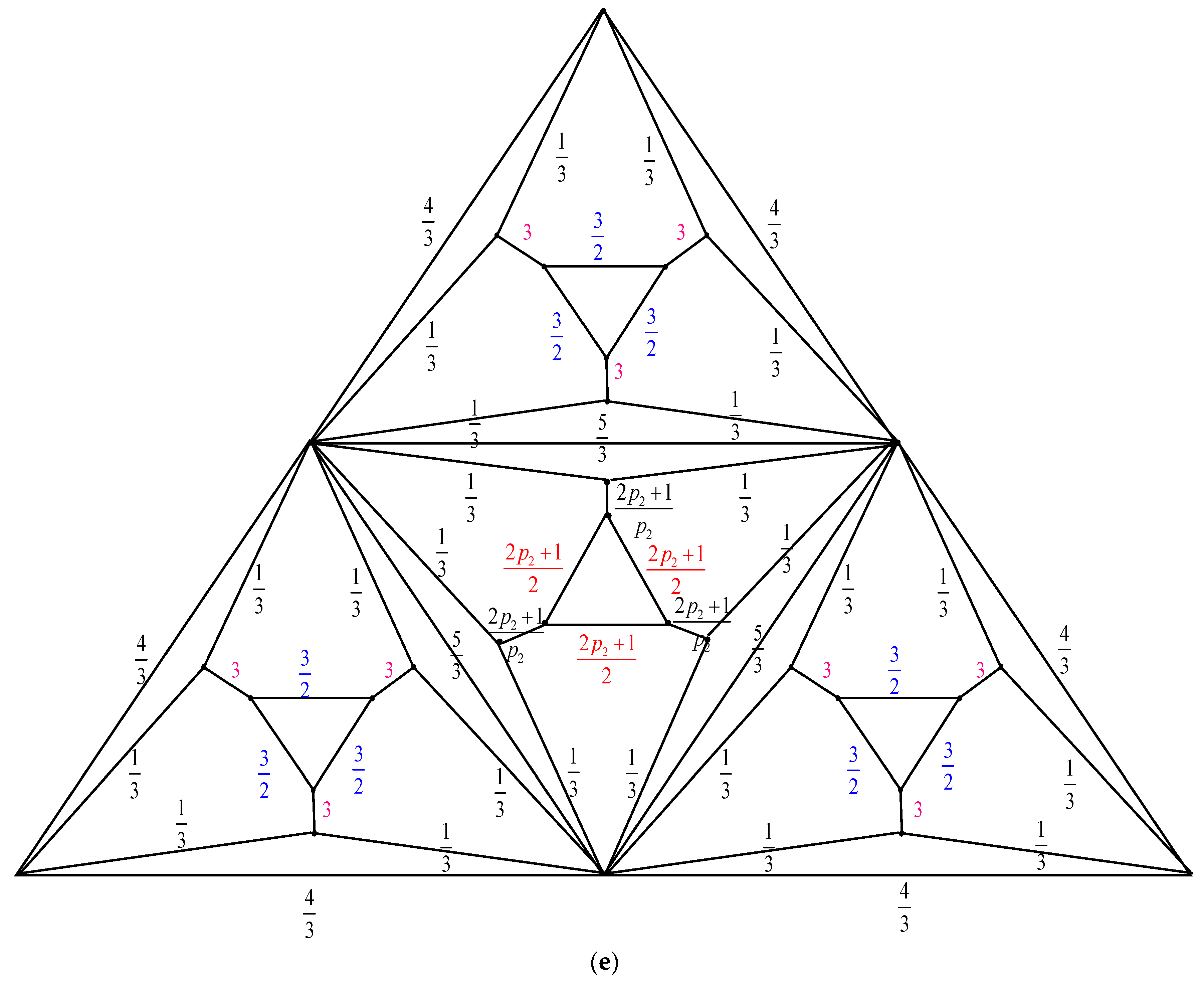
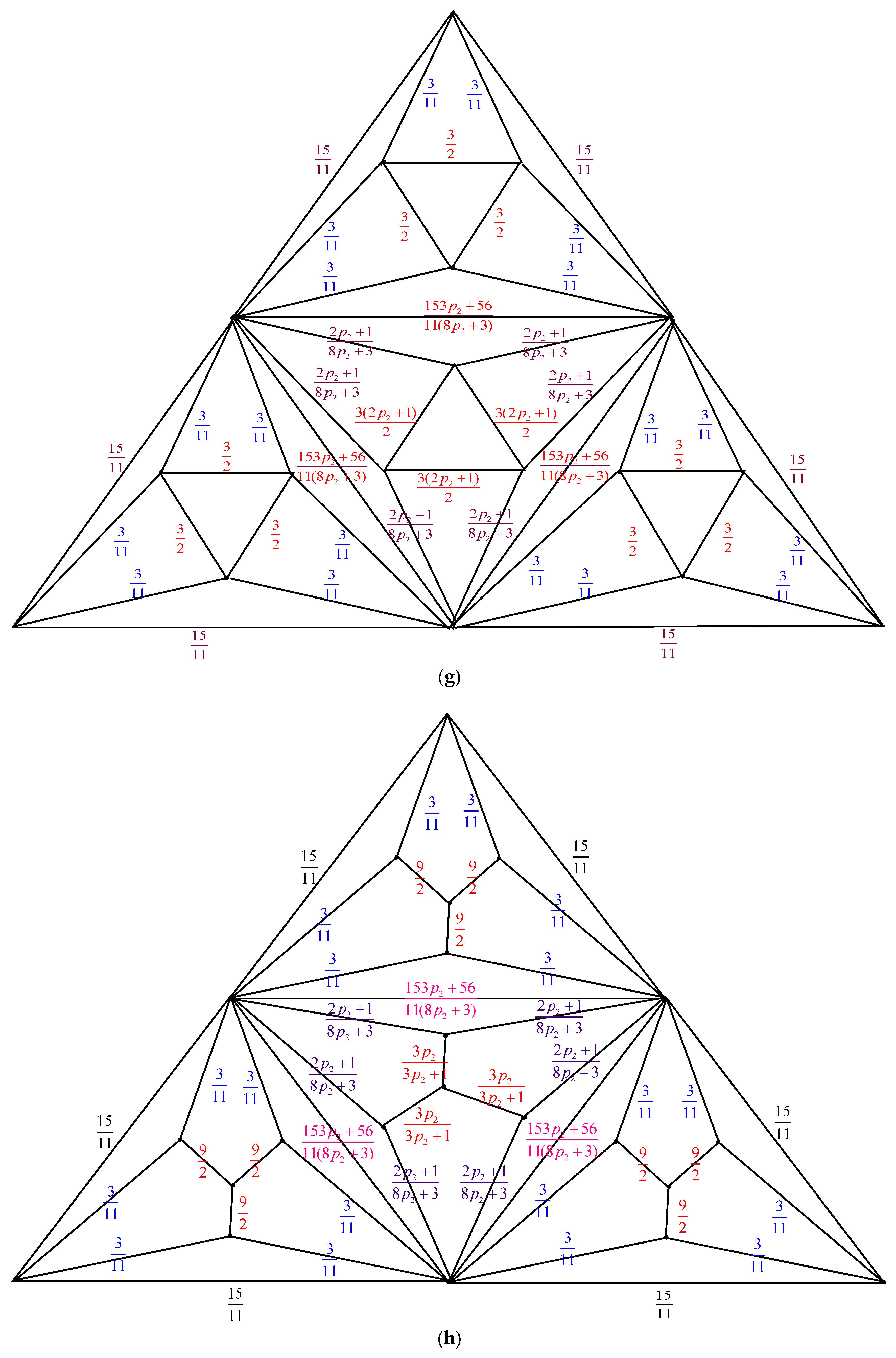
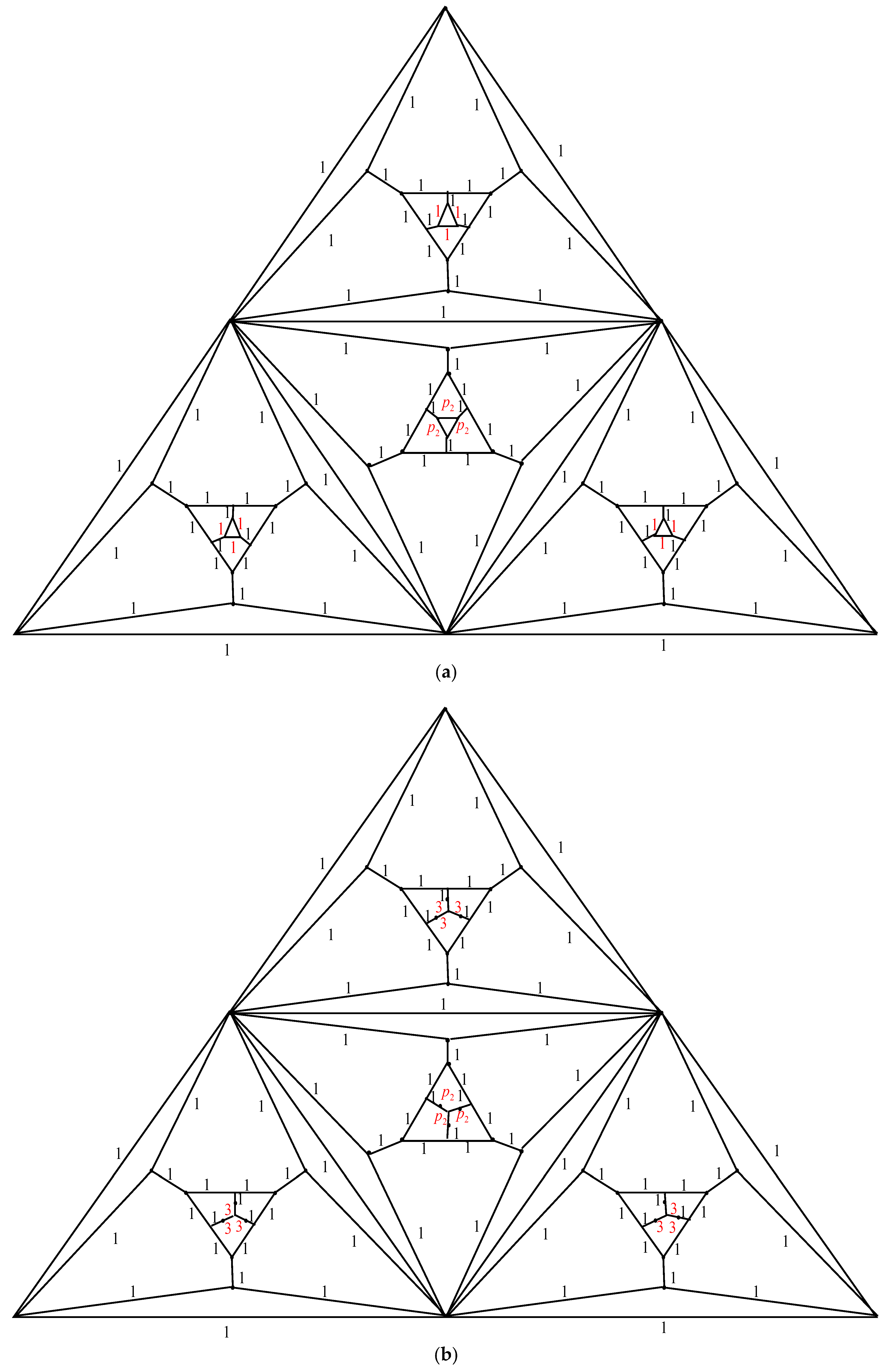
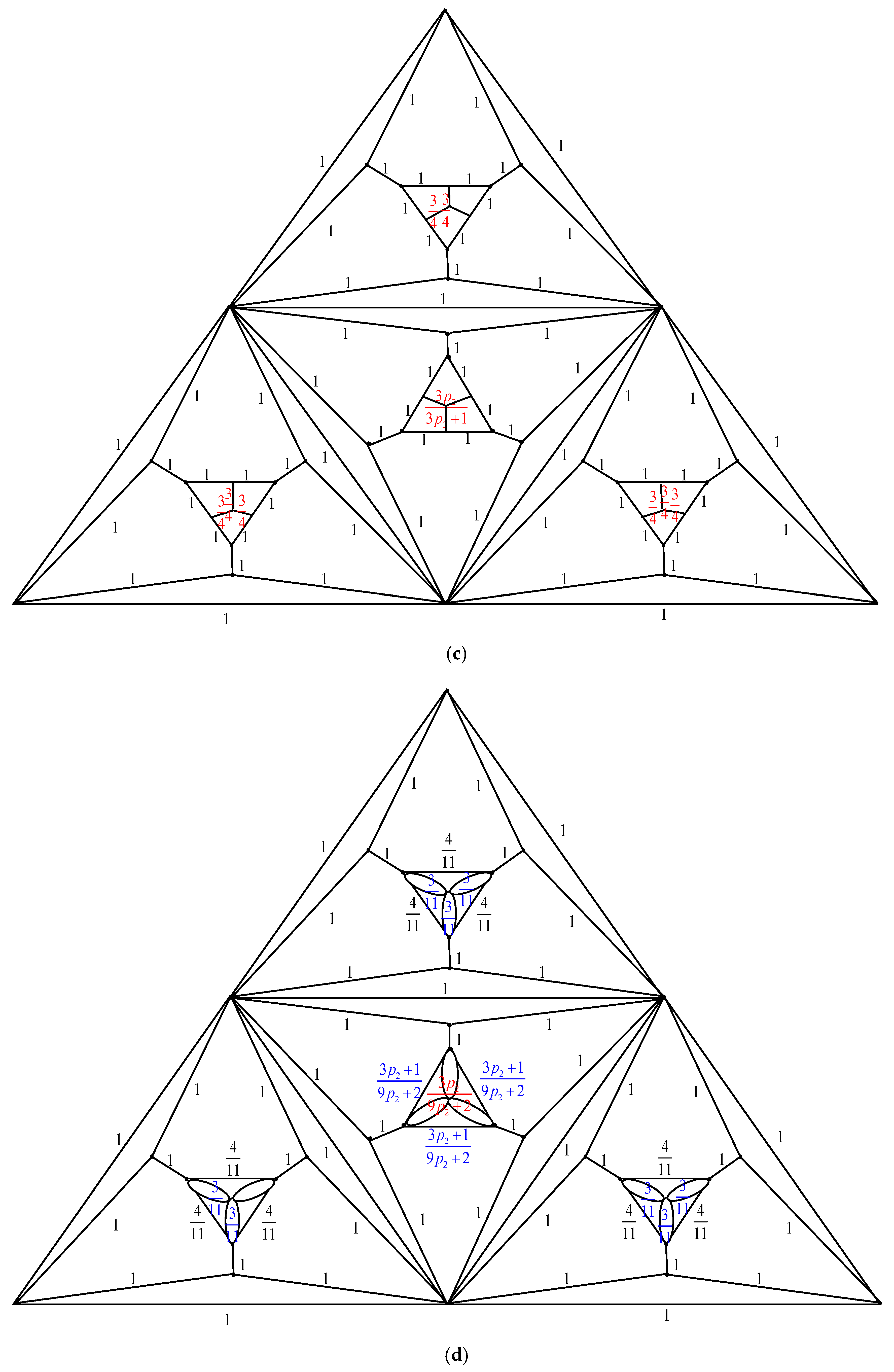
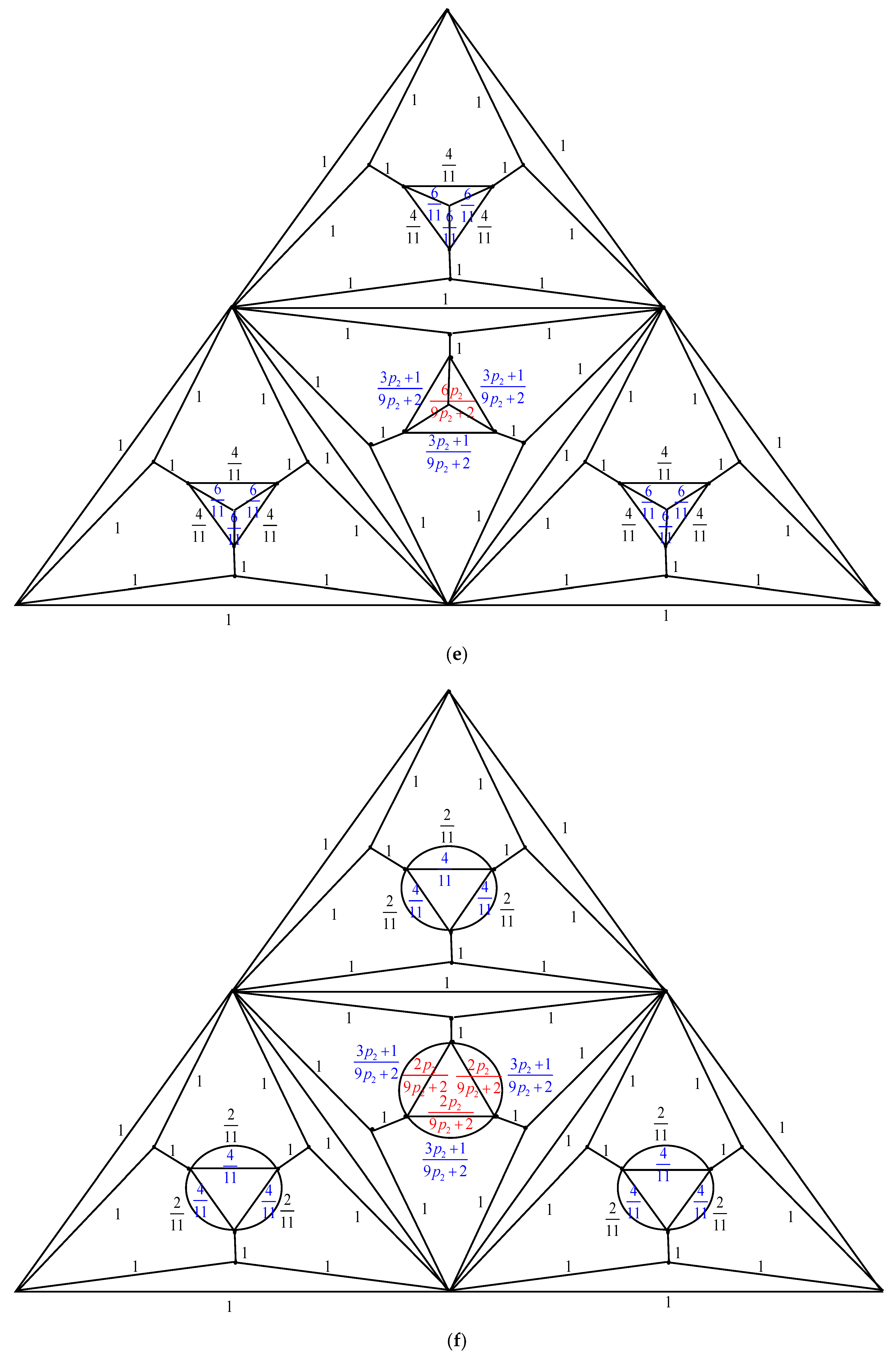
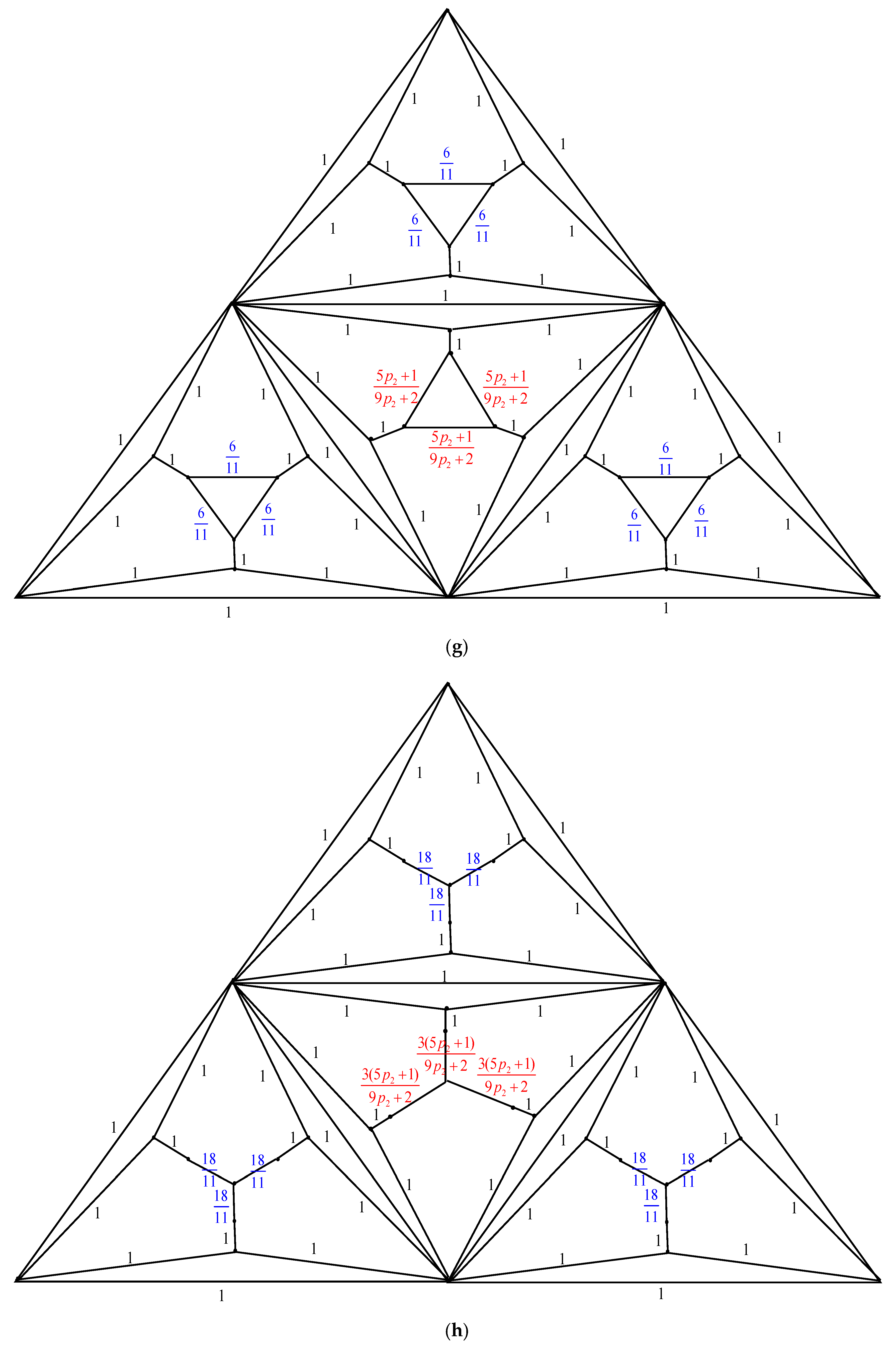
We convert to using the electrically equivalent transformation. The process of change from to is depicted in Figure 3.


Figure 3.
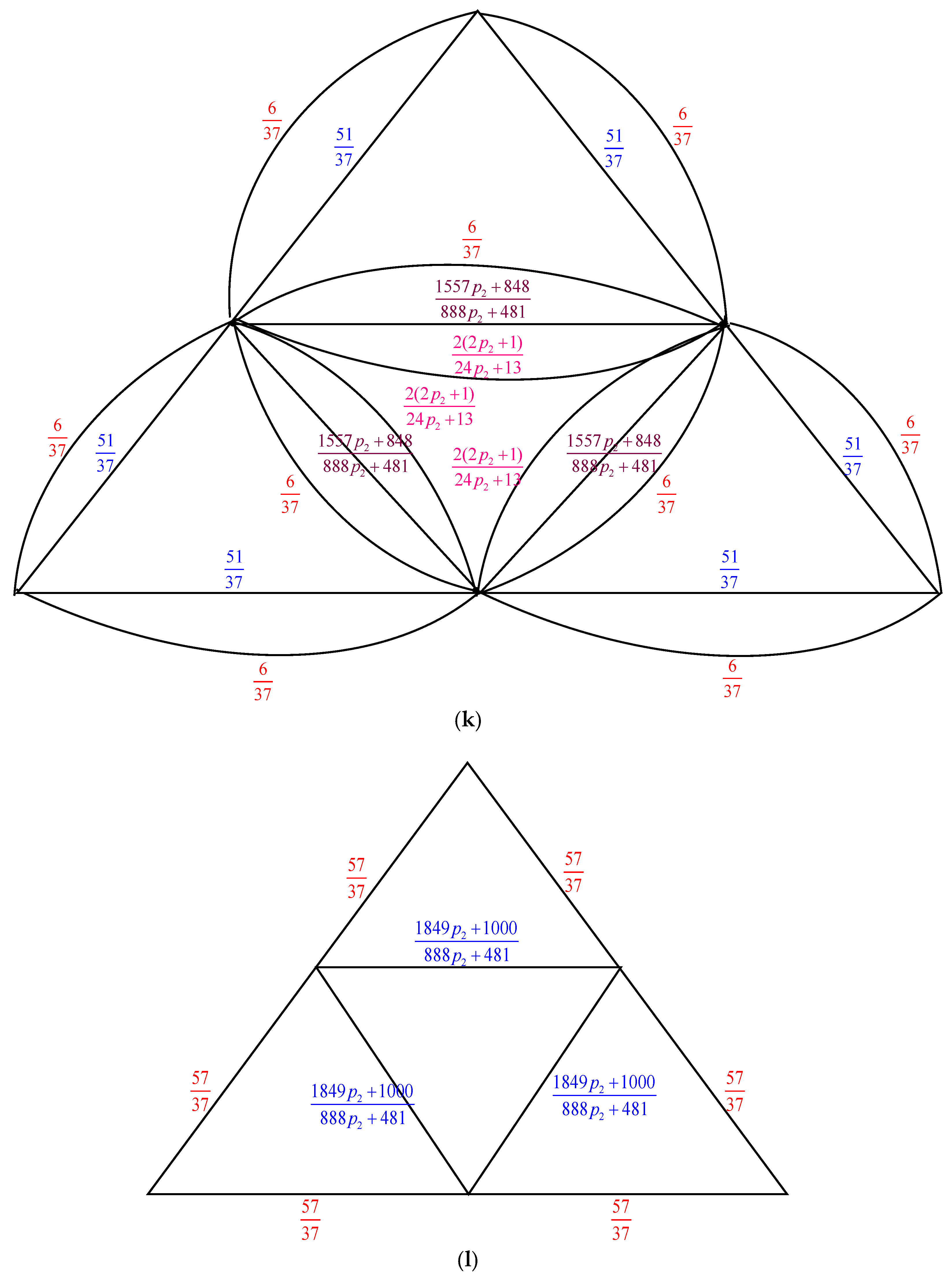
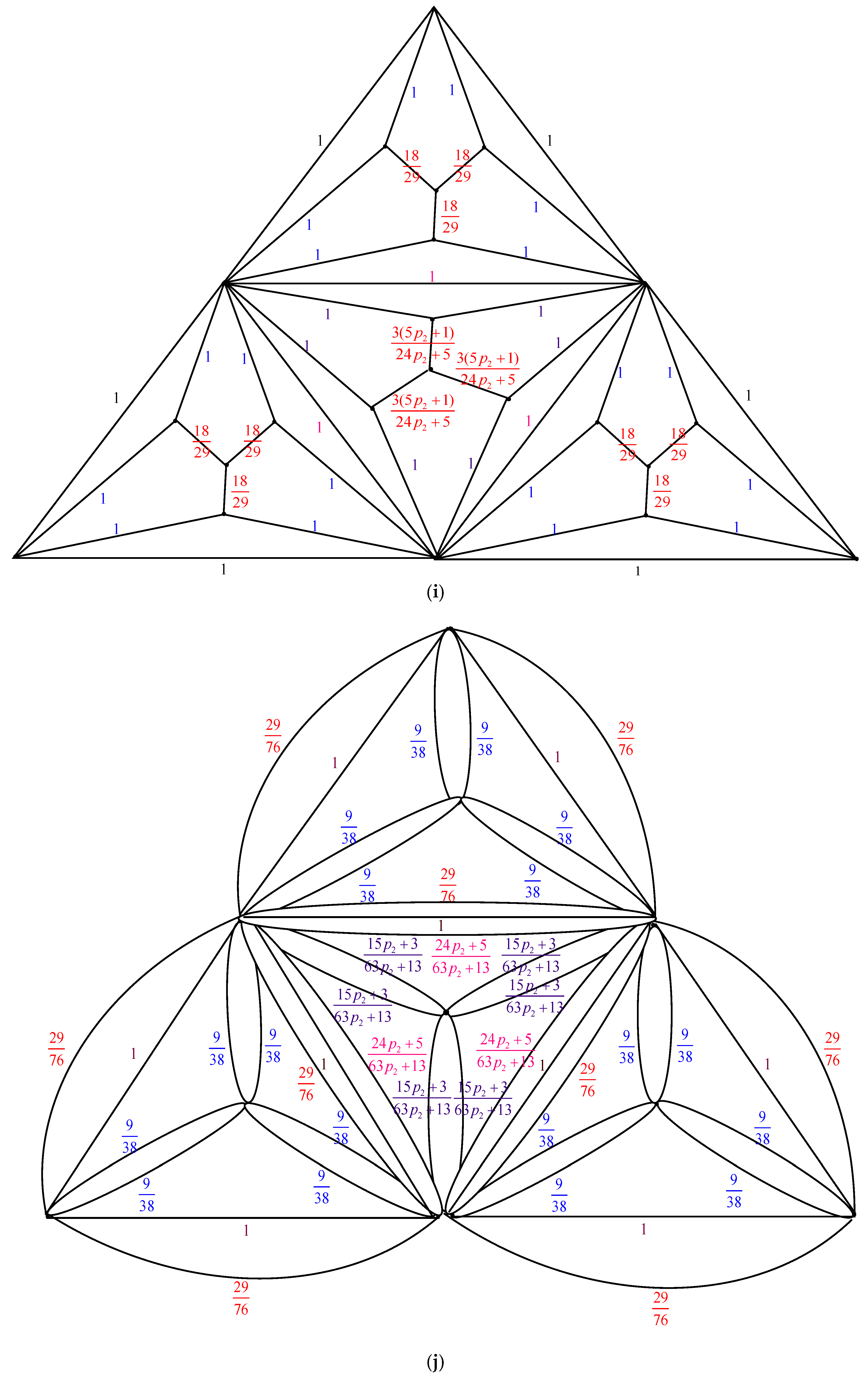
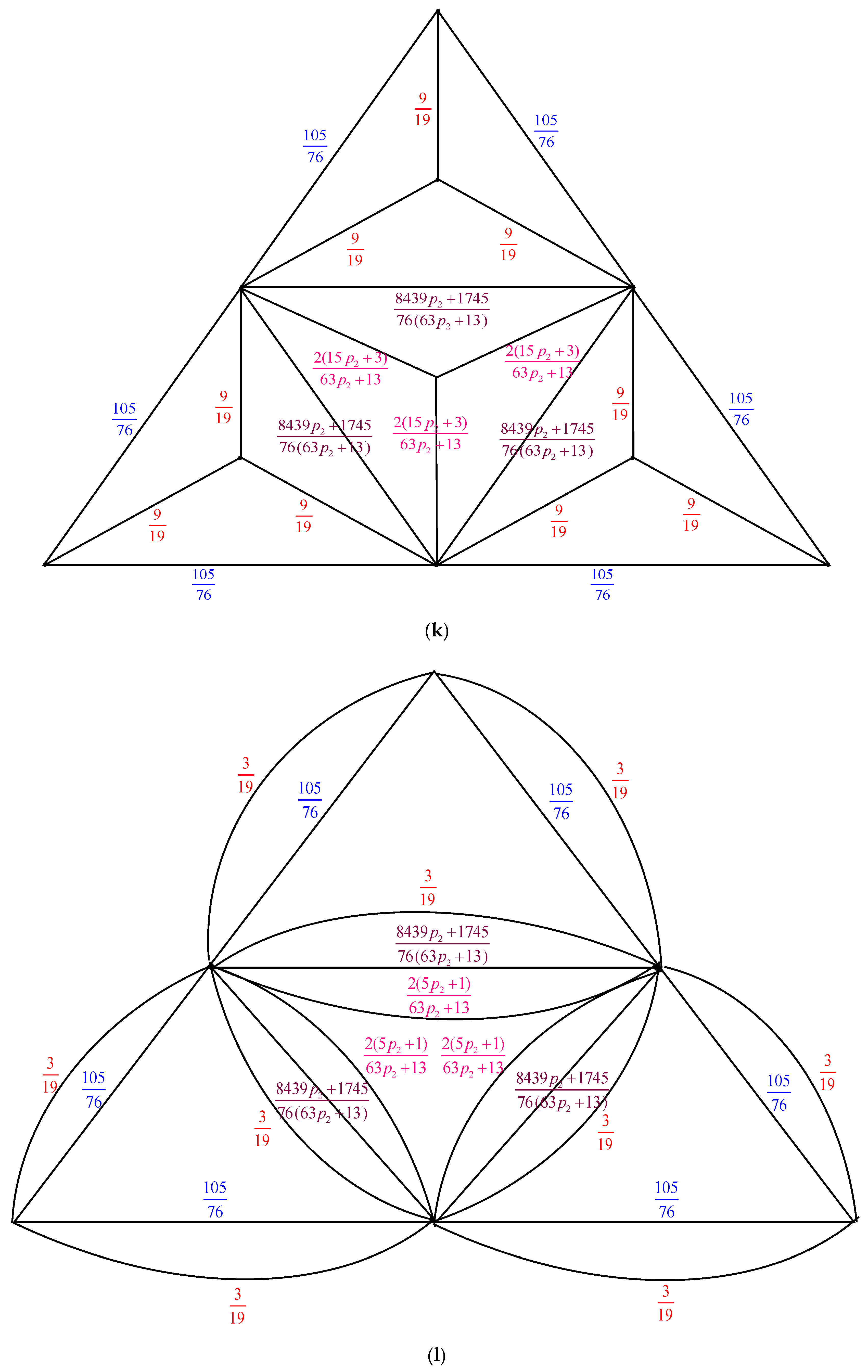
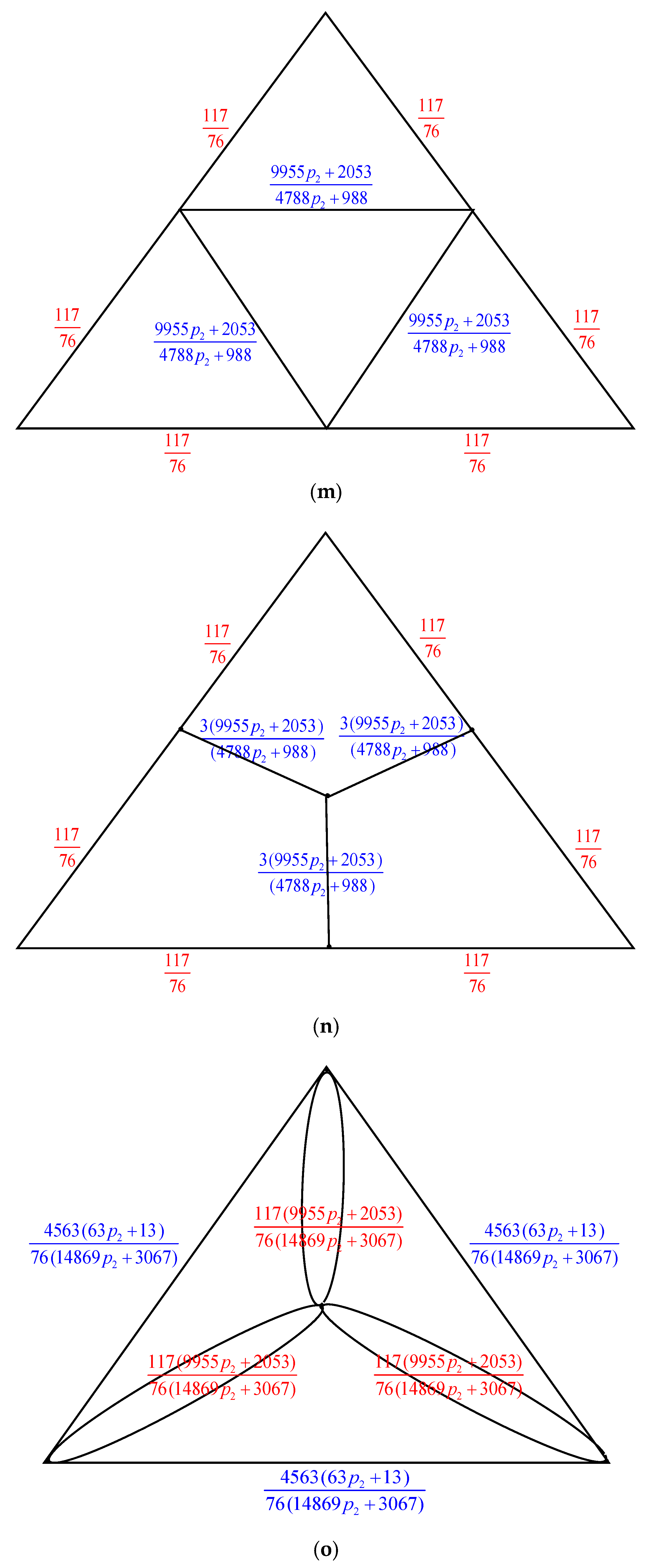
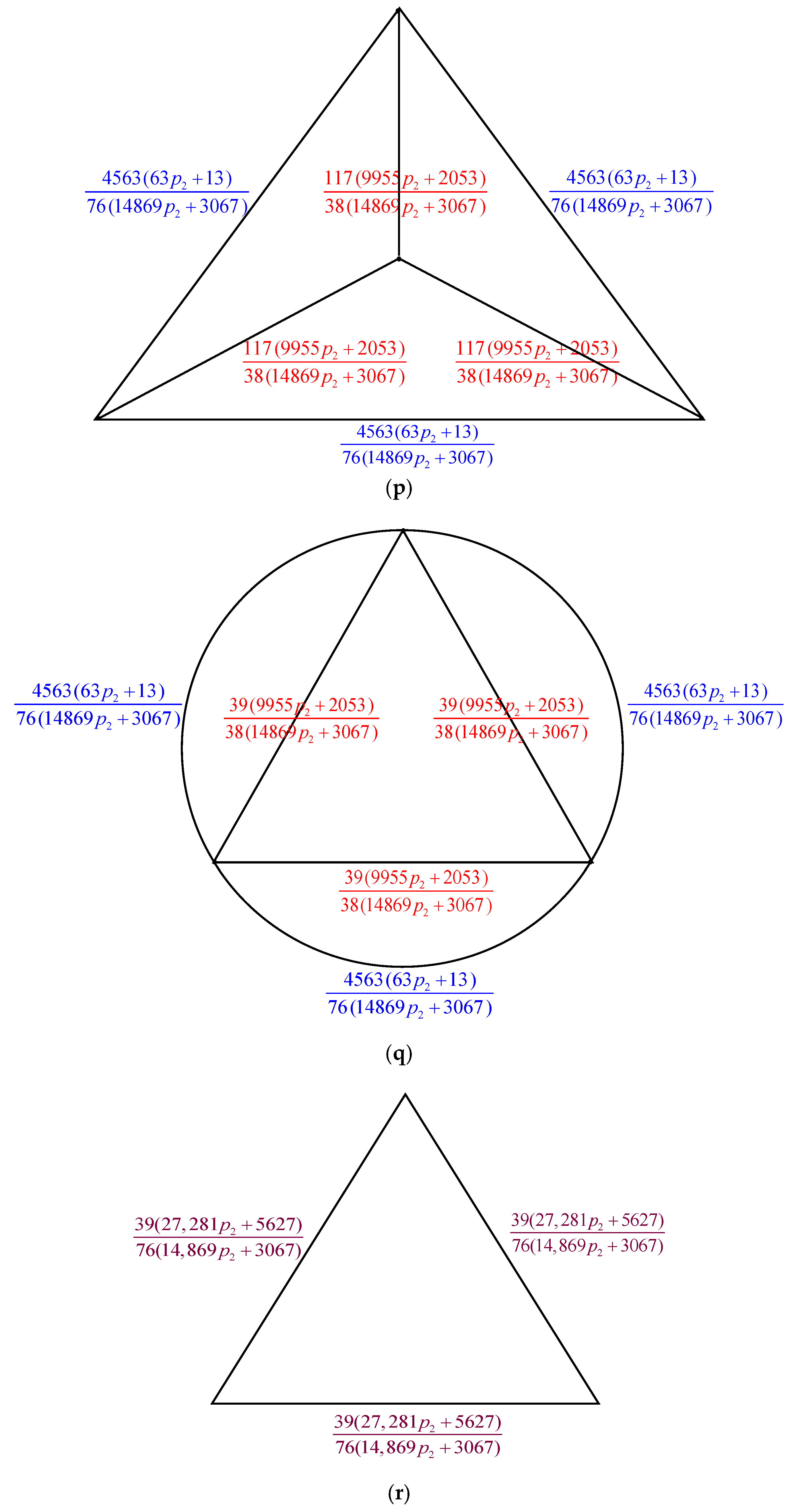
The transformations from JS2 to JS1. (a) The graph (b) The graph . By applying the rule of Δ-Y transformation, we arrive at (c) The graph . By using the serial edges rule, we arrive at: . (d) The graph . Utilizing the Y-Δ transformation rule, we get: . (e) The graph . Using the rule of parallel edges, we get: . (f) The graph . Applying the rule of Y-Δ transformation, we obtain: . (g) The graph . Using the rule of parallel edges, we get: . (h) The graph . With the use of the Δ-Y transformation rule, we get: . (i) The graph . Utilizing the Y-Δ rule, we arrive at: . (j) The graph . Using the rule of parallel edges, we get: . (k) The graph . When we use the Y-Δ rule, we get: . (l) The graph . Using the rule of parallel edges, we get: .
When the ten adjustments listed above are combined, we obtain
Thus
Further
where The characteristic equation for this is like with roots and . When two roots are subtracted from both sides of , we get
Let . Then, by Equations (3) and (4), we get and . Therefore, Thus
Using the formula and denoting the coefficients of and as and , we have
Thus, we get
where and . By the expression and using Equations (6) and (7), we have
Equation (9) has a characteristic equation of with roots and . The general solutions of Equation (9) are . Using the initial conditions and , yields
Should is devoid of any electrically equivalent transformation. Entering (10) into Equation (8), we get
When , , which satisfies Equation (11). Therefore, the number of spanning trees in the sequence of the graph is given by
where
Equation (13) is inserted into Equation (12), yielding the desired result. □
3.2. The Number of Spanning Trees in the Graph Sequence
The graph sequence is a recursive definition using the graphs and (triangle or ): A replica of is used in place of the middle triangle of to create the graph . The central triangle in the graph is typically swapped out for to make , as shown in Figure 4. and are the total vertices and edges of , respectively. According to this architecture in the large limit, the average degree of is .
Figure 4.
The graph .
Theorem 2.
For , the number of spanning trees in the sequence of the graph is given by
Proof.


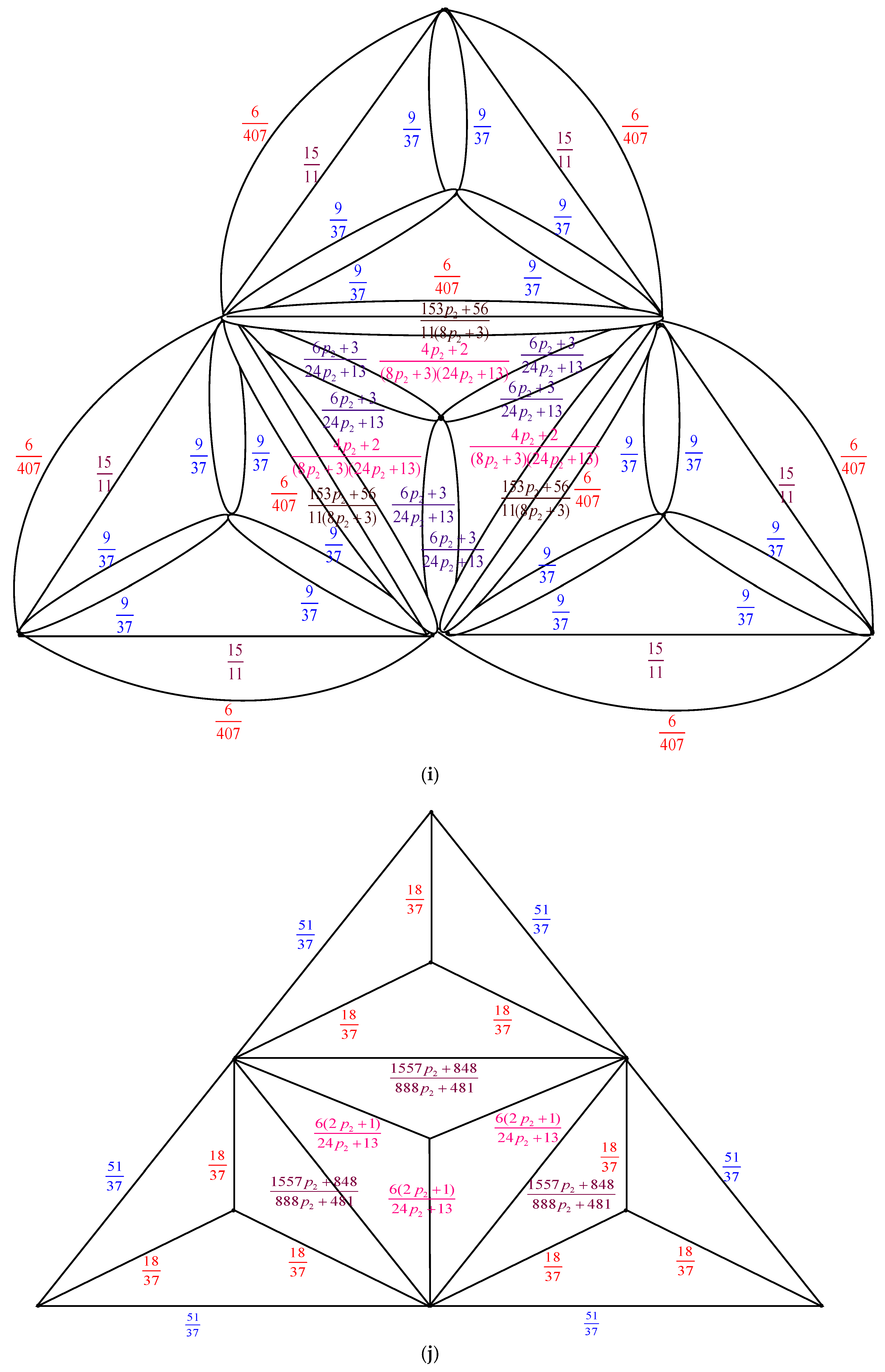
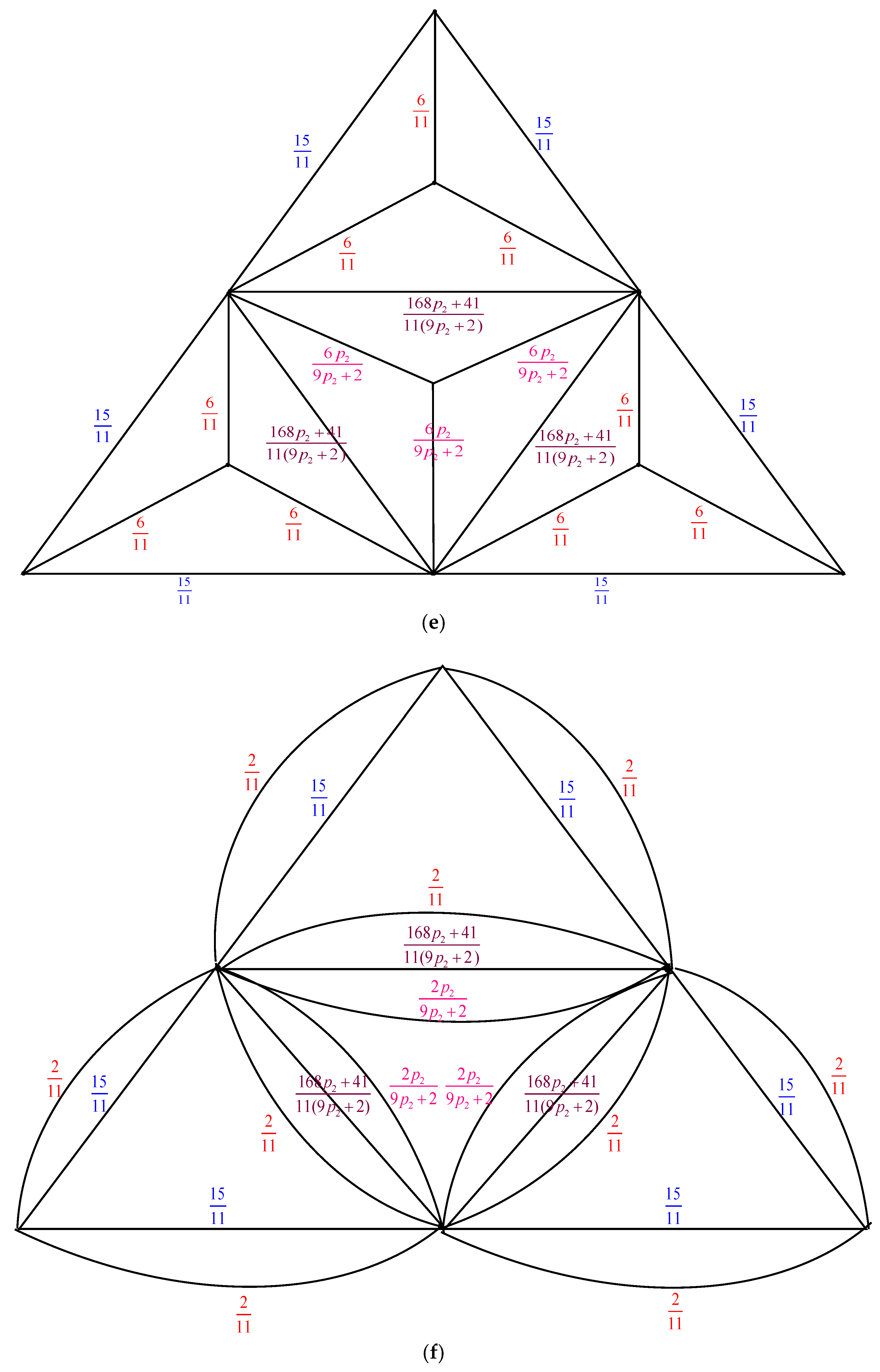
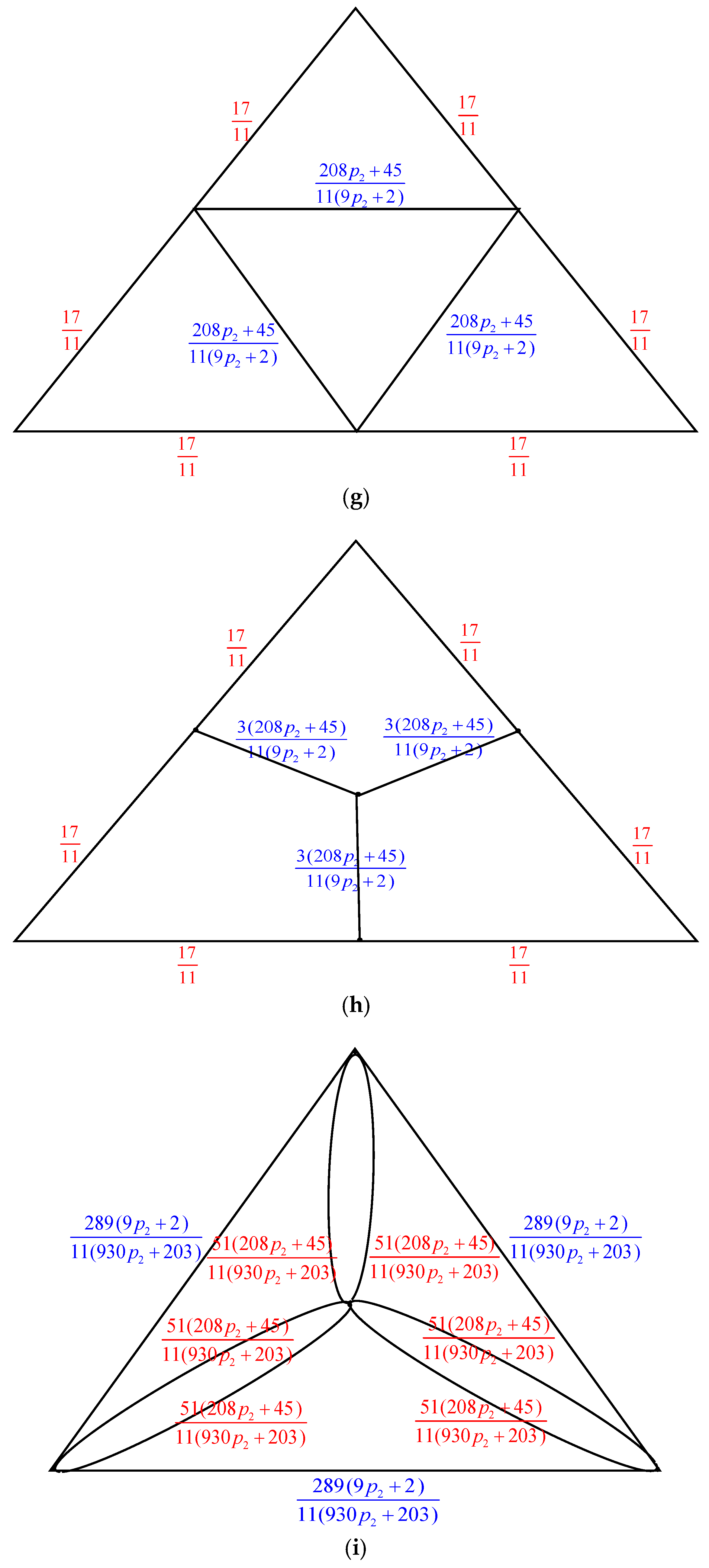
We convert to using the electrically equivalent transformation. The process of change from to is depicted in Figure 5.


Figure 5.
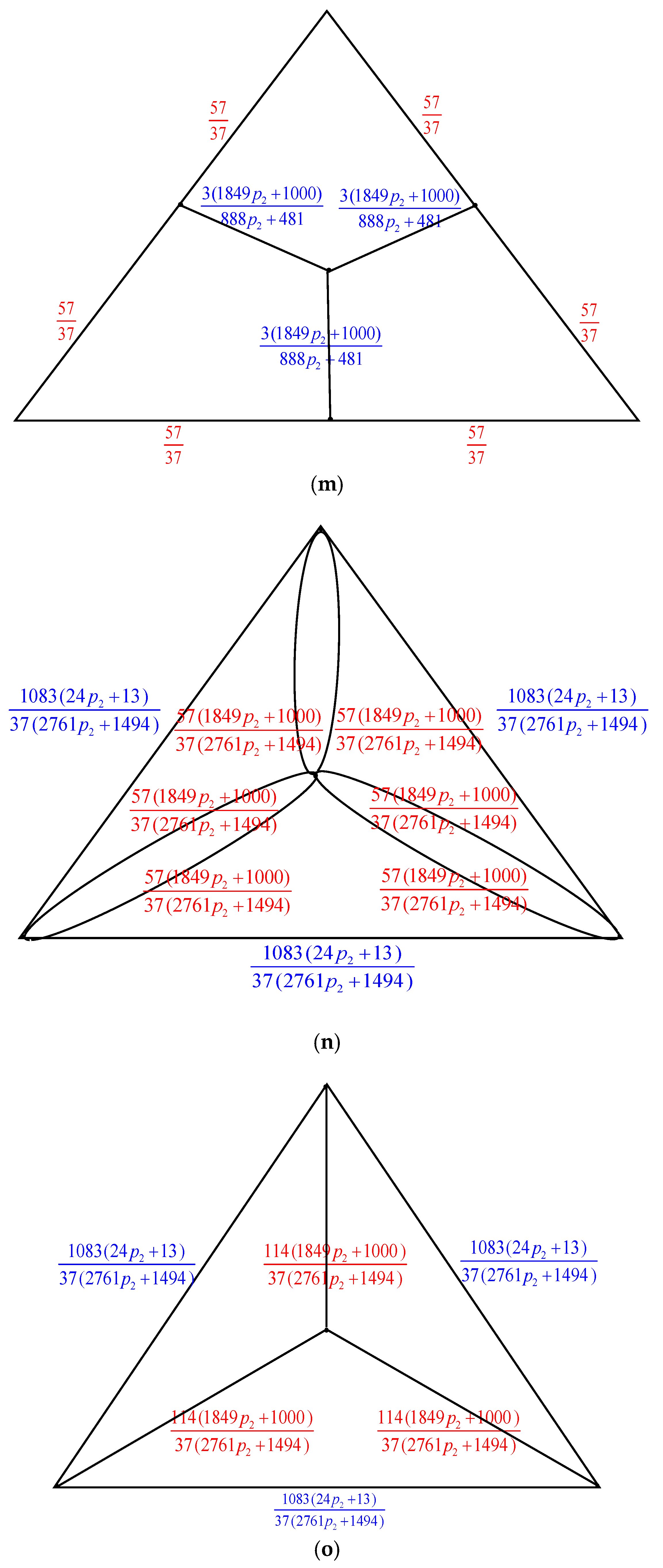
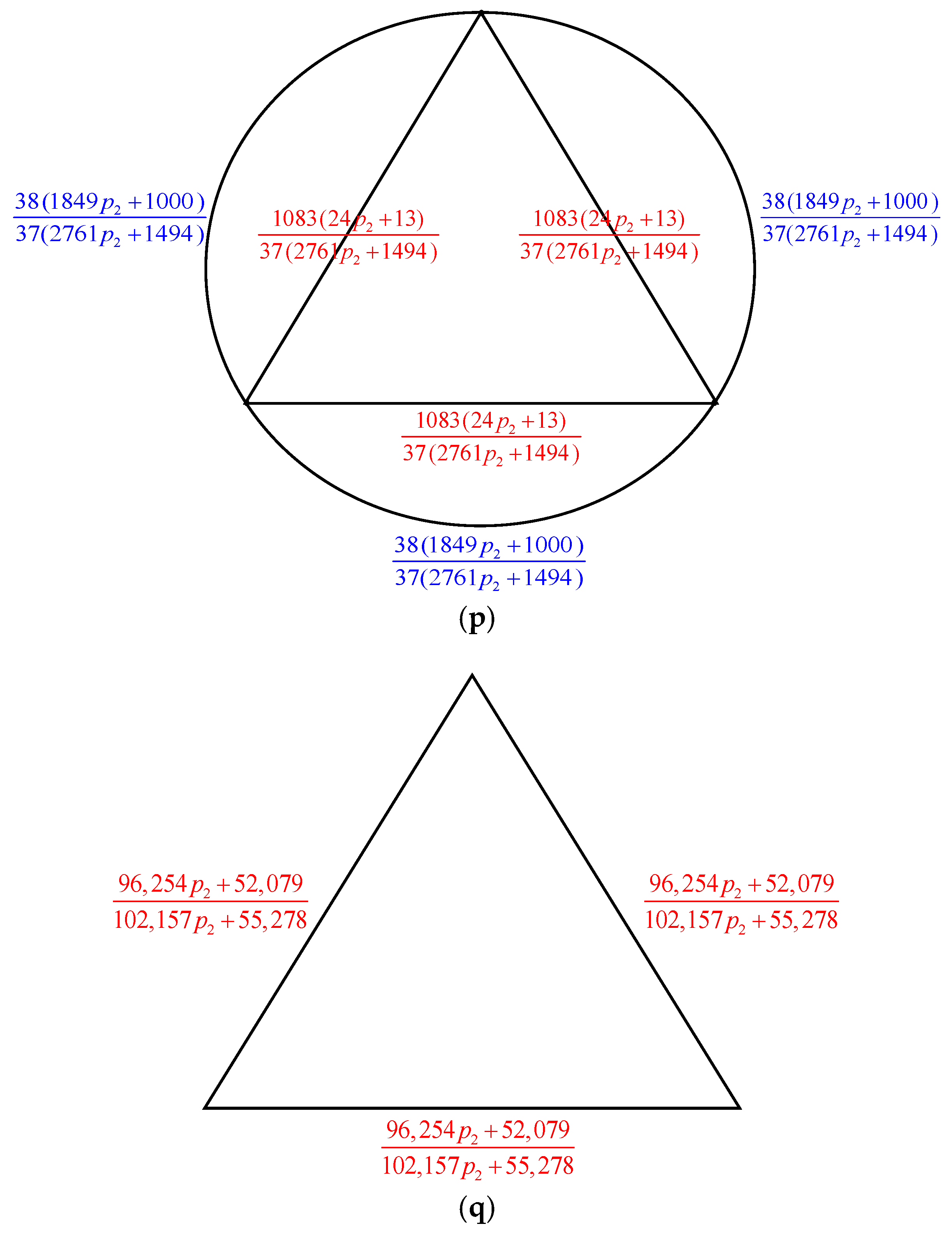
The transformations from to . (a) The graph (b) The graph . Applying the Y-Δ rule yields: . (c) The graph . By applying the parallel edge rule, we obtain: . (d) The graph . When the Δ-Y transformation rule is applied, we obtain: . (e) The graph . Using the rule of serial edges, we get: . (f) The graph . Applying the Y-Δ transformation rule yields the following results: . (g) The graph . Utilizing the parallel edge rule, we arrive at: . (h) The graph . Upon applying the Δ-Y transformation rule, we get: . (i) The graph . According to the Y-Δ transformation rule, we get:. (j) The graph . Applying the rule of parallel edges, we arrive at:. (k) The graph . Using the Y-Δ transformation rule, we obtain: . (l) The graph . The rule of parallel edges is applied, and we get: . (m) The graph . The Δ-Y transformation rule gives us: . (n) The graph . By applying the Y-Δ transformation rule, we arrive at: . (o) The graph . When we apply the rule of parallel edges, we obtain:. (p) The graph . When we use the Y-Δ transformation rule, we get: . (q) The graph . Applying the parallel edge rule yields the following results: .
When the sixteen modifications mentioned above are combined, the result is:
Thus, we have
Further
where Its characteristic equation is with roots and . Subtracting these two roots into both sides of , we get
Let . Then by Equations (16) and (17), we get and .
Therefore
Thus
Using the expression and denoting the coefficients of and as and , we have
Thus, we obtain
where and . By the expression and using Equations (19) and (20), we have
The characteristic equation of Equation (22) is with roots and . The general solutions of Equation (22) are . Using the initial conditions and , yields
If , it means that is without any electrically equivalent transformation. Plugging Equation (23) into Equation (21), we have
When , , which satisfies Equation (24). Therefore, the number of spanning trees in the sequence of the graph is given by
where
Equation (26) is inserted into Equation (25), yielding the desired outcome. □
3.3. The Number of Spanning Trees in the Graph Sequence
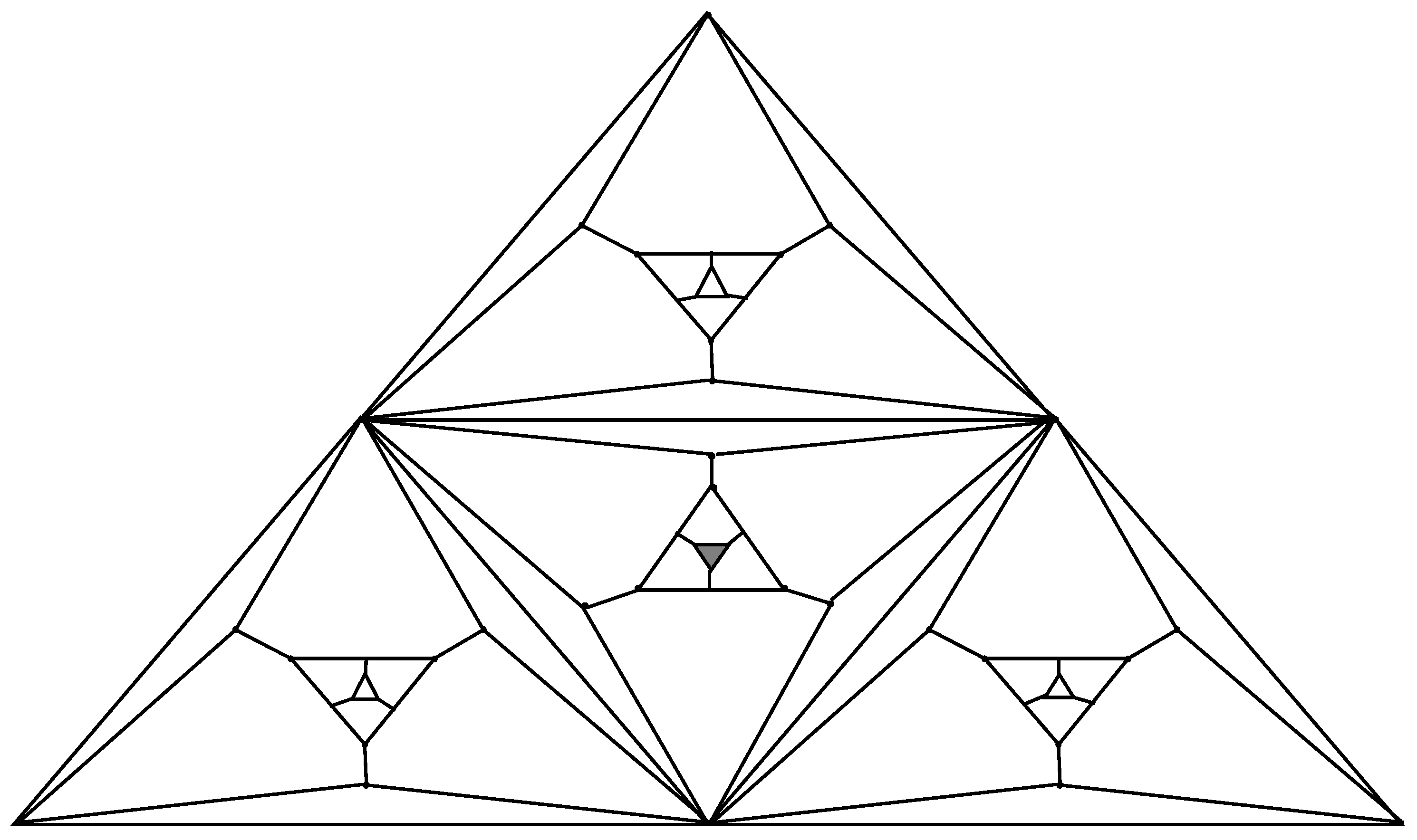
The graph sequence is a recursive definition using the graphs and (triangle or ): A replica of is used in place of the middle triangle of to create the graph . The central triangle in the graph is typically swapped out for to make , as shown in Figure 6. and are the total vertices and edges of , respectively. According to this architecture in the large limit, the average degree of is .
Figure 6.
The graph .
Theorem 3.
For , the number of spanning trees in the graph sequence is given by
Proof.


We convert to using the electrically equivalent transformation. The process of change from to is depicted in Figure 7.


Figure 7.
The transformations from to .(a) The graph (b) The graph . When we use the Δ-Y transformation rule, we get: . (c) The graph . By applying the serial edge rule, we obtain: . (d) The graph . Upon applying the Y-Δ transformation rule, we obtain: . (e) The graph . The parallel edge rule is used to get: . (f) The graph . Using the Y-Δ transformation rule, we get: . (g) The graph . By applying the parallel edge rule, one can obtain: . (h) The graph . Applying the rule of Δ-Y transformation, we obtain: . (i) The graph . The serial edge rule is applied, and the result is: . (j) The graph . Applying the rule of Y-Δ transformation, we obtain: . (k) The graph . The parallel edge rule can be used to get:. (l) The graph . By using the Y-Δ transformation rule, we get: . (m) The graph . Using the parallel edge rule, one can obtain: . (n) The graph . Using the rule of Δ-Y transformation, we obtain: . (o) The graph . When the Y-Δ transformation rule is used, we obtain:. (p) The graph . By applying the rule of parallel edges, one can get: . (q) The graph . Applying the Y-Δ transformation rule yields: . (r) The graph =. The rule of parallel edges can be used to obtain: .
When the seventeen modifications mentioned above are combined, the result is:
Thus, we have
Further
where Its characteristic equation is with roots are and . Subtracting these two roots into both sides of , we get
Let . Then, by Equations (29) and (30), we get
And
Therefore
Thus
Using the expression and denoting the coefficients of and as and , we have
Thus, we obtain
where and . By the expression and using Equations (32) and (33), we have
The characteristic equation of Equation (35) is with roots and . The general solutions of Equation (35) are . Using the initial conditions and , yields
If , it means that is without any electrically equivalent transformation. Plugging Equation (36) into Equation (34), we have
When , , which satisfies Equation (37). Therefore, the number of spanning trees in the sequence of the graph is given by
where
Equation (39) can be inserted into Equation (38), yielding the desired result. □
4. Numerical Results
The values of the number of spanning trees in the sequence graphs , , and are shown in the following Table 1, Table 2 and Table 3:
Table 1.
Some values of the sequence graph .
Table 2.
Some values of the sequence graph .
Table 3.
Some values of the sequence graph .
5. Spanning Tree Entropy
Once we have exact formulas for the number of spanning trees of the three sequence graphs , , and , we can compute the spanning tree entropy Z, a finite number, and an interesting metric defining the network topology. In [10,22], this is explained as follows: Regarding graph ,
We now compare our sequence graphs’ entropy values to those of other graphs. It is evident that the graph has a higher entropy than the other two graphs, whereas the graph has a lower entropy. Furthermore, the entropy of the two-dimensional Sierpinski gasket [23] and the fractal scale free lattice [20] both have entropies of 1.166 and 1.040 and are of the same average degree 4, respectively, while the entropy of the graph is greater than that of the fractal scale free lattice and lower than that of the two dimensional Sierpinski gasket.

6. Conclusions
In this study, we used electrically equivalent transformations to determine the number of spanning trees of sequence graphs produced from the Johnson skeleton graph and other related graphs. This technique’s strength is its ability to avoid the laborious computation of Laplacian spectra, which is a requirement for a general approach to spanning tree determination. Furthermore, our findings indicate a relationship between the entropy and the graph’s average degree.
Author Contributions
Conceptualization, A.A.; Methodology, A.A. and S.N.D.; Software, A.A. and S.N.D.; Validation, A.A. and S.N.D.; Formal analysis, A.A. and S.N.D.; Investigation, A.A. and S.N.D.; Resources, A.A. and S.N.D.; Data curation, A.A. and S.N.D.; Writing—original draft, A.A. and S.N.D.; Writing—review & editing, A.A. and S.N.D.; Visualization, A.A. and S.N.D.; Supervision, A.A. and S.N.D.; Project administration, A.A. and S.N.D.; Funding acquisition, A.A. All authors have read and agreed to the published version of the manuscript.
Funding
Deanship of Scientific Research at King Khalid University. (Project under grant number (RGP.2/372/45).
Data Availability Statement
The original contributions presented in this study are included in the article. Further inquiries can be directed to the corresponding author.
Acknowledgments
The authors extend their appreciation to the Deanship of Scientific Research at King Khalid University for funding this work through Larg Groups. (Project under grant number (RGP.2/372/45)). The authors wish to extend their gratitude to the anonymous editors and referees for their valuable feedback, which significantly enhanced the quality of the manuscript.
Conflicts of Interest
The authors declare no conflicts of interest. The funders had no role in the design of the study; in the collection, analyses, or interpretation of data; in the writing of the manuscript; or in the decision to publish the results.
References
- Cvetkoviĕ, D.; Doob, M.; Sachs, H. Spectra of Graphs: Theory and Applications, 3rd ed.; Johann Ambrosius Barth: Heidelberg, Germany, 1995. [Google Scholar]
- Zhang, F.; Yong, X. Asymptotic enumeration theorems for the number of spanning trees and Eulerian trail in circulant digraphs & graphs. Sci. China Ser. A Math. 1999, 43, 264–271. [Google Scholar]
- Baron, G.; Prodinger, H.; Tichy, R.; Boesch, F.; Wang, J. The number of spanning trees of a cycle. Fibonacci Quart. 1985, 23, 258–264. [Google Scholar] [CrossRef]
- Boesch, F.T. On unreliability polynomials and graph connectivity in reliable network synthesis. J. Graph Theory 1986, 10, 339–352. [Google Scholar] [CrossRef]
- Boesch, F.T.; Salyanarayana, A.; Suffel, C.L. A survey of some network reliability analysis and synthesis results. Networks 2009, 54, 99–107. [Google Scholar] [CrossRef]
- Atajan, T.; Inaba, H. Network reliability analysis by counting the number of spanning trees, ISCIT 2004. IEEE Int. Symp. Commun. Inf. Technol. 2004, 1, 601–604. [Google Scholar]
- Kirchhoff, G.G. Über die Auflösung der Gleichungen auf welche man bei der Untersucher der linearen Verteilung galuanischer Strome gefhrt wird. Ann. Phys. 1847, 72, 497–508. [Google Scholar] [CrossRef]
- Kelmans, K.; Chelnokov, V.M. A certain polynomial of a graph and graphs with an extremal number of trees. J. Comb. Theory B 1974, 16, 197–214. [Google Scholar] [CrossRef]
- Yang, X.-R.; Acenjian, T. The number of spanning trees of the cubic cycle and the quadruple cycle . Discret. Math. 1997, 169, 293–298. [Google Scholar] [CrossRef]
- Lyons, R. Asymptotic enumeration of spanning trees. Comb. Probab. Comput. 2005, 14, 491–522. [Google Scholar] [CrossRef]
- Daoud, S.N. Number of Spanning Trees of Different Products of Some Complete and Complete Bipartite Graphs. J. Math. Probl. Eng. 2014, 2014, 965105. [Google Scholar] [CrossRef]
- Daoud, S.N. On the Complexity of a Class of Pyramid Graphs and Chebyshev Polynomials. J. Math. Probl. Eng. 2013, 2013, 820549. [Google Scholar] [CrossRef]
- Feussner, W. Über Stromverzweigung in Netzförmigen Leitern. Ann. Phys. 1902, 9, 1304–1329. [Google Scholar] [CrossRef]
- Feussner, W. Zur Berechnung der Stromsträrke in Netzförmigen Leitern. Ann. Phys. 1904, 15, 385–394. [Google Scholar] [CrossRef][Green Version]
- Cayley, A. A theorem on trees. Q. J. Math. 1889, 23, 376–378. [Google Scholar]
- Prüfer, H. Neuer Beweis eines Satzes über Permutationen. Arch. Math. Phys. 1918, 27, 742–744. [Google Scholar]
- Daoud, S.N. The Deletion-Contraction Method for Counting the Number of Spanning Trees of Graphs. Eur. J. Phys. Plus 2015, 130, 217. [Google Scholar] [CrossRef]
- Daoud, S.N. Complexity of Graphs Generated by Wheel Graph and Their Asymptotic Limits. J. Egypt. Math. Soc. 2017, 25, 424–433. [Google Scholar] [CrossRef]
- Teufl, E.; Wagner, S. On the number of spanning trees on various lattices. J. Phys. A 2010, 43, 415001. [Google Scholar] [CrossRef]
- Zhang, Z.; Liu, H.; Wu, B.; Zou, T. Spanning trees in a fractal scale-free lattice. Phys. Rev. E 2011, 83, 016116. [Google Scholar] [CrossRef]
- Asiri, A.; Daoud, S.N. The Complexity of Classes of Pyramid Graphs Based on the Fritsch Graph and Its Related Graphs. Axioms 2025, 14, 622. [Google Scholar] [CrossRef]
- Wu, F.Y. Number of spanning trees on a lattice. J. Phys. A Math. Gen. 1977, 10, 113–115. [Google Scholar] [CrossRef]
- Chang, S.; Chen, L.; Yang, W. Spanning trees on the Sierpinski gasket. J. Stat. Phys. 2007, 126, 649–667. [Google Scholar] [CrossRef]
Disclaimer/Publisher’s Note: The statements, opinions and data contained in all publications are solely those of the individual author(s) and contributor(s) and not of MDPI and/or the editor(s). MDPI and/or the editor(s) disclaim responsibility for any injury to people or property resulting from any ideas, methods, instructions or products referred to in the content. |
© 2025 by the authors. Licensee MDPI, Basel, Switzerland. This article is an open access article distributed under the terms and conditions of the Creative Commons Attribution (CC BY) license (https://creativecommons.org/licenses/by/4.0/).