


Abstract
One of the important techniques for solving several partial differential equations is the residual power series method, which provides the approximate solutions of differential equations in power series form.In this work, we use Aboodh transform in the analogical structure of the residual power series method to obtain a new method called the Aboodh residual power series method (ARPSM). By using this technique, we calculate the coefficients of some power series solutions of time Caputo fractional Kawahara equations. To obtain analytical and numerical solutions for the TCFKEs, we use ARPSM, first with the approximate initial condition and then with the exact initial condition. We present ARPSM’s reliability, efficiency, and capability by graphically describing the numerical results for analytical solutions and by comparing our solutions with other solutions for the TCFKEs obtained using two alternative methods, namely, the residual power series method and the natural transform decomposition method.
Keywords:
Caputo operator; Aboodh transform; fractional differential equations; residual power series MSC:
35A20; 44A10; 34A34; 33B15
1. Introduction
The partial fractional differential equations are considered good descriptions for many models in sciences such as groundwater science, electrical networks, physics, medicine, fluid mechanics, polymer science, and engineering [1,2]. For the wave motions, there are many partial differential equations represented, which are considered to be among the most important equations in physics, mathematics, and fluid theory. One of theses equations, called the Kawahara equation, was introduced by Kawahara in 1970 [3] to characterize solitary-wave propagation in media [4,5,6], which is given by
Concerning the theory of shallow water waves with magnetoacoustic waves, the generalization conservation and symmetry laws that concern the Kawahara equation were introduced in [7]. For capillary–gravity water waves and plasma waves, there are many applications of the Kawahara equations [8,9,10,11]. In plasma physics, the Kawahara equation can describe wave propagation in magnetized plasmas, where nonlinear effects play a significant role in wave dynamics. In engineering, the Kawahara equation can be used to analyze stability in structures subjected to dynamic loading, especially in materials science, where wave propagation is significant.
To support mathematical modeling in fractional calculus, many fractional operators and studies that describe the various materials and hereditary properties of the processes have been introduced. Concerning the theory behind various biological equations and physical systems, many mathematical researchers have examined the exact and approximate solutions of the partial differential equations involved in the fractional order using mathematical methods. Several techniques and efficient methods have been introduced to provide approximate solutions to biological and physical fractional partial differential equations, such as the fractional Newton method [12], the sine-Gordon expansion technique for solving Wu-Zhang system models [13], a modified Adams–Bashforth method [14], a modified expansion map technique for solving the non-linear Schrodinger equation [15], the homotopy perturbation technique [16], the Laplace transform technique [1], the expansion technique [17], the variational iteration technique [18], a monotone iterative method for solving the reaction diffusion equation [19], an extended direct algebraic mapping technique [20], and the reproducing kernel Hilbert space method with three equations, namely, the Fornberg–Whitham-type equation [21], the telegraph equation [22] and the non-local fractional equation [23]. Also, one of these methods is the ARPSM, which is used in the solving of some fractional differential equations, such as in Yasmin and Almuqrin [24], who used the ARPSM to obtain some solutions. Yang et al. [25] developed a full-stage creep constitutive model by integrating fractional calculus theory with statistical damage mechanics and, in [26], introduced some results concerning the fractional order analysis of the creep characteristics of sandstone. Damag et al. [27] used the Laplace residual power series method to solve modified time Caputo fractional Kawahara equations. Liaqat et al. [28] developed an analytic technique, i.e., the ARPSM, to obtain some solutions for the Caputo time-fractional partial differential equations. Edalatpanah and Abdolmaleki [29] provided some results for the N–Wh–S equation using the ARPSM. Noor et al. [30] identified some approximate solutions for a number of equations with one-dimensional nonlinear shock waves using ARPSM. Liaqat et al. [31] used ARPSM to solve the Black–Scholes differential equations.
Consider the following TCFKE:
where and is the Caputo differential operator of order . A number of techniques have been used to solve the TCFKE (2), such as the residual power series method (RPSM) [32], the natural transform method (NTDM) [33], the homotopy analysis method [34], an iterative Laplace transform method [35], the Laplace Adomian decomposition method [36], the homotopy analysis transform technique [37], and the septic collocation B-spline technique [38].
In this work, we introduce and investigate the analytical scheme and efficiency of the ARPSM in finding analytical and numerical solutions for the TCFKE (2). Section 2 presents some definitions and facts concerning Aboodh transform with Caputo fractional differential operators. Section 3 presents the basic steps of the ARPSM. In Section 4, we use the ARPSM to find the analytical solutions for the TCFKE (2), first with the approximate initial condition and then with the exact initial condition. In Section 5, we present our numerical results graphically and compare them with the solutions obtained for the TCFKE (2) using the NTDM [33] and RPSM [32]. Some discussion and our conclusions are presented in Section 6.
2. Aboodh Transform of Caputo Operator
Definition 1
([39]). Let I be any interval in and μ be any map on . The R-L fractional derivative of of order is given by
where and is the R-L integral operator [39]. That of of order ρ is given by
Definition 2
([40]). The Caputo fractional derivative for of order ρ is given by
Remark 1
([40]). For and for , we have , , and
where , and .
Definition 3
([30]). Let be of exponential order α and map on . The Aboodh transform of w.r.t is given by
The inverse Aboodh transform of w.r.t σ is given by
Lemma 1
([31]). Let be any map on . Then,
- 1.
- , where and are constants;
- 2.
- , where and are constants;
- 3.
- ;
- 4.
- .
From [24], it is clear that the power series form is given by
The multiple fractional power series (MFPS) means that the series concerning with is a variable, along with the series coefficients .
Lemma 2.
Let be continuous on . Then,
Proof.
We use the induction to prove the relation (9). At , since in (9), in the part (4) of Lemma above. Hence,
Hence, the relation (9) is true for all □
Lemma 3.
Let be an exponential order function. The MFPS notation for the Aboodh transform is given by
where .
Lemma 4.
Let be a map with exponential order. Then, for all .
Proof.
From the Equation (16), we have
□
Theorem 1.
Let be a map with exponential order. Then,
for all and , where .
Proof.
The new form of Taylor’s series will be
Take the limit of (19) when to obtain
By Lemma 2,
By Lemma 4, we have
Similarly, the new form of Taylor’s series of will be
By taking the limit of two sides of Equation (22) when , we obtain
By Lemmas 2 and 4, we have By this continuity, we determine that □
By Theorem 1, we have
for all , , and the inverse Aboodh transform will be
for all and .
Theorem 2.
Let be a map with exponential order. If for all and , then the residual of MFPS satisfies .
Proof.
We use the new form of Taylor’s series by
By Theorem 1, we have
We multiply (25) by to obtain
By Lemma 2, we have
Hence,
That is, . □
3. The ARPSM Steps
Consider the following TCFKE:
Take the Aboodh transform of (28):
By Lemma 1, for the left side of (29) will be
The analytical solution for (29) is given by
By using the initial condition in (28) and Lemma 1, we provide the following sequence as a partial sums sequence of (32) as
where . Now, we structure the residual function of the Aboodh transform, , for (31) as follows:
and the nth Aboodh residual function is
We have and for all . If , then In general, if
then
for every and . We will use the iterative method to obtain the coefficients in solving the following:
for all . Next, we introduce the coefficients into (33) to obtain the nth proximate solutions of (31). Finally, we use the inverse Aboodh transform of the nth proximate solutions to obtain the nth proximate solutions of (28).
4. Some Applications
Here, we use the ARPSM set out above to obtain analytical solutions of the TCFKE (2), first with the approximate initial condition obtained using the Taylor series on the exact initial condition of the TCFKE (2) for the 7th order. Consider the following TCFKE:
The nth construction of (38) is given by
for . The Aboodh eesidual map, , for (38) will be
with the nth Aboodh Residual function
for . Next, we find the terms of by using the relation
This implies
Next, we input the values of in (32) to obtain
We take the inverse Aboodh transform of (48):
Now, we find the analytical solution of the TCFKE (2) by using the exact initial condition. Consider the TCFKE:
The nth construction of (52) is given by
for . The Aboodh residual map, , for (52) will be
with the nth Aboodh residual map:
for . The terms of , using the following relation, are
This implies
Next, we input the terms of in (32) to obtain
We use the inverse Aboodh transform of (62),
5. Numerical Discussion
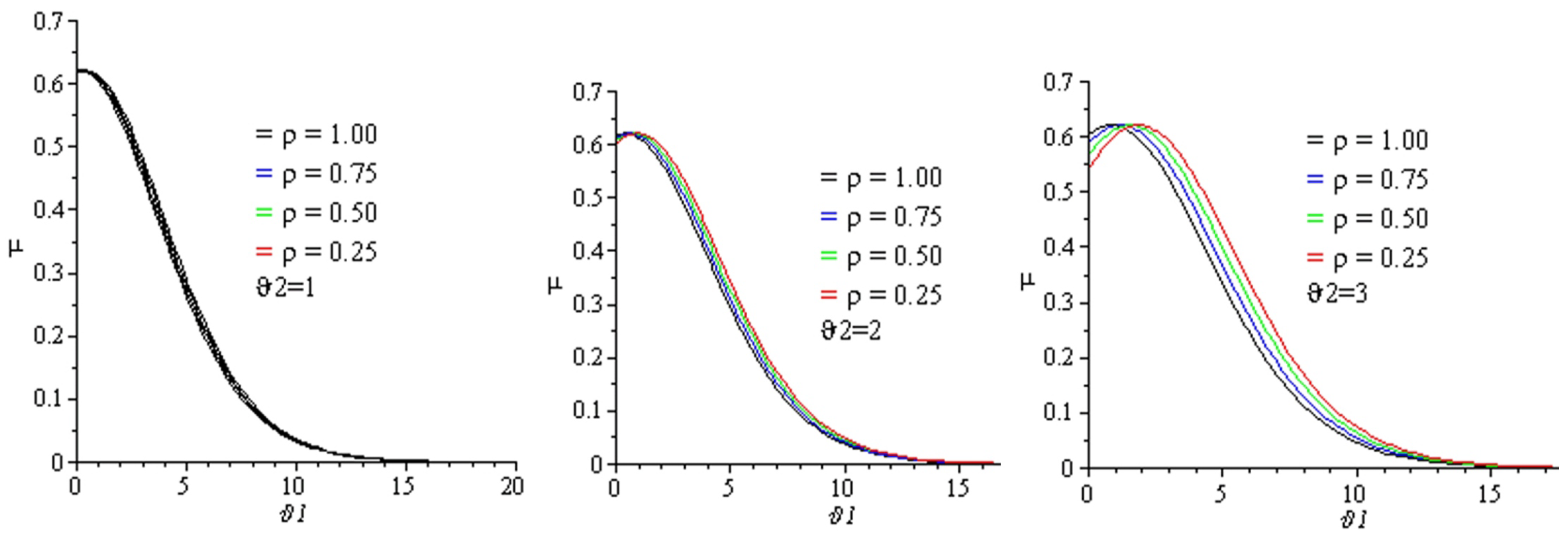
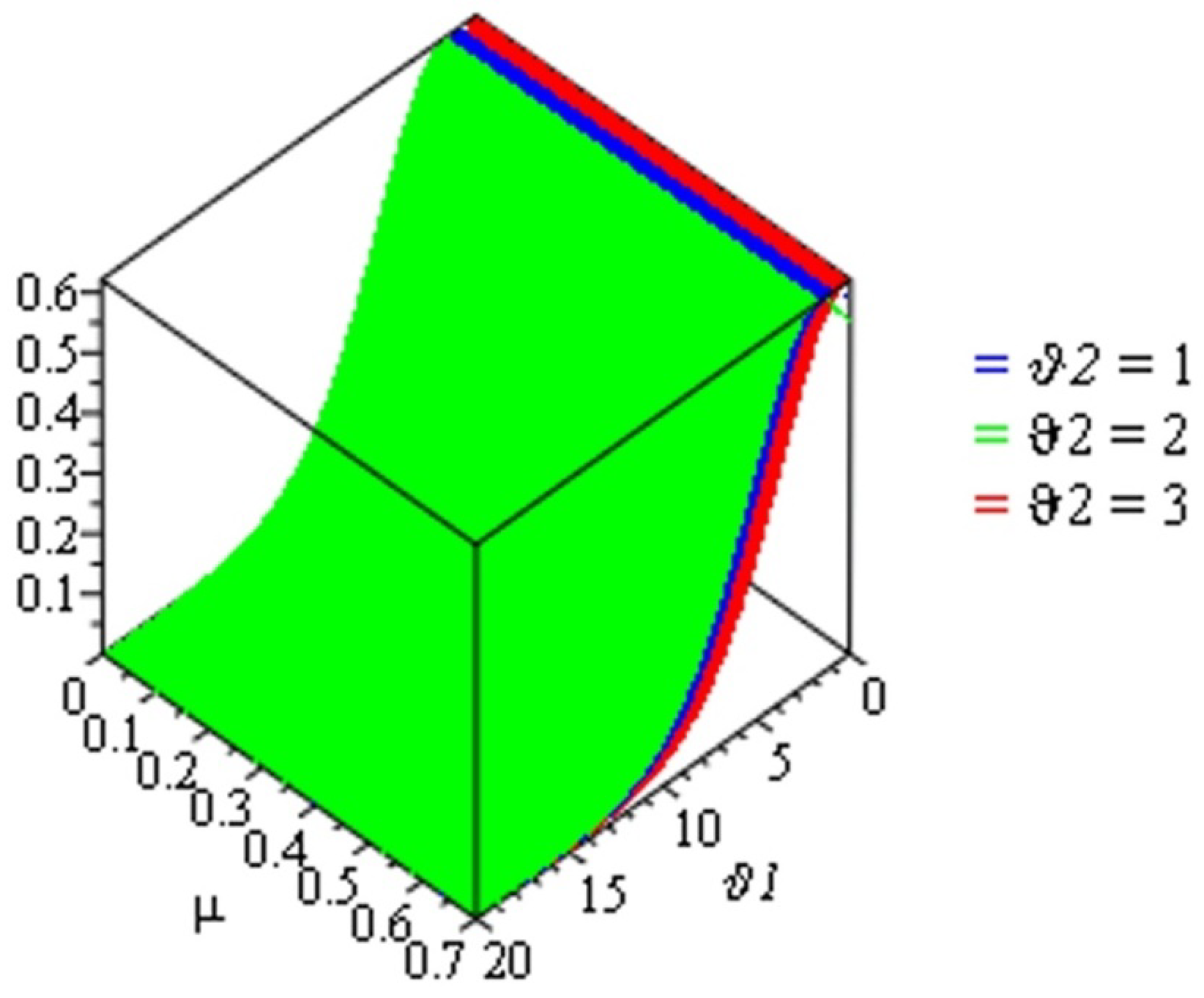
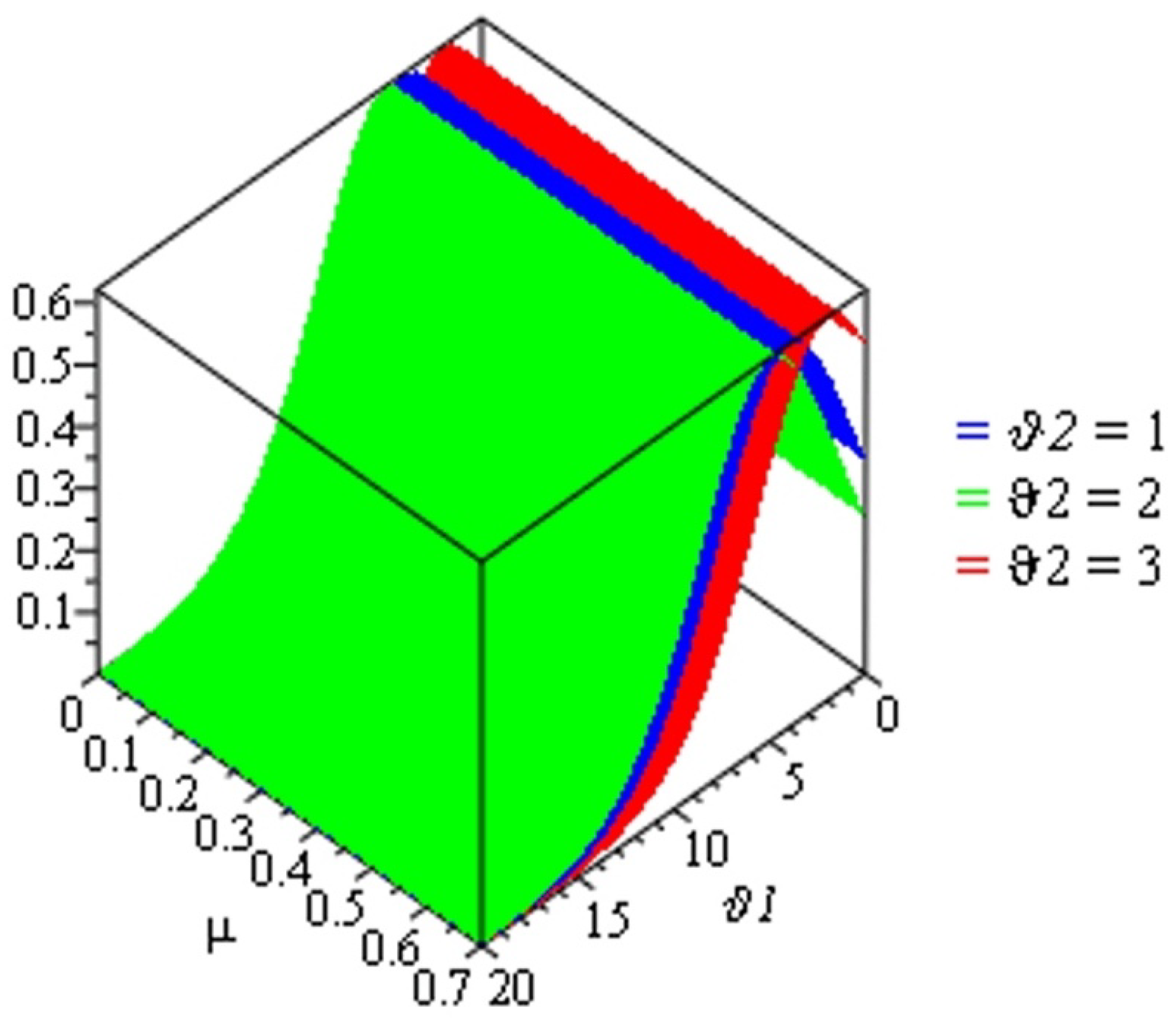
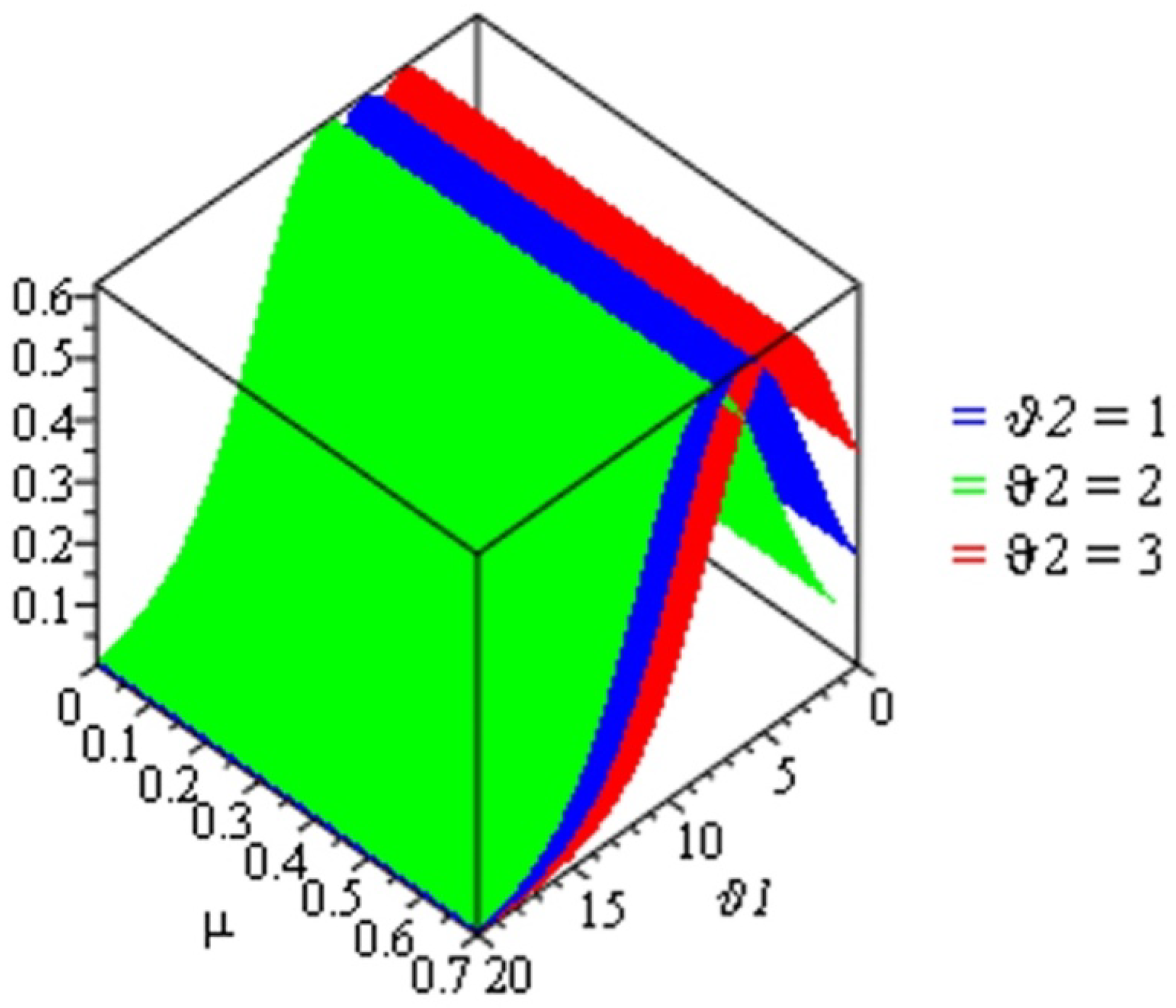
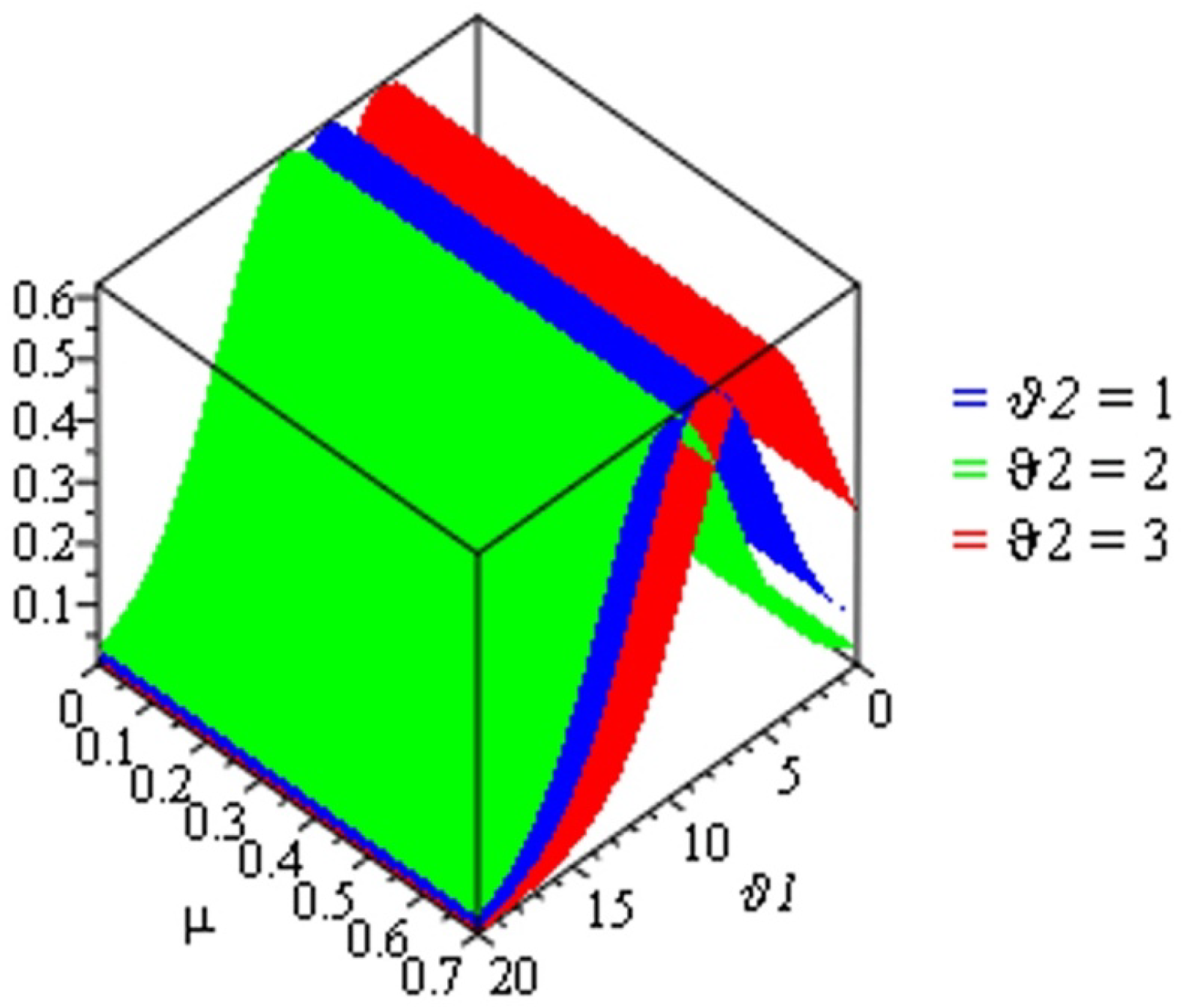
This section illustrates and presents the approximate solutions of the TCFKE (37) by giving some different values of fractional-order in Table 1 and Table 2 and by using numerical imitation in Figure 1, Figure 2, Figure 3, Figure 4 and Figure 5. We demonstrate the dynamical behavior of the approximate solutions of the TCFKE (37). Table 1 includes some comparison studies concerning the absolute error (AE) for the exact solutions of the TCFKE (37) at and , with the obtained solutions of TCFKE (37) given by the RPSM [32] and NTDM [33]. Table 2 presents the numerical solution of (37) at and several values of and obtained via the ARPSM. We compare our solutions and other solutions that were obtained by the RPSM [32] and NTDM [33] techniques. In Figure 1, we present a number of curves for the numerical solutions for (37), with , , , and certain values of . Figure 2 presents some surface plots of ARPSM solutions for the TCFKE (37), with , , , , and different values of . Figure 3 presents some surface plots of ARPSM solutions for the TCFKE (37), with , , , , and different values of . Figure 4 presents some surface plots of ARPSM solutions for the TCFKE (37), with , , , , and different values of . Figure 5 presents some surface plots of ARPSM solutions for TCFKE (37), with , , , , and different values of . The graphs and tables explain the ARPSM’s accuracy and applicability; that is, the tables show the accuracy of the proposed method compared to existing techniques, with various fractional-order values, and the figures present the similarity and symmetricality of three derivative graphical patterns.

Table 1.
Comparison of absolute errors of the ARPSM at and and several values of in TCFKE (37).
Table 2.
Numerical solutions of TCFKE (37) at with several values of and .
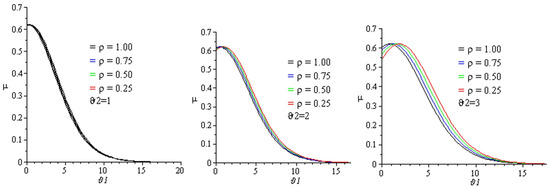
Figure 1.
ARPSM graphs for solution (63) with , , , and some values of .
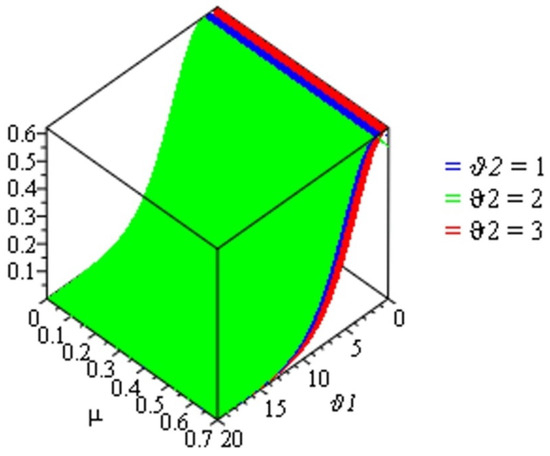
Figure 2.
Surface plot of solution (63) with and some values of .
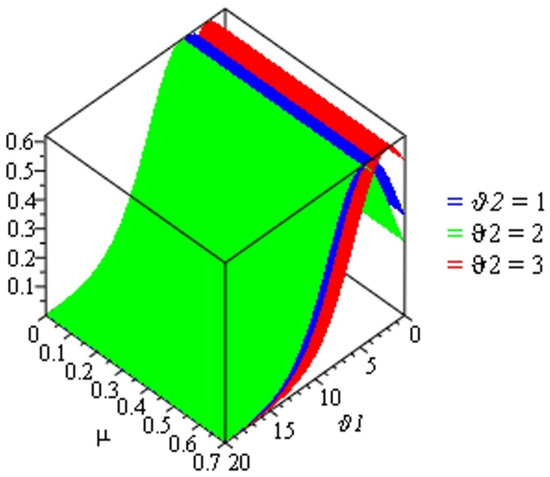
Figure 3.
Surface plot of solution (63) with and some values of .
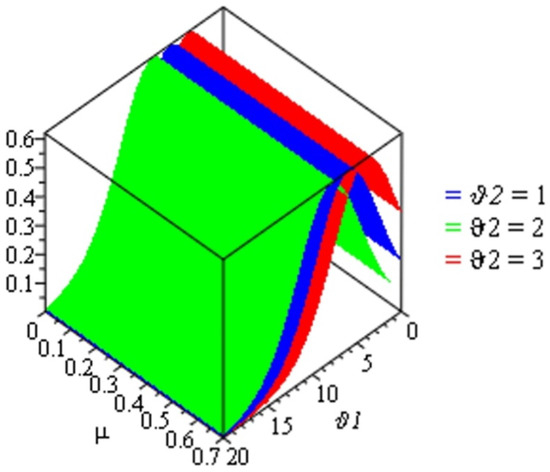
Figure 4.
Surface plot of solution (63) with and some values of .
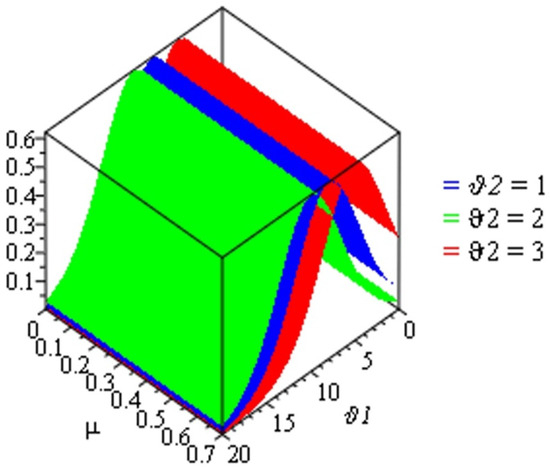
Figure 5.
Surface plot of solution (63) with and some values of .
6. Conclusions
The residual power series method using Aboodh transforms was efficient in examining the numerical solutions of the TCFKE. The ARPSM revealed the analytical solutions for the TCFKE as the sum of the terms of the convergent sequence . The efficiency and systematic approach of the ARPSM provide approximate solutions that align well with numerical simulations. The comparisons in the tables above show the efficacy and reliability of our method, where it can be seen that the obtained solutions emphasize the method’s suitability for biological and mathematical–physical systems of equations, as well as those of other fields.
Funding
This research received no external funding.
Data Availability Statement
The original contributions presented in this study are included in the article. Further inquiries can be directed to the author.
Conflicts of Interest
The author declares no conflicts of interest.
References
- Shah, K.; Seadawy, A.R.; Arfan, M. Evaluation of one dimensional fuzzy fractional partial differential equations. Alex. Eng. J. 2020, 59, 3347–3353. [Google Scholar] [CrossRef]
- Damag, F.H.; Saif, A.; Kiliçman, A. φ-Hilfer Fractional Cauchy Problems with Almost Sectorial and Lie Bracket Operators in Banach Algebras. Fractal Fract. 2024, 8, 741. [Google Scholar] [CrossRef]
- Kawahara, T. Oscillatory solitary waves in dispersive media. J. Phys. Soc. Jpn. 1972, 1, 260–264. [Google Scholar] [CrossRef]
- Kaya, D.; Al-Khaled, K. A numerical comparison of a Kawahara equation. Phys. Lett. A 2007, 5–6, 433–439. [Google Scholar] [CrossRef]
- Lu, J. Analytical approach to Kawahara equation using variational iteration method and homotopy perturbation method. Topol. Methods Nonlinear Anal. 2008, 2, 287–293. [Google Scholar]
- Kudryashov, N.A. A note on new exact solutions for the Kawahara equation using Exp-function method. J. Comput. Appl. Math. 2010, 12, 3511–3512. [Google Scholar] [CrossRef]
- Jakub, V. Symmetries and conservation laws for a generalization of Kawahara equation. J. Geom. Phys. 2020, 150, 103579. [Google Scholar] [CrossRef]
- Jin, L. Application of variational iteration method and homotopy perturbation method to the modified Kawahara equation. Math. Comput. Model Dyn. Syst. 2009, 3–4, 573–578. [Google Scholar] [CrossRef]
- Jabbari, A.; Kheiri, H. New exact traveling wave solutions for the Kawahara and modified Kawahara equations by using modified tanh–coth method. Acta Univ. Apulensis Math. Inform. 2010, 23, 21–38. [Google Scholar]
- Wazwaz, A.M. New solitary wave solutions to the modified Kawahara equation. Phys. Lett. A 2010, 4–5, 588–592. [Google Scholar] [CrossRef]
- Kurulay, M. Approximate analytic solutions of the modified Kawahara equation with homotopy analysis method. Adv. Differ. Eq. 2012, 2012, 178. [Google Scholar] [CrossRef]
- Akgul, A.; Cordero, A.; Torregrosa, J.R. A fractional Newton method with 2α-order of convergence and its stability. Appl. Math. Lett. 2019, 98, 344–351. [Google Scholar] [CrossRef]
- Yazgan, T.; Ilhan, E.; Çelik, E.; Bulut, H. On the new hyperbolic wave solutions to Wu-Zhang system models. Opt. Quantum Electron. 2022, 54, 298. [Google Scholar] [CrossRef]
- Rahman, M.U.; Arfan, M.; Shah, Z.; Alzahrani, E. Evolution of fractional mathematical model for drinking under Atangana-Baleanu Caputo derivatives. Phys. Scr. 2021, 96, 115203. [Google Scholar] [CrossRef]
- Tazgan, T.; Çelik, E.; Gulnur, Y.E.L.; Bulut, H. On survey of the some wave solutions of the non-linear Schrödinger equation (NLSE) in infinite water depth. Gazi Univ. J. Sci. 2023, 36, 819–843. [Google Scholar] [CrossRef]
- He, J.H. Homotopy perturbation technique. Comput. Methods Appl. Mech. Eng. 1999, 3–4, 257–262. [Google Scholar] [CrossRef]
- Kilic, S.; Celik, E. Complex solutions to the higher-order nonlinear boussinesq type wave equation transform. Ric. Mat. 2024, 73, 1793–1800. [Google Scholar] [CrossRef]
- Sontakke, B.R.; Shelke, A.S.; Shaikh, A.S. Solution of non-linear fractional differential equations by variational iteration method and applications. Far East J. Math. Sci. 2019, 1, 113–129. [Google Scholar] [CrossRef]
- Dhaigude, D.B.; Kiwne, S.B.; Dhaigude, R.M. Monotone iterative scheme for weakly coupled system of finite difference reaction diffusion equations. Commun. Appl. Anal. 2008, 2, 161–172. [Google Scholar]
- Seadawy, A.R.; Iqbal, M.; Lu, D. Propagation of kink and anti-kink wave solitons for the nonlinear dampedmodified Korteweg-de Vries equation arising in ion-acoustic wave in an unmagnetized collisional dusty plasma. Phys. Stat. Mech. Appl. 2020, 544, 123560. [Google Scholar] [CrossRef]
- Boutarfa, B.; Akgul, A.; Inc, M. New approach for the Fornberg–Whitham type equations. J. Comput. Appl. Math. 2017, 312, 13–26. [Google Scholar] [CrossRef]
- Inc, M.; Akgul, A.; Kilicman, A. Explicit solution of telegraph equation based on reproducing kernel method. J. Funct. Spaces. Appl. 2012, 2012, 984682. [Google Scholar] [CrossRef]
- Akgul, A. A novel method for a fractional derivative with non-local and non-singular kernel. Chaos Solitons Fractals 2018, 114, 478–482. [Google Scholar] [CrossRef]
- Yasmin, H.; Almuqrin, A.H. Analytical study of time-fractional heat, diffusion, and Burger’s equations using Aboodh residual power series and transform iterative methodologies. AIMS Math. 2024, 9, 16721–16752. [Google Scholar] [CrossRef]
- Yang, S.; Song, H.; Zhou, H.; Xie, S.; Zhang, L.; Zhou, W. A Fractional Derivative Insight into Full-Stage Creep Behavior in Deep Coal. Fractal Fract. 2025, 9, 473. [Google Scholar] [CrossRef]
- Yang, S.; Zhou, W.; Xie, X.; Lei, B.; Song, H. Fractional Order Analysis of Creep Characteristics of Sandstone with Multiscale Damage. Mathematics 2025, 13, 2551. [Google Scholar] [CrossRef]
- Damag, F.H.; Saif, A. On Solving Modified Time Caputo Fractional Kawahara Equations in the Framework of Hilbert Algebras Using the Laplace Residual Power Series Method. Fractal Fract. 2025, 9, 301. [Google Scholar] [CrossRef]
- Liaqat, M.I.; Etemad, S.; Rezapour, S. A novel analytical Aboodh residual power series method for solving linear and nonlinear time-fractional partial differential equations with variable coefficients. AIMS Math. 2022, 7, 16917–16948. [Google Scholar] [CrossRef]
- Edalatpanah, S.A.; Abdolmaleki, E. An innovative analytical method utilizing aboodh residual power series for solving the time-fractional newell-whitehead-segel equation. Comput. Algorithms Numer. Dimens. 2024, 3, 115–131. [Google Scholar]
- Noor, S.; Albalawi, W.; Shah, R.; Al-Sawalha, M.M.; Ismaeel, S.M.; El-Tantawy, S.A. On the approximations to fractional nonlinear damped Burger’s-type equations that arise in fluids and plasmas using Aboodh residual power series and Aboodh transform iteration methods. Front. Phys. 2024, 12, 1374481. [Google Scholar] [CrossRef]
- Liaqat, M.I.; Akgül, A.; Abu-Zinadah, H. Analytical Investigation of Some Time-Fractional Black–Scholes Models by the Aboodh Residual Power Series Method. Mathematics 2023, 11, 276. [Google Scholar] [CrossRef]
- Culha Unal, S. Approximate solutions of time fractional Kawahara equation by utilizing the residual power series method. Int. J. Appl. Math. Comput. Sci. 2022, 8, 78. [Google Scholar]
- Pavani, K.; Raghavendar, K. An efficient technique to solve time-fractional Kawahara and modified Kawahara equations. Symmetry 2022, 14, 1777. [Google Scholar] [CrossRef]
- Zafar, H.; Ali, A.; Khan, K.; Sadiq, M.N. Analytical solution of time fractional Kawahara and modified Kawahara equations by homotopy analysis method. Int. J. Appl. Math. Comput. Sci. 2022, 8, 94. [Google Scholar] [CrossRef]
- Dhaigude, D.B.; Bhadgaonkar, V.N. A novel approach for fractional Kawahara and modified Kawahara equations using Atangana-Baleanu derivative operator. J. Math. Comput. Sci. 2021, 3, 2792–2813. [Google Scholar]
- Rahman, M.U.; Arfan, M.; Deebani, W.; Kumam, P.; Shah, Z. Analysis of time-fractional Kawahara equation under Mittag-Leffler Power Law. Fractals 2022, 30, 2240021. [Google Scholar] [CrossRef]
- Bhatter, S.; Mathur, A.; Kumar, D.; Nisar, K.S.; Singh, J. Fractional modified Kawahara equation with Mittag–Leffler law. Chaos Solitons Fractals 2020, 131, 109508. [Google Scholar] [CrossRef]
- Ak, T.; Karakoc, S.B. A numerical technique based on collocation method for solving modified Kawahara equation. J. Ocean. Eng. Sci. 2018, 3, 67–75. [Google Scholar] [CrossRef]
- Damag, F.H.; Kılıçman, A.; Al-Arioi, A.T. On Hybrid Type Nonlinear Fractional Integrodifferential Equations. Mathematics 2020, 8, 984. [Google Scholar] [CrossRef]
- Oqielat, M.A.; Eriqat, T.; Ogilat, O.; El-Ajou, A.; Alhazmi, S.E.; Al-Omari, S. Laplace-residual power series method for solving time-fractional reaction–diffusion model. Fractal Fract. 2023, 309, 309. [Google Scholar] [CrossRef]
Disclaimer/Publisher’s Note: The statements, opinions and data contained in all publications are solely those of the individual author(s) and contributor(s) and not of MDPI and/or the editor(s). MDPI and/or the editor(s) disclaim responsibility for any injury to people or property resulting from any ideas, methods, instructions or products referred to in the content. |
© 2025 by the author. Licensee MDPI, Basel, Switzerland. This article is an open access article distributed under the terms and conditions of the Creative Commons Attribution (CC BY) license (https://creativecommons.org/licenses/by/4.0/).