1. Introduction
In recent decades, there has been substantial interest in continuous-time consumption and investment problems (e.g., Cheng and Escobar-Anel [
1], Lee [
2], and Wang et al. [
3]), particularly in scenarios where agents have flexibility in labor decisions, such as adjusting working hours or choosing when to retire (see Bodie et al. [
4], Bodie et al. [
5], Choi et al. [
6], Yang and Koo [
7], Lee et al. [
8], Park et al. [
9], Jeon and Oh [
10], and the references therein). However, existing research has largely overlooked the case where agents can actively increase their income through deliberate effort. Most models emphasize consumption and portfolio choices, but fail to fully account for the strategic role of income enhancement, which is crucial for understanding long-term financial planning, especially in the context of human capital development.
Incorporating the option to increase income is both novel and economically relevant. Individuals in real-world financial planning often have opportunities to boost their earnings, whether through additional work, skill acquisition, or entrepreneurial ventures. These opportunities can significantly influence consumption and investment behavior by providing a dynamic mechanism for wealth accumulation over time. Exploring the impact of such income adjustments is key to developing more realistic models that capture the flexibility people have in optimizing their financial decisions.
This paper introduces a model in which an agent has the option to increase their income at any time, but must incur a wealth cost proportional to the size of the income increase. This reflects the real-world situation where earning more—whether through overtime work, career progression, or business ventures—usually entails costs, such as education investments or lost leisure time. By incorporating a proportional wealth cost, we capture the fundamental trade-off between current consumption and future financial stability, which is at the heart of many financial decisions. This model provides a rich framework to study optimal consumption, investment, and income-adjustment strategies under realistic economic conditions.
The agent’s utility maximization problem discussed in this paper is highly applicable in scenarios where individuals have flexible income opportunities and need to balance immediate consumption with long-term financial stability. This type of model is especially useful for understanding financial planning decisions in real life, where people can increase income through additional work, skills training, or investments in their careers. It helps illustrate the trade-offs they face, such as spending on immediate needs versus investing in income-generating efforts for future growth.
This model is valuable for fields like retirement planning, human capital investment, and entrepreneurial finance, as it provides insights into how people can optimize both their consumption and savings while navigating real-world opportunities to grow income, ultimately enhancing their financial well-being.
Aim and Purpose of the Study
The main aim of this paper is to develop and solve a model that addresses optimal consumption, investment, and income adjustment for an infinitely lived agent, focusing on scenarios where income can be increased at any time with a proportional wealth cost. By examining this setup, we aim to provide insights into how agents with opportunities for income enhancement can best manage their consumption and investment choices over time. The purpose is to expand on the traditional consumption and portfolio optimization models by introducing the ability to alter income, capturing an essential aspect of real-world financial decision-making that has been largely neglected in the existing literature.
Specifically, we focus on solving the utility maximization problem for an agent with the flexibility to increase income while facing a non-negative wealth constraint to prevent borrowing against future earnings. This setup requires the integration of stochastic control for consumption and investment decisions with singular control for income adjustments, presenting a complex optimization problem.
To address this challenge, we derive the Hamilton–Jacobi–Bellman (HJB) equation with a gradient constraint through the dynamic programming approach. Using a guess-and-verify method and a linearization technique, we find a closed-form solution for the HJB equation, identifying the optimal strategies for consumption, investment, and income adjustment. This model offers a robust framework for understanding the trade-offs faced by agents with the ability to alter their income in the pursuit of long-term financial well-being.
Various Free Boundary Problems have been studied within the continuous-time consumption and investment problem framework (e.g., Davis and Norman [
11], Dybvig [
12], Deng et al. [
13], and Jeon and Kwak [
14]). We contribute to the literature by investigating the Free Boundary Problem that arises from the utility maximization problem, where the agent has the option to increase their income.
Our paper is organized as follows. In
Section 2, we introduce the agent’s preferences and income structure, and define the utility maximization problem. In
Section 3, we derive the HJB equation with a gradient constraint using the DPP and obtain the solution in closed form. In
Section 4, we characterize the optimal strategy by proving its optimality.
2. Model
We consider a continuous-time model with a complete financial market and an infinitely lived agent. Let be a standard Brownian motion defined on a usual probability space and equipped with the natural filtration generated by .
For simplicity, we assume that there are only two assets in the financial market: a risk-free asset
and a risky asset
, with their dynamics given as follows:
where
is the constant risk-free interest rate,
and
are the expected return and volatility of stock
, respectively.
Let and denote the agent’s consumption rate and the amount invested in the stock at time , respectively. Additionally, the agent receives a labor income flow at time t. The agent can always increase the income process , but doing so incurs a wealth cost proportional to the increase by a factor of .
Remark 1. In practice, individuals may increase their income by taking on extra work, investing in education, or improving skills, but these adjustments involve costs. For instance, additional work can lead to physical and mental strain, often requiring financial resources for health maintenance. Likewise, pursuing further education entails financial expenses and time commitments, reflecting both opportunity and direct costs. In our model, we introduce a proportional cost for any increase in income , where captures the intensity of these adjustment costs. This formulation aligns with labor economics findings, which highlight the rising costs associated with additional income efforts.
Remark 2. From a mathematical perspective, it is possible to set as a finite variation process. In this case, the income process could be increased by incurring a cost, while a reduction in would generate an additional income stream proportional to the decrease. Although this extension could lead to an interesting and challenging problem, from a practical standpoint, reducing income does not yield a compensatory "negative cost"; thus, there is no meaningful economic interpretation for receiving benefits simply by reducing income.
In this setting, the dynamics of the agent’s wealth
under the given strategy
are as follows:
where
x is an initial endowment for the agnet.
Since the agent can borrow up to the present value of future income flows,
, at time
t, the following non-negative wealth constraint or borrowing constraint is imposed to prevent unlimited borrowing:
Furthermore, we assume that the agent’s utility function follows the constant relative risk aversion (CRRA) form, as given below:
where
is the constant relative risk aversion coefficient.
Now, we state our main problem.
Problem 1. Let and be given. The agent faces the following utility maximization problem:where is the set of all admissible strategies , such that: (i) and are -progressively measurable, satisfying a.s., a.s., for all ; (ii) is a -adapted, positive, non-decreasing, and right-continuous with right limits process starting at ; and (iii) the wealth corresponding to satisfies the borrowing constraint (3). If the cost of increasing income exceeds the present value of the increase, the agent has no incentive to increase income. Thus, we impose the following assumption.
Assumption 1. If p is greater than or equal to , the agent will never increase their income. In this case, it is equivalent to a problem with a borrowing constraint on constant income (see El Karoui and Jeanblanc-Picqué [15]). Additionally, for the well-definedness of the infinite horizon problem, the following assumption is necessary.
Assumption 2. The Merton constant K (see Merton [16,17]), defined asis positive. Problem 1 is a stochastic control problem mixed with singular control, where the agent must choose not only the consumption and investment , but also the non-decreasing income process . To address this problem, we first derive the Hamilton–Jacobi–Bellman (HJB) equation with a gradient constraint that the value function of Problem 1 satisfies, using the dynamic programming principle (DPP). By employing the guess-and-verify method, we derive a non-linear Free Boundary Problem from the HJB equation. We then obtain a closed-form solution to this Free Boundary Problem using a linearization technique.
3. Optimization Problem: Dynamic Programming Principle
By utilizing DPP, we derive the HJB equation with a gradient constraint for
on
,
where the operator
for given
is defined by
Remark 3. The HJB Equation (6) consists of two parts: the region where income is not increased, and the region where income is increased. This characteristic is similar to the form of the HJB equation dealt with in durable goods (e.g., Hindi and Huang [18], Steffensen [19]). For given
, from the first-order condition of the static optimization problem inside the HJB equation, we obtain the following candidates for
c and
:
where
is the market price of risk (or Sharpe ratio), given by
Let us consider the substitution
and it follows from (
8) that
By putting (
8) into (
6), it follows from (
10) that
and
Thus, the HJB Equation (
6) can be reduced as follows on the domain
:
From the HJB Equation (
12), we define the increasing region (
IR) and waiting region (
WR) as follows:
We aim to solve the HJB Equation (
12) by employing the guess and verify method, given the high nonlinearity of the equation. To proceed, we make the following intuitive conjectures:
The value function is strictly increasing, strictly concave, and twice continuously differentiable with respect to .
There exists a critical boundary, , such that whenever the wealth to income ratio hits , the agent increases his/her income, incurring a cost. That is, .
When the agent’s wealth decreases to 0, the agent reduces the risky investment to 0. That is, when .
Remark 4. It is standard to impose the -condition on the solution of the HJB Equation (12) with a gradient constraint derived from the singular control problem (Problem 1). This -condition is essential for verification through Itô’s lemma, as it shows that the solution to the HJB Equation (6) corresponds to the solution of the agent’s utility maximization problem (Problem 1). Furthermore, the -condition implies that the agent optimally chooses the boundary where the income is increased. According to the above conjectures, we consider the following Free Boundary Problem arising from the HJB Equation (
12).
Free Boundary Problem: Find a strictly increasing, strictly concave, and twice continuously differentiable function
in
, such that
To linearize the first part of the Free Boundary Problem (
14), we first assume that
is strictly increasing and concave with respect to
, i.e.,
and
, and we will verify these assumptions later. From (
10), there exists a inverse function
of
, i.e.,
Since
we deduce that
or, equivalently,
By differentiating both sides of Equation (
20) with respect to
, we obtain that
Given that the ordinary differential equation (ODE) in (
22) is of Cauchy–Euler form, we assumed a solution of the form
, where
n is a constant to be determined. Substituting this form into the differential equation yields the following characteristic equation:
This is a quadratic equation in
n, and solving it gives two roots,
and
. Using these roots, we construct the general solution for the second-order Cauchy–Euler ODE as a linear combination of terms involving
and
, as shown in (
24):
where
and
are constants determined by the boundary conditions specific to the problem. This method is a well-established technique for solving Cauchy–Euler ODEs, utilizing the characteristic equation to find a complete solution.
By using the relation
we can represent
in (
21) as
By the
condition of
at
in (
14),
and
By (
26), (
27), and (
28), we have
Thus, it follows from
and
that
Since
for
, there exists a constant
, such that
Since
for
, we can extend
from
to
as
Since
, it follows from (
25) that
Moreover,
implies that
Since
in (
14), we deduce that
. This yields that
where
is defined as
Since , , and for , there exists a unique , such that .
Lemma 1. and .
Proof. It suffices to show .
Let us temporarily denote
by
Clearly, .
Since
is independent of
in
, we have
Thus, we conclude that and . □
Lemma 2. in (34) is a continuously differentiable and strictly increasing function in . Moreover, Proof. By the construction of , it is easy to check that is continuously differentiable with respect to .
By direct computation, it follows from
and
that
Since
, we conclude that, for all
,
□
Proposition 1. in (35) satisfies the following properties: - (a)
is twice continuously differentiable, strictly increasing and strictly concave in .
- (b)
satisfies the HJB equation in (12). Moreover,
Proof. Since
we can easily confirm that
Thus, is twice continuously differentiable with respect to .
Moreover,
and
where we have used the fact
and
. That is,
is strictly increasing and strictly concave in
.
By the construction of
in (
35), we can easily check that, for
,
Let us temporarily denote
by
It follows from (
34) and (
35) that, for
,
This yields that, for
,
Since
, we obtain that
and
By putting
into the above equation instead of
, we have
On the other hand, if
,
Moreover, for
, we derive that
It follows from (
24) and (
28) that
where we have used the following relation:
This implies that, for
,
and
.
Hence, we conclude that
satisfies the HJB equation in (
12). □
Consequently, we directly obtain the following corollary.
Corollary 1. in (62) is a strictly increasing and strictly concave function of , satisfying the HJB Equation (6). Moreover, . 4. Optimal Strategies
By the strictly increasing property of
, for given
and
, there exists a unique
, such that
To describe the optimal strategy, we introduce a
regulated geometric Brownian motion
with boundaries at
and
. This process is governed by the following stochastic differential equation with two reflecting boundaries (SDER):
Here, and , , represent the regulators at the boundaries and , respectively. These are the local times of at the boundaries and . The processes H and L are determined by the following properties:
- (i)
Both and are continuous, non-decreasing functions with .
- (ii)
remains in the interval for all .
- (iii)
H and L increase only when hits the boundaries, i.e.,
As shown by Lions and Sznitman [
20], the SDER (
64) admits a unique strong solution
, which remains confined within the interval
for all
.
Based on
and
, let us denote
,
, and
by
By applying the generalized Itô lemma to
, we deduce that
That is, and .
Thus, by utilizing a standard verification argument, we can easily obtain the following theorem.
Theorem 1. Let and be given. Then, That is, is the optimal strategy.
5. Implications
In this section, we provide numerical results regarding the optimal strategies obtained in Theorem 1. The baseline parameters used for this purpose are given as follows:
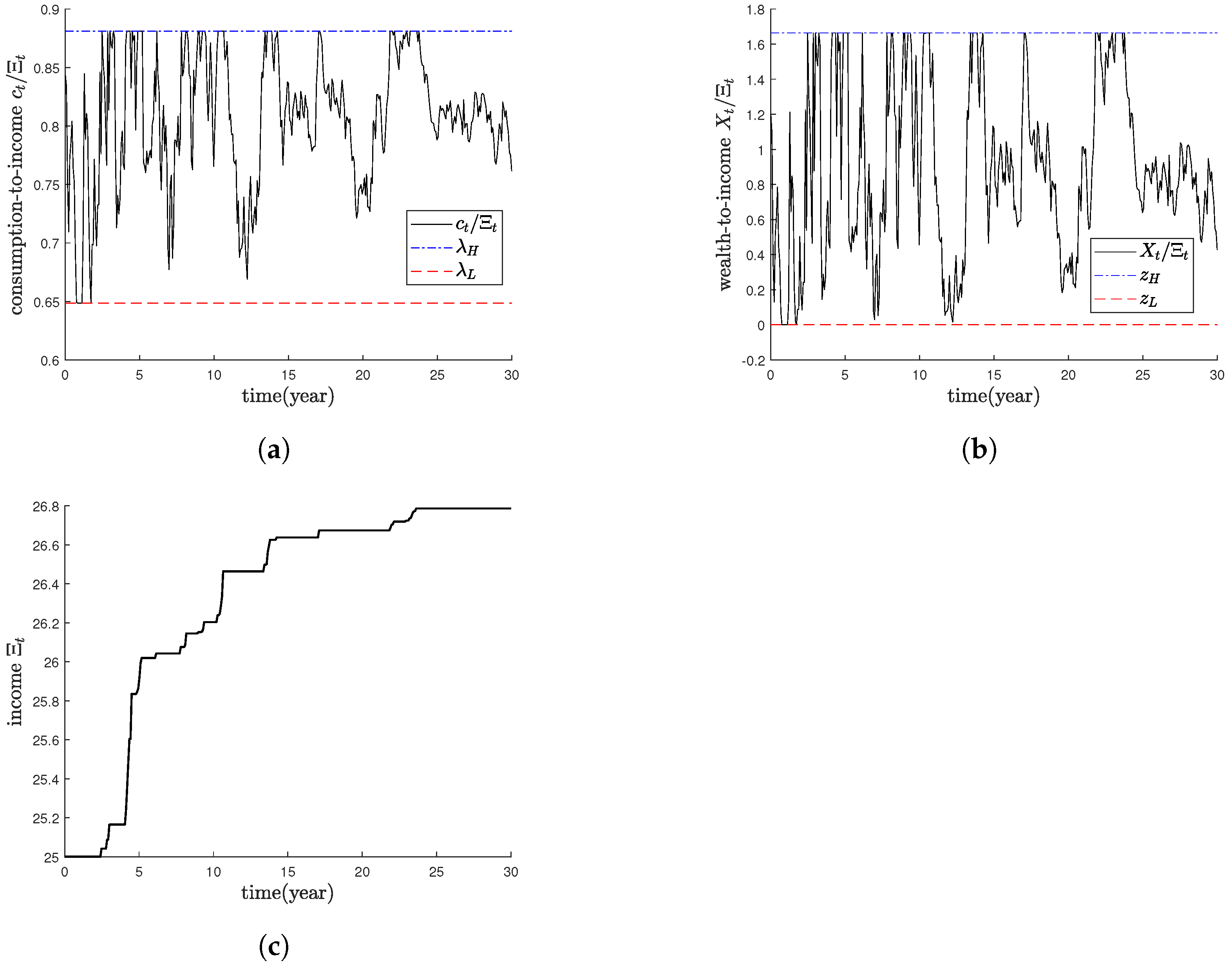
Figure 1 shows the simulation paths of consumption to income
, wealth to income
, and income
. As seen in the figure, whenever
or
reaches the upper boundary
or
, the agent increases their income
.
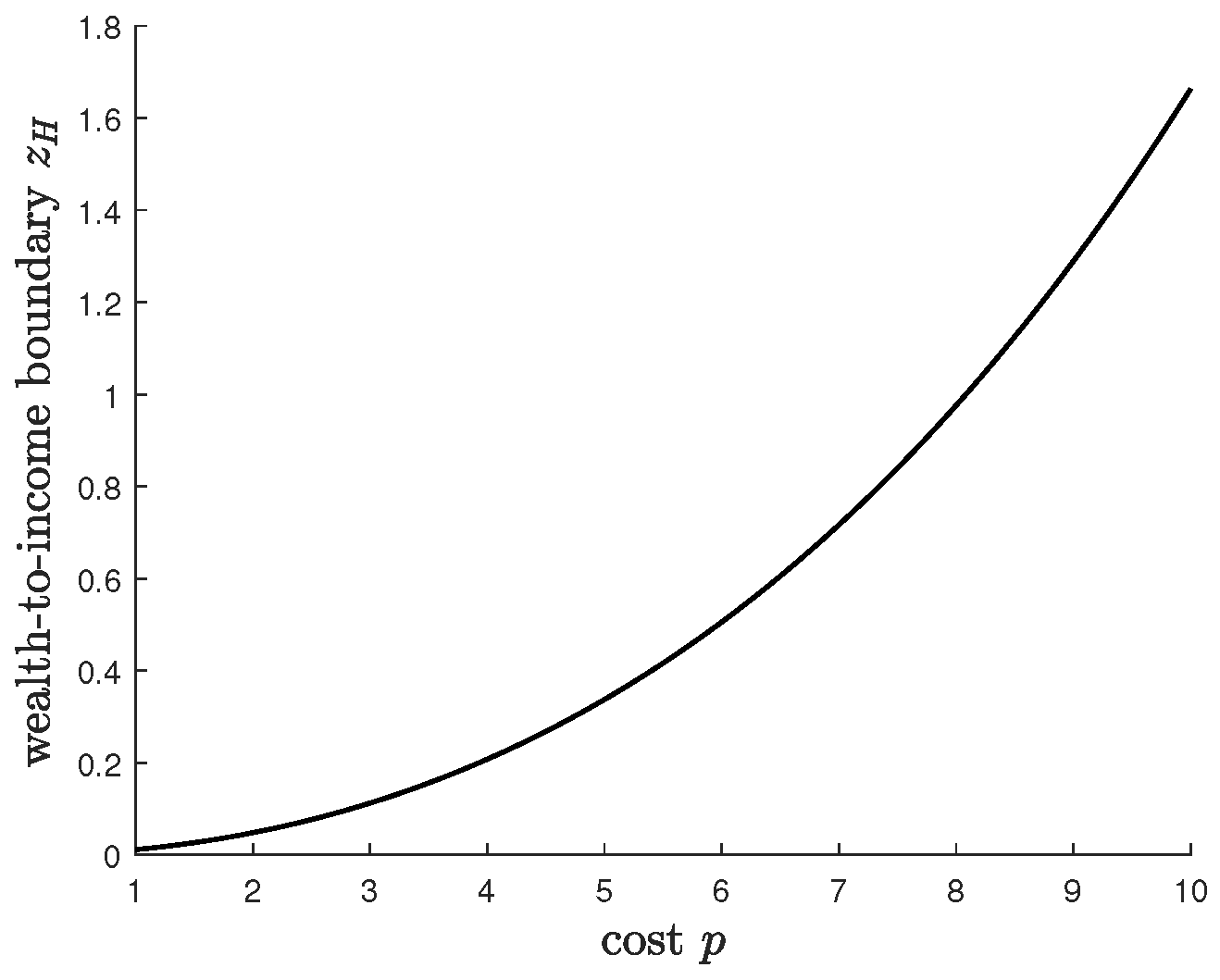
As the proportional cost
p of increasing income rises, the agent is less inclined to raise their income. This intuition can be observed in
Figure 2. More precisely, the agent increases income each time the wealth to income ratio
reaches the upper boundary
. As shown in
Figure 2, since
is an increasing function of
p, we can infer that a higher
p discourages the agent from increasing their income as frequently.
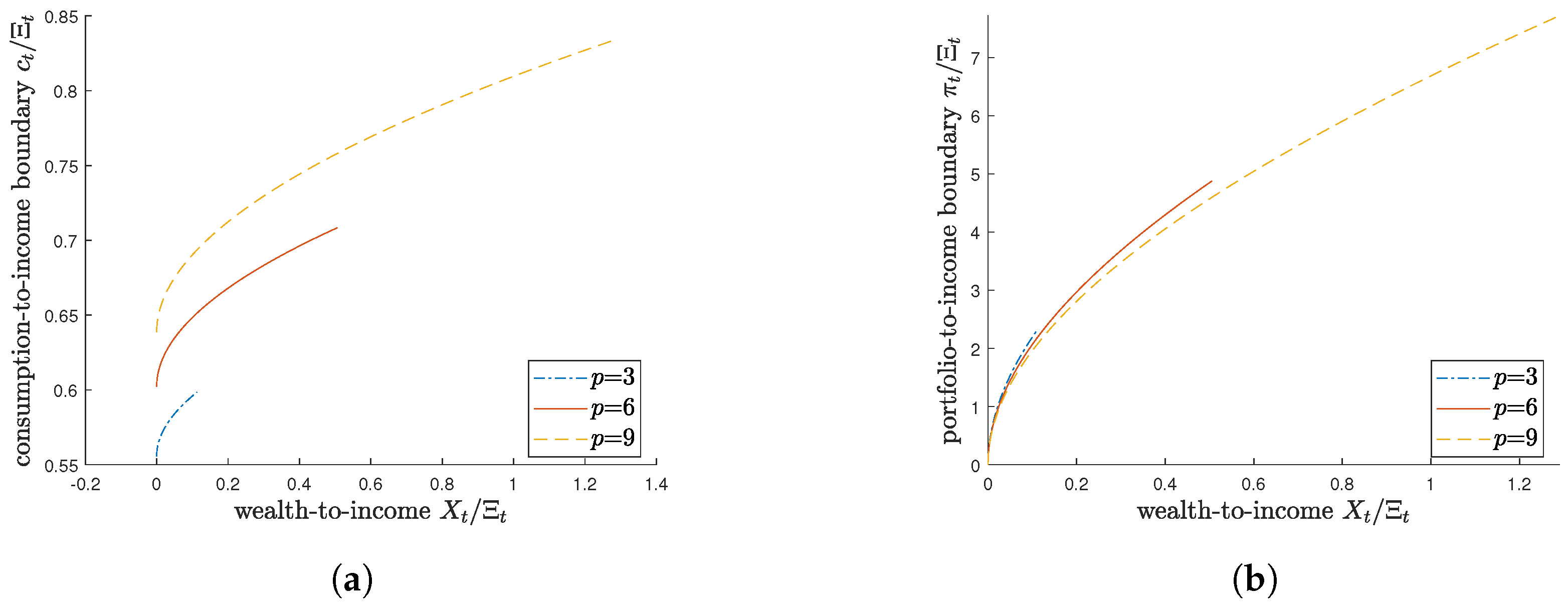
Figure 3 illustrates the impact of the cost
p on the optimal strategy. As seen in the figure, as the cost
p increases, the agent tends to increase consumption and reduce investment in risky assets.
6. Concluding Remarks
In this paper, we address the optimal consumption and investment problem for an infinitely lived agent who has the option to increase income at a cost. The agent also faces a borrowing constraint, which prevents them from borrowing against future income flows. This utility maximization problem for the agent features both stochastic control and singular control characteristics, and the domain of the state variable is restricted due to the borrowing constraint. To tackle this challenging problem, we derive the HJB equation arising from the agent’s utility maximization problem and, using the guess-and-verify method, obtain the agent’s optimal strategy in closed form.