Abstract
An influence network of events is a view of the universe based on events that may be related to one another via influence. The network of events forms a partially ordered set which, when quantified consistently via a technique called chain projection, results in the emergence of spacetime and the Minkowski metric as well as the Lorentz transformation through changing an observer from one frame to another. Interestingly, using this approach, the motion of a free electron as well as the Dirac equation can be described. Indeed, the same approach can be employed to show how a discrete version of some of the features of Euclidean geometry including directions, dimensions, subspaces, Pythagorean theorem, and geometric shapes can emerge. In this paper, after reviewing the essentials of the influence network formalism, we build on some of our previous works to further develop aspects of Euclidean geometry. Specifically, we present the emergence of geometric shapes, a discrete version of the parallel postulate, the dot product, and the outer (wedge product) in dimensions. Finally, we show that the scalar quantification of two concatenated orthogonal intervals exhibits features that are similar to those of the well-known concept of a geometric product in geometric Clifford algebras.
MSC:
06A06
1. Introduction
Euclid’s book “the Elements”, which has been the foundation of Euclidean geometry, presents a list of definitions and postulates based on logic, common sense, and the perceptions of the surrounding space as the basis for proving the rest of the theorems in flat space [1]. Hence, the definitions are considered to be fundamental. For example, Euclid defines angles, triangles, and areas and then gives a proof for the Pythagorean theorem by rearranging areas of identical triangles. Therefore, angles, triangles, and areas are treated as fundamental and the Pythagorean theorem is proven based on these fundamental definitions, which implies that the Pythagorean theorem is not fundamental itself.
As the study of the surrounding objects is not independent of studying the surrounding space, studying geometry has been tied to studying space since its early days. The ideas about the nature of space viewed it to be infinite and fundamental [2]. Later, with Newton’s laws, space was believed to be independent of what happens in it until Einstein showed that space is shaped by what goes on in it [3]. This questioned the absoluteness of space but only to the extent that scientists started looking for the shape of the universe based on the amount of matter and energy it contained; the absoluteness of space was still intact. Einstein’s relativity theory gave rise to a new geometry to explain the properties of a curved space. However, like Euclidean geometry, in this new geometry the fundamental notions such as angles, geometrical shapes, and areas were still considered to be fundamental and serve as the basis for the derivation of other properties.
Here, the universe is viewed as a partially ordered set (poset) of events where events are defined as interactions between particles. Thus, a causal relation is formed as introduced and discussed in [4,5,6,7,8,9,10], which results from probabilistic inferences [11]. Partially ordered sets are the same as directed acyclic graphs (DAG). Causal influence in partially ordered sets of events called causal sets or causets were introduced by Bombelli and collaborators and studied extensively by Sorkin, where the causal sets are usually embedded in a Minkowski geometry that exhibits Lorentz invariance [12,13,14,15]. This approach, where a causal model is embedded in spacetime in an information-theoretic setting, has been used to find connections between geometric and informational causality [16]. Causal models have also been used to find new interpretations of quantum theory [17]. The concept of information flow plays a key role in causal influences that are studied as an information-theoretic setting [18,19]. Interestingly, in Ref. [20], the geometry of spacetime was shown to emerge from abstract-order lattices [21,22] expressed in a quantitative way by means of the geometric Clifford algebra language [23,24,25,26].
Geometric algebra, Clifford’s generalization of complex numbers and quaternion algebra to vectors in arbitrary dimensions, is a formalism in which elements of any grade such as scalars, vectors, bivectors, and higher-order multivectors can be added or multiplied together. This result is shown in the geometric product of two vectors and as the sum of an inner product and an outer product
In three-dimensional space, and are three-dimensional vectors and this relation gives the usual results from the dot and cross products [24]. This algebra has been used to describe physical laws in different fields of physics.
In our picture, instead of assuming events taking place in any space or time or assuming any properties for them, we take the poset to be fundamental and seek a consistent quantification such that it preserves the order by mapping events to real numbers. The quantification of lattices that are a special case of posets has been studied by Knuth where instead of assuming sum and product rules, he demonstrated how quantifications constrained by lattice symmetries result in constraint equations representing the sum and product rules [27,28,29].
We quantify this causal set of events using embedded observers represented by chains that are totally ordered sets of events. In our previous work, we showed how consistently quantifying the poset using a pair of embedded observers resulted in a discrete version of the Minkowski metric and the Lorentz transformations [4,5,6,10]. Kinematics also arises in this picture as a result of changing relationship between observer and object [30]. The focus of this paper is the further investigation of the geometrical results from our previous work such as directionality, subspaces, and the Pythagorean theorem and the study of quantification with more than a pair of embedded observers. We show how quantifying with more than two observers is related to dimensions higher than 1 + 1. In addition, we show how constraints from quantifying with a number of embedded observers results in some fundamental features of Euclidean geometry such as the parallel postulate, a discrete version of the dot product, and a discrete version of the outer (wedge) product in 2 + 1 dimensions.
In this paper, we will review our previous work on the quantification technique of a poset using an embedded observer in Section 2. In Section 3, we will review the coordination condition which constraints the quantification using a pair of embedded observers, the conditions for directionality, subspaces and the Pythagorean theorem. We will then show in Section 4 how quantifying with more than a pair of observers results in simplices and subspaces up to N + 1 dimensions where . In Section 5 and Section 6 we discuss quantification of the poset using a number of coordinated and collinear embedded observers, called a fence, and present a derivation of a discrete version of the parallel postulate and the dot product. Finally, in Section 7 we will extend the quantification from a set of collinear and coordinated observers (a fence) to multiple sets of fences, called a grid and show how quantification for an orthogonal grid which is a special case of a grid leads to a discrete version of the outer (wedge) product in 2 + 1 dimensions. In Section 8, we present a summary of the results along with our final remarks.
2. Influence Network and Its Quantification
We start by reviewing the definition of a partially ordered set of events and its quantification using an embedded chain which we call an observer.
Partially Ordered Set of Events and Chains
A partially ordered set is a set of elements with a binary ordering relation ≤, called inclusion, such that for elements inclusion is transitive (if and , then ), reflexive () and antisymmetric (if and then ) [31]. If elements of the poset are not related through inclusion, they are incomparable, denoted as ; hence, the name partially ordered set of elements.
If for two elements of the poset we have that and , and there is not an element x such that , then b covers a, which is denoted as . In [4,5,6,7], we defined an event as the boundary of an interaction where one event represents the act of influencing and another event represents the act of being influenced. A partially ordered set of events, or a poset of events, is defined as a set of events and a binary relation ≤ defined by influence such that this relation is transitive (if and , then ), reflexive () and antisymmetric (if and , then ) [4,5,6,7].
A chain is defined to be a set of events such that for any given x and y in the chain, either or [32]. Therefore, a chain is totally ordered. Given a poset with event and chain such that where then the forward projection of x onto , is given by the map (functional) such that and if where then the backward projection of x onto , is given by the map (functional) such that [4,5].
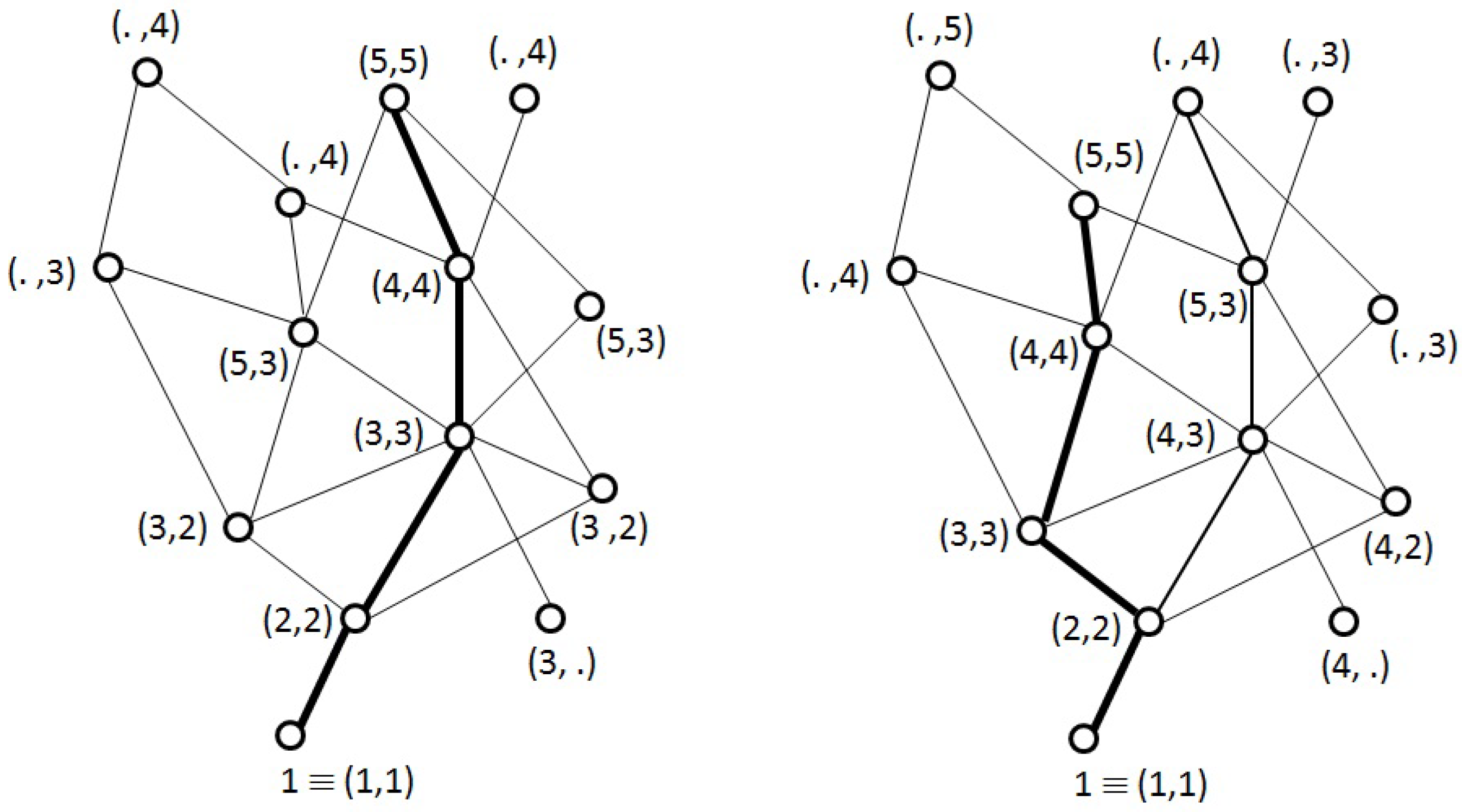
Quantification of a partially ordered set of events is carried out through chain projection, as shown in Figure 1. Elements of a chain are quantified by defining a functional called monotonic valuation that takes each element p of the chain to a real number such that if then , where and are valuations assigned to x and y with respect to chain , respectively. Other events of the poset that are forward and backward projected onto the elements of the distinct chain will be quantified by the corresponding valuations of the two events onto which they are projected. Note that the quantification of an element by chain projection is chain-dependent. Furthermore, there are some subsets of events that cannot be quantified by any given chain. However, these subsets are different for different chains.
Figure 1.
Quantification of a poset with respect to two different embedded observers (chains). Embedded observers are totally ordered sets of events that are quantified by isotonic valuations of successive integers and the rest of the poset is quantified with respect to the observers using the forward and backward projections. Quantification of the poset will be different according to each embedded observer shown in the two figures.
An interval comprises a pair of events that are quantified by the same chain or the same pair of chains. There are different classes of intervals: chain-like intervals, antichain-like intervals, and projection-like intervals.
An interval is called chain-like if and only if both elements of its quantifying pair are of like sign, with as a degenerate case. In this case, degeneracy occurs when both elements lie on a chain where the two endpoints forward project onto the same element on the quantifying chain and backward project onto the same element on the quantifying chain. The interval is called purely chain-like if both elements of its quantification pair are positive and equal.
An interval is called antichain-like if and only if the elements of its quantifying pair are of opposite sign, with as a degenerate case where the endpoint elements are incomparable but forward project onto the same element on the quantifying chain and backward project onto the same element on the quantifying chain. If both elements of the quantifying pair have the same value and opposite signs, then the interval is called purely antichain-like.
An interval is called projection-like if and only if only one of the elements of its quantifying pair is zero, with as a degenerate case where the interval itself is degenerate such that the endpoints of the interval are identical and lie on the quantifying chain.
We will use this quantification technique for two chains in a poset of events instead of one and see how this constraint gives rise to some geometrical features such as dimensionality, directionality, and subspaces.
3. Basic Geometrical Structures
In this section, we will consider quantification with two embedded observers. First, we need to study the relation between an event and a pair of observers via chain projection. We will see how the order in projections gives rise to collinearity, directionality, and subspaces.
3.1. Collinearity and Subspaces
The order in chain projection induces structure in the partially ordered set. A pair of distinct chains and an event can be forward collinear if and only if the forward projections of event x onto can be found by first forward projecting x onto and then either forward or backward projecting onto or backward collinear if and only if the backward projections of event x onto can be found by first forward projecting x onto and then either forward or backward projecting onto or collinear if and only if event x is both forward and backward collinear with its projections onto the two chains [4,5].
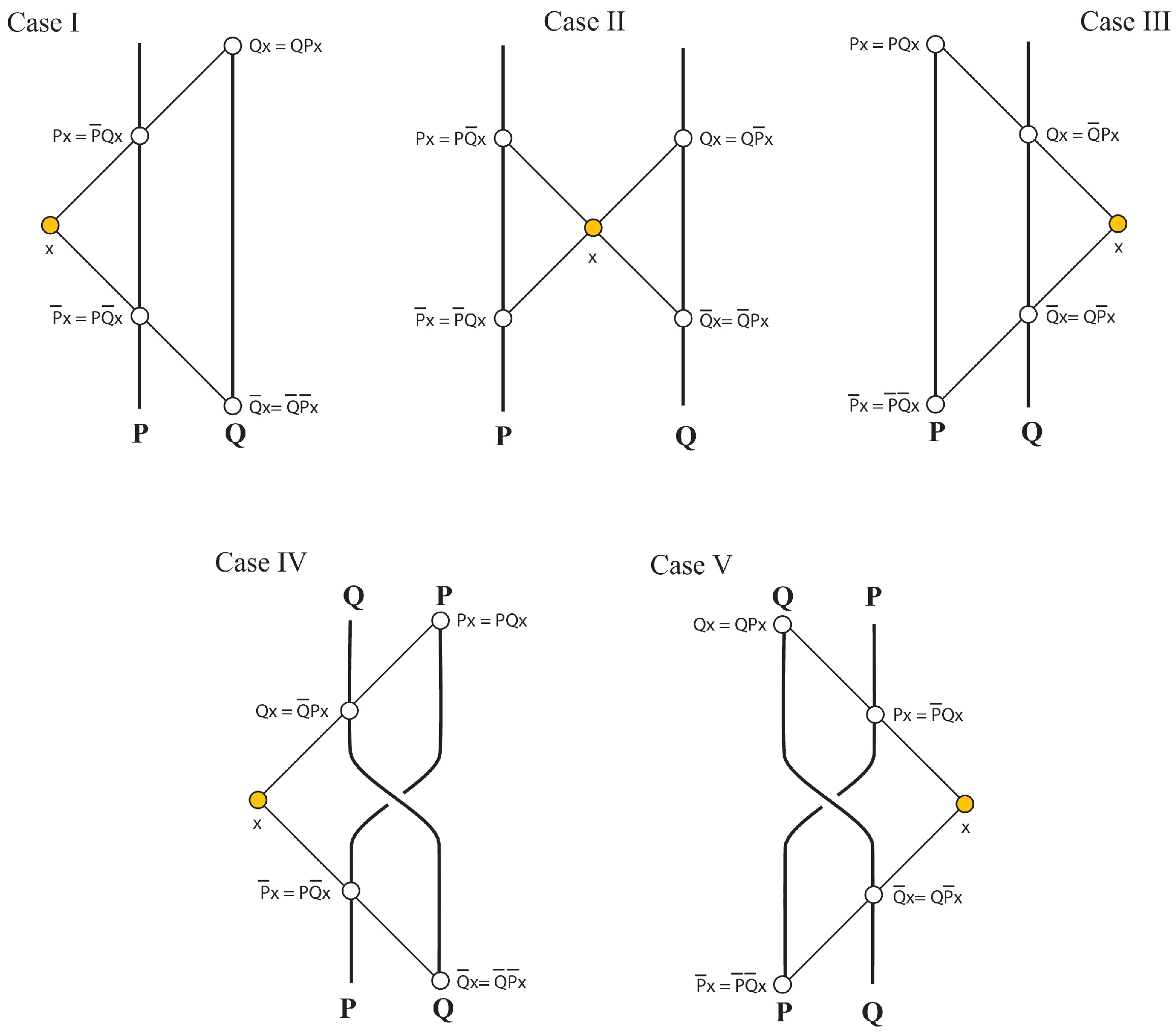
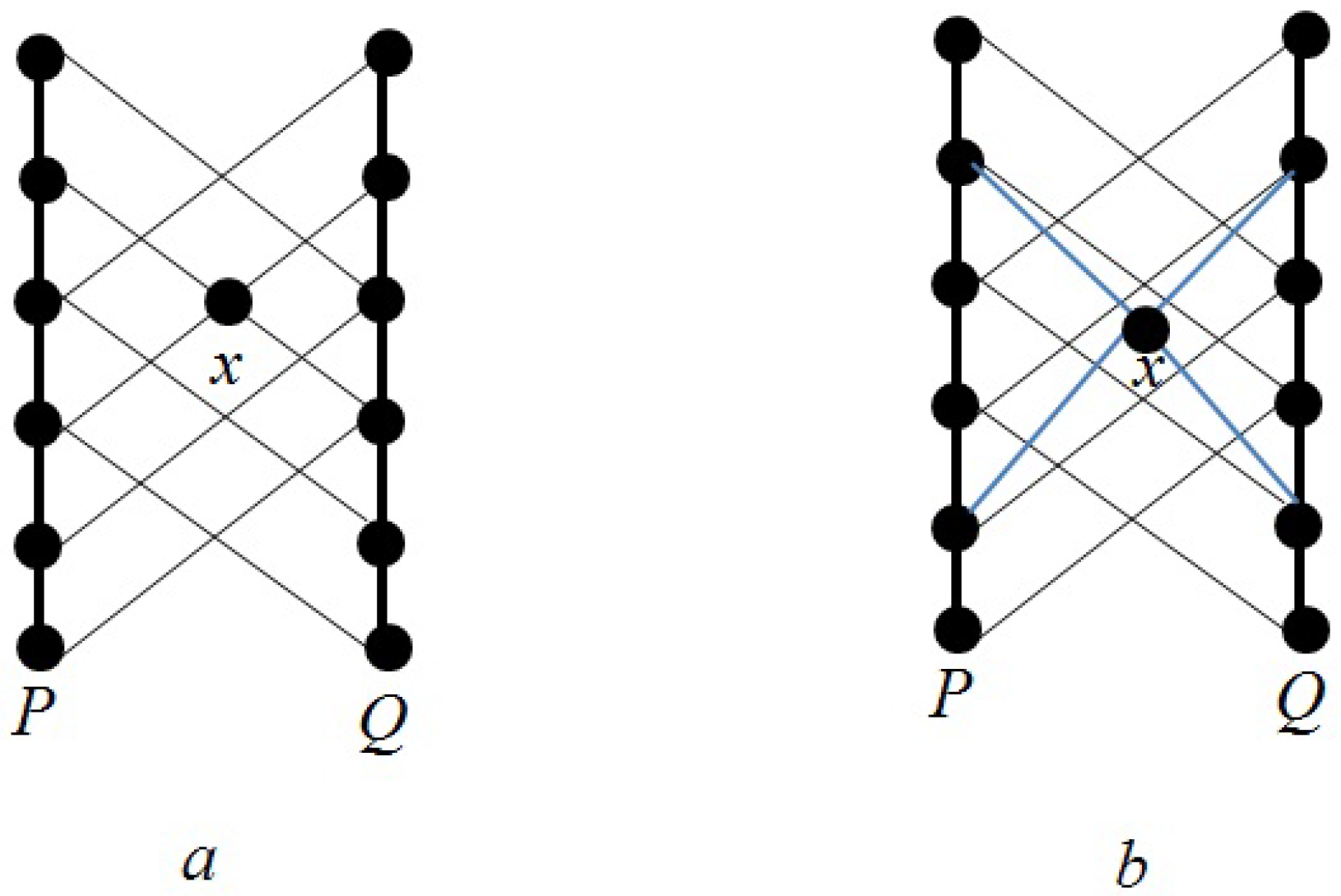
One can show that the following five cases are the only possible cases in which an event x and two distinct chains and in a partially ordered set can be collinear as shown in Figure 2 (a proof is given in Appendix A).
Figure 2.
All possible ways in which an event x is collinear with its projections onto two distinct finite chains and . Cases I–III illustrate the concept of proper collinearity, which enables us to define directionality and betweenness.
Case I:
Case II:
Case III:
Case IV:
Case V:
The invariance of the Cases I, II and III with respect to interchanging forward and backward projections leads us to a more specific definition of collinearity called proper collinearity where an event x is said to be properly collinear with its projections onto two distinct finite chains and if and only if it is collinear with its projections onto the two chains and those projections are invariant with respect to reversing the ordering relation. The generalization of proper collinearity to three finite chains is made if and only if each event is properly collinear with its projections onto and , and these projections constitute a surjective map from onto the finite subchains defined by the closed interval quantified by , and interval quantified by chain , denoted by and .
Collinearity divides the partially ordered set into two equivalence classes: events that are collinear with two distinct finite chains and events that are not collinear with two distinct finite chains. This results in the definition of a subspace. Events that are properly collinear with the two distinct finite chains and reside in a discrete subspace defined by the two chains, denoted by shown in Figure 3a. Chains and are defined to be elements of the subspace [4,5].
Figure 3.
Potential relationships between event x and a subspace formed by two chains and . (a) Event x is in the subspace formed by and , denoted . (b) Event x is not in the subspace formed by and , denoted as .
The collinearity of an event x and two distinct observers can be investigated further by looking at the order in the projections and see how this induces directionality.
3.2. Directionality
In addition to discrete subspaces, collinearity gives rise to the concept of directionality and betweenness in a partially ordered set. Event x is said to be on the side of two distinct finite chains and if the forward and backward projections of event x onto chain are first found on chain denoted as and for the forward and backward projections, respectively, denoted as shown in Figure 2 (Case I). Similarly, if projections of event x onto chain is first found on chain denoted as and for the forward and backward projections, respectively, then x is said to be on the -side of the two finite chains, denoted as shown in Figure 2 (Case II) [4,5].
Event x is said to be between and , denoted as , if event x is first backward projected onto chain and then forward projected onto chain , denoted as , and similarly it is forward projected onto chain and then backward projected onto chain , denoted as as shown in Figure 2 (Case II).
These notions can be extended to three chains , and when all the events on chain are properly collinear with their projections on and .
This results in an ordering relation among chains such that
where < indicates that but . Thus, chains can be ordered, where the direction of ordering is arbitrary.
The subspace defined by two finite chains is two-dimensional, with one dimension resulting from the natural causal ordering among sequences of events along chains and the other resulting from an induced order that is caused by collinearity [4]. To differentiate between the natural ordering and the induced ordering, we say that the subspace is 1 + 1 dimensional [4,5].
A pair of collinear chains that form a subspace can be used as a pair of quantifying embedded observers. The results of this quantification lead to emergence of spacetime and the Minkowski metric as discussed in detail in our previous work [4]. Here, we will review the coordination condition and study different cases as we increase the number of coordinated chains.
3.3. Coordinated Observers
Two chains and are said to be coordinated over the intervals given by , and , if and only if forward projects onto and backward projects onto such that the projections have a one-to-one correspondence, and if the length of a closed interval on is equal to the length of its image on and vice versa. Moreover, we postulate that if two chains agree on the quantification of each other’s intervals, then they must agree on the quantification of all the intervals they both can quantify [4,5].
The set of coordinated chains and form a 1 + 1 dimensional subspace denoted by which includes all elements collinear with these two chains as shown in Figure 3a. Thus, the two coordinated chains can quantify all events that belong to this subspace [4,5].
It can be shown [4] that any generalized interval that belongs to a 1 + 1 dimensional subspace defined by a set of coordinated chains , , and can be quantified consistently with one of the following pairs:
when the interval is on one side of the chain
when the interval is on both sides of the chain and
when both events of an interval are situated between the two quantifying chains, and .
Next, we will consider a special case of two pairs of coordinated chains and use that special case to derive a discrete version of the Pythagorean theorem.
3.4. Orthogonal Subspaces
Here, we will discuss a special case of the two subspaces that will motivate a more general concept of orthogonal subspaces.
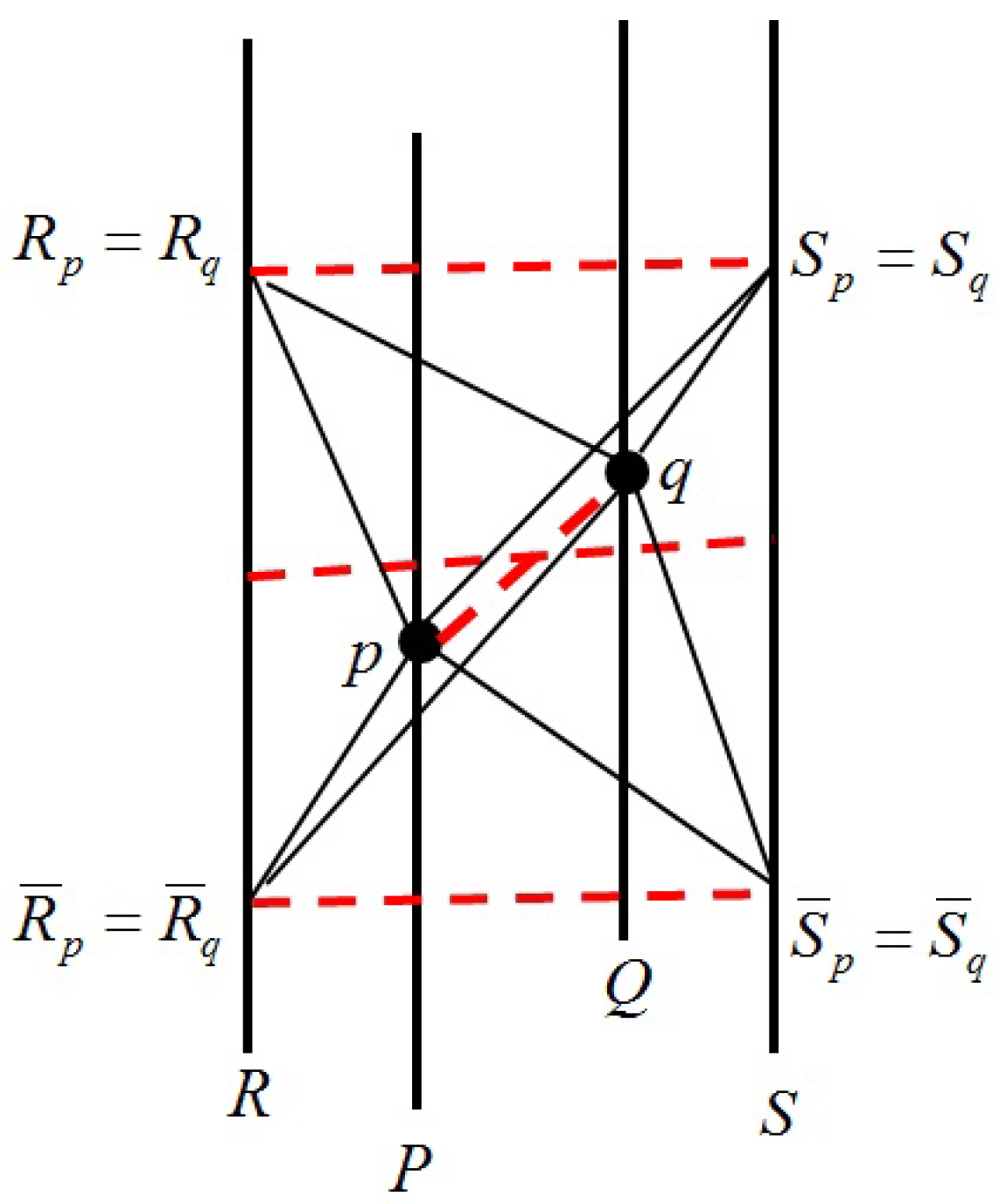
Consider two pairs of coordinated chains and and their corresponding subspaces and , respectively. Consider events and such that is a purely antichain-like interval as quantified by so that the quantification pair for interval with respect to is given by
Now, consider a special case where the two coordinated chains quantify events p and q with the same valuations so that, , , , and . This results in the following antichain-like degenerate quantification pair for the interval with respect to chains
Note that also quantifies both and in an antichain-like degenerate fashion,
where is the valuation assigned by chain . In this situation, the two subspaces and are said to be orthogonal to one another as shown in Figure 4.
Figure 4.
A motivating example for the concept of orthogonality. The chains and are coordinated and the chains and are also coordinated. The pair is the quantification pair for interval as quantified by the chains and . Thus, the two subspaces and are said to be orthogonal.
Note that this is not a definition of orthogonality. This represents a sufficient condition but not a necessary one. A definition of orthogonality will be given in Section 7.
We will use two pairs of orthogonal coordinated chains that were introduced here to derive the Pythagorean theorem.
3.5. Pythagorean Theorem
We use a special configuration of chains to prove the Pythagorean theorem in the poset picture. Consider two sets of coordinated chains and such that they form two orthogonal subspaces and three events , , and as shown in Figure 5. The corresponding antichain-like intervals , , and will then be such that
where ⊎ is the operation that maps the two intervals onto the single interval. For the quantifying pairs, we write
where , , , ⊕ is a function that combines the orthogonal pairs and ∼ is a relation that is the result of combining the quantification pairs of the orthogonal intervals since combining the pairs and in this way is not equal to . Let , , and . Then, Equation (8) can be rewritten as
Figure 5.
A geometric view of the two orthogonal subspaces and where the dots show the geometric view of the chains and the dotted lines show the antichain-like intervals with their endpoints on the chains. The addition of the interval scalars for orthogonal subspaces gives the Pythagorean theorem in the poset picture.
Previously, we have shown that any quantifiable interval can be quantified by a pair as well as a scalar [4]. We have shown that the scalar quantification of a generalized interval that is quantified by the pair with respect to a chain P given by , which is the product of the two elements of the quantifying pair. Equivalently, for a generalized interval quantified by the pair with respect to coordinated chains and , the scalar quantification is given by . This also resulted in a relation among orthogonal intervals such that for orthogonal intervals and . Using this result, we have
among their corresponding interval scalars, which is the familiar Pythagorean theorem applied to antichain-like intervals. Increasing the number of embedded observers from two to three in the special case where the embedded observers belong to orthogonal subspaces results in the Pythagorean theorem. In the next section, we will study two other special cases of adding more quantifying chains and discuss the results.
4. Simplices
We can now show how geometrical shapes, more specifically simplices, arise in a partially ordered set of events when we have more than a pair of quantifying embedded observers. We will consider the cases where we have three and then four observers and discuss each result and the generalization to N observers.
4.1. Discrete Equilateral Triangle
We begin by considering a set of three coordinated chains in two different configurations; when all are collinear and when they are collinear pairwise. Then, we discuss how each configuration is related to a geometric shape.
Consider three coordinated chains , , and with events , , and . Two possible configurations for this set of three coordinated chains are as follows:
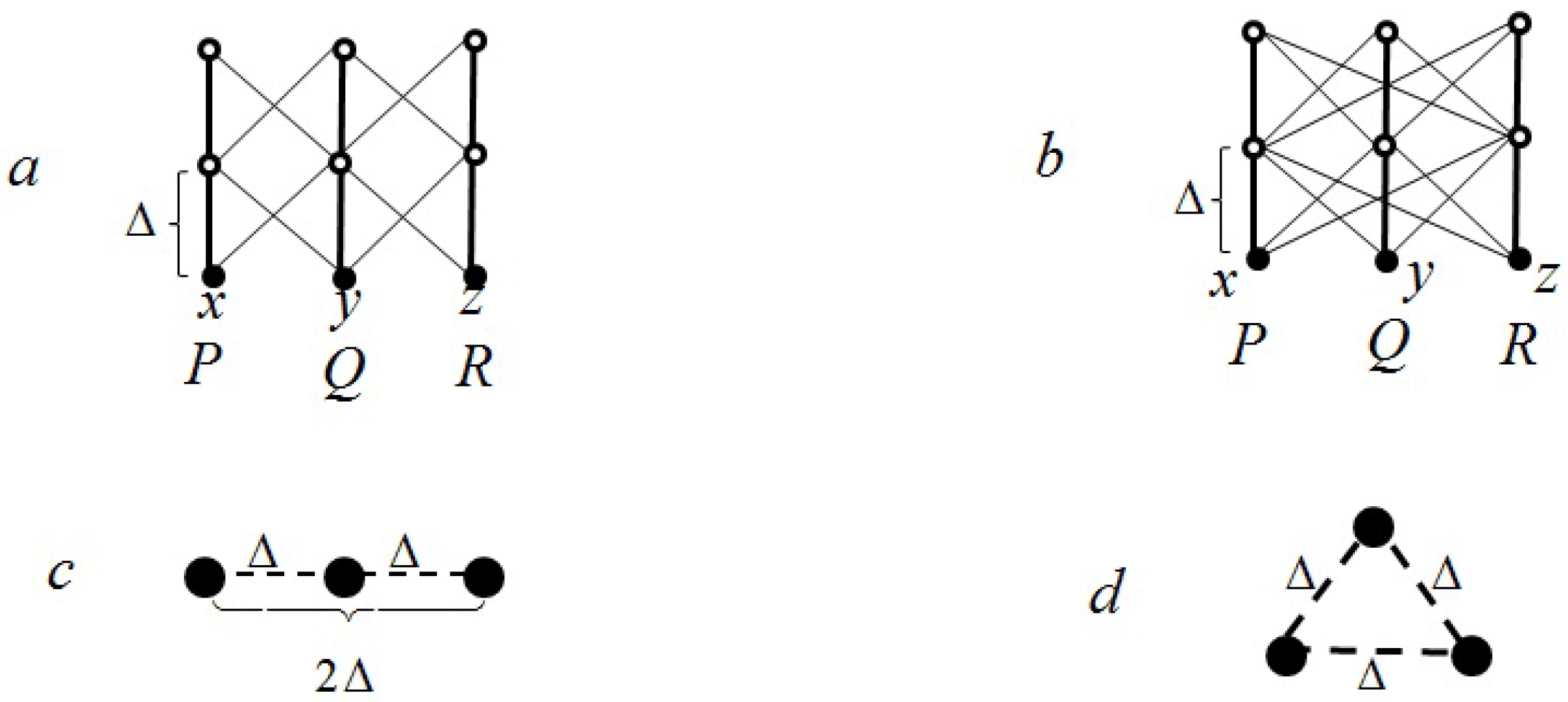
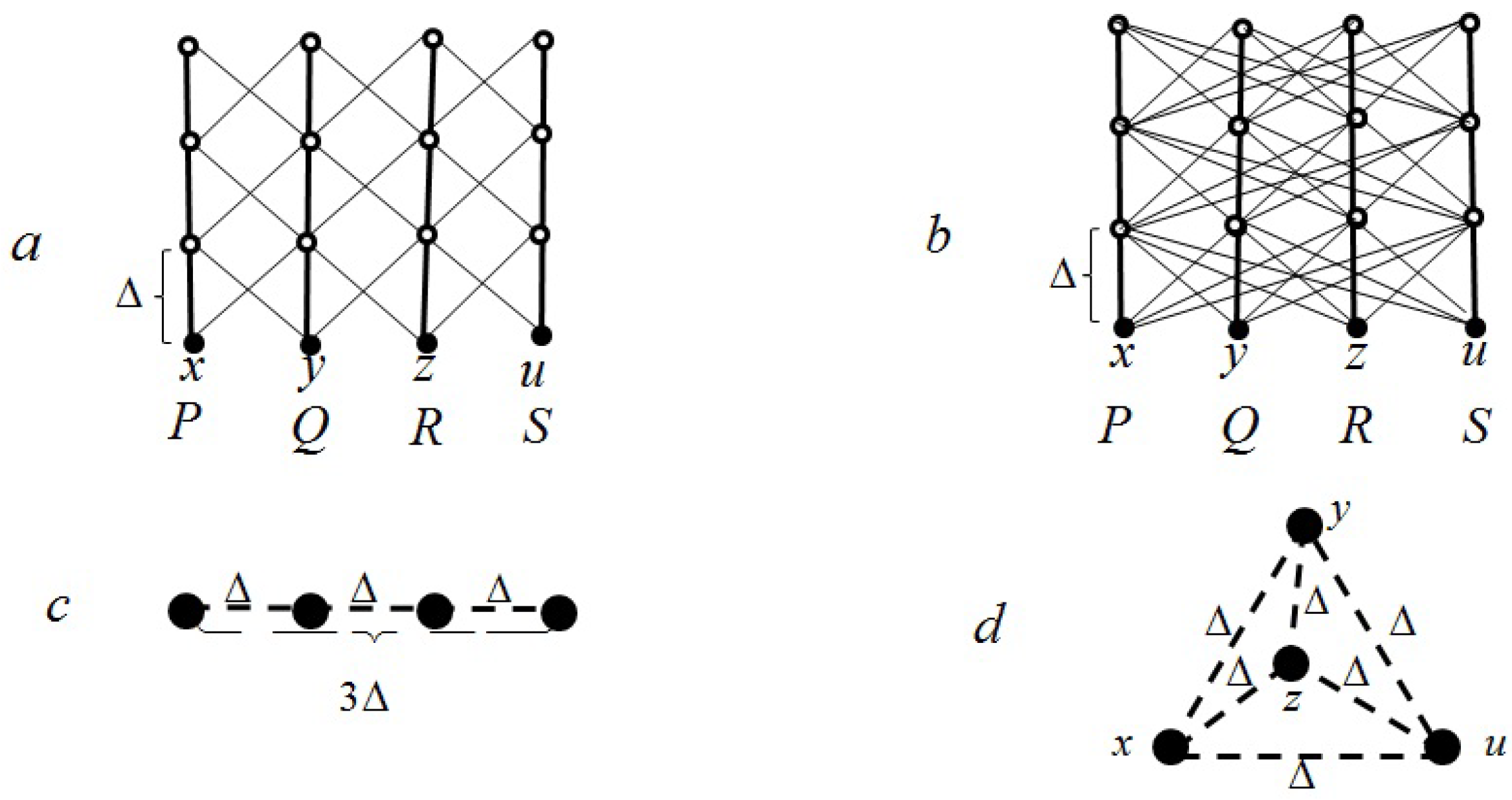
Case I: Coordinated chains , , and are collinear as shown in Figure 6a. Case II: Coordinated chains , , and are collinear pairwise as shown in Figure 6b. According to the configuration in Case I, the finite chain is between the finite chains and , . Consider the situation where , , , and are all pure antichain-like intervals.
Figure 6.
Two cases of three coordinated chains , , and . In Case I, shown in (a), they are all collinear, and in Case II, shown in (b), they are collinear pairwise. The intervals , , and are quantified with respect to pairs of chains , , and , respectively, in both cases. This shows that in Case II intervals form a discrete equilateral triangle shown in (d). The dots in (c,d) show a geometric view of the chains and their corresponding events and the dotted lines show the antichain-like intervals formed by the events.
Case I: Quantifying intervals , , and in Case I with respect to chains , , and , respectively, gives
In general, the quantification pair of an interval can be decomposed using a relation called the symmetric–antisymmetric decomposition, where an interval pair can be rewritten as a component-wise sum of a symmetric pair and an antisymmetric pair such that [4,5]
Introduce the change of variables based on the length as measured along chains and the distance as measured between coordinated chains is as follows:
Rewriting Equation (12) in terms of the new variables gives
We now use this format and rewrite Equation (11) in terms of the symmetric–antisymmetric pairs and
The coordination condition demands that event i on chain projects onto event on chain . This gives . Similarly, for interval we have
and, for interval we have
Geometric view of this case is shown in Figure 6c, where the dots refer to the events , , and and the dotted lines show the antichain-like intervals , , and . Therefore, collinearity imposed on the three coordinated chains makes the intervals , , and aligned such that
It is important to mention here that although the quantifications are with respect to different pairs of chains, since the chains are all coordinated they can compare quantifications.
Case II: In this case, the coordinated chains are collinear pairwise. The quantification pairs of the intervals , , and with respect to chains , , and would be
or in terms of and we have
For intervals and , we have
The geometric view of Case II is shown in Figure 6d, where each chain is equidistant from every other chain. This gives the relation among the intervals as
which shows that the intervals , , and form a discrete equilateral triangle.
This demonstrates that chain projection can be used to order chains in such a way that they can result in the formation of geometric shapes.
We will increase the number of quantifying chains from three to four and discuss the results next.
4.2. Discrete Tetrahedron
Now, let us consider four coordinated chains in both cases discussed above where Case I refers to the set of coordinated chains that are all collinear, and Case II refers to the set of four coordinated chains that are collinear pairwise. Consider four events , , , and such that they form antichain-like intervals , , , , , and as shown in Figure 7a,b.
Figure 7.
Four coordinated chains , , , and in two cases; Case I: all four coordinated chains are collinear. Case II: the four coordinated chains are collinear pairwise. Quantifying intervals , , , , , and with respect to pairs of chains , , , , , and , respectively, results in purely antichain-like intervals that are aligned in Case I as shown in (c), whereas in Case II they form a discrete tetrahedron shown in (d).
We will quantify the purely antichain-like intervals , , , , , and with respect to the pair of coordinated chains shown in their subscripts for each case.
Case I:
where due to the coordination condition. Similarly, for the interval quantified by the coordinated chains we have
and for the interval , the quantification pair with respect to the coordinated chains we have
The quantification pair for interval would be
Interval with respect to the coordinated chains can be quantified as
Next, consider interval with respect to the coordinated chains . In Case I, the quantification pair is given by
Since the chains are all coordinated, the quantifications can be compared. Comparing the quantification results among the pairs of chains in Case I gives
Case II:
This gives the relation
between the quantified intervals. From this result it can be inferred that the events in Case II where the chains are equidistant, are related to a discrete tetrahedron. The rise of geometric simplices implies another important result regarding the dimensionality. The number of discrete subspaces is 1 + 1 for a set of 3 and 4 chains when they are coordinated and collinear. However, the number of discrete subspaces with 4 coordinated chains that are collinear pairwise is 3 + 1 while the number of discrete subspaces is 2 + 1 when there are 3 coordinated chains that are collinear pairwise. In this case, adding a chain corresponds to the addition of one spatial dimension. This can be used to generalize the results from four coordinated chains to N such that having N equidistant coordinated chains corresponds to an dimensional subspace. This means that the quantification technique used to quantify the poset of events and the causal relation among the events do not constrain the dimensionality of space.
Next, we will consider a set of three or more coordinated and collinear observer chains where all belong to the same subspace, called a fence. We will then show how a discrete version of the parallel postulate can be proved as we consider different configurations of two fences.
5. Fence
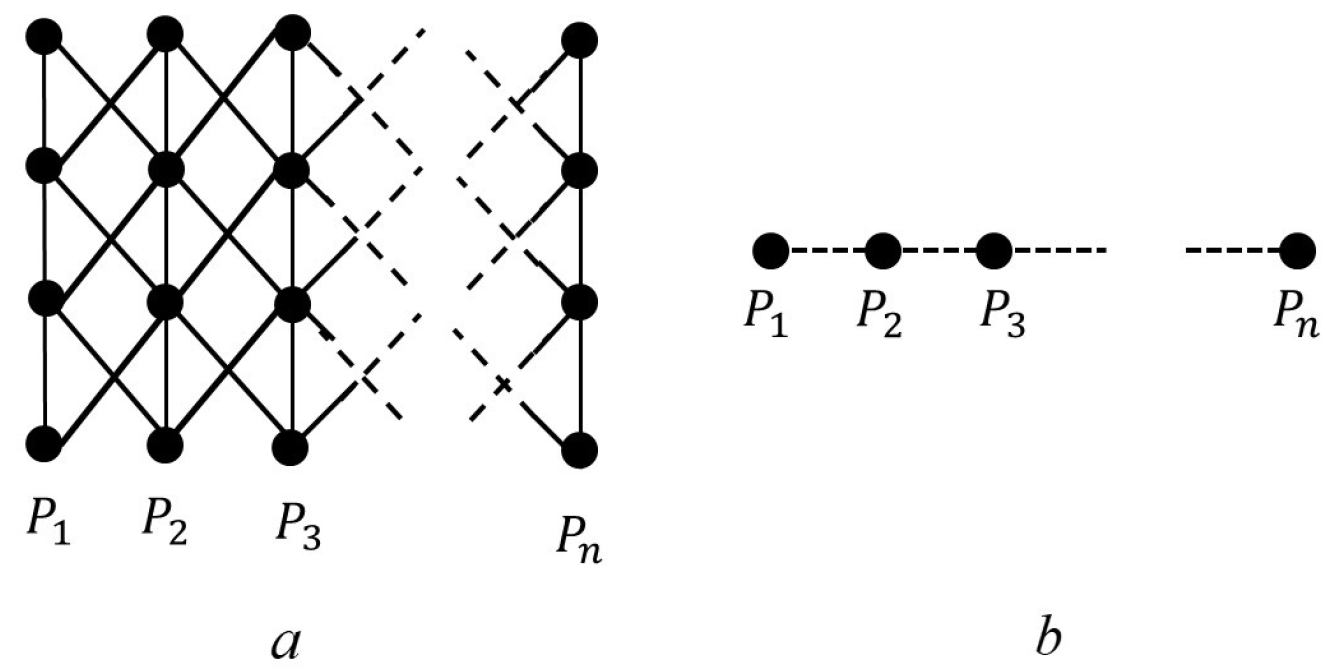
We define a fence as a set of three or more coordinated and collinear chains, denoted by where chains and are the chains at the two ends of the fence as shown in Figure 8. All chains in the fence belong to the subspace . The distance between the first and the last chains in a fence is denoted by .
Figure 8.
(a) Coordinated and collinear chains form a fence. (b) Geometric view of fence .
We will consider different configurations of fences and present a proof of a discrete version of the parallel postulate.
The Parallel Postulate
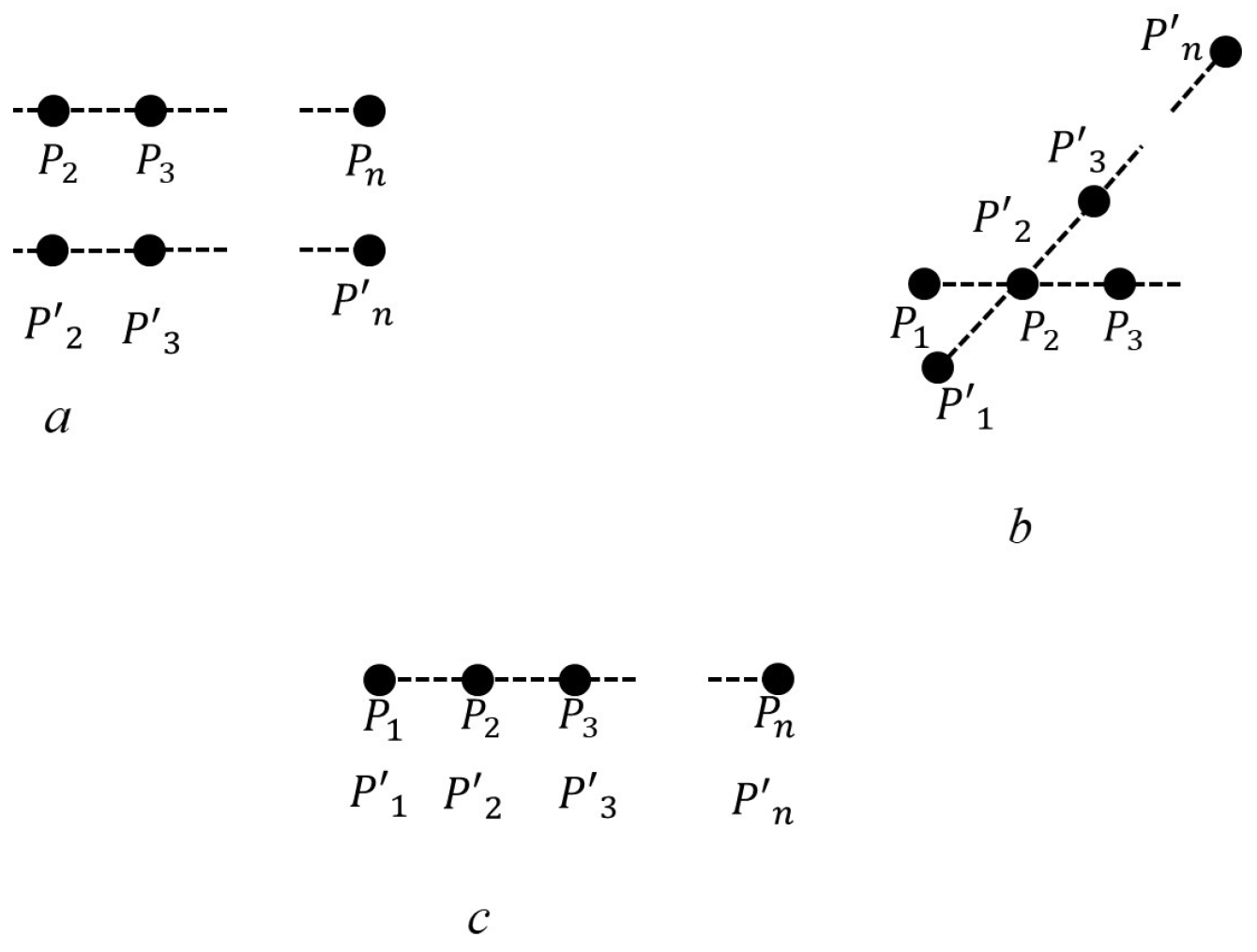
Fences can have different configurations with respect to each other. Two or more fences can share one chain, all chains, or no chain as shown in Figure 9. We will show that if two fences share more than one chain, they share all chains. This is analogous to the parallel postulate in the discrete form.
Figure 9.
Geometric view of three cases of two fences and where they share no chains in (a), they share one chain in (b), and they share all chains in (c).
Proof.
Consider two fences and . If the fences share two chains and , and , then we have
Next, consider an event . Event x has to be collinear with both fences since it belongs to one of the chains in each fence, so we have
for the forward and backward projections of x, respectively. Similarly, for the projections of x onto the fence we have
Since , the projections given in Equation (35) will become
Equations (35) and (37) can both be true only if which is only possible when , since all of the chains in the two fences are coordinated.
□
Note that the number of coordinated and collinear chains for each fence is arbitrary. So, this can be generalized to a pair of fences with any number of chains. Moreover, the number of chains in the two fences does not need to be equal.
This illustrates an analog of the parallel postulate where fences that share no chain are called parallel. This result is not a postulate in this picture; rather, it is a special case derived through coordination condition.
Quantification of an interval with respect to a fence is discussed next when the interval does not belong to the subspace formed by the fence. We will show how this quantification is the analog of a discrete version of the dot product.
6. The Dot Product
We can introduce a more general method that defines the projection of any interval onto a subspace defined by a fence (a set of coordinated and collinear chains). We will show how the result of such projection is the analog of the dot product in the discrete form in a partially ordered set of events.
Consider a set of coordinated chains , …, such that they form a fence . Also, consider an event . The quantification of x with respect to chain would be given by the pair . Consider an event . The quantification pair for the interval with respect to chain is given by . The distance between event x and chain —the antisymmeric component of the symmetric–antisymmetric decomposition of the quantification pair, denoted as —is given as
Now, consider another event y such that and . Event y is quantified by the pair with respect to chain . The quantification of the interval with respect to chain is given by . This gives the distance between event y and chain as the antisymmetric component of the symmetric–antisymmetric decomposition of this quantification pair, denoted by and defined as
Similarly, we can obtain the distances between events x and y and chain as
The projection of the interval onto the subspace will then be given by
or equivalently
Normalizing this term by twice the distance between and , gives
This is a method of subspace projection, and below, we will show that Equation (44) is the analog of the dot product for the poset picture. Note that since this relation only depends on the antisymmetric components, it is independent of the choice of coordinated chains as long as they belong to the same 1 + 1 dimensional subspace shown in Figure 10.
Figure 10.
Geometric view of interval projected onto fence .
To prove that Equation (44) is the answer, we seek a function f that gives us the projection of onto such that the function is independent of the choice of quantifying chains in the fence. To satisfy this requirement, the function must result in a scalar and it must depend on the distances between events x and y and chains and . So, we can assume that the function should linearly depend on all possible scalars involved in this projection
where the distance between event x and chain has the scalar representation of . Similarly, the scalars , , and are found from
Note that instead of and , we can consider any other chain from the fence and the result would be the same. The linear combination of the distances ensures that the result of the projection remains a scalar of the same order. Since has the same time coordinate with respect to all chains in the fence, there is no length-dependence in the projection function.
We now need to determine constants a, b, c, and d. Consider the following special cases:
Special Case I: If , then . So, the projection of onto will be
which gives
Substituting these results back into Equation (46) gives
Special Case II: Consider a special configuration where but and . Also, for their distances, we have and and the time coordinates for both x and y are the same as those quantified by the chains in the fence, as shown in Figure 11. We can write the Pythagorean theorem for this configuration as
in which case the projection will also be zero. Using this condition in Equation (48) gives
Figure 11.
Geometric view of interval perpendicular to fence .
Special Case III: The last special case that we consider is when and . The projection of onto would be . So, we have
However, if and , then
Thus, the projection of an interval onto a set of coordinated and collinear chains that form a fence where both x and y are quantified with the same time coordinates with respect to the chains in the fence is given by
Since all chains in the fence are coordinated, they can share quantifications of the same event. Thus, the same proof holds for any other chain in the fence as it does for and . This allows us to write the discrete form of the dot product of an interval and a fence as
Finally, we can extend quantification with a fence to quantification with a number of fences. We will study a special configuration of fences called a grid and show how such quantifications result in a discrete version of the geometric product.
7. Grid
Let us now study the case where we have more than one fence. In this section, we will focus on a specific configuration of fences called a grid and we will look at the projection of an interval onto the subspace formed by the grid.
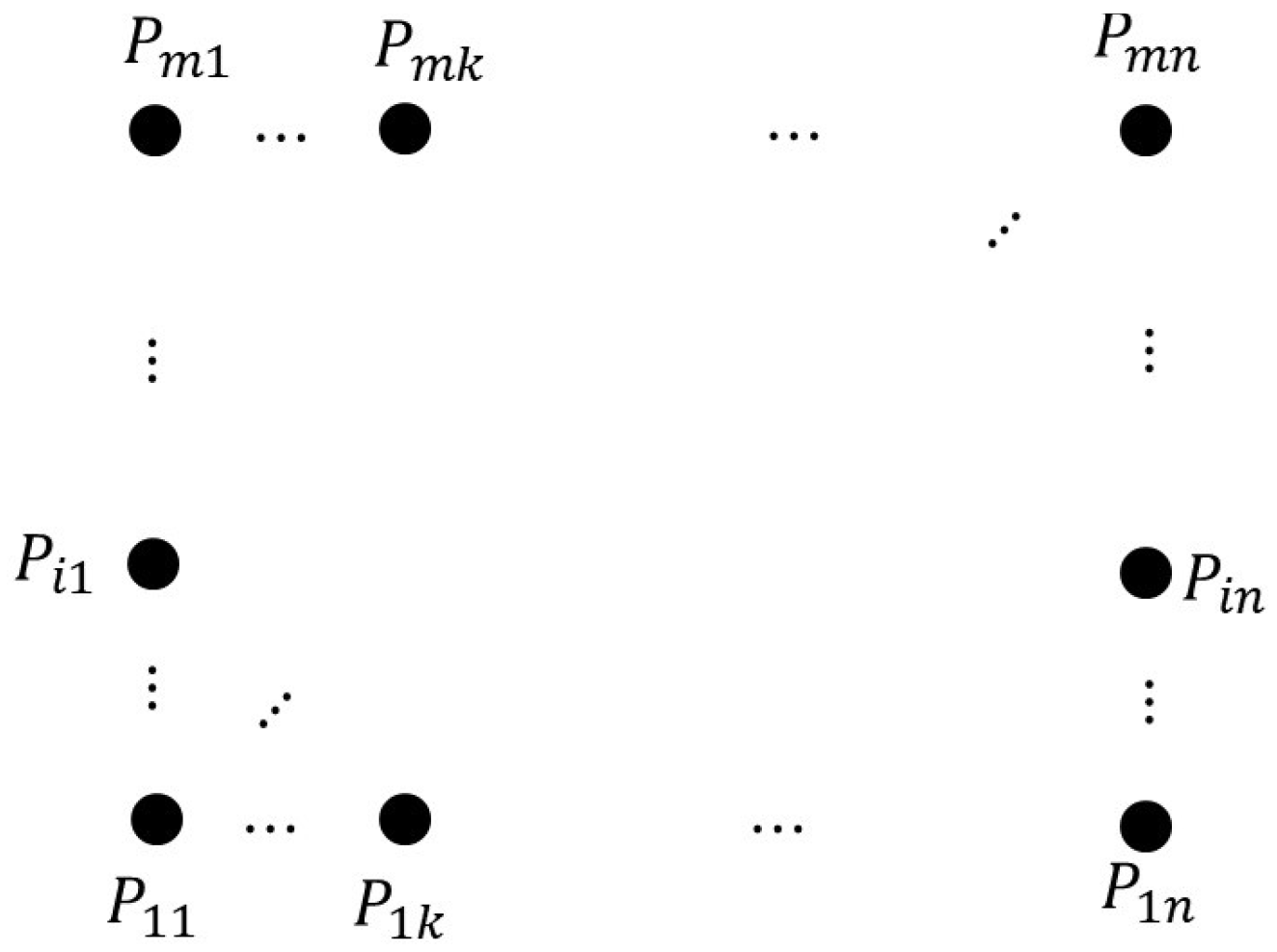
A grid, denoted as , is defined to be a set of two or more parallel fences, where , such that , , …, also form parallel fences as shown in Figure 12. Thus, the subspace formed by a grid is 2 + 1. The two indices in each chain indicate the fence and chain numbers, respectively. For example, is the third chain of the second fence in the grid.
Figure 12.
Geometric view of the grid . Fences , …, are parallel and fences , , …, are also parallel.
Quantification Inside a Grid
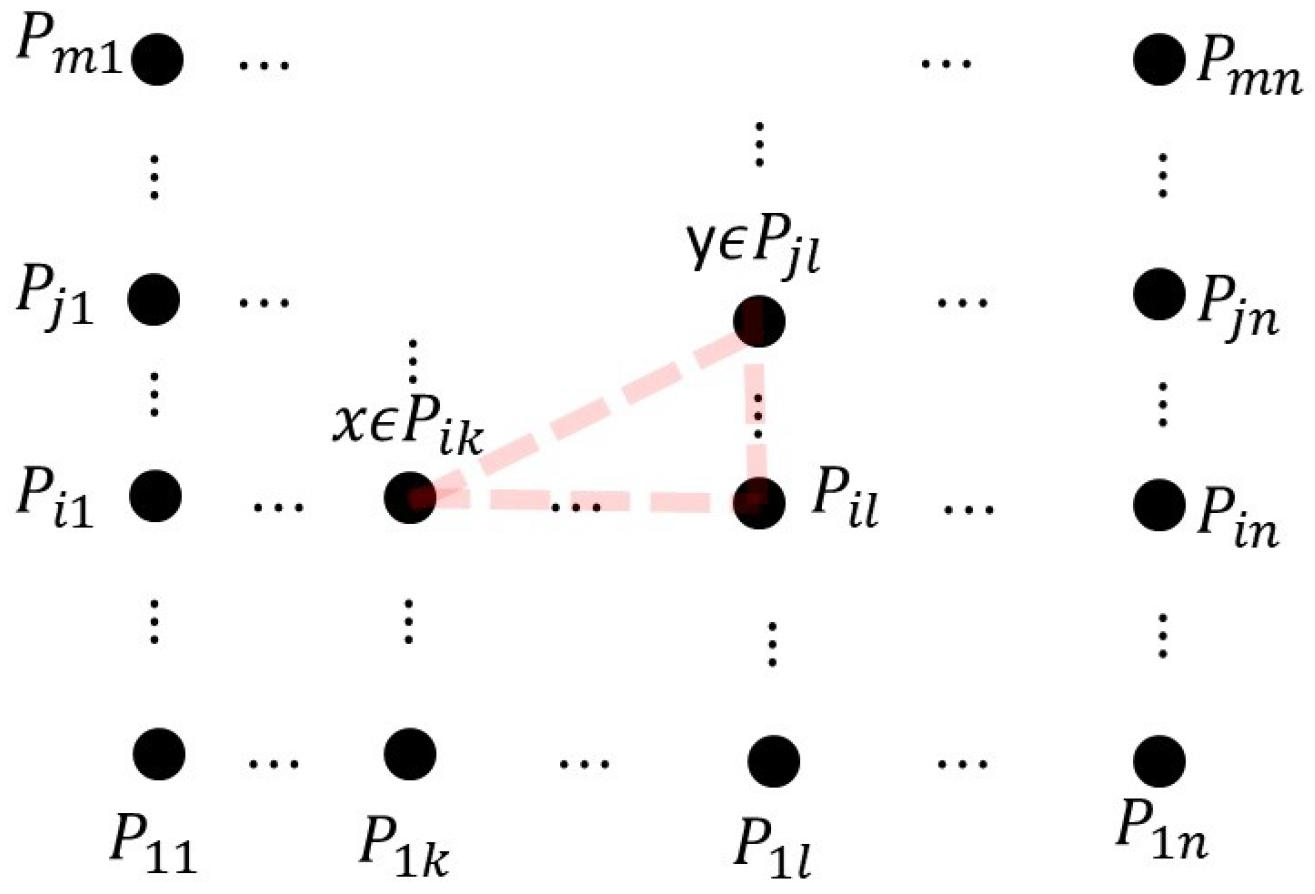
Consider events such that and where are arbitrary fences in the grid shown in Figure 13.
Figure 13.
Events are on and , respectively.
Next, we use Equation (54) to write the projection of interval onto the fence
Note that the projection can be written using any chain in the fence. Moreover, since fences are coordinated, one can pick any other fence and find the projection of the interval onto that fence using Equation (54). For instance, using , the projection would be given by .
If the relation between the projections of any two consecutive fences, such as and , is such that one can write the Pythagorean theorem as
where is the distance between the two chains and , then the grid is defined to be orthogonal. If the grid is orthogonal, Equation (56) can be used to rewrite Equation (57) as
Rearranging this gives
The first term on the right-hand side is simply the dot product. So, Equation (59) can be rewritten as
where we substituted for . To study the second term on the right-hand side, we can look at a few special cases:
- Special Case I: If and , then .
- Special Case II: If and , then .
- Special Case III: If and , then .
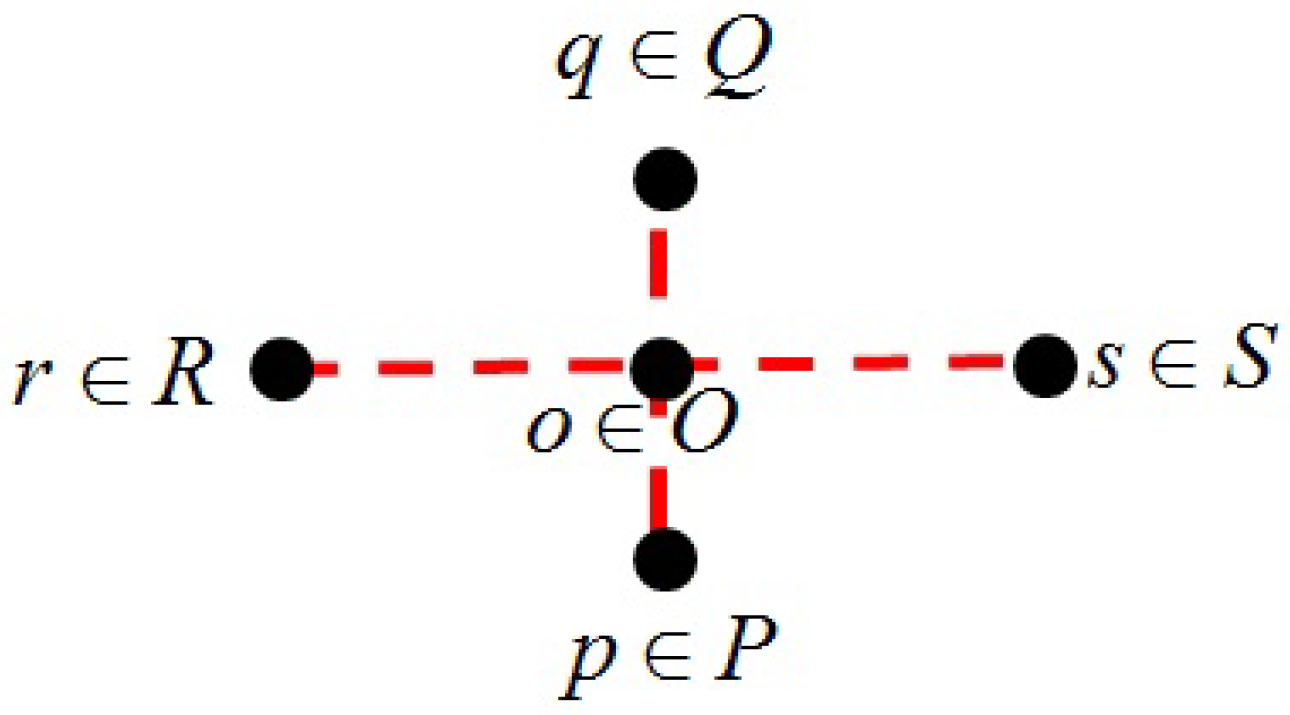
Since is the distance between two events x and y or equivalently, the distance between their corresponding chains and , and is the distance between two chains and , their product must be associated with an area, and the negative sign in the third special case indicates that this must be a directed area. The three special cases considered here indicate that this term can be regarded as the analog of the outer (wedge) product in a discrete case. So, Equation (60) can be rewritten as
where is substituted by .
The same result can be found in the geometric product of two vectors which is defined as the sum of their inner and their outer products
Since , we can write
Squaring both equations and adding them gives
which is the same result found in Equation (61).
The wedge product found here is based on considering 2 + 1 dimensions. However, the results can be generalized to higher dimensions n where . In the special case where we have 3 + 1 dimensions where the wedge product can be written as the cross product which gives Equation (64) as .
8. Conclusions
In this paper, we applied the quantification technique introduced in Ref. [4] for quantifying partially ordered set of events to different configurations of chains in order to find geometric features of a poset of events. This led to a discrete version of some features of Euclidean geometry. We first reviewed our previous work on quantifying a partially ordered set of events using chain projections. We showed how order in projections of an event onto a pair of chains induce some of the fundamental concepts in geometry such as collinearity, directionality, and subspaces. The coordination condition from our previous work is reviewed and then extended from two to more chains.
Our results suggest that many features in Euclidean geometry are not fundamental, but rather they are derived from order. Our main findings in this paper can be outlined as follows:
- [1]
- We demonstrated that the Pythagorean theorem is derived from the fact that the interval scalars of orthogonal subspaces are additive (see Equation (10)).
- [2]
- [3]
- We introduced the concept of a fence as a set of three or more collinear and coordinated chains. Then, we studied different configurations of two fences. Most importantly, we proved (see Equations (35)–(37)) that fences that share more than one chain and share all chains, which is the equivalent of the parallel postulate in the discrete case.
- [4]
- We found that the projection of an interval onto a set of collinear and coordinated chains results in the dot product (see Equation (54)). The features of the outer (wedge) product in dimensions appeared when quantification was extended from one fence to a number of fences.
- [5]
- Writing the Pythagorean theorem inside a grid, we found a relation whose terms were similar to those of the geometric product squared (see Equation (61)).
Applications of lattice theory extend beyond Euclidean geometry. For instance, lattice theory has a wide range of applications from computer science (e.g., [33,34]) to physics (e.g., [35]). Applications of causal sets have also been investigated. In one study, the dynamics of spacetime at quantum scales was studied using numerical simulations of a two-dimensional causal set quantum gravity [36]. These results indicate that changes in some parameters cause a change in the properties of the causal set, which is referred to as a phase transition. Moreover, there have been studies on testing the dimensionality of spacetime using a causal set model where it has been demonstrated that the dimensions of spacetime, for conformally flat spacetime, can be determined by the causal set theory [37]. The approach is based on embedding the causal set in conformally flat spacetime which can ultimately result in the correct continuum dimensions.
Deriving the geometry of spacetime has been the focus of many studies. For instance, in order to study curved spacetime, a topology which unifies causal, differential, and conformal structure was introduced [38]. In another example, the topology of spacetime was shown to be determined by a class of timelike curves which are all possible causal trajectories of particles with mass [39]. Another study models causal sets that correspond to continuum spacetime and compares their discrete topology to that of the continuum topology [40].
It is important to emphasize that the results found in our paper are based on no assumptions about the structure or even the existence of space or time. Rather, they appear merely as a result of order in a poset of events and their consistent quantification. The results found so far in this picture indicate an interesting view of the foundations of physics without any assumptions about space or time. In particular, this theoretical approach leads to obtaining many features of the Fermion physics and the Dirac equation based on a model of a free electron as a poset [6,7,8,10], relativistic Newton’s second law when a particle in being influenced [30], and the derivation of all aspects of special relativity including the Minkowski metric, the existence of an upper limit for velocity, and the Lorentz transformations [4,5]. Finally, this methodology may be used to investigate further physical laws and their connections based on a minimalist view. Based on our previous work [4,5] the scalar quantification of symmetric and antisymmetric pairs associated with quantifications along and across a pair of coordinated chains, respectively, are responsible for the Lorentzian signature that appears in this picture. However, nothing in the causal relation or the quantification scheme we have used prevents us from going to N spatial dimensions. So, the fact that the laws of physics, expressed in terms of empirically defined concepts such as mass, energy, momentum, and positions in space and time, emerge from a more foundational and basic axiomatic/theoretical approach suggests that these concepts may not be fundamental. Based on this picture, one could argue that what we observe in spacetime physics is a macroscopic manifestation of a continuum of elementary events which, when suitably ordered, can be expressed as time, compared in terms of distances, and grouped in certain ways to form areas and/or volumes while there is no space or time defined in this picture. Indeed, it happens to be the case that one can argue that this macroscopic physical picture can be regarded, at a deeper level, as emerging from a microscopic discrete theoretical framework where the concepts of a causal set equipped with an ordering relation can give rise to a classical spacetime equipped with its Lorentzian metric. This foundational viewpoint lays the foundations of the so-called causal set theory approach to quantum gravity [14,41].
Although the relative view of space as being merely a relation among objects which was envisioned by al-Ghazali [42] and later Leibnitz [43] was first ignored and then rejected due to its contradiction with the Newtonian mechanics, it was not until the derivation of Einstein’s theory of Special Relativity when the relative view of space and time was taken seriously. The poset picture that was discussed in this research takes this a step further by showing how all aspects of special relativity can be derived with no assumption about space and time [4]. Even geometrical properties that were thought to be intrinsic properties of space such as directionality and subspaces emerge in this picture with no reference to space and time. As Poincaré and Mach also suggested, it is all about the connectivity.
Author Contributions
Conceptualization, N.B.; Writing-original draft, N.B.; Writing—review and editing, N.B., C.C. and L.R. All authors have read and agreed to the published version of the manuscript.
Funding
This research received no external funding.
Data Availability Statement
No new data were created or analyzed in this study. Data sharing is not applicable to this article.
Acknowledgments
N.B. thanks W. Ballard, D. McCuskey, C. Zhang and I. Ashley for helpful discussions on deriving some of the aspects in Euclidean geometry including the dot product, the parallel postulate, and the outer (wedge) product. The authors thank the anonymous referees for useful comments leading to an improved version of the manuscript.
Conflicts of Interest
The authors declare no conflict of interest.
Appendix A
As mentioned in Section 3.1, there are five possible cases where an event x and two distinct chains and in a partially ordered set can be collinear. The proof is given here.
Theorem A1.
According to the definition of collinearity, the following cases exhaust all possible ways in which x can be collinear with and :
- Case I:
- Case II:
- Case III:
- Case IV:
- Case V:
Proof.
which corresponds to the code 2201.
which corresponds to the code 1010.
which corresponds to the code 0122.
which corresponds to the code 0221.
which corresponds to the code 2102 Q.E.D.
Consider two distinct finite chains and and an event such that event x is forward and backward projected onto both chains. There are algebraic possibilities of the order of projections of x onto the two chains given by
There are then pairwise combinations of these relations. First, note that cases , , , and cannot occur. Consider, for example, . On the right-hand side, we have both backward projections and of event x whereas in the left-hand side we have only forward projection P of the same event on one of the chains. This is not possible since if x is backward projected onto chains and then which is only equal to if which violates causality. Similarly, the other three cases , , and are also ruled out. This leaves us with twelve cases
where the columns are codes as 0, 1, and 2. We have to consider all the possible combinations of the forward and backward projections for both chains, which are P, Q, , and for each combination, which in terms of the codes given above, would be
which are cases. We now have to consider each case to see which of them are possible.
Consider the case 0000
These relations among the forward and backward projections of event x onto the two distinct chains and are also not possible. For example, if we have , it means that the forward projection of event x onto chain is first found on chain while indicates that the forward projection of event x onto chain is first found on chain . This is only possible when chains and are interchanged, which then does not refer to this one case. This also holds for the backward projections, that is, the two cases and cannot occur together. There are 17 combinations that include these two conditions together which will be eliminated. Next, consider 0010
Substituting into gives
which is impossible since on the right-hand side the forward and backward projections of x onto overlap. Similarly, and cannot be combined which together eliminates 14 more cases that include these combinations. For the same reason we can see that the two cases and as well as and also cannot be combined which eliminates 13 more cases. Moreover, the two cases and cannot be combined since they yield that both and are equal to . Therefore, eight more cases are ruled out. Now, consider and . Upon substitution of from the second equation into the first we obtain which is an impossible order of projections since the forward projection of event x onto overlaps with its backward projection. Similarly, the combinations and cannot occur either which together, eliminates nine more cases. The two cases and cannot be combined since they give the same relation for the forward and backward projections. The same situation holds for and . These two conditions rule out five more cases. It is also impossible to have and together as well as and since both forward and backward projections of x onto one of the two chains are first found as a backward projection of x onto the other chain which contradicts collinearity. This eliminates three more cases. Consider the combinations that have and . If we substitute the value for from the second equation into the first one, we have , which is impossible, and eliminates two more cases. and cannot be combined either since both the forward and backward projections of x onto can be found on the forward projection of x onto , which eliminates two more cases. The two cases and cannot be combined either since if we substitute into the relation for we obtain which means that the forward and backward projections of x onto are the same point. This eliminates two more cases. Finally, the combination 0121 cannot occur which refers to , , , and . If we have , , and , then we cannot have . This leaves us with the remaining five cases
- Case I:
- Case II:
- Case III:
- Case IV:
- Case V:
□
References
- Euclid. The Thirteen Books of The Elements, 2nd ed.; Heath, T., Ed.; Dover: New York, NY, USA, 1956. [Google Scholar]
- Jammer, M. Concepts of Space: The History of Theories of Space in Physics, 2nd ed.; Harvard University Press: Cambridge, MA, USA, 1969. [Google Scholar]
- Einstein, A. On the Electrodynamics of Moving Bodies. Ann. Phys. 1905, 17, 891. [Google Scholar] [CrossRef]
- Knuth, K.H.; Bahreyni, N. A Potential Foundation for Emergent Space-Time. J. Math. Phys. 2014, 55, 112501. [Google Scholar] [CrossRef]
- Knuth, K.H.; Bahreyni, N. The order-theoretic origin of special relativity. In Bayesian Inference and Maximum Entropy Methods in Science and Engineering: Proceedings of the 30th International Workshop on Bayesian Inference and Maximum Entropy Methods in Science and Engineering, Chamonix, France, 4–9 July 2010; Bessiere, P., Bercher, J.-F., Mohammad-Djafari, A., Eds.; American Institute of Physics: Melville, NY, USA, 2011; Volume 1305, pp. 115–121. [Google Scholar]
- Knuth, K.H. Inferences about interactions: Fermions and the Dirac equation. arXiv 2012, arXiv:1212.233. [Google Scholar]
- Knuth, K.H. Information-based physics: An observer-centric foundation. Contemp. Phys. 2013, 55, 12–32. [Google Scholar] [CrossRef]
- Knuth, K.H. Understanding the Electron. arXiv 2015, arXiv:1511.07766. [Google Scholar]
- Knuth, K.H. Information physics: The new frontier. In Bayesian Inference and Maximum Entropy Methods in Science and Engineering: Proceedings of the 30th International Workshop on Bayesian Inference and Maximum Entropy Methods in Science and Engineering, Chamonix, France, 4–9 July 2010; Bessiere, P., Bercher, J.-F., Mohammad-Djafari, A., Eds.; AIP: New York, NY, USA, 2010; Volume 1305, pp. 3–19. [Google Scholar]
- Knuth, K.H. Information-based physics and the influence network. In It from Bit or Bit from It? Springer: Cham, Switzerland, 2013. [Google Scholar]
- Knuth, K.H.; Skilling, J. Foundations of Inference. Axioms 2012, 1, 38–73. [Google Scholar] [CrossRef]
- Sorkin, R.D. Causal Sets: Discrete Gravity, Lectures on Quantum Gravity; Gomberoff, A., Marolf, D., Eds.; Springer: New York, NY, USA, 2005; pp. 305–327. [Google Scholar]
- Sorkin, R.D. Geometry from Order: Causal Sets. Einstein Online 2006, 2, 1007. [Google Scholar]
- Bombelli, L.; Lee, J.-H.; Meyer, D.; Sorkin, R. Spacetime as a Causal Set. Phys. Rev. Lett. 1987, 59, 521–524. [Google Scholar] [CrossRef]
- Bombelli, L.; Meyer, D.A. The origin of Lorentzian geometry. Phys. Lett. A 1989, 141, 226–228. [Google Scholar] [CrossRef]
- Grothus, M.; Vilasini, V. Characterizing signalling: Connections Between Causal Inference and Space-time Geometry. arXiv 2024, arXiv:2403.0091. [Google Scholar]
- Ormrod, N.; Barrett, J. Quantum influences and event relativity. arXiv 2024, arXiv:2401.18005. [Google Scholar]
- Cafaro, C.; Lord, W.M.; Sun, J.; Bollt, E.M. Causation Entropy from Symbolic Representations of Dynamical Systems. Chaos 2015, 25, 043106. [Google Scholar] [CrossRef] [PubMed]
- Cafaro, C.; Ali, S.A.; Giffin, A. Thermodynamic Aspects of Information Transfer in Complex Dynamical Systems. Phys. Rev. 2016, E93, 022114. [Google Scholar] [CrossRef] [PubMed]
- Dukovski, I. Causal structure of Spacetime and Geometric Algebra for Quantum Gravity. Phys. Rev. 2013, D87, 064022. [Google Scholar] [CrossRef]
- Davey, B.A.; Priestley, H.A. Introduction to Lattices and Order; Cambridge University Press: Cambridge, MA, USA, 2002. [Google Scholar]
- Gätzer, G. General Lattice Theory; Birkhäuser: Basel, Switzerland, 2003. [Google Scholar]
- Cafaro, C.; Ali, S.A. The Spacetime Algebra Approach to Massive Classical Electrodynamics with Magnetic Monopoles. Adv. Appl. Clifford Algebr. 2007, 17, 23. [Google Scholar] [CrossRef]
- Doran, C.; Lasenby, A. Geometric Algebra for Physicists; Cambridge University Press: Cambridge, MA, USA, 2003. [Google Scholar]
- Hestenes, D. Spacetime Algebra; Gordon and Breach: New York, NY, USA, 1966. [Google Scholar]
- Cafaro, C. Finite-Range Electromagnetic Interaction and Magnetic Charges: Spacetime Algebra or Algebra of Physical Space? Adv. Appl. Clifford Algebr. 2007, 17, 617. [Google Scholar] [CrossRef]
- Knuth, K.H. Lattice duality: The origin of probability and entropy. Neurocomputing 2005, 67C, 245–274. [Google Scholar] [CrossRef]
- Knuth, K.H. Valuations on lattices and their application to information theory. In Proceedings of the 2006 IEEE International Conference on Fuzzy Systems, Vancouver, BC, Canada, 16–21 July 2006; pp. 217–224. [Google Scholar]
- Knuth, K.H. Measuring on lattices. In Bayesian Inference and Maximum Entropy Methods in Science and Engineering: The 29th International Workshop on Bayesian Inference and Maximum Entropy Methods in Science and Engineering, Oxford, MS, USA, 2009; Goggans, P., Chan, C.-Y., Eds.; AIP: New York, NY, USA, 2009; Volume 1193, pp. 132–144. [Google Scholar]
- Knuth, K.H.; Walsh, J.L. An Introduction to Influence Theory: Kinematics and Dynamics. Ann. Phys. 2019, 531, 1800091. [Google Scholar] [CrossRef]
- Knuth, K.H. Partially Ordered Set. In Enumerative Combinatorics, 2nd ed.; Cambridge University Press: Cambridge, MA, USA, 2011; Volume 1, pp. 241–463. [Google Scholar]
- Birkhoff, G. Lattice Theory, 3rd ed.; American Mathematical Society: Providence, RI, USA, 1967. [Google Scholar]
- Fayyad, U.; Piatetsky-Shapiro, G.; Smyth, P. From Data Mining to Knowledge Discovery in Databases. AI Mag. 1996, 17, 37. [Google Scholar]
- Micciancio, D.; Regev, O. Lattice-Based Cryptography. In Post-Quantum Cryptography; Bernstein, D.J., Buchmann, J., Dahmen, E., Eds.; Springer: Berlin, Germany, 2009; pp. 147–191. [Google Scholar]
- Smyth, M.S.; Martin, J.H. X Ray Crystallography. Mol. Pathol. 2000, 53, 8–14. [Google Scholar] [CrossRef] [PubMed] [PubMed Central]
- Surya, S. Evidence for a Phase Transition in 2D Causal Set Quantum Gravity. Class. Quantum Gravity 2012, 29, 132001. [Google Scholar] [CrossRef]
- Reid, D.D. Manifold dimension of a causal set: Tests in conformally flat spacetimes. Phys. Rev. D 2003, 67, 024034. [Google Scholar] [CrossRef]
- Hawking, S.W.; King, A.R.; McCarthy, P.J. A New Topology for Curved Space-Time which Incorporates the Causal, Differential and Causal Structures. J. Math. Phys. 1976, 17, 174181. [Google Scholar] [CrossRef]
- Malament, D.B. The Class of Continuous Timelike Curves Determines the Topology of Spacetime. J. Math. Phys. 1977, 18, 13991404. [Google Scholar] [CrossRef]
- Surya, S. Causal Set Topology. Theor. Comput. Sci. 2008, 405, 187–197. [Google Scholar] [CrossRef]
- Surya, S. The Causal Set Approach to Quantum Gravity. Living Rev. Relativ. 2019, 22, 5. [Google Scholar] [CrossRef]
- Al-Ghazali, M. The Incoherence of the Philosophers, 2nd ed.; Marmura, M.E., Ed.; Brigham Young University: Provo, UT, USA, 2002. [Google Scholar]
- Futch, M. Leibniz’s Metaphysics of Time and Space; Springer: New York, NY, USA, 2008. [Google Scholar]
Disclaimer/Publisher’s Note: The statements, opinions and data contained in all publications are solely those of the individual author(s) and contributor(s) and not of MDPI and/or the editor(s). MDPI and/or the editor(s) disclaim responsibility for any injury to people or property resulting from any ideas, methods, instructions or products referred to in the content. |
© 2024 by the authors. Licensee MDPI, Basel, Switzerland. This article is an open access article distributed under the terms and conditions of the Creative Commons Attribution (CC BY) license (https://creativecommons.org/licenses/by/4.0/).