

Abstract
Suppose R is a local ring with invariants and that is R of order Then, has maximal ideal of order and a residue field F of order where is the coefficient subring of In this article, the goal is to improve the understanding of linear codes over small-order non-chain rings. In particular, we produce the MacWilliams formulas and generator matrices for linear codes of length N over In order to accomplish that, we first list all such rings up to isomorphism for different values of Furthermore, we fully describe the lattice of ideals in R and their orders. Next, for linear codes C over R, we compute the generator matrices and MacWilliams identities, as shown by numerical examples. Given that non-chain rings are not principal ideals rings, it is crucial to acknowledge the difficulties that arise while studying linear codes over them.
MSC:
16L30; 94B05; 16P20; 94B60
1. Introduction
Linear codes with length N over ring R correspond to R-submodules of The interest in coding over finite rings began when linear codes over rings and those over fields were linked using Gray maps. Every alphabet ring used in this work is finite, commutative, and contains an identity. If a ring R has one maximal ideal, J (the Jacobson radical), then it is said to be local. Each local ring is associated with specific integer invariants, and where p is a prime number representing the characteristic of the residue field of order m satisfies with is the characteristic of R, and k is related to a distinguished basis of explained later in Section 2 (see [1,2,3]). The ring R is referred to as a principal ideal ring (PIR) when all of its ideals are principal. When J is principal, it creates a distinguished class known as chain rings [4,5,6]. Codes over local non-chain rings have received less research attention because chain rings are principal ideal rings (PIRs), and many results found for chain rings also hold for PIRs. One of the main reasons that Frobenius rings, defined later, are considered an appropriate class to characterize codes is because they meet both of the MacWilliams theorems [7,8,9]. Frobenius local rings, however, can be decomposed into their primary components. To fully comprehend codes over Frobenius rings, it is necessary, despite difficulties, to consider local non-chain rings. Thus, the primary goal of this work is to produce significant coding results over local non-chain rings in order to advance this field of study. For additional information on this subject, see [10,11,12,13,14] and related references.
The main purpose of this work is to generate important coding results over local non-chain rings to address the significance of these broad discoveries. This paper focuses mainly on codes over local rings with order ; that is, Previous work on these rings was described in [1], where it was emphasized how applicable they are to coding theory and how closely they relate to linear binary codes and [15]. In error-correcting theory, we clarify the roles of generator matrices and MacWilliams relations, particularly as they relate to the weight enumerators of a code and its dual code. These methods were taken into consideration by the authors of [16,17] for Frobenius local rings of small order, namely In [18], rings of order 32 were used to describe generator matrices and the MacWilliams relations. In an attempt to expand upon earlier discoveries, this paper offers access to more generic rings with higher orders. With let where is the maximum ideal of R and is its coefficient subring. This paper focuses on two useful tools of coding theory: generator matrices and MacWilliams relations. First, we provide a formula for a generating character associated with R, and we make use of it to generate a matrix This matrix is then utilized to obtain the MacWilliams relations between symmetrized weight enumerators for a code C over R and its dual. Next, we investigate generator matrices of linear codes over These matrices are extremely useful tools, since they can generate the code and provide the code’s size. There is a well-known canonical form that achieves this for codes over chain rings. However, codes over local non-chain rings do not fit similarly; thus, we give a natural extension of this canonical form (see Theorem 10). We also exhibit several numerical examples to demonstrate why the code’s size cannot always be determined directly from its generator matrix.
Following the basic definitions and information in Section 2, the list of all rings of type with invariants such that are provided in Section 3. A special focus is on supplying all the information required to define the lattice of ideals of rings of order and to describe them. The overall process for creating characters for R when it is Frobenius is given in Section 4. Additionally, an appropriate matrix is also acquired through which MacWilliams relations are deduced. The results for matrices producing linear codes over such rings are given in Section 5.
2. Preliminaries
This section introduces the notations and basic information that will be used later in our discussion. Let J be the maximal ideal of a local ring with identity R. We will rely on the proven results listed below (see [1,2,3,6,8]).
The size of R is , with The order of J is if The index of nilpotency of J is denoted by l and defined as and where The characteristic of R is expressed as where . In addition, there is a Galois subring of R with invariants , written as This is called a coefficient subring, which is the maximal Galois subring of Additionally, there are k and where is called the distinguished basis of R over , such that:
If J is principal, then R is a chain. In particular, when we have and
where is a root (primitive element) of a specific polynomial Let
Suppose so
where Furthermore, assume that t is the smallest number with the condition of We label and t as the parameters (invariants) of
In our later discussion, we set and This implies that is or depending on r and where In addition, we fix R as follows:
This means throughout this work; that is, when we set and Thus, R can be expressed as a quotient ring of the form
where I is an ideal generated by combinations of , and As we see later, the structure of I will completely determine
The total sum of all minimal ideals in R is what we define as the socle of also known as soc Since R is commutative, we have:
We will highlight the definition of Frobenius rings that is most pertinent to our analysis. In [8], we call R Frobenius if
Let denote the character group of Then, elements of are called characters of If ker has no non-trivial ideals of then is named a generating character.
Theorem 1
(Honold [8]). The ring R is Frobenius if and only if soc is cyclic.
A code C of length N over R is a subset of and it is referred to as linear if it is a R-submodule. Furthermore, by including the inner-product (·) in , the dual code of C is defined as follows:
3. Local Rings of Order
Take a finite local ring R and its invariants This section contains the proof of some results on local rings of order and with residue field i.e., These findings help our discussion that follows in later sections. As then, based on we have the following:
Suppose is the order (additive) of in that is, for Since
Moreover, since , for every
If consider the usual partition on
We denote and in our further discussion. Also, we denote to be a primitive element of Because of the order of we obtain thus, we have many possibilities for r and (a) and (b) (c) and
- Case a: when Then, we have and Moreover, Consider the following subcases depending on the values that n can take.
In this case, R can be constructed as one of the following:
The rings listed above are local rings with invarinats In addition, we imply the following:
Theorem 2.
Assume that R is a local ring with Then, R is isomorphic to a unique ring of of Equation (8). Moreover, is Frobenius, where
Proof.
As then i.e., This means that Let This implies that and hence all multiplications Thus, and therefore R has the form of
We proceed with In this case, thus, we have exactly three choices of w, which are , or According to a certain choice of then we obtain the construction of If then and where When then we have and we obtain Let then we replace v by , which gives Now, we obtain if and if by replacing u with where The case is similar to that when Suppose We only consider the situation and When one can map to by using and thus, we obtain which is isomorphic to when and isomorphic to otherwise. However, this is not true when Moreover, one can deduce that this is true with the ring All such rings will be represented by In summary, there are 4 rings when of the following form:
Finally, if then R is a chain with the following form:
The last hypothesis follows directly form Theorem 1 and Equation (9). □
Remark 1.
When and then R is a chain of the form
- Case a2: if In this case, Based on Equation (6), i.e., or 2 according to which have the following solutions:
Theorem 3.
For rings with invariants the classes are given as follows:
Furthermore, they are all Frobenius.
Proof.
Since in this case, Moreover, and hence, R is a singleton ring of the following form [1]:
In such case, and thus since where
If then one can complete the sequare when hence, we have Now, if then , and R has the form In the case where the construction of R depends on whether or This means that R takes the form of or respectively. Thus, when we obtain the following non-isomorphic classes of rings:
On the other hand, there are two relations when namely, and When then , and we return the previous case. Therefore, we acquire exactly three copies of such rings under and four classes, otherwise. Therefore, when we list them as follows:
Moreover, it can be easily shown that
This finishes the proof. □
Theorem 4.
Suppose R is a ring with and Then, R takes the form of only one of the following:
where
Proof.
Since we have i.e., The direct sum form of R is as follows:
To classify such rings, we first set Thus, , and R is a chain with invariants [6]. As we must have and thus where If then we have and However, if we obtain and Therefore, R can be constructed as follows:
where Again, based on [6], the number of isomorphic classes of is already computed, and it depends on the gcd of and
We conclude that there are of rings under the conditions of Case a2 with and □
Corollary 1.
There are of rings in Theorem 4. Also, their socle is the ideal thus, they are Frobenius.
We next go further with The construction of R is given as follows:
where and
Theorem 5.
Let R be a local ring with parameters with Then, there exist 5 copies of R when and 4 rings if namely:
Proof.
Observe that if . If then Let and in which and In actuality, when implies through the use of Additionally, in the case that and we obtain by allowing Let and be assumed. If we replace u by and by then and as long as This means that Therefore, in the case where can always be selected to be Finally, we have the situation where and are in Given this, where can be found. This is the same as having and , or having and Here,
This means if we obtain , and when we have Furthermore, if either or then R has the form or respectively. If we let or then we obtain the following:
Note that if and can not both be 0; otherwise, If we have an extra class which is represented by the ring Therefore, the results follow. □
Corollary 2.
Let R be as defined in Theorem 5. Then,
- Case a4: if SinceThere is only one ring of such R, and it is Frobenius.
- Case b: if we have and thus Meanwhile, if thenThis ring is unique and Frobenius. Now, assume that then and henceThe ring is a unique and Frobenius ring with soc
- Case c: if then Thus, there exists a unique copy of which is
To end this section, we give the number of local rings with order We insert this result into the following theorem, and its proof is deduced from Table 1 and Equation (19) below.
Table 1.
Local rings of order .
Theorem 6.
Suppose that R is a local ring with invaraints and of order Then,
- (i)
- The number of classes of such rings is as follows:
- (ii)
- With respect to Frobenius rings, we have as
We conclude this section by listing in Table 1 all local rings of order that were characterized in Theorems 1–5. We place them in two columns: Frobenius rings (chain and non-chain) and non-Frobenius rings, noting that the number of non-isomorphic copies of is given as follows:
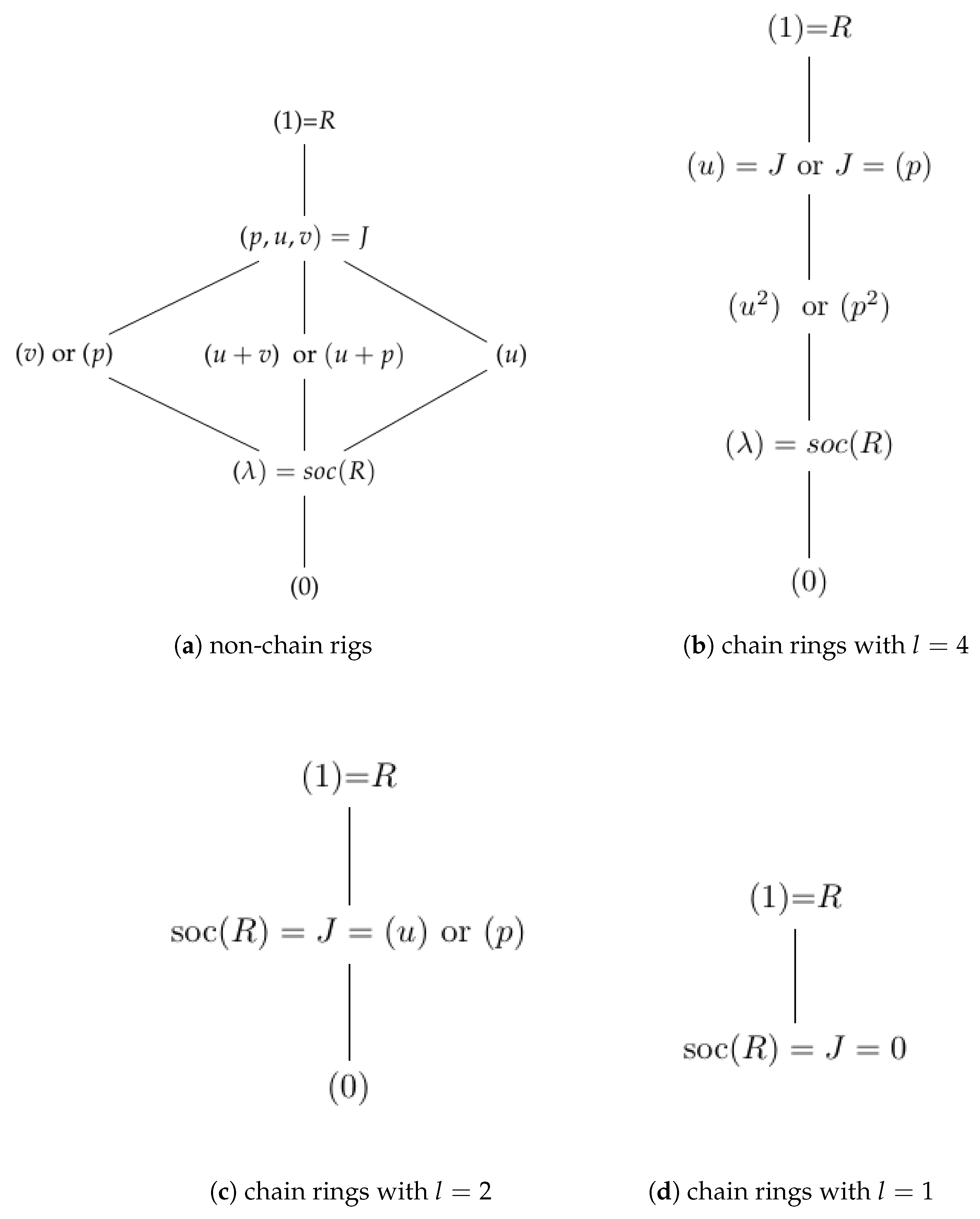
Finally, we present the lattices of ideals of all local rings with order in Figure 1. It worth noting that the lattices of ideals of local non-chain rings of order are equivalent, while those of chain rings depends on
Figure 1.
Lattices of ideals.
4. MacWilliams Identities
With as invariants such as , let R be a Frobenius local ring of order The MacWilliams identities for various versions of R are now computed. It is actually possible to extend these relations to a larger class of finite rings: the class of all Frobenius rings. These identities are fundamental to the study of coding theory because they introduce a crucial link between a code’s dual and weight enumerator.
Next, we restate the following result, which implements a method to produce a generating character for any such ring. We refer to [18] for the proof. Assume that is -root of unity and for each
Theorem 7
([18]). Let Then, there exists a generating character ν and such that
Suppose C is a linear code over R with length N. Let us assume that is the number of instances of in c . Moreover, assume the elements of R are ordered by The complete weight enumerator is then defined as follows:
where and We define The Hamming weight (HW) enumerator and its MacWilliam identity are given as follows:
Suppose that ∼ is defined on R by when there is such that This means that the group of units of R acts by translation on (the set) R, and it determines an equivalence relation. Let be the equivalence classes, and let calculate the number of elements of that occurred in the codeword c. Hence, SWE is defined as follows:
We introduce the MacWiliams equation for SWE as follows:
where and
The formulas of for R are shown in Table 2. As we can notice, once is obtained, it is straightforward to obtain the matrix A in (22). Nonetheless, S in Equation (26) requires the determination of the classes While it takes more work, this procedure is essential to building S if we look at the broader case; that is, R is Frobenius local of order Note that J in this ring is of order , with as its index of nilpotency, and is cyclic of order The following lemma provides a comprehensive scheme for determining in a broader case.
Table 2.
for ring R.
Lemma 1.
Suppose soc where Then, the classes for R are given by the following formula:
Proof.
Suppose that then . For the other cases, assume that First, let As soc then where and are representative of Now, suppose also that then for some in It follows that where This means that all elements of are of the form which can be interpreted as the set being copies of soc Thus,
However, we have the following formula for complex numbers:
The positive reflects the number of copies of soc, which is precisely Therefore,
The last case of the proof can be performed similarly, noting that every element of can be expressed as where As then, for a fixed In such case,
Hence, based on Equation (28), Thus, we conclude with the result, i.e., □
If R is a chain, then one can obtain the sets of as follows.
Theorem 8.
Suppose that R is a chain of order Then,
Proof.
For and the values are direct from Lemma 1. As of soc and based on Equation (28). If or thus where Therefore, Furthermore, then using the same lemma, and also , which means that Lastly, assume Note that where Thus, from Lemma 1. The other case of is where , and because Meanwhile, the values of , and are equal to , since in all these cases, we have □
When R is not a chain, we list all the equivalence classes The determination of relies on the lattices of ideals of R when it is not a chain; please see Figure 1.
- 1.
- When
- 2.
- WhenFor simplicity, we denote and as follows:
Note that the entries of and are obtained from Equation (27) in Lemma 1 and given above in Equations (29) and (30).
Theorem 9.
Suppose that R is non-chain Frobenius of order Then, S takes the from of or
Proof.
The proof depends heavily on Lemma 1, which means in order to obtain the entries of the matrix it is enough to investigate the subsets Either or Let us first consider the classes and their sizes as mentioned above. Suppose also soc For all we have . Then, Next, observe the following:
Thus, all elements of such subsets are and based on Lemma 1, we obtain
On the other hand, one can see that where Thus, for the same values of the index we obtain
with regard to the remaining cases where First, note that is in all , and Hence, based on the same lemma,
The value of depends on We know that or and or Then, in any case of R (non-chain ring), we have If then and thus while if then hence, In other words,
where is defined above. We notice that because or , except for where and Furthermore, for all rings, since To conclude, we have two different submatrices of size of the following form:
Therefore, we obtain and for each R non-chain Frobenius ring of order as desired. □
Before ending this section, we introduce Table 3 to present all matrices S and corresponding to rings For clarification, we then move on to a numerical demonstration of these computations and their steps, for example, of a ring with order i.e., We will first concentrate on comprehending under ∼ before building
Table 3.
S and for Frobenius local rings of order .
Example 1.
We now construct S for Let us assume that the elements of R are ordered as follows: if then i comes before j if as an integer, and comes before if i precedes The equivalence classes are therefore as follows:
Note that which means that R is not a chain. Moreover, , and since then Thus, Therefore, by using Theorem 9, and after making the necessary computations, S takes the following form:
Remark 2.
The matrix S can be obtained for R when but the computations will be tedious.
Remark 3.
Based on the above discussion, the matrices S for chain rings that have same l are equivalent.
5. Generator Matrices
This section finds matrices G that produce linear codes over Generating a standard form generator matrix for a code is a fundamental method in coding theory. The process of creating a generator matrix, a minimal set of generators from which the code size can be computed, is simple when dealing with codes over chain rings. It is much more difficult to find a minimal set of generators for codes over local rings that are not chain rings. It is always possible to find such a minimal set of generators, but unlike in the case of chain rings, this does not always make it easy to determine the code size from such a generator matrix. In this regard, little work have been done. The Frobenius local rings that have been investigated are those of order 16 and that is, when The generator matrices of linear codes over rings of order 16 are considered in [16], while the ring is thoroughly studied in [18].
If R is any chain rings with index or then or respectively, are given as follows:
where s are matrices over R with different sizes. A code with a generator matrix of this form is said to have type where s are the sizes of the matrices A code C with such generator matrix has an immediate size as follows:
Now, R will denote Frobenius non-chain rings. First, we provide a precise definition of a generator matrix in this context. Keep in mind that the classical case of codes over fields is being generalized here. To demonstrate the challenges of creating a matrix and the limitations of this kind of matrix, we have concluded this work for a practical canonical form for codes over local Frobenius rings, and eventually, for Frobenius rings.
Definition 1.
If the vectors with coefficients from J cannot be combined linearly in a nontrivial way to equal the zero vector, we refer to the vectors as modularly independent. When the rows of G independently produce the code C, then G is a generator matrix over the ring R.
Figure 1 above illustrates lattices of ideals of As , and Therefore, the goal of this section is to produce a collection of independent modular vectors that function as a code’s generator matrix’s rows. A complete description of the structure of G is given by the following theorem.
Theorem 10. 
Let C be a linear code with length N over Thus,

where are matrices of various sizes and or
Proof. 

Let G be a matrix such that the row s of the matrix produce C as an R-module. Every column containing a unit is moved to the left of We obtain a matrix of the following form via row reduction on those columns:
Now, not every element in T is a unit. To transform the matrix into the next form, we shift all columns containing elements of to the left once more and apply the primary row operations.
We continue with this algorithm, making sure that the matrix is created by placing elements in columns such that they form a pair We keep doing this until the matrix takes on the form that we want.

Only one of (w), (u), or (w + u) is represented by the elements of the matrix T2’s columns. We will now move over to the matrix T2. The three ideals are (u), (w), and (w + u). We choose a particular ordering for each ideal to produce one expression of the matrix. The matrix will be constructed using this selected order consistently. Assuming α is a unit of R, we proceed as follows: columns with entries of the form uβ, columns with elements of the form (w)v, and finally, we address columns that take the form (u + w)v. We carry out row reduction in the standard way in each step. Observe that both (w) and (u + w) contain the socle ideal. Consequently, we redo similar process with soc(R) = (λ), since the remaining column entries will come from (λ).

Finally, every component of originates from the ideal that generates. We obtain a matrix that precisely corresponds to the desired form by removing any rows that contain only zeros and completing one last row reduction round. □
We present an example showing the steps of our earlier algorithm described in Theorem 10.
Example 2.
Suppose that C is a linear code with length over and generated by the vectors and i.e., where β is a unit of Let be a matrix constructed by the vectors generating C as its rows. Therefore,
Step 1. Move column 2, , to the left:
Step 2. Carry out row reductions as and Since
Step 3. Move to the left:
Step 4. Apply the row reduction by noting that Therefore:
Then, G is the desired matrix with The size of G is
Note that is the number of rows, and is the number of columns.
Remark 4.
The size of G in Theorem 10 is where and , and is the number of columns of the matrix
Example 3 shows that a minimal set of generators may not exist for C over a (non-chain) Frobenius singleton local, which makes the code more complicated. Stated differently, it highlights the differences in coding over chain rings and non-chain rings.
Example 3.
If G is a matrix of C over of the following form:
Assuming that is the R-submodule produced by rows and of and is the R-submodule generated by of
Noting that and in R, then since , and also, This indicates that the R-submodule C cannot be reduced.
Example 4.
To have C over of order set with Then, Meanwhile, to construct C with size suppose with , and This implies that Take , and Hence, Therefore,
Example 5.
Suppose that G for C with length over has the following form:
Note that and Consider the submodules and which have non-trivial intersections. Thus, the size of C might not be easily obtained from G. However, if we add to we obtain the following:
In such Therefore,
6. Conclusions
We conclude that, up to isomorphism, all local rings of the form and have been successfully classified in terms of Furthermore, generator matrices and MacWilliams relations for linear codes over such rings have been discovered. These are popular and effective tools for encoding data over chain rings; codes over local non-chain rings may not be able to achieve such a case. The challenge is in identifying a smallest number of generators and counting the code size because non-chain local rings are not PIRs. This restriction suggests that in order to effectively handle this issue, different approaches or strategies are needed.
Author Contributions
Conceptualization, S.A. and A.A.A.; Methodology, S.A.; Validation, S.A. and N.A.A.; Formal analysis, S.A.; Investigation, S.A. and A.A.A.; Writing—original draft, S.A. and N.A.A.; Writing—review & editing, S.A., A.A.A. and N.A.A. All authors have read and agreed to the published version of the manuscript.
Funding
This research was supported by the Researchers Supporting Project number (RSPD2024R871), King Saud University, Riyadh, Saudi Arabia.
Data Availability Statement
Data are contained within the article.
Conflicts of Interest
The authors declare no conflicts of interest.
References
- Alkhamees, Y.; Alabiad, S. The structure of local rings with singleton basis and their enumeration. Mathematics 2022, 10, 4040. [Google Scholar] [CrossRef]
- McDoland, B. Finite Rings with Identity; Marcel Dekker Incorporated: Norman, OK, USA, 1974. [Google Scholar]
- Raghavendran, R. Finite associative rings. Compos. Math. 1969, 21, 195–229. [Google Scholar]
- Norton, G.; Salagean, A. On the structure of linear cyclic codes over finite chain rings. Appl. Algebra Eng. Commun. Comput. 2000, 10, 489–506. [Google Scholar] [CrossRef]
- Dinh, H.; López-Permouth, S. Cyclic and negacyclic codes over finite chain rings. IEEE Trans. Inform. Theory 2004, 50, 1728–1744. [Google Scholar] [CrossRef]
- Alabiad, S.; Alkhamees, Y. Constacyclic codes over finite chain rings of characteristic p. Axioms 2021, 10, 303. [Google Scholar] [CrossRef]
- Wood, J.A. Duality for modules over finite rings and applications to coding theory. Am. J. Math. 1999, 121, 555–575. [Google Scholar] [CrossRef]
- Honold, T. Characterization of finite Frobenius rings. Arch. Math. 2001, 76, 406–415. [Google Scholar] [CrossRef]
- Yildiz, B.; Karadeniz, S. Linear codes over ℤ4 + uℤ4: MacWilliams identities, projections, and formally self-dual codes. Finite Fields Their Appl. 2014, 27, 24–40. [Google Scholar] [CrossRef]
- Sriwirach, W.; Klin-Eam, C. Repeated-root constacyclic codes of length 2ps over 𝔽pm + u𝔽pm + u2𝔽pm. Cryptogr. Comm. 2021, 13, 27–52. [Google Scholar] [CrossRef]
- Laaouine, J.; Charkani, M.E.; Wang, L. Complete classification of repeated-root-constacyclic codes of prime power length over . Discrete Math. 2021, 344, 112325. [Google Scholar] [CrossRef]
- Castillo-Guillén, C.A.; Rentería-Márquez, C.; Tapia-Recillas, H. Constacyclic codes over finite local Frobenius non-chain rings with nilpotency index 3. Finite Fields Their Appl. 2017, 43, 1–21. [Google Scholar] [CrossRef]
- Greferath, M. Cyclic codes over finite rings. Discrete Math. 1997, 177, 273–277. [Google Scholar] [CrossRef]
- Shi, M.; Zhu, S.; Yang, S. A class of optimal p-ary codes from one-weight codes over Fp[u](um). J. Frankl. Inst. 2013, 350, 929–937. [Google Scholar] [CrossRef]
- Dougherty, S.T.; Saltürk, E.; Szabo, S. Codes over local rings of order 16 and binary codes. Adv. Math. Commun. 2016, 10, 379–391. [Google Scholar] [CrossRef]
- Dougherty, S.T.; Saltürk, E.; Szabo, S. On codes over Frobenius rings: Generating characters, MacWilliams identities and generator matrices. Appl. Algebra Eng. Commun. Comput. 2019, 30, 193–206. [Google Scholar] [CrossRef]
- Martínez-Moro, E.; Szabo, S. On codes over local Frobenius non-chain rings of order 16. In Noncommutative Rings and Their Applications; Contemporary Mathematics; Dougherty, S., Facchini, A., Leroy, A., Puczylowski, E., Solé, P., Eds.; American Mathematical Society: Providence, RI, USA, 2015; Volume 634, pp. 227–241. [Google Scholar]
- Alabiad, S.; Alhomaidhi, A.A.; Alsarori, N.A. On Linear Codes over Finite Singleton Local Rings. Mathematics 2024, 12, 1099. [Google Scholar] [CrossRef]
Disclaimer/Publisher’s Note: The statements, opinions and data contained in all publications are solely those of the individual author(s) and contributor(s) and not of MDPI and/or the editor(s). MDPI and/or the editor(s) disclaim responsibility for any injury to people or property resulting from any ideas, methods, instructions or products referred to in the content. |
© 2024 by the authors. Licensee MDPI, Basel, Switzerland. This article is an open access article distributed under the terms and conditions of the Creative Commons Attribution (CC BY) license (https://creativecommons.org/licenses/by/4.0/).



