Abstract
The beta-logarithmic function substantially generalizes the standard beta function, which is widely recognized for its significance in many applications. This article is devoted to the study of a generalization of the classical beta-logarithmic function in a matrix setting called the extended beta-logarithmic matrix function. The proofs of some essential properties of this extension, such as convergence, partial derivative formulas, functional relations, integral representations, inequalities, and finite and infinite sums, are established. Moreover, an application of the extended beta-logarithmic function in matrix arguments is proposed in probability theory. Further, numerical examples and graphical presentations of the new generalization are obtained.
Keywords:
beta-logarithmic matrix function; extended beta-logarithmic matrix function; beta-logarithmic matrix distribution MSC:
33B15; 15A16; 65F60; 33C05
1. Introduction and Preliminaries
Special functions, which are natural generalizations of elementary functions, are derived by solving partial differential equations that satisfy a specific set of conditions. For centuries, many special functions have been developed and implemented in various fields, including combinatorics, chemistry, statistics, physics, and engineering (see, e.g., [1,2,3]).
On the other hand, recent extensions of special functions build upon the work of esteemed researchers such as Abdalla et al. [4,5], Abd-Elmageed et al. [6], Hidan et al. [7], Fuli He et al. [8], and Cuchta et al. [9], who have shown a strong interest in studying the extension of special functions in matrix arguments. Contributions to the field by considering various extensions of the gamma, beta, and hypergeometric matrix functions have been documented in [10,11,12,13,14]. Inspired by earlier studies, a new extension of the beta function in its matrix version is presented: the extended beta-logarithmic matrix function (EBLMF). An application and discussion of some of its analytic and numerical properties were also provided. One can easily obtain various applications from the close relationship of EBLMF with several special functions.
This paper is structured as follows: Section 2 gives the definition of the extended beta-logarithmic matrix function and studies its convergence properties and partial derivative formulas. Section 3 presents various properties of the EBLMF, including functional relations, inequalities, infinite sums, finite sums, and integral formulas. In Section 4, an application of the extended beta-logarithmic function in matrix arguments is offered. Section 5 provides numerical illustration examples and graphical descriptions of the EBLMF and some exceptional cases. Finally, in Section 6, we conclude with some final remarks.
Following [15,16], let be the vector space of all the Hermitian positive stable matrices of order whose entries are in the set of complex number For a matrix let be the set of all eigenvalues of , which is called the spectrum of and
where is referred to the spectral abscissa and For , the norm of a matrix is defined by
The matrix norm of the maximum absolute row sum of the matrix is given [17] by
Taking into account the Schur decomposition of a matrix (see [17], pp. 192–193), we have
The Gamma function is defined by (see, e.g., [18] (Chapter 11, p. 231) and [19] (Section 1.1))
If then the Gamma matrix function and the extended Gamma matrix function are well defined, respectively, as follows (see, e.g., [12,20]):
and
where I denotes the identity matrix of any order The beta function is defined by (see, e.g., [18] (Chapter 11, p. 235))
Let such that Then, the beta matrix function is well defined as follows (cf. [20]):
The extended beta function (EBF) is defined by Choudhary et al. [21] in the form
For and the extended beta function (10) in the matrix setting is defined by Abdalla and Bakhet in [11] as follows:
In the view of integral (11), they introduced types of extended hypergeometric matrix functions and provided numerous characteristics in [4,12,22].
Further, the logarithmic mean of is defined in [23,24] by
where
Raïssouli and Chergui [25] applied Equation (12) in presenting the beta-logarithmic function () as follows:
Lately, Alqarni and Abdalla [26] introduced the following extension of the beta-logarithmic function
2. The Extended Beta-Logarithmic Matrix Function
2.1. Convergence Property
Assume that , and for all and where and are matrices in , and if fixed, the function is continuous on and so it is bounded on Let , from (4) and using and for and it follows that
The EBLMF is revealed in the following definition.
Definition 1.
The EBLMF is defined by
where with and
Remark 1.
One can deduce some special cases of Definition (1) as follows:
- a-
- b-
- c-
- d-
- For with and let Then, the extended logarithmic mean of a matrix argument is defined by
- e-
- f-
- g-
Remark 2.
The can provide the following identities directly:
and
2.2. Partial Derivative Formulas
Here, the higher-order derivative formulas of EBLMF where the matrices and the parameters are discussed in the following theorem.
Theorem 1.
For such that and let and be mutually commutative matrices in we have
and
Proof.
Setting in Theorem 1, the higher-order derivative formulas for the beta-logarithmic matrix function defined in (18) are given in the following corollary.
Corollary 1.
For such that and let we have
and
Similarly, the following result gives the partial differentiations of the logarithmic function in a matrix argument (19).
Corollary 2.
For such that and let we obtain
and
Remark 3.
When considering the results in Remark 1 and Theorem 1, various other outcomes in the literature, including those in (see, e.g., [20,21,25]), can be demonstrated as special cases.
3. Some Analytic Characteristics
The essential analytic properties are established in this section.
Theorem 2.
Proof.
Using Definition 1, we obtain
Thus, the desired result is attained. □
Corollary 3.
Corollary 4.
The following theorem delivers a bound of the EBLMF given in (17).
Theorem 3.
Proof.
Corollary 5.
For in Theorem 3, the following inequality for holds true:
Corollary 6.
For let and be reciprocally commutative matrices in we derive
The following theorem gives various integral representations of the EBLMF defined in (17).
Theorem 4.
For such that and let the satisfies the following integral formulas:
and
Proof.
Corollary 7.
Remark 4.
Applying Remark 1’s results into Theorem 4 generates the other conformable results found in [12,20,25,28].
Now, we archive some finite and infinite sums of the .
Theorem 5.
The following sums hold for the :
and
Proof.
To demonstrate (49), we use induction on for we find
Assume that Equation (49) is true for , it follows that
Using the binomial identity and taking , one finds
Thus, we attain the desired result (49).
Hence, (50) is obtained.
Thus, the infinite sum in (51) is seized after simplification. □
Corollary 8.
For such that and let we have
Remark 5.
There are also matrix versions of some known infinite sums in [25].
4. The Beta-Logarithmic Distribution: Matrix Arguments
As is well known, the beta distribution is one of the essential variate distributions in statistical analysis, and its importance is that it is in deriving moments and can help us understand the different probabilities associated with the random variable (cf. [29]). Traditional beta distributions were introduced in [11,12,13,28,30] using extended beta functions. They suggested that these distributions could help analyze and review techniques employed in specific circumstances during project evaluation and review. They pointed out that these distributions could be advantageous for evaluating and reviewing the method used in particular cases during project evaluation and review. Here, the generalized beta-logarithmic distribution of matrix arguments is defined as
where with and let It will be said that a random variable with probability density matrix function defined by (54) has the extended beta-logarithmic distribution with matrix arguments and in If the incomplete extended beta-logarithmic matrix function is expressed by
then the cumulative distribution of (54) can be given as
Remark 6.
The incomplete generalized beta-logarithmic matrix function in (55) can be reduced to numerous simple incomplete extended beta matrix functions (see, e.g., [4,13]).
Also, let then one obtains (cf. [11,28])
Following the particular case of (57) at , the mean of the distribution is provided as
Further, the variance of the generalized beta-logarithmic distribution of matrix arguments is shown as
In addition, the moment-generating function of the distribution can be expressed as
Remark 7.
The results in [11] can be achieved when in the above results. Also, setting in (54), corresponding to (g) in Remark 2.1, one can achieve various results in [28] (Chapter 5, p. 258).
Remark 8.
The generalized results of the matrix setting in [25] (p. 137) are obtained by taking in the above results.
5. Numerical and Graphical Representations
5.1. Numerical Illustration Examples
Example 1.
For and
Then
and
Thus, we have
Example 2.
For and
Then,
and
Thus, we have
Example 3.
For and
Then,
and
Thus, we have
Remark 9.
The previous examples show that if and do not commute with , then the property symmetry of the function does not hold.
Remark 10.
The following example shows that if and are commutes with then the property symmetry of the functions and , respectively, does hold.
Example 4.
For and
Then,
and
Thus, we obtain
Example 5.
For and
Then
and
Thus, we obtain
Example 6.
For
and Then,
and
Thus, we find that
5.2. Graphical Representations
This section illustrates the generalization presented in this paper with the previous results in [20] in their graphical forms to provide a comprehensive understanding. The differences were handled using the infinite norm (3) since the comparisons run over matrices. The size of all matrices used here is . The choice of the used matrices is and , as in [20], while is a matrix chosen to be approaching the zero matrices, .
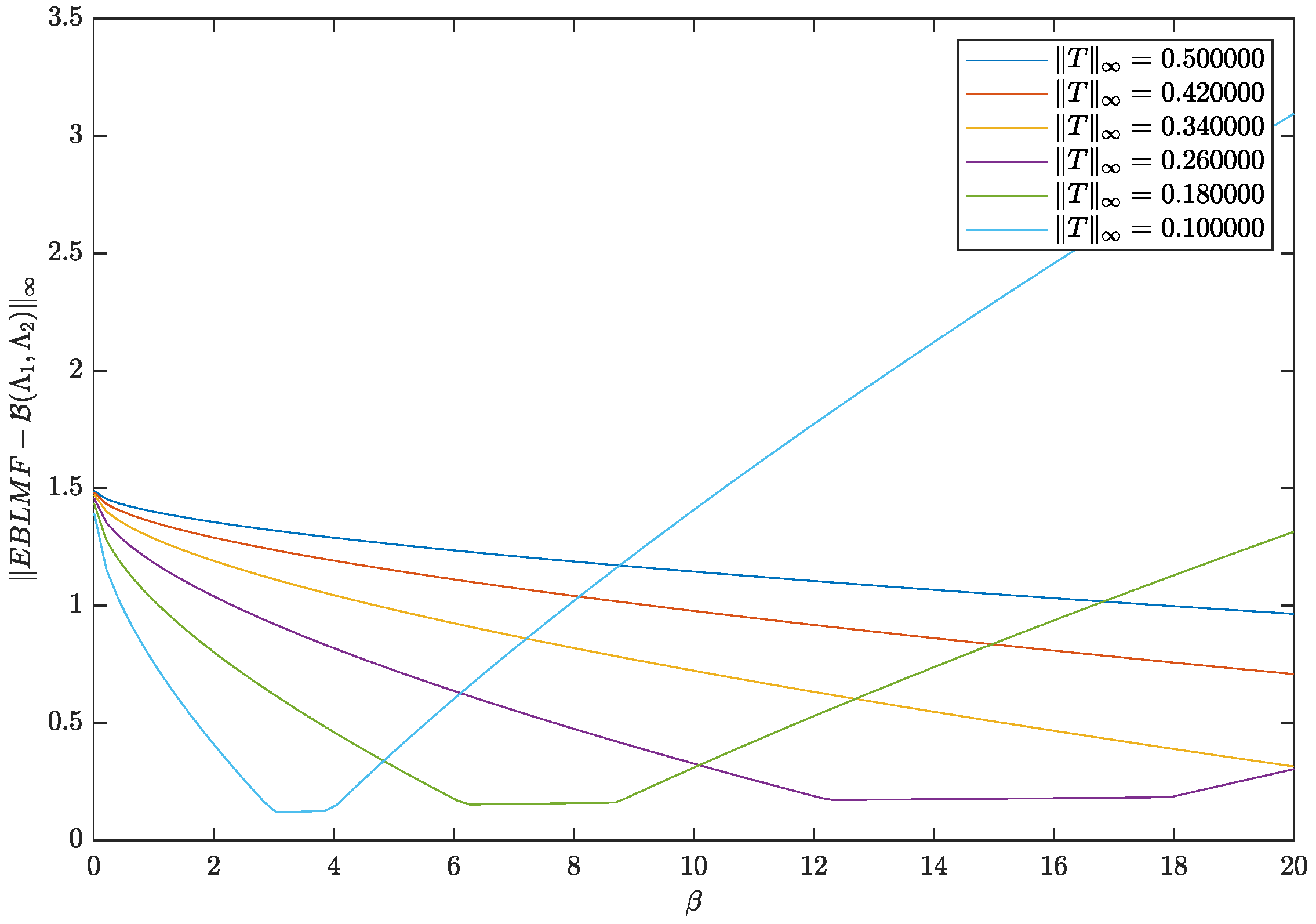
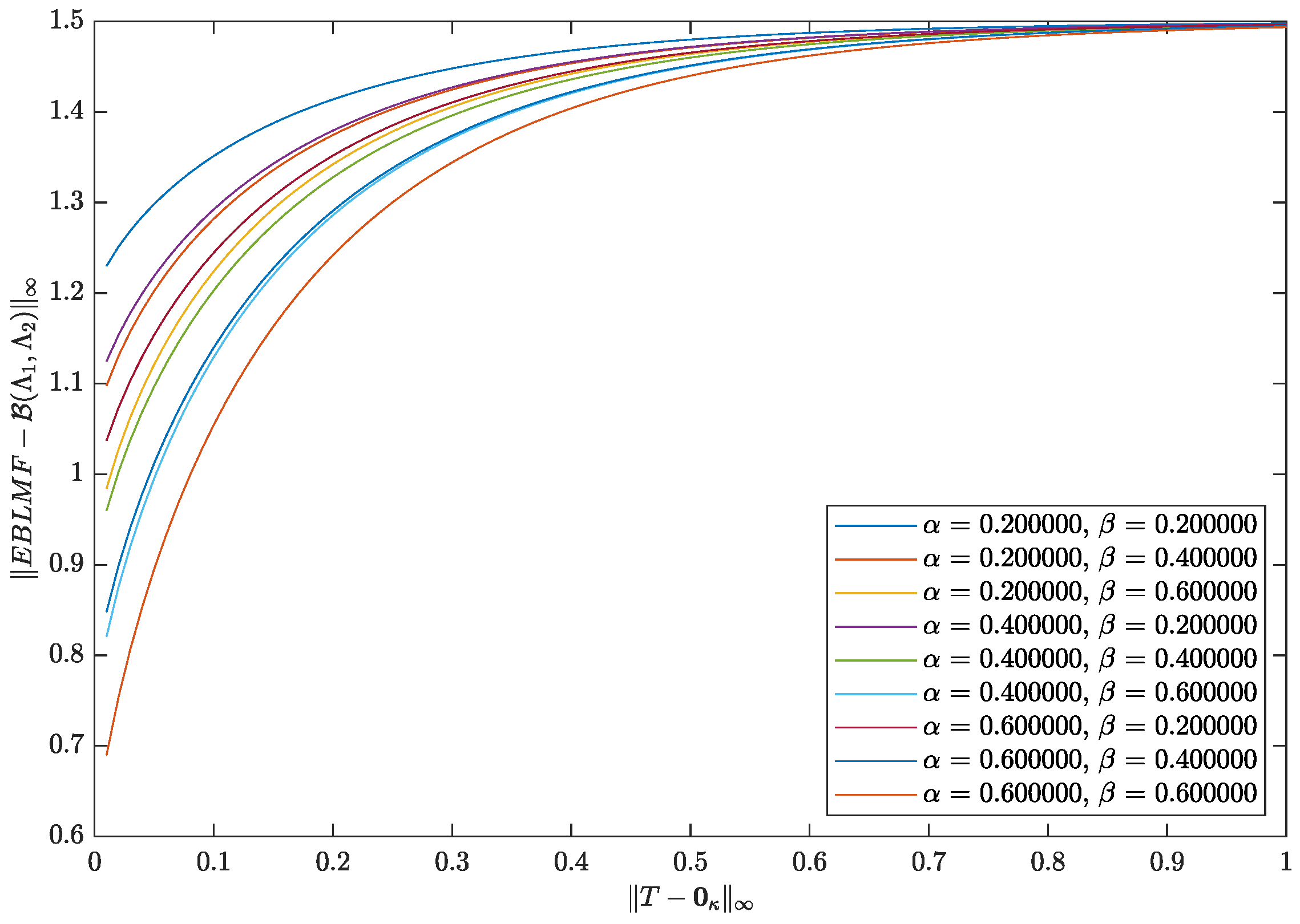
Figure 1 shows the graph of the differences between the EBLMF and beta matrix function against various values of in the interval for multiple choice of matrix having infinity-norm starting from 0.5 and approaching 0 and taking . As value increases, the difference decreases when is not close to . However, for approaching zero matrices, the difference decreases for small values of and then it changes direction. That is because of the trade-off between and the choice of in (17). Similar observations can be made when fixing and plotting the differences versus , as shown in Figure 2.
Figure 1.
Graphical representation of various values of .
Figure 2.
Graphical representation of various values of .
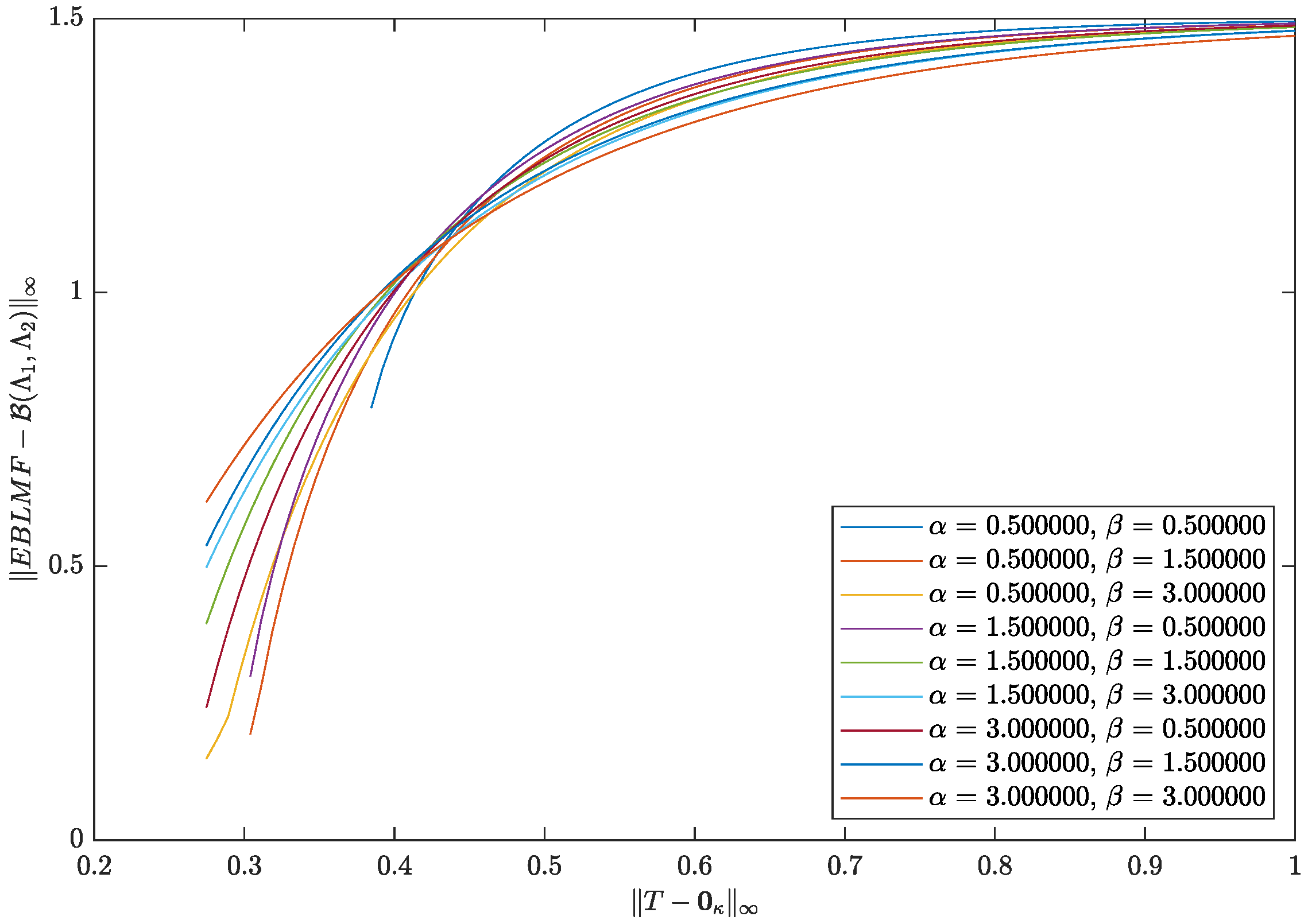
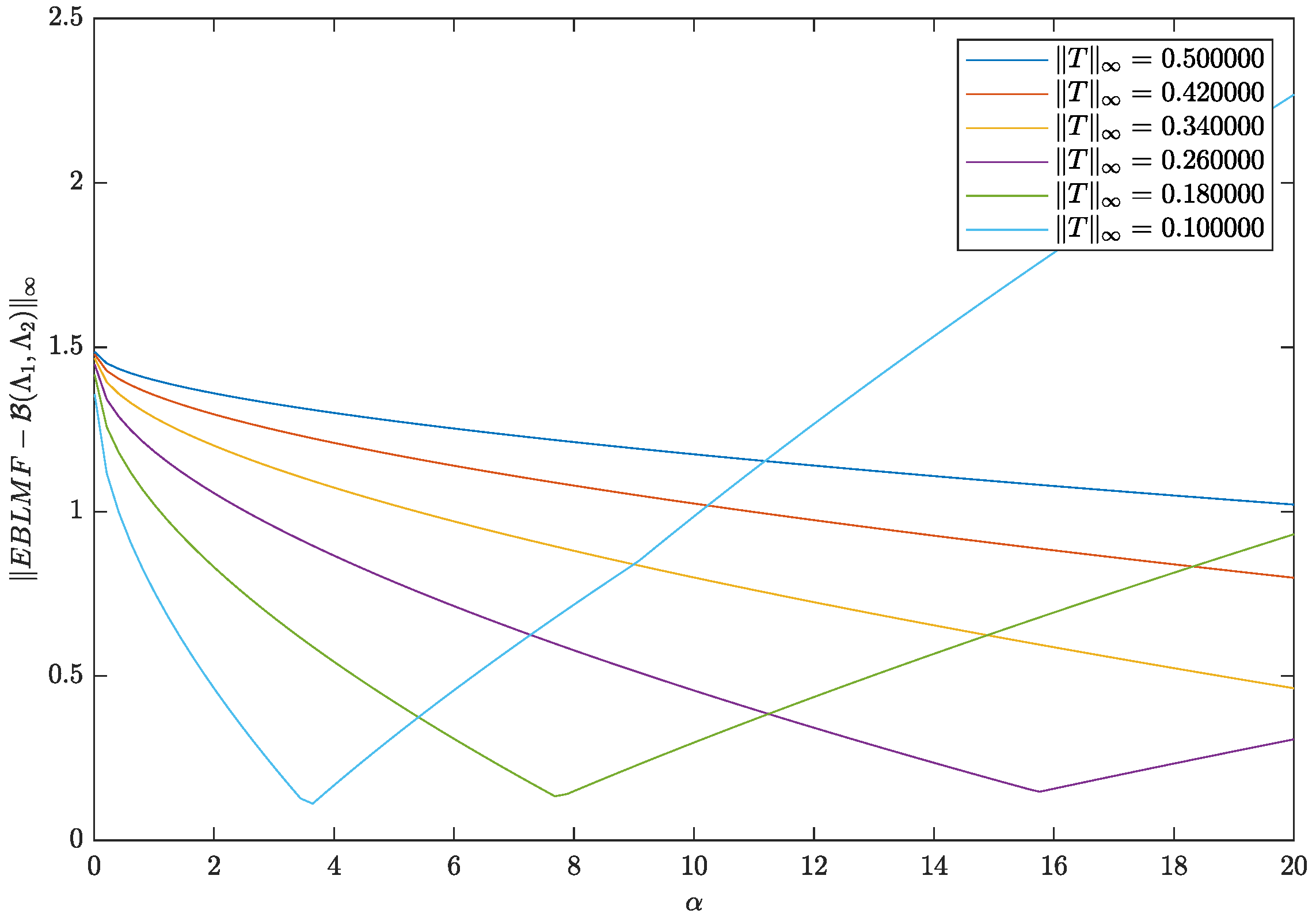
When the matrix approaches zero, should go to zero when , and the result in [20] is obtained. To show the generalization introduced in this paper, Figure 3 depicts the graphs of the differences versus when the matrix is chosen to approach zero, and the values of and One can conclude that the differences decrease for all the values of and when tends to zero in its infinity norm. Similar results can be obtained from Figure 4 when the values of and for a suitable choice of matrix.
Figure 3.
Graphical representation of with for various values of .
Figure 4.
Graphical representation of with for various values of .
6. Conclusions
Later, many researchers contemplated the extension of the classical beta function to the matrix framework. The extended beta-logarithmic matrix function extends the extended beta matrix function [10] and the beta matrix function [20]. This manuscript explores several analytical properties of this function and employs this extension to derive the generalized beta distribution of matrix arguments. In addition, some numerical illustration examples and graphical descriptions were presented to show the efficacy of this extension by using MATLAB R2023b. Finally, the extended beta-logarithmic matrix function has the potential to extend several known applications based on numerous special functions in the literature.
Funding
This work was funded by the Deanship of Scientific Research at King Khalid University through a large group research project under grant number RGP2/327/45.
Data Availability Statement
No data were used to support this study.
Acknowledgments
The author extends his appreciation to the Deanship of Scientific Research at King Khalid University for funding this work through a large group research project under grant number RGP2/327/45.
Conflicts of Interest
The author declares no conflict of interest.
References
- Agarwal, P.; Agarwal, R.P.; Ruzhansky, M. Special Functions and Analysis of Differential Equations; CRC Press: Boca Raton, FL, USA, 2020. [Google Scholar]
- Akhmedova, V.; Akhmedov, E.T. Selected Special Functions for Fundamental Physics; Springer: Cham, Switzerland, 2019. [Google Scholar]
- Andrews, G.E.; Askey, R.; Roy, R. Special Functions, Encyclopedia of Mathematics and Its Applications; Cambridge University Press: Cambridge, UK; London, UK; New York, NY, USA, 1999; Volume 71. [Google Scholar]
- Abdalla, M. Special matrix functions: Characteristics, achievements and future directions. Linear Multilinear Algebra 2020, 68, 1–28. [Google Scholar] [CrossRef]
- Abdalla, M.; Akel, M.; Choi, J. Certain matrix Riemann-Liouville fractional integrals associated with functions involving generalized Bessel matrix polynomials. Symmetry 2021, 13, 622. [Google Scholar] [CrossRef]
- Abd-Elmageed, H.; Hidan, M.; Abdalla, M. Investigation for the k-analogue of τ-Gauss hypergeometric matrix functions and associated fractional calculus. Linear Multilinear Algebra 2024, 72, 737–750. [Google Scholar] [CrossRef]
- Hidan, M.; Akel, M.; El-mageed, H.A.; Abdalla, M. Some matrix families of the Hurwitz-Lerch ζ-functions and associated fractional kinetic equations. Fractals 2022, 30, 2240027. [Google Scholar] [CrossRef]
- He, F.; Bakhet, A.; Hidan, M.; Abdalla, M. Two variables Shivley’s matrix polynomials. Symmetry 2019, 11, 151. [Google Scholar] [CrossRef]
- Cuchta, T.; Grow, D.; Wintz, N. Divergence criteria for matrix generalized hypergeometric series. Proc. Am. Math. Soc. 2022, 150, 1235–1240. [Google Scholar] [CrossRef]
- Abdalla, M.; Bakhet, A. Extension of Beta matrix function. Asian J. Math. Comput. Res. 2016, 9, 253–264. [Google Scholar]
- Khammash, G.; Agarwal, P.; Choi, J. Extended k-gamma and k-beta functions of matrix arguments. Mathematics 2020, 8, 1715. [Google Scholar] [CrossRef]
- Abdalla, M.; Bakhet, A. Extended Gauss hypergeometric matrix functions. Iran. J. Sci. Technol. Trans. Sci. 2018, 42, 1465–1470. [Google Scholar] [CrossRef]
- Verma, A.; Yadav, K.S.; Sharan, B.; Suthar, D.L. Some properties of ψ-gamma, ψ-beta and ψ-hypergeometric matrix functions. Analysis 2024. [Google Scholar] [CrossRef]
- Maa, X.; Bakhetb, A.; He, F.; Abdalla, M. The incomplete matrix beta function and its application to first Appell hypergeometric matrix function. Linear Multilinear Algebra 2023, 1–19. [Google Scholar] [CrossRef]
- Brualdi, R.; Cvetkvić, D. A Combinatorial Approach to Matrix Theory and Its Applications; Chapman and Hall/CRC: New York, NY, USA, 2009. [Google Scholar]
- Johnson, C.R. Positive definite matrices. Am. Math. Mon. 1970, 77, 259–264. [Google Scholar] [CrossRef]
- Golud, G.H.; Loan, C.F.V. Matrix Computations; The Johns Hopkins Press Ltd.: London, UK, 1996. [Google Scholar]
- Jeffrey, A.; Dai, H.H. Handbook of Mathematical Formulas and Integrals, 4th ed.; Academic Press: Amsterdam, The Netherlands, 2008. [Google Scholar]
- Srivastava, H.M.; Choi, J. Zeta and q-Zeta Functions and Associated Series and Integrals; Elsevier Science Publishers: Amsterdam, The Netherlands; London, UK; New York, NY, USA, 2012. [Google Scholar]
- Jódar, L.; Cortés, J. Some properties of gamma and beta matrix functions. Appl. Math. Lett. 1998, 11, 89–93. [Google Scholar] [CrossRef]
- Chaudhry, M.A.; Qadir, A.; Rafique, M.; Zubair, S.M. Extension of Euler’s beta function. J. Comput. Appl. Math. 1997, 78, 19–32. [Google Scholar] [CrossRef]
- Abdalla, M.; Idris, S.A.; Mekawy, I. Some results on the extended hypergeometric matrix functions and related functions. J. Math. 2021, 2021, 2046726. [Google Scholar] [CrossRef]
- Choi, B.J.; Kim, S. Logarithmic mean of positive invertible operators. Banach J. Math. Anal. 2023, 17, 20. [Google Scholar] [CrossRef]
- Nussbaum, R.D.; Cohen, J.E. The arithmetic-geometric mean and its generalizations for noncommuting linear operators. Ann. Sc. Norm. Super. Pisa Cl. Sci. Sér. Tome. 1988, 15, 239–308. [Google Scholar]
- Raïssouli, M.; Chergui, M. On a new parametrized beta functions. Proc. Inst. Math. Mech. Natl. Acad. Sci. Azerbaijan 2022, 48, 132–139. [Google Scholar]
- Alqarni, M.Z.; Abdalla, M. Analytic properties and numerical representations for constructing the extended beta function using logarithmic mean. Aims Math. 2024, 9, 12072–12089. [Google Scholar] [CrossRef]
- Protter, M.H.; Morrey, C.B. Intermediate Calculus, 2nd ed.; Springer: New York, NY, USA, 1985. [Google Scholar]
- Chaudhry, M.A.; Zubair, S.M. On a Class of Incomplete Gamma Functions with Applications; Chapman and Hall/CRC: Boca Raton, FL, USA, 2002. [Google Scholar]
- Pishro-Nik, H. Introduction to Probability, Statistics, and Random Processes; Kappa Research LLC: Sunderland, MA, USA, 2014. [Google Scholar]
- Dell’Accio, F.; Tommaso, F.D.; Guessab, A.; Nudo, F. A unified enrichment approach of the standard three-node triangular element. Appl. Numer. Math. 2023, 187, 1–23. [Google Scholar] [CrossRef]
Disclaimer/Publisher’s Note: The statements, opinions and data contained in all publications are solely those of the individual author(s) and contributor(s) and not of MDPI and/or the editor(s). MDPI and/or the editor(s) disclaim responsibility for any injury to people or property resulting from any ideas, methods, instructions or products referred to in the content. |
© 2024 by the author. Licensee MDPI, Basel, Switzerland. This article is an open access article distributed under the terms and conditions of the Creative Commons Attribution (CC BY) license (https://creativecommons.org/licenses/by/4.0/).