


Abstract
The Black–Scholes formula is an important formula for pricing a contingent claim in complete financial markets. This formula can be obtained under the assumption that the investor’s strategy is carried out according to a self-financing criterion; hence, there arise a set of self-financing portfolios corresponding to different contingent claims. The natural questions are: If an investor invests according to self-financing portfolios in the financial market, what are the maximal and minimal distributions of the investor’s wealth on some specific interval at the terminal time? Furthermore, if such distributions exist, how can the corresponding optimal portfolios be constructed? The present study applies the theory of backward stochastic differential equations in order to obtain an affirmative answer to the above questions. That is, the explicit formulations for the maximal and minimal distributions of wealth when adopting self-financing strategies would be derived, and the corresponding optimal (self-financing) portfolios would be constructed. Furthermore, this would verify the benefits of diversified portfolios in financial markets: that is, do not put all your eggs in the same basket.
Keywords:
self-financing portfolio; optimal investment; maximal distribution; backward stochastic differential equation; diversified portfolio MSC:
60G05; 60H05; 60H30; 91-10
1. Introduction
In the realm of financial markets, the continuous trading of securities such as stocks forms the backbone of economic dynamics. This paper delves into a market comprising N securities operating within a fixed time horizon. The price trajectories of these securities are modeled by geometric Brownian motion: each is characterized by distinct drifts and volatilities. We explore the scenario of an investor investing his/her initial endowment into these N securities. The investor’s portfolio, , represents the proportion of wealth invested in each stock. The notation represents the investor’s wealth trajectory under the self-financing portfolio strategy . In the context of modern portfolio theory, investors aim to balance risk and reward, with risk-averse individuals prioritizing predictability and lower risk over potentially higher but uncertain returns; see, for example, [1,2,3,4]. This preference underscores the importance of understanding the risk associated with a portfolio, particularly through the probability of the wealth process falling within a specific interval.
Therefore, a natural question is: Can we obtain the maximal and minimal distributions of the wealth process on any specific interval over the portfolio set . If this is possible, how can these two optimal portfolios, and , be constructed to achieve the maximal and minimal distributions, respectively? This is, for any given positive numbers and ,
and
In the above proposed financial market model, the drift terms of the securities’ price processes are not precisely known, introducing ambiguity into the market dynamics. This ambiguity reflects the real-world uncertainty that investors face when the true probabilities of future events are unclear or indeterminate. Unlike risk, which can be quantified and managed through probabilistic models, ambiguity challenges traditional decision-making frameworks and necessitates novel approaches to portfolio optimization.
The current study addresses this ambiguity by considering the range of possible drift values within known bounds . By doing so, we aim to characterize the maximal and minimal distributions of the wealth process , which represent the best- and worst-case scenarios for an investor’s wealth at time T given the uncertain drift terms. These distributions provide valuable insights for investors, particularly those who are risk-averse, as they offer a way to gauge the potential outcomes of their investment strategies in the face of ambiguous market conditions.
The study on ambiguity models dates back to Frank [5], who explains how uncertainty can create imperfect market structures. The portfolio optimization problem is studied by Hansen and Sargent [6], who model the volatility of stocks as a stochastic process such that the volatility of stocks is uncertain. Chen and Epstein [2] conceptualize the theoretical framework of ambiguity, risk and asset return with respect to a set of ‘objective’ probability measures. Cvitanic, Ma and Zhang [7] study the problem of computing hedging portfolios for options that may have discontinuous payoffs. Schied [8] uses risk assessment operators to solve the portfolio maximization problem. A robust mean-variance maximization problem is studied by Maccheroni, Marinacci and Ruffino [9]. Bielecki, Jin, Pliska and Zhou [10] study continuous-time mean-variance portfolio selection with bankruptcy prohibition. Jin and Zhou [11] study continuous-time portfolio selection under ambiguity, in which the appreciation rates are only known to be in a certain convex closed set, and the portfolios are allowed to be only based on historical stock prices. Bai, Ma and Xing [12] study a class of optimal dividend and investment problems with the assumption that the underlying reserve process follows the Sparre Andersen model. Hu, Jin and Zhou [13] study portfolio selection in a complete, continuous time market, in which the preference is dictated by the rank-dependent utility. Chen, Feng and Zhang [14] study sampling-strategy-driven limit theorems that generate the maximum or minimum average reward in the two-armed bandit problem.
To date, the above model has been widely studied. However, the explicit formulations of the maximal and minimal distributions remain unknown. The present study introduces a new method to investigate the above model. Specifically, based on the theory of backward stochastic differential equations (BSDEs), a confirmed answer can be obtained for the above question. That is, the explicit expression of and would be established, and the closed form of and would be obtained. Actually, we shall show that the maximal and minimal distributions are closely related to a BSDE that is nonlinear in . Nonlinear BSDEs were initially studied by Pardoux and Peng [15]. It has been widely recognized that BSDEs provide a useful framework for formulating problems in various fields, such as financial mathematics, stochastic optimal control, and partial differential equations (PDEs). For example, El Karoui, Peng and Quenez [16] study different properties of BSDEs and their applications in finance, especially contingent claim valuation and recursive utility (independently introduced by Duffie and Epstein [17]). Pardoux and Peng [18] establish some estimates and regularity results for the solution of BSDEs and provide a Feynman–Kac representation for solutions to some nonlinear parabolic PDEs. Peng [19] obtain the general stochastic maximum principle through the theory of BSDEs. Yong [20] discusses the solvability of BSDEs with possibly unbounded coefficients and their applications in a Black–Scholes type security market with unbounded risk premium processes and/or interest rates. Chen and Epstein [21] study a central limit theorem for a sequence of random variables with a mean uncertainty, and it was revealed that the limit is defined by a BSDE, which can be interpreted as modeling an ambiguous continuous-time random walk.
Although BSDEs have been used in various problems, this method still has some limitations since the properties of and the explicit solution of general nonlinear BSDEs cannot be easily established. For the part, Chen, Kupperger and Wei [22] obtain an interesting comonotonic theorem of for a nonlinear but special generator. Although it is difficult to obtain the explicit formulations for the solution of a general nonlinear BSDE, Chen, Liu, Qian and Xu [23] obtain explicit solutions to an interesting class of nonlinear BSDEs, which is the k-ignorance model that arose from modeling the ambiguity of asset pricing (e.g., Chen and Epstein [2]).
Motivated by these above results, the present paper uses BSDEs to study the optimal investment problem. The main ideas are as follows: First, the correlation between the maximal distribution and the solution for a special kind of nonlinear BSDE (Theorem 1) is established. Second, through the formulation of the BSDE, the corresponding optimal portfolio is constructed (Theorem 2). Third, after obtaining the explicit solution for the derived BSDE, the maximal distribution is explicitly computed (Theorem 4). Similarly, the minimal distribution and the corresponding optimal portfolio are similarly studied. For wider applications, a general utility function including the indicator function is considered (Theorem 3). From the explicit formulations of the optimal strategy and the optimal distribution, it can easily be observed that diversified portfolios with two stocks would be better than portfolios with only one stock.
The present study is organized as follows. Section 2 presents the definition of maximal and minimal distributions and some basic results for the BSDEs used for the study. Section 3 presents the explicit representations of optimal portfolios and , which correspond to the maximal and minimal distributions, respectively. The explicit expressions for the maximal and minimal distributions and a general utility function case are presented in Section 4. The maximal distribution is applied to explain the benefits of diversified portfolios in Section 5.
2. Preliminaries
In this section, some notations and lemmas are provided. Let refer to the probability space, refer to the standard Brownian motion on this probability space, and refer to the -filtration generated by the Brownian motion, which is augmented by all -null sets . That is, . Let refer to the set of all -measurable and square-integrable random variables, refer to the set of all real-valued -adapted processes with , and refer to the set of all -progressively measurable real-valued processes with Throughout the study, represents the indicator function on set A, denotes the expectation under probability measure , and the sign function is given by
The definition of a maximal distribution is initially given. The minimal distribution is similarly defined.
Definition 1
(Maximal distribution). Let refer to the family of random variables over a given index set Θ. The maximal distribution of over the set Θ is denoted by the following:
We now introduce the model of our study, which is set within a finite time horizon . The price dynamics of the securities are governed by the following system of stochastic differential equations (SDEs):
where represents the drift, is the volatility, is the initial price, and is a Brownian motion within the probability space . A feature of our model is the ambiguity of the exact values of , with only their maximum and minimum known. For simplicity, we only consider the case and for . This simplification does not detract from the generality of our results, which can be extended to scenarios with .
We explore the scenario of an investor investing his/her initial endowment into two stocks. The investor’s portfolio, , represents the proportion of wealth invested in each stock. The evolution of the investor’s wealth, , is governed by the stochastic differential equation:
The set of all possible self-financing portfolios, , is defined as:
where refer to two fixed numbers that represent the constraints on the investment proportion of these two stocks.
At the end of this section, nonlinear BSDEs are briefly introduced, which were initially investigated in [15]:
Lemma 1
([15]). Assume that is uniformly Lipschitz continuous. Hence, for any and , the BSDE (5) has a unique pair of solution
Usually, it is difficult to obtain the closed form for the solution of the BSDE (5) when g is nonlinear. Interestingly, as shown in the following lemma, for cases and , the following BSDE has a pair of explicit solutions:
where satisfies the following assumption:
Hypothesis 1.
There exists some such that φ is symmetric on c. That is, for all.
Lemma 2
([23]). Assume that satisfies (H.1) for some , and (where ) have, at most, polynomial growth. Then BSDE (6) has a pair of explicit solutions
with H defined as follows:
(i) If and on , then
(ii) If and on , then
where is the joint distribution of and its local time with respect to ℓ and is given by
3. Explicit Representation of Optimal Portfolios
For simplicity, in the following, we will suppress the time variable t in when there is no confusion. This section provides the optimal portfolios and such that
and
Moreover, in the following it is assumed that and . Then, the wealth process takes the following form:
Denote
Similarly, and are denoted corresponding to and , respectively. In order to study the optimal portfolios, the following result needs to be initially obtained.
Theorem 1.
Suppose that is the wealth process defined in (8) with , and is the related portfolio. Assume that . Then
- (1)
- is the value of the solution of the following BSDE at :
- (2)
- is the value of the solution of the following BSDE at :whereand are the upper bound and lower bound, respectively, of.
Proof.
Note that
Let be the set of -progressively measurable processes , taking values in . Then, from
we have
Therefore,
Let be the solution of BSDE (9). Define
By Girsanov’s theorem (see for example [24]), we know is a Brownian motion under , where
Therefore,
Hence,
For any , consider the following BSDE:
Define . Then is a Brownian motion under , where
Thus,
Hence,
It follows from the comparison theorem of BSDE (e.g., [16]) that
Consequently,
Note
Combining (11), (14) and (16), we have
Similarly, part (2) of Theorem 1 can be proved. □
Now, we can give the main result of this section, which is about the optimal portfolios.
Theorem 2.
Proof.
By Theorem 1, we have
where
and is the indicator function on . Moreover,
where and are given by (12) and (13), respectively. Define . We know from Girsanov’s theorem that is a Brownian motion under with
and
It follows from ([23] Corollary 6) that
Therefore,
Define
We have
Since
and , from (11), we obtain that
Moreover, we know
Thus,
Similarly, by Theorem 1, we have
where
and
is a Brownian motion under with
and
It follows from ([23] Corollary 6) that
Therefore,
Then we have
From
we have
This completes the proof. □
Remark 1.
If the drifts and of the prices are known, based on (17) and (18), the optimal portfolios can be obtained with reference to the processes/wealth and , respectively. For the case that and are unknown, the optimal portfolios cannot be applied directly. However, if and are known while and are unknown, under the criterion of exploration and exploitation, the reinforcement learning technique (e.g., the ε-greedy method, ([25] Chapter 2) and [26]) and the above optimal portfolios can be combined together to construct the desired portfolios. With the estimated drifts (based on the historic data), a portfolio can be constructed to achieve the largest coverage probability on any interval , for which the stock deduced by the optimal portfolios (17) and (18) with the estimated drifts is selected most of the time. However, every once in a while, such as with a small probability ε, the two stocks are chosen randomly (i.e., chosen with equal probabilities) independent of the estimated drifts for portfolios (17) and (18). Specifically, when the sign function in (17) is positive, the stock with the larger estimated drift is chosen with probability , and the two stocks are chosen randomly with the probability ε. Otherwise, the stock with the smaller estimated drift is chosen with probability , and the two stocks are chosen randomly with the probability ε. Similarly, when the sign function in (18) is positive, the stock with smaller estimated drift is chosen with probability , and the two stocks are chosen randomly with the probability ε. Otherwise, the stock with the larger estimated drift is chosen with probability , and the two stocks are chosen randomly with the probability ε. The algorithm with is presented in Appendix A.
4. Maximal and Minimal Distributions
Next, the explicit distributions of the ambiguity portfolio model will be provided: that is, the explicit expressions of and . In particular, the representations of and for general utility function are initially given. Then, the maximal and minimal distributions are obtained.
Theorem 3.
Assume that satisfies (H.1) for some , and () have, at most, polynomial growth. Set Then the representations of and are given as follows:
- (1)
- (2)
- If and on , then
Proof.
Let . Then . We will only give the proof of when and on since the other case can be treated similarly. Using Theorem 1, we have
where is the solution of the following BSDE at :
Set and . Then BSDE (20) is equivalent to the following equation:
where is a Brownian motion under measure defined by
Thus, it suffices to solve BSDE (21) on . By Lemma 2, we have
where
So we obtain the expression of .
Similarly, applying Theorem 1, we have
where is the solution of the following BSDE when :
It then follows from Lemma 2 that
thus, the expression of is obtained. □
Applying Theorem 3, the explicit formulations of the maximal and minimal distributions when with can be obtained.
Theorem 4.
Let and with ; then the maximal and minimal distributions are given by
and
where is the distribution function of the standard normal distribution.
Proof.
First, recall that is the value of the solution of the following BSDE at :
where is a Brownian motion under with
For simplicity, let
For any , define
where is a standard normal distribution under probability measure . Then and as . Consider the following BSDE:
By Theorem 3, we have
where
Define
After some computations, we have
By Lebesgue’s dominated convergence theorem, we have that converges to as , which means converges to almost surely. Therefore, of (23) is given by
Finally,
Similarly, we have (22). □
Remark 2.
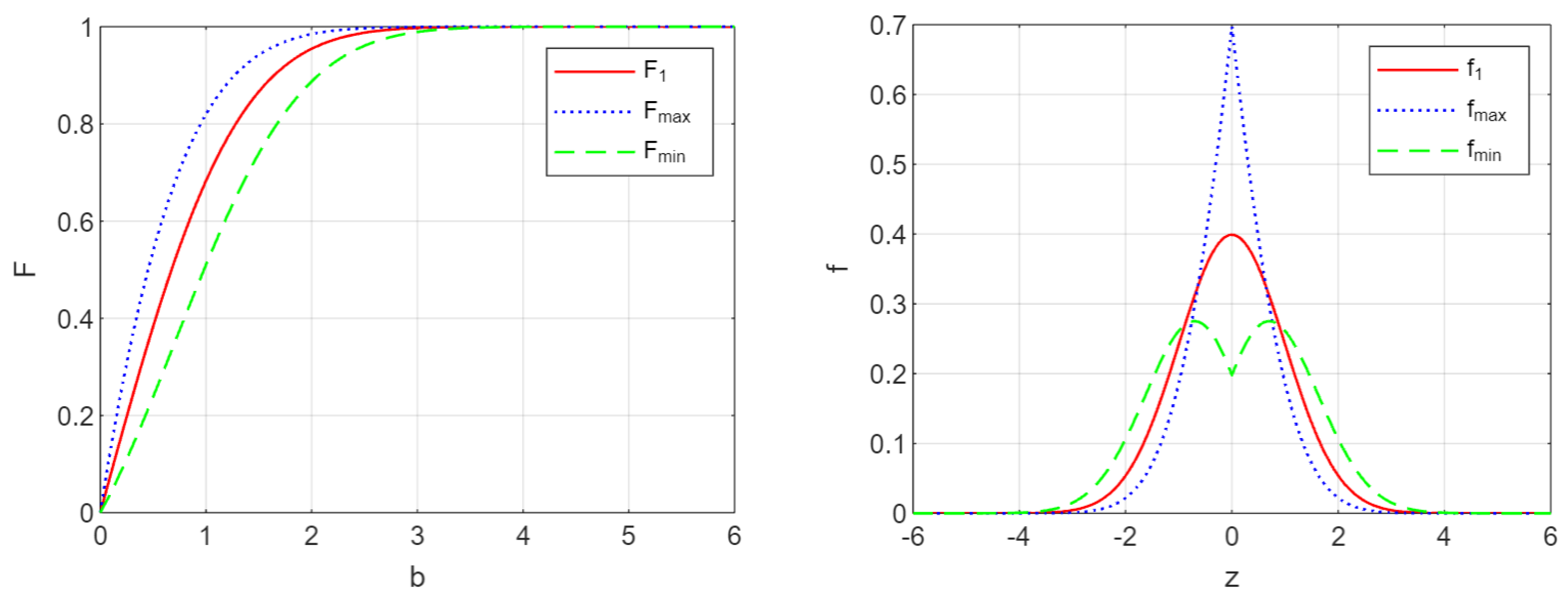
It can be observed from Theorem 4 that the maximal and minimal distributions of wealth are no longer log-normal when . That is, if a random disturbance is given to the Brownian motion (or the price process of the stocks), then its distribution will no longer be normal. That is, it would be a mixture of normal distributions. This is explained in the following example: If the process follows the following SDE with some random disturbance ,
where . Take and set
Let refer to the density function of , and let and refer to the density functions of and , respectively. Based on Theorem 4, it is not difficult to obtain
and consequently,
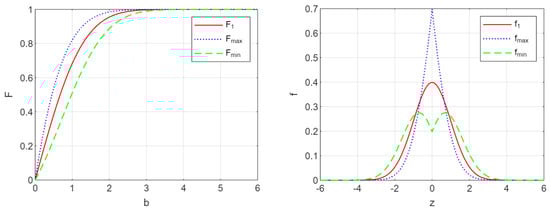
The differences in , and and the differences in , and can be intuitively observed from Figure 1. This shows that the maximal and minimal distributions of are no longer log-normal.
Figure 1.
Differences among and and differences in f, and when .
5. Do Not Put All the Eggs in One Basket
‘Do not put all your eggs in the same basket’ is a widespread proverb that means that diversified investment is necessary in order to avoid great losses due to a single investment. On the one hand, this advice can be partly formalized by considering the volatility of the portfolio. For example, by constructing portfolios with assets that are imperfectly correlated with one another, the risk inherent in the portfolio would decline as more assets are added to the portfolio until, eventually, the volatility of the portfolio would converge to the average covariance of assets that comprise the portfolio. Therefore, diversified risks can be reduced when compared to undiversified risks. On the other hand, after obtaining the explicit formulation for the maximal distribution and the corresponding portfolio, the benefits of the diversified portfolios can be explained and the proverb from the probability framework can be formalized, as shown in the following results.
Let and . Then, and refer to two self-financing portfolios. By applying Theorem 4, the following result can be obtained.
Proposition 1.
For ,
where , is defined in (19), and are the wealth processes corresponding to portfolios and , respectively: that is, investing only in the first stock and only in the second stock respectively. Furthermore, let , and for some ; we have
The two portfolios, and , correspond to the cases for which all wealth is invested solely in the first and second stock, respectively. From (25), it can be observed that neither of the above portfolios is optimal in the probability framework. Instead, investing in both stocks according to would deduce a larger probability on any interval around the larger drift/return, thereby achieving a greater coverage probability to win a larger drift/return and reducing the risk. Therefore, a diversified portfolio with two stocks is better than a portfolio with only one stock (even when the stock has a larger drift/return). That is, the existence of a stock with a smaller drift/return does not always cause bad influences on the market. Interestingly, the combination of these two stocks would induce a larger coverage probability of wealth on any specific interval, consequently reducing the risk of the investment. Therefore, this verifies the benefits of diversified portfolios and implies the mathematical explanations for the proverb.
Remark 3.
The results for the maximal and minimal distributions can be extended to a case with more than two stocks. For example, consider that there are stocks in the financial market; the wealth process would follow the following SDE:
in which , and the set of self-financing portfolios is
Let
Then, similar to Theorem 1, it can be proved that is equal to of BSDE (9), with and given by (27). Thus, through solving BSDE (9), the maximal distributions of this case can be obtained based on Theorem 4. Furthermore, the minimal distribution can be similarly obtained.
Funding
This research was funded by Research Grants of The Hong Kong Polytechnic University under grant numbers S-ZG9U and 1-W32B.
Data Availability Statement
No new data were created or analyzed in this study. Data sharing is not applicable to this article.
Conflicts of Interest
The author declares no conflict of interest.
Appendix A
The algorithm is as follows:
| Algorithm 1: -greedy algorithm |
Input: time partition K; returns ; reward interval ; Output: Wealth . 1: terminal time , initial condition , maximal drift coefficient , minimal drift coefficient . 2: for do 3: sample means ; 4: the number of times each state has been observed ; 5: end for 6: for each do 7: if , then 8: ; 9: ; 10: ; 11: , ; 12: ; 13: ; 14: else 15: if , then 16: find j such that ; 17: ; 18: ; 19: , ; 20: ; 21 ; 22: else 23: find j such that ; 24: ; 25: ; 26: , ; 27: ; 28: ; 29: end if 30: end if 31: end for |
References
- Barberis, N. Investing for the Long Run when Returns Are Predictable. J. Financ. 2000, 55, 225–264. [Google Scholar] [CrossRef] [Scilit]
- Chen, Z.; Epstein, L. Ambiguity, risk, and asset returns in continuous time. Econometrica 2002, 70, 1403–1443. [Google Scholar] [CrossRef] [Scilit]
- Markowitz, H.M. Portfolio Selection. J. Financ. 1952, 7, 77–91. [Google Scholar]
- Pedersen, L.H. Efficiently Inefficient: How Smart Money Invests and Market Prices Are Determined; Princeton University Press: Princeton, NJ, USA, 2019. [Google Scholar]
- Frank, H.K. Risk, Uncertainty and Profit; BN Publishing: Hawthorne, CA, USA, 1921. [Google Scholar]
- Hansen, L.P.; Sargent, T.J. Robust control and model uncertainty. Am. Econ. Rev. 2001, 91, 60–66. [Google Scholar] [CrossRef] [Scilit]
- Cvitanic, J.; Ma, J.; Zhang, J. Efficient Computation of Hedging Portfolios for Options with Discontinuous Payoffs. Math. Financ. 2003, 13, 131–151. [Google Scholar] [CrossRef] [Scilit]
- Schied, A. Risk measures and robust optimization problems. Stoch. Model. 2006, 22, 753–831. [Google Scholar] [CrossRef] [Scilit]
- Maccheroni, F.; Marinacci, M.; Ruffino, D. Alpha as ambiguity: Robust mean-variance portfolio analysis. Econometrica 2013, 81, 1075–1113. [Google Scholar] [CrossRef] [Scilit]
- Bielecki, T.; Jin, H.; Pliska, S.; Zhou, X. Continuous-time mean-variance portfolio selection with bankruptcy prohibition. Math. Financ. 2005, 15, 213–244. [Google Scholar] [CrossRef] [Scilit]
- Jin, H.; Zhou, X. Continuous-time portfolio selection under ambiguity. Math. Control. Relat. Fields 2015, 5, 475–488. [Google Scholar] [CrossRef] [Scilit]
- Bai, L.; Ma, J.; Xing, X. Optimal Dividend and Investment Problems under Sparrer-Andersen Model. Ann. Appl. Probab. 2017, 27, 3588–3632. [Google Scholar] [CrossRef] [Scilit]
- Hu, Y.; Jin, H.; Zhou, X. Consistent investment of sophisticated rank-dependent utility agents in continuous time. Math. Financ. 2021, 31, 1056–1095. [Google Scholar] [CrossRef] [Scilit]
- Chen, Z.; Feng, S.; Zhang, G. Strategy-Driven Limit Theorems Associated with Bandit Problems. arXiv 2022, arXiv:2204.04442. [Google Scholar]
- Pardoux, E.; Peng, S. Adapted solution of a backward stochastic differential equation. Syst. Control. Lett. 1990, 14, 55–61. [Google Scholar] [CrossRef] [Scilit]
- Karoui, N.E.; Peng, S.; Quenez, M.C. Backward stochastic differential equations in finance. Math. Financ. 1997, 7, 1–71. [Google Scholar] [CrossRef] [Scilit]
- Duffie, D.; Epstein, L.G. Stochastic differential utility. Econometrica 1992, 60, 353–394. [Google Scholar] [CrossRef] [Scilit]
- Pardoux, E.; Peng, S. Backward stochastic differential equations and quasilinear parabolic partial differential equations. In Stochastic Partial Differential Equations and Their Applications; Springer: Berlin/Heidelberg, Germany, 1992; Volume 176, pp. 200–217. [Google Scholar]
- Peng, S. Backward stochastic differential equations and applications to optimal control. Appl. Math. Optim. 1993, 27, 125–144. [Google Scholar] [CrossRef] [Scilit]
- Yong, J. Completeness of security markets and solvability of linear backward stochastic differential equations. J. Math. Anal. Appl. 2006, 319, 333–356. [Google Scholar] [CrossRef] [Scilit]
- Chen, Z.; Epstein, L. A Central Limit Theorem for sets of probability measures. Stoch. Process. Their Appl. 2022, 152, 424–451. [Google Scholar] [CrossRef] [Scilit]
- Chen, Z.; Kulperger, R.; Wei, G. A comonotonic theorem of BSDEs. Stoch. Process. Their Appl. 2005, 115, 41–54. [Google Scholar] [CrossRef] [Scilit]
- Chen, Z.; Liu, S.; Qian, Z.; Xu, X. Explicit solutions for a class of nonlinear BSDEs and their nodal sets. Probab. Uncertain. Quant. Risk 2022, 7, 283–300. [Google Scholar] [CrossRef] [Scilit]
- Karatzas, I.; Shreve, S. Brownian Motion and Stochastic Calculus; Springer: New York, NY, USA, 1988. [Google Scholar]
- Sutton, R.S.; Barto, A.G. Reinforcement Learning: An Introduction; MIT Press: Cambridge, MA, USA, 1998. [Google Scholar]
- Agrrawal, P. An automation algorithm for harvesting capital market information from the web. Manag. Financ. 2009, 35, 427–438. [Google Scholar]
Disclaimer/Publisher’s Note: The statements, opinions and data contained in all publications are solely those of the individual author(s) and contributor(s) and not of MDPI and/or the editor(s). MDPI and/or the editor(s) disclaim responsibility for any injury to people or property resulting from any ideas, methods, instructions or products referred to in the content. |
© 2024 by the author. Licensee MDPI, Basel, Switzerland. This article is an open access article distributed under the terms and conditions of the Creative Commons Attribution (CC BY) license (https://creativecommons.org/licenses/by/4.0/).