Computation of the Mann–Whitney Effect under Parametric Survival Copula Models



Abstract
1. Introduction
2. Proposed Method
2.1. Survival Copula Models for Dependent Survival Time
- 1.
- The independence copula:
- 2.
- The Clayton copula [28]:
- 3.
- The Gumbel copula [29]:
- 4.
- The Frank copula [30]:
- 5.
- The Farlie–Gumbel–Morgenstern (FGM) copula [31]:
- 6.
2.2. Proposed Method for Computing p
2.3. Computing p with Follow-Up Time
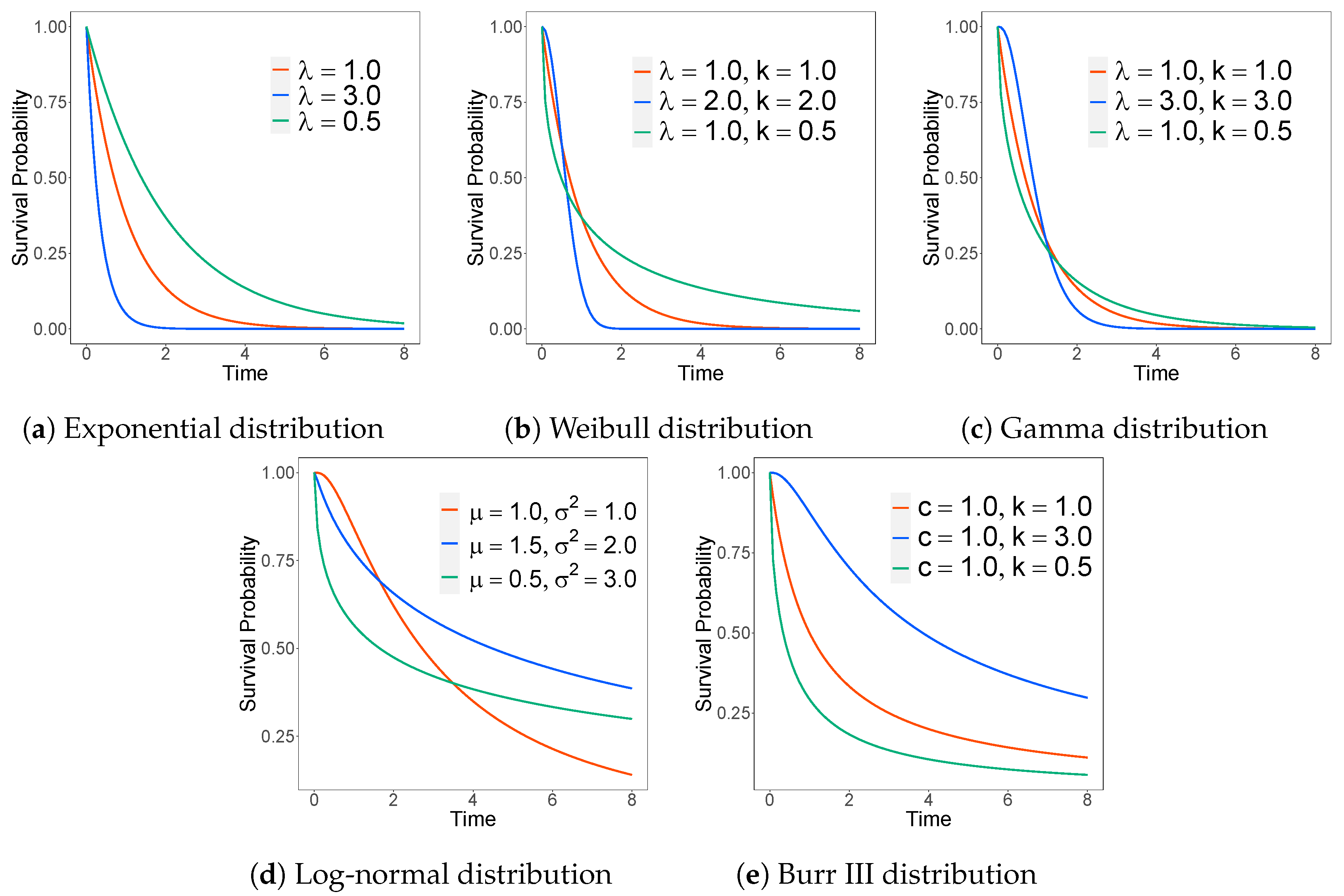
2.4. Marginal Survival Distributions
- 1.
- The exponential distribution:where is a rate parameter.
- 2.
- The Weibull distribution:where is a scale parameter and is a shape parameter.
- 3.
- The gamma distribution:where is a scale parameter and is a shape parameter, and is the gamma function, and is the lower incomplete gamma function. The gamma distribution has no simple closed-form expression for the inverse survival function. Therefore, one can use approximations for the inverse survival function. In this article, we use the R software version 4.2.3 function “qgamma” to calculate .
- 4.
- The log-normal distribution:where is a location parameter and is a scale parameter. Note that has no simple closed-form expression for the inverse survival function. Therefore, one can use approximations for the inverse survival function. In this article, we use the R software function “qlnorm” to calculate .
- 5.
- The Burr III distribution:where are shape parameters.
2.5. Sensitivity Analysis by Copulas
3. Software and Web App
3.1. Input
3.2. Output
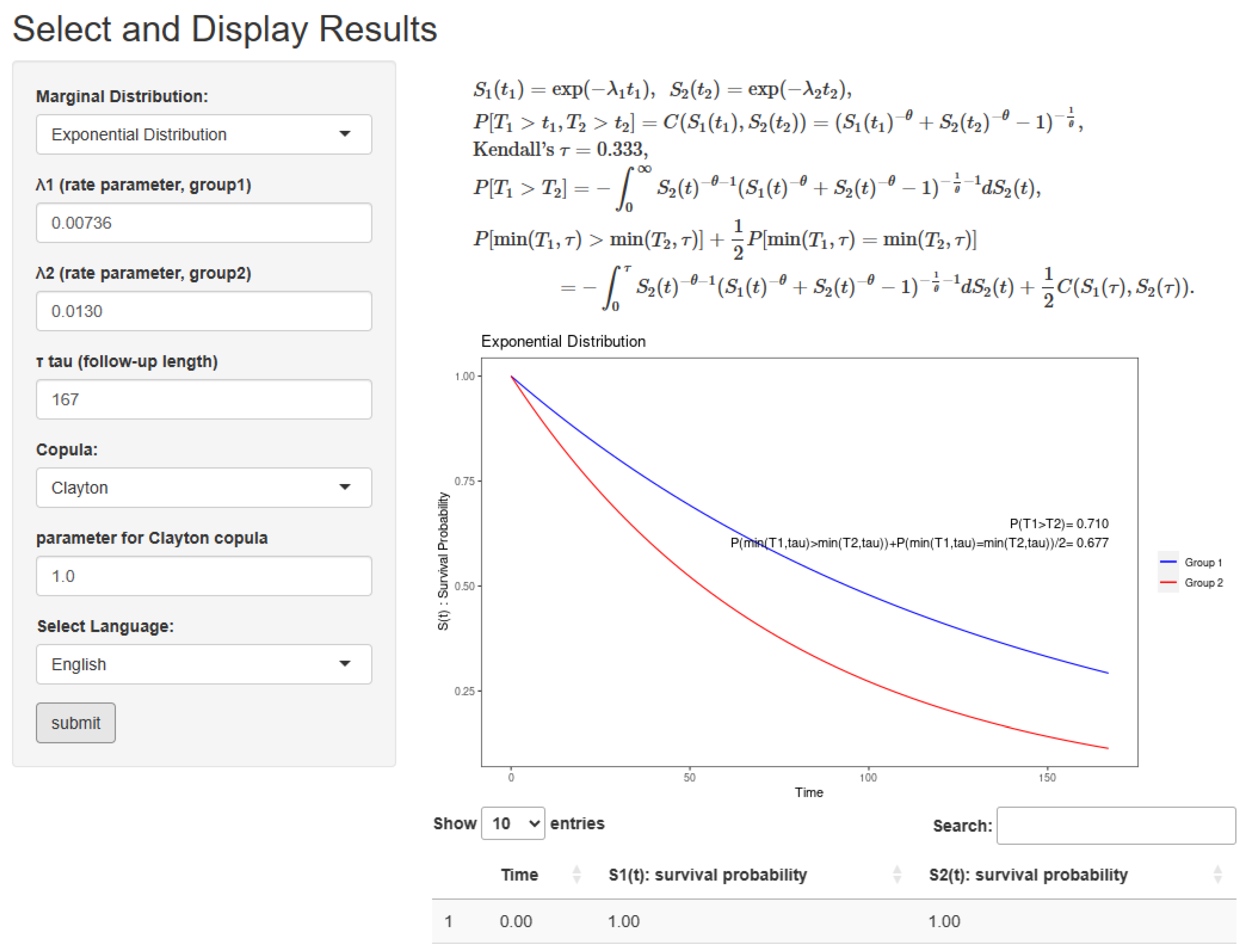
3.3. Example of Using the App
4. Simulation Studies
5. Data Analysis
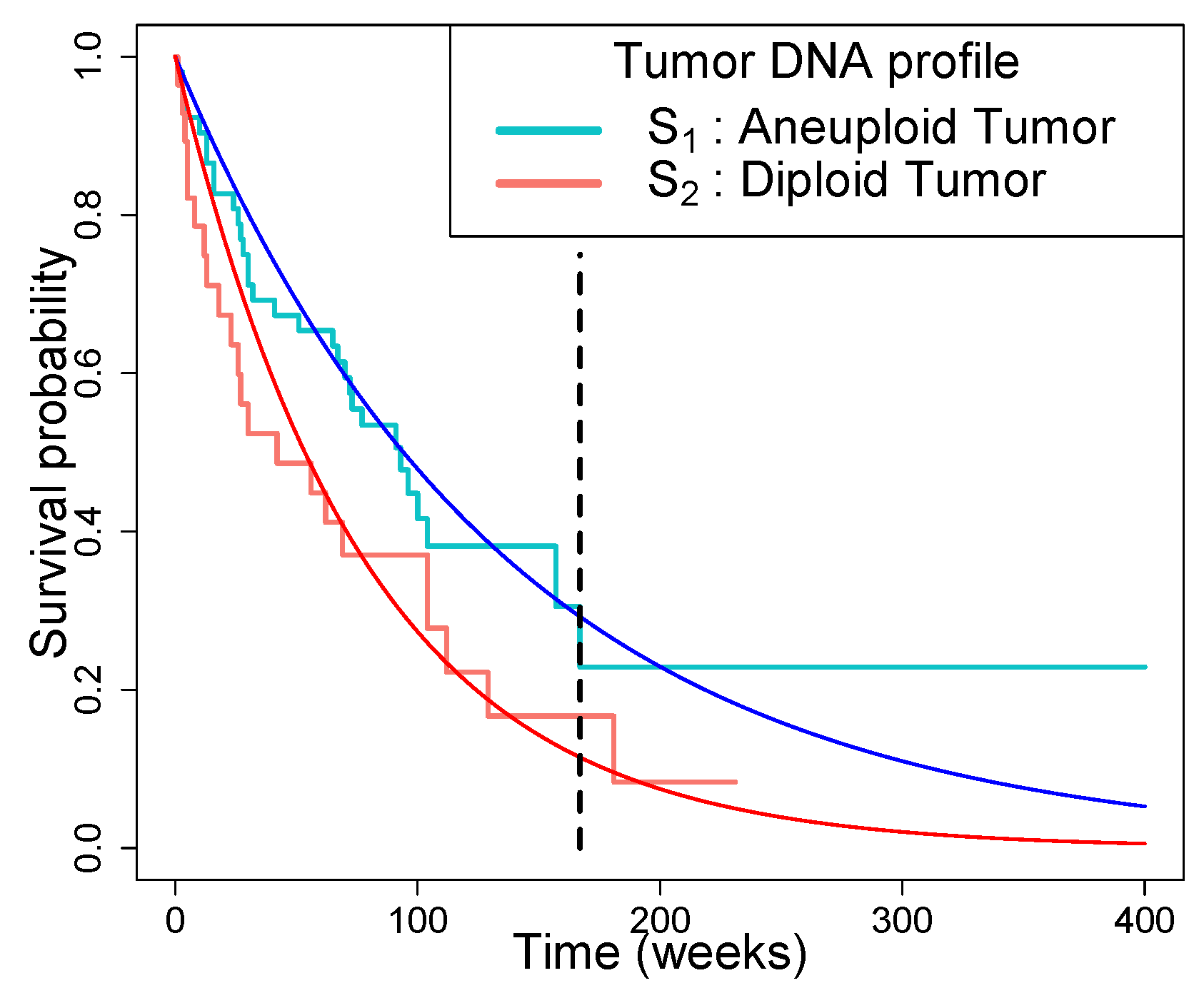
5.1. Tongue Cancer Data
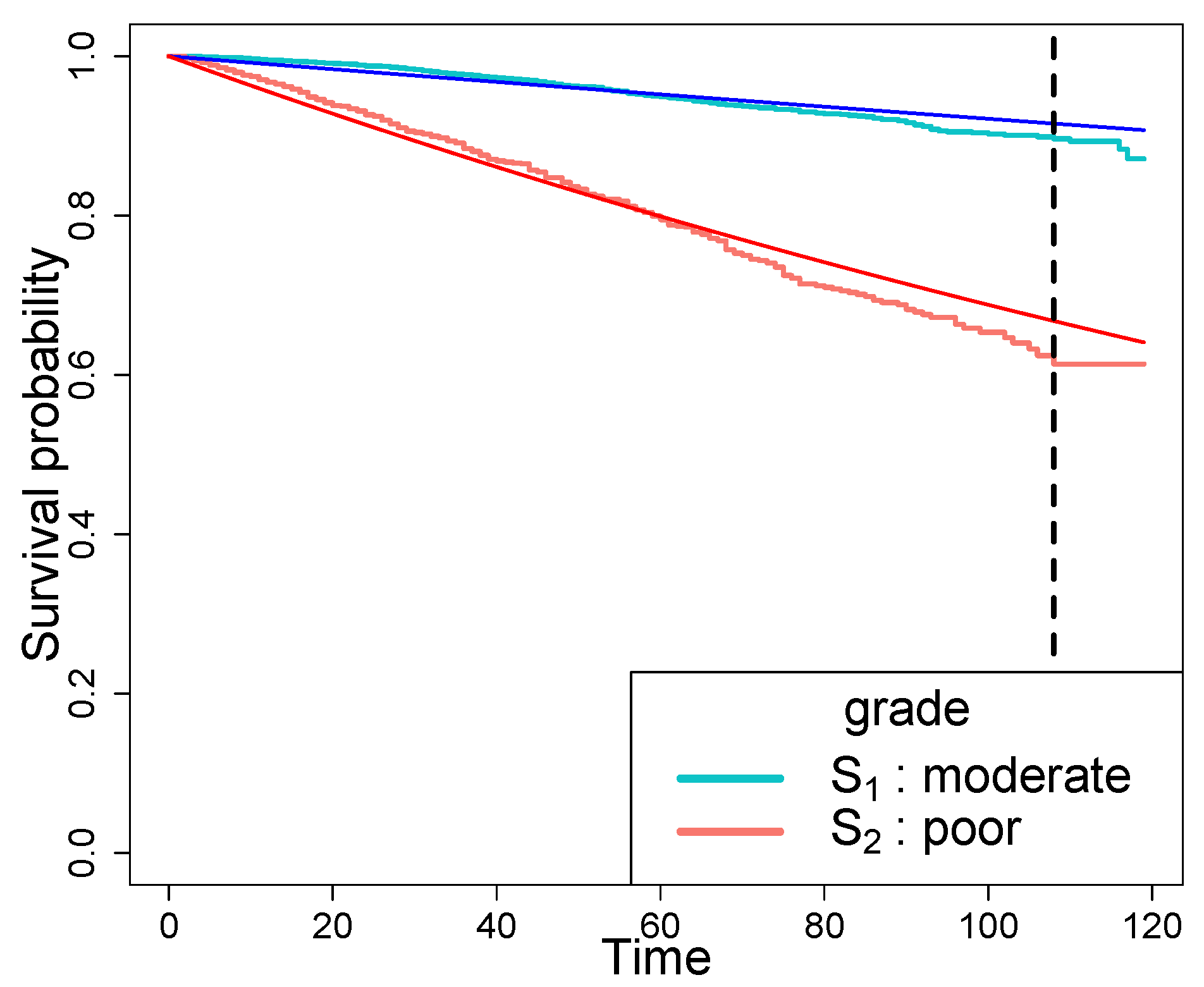
5.2. Prostate Cancer Data
6. Conclusions
Supplementary Materials
Author Contributions
Funding
Data Availability Statement
Acknowledgments
Conflicts of Interest
Appendix A. Kendall’s τ
- 1.
- The independence copula:
- 2.
- The Clayton copula:
- 3.
- The Gumbel copula:
- 4.
- The Frank copula:
- 5.
- The FGM copula:
- 6.
- The GB copula:
Appendix B. Examples of p and pτ with Different Copulas
- 1.
- The Clayton copula:
- 2.
- The Gumbel copula:
- 3.
- The Frank copula:
- 4.
- The FGM copula:
- 5.
- The GB copula:
- 1.
- The Clayton copula:
- 2.
- The Gumbel copula:
- 3.
- The Frank copula:
- 4.
- The FGM copula:
- 5.
- The GB copula:
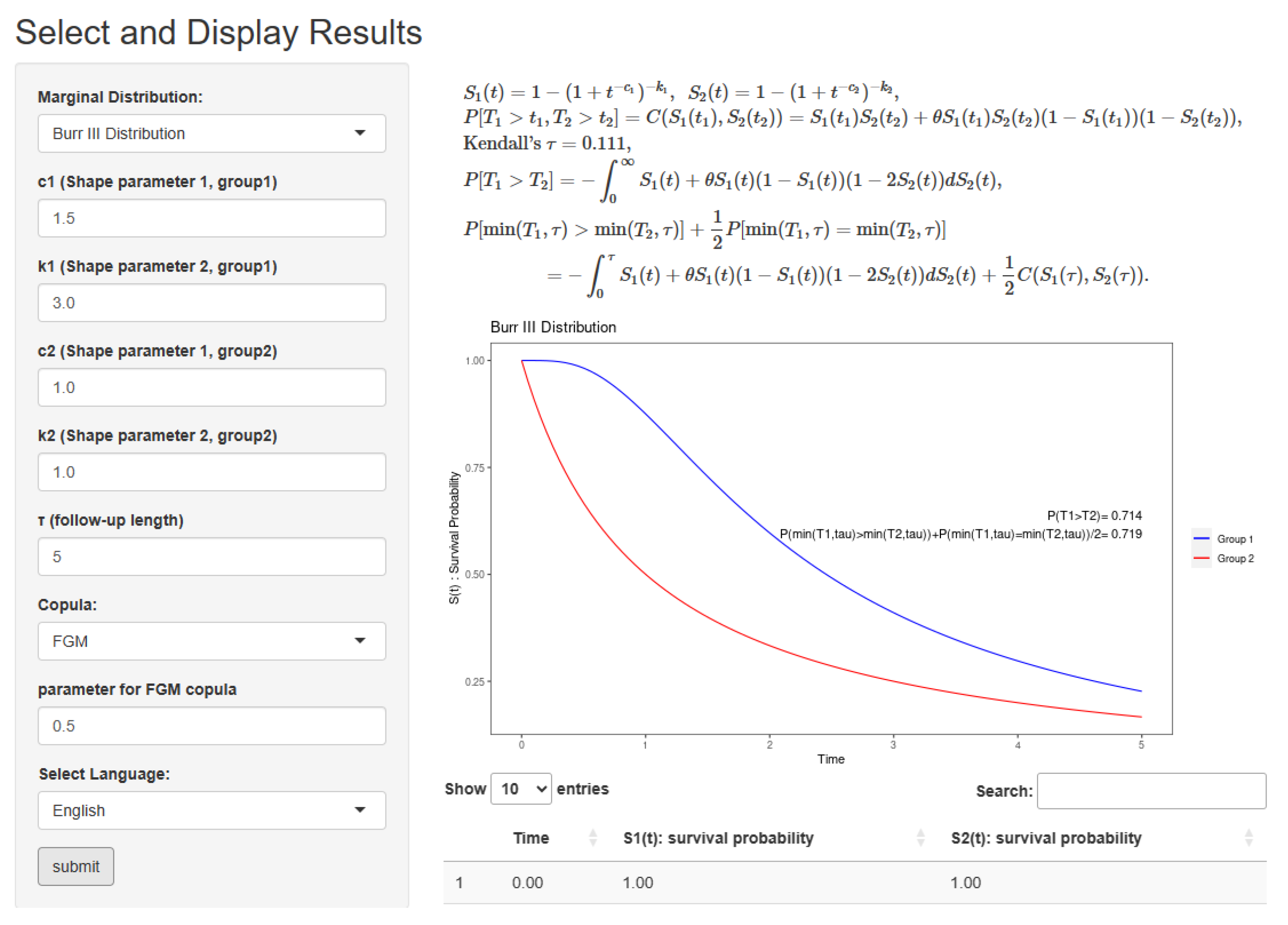
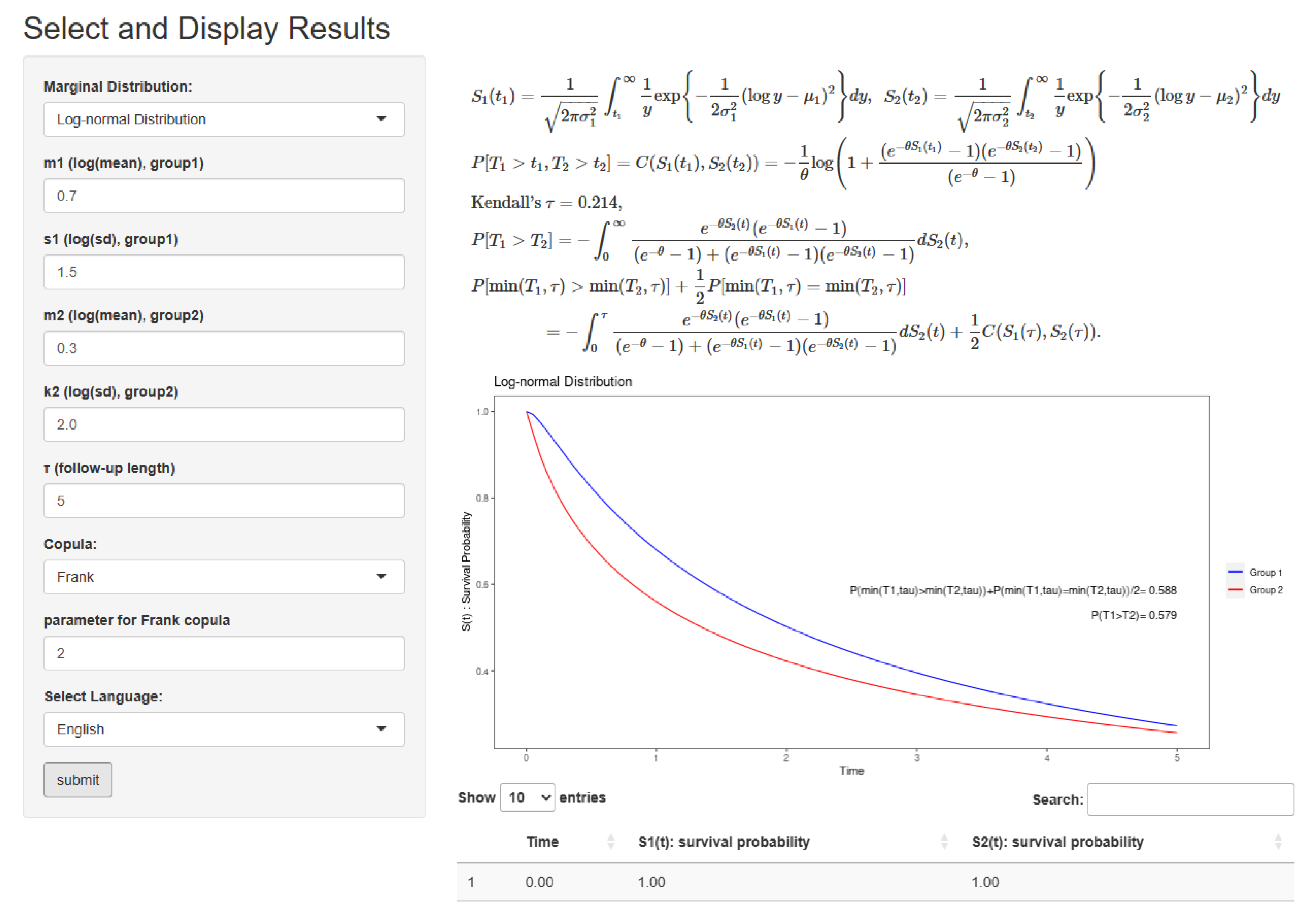
Appendix C. Examples of Using the Shiny Web App

References
- Efron, B. The two sample problem with censored data. In Proceedings of the Fifth Berkeley Symposium on Mathematical Statistics and Probability; University of California Press: Berkeley, CA, USA, 1967; Volume 4, pp. 831–853. [Google Scholar]
- Rahlfs, V.W.; Zimmermann, H.; Lees, K.R. Effect Size Measures and Their Relationships in Stroke Studies. Stroke 2014, 45, 627–633. [Google Scholar] [CrossRef][Green Version]
- Mann, H.B.; Whitney, D.R. On a test of whether one of two random variables is stochastically larger than the other. Ann. Math. Stat. 1947, 18, 50–60. [Google Scholar] [CrossRef]
- Pocock, S.J.; Ariti, C.A.; Collier, T.J.; Wang, D. The win ratio: A new approach to the analysis of composite endpoints in clinical trials based on clinical priorities. Eur. Heart J. 2011, 33, 176–182. [Google Scholar] [CrossRef]
- Birnbaum, Z.W. On a use of the Mann-Whitney statistic. In Proceedings of the Third Berkeley Symposium on Mathematical Statistics and Probability, 1954–1955; University of California Press: Berkeley, BA, USA,, 1956; Volume I, pp. 13–17. [Google Scholar]
- Dobler, D.; Pauly, M. Bootstrap- and permutation-based inference for the Mann-Whitney effect for right-censored and tied data. TEST 2018, 27, 639–658. [Google Scholar] [CrossRef]
- Emura, T.; Hsu, J. Estimation of the Mann-Whitney effect in the two-sample problem under dependent censoring. Comput. Statist. Data Anal. 2020, 150, 106990. [Google Scholar] [CrossRef]
- Biswas, A.; Chakraborty, S.; Mukherjee, M. On estimation of stress-strength reliability with log-Lindley distribution. J. Stat. Comput. Simul. 2021, 91, 128–150. [Google Scholar] [CrossRef]
- Rubarth, K.; Sattler, P.; Zimmermann, H.G.; Konietschke, F. Estimation and Testing of Wilcoxon-Mann-Whitney Effects in Factorial Clustered Data Designs. Symmetry 2022, 14, 244. [Google Scholar] [CrossRef]
- Hu, J.; Zhuang, Y.; Goldiner, C. Fixed-accuracy confidence interval estimation of P(X<Y) under a geometric-exponential model. Jpn. J. Stat. Data Sci. 2021, 4, 1079–1104. [Google Scholar] [CrossRef]
- de la Cruz, R.; Salinas, H.S.; Meza, C. Reliability Estimation for Stress-Strength Model Based on Unit-Half-Normal Distribution. Symmetry 2022, 14, 837. [Google Scholar] [CrossRef]
- Patil, D.; Naik-Nimbalkar, U.V.; Kale, M.M. Effect of Dependency on the Estimation of P[Y>X] in Exponential Stress-strength Models. Austrian J. Stat. 2022, 51, 10–34. [Google Scholar] [CrossRef]
- Nowak, C.P.; Mütze, T.; Konietschke, F. Group sequential methods for the Mann-Whitney parameter. Stat. Methods Med. Res. 2022, 31, 2004–2020. [Google Scholar] [CrossRef]
- Singh, B.; Nayal, A.S.; Tyagi, A. Estimation of P [Y< Z] under Geometric-Lindley model. Ric. Mat. 2023, 1–32. [Google Scholar] [CrossRef]
- Hand, D.J. On Comparing Two Treatments. Am. Stat. 1992, 46, 190–192. [Google Scholar] [CrossRef]
- Cochran, W.G.; Cox, G.M. Experimental Designs, 2nd ed.; John Wiley & Sons Inc.: New York, NY, USA; Chapman & Hall, Ltd.: London, UK, 1957; p. xiv+617. [Google Scholar]
- Dobler, D.; Möllenhoff, K. A nonparametric relative treatment effect for direct comparisons of censored paired survival outcomes. Stat. Med. 2024; early view. [Google Scholar] [CrossRef] [PubMed]
- Fan, Y.; Park, S.S. Sharp bounds on the distribution of treatment effects and their statistical inference. Econom. Theory 2010, 26, 931–951. [Google Scholar] [CrossRef]
- Fay, M.P.; Brittain, E.H.; Shih, J.H.; Follmann, D.A.; Gabriel, E.E. Causal estimands and confidence intervals associated with Wilcoxon-Mann-Whitney tests in randomized experiments. Stat. Med. 2018, 37, 2923–2937. [Google Scholar] [CrossRef]
- Emura, T.; Matsui, S.; Rondeau, V. Survival Analysis with Correlated Endpoints; SpringerBriefs in Statistics; Springer: Singapore, 2019; p. xvii+118. [Google Scholar] [CrossRef]
- Li, D.; Hu, X.J.; Wang, R. Evaluating association between two event times with observations subject to informative censoring. J. Amer. Statist. Assoc. 2023, 118, 1282–1294. [Google Scholar] [CrossRef]
- Emura, T.; Pan, C. Parametric likelihood inference and goodness-of-fit for dependently left-truncated data, a copula-based approach. Statist. Pap. 2020, 61, 479–501. [Google Scholar] [CrossRef]
- Sklar, M. Fonctions de répartition à n dimensions et leurs marges. Publ. Inst. Statist. Univ. Paris 1959, 8, 229–231. [Google Scholar]
- Nelsen, R.B. An Introduction to Copulas, 2nd ed.; Springer Series in Statistics; Springer: New York, NY, USA, 2006; p. xiv+269. [Google Scholar] [CrossRef]
- Geenens, G. (Re-)Reading Sklar (1959);A Personal View on Sklar’s Theorem. Mathematics 2024, 12, 380. [Google Scholar] [CrossRef]
- Escarela, G.; Carrière, J.F. Fitting competing risks with an assumed copula. Stat. Methods Med. Res. 2003, 12, 333–349. [Google Scholar] [CrossRef] [PubMed]
- Petti, D.; Eletti, A.; Marra, G.; Radice, R. Copula link-based additive models for bivariate time-to-event outcomes with general censoring scheme. Comput. Statist. Data Anal. 2022, 175, 107550. [Google Scholar] [CrossRef]
- Clayton, D.G. A model for association in bivariate life tables and its application in epidemiological studies of familial tendency in chronic disease incidence. Biometrika 1978, 65, 141–151. [Google Scholar] [CrossRef]
- Gumbel, E.J. Distributions des valeurs extrêmes en plusieurs dimensions. Publ. Inst. Statist. Univ. Paris 1960, 9, 171–173. [Google Scholar]
- Frank, M.J. On the simultaneous associativity of F(x,y) and x + y − F(x,y). Aequationes Math. 1979, 19, 194–226. [Google Scholar] [CrossRef]
- Morgenstern, D. Einfache Beispiele zweidimensionaler Verteilungen. Mitteilungsbl. Math. Statist. 1956, 8, 234–235. [Google Scholar]
- Chesneau, C. On the Gumbel-Barnett extended Celebioglu-Cuadras copula. Jpn. J. Stat. Data Sci. 2023, 6, 759–781. [Google Scholar] [CrossRef]
- Toparkus, A.; Weißbach, R. Testing Truncation Dependence: The Gumbel-Barnett Copula. arXiv 2024, arXiv:2305.19675. [Google Scholar]
- Schneider, S.; dos Reis, R.C.P.; Gottselig, M.M.F.; Fisch, P.; Knauth, D.R.; Vigo, A. Clayton copula for survival data with dependent censoring: An application to a tuberculosis treatment adherence data. Stat. Med. 2023, 42, 4057–4081. [Google Scholar] [CrossRef]
- Sun, T.; Ding, Y. Copula-based semiparametric regression method for bivariate data under general interval censoring. Biostatistics 2021, 22, 315–330. [Google Scholar] [CrossRef]
- Moradian, H.; Larocque, D.; Bellavance, F. Survival forests for data with dependent censoring. Stat. Methods Med. Res. 2019, 28, 445–461. [Google Scholar] [CrossRef] [PubMed]
- Farzana, W.; Basree, M.M.; Diawara, N.; Shboul, Z.A.; Dubey, S.; Lockhart, M.M.; Hamza, M.; Palmer, J.D.; Iftekharuddin, K.M. Prediction of Rapid Early Progression and Survival Risk with Pre-Radiation MRI in WHO Grade 4 Glioma Patients. Cancers 2023, 15, 4636. [Google Scholar] [CrossRef] [PubMed]
- Chen, Y. Semiparametric marginal regression analysis for dependent competing risks under an assumed copula. J. R. Stat. Soc. Ser. B Stat. Methodol. 2010, 72, 235–251. [Google Scholar] [CrossRef]
- Shih, J.; Emura, T. Likelihood-based inference for bivariate latent failure time models with competing risks under the generalized FGM copula. Comput. Statist. 2018, 33, 1293–1323. [Google Scholar] [CrossRef]
- Kawakami, R.; Michimae, H.; Lin, Y. Assessing the numerical integration of dynamic prediction formulas using the exact expressions under the joint frailty-copula model. Jpn. J. Stat. Data Sci. 2021, 4, 1293–1321. [Google Scholar] [CrossRef]
- Shih, J.; Konno, Y.; Chang, Y.; Emura, T. Estimation of a common mean vector in bivariate meta-analysis under the FGM copula. Statistics 2019, 53, 673–695. [Google Scholar] [CrossRef]
- Shih, J.; Konno, Y.; Chang, Y.; Emura, T. Copula-Based Estimation Methods for a Common Mean Vector for Bivariate Meta-Analyses. Symmetry 2022, 14, 186. [Google Scholar] [CrossRef]
- Dobler, D.; Pauly, M. Factorial analyses of treatment effects under independent right-censoring. Stat. Methods Med. Res. 2020, 29, 325–343. [Google Scholar] [CrossRef] [PubMed]
- Emura, T.; Ditzhaus, M.; Dobler, D.; Murotani, K. Factorial survival analysis for treatment effects under dependent censoring. Stat. Methods Med. Res. 2024, 33, 61–79. [Google Scholar] [CrossRef]
- Moore, D.F. Applied Survival Analysis Using R; Springer: Berlin/Heidelberg, Germany, 2016; Volume 473. [Google Scholar]
- Greenland, S.; Fay, M.P.; Brittain, E.H.; Shih, J.H.; Follmann, D.A.; Gabriel, E.E.; Robins, J.M. On causal inferences for personalized medicine: How hidden causal assumptions led to erroneous causal claims about the D-value. Am. Statist. 2020, 74, 243–248. [Google Scholar] [CrossRef]
- Domma, F.; Giordano, S. A copula-based approach to account for dependence in stress-strength models. Statist. Pap. 2013, 54, 807–826. [Google Scholar] [CrossRef]
- Gao, J.; An, Z.; Liu, B. A dependent stress-strength interference model based on mixed copula function. J. Mech. Sci. Technol. 2016, 30, 4443–4446. [Google Scholar] [CrossRef]
- de Andrade, B.B.; do Nascimento, A.R.; Rathie, P.N. Parametric and nonparametric inference for the reliability of copula-based stress-strength models. Qual. Reliab. Eng. Int. 2020, 36, 2249–2267. [Google Scholar] [CrossRef]
- Rathie, P.N.; de Sena Monteiro Ozelim, L.C.; de Andrade, B.B. Portfolio Management of Copula-Dependent Assets Based on P(Y < X) Reliability Models: Revisiting Frank Copula and Dagum Distributions. Stats 2021, 4, 1027–1050. [Google Scholar] [CrossRef]
- James, A.; Chandra, N.; Sebastian, N. Stress-strength reliability estimation for bivariate copula function with rayleigh marginals. Int. J. Syst. Assur. Eng. Manag. 2023, 14, 196–215. [Google Scholar] [CrossRef]
- Shang, L.; Yan, Z. Reliability estimation stress-strength dependent model based on copula function using ranked set sampling. J. Radiat. Res. Appl. Sci. 2024, 17, 100811. [Google Scholar] [CrossRef]
- Lima, R.K.; Quintino, F.S.; da Fonseca, T.A.; de Sena Monteiro Ozelim, L.C.; Rathie, P.N.; Saulo, H. Assessing the Impact of Copula Selection on Reliability Measures of Type P(X < Y) with Generalized Extreme Value Marginals. Modelling 2024, 5, 180–200. [Google Scholar] [CrossRef]
- Patton, A.J. Modelling asymmetric exchange rate dependence. Internat. Econom. Rev. 2006, 47, 527–556. [Google Scholar] [CrossRef]
- Almeida, C.; Czado, C. Efficient Bayesian inference for stochastic time-varying copula models. Comput. Statist. Data Anal. 2012, 56, 1511–1527. [Google Scholar] [CrossRef]
- Yin, Y.; Cai, Z.; Zhou, X. Using secondary outcome to sharpen bounds for treatment harm rate in characterizing heterogeneity. Biom. J. 2018, 60, 879–892. [Google Scholar] [CrossRef]
- Susam, S.O. A multi-parameter Generalized Farlie-Gumbel-Morgenstern bivariate copula family via Bernstein polynomial. Hacet. J. Math. Stat. 2022, 51, 618–631. [Google Scholar] [CrossRef]
- Deresa, N.W.; Van Keilegom, I. A multivariate normal regression model for survival data subject to different types of dependent censoring. Comput. Statist. Data Anal. 2020, 144, 106879. [Google Scholar] [CrossRef]
- Jo, J.H.; Gao, Z.; Jung, I.; Song, S.Y.; Ridder, G.; Moon, H.R. Copula graphic estimation of the survival function with dependent censoring and its application to analysis of pancreatic cancer clinical trial. Stat. Methods Med. Res. 2023, 32, 944–962. [Google Scholar] [CrossRef] [PubMed]
- Emura, T.; Chen, Y. Analysis of Survival Data with Dependent Censoring: Copula-Based Approaches; Springer: Berlin/Heidelberg, Germany, 2018; Volume 450. [Google Scholar]
- Brunner, E.; Puri, M.L. Nonparametric methods in factorial designs. Statist. Pap. 2001, 42, 1–52. [Google Scholar] [CrossRef]



| Copula | Kendall’s | |
|---|---|---|
| Clayton | 1.0 | 0.33 |
| 5.0 | 0.71 | |
| 10.0 | 0.83 | |
| Gumbel | 0.0 | 0.00 |
| 4.0 | 0.80 | |
| Frank | −20.0 | −0.82 |
| −5.0 | −0.46 | |
| 1.0 | 0.11 | |
| 5.0 | 0.46 | |
| FGM | −1.0 | −0.22 |
| 0.0 | 0.00 | |
| 1.0 | 0.22 | |
| GB | 0.5 | −0.21 |
| 1.0 | −0.36 |
| Distribution | Copula | ||||||||||
| Exponential | Clayton | 1.0 | 0.33 | 0.645 | 0.643 | 0.737 | 0.738 | 0.744 | 0.746 | 0.744 | 0.746 |
| 5.0 | 0.71 | 0.704 | 0.706 | 0.872 | 0.872 | 0.881 | 0.883 | 0.881 | 0.883 | ||
| 10.0 | 0.83 | 0.746 | 0.745 | 0.920 | 0.921 | 0.930 | 0.930 | 0.930 | 0.929 | ||
| Gumbel | 0.0 | 0.00 | 0.629 | 0.631 | 0.666 | 0.666 | 0.666 | 0.665 | 0.667 | 0.666 | |
| 4.0 | 0.80 | 0.798 | 0.799 | 0.961 | 0.961 | 0.970 | 0.969 | 0.970 | 0.968 | ||
| Frank | −5.0 | −0.46 | 0.615 | 0.615 | 0.622 | 0.622 | 0.622 | 0.622 | 0.622 | 0.620 | |
| 1.0 | 0.11 | 0.636 | 0.636 | 0.684 | 0.684 | 0.685 | 0.685 | 0.685 | 0.685 | ||
| 5.0 | 0.46 | 0.674 | 0.674 | 0.771 | 0.768 | 0.773 | 0.772 | 0.773 | 0.775 | ||
| FGM | −1.0 | −0.22 | 0.617 | 0.617 | 0.633 | 0.634 | 0.633 | 0.631 | 0.633 | 0.633 | |
| 0.0 | 0.00 | 0.629 | 0.629 | 0.666 | 0.666 | 0.666 | 0.666 | 0.666 | 0.664 | ||
| 1.0 | 0.22 | 0.642 | 0.641 | 0.699 | 0.697 | 0.700 | 0.702 | 0.700 | 0.698 | ||
| GB | 0.5 | −0.21 | 0.623 | 0.624 | 0.642 | 0.643 | 0.642 | 0.641 | 0.642 | 0.640 | |
| 1.0 | −0.36 | 0.617 | 0.616 | 0.629 | 0.628 | 0.629 | 0.632 | 0.629 | 0.630 | ||
| Weibull | Clayton | 1.0 | 0.33 | 0.497 | 0.496 | 0.594 | 0.589 | 0.603 | 0.602 | 0.603 | 0.602 |
| 5.0 | 0.71 | 0.482 | 0.480 | 0.644 | 0.645 | 0.653 | 0.654 | 0.653 | 0.650 | ||
| 10.0 | 0.83 | 0.472 | 0.472 | 0.645 | 0.645 | 0.654 | 0.653 | 0.654 | 0.652 | ||
| Gumbel | 0.0 | 0.00 | 0.511 | 0.509 | 0.560 | 0.562 | 0.562 | 0.562 | 0.562 | 0.563 | |
| 4.0 | 0.80 | 0.425 | 0.424 | 0.584 | 0.585 | 0.593 | 0.594 | 0.593 | 0.592 | ||
| Frank | −5.0 | −0.46 | 0.528 | 0.530 | 0.542 | 0.541 | 0.542 | 0.543 | 0.542 | 0.541 | |
| 1.0 | 0.11 | 0.505 | 0.504 | 0.566 | 0.565 | 0.569 | 0.572 | 0.569 | 0.568 | ||
| 5.0 | 0.46 | 0.486 | 0.486 | 0.592 | 0.595 | 0.597 | 0.597 | 0.597 | 0.594 | ||
| FGM | −1.0 | −0.22 | 0.521 | 0.523 | 0.548 | 0.549 | 0.549 | 0.551 | 0.549 | 0.549 | |
| 0.0 | 0.00 | 0.511 | 0.509 | 0.560 | 0.563 | 0.562 | 0.562 | 0.562 | 0.564 | ||
| 1.0 | 0.22 | 0.501 | 0.503 | 0.572 | 0.574 | 0.575 | 0.577 | 0.575 | 0.574 | ||
| GB | 0.5 | −0.21 | 0.519 | 0.520 | 0.549 | 0.546 | 0.549 | 0.548 | 0.549 | 0.553 | |
| 1.0 | −0.36 | 0.526 | 0.526 | 0.545 | 0.545 | 0.545 | 0.545 | 0.545 | 0.546 | ||
| Gamma | Clayton | 1.0 | 0.33 | 0.529 | 0.529 | 0.651 | 0.649 | 0.679 | 0.678 | 0.679 | 0.680 |
| 5.0 | 0.71 | 0.530 | 0.528 | 0.763 | 0.763 | 0.809 | 0.810 | 0.809 | 0.810 | ||
| 10.0 | 0.83 | 0.534 | 0.533 | 0.817 | 0.816 | 0.862 | 0.863 | 0.863 | 0.863 | ||
| Gumbel | 0.0 | 0.00 | 0.530 | 0.530 | 0.611 | 0.612 | 0.615 | 0.614 | 0.615 | 0.616 | |
| 4.0 | 0.80 | 0.545 | 0.546 | 0.813 | 0.813 | 0.853 | 0.853 | 0.854 | 0.853 | ||
| Frank | −5.0 | −0.46 | 0.532 | 0.530 | 0.584 | 0.584 | 0.584 | 0.583 | 0.584 | 0.584 | |
| 1.0 | 0.11 | 0.530 | 0.529 | 0.622 | 0.622 | 0.628 | 0.628 | 0.628 | 0.628 | ||
| 5.0 | 0.46 | 0.530 | 0.530 | 0.679 | 0.679 | 0.694 | 0.692 | 0.694 | 0.697 | ||
| FGM | −1.0 | −0.22 | 0.531 | 0.533 | 0.591 | 0.591 | 0.592 | 0.591 | 0.592 | 0.592 | |
| 0.0 | 0.00 | 0.530 | 0.529 | 0.611 | 0.610 | 0.615 | 0.614 | 0.615 | 0.617 | ||
| 1.0 | 0.22 | 0.529 | 0.529 | 0.631 | 0.631 | 0.639 | 0.640 | 0.639 | 0.641 | ||
| GB | 0.5 | −0.21 | 0.531 | 0.532 | 0.597 | 0.598 | 0.598 | 0.598 | 0.598 | 0.597 | |
| 1.0 | −0.36 | 0.532 | 0.532 | 0.589 | 0.592 | 0.590 | 0.588 | 0.589 | 0.588 | ||
| Log-normal | Clayton | 1.0 | 0.33 | 0.580 | 0.582 | 0.596 | 0.594 | 0.593 | 0.591 | 0.573 | 0.574 |
| 5.0 | 0.71 | 0.599 | 0.599 | 0.658 | 0.658 | 0.675 | 0.677 | 0.619 | 0.619 | ||
| 10.0 | 0.83 | 0.618 | 0.617 | 0.715 | 0.715 | 0.756 | 0.755 | 0.684 | 0.684 | ||
| Gumbel | 0.0 | 0.00 | 0.574 | 0.575 | 0.576 | 0.578 | 0.569 | 0.570 | 0.564 | 0.562 | |
| 4.0 | 0.80 | 0.652 | 0.652 | 0.745 | 0.746 | 0.760 | 0.759 | 0.728 | 0.726 | ||
| Frank | −5.0 | −0.46 | 0.567 | 0.567 | 0.553 | 0.554 | 0.547 | 0.547 | 0.547 | 0.544 | |
| 1.0 | 0.11 | 0.577 | 0.576 | 0.584 | 0.586 | 0.578 | 0.580 | 0.571 | 0.570 | ||
| 5.0 | 0.46 | 0.593 | 0.593 | 0.624 | 0.625 | 0.623 | 0.621 | 0.609 | 0.607 | ||
| FGM | −1.0 | −0.22 | 0.568 | 0.567 | 0.560 | 0.561 | 0.553 | 0.553 | 0.550 | 0.551 | |
| 0.0 | 0.00 | 0.574 | 0.574 | 0.576 | 0.576 | 0.569 | 0.569 | 0.564 | 0.560 | ||
| 1.0 | 0.22 | 0.580 | 0.580 | 0.591 | 0.593 | 0.585 | 0.586 | 0.577 | 0.579 | ||
| GB | 0.5 | −0.21 | 0.571 | 0.572 | 0.563 | 0.566 | 0.558 | 0.555 | 0.558 | 0.557 | |
| 1.0 | −0.36 | 0.568 | 0.567 | 0.557 | 0.557 | 0.550 | 0.554 | 0.549 | 0.550 | ||
| Burr III | Clayton | 1.0 | 0.33 | 0.661 | 0.662 | 0.753 | 0.753 | 0.760 | 0.761 | 0.747 | 0.748 |
| 5.0 | 0.71 | 0.665 | 0.665 | 0.819 | 0.820 | 0.883 | 0.883 | 0.863 | 0.865 | ||
| 10.0 | 0.83 | 0.666 | 0.666 | 0.832 | 0.832 | 0.913 | 0.914 | 0.896 | 0.897 | ||
| Gumbel | 0.0 | 0.00 | 0.660 | 0.661 | 0.714 | 0.715 | 0.701 | 0.701 | 0.697 | 0.696 | |
| 4.0 | 0.80 | 0.667 | 0.665 | 0.832 | 0.832 | 0.885 | 0.883 | 0.871 | 0.871 | ||
| Frank | −5.0 | −0.46 | 0.658 | 0.658 | 0.663 | 0.662 | 0.650 | 0.649 | 0.650 | 0.653 | |
| 1.0 | 0.11 | 0.661 | 0.660 | 0.730 | 0.731 | 0.720 | 0.719 | 0.715 | 0.716 | ||
| 5.0 | 0.46 | 0.664 | 0.663 | 0.788 | 0.789 | 0.798 | 0.797 | 0.789 | 0.788 | ||
| FGM | −1.0 | −0.22 | 0.658 | 0.658 | 0.683 | 0.683 | 0.666 | 0.666 | 0.665 | 0.664 | |
| 0.0 | 0.00 | 0.660 | 0.660 | 0.714 | 0.711 | 0.701 | 0.701 | 0.697 | 0.699 | ||
| 1.0 | 0.22 | 0.661 | 0.662 | 0.744 | 0.747 | 0.737 | 0.736 | 0.730 | 0.729 | ||
| GB | 0.5 | −0.21 | 0.659 | 0.659 | 0.692 | 0.693 | 0.676 | 0.677 | 0.675 | 0.676 | |
| 1.0 | −0.36 | 0.658 | 0.658 | 0.673 | 0.671 | 0.659 | 0.659 | 0.659 | 0.659 | ||
| Copula | Marginal Distribution | SE | p-Value | SE | p-Value | |||
|---|---|---|---|---|---|---|---|---|
| Independent | KM estimator | - | - | - | - | 0.624 | 0.071 | 0.079 |
| Independent | exponential | - | 0.638 | 0.076 | 0.070 | 0.633 | 0.075 | 0.076 |
| Clayton | exponential | 1.0 | 0.709 | 0.096 | 0.029 | 0.676 | 0.096 | 0.067 |
| 5.0 | 0.856 | 0.075 | <0.001 | 0.799 | 0.100 | 0.003 | ||
| Gumbel | exponential | 4.0 | 0.944 | 0.084 | <0.001 | 0.895 | 0.095 | <0.001 |
| Frank | exponential | −20.0 | 0.596 | 0.055 | 0.080 | 0.596 | 0.055 | 0.080 |
| −5.0 | 0.600 | 0.057 | 0.081 | 0.600 | 0.057 | 0.081 | ||
| 5.0 | 0.733 | 0.111 | 0.036 | 0.714 | 0.108 | 0.046 | ||
| FGM | exponential | −1.0 | 0.609 | 0.063 | 0.082 | 0.609 | 0.063 | 0.083 |
| 1.0 | 0.666 | 0.090 | 0.063 | 0.658 | 0.088 | 0.072 | ||
| GB | exponential | 0.5 | 0.617 | 0.066 | 0.077 | 0.617 | 0.066 | 0.078 |
| 1.0 | 0.606 | 0.060 | 0.079 | 0.606 | 0.060 | 0.080 |
| Copula | Marginal Distribution | SE | p-Value | SE | p-Value | |||
|---|---|---|---|---|---|---|---|---|
| Independent | KM estimator | - | - | - | - | 0.635 | 0.013 | <0.001 |
| Independent | exponential | - | 0.821 | 0.010 | <0.001 | 0.625 | 0.007 | <0.001 |
| Clayton | exponential | 1.0 | 0.889 | 0.008 | <0.001 | 0.626 | 0.007 | <0.001 |
| 5.0 | 0.958 | 0.003 | <0.001 | 0.635 | 0.007 | <0.001 | ||
| Gumbel | exponential | 4.0 | 0.999 | <0.001 | <0.001 | 0.666 | 0.006 | <0.001 |
| Frank | exponential | −20.0 | 0.741 | 0.009 | <0.001 | 0.624 | 0.007 | <0.001 |
| −5.0 | 0.753 | 0.010 | <0.001 | 0.624 | 0.007 | <0.001 | ||
| 5.0 | 0.924 | 0.007 | <0.001 | 0.632 | 0.007 | <0.001 | ||
| FGM | exponential | −1.0 | 0.777 | 0.011 | <0.001 | 0.623 | 0.007 | <0.001 |
| 1.0 | 0.865 | 0.010 | <0.001 | 0.626 | 0.007 | <0.001 | ||
| GB | exponential | 0.5 | 0.786 | 0.010 | <0.001 | 0.624 | 0.007 | <0.001 |
| 1.0 | 0.764 | 0.010 | <0.001 | 0.623 | 0.007 | <0.001 |
| Copula | Marginal Distribution | |
|---|---|---|
| Domma & Giordano [47] | FGM, Generalized FGM, Frank | Burr III, Dagum, Singh–Maddala |
| Gao et al. [48] | Mixed (Clayton, Gumbel, Frank) | Empirical |
| de Andrade et al. [49] | Clayton, Gumbel, Frank, Gauss, Plackett | Weibull, Gamma, Log-normal, Dagum |
| Rathie et al. [50] | Frank | Dagum, Log-Dagum |
| James et al. [51] | FGM | Rayleigh |
| Shang & Yan [52] | Clayton | Weibull, Kumaraswamy |
| Lima et al. [53] | Clayton, Frank, Gumbel–Houggard | Generalized extreme value, Weibull, gamma |
Disclaimer/Publisher’s Note: The statements, opinions and data contained in all publications are solely those of the individual author(s) and contributor(s) and not of MDPI and/or the editor(s). MDPI and/or the editor(s) disclaim responsibility for any injury to people or property resulting from any ideas, methods, instructions or products referred to in the content. |
© 2024 by the authors. Licensee MDPI, Basel, Switzerland. This article is an open access article distributed under the terms and conditions of the Creative Commons Attribution (CC BY) license (https://creativecommons.org/licenses/by/4.0/).
Share and Cite
Nakazono, K.; Lin, Y.-C.; Liao, G.-Y.; Uozumi, R.; Emura, T. Computation of the Mann–Whitney Effect under Parametric Survival Copula Models. Mathematics 2024, 12, 1453. https://doi.org/10.3390/math12101453
Nakazono K, Lin Y-C, Liao G-Y, Uozumi R, Emura T. Computation of the Mann–Whitney Effect under Parametric Survival Copula Models. Mathematics. 2024; 12(10):1453. https://doi.org/10.3390/math12101453
Chicago/Turabian StyleNakazono, Kosuke, Yu-Cheng Lin, Gen-Yih Liao, Ryuji Uozumi, and Takeshi Emura. 2024. "Computation of the Mann–Whitney Effect under Parametric Survival Copula Models" Mathematics 12, no. 10: 1453. https://doi.org/10.3390/math12101453
APA StyleNakazono, K., Lin, Y.-C., Liao, G.-Y., Uozumi, R., & Emura, T. (2024). Computation of the Mann–Whitney Effect under Parametric Survival Copula Models. Mathematics, 12(10), 1453. https://doi.org/10.3390/math12101453