Abstract
Given the challenges associated with accurately modeling complex nonlinear systems with time delays in industrial processes, this paper introduces an advanced model-free control algorithm that combines data-driven and model-driven approaches. Initially, an enhanced algorithm for multi-innovation model-free control, incorporating error feedback, is presented based on the error feedback principle. Subsequently, a novel control strategy is introduced by delving into PID neural network (NN) recognition and control theory, merging PID NN control with multi-innovation feedback control. Through meticulous mathematical derivation, the proposed strategy is proven to ensure system stability. Compared with traditional NN PID controllers, the convergence rate of the proposed scheme is 50 s faster and the steady-state errors are limited to ±1.
MSC:
93B70
1. Introduction
The rapid evolution of modern industry has led to an escalation in the complexity of industrial control systems, driven by the increasing demands placed upon them. Traditional feedback control and contemporary control theories exhibit a significant limitation—they heavily rely on the availability of accurate mathematical models for the controlled systems. Furthermore, the modeling of industrial process control objects necessitates consideration of various factors, including uncertainties within the objects, incomplete knowledge of their states, robust system coupling, uncertain time delays, and pronounced system nonlinearities [1]. Methods derived from modern control theory, such as state-space analysis and optimal control theory, hinge on the availability of precise mathematical models for effective application. Nevertheless, creating a precise mechanistic or mathematical model for a controlled system poses a formidable challenge, and the inevitability of unmodeled dynamics complicates this task. Consequently, the practical application of modern control theories often encounters limitations beyond theoretical analyses [2]. A mathematical model serves as a fundamental prerequisite for control, facilitating the implementation of control actions on the system. However, the challenge of unmodeled dynamics arises inherently during the establishment of a mathematical model for a system. Since the early stages of control theory development, researchers have endeavored to explore control methods that transcend dependence on mathematical models and effectively address the challenges posed by unmodeled dynamics.
Model-free adaptive control (MFAC) algorithms rely solely on the input/output (I/O) data of the system and do not require a pre-established mathematical model of the controlled system [3,4,5]. As a nonparametric model adaptive control method, it has gained widespread attention in the field of control [6,7,8]. The most important thing is that it does not require the prior establishment of a mathematical or mechanistic model of the controlled object and operates under certain assumptions to achieve convergence and robustness [9]. In [10], an event-triggered data-driven NN control scheme with a uniform quantizer was introduced to overcome disturbance and achieve low communication transmissions. In [11], a novel data-driven MFAC scheme was proposed and the significant advantage was that it reduced the number of parameters required. In [12], a sliding-mode MFMC strategy was introduced to design a robust controller for a three-axis Gimbal model based on data. This approach could lessen the computational time and difficulty effectively. In [13], a combination of MFMC and predictive control schemes was developed for a motor system to adapt time-varying parameters and overcome unknown disturbances. In [14], an event-triggered data-driven control was proposed for nonlinear systems and an extended state observer was designed to estimate the unknown disturbances. These studies all demonstrated the advantages of MFCC schemes. However, these methods are more complex and may be difficult to apply in engineering.
Neural network (NN) proportional–integral–derivative (PID) control is a typical MFMC strategy that combines NN technology and traditional PID control [15]. By training the NN model, NN PID control can adaptively adjust the parameters of the controller to accommodate different system dynamics and control requirements [16]. To be specific, the network learns to mimic the behavior of a PID controller, with different neurons contributing to the proportional, integral, and differential aspects of the control action. The learning process involves optimizing the weights to minimize the discrepancy between the network’s output and the desired output, effectively capturing the proportional, integral, and differential characteristics necessary for effective control. It possesses strong nonlinear modeling capability and robustness, enabling it to achieve superior control performance for unknown system models or changing environments. In [17], the authors proposed an NN PID control scheme for an ultrasonic motor so that the NN can dynamically adjust the control gain to obtain optimal control performance. In [15], an NN PID control system was designed to enhance the efficiency of flying simulator control and achieve a better control performance compared to traditional PID control arithmetic. In [18], a novel NN PID controller was developed to suppress the oscillating pressure, and the results suggested that the designed control scheme was not affected by noise and, finally, can effectively suppress and eliminate the system pressure oscillation. All of the above literature reflects the uniqueness of NN PID control schemes in engineering, but no studies have been reported on how to utilize more information to achieve faster convergence of this controller.
The multi-innovation identification method is a novel approach that makes full use of information from the past period. Therefore, it has the characteristics of fast convergence and the ability to overcome the influence of lost data [19,20,21]. Currently, the method has been applied to solve model identification problems in the design of various control systems [22,23,24]. In [25], for the uncertain internal variables and unknown noise in the information vector, a multi-innovation identification scheme with extended stochastic gradient was proposed to effectively improve the estimation accuracy and identification speed. In [26], an auxiliary model-based multi-innovation extended stochastic gradient algorithm was developed to achieve parameter identification for a class of multi-input, multi-output nonlinear systems. A satisfying parameter estimation accuracy was obtained. In [27], to estimate the parameters of multi-rate multi-input systems with different updating periods and sampling periods, a multi-innovation stochastic gradient scheme was introduced. Although the method of multi-innovation presented a strong vitality in the field of system identification, little research has been conducted thus far on the combination of the NN PID control and multi-innovation, and this inspired our study.
Driven by the above discussion, to overcome the challenges of nonlinear system modeling and address the issues associated with unmodeled dynamics, this paper focuses on designing an efficient NN PID control strategy with multi-innovation to achieve highly effective MFMC. This control strategy leverages the learning capability of the NN, the simplicity of the PID controller, and the efficiency of the multi-information identification method. The main contributions are as follows:
- (i)
- Diverging from the conventional NN PID control methods, the control strategy proposed in this paper allows for the online refinement of the weight adjustment mode in PID neural networks. This feature proves advantageous for achieving online optimization, identification, and control of the system.
- (ii)
- Unlike traditional single-innovation feedback, the NN PID control proposed in this paper harnesses the multi-information theory, leveraging historical data to enhance learning efficiency. As a result, the controller exhibits rapid convergence and excellent generalization performance.
- (iii)
- The proposed scheme is validated through rigorous derivation and stability analysis, establishing its applicability. Furthermore, simulation results are presented to provide additional evidence of its effectiveness.
2. Problem Formulation and Preliminaries
2.1. Multi-Innovation Theory
Multi-innovation theory is one of the important branches in the field of system recognition [28]. Its theoretical system includes multi-innovation least squares recognition, multi-innovation Kalman filters, multi-innovation stochastic gradient algorithms, etc. Unlike the traditional time-domain identification methods, this theory is based on the current moment and has a certain length of time to recursively identify the historical data. Therefore, it has the characteristics of fast parameter convergence and high recognition accuracy.
Traditional recognition algorithms such as stochastic gradient class and least squares class algorithms share a common feature; they all use single-innovation correction techniques. Hence, they are classified as methods of single-innovation recognition and expressed as
where stands for at time , denotes the information vector of I/O data, denotes a vector of parameters to be identified, denotes the zero-mean random noise, and denotes the model output.
Then, an estimated parameter vector is designed as
where is defined as single-innovation and is a gain vector.
From the above description of the single-innovation recognition method, it can be concluded that the current estimated parameter is obtained using the information of the current single-innovation , gain vector and the estimated parameter of the previous moment .
Differently from the single-innovation recognition method, the multi-innovation theory extends the single-innovation to multi-innovation , with being the innovation dimension. The detailed formulation is
where represents the multi-innovation and represents the gain vector.
Subsequently, based on the stochastic gradient methods, Equation (3) can be further developed as
where and are the stacking output vector and information matrix, respectively.
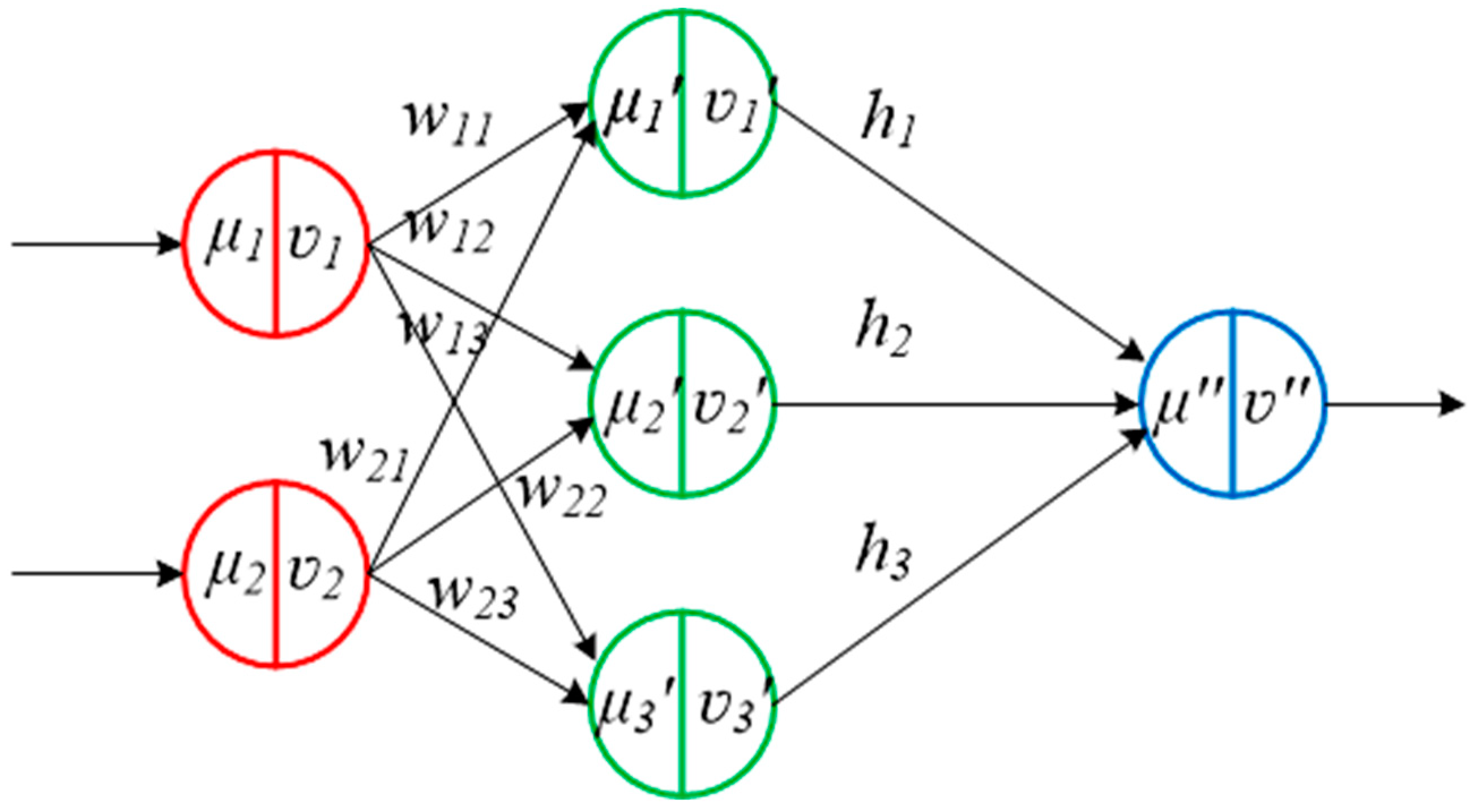
2.2. NN PID Control
NN PID control is a control strategy that combines PID control and NNs. The NNs can enhance the control performance of the PID due to their advantages of powerful approximation capability, ability for parallel computation, strong nonlinearity, and excellent dynamic characteristics [15,29,30]. The NN PID control strategy is applicable to the identification and control of dynamic systems.
Figure 1.
The structure of an NN.
The inputs of the three neurons of the proportional, integral, and differential elements of the implicit layer of the network are
where denotes the weights between the input layer and the hidden layer.
Then, the output of the proportional , integral , and differential elements are expressed as
where is a saturation function, which is defined as the
where is the input to the function.
Subsequently, the final output is defined as
where is the weight vector.
In order to obtain the update law for the weights and , the squared difference error function for the evaluation of network performance metrics is introduced as
with being the output signal. Then, the modified equation for the weight is
where is denoted as the update rate.
By the chain rule, the partial derivative derivation yields
Finally, the update rate of the weights is derived as
3. Control Design and Stability Analysis
3.1. Control Design
The following is a control design scheme that combines multi-innovation and NN PID control.
First, consider the following time-varying system that was described in (1):
with being an innovation vector consisting of the output and input data of the system.
In order to generalize the layers of the NN from scalars to vectors of multi-innovation, the output vector of each node of the input layer of the PID NN is
where denotes the sets of input data of the system from to .
The output vector of the output layer node is
The ideal output vector is
Then, the error function becomes
Then, the modified equation for the weights from the implicit layer to the output layer of the PID NN is
The input layers to the implied layer weights are modified as
where
Subsequently, we can further derive
Finally, the modified equation for the value of the weights and are
3.2. Stability Analysis
Assume that the system noise is uncorrelated with the system input in (22), has zero-mean random noise, and satisfies the mean square bound. Then, the following two conditions hold:
where, if there exists a constant and an innovation length such that the continuous excitation condition for any ,
Hence, the parameter estimate given in (4) is bounded.
Proof.
Define an error vector of the estimated parameter
Combining (4), we have
Invoking (36), we can derive that
From theorem (ii), we obtain
Then, we have
Combining (6), we have
Furthermore, it can be deduced that
According to theorem (i), we have
Taking parametric values for both sides of Equation (37) yields
Similarly, taking parametric values for both sides of Equation (46) yields
Appropriate selection of and yields
where is a constant. Thus, we further have
where is also a constant.
Finally, iterating the above Equation (50) yields
□
4. Simulation
To demonstrate the validity of the proposed PID NN-based multi-innovation learning algorithm, the proposed scheme is compared with an NN PID control using the standard BP algorithm, and the simulation experiments are conducted using the following two examples.
In the NN PID control, the initial value selection for the neural network is crucial. Choosing values that are too large or too small may lead to system instability. Ideally, a smaller adjustment is desired for the integral term, and a slightly larger adjustment for the proportional and differential terms. To achieve this, it is advisable to initially determine the parameter range based on the system’s characteristics and then iteratively fine-tune them to ensure stability. Therefore, the improved NN algorithm uses the online gradient method, and the initial value of the input layer to the hidden layer weight connection value matrix of the NN is set as . In addition, the initial value of the weight vector from the implicit layer of the network to the output layer is . In addition, and represent the desired output of the NN and the actual output, respectively. The length of innovation is selected as and the updating rate is chosen as . The experimental results are displayed in Figure 2, Figure 3, Figure 4 and Figure 5.
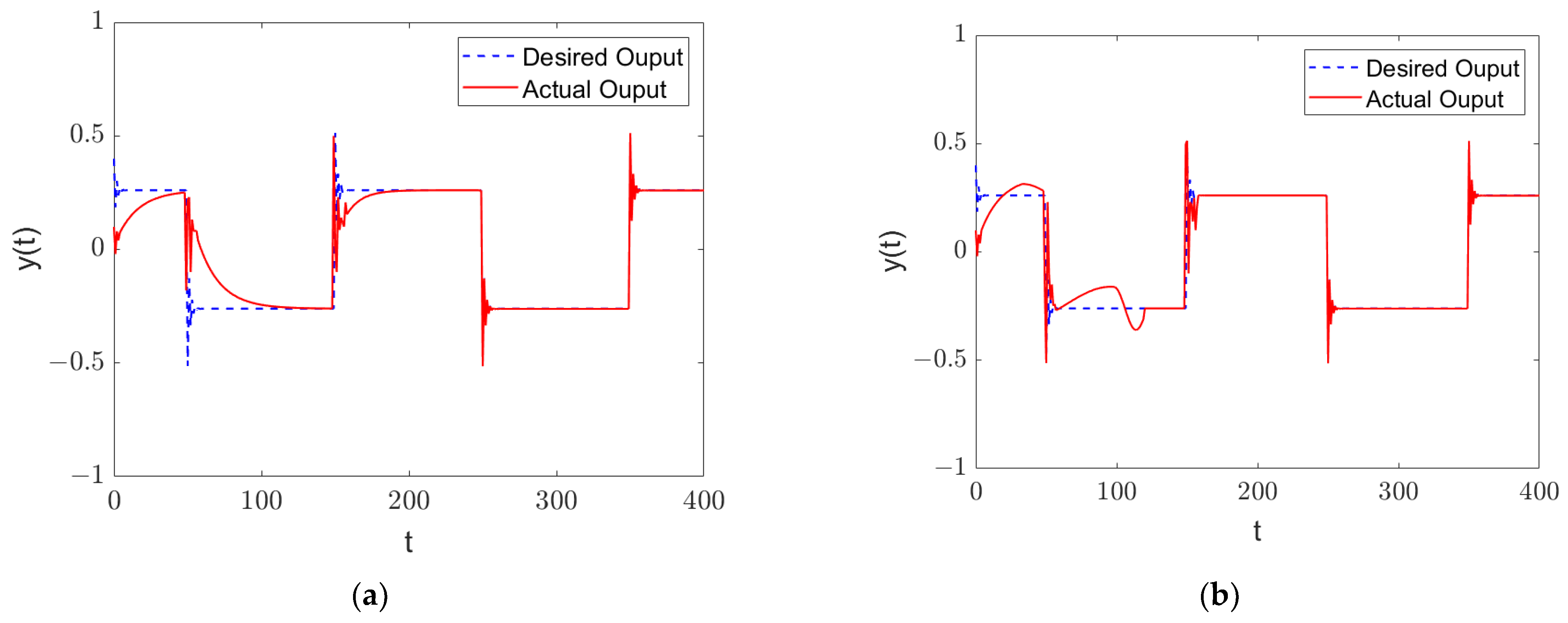
Figure 2.
The compared simulated results for system (53) without disturbance. (a) Traditional NN PID scheme. (b) The proposed scheme.
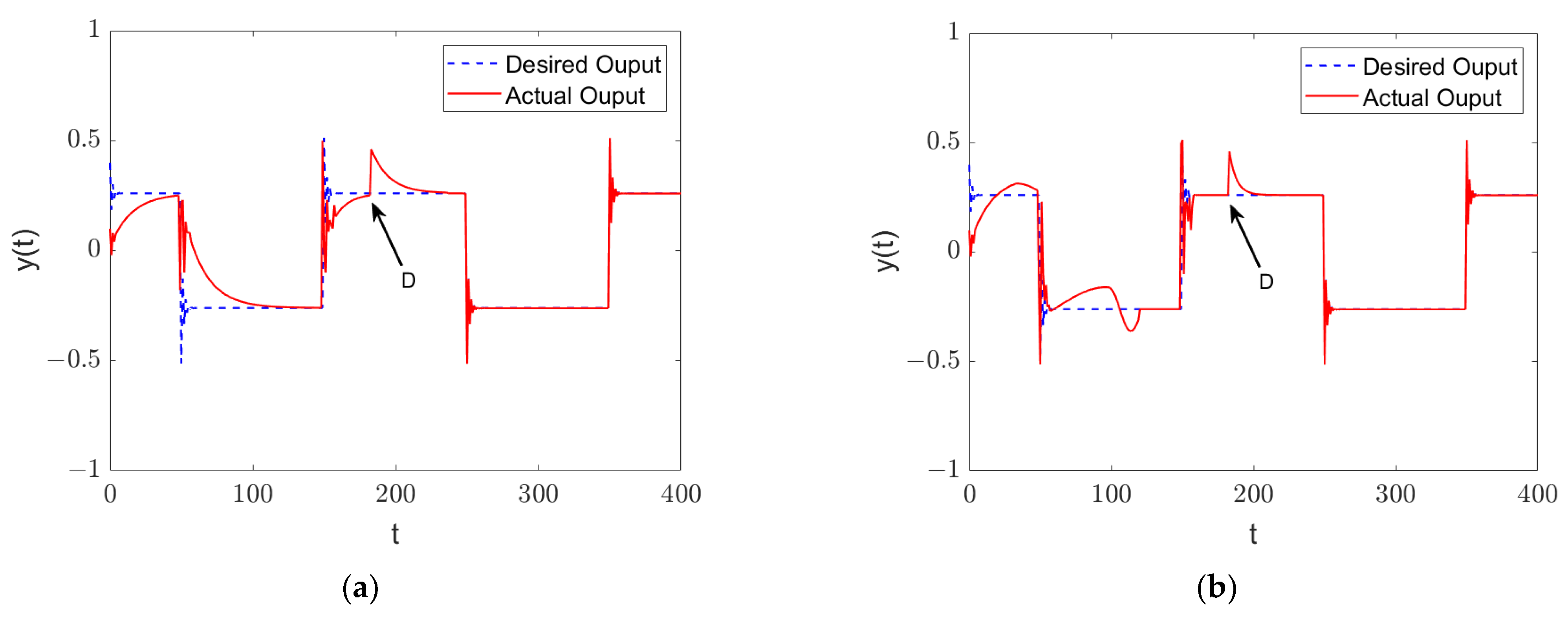
Figure 3.
The compared simulated results for system (53) with disturbance. (a) Traditional NN PID scheme. (b) The proposed scheme.
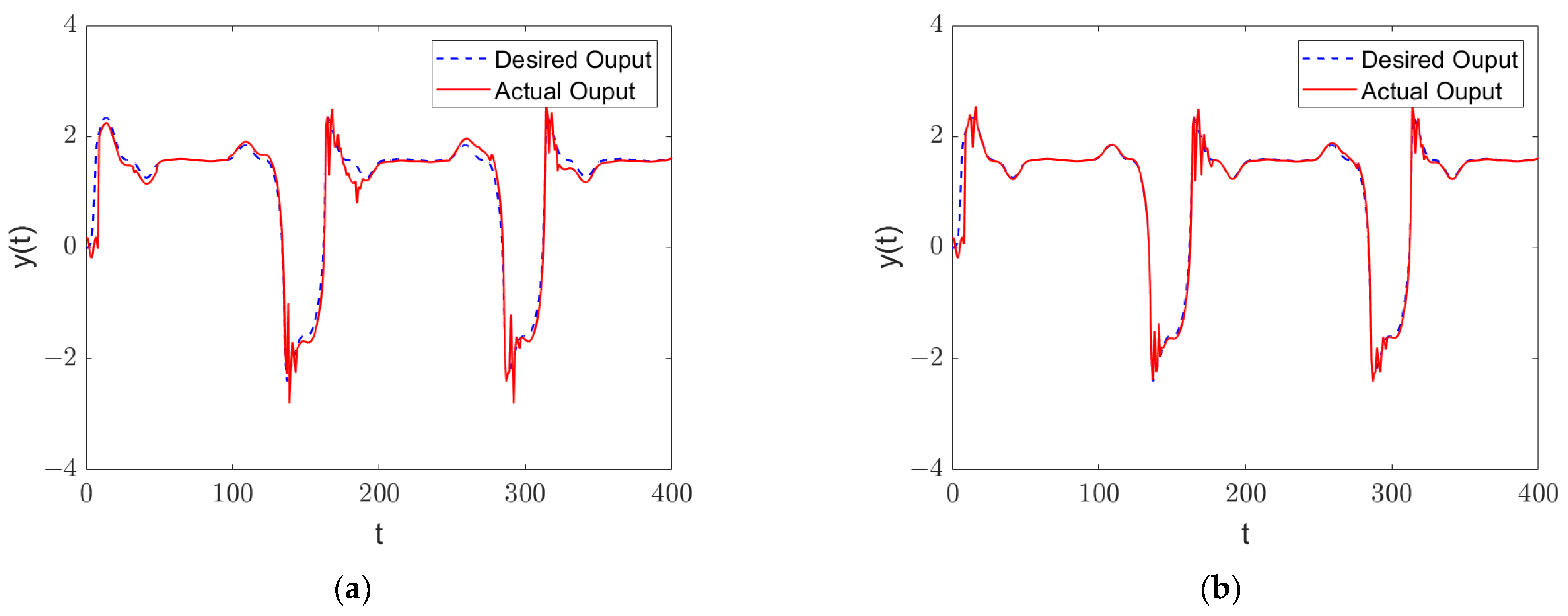
Figure 4.
The compared simulated results for system (54) without disturbance. (a) Traditional NN PID scheme. (b) The proposed scheme.
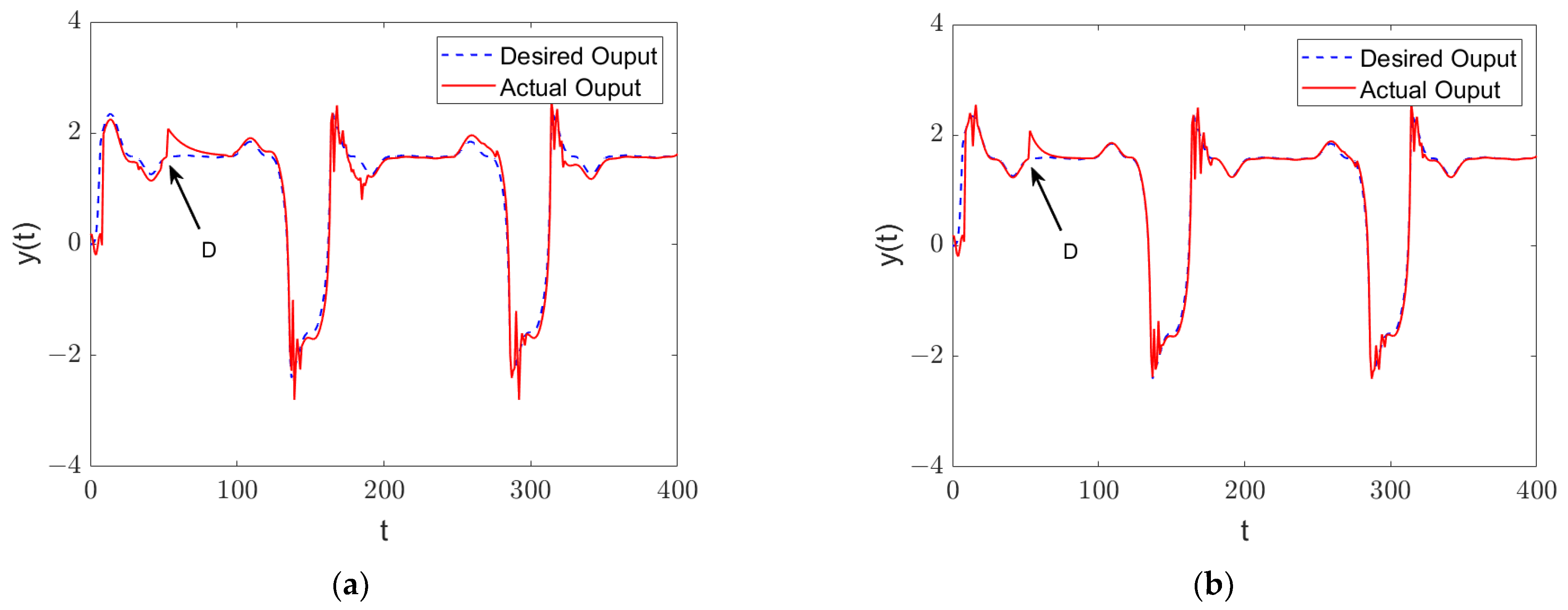
Figure 5.
The compared simulated results for system (54) with disturbance. (a) Traditional NN PID scheme. (b) The proposed scheme.
Consider the first nonlinear dynamic system described by the following equation:
where is the system output at time and is the system input at time . The input function is defined as .
Consider another nonlinear dynamical system, which is expressed as
where and .
The input signal is defined as
To showcase the effectiveness of the proposed approach, we conducted simulation experiments employing two control strategies for nonlinear systems (53) and (54). Specifically, we compared our novel approach with the traditional NN PID scheme introduced in [15]. The simulation experiments were categorized into two groups: one conducted in an ideal environment, and the other in an environment with disturbances. Figure 2 and Figure 3 present the simulation results for nonlinear system (53) without and with disturbances, respectively. Clearly evident from the results is the rapid model identification achieved by our proposed scheme within 150 s, in contrast to the traditional NN PID scheme, which required 200 s for model identification in the absence of disturbances. Additionally, our proposed controller demonstrated the capability to swiftly adjust PID parameters to counter external disturbances. The comparison result is shown in Table 1. These findings effectively illustrate that the NN PID control with multi-innovation exhibits faster convergence and superior robustness.
Table 1.
The tracking performance for system (53) under the two control strategies.
Subsequently, we extended our experiments to a more complex system, and the corresponding results are depicted in Figure 4 and Figure 5. Notably, under traditional NN PID control, the tracking performance for the more complex system was suboptimal, exhibiting a maximum error of up to 0.5 after stabilization. In contrast, our proposed scheme maintained excellent control performance, limiting the maximum error to only 0.1 after stabilization. Furthermore, it achieved convergence approximately 50 s faster than the conventional NN PID control. Additionally, in the presence of external disturbances, the control strategy proposed in this paper demonstrated a quicker resistance to disturbances, promptly returning to the original tracking state. The comparison result is shown in Table 2. Consequently, our proposed scheme proves to be applicable and significantly improved in terms of convergence and robustness, even in the context of complex systems.
Table 2.
The tracking performance for system (54) under the two control strategies.
5. Limitations of This Study
For the proposed scheme in this paper, the neural network has the ability to search for the optimal PID control parameters. However, the selection of initial values for neural network parameters cannot be ignored. Inappropriate parameters can cause the system to lose control before the optimal PID control parameters are found. Furthermore, there is still room for further improvement in the convergence time of the control scheme proposed in this paper, which is essential for better practical engineering applications.
6. Conclusions
In this paper, we proposed an improved algorithm for PID NN control based on multi-innovation theory to achieve model identification for a class of nonlinear systems. The scheme takes full advantage of the simplicity of PID control and the approximation and generalization capabilities of NN, while also incorporating the features of multi-innovation. Finally, the results of the two sets of experiments effectively illustrate the effectiveness and practicality of the designed strategy. Although the control strategy proposed in this paper has a faster convergence time and is more accurate than the traditional NN PID control has been in the past, such a convergence time is still not satisfactory enough for practical applications, as shown in the simulation results. The goal of future research is to further enhance the convergence speed by improving the NN structure and the gradient descent method of multi-innovation.
7. Literature Review
PID control, as a widely adopted classical control method in the field of automatic control, has gained extensive application in industrial and engineering settings due to its simplicity and efficiency. However, despite its commendable performance in many scenarios, the selection of PID parameters has been an ongoing challenge for researchers and engineers. In order to overcome this limitation, PID control has evolved in recent years, giving rise to improved variants such as Fuzzy PID and NN PID.
However, recently, with the continuous advancement of engineering technology, there is a growing demand for control strategies that are more flexible and robust. This has led scholars to focus their attention on the concept of fractional calculus. Fractional-Order PID control (FOPID), introduced through fractional calculus, offers unique advantages in modeling and controlling dynamic systems [31,32]. The relevant literature review can be seen in Table 3. In comparison to traditional PID, FOPID control is more capable of capturing the nonlinearity and time-delay characteristics of complex systems. Furthermore, to better adapt to the complexity of nonlinear systems, researchers have advanced the study of Nonlinear Fractional-Order PID (NFOPID) control. The development in this field aims to overcome the shortcomings of traditional PID control in highly nonlinear systems, providing more precise and stable control for engineering applications.
Table 3.
Summary table.
Author Contributions
Conceptualization, Z.G.; data curation, Z.G.; formal analysis, Z.G.; investigation, Z.G.; methodology, Z.G. and H.Y.; project administration, H.Y.; software, Z.G.; supervision, H.Y.; validation, Z.G. and H.Y.; visualization, Z.G.; writing—original draft, Z.G.; writing—review and editing, H.Y. All authors have read and agreed to the published version of the manuscript.
Funding
This research received no external funding.
Data Availability Statement
The labeled data set used to support the findings of this study are available from the corresponding author upon request.
Acknowledgments
The authors sincerely thank Dickinson College and Jiangxi University of Science and Technology for supporting this study.
Conflicts of Interest
The authors declare no conflicts of interest.
References
- Hou, Z.; Chi, R.; Gao, H. An overview of dynamic-linearization-based data-driven control and applications. IEEE Trans. Ind. Electron. 2017, 64, 4076–4090. [Google Scholar] [CrossRef]
- Kou, Z.; Sun, J. Test-based model-free adaptive iterative learning control with strong robustness. Int. J. Syst. Sci. 2023, 54, 1213–1228. [Google Scholar] [CrossRef]
- Hou, Z.; Xiong, S. On model-free adaptive control and its stability analysis. IEEE Trans. Autom. Control 2019, 64, 4555–4569. [Google Scholar] [CrossRef]
- Precup, R.-E.; Roman, R.-C.; Hedrea, E.-L.; Petriu, E.M.; Bojan-Dragos, C.-A. Data-driven model-free sliding mode and fuzzy control with experimental validation. Int. J. Comput. Commun. Control 2020, 16, 4076. [Google Scholar] [CrossRef]
- Dong, N.; Lv, W.; Zhu, S.; Li, D. Anti-noise model-free adaptive control and its application in the circulating fluidized bed boiler. Proc. Inst. Mech. Eng. Part I J. Syst. Control Eng. 2021, 235, 1472–1481. [Google Scholar] [CrossRef]
- Safaei, A.; Mahyuddin, M.N. Adaptive model-free control based on an ultra-local model with model-free parameter estimations for a generic siso system. IEEE Access 2018, 6, 4266–4275. [Google Scholar] [CrossRef]
- Liu, Y.; Peng, F.; Hua, Z.; Liu, C.; Zhao, G. Improved model-free adaptive control of pneumatic gravity compensation system. J. Adv. Comput. Intell. Intell. Inform. 2020, 24, 357–365. [Google Scholar] [CrossRef]
- Roman, R.-C.; Radac, M.-B.; Precup, R.-E. Multi-input-multioutput system experimental validation of model-free control and virtual reference feedback tuning techniques. IET Control Theory Appl. 2016, 10, 1395–1403. [Google Scholar] [CrossRef]
- Prag, K.; Woolway, M.; Celik, T. Toward data-driven optimal control: A systematic review of the landscape. IEEE Access 2022, 10, 32190–32212. [Google Scholar] [CrossRef]
- Wang, X.; Karimi, H.R.; Shen, M.; Liu, D.; Li, L.-W.; Shi, J. Neural network-based event-triggered data-driven control of disturbed nonlinear systems with quantized input. Neural Netw. 2022, 156, 152–159. [Google Scholar] [CrossRef]
- Deng, K.; Li, F.; Yang, C. A new data-driven model-free adaptive control for discrete-time nonlinear systems. IEEE Access 2019, 7, 126224–126233. [Google Scholar] [CrossRef]
- Wang, W.; Rana, J.M. Model-free-adaptive-based data-driven method for three-axis gimbal control. Meas. Control 2020, 53, 1512–1517. [Google Scholar] [CrossRef]
- Wang, X.; Yao, S.; Qu, C.; Wang, Y.; Xu, Z.; Huang, W.; Wang, H. Direct thrust force control of primary permanent magnet linear motor based on improved extended state observer and model-free adaptive predictive control. Actuators 2022, 11, 270. [Google Scholar] [CrossRef]
- Shen, M.; Wang, X.; Park, J.H.; Yi, Y.; Che, W.-W. Extended Disturbance-Observer-Based Data-Driven Control of Networked Nonlinear Systems with Event-Triggered Output. IEEE Trans. Syst. Man Cybern. Syst. 2022, 53, 3129–3140. [Google Scholar] [CrossRef]
- Liu, K.; Lu, P. The design of pid controller of turntable based on bp neural network. Appl. Mech. Mater. 2012, 220–223, 1207–1211. [Google Scholar] [CrossRef]
- Pezeshki, S.; Badalkhani, S.; Javadi, A. Performance analysis of a neuro-PID controller applied to a robot manipulator. Int. J. Adv. Robot. Syst. 2012, 9, 163. [Google Scholar] [CrossRef]
- Tanaka, K.; Oka, M.; Uchibori, A.; Iwata, Y.; Morioka, H. Precise position control of an ultrasonic motor using the PID controller combined with NN. Electr. Eng. Jpn. 2004, 146, 46–54. [Google Scholar] [CrossRef]
- Zhang, L.; Li, S.; Xue, Y.; Zhou, H.; Ren, Z. Neural network PID control for combustion instability. Combust. Theory Model. 2022, 26, 383–398. [Google Scholar] [CrossRef]
- Ding, F.; Chen, T. Performance analysis of multi-innovation gradient type identification methods. Automatica 2007, 43, 1–14. [Google Scholar] [CrossRef]
- Ding, F. Several multi-innovation identification methods. Digit. Signal Process. 2010, 20, 1027–1039. [Google Scholar] [CrossRef]
- Ding, F.; Chen, H.; Li, M. Multi-innovation least squares identification methods based on the auxiliary model for MISO systems. Appl. Math. Comput. 2007, 187, 658–668. [Google Scholar] [CrossRef]
- Han, L.; Ding, F. Identification for multi-rate multi-input systems using the multi-innovation identification theory. Comput. Math. Appl. 2009, 57, 1438–1449. [Google Scholar] [CrossRef]
- Wang, D.; Ding, F. Performance analysis of the auxiliary models based multi-innovation stochastic gradient estimation algorithm for output error systems. Digit. Signal Process. 2010, 20, 750–762. [Google Scholar] [CrossRef]
- Liu, Y.; Xiao, Y.; Zhao, X. Multi-innovation stochastic gradient algorithm for multiple-input single-output systems using the auxiliary model. Appl. Math. Comput. 2009, 215, 1477–1483. [Google Scholar] [CrossRef]
- Xie, L.; Liu, Y.J.; Yang, H.Z.; Ding, F. Modelling and identification for non-uniformly periodically sampled-data systems. IET Control Theory Appl. 2010, 4, 784–794. [Google Scholar] [CrossRef]
- Chen, J.; Zhang, Y.; Ding, R. Auxiliary model based multi-innovation algorithms for multivariable nonlinear systems. Math. Comput. Model. 2010, 52, 1428–1434. [Google Scholar] [CrossRef]
- Han, L.; Ding, F. Parameter estimation for multi-rate multi-input systems using auxiliary model and multi-innovation. J. Syst. Eng. Electron. 2010, 21, 1079–1083. [Google Scholar] [CrossRef][Green Version]
- Qin, P.; Lin, Y.; Chen, M. Improvement of tracking performance in model-free adaptive controller based on multi-innovation and particle swarm optimization. Int. J. Innov. Comput. Inf. Control 2009, 5, 1367–1377. [Google Scholar]
- Bai, R.; Wang, J.; Wang, L.; Ding, F. Design of nn-pid controller based on pso and its fpga implementation. Dyn. Contin. Discret. Impuls. Syst.-Ser. A Math. Anal. 2006, 13, 1307–1314. [Google Scholar]
- Kashihara, K.; Kawada, T.; Uemura, K.; Sugimachi, M.; Sunagawa, K. Adaptive predictive control of arterial blood pressure based on a neural network during acute hypotension. Ann. Biomed. Eng. 2004, 32, 1365–1383. [Google Scholar] [CrossRef]
- Chen, P.; Luo, Y. Analytical fractional-order pid controller design with bode’s ideal cutoff filter for pmsm speed servo system. IEEE Trans. Ind. Electron. 2022, 70, 1783–1793. [Google Scholar] [CrossRef]
- Liu, L.; Zhang, L.; Pan, G.; Zhang, S. Robust yaw control of autonomous underwater vehicle based on fractional-order PID controller. Ocean Eng. 2022, 257, 111493. [Google Scholar] [CrossRef]
- Mirrezapour, S.Z.; Zare, A.; Hallaji, M. A new fractional sliding mode controller based on nonlinear fractional-order proportional integral derivative controller structure to synchronize fractional-order chaotic systems with uncertainty and disturbances. J. Vib. Control 2022, 28, 773–785. [Google Scholar] [CrossRef]
- Rasouli, M.; Zare, A.; Hallaji, M.; Alizadehsani, R. The synchronization of a class of time-delayed chaotic systems using sliding mode control based on a fractional-order nonlinear PID sliding surface and its application in secure communication. Axioms 2022, 11, 738. [Google Scholar] [CrossRef]
Disclaimer/Publisher’s Note: The statements, opinions and data contained in all publications are solely those of the individual author(s) and contributor(s) and not of MDPI and/or the editor(s). MDPI and/or the editor(s) disclaim responsibility for any injury to people or property resulting from any ideas, methods, instructions or products referred to in the content. |
© 2023 by the authors. Licensee MDPI, Basel, Switzerland. This article is an open access article distributed under the terms and conditions of the Creative Commons Attribution (CC BY) license (https://creativecommons.org/licenses/by/4.0/).