1. Introduction
In this paper, we are concerned with a mixed boundary problem of the form
where
, is a bounded domain with smooth boundary
and
denotes the derivation with respect to the outward unit normal
on
. We suppose that
and
are (n-1)-dimensional submanifolds of
having positive Hausdorff measures.
We are looking for solutions to problem (
1) in the Sobolev space
For any
we define
It is straightforward to see that the solutions of the problem (
1) correspond to the critical points of the variational functional
subject to the constraint
. However
J involves the exponent
, which is the critical exponent of the Sobolev embeddings
. In contrast with the subcritical cases,
, the Sobolev embedding is not compact for
. It results in the corresponding variational structure presenting a lack of compactness, which can be seen in the fact that
J does not satisfy the Palais–Smale condition. This makes the problem of finding positive critical points of
J particulary difficult.
Elliptic equations involving Laplacian operator on bounded domains with mixed boundary conditions arise in real applications, for example, in hydrodynamics; see [
1,
2]. Generally, nonlinear problems subject to various boundary conditions appear in many different branches of the applied sciences, including physics (e.g., steady-state heat flux modeling), chemistry (e.g., Keller–Segel model for parabolic equations in chemotaxis), biology (e.g., Gierer–Meinhardt system in the formation of biological models), and engineering. See for example [
3,
4,
5] and references therein.
By continuity of the Sobolev embedding for
, the functional
J is lower bounded on
. Let
A first attempt to find solutions of (
1) could be to see if
may be achieved. In [
6], Lions–Pacella and Tricarico studied the minimizing sequences of
J following the concentration compactness principle of Lions [
7]. As product, under some geometrical conditions on
, it is shown that it is possible to prove that
is achieved. See corollaries 2.1 and 2.2 of [
6]. The existence of a bounded domain for which
is achieved is strange and makes the study of mixed boundary problems of type (
1) different compared with the classical homogeneous Dirichlet problem. For more conditions that ensure
is achieved for problems such as (
1), we refer to [
8,
9,
10,
11,
12].
Problem (
1) does not always have a solution. A necessary condition to obtain a solution has been established in [
6]. It is the following Pohozaev-type identity:
Particulary, (
1) has no solution provided:
For examples of domains satisfying such a condition, we refer to [
6]. However, there are other conditions on
obtained by some Sobolev inequalities (see [
13,
14]) that only guarantee
is not achieved. An example of such domains is given by Pacella and Tricarico in [
15] by considering domains bounded by two concentric spheres with
denoting the interior sphere. Using the so-called “isoperimetric constant of
relative to
”, see [
15], it is proved that
is not achieved whatever the radius of the two spheres. When
is not achieved, a natural question arises: Could one find positive critical points of
J of energy levels larger than
?
An analysis of Palais–Smale sequences of the function
J has been performed by Grossi and Pacella [
16]. As a consequence of it, a positive answer to the above question has been derived for bounded domains
with two holes, one of which is very small;
denotes the boundaries of the interior two holes and
.
Observe that the case of domains bounded by two concentric spheres with
denotes the boundary of the interior ball is not included in the existence results of [
16]. Motivated by the work of Bahri–Coron [
17] and aiming to include a larger class of domains
in the existence results of problem (
1), we develop in the present article and the subsequent one [
18] an approach that allows us to include all possible cases of bounded domains with an arbitrary number of holes of arbitrary sizes.
Here,
denotes the closure of the ball of center
x and radius
R. Let
In the following, we state the main theorem that we shall prove in this paper and the subsequent one [
18].
Theorem 1. If Ω, and satisfy description , then (1) has a solution. The aim of this paper is to prepare the field to prove Theorem 1. We first establish under the assumption that
a strong maximum principle for the Laplacian operator with mixed Dirichlet–Neumann boundary conditions. After that we extend the analysis of [
17] (see also [
19]) to the present setting and prove useful estimates involving asymptotic expansions of the variational functional
J. Then, we develop an algebraic topological method and prove Theorem 1 under an additional topological condition. See Theorem 3 below.
Notice that, although the general scheme of our proof falls within the analysis and topological techniques of Bahri–Coron [
17], the same techniques cannot be extended to the present framework. Indeed, with respect to the homogeneous Dirichlet problem traited by Bahri–Coron, the case of mixed boundary problem presents new phenomena. Namely, due to the influence of the boundary part where the Neumann condition is assumed, the blow-up configuration is completely different and more complicated. It is described by interior and boundary blow-up points as well as mixed configurations. See [
6,
16]. This leads to additional difficulties and obstacles to apply Bahri–Coron’s approach and requires novelties in the proof.
2. A Maximum Principle Theorem
In this section, we prove an
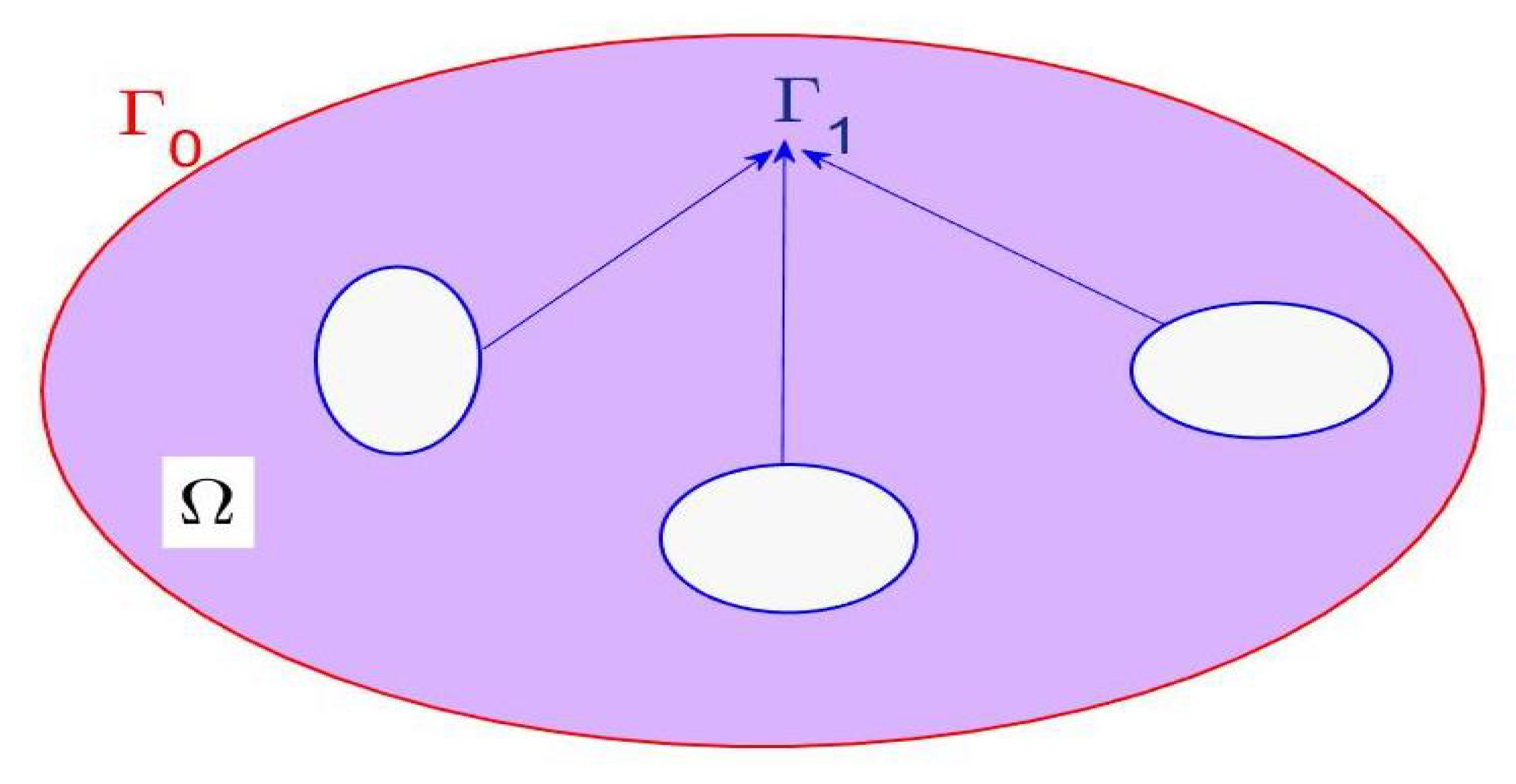
estimate for solutions of mixed boundary value problems with Laplace operator. Let
be a bounded connected domain of
with smooth boundary
such that
(
Figure 1).
Let
,
,
and
. Denote
be the solution of the following problem:
We then have
Theorem 2. for every , it holds:where , and are the solutions of the following boundary value problems:and The proof of Theorem 2 requires the following three Lemmas.
Lemma 1. Let be the solution of Then for any , we have Proof. Let
and
. We then have
By regularity Theorems, see [
20,
21], we have
. Indeed, under assumption
, the solutions
and
lie in
since
.
Let
, such that
To proof the left side inequality of the Lemma, we distinguish two cases.
Similarly, we proof the right side inequality of the Lemma. Indeed,
If is a constant function on , we then have on .
If not, and satisfies It follows that . Therefore,
□
Lemma 2. Let be the solution of Then for any , we have Proof. Let
and
. We then have
Let
such that
If
is a constant function on
, from the fact that
, we obtain
If
is not constant, then
have to be in
and satisfies
Therefore,
where
. Consequently,
Moreover,
If
is a constant function on
, then by condition
, we get
If is not constant, then have to be in and satisfies , this implies that , where . Therefore,
□
Lemma 3. Let be the solution of Then for every any , we have Proof. Let
and
. We then have:
Let
such that:
As the proof of previous Lemmas, we distinguish the following cases:
Concerning ,
If is constant on , then by condition on , we get on .
If not, have to be in and satisfies Consequently , where . Therefore,
□
Proof of Theorem 2. Let
be the solution of problem
. We decompose
u as follows:
where
are the solutions of Lemmas 1–3. The estimate of
, follows from the estimates of
We end this section by stating an estimate of the solution of problem . The estimate is a direct consequence of Theorem 2. □
Corollary 1. Let . There exists a positive constant , such that for every , and , the solution of problem satisfies 3. Asymptotic Analysis
Problem (
1) has a variational structure. Indeed, if
u is a critical point of
J in
, then
is a solution of (
1). Due to the compactness defect of the Sobolev embedding
, the functional
J fails to satisfy the Palais–Smale condition on
. In order to describe the sequences failing the Palais–Smale condition, we introduce in the following a family of ”almost solutions” of problem (
1).
For any
, and
, we define
where
is a fixed positive constant which depends only on
n and chosen so that
In the case of
, we define an almost solution
by
where
is a smooth cut-off function defined by
Here, is a positive constant depending on a and chosen so that on .
In the case of
, we define
as the unique solution in
of
Denote
Setting
In the following proposition, we estimate . It involves the regular part of the Green function for the Laplacian operator under mixed Dirichlet–Neumann boundary conditions.
Proposition 1. Let and let be the regular part of the Green’s function associated with problem (1). We then have Proof. Using the fact that
satisfies
it holds
Thus, by Corollary 1 we obtain
A change of variables,
yields
Now, using the fact that
and
we obtain that
Observe that for any
, we have
. Therefore,
Using the same reasoning as before, we obtain
The proof follows from (
2)–(
4). □
Let
h and
q be positive integers such that
and let
. Define
Here, .
As in [
17], we parameterize the sets
as follows. For
, we consider the minimization problem
Arguing as in ([
17], Proposition 7), we have
Proposition 2. Let . There exists such that for any and for any the above minimization problem admits a unique solution (up to permutation). Denotingthen v satisfies the following orthogonality condition, Following the concentration compactness principle of [
6,
16,
17], we have the following result.
Proposition 3. Assume that (1) has no solution. Let be a sequence of such that and . Then there exist integers h and q, , and a subsequence of such that where S is a fixed constant given by Let us note that under the assumption that (
1) has no solution,
see ([
16], Lemma 3.5).
Fix
be a compact set in
. For
and
, we denote
For , we may assume that , (if not, . Denote . Then it holds
Proposition 4. For any , we havewhere S is defined in (5) and For any
we have
Moreover, by Proposition 1, we have
Expanding
around
, we obtain
Moreover, for any
we have
Using (
7) and (
8), Claim (
6) follows.
We now estimate the denomerator of
. We claim that
Indeed, let
small enough such that for any
,
and
. We may assume
. We then have
Let
To estimate
, we write
Using Proposition 1, we have
This concludes the proof of Claim (
9). The expansion of Proposition 4 follows from (
6) and (
9).
We now prove the following Lemma
Lemma 4. For any , we havewhere Proof. Let
. We have
Using Holder’s inequality,
This concludes the proof. □
Proposition 5. Let . For any , there exists such that for every , we have Proof. By Lemma 4, we know that for any
, we have
Using the fact that
we obtain
Using the estimate of Proposition 1, we obtain
Let . for large enough, the inclusion of Proposition 5 is valid. □
The above expansion can be improved for h large enough. Namely,
Proposition 6. There exists and such that for any and , Proof. Let . We distinguish two cases.
We know from Proposition 5 that
Thus, for
small enough, we have
Case 2. Assume that
is lower bounded by a fixed positive constant. If
is small enough, using expansion of Proposition 4, we obtain
If
is lower bounded by a fixed positive constant, we deduce from Proposition 4 the existence of three positive constants
and
such that
Thus, for
such that
and for
large enough, we have
This finishes the proof. □
4. Topological Arguments
In this section, we extend the topological approach of Bahri–Coron [
17] to the framework of mixed boundary problems. Due to the effect of boundary blow-up points, the same techniques cannot be applied in the present setting, and therefore new constructions and extra ideas will be required. That is what we will do in this section. We think that such an approach will be helpful to prove Theorem 1. This is subject of the forthcoming paper [
18]. Nevertheless, it leads to prove Theorem 1 under an additional topological condition; see Theorem 3 below.
Assume that (
1) has no solution. Under the assumption of Theorem 3, we construct a sequence of maps of topological pairs in
which induces a sequences of non trivial homomorphisms of relative homological groups. However, by using the asymptotic expansions of
Section 3, we prove that the induced homomorphisms sequence is trivial from a certain rank. This leads to a contradiction.
First, let us introduce the gradient vector field of the functional
J, and it follows that will be used to deform the level sets of
Let
be the gradient field of
J, and let
be the associated flow. For any
is the unique solution of
A direct computation shows that J decreases a long as and if then
Let
It follows from Proposition 3 that under the assumption that
J has no critical point in
there exists a unique positive integer
and a unique integer
, such that
, so that the following holds: For any
and there exists
such that for any
Consequently,
Here,
q represents the number of concentation points of
that lie in the boundary part
and
S is defined in (
5). The levels
are called critical values at infinity.
Using the classical deformation lemma, we have
Proposition 7. Assume that J has no critical point in Let h be a positive integer and let q be an integer such that . For any two real numbers and such thatwe havewhere ≃ denotes retract by deformation. Proof. We use the gradient flow to deform onto Since J decreases along and J has no critical values nor critical values at infinity in , then . □
For any let be a fixed positive constant subjected to Proposition 2.
Proposition 8. Assume that J has no critical points in For any there exists a fixed constant such that if a flow line moves from to then decreases by at least Here .
Proof. Assume that there exists
such that
, and
It follows from Propostion 3 that there exists
such that
Moreover, by estimate
of [
23], we know that there exists
such that
The result follows for □
Next, we shall use the following notations. Let
and
Proposition 9. Assume that J has no critical point in Let If there exixts a positive time such that for some positive integer then decreases by at least where is the given constant of Propostion 8.
Proof. Let Before the time at which the flow line has to leave since at all the indices satisfy , and at there exists at least an index , satisfying Therefore, the flow line moves from to The result follows from Proposition 8. □
From Proposition 3, we know that for any
there exists
large enough such that
For simplicity, we shall denote
the unstable manifold of
with respect to the gradient flow. More precisely,
In this way it is easy to verify that
with
We now prove the following result.
Let be two topological spaces. We denote the homology group of order ∗ of the pair
Proposition 10. Assume that (1) has no solution. For any there exists so that the following holds. For any there exists a continious mapwhich induces an isomorphism Proof. If we assume that
J has no critical point in
it follows from Proposition 7 that for any
Let
be the associated deformation retract. Using Proposition 3, the following holds.
For any
there exists
such that for any
Particularly, for
there exists
such that for any
we have
Note that for given sets
and
A such that
then,
We apply this in our statement. It results that the pairs
and
are homotopical equivalent, since
Let
be the associated homotopy equivalence. We define
Using the fact that and two homotopy equivalences, is then an isomorphism. □
Let be a bounded domain of satisfaying the condition of Theorem 1. Then, there exists at least an –dimensional sphere included in such that, if we denote the natural injection, then the induced homorphism of groups is not null for . Here, denotes the homology groups of a topological space
Let us introduce the following notations. For
we denote
and
Here, is the Dirac distribution at .
In the following two Propositions, we construct a sequence of non trivial homomorphisms
between the relative homological groups and
Proposition 11. Assume that (1) has no solution. For any positive integer the homology group has a structure of a module over the cohomology group where is the permutation group of order h. Moreover, there exists a sequence of homomorphismssuch that for any is –linear. Proof. Let
Define the projection
Let
be the restriction of
on
The mapping
induces a homomorphism
The cap product, see [
24],
provides
a structure of a module over
and therefore over
through the homomorphism
Using now the isomorphism
given in Proposition 10,
obtains the structure of an
module.
We now construct the required sequence of homomorphisms .
For
we define an equivalence relation ∼ on
by
can be viewed as the quotient space
of
with respect to
Following [
24], there exits a
–equivariant tubular neighborhood
of
in
such that
retracts by deformation on
The above projection
induces a map of pairs denoted again
It is easy to see that
is an homeomorphism and therefore induces an isomorphism
Let
be the natural injection. Using the fact that
is a strong deformation retract of
defines an homotopy equivalence and hence induces an isomorphism
Let us denote
and for
we also denote
We note that
retracts by deformation on
As a consequence there exists an isomorphism
By excision of
we get the existence of an isomorphism
since
is open in
Let
be a large positive constant. We define
Using expansions of Propositions 5 and 6, we can select
and a diameter
of
small enough so that for
large enough, we have
and
In addition, using the fact that
for any
we obtain for
large,
and
Therefore, for
defines a map denoted again
Thus, it induces an homomorphism
The required sequence of homomorphism is
To prove that
defines a
–linear map. We consider the following commutative diagram, analogue to the one of ([
17], diagram (17)). Let
be the first projection. Using expansions of Propositions 5 and 6, it is easy to check that
maps
Moreover, using the fact that
for any
we obtain for
large,
and
Thus,
defines a map denoted again
Consider the following diagram:
where
, and
are the natural injection. It is easy to verify that the above diagram is commutative. Moreover,
and
are two isomorphisms. Thus we are in the same position of diagram (17) of [
17]. The
–linearity of
follows from the same argument of ([
17], Proposition 9). □
We now prove the following result:
Proposition 12. Assume that (1) has no solution and assume condition below. Then, Proof. From the construction of the proof of Proposition 11,
defines an isomorphism:
Using the fact that
retracts by deformation on
induces an isomorphism denoted again
Observe that
is a manifold of dimension
with boundary. Therefore,
defines a non-zero class in
for
.
Denote
and
are the usual connecting homomorphism. We introduce the following topological condition. (A): Assume that there exists a connecting homomorphism
such that the following diagram is commutative
Under assumption (A), the topological argument displayed in ([
17] estimates (25) and (26)) shows that
We agree to suppose that
. If
, then
where
and
are defined in diagram (
13). Observe that
Using mapping (
12), we have
Thus,
since
is an equivalence of homotopy. It follows that
since
. We therefore have from (
14),
in
. This is absurd. Thus,
and the proof of Proposition 12 follows. □
We prove now the following existence result.
Theorem 3. Under assumption , Theorem 1 holds.
Proof. Assume that (
1) has no solution. It follows from proposition 12 that under assumption (A),
However, the expansion of Proposition 6 shows that for
h large enough,
is a null homomorphism. Such a contradiction implies the existence of solutions of problem (
1). □