Abstract
In this paper we consider a jerk system where j is an arbitrary smooth function and is a real parameter. Using the derivatives of j at an equilibrium point, we discuss the stability of that point, and we point out some local codim-1 bifurcations. Moreover, we deduce jerk approximate normal forms for the most common fold bifurcations.
MSC:
70K20; 70K45; 70K50
1. Introduction
A jerk equation is a third-order ordinary differential equation of the form
where the rate of change of acceleration of the motion, , is called jerk [1]. Its equivalent form is the jerk system
Jerk systems have triggered wide interest. On one hand, they have a simple form but display complex behavior, and on the other hand, jerk systems model, among other things, some oscillators, in particular chaotic oscillators (see, e.g., [2,3,4,5]). Jerk systems display different dynamic behaviors, which depend on the total number of terms and parameters of j, particularly on the number of nonlinearities (see, e.g., [6] and references therein). The variation in the parameters leads to some bifurcations and an asymptotically stable or periodic orbit can becomes chaotic. Bifurcations of particular jerk systems were analyzed (see, e.g., [7,8,9,10,11]). Moreover, new chaotic jerk systems were recently reported (see, e.g., [12,13,14]).
In this paper, we analyze the jerk system
where j is smooth, and is a real parameter under the assumption that there is such that is an equilibrium point of (1), that is,
Of course, E can be an equilibrium point for every For instance, if j is odd, i.e., for every then for every .
We denote
and
The Jacobian matrix of system (1) at the equilibrium E is
and the characteristic equation is given by
For , it becomes
which allows us to discuss the stability of E and some codim-1 local bifurcations, namely Hopf and fold bifurcations.
A fold bifurcation is a local bifurcation associated with the appearance of a zero eigenvalue. In the one-dimensional case, the generic fold bifurcation, also called the saddle-node bifurcation, has the normal form given by the equation
where is a real parameter (see, e.g., [15]). The other common fold bifurcations are the transcritical bifurcation and the pitchfork bifurcation, and their normal forms are also given by one-dimensional equations. In higher dimensions, the same normal form for the saddle-node bifurcation is obtained by reduction on the center manifold. One of the goals of this work is to obtain (approximate) normal forms for these fold bifurcations that continue being jerk systems, that is, the simplest jerk systems that display such bifurcations. To obtain such normal forms, we first study the stability of an arbitrary jerk system, and we point out the framework that ensures the existence of the above-mentioned bifurcations.
The paper is organized as follows: In Section 2, we discuss the local stability of an equilibrium point E of system (1), taking into account the sign of and In Section 3, using again the sign of and the behavior of the function we prove that system (1) experiences a Hopf bifurcation. In Section 4, we establish conditions of existence for each above-mentioned fold bifurcation. In Section 5, we deduce approximate normal forms for the saddle-node bifurcation, the transcritical bifurcation, and the pitchfork bifurcation. These normal forms are also jerk systems. We study the stability of the proposed approximate normal form using the reduction on the center manifold. Also, we give bifurcation diagrams and some orbits of these normal forms. In Section 6, we present some conclusions.
2. Stability of a Jerk System
The equilibria of system (1) are of the form , where fulfills the condition
Theorem 1.
- (a)
- For the equilibrium point
- (i)
- is asymptotically stable if and ;
- (ii)
- is unstable if or or or
- (b)
- For the equilibrium point is unstable if or
Proof.
Taking into account (6), the conclusions follow from the Routh–Hurwitz theorem (see, e.g., [16]). □
Remark 1.
For the stability of the equilibrium E is discussed in all cases except In this case, there is a pair of pure imaginary eigenvalues. Therefore, reduction on the center manifold will be necessary. In particular, if the first Lyapunov coefficient is computed, then we can conclude that E is weakly asymptotically stable if and unstable if
If the follow cases remain: (a zero eigenvalue), (a pair of zero eigenvalues), (a zero eigenvalue and a pair of pure imaginary eigenvalues), and (all eigenvalues are zero). In the first two cases, the stability of E results from the reduced form of the center manifold.
Some of the above-mentioned cases are related to some local codim-1 bifurcations that can occur in the dynamics of the considered system. Such bifurcations will be discussed in the next sections.
3. Hopf Bifurcation
In this section, we give conditions for which system (1) experiences a Hopf bifurcation.
Theorem 2.
Consider jerk system (1) with property (2) and notations (3) and (4), and let Assume that is an equilibrium point of system (1) for every α in the neighborhood of .
If , and then system (1) displays a Hopf bifurcation at the point when α passes through the critical value .
Proof.
For , that is, , the roots of (6) are and .
It remains to check the transversality condition from Hopf’s bifurcation theorem (see, e.g., [17]). Using (5) and the implicit function theorem, we have
and
which finishes the proof. □
Remark 2.
In some particular cases, we can calculate the first Lyapunov coefficient , which allows to see if the Hopf bifurcation is non-degenerate or degenerate .
Remark 3.
Since the Hopf bifurcation involves a change in the stability, the conditions are necessary conditions. In this case, the change in the stability is given by and (the transversality condition), where (3).
Taking into account the above results, we notice that one of the simplest nonlinear jerk system which experiences the Hopf bifurcation at when the parameter passes through the critical value is given by
with In fact, it is easy to see that any jerk system (1) with
has the same property, where is smooth, ,
4. Fold Bifurcations
In this section, we study the bifurcation of the considered system associated with the appearance of a zero eigenvalue, namely the fold bifurcation or zero bifurcation. The non-degenerate fold bifurcation is called the saddle-node bifurcation. The most known degenerate fold bifurcations are the transcritical bifurcation and the pitchfork bifurcation.
Let be the bifurcation parameter such that at , system (1) has the non-hyperbolic equilibrium with only one zero eigenvalue. Using (6), it follows that and
In the following, we point out fold bifurcations of system (1) using Sotomayor’s theorem [18] (also see [17,19]). First, we compute the expressions that are used in Sotomayor’s theorem.
Proposition 1.
Let given by jerk system (1) with property (2) and notations (3) and (4). If , then the following assertions hold:
- 1.
- has a simple eigenvalue with right eigenvector and left eigenvector ;
- 2.
- and
- 3.
- and;
- 4.
- and;
- 5.
- and
Now, using Proposition 1 and Sotomayor’s theorem, we obtain the next results.
Theorem 3.
- SN1.
- , , ,,
- SN2.
- ,
- SN3.
- ,
More precisely, there are two hyperbolic equilibrium points of the system near E for (or ), which collide for into the non-hyperbolic equilibrium E and then disappear. In addition, the two equilibrium points have stable manifolds of dimensions k and respectively, where k is the number of eigenvalues of with a negative real part.
Remark 4.
If we consider in the above theorem, then the Jacobian matrix has eigenvalues with negative real part. Therefore, the two equilibrium points that collide are a saddle and a stable node respectively (as in the one-dimensional case of the saddle-node bifurcation). If , then and the points are an unstable node and a saddle. Finally, if then and both equilibrium points are saddles.
Theorem 4.
- T1.
- , , , ,
- T2.
- , ,
- T3.
- ,
Theorem 5.
- P1.
- , , , ,
- P2.
- , ,
- P3.
- ,
Remark 5.
The condition (, ) implies that is an equilibrium point of the considered jerk system with a simple zero eigenvalue and no other eigenvalues on the imaginary axis. The genericity conditions of the saddle-node bifurcation are the transversality condition and the nondegeneracy condition . Transcritical and pitchfork bifurcations are obtained violating some of these genericity conditions.
5. Approximate Normal Forms for Fold Bifurcations
In this section, we derive approximate normal forms for each of the above fold bifurcations. We mention that these normal forms are also jerk systems.
In the following, we consider and Then, for the fold bifurcation we have
5.1. Approximate Normal Forms for the Saddle-Node Bifurcation
We follow the steps used for the one-dimensional case (see, e.g., [15]). Assume that conditions and from Theorem 3 are fulfilled.
Consider a Taylor expansion of the function j with respect to at
where is the remainder of the expansion, and
We do not explicitly use the term in the above Taylor expansion because such a term and its derivatives vanish at .
Step 1. Using the translation , , , where , system (1) is written as
We find such that the coefficient of vanishes. Let
Then,
and
Therefore, by using the implicit function theorem, there is a function with and in the neighborhood of . Moreover, since
we obtain
Using and the following Taylor expansions
system (7) becomes
Step 2. We denote
Let
We have and
Then, there is a function such that and in the neighborhood of . Consequently, system (8) becomes
Step 3. We denote
It follows that
thus, in the neighborhood of . Moreover,
on .
Using the change in the parameter and variables given by
with system (9) becomes
where the remainder was properly changed, but it does not contain terms in the form of those already written in the third equation of (10).
In conclusion, we have proven the following result.
Theorem 6.
Consider jerk system (1) with smooth j such that is an equilibrium at with a zero eigenvalue, that is, , Suppose that
- SN1.
- , ,
- SN2.
- ,
- SN3.
- .
Let An equilibrium point of system (10) has the form , where is a solution of the equation . Since the fold bifurcation takes place at in O, we are concerned with equilibria close to O, thus is near 0. Recall that for any sufficiently small the above equation has two solutions near the origin, which are close to the solutions of the equation for the same parameter value (see, e.g., the proof of Lemma 3.1 [15]). Therefore, in order to obtain a normal form for the fold bifurcation in at , we can truncate system (10). Thus, we obtain the following truncated normal form for the generic fold bifurcation of a jerk system:
Moreover, we can consider the following approximate normal form for the generic fold bifurcation of a jerk system:
where is the parameter, , and are fixed such that
We note that the last two systems have the same equilibria and the corresponding characteristic polynomials are similar.
We will study system (12) near the origin and in the neighborhood of
Let Then, system (12) has two equilibria for ; one equilibrium point for ; and no equilibria for
Proposition 2.
- 1.
- Assume and .
- (a)
- If then is asymptotically stable and is unstable.
- (b)
- If then is unstable.
- 2.
- If or , then O and are unstable for any provided they exist.
Proof.
According to Theorem 1, it only remains to study the case with . Because the equilibrium point has a zero eigenvalue, we will reduce system (12) on the center manifold (see, e.g., [17,20]). Using the eigenvectors of the Jacobian matrix at O, we deduce the following transformation
Then, system (12) becomes
Consider the center manifold
where Using (13), we obtain
and the reduced equation on given by
Thus, O is unstable, and the proof is finished. □
For , we obtain a similar result.
Remark 6.
We notice that the results presented in Remark 4 are valid for the approximate normal form (12).
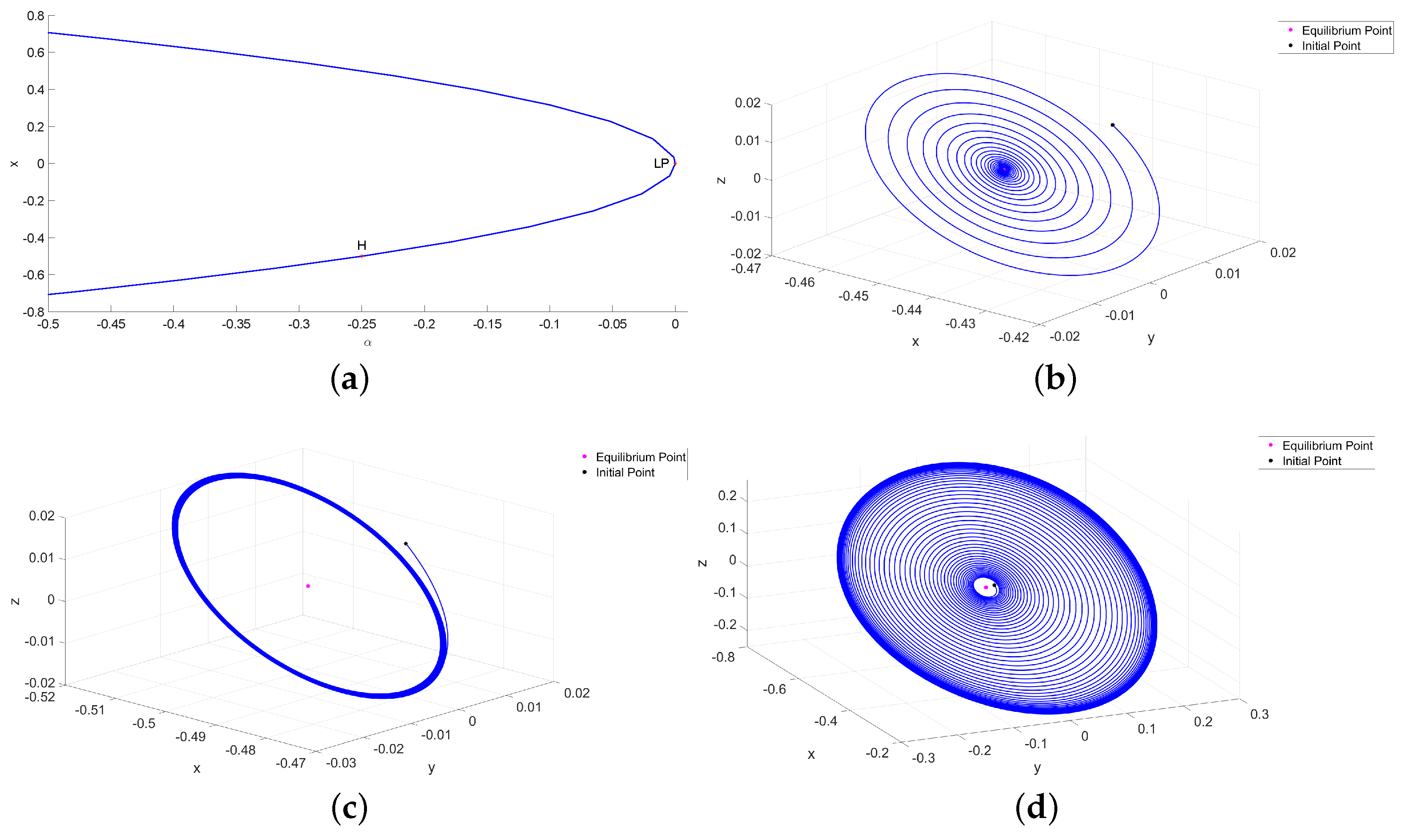
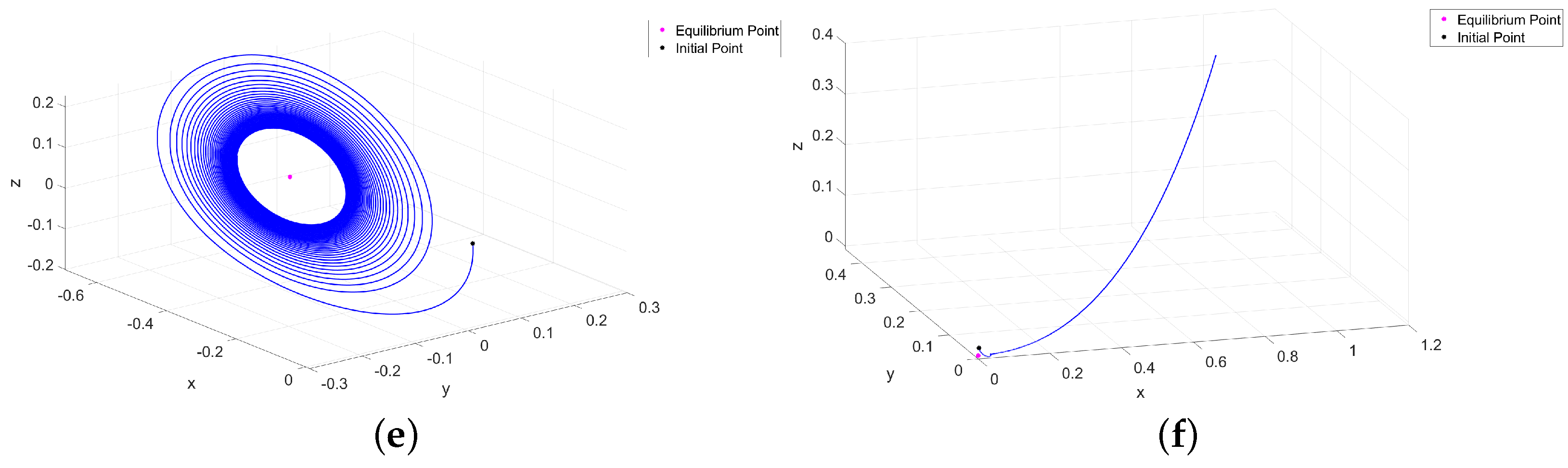
In Proposition 2, we discuss the stability of system (12) for close to zero. The equilibrium points can be stable only if . In this case, when moves away from zero we deduce that remains unstable and changes its stability for (see Theorem 1). Moreover, a Hopf bifurcation occurs in the dynamics of system (12) (Theorem 2), and a stable limit cycle is born (see Figure 1c–e). The saddle-node and Hopf bifurcations are also pointed out in the bifurcation diagram obtained by numerical simulations using MatCont/MatLab (Figure 1a).

Figure 1.
The normalform (12), − − (a) the bifurcation diagram (H stands for Hopf bifurcation and LP for the limit point, that is, the fold bifurcation); (b) an asymptotically stable orbit ( −); (c) a stable limit cycle ( −); (d,e) unstable orbits attracted by the limit cycle ( − and −, respectively); (f) an unbounded unstable orbit (). The initial conditions are close to in (d) and close to O in the other cases.
5.2. Approximate Normal Forms for the Transcritical Bifurcation
The transcritical bifurcation is a non-generic fold bifurcation, and the method used in the above paragraph is useless.
Assume that hypotheses – of Theorem 4 are satisfied. Therefore, we have the following Taylor expansion of the function j with respect to at
where . Let Using the transformation
system (1) becomes
An equilibrium point of system (14) has the form , where is a solution of the equation . A solution is , and the others satisfy near , where From the implicit function theorem, there is a unique function with and in the neighborhood of . Moreover, thus, near 0, that is, for any sufficiently small the equation has a unique solution near the origin, which is close to the solution of the equation for the same parameter value. In conclusion, near the origin, the equilibria of system (14) are close to the equilibria of its truncated normal forms
and
where is the parameter, and are fixed such that
The characteristic polynomials at the equilibria of the last two systems are similar. Therefore, we consider that system (16) is an approximate normal form for the transcritical bifurcation of a jerk system.
Let . Then, system (16) has two equilibria for every , namely, and , which collide for
Proposition 3.
- 1.
- Assume and .
- (a)
- If then O is asymptotically stable and E is unstable.
- (b)
- If then is unstable.
- (c)
- If then E is asymptotically stable and O is unstable.
- 2.
- If or , then O and E are unstable for any
Proof.
We immediately obtain the results , , and 2 via Theorem 1. For ), we proceed as in the proof of Proposition 2. In this case, the reduced equation on the center manifold is given by
Thus, O is unstable, and the proof is finished. □
For , we obtain a similar result.
Remark 7.
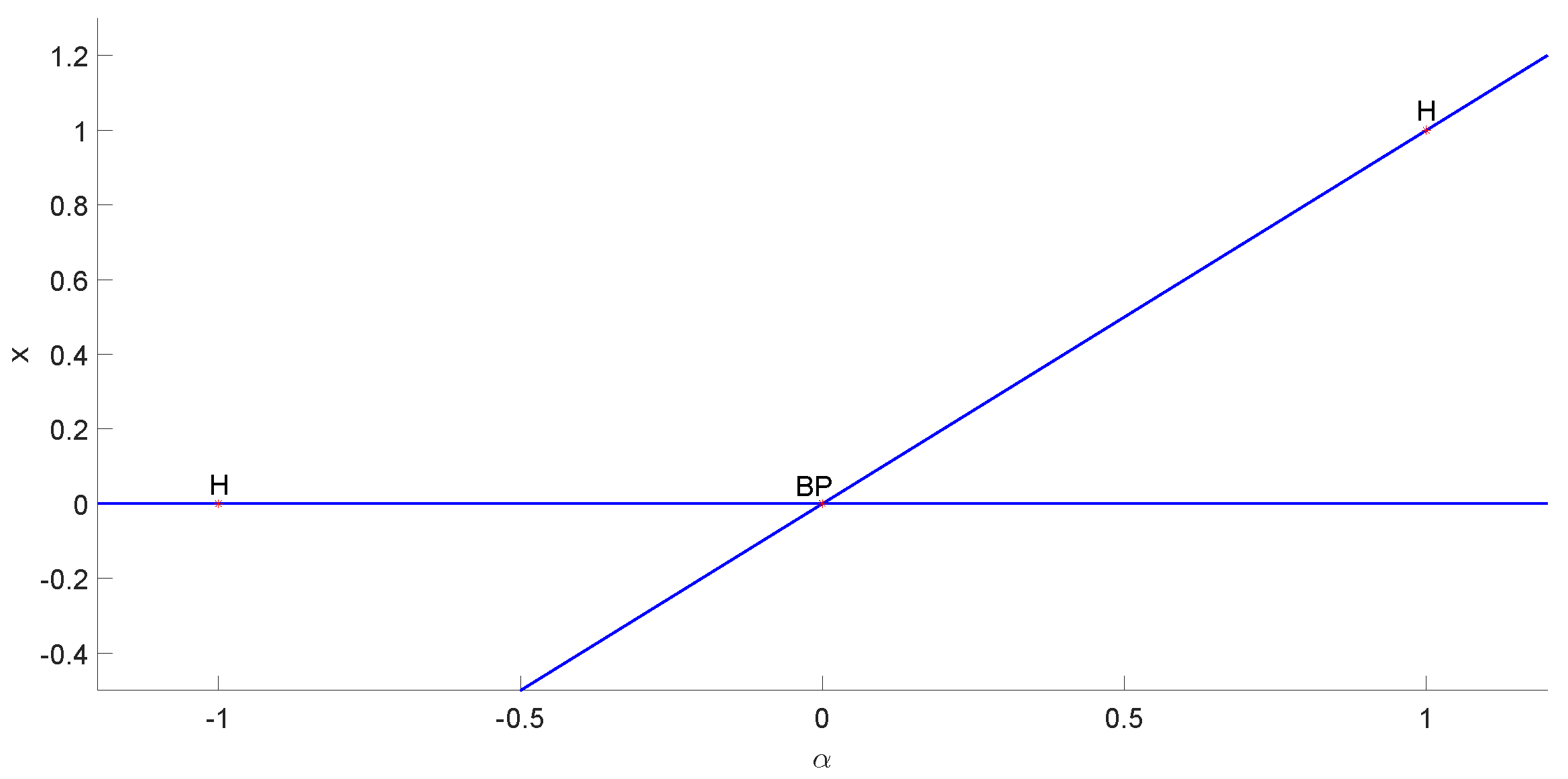
We notice that the case explains the transcritical bifurcation, also named the exchange of stability: two equilibria collide when the parameter passes through the critical value and then split, exchanging their stability. In the other cases, even if both equilibria are unstable, there is an exchange of the dimensions of the stable manifolds at the bifurcation value.
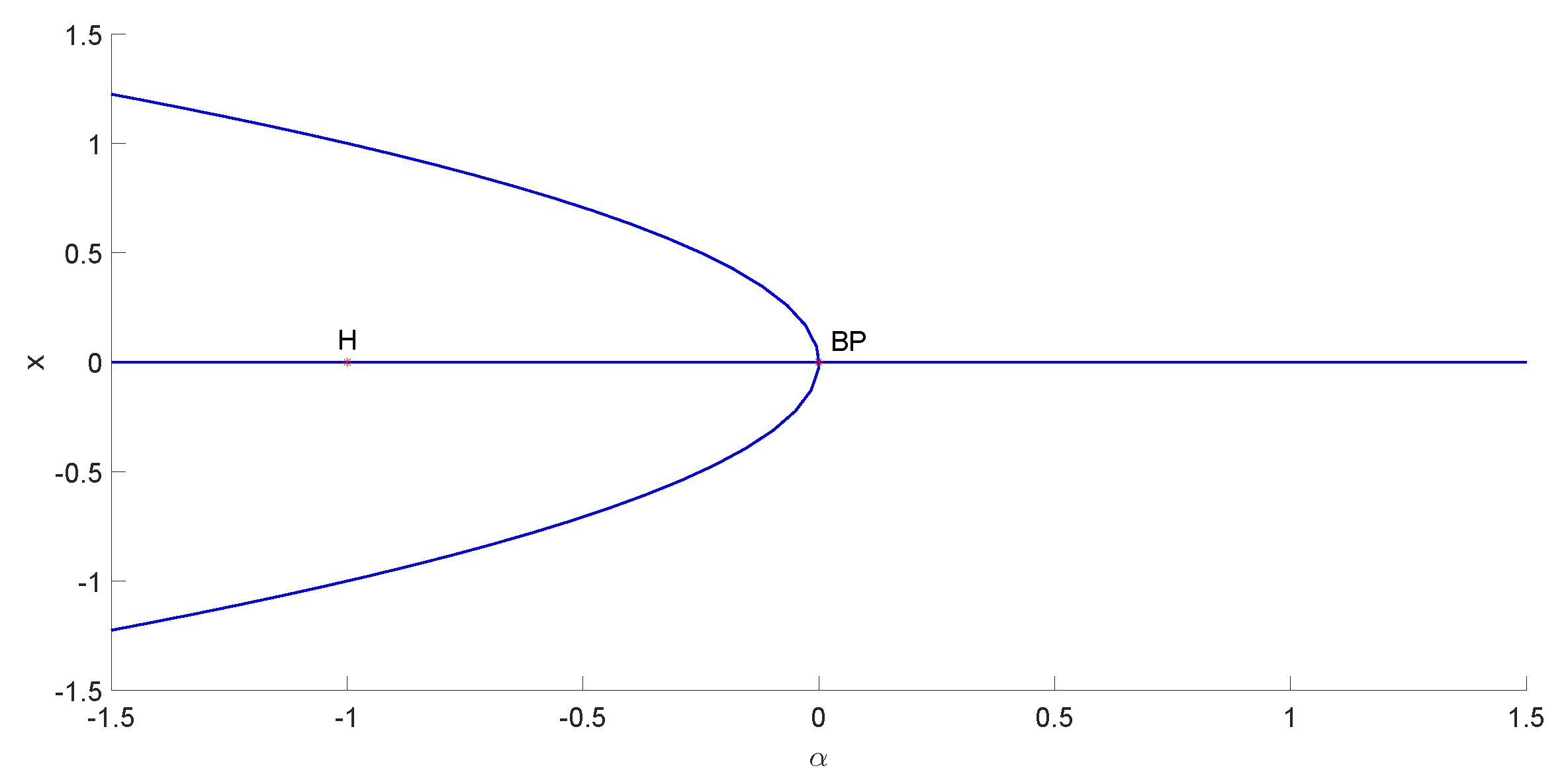
The bifurcation diagram of system (16) is presented in Figure 2. Again, we notice a Hopf bifurcation, which follows from Theorem 2. In this case, the orbits look similar to those depicted in Figure 1.
Figure 2.
The bifurcation diagram of the normal form (16), − − −1 (BP stands for the branch point, that is, it highlights the transcritical bifurcation in this case).
5.3. Approximate Normal Forms for the Pitchfork Bifurcation
In this case, we work under the hypothesis – of Theorem 5. It results in the following Taylor expansion of the function j with respect to at
where . Using the transformation
where system (1) writes
An equilibrium point of system (17) has the form , where is a solution of the equation . A solution is , and the others satisfy near , which is the same equation as in the case of the saddle-node bifurcation. Thus, we can truncate the above expansion. Consequently, we obtain the following approximate normal forms for the pitchfork bifurcation of a jerk system:
and
where is the parameter, and are fixed such that
Proposition 4.
Let with sufficiently small .
- 1.
- Assume and .
- (a)
- If then O is asymptotically stable.
- (b)
- If then is stable.
- (c)
- If then are asymptotically stable and O is unstable.
- 2.
- If or , then O and are unstable for any α, provided they exist.
Proof.
For ), we proceed as in the proof of Proposition 2. In this case, the reduced equation of the center manifold is given by
thus O is stable. The other conclusions result from Theorem 1. □
Similarly, we obtain:
Proposition 5.
Let with sufficiently small .
- 1.
- Assume and .
- (a)
- If then O is asymptotically stable and are unstable.
- (b)
- If then is unstable.
- (c)
- If then O is unstable.
- 2.
- If or , then O and are unstable for any α, provided they exist.
Proof.
For the reduced equation on the center manifold is given by
thus O is unstable. □
Remark 8.
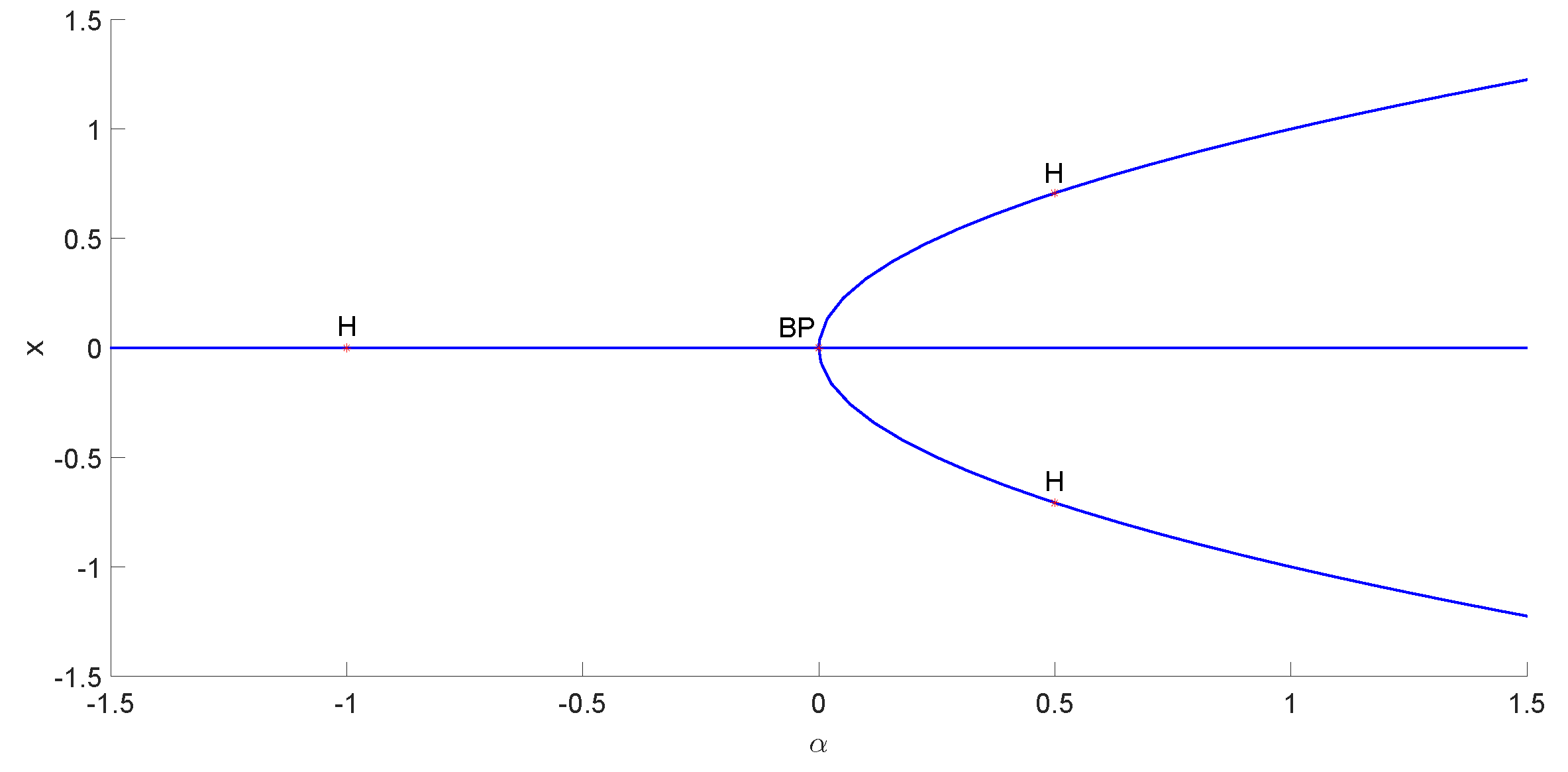
The pitchfork bifurcation shows the following local phenomenon in the dynamics of a system: at the point of bifurcation, the stability of an equilibrium changes, and a pair of equilibria appears (see Figure 3) or disappears (see Figure 4). This situation is pointed out in the case . More precisely, for we have obtained the supercritical pitchfork bifurcation, that is, a stable equilibrium point becomes unstable and a pair of stable equilibria is born from it at the branch point BP (Figure 3). For a stable equilibrium point collides with a pair of unstable equilibria and becomes unstable, which indicates a subcritical pitchfork bifurcation (Figure 4).
Figure 3.
The bifurcation diagram of the normal form (19), − − −1.
Figure 4.
The bifurcation diagram of the normal form (19), − −1.
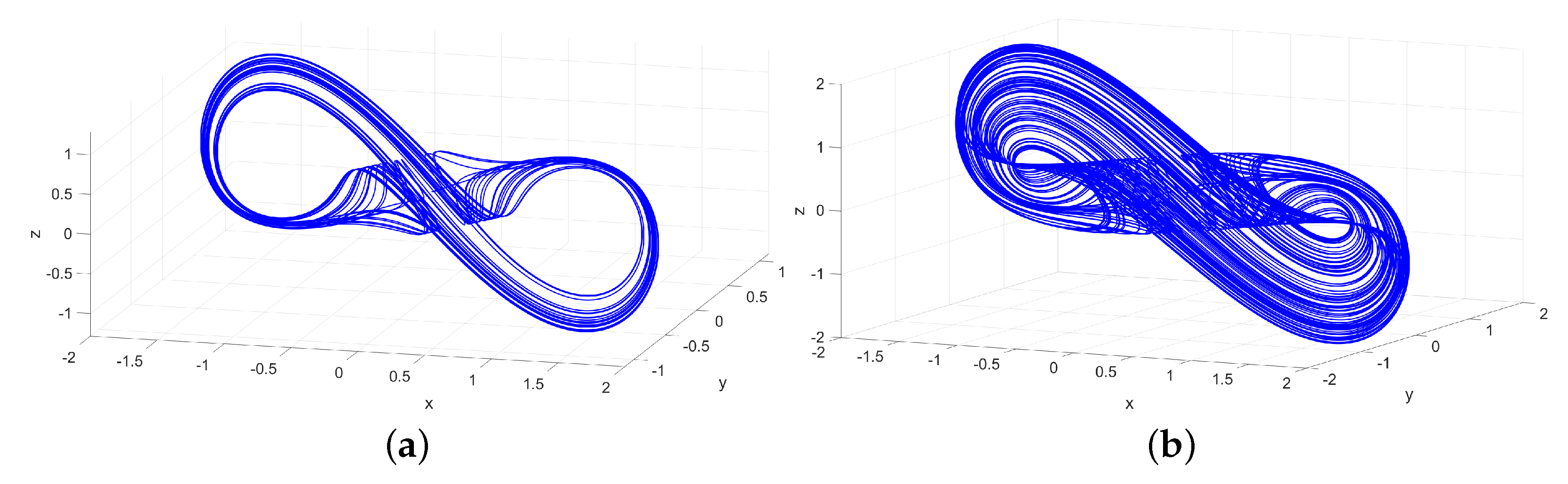
The pitchfork bifurcation is specific to systems with symmetries, more precisely to those systems that are invariant under the transformation We notice that system (19) is such a system. Moreover, such systems can have symmetrical orbits and symmetrical chaotic attractors (see, e.g., [2,10]), as shown in Figure 5.
Figure 5.
Chaotic attractors in the dynamics of system (19) for : (a) (b) .
6. Conclusions
In this paper, we have studied the local stability and codim-1 bifurcations of an arbitrary one-parameter jerk system. We have established conditions for which Hopf or fold bifurcations occur in the dynamics of a jerk system. It is known that for an dimensional dynamical system, a normal form of a local bifurcation is obtained by reduction on the center manifold. The normal forms of the most well-known fold bifurcations, namely the saddle-node bifurcation, the transcritical bifurcation, and the pitchfork bifurcation, are given by one-dimensional equations. Our goal was to derive three-dimensional (approximate) normal forms, which are themselves jerk systems. We have obtained such a normal form for each above-mentioned fold bifurcation. Particularly, because the saddle-node bifurcation is a generic fold bifurcation, we have derived such an approximate normal form using invertible coordinate and parameter changes.
Author Contributions
Conceptualization, C.L.; methodology, C.L.; formal analysis, C.L. and J.C.; writing—original draft preparation, C.L. and J.C.; writing—review and editing, C.L.; visualization, C.L. and J.C.; supervision, C.L. All authors have read and agreed to the published version of the manuscript.
Funding
This research received no external funding.
Data Availability Statement
Not applicable.
Acknowledgments
We would like to thank the referees very much for their valuable comments and suggestions.
Conflicts of Interest
The authors declare no conflict of interest.
References
- Schot, S.H. Jerk: The time rate of change of acceleration. Am. J. Phys. 1978, 46, 1090–1094. [Google Scholar] [CrossRef]
- Coullet, P.H.; Tresser, C.; Arneodo, A. Transition to stochasticity for a class of forced oscillators. Phys. Lett. A 1979, 72, 268–270. [Google Scholar] [CrossRef]
- Gottlieb, H.P.W. Question 38. What is the simplest jerk function that gives chaos? Am. J. Phys. 1996, 64, 525. [Google Scholar] [CrossRef]
- Sprott, J.C. Some simple chaotic jerk functions. Am. J. Phys. 1997, 65, 537–543. [Google Scholar] [CrossRef]
- Wei, Z.; Sprott, J.C.; Chen, H. Elementary quadratic chaotic flows with a single non-hyperbolic equilibrium. Phys. Lett. A 2015, 379, 2184–2187. [Google Scholar] [CrossRef]
- Singh, P.P.; Roy, B.K. Pliers shaped coexisting bifurcation behaviors in a simple jerk chaotic system in comparison with 21 reported systems. IFAC PapersOnLine 2022, 55, 920–926. [Google Scholar] [CrossRef]
- Tang, D.; Zhang, S.; Ren, J. Dynamics of a general jerky equation. J. Vib. Control 2019, 25, 922–932. [Google Scholar] [CrossRef]
- Sang, B.; Huang, B. Zero-Hopf Bifurcations of 3D Quadratic Jerk System. Mathematics 2020, 8, 1454. [Google Scholar] [CrossRef]
- Braun, F.; Mereu, A.C. Zero-Hopf bifurcation in a 3D jerk system. Nonlinear Anal. Real World Appl. 2021, 59, 103245. [Google Scholar] [CrossRef]
- Lăzureanu, C. Dynamical Properties, Deformations, and Chaos in a Class of Inversion Invariant Jerk Equations. Symmetry 2022, 14, 1318. [Google Scholar] [CrossRef]
- Lyu, W.; Li, S.; Chen, Z.; Bi, Q. Bursting Dynamics in a Singular Vector Field with Codimension Three Triple Zero Bifurcation. Mathematics 2023, 11, 2486. [Google Scholar] [CrossRef]
- Zhang, S.; Zeng, Y. A simple Jerk-like system without equilibrium: Asymmetric coexisting hidden attractors, bursting oscillation and double full Feigenbaum remerging trees. Chaos Solitons Fractals 2019, 120, 25–40. [Google Scholar] [CrossRef]
- Li, F.; Zeng, J. Multi-Scroll Attractor and Multi-Stable Dynamics of a Three-Dimensional Jerk System. Energies 2023, 16, 2494. [Google Scholar] [CrossRef]
- Vaidyanathan, S.; Kammogne, A.S.T.; Tlelo-Cuautle, E.; Talonang, C.N.; Abd-El-Atty, B.; Abd El-Latif, A.A.; Kengne, E.M.; Mawamba, V.F.; Sambas, A.; Darwin, P.; et al. A Novel 3-D Jerk System, Its Bifurcation Analysis, Electronic Circuit Design and a Cryptographic Application. Electronics 2023, 12, 2818. [Google Scholar] [CrossRef]
- Kuznetsov, Y.A. Elements of Applied Bifurcation Theory; Springer: New York, NY, USA, 1998. [Google Scholar]
- Pontryagin, L.S. Ordinary Differential Equations; Addison-Wesley Publishing Company Inc.: Reading, MA, USA, 1962. [Google Scholar]
- Perko, L. Differential Equations and Dynamical Systems, 3rd ed.; Texts in Applied Mathematics 7; Springer: New York, NY, USA, 2001. [Google Scholar]
- Sotomayor, J. Generic Bifurcations of Dynamical Systems. In Dynamical Systems; Peixoto, M.M., Ed.; Academic Press: New York, NY, USA, 1973; pp. 561–582. [Google Scholar]
- Guckenheimer, J.; Holmes, P. Nonlinear Oscillations, Dynamical Systems, and Bifurcations of Vector Fields, Applied Mathematical Sciences; Springer: Berlin/Heidelberg, Germany, 1983. [Google Scholar]
- Osipenko, G. Center Manifolds. In Encyclopedia of Complexity and Systems Science; Meyers, R., Ed.; Springer: New York, NY, USA, 2009. [Google Scholar] [CrossRef]
Disclaimer/Publisher’s Note: The statements, opinions and data contained in all publications are solely those of the individual author(s) and contributor(s) and not of MDPI and/or the editor(s). MDPI and/or the editor(s) disclaim responsibility for any injury to people or property resulting from any ideas, methods, instructions or products referred to in the content. |
© 2023 by the authors. Licensee MDPI, Basel, Switzerland. This article is an open access article distributed under the terms and conditions of the Creative Commons Attribution (CC BY) license (https://creativecommons.org/licenses/by/4.0/).