Abstract
In this paper, a new approach for numerically solving the system of fractional integrodifferential equations is devised. To approximate the issue, we employ Vieta–Fibonacci polynomials as basis functions and derive the projection method for Caputo fractional order for the first time. An efficient transformation reduces the problem to a system of two independent equations. Solving two algebraic equations yields an approximate solution to the problem. The proposed method’s efficiency and accuracy are validated. We demonstrate the existence of the solution to the approximate problem and conduct an error analysis. Numerical tests reinforce the interpretations of the theory.
Keywords:
integrodifferential equations; system; fractional; Vieta–Fibonacci polynomials; projection method MSC:
47G20; 26A33; 33D45; 65D30
1. Introduction
Fractional calculus is now utilized to simulate issues in many other fields, including physics, hydrodynamics, nature, finance, etc. Numerous disciplines employ fractional analysis. The fractional differential operators Riemann–Liouville, Grunwald–Letnikov, Riesz, Hadamard, Caputo, Caputo–Fabrizio, etc., represent only some examples, see [1,2,3,4,5,6,7,8,9,10,11,12,13,14].
A lot of issues in the fields of engineering, mathematics, science, and related disciplines have recently been expressed in fractional integrodifferential equations.
The study in [15] examined whether a set of nonlinear Hadamard fractional differential equations has any positive solutions. These equations have non-negative nonlinear components and are defined on an infinite interval. Additionally, they are sensitive to nonlocal coupled boundary conditions that include Hadamard fractional derivatives and Riemann–Stieltjes integrals. The Guo–Krasnosel’skii fixed-point theorem and the Leggett-Williams fixed-point theorem were both used by the authors to establish the key theorems.
In [16] The authors established the existence and uniqueness of solutions for a system of Caputo fractional differential equations with sequential derivatives, integral terms, two positive factors, and universal coupled Riemann–Stieltjes integral boundary conditions. Their results’ proofs are founded on the Banach fixed-point theorem and the Leray–Schau alternative. The objective of [17] is to establish a discontinuous Galerkin method with a one-sided flux for a singularly perturbed regular Volterra integrodifferential equation. In [18], the authors proposed adequate requirements for the estimated controllability of a class of fractional differential systems in Banach space with a fixed delay. The existence of a moderate solution is examined using the fixed-point theorem. Using generalized Gronwall’s inequality, Cauchy sequence, and functional analysis fundamentals, controllability results are derived.
In [19], the authors established the existence and uniqueness of results for a system of coupled differential equations involving both left Caputo and right Riemann–Liouville fractional derivatives and mixed fractional integrals, supplemented with nonlocal coupled fractional integral boundary conditions using standard fixed-point theorems. The objective of [20] is to devise an approximate spectral method for the nonlinear time-fractional partial integrodifferential equation with a weakly singular kernel. This strategy is predicated on establishing a new Hilbert space that satisfies the initial and boundary conditions. The new spectral collocation method is applied to acquire a precise numerical approximation using new basis functions based on shifted first-kind Chebyshev polynomials. The paper [21] investigated an effective method for solving fractional integrodifferential equations with various scientific applications. The proposed method is founded on the orthonormal polynomial of Legendre and the least squares method. The authors of [22] presented, analyzed, and devised spectral collocation procedures for a particular class of nonlinear singular Lane-Emden equations with generalized Caputo derivatives that manifest in the study of astronomical objects. Under the supposition that the exact solution is an element in , the proposed solution is approximated as a truncated series of normalized shifted Jacobi polynomials. The spectral collocation method is used as a solver to obtain the unknown expansion coefficients.
The purpose of [23] is to develop a new operational matrix method based on Vieta–Fibonacci polynomials and validate the proposed method using it to find an approximation to the solution of the fractional-order nonlinear reaction-advection-diffusion equation of the form
subject to
The study in question [24] examined the following specific category of fractional optimal control problem:
subject to
which was addressed by the utilization of an approximate methodology relying on fractional shifted Vieta–Fibonacci functions. The operational matrix of fractional integral for this method is derived.
In [25], the numerical solution of the following fractional-order stochastic integrodifferential equations
is obtained using an operational matrix approach based on shifted Vieta–Fibonacci polynomials. Here, B is the Brownian motion.
The authors of [26] used a Vieta–Fibonacci collocation method to find a numerical solution to fractional delay integrodifferential equations with weakly singular kernels using the collocation method and resultant operational matrices linked to the Vieta–Fibonacci polynomials. Krasnoselskii’s fixed-point theorem shows that the solution to this type of fractional delay singular integrodifferential equation exists and is unique.
Recently, many models, such as those in control interpreting, elasticity, signal analysis, and unusual propagation, have been formulated regarding fractional derivatives. These considerations lead us to propose a numerical method for solving a system of Caputo fractional integrodifferential equations. The reason for conducting our research on the Caputo derivative is because this kind of fractional operator, one of the most widely used fractional derivatives, in greater depth and takes into account the realistic initial conditions employed in physics. The following are some of the overarching goals of this work:
- Examining a system of fractional integrodifferential equations for the first time;
- The utilization of Vieta–Fibonacci polynomials was initially employed to numerically obtain the solution a system of fractional integrodifferential equations;
- Developing a projection method for addressing a system of fractional integrodifferential equations using Vieta–Fibonacci polynomials;
- Establishing a new error analysis in a Vieta–Fibonacci weighted space.
In this study, a new way of solving the system of fractional integrodifferential equations numerically is proposed. We use Vieta–Fibonacci polynomials as basis functions and derive for the first time the projection method for Caputo fractional order to obtain the approximation solution. The problem is reduced to a set of two separate equations by an excellent transformation. By solving two algebraic problems, we obtain the approximate solution to the problem. The suggested method is proven to work and be accurate. We show that there is a solution to the approximate problem. Numerical tests back up how the theory is interpreted.
2. Preliminaries
In this section, we begin by reviewing some of the basic terms and theoretical concepts used in fractional theory.
Let indicate the fundamental Euler Gamma function in the analysis of fractional differential equations.
Definition 1
([3,27]). The left-sided Riemann–Liouville fractional integral of order of an integrable function is presented as follows:
Remark 1.
The above integral can be represented in convolution form as follows:
where
Definition 2
([11,28]). The left-sided Riemann–Liouville fractional derivative of order of a continuous function is defined by
Remark 2.
We have
Remark 3.
For , we have
Also,
Definition 3
([3,28]). For an absolutely continuous function λ, the Caputo fractional derivative of order is defined by
Remark 4
([3,28]). For a continuous function λ, the relationship between the Caputo and Riemann–Liouville fractional derivatives is provided by
In addition,
3. System of Fractional Integrodifferential Equations

Let be the space of real-valued Lebesgue square integrable functions on .
The Vieta–Fibonacci polynomials in are used in this paper to provide a projection method for solving a coupled system of fractional integrodifferential equations of the type:
where and are the unknown solutions and , and are given real smooth functions. The function is called the kernel.
We transform the above-coupled system into a system of two separable fractional integrodifferential equations, which is subsequently solved using the current method. To this end, as Mennouni suggests in [29,30], investigate the following transformation:
Lemma 1.
Problem (16) can be expressed in the following form:
Proof.
Denoting by the integral operator, i.e.,
and setting
System (18) can be represented this way in operator form:
Recall that the operator is compact from into itself.
Also,
and
Moreover, is compact.
4. Vieta–Fibonacci Polynomials
In this section, we look at a class of orthogonal polynomials. These polynomials can be used to construct a new family of orthogonal polynomials known as Vieta–Fibonacci polynomials using recurrence relations and an analytical formula.
Vieta–Fibonacci polynomials of degree are defined as follows:
The following iterative formula can be used to generate polynomial :
Also, the explicit power series formula shown below can be used to calculate :
In addition, are orthogonal polynomials with respect to the integral shown below:
Let
denote the corresponding orthogonal polynomials on . Additionally, are produced using the recurrence formula shown below:
with
We note that
Moreover,
where
Letting
Now, we introduce the first seven terms of :
Let be the chain of bounded finite rank orthogonal projections described by
Denote by the corresponding norm on . Thus,
Let represent the space covered by the first n-orthonormal shifted Vieta–Fibonacci polynomials. Recall that
So,
5. Development of the Method
Clearly that . Therefore, the system
is approached by
Alternatively,
We suppose that is not eigenvalue of and , respectively. Thus, both operators and are invertible.
We know that is compact and
Writing
We obtain unknowns and by solving the following two separate linear systems,
As a result, two separate linear systems are produced,
where, for and ,
6. Convergence Analysis
We now show how the current method converges. To that end, consider to be the weighted space and to be its norm.
Denote with the identity operator. We recall that there exists such that
Since and are compact, the operators and exist for n large enough and are uniformly bounded with respect to n.
Theorem 1.
Assume that . Then, there exist such that
and
Proof.
In fact,
Moreover,
In addition,
Hence,
Also,
Letting
we obtain
Moreover,
Letting
we obtain the desired results. □
7. Numerical Example
This section establishes numerical experiments to illustrate the results stated in the preceding one. The Maple programming language was used in these numerical evaluations.
Example 1.
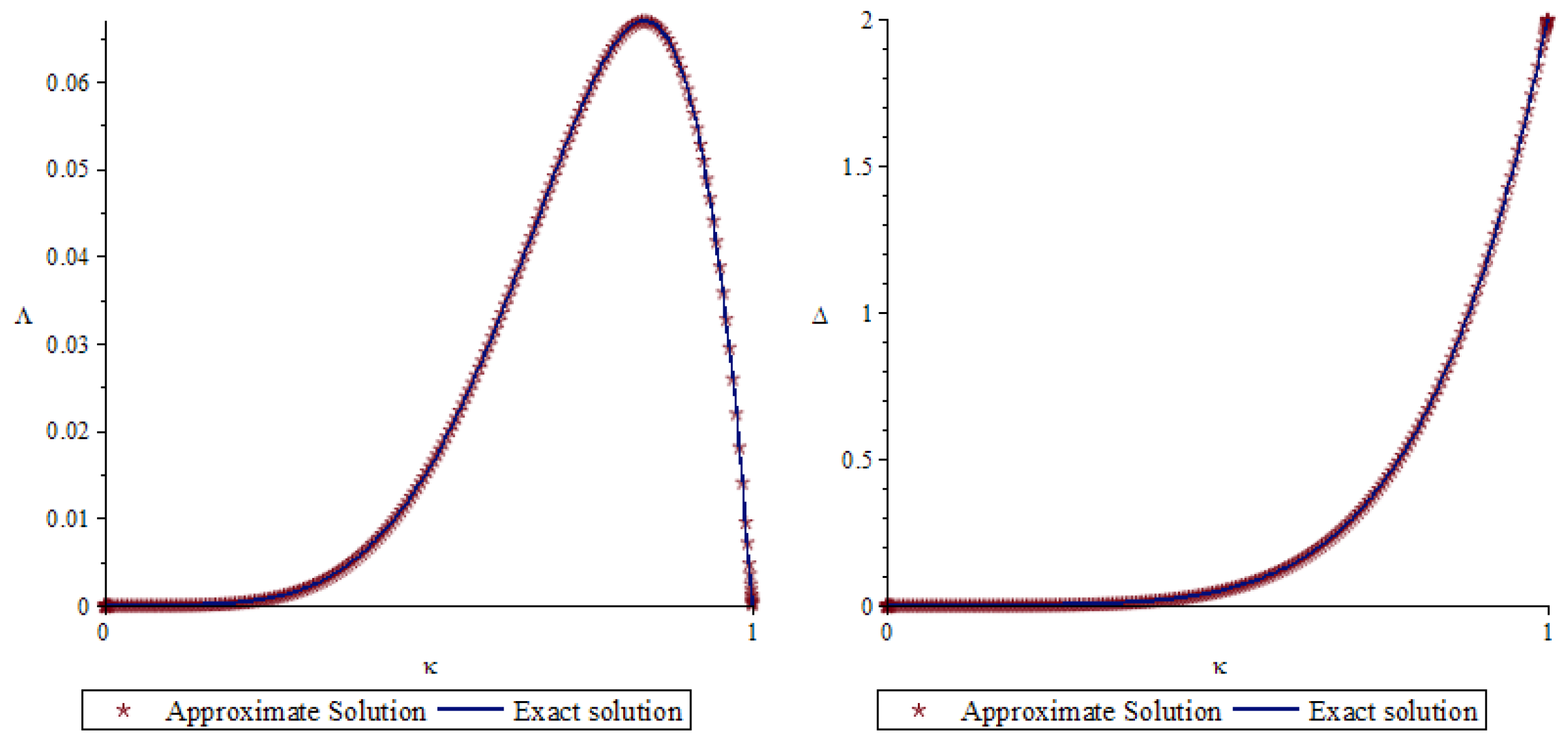
We study the fractional integrodifferential system (16) in this example, which has the exact solution as follows:
and
So,
and
Also,
We perform some numerical tests to demonstrate the effectiveness of this example. For example, for , unknowns are described as follows:
The approximate solution is offered by
Moreover,
The approximate solution is presented by
Using our proposed method, Table 1 displays the numerical results obtained for Example 1.
Table 1.
Numerical results for Example 1.
The achieved approximate solutions and exacts one for Example 1 are shown in Figure 1.
Figure 1.
Comparison of exact solutions and and approximate ones and , respectively, for .
Example 2.
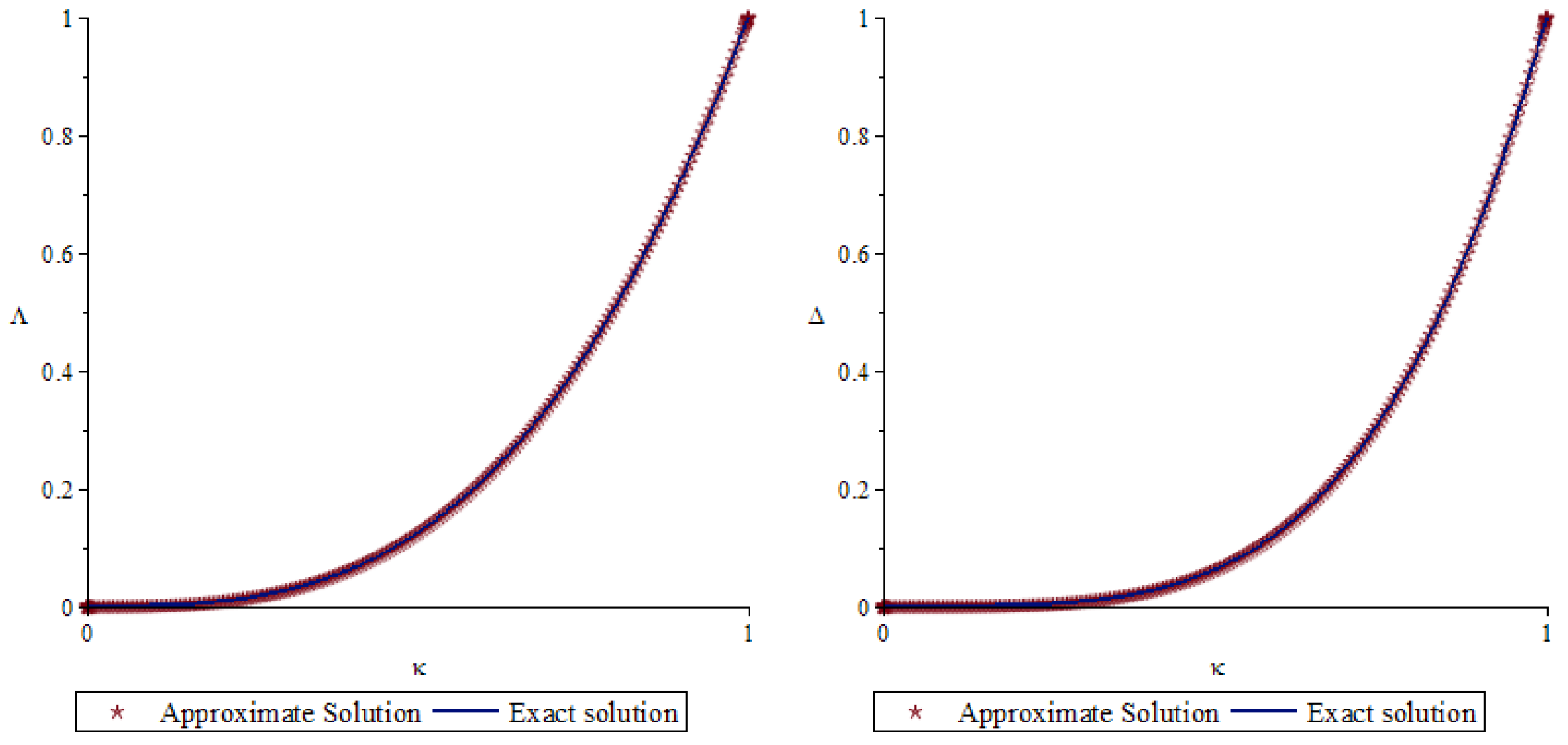
In this example, we investigate the fractional red integrodifferential system (16), which has the following exact solution:
and
So,
and
Also,
The numerical outcomes for the second case using the current approximation are shown in Figure 2.
Figure 2.
Comparison of exact solutions and and approximate ones and , respectively, for .
8. Conclusions
In this research, we generalized a projection method to solve a system fractional integrodifferential via the shifted Vieta–Fibonacci polynomials. The current method reduces the provided problem into two systems of algebraic equations. Approximate solutions to the given problem are obtained by solving the acquired systems. This integrodifferential system has obvious relevance to problems in mathematical research, especially those involving interactions in physics. The fractional operator has been found to affect the growth of numerical results significantly. This method can be used to study and find solutions to various fractional integrodifferential and integral problems. This method has the potential to be employed as a future project for solving the system of fractional partial differential equations outlined below under some conditions:
Author Contributions
Methodology, A.M. (Abdelaziz Mennouni); Software, A.M. (Abdelkader Moumen), M.B. and A.M. (Abdelaziz Mennouni); Validation, A.M. (Abdelaziz Mennouni), A.M. (Abdelkader Moumen) and M.B.; Formal analysis, A.M. (Abdelaziz Mennouni); Investigation, A.M. (Abdelaziz Mennouni), A.M. (Abdelkader Moumen) and M.B.; Resources, A.M. (Abdelaziz Mennouni); Data curation, A.M. (Abdelaziz Mennouni), A.M. (Abdelkader Moumen) and M.B.; Writing—original draft, A.M. (Abdelaziz Mennouni); Writing—review and editing, A.M. (Abdelaziz Mennouni); Visualization, A.M. (Abdelaziz Mennouni), A.M. (Abdelkader Moumen) and M.B.; Supervision, A.M. (Abdelaziz Mennouni); Project administration, A.M. (Abdelkader Moumen) and M.B.; Funding acquisition, A.M. (Abdelkader Moumen) and M.B. All authors have read and agreed to the published version of the manuscript.
Funding
This research received no external funding.
Data Availability Statement
Not applicable.
Acknowledgments
The first and the third author extend their appreciation to the Deanship of Scientific Research at King Khalid University for funding this work through a large research project under grant number R.G.P.2/252/44.
Conflicts of Interest
The authors declare no conflict of interest.
References
- Araour, M.; Mennouni, A. A New Procedures for Solving Two Classes of Fuzzy Singular Integro-Differential Equations: Airfoil Collocation Methods. Int. J. Appl. Comput. Math. 2022, 8, 35. [Google Scholar] [CrossRef]
- Nieto, J.J. Fractional Euler numbers and generalized proportional fractional logistic differential equation. Fract. Calc. Appl. Anal. 2022, 25, 876–886. [Google Scholar] [CrossRef] [PubMed]
- Kilbas, A.A.; Srivastava, H.M.; Trujillo, J.J. Theory and Applications of Fractional Differential Equations. In North–Holland Mathematics Studies; Elsevier Science B.V.: Amsterdam, The Netherlands, 2006; Volume 204. [Google Scholar]
- Mennouni, A. The iterated projection method for integro-differential equations with Cauchy kernel. J. Appl. Math. Inform. 2013, 31, 661–667. [Google Scholar] [CrossRef][Green Version]
- Kirane, M.; Abdeljabbar, A. Nonexistence of global solutions of systems of time fractional differential equations posed on the Heisenberg group. Math. Methods Appl. Sci. 2022, 45, 7336–7345. [Google Scholar] [CrossRef]
- Zhou, Y. Basic Theory of Fractional Differential Equations; World Scientific: Singapore, 2014; pp. 3–11. [Google Scholar]
- Bentrcia, T.; Mennouni, A. On the asymptotic stability of a Bresse system with two fractional damping terms: Theoretical and numerical analysis. Discrete Contin. Dyn. Syst. Ser. B 2022, 28, 580–622. [Google Scholar] [CrossRef]
- Wang, J.N.; Zhou, Y.; Alsaedi, A.; Ahmad, B. Well-posedness and regularity of fractional Rayleigh–Stokes problems. Z. Angew. Math. Phys. 2022, 73, 161. [Google Scholar] [CrossRef]
- Li, Y. Regularity of mild solutions for fractional abstract Cauchy problem with order μ∈(1,2). Z. Angew. Math. Phys. 2015, 66, 3283–3298. [Google Scholar] [CrossRef]
- Mennouni, A. Improvement by projection for integro-differential equations. Math. Methods Appl. Sci. 2020, 1–7. [Google Scholar] [CrossRef]
- Samko, S.G.; Kilbas, A.A.; Marichev, O.I. Fractional Integrals and Derivatives, Theory and Applications; Gordon and Breach: Amsterdam, The Netherlands, 1993. [Google Scholar]
- Xu, C.; ur Rahman, M.; Baleanu, D. On fractional-order symmetric oscillator with offset-boosting control. Nonlinear Anal. Model. Control 2022, 27, 994–1008. [Google Scholar] [CrossRef]
- Ahmad, B.; Ntouyas, S.K. Existence results for a coupled system of Caputo-type sequential fractional differential equations with nonlocal integral boundary conditions. Appl. Math. Comput. 2015, 266, 615–622. [Google Scholar] [CrossRef]
- Ahmad, B.; Ntouyas, S.K. Nonlocal Nonlinear Fractional-Order Boundary Value Problems; World Scientific: Singapore, 2021. [Google Scholar]
- Luca, R.; Tudorache, A. On a System of Hadamard Fractional Differential Equations with Nonlocal Boundary Conditions on an Infinite Interval. Fractal Fract. 2023, 7, 458. [Google Scholar] [CrossRef]
- Tudorache, A.; Luca, R. On a System of Sequential Caputo Fractional Differential Equations with Nonlocal Boundary Conditions. Fractal Fract. 2023, 7, 181. [Google Scholar] [CrossRef]
- Tao, X.; Xie, Z. The Uniform Convergence of a DG Method for a Singularly Perturbed Volterra Integro-Differential Equation. Acta Math. Sci. 2023, 43, 2159–2178. [Google Scholar] [CrossRef]
- Kumar, A.; Patel, R.; Vijayakumar, V.; Shukla, A. Investigation on the Approximate Controllability of Fractional Differential Systems with State Delay. Circuits Syst. Signal Process. 2023, 42, 4585–4602. [Google Scholar] [CrossRef]
- Ahmad, B.; Agarwal, R.P.; Broom, A.; Alsaedi, A. On a Coupled Integro-Differential System Involving Mixed Fractional Derivatives and Integrals of Different Orders. Acta Math. Sci. 2021, 41, 1366–1384. [Google Scholar] [CrossRef]
- Atta, A.G.; Youssri, Y.H. Advanced shifted first-kind Chebyshev collocation approach for solving the nonlinear time-fractional partial integro-differential equation with a weakly singular kernel. Comput. Appl. Math. 2022, 41, 381. [Google Scholar] [CrossRef]
- Jia, Y.; Xu, M.; Lin, Y.; Jiang, D. An efficient technique based on least-squares method for fractional integro-differential equations. Alex. Eng. J. 2023, 64, 97–105. [Google Scholar] [CrossRef]
- Youssri, Y.H.; Atta, A.G. Spectral Collocation Approach via Normalized Shifted Jacobi Polynomials for the Nonlinear Lane-Emden Equation with Fractal-Fractional Derivative. Fractal Fract. 2023, 7, 133. [Google Scholar] [CrossRef]
- Singh, M.; Das, S.; Rajeev; Ong, S.H. Novel operational matrix method for the numerical solution of nonlinear reaction–advection–diffusion equation of fractional order. Comput. Appl. Math. 2022, 41, 306. [Google Scholar] [CrossRef]
- Hoseini, T.; Ordokhani, Y.; Rahimkhani, P. A Numerical Method Based on the Fractional Vieta–Fibonacci Functions for a Class of Fractional Optimal Control Problems. Iran J. Sci. Technol. Trans. Electr. Eng. 2023, 47, 1117–1128. [Google Scholar] [CrossRef]
- Gupta, R.; Saha Ray, S. A new effective coherent numerical technique based on shifted Vieta–Fibonacci polynomials for solving stochastic fractional integro-differential equation. Comput. Appl. Math. 2023, 42, 256. [Google Scholar] [CrossRef]
- Sadri, K.; Hosseini, K.; Baleanu, D.; Salahshour, S.; Park, C. Designing a Matrix Collocation Method for Fractional Delay Integro-Differential Equations with Weakly Singular Kernels Based on Vieta–Fibonacci Polynomials. Fractal Fract. 2022, 6, 2. [Google Scholar] [CrossRef]
- Althubiti, S.; Mennouni, A. An Effective Projection Method for Solving a Coupled System of Fractional-Order Bagley–Torvik Equations via Fractional Shifted Legendre Polynomials. Symmetry 2022, 14, 1514. [Google Scholar] [CrossRef]
- Althubiti, S.; Mennouni, A. A Novel Projection Method for Cauchy-Type Systems of Singular Integro-Differential Equations. Mathematics 2022, 10, 2694. [Google Scholar] [CrossRef]
- Mennouni, A. A new efficient strategy for solving the system of Cauchy integral equations via two projection methods. Transylv. J. Math. Mech. 2022, 14, 63–71. [Google Scholar]
- Mennouni, A. Airfoil Collocation Method Employing a New Efficient Procedure for Solving System of Two Logarithmic Integro–Differential Equations. Int. J. Appl. Comput. Math. 2022, 8, 208. [Google Scholar] [CrossRef]
Disclaimer/Publisher’s Note: The statements, opinions and data contained in all publications are solely those of the individual author(s) and contributor(s) and not of MDPI and/or the editor(s). MDPI and/or the editor(s) disclaim responsibility for any injury to people or property resulting from any ideas, methods, instructions or products referred to in the content. |
© 2023 by the authors. Licensee MDPI, Basel, Switzerland. This article is an open access article distributed under the terms and conditions of the Creative Commons Attribution (CC BY) license (https://creativecommons.org/licenses/by/4.0/).