1. Introduction
A
birational planar map is a rational function
from
to
with a rational function
inverse to
, i.e.,
. The research on birational maps traces its history back to 1863 when birational maps were known as Cremona transformations. H. Hudson published a monograph in 1927 to classify Cremona transformations in the plane and in 3D space [
1]. However, [
1] predates by over half a century Bézier and B-spline curves and surfaces.
Free-form deformation (FFD) is an artist-friendly tool, which is used to model deformations by warping the ambient space [
2]. FFD has numerous applications such as image morphing [
3,
4], facial animation [
5] and medical image registration [
6].
A preimage of a given
is defined as any
for which
. Computing FFD preimages is also required in many applications, e.g., extended FFD [
7] and directly manipulated FFD [
8]. However, computing preimages usually involves solving a system of nonlinear equations using either numerical methods or algebraic techniques. The computation of preimages can be simplified when the rational map used in FFD is birational. Hence, the notion of birational FFD is put forward in [
9], i.e., an FFD in which the control points can be moved freely and the FFD can be made birational by adjusting the weights.
Birational FFDs of degree
, i.e., birational quadrilateral maps, are constructed by considering axial moving lines in [
10]. The inverses of birational quadrilateral maps are also discussed from the viewpoint of generalized barycentric coordinates [
11,
12]. The relationship between the inverses of rational quadrilateral maps and their characteristic conic is presented in [
13]. Hence, by setting the isoparametric curves to be monoid curves, Seberberg et al. [
9] studied the construction of the birational 2D FFD of degree
. To characterize the birational maps, Botbol et al. [
14] provides a birationality criterion for bigraded birational maps. Note that the current methods to construct birational maps focus on the discussion of 2D rational maps related to bidegree cases [
9,
10].
Complex rational curves were introduced by J. Sánchez-Reyes by allowing complex weights in rational Bézier curves [
15]. Based on the observation that complex rational curves have two special syzygies of low degrees [
16], we can construct birational quadratic planar maps by exploiting their complex rational representations [
17], which are complex rational maps of degree one. Complex rational planar maps of degree one represent exactly Möbius transformations. Based on Möbius transformations, Lipman et al. also introduced the four-point interpolant (FPI) maps, where four endpoints are free to move. Since Möbius transformations map lines to circles, the boundaries of the complex rational planar maps of degree one and FPI are limited circular arcs. Recently, the planar and bent corner-operated and transimilar (COTS) maps have been proposed to take the unit square to a region bounded by four log-spiral edges [
18,
19]. Based on the self-similar property of the log-spiral, the tiles of the COTS map of a regular pattern are similar, which will reduce the query cost of point inclusion testing (PIT) [
20] and total area calculation (TAC). To increase the flexibility to construct birational planar maps and inspired by recent work on generalized complex rational curves [
21], we shall discuss the construction of birational quadratic planar maps by probing their generalized complex representations. The main contributions of this study are as follows:
We introduce generalized complex rational curves and planar maps, and we discuss their properties.
We prove that degree one, generalized, complex rational maps correspond to quadratic birational planar maps.
We propose a new method to construct quadratic birational planar maps via generalized complex rational planar maps.
This paper is organized in the following fashion. We begin in
Section 2 by recalling some preliminary results about rational curves over generalized complex numbers. In
Section 3, we establish the relationship between quadratic rational Bézier curves and degree one complex rational curves. By considering the bivariate case of generalized complex rational curves, we construct birational quadratic planar maps by degree one, generalized, complex rational maps in
Section 4. We close in
Section 5 with a brief summary of our work.
3. Generalized Complex Rational Linear Curves
Let
denote the generalized complex rational Bézier curve of degree one:
where
,
,
. Note that when
,
will degenerate to a line segment connecting
and
. Hence, in the rest of this paper, we assume at least one of
.
Lemma 2. Letbe the corresponding real rational curve of . Then, the control points and the weights in (
7)
have the following properties: - (1)
- (2)
- (3)
, ;
- (4)
is the conjugate of ;
- (5)
, where - (6)
Geometrically, is on three different lines when is set to . All three lines pass through a common point . More precisely,
- (a)
When , the line is the perpendicular bisector of the line segment between and ;
- (b)
When , the line is symmetric to the line about the axis ;
- (c)
When , the line is parallel to the y-axis, which also passes through the midpoint .
- (7)
Proof. Items (1), (2), and (3) can be verified by multiplying the denominator and numerator of (
6) by
.
Since the conjugate of is , it follows from (3) that is the conjugate of . Hence, (4) holds.
Again, according to (3),
By solving for
in (
9), we obtain
. Substituting
,
into
yields
By setting
, it follows from (
9) that
Thus, (5) holds.
We shall prove (6) based on (5). Since
corresponds to the vector
, it follows that
- (a)
When , the vector , which is perpendicular to the vector . Thus, is on the perpendicular bisector of the line segment between and ;
- (b)
When , the vector . Hence, . Since the vector is symmetric to the vector about the axis , it follows that is on a line symmetric to the line about the axis ;
- (c)
When , the vector . Hence, , which is on a line parallel to the y-axis.
Next, we shall prove (7). Recall from (
8) that
. On the other hand,
Hence, when
,
Thus,
and (7) holds. □
Based on the above analysis, we are now ready to derive conditions for a general real rational quadratic Bézier curve to have a generalized complex rational representation.
Theorem 1. Suppose that the two endpoints and their weights are fixed for the rational quadratic curve (
7).
If the middle control point and its weight satisfy the following two conditions: - (1)
can be expressed as for some ;
- (2)
then has a generalized complex rational representation.
Proof. When the middle control point and its corresponding weight satisfy conditions (1) and (2), it can be verified that
corresponds to a generalized complex rational representation
if we choose
such that
and set
where
□
Remark 1. Based on Theorem 1, a rational quadratic Bézier curve in (
7)
with complex rational representation is fully determined by , and the parameter λ. To ensure that the curve segment is located in the convex hull of the control polygon , we shall adopt the positive square root for in (
10).
The complementary segment of the curve is generated by reversing of the sign of [28]. Remark 2. When , we can divide the numerator and the denominator of by . Hence, can be rewritten asThus, the choice of the ratio , instead of itself, affects the shape of the curve . Remark 3. in (
12)
can be expressed in exponential form: Remark 4. In the case of hyperbolic rational curves, since , it follows from (
10)
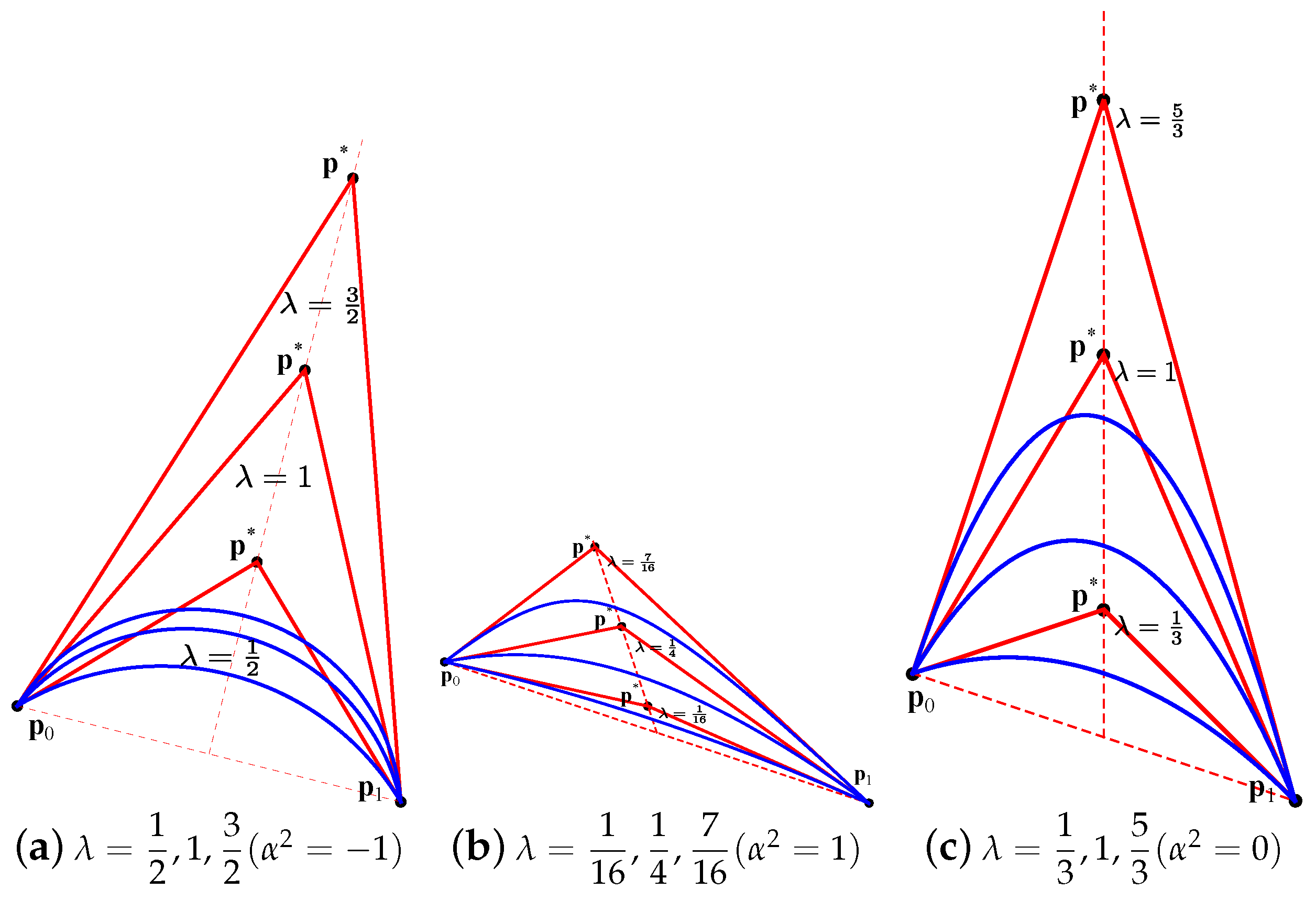
that the parameter λ must satisfy: . Example 1. () Consider two endpoints and their corresponding weights . Choose with . From (
10),
we need to set the weight :Choose . Then, , , . The corresponding rational quadratic curves are shown in Figure 1a (blue curves). Example 2. () Consider two endpoints and their corresponding weights . Choose with . From (
10),
we need to set the weight :Let . Then, . The corresponding rational quadratic curves are shown in Figure 1b (blue curves). Example 3. () Consider two endpoints and their corresponding weights . Choose with . From (
10),
we need to set the weight :Let . Then, . The corresponding rational quadratic curves are shown in Figure 1c (blue curves). 4. Construction of Quadratic Birational Maps via Generalized Complex Representations
To generate planar rational maps, we generalize
in (
6) to the bivariate setting as follows.
Consider three non-collinear endpoints
. Let
where
are generalized complex weights, denoted by
To avoid the degenerate case, we also assume
,
,
. In addition, at least one of
,
,
is not fully real throughout the rest of the paper. Note that the complex, hyperbolic and parabolic rational curves are invariant with respect to Möbius transformations, i.e., applying a Möbius transformation to the control points and weights is equivalent to applying the Möbius transformation to every point on the curve (for more details, the readers are referred to Theorem 4.5 in [
21]).
Multiplying the numerator and denominator in (
13) by the conjugate of the denominator yields the corresponding quadratic real rational planar map:
where
are Bernstein polynomials defined by
and
,
.
Denote by
, the homogeneous form of
. Next, we shall derive the syzygies of a planar rational map
that is endowed with a generalized complex representation (
13).
From Lemma 1, there are two special syzygies
in the form (
5) of
, which are
-independent. Let
and
. Then, after calculation, we obtain
where
With the above notation in hand, we are now ready to give the inversion formulas for a rational quadratic map with a generalized complex rational representation.
Theorem 2. For a real planar rational quadratic map with a generalized complex rational representation (
13),
the inversion equation iswhereHence, the rational map (13) with generalized complex rational representation is birational. Proof. The proof is similar to the proof of Theorem 4 in [
17]. □
Given three endpoints , , and their corresponding weights , , , next we shall show how to obtain and , , such that the rational quadratic map is endowed with a generalized complex rational representation.
Note that not all three middle points are free to be chosen arbitrarily. Without loss of generality, we consider the two boundary curves
,
first. Choose two parameters
to fix the middle points
, i.e.,
Then from (
10) in Theorem 1, we obtain
By setting the generalized complex weight
such that
, we can compute
,
from (
11).
Let
, then
In this way, we can construct a planar rational quadratic map (
14) that is endowed with a generalized complex rational representation
Based on Theorem 2, the planar rational quadratic map
is also birational.
In general, the method of constructing a planar rational quadratic map that is endowed with a generalized complex rational representation can be summarized in the following Algorithm 1.
| Algorithm 1 To construct a birational quadratic planar map with a generalized complex rational representation |
Input: Three endpoints ; weights ; two parameters
Output: A quadratic planar map that is endowed with generalized complex representation
Calculate two real weights Choose a generalized complex weight such that . Calculate the other two weights as ( 11) Calculate the real weight Set three middle points , ,
return .
|
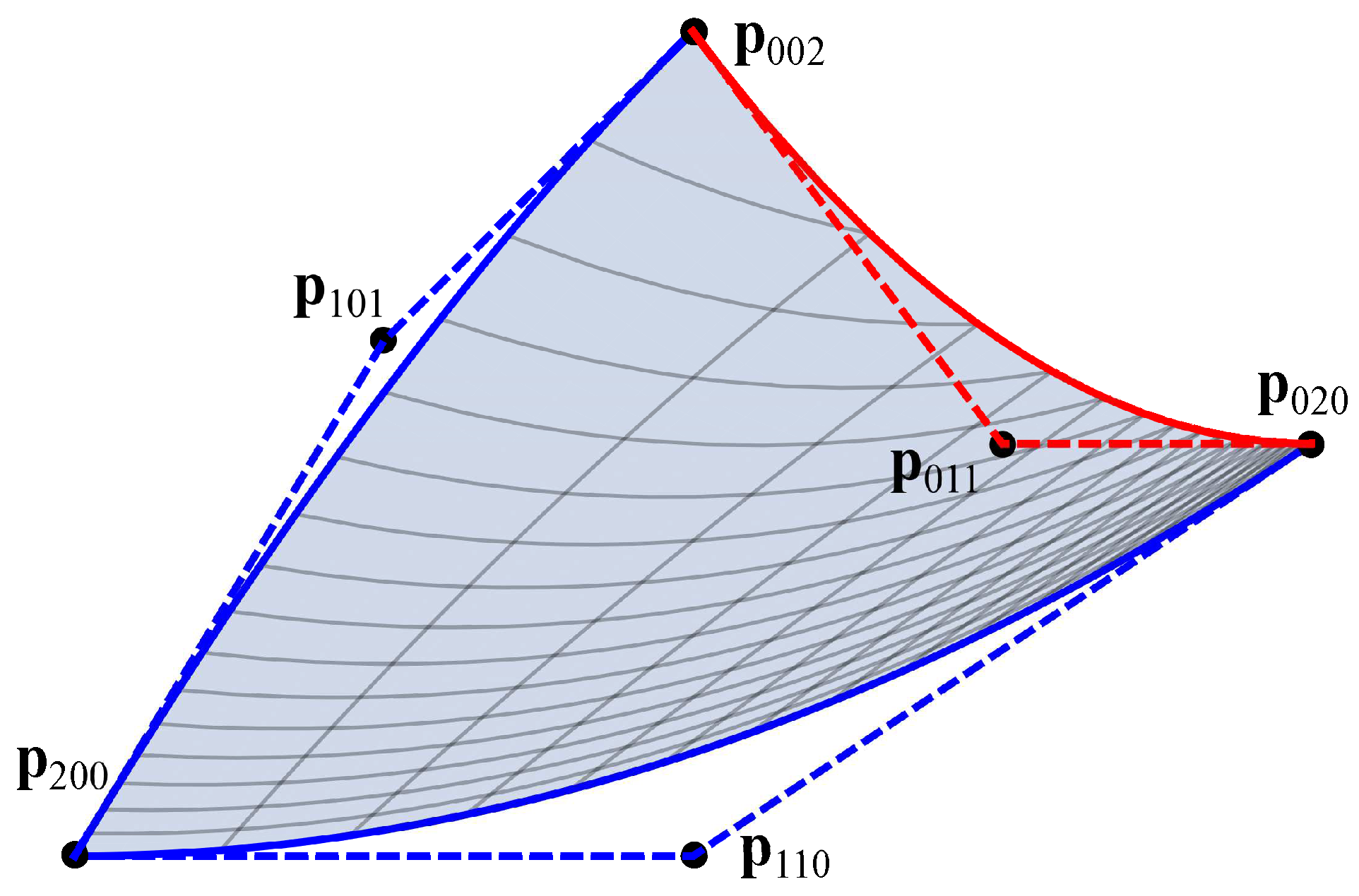
Example 4. () Fix three endpoints . Set the weights . The control points are fixed by choosing , i.e.,HenceFrom (
12),
we obtainChoose . Hence, from (
11),
Set . and can be calculated as follows:Thus, we obtain a rational quadratic map with complex rational representationSee Figure 2 for an illustration of the birational map . Let , , , . Solving the system of equationswith respect to the variables , we obtain the inversion equation: Example 5. () Fix three endpoints . Set the weights . The control points are fixed by choosing , i.e.,HenceFrom (
12),
we obtainChoose . Hence, from (
11),
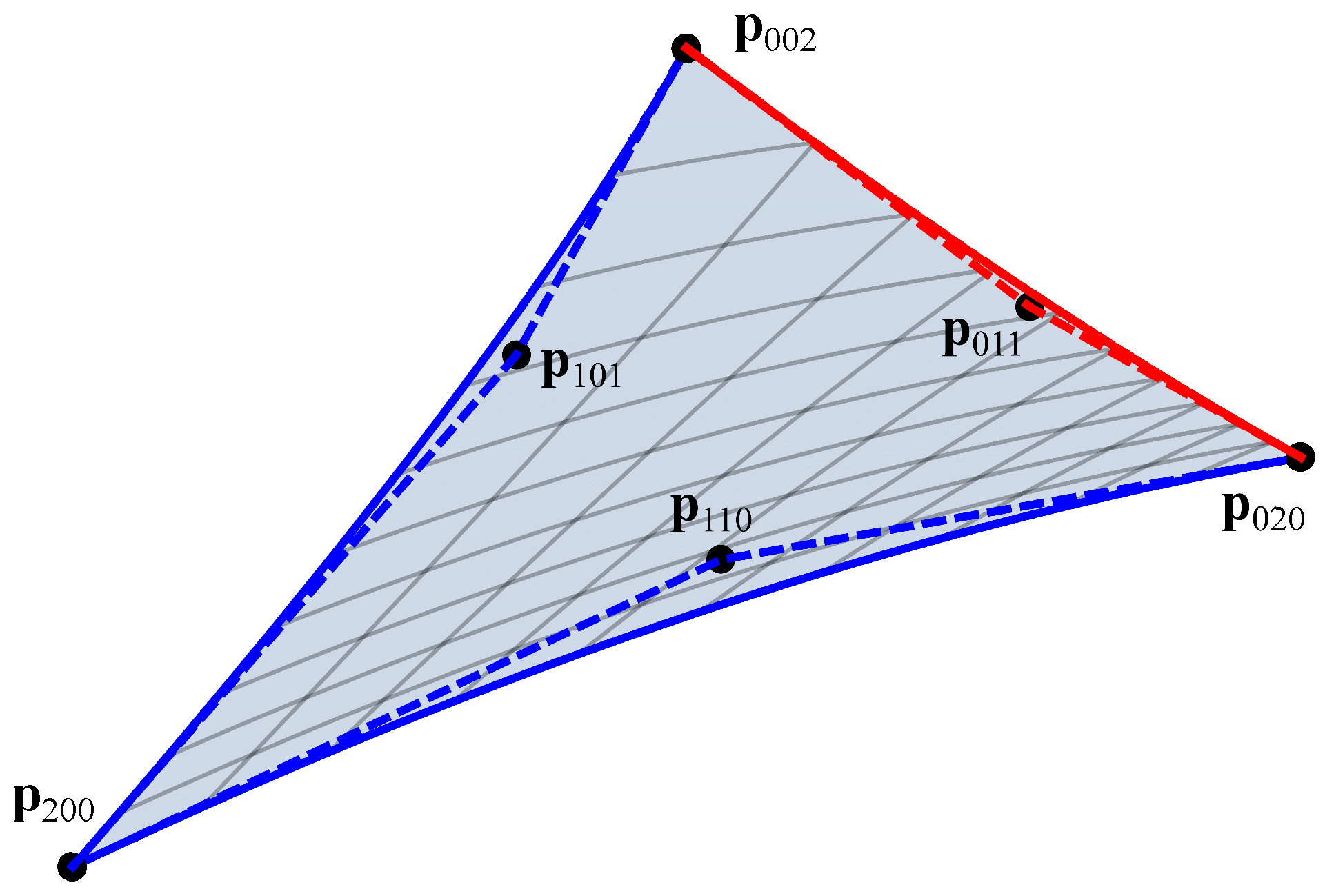
Set . and can be calculated as follows:Thus, we obtain a rational quadratic map with complex rational representationSee Figure 3 for an illustration of the birational map . Let , , , , solving the system of equationsand with respect to the variables , we obtain the inversion equation: 5. Conclusions
We extended the construction of birational quadratic maps based on rational maps over generalized complex numbers. When we need to construct birational quadratic maps, the new method provides more options for choosing the middle control points and their corresponding weights. Hence, we increase the flexibility of the boundary curves of birational quadratic maps. The proof of the birational property is based on the construction of two special syzygies. The formulas for the inversion equation are also provided. Although we have generalized the construction of birational maps based on generalized complex representations, the choice of the middle control points is still limited, and we cannot construct quadratic birational planar maps by moving the three middle points freely. In the future, we hope to construct general birational maps by setting to the real values other than , which will be used as a shape parameter to control the shape of the boundaries.