
Abstract
In this study, we introduce a new generalization of a Bernstein-type rational function possessing better estimates than the classical Bernstein-type rational function. We investigate its error of approximation globally and locally in terms of the first and second modulus of continuity and a class of Lipschitz-type functions. We present graphical comparisons of its approximation with illustrative examples.
MSC:
41A25; 41A36
1. Introduction
Bernstein polynomials [1] are defined to prove the well-known convergence theorem of Weierstreiss for each real-valued function f defined on by
In 1975, Balázs [2] defined an operator for each real-valued function f defined on and appropriately chosen real sequences and such that by
When , this operator possesses the following relation with a Bernstein polynomial:
which is known as a Bernstein-type rational function. Balàzs estimated its rate of convergence for each continuous function f defined on and proved an asymptotic approximation theorem under the condition that for some real number . In [3], Balàzs and Szabados improved the estimates given in [2] under more restrictive conditions by choosing and for , by assumming that f is uniformly continuous on . Additionally, in [4], Balázs presented approximation results for Balázs–Szabados operators on all real axes. Totik investigated in [5] saturation properties of Balázs–Szabados operators, and Abel and Veccia [6] obtained Voronovskaja type asiymtotic results for Balázs–Szabados operators. In [7], Holhoş have presented new approximation results for Balázs–Szabados operators by means of super-exponential functions.
In [8], İspir and Atakut gave a generalization of Bernstein-type rational functions as follows:
where and are suitably chosen positive numbers, and is a sequence of functions satisfying certain conditions. Recently, Agratini [9] has studied a class of Bernstein-type rational functions by choosing a strictly decreasing positive real sequence such that as follows:
where f is continuous on satisfying a certain growing condition. Agratini has investigated both a local and global estimation of rate of convergence and has presented a weighted approximation result by using weighted modulus of continuity. Researchers can also find approximation results of some other Bernstein-type rational functions in those references [10,11,12,13,14,15,16,17,18,19,20].
Denoted by is the Banach space of all real-valued continuous and bounded functions on endowed with the sup-norm
For a compact subinterval , the same norm is valid and reduced to
In this paper, we construct a new generalization of Bernstein-type rational function, which is reducible to (2) and (3), and it is a rational function associated with the Bernstein polynomial given in (1). In an effort to define a well-defined Bernstein-type rational function, we choose non-negative real sequences and such that satisfying the property
We consider a newly defined Bernstein-type rational function as follows:
where f is a real-valued continuous function on , and are real sequences such that satisfies the property (4). It is clear that is a well-defined, linear and positive operator. When , and , under the condition that for some real number , it is reduced to the Bernstein-type rational functions given by (2). When is a strictly decreasing positive real sequence, and f is continuous on satisfying a certain growing condition, it is induced to Agratini’s modification given by (3). Additionally, since it has the following connection with the Bernstein polynomial given by (1):
when for , it can be called a generalized Bernstein-type rational function.
2. Approximation Results
Firstly, we present the following auxiliary result, which will be used throughout the paper:
Lemma 1.
We have the following values of the generalized Bernstein-type rational function at monomials:
where for , , and are real sequences such that .
Proof.
By considering
We calculate that
□
Remark 1.
We have the following first- and second-order central moments by considering Lemma 1:
Theorem 1.
Proof.
The proof can be fulfilled easily from the well-known Bohman–Korovkin theorem [21]. From (6) of Lemma 1, it is clear that
Since for each , by Remark 1, we can write
By considering () of Lemma 1, we can calculate that
3. Local and Global Approximation
In this part, we present local and global results of approximation with the help of the first and second modulus of continuity and a Lipschitz class of functions.
For any , modulus of continuity of is defined as
which possesses the following property:
for , and , when f is uniformly continuous [22].
Theorem 2.
Proof.
Let .By (18), we have
By applying the operator to (20), by taking linearity and positivity of the operator into account and by applying Cauchy–Schwarz inequality, we obtain
From (11) of Remark 1, by choosing
and by replacing , we complete the proof of the theorem. □
Remark 2.
In Theorem 2, is dependent on x and choosing of and . and must be non-negative real sequences satisfying . Otherwise, Theorem 2 becomes invalid. For example, if and then . This is not the only possible condition as .
Moreover, for Theorem 2 is reduced to the following inequality:
where
For , Petree’s K-functional is defined by
where
We have the following connection (see p. 192 in [23]) between Petree’s K-functional and the second modulus of continuity
where
Theorem 3.
Let and be real sequences such that satisfying property (4). For each , then there exists a such that
where is given as in (19).
Proof.
We initially define an auxilary operator by
where
By (26), we obtain
For any , from Taylor’s formula, we can write
Since , there exists a such that Therefore, by applying Cauchy–Schwarz inequality, we obtain
Additionally, for , we have
Remark 3.
Let E be any subset of and . Let denote a class of Lipschitz functions in satisfying
where is a constant, and is the closure of E in .
Theorem 4.
Proof.
Let and such that . We can write
Remark 4.
4. Graphical Comparison
In this part, we present some graphical results produced in Maple software.
Example 1.
Let us choose , , for and .
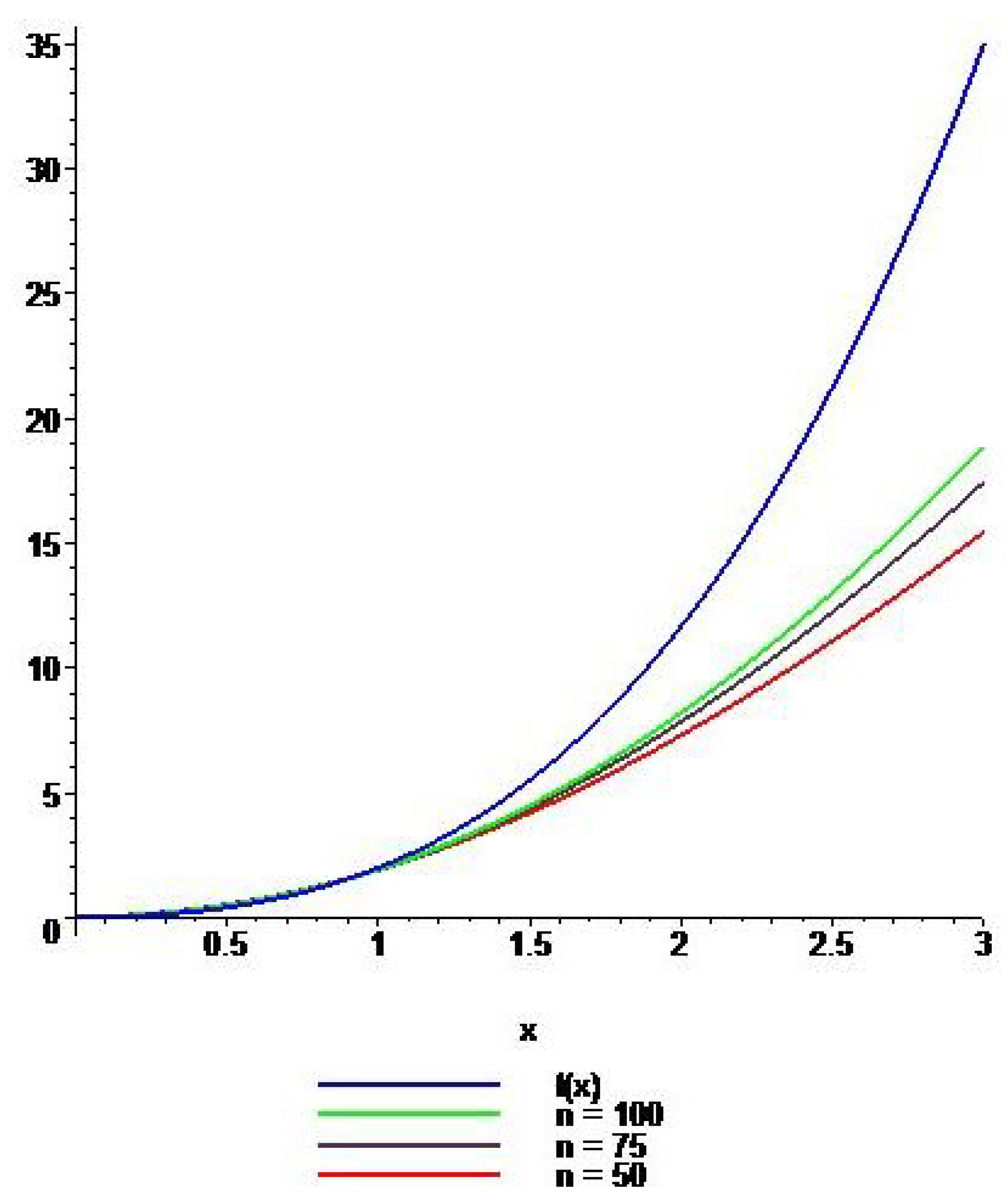
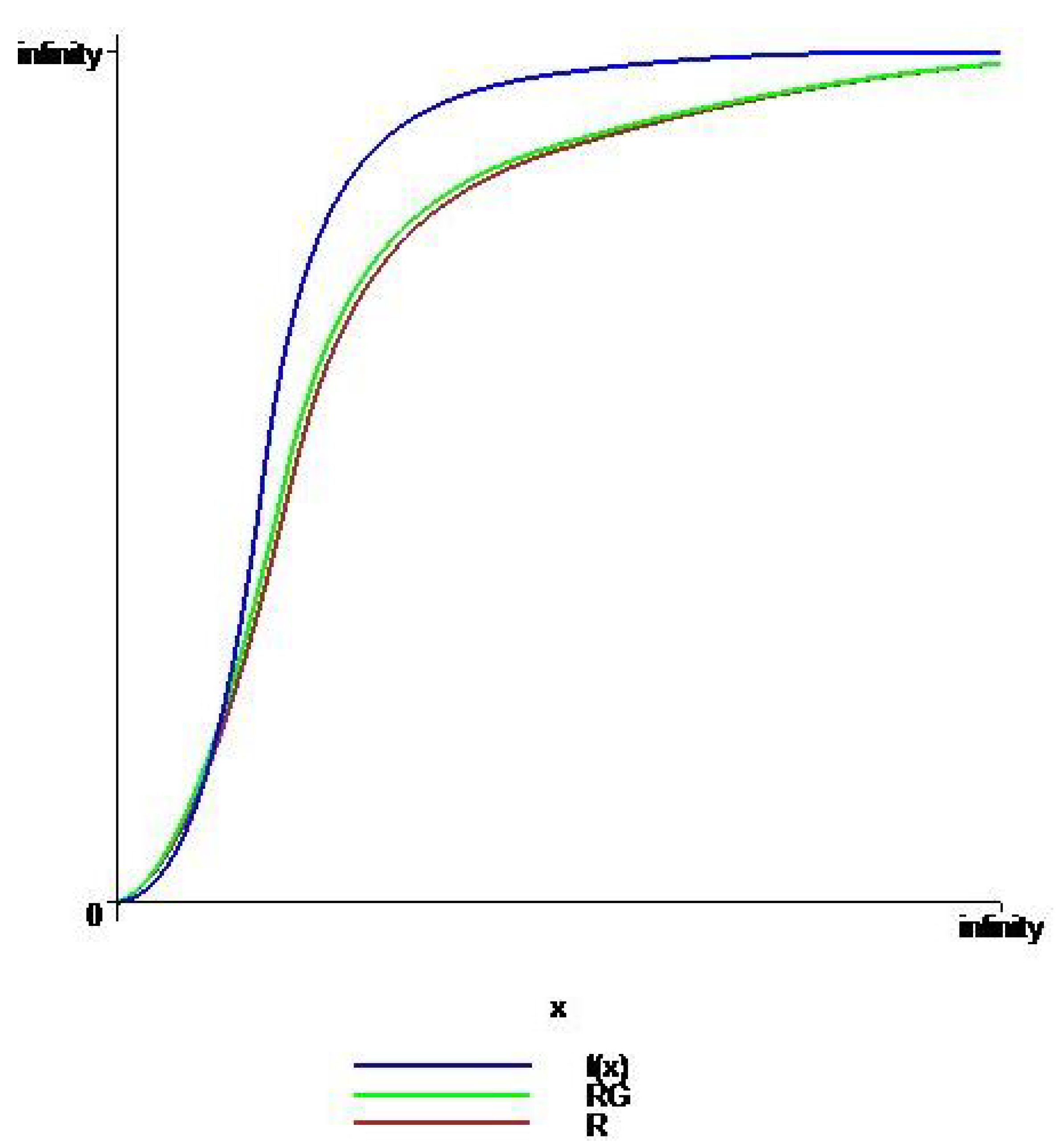
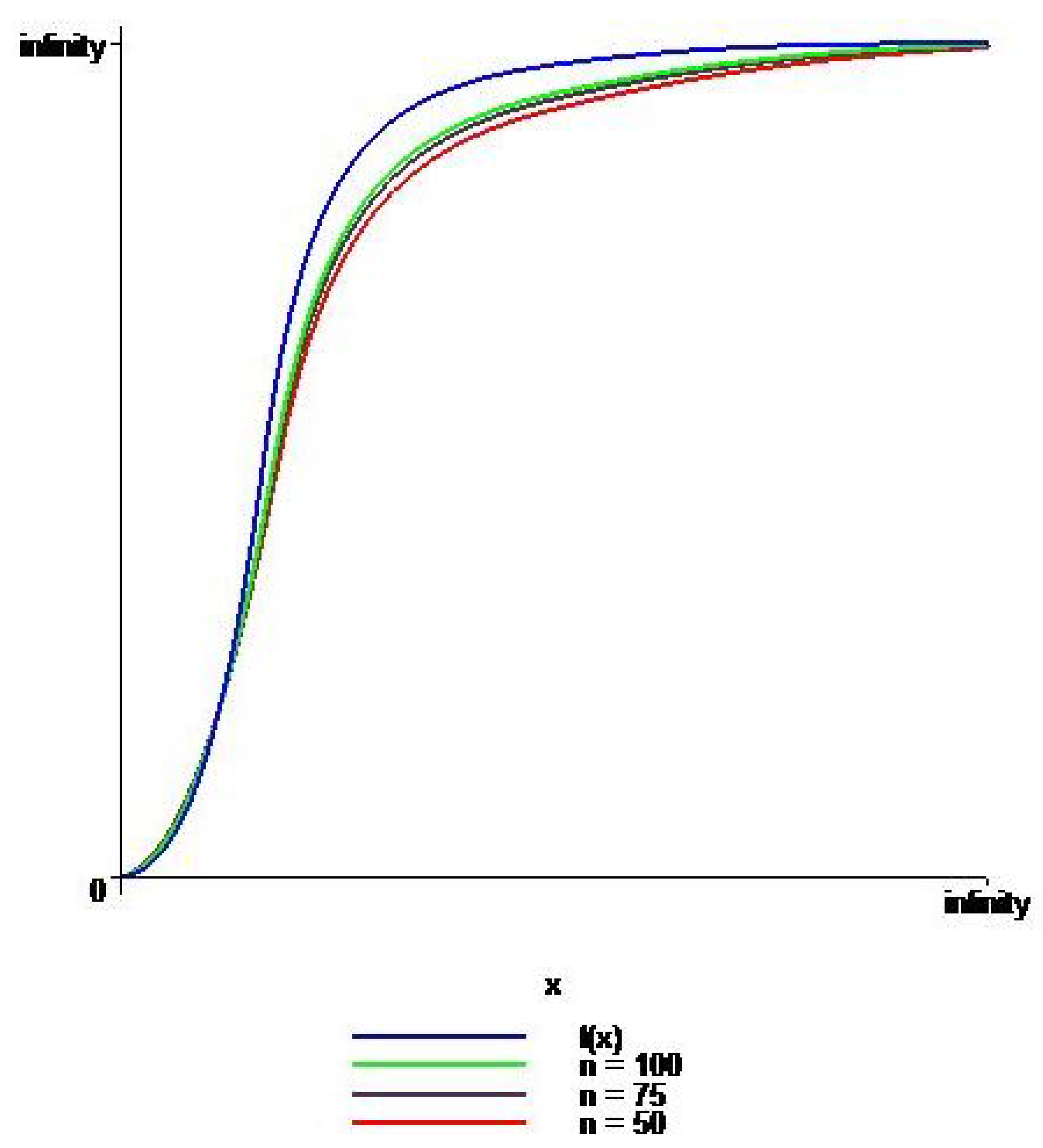
In Figure 1 and Figure 2, by choosing , graphical comparison of approximation of to f for and 100 is presented on and It is clear that approximation of to f is better for increasing the value of n.
Figure 1.
Approximation by on , for , and 100.
Figure 2.
Approximation by on , for , and 100.
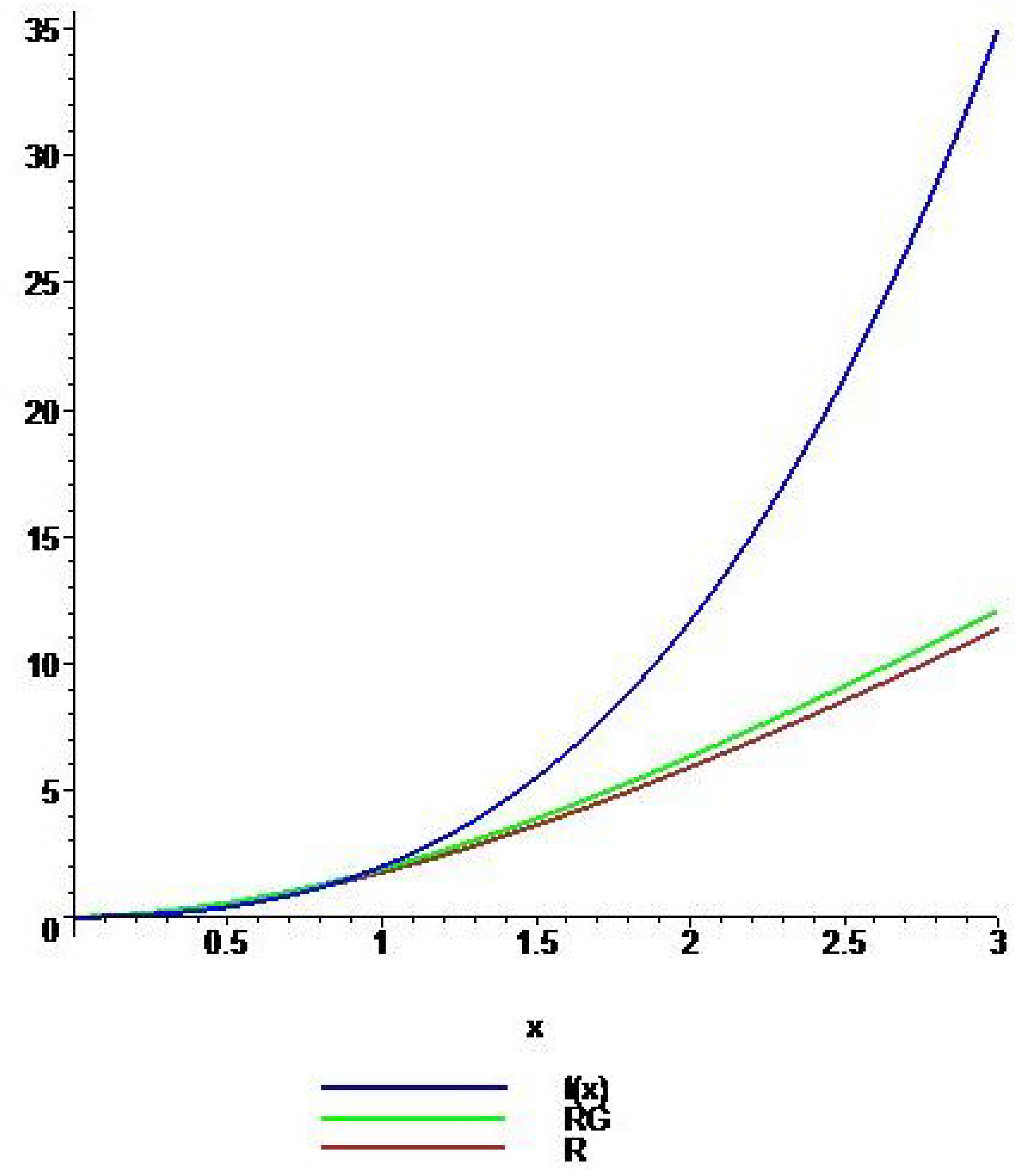
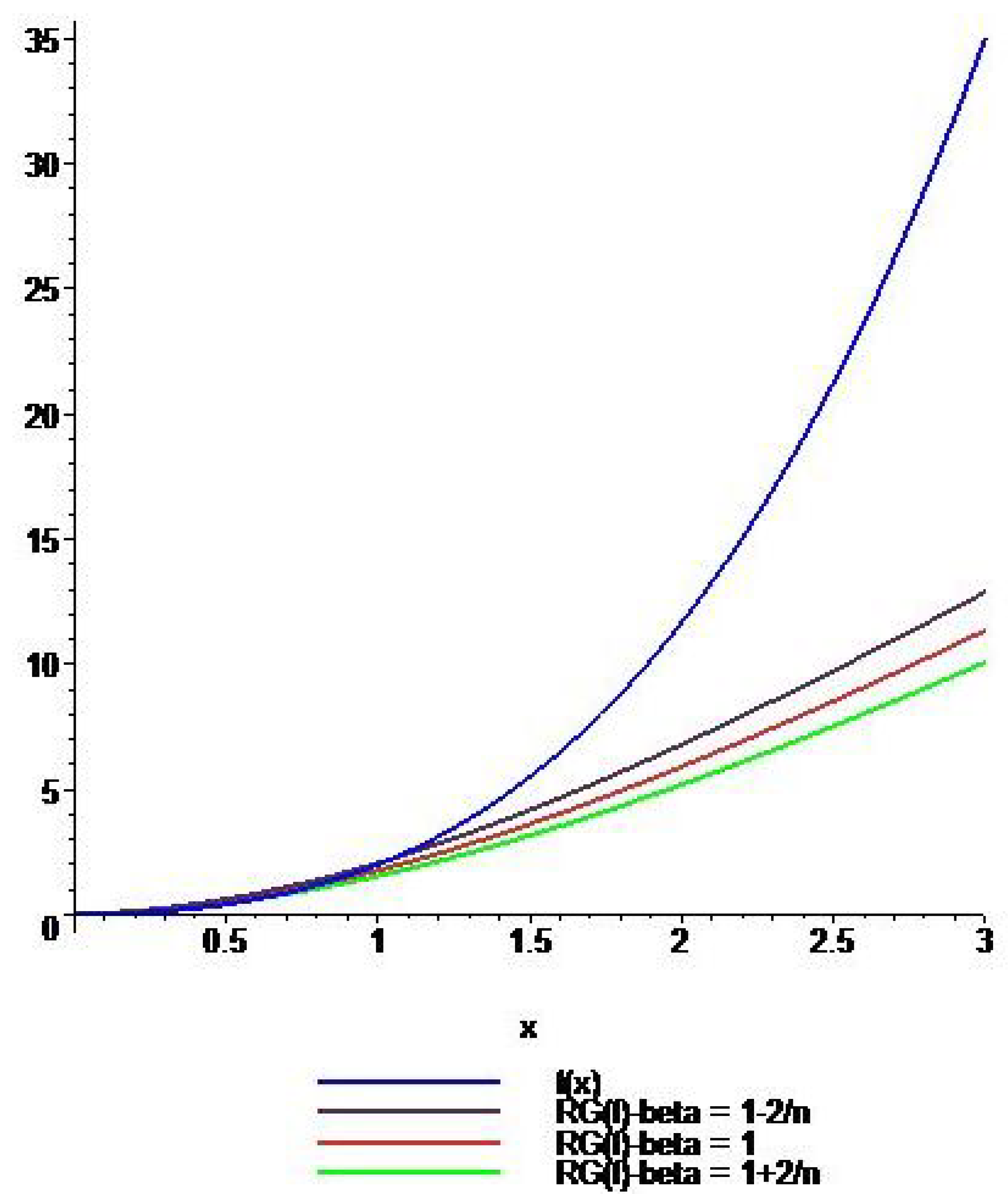
In Figure 3 and Figure 4, by choosing , is compared graphically with the classical Bernstein-type rational function given by (2) to f for on and It is obvious that approximation of to f is better than approximation by to f on and
Figure 3.
Comparison by and on , for , .
Figure 4.
Comparison of and on , for , .
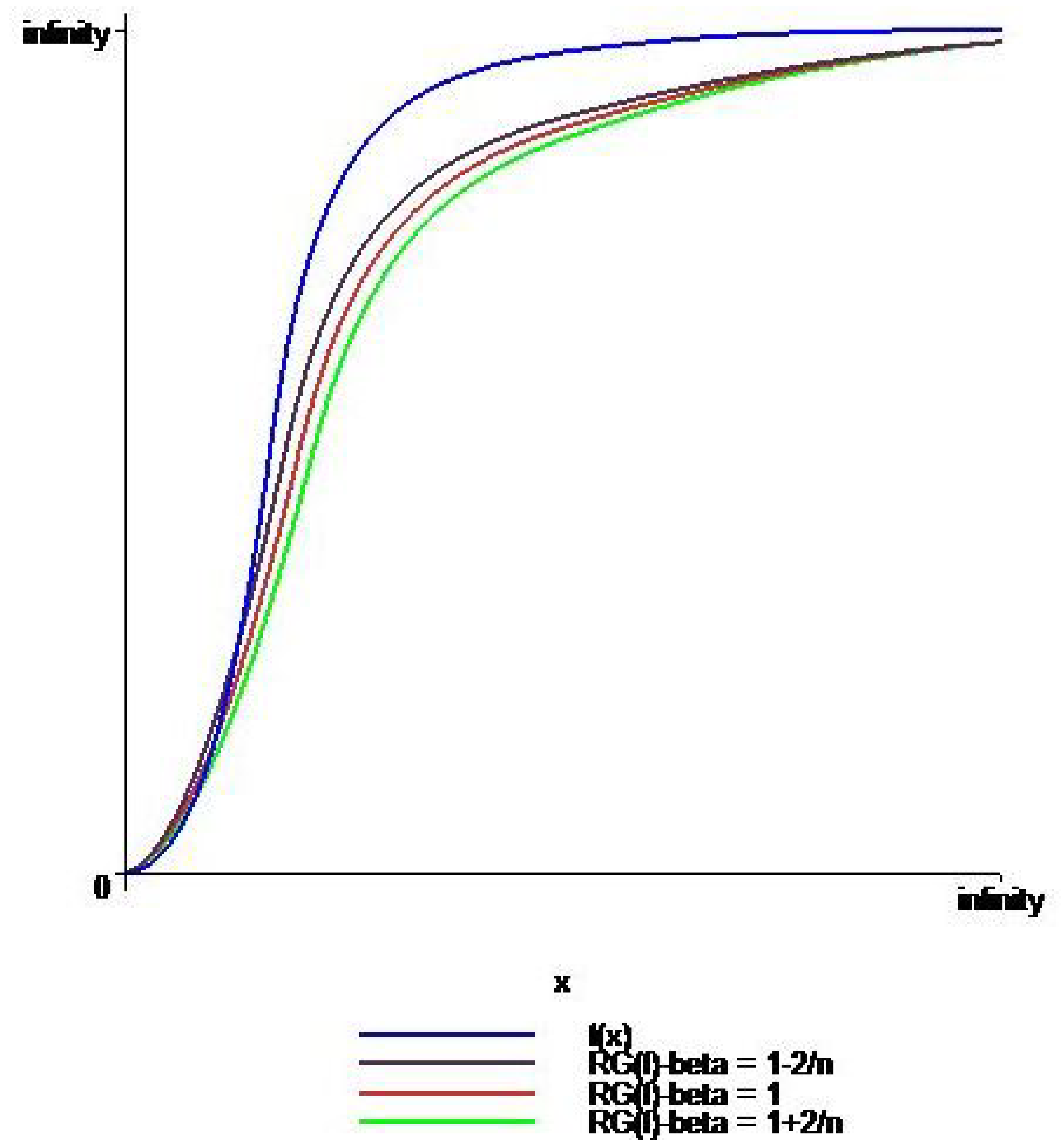
In Figure 5 and Figure 6, by denoting and choosing and and are graphically compared. Here, it is clear that is reduced to for If we choose as a real sequence such that , and is not constant, then we see that approximation by is better than and on and
Figure 5.
Approximation by on , for and , .
Figure 6.
Approximation by on , for and , .
5. Conclusions
In this study, we have introduced a newly defined Bernstein-type rational function , which is a generalized Bernstein-type rational function in terms of including the classical Bernstein-type rational function defined by (2) and Agratini’s modification, defined by (3). We have estimated the error of its approximation for conveniently chosen non-negative real sequences and . Consequently, the newly defined generalized Bernstein-type rational function possesses better results than the classical Bernstein-type rational function defined by (2) for certain functions.
Author Contributions
Conceptualization, E.Y.Ö.; methodology, E.Y.Ö. and G.A.; software, E.Y.Ö.; validation, E.Y.Ö. and G.A.; investigation, E.Y.Ö. and G.A.; resources, E.Y.Ö. and G.A.; data curation, E.Y.Ö.; writing—original draft preparation, E.Y.Ö. and G.A.; writing—review and editing, E.Y.Ö.; visualization, E.Y.Ö.; supervision, E.Y.Ö. All authors have read and agreed to the published version of the manuscript.
Funding
This research received no external funding.
Institutional Review Board Statement
Not applicable.
Informed Consent Statement
Not applicable.
Data Availability Statement
All the data for this article are included in the text.
Acknowledgments
The authors are grateful to all the referees who contributed to the best presentation of the paper with their valuable comments.
Conflicts of Interest
The authors declare no conflict of interest.
References
- Bernstein, S.N. Démonstration du théorème de Weierstrass fondée sur le calcul de probabilités. Commun. Soc. Math. Kharkow 2013, 13, 1–2. [Google Scholar]
- Balázs, K. Approximation by Bernstein type rational funstions. Acta Math. Acad. Sci. Hungar. 1975, 26, 123–134. [Google Scholar] [CrossRef]
- Balázs, K.; Szabados, J. Approximation by Bernstein type rational functions II. Acta Math. Acad. Sci. Hungar. 1982, 40, 331–337. [Google Scholar] [CrossRef]
- Balázs, K. Approximation by Bernstein type rational functions on the real axis. Acta Math. Hung. 1985, 46, 195–204. [Google Scholar] [CrossRef]
- Totik, V. Saturation for Bernstein type rational functions. Acta Math. Hung. 1984, 43, 219–250. [Google Scholar] [CrossRef]
- Abel, U.; Vecchia, B.D. Asymptotic approximation by the operators of K. Balázs and Szabados. Acta Sci. Math. 2000, 66, 137–145. [Google Scholar]
- Holhos, A. On the approximation by Balázs-Szabados operators. Mathematics 2021, 9, 1588. [Google Scholar] [CrossRef]
- İspir, N.; Atakut, Ç. Approximation by generalized Balázs type rational functions. Int. J. Comput. Numer. Anal. 2003, 4, 297–316. [Google Scholar]
- Agratini, O. On a class of Bernstein-type rational functions. Numer. Funct. Anal. Optim. 2020, 41, 483–494. [Google Scholar] [CrossRef]
- Gupta, V.; İspir, N. On Bézier variant of generalized Kantorovich type Balázs operators. Appl. Math. Lett. 2005, 18, 1053–1061. [Google Scholar] [CrossRef][Green Version]
- Gupta, V.; Lupaş, A. On the rate of approximation for the Bézier variant of Kantorovich-Balázs operators. Gen. Math. 2004, 1, 3–18. [Google Scholar] [CrossRef]
- Gupta, V.; Zeng, X.M. Rate of approximation fort he Bézier variant of Balázs Kantorovich operators. Math. Slovaca 2007, 57, 349–358. [Google Scholar] [CrossRef]
- Hamal, H.; Sabancıgil, P. Some approximation properties of new Kantorovich type q-analogue of Balázs-Szabados operators. J. Inequal. Appl. 2020, 2020, 159. [Google Scholar] [CrossRef]
- İspir, N.; Özkan, E.Y. Approximation properties of complex q-Balázs-Szabados operators in compact disks. J. Inequal. Appl. 2013, 2013, 361. [Google Scholar] [CrossRef]
- Özkan, E.Y.; İspir, N. Approximation by (p,q)-analogue of Balázs-Szabados operators. Filomat 2018, 32, 2257–2271. [Google Scholar] [CrossRef]
- Özkan, E.Y. Approximation properties of bivariate complex q-Balázs-Szabados operators of tensor product kind. J. Inequal. Appl. 2014, 2014, 20. [Google Scholar] [CrossRef][Green Version]
- Özkan, E.Y. Statistical approximation properties of q-Balázs-Szabados-Stancu operators. Filomat 2014, 28, 1943–1952. [Google Scholar] [CrossRef][Green Version]
- Özkan, E.Y. Approximation by complex bivariate Balázs-Szabados operators. Bull. Malays. Math. Sci. Soc. 2016, 39, 1–16. [Google Scholar] [CrossRef]
- Özkan, E.Y. Approximation properties of Kantorovich type q-Balázs-Szabados operators. Demonstr. Math. 2019, 52, 10–19. [Google Scholar] [CrossRef]
- Özkan, E.Y. Quantitative estimates for the tensor product (p,q)-Balázs-Szabados operators and associated Boolean sum operators. Filomat 2020, 34, 779–793. [Google Scholar] [CrossRef]
- Korovkin, P.P. On convergence of linear positive operators in the space of continuous functions. Dokl. Akad. Nauk. SSSR 1953, 90, 961–964. [Google Scholar]
- Devore, R.A.; Lorentz, G.G. Constructive Approximation: Polynomials and Splines Approximation; Springer: Berlin/Heidelberg, Germany, 1993. [Google Scholar]
- Butzer, P.L.; Berens, H. Semi-Groups of Operators and Approximation; Springer: New York, NY, USA, 1967. [Google Scholar]
Publisher’s Note: MDPI stays neutral with regard to jurisdictional claims in published maps and institutional affiliations. |
© 2022 by the authors. Licensee MDPI, Basel, Switzerland. This article is an open access article distributed under the terms and conditions of the Creative Commons Attribution (CC BY) license (https://creativecommons.org/licenses/by/4.0/).