Abstract
Let G be a connected, simple, and finite graph. For an ordered set and a vertex v of G, the representation of v with respect to W is the k-vector . The set W is called a resolving set of G, if every two vertices of G has a different representation. A resolving set containing a minimum number of vertices is called a basis of H. The number of elements in a basis of G is called the metric dimension of G and denoted by . In this paper, we considered a resolving set W of G where the induced subgraph of G by W does not contain an isolated vertex. Such a resolving set is called a non-isolated resolving set. A non-isolated resolving set of G with minimum cardinality is called an -set of G. The cardinality of an -set of G is called the non-isolated resolving number of G, denoted by . Let H be a graph. The corona product graph of G with H, denoted by , is a graph obtained by taking one copy of G and copies of H, namely , such that the i-th vertex of G is adjacent to every vertex of . If the degree of every vertex of H is k, then H is called a k-regular graph. In this paper, we determined where G is an arbitrary connected graph of order n at least two and H is a k-regular graph of order t with .
Keywords:
corona product graph; k-regular graph; metric dimension; non-isolated resolving number; non-isolated resolving set MSC:
05C12; 05C76
1. Introduction
Let G be a simple, finite, and connected graph with the vertex set and the edge set . For u and v in , the distance between two different vertices u and v is the length of the shortest u - v path in G, denoted by . Let be an ordered set of vertices of G. The representation of with respect to W is the k-vector . If every two vertices of G has a different representation, then the set W is called a resolving set of G. A resolving set containing a minimum number of vertices is called a basis of G. The number of elements in a basis of G is called the metric dimension of G and denoted by .
The metric dimension concept of a graph was first introduced by Slater [1] and Harary and Melter [2]. Since then, many results in the metric dimension have been obtained. Some of them can be seen in [3,4,5,6,7,8,9,10,11,12,13,14,15,16,17]. A resolving set is needed to manage robotic navigation [18], to identify chemical compounds [19], and to optimize the placement of threat detection sensors [20].
Practically, we need a threat detection sensor that also has the function to check whether its neighbor sensor is malfunctioning or not. Hence, we need an optimization of the placement of threat detection sensors such that the location of each sensor must not be isolated. In 2015, Chitra and Arumugan [21] introduced the concept of a non-isolated resolving set. Let W be a subset of . A resolving set W is called a non-isolated resolving set, if the induced subgraph of H by W has no isolated vertex. A non-isolated resolving set of H with minimum cardinality is called an nr-set of H. The cardinality of an -set of H is called the non-isolated resolving number of H, denoted by . Since a non-isolated resolving set is also a resolving set of a connected graph H of order n, we have:
Chitra and Arumugam [21] determined the non-isolated resolving number of some classes of graphs such as complete bipartite graphs, complete graphs, paths, and friendship graphs. The non-isolated resolving number of the graph depends on the structure of the graph. We can obtain a structure of a graph by using an operation between two graphs. Determining a relation, in terms of a non-isolated resolving number, between the original graph and the resulting graph under a graph operation is also interesting to be considered. Chitra and Arumugam also determined the non-isolated resolving number of the Cartesian product between a path and a path, a cycle, and a complete graph. In addition, they provided an upper bound for the non-isolated resolving number of the Cartesian product of a connected graph with a complete graph. In 2018, Hasibuan et al. [22] continued the investigation of the non-isolated resolving set of the Cartesian product of some graphs. They showed the non-isolated number of the Cartesian product between a path and some simple graphs, namely a complete graph, a cycle, a bipartite, and a friendship graph.
Now, we consider corona product graphs. Let G be a connected graph of order and H be a graph of order . The corona product graph is a graph obtained by taking one copy of G and copies of H, namely , such that the i-th vertex of G is adjacent to every vertex of . If the degree of every vertex of H is k, then H is said to be k-regular. Abidin et al. [23] studied the non-isolated resolving set of where H is a complete graph. Note that a simple and -regular graph is isomorphic to a complete graph of order t.
In this paper, we determined where G is any connected graph of order at least two and H is a k-regular graph of order t for or . From now on, we only consider finite and simple graphs. We also define .
2. Non-Isolated Resolving Set of Where Is a -Regular Graph
Let be a -regular graph of order t. A subset M of is called a matching in if no two of its elements are adjacent in . If M is a matching in with the property that every vertex of is incident with an edge of M, then M is called a perfect matching in [24]. If is a -regular graph of order , it is easy to check that t is an even positive integer and is isomorphic to a complete graph of order t minus a perfect matching in . In this section, we determine a non-isolated resolving number of the corona product of a connected graph with a -regular graph of order t.
Theorem 1.
Let n be a positive integer and t be an even integer at least two. If G is a connected graph of order n and is a -regular graph of order t, then:
Proof.
Let and for some positive integer m. By the definition of the corona product, for every , let be the vertex set of such that and j in with and . Therefore, we can say that and We distinguish two cases.
Case 1. :
First, we show that . We define for every . Let . Since , there is no isolated vertex in W. Let x and y be two different vertices in . Let and for some p and q in with . Since , we obtain . Therefore, .
Next, we show that . Suppose that is an -set of with . For every , let . Since , there exists such that . Since does not contain an isolated vertex, there are two different vertices and in satisfying . Therefore, we obtain a contradiction.
Case 2.:
We show that . For every , we define . Since an induced subgraph of by is isomorphic to a complete graph on order m, it is easy to see that there is no isolated vertex in . Let . Let x and y be any two different vertices in . We consider four subcases.
Subcase 2.1.x and y in for some :
Let and for some a and b in with . Since , we have . Therefore, .
Subcase 2.2. for some and :
Let for some and for some . If , then . This means that . If , then there exists such that . This means that . Therefore, .
Subcase 2.3. and for some p and q in with :
Let and for some a and b in . Since , we obtain . Therefore, .
Subcase 2.4.x and y in with :
Let and for some p and q in with . Since , we obtain . Therefore, .
Next, we show that . Suppose that is an -set of with . Then, there exists such that . There exist two different vertices and for some that are not in . Note that for every we obtain , and for every , we have . Therefore, we have . This is a contradiction. □
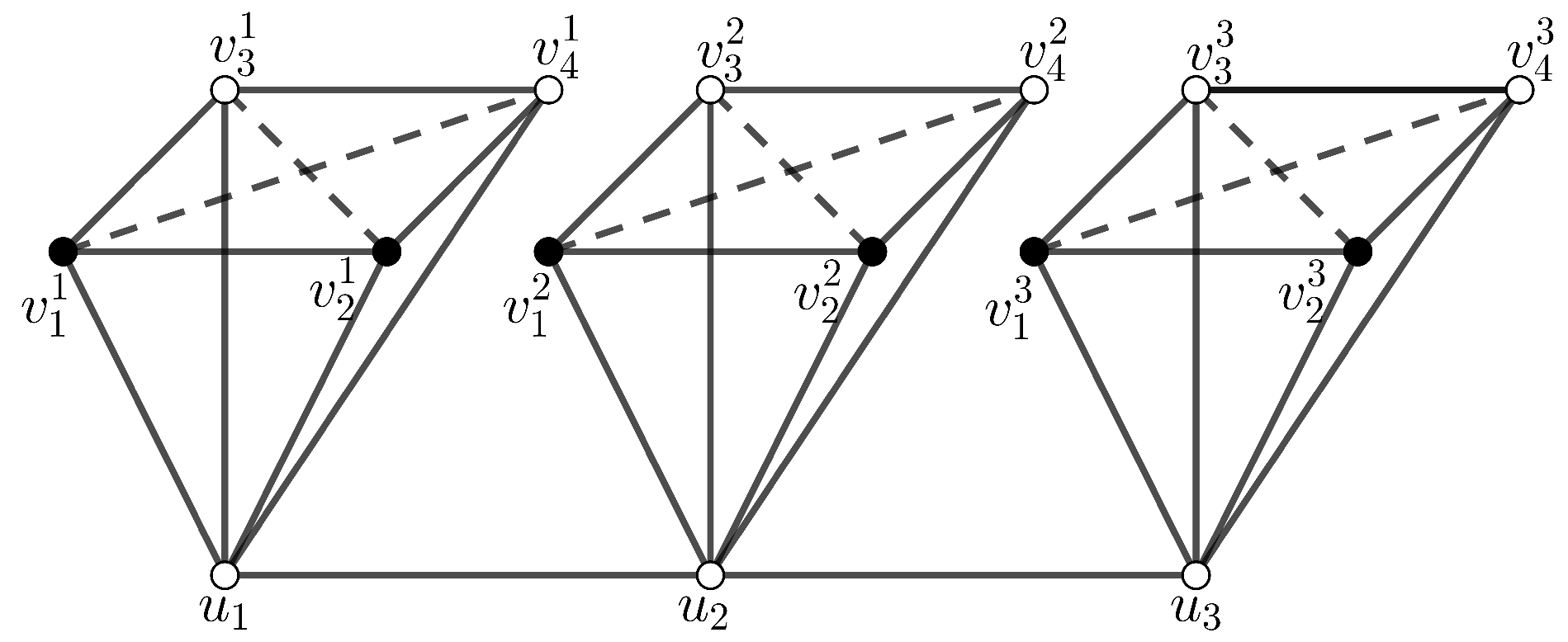
An illustration of Theorem 1 can be seen in Figure 1.
Figure 1.
with its -set }.
3. Non-Isolated Resolving Set of Where Is a -Regular Graph
In this section, we investigate where is a -regular graph for any . It is easy to check that is connected if and only if . Note that for a connected graph G, a graph is still connected for . In case , we show that only depends on the order of G, which can be seen in Section 3.3. In case , we prove that for most cases of , it depends on .
Now, assume . In Lemma 1, we show that is isomorphic to the join product of and for some , where with a complete graph of order and a cycle graph of order . We recall the join product of and , denoted by , which is a graph with the vertex set and the edge set . We also prove that for some cases , depends on for every .
Lemma 1.
For an integer , let be a -regular graph. Then, there exists such that , where for every with is an integer at least three and .
Proof.
Let be a -regular graph. Let and be a complete graph of order minus a Hamiltonian cycle. It is shown that by using the following algorithm.
Input: a -regular graph with t vertices:
- 1.
- Let ;
- 2.
- Let ;
- 3.
- Choose two non-adjacent vertices in , say and and say another unlabeled vertex that is not adjacent to as ;
- 4.
- Let ;
- 5.
- Let be a vertex that is not adjacent to ;
- 6.
- If , then , and define , then repeat Step 5. Otherwise, go to Step 7;
- 7.
- Let be an induced subgraph of by ;
- 8.
- Define ;
- 9.
- If , then define , and repeat Step 3. Otherwise, finish.
Let q be the last number i obtained from the above algorithm. We obtain . □
Let us consider a graph , where G is a connected graph of order n and is a -regular graph. For , for every x and y in and , we have , which implies any two vertices in are only resolved in . Therefore, it is necessary to determine for every . Note that is a -regular graph.
Let and such that for some . It is easy to check that is connected if and only if . If is only thejoin of some or , is still connected. This case of is investigated in Section 3.2. Now, we assume . Note that for every two vertices and , we obtain . Therefore, every two vertices x and y in is not resolved by u. Therefore, an -set of must contain some vertices in , which resolves .
Lemma 2.
Let be a -regular graph of order . Let W be an -set of . Let where for some :
- (i)
- If , then W is an -set of ;
- (ii)
- If , then .
Proof.
- (i)
- Since , we have . Hence, W is also an -set of ;
- (ii)
- Since is a -regular graph, by Lemma 1, there is such that where and . Let W be an -set of and for every . Next, it is proven by contradiction. Suppose there is such that . As a consequence, there are two vertices u and v in such that . Since every is adjacent to all vertices in , we have . We obtain a contradiction.
□
In order to determine , according to Lemma 2, we need to determine for some , which can be seen in Section 3.1. Note that is a complete graph of order m minus a Hamiltonian cycle. In Section 3.2, we provide the non-isolated resolving number of . Some results in Section 3.1 can be used to determine . All results in Section 3.1 and Section 3.2 were used to determine , which can be seen in Section 3.3.
3.1. Resolvability of a Complete Graph Minus a Hamiltonian Cycle
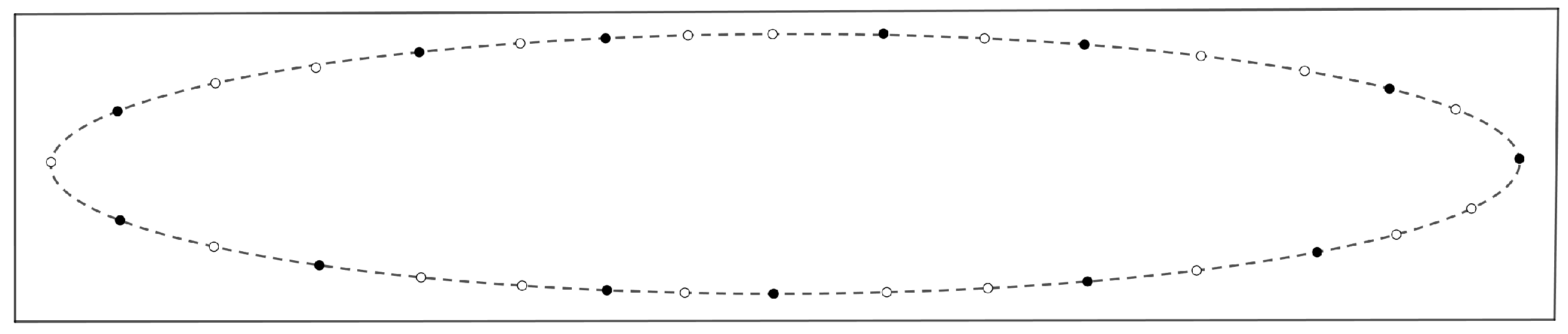
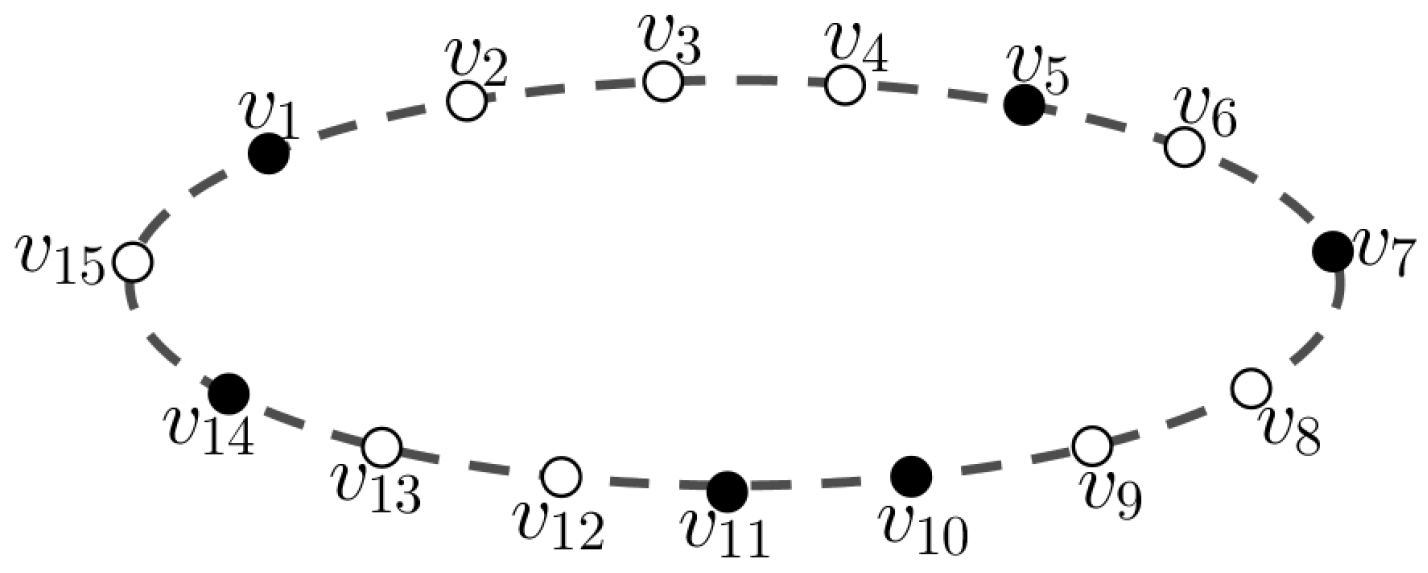
By Lemma 2, we need to determine a basis or an -set of . It is easy to check that is connected when . We use a gap between two vertices to determine a (non-isolated) resolving set of . Let Q be a subset of . Let u and v be two different vertices in Q. A gap of Q between u and v is defined as where is a path in , all inner vertices of which are not in Q. Note that every pair of vertices u and v in Q has at most two different gaps. The vertices u and v are called the end point of a gap of Q between u and v. If two different gaps of Q have a common end point, then those two gaps are called neighboring gaps. Therefore, if , then Q has r gaps, and some of the gaps may be empty. This technique was introduced in [25]. For illustration, let as described in Figure 2. We have some gaps, namely and .
Figure 2.
with its .
Lemma 3.
Let and . Then, W is a resolving set of if and only if W satisfies all the following properties:
- (i)
- Every gap of W contains at most three vertices;
- (ii)
- At most one gap of W contains three vertices;
- (iii)
- If a gap of W contains at least two vertices, then its neighboring gaps contain at most one vertex.
Proof.
Let such that and .
Let W be a resolving set of :
- (i)
- Suppose there is a gap of W containing four vertices for some . We obtain . We obtain a contradiction. Hence, every gap of W contains at most three vertices;
- (ii)
- Suppose there are two different gaps containing three vertices and for some k and l in with . We obtain . This is a contradiction. Therefore, the number of gaps of W containing three vertices is at most one;
- (iii)
- Suppose there are five vertices for some such that is the only vertex of W. Since and for every , we obtain . This is a contradiction. We conclude that if A is a gap of W containing at least two vertices, then the neighboring gaps of A contain at most one vertex.
Let W satisfy the three above properties. We show that W is a resolving set of . Let v be any vertex in . We divide the proof into three cases as follows:
- v belongs to a gap of size one of W:Let and be the end points of a gap containing v. Then, the vertex v has a distance of two to both and . Since , for every , we have or . This implies ;
- v belongs to a gap of size two of W:Let and be the end points of a gap containing v. Without loss of generality, let , then and . If there is with and and , then there is such that and . Therefore, for every , we obtain
- v belongs to a gap of size three of W:Let and be the end points of a gap containing v. Let , then . By Properties and of Lemma 3, no other vertex of has this representation. Now, let or . Without loss of generality, let , then and . If there is with , and , then there is such that and . Therefore, for every , we obtain .
We conclude that every vertex in has a distinct representation with respect to W. Therefore, W is a resolving set of . □
Now, we are ready to determine and where .
Theorem 2.
Let and . Then:
Proof.
First, we show that . Let W be a resolving set of . Based on Properties of Lemma 3, there is at most one gap of W that contains three vertices. Furthermore, at most gaps contain two vertices, and the rest of the gaps contain at most one vertex. Let us consider two cases below:
- for some :The number of vertices in all gaps of W is at most . Therefore, . This implies that ;
- for some :The number of vertices in all gaps of W is at most . Therefore, . This means that .
For an upper bound, let such that We show that . Let us consider five cases below:
- :Therefore, for some . Thus, . We define . Note that W contains vertices and satisfies Properties of Lemma 3;
- :Therefore, for some . Thus, . For , we define . For , we define . Note that W contains vertices and satisfies Properties of Lemma 3;
- :Therefore, for some . Thus, . We define . Note that W contains vertices and satisfies Properties of Lemma 3;
- :Therefore, for some . Thus, . For , we define . For , we define . Note that W contains vertices and satisfies Properties of Lemma 3;
- :Therefore, for some . Thus, . We define . Note that W contains vertices and satisfies Properties of Lemma 3.
Therefore, W with is a resolving set of . We obtain that . Next, it is easy to check that W does not contain an isolated vertex. Consequently, W is also a non-isolated resolving set. Hence, . By (1), we have . We conclude that . □
3.2. -Set of a -Regular Graph
Let be a -regular graph of order . By Lemma 1, a -regular graph is isomorphic to for some , where and for every . Let W be an -set of . By Lemma 2 (i), if , then W is an -set of . Note that an -set of for any was discussed in Section 3.1. If contains with , by Lemma 2 (ii), then . A basis of also was discussed in Section 3.1. Note that for , it is possible to have or in . However, with is a disconnected graph. In Lemma 4, we provide a property of an -set of that contains or .
Lemma 4.
Let be a -regular graph where . Let where for some . Then, contributes at least two vertices in an -set of .
Proof.
Suppose there exists an -set of that contains at most one vertex of . Note that for every and , there are two vertices x and y in such that and . Hence, . We have a contradiction. □
Let with for every . We assume that contains b subgraphs that are isomorphic to or . By Lemma 2 (ii) and Lemma 4, we have . Let and for every . We define gaps of S in as the union of gaps of and . In order to determine , we also need to consider some necessary conditions for the -set of , which can be seen in the following lemma.
Lemma 5.
Let be a -regular graph of order . Let W be a non-isolated resolving set of . Then, W satisfies the two conditions below:
- (i)
- Every gap of W contains at most three vertices;
- (ii)
- At most one gap of W contains three vertices.
Proof.
Let W be a non-isolated resolving set of . For every , let such that and :
- (i)
- Suppose there is a gap of W containing four vertices for some and . We obtain . We obtain a contradiction. Hence, every gap of W contains at most three vertices;
- (ii)
- By considering Lemma 4, suppose there are two different gaps containing three vertices in of and in of for some and with . We obtain . We have a contradiction. Hence, the number of gaps of W containing three vertices is at most one.
□
In order to determine an -set of , by Lemma 5, we need to investigate the gap property for a basis of , which can be seen in the lemma below.
Lemma 6.
Let be a -regular graph of order . Let such that for some , then every basis of has a gap containing at least three vertices if and only if or .
Proof.
Let such that .
Suppose or . We distinguish three cases as follows:
Case 1.:
Let for some integer l at least two. Thus, . We define .
Case 2.:
Let for some . Thus, . We define .
Case 3.:
Let for some . Thus, . We define .
From all cases above, we have that every gap of W contains at most two vertices. By Lemma 3 and Theorem 2, we conclude that W is a basis of .
Suppose that every gap of the basis of contains at most two vertices. We have two cases:
Case 1.:
Let for some . By using Theorem 2, we obtain . By Properties of Lemma 3, there are gaps that contain one vertex and at most gaps that contain two vertices. By Theorem 2, we obtain , a contradiction with .
Case 2.:
Let for some . By using Theorem 2, we obtain . By Properties of Lemma 3, there are gaps that contain one vertex and at most gaps that contain two vertices. By Theorem 2, we obtain , a contradiction with . □
The lemma below is useful to determine the non-isolated number of .
Lemma 7.
Let be a -regular graph of order . Let such that for some . There is an -set W of such that for every , .
Proof.
Let such that . Let . Let be an -set of . We define . We distinguish two cases as follows:
- For , we have and ;
- For , we have , and .
Therefore, for all , we obtain . □
In the next theorem, we provide the non-isolated resolving number of a -regular graph where .
Theorem 3.
Let be a -regular graph of order . Let such that , where and , for every . Let b be the number of and . Let d be the number of with or and . Then,
Proof.
We divide the proof into four cases.
Case 1.:
According to Lemma 1, we obtain . Therefore, .
Case 2.:
By Lemma 4, we only need to show that . For every , let such that . We define of . Let . Note that and W does not contain an isolated vertex. For , we have . For , we have . Since is adjacent to with , we have . Therefore, .
Case 3., and :
Let W be a non-isolated resolving set of . Let for every . By Lemma 4, we obtain for every . Since , we have for every . By Lemma 2 (ii) and Theorem 2, we obtain . Therefore, we obtain .
Next, for every , let such that . We construct a non-isolated resolving set of with elements. For every , let . For every , choose a basis of such that if or , then every gap of contains at most two vertices. We define .
We show that W is a non-isolated resolving set of . Note that W does not contain an isolated vertex. For , we have . For , we have . For every , since is a basis of , every two different vertices x and y of satisfies . Thus, for , every pair of distinct vertices x and y in satisfies .
Now, for distinct integers r and s in , let us consider and . If , or or with , then there exists a vertex in that is not adjacent to x, which implies . If or with , then there exists a vertex in that is not adjacent to z, which implies . Therefore, we have . We conclude that W is a non-isolated resolving set of . Since and by considering Theorem 2, we obtain that .
Case 4., and :
Let W be a non-isolated resolving set of . Let for every . By Lemma 4, we obtain for every . Since , we have for every . By Lemma 2 (ii) and Theorem 2, we obtain . Since there are gaps containing three vertices, by Lemma 5 (ii), we have .
Next, for every , let such that . We construct a non-isolated resolving set of with elements. For every , let . For every , choose a basis of such that if or , then every gap of contains at most two vertices. For , if or , then by Lemma 3.7, has a gap containing three vertices. For those , without loss of generality, let be a gap of with three vertices. Let or . Note that . Let or , we define . We define .
We show that W is a non-isolated resolving set of . Note that W does not contain an isolated vertex. For , we have . For , we have . For every with , since is a basis of , every two different vertices x and y of satisfies . Thus, for , for two distinct vertices x and y in , we obtain .
Now, for distinct integers r and s in , let us consider and . If , or or with , then there exists a vertex in that is not adjacent to x. Hence, . If or with , then there exists a vertex in that is not adjacent to z, which implies . If , or with and , or with , without loss of generality, and assuming , then there exists a vertex in that is not adjacent to z, which implies . Therefore, we have . We conclude that W is a non-isolated resolving set of . Since and by considering Theorem 2, we obtain that . □
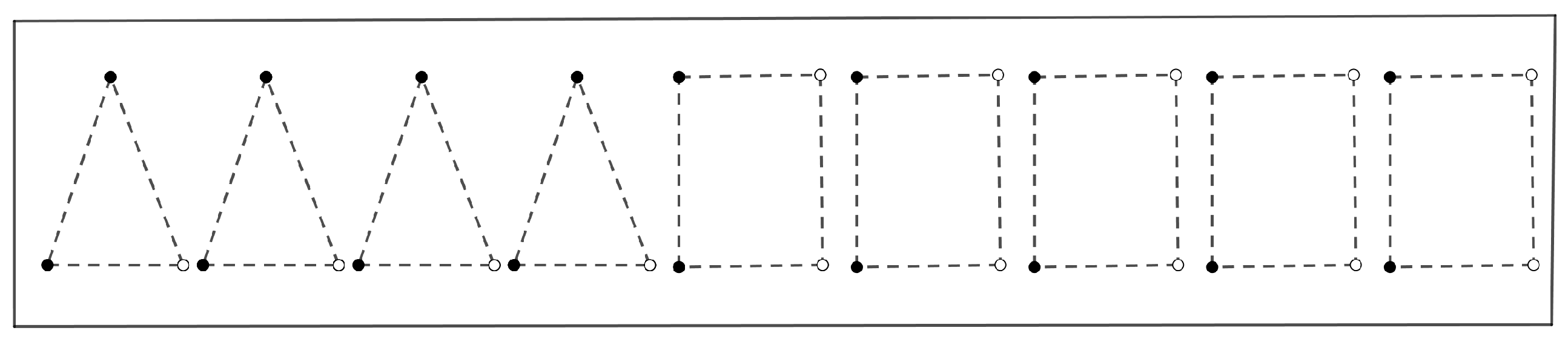
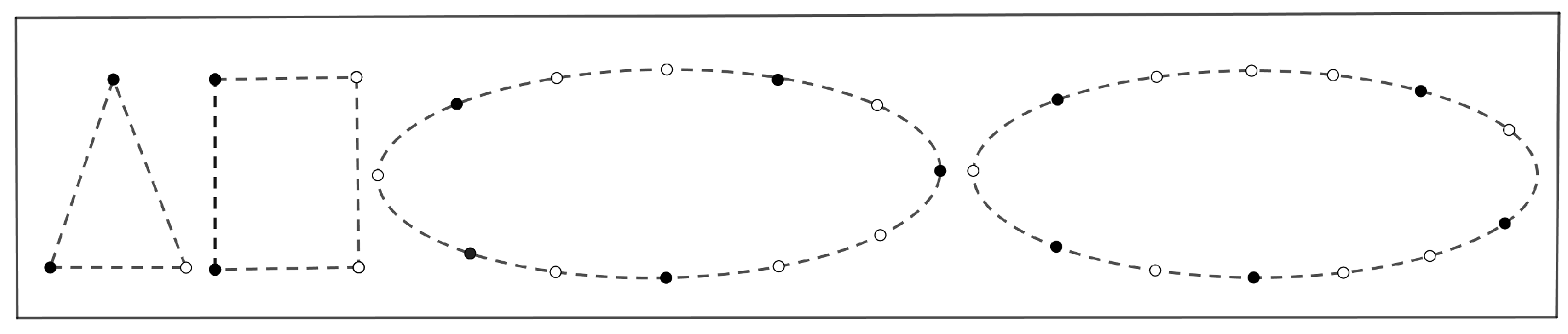
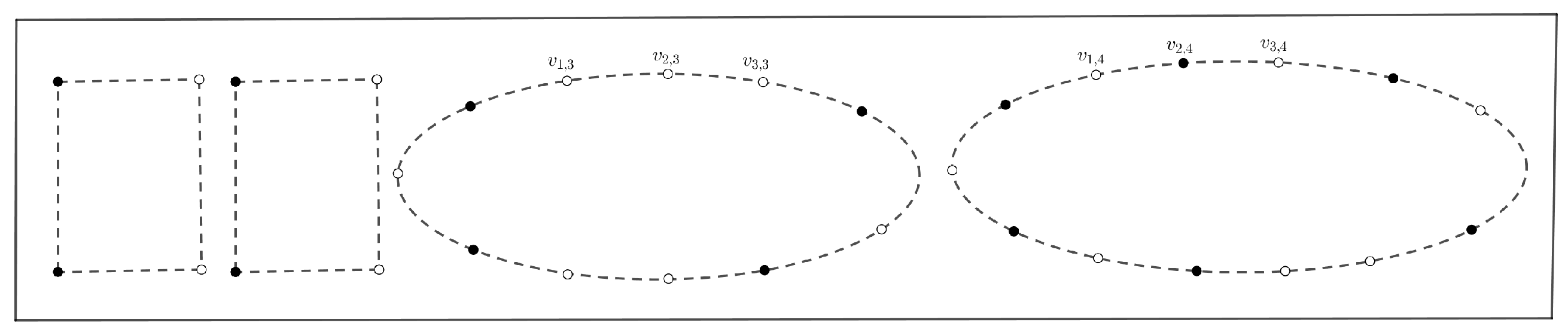
Some illustrations of Theorem 3 can be seen in some figures of below. An illustration of Theorem 3 of Case 1, Case 2, and Case 3 can be seen in Figure 3, Figure 4 and Figure 5, respectively. In those figures, we have as , and , respectively. The black vertices represent the elements of a chosen -set. For Case 4, with its -set in Figure 6. For every , let be an -set of . There is one gap of containing three vertices, which are , and there is one gap of containing three vertices, which are . Note that vertices and have the same representation. Hence, we should add vertex to an -set of .
Figure 3.
with its -set.
Figure 4.
with its -set.
Figure 5.
with its -set.
Figure 6.
with its -set.
3.3. -Set of Where Is a -Regular Graph
Let be a -regular graph of order . Note that is isomorphic to a complete graph minus the edge set of some disjoint cycles.
Theorem 4.
Let G be a connected graph of order and be a -regular graph of order . Then,
Proof.
Let . For every , we define as a copy of in where all of its vertices are adjacent to . Let . We divide a proof into three cases.
Case 1.:
First, we show that . For every , we define . Let . Note that . Since and in , W does not contain an isolated vertex. Next, we show that W is a resolving set of . Let x and y be two distinct vertices in . Let and for some p and q in with . Since , this implies that .
Now, we show that . Suppose that . Let be an -set of and for every . Then, there exists such that . We have two subcases:
- If , then there exist two vertices x and y in such that . This implies that , a contradiction;
- If , then contains an isolated vertex, a contradiction.
Case 2.:
Without loss of generality, let . First, we show that . For every , we define . Let . Note that . Since , W does not contain an isolated vertex. Next, we show that W is a resolving set of . Let x and y be two distinct vertices in . We have two subcases:
- x and y in for some :Let and . Since , we obtain ;
- and for some j and k in with :Let and for some a and b in . Since , we obtain .
Now, we show that . Suppose that . Let be an -set of and for every . Then, there exists such that . We have two subcases:
- If , then there exist two vertices x and y in such that . This implies that , a contradiction;
- For , if contains an isolated vertex, then we have a contradiction. Otherwise, then there exist two vertices x and y in such that for every . This implies that , a contradiction.
Case 3.:
We prove that . For every , let be an -set of . We define . Note that there is no isolated vertex in W. Next, we show that every two distinct vertices in has a distinct representation with respect to W. Let x and y be different vertices in . We divide this into four subcases:
- x and y in for some :Since is an -set of , we have . This means that ;
- and for some :If , then for some with and for any , we have . If , then for any , we have . Therefore, , and this means that ;
- and for some j and k in with :For any , we have but . Therefore, , so that ;
- x and y in :Let and for some j and k in with . For any , we have . Therefore . This means that .
Next, we show that . Suppose that . Let be an -set of . For every , let . Then, there exists such that . Hence, there exist two vertices x and y in such that for every . Since for every , we have . Therefore, . This is a contradiction. □
4. Conclusions
In this paper, we studied the non-isolated resolving number of the corona product where G is an arbitrary connected graph of order n at least two and H is a k-regular graph of order t with . We obtained that the non-isolated resolving number of is a function of . We made the hypothesis that for any k-regular graph H is also a function of .
Author Contributions
Conceptualization, W.A., A.S. and S.W.S.; methodology, W.A., A.S. and S.W.S.; writing—original draft, W.A.; writing—review and editing, W.A., A.S. and S.W.S.; supervision, A.S. and S.W.S. All authors have read and agreed to the published version of the manuscript.
Funding
The Ministry of Education, Culture, Research and Technology of Indonesia.
Data Availability Statement
Not applicable.
Conflicts of Interest
The authors declare no conflict of interest.
References
- Slater, P.J. Leaves of trees. Congr. Numer. 1975, 14, 549–559. [Google Scholar]
- Harary, F.; Melter, R.A. On the metric dimension of a graph. Ars Comb. 1976, 2, 191–195. [Google Scholar]
- Iswadi, H.; Baskoro, E.T.; Salman, A.N.M.; Simanjuntak, R. The metric dimension of graph with pendant edges. J. Comb. Math. Comb. Comput. 2008, 65, 139–145. [Google Scholar]
- Iswadi, H.; Baskoro, E.T.; Salman, A.N.M.; Simanjuntak, R. The resolving graph of amalgamation of cycles. Util. Math. 2010, 83, 121–132. [Google Scholar]
- Iswadi, H.; Baskoro, E.T.; Simanjuntak, R.; Salman, A.N.M. On the metric dimension of corona product of graphs. Far East J. Math. Sci. (FJMS) 2011, 52, 155–170. [Google Scholar]
- Saputro, S.W.; Baskoro, E.T.; Salman, A.N.M.; Suprijanto, D. The metric dimensions of a complete n-partite graph and its Cartesian product with a path. J. Comb. Math. Comb. Comput. 2009, 71, 283–293. [Google Scholar]
- Saputro, S.W.; Simanjuntak, R.; Uttunggadewa, S.; Assiyatun, H.; Baskoro, E.T. The metric dimension of the lexicographic product of graphs. Discret. Math. 2013, 313, 1045–1051. [Google Scholar] [CrossRef]
- Saputro, S.W.; Mardiana, N.; Purwasih, I.A. The metric dimension of comb product graphs. Matematički Vesn. 2017, 69, 248–258. [Google Scholar]
- Wang, J.; Mion, L.; Liu, Y. Characterization of n-vertex graphs of metric dimension n − 3 by metric matrix. Mathematics 2019, 7, 479. [Google Scholar] [CrossRef]
- Buczkowski, P.; Chartrand, G.; Poisson, C.; Zhang, P. On k-dimensional graphs and their bases. Period. Math. Hung. 2003, 46, 9–15. [Google Scholar] [CrossRef]
- Cáceres, J.; Hernando, C.; Mora, M.; Pelayo, I.M.; Puertas, M.L.; Seara, C.; Wood, D.R. On the metric dimension of Cartesian products of graphs. SIAM J. Discret. Math. 2007, 21, 423–441. [Google Scholar] [CrossRef]
- Hernando, C.; Mora, M.; Pelayo, I.M.; Seara, C.; Cáceres, J.; Puertas, M.L. On the metric dimension of some families of graphs. Electron. Discret. Math. 2005, 22, 129–133. [Google Scholar] [CrossRef]
- Chartrand, G.; Poisson, C.; Zhang, P. Resolvability and the upper dimension of graphs. Comput. Math. Appl. 2000, 39, 19–28. [Google Scholar] [CrossRef]
- Estrada-Moreno, A. The k-metric dimension of a unicyclic graph. Mathematics 2021, 9, 2789. [Google Scholar] [CrossRef]
- González Yero, I. The Simultaneous strong resolving graph and the simultaneous strong metric dimension of graph families. Mathematics 2020, 8, 125. [Google Scholar] [CrossRef]
- Hernando, C.; Mora, M.; Pelayo, I.M.; Seara, C.; Wood, D.R. Extremal graph theory for metric dimension and diameter. Electron. J. Comb. 2010, 17, 1–26. [Google Scholar] [CrossRef]
- Javaid, I.; Rahim, M.T.; Ali, K. Families of regular graphs with constant metric dimension. Util. Math. 2008, 75, 21–33. [Google Scholar]
- Khuller, S.; Raghavachari, B.; Rosenfeld, A. Landmarks in graphs. Discret. Appl. Math. 1996, 70, 217–229. [Google Scholar] [CrossRef]
- Chartrand, G.; Eroh, L.; Johnson, M.A.; Oellermann, O.R. Resolvability in graphs and the metric dimension of a graph. Discret. Appl. Math. 2000, 105, 99–113. [Google Scholar] [CrossRef]
- Chartrand, G.; Zhang, P. The theory and applications of resolvability in graphs: A survey. Congr. Numer. 2003, 160, 47–68. [Google Scholar]
- Chitra, P.J.B.; Arumugam, S. Resolving sets without isolated vertices. Procedia Comput. Sci. 2015, 74, 38–42. [Google Scholar] [CrossRef][Green Version]
- Hasibuan, I.M.; Salman, A.N.M.; Saputro, S.W. Non-isolated resolving sets of certain graphs Cartesian product with a path. J. Phys. Conf. Ser. 2018, 1008, 012045. [Google Scholar] [CrossRef]
- Abidin, W.; Salman, A.N.M.; Saputro, S.W. The non-isolated resolving number of some corona graphs. J. Phys. Conf. Ser. 2018, 1097, 012073. [Google Scholar] [CrossRef]
- Chartrand, G.; Lesniak, L.; Zhang, P. Graphs & Digraphs; Chapman and Hall/CRC: London, UK, 2010; pp. 401–402. [Google Scholar]
- Saputro, S.W. On local metric dimension of (n − 3)-regular graph. J. Comb. Math. Comb. Comput. 2016, 98, 43–54. [Google Scholar]
Publisher’s Note: MDPI stays neutral with regard to jurisdictional claims in published maps and institutional affiliations. |
© 2022 by the authors. Licensee MDPI, Basel, Switzerland. This article is an open access article distributed under the terms and conditions of the Creative Commons Attribution (CC BY) license (https://creativecommons.org/licenses/by/4.0/).