


Sobolev-Slobodeckij Spaces on Compact Manifolds, Revisited

Abstract
1. Introduction
- Density of smooth functions
- Completeness, separability, reflexivity
- Embedding properties
- Behavior under differentiation
- Being closed under multiplication by smooth functions:
- Invariance under change of coordinates:
- Invariance under composition by a smooth function:
- Are the different characterizations that exist in the literature equivalent? If not, what is the relationship between the various characterizations of Sobolev-Slobodeckij spaces on M?
- In particular, does the corresponding space depend on the chosen atlas (more precisely the chosen augmented total trivialization atlas) used in the definition?
- Suppose . Does this imply that the local representation of f with respect to each chart is in ? If g is a metric on M and , can we conclude that ?
- Suppose that is a linear differential operator. Is it possible to gain information about the mapping properties of P by studying the mapping properties of its local representations with respect to charts in a given atlas? For example, suppose that the local representations of P with respect to each chart in an atlas is continuous from to . Is it possible to extend P to a continuous linear map from to ?
- (1)
- (2)
- is an arbitrary open subset of
- (3)
- is an open subset of with smooth boundary
- Fact 1:is a well-defined bounded linear operator.
- Fact 2: If we further assume that and has smooth boundary thenis a well-defined bounded linear operator.
- Fact 3: If , then
- Fact 4: If does NOT have Lipschitz boundary, then it is NOT necessarily true thatfor .
- Is it possible to find an atlas such that the image of each coordinate domain in the atlas (and the image of the intersection of any two coordinate domains in the atlas) under the corresponding coordinate map is either the entire or a nonempty bounded set with smooth boundary? Furthermore, if we define the Sobolev spaces using such an atlas, will the results be independent of the chosen atlas?
2. Notation and Conventions
- ;
- .
3. Review of Some Results from Linear Algebra
- Let V and W be two vector spaces. The collection of all linear maps from V to W is a new vector space which we denote by . In particular, is the (algebraic) dual of V. If V and W are finite-dimensional, then is a vector space whose dimension is equal to the product of dimensions of V and W. Indeed, if we choose a basis for V and a basis for W, then is isomorphic with the space of matrices with rows and columns.
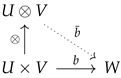
- Let U and V be two vector spaces. Roughly speaking, the tensor product of U and V (denoted by ) is the unique vector space (up to isomorphism of vector spaces) such that for any vector space W, is isomorphic to the collection of bilinear maps from to W. Informally, consists of finite linear combinations of symbols , where and . It is assumed that these symbols satisfy the following identities:for all , and . These identities simply say that the mapis a bilinear map. The image of this map spans .Definition 1.For us, the most useful property of the tensor product of finite dimensional vector spaces is the following property:Let U and V be two vector spaces. Tensor product is a vector space together with a bilinear map such that given any vector space W and any bilinear map , there is a unique linear map with . That is, the following diagram commutes:
 Indeed, the following map is an isomorphism of vector spaces:It is useful to obtain an expression for the inverse of F too. That is, given , we want to find an expression for the corresponding element of . To this end, let be a basis for V and denote the corresponding dual basis. Let be a basis for W. Then is a basis for . Suppose is the element of that corresponds to T. We haveIn particular, for all ,That is, is the entry in the ath row and ith column of the matrix of the linear transformation T.
 - Let V be an n-dimensional vector space. A density on V is a function with the property thatfor all .We denote the collection of all densities on V by . It can be shown that is a one dimensional vector space under the obvious vector space operations. Indeed, if is a basis for V, then each element is uniquely determined by its value at because for any , we have where is the linear transformation defined by for all . Thuswill be an isomorphism of vector spaces.Moreover, if where is the collection of all alternating covariant n-tensors, then belongs to . Thus, if is any nonzero element of , then will be a basis for ([19], p. 428).
4. Review of Some Results from Analysis and Topology
4.1. Euclidean Space
- (1)
- Each is an open bounded set and ;
- (2)
- The cover is locally finite in Ω, that is, each compact subset of Ω has nonempty intersection with only a finite number of the ’s;
- (3)
- There is a family of functions taking values in such that and
4.2. Normed Spaces
- is dense in ;
- If is a continuous bilinear map, then T has a unique extension to a continuous bilinear operator .
- (1)
- If X is reflexive, then X is a Banach space.
- (2)
- X is reflexive if and only if is reflexive.
- (3)
- If is separable, then X is separable.
- (4)
- If X is reflexive and separable, then so is .
- (5)
- If X is a reflexive Banach space, then so is M.
- (6)
- If X is a separable Banach space, then so is M.
4.3. Topological Vector Spaces
- (i)
- For all , the singleton is a closed set.
- (ii)
- The mapsare continuous where and are equipped with the product topology.
- Y is said to be convex if for all and it is true that .
- Y is said to be balanced if for all and it holds that . In particular, any balanced set contains the origin.
- We say Y is bounded if for any neighborhood U of the origin (i.e., any open set containing the origin), there exits such that .
- Every topological vector space is Hausdorff.
- If is a topological vector space, then
- (1)
- For all : (that is, τ is translation invariant);
- (2)
- For all : (that is, τ is scale invariant);
- (3)
- If is convex and , then so is ;
- (4)
- If is a family of convex subsets of X, then is convex.
- A collection is said to be a basis for τ, if every element of τ is a union of elements in .
- Let . If is such that each element of γ contains p and every neighborhood of p (i.e., every open set containing p) contains at least one element of γ, then we say γ is a local base at p . If X is a vector space, then the local base γ is said to be convex if each element of γ is a convex set.
- is called first-countable if each point has a countable local base.
- is called second-countable if there is a countable basis for τ.
- X is metrizable there exists a metric d on X such that for all , is a local base at x.
- A metric d on X is compatible with τ for all , is a local base at x. ( is the open ball of radius centered at x).
- (1)
- For all , is a local base at x.
- (2)
- There exists such that is a local base at .
- We say that converges to a point provided that
- We say that is a Cauchy sequence provided that
- (1)
- ;
- (2)
- ;
- (3)
- ;
- (4)
- .
- (1)
- is a Cauchy sequence in the topological vector space .
- (2)
- is a Cauchy sequence in the metric space .
- (1)
- is a locally convex topological vector space.
- (2)
- There exists with a convex local base at p.
- (3)
- For every there exists a convex local base at p.
- (i)
- (ii)
- (1)
- τ is translation invariant (that is, if and , then ).
- (2)
- γ is a local base at the origin for τ.
- (i)
- is a locally convex topological vector space,
- (ii)
- every is a continuous function from X to .
- (1)
- τ is the smallest topology on X that is translation invariant and with respect to which every is continuous,
- (2)
- τ is the smallest topology on X with respect to which addition is continuous and every is continuous.
- (1)
- A sequence converges to x in X if and only if for all , .
- (2)
- A linear operator is continuous if and only if
- (3)
- A linear operator is continuous if and only if
- (1)
- T is continuous.
- (2)
- in X⟹ in Y.
- The weak topology on is the natural topology induced by the separating family of seminorms whereA sequence converges to f in with respect to the weak topology if and only if in for all .
- The strong topology on is the natural topology induced by the separating family of seminorms where for any bounded subset B of X(It can be shown that for any bounded subset B of X and , is a bounded subset of .)
- (1)
- If X is a normed space, then the topology induced by the normon is the same as the strong topology on ([25], p. 198).
- (2)
- In this manuscript, we always consider the topological dual of a locally convex topological vector space with the strong topology. Of course, it is worth mentioning that for many of the spaces that we will consider (including or where Ω is an open subset of ) a sequence in converges with respect to the weak topology if and only if it converges with respect to the strong topology (for more details on this see the definition and properties of Montel spaces in Section 34.4, page 356 of [25]).
- (1)
- The mapis well-defined, linear, and continuous. ( is called the adjoint of T).
- (2)
- If is dense in Y, then is injective.
- (1)
- Suppose Y is a normed space and H is a dense subspace of Y. Clearly, the identity map is continuous with dense image. Therefore, () is continuous and injective. Furthermore, by the Hahn–Banach theorem for all there exists such that and . So the above map is indeed bijective and and are isometrically isomorphic. As an important example, let be a nonempty open set in , , and . Consider the space (see Section 7 for the definition of ). is a dense subspace of . Therefore, is isometrically isomorphic to . In particular, if , then
- (2)
- Suppose is a normed space, is a locally convex topological vector space, , and the identity map is continuous with dense image. So () is continuous and injective and can be used to identify with a subspace of .
- Question: Exactly what elements of are in the image of ? That is, which elements of “belong to” ?
- Answer: belongs to the image of if and only if is continuous, that is, belongs to the image of if and only if .
So, an element can be considered as an element of if and only ifFurthermore, if we denote the unique corresponding element in by (normally we identify and and we use the same notation for both) then since X is dense in YRemark 11.To sum up, given an element in order to show that φ can be considered as an element of we just need to show that and in that case, norm of φ as an element of is . However, it is important to notice that if is a linear map, X is a dense subspace of Y, and is bounded, that does NOT imply that . It just shows that there exists such that .
- For each , is equipped with a topology that makes it a locally convex topological vector space, and
- .
- (1)
- X is a locally convex topological vector space;
- (2)
- All the inclusions are continuous.
- (1)
- The product topology;
- (2)
- The inductive limit topology with respect to the family (For each j, is equipped with the product topology).
5. Review of Some Results from Differential Geometry
5.1. Smooth Manifolds
- (1)
- Each point of M has a neighborhood that is homeomorphic to an open subset of .
- (2)
- Each point of M has a neighborhood that is homeomorphic to an open ball in .
- (3)
- Each point of M has a neighborhood that is homeomorphic to .
- Sometimes we use the shorthand notation to indicate that M is n-dimensional.
- Clearly, if is a chart in a maximal smooth atlas and V is an open subset of U, then where is also a smooth chart (i.e., it belongs to the same maximal atlas).
- Every smooth atlas for M is contained in a unique maximal smooth atlas, called the smooth structure determined by .
- If M is a compact smooth manifold, then there exists a smooth atlas with finitely many elements that determines the smooth structure of M (this is immediate from the definition of compactness).
- We say that a smooth atlas for a smooth manifold M is a geometrically Lipschitz (GL) smooth atlas if the image of each coordinate domain in the atlas under the corresponding coordinate map is a nonempty bounded open set with Lipschitz boundary.
- We say that a smooth atlas for a smooth manifold is a generalized geometrically Lipschitz (GGL) smooth atlas if the image of each coordinate domain in the atlas under the corresponding coordinate map is the entire or a nonempty bounded open set with Lipschitz boundary.
- We say that a smooth atlas for a smooth manifold is a nice smooth atlas if the image of each coordinate domain in the atlas under the corresponding coordinate map is a ball in .
- We say that a smooth atlas for a smooth manifold is a super nice smooth atlas if the image of each coordinate domain in the atlas under the corresponding coordinate map is the entire .
- We say that two smooth atlases and for a smooth manifold are geometrically Lipschitz compatible (GLC) smooth atlases provided that each atlas is GGL and moreover for all and with , and are nonempty bounded open sets with Lipschitz boundary or the entire .
- (i)
- The collection of supports, is locally finite in the sense that every point in M has a neighborhood that intersects only finitely many of the sets in .
- (ii)
- .
- (i)
- There is a partition of unity with every having compact support such that for each k, for some .
- (ii)
- If we do not require compact support, then there is a partition of unity subordinate to .
- ◦
- For all , is another partition of unity subordinate to .
- ◦
- If is an open cover of M and is a partition of unity subordinate to , then is a partition of unity subordinate to the open cover .
5.2. Vector Bundles, Basic Definitions
- (1)
- For each , is an r-dimensional (real) vector space;
- (2)
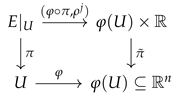
- For each , there exists a neighborhood U of x in M and a smooth map from onto such that
- For every , is an isomorphism of vector spaces,
- is a diffeomorphism.
- We say that a total trivialization triple is geometrically Lipschitz (GL) provided that is a nonempty bounded open set with Lipschitz boundary. A total trivialization atlas is called geometrically Lipschitz if each of its total trivialization triples is GL.
- We say that a total trivialization triple is nice provided that is equal to a ball in . A total trivialization atlas is called nice if each of its total trivialization triples is nice.
- We say that a total trivialization triple is super nice provided that is equal to . A total trivialization atlas is called super nice if each of its total trivialization triples is super nice.
- A total trivialization atlas is called generalized geometrically Lipschitz (GGL) if each of its total trivialization triples is GL or super nice.
- We say that two total trivialization atlases and are geometrically Lipschitz compatible (GLC) if the corresponding atlases and are GLC.
- For all , is bounded with Lipschitz continuous boundary;
- For all , is either empty or else and are bounded with Lipschitz continuous boundary.
- ;
- where denotes the components of the metric with respect to the normal coordinate chart ;
- where is the coordinate basis induced by .
- (1)
- Smooth local sections over U form a module over the ring ;
- (2)
- The function from U to is smooth;
- (3)
- Since , is nonzero on U and as a function from U to is nonzero on U and it is a composition of smooth functions.
5.3. Standard Total Trivialization Triples
- : The collection of the following tensor fields on U forms a local frame for associated with .So, given any atlas of a manifold , there is a corresponding total trivialization atlas for the tensor bundle , namely where for each , has components which we denote by . For all , we haveHere denotes the components of F with respect to the standard frame for described above. When there is no possibility of confusion, we may write instead of .
- : This is the bundle whose fiber over each consists of alternating covariant tensors of order k. The collection of the following forms on U form a local frame for associated with
- (the density bundle): The density bundle over M is the vector bundle whose fiber over each is . More precisely, if we letthen is a smooth vector bundle of rank 1 over M ([19], p. 429). Indeed, for every smooth chart , on U is a local frame for . We denote the corresponding trivialization by , that is, given , there exists a number a such thatand sends to a. Sometimes we write instead of if M is clear from the context. Furthermore, when there is no possibility of confusion we may write instead of .
- Case 1: There exists a smooth chart such that .
- Case 2: If μ is an arbitrary element of , then we consider a smooth atlas and a partition of unity subordinate to and we let
5.4. Constructing New Bundles from Old Ones
5.4.1. Hom Bundle, Dual Bundle, Functional Dual Bundle
- The construction can be applied fiberwise to a pair of vector bundles E and over a manifold M to give a new vector bundle denoted by . The fiber of at any given point is the vector space . Clearly, if and , then .If and are total trivialization atlases for the vector bundles and , respectively, then will be a total trivialization atlas for where is defined as follows: for , is mapped to .
- Let be a vector bundle. The dual bundle is defined by .
- Let be a vector bundle and let denote the density bundle of M. The functional dual bundle is defined by (see [24]). Let us describe explicitly what the standard total trivialization triples of this bundle are. Let be a total trivialization triple for E. We can associate with this triple the total trivialization triple for where is defined as follows: for , is mapped to . Note that under the following isomorphismThat is, u as an element of is the vector whose components are . In particular, if is an arbitrary vector in , thenwhere on the LHS u is viewed as an element of and on the RHS u is viewed as an element of .In short, is given by
5.4.2. Tensor Product of Bundles
5.5. Connection on Vector Bundles, Covariant Derivative
5.5.1. Basic Definitions
- (1)
- is linear over in X
- (2)
- is linear over in u:
- (3)
- ∇ satisfies the following product rule
- ([34], p. 183) Using a partition of unity, one can show that any real vector bundle with a smooth fiber metric admits a metric connection;
- ([19], p. 50) If ∇ is a connection in a bundle E, , , and , then depends only on the values of u in a neighborhood of p and the value of X at p. More precisely, if on a neighborhood of p and , then ;
- ([19], p. 53) If ∇ is a connection in , then there exists a unique connection in each tensor bundle , also denoted by ∇, such that the following conditions are satisfied:
- (1)
- On the tangent bundle, ∇ agrees with the given connection.
- (2)
- On , ∇ is given by ordinary differentiation of functions, that is, for all real-valued smooth functions : .
- (3)
- .
- (4)
- If denotes the trace on any pair of indices, then .
This connection satisfies the following additional property: for any , vector fields , and differential 1-forms ,
- (1)
- Given , the corresponding element is given by
- (2)
- Given , the corresponding element is given by
5.5.2. Covariant Derivative on Tensor Product of Bundles
5.5.3. Higher Order Covariant Derivatives
5.5.4. Three Useful Rules, Two Important Observations
- (1)
- is a coordinate frame for over U.
- (2)
- is a local frame for E over U ( is the standard basis for where ).
- (3)
- Christoffel Symbols for ∇ on : .
- (4)
- Christoffel Symbols for on : .
- Rule 1: For allThe reason is as follows: Recall that for all , . Since is a local frame for on U we haveAccording to what was discussed in the study of the isomorphism in Section 3 we know that at any point , is the element in column i and row a of the matrix of as an element of . Therefore,Consequently, we have .
- Rule 2: For all and
- Rule 3: For all and
- Example 1: Let . On U we may write . We haveThat is, where
- Example 2: Let . On U we may write . We have
- Observation 1: In general where is a linear combination of and their partial derivatives up to order k and the coefficients are polynomials in terms of Christoffel symbols (of the linear connection on M and connection in E) and their derivatives (on a compact manifold these coefficients are uniformly bounded provided that the metric and the fiber metric are smooth). That is,where for each and l, is a polynomial in terms of Christoffel symbols (of the linear connection on M and connection in E) and their derivatives.
- Observation 2: The highest order term in is ; that is,where extra terms contain derivatives of order at most of :
6. Some Results from the Theory of Generalized Functions
6.1. Distributions on Domains in Euclidean Space
- (1)
- Recall that
- is the collection of all compact subsets of .
- = the collection of all infinitely differentiable (real-valued) functions on .
- For all , .
- .
- (2)
- For all , and we define
- (3)
- For all and , is a seminorm on . We define to be equipped with the natural topology induced by the separating family of seminorms . It can be shown that is a Frechet space.
- (4)
- For all we define to be equipped with the subspace topology. This subspace topology on is the natural topology induced by the separating family of seminorms . Since is a closed subset of the Frechet space , is also a Frechet space.
- (5)
- We define equipped with the inductive limit topology with respect to the family of vector subspaces . It can be shown that if is an exhaustion by compacts sets of , then the inductive limit topology on with respect to the family is exactly the same as the inductive limit topology with respect to .
- (1)
- A sequence converges to φ in if and only if for all and .
- (2)
- Suppose is a linear map. Then the following is equivalent
- T is continuous.
- For every , there exist and , and such that
- If in , then in Y.
- (3)
- In particular, a linear map is continuous if and only if there exist and , and such that
- (4)
- A linear map is continuous if and only if
- (1)
- A sequence converges to φ in if and only if for all .
- (2)
- Suppose is a linear map. Then the following is equivalent:
- T is continuous.
- For every , there exists and such that
- If in , then in Y.
- (1)
- A sequence converges to φ in if and only if there is a such that and in .
- (2)
- Suppose is a linear map. Then the following is equivalent
- T is continuous.
- For all , is continuous.
- For every and , there exists and such that
- If in , then in Y.
- (3)
- In particular, a linear map is continuous if and only if for every , there exists and such that
- (1)
- The identity mapis continuous (that is, ).
- (2)
- If is a continuous linear map such that for all (i.e., T is a local continuous linear map), then T restricts to a continuous linear map from to . Indeed, the assumption implies that . Moreover, is continuous if and only if for is continuous. Since , this map is continuous if and only if is continuous (see Remark 22). However, since the topology of is the induced topology from , the continuity of the preceding map follows from the continuity of .
- (1)
- is continuous.
- (2)
- For all , is continuous.
- (3)
- For all and , there exists such that
- (1)
- A set is bounded if and only if there exists such that B is a bounded subset of which is in turn equivalent to the following statement:
- (2)
- If is a Cauchy sequence in , then it converges to a function . We say is sequentially complete.
- Let X be a topological space and let . The sequential closure of E, denoted is defined as follows:Clearly, is contained in the closure if E.
- A topological space X is called a Frechet-Urysohn space if for every the sequential closure of E is equal to the closure of E.
- A subset E of a topological space X is said to be sequentially closed if .
- A topological space X is said to be sequential if for every , E is closed if and only if E is sequentially closed. If X is a sequential topological space and Y is any topological space, then a map is continuous if and only iffor each convergent sequence in X.
- (1)
- for all .
- (2)
- For all , .
- (3)
- For every nonempty open set such that is compact and contained in Ω, .(It can be shown that every locally integrable function is measurable ([36], p. 70)).As a consequence, if we define to be the setthen .
- For all , is defined byIt can be shown that .
- For all multiindices α, is defined byIt can be shown that .
- We say u is equal to zero on some open subset V of Ω if .
- Let be the collection of all open subsets of Ω such that u is equal to zero on . Let . The support of u is defined as follows:Note that is closed in Ω but it is not necessarily closed in .
- If , then .
- For all , on .
- Let . If vanishes on an open neighborhood of , then .
- For every closed subset A of Ω and every , we have if and only if for every with .
- For every and , .
- Let . If there exists a nonempty open subset U of Ω such that and andthen as elements of .
- Let . Then .
- Let be a sequence in , , and such that in and for all i. Then also .
- For every and , .
- If is a diffeomorphism, then . In particular, if u has compact support, then so has .
- The map that sends to is an injective continuous linear map from into .
- The image of the above map consists precisely of those for which is compact.
- For all , .
- For all , .
- For all , .
6.2. Distributions on Vector Bundles
6.2.1. Basic Definitions, Notation
- (1)
- is defined as equipped with the locally convex topology induced by the following family of seminorms: let be a total trivialization atlas. Then for every , , and , is an element of . For every 4-tuple with , , , K a compact subset of (i.e., ) we defineIt is easy to check that is a seminorm on and the locally convex topology induced by the above family of seminorms does not depend on the choice of the total trivialization atlas. Sometimes we may write instead of .
- (2)
- For any compact subset we defineequipped with the subspace topology.
- (3)
- (union over all compact subsets of M) equipped with the inductive limit topology with respect to the family . Clearly, if M is compact, then (as topological vector spaces).
- If for each , is an exhaustion by compact sets of , then the topology induced by the family of seminormson is the same as the topology of . This together with the fact that every manifold has a countable total trivialization atlas shows that the topology of is induced by a countable family of seminorms. So is metrizable.
- If is an exhuastion by compact sets of M, then the inductive limit topology on with respect to the family is the same as the topology on .
- As in the Euclidean case, the linear map defined byrestricts to a continuous linear map from to .
- As in the Euclidean case, the restriction map is defined as the adjoint of :
- Support of a distribution is defined in the exact same way as for distributions in the Euclidean space. It can be shown that
6.2.2. Local Representation of Distributions
- (1)
- For everyIndeed, let . By Theorem 43, it is enough to show that if is such that , then . Note thatSo, by Remark 30 we just need to show that on an open neighborhood of . Let . Clearly, is an open neighborhood of . We will show that vanishes on this open neighborhood. Note thatSince is an isomorphism and on , we conclude that on .
- (2)
- Clearly, preserves addition. Moreover, if and , then . Recall that .(The third equality follows directly from the definition of .) Therefore,The fact that is an immediate consequence of the definition of L.
- (3)
- Since and L are both linear topological isomorphisms, is also a linear topological isomorphism. It is useful for our later considerations to find an explicit formula for this map. Note thatRecall thatTherefore, for all
- (1)
- ,
- (2)
- .
7. Spaces of Sobolev and Locally Sobolev Functions in
7.1. Basic Definitions
- If , ,
- If , ,
- If , ,
- If , ,
- (1)
- We may write:In particular, if , then the last integral vanishes and the sum of the two middle integrals will be equal to . Therefore, in this case
- (2)
- If A is open, is compact and , then there exists a number C such that for all we have(C may depend on A, K, n, and α but is independent of x.) The reason is as follows: Let . Clearly, for all , the ball is inside A. Therefore, for all , which implies that for allwhich converges because . We can let .
- (3)
- If A is bounded and , then there exists a number C such that for all(C depends on A, n, and α but is independent of x.) The reason is as follows: Since A is bounded there exists such that for all we have . So, for allwhich converges because .
- Step 1: If ,where the implicit constant depends on m, p, and K but is independent of .
- Step 2: Let A be an open ball that contains K (in particular, A is bounded). As it was pointed out in Remark 34 we may writeFirst note that is a convex open set; so by Theorem 6 every function is Lipschitz; indeed, for all we have . HenceBy part 3 of Remark 34 is bounded by a constant independent of x; also, clearly, . Considering that is finite we getFinally, for the remaining integral we havebecause the inner integral is zero for . Now, we can writeBy part 2 of Remark 34 for all , the inner integral is bounded by a constant. Since is finite we conclude that
- (1)
- If ,
- If ,
- If ,
- If ,where for all and , is defined as the closure of in .
- (2)
- is defined as the restriction of to Ω. That is, is the collection of all such that there is a with . Here should be interpreted as the restriction of a distribution in to a distribution in . is equipped with the following norm:
- (3)
- is equipped with the norm .
- (4)
- Again should be interpreted as the restriction of an element in to . So is a subspace of . This space is equipped with the norm where the infimum is taken over all v that satisfy the equality in Equation (3). Note that two elements and of restrict to the same element in if and only if . Therefore,
- (5)
- For we defineWe equip this space with the normNote that previously we defined the operator only for distributions with compact support and functions; this is why the values of s are restricted to be nonnegative in this definition.
- (6)
- For all we definewith .
- (7)
- This space is normally equipped with the inductive limit topology with respect to the family . However, in these notes we always consider as a normed space equipped with the norm induced from .
- Note thatTherefore, the following is an equivalent norm on
- For and we have ; indeed,More generally, if are nonnegative numbers, then . Therefore, for any nonempty open set Ω in , , the following expressions are both equivalent to the original norm onwhere .
7.2. Properties of Sobolev Spaces on the Whole Space
- (i)
- ,
- (ii)
- ,
- (iii)
- ,
- (iv)
- ,
- (i)
- ,
- (ii)
- ,
- (iii)
- ,
- (iv)
- .
- (i)
- ,
- (ii)
- ,
- (iii)
- ,
- (iv)
- ,
- (v)
- .
- (i)
- ,
- (ii)
- and ,
- (iii)
- ,
- (iv)
- ,
- (v)
- (the inequality is strict).
- (1)
- For all i, (multiplication of a smooth function and a distribution);
- (2)
- converges to some element g in as ;
- (3)
- where the implicit constant does not depend on u and v;
- (4)
- is independent of the sequence and can be regarded as the product of u and v.
7.3. Properties of Sobolev Spaces on Smooth Bounded Domains
- ([4], p. 584) [Theorem 8.10.13 and its proof] Suppose and . Then in the sense of equivalent normed spaces.
- ([40], pp. 481 and 494) For , . That is, for
- Let and . Then for (that is, when the fractional part of s is not equal to ) we have
- (1)
- ([4], p. 592) [Theorem 8.10.20] in the sense of equivalent normed spaces.
- (2)
- is a well-defined bounded linear operator.
- (3)
- is a well-defined bounded linear operator.
- (1)
- Let and . If , then the linear map defined by is well-defined and bounded.
- (2)
- Let and . If (all partial derivatives of φ up to and including order exist and are bounded and Lipschitz continuous), then the linear map defined by is well-defined and bounded.
- (3)
- Let and . If , then the linear map defined by is well-defined and bounded.
- Step 1:. The claim is proved in ([29], p. 995).
- Step 2:. The proof in p. 194 of [41], with obvious modifications, shows the validity of the claim for the case where .
- Step 3:. In this case we can proceed as follows: Let , .Note that the embedding is valid due to the extra assumption that is bounded with Lipschitz continuous boundary (see Theorem 68 and Remark 42).
- Step 4:. For this case we use a duality argument. Note that since , is defined as an element of . Furthermore, recall that is isometrically isomorphic to (see the discussion after Remark 10). So, in order to prove the claim, it is enough to show that multiplication by is a well-defined continuous operator from to . We have
- (1)
- . That is, every element of is a limit of a sequence in ;
- (2)
- if where and is compact and V is open, then for every , there exists a sequence in that converges to u in .
- (1)
- Let . By Theorems 65 and 66, there exists a sequence in such that in . Let be such that on K. Since , it follows from Theorems 51 and 61 that in . This proves the claim because and .
- (2)
- In the above argument, choose such that on K and outside V.
7.4. Properties of Sobolev Spaces on General Domains
- Suppose and . Then for all , we have . Moreover, . Indeed, if we letSo, is a continuous linear map. Furthermore, as a consequence, for every real numberIndeed, if , then there exists such that and thus . Moreover, for every such v, . This implies that
- Clearly, for all
- For every integer ([5], p. 18)
- Suppose . Clearly, the restriction map is a continuous linear map. This combined with the fact that is dense in implies that is dense in for all .
- is a closed subspace of . Closed subspaces of reflexive spaces are reflexive, hence is a reflexive space.
- (1)
- For all , is reflexive.
- (2)
- For all , is reflexive.
- (3)
- For all , is reflexive.
- (1)
- The space equipped with the normis a product of reflexive spaces and so it is reflexive (see Theorem 9). Clearly, the operator P is an isometry from to . Since is a Banach space, is a closed subspace of the reflexive space and thus it is reflexive. Hence itself is reflexive.
- (2)
- is the closure of in . Closed subspaces of reflexive spaces are reflexive. Therefore, is reflexive.
- (3)
- A normed space X is reflexive if and only if is reflexive (see Theorem 9). Since for we have , the reflexivity of follows from the reflexivity of .
- (1)
- , as elements of ,
- (2)
- with .
- (1)
- . Indeed, where the implicit constant may depend on but it is independent of .
- (2)
- Moreover,
- (1)
- ,
- (2)
- .
- (1)
- Suppose and satisfy . Then .
- (2)
- Suppose and satisfy . Then for all .
- (3)
- For all with and , .
- (4)
- If and , then .
- (5)
- If are such that and , then .
- (6)
- If , , and , then .
- (1)
- If and (that is, φ is bounded and φ is Lipschitz), thenis a well-defined bounded linear map.
- (2)
- If and , thenis a well-defined bounded linear map.
- (3)
- If and or and , thenis a well-defined bounded linear map ( is interpreted as the product of a smooth function and a distribution).
- (1)
- If , then (the implicit constant may depend on K).
- (2)
- If or , then and . This result holds for all if we further assume that Ω is Lipschitz or .
- If is not a noninteger less than , then
- If Ω is Lipschitz or , then for all
- (1)
- Question 1: What does it mean to say belongs to ?Answer:
- (2)
- Question 2: How should we interpret ?Answer: is continuous with dense image. Therefore, is an injective continuous linear map. If , then andSo, and if we identify with with u we can write
- (3)
- Question 3: How should we interpret ?Answer: It is a direct consequence of the definition of that for any open set Ω. So, any can be identified with the regular distribution where
- (4)
- Question 4: What does it mean to say belongs to ?Answer: It means there exists such that .
- If , thenSo, for allIn particular, for g, we have
- If , we may replace the roles of f and g, and also and in the above argument to get the exact same inequality: .
7.5. Invariance under Change of Coordinates, Composition
- (1)
- If is a 1-smooth map, then the mapis well-defined and is bounded.
- (2)
- If is a k-smooth map, then the mapis well-defined and is bounded.
- (1)
- For each the linear mapis well-defined and is bounded.
- (2)
- If we further assume that V is Lipschitz (and so U is Lipschitz), the linear mapis well-defined and is bounded.Note: When U is a Lipschitz domain, the fact that T is k-smooth automatically implies that all the partial derivatives of the components of T up to and including order are Lipschitz continuous (see Theorem 60). So in this case, the only extra assumption, in addition to T being k-smooth, is that the partial derivatives of the components of T of order k are Lipschitz continuous on U.
- Step 1: We haveSince u and T are both , it can be proved by induction that (see, e.g., [1])where are polynomials of degree at most in derivatives of order at most of the components of T. In particular, . Therefore,(The fact that belongs to is a consequence of the definition of the Slobodeckij norm combined with our embedding theorems for Sobolev spaces of functions with fixed compact support in an arbitrary domain or embedding theorems for Sobolev spaces of functions on a Lipschitz domain). HenceNote that the last equivalence is due to the assumption that (or with V being Lipschitz).
- Step 2: Now suppose u is an arbitrary element of (or with V being Lipschitz). There exists a sequence in such that in . In particular, is Cauchy. By the previous steps we haveTherefore, is a Cauchy sequence in the Banach space and subsequently there exists such that as . It remains to show that as elements of . As a direct consequence of the definition of -norm we haveNote that by Theorem 74, in implies that in . Thus as elements of and hence as elements of .
- (1)
- is a -smooth map.
- (2)
- and are Lipschitz (the Lipschitz constant may depend on B).
- (3)
- For all and , and .
- (1)
- If s is NOT a noninteger less than , then(The implicit constant may depend on B but otherwise is independent of u.)
- (2)
- If U and V are Lipschitz or , then the above result holds for all .
7.6. Differentiation
- (1)
- The linear operator is well-defined and bounded.
- (2)
- For , the linear operator is well-defined and bounded.
- (3)
- For and , the linear operator is well-defined and bounded.
- (4)
- If Ω is bounded with Lipschitz continuous boundary, and if , (i.e., the fractional part of s is not equal to ), then the linear operator for is well-defined and bounded.
7.7. Spaces of Locally Sobolev Functions
- (1)
- The linear operator is well-defined and continuous.
- (2)
- For , the linear operator is well-defined and continuous.
- (3)
- For and , the linear operator is well-defined and continuous.
- (4)
- If , (i.e., the fractional part of s is not equal to ), then the linear operator for is well-defined and continuous.
- (1)
- ,
- (2)
- For all , . In particular, if , then the mapping is a well-defined continuous linear map from to .
- (1)
- .
- (2)
- Moreover, if for each and for all in , then in .
- (1)
- Suppose that and that for all where I is some interval in . If is a smooth function, then .
- (2)
- Suppose that in and that for all and , where I is some open interval in . If is a smooth function, then in .
- (3)
- If is a smooth function, then the map taking u to is continuous from to .
8. Lebesgue Spaces on Compact Manifolds
- (1)
- Definition A: The space is the completion of with respect to the following norm:Note that for this definition to make sense it is not necessary to have metric on M or fiber metric on E.
- (2)
- Definition B: The space is the completion of with respect to the following norm:
- (3)
- Definition C: The metric g defines a measure on M. Define the following equivalence relation on :We defineFor we define
- Step 1: In the next section it will be proved that different total trivialization atlases and partitions of unity result in equivalent norms (note that ). Therefore, without loss of generality we may assume that is a total trivialization atlas that trivializes the fiber metric (see Theorem 37 and Corollary 2). So, on any bundle chart and for any section u we have
- Step 2: In this step we show that if there is such that , thenWe have
- Step 3: In this step we will prove that for allWe have
- Step 4: Let u be an arbitrary element of . We have
9. Sobolev Spaces on Compact Manifolds and Alternative Characterizations
9.1. The Definition
- (1)
- If is a regular distribution, it follows from Remark 32 that
- (2)
- It is clear that the collection of functions from M to can be identified with sections of the vector bundle . For this reason is defined as . Note that in this case, for each α, is the identity map. So, we may consider an augmented total trivialization atlas Λ as a collection of 3-tuples . In particular, if is a regular distribution, then
- (3)
- Sometimes, when the underlying manifold M and the augmented total trivialization atlas are clear from the context (or when they are irrelevant), we may write instead of . In particular, for tensor bundles, we may write instead of .
- (1)
- Suppose .
- (2)
- (3)
- (4)
- is the completion of with respect to the norm
- (5)
- Let g be a smooth Riemannian metric (i.e., a fiber metric on ). So, is a fiber metric on .
- Let be a smooth fiber metric on E.
- Let be a metric connection in the vector bundle .
For , is the completion of with respect to the following norm:In particular, if we denote the Levi Civita connection corresponding to the smooth Riemannian metric g by ∇, then is the completion of with respect to the following norm
- (1)
- If e is not a noninteger less than , then W is a subspace of as well, and the norms produced by Λ and Υ are equivalent on .
- (2)
- If e is a noninteger less than , further assume that the total trivialization atlases corresponding to Λ and Υ are GLC. Then W is a subspace of as well, and the norms produced by Λ and Υ are equivalent on .
- (1)
- If e is not a noninteger less than , then W is a subspace of as well, and the norms produced by Λ and Υ are equivalent on .
- (2)
- If e is a noninteger less than , further assume that the total trivialization atlases corresponding to Λ and Υ are GLC. Then W is a subspace of as well, and the norms produced by Λ and Υ are equivalent on .
- (1)
- If e is not a noninteger less than , then and are equivalent normed spaces.
- (2)
- If e is a noninteger less than , further assume that the total trivialization atlases corresponding to Λ and Υ are GLC. Then and are equivalent normed spaces.
9.2. The Properties
9.2.1. Multiplication Properties
- (1)
- If , , and s are not nonintegers less than , and if , then
- (2)
- If , , and s are not nonintegers less than , and if , for any open ball Ω, then
- (3)
- If any of , , or s is a noninteger less than , and if for and for any bounded open set Ω with Lipschitz continuous boundary, then
- (1)
- Let be any augmented total trivialization atlas which is super nice. Let where for each , . Note that . For and we have
- (2)
- We can use the exact same argument as item 1. Just choose to be “nice” instead of “super nice”.
- (3)
- The exact same argument as item 1 works. Just choose . (The equality holds due to the assumption that is GL compatible with itself.)
9.2.2. Embedding Properties
- (1)
- If and are not nonintegers less than and if , then .
- (2)
- If and are not nonintegers less than and if for all open balls , then .
- (3)
- If any of or is a noninteger less than and if for and for any bounded domain with Lipschitz continuous boundary, then .
- (1)
- Let be any augmented total trivialization atlas for E which is super nice. We have
- (2)
- We can use the exact same argument as item 1. Just choose to be “nice” instead of “super nice”.
- (3)
- The exact same argument as item 1 works. Just choose .
- •
- Step 1: Suppose there exists such that . We have
- •
- Step 2: Now, suppose u is an arbitrary element of . We have
9.2.3. Observations concerning the Local Representation of Sobolev Functions
9.2.4. Observations concerning the Riemannian Metric
- (1)
- where is the matrix whose -entry is ,
- (2)
- ,
- (3)
- .
- (1)
- By Corollary 8, is in . So, it follows from Lemma 10 that .
- (2)
- This is a direct consequence of item 1 and Theorem 85.
- (3)
- This is a direct consequence of item 1 and Theorem 85.
9.2.5. A Useful Isomorphism
- (1)
- First we show that .
- (2)
- Next we show that if , then which proves that:
- (i)
- is indeed an element of ;
- (ii)
- is continuous.
Note that (i) together with the fact that shows that is indeed an element of so is well-defined. - (3)
- We prove that is injective.
- (4)
- In order to prove that is surjective we use our explicit formula for (see Remark 31).
- (1)
- This item is a direct consequence of item 1 in Remark 31.
- (2)
- Define the augmented total trivialization atlas by where is a partition of unity subordinate to such that on a neighborhood of K. Note that for each , and . Thus, the assumption on K implies that on K for all . We haveNote that and on K, so as elements of . Therefore, .
- (3)
- is injective because it is a restriction of the injective map H.
- (4)
- Let . Our goal is to show that (this implies that is surjective). By Remark 31, for allFirst note it follows from Remark 30 that ; indeed, if , then on . So, on . That is, . Thus, for all i, (because, by assumption, ). This shows that if , then . Consequently, .Furthermore, we haveSo, .
9.2.6. Completeness; Density of Smooth Functions
9.2.7. Dual of Sobolev Spaces
- •
- Tis one-to-one: Suppose is such that . Then
- •
- Tis onto: Let . Our goal is to show that there exists such that . Note thatSince is 1-dimensional and both (which is a positive smooth density) and belong to , there exists a number such thatSo, we need to show that there exists such thatThe above equality uniquely defines a functional on which gives us a unique element by the Riesz representation theorem. It remains to prove that is smooth. To this end, we will show that for each , is smooth. Let be a smooth orthonormal frame for .It suffices to show that are smooth functions (see Theorem 36). We haveIt follows from the definition of thatTherefore, satisfies the following equalityThat is, if we define a section of bythen is the component of this section with respect to the smooth frame on . The smoothness of follows from the fact that if N is any manifold, is a vector bundle and u and v are in and , respectively, then is in ; indeed, the local representation of is which is a smooth function because and are smooth functions.
- •
- is continuous:We make use of Theorem 20. Recall that
- (1)
- The topology on is induced by the seminorms:
- (2)
- The topology on is induced by the seminorms:
For all we havewhere is the standard basis for . Let . Note thatTherefore, if we define the smooth function on by , thenSo, if we letthen - •
- is a topological isomorphism:By Equation (8), we haveTherefore,Now, we just need to notice that is a positive function and belongs to (so is also smooth) and has support in the compact set to conclude that
- (i)
- extends uniquely to a continuous bilinear pairing (We are using the same notation (i.e., ) for the extended bilinear map!)
- (ii)
- The map defined by whereis a well-defined topological isomorphism.
- (1)
- By Theorem 8, in order to prove (i) it is enough to show thatis a continuous bilinear map. Denote the corresponding standard trivialization map for the density bundle by . Let be an augmented total trivialization atlas for E where . Note that . Let . Recall that on we may write where is smooth. Moreover, for any continuous function ,Therefore, we haveSince by assumption the total trivialization atlas in trivializes the metric, we get
- (2)
- For each , is continuous because is continuous. So, S is well-defined.
- (3)
- S is a continuous linear map becausewhere C is the norm of the continuous bilinear form .
- (4)
- S is injective: suppose is such that , thenWe need to show that .
- •
- Step 1: For and in we havewhere T is the map introduced in Lemma 13 (note that if we identify with a subset of , then we may write instead of on the right hand side of the above equality). The reason is as follows:Recall that by definition of we haveIn particular,Therefore,
- •
- Step 2: For and we haveIndeed, let be a sequence in that converges to w in . Note that , so the sequence converges to w in as well. By what was proved in the first step, for all mTaking the limit as proves the claim.
- •
- Step 3: Finally note that for allTherefore, as an element of . T is a continuous bijective map, so is injective. It follows that as an element of and so as an element of .
- (5)
- S is surjective. Let . We need to show that there is an element such that . Since is dense in , it is enough to show that there exists an element with the property thatNote that, according to what was proved in Step 2,So, we need to show that there exists an element such thatSince , is an element of . We letClearly, u satisfies the desired equality (note that ). So, we just need to show that u is indeed an element of . Note thatSince , it follows from Remark 31 thatIt remains to prove that . Note thatConsequently, for all eTherefore, it is enough to show thatTo this end, we need to prove thatis continuous. For all we haveThus, is the composition of the following maps:which is a composition of continuous maps.
- (6)
- is a continuous bijective map, so by the Banach isomorphism theorem, it is a topological isomorphism.
- (1)
- The result of Theorem 100 remains valid even if does not trivialize the fiber metric. Indeed, if e is not a noninteger whose magnitude is greater than 1, then the Sobolev spaces and are independent of the choice of augmented total trivialization atlas. If e is a noninteger whose magnitude is greater than 1, then by Theorem 37 there exists an augmented total trivialization atlas that trivializes the metric and has the same base atlas as Λ (so it is GL compatible with Λ because by assumption Λ is GL compatible with itself). So, we can replace Λ by .
- (2)
- Let Λ be an augmented total trivialization atlas that is GL compatible with itself. Let e be a noninteger less than and . By Theorem 100 and the above observation, is topologically isomorphic to . However, the space is independent of Λ. So, we may conclude that even when e is a noninteger less than , the space is independent of the choice of the augmented total trivialization atlas as long as the corresponding total trivialization atlas is GL compatible with itself.
9.3. On the Relationship between Various Characterizations
- (1)
- Suppose .As a direct consequence of Theorem 92, for , with the original definition of . Therefore, the above characterization is completely consistent with the original definition.
- (2)
- It follows from Corollary 6 that
- •
- If e is not a noninteger less than , then
- •
- If e is a noninteger less than and is or a bounded open set with Lipschitz continuous boundary, then again the above equality holds.
Therefore, when e is not a noninteger less than , the above characterization completely agrees with the original definition. If e is a noninteger less than and the total trivialization atlas corresponding to is GGL, then again the two definitions agree. - (3)
- It follows immediately from Theorem 94 and Corollary 8 that the above characterization of the set of Sobolev functions is equivalent to the set given in the original definition provided we assume that if e is a noninteger less than , then is GL compatible with itself.
- (4)
- is the completion of with respect to the normIt follows from Theorem 99 that if e is not a noninteger less than the above characterization of Sobolev spaces is equivalent to the original definition. Furthermore, if e is a noninteger less than and is GL compatible with itself, the two characterizations are equivalent.
- •
- Fact 1: Let be such that for some . Then
- •
- Fact 2: Let be such that for some . ThenProof.□
- •
- Fact 3: Let be such that for some . ThenProof.Let be a partition of unity such that on (note that since elements of a partition of unity are nonnegative and their sum is equal to 1, we can conclude that if then on ). We have□
- •
- Fact 4: Let . Then for any multi-index and all we have (on any total trivialization triple ):Proof.For any multi-index we define to be the following list of numbers:Note that there are exactly numbers in . By Observation 2 in Section 5.5.4 we haveThuswhere the coefficients , , etc. are polynomials in terms of christoffel symbols and the metric and so they are all bounded on the compact manifold M. Consequently,□
- •
- Fact 5: Let and where is another vector bundle over M. Thenwhere the implicit constant may depend on f but it does not depend on u.Proof.Let and be total trivialization atlases for E and , respectively. Let be the corresponding local frame for E on and be the corresponding local frame for on . Let be an arbitrary but fixed bijective function. Then is a total trivialization atlas for whereand it is extended by linearity to the . Now we havewhere and on . Clearly . Therefore,□
- •
- Part I: First we prove that .
- (1)
- Case 1: Suppose there exists such that . We have
- (2)
- Case 2: Now let u be an arbitrary element of . We have
We note that the last inequality holds because
- •
- Part II: Now we show that .
- (1)
- Case 1: Suppose there exists such that .
- (2)
- Case 2: Now let u be an arbitrary element of .
10. Some Results on Differential Operators
- •
- ,
- •
- is continuous and so it can be extended to a continuous linear map .
11. Conclusions
- •
- Various common standard characterizations of (as discussed in Section 9) are equivalent;
- •
- The local charts definition of is independent of the chosen atlas;
- •
- Nice properties of for smooth domains in (such as embedding properties and multiplication properties) will carry over to of sections of vector bundles.
Author Contributions
Funding
Institutional Review Board Statement
Informed Consent Statement
Data Availability Statement
Conflicts of Interest
References
- Adams, R.A.; Fournier, J.J.F. Sobolev Spaces, 2nd ed.; Academic Press: New York, NY, USA, 2003. [Google Scholar]
- Evans, L. Partial Differential Equations, 2nd ed.; American Mathematical Society: Providence, RI, USA, 2010. [Google Scholar]
- Renardy, M.; Rogers, R. An Introduction to Partial Differential Equations, 2nd ed.; Springer: Berlin/Heildelberg, Germany; New York, NY, USA, 2004. [Google Scholar]
- Bhattacharyya, P.K. Distributions: Generalized Functions with Applications in Sobolev Spaces; de Gruyter: Berlin, Germany, 2012. [Google Scholar]
- Grisvard, P. Elliptic Problems in Nonsmooth Domains; Pitman Publishing: Marshfield, MA, USA, 1985. [Google Scholar]
- Nezza, E.D.; Palatucci, G.; Valdinoci, E. Hitchhiker’s guide to the fractional Sobolev spaces. Bull. Sci. Math. 2012, 136, 521–573. [Google Scholar] [CrossRef]
- Runst, T.; Sickel, W. Sobolev Spaces of Fractional Order, Nemytskij Operators, and Nonlinear Partial Differential Equations; Walter de Gruyter: Berlin, Germany, 1996. [Google Scholar]
- Triebel, H. Theory of Function Spaces; Volume 78 of Monographs in Mathematics; Birkhäuser: Basel, Switzerland, 1983. [Google Scholar]
- Aubin, T. Some Nonlinear Problems in Riemannian Geometry; Springer: Berlin/Heidelberg, Germany, 1998. [Google Scholar]
- Hebey, E. Sobolev Spaces on Riemannian Manifolds; Volume 1635 of Lecture Notes in Mathematics; Springer: Berlin, Germany; New York, NY, USA, 1996. [Google Scholar]
- Hebey, E. Nonlinear Analysis on Manifolds: Sobolev Spaces and Inequalities; American Mathematical Society: Providence, RI, USA, 2000. [Google Scholar]
- Triebel, H. Theory of Function Spaces. II; Volume 84 of Monographs in Mathematics; Birkhäuser: Basel, Switzerland, 1992. [Google Scholar]
- Eichhorn, J. Global Analysis on Open Manifolds; Nova Science Publishers: Hauppauge, NY, USA, 2007. [Google Scholar]
- Palais, R. Seminar on the Atiyah-Singer Index Theorem; Princeton University Press: Princeton, NJ, USA, 1965. [Google Scholar]
- Behzadan, A. Some remarks on Ws,p interior elliptic regularity estimates. J. Elliptic Parabol. Equ. 2021, 7, 137–169. [Google Scholar] [CrossRef]
- Behzadan, A.; Holst, M. On certain geometric operators between Sobolev spaces of sections of tensor bundles on compact manifolds equipped with rough metrics. arXiv 2017, arXiv:1704.07930v2. [Google Scholar]
- Behzadan, A.; Holst, M. Some remarks on the space of locally Sobolev-Slobodeckij functions. arXiv 2018, arXiv:1806.02188. [Google Scholar]
- Behzadan, A.; Holst, M. Multiplication in Sobolev spaces, revisited. Ark. Mat. 2021, 59, 275–306. [Google Scholar] [CrossRef]
- Lee, J.M. Introduction to Smooth Manifolds, 2nd ed.; Springer: Berlin/Heidelberg, Germany, 2012. [Google Scholar]
- Grubb, G. Distributions and Operators; Springer: New York, NY, USA, 2009. [Google Scholar]
- Folland, G. Real Analysis: Modern Techniques and Their Applications, 2nd ed.; Wiley: Hoboken, NJ, USA, 2007. [Google Scholar]
- Apostol, T. Mathematical Analysis, 2nd ed.; Addison-Wesley: London, UK, 1974. [Google Scholar]
- Rudin, W. Functional Analysis; McGraw-Hill: New York, NY, USA, 1973. [Google Scholar]
- Reus, M.D. An Introduction to Functional Spaces. Master’s Thesis, Utrecht University, Utrecht, The Netherlands, 2011. [Google Scholar]
- Treves, F. Topological Vector Spaces, Distributions and Kernels; Academic Press: New York, NY, USA; London, UK, 1967. [Google Scholar]
- Choquet-Bruhat, Y.; DeWitt-Morette, C. Analysis, Manifolds and Physics, Part 1: Basics, Revised ed.; North Holland: Amsterdam, The Netherlands, 1982. [Google Scholar]
- Bastos, M.A.; Lebre, A.; Samko, S.; Spitkovsky, I.M. Operator Theory, Operator Algebras and Applications; Birkhäuser: Basel, Switzerland, 2014. [Google Scholar]
- Tu, L. An Introduction to Manifolds, 2nd ed.; Springer: Berlin/Heidelberg, Germany, 2011. [Google Scholar]
- Driver, B. Analysis Tools with Applications. 2003. Available online: https://mathweb.ucsd.edu/~bdriver/231-02-03/Lecture_Notes/PDE-Anal-Book/analpde2-2p.pdf (accessed on 29 January 2022).
- Walschap, G. Metric Structures in Differential Geometry; Springer: Berlin/Heidelberg, Germany, 2004. [Google Scholar]
- Inci, H.; Kappeler, T.; Topalov, P. On the Regularity of the Composition of Diffeomorphisms; American Mathematical Society: Providence, RI, USA, 2013; Volume 226. [Google Scholar]
- Lee, J.M. Riemannian Manifolds: An Introduction to Curvature; Springer: Berlin/Heidelberg, Germany, 1997. [Google Scholar]
- Taubes, C. Differential Geometry: Bundles, Connections, Metrics and Curvature; Oxford University Press: Oxford, UK, 2011. [Google Scholar]
- Moore, J.D. Lectures on Differential Geometry. 2009. Available online: https://web.math.ucsb.edu/~moore/riemanniangeometry.pdf (accessed on 29 January 2022).
- Gavrilov, A.V. Higher covariant derivatives. Sib. Math. J. 2008, 49, 997–1007. [Google Scholar] [CrossRef][Green Version]
- Debnath, L.; Mikusinski, P. Introduction to Hilbert Spaces with Applications, 3rd ed.; Academic Press: New York, NY, USA, 2005. [Google Scholar]
- Grosser, M.; Kunzinger, M.; Oberguggenberger, M.; Steinbauer, R. Geometric Theory of Generalized Functions with Applications to General Relativity; Springer: Berlin/Heidelberg, Germany, 2001. [Google Scholar]
- Adams, R.A. Sobolev Spaces; Academic Press: New York, NY, USA, 1975. [Google Scholar]
- Triebel, H. Interpolation Theory, Function Spaces, Differential Operators; North-Holland Publishing Company: Amsterdam, The Netherlands, 1977. [Google Scholar]
- Triebel, H. Function spaces in Lipschitz domains and on Lipschitz manifolds. Characteristic functions as pointwise multipliers. Rev. Mat. Complut. 2002, 15, 475–524. [Google Scholar] [CrossRef]
- Demengel, F.; Demengel, G. Function Spaces for the Theory of Elliptic Partial Differential Equations; Springer: Berlin/Heidelberg, Germany, 2012. [Google Scholar]
- Brezis, H.; Mironescu, P. Gagliardo-Nirenberg, composition and products in fractional Sobolev spaces. J. Evol. Equ. 2001, 1, 387–404. [Google Scholar] [CrossRef]
- Lee, J.M. Introduction to Smooth Manifolds; Springer: Berlin/Heidelberg, Germany, 2002. [Google Scholar]
- Grosse, N.; Schneider, C. Sobolev spaces on Riemannian manifolds with bounded geometry: General coordinates and traces. Math. Nachr. 2013, 286, 1586–1613. [Google Scholar] [CrossRef]

Strong | Strong | Weak | Weak | |||
|---|---|---|---|---|---|---|
| Sequential | No | Yes | No | No | No | No |
| First-Countable | No | Yes | No | No | No | No |
| Metrizable | No | Yes | No | No | No | No |
| Second-Countable | No | Yes | No | No | No | No |
| Sequentially Complete | Yes | Yes | Yes | Yes | Yes | Yes |
| Complete | Yes | Yes | Yes | Yes | No | No |
Publisher’s Note: MDPI stays neutral with regard to jurisdictional claims in published maps and institutional affiliations. |
© 2022 by the authors. Licensee MDPI, Basel, Switzerland. This article is an open access article distributed under the terms and conditions of the Creative Commons Attribution (CC BY) license (https://creativecommons.org/licenses/by/4.0/).
Share and Cite
Behzadan, A.; Holst, M. Sobolev-Slobodeckij Spaces on Compact Manifolds, Revisited. Mathematics 2022, 10, 522. https://doi.org/10.3390/math10030522
Behzadan A, Holst M. Sobolev-Slobodeckij Spaces on Compact Manifolds, Revisited. Mathematics. 2022; 10(3):522. https://doi.org/10.3390/math10030522
Chicago/Turabian StyleBehzadan, Ali, and Michael Holst. 2022. "Sobolev-Slobodeckij Spaces on Compact Manifolds, Revisited" Mathematics 10, no. 3: 522. https://doi.org/10.3390/math10030522
APA StyleBehzadan, A., & Holst, M. (2022). Sobolev-Slobodeckij Spaces on Compact Manifolds, Revisited. Mathematics, 10(3), 522. https://doi.org/10.3390/math10030522
