Abstract
With an increase in tracking time, the operating cost of the controller will increase accordingly. Considering the biological applications of Boolean control networks (BCNs), it is necessary to study the control problem of BCNs over finite time. In this paper, we study the output tracking problem of a BCN with disturbance inputs in a given finite time. First, the logical form of BCNs is transformed into an algebraic form using the semi-tensor product (STP) method. Then, the robust output tracking problems of a reference output trajectory and the outputs of a reference system over finite time are transformed into the robust reachability problem of the BCNs. Based on the truth matrix technique, two necessary and sufficient conditions are provided for the trackability of the reference outputs over finite time. Moreover, two algorithms are proposed to design the controllers in the case of the traceable outputs. It should be pointed out that the truth matrix method we used here has some unique features, including its simple computation and concise expression. Finally, two illustrative examples are presented to demonstrate the results in this paper.
Keywords:
Boolean control networks; robust output tracking; finite time; semi-tensor product; truth matrix MSC:
93-10; 93B03; 93B52
1. Introduction
The Boolean network, which was proposed by Kauffman in [1], is an effective tool for modeling gene regulatory networks. In the Boolean network, the values of each node are estimated as “1” and “0” to represent the active state and the inactive state of the genes, respectively. The state of each node at time is determined by the states of its adjacent nodes at time t, and the coupling relationships between the nodes can be expressed by Boolean functions. In addition to gene regulatory networks, Boolean networks have been applied to many other fields, such as artificial neural networks [2], cellular signaling pathways [3], and engineering [4], which are quite different from the continuous models [5,6]. In order to manipulate the dynamics of Boolean networks, exogenous control inputs are introduced, which generate the Boolean control networks (BCNs).
In previous studies, the investigation of BCNs has mainly been based on the mean-field approach, computer simulation, and experimentation. However, it is not easy to systematically investigate the evolutionary processes of the BCNs using these methods. To overcome this difficulty, the semi-tensor product (STP) method to investigate the BCNs was introduced by Prof. Cheng [7]. Based on the STP theory, the evolutionary dynamics of a BCN can be converted into an equivalent algebraic form, which makes it possible for the conventional analysis tools in control theory to be used to analyze and control BCNs. A lot of the results for BCNs are obtained using the STP theory, including but not limited to stability and stabilization [8], function perturbation [9], and disturbance coupling [10,11]. Moreover, the STP method can also be applied to finite automata [12], networked evolutionary games [13], feedback shift registers [14,15], and many other fields [16,17,18].
Influenced by immeasurable variables and limited by measurement methods, some state variables in many Boolean networks cannot be directly measured. As a result of this situation, the states of Boolean networks are usually studied by measuring their outputs. Therefore, some appropriate controllers are designed to make the measured outputs track an ideal signal trajectory. This is called the output trajectory tracking problem of BCNs. In addition, there is another kind of output tracking problem, which aims to track the outputs of a reference system. For example, when investigating the large-scale behaviors of a lactose regulation system with the Escherichia coli bacteria, Julius and co-authors presented a novel feedback control approach to make the proportion of induced cells, which is the output of the lactose regulation system, attain the optimal range [19].
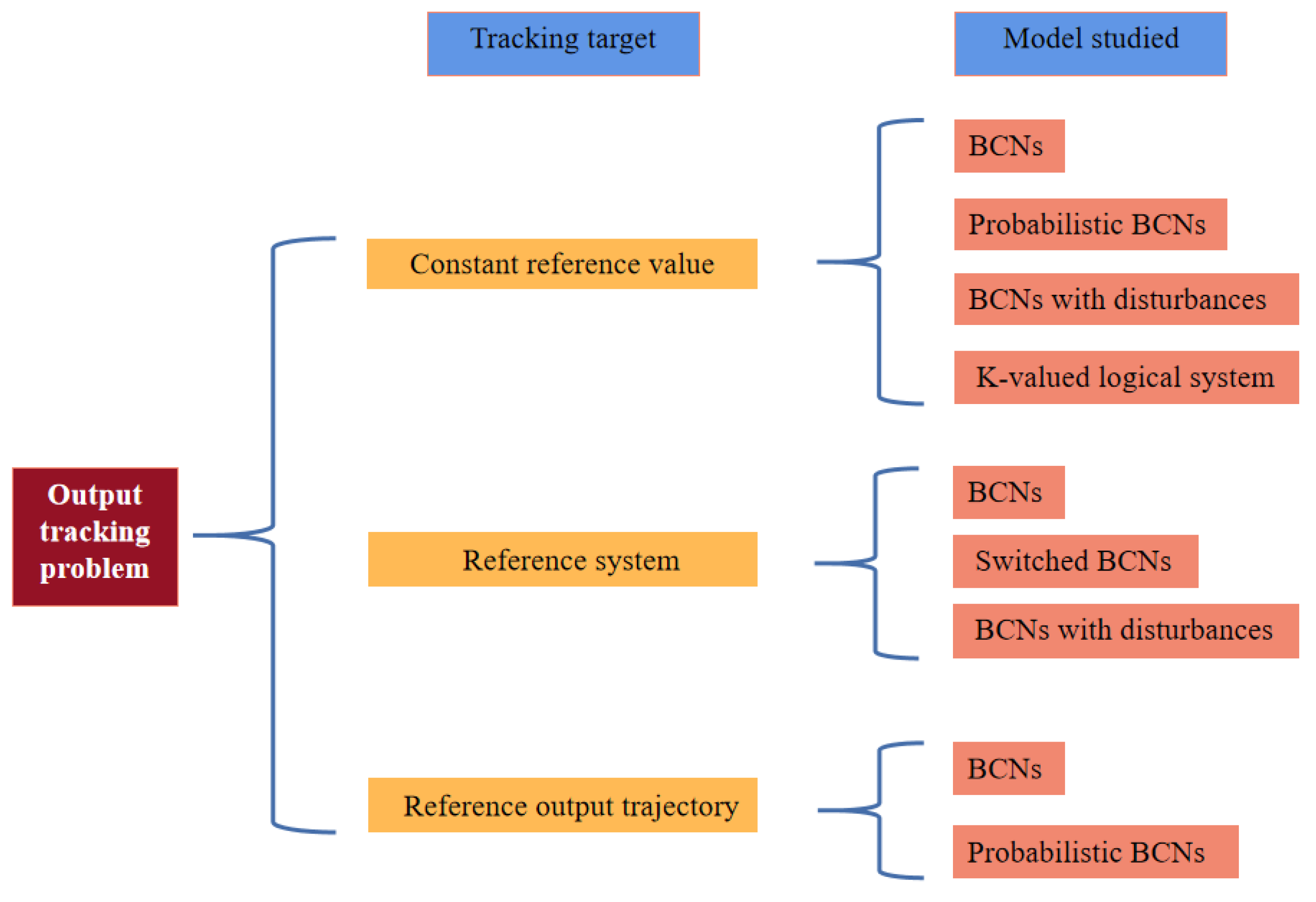
These two kinds of output tracking problems have been studied by some scholars via the STP method. Using the augmented system method, the output tracking problem of (switched) BCNs with a reference system have also been discussed [20,21]. More research results on output tracking problems are shown in Figure 1.
Figure 1.
Research status of output tracking problems.
It should be noted that most papers investigate output tracking problems over infinite time. However, considering the cost of the controllers, research on output tracking and the corresponding control design over infinite time is impractical. Thus, it is of great significance to study the output tracking problem of BCNs over finite time. The finite-time tracking control problem of BCNs have been discussed, and some interesting results have been given [22]. Those results were then extended to probabilistic BCNs, and some necessary and sufficient conditions were established in order to discuss the traceability of the reference output trajectory with probability one [23].
As stated above, there are some results on the output tracking problem over finite time, but these results did not take the impact of disturbances into account. As the disturbances are ubiquitous in the process of modeling BCNs, some unanticipated behaviors may occur in the system. Taking gene regulation as an example, it is a noisy process in essence, which is always affected by intracellular and extracellular disturbances. Intracellular disturbances may be gene mutation, duplication, or the deletion of fragments in gene recombination, while extracellular disturbances may be environmental stimulation. These disturbance inputs may obstruct the control strategies to maintain the cellular state of biological systems inside an ideal domain. Therefore, it is very necessary to design the control scheme in order to deal with the negative effects of the disturbances. However, as far as we know, few studies have been proposed to discuss these two kinds of robust output tracking problems of BCNs with disturbances over finite time.
Using the truth matrix method, the robust output tracking problems of BCNs over finite time are investigated in this paper. The main results are as follows. First, two necessary and sufficient conditions are provided for the trackability of a reference output trajectory and the outputs of a reference system with finite time. Then, two algorithms are proposed to design the state feedback controllers in the case of traceable outputs. Compared with the existing results, the main advantage of the truth matrix method used in this paper is that the computations involved are very easy and the control corresponding to each state can be determined from the non-zero columns of the truth matrices; on the other hand, the technique used in previous works cannot give the state feedback control directly.
2. Preliminaries
In this section, some necessary notations and results are given in Table 1.
Table 1.
Notations.
Definition 1
([7]).Let λ be the least common multiple of b and p. The STP of and is defined as follows:
Remark 1
([7]).The STP is a generalization of the conventional matrix product; thus, “⋉” can be omitted in the following.
Lemma 1
([7]).Let , . Then,
To express a Boolean function in algebraic form, we denote “1” ∼ “” and “0" ∼ “”, where “∼” represents an equivalence relation. Then, we have the following lemma.
Lemma 2
([7]).Let be a Boolean function. Then, there exists a unique , such that
where , and is the structure matrix of f.
3. Main Results
3.1. Trackability of a Reference Output Trajectory
In this part, the trackability of a reference output trajectory with finite length is considered. First, the dynamics of the BCN with disturbance inputs is described as follows:
where , , , and are the states, inputs, disturbances, and outputs of the BCN (4), respectively. and are Boolean functions.
In this subsection, we consider the design of the state feedback controller, which is expressed as
in order to track a reference output trajectory , where , and when , and is a Boolean function. A definition of the trackability of the reference output trajectory is presented below.
Definition 2.
Using the STP method, (4) and (5) can be converted into algebraic forms, as follows:
and
where , , and , , and are the state transition matrix, the output-state incidence matrix, and the state feedback gain matrix of original system (6).
Denote , then the algebraic form of is . Denote
where . The output of states in are consistent with . Based on this, we can convert the robust output tracking problem into the robust reachability problem of system (6), where the definition of robust reachability is given below.
Definition 3
([24]).Consider system (6). For a state and a nonempty set , S is one step robustly reachable from if there exists a control , such that under any disturbance .
For two nonempty sets and , is one step robustly reachable from if for any state , is one step robustly reachable from .
Next, we consider the trackability of from a given initial state . First, denote and construct a truth matrix , as follows:
Let If , then for any , there is no control such that under all disturbances . This means that is not one step reachable from any state in under the influence of disturbances. Thus, in this case, is untraceable by system (6). If , then for any , there exists at least a control such that under any disturbance , which means that is one step robustly reachable from .
Similarly, can be constructed as follows:
where . Let If , then trajectory is untraceable. If , then is one step robustly reachable from .
After iterative calculations, the results confirm that if are not empty sets, then the truth vector can be expressed as follows:
Through the above discussion, a necessary and sufficient condition is thus given for the traceability of the reference output trajectory .
Theorem 1.
The reference output trajectory is traceable by system (6) from the given initial state if and only if
Proof.
(Sufficiency): If , then we have , and there exists at least a control such that under any disturbance , which means that is one step robustly reachable from . As , we can easily verify that are not empty sets, and that for any state , there exists at least a control such that under any disturbance , which means that is one step robustly reachable from , . Thus, is robustly reachable from by iterative calculations. As the output of the states in is consistent with , then is traceable by system (6) from the initial state .
(Necessity): If the reference output trajectory is traceable from , then we can confirm that , and that is one step robustly reachable from , where . Moreover, there exists at least a control such that is one step robustly reachable from the state . Thus, we can affirm that . □
Remark 2.
The computational complexity of deriving the criteria for the traceability of the reference output trajectory is . When studying the output tracking problem of a BCN in infinite time, the target set is generally unique. We first need to calculate a control invariant set in this target set and then design the controls such that all the initial states finally converge to this invariant set. However, if we consider the output tracking problem of a BCN in finite time, the target set is usually not unique. We need not compute the control invariant set of any set, but we should ensure that the given initial state can successively reach these target sets.
Then, we consider the design of the controller when the reference output trajectory , is robustly traceable from . Algorithm 1 is presented to search for all the controllers based on the truth matrix.
| Algorithm 1 Design of controller for tracking a reference output trajectory |
Input: and Output:G
|
Remark 3.
Assume that are robustly traceable from . If is robustly reachable from , that is, belongs to the robust convergence region of , then are also robustly traceable from .
3.2. Trackability of the Outputs of a Reference System
In this subsection, we consider continuously tracking the outputs of a reference system over finite time. At first, the dynamics of the reference BCN can be given as follows:
where and are the states and the outputs of system (13), respectively, while and are Boolean functions.
Using the STP method, the algebraic form of system (13) can be expressed as follows:
where and , and are the state transition matrix and the output-state incidence matrix of reference system (14).
In this section, we want the outputs of system (6) to be consistent with that of reference system (14) for c consecutive times.
Hence, we have the following definition.
Definition 4.
The augmented system approach is considered to solve this kind of robust output tracking problem. Denote and . Then, an augmented system can be obtained with the following equation:
Moreover, the outputs of the augmented system can be expressed as follows:
Then, the algebraic form of the augmented system can be rewritten as follows:
where and are the state transition matrix and the output-state incidence matrix of augmented system (17), respectively.
For augmented system (17), we consider the design of the state feedback controller, which has the following form:
Then, (18) has the following algebraic form:
where , is the structure matrix of .
If the outputs of reference system (14) can be traced by system (6) for c consecutive times, then there exist a state feedback control (19) and initial states , , such that
for any disturbance and any , which means that the state trajectory starting from of the augmented system (17) will stay c steps in set , where .
Construct the following:
This type of robust output tracking problem can be converted into the robust reachability problem of augmented system (17).
Next, we consider the trackability of this kind of robust output tracking problem. Construct a truth matrix as follows:
Let obviously, If , then for any , there is no control such that under all disturbances . Thus, the outputs of reference system (14) are untraceable by system (6). If , then for any , there exists at least a control such that under any disturbance , which means that any state in will still evolve in within the subsequent time interval.
Similarly, we can construct as follows:
Let obviously, . If , then the outputs of reference system (14) are untraceable by system (6). If , then any state in will evolve in in the subsequent time interval.
After iterative calculations, we verify that if are not empty sets, then the truth matrix can be expressed as follows:
Denote ; obviously, .
After the above discussion, a necessary and sufficient condition is presented for the traceability of the outputs of reference system (14) for c consecutive times.
Theorem 2.
Proof.
(Sufficiency): If , then and is one step robustly reachable from . As , we can easily confirm that , and for any , there exists at least a control such that under any disturbance , which means that is one step robustly reachable from , . Thus, is robustly reachable from . As , we can confirm that the outputs of reference system (14) are traceable by system (6) for c consecutive times.
(Necessity): If the outputs of reference system (14) are trackable by system (6) for c consecutive times, then we can verify that there exists at least one initial state , such that the state trajectory lasts c steps in . This means that are not empty sets, and that the initial state will evolve into set . Thus, □
Remark 4.
The computational complexity of deriving the criteria for the traceability of the outputs of the reference system is , where
If the outputs of reference system (14) are continuously traceable for c consecutive times, then we give the method for designing the state feedback controllers. Algorithm 2 is presented to search for all the controllers based on the truth matrix method.
| Algorithm 2 Design of controller for tracking the outputs of a reference system over finite time |
Input: Output:R
|
4. Illustrative Examples
In this section, two illustrative examples are presented to verify the main results in this paper. Some basic logical operators are given: “¬” (negation), “∧” (conjunction), “∨” (disjunction), “→” (conditional), “↔” (biconditional), “↑” (not and).
Example 1.
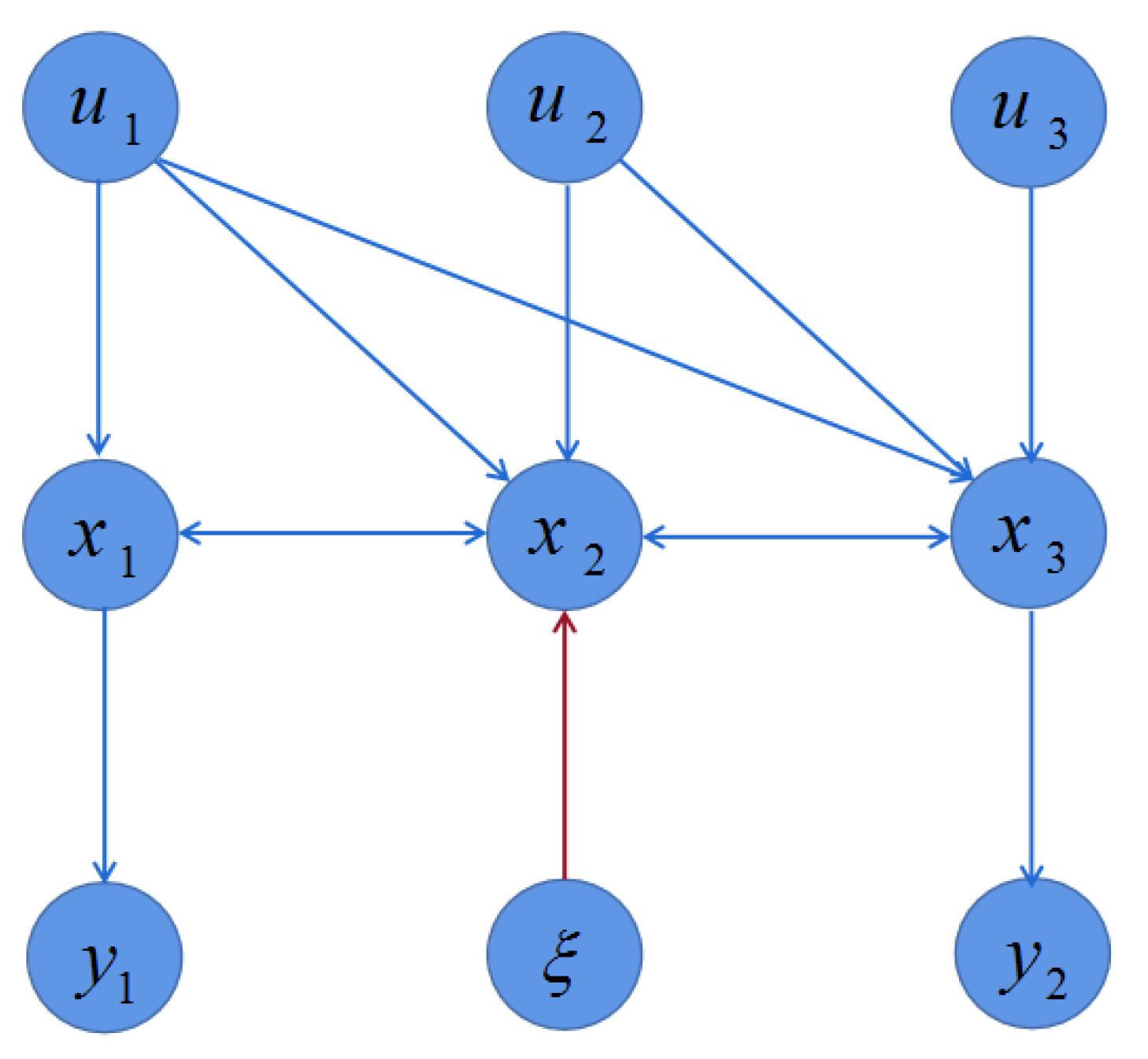
Consider the following simplified model for the E. coli lactose operon network with disturbances:
where , and are state variables representing lactose messenger RNA, high-concentration lactose, and medium-concentration lactose, respectively; , and are control inputs, indicating extracellular glucose, high exolactose, and medium exolactose, respectively; and are the outputs; ξ is the disturbance input. The network diagram of system (26) is shown in Figure 2:
Figure 2.
Network diagram of system (26).
Then, the algebraic form of system (26) can be expressed as follows:
where , , and , and
Assume that the reference output trajectory is as shown below.
| t | 1 | 2 | 3 | 4 |
| Y |
We then detect whether the initial state can track this output trajectory. According to (8), we have , , , and .
By Algorithm 1, we can obtain the following:
and
As , we can verify that this reference output trajectory is traceable by system (26) from under any disturbance.
Next, according to Algorithm 1, one state feedback gain matrix G can be given as follows:
Thus, to track the reference output trajectory from by system (26), the state feedback controller (7) can be expressed as follows:
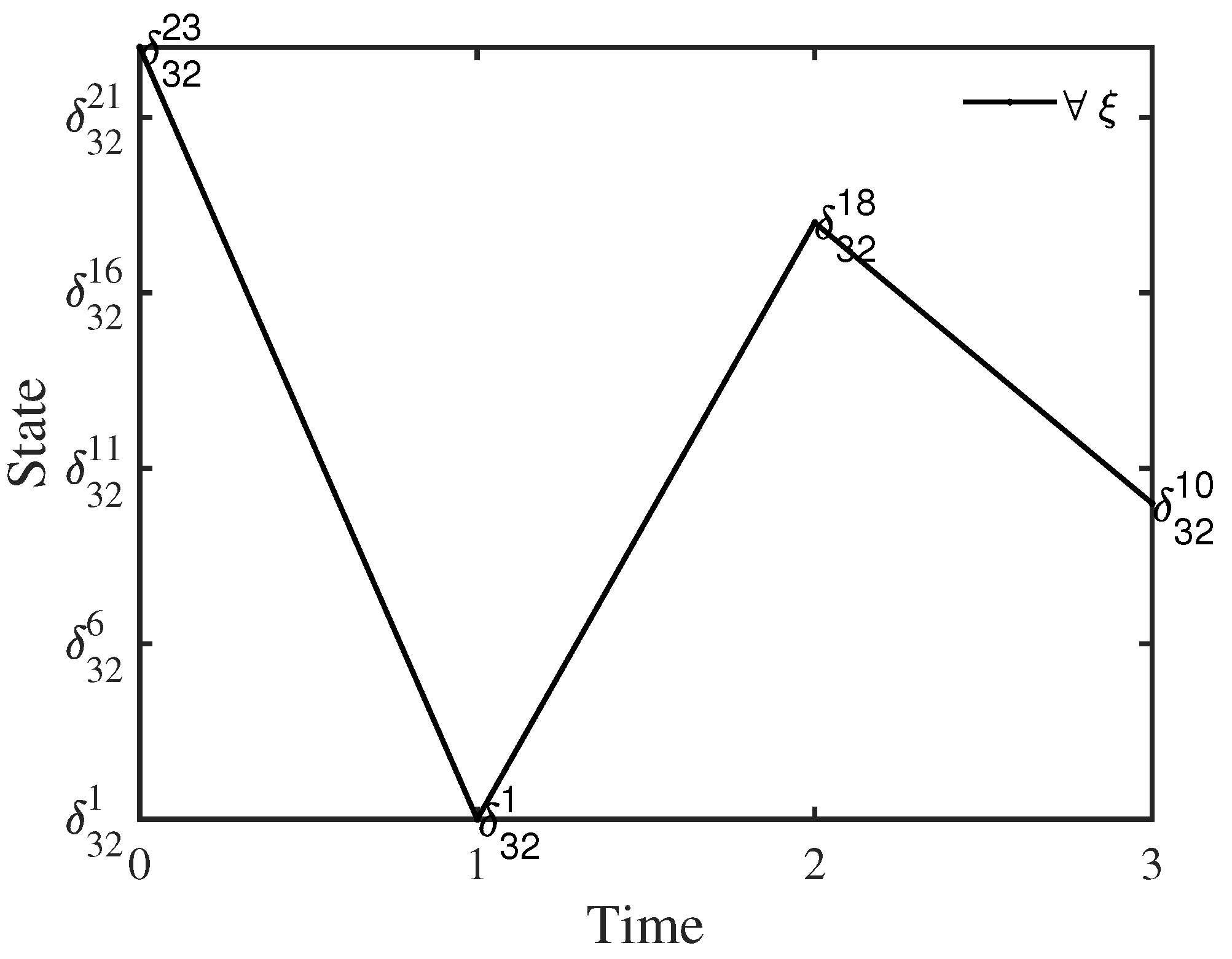
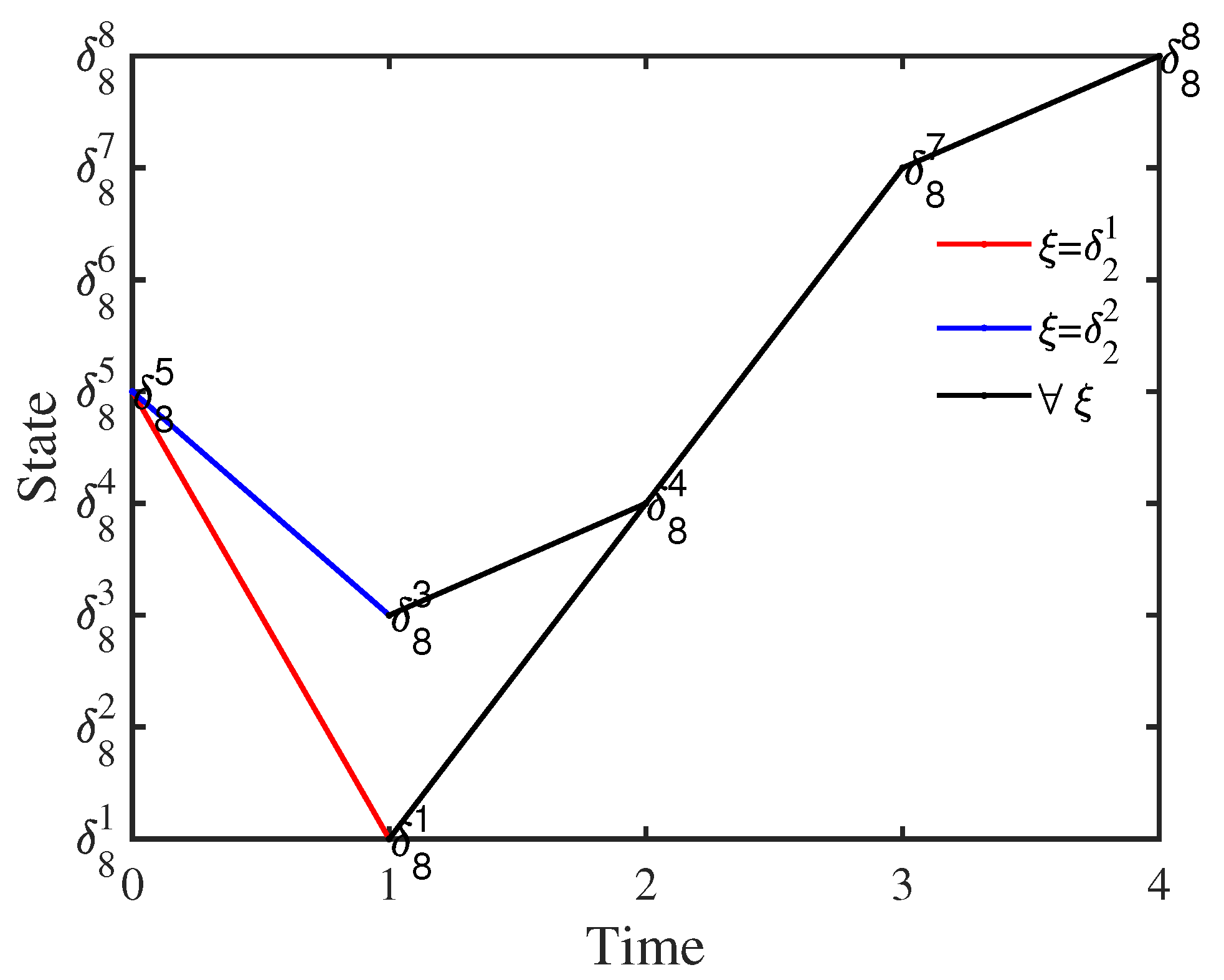
To make the results more visual, we show the evolutionary trajectories of the initial state under controller (28) in Figure 3.
Figure 3.
Evolutionary trajectories of initial state under controller (28).
If we study the output tracking problem of BCN (26) over infinite time, we should give a constant reference signal or a periodic signal and then confirm the target state set according to the output signals. Next, we need to calculate a control invariant set in this target set and make the given initial state converge to this invariant set. However, if we study the output tracking problem in finite time, we just need to ensure that state can successively reach sets , , , and .
Example 2.
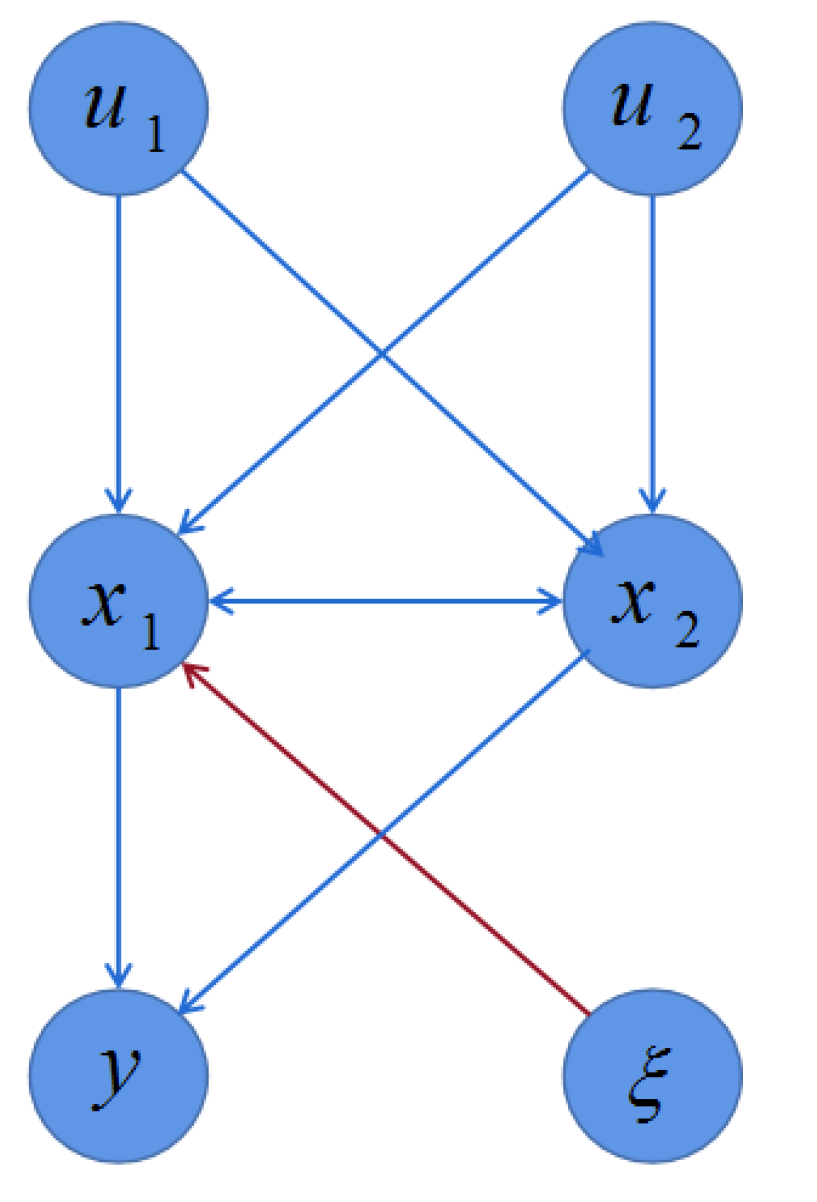
Consider a BCN with the following disturbances:
where and are the state variables, and are control inputs, y is the output, and ξ is the disturbance input. The network diagram for system (29) is shown in Figure 4:
Figure 4.
Network diagram of system (29).
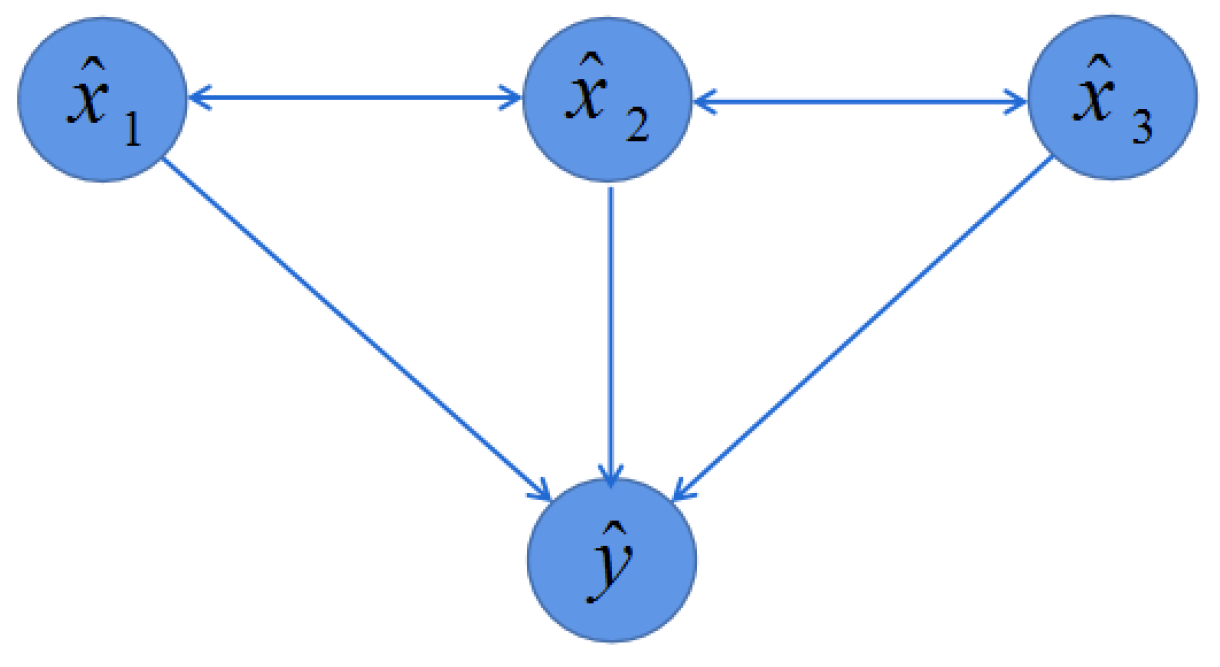
A reference BN is shown below:
where , , and are the state variables, and is the output. The network diagram for system (31) is shown in Figure 5.
Figure 5.
Network diagram of system (31).
Let , and we can obtain the algebraic form of system (31) as follows:
where and
Denote and , then an augmented system can be generated by combining system (30) and reference system (32) as follows:
where and
We consider continuously tracing the outputs of reference system (32) with system (31) for 3 consecutive times.
Assume that the initial state of the augmented system is . According to (21), we can calculate the pairs of states that keep the outputs of systems (31) and (32) consistent, and we can further confirm that
By Algorithm 2, we can obtain the following values: , Thus, the outputs of reference system (32) are continuously tracked by system (31) for three consecutive times.
According to Algorithm 2, we can obtain a possible state feedback gain matrix R as follows:
Thus, in order to continuously track the outputs of reference system (32) with system (30) for three consecutive times, the state feedback controller (19) can be expressed as follows:
Figure 6.
Evolutionary trajectories of initial state under control (34).
When studying the output tracking problem in infinite time, there must be some state trajectories in set that are evolving all the time, which requires set to contain at least one control invariant set. However, when we study the output tracking problem in finite time, we just need to ensure that there exists a state trajectory that can evolve in set for a finite number of steps.
5. Conclusions
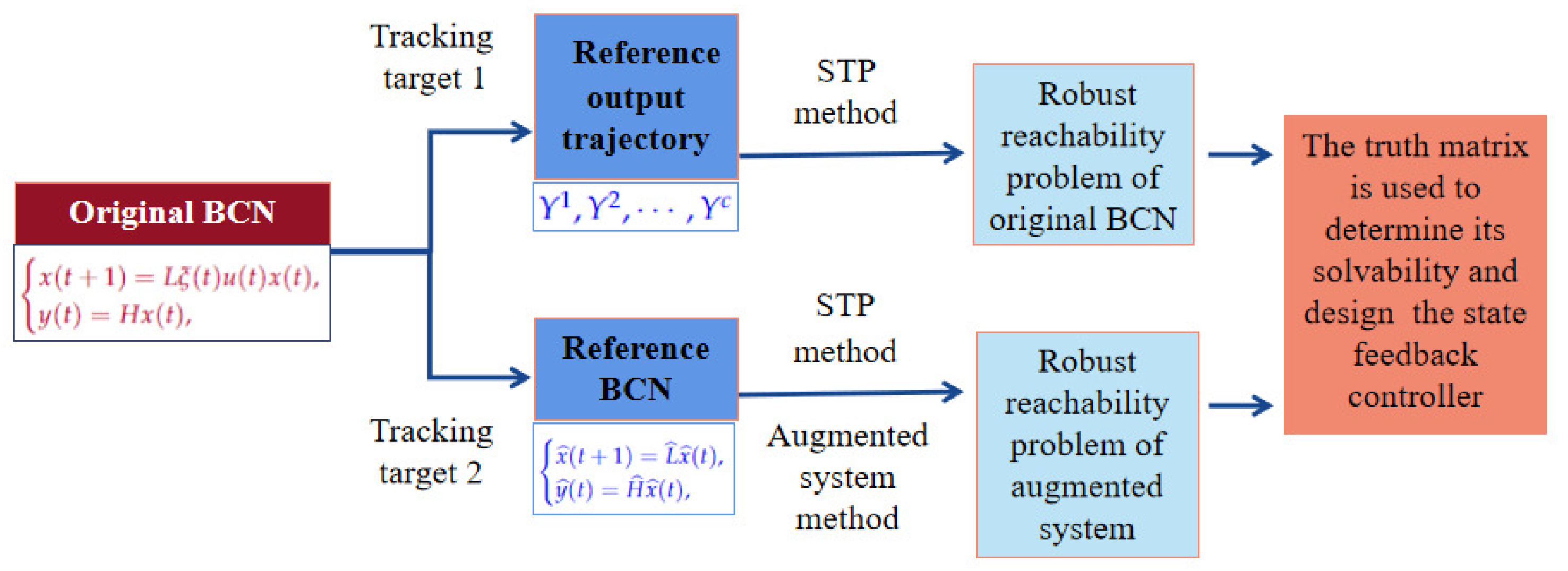
Taking advantage of the STP method, classical control theory has been used to solve two kinds of robust output tracking problems of BCNs. First, two necessary and sufficient conditions were provided for the trackability of a reference output trajectory and the outputs of a reference system with finite length. Then, two algorithms were proposed to design the state feedback controllers in the case where the outputs could be tracked. The STP method has to perform a large amount of computation when dealing with networks with many nodes; thus, two illustrative examples using a few nodes were presented to demonstrate the theory results in this paper. The methodology and outline of this paper are shown in Figure 7:
Figure 7.
The methodology and outline of this paper.
Our method can also be used to study the stability and control problems of many other finite-valued dynamic systems. In the future, we will study the influence of disturbance inputs on the consensus of multi-agent systems over finite fields, and we will propose some criteria for the finite-time consistency of these systems.
Author Contributions
Formal analysis, Y.Z. and X.Z.; Writing—original draft, Y.Z. and X.Z.; Writing—review & editing, S.F. and J.X. All authors have read and agreed to the published version of the manuscript.
Funding
This work was supported by the National Natural Science Foundation (NNSF) of China under Grant No. 62103176, the Natural Science Foundation of Shandong Province under Grant No. ZR2019BF023, the “Guangyue Young Scholar Innovation Team” of Liaocheng University under Grant No. LCUGYTD2022-01, and Discipline with Strong Characteristics of Liaocheng University—Intelligent Science and Technology under Grant No. 319462208.
Institutional Review Board Statement
Not applicable.
Informed Consent Statement
Not applicable.
Data Availability Statement
Not applicable.
Conflicts of Interest
The authors declare no conflict of interest.
References
- Kauffman, S.A. Metabolic stability and epigenesis in randomly constructed genetic nets. J. Theor. Bio. 1969, 22, 437–467. [Google Scholar] [CrossRef]
- Hassoun, M.H. Fundamentals of Artificial Neural Networks; MIT Press: Cambridge, MA, USA, 1995. [Google Scholar]
- Bloomingdale, P.; Nguyen, V.A.; Niu, J.; Mager, D.E. Boolean network modeling in systems pharmacology. J. Pharmacokinet. Phar. 2018, 45, 159–180. [Google Scholar] [CrossRef]
- Shen, X.; Wu, Y.; Shen, T. Logical control scheme with real-time statistical learning for residual gas fraction in IC engines. Sci. China Inf. Sci. 2018, 61, 010203. [Google Scholar] [CrossRef]
- Vadivel, R.; Hammachukiattikul, P.; Gunasekaran, N.; Saravanakumar, R.; Dutta, H. Strict dissipativity synchronization for delayed static neural networks: An event-triggered scheme. Chaos Soliton Fract. 2021, 150, 111212. [Google Scholar] [CrossRef]
- Vadivel, R.; Suresh, R.; Hammachukiattikul, P.; Unyong, B.; Gunasekaran, N. Event-triggered L-2-L-infinity filtering for network-based neutral systems with time-varying delays via T-S fuzzy approach. IEEE Access 2021, 9, 145133–145147. [Google Scholar] [CrossRef]
- Cheng, D.; Qi, H.; Li, Z. Analysis and Control of Boolean Networks: A Semi-Tensor Product Approach; Springer: London, UK, 2011. [Google Scholar]
- Guo, Y.; Zhou, R.; Wu, Y.; Gui, W.; Yang, C. Stability and set stability in distribution of probabilistic Boolean networks. IEEE Trans. Automat. Contr. 2018, 64, 736–742. [Google Scholar] [CrossRef]
- Li, H.; Wang, S.; Li, X.; Zhao, G. Perturbation analysis for controllability of logical control networks. SIAM J. Control Optim. 2020, 58, 3632–3657. [Google Scholar] [CrossRef]
- Feng, J.; Li, Y.; Fu, S.; Lyu, H. New method for disturbance decoupling of Boolean networks. IEEE Trans. Automat. Contr. 2022, 67, 4794–4800. [Google Scholar] [CrossRef]
- Li, R.; Yang, M.; Chu, T. State feedback stabilization for disturbance decoupling of Boolean control networks. IEEE Trans. Aut. Contr. 2013, 58, 1853–1857. [Google Scholar] [CrossRef]
- Zhang, Z.; Chen, Z.; Han, X.; Liu, Z. Stabilization of probabilistic finite automata based on semi-tensor product of matrices. J. Franklin Inst. 2020, 357, 5173–5186. [Google Scholar] [CrossRef]
- Zhao, G.; Li, H.; Duan, P.; Alsaadi, F. Survey on applications of semi-tensor product method in networked evolutionary games. J. Appl. Anal. Comput. 2019, 10, 32–54. [Google Scholar] [CrossRef]
- Zhong, J.; Lin, D. Driven stability of nonlinear feedback shift registers with inputs. IEEE Trans. Commun. 2016, 64, 2274–2284. [Google Scholar] [CrossRef]
- Lu, J.; Li, M.; Liu, Y.; Ho, D.; Kurths, J. Nonsingularity of Grain-like cascade FSRs via semi-tensor product. Sci. China Inf. Sci. 2018, 61, 010204. [Google Scholar] [CrossRef]
- Wu, Y.; Le, S.; Zhang, K.; Sun, X. Ex-ante agent transformation of Bayesian games. IEEE Trans. Automat. Contr. 2021, 67, 5793–5808. [Google Scholar] [CrossRef]
- Le, S.; Wu, Y.; Toyoda, M. A congestion game framework for service chain composition in NFV with function benefit. Inf. Sci. 2020, 514, 512–522. [Google Scholar] [CrossRef]
- Li, B.; Lu, J. Boolean-network-based approach for construction of filter generators. Sci. China Inf. Sci. 2020, 63, 212206. [Google Scholar] [CrossRef]
- Julius, A.; Halasz, A.; Sakar, M.; Rubin, H.; Kumar, V.; Pappas, G. Stochastic modeling and control of biological systems: The lactose regulation system of Escherichia coli. IEEE Trans. Automat. Contr. 2018, 53, 51–65. [Google Scholar] [CrossRef]
- Yerudkar, A.; Del Vecchio, C.; Glielmo, L. Output tracking control design of switched Boolean control networks. IEEE Control Syst. Lett. 2020, 4, 355–360. [Google Scholar] [CrossRef]
- Zhang, X.; Wang, Y.; Cheng, D. Output tracking of Boolean control networks. IEEE Trans. Automat. Contr. 2019, 65, 2730–2735. [Google Scholar] [CrossRef]
- Zhang, Z.; Leifeld, T.; Zhang, P. Finite horizon tracking control of Boolean control networks. IEEE Trans. Automat. Contr. 2017, 63, 1798–1805. [Google Scholar] [CrossRef]
- Zhang, Q.; Feng, J.; Jiao, T. Finite horizon tracking control of probabilistic Boolean control networks. J. Franklin Inst. 2021, 358, 9909–9928. [Google Scholar] [CrossRef]
- Li, H.; Song, P.; Yang, Q. Pinning control design for robust output tracking of k-valued logical networks. J. Franklin Inst. 2017, 354, 3039–3053. [Google Scholar] [CrossRef]
Publisher’s Note: MDPI stays neutral with regard to jurisdictional claims in published maps and institutional affiliations. |
© 2022 by the authors. Licensee MDPI, Basel, Switzerland. This article is an open access article distributed under the terms and conditions of the Creative Commons Attribution (CC BY) license (https://creativecommons.org/licenses/by/4.0/).