


Abstract
This study uses bibliometric analysis to examine the scientific evolution of particle swarm optimization (PSO) for the vehicle routing problem (VRP) over the past 20 years. Analyses were conducted to discover and characterize emerging trends in the research related to these topics and to examine the relationships between key publications. Through queries of the Web of Science and Scopus databases, the metadata for these particle swarm optimization (PSO) and vehicle routing problem (VRP) solution strategies were compared using bibliographic coupling and co-citation analysis using the Bibliometrix R software package, and secondly with VOSViewer. The bibliometric study’s purpose was to identify the most relevant thematic clusters and publications where PSO and VRP research intersect. The findings of this study can guide future VRP research and underscore the importance of developing effective PSO metaheuristics.
Keywords:
particle swarm optimization; vehicle routing problem; bibliometric analysis; supply chain management; metaheuristics; combinatorial optimization; data mining MSC:
00A71; 58Z05
1. Introduction
PSO, or particle swarm optimization, was originally developed by Eberhart et al. [1] for solving mathematical optimization problems. PSO is a heuristic that mimics the social behavior of flocking birds and other animals. Particles or individuals, each with a personal memory of previous performance, traverse a search space according to a velocity function, updating their velocities based on the positions of other particles. The leaders or particles that have performed best in the search space are remembered, and the fastest particle is tracked over the course of the optimization. PSO has also been shown to be more resistant to local minima than other heuristic optimization algorithms, particularly for problems in which the functions are multi-modal and discontinuous.
The vehicle routing problem (VRP) is an NP-hard optimization problem that seeks to minimize the total cost of a number of vehicles traveling from a warehouse or central location to a set of customers (Toth and Vigo [2]). It was first identified in the literature by Dantzig et al. [3] as the truck dispatching problem. Minimization in VRP is often multi-objective, and usually includes factors such as distance, number of vehicles, or travel time. VRP variants include the Capacitated VRP (CVRP), the Vehicle Routing Problem with Time Windows (VRPTW), the Pickup and Delivery Problem (PDP), the Dial-a-Ride Problem (DARP), the Open Vehicle Routing Problem (OVRP), and the Inventory Routing Problem (IRP). VRP applications can be found in many industries and logistical fields, such as package delivery, supply chain management, waste management, and retailing. As this survey demonstrates, research attention is shifting to topics of sustainability and reverse logistics, such as those of Sarkar et al. [4,5,6]. With the growth of strategic research field, research on operational applications of metaheuristics on issues such as the VRP has continued unabated.
Although PSO has received extensive research since its discovery in 1995, the first main intersection between PSO and VRP research only occurred about 10 years later (Marinakis [7]). Since then, PSO and VRP research on particle swarm optimization and vehicle routing problem solution strategies has become a well-recognized field of study. Despite the abundance of existing literature on particle swarm optimization, few existing reviews consider the entirety of PSO and VRP research within the Web of Science and Scopus databases, which means that many essential VRP-PSO publications may be left out. This is a substantial research challenge because the production of new research relies on the systematic review of existing research to find gaps and explore new avenues. Therefore, there is an opportunity to provide a more comprehensive review of all PSO and VRP publications collected from these two databases using a structured, algorithmic approach.
To the best of our knowledge, while there has been a substantial number of literature reviews made on metaheuristic methods for the vehicle routing problem, few have included bibliometric study as a supporting methodology, and only one has focused explicitly on particle swarm optimization using a manual review approach. Thus, a novel research gap exists with respect to a bibliometric review on particle swarm optimization for the vehicle routing problem, outlined in Table 1 [7,8,9,10]:

Table 1.
Research gap table for significant VRP heuristics literature review papers.
This literature study looks to confirm the most relevant research questions concerning particle swarm optimization (PSO) while applied to the vehicle routing problem (VRP). The study systematically answers three questions: (1) Which publications have been cited the most, (2) What sources do they cite, and (3) Which shared topics do these publications and their references fall under? The key methods used in this study, bibliographic coupling and co-citation analysis, help to address these inquiries.
The methodology of bibliographic coupling was developed by Kessler [11] from MIT. It is a simple, yet effective technique for mapping relationships between publications. This approach looks at the co-occurrence of citations between two papers and can be used to identify knowledge communities. The idea behind this method is that if two publications concurrently cite at least one reference, they are likely to be related. If more citations are shared, the likelihood increases. However, a shortcoming of bibliographic coupling is that its relationships contained within each publication can only exist up to the date of issuance. To complement this methodology, Small [12] proposed the co-citation analysis method. This is an extension of bibliometric coupling, where two publications are co-cited if they are independently cited concurrently by other publications. Co-citation analysis is more powerful than bibliographic coupling because it can identify relationships between publications that have not been explicitly cited concurrently. These two techniques are often used in combination to map the evolution of research trends. A brief diagram of these two techniques is shown in Figure 1.
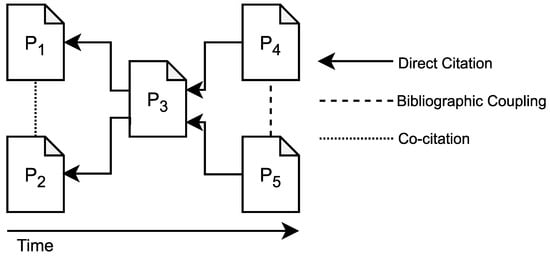
Figure 1.
Bibliographic coupling and co-citation analyses.
2. Methodology
The structure of this search can be seen in Figure 2. The two databases that were selected for this bibliometric study were the Web of Science and Scopus databases, which are widely recognized for their academic journal literature. These two databases were queried for publications related to PSO, VRP, and their various variants from the year 2000 to 2022, so that the publication history would be long enough to examine some of the research trends in PSO and VRP. Lastly, a bibliometric study was carried out using the VOSViewer visualization software (van Eck et al. [13]) and the Bibliometrix R software package (Aria et al. [14]) through bibliographic coupling and co-citation analyses. These metadata analyses helped to identify the most relevant publications, topics, and trends.
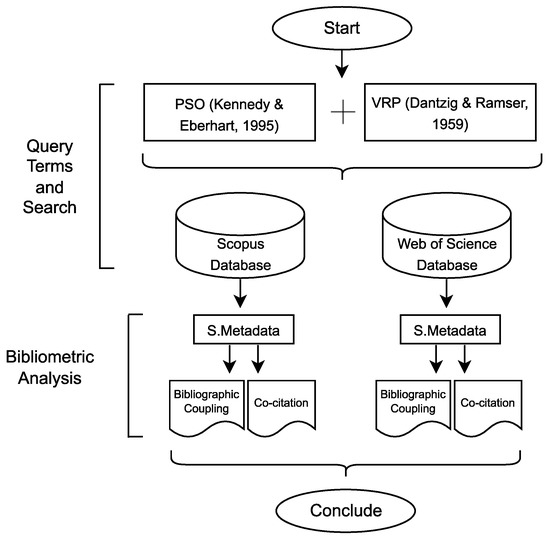
Figure 2.
PSO + VRP bibliometric study methodology chart [3,15].
The search terms listed in Table 2 below were used for the Dimensions and Web of Science databases.
Table 2.
Adapted search query strings.
Two types of metadata were investigated after the search query. First were the bibliographic coupling and co-citation metadata, and second, the Keywords Plus keywords attached to each article. Keywords Plus is a feature adapted by both the Web of Science (Clarivate) and Scopus (Elsevier) databases. An automated algorithm generates word sets that relate the most to the article’s title and abstract, and these terms are then attached to each article. For bibliometric analysis, Keywords Plus Frequency, the total number of instances each term is found in the search results of a given query, was also analyzed.
Following these two queries, an analysis was performed at the levels of sources, authors, and documents, which is a domain-based approach pioneered by Aria et al. [14]. The results of the bibliometric query were first analyzed according to Bradford’s law, which is a well-known method to study the most relevant articles [16]. Then, the H-index (Hirsch, [17]), which captures both the productivity and citation impact of the publications of a source or author, was used to measure the academic impact of sources and their authors. For the calculation of Lotka’s law, which is used to study author productivity (Lotka, [18]), the total number of authors and their publications were used. The calculation of Hirsch’s index at the author level was also performed in order to measure the academic impact of authors. In order to identify affiliations and countries that have made the most contributions to the field, a co-authorship network was constructed, and centrality measures were calculated. Finally, global and local citation scores were assessed in order to identify the most relevant publications according to bibliographic coupling and co-citation analysis. These procedures and their metrics are summarized in Table 3.
Table 3.
Analysis methodology table for mapping the field of VRP/PSO research.
3. Results and Discussion
The literature and database searches were completed in mid-August 2022. In total, 263 articles were found from the Dimensions database and 82 articles were found from the Web of Science Core Collection database. The publication date range for both databases was 2004 to 2022; a summary can be seen in Table 4 below.
Table 4.
General information about the data obtained from the Scopus and Web of Science searches.
3.1. Data Level: Sources
The first step of the bibliometric analysis was to investigate the sources that published papers related to PSO and VRP. By partitioning the publications according to Bradford’s law, which states that a group of articles ranked by citation and divided into thirds can have a journal distribution of the form: 1 in the first group (core), y% in the second group (zone 2), and y2% in the third group (outer) (Bradford [16]). It was possible to identify which sources were more relevant for this study. For the Web of Science database, 30 out of 82 documents, 6 of 49 sources, and 80 of 227 authors were identified as being part of the core group, while the Scopus database search results returned 87 out of 263 documents, 22 out of 181 sources, and 211 out of 574 authors. The majority of the core sources for both databases were published in English, with a few exceptions for the Scopus database. The top 10 most relevant Web of Science sources according to Bradford’s law and published documents are shown in Table 5.
Table 5.
The top 10 most relevant journals to PSO/VRP found in the Web of Science search using Bradford’s Law.
Bradford’s Law, however, can be confounded by source productivity and self-citation. In order to further investigate the sources publishing papers related to PSO and VRP, a second metric was used: Hirsch’s index (Hirsch [17]). This metric captures both the productivity and citation impact of the publications from a source, and is calculated as the total number H of publications from a source that have been individually cited at least H times. The purpose of Hirsch’s index is to eliminate outlier publications of less relevance and prestige, so that the final result is a better measure of a source’s scientific impact. The resulting sources with the highest h-index scores greater than 1 were found to match the results of Table 4, and are shown in Figure 3.
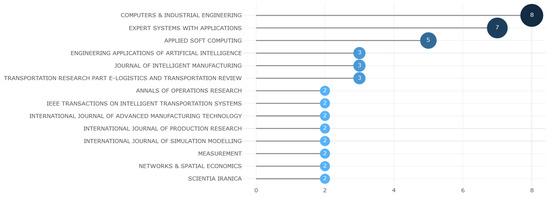
Figure 3.
Most cited institutions for Web of Science PSO/VRP publications, h-index score.
Thus, it was found that the most relevant publications related to PSO and VRP were published by Computers & Industrial Engineering, followed by Expert Systems with Applications and Applied Soft Computing. The results of the Hirsch’s index metric were in agreement with the Bradford’s law metric, which indicated that these sources were the most relevant for this study.
3.2. Data Level: Authors
The second step of the bibliometric analysis was to investigate authors who published papers related to PSO and VRP. In order to identify which countries and affiliations were more productive in this area, Lotka’s law (Lotka [18]) was used. This inverse square law states that the number of authors producing a given number of publications is inversely proportional to the rank order of the number of publications they produced. In other words, a small number of authors produce most of the publications in any field, while a large number of authors produce only a few publications. Specifically, Lotka’s Law calculates the distribution of publications as , where is the number of authors, is the number of publications produced by each author, and is a constant. The Lotka’s coefficient, beta (), can be determined by fitting a regression line to a log graph of the data, and is expected to be roughly 2 for most research fields. The results of the Lotka’s law analysis are shown in Figure 4.
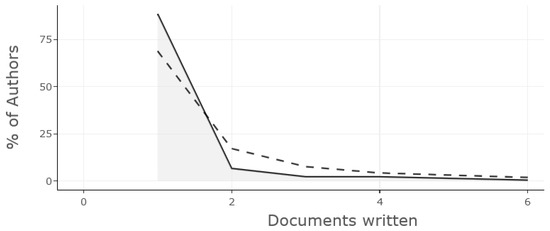
Figure 4.
Author productivity (gray) compared with Lotka’s Law (dashed); percentage of authors against number of publications.
From this figure, it can be seen that the distribution of authors for PSO/VRP is significantly steeper than the expected curve for authors who have published only one article, and lower than the expected curve for authors of two or more articles. For a topic that has been researched for 20 years, this suggests that there is relatively less turnover in the field than in other, newer topics of research. It also suggests that the same authors are publishing multiple articles on PSO/VRP over time—an indication of the subject’s maturity.
Analysis based on Lotka’s law, however, can be confounded by co-authorship. Namely, assuming equally divided contribution, an author who publishes a number of documents with fewer co-authors should be more influential than an author who publishes the same number of documents with more co-authors. In order to more accurately measure the academic impact of an author, a second metric used by Waltman and van Eck [19], fractional authorship, was applied. This metric takes into account both an author’s productivity and the number of authors with whom they co-author publications, and is calculated as , where is the set of documents written by the author , and an authored document in the set . The results of the fractional authorship metric are shown in Figure 5, which lists the top 10 most influential authors in the field.
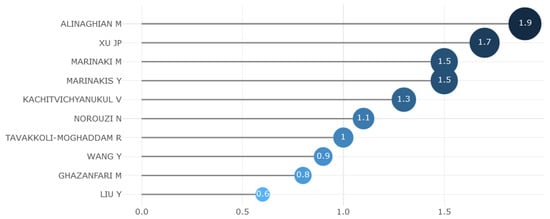
Figure 5.
Most relevant authors for Web of Science PSO/VRP publications, by number of publications (fractionalized).
Additionally, mapping the information of the authors and their affiliated institutions and countries reveals some insightful patterns in the global distribution of research in this field (Figure 6).
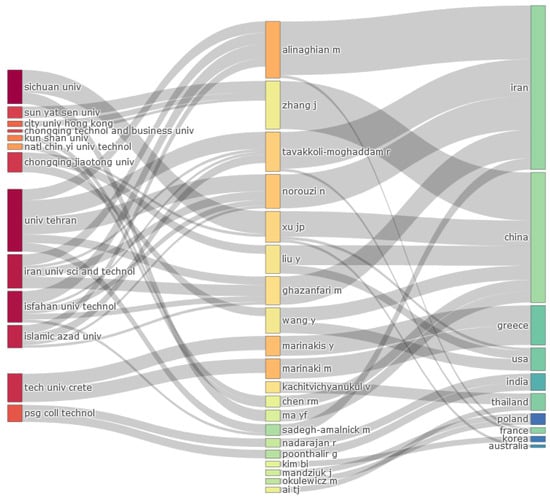
Figure 6.
Three-field plot (institutions, authors, countries) for PSO/VRP research, scaled to Web of Science publication counts.
In particular, Iran, China, and Greece had the highest number of publications associated with the most influential authors, and most of the top 10 influential authors were affiliated with universities in these countries.
3.3. Data Level: Documents
The final step of the bibliometric analysis was to investigate which documents were most relevant to PSO and VRP. In order to identify the most important publications in this area, global and local citation analysis was performed for the documents in the Web of Science database. Two metrics were used to measure the impact of publications: global citation analysis and local citation analysis. Global citation analysis counts the number of times a publication has been cited by other publications in the database. Local citation analysis, however, measures publication influence based on how often it is cited by other publications within the same research field. This becomes possible by assessing the internal citation metadata of the search query results. Additionally, the Keywords Plus feature and Author’s Keywords were assessed in order to identify any emerging trends in the research.
The results for each search were first scanned for thematic relevance in order to track the change in research subtopics over the years. This method applies the research by Cobo et al. [20] using co-word analysis to map the strength of textual data associations that reflect the relationships between various topics in a research field. This was done to identify common trends and possible gaps in literature by tracking popular research topic keywords and their changes in the distribution over time. Figure 7 shows the evolution of these themes as the research progressed.
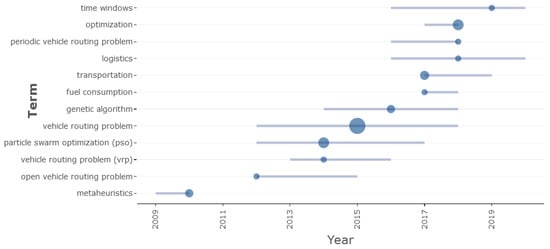
Figure 7.
Author’s Keywords Thematic Evolution, three words/year; three-word minimum frequency.
The Keywords Plus terms attached to each publication in Scopus and Web of Science databases were then visualized by splitting the progression of each database’s publications into two separate timeframes. In this way, the change of Keywords Plus Frequencies distributions in literature could be more clearly observed, this time by tracking the number of publications that appeared with each instance of Keywords Plus. Figure 8 below shows the Thematic Map for the evolution of research topics over two timeframes, as provided by Bibliometrix and based on data from the Scopus database.
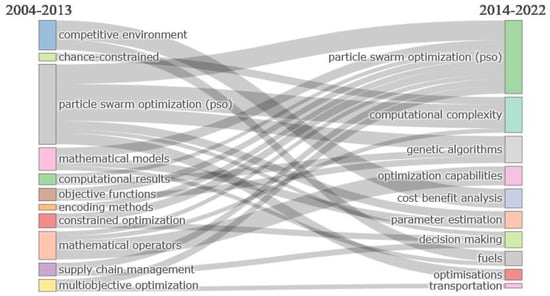
Figure 8.
PSO/VRP Publication Thematic Evolution, measured by Scopus Keywords Plus frequency.
From this figure, it can be seen that both changes in the distributions of keywords, along with the keywords themselves, have changed between 2004–2013 and 2014–2022. Computational complexity emerged as a new theme in 2014–2022, as newer approaches harnessing higher computing power to solving the vehicle routing problem are investigated. Similarly, research interest has shown a shift from exact-method mathematical models towards optimization capabilities, genetic algorithms, and cost-benefit tradeoffs. This change is likely in response to the emergence of more powerful PSO solution strategies that can approximate VRP solutions with reasonable accuracy. Therefore, the most recent VRP and PSO research have been increasingly focused on developing effective metaheuristics and hybrid strategies.
The thematic evolution results for the Web of Science database search in Figure 9 show a narrower scope due to its highly selective nature and relatively smaller number of curated articles.
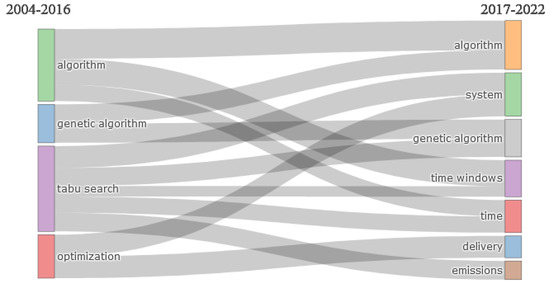
Figure 9.
PSO/VRP Publication Thematic Evolution, measured by Web of Science Keywords Plus frequency.
The Web of Science thematic evolution figure shows a narrower scope of results; however, it also shows insights that are not as noticeable in its Scopus counterpart. This is likely because the vehicle routing problem with time windows (VRPTW) is a classic variant of the VRP and has been frequently studied in the literature. Furthermore, the terms delivery and emission emerged as new keywords in the same time period. This is due to the increasing importance of sustainability and “green” issues in logistics and transportation. To verify these trend possibilities, bibliometric analysis was carried out.
VOSViewer graphically represents the relevance of publications on a coordinate plane, as shown in Figure 10 below. The closer two publications are to each other in measurable distance, the more related they are. The higher link strength resulting in a thicker line between two nodes is influenced by bibliographic coupling and co-citation scores. The total link strength of each publication influences the opacity of the publication. More citations result in larger nodes, and the color of a node is determined by the cluster it belongs to. Node clusters are determined by the VOS Viewer software and are represented in terms of distance and color (linked nodes that are closer together are likelier to be of the same cluster and color). Conceptually, this shows bibliographic coupling and co-citation relationships that cannot be illustrated in tabulated form.
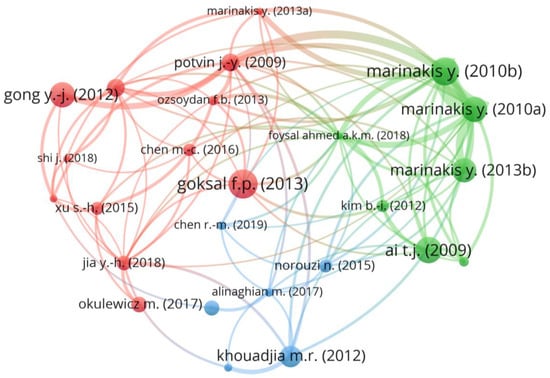
Figure 10.
Bibliographic coupling documents network for the Scopus database search, 10 minimum citations [21,22,23,24,25,26,27,28,29,30,31,32,33,34,35,36,37,38].
Bibliographic coupling was first performed on the Scopus search. Clustering was carried out using the VOS algorithm, which automatically grouped 25 publications with the greatest link strength into three groups. This can be seen in Table 6 above [21,22,23,24,25,26,27,28,29,30,31,32,33,34,35,36,37,38,39,40,41,42,43], where unique publications not shared with Web of Science are without gray fill and found in Table 7. Three main clusters are found in Figure 10: the most central red cluster includes the works by Goksal et al. [40], Gong et al. [25], and Potvin et al. [36]; they considered pickup, delivery, time windows, and evolutionary algorithms. The rightmost green cluster shows the work of Marinakis et al. [7,30,31], who addressed hybrid genetic PSO and stochastic demands. Ai and Kachitvichyanukul [22] introduced the GLNPSO variant to solve for capacitated vehicle routing. Lastly, the bottom blue cluster is broadly linked to the work of Khouadjia et al. [27]; they used PSO to solve for dynamic vehicle routing.
Table 6.
Key PSO/VRP documents from the Scopus query that are bibliographically coupled, n = 25/263.
The Scopus bibliographic coupling analysis results show that VRP research remains a central topic in the field of supply chain management, while the PSO-based solution strategies continue to be developed and improved. The most highly cited publications are those that address specific problem variants, such as the VRPTW, capacitated VRP, and those that develop new hybrid solution methods. The results demonstrate a clear shift from OR/MS to SCM research, and a move towards developing more hybrid metaheuristic solution strategies. This is likely in response to the increased computational power and ability to solve more complex problems. The top publications also confirm the thematic results from the Web of Science search.
Here, it is also important to note the disparity between the number of local database citations and link strength. In particular, the publications with high bibliographic coupling but fewer citations may indicate high relevance in a narrow field of research, but may be overlooked in the mainstream. On the other hand, publications with high citation counts but low link strength may indicate a general popularity but exert little influence on the intellectual structure of the topic. Here, intellectual structure is defined as the topology of the citation network. It can be assumed from the outputted network figures that a source with high link strength, i.e., one that that cites and is cited by many other sources, will play a more central role in the intellectual structure of its field. Furthermore, it can be assumed that a source with few local database citations but high link strength indicates the importance of other sources outside of the current query’s citation dataset in a more narrow or specialized field. Finally, publications with both high citation counts and high link strength represent a core set of publications that are highly influential in their field of study, out of which the top 25 were selected for the above table.
In order to retrospectively confirm the key reference structure of PSO/VRP research, a co-citation analysis was performed on the Scopus database. The results of this analysis are shown in Figure 11.
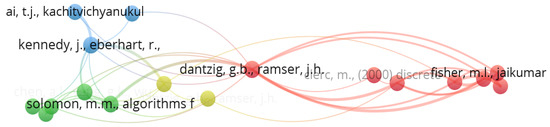
Figure 11.
Co-citation reference network for the Scopus database search, five minimum citations [3,15,22,45,46,47].
Table 7.
Key co-cited PSO/VRP documents from the Scopus query, n = 12/42.
Table 7.
Key co-cited PSO/VRP documents from the Scopus query, n = 12/42.
| Authors | Publication Title | Local Citations | Link Strength |
|---|---|---|---|
| Kennedy and Eberhart, 1995 [15] | Particle swarm optimization | 22 | 29 |
| Dantzig and Ramser, 1959 [3] | The truck dispatching problem | 27 | 25 |
| Gendreau et al., 1994 [48] | A Tabu search heuristic for the vehicle routing problem | 5 | 13 |
| Lin, 1965 [49] | Computer solutions of the traveling salesman problem | 5 | 12 |
| Rochat and Taillard, 1995 [50] | Probabilistic diversification and intensification in local search for vehicle routing | 5 | 11 |
| Solomon, 1987 [47] | Algorithms for the vehicle routing and scheduling problems with time window constraints | 14 | 11 |
| Fisher and Jaikumar, 1981 [46] | A generalized assignment heuristic for vehicle routing | 6 | 10 |
| Clerc, 2000 [45] | Discrete particle swarm optimization illustrated by the traveling salesman problem | 10 | 9 |
| Ai and Kachitvichyanukul, 2009 [22] | A particle swarm optimization for the vehicle routing problem with simultaneous pickup and delivery | 17 | 8 |
| Chen et al., 2006 [43] | Hybrid discrete particle swarm optimization algorithm for capacitated vehicle routing problem | 8 | 7 |
| Norouzi et al., 2015 [33] | Evaluating of the particle swarm optimization in a periodic vehicle routing problem | 7 | 3 |
| Dethloff, 2001 [51] | Vehicle routing and reverse logistics: the vehicle routing problem with simultaneous delivery and pick-up | 5 | 2 |
Co-citation analysis for the Scopus search was also shown graphically in Figure 11 and tabulated in Table 7 [3,15,22,33,43,45,46,46,47,48,49,50]. In total, 17 references were found, and duplicate references published in separate instances were combined with their total citations and link strengths summed, leaving 12 key references. The somewhat sparse and linear nature of Figure 6 also shows how most publications in the Scopus database, despite their high number, cited relatively fewer common sources except for these core references.
As expected, the PSO paper from [15] had the highest link strength, while the truck dispatching problem of Dantzig and Ramzer [3] had the second-highest link strength. They form the blue cluster on the left and the red on the right, respectively. In addition, a clear link is found in the research of Ai and Kachitvichyanukul [22], one of the introductory papers on GLNPSO. The introduction of the nearest neighbor social structure in GLNPSO is mirrored by the faint presence of Clerc [45] in the red cluster. Clerc [45] studied constriction methods to ensure convergence on the optimal solution. Much of the research also sought to incorporate traditional routing algorithms into PSO, resulting in citations of the seminal work of Solomon [47] in the bottom left green cluster.
More interesting are the sub-problem references listed after these two essential references: themes on Tabu search, assignment heuristics, cross-docking, hybrid metaheuristics, and variable neighborhood search demonstrate how PSO for VRP has moved away from exact mathematical optimization models and towards more effective and efficient metaheuristic solution strategies.
Next, this methodology was replicated for the Web of Science database. Figure 12 shows the bibliographic coupling network, while Figure 8 shows the co-citation network. Table 8 and Table 9, respectively, show their key publications.
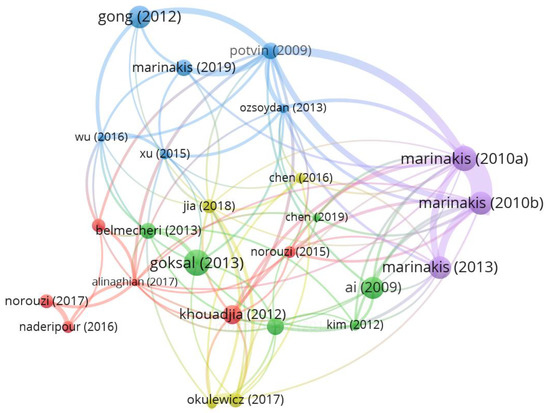
Figure 12.
Bibliographic coupling documents network for the Web of Science database search, 10 minimum citations [22,23,24,25,27,28,30,31,34,35,36,38,39,40,41,52,53,54,55].
Table 8.
Key bibliographically coupled PSO/VRP documents from the Web of Science query, n = 25/82.
Table 9.
Key co-cited PSO/VRP documents from the Web of Science query, n = 13/2517.
The results for the Web of Science bibliographic coupling analysis in Table 8 [23,25,26,27,28,30,31,32,33,34,35,38,39,40,41,44,52,53,53,54,55,56,57,58] and co-citation analysis in Table 9 [3,15,15,22,30,31,32,47,58,59,60] shared with the Scopus database search are highlighted in gray. Here, it is significant to note that although the Web of Science contains only a quarter of the publications in the Scopus database, the Web of Science’s top 25 bibliographically coupled results are nevertheless 80% similar to the top results of the Scopus search. Due to consistent database citation records, however, the bibliographic coupling figure is more distinct. The same work by Marinakis et al. [7,30,31] is seen on the far-right purple cluster, and that of Goksal [40] and Ai and Kachitvichyanukul [22] in the central green cluster. However, this green cluster also contains the work of Kim and Son [28], who expressed a simple solution approach by encoding directed probability matrices into solution particles for use in standard graph theory applications. Gong et al. [25] and Potvin [36] are replicated in the top left blue cluster. The centricity of the research by Khouadjia [27] is repeated in the red cluster, but two additional distal but distinct publications emerge in the research by Norouzi et al. [33,44] and Naderipour and Alinaghian [54]. They explored periodic and time-dependent vehicle routing, and the results of time-dependent routing on emissions, respectively. Lastly, a new, distinct cluster is shown in the work of Okulewicz et al. [34], Jia et al. [26], and Chen et al. [24], who deal with dynamic vehicle routing applications and cross-docking.
Some variation exists in a higher ranking of emissions and fuel-related publications, which were widely cited and confirmed the difference in thematic evolution between the two databases. These results suggest that although a minor number of crossover publications are observed between the two databases, a significant shift in focus in thematic diversity is seen when comparing the database results. While the Web of Science displays an additional preference for environmental and vehicle routing applications, the themes explored in the publications found in Scopus are much more varied.
Here, a distinct advantage of the Web of Science’s curation can be seen. The normalized citation format increased the completeness of all cited references, which was lacking in the Scopus search results. The seminal works of Kennedy and Eberhart [15] and Dantzig and Ramzer [3] once again take precedence, confirming the centricity of this research topic, but several sources remain unique to each database. In particular, the Web of Science cites a significantly higher number of contemporary sources also listed in both Table 3 and Table 5. This is likely because the Web of Science is a selective database that contains only the most highly cited publications.
Despite its smaller size, the thematic centricity and formatting of the Web of Science database might also be more conducive to bibliometric analysis; for example, the essential concept of PSO inertia weight introduced by Shi and Eberhart [60] entered into the top co-cited papers for the Web of Science database, but was not present in the Scopus database, either due to citation formatting differences or the co-citations of other publications. The work of by Kennedy and Eberhart [15] and Dantzig and Ramzer [3] once again appear to form the green right cluster, but another distinct source by Clarke and Wright [59], who described vehicle scheduling from a central depot, also appears in this cluster. Similarly, the research by Marinakis et al. [7,30,31], Ai and Kachitvichyanukul [22], and Solomon [47] also reappear in the left red cluster. One additional distinct source by Chen et al. [43], who dealt with hybridizing PSO with simulated annealing to escape local optima, is found (Figure 13).
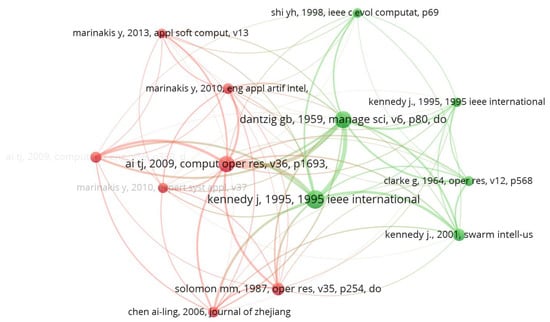
Figure 13.
Co-citation reference network for the Web of Science database search, 10 minimum citations [1,3,15,22,30,31,31,43,47,58,59].
The relatively low spread of representative citations (13/2617 at 10 minimum citations) suggests a highly broad field of applications with fewer shared citations. The results generally encompass a wide range of methods and applications, with specific reinforcement in both the vehicle routing problem literature as well as the traveling salesman problem.
4. Conclusions
This study systematically reviewed and analyzed the scientific production of PSO and VRP publications over the past 20 years to identify intellectual trends in the field. The results of this study show that there has been a shift in research focus from OR/MS towards SCM, and from exact methods to more hybrid metaheuristic solution strategies. This is likely in response to the increased computational power and ability to solve more complex problem. Furthermore, the thematic evolution results for the Web of Science database search show a narrower scope of results; however, the Web of Science database also shows insights that are not as noticeable in its Scopus counterpart. This is likely because the vehicle routing problem with time windows (VRPTW) is a classic variant of the VRP and has been frequently studied in the literature. Furthermore, the terms delivery and emission emerged as new keywords recently. This is due to the increasing importance of sustainability and “green” issues in logistics and transportation.
The bibliometric coupling and co-citation results also confirmed these observations, with VRPTW and hybrid solution strategies being two of the most important topics. In addition, this study found that despite its smaller size, the top 25 bibliographically coupled results of the Web of Science database contained 80% of Scopus’ top 25 bibliographically coupled publications. This is likely because the Web of Science contains only highly cited publications. While PSO and VRP often intersect, this study was able to identify a core set of references that are highly influential in each field of study. These results provide direction for future VRP research and underscore the significance of novel and effective PSO metaheuristics research. The novelty of this research lies in its application of bibliometrics to the specific field of PSO for VRP, and its identification of intellectual trends in this field.
Despite its insights, this study has several limitations. First, this study only considered English-language publications in the Scopus and Web of Science databases. However, PSO and VRP research is conducted all over the world and many important contributions may have been missed as a result. Therefore, future bibliometric studies may consider a wider range of languages and databases. Second, this study did not consider the clear influence of PSO on other OR/MS or SCM problem domains such as scheduling or stock control. Thus, it remains to be seen whether the intellectual trends observed in this research can also apply to these other fields. Finally, this study only considered two bibliometric databases (Scopus and Web of Science), which may have resulted in more limited conclusions than those drawn from less selective and larger databases. Future bibliometric study may also consider other database options such as the Dimensions database, which contains a wider range of publications than both Scopus and the Web of Science, and investigate in greater detail the differences between these databases.
Author Contributions
Conceptualization, S.R. and H.-M.W.; methodology, S.R.; validation, H.-M.W. and Y.-L.H.; resources, H.-M.W. and Y.-L.H.; writing—original draft preparation, S.R.; review and editing, H.-M.W. and Y.-L.H.; supervision, H.-M.W. All authors have read and agreed to the published version of the manuscript.
Funding
This research received no external funding.
Acknowledgments
The authors express their gratitude to the editor and the anonymous reviewers for their comments and valuable suggestions to improve this paper.
Conflicts of Interest
The authors declare no conflict of interest.
References
- Eberhart, R.C.; Shi, Y.; Kennedy, J. Swarm Intelligence; Elsevier: Amsterdam, The Netherlands, 2001. [Google Scholar]
- Toth, P.; Vigo, D. The Vehicle Routing Problem, 1st ed.; SIAM: Bangkok, Thailand, 2002; pp. 1–23. [Google Scholar]
- Dantzig, G.B.; Ramser, J.H. The Truck Dispatching Problem. Manag. Sci. 1959, 6, 80–91. [Google Scholar] [CrossRef]
- Garai, A.; Sarkar, B. Economically Independent Reverse Logistics of Customer-Centric Closed-Loop Supply Chain for Herbal Medicines and Biofuel. J. Clean. Prod. 2021, 334, 129977. [Google Scholar] [CrossRef]
- Sarkar, B.; Bhuniya, S. A Sustainable Flexible Manufacturing–Remanufacturing Model with Improved Service and Green Investment Under Variable Demand. Expert Syst. Appl. 2022, 202, 117154. [Google Scholar] [CrossRef]
- Sarkar, B.; Mridha, B.; Pareek, S.; Sarkar, M.; Thangavelu, L. A Flexible Biofuel and Bioenergy Production System with Transportation Disruption Under a Sustainable Supply Chain Network. J. Clean. Prod. 2021, 317, 128079. [Google Scholar] [CrossRef]
- Marinakis, Y.; Marinaki, M.; Migdalas, A. Particle Swarm Optimization for the Vehicle Routing Problem: A Survey and a Comparative Analysis; Springer: Cham, Denmark, 2018. [Google Scholar] [CrossRef]
- Ferrucci, F. Introduction to Tour Planning: Vehicle Routing and Related Problems; Springer: Berlin-Heidelberg, Germany, 2013. [Google Scholar] [CrossRef]
- Lahyani, R.; Khemakhem, M.; Semet, F. Rich Vehicle Routing Problems: From a Taxonomy to a Definition. Eur. J. Oper. Res. 2015, 241, 1–14. [Google Scholar] [CrossRef]
- Vidal, T.; Crainic, T.G.; Gendreau, M.; Prins, C. Heuristics for Multi-Attribute Vehicle Routing Problems: A Survey and Synthesis. Eur. J. Oper. Res. 2013, 231, 1–21. [Google Scholar] [CrossRef]
- Kessler, M.M. Bibliographic Coupling Between Scientific Papers. Am. Doc. 1963, 14, 10–25. [Google Scholar] [CrossRef]
- Small, H. Co-Citation in the Scientific Literature: A New Measure of the Relationship Between Two Documents. J. Am. Soc. Inf. Sci. 1973, 24, 265–269. [Google Scholar] [CrossRef]
- Van Eck, N.J.; Waltman, L. Visualizing Bibliometric Networks. In Measuring Scholarly Impact; Springer: Cham, Switzerland, 2014; pp. 285–320. [Google Scholar]
- Aria, M.; Cuccurullo, C. bibliometrix: An R-Tool for Comprehensive Science Mapping Analysis. J. Informetr. 2017, 11, 959–975. [Google Scholar] [CrossRef]
- Kennedy, J.; Eberhart, R. Particle Swarm Optimization. In Proceedings of the ICNN’95-International Conference on Neural Networks, Perth, WA, Australia, 27 November–1 December 1995; pp. 1942–1948. [Google Scholar] [CrossRef]
- Bradford, S.C. Sources of Information on Specific Subjects. Engineering 1934, 137, 85–86. [Google Scholar]
- Hirsch, J.E. An Index to Quantify an Individual’s Scientific Research Output. Proc. Natl. Acad. Sci. USA 2005, 102, 16569–16572. [Google Scholar] [CrossRef] [PubMed]
- Lotka, A.J. The Frequency Distribution of Scientific Productivity. J. Wash. Acad. Sci. 1926, 16, 317–323. [Google Scholar]
- Waltman, L.; van Eck, N.J. Field-Normalized Citation Impact Indicators and the Choice of an Appropriate Counting Method. J. Informetr. 2015, 9, 872–894. [Google Scholar] [CrossRef]
- Cobo, M.J.; López-Herrera, A.G.; Herrera-Viedma, E.; Herrera, F. An Approach for Detecting, Quantifying, And Visualizing the Evolution of a Research Field: A Practical Application to the Fuzzy Sets Theory Field. J. Informetr. 2011, 5, 146–166. [Google Scholar] [CrossRef]
- Ahmed, A.K.M.F.; Sun, J.U. Bilayer Local Search Enhanced Particle Swarm Optimization for the Capacitated Vehicle Routing Problem. Algorithms 2018, 11, 31. [Google Scholar] [CrossRef]
- Ai, T.J.; Kachitvichyanukul, V. A Particle Swarm Optimization for the Vehicle Routing Problem with Simultaneous Pickup and Delivery. Comput. Oper. Res. 2009, 36, 1693–1702. [Google Scholar] [CrossRef]
- Alinaghian, M.; Ghazanfari, M.; Norouzi, N.; Nouralizadeh, H.R. A Novel Model for the Time Dependent Competitive Vehicle Routing Problem: Modified Random Topology Particle Swarm Optimization. Networks Spat. Econ. 2017, 17, 1185–1211. [Google Scholar] [CrossRef]
- Chen, M.-C.; Hsiao, Y.-H.; Reddy, R.H.; Tiwari, M.K. The Self-Learning Particle Swarm Optimization Approach for Routing Pickup and Delivery of Multiple Products with Material Handling in Multiple Cross-Docks. Transp. Res. Part E Logist. Transp. Rev. 2016, 91, 208–226. [Google Scholar] [CrossRef]
- Gong, Y.-J.; Zhang, J.; Liu, O.; Huang, R.-Z.; Chung, H.S.-H.; Shi, Y.-H. Optimizing the Vehicle Routing Problem with Time Windows: A Discrete Particle Swarm Optimization Approach. IEEE Trans. Syst. Man Cybern. Part C Appl. Rev. 2011, 42, 254–267. [Google Scholar] [CrossRef]
- Jia, Y.-H.; Chen, W.-N.; Gu, T.; Zhang, H.; Yuan, H.; Lin, Y.; Yu, W.-J.; Zhang, J. A Dynamic Logistic Dispatching System with Set-Based Particle Swarm Optimization. IEEE Trans. Syst. Man Cybern. Syst. 2017, 48, 1607–1621. [Google Scholar] [CrossRef]
- Khouadjia, M.R.; Sarasola, B.; Alba, E.; Jourdan, L.; Talbi, E.-G. A Comparative Study Between Dynamic Adapted PSO and VNS for the Vehicle Routing Problem with Dynamic Requests. Appl. Soft Comput. 2012, 12, 1426–1439. [Google Scholar] [CrossRef]
- Kim, B.-I.; Son, S.-J. A Probability Matrix Based Particle Swarm Optimization for the Capacitated Vehicle Routing Problem. J. Intell. Manuf. 2010, 23, 1119–1126. [Google Scholar] [CrossRef]
- Marinakis, Y.; Marinaki, M. Combinatorial Neighborhood Topology Particle Swarm Optimization Algorithm for the Vehicle Routing Problem. In European Conference on Evolutionary Computation in Combinatorial Optimization; Springer: Berlin/Heidelberg, Germany, 2013; pp. 133–144. [Google Scholar]
- Marinakis, Y.; Marinaki, M. A Hybrid Genetic—Particle Swarm Optimization Algorithm for the Vehicle Routing Problem. Expert Syst. Appl. 2010, 37, 1446–1455. [Google Scholar] [CrossRef]
- Marinakis, Y.; Marinaki, M.; Dounias, G. A Hybrid Particle Swarm Optimization Algorithm for the Vehicle Routing Problem. Eng. Appl. Artif. Intell. 2010, 23, 463–472. [Google Scholar] [CrossRef]
- Marinakis, Y.; Iordanidou, G.R.; Marinaki, M. Particle swarm optimization for the vehicle routing problem with stochastic demands. Appl. Soft. Comput. 2013, 13, 1693–1704. [Google Scholar] [CrossRef]
- Norouzi, N.; Sadegh-Amalnick, M.; Alinaghiyan, M. Evaluating of the Particle Swarm Optimization in a Periodic Vehicle Routing Problem. Measurement 2015, 62, 162–169. [Google Scholar] [CrossRef]
- Okulewicz, M.; Mańdziuk, J. The Impact of Particular Components of the PSO-Based Algorithm Solving the Dynamic Vehicle Routing Problem. Appl. Soft Comput. 2017, 58, 586–604. [Google Scholar] [CrossRef]
- Ozsoydan, F.B.; Sipahioglu, A. Heuristic Solution Approaches for the Cumulative Capacitated Vehicle Routing Problem. Optimization 2013, 62, 1321–1340. [Google Scholar] [CrossRef]
- Potvin, J.-Y. State-of-the Art Review—Evolutionary Algorithms for Vehicle Routing. INFORMS J. Comput. 2009, 21, 518–548. [Google Scholar] [CrossRef]
- Shi, J.; Zhang, J.; Wang, K.; Fang, X. Particle Swarm Optimization for Split Delivery Vehicle Routing Problem. Asia-Pacific J. Oper. Res. 2018, 35, 42. [Google Scholar] [CrossRef]
- Xu, J.; Yan, F.; Li, S. Vehicle Routing Optimization with Soft Time Windows in a Fuzzy Random Environment. Transp. Res. Part E Logist. Transp. Rev. 2011, 47, 1075–1091. [Google Scholar] [CrossRef]
- Marinakis, Y.; Marinaki, M.; Migdalas, A. A Multi-Adaptive Particle Swarm Optimization for the Vehicle Routing Problem with time windows. Inf. Sci. 2019, 481, 311–329. [Google Scholar] [CrossRef]
- Goksal, F.P.; Karaoglan, I.; Altiparmak, F. A Hybrid Discrete Particle Swarm Optimization for Vehicle Routing Problem with Simultaneous Pickup and Delivery. Comput. Ind. Eng. 2013, 65, 39–53. [Google Scholar] [CrossRef]
- Wu, D.Q.; Dong, M.; Li, H.Y. Vehicle Routing Problem with Time Windows Using Multi-Objective Co-Evolutionary Approach. Int. J. Simul. Model. 2016, 15, 742–753. [Google Scholar] [CrossRef]
- Kanthavel, K.; Prasad, P. Optimization of Capacitated Vehicle Routing Problem by Nested Particle Swarm Optimization. Am. J. Appl. Sci. 2011, 8, 107–112. [Google Scholar] [CrossRef]
- Chen, A.-L.; Yang, G.-K.; Wu, Z.-M. Hybrid Discrete Particle Swarm Optimization Algorithm for Capacitated Vehicle Routing Problem. J. Zhejiang Univ. A 2006, 7, 607–614. [Google Scholar] [CrossRef]
- Norouzi, N.; Tavakkoli-Moghaddam, R.; Ghazanfari, M.; Alinaghian, M.; Salamatbakhsh, A. A New Multi-Objective Competitive Open Vehicle Routing Problem Solved by Particle Swarm Optimization. Networks Spat. Econ. 2011, 12, 609–633. [Google Scholar] [CrossRef]
- Clerc, M. Discrete Particle Swarm Optimization, Illustrated by the Traveling Salesman Problem. In New Optimization Techniques in Engineering; Springer: Berlin/Heidelberg, Germany, 2004; pp. 219–239. [Google Scholar]
- Fisher, M.L.; Jaikumar, R. A Generalized Assignment Heuristic for Vehicle Routing. Networks 1981, 11, 109–124. [Google Scholar] [CrossRef]
- Solomon, M.M. Algorithms for the Vehicle Routing and Scheduling Problems with Time Window Constraints. Oper. Res. 1987, 35, 254–265. [Google Scholar] [CrossRef]
- Gendreau, M.; Hertz, A.; Laporte, G. A Tabu Search Heuristic for the Vehicle Routing Problem. Manag. Sci. 1994, 40, 1276–1290. [Google Scholar] [CrossRef]
- Lin, S. Computer Solutions of the Traveling Salesman Problem. Bell Syst. Technol. J. 1965, 44, 2245–2269. [Google Scholar] [CrossRef]
- Rochat, Y.; Taillard, É.D. Probabilistic Diversification and Intensification in Local Search for Vehicle Routing. J. Heuristics 1995, 1, 147–167. [Google Scholar] [CrossRef]
- Dethloff, J. Vehicle Routing and Reverse Logistics: The Vehicle Routing Problem with Simultaneous Delivery and Pick-Up. OR Spektrum 2001, 23, 79–96. [Google Scholar] [CrossRef]
- Belmecheri, F.; Prins, C.; Yalaoui, F.; Amodeo, L. Particle Swarm Optimization Algorithm for A Vehicle Routing Problem with Heterogeneous Fleet, Mixed Backhauls, and Time Windows. J. Intell. Manuf. 2012, 24, 775–789. [Google Scholar] [CrossRef]
- Chen, R.-M.; Shen, Y.-M.; Hong, W.-Z. Neural-Like Encoding Particle Swarm Optimization for Periodic Vehicle Routing Problems. Expert Syst. Appl. 2019, 138, 112833. [Google Scholar] [CrossRef]
- Naderipour, M.; Alinaghian, M. Measurement, Evaluation and Minimization of CO2, NO, And CO Emissions in the Open Time Dependent Vehicle Routing Problem. Measurement 2016, 90, 443–452. [Google Scholar] [CrossRef]
- Norouzi, N.; Sadegh-Amalnick, M.; Tavakkoli-Moghaddam, R. Modified Particle Swarm Optimization in a Time-Dependent Vehicle Routing Problem: Minimizing Fuel Consumption. Optim. Lett. 2016, 11, 121–134. [Google Scholar] [CrossRef]
- Okulewicz, M.; Mańdziuk, J. A Metaheuristic Approach to Solve Dynamic Vehicle Routing Problem in Continuous Search Space. Swarm Evol. Comput. 2019, 48, 44–61. [Google Scholar] [CrossRef]
- Moghaddam, B.F.; Ruiz, R.; Sadjadi, S.J. Vehicle Routing Problem with Uncertain Demands: An Advanced Particle Swarm Algorithm. Comput. Ind. Eng. 2012, 62, 306–317. [Google Scholar] [CrossRef]
- Ai, T.J.; Kachitvichyanukul, V. Particle Swarm Optimization and Two Solution Representations for Solving the Capacitated Vehicle Routing Problem. Comput. Ind. Eng. 2009, 56, 380–387. [Google Scholar] [CrossRef]
- Clarke, G.; Wright, J.W. Scheduling of Vehicles from a Central Depot to a Number of Delivery Points. Oper. Res. 1964, 12, 568–581. [Google Scholar] [CrossRef]
- Shi, Y.; Eberhart, R. A modified particle swarm optimizer. In Proceedings of the 1998 IEEE International Conference on Evolutionary Computation Proceedings. IEEE World Congress on Computational Intelligence (Cat. No. 98TH8360), Anchorage, AK, USA, 4–9 May 1998; pp. 69–73. [Google Scholar] [CrossRef]
Publisher’s Note: MDPI stays neutral with regard to jurisdictional claims in published maps and institutional affiliations. |
© 2022 by the authors. Licensee MDPI, Basel, Switzerland. This article is an open access article distributed under the terms and conditions of the Creative Commons Attribution (CC BY) license (https://creativecommons.org/licenses/by/4.0/).