Abstract
We define an addition signed Cayley graph on a unitary addition Cayley graph represented by , and study several properties such as balancing, clusterability and sign compatibility of the addition signed Cayley graph . We also study the characterization of canonical consistency of , for some n.
MSC:
05C 22; 05C 75
1. Introduction
We refer to standard books of Harary [1] and West [2] for graph theory. For the signed graphs, we refer to Zaslavsky [3,4]. All the signed graphs considered in this paper are simple, finite and loopless.
For the preliminaries, definition and notation of signed graph S, underlying graph , its negation , signed isomorphism and its positive (negative) section, we refer to [5,6].
Some Basic Lemma and Theorems which are used in this paper are stated below as a reference.
Lemma 1
([7]). A signed graph in which every chordless cycle is positive is balanced.
Theorem 1
([8]). A signed graph S is clusterable if—and only if—S does not contains a cycle with exactly one negatively charged edge.
For balancing, clusterability, marking, canonical marking (-marking), consistency, -consistency, S consistency, sign compatibility, line signed graph , line signed root graph, ×-line signed graph, ×-line signed root graph and the common-edge signed graph of signed graph, S we refer to [6,9,10,11,12,13,14,15,16].
Addition Signed Cayley Graph
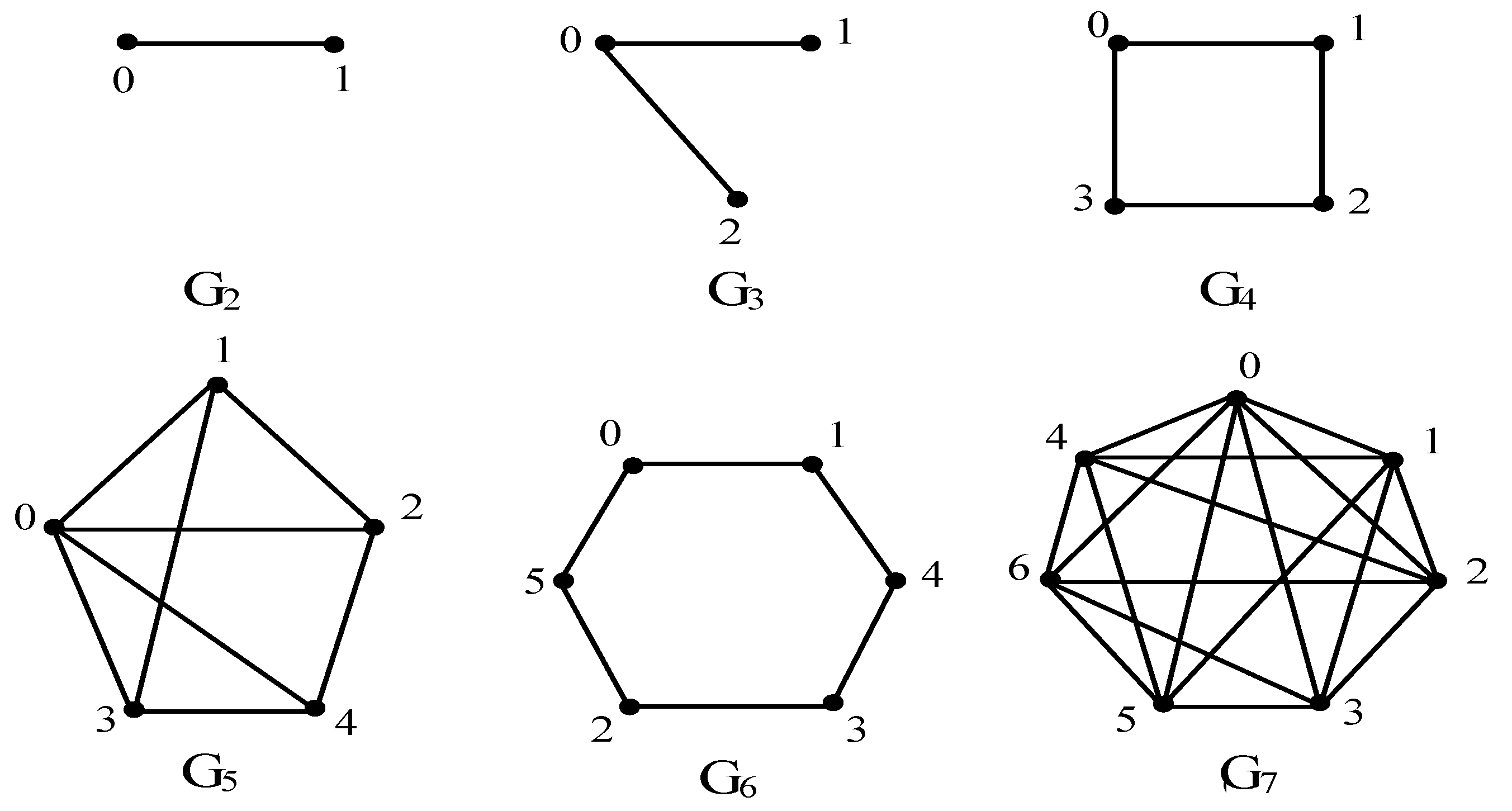
A unitary addition Cayley graph , where , is set of positive integers, is a graph in which the vertex set is a ring of integers modulo n, . Any two vertices and are adjacent in if—and only if—, where denotes the unit set.
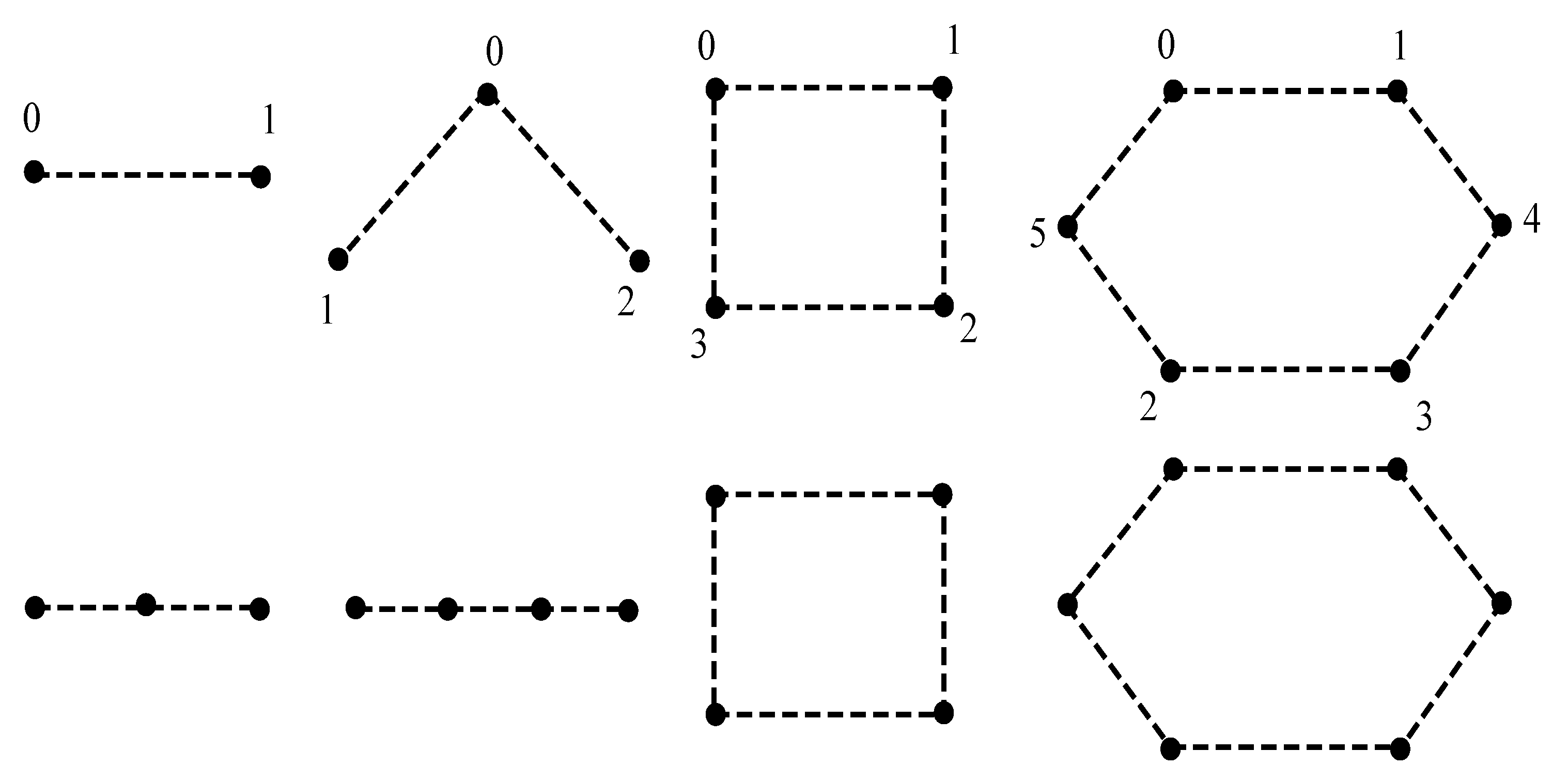
Unitary addition Cayley graphs for n = 2, 3, 4, 5, 6 and 7 are shown in Figure 1.
Figure 1.
Examples of unitary addition Cayley graphs.
The study of unitary Cayley graphs began in order to gain some insight into the graph representation problem (see [17]), and we can extend it to the signed graphs (see [18]).
Now, we introduce the definition of an addition signed Cayley graph as follows:
The addition signed Cayley graph is a signed graph whose underlying graph is a unitary addition Cayley graph , where and for an edge of ,
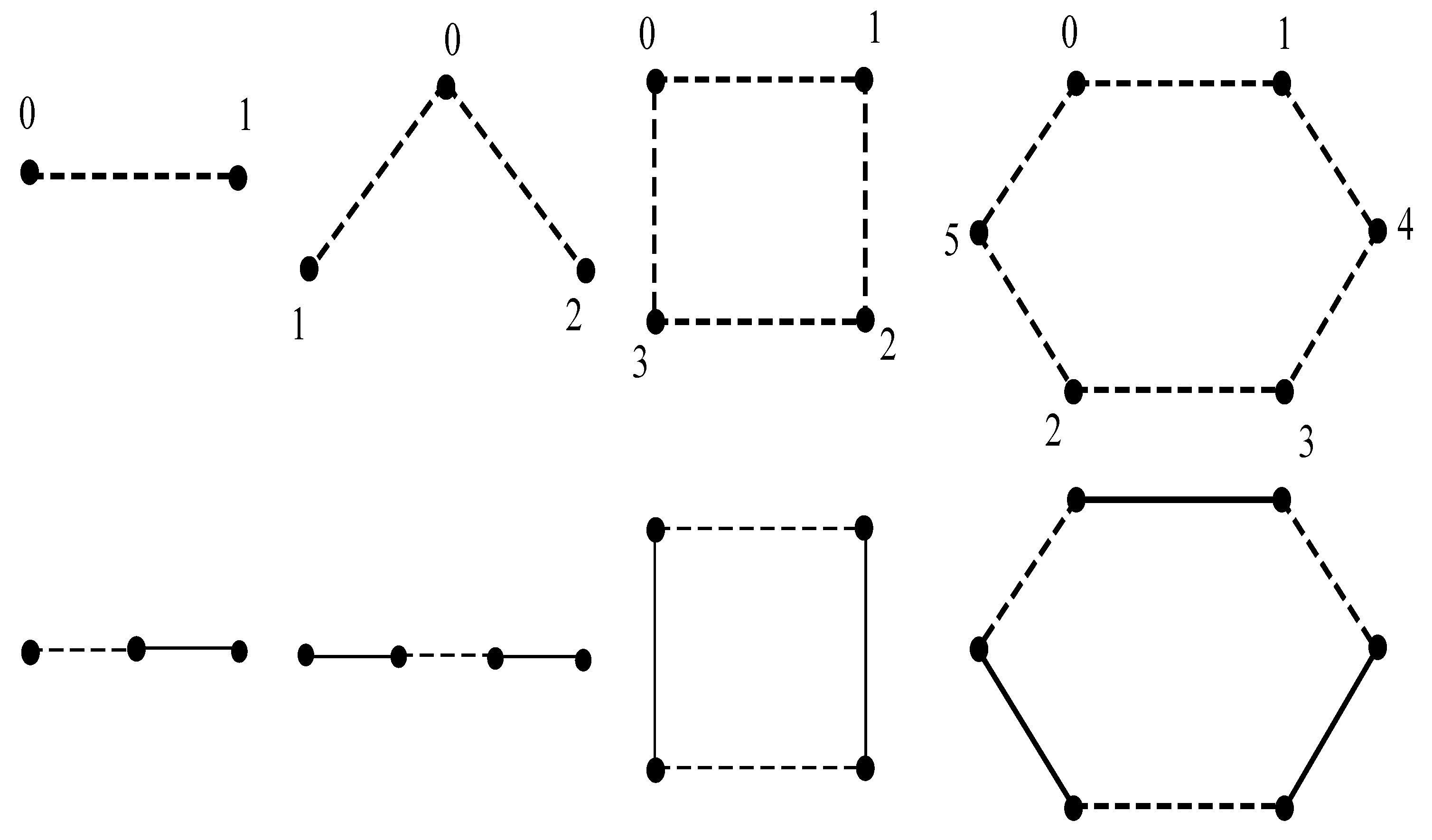
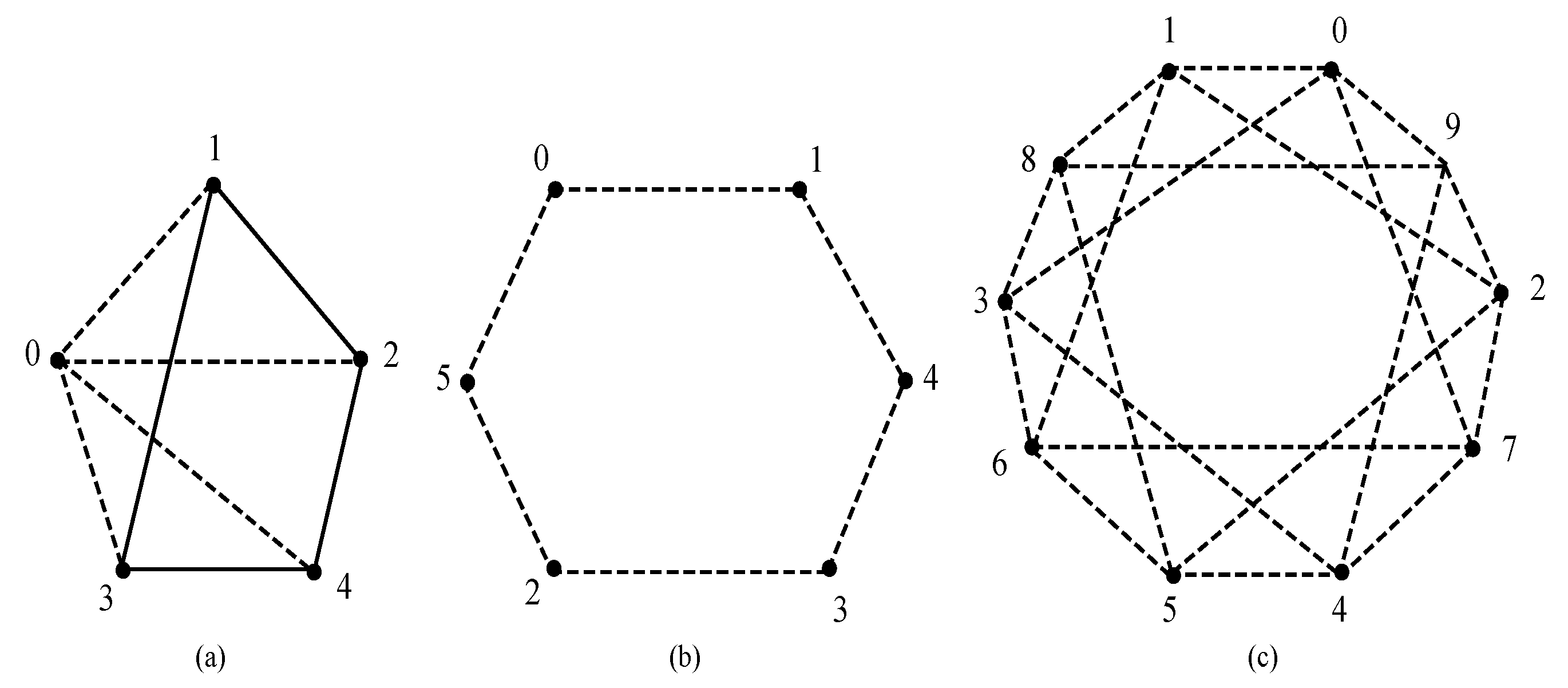
Examples of addition signed Cayley graph for n = 5, 6 and 10 can be seen in Figure 2a–c. Throughout the paper, we consider .
Figure 2.
Examples of addition signed Cayley graph .
2. Some Properties of
2.1. Balancing in
The balancing of some derived signed Cayley graphs has been studied in the literature (see [19]). Here, we find out the property of balancing for the addition signed Cayley graph , for which the following well-known result can be used as a tool.
Theorem 2
([20]). , is bipartite if—and only if—either or n is even.
Lemma 2.
and .
Lemma 3.
Addition signed Cayley graph , for n even, is an all-negative signed graph.
Proof.
Given an addition signed Cayley graph , where n is even. Suppose the conclusion is false. Let there be a positive edge, say , in . By the definition of , . Since n is even, consists only of odd numbers. Thus, i and j are odd numbers and their addition is an even number. This shows that , i.e., i and j, are not adjacent in . Thus, we have a contradiction. Hence, if n is even, then is all-negative signed graph. □
Sampathkumar [21] gave the famous characterization to prove the balancing in a signed graph, which is as follows:
Theorem 3
(Marking Criterion [21]). A signed graph is balanced if—and only if—there exists a marking μ of its vertices such that each edge in S satisfies .
Lemma 4.
For the addition signed Cayley graph , is a balanced signed graph, if for any prime p, .
Proof.
, where p is a prime number. Now, we assign a marking to the vertices of in such a manner that if , then and if , then , ∀ Suppose there is an edge, say , in .
Case I: Let Then, and according to the marking Thus,
Case II: Let Then, there are three possibilities:
- , .
- , .
- .
Now, for (a) and (b), by marking , we get and or vice versa. Therefore, Now, if . Then, i and j are both multiples of p, and then , where k is some positive integer and . So . Thus, condition (c) is not possible. So in every condition we get . Since is an arbitrary edge, using Theorem 3, is balanced. □
Theorem 4.
The addition signed Cayley graph is balanced if—and only if—either n is even or if n has exactly one prime factor, then n is odd.
Proof.
Necessity: First, suppose is balanced. Now, let ; being distinct primes, , .
In the unitary addition Cayley graph , for and are some positive integers i.e., , so is adjacent with one. Now, we claim that and are adjacent in . On the contrary, suppose is not an edge in . Then, . Thus, for some and are some positive integers. Let be a multiple of .
for the positive integer , a contradiction. With the same argument, we can show that is not a multiple of . Now, let , for As we know, the addition of two prime factors is always even; is even. So, is even and is at least 2. However, as , is always less than any multiple of for Thus, and is an edge in . Next, if is adjacent to 1 in , we get a cycle
in . Clearly, and are not in , then by definition of , C is a negative cycle. Thus, we have a negative cycle in , implying that is not balanced. Now, suppose , since Then, ; , c are positive integers. Clearly,
is a positive integer.
Since , according to Lemma 2, . Next, we claim that is adjacent to 1 or . If then according to Lemma 2, Suppose Then, ; , are positive integers. Let However, from Equation (1), This implies
This is not possible, as is at least Thus, is not a multiple of any of the s, whence . Hence, whence is adjacent to 1 in . Now, Since , ; , k is a positive integer. Additionally, is not a multiple of This shows that and by Lemma 2, This shows that is adjacent to in Thus, we get a cycle
in Clearly, and do not belong to and Then, by definition , we have a cycle with three negative edges. Thus, a contradiction. So, by contraposition, necessity is true.
Sufficiency: Let n be even. Then, according to Lemma 3, is an all-negative signed graph. Additionally, according to Theorem 2, is a bipartite graph. Hence, , by Lemma 3 and Theorem 2, is balanced.
Now, let n be odd, with exactly one prime factor. Then, according to Lemma 4, is balanced, hence the theorem. □
2.2. Clusterability in
Theorem 5.
The addition signed Cayley graph is clusterable.
Proof.
Given an addition signed Cayley graph . Suppose . Define , such that . By the definition of , clearly and v are in .
If, for i and j, (), and are adjacent, then . Thus, . Since , (say) vertices are not in . Thus, only negative edges are incident on these k vertices. Put all these vertices in the k partition , such that each partition contains exactly only one vertex. The clearly induced subgraph is all positive. Additionally, no positive edge joins the vertex of with the vertex of any of , for , and there is no edge , such that and . Thus, there exists a partition of the , such that every positive edge has end vertices within the same subset and every negative edge has end vertices in a different subset. Hence, the proof. □
2.3. Sign-Compatibility in
Theorem 6
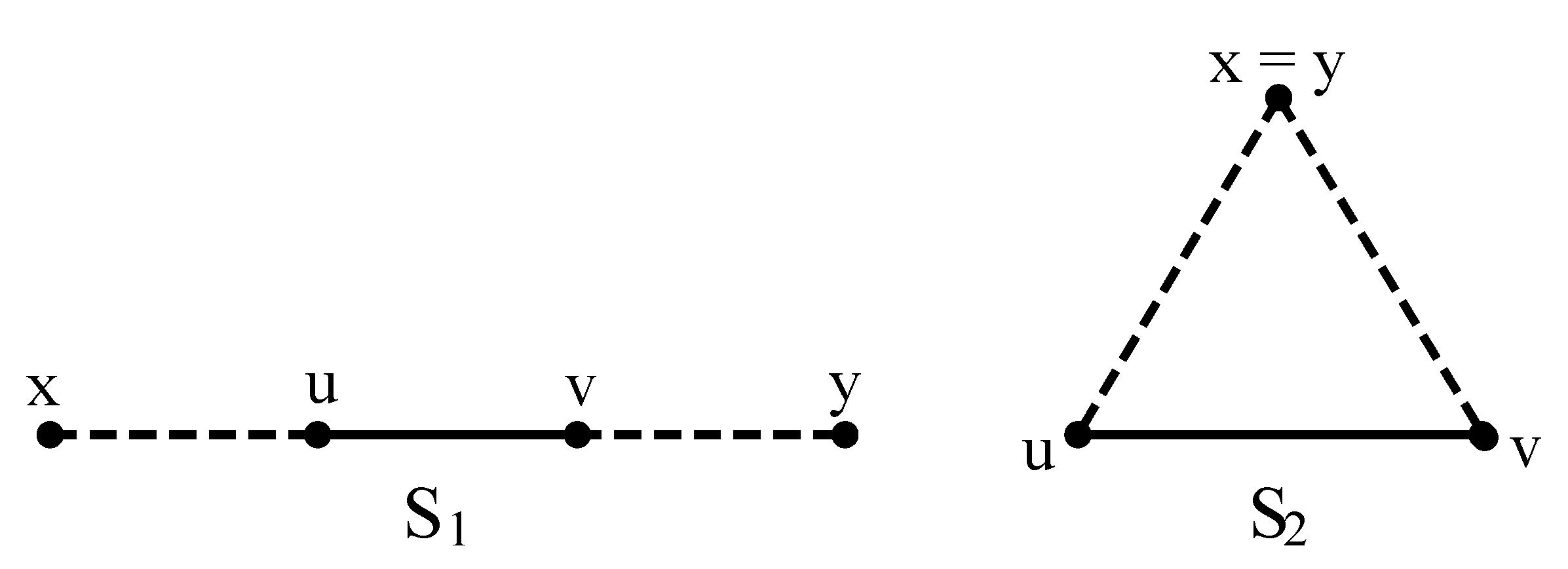
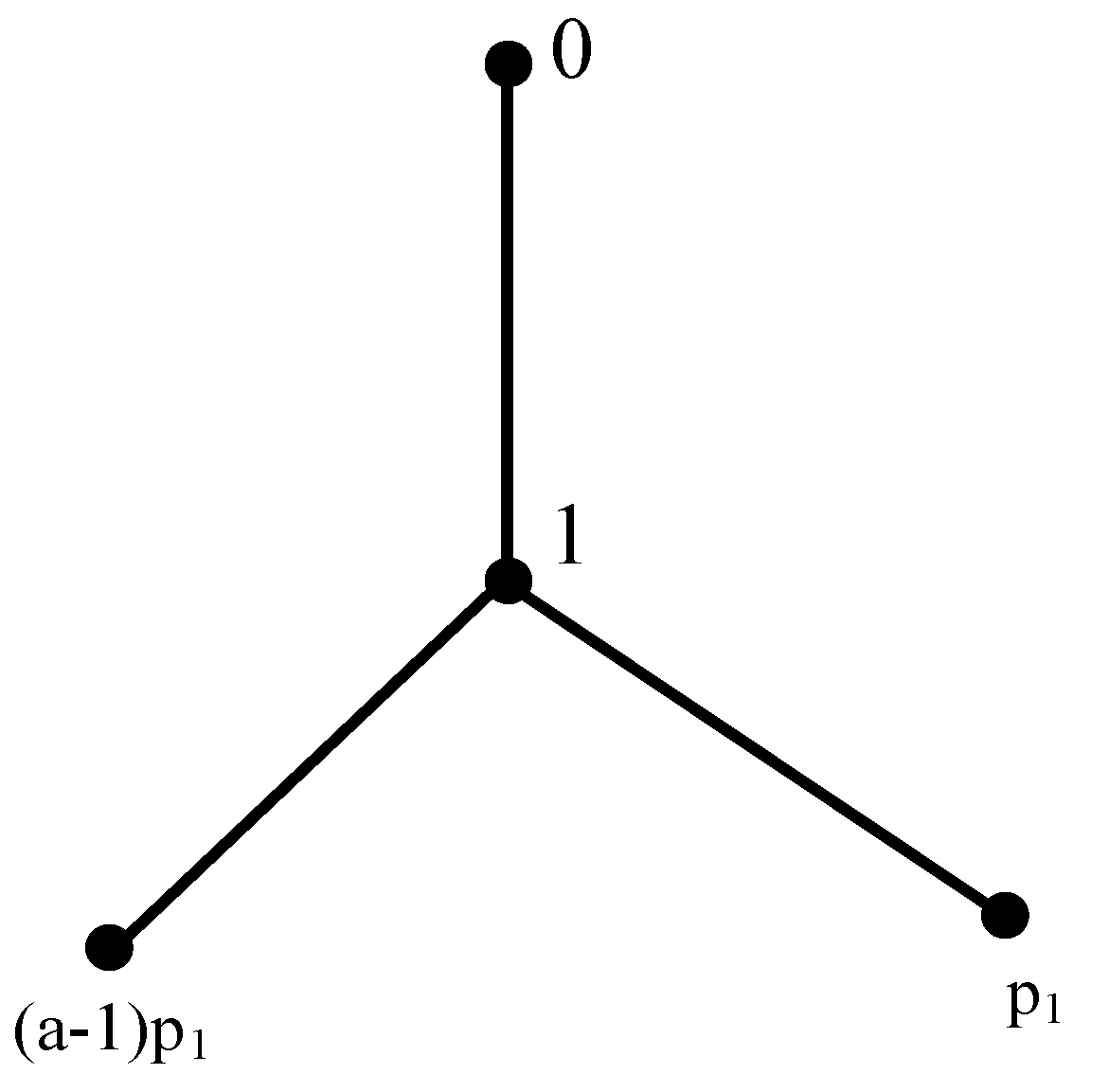
([22]). A signed graph S is sign compatible if—and only if—S does not contain a sub signed graph isomorphic to either of the two signed graphs. formed by taking the path with both edges and negative and edge positive, and formed by taking and identifying the vertices x and y (Figure 3).
Figure 3.
Two forbidden sub signed graphs for a sign-compatible signed graph [13].
Theorem 7.
Addition signed Cayley graph is sign compatible if—and only if—n is 3 or even.
Proof.
Let addition signed Cayley graph be sign compatible. If possible, suppose the conclusion is not true. Let n be odd but not 3. Now, . As, , . Additionally, . Thus, we have a triangle with one positive edge and two negative edges 01 and , which again contradict Theorem 6. Hence, the condition is necessary.
Next, let n be even. Thus, according to Lemma 3, , which is all-negative, is trivially sign compatible. If , then is , which is trivially sign compatible. □
Acharya and Sinha [23] showed that every line signed graph is sign compatible. Next, we discuss the value of n for which is a line signed graph.
Theorem 8.
is a line graph if—and only if—n is equal to 2 or 3 or 4 or 6.
Proof.
Necessity: Let be a line graph. Meanwhile, n is not equal to 2, 3, 4 and 6.
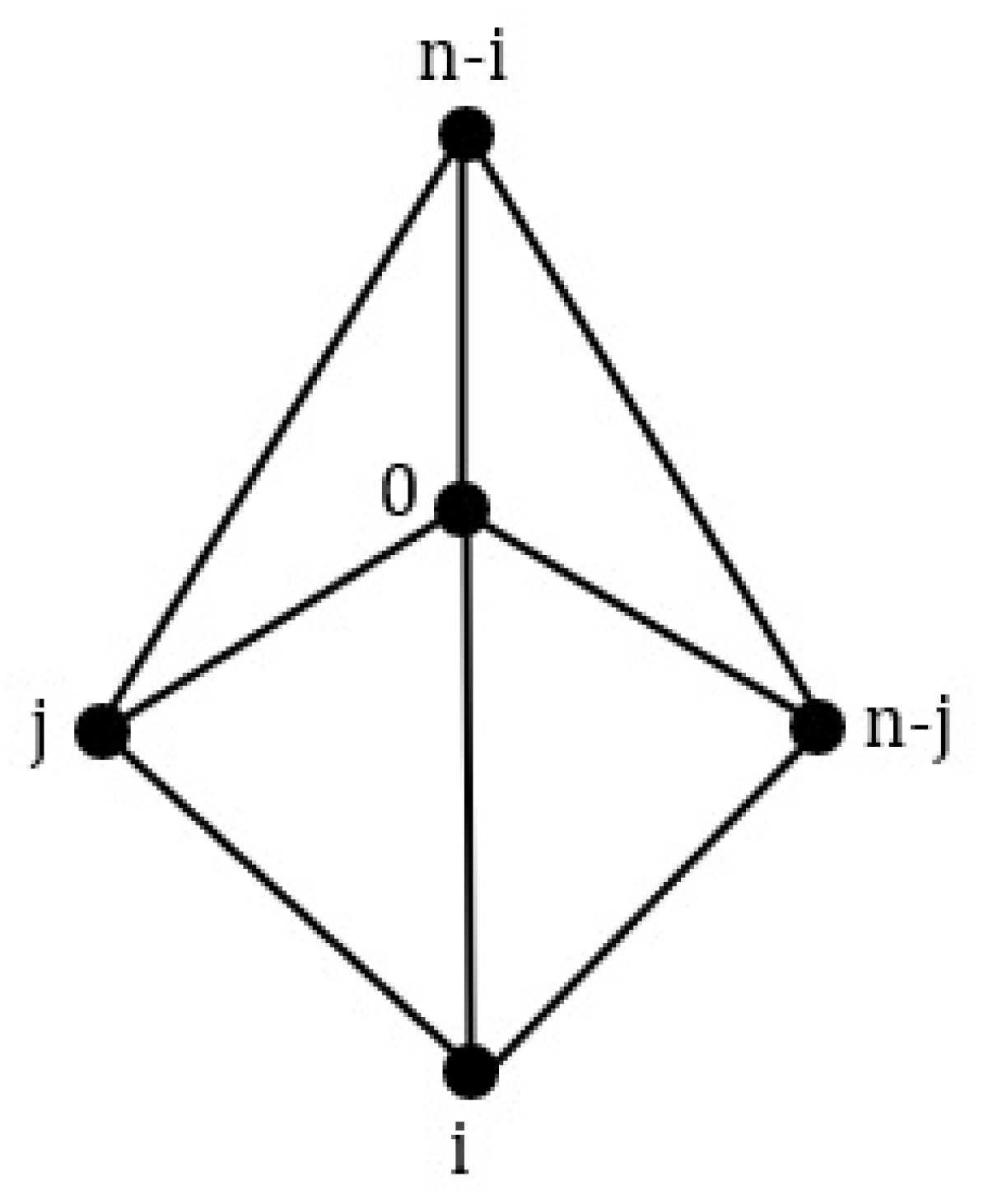
Case I: n is prime. It is clear that Here, n is prime, so by the definition of , there are numbers from 1 to in 0 is connected to every vertex of The other vertex, , in is not connected to only by definition. For any ; , there is an induced subgraph in (see Figure 4).
Figure 4.
A forbidden subgraph for a line graph in .
Thus, contains forbidden subgraph for a line graph. Thus, is not a line graph.
Case II: n is not prime. 1 is connected to 0 in Next, 1 is connected to as where is the smallest factor of Let , for a positive integer . Now,
Since by Lemma 2, Thus, 1 and are adjacent in Additionally, 0 is not adjacent to and , because their sum is a multiple of In the same way, and are not connected in because their sum is a multiple of So, we have an induced subgraph in (see Figure 5). Thus, there is a forbidden subgraph of a line graph. Additionally, is not a line graph.
Figure 5.
A forbidden subgraph for a line graph in .
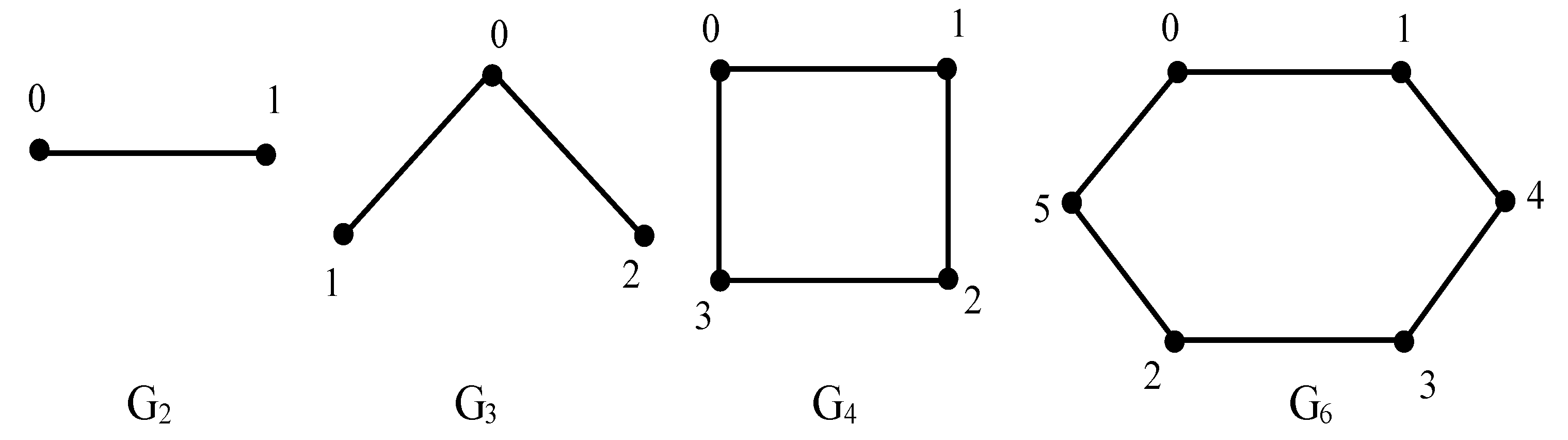
Sufficiency: Let or or or . Then, , , and (see Figure 6). Hence, the result. □
Figure 6.
Showing and .
Theorem 9.
is a line signed graph if—and only if— or or or .
Proof.
Necessity: Let, if possible, n be unequal to 2, 3, 4 and 6. Theorem 8 shows that , for any graph G. Thus, a contradiction and the condition are necessary.
Sufficiency: Now, suppose or or or . Line signed graphs of an addition signed Cayley graph, for these values of n, are displayed in Figure 7, hence the sufficiency. □
Figure 7.
Showing , , and and its line signed root graphs.
Remark 1.
is a ×-line signed graph if—and only if— or or or .
Proof.
Let be a line signed graph. We know that the underlying structure for line signed graphs and line signed graphs is the same. Thus, the condition comes from Theorem 8.
Next, let . , , and and its line signed root graphs are displayed in Figure 8. From Theorem 4, it is clear that for these values of an addition signed Cayley graph is balanced. Additionally, of any signed graph is always balanced, and its underlying graph is a line graph (see [24]). This result comes from Theorems 4 and 8. □
Figure 8.
Showing , , and and its line signed root graphs.
2.4. -Consistency of
Lemma 5.
For any prime p, and , the and in is odd.
Proof.
Given a , where and p is an odd prime. Since n is odd; 2, . It is obvious that and in appear only when 2 and 4 are adjacent to , where k is some positive integer. Now, ; positive integers c and k. Additionally, 2 and 4 are connected to all the multiples of p, which are . Therefore is odd, hence the lemma. □
Theorem 10
([25]). Let a, b and m be integers with m positive. The linear congruence is soluble if and only if . If is a solution, there are exactly incongruent solutions given by , where .
Corollary 1.
If then the congruence has exactly one incongruent solution.
Lemma 6.
In addition, signed Cayley graph , if , where and are two distinct odd primes, then = odd.
Proof.
Given that in , and are distinct odd primes. As n is odd, . Now, the negative degree of 2 of appears only when 2 is adjacent with the multiples of and . Let . Then,
and
Thus, using the inclusion–exclusion principle
Since , for certain positive integers c and so, for those c. Thus, according to Theorem 10, we have
and
Due to Corollary 1, we have an incongruent solution (say), which is unique for Equation (2). So, for Equation (2) where , we have:
and are odd primes, which implies is odd. The proof for is analogous. □
Lemma 7.
In , if , then = odd.
Proof.
This is easy to prove using the same logic as mentioned in Lemma 6. □
Theorem 11.
Let n have at most two distinct odd prime factors, then is consistent if—and only if—n is even or 3.
Proof.
Necessity: Let n have, at most, two distinct prime factors and let be consistent. If possible, let n be odd but not 3.
Case (a): Let or . As n is odd, . Clearly, 0 is adjacent with 1, 2, in Since, , and 2 are connected in Since, 3 is not a factor of n, Now, . Hence, 2 and 1 are adjacent in Now, the cycles , have a common chord with end vertices 0 and 2. By Lemma 6,
Since the vertex , even. It follows,
Now, if either or is not a -consistent cycle, a contradiction. Thus, and both cycle are -consistent. The common chord with end vertices zero and two are oppositely marked, in contradiction with (Theorem 2, [26]).
Case (b): Let Then, either or First, suppose Since, n is odd, According to Lemma 2, Clearly, 0 is adjacent to 1, 4 and in Since, , is adjacent to 4 in Now, for cycle , ; , have a common chord with end vertices 0 and 4. According to Lemma 6,
Since the vertex even. It follows,
Now, if either or is a cycle which is not consistent, a contradiction. Therefore, and are the cycles which are -consistent. However, there is a chord whose end vertices 0 and 4 have opposite marking. Here again, we find a contradiction to the (Theorem 2, [26]).
Now, suppose In this case, we consider two cycles and in For cycles , have a common chord with end vertices 0 and 7, according to Lemma 7,
Since the vertex even. It follows that
Now, if either or is a cycle which is not consistent, this is a contradiction. Therefore, and are the cycles which are consistent. However, the end vertices 0 and 7 have the opposite marking. Here, we have a contradiction to the (Theorem 2, [26]). Hence, n is either even or .
Sufficiency: Let n be even. According to Lemma 3, is all negative. Additionally, according to Theorem 13, = even ∀ So, according to canonical marking ∀ So when n is even, is trivially consistent. If , then is a path, which is trivially - consistent, hence the result. □
3. Balance in Certain Derived Signed Graphs of
Theorem 12.
is balanced if—and only if—n is 3 or even.
Proof.
Let be balanced. If possible, n is odd but not 3, and p is the smallest prime factor of . Since , and 1 are connected in . implies that p and 1 are connected in Additionally, as n is odd, and according to Lemma 2. Since, , Now, for the cycle in we have a one positive edge and two negative edges and in However, in , there is a cycle with one negative edge and two positive edges and Thus, we have a negative cycle that contradicts the given condition. Therefore, the only possibility is that n is 3 or even.
Conversely, let n be even. , according to Lemma 3 is an all-negative signed graph. So is balanced and is all positive. for is a tree which is trivially balanced, hence the converse. □
We present the following theorem for the degree of the vertices of (see [20]).
Theorem 13
([20]). Let m be any vertex of the unitary addition Cayley graph . Then,
Additionally, for a signed graph S, the balance property of is discussed in ([27], Theorem 4).
Theorem 14.
For an additional signed Cayley graph , its line signed graph is balanced if—and only if—
Proof.
Let be balanced and and 6. Now, according to Theorem 13, = even, which implies This shows that condition (of Theorem 4, [27]) is not satisfied for This is a contradiction. Hence, The converse part is easy to prove. □
For a signed graph S, the balance property of is discussed in ([9], Theorem 13).
Theorem 15.
For an additional signed Cayley graph , its common-edge signed graph is balanced if—and only if—
Proof.
Let It is clear that Now, by Theorem 13, = even, which implies This shows that condition (of Theorem 13, [9]) is not satisfied for Thus, is not balanced, which is a contradiction. Hence, . The converse part is easy to prove. □
Author Contributions
Conceptualization, D.S.; Formal analysis, O.W., D.S. and A.D.; Methodology, O.W.; Supervision, D.S.; Writing—review & editing, O.W. and D.S. All authors have read and agreed to the published version of the manuscript.
Funding
The first author thanks the South Asian University for research grant support. The third author is grateful to DST [MTR/2018/000607] for the support under the Mathematical Research Impact Centric Support (MATRICS).
Data Availability Statement
No data were used to support the findings of the study.
Conflicts of Interest
All the authors declare that they have no conflict of interest regarding the publication of this paper.
References
- Harary, F. Graph Theory; Addison-Wesley Publ. Comp.: Boston, MA, USA, 1969. [Google Scholar]
- West, D.B. Introduction to Graph Theory; Prentice-Hall of India Pvt. Ltd.: New Delhi, India, 1996. [Google Scholar]
- Zaslavsky, T. A mathematical bibliography of signed and gain graphs and allied areas. Electron. J. Combin. 2018, DS8. [Google Scholar] [CrossRef]
- Zaslavsky, T. Glossary of signed and gain graphs and allied areas. Electron. J. Combin. 1998, DS9. Available online: https://www.combinatorics.org/files/Surveys/ds9/ds9v1-1998.pdf (accessed on 11 July 2022).
- Harary, F. On the notion of balance of a signed graph. Mich. Math. 1953, 2, 143–146. [Google Scholar] [CrossRef]
- Sinha, D.; Wardak, O.; Dhama, A. On Some Properties of Signed Cayley Graph Sn. Mathematics 2022, 10, 2633. [Google Scholar] [CrossRef]
- Zaslavsky, T. Signed analogs of bipartite graphs. Discrete Math. 1998, 179, 205–216. [Google Scholar] [CrossRef]
- Davis, J.A. Clustering and structural balance in graphs. Hum. Relat. 1967, 20, 181–187. [Google Scholar] [CrossRef]
- Acharya, M.; Sinha, D. Common-edge sigraphs. AKCE Int. J. Graphs Comb. 2006, 3, 115–130. [Google Scholar]
- Behzad, M.; Chartrand, G.T. Line coloring of signed graphs. Elem. Math. 1969, 24, 49–52. [Google Scholar]
- Gill, M.K. Contribution to Some Topics in Graph Theory and It’s Applications. Ph.D. Thesis, Indian Institute of Technology, Bombay, India, 1969. [Google Scholar]
- Sharma, P.; Acharya, M. Balanced signed total graphs of commutative ring. Graphs Combin. 2016, 32, 1585–1597. [Google Scholar] [CrossRef]
- Sinha, D. New Frontiers in the Theory of Signed Graphs. Ph.D. Thesis, University of Delhi, New Delhi, India, 2005. [Google Scholar]
- Acharya, B.D. A characterization of consistent marked graphs. Nat. Acad. Sci. Lett. USA 1983, 6, 431–440. [Google Scholar]
- Sinha, D.; Acharya, M. Characterization of signed graphs whose iteratied line graphs are balanced and S-consistent. Bull. Malays. Math. Sci. Soc. 2016, 39, 297–306. [Google Scholar] [CrossRef]
- Zaslavsky, T. Consistency in the naturally vertex-signed line graph of a signed graph. Bull. Malays. Math. Sci. Soc. 2016, 39, 307–314. [Google Scholar] [CrossRef]
- Evans, A.B.; Fricke, G.H.; Maneri, C.C.; McKee, T.A.; Perkel, M. Representations of graphs modulo n. J. Graph Theory 1994, 18, 801–815. [Google Scholar] [CrossRef]
- Sinha, D.; Dhama, A. Unitary Cayley Meet Signed Graphs. Electron. Notes Discret. Math. 2017, 63, 425–434. [Google Scholar] [CrossRef]
- Sinha, D.; Garg, P. On the unitary Cayley signed graphs. Electron. J. Comb. 2011, 18, P229. [Google Scholar] [CrossRef]
- Sinha, D.; Garg, P.; Singh, A. Some properties of unitary addition Cayley graphs. Notes Number Theory Discret. Math. 2011, 17, 49–59. [Google Scholar]
- Sampathkumar, E. Point-signed and line-signed graphs. Natl. Acad. Sci. Lett. 1984, 7, 91–93. [Google Scholar]
- Sinha, D.; Dhama, A. Sign-Compatibility of common-edge signed graphs and 2-path signed graphs. Graph Theory Notes N.Y. 2013, 65, 55–61. [Google Scholar]
- Acharya, M.; Sinha, D. Characterizations of line sigraphs. Nat. Acad. Sci. Lett. 2005, 28, 31–34. [Google Scholar] [CrossRef]
- Acharya, M. ×-line sigraph of a sigraph. J. Combin. Math. Combin. Comput. 2009, 69, 103–111. [Google Scholar]
- Rose, H.E. A Course in Number Theory; Oxford Science Publications; Oxford University Press: Oxford, UK, 1988. [Google Scholar]
- Hoede, C. A characterization of consistent marked graphs. J. Graph Theory 1992, 16, 17–23. [Google Scholar] [CrossRef]
- Acharya, M.; Sinha, D. A Characterization of Sigraphs Whose Line Sigraphs and Jump Sigraphs are Switching Equivalent. Graph Theory Notes N. Y. 2003, 44, 30–34. [Google Scholar]
Publisher’s Note: MDPI stays neutral with regard to jurisdictional claims in published maps and institutional affiliations. |
© 2022 by the authors. Licensee MDPI, Basel, Switzerland. This article is an open access article distributed under the terms and conditions of the Creative Commons Attribution (CC BY) license (https://creativecommons.org/licenses/by/4.0/).