Artificial Intelligence in the Personalization of Teaching of Higher Mathematics Students in Kazakhstan

 , ,
, ,  , and
, and
Abstract
1. Introduction
- RQ1. How frequently do students use AI chatbots when studying higher mathematics?
- RQ2. For which topics and learning tasks in higher mathematics do students most frequently use chatbots?
- RQ3. What benefits and limitations of AI chatbots do students perceive in the context of learning higher mathematics?
2. Literature Review
2.1. Artificial Intelligence in Education
2.2. Intelligent Educational Systems
2.3. Types of IES
- Adaptive Hypermedia Systems (AHS): systems that personalize the navigation structure and presentation of learning resources—such as texts, multimedia content, and hyperlinks—based on learners’ characteristics, preferences, and prior knowledge (Brusilovsky, 2001).
- Dynamic Task Generation Systems (DTGS): systems that automatically generate, select, or sequence learning tasks and provide corresponding solutions and feedback using pedagogical and domain models, thereby supporting task variability and individualized practice (Circi et al., 2023).
- Generative AI and LLM-based Tools: systems that leverage large language models to generate explanations and learning-support content on demand; these tools are increasingly discussed in the literature as flexible and scalable solutions for personalized learning support (Kasneci et al., 2023).
2.4. AI in Mathematics Education
Design Higher Mathematics Courses in Moodle Cloud
2.5. Chatbots in Education
3. Materials and Methods
3.1. Research Design and Setting
3.2. Participants
3.3. Instrument (Questionnaire)
- students’ understanding of chatbots;
- the frequency and purposes of chatbot use in higher mathematics;
- preferred types of chatbots;
- perceived benefits and limitations of chatbot use;
- desired chatbot functionalities.
3.4. Data Collection Procedure
3.5. Data Analysis
3.6. Ethics and Limitations of the Study
4. Results
4.1. Respondents’ Understanding of Chatbots
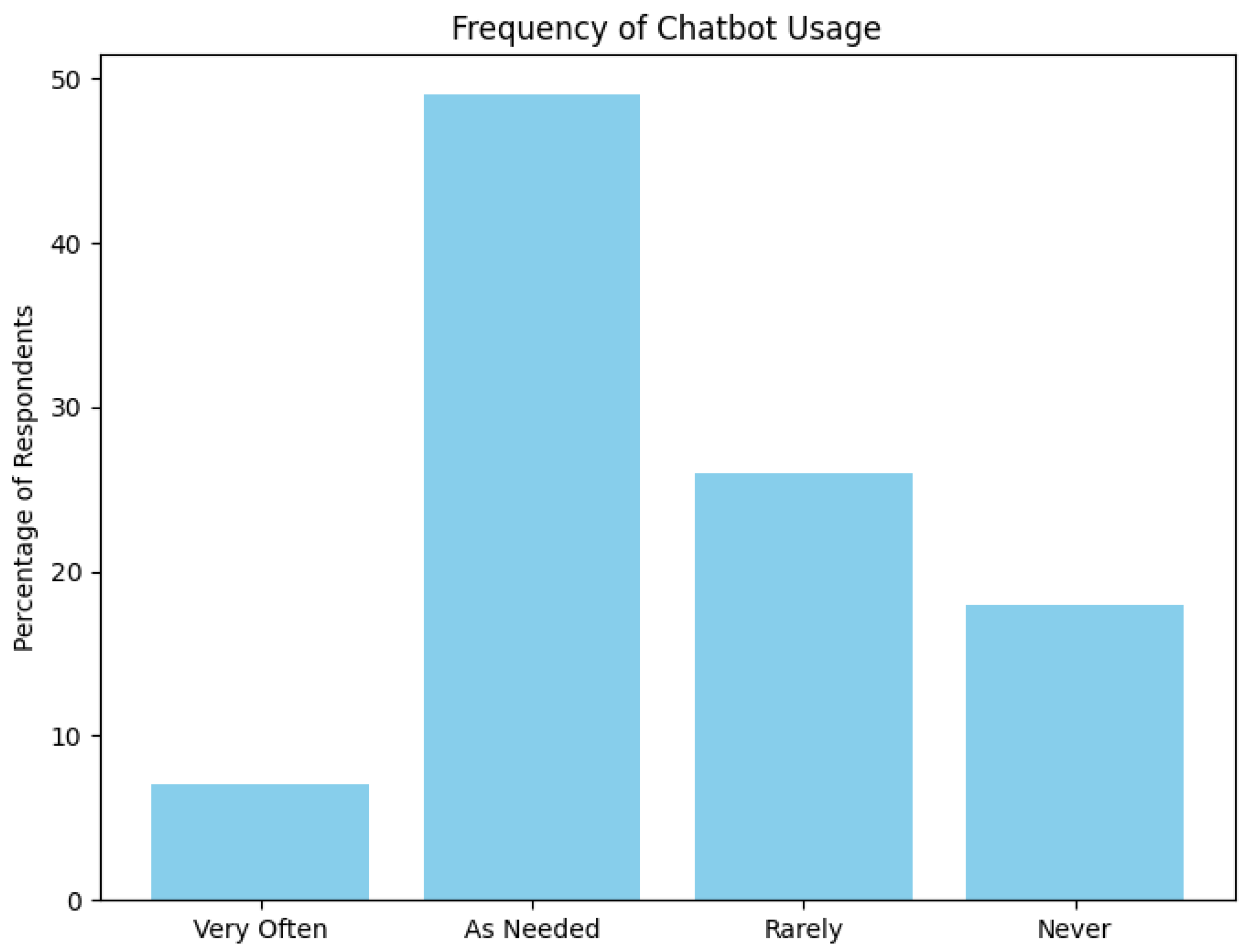
4.2. Frequency of Chatbot Use
- (a)
- Very often (7%), which may indicate intensive or regular reliance on chatbots for learning support;
- (b)
- When there is a need (49%), including situations in which problem-solving proves challenging or when rapid access to information is required;
- (c)
- Very rarely (26%), potentially reflecting confidence in one’s own knowledge or a preference for alternative information sources;
- (d)
- Never (18%), which may indicate a preference for traditional learning approaches or limited trust in automated solutions.
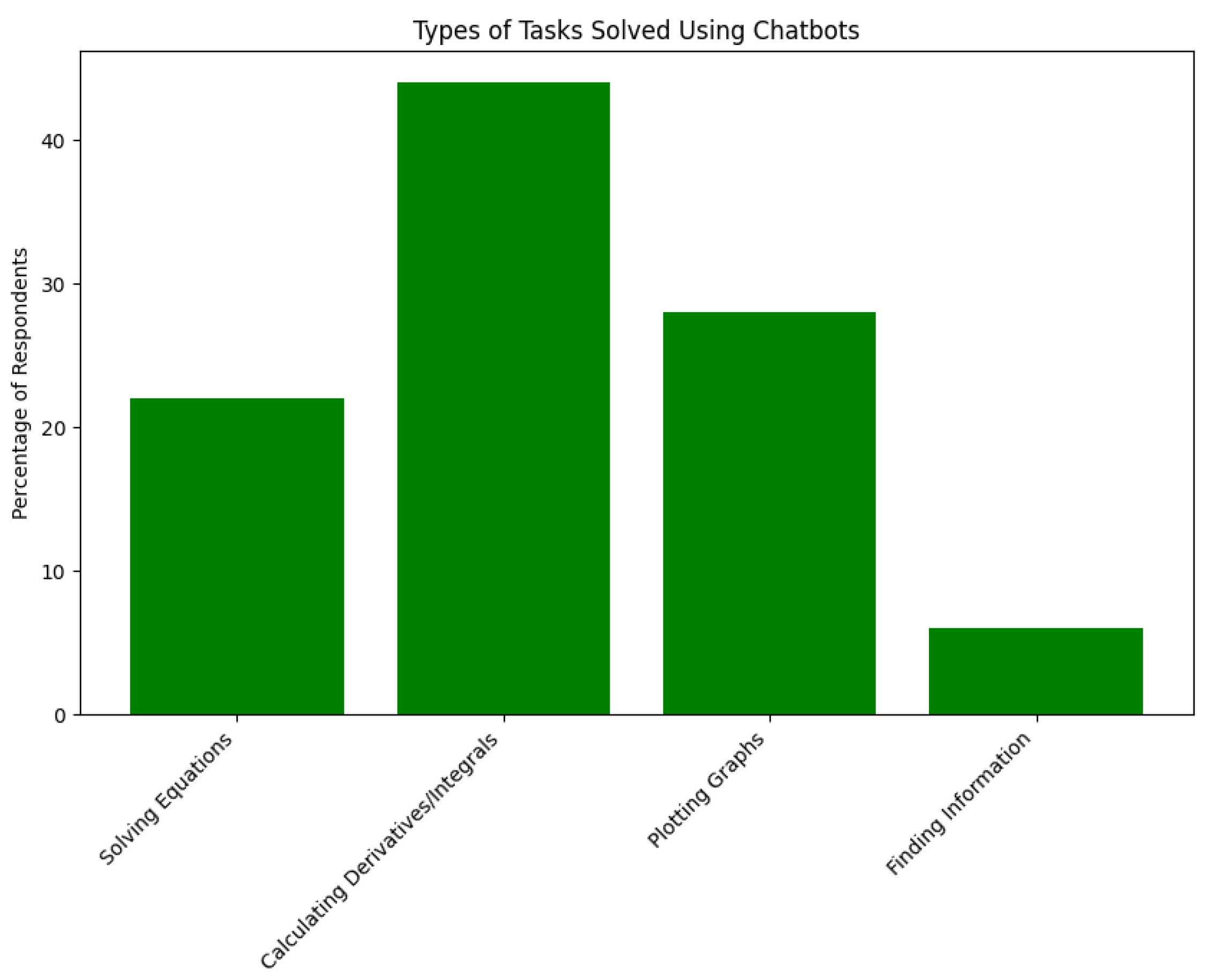
4.3. Types of Tasks Solved with the Assistance of Chatbots
- (a)
- Solving equations (22%), including finding roots, solving systems of equations, and analyzing algebraic expressions;
- (b)
- Calculating derivatives and integrals (44%), with chatbots supporting the computation of function derivatives and the evaluation of integrals;
- (c)
- Plotting function graphs (28%), as chatbots facilitate the construction of graphs and visualization of functional relationships;
- (d)
- Searching for information related to lecture topics (6%), enabling access to supplementary explanations or learning materials.
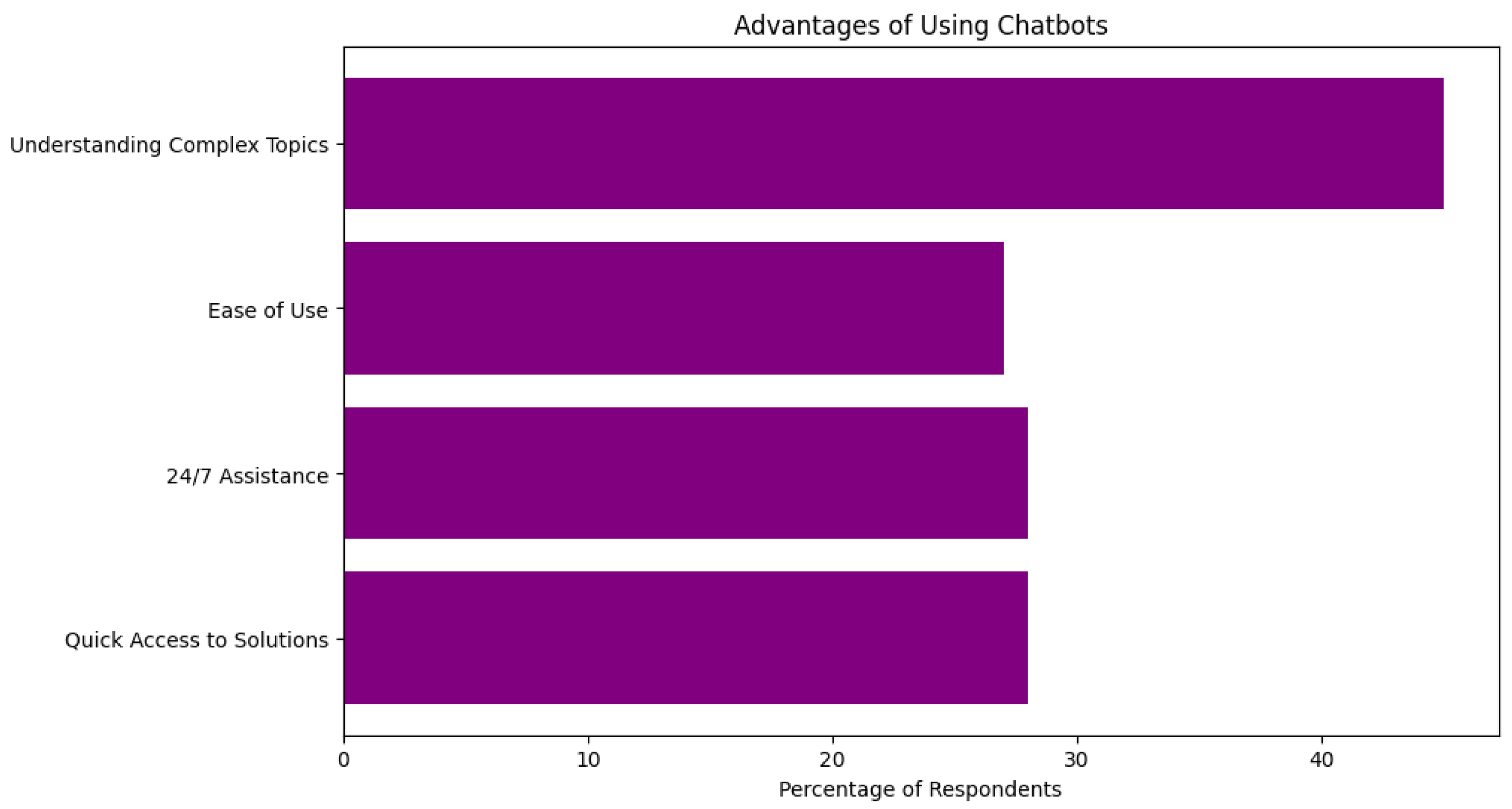
4.4. Advantages of Using Chatbots
- Quick access to solutions (28%): chatbots provide immediate responses, enabling rapid problem resolution;
- 24/7 consulting support (28%): chatbots are accessible at all times;
- Convenience and ease of use (27%): the intuitive interface facilitates user-friendly interaction;
- Support for understanding complex topics (45%): chatbots can clarify mathematical concepts and enhance comprehension.
4.5. Limitations and Disadvantages
- Limited functionality (15%);
- Insufficient accuracy (42%);
- Difficulty in inputting mathematical expressions (35%);
- Difficulty in obtaining answers (8%).
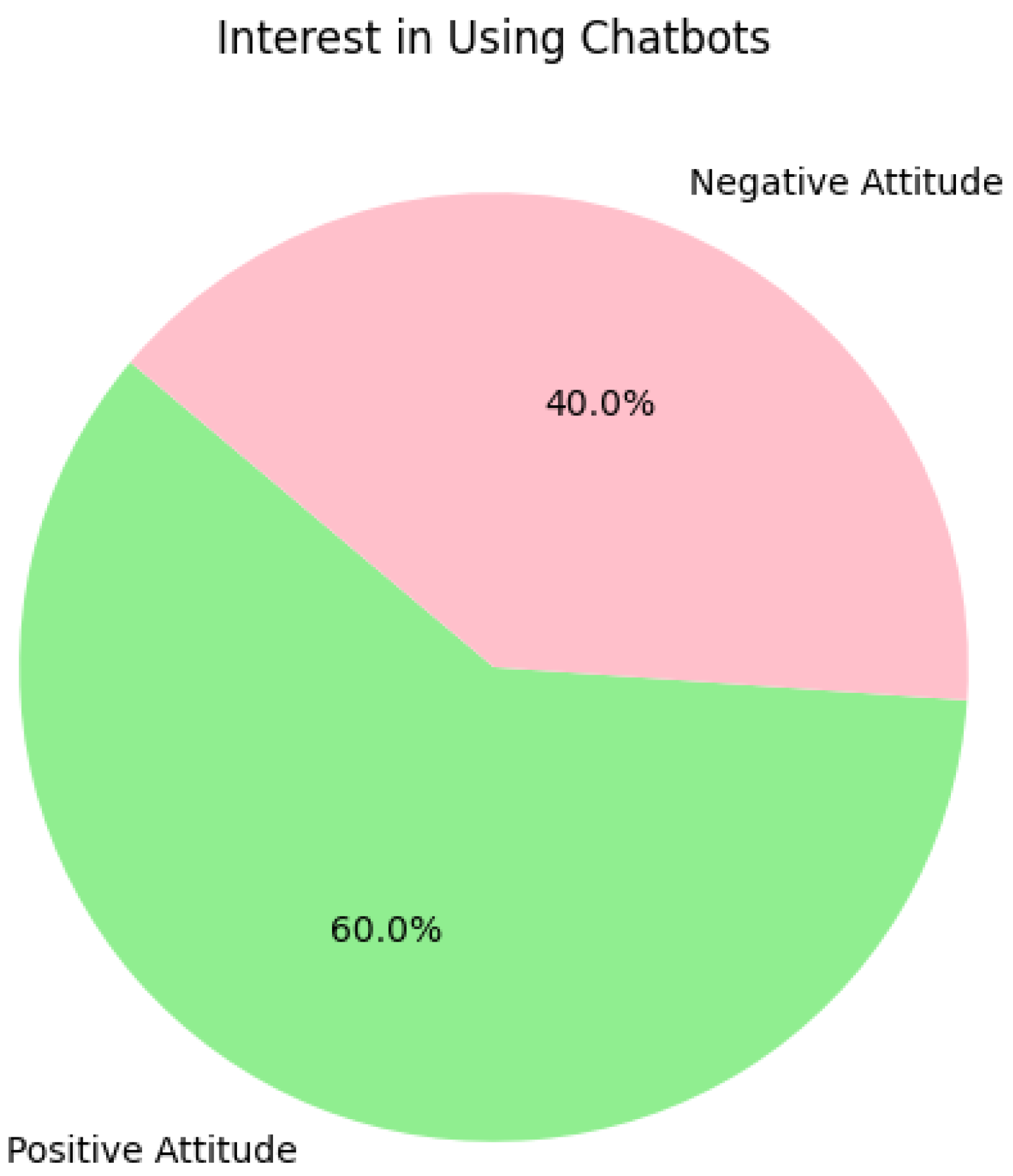
4.6. Respondents’ Interest in Using Chatbots
5. Discussion
5.1. Comparison of Traditional Teaching Methods and AI Approaches
5.1.1. Interpretation of Results
5.1.2. Practical Implications for AI Integration in Higher Mathematics Education
5.2. Frequency of Chatbot Usage
5.2.1. Interpretation of Chatbot Usage Patterns
- A lack of awareness about the full potential of AI-powered chatbots.
- Limited integration of chatbots into structured learning environments.
- Concerns about accuracy and reliability, leading students to cross-check information using other sources.
5.2.2. Practical Implications for Regular Chatbot Use
5.3. Interpretation of Results on the Use of Chatbots for Solving Tasks
5.4. Interpretation of Results on Chatbot Advantages
5.5. Interpretation of Results on Chatbot Limitations
- Improving algorithm accuracy by integrating more advanced mathematical models and expanding knowledge bases.
- Optimizing the user interface to simplify the input of mathematical expressions.
- Developing specialized chatbots that can solve complex mathematical problems and adapt to students’ needs.
- Clear structuring of learning objectives and feedback mechanisms (Chang et al., 2023);
- Consideration of students’ behavioral patterns and cognitive styles (Xu et al., 2024);
- Development of personalized learning strategies based on AI-driven analytics (Wang et al., 2023);
- Use of AI to support self-regulated learning and the development of higher-order thinking skills (Ivanova et al., 2024);
- Adaptation of AI platforms to the specific characteristics of the subject matter, particularly in higher mathematics, where precision and structural rigor are essential (Pérez-Suay et al., 2023).
- accurately interpreting mathematical contexts;
- supporting dialogue aligned with instructional objectives;
- flexibly adapting to individual students’ learning styles and paces.
5.6. Interest in Using Chatbots
- learning support and immediate answers to questions;
- personalized guidance;
- timely feedback; and
- availability and flexibility.
- Prospects
- Challenges
6. Conclusions
6.1. Key Findings
- According to respondents’ self-reports, AI chatbots may enhance the perceived accessibility and effectiveness of learning support, particularly in relation to complex mathematical topics.
- Respondents most frequently used chatbots for calculating derivatives and integrals (44%), plotting function graphs (28%), and explaining complex mathematical concepts (45%).
- The primary perceived limitations reported by respondents include computational inaccuracies (42%), difficulties in inputting mathematical expressions (35%), and potential risks associated with over-reliance on AI tools.
6.2. Practical Recommendations
- Integration of AI tools into educational platforms such as Moodle Cloud, with attention to the specific needs of mathematics education.
- Professional development for instructors focused on interpreting AI-generated recommendations and recognizing common student errors.
- Development of learners’ critical thinking skills when interacting with AI, including the ability to verify, analyze, and consciously apply chatbot-generated outputs.
6.3. Limitations and Future Research
- Accuracy of AI-generated solutions: Chatbots sometimes provide incorrect answers due to limitations of the algorithms that require human verification.
- Limited problem-solving capabilities: Current AI models are good at routine calculations, but have difficulty providing non-routine mathematical problems that require deep conceptual understanding.
- Over-reliance on AI tools: Excessive reliance on chatbots may hinder the development of independent problem-solving skills and reduce opportunities for critical thinking and verification practices.
- Technological barriers: AI-based platforms require a stable internet connection and support from educational institutions, which may be a challenge in some educational environments.
- Longitudinal comparative study: The prospective study will compare the academic performance of learners using AI tutors with those taught using conservative methods in a broad context.
- AI model enhancement: Develop advanced machine learning technologies such as deep learning and reinforcement learning to enhance the learning capabilities of chatbots.
- Teacher-AI collaboration: Explore how AI tools can complement rather than replace teaching to deliver optimal pedagogical outcomes.
- Ethical considerations: exploring the ethical implications of AI in education, including issues of data privacy and algorithmic bias.
- Fostering critical thinking: Researching strategies to encourage students to independently analyze and critically evaluate AI-generated information to prevent blind trust in technology.
- Training and responsible use: Introducing courses or workshops on the effective and responsible use of AI in the classroom.
6.4. Applicability of Findings
Author Contributions
Funding
Institutional Review Board Statement
Informed Consent Statement
Data Availability Statement
Conflicts of Interest
Abbreviations
| AI | Artificial intelligence |
| STEM | Science, Technology, Engineering, Math |
| NLP | Natural language processing |
| AIED | Artificial Intelligence in Education |
| IES | Intelligent educational systems |
| LLM | Large language models |
| IT | Intelligent tutors |
| AHS | Adaptive hypermedia systems |
| LMS | Learning Management Systems |
| DTGS | Dynamic Task Generation Systems |
Appendix A


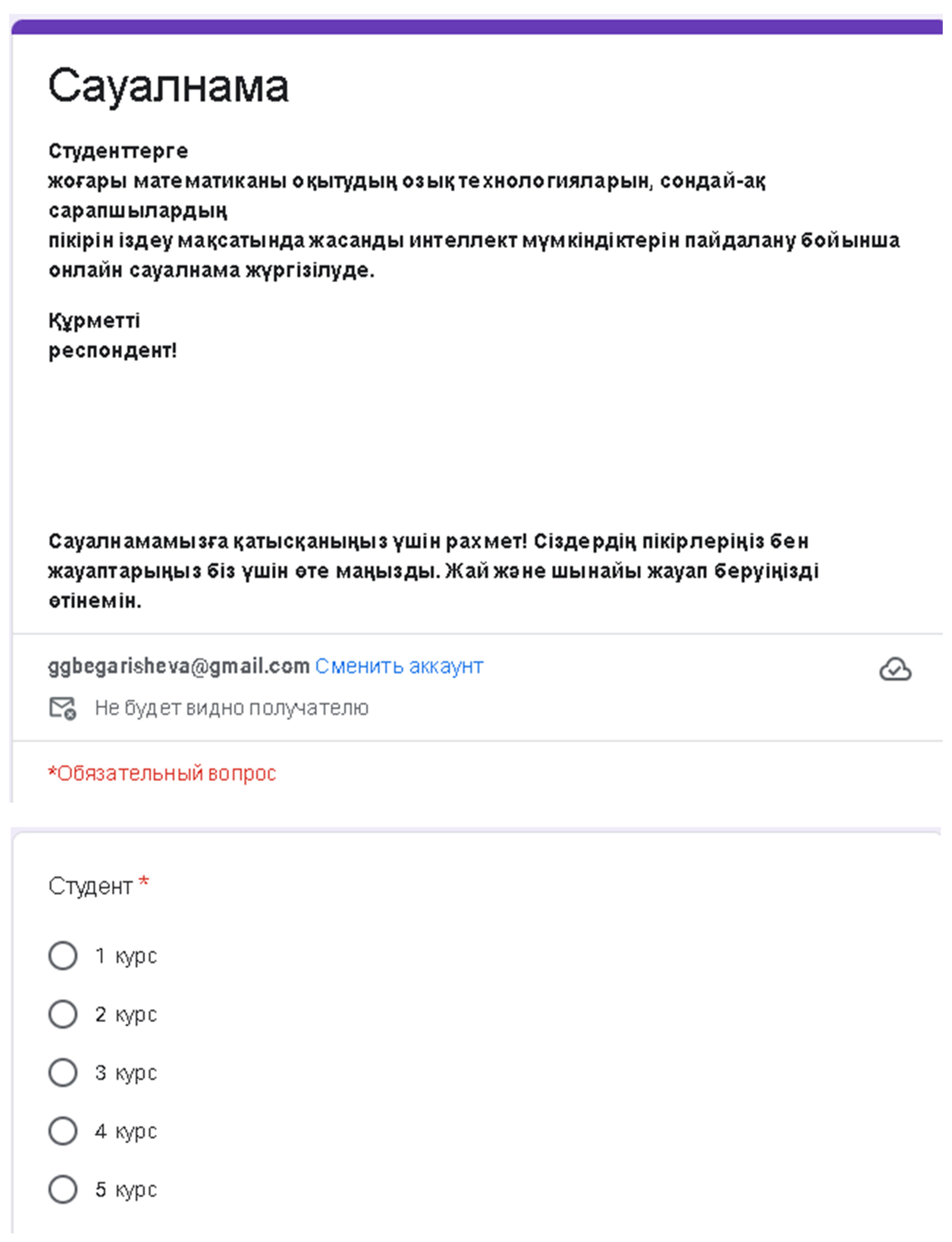
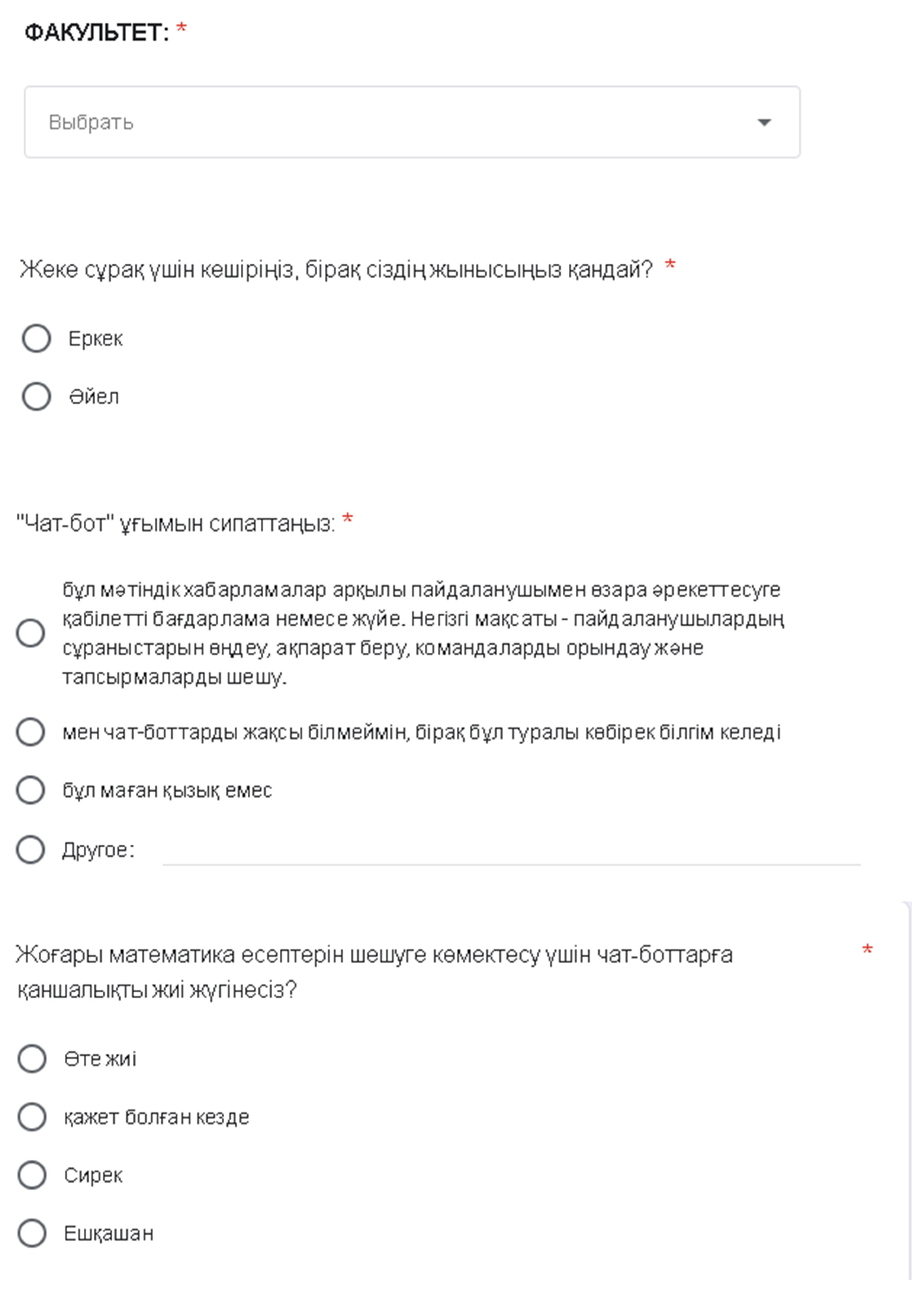
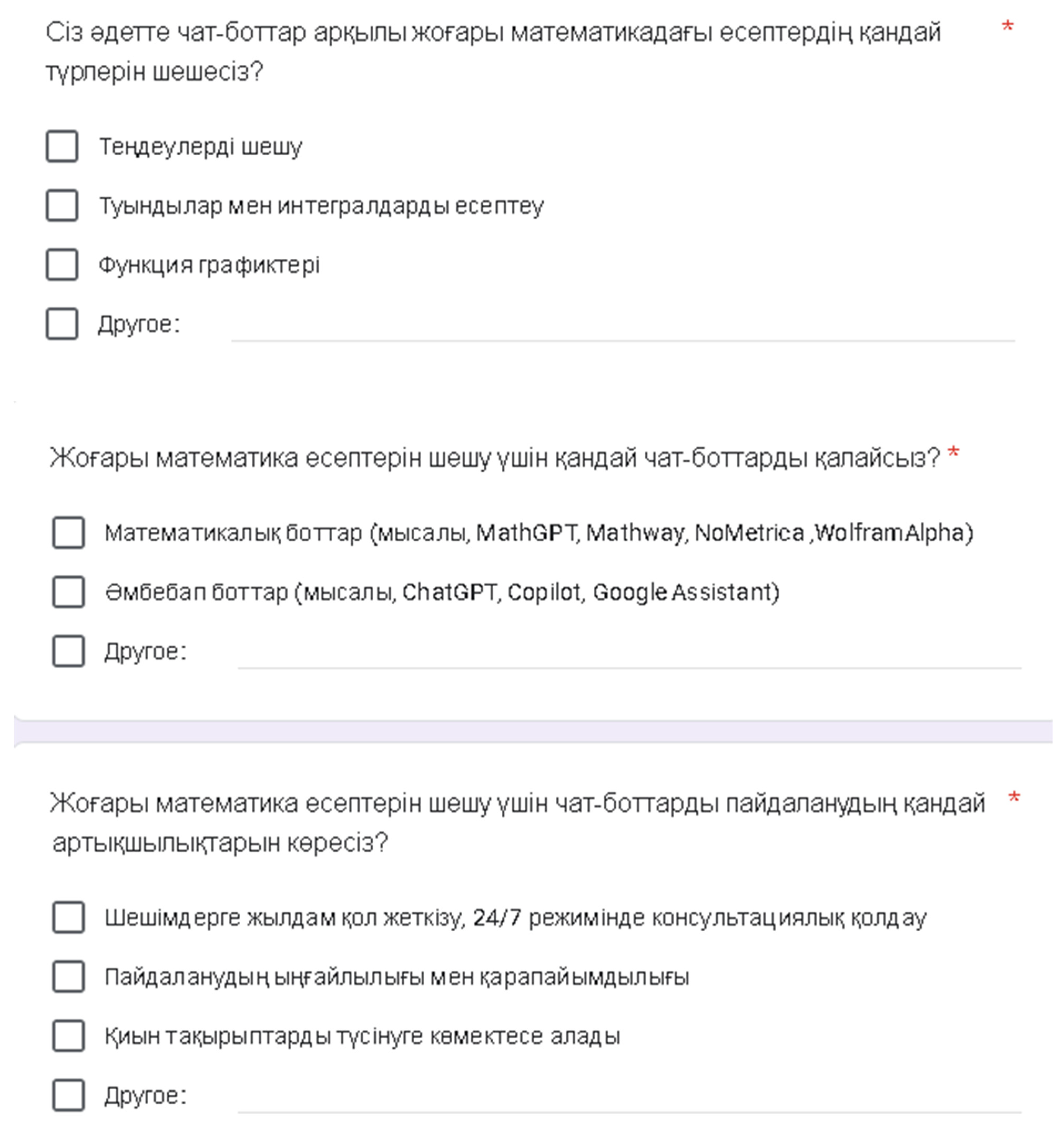
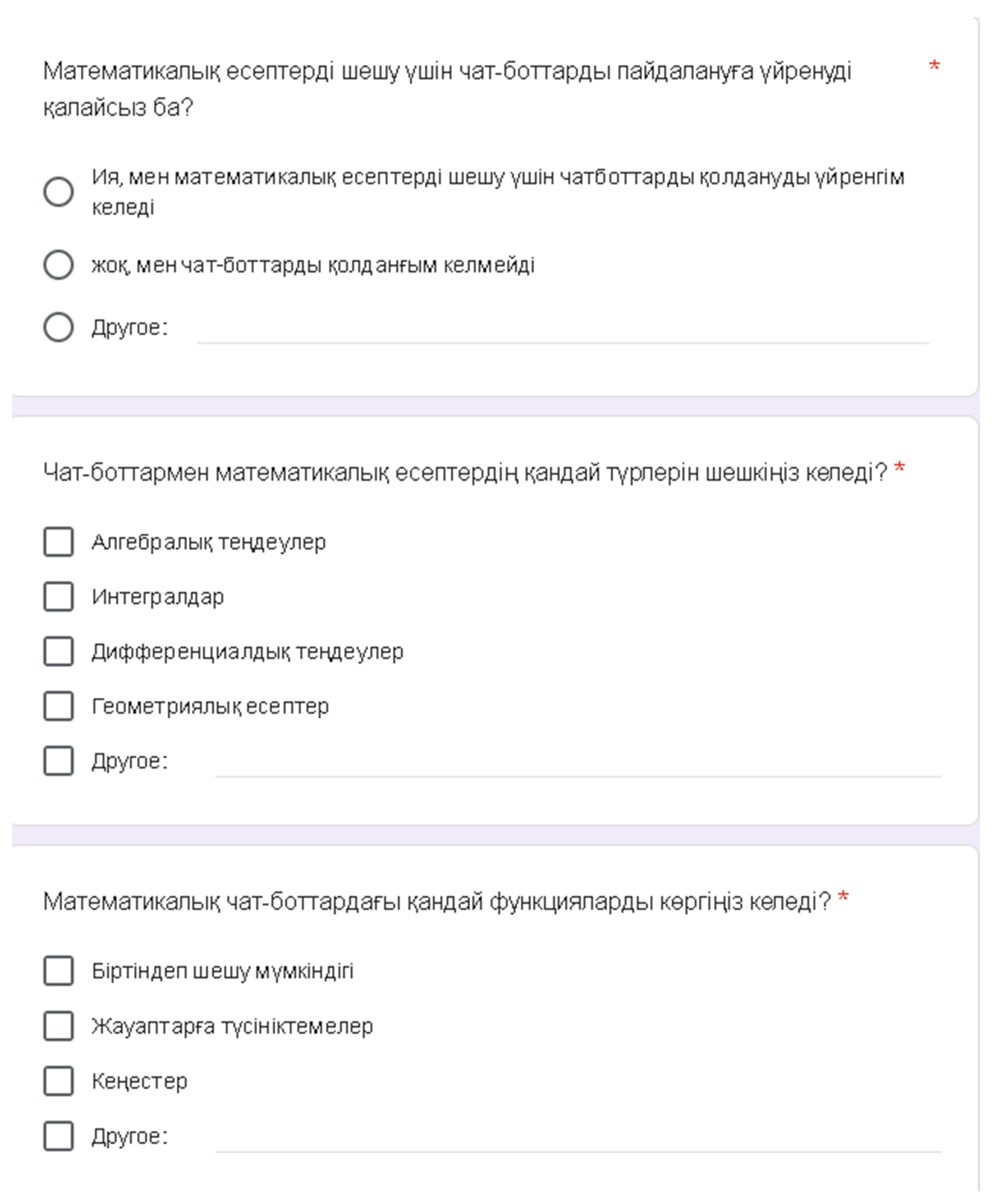
Survey
- ○
- 1st year
- ○
- 2nd year
- ○
- 3rd year
- ○
- 4th year
- ○
- 5th year
- ○
- Male
- ○
- Female
- ○
- This is a program or system that is capable of interacting with the user through text messages. Its main purpose is to process user requests, provide information, execute commands and solve tasks.
- ○
- I don’t know much about chatbots, but I would like to learn more about them
- ○
- I’m not interested in them
- ○
- Other answer:
- ○
- Very often
- ○
- When necessary
- ○
- Rarely
- ○
- Never
- ☐
- Solving equations
- ☐
- Calculating derivatives and integrals
- ☐
- Function graph
- ☐
- Other answer: _________________________________________________
- ☐
- Math bots (e.g., MathGPT, Mathway, NoMetrica, WolframAlpha)
- ☐
- Universal bots (e.g., ChatGPT, Copilot, Google Assistant)
- ☐
- Other answer:
- ☐
- Quick access to solutions, 24/7 consultative support
- ☐
- Convenience and ease of use
- ☐
- Can help you understand difficult topics
- ☐
- Other Answer:
- ☐
- Limited functionality
- ☐
- Insufficient accuracy
- ☐
- Complexity of entering mathematical expressions
- ☐
- Other answer:
- ☐
- Yes, I want to learn how to use chatbots to solve math problems
- ☐
- No, I don’t want to use chatbots
- ☐
- Other answer:
- ☐
- Algebraic equations
- ☐
- Integrals
- ☐
- Differential equations
- ☐
- Geometric problems
- ☐
- Other answer:
- ☐
- Step-by-step solution capability
- ☐
- Answer comments
- ☐
- Tips
- ☐
- Other answer:
References
- Aleshkovski, I. A., Gasparishvili, A. T., Narbut, N. P., Krukhmaleva, O. V., & Savina, N. E. (2024). Russian students on the potential and limitations of artificial intelligence in education. RUDN Journal of Sociology, 24(2), 335–353. [Google Scholar] [CrossRef]
- Ali, D., Fatemi, Y., Awais-E-Yazdan, M., Hussain, A., Baazeem, I., Bashir, M. S., Alanazi, A. A., Aljameel, S. S., & Khalaf, O. I. (2024). ChatGPT in teaching and learning: A systematic review. Education Sciences, 14, 643. [Google Scholar] [CrossRef]
- Alotaibi, N. S. (2024). The impact of AI and LMS integration on the future of higher education: Opportunities, challenges, and strategies for transformation. Sustainability, 16, 10357. [Google Scholar] [CrossRef]
- Bhutoria, A. (2022). Personalized education and artificial intelligence in the United States, China, and India: A systematic review using a human-in-the-loop model. Computers and Education: Artificial Intelligence, 3, 100068. [Google Scholar] [CrossRef]
- Brown, T. B., Mann, B., Ryder, N., Subbiah, M., Kaplan, J., Dhariwal, P., Neelakantan, A., Shyam, P., Sastry, G., Askell, A., Agarwal, S., Herbert-Voss, A., Krueger, G., Henighan, T., Child, R., Ramesh, A., Ziegler, D. M., Wu, J., Winter, C., … Amodei, D. (2020). Language models are few-shot learners. arXiv, arXiv:2005.1416. [Google Scholar] [CrossRef]
- Brusilovsky, P. (2001). Adaptive hypermedia. User Modeling and User-Adapted Interaction, 11, 87–110. [Google Scholar] [CrossRef]
- Chang, D. H., Lin, M. P.-C., Hajian, S., & Wang, Q. Q. (2023). Educational design principles of using AI chatbot that supports self-regulated learning in education: Goal setting, feedback, and personalization. Sustainability, 15, 12921. [Google Scholar] [CrossRef]
- Chen, B., Zhu, X., & Díaz del Castillo, H. F. (2023). Integrating generative AI in knowledge building. Computers and Education: Artificial Intelligence, 5, 100184. [Google Scholar] [CrossRef]
- Chiu, T. K. F., Xia, Q., Zhou, X., Chai, C. S., & Cheng, M. (2023). Systematic literature review on opportunities, challenges, and future research recommendations of artificial intelligence in education. Computers and Education: Artificial Intelligence, 4, 100118. [Google Scholar] [CrossRef]
- Circi, R., Hicks, J., & Sikali, E. (2023). Automatic item generation: Foundations and machine learning-based approaches for assessments. Frontiers in Education, 8, 858273. [Google Scholar] [CrossRef]
- Cope, B., & Kalantzis, M. (2024). A multimodal grammar of artificial intelligence: Measuring the gains and losses in generative AI. Multimodality & Society, 4, 123–152. [Google Scholar] [CrossRef]
- Gligorea, I., Cioca, M., Oancea, R., Gorski, A.-T., Gorski, H., & Tudorache, P. (2023). Adaptive learning using artificial intelligence in e-learning: A literature review. Education Sciences, 13, 1216. [Google Scholar] [CrossRef]
- Heffernan, N. T., & Heffernan, C. L. (2014). The ASSISTments ecosystem: Building a platform that brings scientists and teachers together for minimally invasive research on human learning and teaching. International Journal of Artificial Intelligence in Education, 24, 470–497. [Google Scholar] [CrossRef]
- Holmes, W., Bialik, M., & Fadel, C. (2022). Iskusstvennyi intellekt v obrazovanii: Perspektivy i posledstviya dlya prepodavaniya i obucheniya [Artificial intelligence in education: Promises and implications for teaching and learning]. Alpina Publisher. [Google Scholar]
- Hwang, G.-J., Xie, H., Wah, B. W., & Gašević, D. (2020). Vision, challenges, roles and research issues of artificial intelligence in education. Computers and Education: Artificial Intelligence, 1, 100001. [Google Scholar] [CrossRef]
- Ilieva, G., Yankova, T., Klisarova-Belcheva, S., Dimitrov, A., Bratkov, M., & Angelov, D. (2023). Effects of generative chatbots in higher education. Information, 14, 492. [Google Scholar] [CrossRef]
- Ivanova, I., Grosseck, G., & Holotescu, C. (2024). Unveiling insights: A bibliometric analysis of artificial intelligence in teaching. Informatics, 11, 10. [Google Scholar] [CrossRef]
- Kamalov, F., Calong, D. S., & Gurrib, I. (2023). New era of artificial intelligence in education: Towards a sustainable multifaceted revolution. Sustainability, 15, 12451. [Google Scholar] [CrossRef]
- Kasneci, E., Sessler, K., Küchemann, S., Bannert, M., Dementieva, D., Fischer, F., Gasser, U., Groh, G., Günnemann, S., Hüllermeier, E., Krusche, S., Kutyniok, G., Michaeli, T., Nerdel, C., Pfeiffer, F., Poquet, O., Sailer, M., Schmidt, A., Seidel, T., … Kasneci, G. (2023). ChatGPT for good? On opportunities and challenges of large language models for education. Learning and Individual Differences, 103, 102274. [Google Scholar] [CrossRef]
- Koedinger, K. R., Anderson, J. R., Hadley, W. H., & Mark, M. A. (1997). Intelligent tutoring goes to school in the big city. International Journal of Artificial Intelligence in Education, 8, 30–43. [Google Scholar]
- Koedinger, K. R., Corbett, A. T., & Perfetti, C. (2012). The knowledge–learning–instruction framework: Bridging the science–practice chasm to enhance robust student learning. Cognitive Science, 36, 757–798. [Google Scholar] [CrossRef]
- Kostikova, L. P., Esenina, N. E., & Olkov, A. S. (2025). Artificial intelligence in the educational process of the modern university: Results of a student survey. Scientific and Methodological Electronic Journal “Koncept”, 2, 93–109. [Google Scholar] [CrossRef]
- Kuhail, M. A., Alturki, N., Alramlawi, S., & Alhejori, K. (2023). Interacting with educational chatbots: A systematic review. Education and Information Technologies, 28, 973–1018. [Google Scholar] [CrossRef]
- Maghsoudi, M. M., Kaur, S., & Asl, A. H. (2021). AI in higher education: A systematic literature review. arXiv, arXiv:2101.10074. [Google Scholar] [CrossRef]
- Merino-Campos, C. (2025). The impact of artificial intelligence on personalized learning in higher education: A systematic review. Trends in Higher Education, 4, 17. [Google Scholar] [CrossRef]
- Ministry of Artificial Intelligence and Digital Development of the Republic of Kazakhstan. (n.d.). Kazakhstan entered the TOP 100 supercomputers in the world. Available online: https://www.gov.kz/memleket/entities/maidd/press/news/details/1107339?lang=en (accessed on 2 March 2026).
- Mohamed, M. Z. B., Hidayat, R., Suhaizi, N. N. B., Sabri, N. B. M., Mahmud, M. K. H. B., & Baharuddin, S. N. B. (2022). Artificial intelligence in mathematics education: A systematic literature review. International Electronic Journal of Mathematics Education, 17, em0694. [Google Scholar] [CrossRef]
- Montero-Mesa, L., Pérez-Marín, D., & Pérez-Pérez, J. R. (2023). Personalized learning through AI-driven recommender systems: A systematic review. Education Sciences, 13, 1029. [Google Scholar] [CrossRef]
- Msomi, A. M., & Mthethwa, T. M. (2024). Artificial intelligence in higher education mathematics: A systematic review of trends, benefits, and challenges. In Proceedings of the focus conference (TFC 2024) (pp. 88–118). Atlantis Press. [Google Scholar] [CrossRef]
- Omirali, A., Kozhakhmet, K., & Zhumaliyeva, R. (2025). Digital trust in transition: Student perceptions of AI-enhanced learning for sustainable educational futures. Sustainability, 17, 7567. [Google Scholar] [CrossRef]
- Pérez-Suay, A., Andreu-Perez, J., Perales, F. J., Barón-Crespo, P., Sanfélix-Genovés, J., & Candelas-Herías, D. (2023). Assessing the relevance of information sources for modelling student performance in a higher mathematics education course. Education Sciences, 13, 555. [Google Scholar] [CrossRef]
- Pintrich, P. R. (2000). The role of goal orientation in self-regulated learning. In M. Boekaerts, P. R. Pintrich, & M. Zeidner (Eds.), Handbook of self-regulation (pp. 451–502). Academic Press. [Google Scholar]
- President of the Republic of Kazakhstan. (2025, September 8). President Kassym-Jomart Tokayev’s state of the nation address to the people of Kazakhstan “Kazakhstan in the era of artificial intelligence: Current challenges and solutions through digital transformation.”. Available online: https://www.akorda.kz/en/president-kassym-jomart-tokayevs-state-of-the-nation-address-to-the-people-of-kazakhstan-kazakhstan-in-the-era-of-artificial-intelligence-current-challenges-and-solutions-through-digital-transformation-1083029 (accessed on 14 January 2026).
- Republic of Kazakhstan. (2025, November 17). Law of the Republic of Kazakhstan No. 230-VIII “On artificial intelligence.”. Adilet Information and Legal System. Available online: https://adilet.zan.kz/rus/docs/Z2500000230 (accessed on 11 February 2026).
- Russell, S., & Norvig, P. (2010). Artificial intelligence: A modern approach. Prentice Hall. [Google Scholar]
- Sajja, R., Sermet, Y., Cikmaz, M., Cwiertny, D., & Demir, I. (2023). Integrating AI and learning analytics for data-driven pedagogical decisions and personalized interventions in education. arXiv, arXiv:2312.09548. [Google Scholar] [CrossRef]
- Sajja, R., Sermet, Y., Cikmaz, M., Cwiertny, D., & Demir, I. (2024). Artificial intelligence-enabled intelligent assistant for personalized and adaptive learning in higher education. Information, 15, 596. [Google Scholar] [CrossRef]
- Sangwin, C. J., & Grove, M. J. (2006). STACK: Addressing the needs of the “neglected learners”. In Proceedings of the first WebALT conference and exhibition January 5–6, Technical University of Eindhoven, The Netherlands (pp. 81–95). Oy WebALT Inc.; University of Helsinki. [Google Scholar]
- Schei, O. M., Møgelvang, A., & Ludvigsen, K. (2024). Perceptions and use of AI chatbots among students in higher education: A scoping review of empirical studies. Education Sciences, 14, 922. [Google Scholar] [CrossRef]
- Sun, H., Wang, S., & Li, Q. (2023). Personalized learning in higher mathematics through chatbot integration. Journal of Educational Technology Research, 41(2), 123–140. [Google Scholar]
- VanLehn, K. (2011). The relative effectiveness of human tutoring, intelligent tutoring systems, and other tutoring systems. Educational Psychologist, 46, 197–221. [Google Scholar] [CrossRef]
- Vaswani, A., Shazeer, N., Parmar, N., Uszkoreit, J., Jones, L., Gomez, A. N., Kaiser, Ł., & Polosukhin, I. (2017). Attention is all you need. arXiv, arXiv:1706.03762. [Google Scholar] [CrossRef]
- Wang, T., Lund, B. D., Marengo, A., Pagano, A., Mannuru, N. R., Teel, Z. A., & Pange, J. (2023). Exploring the potential impact of artificial intelligence (AI) on international students in higher education: Generative AI, chatbots, analytics, and international student success. Applied Sciences, 13, 6716. [Google Scholar] [CrossRef]
- Wardat, Y., Jarrah, A. M., Tashtoush, M. A., & AlAli, R. (2023). ChatGPT: A revolutionary tool for teaching and learning mathematics. Eurasia Journal of Mathematics, Science and Technology Education, 19, em2286. [Google Scholar] [CrossRef]
- Wardat, Y., Tashtoush, M. A., Jarrah, A. M., & Al-Marzouqi, A. (2024). Artificial intelligence in education: Mathematics teachers’ perspectives, practices and challenges. Iraqi Journal for Computer Science and Mathematics, 5, 60–77. [Google Scholar] [CrossRef]
- Xu, Y., Zhu, J., Wang, M., Qian, F., Yang, Y., & Zhang, J. (2024). The impact of a digital game-based AI chatbot on students’ academic performance, higher-order thinking, and behavioral patterns in an information technology curriculum. Applied Sciences, 14, 6418. [Google Scholar] [CrossRef]
- Yakov, & Partners. (2023). Artificial intelligence in Russia—2023: Trends and prospects. Available online: https://www.yakovpartners.ru/publications/ai-future/ (accessed on 18 February 2026).
- Yilmaz, H., Maxutov, S., Baitekov, A., & Balta, N. (2023). Student attitudes towards ChatGPT: A technology acceptance model survey. International Educational Review, 1, 57–83. [Google Scholar] [CrossRef]
- Zawacki-Richter, O., Marín, V. I., Bond, M., & Gouverneur, F. (2019). Systematic review of research on artificial intelligence applications in higher education—Where are the educators? International Journal of Educational Technology in Higher Education, 16, 39. [Google Scholar] [CrossRef]
- Zhu, M., Sari, A. R., & Lee, M. M. (2022). Trends and issues in MOOC learning analytics empirical research: A systematic literature review (2011–2021). Education and Information Technologies, 27, 10135–10160. [Google Scholar] [CrossRef]
- Zhuang, Y. (2025). Lessons from using ChatGPT in calculus: Insights from two contrasting cases. Journal of Formative Design in Learning, 9(1), 25–35. [Google Scholar] [CrossRef]
- Zimmerman, B. J. (2002). Becoming a self-regulated learner: An overview. Theory Into Practice, 41, 64–70. [Google Scholar] [CrossRef]




| Characteristic | Value |
|---|---|
| Sample size | n = 154 |
| Year of study | Year 1: n = 126; Year 2: n = 18; Year 3: n = 10 |
| Age | 18–22 years |
| Gender | 38% female; 62% male |
| Parameter | Traditional Methods | AI-Support Approaches |
|---|---|---|
| Individualization | Limited | High (adaptive tasks) |
| Feedback rate | Low | Instant |
| Motivation of students | Average | High (use of game-based elements) |
| Availability of materials | Limited | Extensive (online access) |
| Category of Respondents | Percentage of Respondents |
|---|---|
| Have the right understanding | 72% |
| Would like to learn more | 14% |
| Do not have a particular interest | 14% |
| Limitations and Disadvantages of Using Chatbots | The Response Rate (%) |
|---|---|
| Limited functionality | 15 |
| Insufficient accuracy | 42 |
| Difficulty in inputting mathematical expressions | 35 |
| Difficult to answer | 8 |
Disclaimer/Publisher’s Note: The statements, opinions and data contained in all publications are solely those of the individual author(s) and contributor(s) and not of MDPI and/or the editor(s). MDPI and/or the editor(s) disclaim responsibility for any injury to people or property resulting from any ideas, methods, instructions or products referred to in the content. |
© 2026 by the authors. Licensee MDPI, Basel, Switzerland. This article is an open access article distributed under the terms and conditions of the Creative Commons Attribution (CC BY) license.
Share and Cite
Berikkhanova, G.; Begarisheva, G.; Berikkhanova, A.; Rakhymova, A.; Berikkhanova, K. Artificial Intelligence in the Personalization of Teaching of Higher Mathematics Students in Kazakhstan. Educ. Sci. 2026, 16, 513. https://doi.org/10.3390/educsci16040513
Berikkhanova G, Begarisheva G, Berikkhanova A, Rakhymova A, Berikkhanova K. Artificial Intelligence in the Personalization of Teaching of Higher Mathematics Students in Kazakhstan. Education Sciences. 2026; 16(4):513. https://doi.org/10.3390/educsci16040513
Chicago/Turabian StyleBerikkhanova, Gulsara, Gulshara Begarisheva, Aiman Berikkhanova, Aigerim Rakhymova, and Kulzhan Berikkhanova. 2026. "Artificial Intelligence in the Personalization of Teaching of Higher Mathematics Students in Kazakhstan" Education Sciences 16, no. 4: 513. https://doi.org/10.3390/educsci16040513
APA StyleBerikkhanova, G., Begarisheva, G., Berikkhanova, A., Rakhymova, A., & Berikkhanova, K. (2026). Artificial Intelligence in the Personalization of Teaching of Higher Mathematics Students in Kazakhstan. Education Sciences, 16(4), 513. https://doi.org/10.3390/educsci16040513