
Bibliometric and Content Analysis of Sustainable Education in Biology for Promoting Sustainability at Primary and Secondary Schools and in Teacher Education


Abstract
1. Introduction
2. Theoretical Background
2.1. Visions of Scientific Literacy
- Subject content knowledge: knowledge of the content of biology, such as phenomena from molecules to the biosphere.
- Procedural knowledge: knowledge of the methods of obtaining information in biological research that are needed to produce reliable and testable information.
- Epistemic knowledge: knowledge of biology as a natural science, its procedures for studying and explaining phenomena in the natural world, and ways to test and argue for information critically on the basis of research-based evidence using models and other scientific methods of presentation.
2.2. Sustainable Development Goals (SDGs) and Educational Approaches Promoting Sustainable Development
a change of educational culture, one which develops and embodies the theory and practice of sustainability in a way which is critically aware. It is therefore a transformative paradigm which values, sustains and realises human potential in relation to the need to attain and sustain social, economic and ecological well being, recognising that they must be part of the same dynamic.
2.3. Biology Education Promoting Sustainable Development
2.3.1. Competence Frameworks, Competencies, and Skills
2.3.2. Subject Aims and Learning Objectives
2.3.3. Learning Objectives in Relation to Competency Objectives
2.3.4. Knowledge Categories and Knowledge Types
2.3.5. Teaching and Learning Methods
2.3.6. Evaluation and Assessment
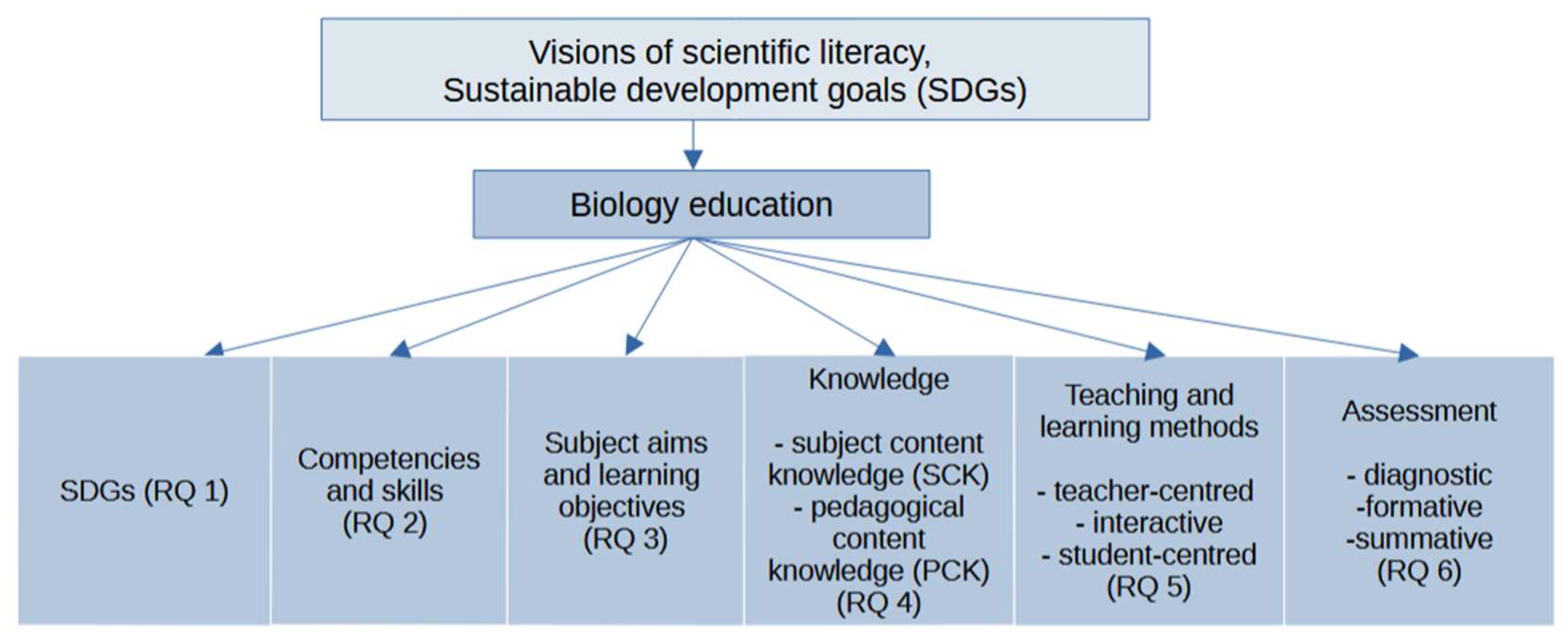
3. Research Aim and Questions
- (1)
- Which of the UN sustainable development goals (SDGs) have been included in biology education?
- (2)
- Which kinds of competencies and skills promoting sustainable development have been included in biology education?
- (3)
- Which kinds of subject aims and learning objectives promoting sustainable development have been included in biology education?
- (4)
- Which kinds of knowledge promoting sustainable development have been included in biology education?
- (5)
- Which kinds of teaching and learning methods promoting sustainable development have been included in biology education?
- (6)
- Which kinds of assessment methods fostering sustainability competencies and skills have been included in biology education?
4. Materials and Methods
4.1. Selection of Materials
- (a)
- Language: English;
- (b)
- Period: 2000–2024;
- (c)
- Scope: national and international publications;
- (d)
- Educational levels: primary, secondary, and higher education;
- (e)
- Types of studies: documents in biology education that provide concrete support to the development of biology curricula and teaching;
- (f)
- Quality: academic studies.
4.2. Analysis Methods
4.2.1. Bibliometric Analysis
4.2.2. Content Analysis
5. Findings
5.1. Sustainable Development Goals (RQ 1)
5.2. Competencies and Skills Promoting Sustainable Development in Biology Education (RQ 2)
5.3. Subject Aims and Learning Objectives Promoting Sustainable Development in Biology Education (RQ 3)
5.3.1. Subject Aims
5.3.2. Learning Objectives
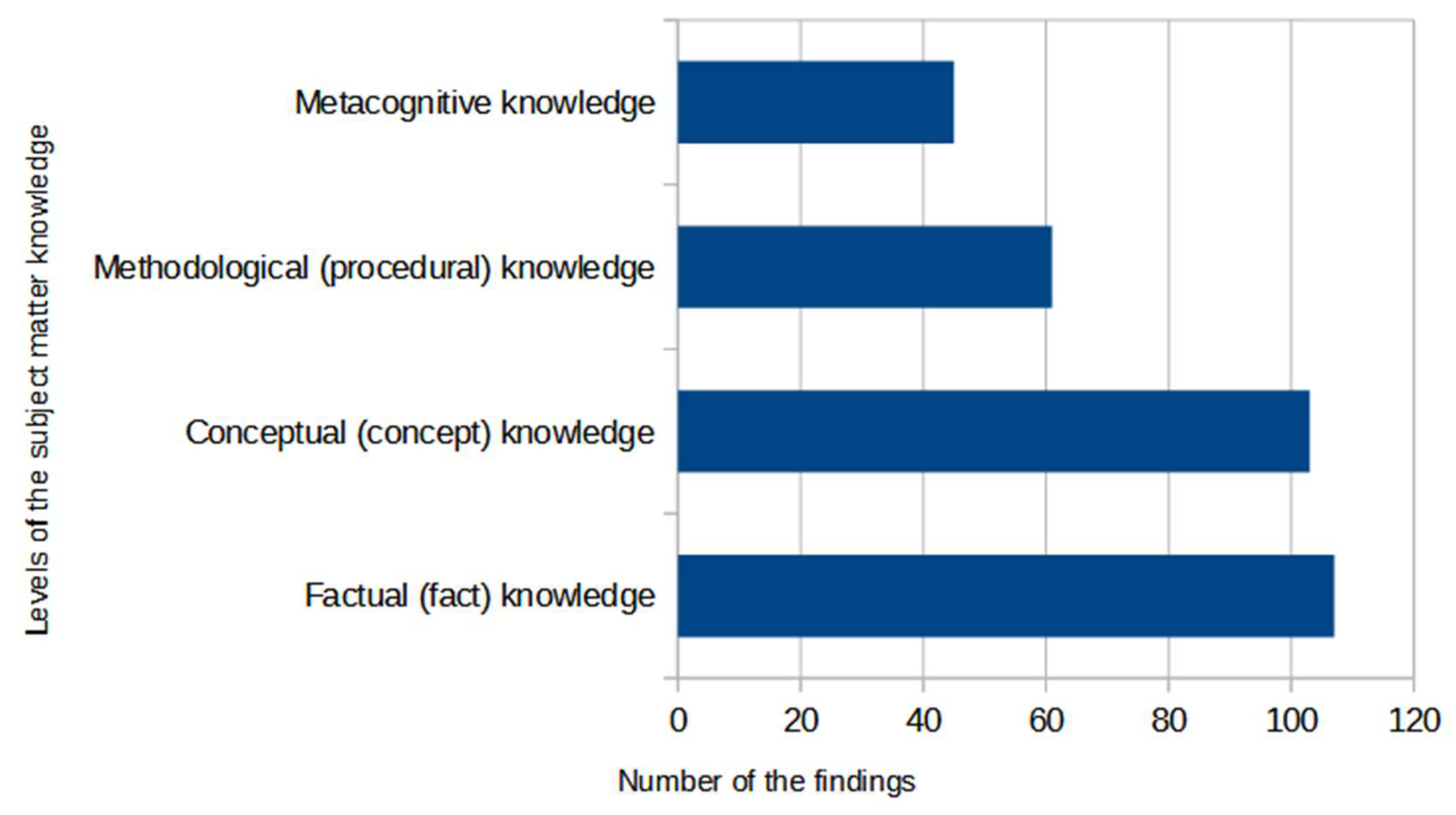
5.4. Content Knowledge Promoting Sustainable Development in Biology Education (RQ 4)
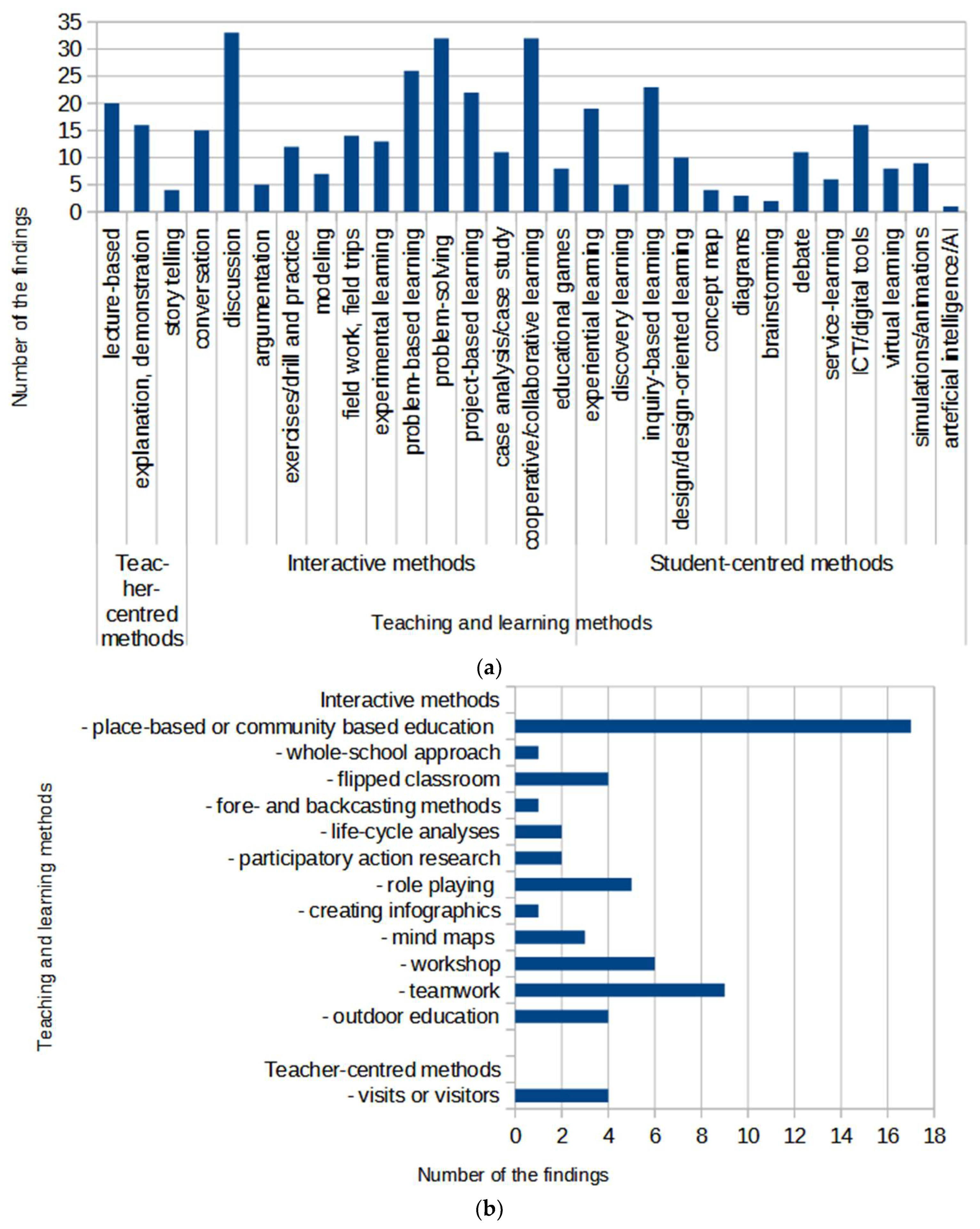
5.5. Teaching and Learning Methods Promoting Sustainable Development in Biology Education (RQ 5)
5.6. Assessment Methods and Types of Measurement Tasks Promoting Sustainable Development in Biology Education (RQ 6)
6. Discussion
6.1. Sustainable Development Goals
6.2. Competencies and Skills Promoting Sustainable Development
6.3. Subject Aims and Learning Objectives
6.3.1. Subject Aims
6.3.2. Learning Objectives
6.4. Knowledge Promoting Sustainable Development
6.5. Teaching and Learning Methods Promoting Sustainable Development
6.6. Assessment Methods Fostering Sustainability Competencies
6.7. Biology Education in Relation to Transformative Teaching and Learning
6.8. Limitations
6.9. Future Research
Author Contributions
Funding
Data Availability Statement
Conflicts of Interest
Appendix A. Clustered Studies (* Not Reviewed in the Content Analysis)
- Abramovich, A., & Loria, Y. (2015). The long-term impact of an education for sustainability course on Israeli science and technology teachers’ pro-environment awareness, commitment and behaviour. Australian Journal of Environmental Education, 1(2), 264–279. https://doi.org/10.1017/aee.2015.31.
- Adeika, B. I., Ariyibi, A., Abiodun, P. O., & Oludare Adegbola Owolabi, P. E. (2024, June 23–26). Breaking barriers: Promoting motivation, engagement, and learning success among biology undergraduates from minority backgrounds. 2024 Annual Conference and Exposition, Oregon Convention Center, Portland, OR, USA. https://doi.org/10.18260/1-2--48406.
- Akpınarlı, S. S., & Turan, S. L. (2023). An examination of reproduction and development in secondary school biology curricula: Türkiye and Germany. In M. Koc, O. T. Ozturk, & M. L. Ciddi (Eds.), Proceedings of ICRES 2023—International conference on research in education and science, Cappadocia, Turkiye (pp. 1854–1865). ISTES Organization. Available online: https://eric.ed.gov/?id=ED654312 (accessed on 22 January 2026).
- Al-Muqbil, N. S. M. (2024). The impact of an artificial intelligence application-based training program on developing sustainable thinking among high school biology teachers. Educational Sciences: Theory and Practice, 24(1), 201–215. Available online: https://psau.sa.elsevierpure.com/en/publications/the-impact-of-an-artificial-intelligence-application-based-traini/ (accessed on 22 January 2026).
- * Alordiah, C. O. (2023). Mind the gap: Exploring effectice strategies for conducting gap analysis in educational studies. Journal of Contemporary Issues in Education, 7(1), 239–252. Available online: https://www.researchgate.net/publication/374420184_MIND_THE_GAP_EXPLORING_EFFECTIVE_STRATEGIES_FOR_CONDUCTING_GAP_ANALYSIS_IN_EDUCATIONAL_STUDIES (accessed on 22 January 2026).
- Amprazis, A., & Papadopoulou, P. (2024). Key competencies in education for sustainable development: A valuable framework for enhancing plant awareness. Plants People Planet, 7(4), 1195–1211. https://doi.org/10.1002/ppp3.10625.
- * Araripe, E., & Zuin Zeidler, V. G. (2024). Advancing sustainable chemistry education: Insights from real-world case studies. Current Research in Green and Sustainable Chemistry, 9, 100436. https://doi.org/10.1016/j.crgsc.2024.100436.
- Ariely, M., & Yarden, A. (2018). Using authentic texts to promote disciplinary literacy in biology. In K. Kampourakis, & M. J. Reiss (Eds.), Teaching biology in schools: Global research, issues, and trends (pp. 205–216). Routledge. Available online: https://www.taylorfrancis.com/chapters/edit/10.4324/9781315110158-17/using-authentic-texts-promote-disciplinary-literacy-biology-moriah-ariely-anat-yarden?context=ubx&refId=91c051c8-1a53-4ec3-aeb2-e3d5e864c132 (accessed on 22 January 2026).
- * Arita, H. T. (2017). Multisite and multispecies measures of overlap, co-occurrence, and co-diversity. Ecography, 40(6), 709–718. https://doi.org/10.1111/ecog.01942.
- Assaraf, A. B. Z., & Snapir, Z. (2018). Human biology. In K. Kampourakis, & M. J. Reiss (Eds.), Teaching biology in schools: Global research, issues, and trends (pp. 62–73). Routledge. Available online: https://www.taylorfrancis.com/chapters/edit/10.4324/9781315110158-6/human-biology-orit-ben-zvi-assaraf-zohar-snapir?context=ubx&refId=f480597a-8cf1-4f82-9ed9-d86eee429278 (accessed on 22 January 2026).
- Bacon, C. M., Mulvaney, D., Ball, T. B., DuPuis, E. M., Gliessman, S. R., Lipschutz, R. D., & Shakouri, A. (2011). The creation of an integrated sustainability curriculum and student praxis projects. International Journal of Sustainability in Higher Education, 12(2), 193–208. https://doi.org/10.1108/14676371111118237.
- Baena-Morales, S., Vásquez-Echeverría, A., Gavilán-Martín, D., & González-Villora, S. (2024). Psychological approaches to sustainability: Implementing intervention model for sustainable development in physical education. Sustainable Development, 32, 5692–5704. https://doi.org/10.1002/sd.2986.
- Bara, E., Bara, G., & Pupe, S. (2024). The role of biology curriculum in promoting student health, environmental awareness, and academic success: Teacher responsibilities. Edelweiss Applied Science and Technology, 8(2), 1–14. https://doi.org/10.55214/25768484.v8i2.1081.
- Barraza, L., & Castaño, C. (2012). Can science education help to build a sustainable society? Profesorado, Revista de Currículum y Formatión del Professorado, 16(2), 45–58. https://www.redalyc.org/articulo.oa?id=56724395004 (accessed on 22 January 2026).
- Bass, C. (2012). Learning theories & their application to science instruction for adults. American Biology Teacher, 74(6), 387–390. https://doi.org/10.1525/abt.2012.74.6.6.
- Bezeljak, P., Scheuch, M., & Torkar, G. (2020). Understanding of sustainability and education for sustainable development among pre-service biology teachers. Sustainability, 12, 6892. https://doi.org/10.3390/su12176892.
- Biletska, H., Mironova, N., Yefremova, O., Barna, L., & Bloshchynskyi, I. (2021). The future biology teachers training for the implementation of sustainable development ideas in ecological education. International Journal of Innovative Research and Scientific Studies, 4(4), 229–237. https://doi.org/10.53894/ijirss.v4i4.200.
- Brandt, J.-O., Barth, M., Merritt, E., & Hal, A. (2021). A matter of connection: The 4 Cs of learning in pre-service teacher education for sustainability. Journal of Cleaner Production, 279, 123749. https://doi.org/10.1016/j.jclepro.2020.123749.
- Brody, S. D., & Ryu, H. (2006). Measuring the educational impacts of a graduate course on sustainable development. Environmental Education Research, 12(2), 179–199. https://doi.org/10.1080/13504620600688955.
- Byrne, J., & Grace, M. (2018). Health and disease. In K. Kampourakis, & M. J. Reiss (Eds.), Teaching biology in schools: Global research, issues, and trends (pp. 74–86). Routledge. Available online: https://www.taylorfrancis.com/chapters/edit/10.4324/9781315110158-7/health-disease-jenny-byrne-marcus-grace?context=ubx&refId=82cd02bb-c652-4c86-9acd-86089f4a6b11 (accessed on 22 January 2026).
- * Cabral, S., & Kaivola T. (2005). Imagine the world. Teaching Geography, 30(2), 86–90. Available online: https://www.jstor.org/stable/44633441 (accessed on 22 January 2026).
- * Capello, M. A., Shaughnessy, A., & Caslin, E. (2021). The geophysical sustainability atlas: Mapping geophysics to the UN sustainable development goals. The Leading Edge, 40(1), 10–24. https://doi.org/10.1190/tle40010010.1.
- Carrió Llach, M., & Llerena Bastida, M. (2023). Exploring innovative strategies in problem based learning to contribute to sustainable development: A case study. International Journal of Sustainability in Higher Education, 24(9), 159–177. https://doi.org/10.1108/IJSHE-07-2021-0296.
- Carson, K., Dawson, V., & Venville, G. (2018). Microbiology. In K. Kampourakis, & M. J. Reiss (Eds.), Teaching biology in schools: Global research, issues, and trends (pp. 178–192). Routledge. Available online: https://www.taylorfrancis.com/chapters/edit/10.4324/9781315110158-15/microbiology-katherine-carson-vaille-dawson-grady-venville?context=ubx&refId=240ce8f4-bae3-4640-9a92-3bec7a0df019 (accessed on 22 January 2026).
- Cheng, L.-T., Smith, T. J., Hong, Z.-R., & Lin, H.-s. (2021). Gender and STEM background as predictors of college students’ competencies in forming research questions and designing experiments in inquiry activities. International Journal of Science Education, 43(17), 2866–2883. https://doi.org/10.1080/09500693.2021.1994167.
- Church, W., & Skelton, L. (2013). Infusing sustainability across the curriculum. In R. McKeown, & V. Nolet (Eds.), Schooling for sustainable development in Canada and the United States (pp. 183–195). Schooling for Sustainable Development, 4. Springer. https://doi.org/10.1007/978-94-007-4273-4_13.
- Chuvieco, E., Carrillo-Hermosilla, J., López-Mújica, M., Campo-López, E., Lazo-Vitoria, X. A., Macias-Guarasa, J., Petre-Bujan, A. L., Perdigón-Melón, J. A., Guardiola-Soler, J., & Salado-García, M. J. (2022). Inventory and analysis of environmental sustainability education in the degrees of the University of Alcalá (Spain). Sustainability, 14, 8310. https://doi.org/10.3390/su14148310.
- * Conde-Caballero, D., Castillo, C. A., Ballesteros-Yáñez, I., & Mariano-Juárez, L. (2019). Blogging as a tool for the acquisition and dissemination of knowledge in health sciences: A preliminary evaluation. International Journal of Educational Technology in Higher Education, 16(1), 30. https://doi.org/10.1186/s41239-019-0161-2.
- Copeland Solas, E., & Wilson, K. (2015). Lessons learned and strategies used while teaching core-curriculum science courses to English language learners at a middle eastern university. Journal of Turkish Science Education, 12(2), 81–94. Available online: https://zu.elsevierpure.com/en/publications/lessons-learned-and-strategies-used-while-teaching-core-curriculu-2/ (accessed on 22 January 2026).
- Courter, J. R. (2012). Graduate students in conservation biology: Bridging the research-implementation gap. Journal for Nature Conservation, 20(1), 62–64. https://doi.org/10.1016/j.jnc.2011.10.001.
- Danilov, S., & Danilova, O. (2013). An integrated approach to the study of biology. In L. V. Shavinina (Ed.), The Routledge international handbook of Iinovation education. Routledge. Available online: https://www.taylorfrancis.com/chapters/edit/10.4324/9780203387146-43/integrated-approach-study-biology-sergei-danilov-olga-danilova?context=ubx&refId=c07abaef-b670-40a4-af84-1a8f57e778e6 (accessed on 2022 January 2026).
- da Silva, N. C., & de Araújo, F. M. F. (2022). The SDGs and the perspective of education for sustainability in the educational program of undergraduate biology courses in the Amazon region of Pará. Sustainability in Debate—Brasília, 13(2), 32–48. https://doi.org/10.18472/SustDeb.v13n2.2022.42251.
- da Silva, N. C., & de Araújo, F. M. F. (2024). Education for the sustainability of teaching practice in degree courses on biology in the state of Pará within the Aamazon area. Educação e Pesquisa (Education and Recearch), 50, e270602. https://doi.org/10.1590/S1678-4634202450270602por.
- Day, D., Guo, C., Ferrari, N., Edgecumbe, H., & Broadbridge, C. (2013). Optimizing K-14 instruction to infuse 21st century skills. MRS Online Proceedings Library, 1583, 306. https://doi.org/10.1557/opl.2013.776.
- Desa, S., Abdullah, M. S., Ab Mutalib, N. H., & Mansor, R. (2021). The readiness of integrating sustainable development into biology teacher education program. Cakrawala Pendidikan, 4(2), 305–315. https://doi.org/10.21831/cp.v40i2.37116.
- Douglas, F., Beasy, K., Sollis, K., & Flies, E. J. (2024). Online, experiential sustainability education can improve students’ self-reported environmental attitudes, behaviours and wellbeing. Sustainability, 16, 2258. https://doi.org/10.3390/su16062258.
- Dönmez, I. (2024). Sustainability in educational research: Mapping the field with a bibliometric analysis. Sustainability, 16, 5541. https://doi.org/10.3390/su16135541.
- Driver, R., Newton, P., & Osborne, J. (2000). Establishing the norms of scientific argumentation in classrooms. Science Education, 84(3), 287–312. https://doi.org/10.1002/(SICI)1098-237X(200005)84:3<287::AID-SCE1>3.0.CO;2-A.
- Duncan, R. G., & Boerwinkel, D. J. (2018). Molecular biology. In K. Kampourakis, & M. J. Reiss (Eds.), Teaching biology in schools: Global research, issues, and trends (pp. 35–47). Routledge. Available online: https://www.taylorfrancis.com/chapters/edit/10.4324/9781315110158-4/molecular-biology-ravit-golan-duncan-dirk-jan-boerwinkel?context=ubx&refId=df9d8ec3-1c73-4f82-a413-b4c6a0cab7f6 (accessed on 22 January 2026).
- * Du Toit, E. (2024). Thirty years of sustainability reporting: Insights, gaps and an agenda for future research through a systematic literature review. Sustainability, 16, 10750. https://doi.org/10.3390/su162310750.
- Edwards, B. I., Aris, B., Shukor, N. A., & Mohammed, H. (2015). Using response system through voting in peer instruction for learning sustainability. Jurnal Teknologi, 77(13), 147–157. https://doi.org/10.11113/jt.v77.6371.
- * EI Kharki, K., Berrada, K., & Burgos, D. (2021). Design and implementation of a virtual laboratory for physics subjects in Moroccan universities. Sustainability, 13, 3711. https://doi.org/10.3390/su13073711.
- * Ergazaki, M. (2018). Biology and young children. In K. Kampourakis, & M. J. Reiss (Eds.), Teaching biology in schools: Global research, issues, and trends (pp. 9–10). Routledge. Available online: https://www.taylorfrancis.com/chapters/edit/10.4324/9781315110158-3/biology-young-children-marida-ergazaki?context=ubx&refId=5f508608-8ac5-4f42-9715-ac066e89c95d (accessed on 22 January 2026).
- Evans, E. M., & Rosengren, K. S. (2018). Cognitive biases or cognitive bridges? Intuitive Reasoning in Biology. In K. Kampourakis, & M. J. Reiss (Eds.), Teaching biology in schools: Global research, issues, and trends (pp. 9–34). Routledge. Available online: https://www.taylorfrancis.com/chapters/edit/10.4324/9781315110158-2/cognitive-biases-cognitive-bridges-evelyn-margaret-evans-karl-rosengren?context=ubx&refId=ef7efae5-a38a-4680-b9e1-d5ebac438d45 (accessed on 22 January 2026).
- Fadzil, H. M., & Saat, R. M. (2020). Exploring secondary school biology teachers’ competency in practical work. Jurnal Pendidikan IPA Indonesia, 9(1), 116–123. https://doi.org/10.15294/jpii.v9i1.21477.
- Faizah, U., Susantini, E., Prastiwi, M. S., Raharjo, R., Indana, S., Kuswanti, N., & Ali, M. (2024). Profile of potential prospective biology teachers designing SDGs-based teaching modules on learning planning courses to realize quality education. E3S Web Conference, 568, 04025. https://doi.org/10.1051/e3sconf/202456804025.
- * Fayomi, O. S. I., Okokpujie, I. P., & Fayomi, G. U. (2019). An innovation concept towards bridging the gaps between teaching and research. Procedia Manufacturing, 35, 775–781. https://doi.org/10.1016/j.promfg.2019.06.022.
- Ferrer-Estévez, M., & Chalmeta, R. (2021). Integrating sustainable development goals in educational institutions. The International Journal of Management Education, 19, 100494. https://doi.org/10.1016/j.ijme.2021.100494.
- Fisher, P. B., & McAdams, E. (2015). Gaps in sustainability education: The impact of higher education coursework on perceptions of sustainability. International Journal of Sustainability in Higher Education, 16(4), 407–423. https://doi.org/10.1108/IJSHE-08-2013-0106.
- * Fox, P., Hundley, S., Cowan, D. J., Tabas, J., & Goodman, D. (2009, August 2–6). Teaching sustainability: Course, program and degree considerations. PICMET 2009 Proceedings (pp. 2240–2245), Portland, OR, USA. https://doi.org/10.1109/PICMET.2009.5261847.
- Förtsch, C., Werner, S., von Kotzebue, L., & Neuhaus, B. J. (2018). Effects of high-complexity and high-cognitive-level instructional tasks in biology lessons on students’ factual and conceptual knowledge. Research in Science & Technological Education, 36(3), 353–374. https://doi.org/10.1080/02635143.2017.1394286.
- Fuentes, A.-L., & Entezari, M. (2020). Water in your neighbourhood: A model for implementing a semester-long course-based undergraduate research project in introductory biology. Education Inquiry, 11(3), 211–275. https://doi.org/10.1080/20004508.2020.1716542.
- Gaard, G. C., Blades, J., & Wright, M. (2017). Assessing sustainability curriculum: From transmissive to transformative approaches. International Journal of Sustainability in Higher Education, 18(7), 1263–1278. https://doi.org/10.1108/IJSHE-11-2015-0186.
- Galante, D., Tassistro, M., & Torreggiani, A. (2024, March 14–15). The Crystal Lake’s Mystery: Interactive eco-crime game for learning about environmental sustainability. New Perspectives in Science Education—International Conference, Florence, Italy. Available online: https://conference.pixel-online.net/files/npse/ed0013/FP/8788-ENV6438-FP-NPSE13.pdf (accessed on 22 January 2026).
- Garibay, J. C., Vincent, S., & Ong, P. (2020). Diversity content in STEM? How faculty values translate into curricular inclusion unevenly for different subjects in environmental and sustainability programs. Journal of Women and Minorities in Science and Engineering, 26(1), 61–90. https://doi.org/10.1615/JWomenMinorScienEng.2020029900.
- * Gatti, L., Ulrich, M., & Seele, P. (2019). Education for sustainable development through business simulation games: An exploratory study of sustainability gamification and its effects on students’ learning outcomes. Journal of Cleaner Production, 207, 667–678. https://doi.org/10.1016/j.jclepro.2018.09.130.
- Gericke, N., & El-Hani, C. N. (2018). Genetics. In K. Kampourakis, & M. J. Reiss (Eds.), Teaching biology in schools: Global research, issues, and trends (pp. 111–124). Routledge. Available online: https://www.taylorfrancis.com/chapters/edit/10.4324/9781315110158-10/genetics-niklas-gericke-charbel-el-hani?context=ubx&refId=05b5156c-bfb9-455d-8834-d44edb9969e7 (accessed on 22 January 2026).
- Ghazian, N., & Lortie, C. J. (2024). Ten simple rules for incorporating the UN Sustainable Development Goals (SDGs) into environmental and natural science courses. Sustainability, 16, 9594. https://doi.org/10.3390/su16219594.
- Goi, C. L. (Ed.). (2024). Teaching and learning for a sustainable future: Innovative strategies and best practices. IGI Global. https://doi.org/10.4018/978-1-6684-9859-0.
- * Gulikers, J., & Oonk, C. (2019). Towards a rubric for stimulating and evaluating sustainable learning. Sustainability, 11, 969. https://doi.org/10.3390/su11040969.
- Gutiérrez-García, L., Blanco-Salas, J., Sánchez-Martín, J., Corbacho-Cuello, I., & Ruiz-Téllez, T. (2024). Assessment of botanical learning through an educational intervention based on aromatic plants and their uses in the immediate environment. Environment, Development and Sustainability, 27, 25381–25402. https://doi.org/10.1007/s10668-024-04733-z.
- Hamman, M. (2018). Biotechnology. In K. Kampourakis, & M. J. Reiss (Eds.), Teaching biology in schools: Global research, issues, and trends (pp. 192–203). Routledge. Available online: https://www.taylorfrancis.com/chapters/edit/10.4324/9781315110158-16/biotechnology-marcus-hammann?context=ubx&refId=dceddb33-ca12-43b6-8048-c079f765921c (accessed on 22 January 2026).
- Hardyanto, Y. S. P., Ibrohim, I., Sueb, S., Memiasih, N., & Alvionita, D. (2024). The effect of using problem-oriented project-based learning in biology electronic module to empower problem-solving of high school students. AIP Conference Proceedings, 3106(1), 030039. https://doi.org/10.1063/5.0215079.
- Harland, T., & Wald, N. (2018). Curriculum, teaching and powerful knowledge. Higher Education, 76, 615–628. https://doi.org/10.1007/s10734-017-0228-8.
- Harms, U., & Bertsch, U. (2018). Energy, photosynthesis and respiration. In K. Kampourakis, & M. J. Reiss (Eds.), Teaching biology in schools: Global research, issues, and trends (pp. 139–153). Routledge. Available online: https://www.taylorfrancis.com/chapters/edit/10.4324/9781315110158-12/energy-photosynthesis-respiration-ute-harms-uwe-bertsch?context=ubx&refId=6baa6121-bdc7-4915-8da1-8608d012e37e (accessed on 22 January 2026).
- Hartadiyati, E., Wiyanto, Rusilowati, A., & Prasetyo, A. P. B. (2020). Pedagogical content knowledge (PCK) of prospective biology teacher on respiratory system material to education for sustainable development. Journal of Physics: Conference Serie, 521, 042034. https://doi.org/10.1088/1742-6596/1521/4/042034.
- Hartadiyati, E., Wiyanto, Rusilowati, A., & Priyono, A. (2019). Representation of sustainability concept in prospective biology teacher learning. Journal of Physics: Conference Series, 1321, 032053. https://doi.org/10.1088/1742-6596/1321/3/032053.
- * Hawa, N. N., Zakaria, S. Z. S., Razman, M. R., & Majid, N. A. (2021). Geography education for promoting sustainability in Indonesia. Sustainability, 13(8), 4340. https://doi.org/10.3390/su13084340.
- Hogan, D., & O’Flaherty, J. (2021). Addressing education for sustainable development in the teaching of science: The case of a biological sciences teacher education program. Sustainability, 13, 12028. https://doi.org/10.3390/su132112028.
- Howell, R. A. (2021). Engaging students in education for sustainable development: The benefits of active learning, reflective practices and flipped classroom pedagogies. Journal of Cleaner Production, 325, 129318. https://doi.org/10.1016/j.jclepro.2021.129318.
- Jackson, W. M., Binding, M. K., Grindstaff, K., Hariani, M., & Koo, B. W. (2023). Addressing sustainability in the high school biology classroom through socioscientific issues. Sustainability, 15, 5766. https://doi.org/10.3390/su15075766.
- Jeronen, E., Palmberg, I., & Yli-Panula, E. (2017). Teaching methods in biology education and sustainability education including outdoor education for promoting sustainability—A literature review. Education Sciences, 7(1), 1. https://doi.org/10.3390/educsci7010001.
- Jiménez-Aleixandre, M. P., & Evagorou, M. (2018). Argumentation in biology education. In K. Kampourakis, & M. J. Reiss (Eds.), Teaching biology in schools: Global research, issues, and trends (pp. 249–261, ISBN 978-1-315-11015-8). Routledge. Available online: https://www.taylorfrancis.com/chapters/edit/10.4324/9781315110158-20/argumentation-biology-education-mar%C3%ADa-pilar-jim%C3%A9nez-aleixandre-maria-evagorou?context=ubx&refId=65b354be-6d0e-46f5-85c9-76386ec87001 (accessed on 22 January 2026).
- Kampourakis, K., & Niebert, K. (2018). Explanation in biology education. In K. Kampourakis, & M. J. Reiss (Eds.), Teaching biology in schools: Global research, issues, and trends (pp. 236–248, ISBN 978-1-315-11015-8). Routledge. Available online: https://www.taylorfrancis.com/chapters/edit/10.4324/9781315110158-19/explanation-biology-education-kostas-kampourakis-kai-niebert?context=ubx&refId=09bfc95a-854f-4022-a4b4-00b755152b64 (accessed on 22 January 2026).
- Kampourakis, K., & Stasinakis, P. K. (2018). Development. In K. Kampourakis, & M. J. Reiss (Eds.), Teaching biology in schools: Global research, issues, and trends (pp. 98–110). Routledge. Available online: https://www.taylorfrancis.com/chapters/edit/10.4324/9781315110158-9/development-kostas-kampourakis-panagiotis-stasinakis?context=ubx&refId=a1d9192e-186f-4283-8be1-381f97905036 (accessed on 22 January 2026).
- Karimov, N., Turobov, S., Janzakov, A., Navotova, D., Ongarov, M., Inogamova, D., Pardaeva, K., & Nematov, O. (2024). Exploring food processing in natural science education: Practical applications and pedagogical techniques. Natural and Engineering Sciences, 9(2), 359–375. https://doi.org/10.28978/nesciences.1574453.
- Kennedy, B., Buikema, A., & Nagel, J. K. S. (2015, March 7). Integrating biology, design, and engineering for sustainable innovation. ISEC 2015—5th IEEE Integrated STEM Education Conference (pp. 88–93), Princeton, NJ, USA. https://doi.org/10.1109/ISECon.2015.7119952.
- Kessler, C. (2018). Re-connecting design, education, and sustainability: The essential role of research in higher education curriculum development. The International Journal of Sustainability in Economic, Social and Cultural Context, 14(1), 15–24. http://doi.org/10.18848/2325-1115/CGP/v14i01/15-24.
- * Khanipoor, F., Bazrafkan, L., Aramesh, S., Shojaei, M., & Ghasemi, A. (2024). A study of medical students’ experiences at Shiraz University of medical sciences from the implementation of integration in medical education: A qualitative study. BMC Medical Education, 24(1), 1042. https://doi.org/10.1186/s12909-024-05983-1.
- Kirkpatrick, C., Schuchardt, A., Baltz, D., & Cotner, S. (2019). Computer-based and bench-based undergraduate research experiences produce similar attitudinal outcomes. CBE—Life Sciences Education, 18(10), 1–11. https://doi.org/10.1187/cbe.18-07-0112.
- Korfiatis, K. (2018). Ecology. In K. Kampourakis, & M. J. Reiss (Eds.), Teaching biology in schools: Global research, issues, and trends (pp. 153–163). Routledge. Available online: https://www.taylorfrancis.com/chapters/edit/10.4324/9781315110158-13/ecology-konstantinos-korfiatis?context=ubx&refId=877eb94c-1bd3-4d06-8ee3-ae38a5d603c4 (accessed on 22 January 2026).
- Kulshreshtha, P., Gupta, S., Shaikh, R., Aggarwal, D., Sharma, D., & Rahi, P. (2022). Foldscope embedded pedagogy in STEM education: A case study of SDG4 promotion in India. Sustainability, 14, 13427. https://doi.org/10.3390/su142013427.
- Kwiek, N. C., Halpin, M. J., Reiter, J. P., Hoeffler, L. A., & Schwartz-Bloom, R. D. (2007). Pharmacology in the high-school classroom. Science, 317(5846), 1871–1872. https://doi.org/10.1126/science.1146811.
- Le, T. P., Pham-Shouse, T., & Do, T. L. (2022). Education for sustainable development through curricular themes of environmental knowledge: An analysis on Vietnam’s biology curriculum. In M. Öztürk (Ed.), Educational response, inclusion and empowerment for SDGs in emerging economies (pp. 83–101). Sustainable Development Goals Series. Springer. https://doi.org/10.1007/978-3-030-98962-0_6.
- Leal Filho, W., Castro, P., Bacelar-Nicolau, P., Azul, A. M., & Azeiteiro, U. M. (2016). Biodiversity and education for sustainable development (ESD): Tendencies and perspectives. In P. Castro, U. M. Azeiteiro, P. Bacelar-Nicolau, W. Leal Filho, & A. M. Azul (Eds.), Biodiversity and education for sustainable development (pp. 1–10). Springer Nature.
- Lebo, N., & Eames, C. (2015). Cultivating attitudes and trellising learning: A permaculture approach to science and sustainability education. Australian Journal of Environmental Education, 31(1), 46–59. https://doi.org/10.1017/aee.2015.23.
- Ledbetter, M. L. S. (2012). Vision and change in undergraduate biology education: A call to action presentation to faculty for undergraduate neuroscience. Journal of Undergraduate Neuroscience Education, 11(1), A22–A26.
- Lederman, N. G. (2018). Nature of scientific knowledge and scientific inquiry in biology teaching. In K. Kampourakis, & M. J. Reiss (Eds.), Teaching biology in schools: Global research, issues, and trends (pp. 216–235). Routledge. Available online: https://www.taylorfrancis.com/chapters/edit/10.4324/9781315110158-18/nature-scientific-knowledge-scientific-inquiry-biology-teaching-norman-lederman?context=ubx&refId=9f4f410e-fadb-47a6-add9-4578f82c8985 (accessed on 22 January 2026).
- Leite, L., Dourado, L., & Morgado, S. (2016). Science education through problem-based learning: A review of research focused on students. In R. Henderson (Ed.), Problem-based learning: Perspectives, methods and challenges (pp. 125–147, ISBN 78-1-63485-183-1). New Science Publishers.
- * Linder, B., & Huang, J. (2022). Beyond structure-function: Getting at sustainability within biomimicry pedagogy. Biomimetics, 7, 90. https://doi.org/10.3390/biomimetics7030090.
- * Livotov, P., Mas’udah, & Sekaran, A. P. C. (2021). Learning eco-innovation from nature: An interdisciplinary approach to education in systematic environmental innovation. In REES AAEE 2021 conference: Engineering education research capability development (pp. 242–249). Engineers Australia. https://doi.org/10.52202/066488-0027.
- López-Fernández, M. M., Hierrezuelo-Osorio, J. M., Cano-Iglesias, M. J., Franco-Mariscal, A. J. (2024, March 14–15). Go extinct! The educational game for learning about invertebrates. New Perspectives in Science Education—International Conference 2024, Florence, Italy. Available online: https://conference.pixel-online.net/NPSE/acceptedabstracts_scheda.php?id_abs=6358 (accessed on 22 January 2026).
- Martens, P., Roorda, N., & Cörvers, R. (2010). Sustainability, science, and higher education—The need for new paradigms. Sustainability: The Journal of Record, 3(5), 294–303. https://doi.org/10.1089/SUS.2010.9744.
- McComas, W. F. (2018). Cell biology. In K. Kampourakis, & M. J. Reiss (Eds.), Teaching biology in schools: Global research, issues, and trends (pp. 48–61). Routledge. Available online: https://www.taylorfrancis.com/chapters/edit/10.4324/9781315110158-5/cell-biology-william-mccomas?context=ubx&refId=17193de0-d568-4ded-9e30-13cc7c8ffee4 (accessed on 22 January 2026).
- McSorley, M., Arkhurst, B. K., Hall, M., Zha, Y., Spyrou, I. M., Duchesneau, K., Ringania, U., & Chang, M. (2023). For graduate students to become leaders in sustainability, we must transcend disciplinary boundaries. Elementa Science in the Anthropocene, 11(1), 00012. https://doi.org/10.1525/elementa.2023.00012.
- * Medir, R. M., Heras, R., & Magin, C. (2016). Una propuesta evaluativa para actividades de edu-cación ambiental para la sostenibilidad [An evaluation framework for environmental education through sustainability activities]. Educación XX1, 19(1), 331–355. https://doi.org/10.5944/educXX1.15589.
- Mikhailova, E. A., Post, C. J., & Nelson, D. G. (2024). Integrating United Nations sustainable development goals in soil science education. Soil Systems, 8, 29. https://doi.org/10.3390/soilsystems8010029.
- Millstein, R. L. (2013). Environmental ethics. In K. Kampourakis (Ed.), The philosophy of biology: A companion for educators (pp. 723–743). Springer. https://doi.org/10.1007/978-94-007-6537-5_31.
- Mintz, K., & Tal, T. (2013). Education for sustainability in higher education: A multiple-case study of three courses. Journal of Biological Education, 47(3), 140–149. https://doi.org/10.1080/00219266.2013.821353.
- Mirosavljević, A., Bognar, B., & Sablić, M. (2024). Case study of biology teaching practices in Croatian primary schools. Open Education Studies, 6(1), 20220229. https://doi.org/10.1515/edu-2022-0229.
- Mitra, M., Nagchaudhuri, A., & Xavier Henry, M. S. (2016). Sustainability in BioEnergy Academy for Teachers (BEAT): Changing perspectives and practices toward “greening” the curricula. In W. Leal Filho, & S. Nesbit (Eds.), New developments in engineering education for sustainable development (pp. 185–197). World Sustainability Series. Springer. https://doi.org/10.1007/978-3-319-32933-8_17.
- Muñoz-Galván, M., & Padilla, K. (2024). Pedagogical content knowledge about the sustainability of high school chemistry and biology teachers. Journal of Environmental Studies and Sciences, 14, 652–665. https://doi.org/10.1007/s13412-024-00919-z.
- Muslu, N., & Isik, H. (2024). Enhancing preservice teachers’ understanding and application of place-based socioscientific issues: A focus on renewable energy and perspective-taking. In B. Namdar, & E. Karahan (Eds.), Socioscientific issues focused teacher education (pp. 113–132). Contemporary Trends and Issues in Science Education, 60. Springer. https://doi.org/10.1007/978-3-031-55233-5_8.
- Nehm, N. H. (2018). Evolution. In K. Kampourakis, & M. J. Reiss (Eds.), Teaching biology in schools: Global research, issues, and trends (pp. 164–177). Routledge. Available online: https://www.taylorfrancis.com/chapters/edit/10.4324/9781315110158-14/evolution-ross-nehm?context=ubx&refId=105282fa-d7f1-4453-9a79-117b8f4e3e17 (accessed on 22 January 2026).
- * Nersesian, E., Vinnikov, M., & Lee, M. J. (2021, October 10–13). Travel kinematics in virtual reality increases learning efficiency. IEEE Symposium on Visual Languages and Human-Centric Computing, VL/HCC, Conference Paper, St Louis, MO, USA. https://doi.org/10.1109/VL/HCC51201.2021.9576317.
- Nkaizirwa, J. P., Aurah, C. M., & Nsanganwimana, F. (2023). Data collected to assess the effect of inquiry-based learning on environmental knowledge and attitudes among pre-service biology teachers in Tanzania. Data in Brief, 49, 109429. https://doi.org/10.1016/j.dib.2023.109429.
- O’Neill, D., Kelly, R., McCormack, O., Azevedo, N. H. A. (2024). Systematic review on education outside the classroom: Lessons for science EOC practices. Sustainability, 16, 5346. https://doi.org/10.3390/su16135346.
- Papageorgiou, V., Druckman, A., Kioupi, V., & Pinilla-Roncancio, M. (2024) Empowering integration of sustainability in higher education curricula. In A. McNamara, D. Mahon, V. Papageorgiou, & J. Ramdeo (Eds.), Inspire: Learning for teaching in higher education. Nova Publishing.
- * Paulauskaite-Taraseviciene, A., Lagzdinyte-Budnike, I., Gaiziuniene, L., Sukacke, V., & Daniuseviciute-Brazaite, L. (2022). Assessing education for sustainable development in engineering study programs: A case of AI ecosystem creation. Sustainability, 14(3), 1702. https://doi.org/10.3390/su14031702.
- * Pessoa, P., Aboim, S., Afonso, L., Lopes, J. B., & Sa’-Pinto, X. (2024). Tasting to preserve: An educational activity to promote children’s positive attitudes towards intraspecific diversity conservation. PLoS ONE, 19(1), e0285649. https://doi.org/10.1371/journal.pone.0285649.
- Pimdee, P. (2020). Antecedents of Thai student teacher sustainable consumption behavior. Heliyon, 6, e04676. https://doi.org/10.1016/j.heliyon.2020.e04676.
- Power, B. (2012). Enriching students’ intellectual diet through inquiry based learning. Libri, 62, 305–325. https://doi.org/10.1515/libri-2012-0024.
- Prieto-Jiménez, E., López-Catalán, L., López-Catalán, B., Domínguez-Fernández, G. (2021). Sustainable development goals and education: A bibliometric mapping analysis. Sustainability, 13, 2126. https://doi.org/10.3390/su13042126.
- Purwianingsih, W., Novidsa, I., & Riandi, R. (2022). Program for integrating education for sustainable development (ESD) into prospective biology teachers’ technological pedagogical content knowledge (TPACK). Jurnal Pendidikan IPA Indonesia, 11(2), 219–228. https://doi.org/10.15294/jpii.v11i2.34772.
- Putra, N. S., Permanasari, A., Setyowati, Y., Kasmita, W., & Firda, R. (2022). Biology pre-service teacher levels in sustainability awareness. AIP Conference Proceedings, 2468, 060015. https://doi.org/10.1063/5.0102667.
- Quinn, F., Elliott, S., Taylor, N., & Littledyke, M. (2015). Education for sustainability in primary science education. In N. Taylor, F. Quinn, & C. Eames (Eds.), Educating for sustainability in primary schools (pp. 91–119). Sense Publishers. https://doi.org/10.1007/978-94-6300-046-8_6.
- Rasmussen K. (2017). The emergence and institutional co-determination of sustainability as a teaching topic in interdisciplinary science teacher education. Environmental Education Research, 23(3), 348–364. https://doi.org/10.1080/13504622.2016.1182625.
- Rehman, A., Jabran, K., & Farooq, M. (2023). Curricula transformations and alternative pedagogical approaches for sustainable agriculture and environment. International Journal of Agriculture & Biology, 30, 242–252. https://doi.org/10.17957/IJAB/15.2081.
- Reiss, M. J. (2018). Reproduction and sex education. In K. Kampourakis, & M. J. Reiss (Eds.), Teaching biology in schools: Global research, issues, and trends (pp. 87–98). Routledge. Available online: https://www.researchgate.net/publication/344461420_Reproduction_and_Sex_Education (accessed on 22 January 2026).
- Reiss, M. J., & Kampourakis, K. (2018). Introduction. In K. Kampourakis, & M. J. Reiss (Eds.), Teaching biology in schools: Global research, issues, and trends (pp. 1–8). Routledge.
- Rodríguez-Loinaz, G., Ametzaga-Arregi, I., & Palacios-Agundez, I. (2022). ICT tools and citizen science: A pathway to promote science learning and Education for Sustainable Development in schools. Journal of Biological Education, 58(3), 609–625. https://doi.org/10.1080/00219266.2022.2092192.
- Rodríguez-Rey, M., Ruiz-Benito, P., Zavala, M. A., Malo, A. F., & Gómez-Sal, A. (2024). Linking research, technology, and sustainability to improve the learning of how ecological processes impact human health. In F. J. García-Peñalvo, M. L. Sein-Echaluce, & Á. Fidalgo-Blanco (Eds.), Innovation and technologies for the digital transformation of education (pp. 195–204). Lecture Notes in Educational Technology. Springer. https://doi.org/10.1007/978-981-97-2468-0_19.
- Rozenszajn, R., & Yarden, A. (2015). Exposing biology teachers’ tacit views about the knowledge that is required for teaching using the repertory grid technique. Studies in Educational Evaluation, 47, 19–27. https://doi.org/10.1016/j.stueduc.2015.06.001.
- Rutledge, M. L. (2008). Effectiveness of elements of a diversified instructional approach in an introductory biology course. Bioscene, 34(1), 24–29.
- Safitri, M., Riandi, R., Widodo, A., & Nasution, W. R. (2017). Integration of various technologies in biology learning. Journal of Physics: Conference Series, 895(1), 012145. https://doi.org/10.1088/1742-6596/895/1/012145.
- * Salovaara, J. J., Pietikäinen J., & Cantell, H. (2021). Perceptions of interconnected sustainability: Students’ narratives bridging transition and education. Journal of Cleaner Production, 281, 125336. https://doi.org/10.1016/j.jclepro.2020.125336.
- Sanders, D. L., & Jenkins, D. (2018). Plant biology. In K. Kampourakis, & M. J. Reiss (Eds.), Teaching biology in schools: Global research, issues, and trends (pp. 124–138). Routledge. Available online: https://www.taylorfrancis.com/chapters/edit/10.4324/9781315110158-11/plant-biology-dawn-sanders-dan-jenkins?context=ubx&refId=646bb9b3-858e-4bcd-9786-536a32370272 (accessed on 22 January 2026).
- * Santhosh, M. E., Bhadra, J., Ahmad, Z., & Al-Thani, N. (2025). A meta-analysis to gauge the impact of pedagogies employed in mixed-ability high school biology classrooms. Humanities and Social Sciences Communications, 11(1), 175. https://doi.org/10.1057/s41599-023-02338-x.
- Schlicht-Schmälzle, R., Hill, J., Folkvord, K. A., Tharaldsen, K. B., Wargo, J., Hartmann, U., & Révai, N. (2024). Bridging the research-practice gap in education: Initiatives from three OECD countries. OECD Education Working Paper, 319. EDU/WKP(2024)14. OECD. Available online: https://one.oecd.org/document/EDU/WKP(2024)14/en/pdf (accessed on 22 January 2026).
- Schmitt-Harsh, M., & Harsh, J. A. (2017). Engaging nonscience majors in urban ecology: Recommendations for course design. Journal of Environmental Studies and Sciences, 7, 550–561. https://doi.org/10.1007/s13412-016-0410-9.
- * Sebastián-López, M., & González, R. M. (2020). Mobile learning for sustainable development and environmental teacher education. Sustainability, 12, 9757. https://doi.org/10.3390/su12229757.
- Sherry, C. (2022). Learning from the Dirt: Initiating university food gardens as a cross-disciplinary tertiary teaching tool. Journal of Outdoor and Environmental Education, 25, 199–217. https://doi.org/10.1007/s42322-022-00100-6.
- Sidiropoulos, E. (2018). The personal context of student learning for sustainability: Results of a multi-university research study. Journal of Cleaner Production, 181, 537–554. https://doi.org/10.1016/j.jclepro.2018.01.083.
- Sterling, S. (2004). An analysis of the development of sustainability education internationally: Evolution, interpretation and transformative potential. In C. Cullingford, & J. Blewitt (Eds.), The sustainability curriculum: The challenge for higher education (pp. 43–62). Routledge.
- Sterling, S. (2010). Learning for resilience, or the resilient learner? Towards a necessary reconciliation in a paradigm of sustainable education. Environmental Education Research, 16(5–6), 511–528. https://doi.org/10.1080/13504622.2010.505427.
- Sterling, S. (2013). An analysis of the development of sustainability education internationally: Evolution, interpretation and transformative potential. In C. Cullingford, & J. Blewitt (Eds.), The sustainability curriculum: The challenge for higher education (pp. 43–62). Routledge. Available online: https://www.taylorfrancis.com/chapters/edit/10.4324/9781849773287-5/analysis-development-sustainability-education-internationally-evolution-interpretation-transformative-potential-stephen-sterling?context=ubx&refId=13a5046a-b153-4846-bfeb-5ba4ff8c9bf3 (accessed on 22 January 2026).
- Stern, P. C. (2000). Toward a coherent theory of environmentally significant behavior. Journal of Social Issues, 56(3), 407–424. https://doi.org/10.1111/0022-4537.00175.
- Stevens, L. L., Fehler, M., Bidwell, D., Singhal, A., & Baumeister, D. (2022). Building from the bottom up: A closer look into the teaching and learning of life’s principles in biomimicry design thinking courses. Biomimetics, 7, 25. https://doi.org/10.3390/biomimetics7010025.
- Stover, S. K., & Mabry, M. L. (2010). Biomedical research experiences for biology majors at a small college. Bioscene, 36(1), 12–19.
- Streiling, S., Hörsch, C., & Rieß, W. (2021). Effects of teacher training in systems thinking on biology students—An intervention study. Sustainability, 13, 7631. https://doi.org/10.3390/su13147631.
- Struminger, R., Short, R. A., Zarestky, J., Vilen L., & Lawing, M. (2021). Biological field stations promote science literacy through outreach. BioScience, 71, 953–963. https://doi.org/10.1093/biosci/biab057.
- * Sundberg, B., Areljung, S., & Ottander, C. (2019). Opportunities for education for sustainability through multidimensional preschool science. Nordic Studies in Science Education, 15(4), 358–369. https://doi.org/10.5617/nordina.6237.
- Susman, K. M. (2015). Discovery-based learning in the life sciences. Wiley-Blackwell. https://doi.org/10.1002/9781118907399.
- Suwono, H. (2019). Building the pre-service biology teachers’ capability through the reconstruction of life-based learning curriculum. Journal of Physics: Conference Series, 1317, 012180. https://doi.org/10.1088/1742-6596/1317/1/012180.
- * Tejedor, G., & Segalas, J. (2018). Action research workshop for transdisciplinary sustainability science. Sustainability Science, 13, 493–502. https://doi.org/10.1007/s11625-017-0452-2.
- Thinh, M. P., Tuori, R., & Diem, H. T. T. (2024). Integrating climate change education in higher education: Insights from lecturers and students across disciplines in the Mekong Delta. Environmental Education Research, 31(11), 2257–2276. https://doi.org/10.1080/13504622.2024.2413630.
- Thomas, H., Ougham, H., & Sanders, D. (2022). Plant blindness and sustainability. International Journal of Sustainability in Higher Education, 23(1), 41–57. https://doi.org/10.1108/IJSHE-09-2020-0335.
- * Upton, R. (2021). Learning for change during the global climate crisis: Exploring the (noneconomic) impact of education for sustainability using the Eden Project as a case study. In W. Leal Filho, J. Luetz, & D. Ayal (Eds.), Handbook of climate change management (pp. 1–24). Springer. https://doi.org/10.1007/978-3-030-22759-3_194-1.
- Vandaele, M., & Stålhammar, S. (2022). “Hope dies, action begins?” The role of hope for proactive sustainability engagement among university students. International Journal of Sustainability in Higher Education, 23(8), 272–289. https://doi.org/10.1108/IJSHE-11-2021-0463.
- Veena Soni, A. (2020). The role of transformation in biology science and education for supporting sustainable development goals. Kongunadu Research Journal, 7(2), 85–93. https://doi.org/10.26524/krj.2020.27.
- * Wamsler, C. (2020). Education for sustainability: Fostering a more conscious society and transformation towards sustainability. International Journal of Sustainability in Higher Education, 21(1), 112–130. https://doi.org/10.1108/IJSHE-04-2019-0152.
- Wang, Y., Wu, N., Kunze, C., Long, R., & Perlik, M. (2019). Drivers of change to mountain sustainability in the Hindu Kush Himalaya. In P. Wester, A. Mishra, A. Mukherji, & A. Bhakta Shrestha (Eds.), The Hindu Kush Himalaya assessment, mountains, climate change, sustainability and people (pp. 17–56). Springer Nature.
- * Wanieck, K., Ritzinger, D., Zollfrank, C., & Jacobs S. (2020). Biomimetics: Teaching the tools of the trade. FEBS Open Bio, 10(11), 2250–2267. https://doi.org/10.1002/2211-5463.12963.
- Warburton, K. (2003). Deep learning and education for sustainability. International Journal of Sustainability in Higher Education, 4(1), 44–56. https://doi.org/10.1108/14676370310455332.
- Weber, A., Büssing, A. G., Jarzyna, R., & Fiebelkorn, F. (2020). Do German student biology teachers intend to eat sustainably? Extending the theory of planned behavior with nature relatedness and environmental concern. Sustainability, 12, 4909. https://doi.org/10.3390/su12124909.
- * Wieërs, G., Absil, S., Maystadt, I., Nicaise, C., Modrie, P., Sibille, F.-X., Melly, L., & Dogné, J.-M. (2024). Prescribing sustainability: Should UN sustainable development goals be part of the medical, pharmacy, and biomedical education? Frontiers in Medicine, 11, 1438636. https://doi.org/10.3389/fmed.2024.1438636.
- Wiek, A., Withycombe, L., & Redman, C. L. (2011). Key competencies in sustainability: A reference framework for academic program development. Sustainability Science, 6, 203–218. https://doi.org/10.1007/s11625-011-0132-6.
- Wolff, L.-A., Vuorenpää, S., & Sjöblom, P. (2018). Chicken raising in a diverse Finnish classroom: Multidimensional sustainability learning. Sustainability, 10, 3886. https://doi.org/10.3390/su10113886.
- * Wright, H. A., Ironside, J. E., & Gwynn-Jones, D. (2008). The current state of sustainability in bioscience laboratories: A statistical examination of a UK tertiary institute. International Journal of Sustainability in Higher Education, 9(3), 282–294. https://doi.org/10.1108/14676370810885899.
- * Wright, H. A., Ironside, J. E., & Gwynn-Jones, D. (2009). Sustainability in bioscience fieldwork: Practical information from a UK agricultural research institute. International Journal of Sustainability in Higher Education, 10(1), 54–67. https://doi.org/10.1108/14676370910925253.
- Yli-Panula, E., Södervik, I., Jeronen, E., & Rantala, H. (2024). Finnish primary school student teachers’ systems thinking regarding sustainability in connection with reproduction, biodiversity and sustainable development. Nordic Studies in Science Education, 20(2), 191–205. https://doi.org/10.5617/nordina.10385.
- Yoon, S. A., Koehler-Yom, J., Anderson, E., Lin, J., & Klopfer, E. (2015). Using an adaptive expertise lens to understand the quality of teachers’ classroom implementation of computer-supported reform curricula in high school science. Research in Science & Technological Education, 33(2), 237–251. https://doi.org/10.1080/02635143.2015.1031099.
- * Zhong, Y., & Liu, J. J. (2022, June 25–27). How does the virtual reality work on science education: An exploratory study of emotional effects on learning. 2022 IEEE 2nd International Conference on Educational Technology (ICET) (pp. 105–109), Beijing, China. https://doi.org/10.1109/ICET55642.2022.9944496.
- * Zilberman, D., Gordon, B., Hochman, G., & Wesseler, J. (2018). Economics of sustainable development and the bioeconomy. Applied Economic Perspectives and Policy, 40(1), 22–37. https://doi.org/10.1093/aepp/ppx051.
- Zimmerman, H. T., & Weible, J. L. (2017). Learning in and about rural places: Connections and tensions between students’ everyday experiences and environmental quality issues in their community. Cultural Studies of Science Education, 12, 7–31. https://doi.org/10.1007/s11422-016-9757-1.
- Zoller, U. (2015). Research-based transformative science/STEM/STES/STESEP education for “sustainability thinking”: From teaching to “know” to learning to “think”. Sustainability, 7, 4474–4491. https://doi.org/10.3390/su7044474.
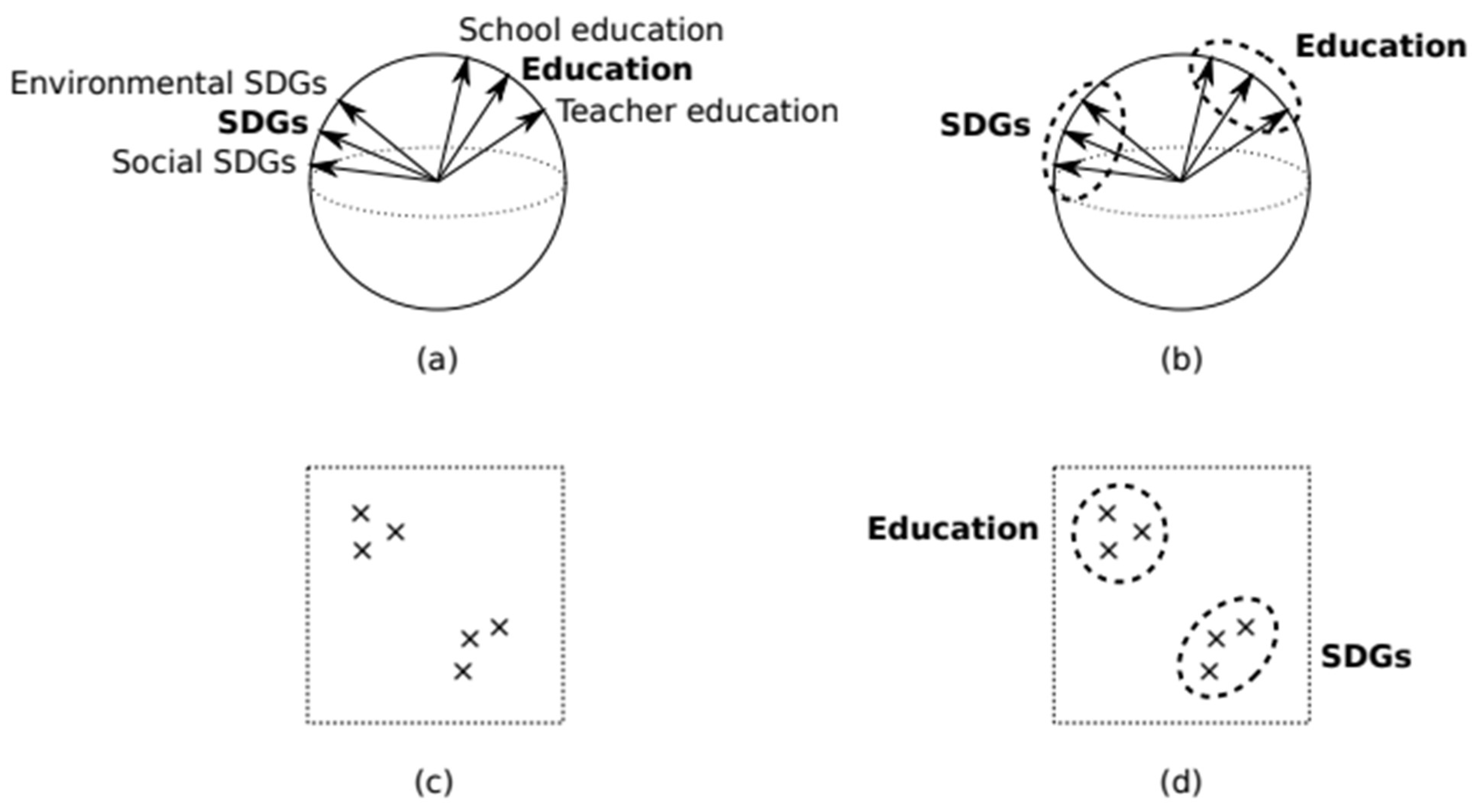
Appendix B. Technical Details of Automatic Bibliometric Clustering

References
- Abduganiev, O. I., & Abdurakhmanov, G. Z. (2020). Ecological education for the purposes sustainable development. American Journal of Social Science and Education Innovations, 2, 280–284. [Google Scholar] [CrossRef]
- Abeysekera, L., & Dawson, P. (2015). Motivation and cognitive load in the flipped classroom: Definition, rationale and a call for research. Higher Education Research & Development, 34(1), 1–14. [Google Scholar] [CrossRef]
- Aboytes, J. G., & Barth, M. (2020). Transformative learning in the field of sustainability: A systematic literature review (1999–2019). International Journal of Sustainability in Higher Education, 21(5), 993–1013. [Google Scholar] [CrossRef]
- Admiraal, W., Post, L., Kester, L., Louws, M., & Lockhorst, D. (2022). Learning labs in a secondary school in the Netherlands: Effects of teachers’ autonomy support on student learning motivation and achievement. Educational Studies, 50(5), 939–956. [Google Scholar] [CrossRef]
- Aivelo, T., & Uitto, A. (2021). Factors explaining students’ attitudes towards learning genetics and belief in genetic determinism. International Journal of Science Education, 43(9), 1408–1425. [Google Scholar] [CrossRef]
- Akinwumi, I. O. (2023). Biology education: A panacea to global environmental challenges. European Journal of Training and Development Studies, 10(2), 44–56. [Google Scholar] [CrossRef]
- Aksela, M., Tikkanen, G., & Kärnä, P. (2012). Mielekäs luonnontieteiden opetus: Miten tukea oppilaiden ajattelua ja ymmärtämistä? In P. Kärnä, L. Houtsonen, & T. Tähkä (Eds.), Luonnontieteiden opetuksen kehittämishaasteita (pp. 109–128). Koulutuksen Seurantaraportit. Opetushallitus. [Google Scholar]
- Albion, P., Redmond, P., Gharineiat, Z., Feldman, J., Shelley, T., Helwig, A., & Burey, P. (2025). Teachers and sustainability education: Exploring the views of Australian preservice and inservice teachers. The Australian Educational Researcher, 52, 3287–3313. [Google Scholar] [CrossRef]
- Aleknavičiūtė, V., Lehtinen, E., & Södervik, I. (2023). Thirty years of conceptual change research in biology—A review and meta-analysis of intervention studies. Educational Research Review, 41(5), 100556. [Google Scholar] [CrossRef]
- Ali, L. (2018). The design of curriculum, assessment and evaluation in higher education with constructive alignment. Journal of Education and e-Learning Research, 5, 72–78. [Google Scholar] [CrossRef]
- Almasri, F., Hewapathirana, G. I., Ghaddar, F., Lee, N., & Ibrahim, B. (2021). Measuring attitudes towards biology major and non-major: Effect of students’ gender, group composition, and learning environment. PLoS ONE, 16(5), e0251453. [Google Scholar] [CrossRef]
- Alnagrat, A. J. A., Che Ismail, R., Syed Idrus, S. Z., & Abdulhafith Alfaqi, R. M. (2022). A review of extended reality (XR) technologies in the future of human education: Current trend and future opportunity. Journal of Human Centered Technology, 1(2), 81–96. [Google Scholar] [CrossRef]
- Annelin, A., & Boström, G. O. (2023). An assessment of key sustainability competencies: A review of scales and propositions for validation. International Journal of Sustainability in Higher Education, 24(9), 53–69. [Google Scholar] [CrossRef]
- Ardoin, N. M., Bowers, A. W., Wyman Roth, N., & Holthuis, N. (2018). Environmental education and K-12 student outcomes: A review and analysis of research. The Journal of Environmental Education, 49(1), 1–17. [Google Scholar] [CrossRef]
- Arntzen, M., Scheie, E., & Haug, B. (2025). Unveiling perceptions: How science teachers perceive sustainable development and their expectations of students’ learning outcomes through environmental and sustainability education. International Journal of Science Education, 1–20. [Google Scholar] [CrossRef]
- Atjonen, P. (2017). Arviointiosaamisen kehittäminen yleissivistävän koulun opettajien koulutuksessa. Opetussuunnitelmatarkastelun virittämiä näkemyksiä. In V. Britschgi, & J. Rautopuro (Eds.), Kriteerit puntarissa (pp. 132–169). Kasvatusalan tutkimuksia, 74. Suomen Kasvatustieteellinen Seura. [Google Scholar]
- Avelar, A. B. A., da Silva Oliveira, K. D., & Farina, M. C. (2023). The integration of the sustainable development goals into curricula, research and partnerships in higher education. International Review of Education, 69, 299–325. [Google Scholar] [CrossRef]
- Àlvarez-Garcia, O., Sureda-Negre, J., & Comas-Forgas, R. (2015). Environmental education in pre-service teacher training: A literature review of existing evidence. Journal of Teacher Education for Sustainability, 17, 72–85. [Google Scholar] [CrossRef]
- Backman, M., Pitt, H., Marsden, T., Mehmood, A., & Mathijs, E. (2019). Experiential approaches to sustainability education: Towards learning landscapes. International Journal of Sustainability in Higher Education, 20(1), 139–156. [Google Scholar] [CrossRef]
- Ballard, H. L., Lindell, A. J., & Jadallah, C. C. (2024). Environmental education outcomes of community and citizen science: A systematic review of empirical research. Environmental Education Research, 30(6), 1007–1040. [Google Scholar] [CrossRef]
- Bandura, A. (1977). Self-efficacy: Toward a unifying theory of behavioral change. Psychological Review, 84(2), 191–215. [Google Scholar] [CrossRef]
- Bennett, J. A., & Saunders, C. P. (2019). A virtual tour of the cell: Impact of virtual reality on student learning and engagement in the STEM classroom. Journal of Microbiology & Biology Education, 20(2). [Google Scholar] [CrossRef]
- Bergmann, J., & Sams, A. (2012). Flip YOUR classroom, reach every student in every class every day. International Society for Technology in Education. ISBN 978-1564845603. [Google Scholar]
- Bianchi, G., Pisiotis, U., & Cabrera Giraldez, M. (2022). GreenComp—The European sustainability competence framework—JRC science for policy report (M. Bacigalupo, & Y. Punie, Eds.). EUR 30955 EN. Publications Office of the European Union. Available online: https://data.europa.eu/doi/10.2760/13286 (accessed on 22 January 2026).
- Biggers, M. (2018). Questioning questions: Elementary teachers’ adaptations of investigation questions across the inquiry continuum. Research in Science Education, 48, 1–28. [Google Scholar] [CrossRef]
- Bleier, M. (2021). Should we bother to practice ecological responsibility? Cultural Studies of Science Education, 16, 783–803. [Google Scholar] [CrossRef] [PubMed]
- Bloom, B. S., Engelhart, M. D., Furst, E. J., Hill, W. H., & Krathwohl, D. R. (1956). Taxonomy of educational objectives: The classification of educational goals. Handbook I: Cognitive domain. Longmans, Green and Co. [Google Scholar]
- Boyle, A., Maguire, S., Martin, A., Milsom, C., Nash, R., Rawlinson, S., & Conchie, S. (2007). Fieldwork is good: The student perception and the affective domain. Journal of Geography in Higher Education, 31(2), 299–317. [Google Scholar] [CrossRef]
- Braun, T., & Dierkes, P. (2017). Connecting students to nature–how intensity of nature experience and student age influence the success of outdoor education programs. Environmental Education Research, 23(7), 937–949. [Google Scholar] [CrossRef]
- Brechet, C., Blanc, N., Mortier, A., & Rossi, S. (2022). Draw me a brain: The use of drawing as a tool to examine children’s developing knowledge about the “black box”. Frontiers in Psychology, 13, 951784. [Google Scholar] [CrossRef]
- Broncano, F. (2014). Daring to believe: Metacognition, epistemic agency, and reflective knowledge. In A. Fairweather (Ed.), Virtue epistemology naturalized: Bridges between virtue epistemology and philosophy of science (pp. 49–66). Springer International Publishing. [Google Scholar] [CrossRef]
- Brondizio, E. S., Settele, J., Díaz, S., & Ngo, H. T. (Eds.). (2019). Global assessment report on biodiversity and ecosystem services of the intergovernmental science-policy platform on biodiversity and ecosystem services. IPBES Secretariat. [Google Scholar] [CrossRef]
- Caeiro, S., & Simão, J. (2025). Sustainability competences and pedagogical approaches at Universidade Aberta. In R. Lozano, M. Barreiro-Gen, & F. J. Lozano (Eds.), Developing sustainability competences through pedagogical approaches. Strategies for sustainability (pp. 43–50). Springer. [Google Scholar] [CrossRef]
- Cavadas, B., & Linhares, E. (2023). Using a problem-based learning approach to develop sustainability competencies in higher education students. In W. Leal Filho, A. M. Azul, F. Doni, & A. L. Salvia (Eds.), Handbook of sustainability science in the future (pp. 339–366). Springer. [Google Scholar] [CrossRef]
- Cavagnetto, A. R., Premo, J., Coleman, Z., & Juergens, K. (2022). Accuracy and idea consideration: A study of small-group interaction in biology. CBE—Life Sciences Education, 21(5), ar5. [Google Scholar] [CrossRef]
- Chen, M., Pei, T., Jeronen, E., Wang, Z., & Xu, L. (2022). Teaching and learning methods for promoting sustainability in tourism education. Sustainability, 14, 14592. [Google Scholar] [CrossRef]
- Cheng, L., Ritzhaupt, A. D., & Antonenko, P. (2019). Effects of the flipped classroom instructional strategy on students’ learning outcomes: A meta-analysis. Educational Technology Research and Development, 67(4), 793–824. [Google Scholar] [CrossRef]
- Chiu, T. K. F., Xia, Q., Zhou, X., Chai, C. S., & Cheng, M. (2023). Systematic literature review on opportunities, challenges, and future research recommendations of artificial intelligence in education. Computers and Education: Artificial Intelligence, 4, 100118. [Google Scholar] [CrossRef]
- Chopra, R., Joshi, A., Nagarajan, A., Fomproix, N., & Shashidhara, L. S. (2019). Climate change education across the curriculum. In W. Leal Filho, & S. L. Hemstock (Eds.), Climate change and the role of education (pp. 53–69). Springer. [Google Scholar]
- Chowdhury, M. (2016). Emphasizing morals, values, ethics, and character education in science education and science teaching. Malaysian Online Journal of Educational Sciences, 4(2), 1–16. [Google Scholar]
- Christ, L., Hahn, M., Sieg, A.-K., & Dreesmann, D. C. (2022). Be(e) engaged! how students benefit from an educational citizen science project on biodiversity in their biology classes. Sustainability, 14(21), 14524. [Google Scholar] [CrossRef]
- Cole, M. J. (2023). Evaluative thinking. Evaluation Journal of Australasia, 23(2), 70–90. [Google Scholar] [CrossRef]
- Colomer, J., Serra, T., Cañabate, D., & Bubnys, R. (2020). Reflective learning in higher education: Active methodologies for transformative practices. Sustainability, 12, 3827. [Google Scholar] [CrossRef]
- Comer, D. R., Lenaghan, J. A., & Sengupta, K. (2015). Factors that affect students’ capacity to fulfill the role of online learner. Journal of Education for Business, 90, 145–155. [Google Scholar] [CrossRef]
- Connors, P. K., Lanier, H. C., Erb, L. P., Varner, J., Dizney, L., Flaherty, E. A., Duggan, J. M., Yahnke, C. J., & Hanson, J. D. (2021). Connected while distant: Networking CUREs across classrooms to create community and inspire students. Integrative and Comparative Biology, 61(3), 934–943. [Google Scholar] [CrossRef]
- Czajkowska, A., & Ingaldi, M. (2023). Analysis of the survey results on the pro-ecological awareness of young people in the aspect of sustainable development. Management Systems in Production Engineering, 31(3), 312–321. [Google Scholar] [CrossRef]
- Davar, M. (2025). Effective implementation of lecture demonstration method for teaching science. International Journal of Advanced Scientific Research, 10(2), 107–109. Available online: https://www.allscientificjournal.com/assets/archives/2025/vol10issue2/10038.pdf (accessed on 27 January 2025).
- Dempster, E. R. (2023). What is ‘powerful knowledge’ in school biology? Journal of Biological Education, 57(2), 245–247. [Google Scholar] [CrossRef]
- Demssie, Y. N., Wesselink, R., Biemans, H. J. A., & Mulder, M. (2019). Think outside the European box: Identifying sustainability competencies for a base of the pyramid context. Journal of Cleaner Production, 221, 828–838. [Google Scholar] [CrossRef]
- Deringer, S. A., & Hanley, A. (2021). Virtual reality of nature can be as effective as actual nature in promoting ecological behavior. Ecopsychology, 13(3), 219–226. [Google Scholar] [CrossRef]
- Di Fabio, A. (2017). The psychology of sustainability and sustainable development for well-being in organizations. Frontiers in Psychology, 8, 1534. [Google Scholar] [CrossRef]
- Dogan, I., & Kunt, H. (2017). Determination of prospective preschool teachers’ science process Ssills. Journal of European Education, 6(1), 8–18. [Google Scholar] [CrossRef]
- Donthu, N., Kumar, S., & Pattnaik, D. (2020). Forty-five years of Journal of Business Research: A bibliometric analysis. Journal of Business Research, 109, 1–14. [Google Scholar] [CrossRef]
- Dyllick, T. (2015). Responsible management education for a sustainable world. Journal of Management Development, 34(1), 16–33. [Google Scholar] [CrossRef]
- EC (European Commission). (2022). Education for environmental sustainability: Policies and approaches in European Union member states. Final report. Publications Office of the European Union. Available online: https://data.europa.eu/doi/10.2766/391 (accessed on 22 January 2026).
- EC (European Commission). (2024). Learning for sustainability in Europe. Building competences and supporting teachers and schools: Eurydice report. European Education and Culture Executive Agency. Available online: https://data.europa.eu/doi/10.2797/81397 (accessed on 22 January 2026).
- Efe, H., & Umdu Topsakal, Ü. (2025). Let’s take the pulse of the classroom on sustainability! An exploratory study on student views and teacher solution suggestions regarding sustainable development goals. Sustainability, 17, 5095. [Google Scholar] [CrossRef]
- Elkington, J. (2007). Partnerships from cannibals with forks: The triple bottom line of 21st century business. Environmental Quality Management, Autumn, 8(1), 37–51, (Original work published 1998). [Google Scholar] [CrossRef]
- Ellis, A. K., & Stuen, C. J. (1998). The interdisciplinary curriculum. Eye On Education. [Google Scholar]
- Elo, S., Kääriäinen, M., Kanste, O., Pölkki, T., Utriainen, K., & Kyngäs, H. (2014). Qualitative content analysis. SAGE Open, 4(1). [Google Scholar] [CrossRef]
- Elo, S., & Kyngäs, H. (2008). The qualitative content analysis process. The Journal of Advanced Nursing, 62(1), 107–115. [Google Scholar] [CrossRef]
- ElSayary, A. (2024). An introduction to interdisciplinary approach on global issues for educational reform. In A. ElSayary, & R. Olowoselu (Eds.), Interdisciplinary approaches for educators’ and learners’ well-being (pp. 3–12). Springer. [Google Scholar] [CrossRef]
- Erduran, S., & Dagher, Z. R. (2014). Reconceptualizing the nature of science for science education. Scientific knowledge, practices and other family categories. Springer. [Google Scholar] [CrossRef]
- Espinosa-Gutirrez, P.-T., Gavari-Starkie, E., Lucini-Baquero, C., & Pastrana-Huguet, J. (2025). STEAM education using natural resources in rural areas: Case study of a grouped rural school in Avila, Spain. Sustainability, 17(6), 2736. [Google Scholar] [CrossRef]
- EU (European Union). (2018). Council recommendation of 22 May 2018 on key competences for lifelong learning. Official Journal of the European Union, C, 189, 1–13. Available online: https://eur-lex.europa.eu/legal-content/EN/TXT/PDF/?uri=CELEX:32018H0604(01) (accessed on 13 July 2025).
- Fam, D., Leimbach, T., Kelly, S., Hitchens, L., & Callen, M. (2018). Meta-considerations for planning, introducing and standardising inter and transdisciplinary learning in higher degree institutions. In D. Fam, L. Neuhauser, & P. Gibbs (Eds.), Transdisciplinary theory, practice and education (pp. 85–102). Springer. [Google Scholar] [CrossRef]
- Faruhana, A., Asniza, I. N., & Ahmad, M. Z. (2022). An exploration into direct nature experiences (DNE) and biodiversity knowledge amongst island children. Journal of Turkish Science Education, 19(2), 660–683. [Google Scholar] [CrossRef]
- Fatmawati, B. (2020). Creative problem solving; implemented study in biology content. Journal of Physics: Conference Series, 1567, 042079. [Google Scholar] [CrossRef]
- Findley, W. G., & Woodruff, A. D. (1964). Review of taxonomy of educational objectives, Handbook II: Affective domain, by D. R. Krathwohl, B. S. Bloom, & B. B. Masia. Journal of Educational Measurement, 1(2), 169–176. Available online: http://www.jstor.org/stable/1433690 (accessed on 22 January 2026).
- Firinci Orman, T. (2024). Exploring youth eco-literacy through lived experiences. ‘When you purchase a pair of jeans, you bear the burden of child labor in South Asia’. The Journal of Environmental Education, 55(5), 363–377. [Google Scholar] [CrossRef]
- Fricke, H.-J., Gathercole, C., & Skinner, A. (2015). Monitoring education for global citizenship: A contribution to debate. DEEEP. [Google Scholar]
- Friman, H., Banner, I., Sitbon, Y., Sahar-Inbar, L., & Shaked, N. (2024). Experiential learning for sustainability: A catalyst for global change. The Educational Administration: Theory and Practice, 30(5), 8508–8514. Available online: https://kuey.net/index.php/kuey/article/view/4404 (accessed on 22 January 2026).
- Fu, J., Hutson, B., Thierer, K., Zhang, X., & Taylor, J. (2025). Experiential learning assessment: A dive into the literature. Intersection: A Journal at the Intersection of Assessment and Learning, 6(1), 3–20. [Google Scholar] [CrossRef]
- Funa, A. A., & Emberga Gabay, R. A. (2025). Bridging the gap among knowledge, attitudes, and behaviors toward sustainable development through I-STEM-PBL-ESD. International Journal on Studies in Education, 7(2), 288–303. [Google Scholar] [CrossRef]
- Gazoulis, I., Antonopoulos, N., Kanatas, P., Karavas, N., Bertoncelj, I., & Travlos, I. (2022). Invasive alien plant species–Raising awareness of a threat to biodiversity and ecological connectivity (EC) in the Adriatic-Ionian Region. Diversity, 14(5), 387. [Google Scholar] [CrossRef]
- Gericke, N. (2022). Teaching for the Anthropocene. Bildung-oriented education for sustainable development in a subject-specific curriculum. In E. Krogh, A. Qvartrup, & S. T. Graf (Eds.), Bildung, knowledge, and global challenges in education. Didaktik and curriculum in the Anthropocene era (1st ed., pp. 53–69). Routledge. [Google Scholar] [CrossRef]
- Gericke, N., Hudson, B., Olin-Scheller, C., & Stolare, M. (2018). Powerful knowledge, transformations and the need for empirical studies across school subjects. London Review of Education, 16(3), 428–444. [Google Scholar] [CrossRef]
- Gericke, N., Tani, S., Newall, E., & Deng, Z. (2025). A framework for curricular analysis of powerful knowledge: Comparing school biology in England, Finland and Sweden. Journal of Curriculum Studies, 57(4), 441–465. [Google Scholar] [CrossRef]
- Ghafar, Z. N. (2023). The teacher-centered and the student-centered: A comparison of two approaches. International Journal of Arts and Humanities, 1(1), 18–23. [Google Scholar] [CrossRef]
- Gilissen, M. G. R., Knippels, M.-C. P. J., & van Joolingen, W. R. (2020). Bringing systems thinking into the classroom. International Journal of Science Education, 42(8), 1253–1280. [Google Scholar] [CrossRef]
- Green, C. S., & Bavelier, D. (2012). Learning, attentional control, and action video games. Current Biology, 22(6), 197–206. [Google Scholar] [CrossRef] [PubMed]
- Green, S., Higgins, J. P. T., Alderson, P., Clarke, M., Mulrow, C. D., & Oxman, A. D. (2011). Introduction. In J. P. T. Higgins, & S. Green (Eds.), Cochrane handbook for systematic reviews of interventions (pp. 3–9). version 5.1.0. University of Oxford. [Google Scholar]
- Hafeez, M. (2021). Project-based versus traditional lecture teaching methods. Journal of Education And Technology, 4(4), 544–559. [Google Scholar] [CrossRef]
- Hakkarainen, K. (2003). Progressive inquiry in a computer-supported biology class. Journal of Research in Science Teaching, 40, 1072–1088. [Google Scholar] [CrossRef]
- Harlen, W., Bell, D., Devés, R., Dyasi, H., de la Garza, G. F., Léna, P., Millar, R., Reiss, M., Rowell, P., & Yu, W. (2010). Principles and big ideas of science education. Association of Science Education. Available online: www.ase.org.uk/documents/principles-and-big-ideas-of-science-education (accessed on 22 January 2026).
- Heldén, G., & Heldén, S. (2008). Students’ early experiences of biodiversity and education for a sustainable future. Nordic Studies in Science Education, 4(2), 123–131. [Google Scholar] [CrossRef]
- Hiatt, A., Hove, A. A., Ward, J. R., Ventura, L., Boyd, A. E., Clarke, D., Horton, J. L., Murrell, Z., & Neufeld, H. S. (2021). Authentic research in the classroom increases self-efficacy and appreciation for plants in undergraduate biology students. Integrative and Comparative Biology, 61(3), 969–980. [Google Scholar] [CrossRef]
- Hiltunen, M., Kärkkäinen, S., & Keinonen, T. (2021). Identifying student teachers’ inquiry-related questions in biology lessons. Education Sciences, 11(2), 87. [Google Scholar] [CrossRef]
- Holbrook, J., Rannikmäe, M., & Soobard, R. (2020). STEAM education—A transdisciplinary teaching and learning approach. In B. Akpan, & T. J. Kennedy (Eds.), Science education in theory and practice (pp. 465–477). Springer Texts in Education. Springer. [Google Scholar] [CrossRef]
- Honra, J. R., & Monterola, S. L. C. (2025). Enhancing biology students’ cognitive flexibility through problem-based learning moderated by transdisciplinary thinking. The Journal of Educational Research, 119(1), 129–139. [Google Scholar] [CrossRef]
- Howlett, C., Ferreira, J., & Blomfield, J. (2016). Teaching sustainable development in higher education: Building critical, reflective thinkers through an interdisciplinary approach. International Journal of Sustainability in Higher Education, 17(3), 305–321. [Google Scholar] [CrossRef]
- Hu, Y., Wang, M., Ren, L., & Chen, Y. (2025). Innovation and assessment system for the development of biology teaching content aligned with sustainable development goals. Frontiers in Interdisciplinary Educational Methodology, 2(1), 1–16. [Google Scholar] [CrossRef]
- Hubbard, K. (2024). Plant biology education: A competency-based vision for the future. Plants People Planet, 6, 780–790. [Google Scholar] [CrossRef]
- Hudson, B., Gericke, N., Olin-Scheller, C., & Stolare, M. (2023). Trajectories of powerful knowledge and epistemic quality: Analysing the transformations from disciplines across school subjects. Journal of Curriculum Studies, 55(2), 119–137. [Google Scholar] [CrossRef]
- Jahnke, I. (2012). Socio-technical learning. In N. M. Seel (Ed.), Encyclopedia of the sciences of learning (pp. 3141–3143). Springer Science & Business Media. [Google Scholar]
- Jensen, E. L. (2025). “The name of things”: Lexical ecological literacy as Bildung in environmental and sustainability education. The Journal of Environmental Education. [Google Scholar] [CrossRef]
- Jeronen, E., Ahonen, P., & Korkeamäki, R.-L. (2022). Connections of transformative education with Bhutan’s pedagogical ideas for promoting sustainability education. Sustainability, 14, 163. [Google Scholar] [CrossRef]
- Jeronen, E., Keinonen, T., & Kärkkäinen, S. (2024). Visioning transformative science education for sustainability. Discourse and Communication for Sustainable Education, 15(1), 19–38. [Google Scholar] [CrossRef]
- Jeronen, J. (2024). Raven—Absorb scientific literature. Available online: https://github.com/Technologicat/raven (accessed on 11 November 2025).
- Kahveci, H. (2023). The positive and negative effects of teacher attitudes and behaviors on student progress. Journal of Pedagogical Research, 7(1), 290–306. [Google Scholar] [CrossRef]
- Kapp, K., Sivén, M., Laurén, P., Aejmelaeus, M., Virtanen, S., Katajavuori, N., & Södervik, I. (2020). Learning of laboratory skills via augmented reality-case study in pharmacy. In EDULEARN20 proceedings (pp. 7631–7638). IATED. [Google Scholar] [CrossRef]
- Kapp, K., Sivén, M., Laurén, P., Virtanen, S., Katajavuori, N., & Södervik, I. (2022). Design and usability testing of an augmented reality (AR) environment in pharmacy education—Presenting a pilot study on comparison between AR smart glasses and a mobile device in a laboratory course. Education Sciences, 12(12), 854. [Google Scholar] [CrossRef]
- Kassa, M. M., Azene, M. K., Mengstie, S. M., & Ferede, M. W. (2024). Effect of multimedia and dynamic classroom integrated instruction on grade 11 students’ biology academic achievements. Helyon, 10(18), e37315. [Google Scholar] [CrossRef]
- Kazazoglu, S. (2025). Environmental education through eco-literacy: Integrating sustainability into English language teaching. Sustainability, 17, 2156. [Google Scholar] [CrossRef]
- Kärnä, P., Hakonen, R., & Kuusela, J. (2012). Luonnontieteellinen osaaminen perusopetuksen 9. luokalla 2011. Koulutuksen seurantaraportti, 2. Juvenes Print. Opetushallitus. Tampereen yliopistopaino Oy. [Google Scholar]
- Kegley, M. D., Toteva, M. T., & Wolf, J. S. (2016). Hybrids, hassles, and hiccups: Interdisciplinary perspectives on the challenges and advantages of hybrid classes. AURCO Journal, 22, 111–133. [Google Scholar]
- Kesler, M. (2020). Opettaja luovan ongelmanratkaisun prosessin ohjaajana [Ph.D. thesis, University of Helsinki]. Kasvatustieteellisiä tutkimuksia, 105. Yliopistopaino Unigrafia. Available online: http://hdl.handle.net/10138/322029 (accessed on 7 December 2025).
- Kesler, M., Havu-Nuutinen, S., & Kärkkäinen, S. (2024). Ongelmanratkaisutaitojen kehittäminen biologian opetuksessa. In A. Uitto, E. Jeronen, & E. Yli-Panula (Eds.), Biologian opetus ja tiedekasvatus kestävän tulevaisuuden edistäjinä (pp. 171–200). Ainedidaktisia tutkimuksia, 27. Suomen ainedidaktisen tutkimusseuran julkaisuja. [Google Scholar] [CrossRef]
- Kiewra, L., Powell, R. B., Stern, M. J., Hemby, T., & Browning, M. H. (2023). Is naturalness associated with positive learning outcomes during environmental education field trips? Journal of Environmental Education, 54(2), 148–162. [Google Scholar] [CrossRef]
- Knight, S., Buckingham Shum, S., & Littleton, K. (2014). Epistemology, assessment, pedagogy: Where learning meets analytics in the middle space. Journal of Learning Analytics, 1(2), 23–47. [Google Scholar] [CrossRef]
- Kolb, D. (1984). Experimental learning. Experience as the source of learning and development. Prentice-Hall. [Google Scholar]
- Kontkanen, J., Kärkkäinen, S., Dillon, P., Hartikainen-Ahia, A., & Åhlberg, M. (2016). Collaborative processes in species identification using an internet-based taxonomic resource. International Journal of Science Education, 38(1), 96–115. [Google Scholar] [CrossRef]
- Krathwohl, D. R. (2002). A revision of Bloom’s taxonomy: An overview. Theory into Practice, 41(4), 212–218. [Google Scholar] [CrossRef]
- Kumar, V., & Kumar Choudhary, S. (2025). Reimagining scientific literacy: A textbook framework for future-focused science education. Research in Science Education, 55, 1109–1127. [Google Scholar] [CrossRef]
- Kurt, S. (2020). Problem-based learning (PBL). Educational technology. Available online: https://educationaltechnology.net/problem-based-learning-pbl/ (accessed on 30 August 2025).
- Lampert, P., Olsson, D., Hoppenreijs, J., & Gericke, N. (2025). The effectiveness of the action competence teaching approach in biodiversity education—Taking actions for insects. International Journal of Science Education. [Google Scholar] [CrossRef]
- Landøy, A., Popa, D., & Repanovici, A. (2020). Teaching learning methods. In A. Landøy, D. Popa, & A. Repanovici (Eds.), Collaboration in designing a pedagogical approach in information literacy (pp. 137–161). Springer Texts in Education. Springer. [Google Scholar] [CrossRef]
- Lankenau, G. R. (2018). Fostering connectedness to nature in higher education. Environmental Education Research, 24(2), 230–244. [Google Scholar] [CrossRef]
- Laupichler, M. C., Aster, A., Schirch, J., & Raupach, T. (2022). Artificial intelligence literacy in higher and adult education: A scoping literature review. Computers and Education: Artificial Intelligence, 3, 100101. [Google Scholar] [CrossRef]
- Lavie Alon, N. L., & Tal, T. (2015). Student self-reported learning outcomes of field trips: The pedagogical impact. International Journal of Science Education, 37(8), 1279–1298. [Google Scholar] [CrossRef]
- Lawrence, J., Morrell, L. J., & Scott, G. W. (2023). Building a competence-based model for the academic development of programme leaders. International Journal for Academic Development, 29(3), 379–392. [Google Scholar] [CrossRef]
- Lei, S. A., & Lei, S. Y. (2019). Evaluating benefits and drawbacks of hybrid courses: Perspectives of college instructors. Education (Chula Vista), 140(1), 1–8. [Google Scholar]
- Lewinsohn, T. M., Attayde, J. L., Fonseca, C. R., Ganade, G., Jorge, L. R., Kollmann, J., Overbeck, G. E., Prado, P. I., Pillar, V. D., Popp, D., da Rocha, P. L., Silva, W. R., Spiekermann, A., & Weisser, W. W. (2015). Ecological literacy and beyond: Problem-based learning for future professionals. Ambio, 44(2), 154–162. [Google Scholar] [CrossRef]
- Liefländer, A. K., & Bogner, F. X. (2018). Educational impact on the relationship of environmental knowledge and attitudes. Environmental Education Research, 24(4), 611–624. [Google Scholar] [CrossRef]
- Liefländer, A. K., Fröhlich, G., Bogner, F. X., & Schultz, P. W. (2013). Promoting connectedness with nature through environmental education. Environmental Education Research, 19(3), 370–384. [Google Scholar] [CrossRef]
- Liu, Y., & Pásztor, A. (2022). Effects of problem-based learning instructional intervention on critical thinking in higher education: A meta-analysis. Thinking Skills and Creativity, 45, 101069. [Google Scholar] [CrossRef]
- Lovren, V. O., & Jablanovic, M. M. (2023). Bridging the gap: The affective dimension of learning outcomes in environmental primary and secondary education. Sustainability, 15(8), 6370. [Google Scholar] [CrossRef]
- Lozano, R., Merrill, M. Y., Sammalisto, K., Ceulemans, K., & Lozano, F. J. (2017). Connecting competences and pedagogical approaches for sustainable development in higher education: A literature review and framework proposal. Sustainability, 9, 1889. [Google Scholar] [CrossRef]
- Lynch, R., McCormack, O., & Hennessy, J. (2025). Exploring teachers’ and students’ views and experiences of field trips. Journal of Adventure Education and Outdoor Learning. [Google Scholar] [CrossRef]
- Lyon, E. G. (2013). Learning to assess science in linguistically diverse classrooms: Tracking growth in secondary science preservice teachers’ assessment expertise. Science Education, 97, 442–467. [Google Scholar] [CrossRef]
- McInnes, L., & Healy, J. (2017, November 18–21). Accelerated hierarchical density based clustering. 2017 IEEE International Conference on Data Mining Workshops (ICDMW) (pp. 33–42), New Orleans, LA, USA. [Google Scholar] [CrossRef]
- Merchant, Z., Goetz, E. T., Cifuentes, L., Keeney-Kennicutt, W., & Davis, T. J. (2014). Effectiveness of virtual reality-based instruction on students’ learning outcomes in K-12 and higher education: A meta-analysis. Computers & Education, 70, 29–40. [Google Scholar] [CrossRef]
- Merrick, L., Xu, D., Nuti, G., & Campos, D. (2024). Arctic-embed: Scalable, efficient, and accurate text embedding models. arXiv, arXiv:2405.05374. [Google Scholar] [CrossRef]
- Molthan-Hill, P., Blaj-Ward, L., Mbah, M. F., & Ledley, T. S. (2022). Climate change education at universities: Relevance and strategies for every discipline. In M. Lackner, B. Sajjadi, & W. Y. Chen (Eds.), Handbook of climate change mitigation and adaptation (pp. 3395–3457). Springer. [Google Scholar]
- Montani, I., Honnibal, M., Boyd, A., Van Landeghem, S., & Peters, H. (2023). spaCy: Industrial-strength natural language processing in Python. Zenodo. [Google Scholar] [CrossRef]
- Morris, R., Perry, T., & Wardle, L. (2021). Formative assessment and feedback for learning in higher education: A systematic review. Revue of Education, 9, e3292. [Google Scholar] [CrossRef]
- Muller, J., & Young, M. (2019). Knowledge, power and powerful knowledge re-visited. The Curriculum Journal, 30(2), 196–214. [Google Scholar] [CrossRef]
- Murti, W., Rohman, F., Sapta Sari, M., & Ibrohim, I. (2025). Ecoliteracy competencies: A systematic literature review of domains, approaches, and impacts in education. EURASIA Journal of Mathematics, Science and Technology Education, 21(8), em2677. [Google Scholar] [CrossRef] [PubMed]
- Nawani, J., von Kotzebue, L., Spangler, M., & Neuhaus, B. J. (2019). Engaging students in constructing scientific explanations in biology classrooms: A lesson-design model. Journal of Biological Education, 53(4), 378–389. [Google Scholar] [CrossRef]
- Nazir, J., & Pedretti, E. (2016). Educators’ perceptions of bringing students to environmental consciousness through engaging outdoor experiences. Environmental Education Research, 22(2), 288–304. [Google Scholar] [CrossRef]
- Novak, J. D. (2010). Learning, creating, and using knowledge: Concept maps as facilitative tools in schools and corporations. Routledge. [Google Scholar]
- Odell, V., Molthan-Hill, P., Martin, S., & Sterling, S. (2019). Transformative education to address all sustainable development goals. In W. Leal Filho, A. Azul, L. Brandli, P. Özuyar, & T. Wall (Eds.), Quality education, Encyclopedia of the UN sustainable development goals (pp. 1–12). Springer. [Google Scholar] [CrossRef]
- OECD (Organisation for Economic Co-operation and Development). (2017). PISA 2015 assessment and analytical framework: Science, reading, mathematic, financial literacy and collaborative problem solving (rev. ed.). PISA, OECD Publishing. [Google Scholar] [CrossRef]
- OECD (Organisation for Economic Co-operation and Development). (2018). Education at a glance 2018. OECD Indicators. OECD Publishing. [Google Scholar] [CrossRef]
- OECD (Organisation for Economic Co-operation and Development). (2019). PISA 2018 assessment and analytical framework (pp. 97–117). OECD Publishing. [Google Scholar] [CrossRef]
- OECD (Organisation for Economic Co-operation and Development). (2023). PISA 2025 science framework, draft. Available online: https://pisa-framework.oecd.org/science-2025/assets/docs/PISA_2025_Science_Framework.pdf (accessed on 7 December 2025).
- Oliveira, J. V., Lopes, F. S., Barboza, D. R. R., Trovao, B. M., Ramos, B. M., & Alves, N. R. R. (2019). Wild vertebrates and their representation by urban/rural students in a region of northeast Brazil. Journal of Ethnobiology and Ethnomedicine, 15(1), 1. [Google Scholar] [CrossRef]
- Olsson, D., Gericke, N., & Boeve-de Pauw, J. (2022). The effectiveness of education for sustainable development revisited—A longitudinal study on secondary students’ action competence for sustainability. Environmental Education Research, 28(3), 405–429. [Google Scholar] [CrossRef]
- Osborne, J., Rafanelli, S., & Kind, P. (2018). Toward a more coherent model for science education than the crosscutting concepts of the next generation science standards: The affordances of styles of reasoning. Journal of Research in Science Teaching, 55(7), 962–981. [Google Scholar] [CrossRef]
- Ottander, K., & Simon, S. (2021). Learning democratic participation? Meaning-making in discussion of socioscientific issues in science education. International Journal of Science Education, 43(12), 1895–1925. [Google Scholar] [CrossRef]
- Ölçer-Çevik, C., & Kozaner, Ç. (2025). Building a sustainable future: Perspectives on primary school sustainability projects from teachers and pre-service teachers. International Journal of Evaluation and Research in Education, 14(5), 3403–3417. [Google Scholar] [CrossRef]
- Palmberg, I., Berg, I., Jeronen, E., Kärkkäinen, S., Norrgård-Sillanpää, P., Persson, C., Vilkonis, R., & Yli-Panula, E. (2015). Nordic–Baltic student teachers’ identification of and interest in plant and animal species: The importance of species identification and biodiversity for sustainable development. Journal of Science Teacher Education, 26(6), 549–571. [Google Scholar] [CrossRef]
- Palmberg, I., Hermans, M., Jeronen, E., Kärkkäinen, S., Persson, C., & Yli-Panula, E. (2018). Nordic student teachers’ views on the importance of species and species identification. Journal of Science Teacher Education, 29(5), 397–419. [Google Scholar] [CrossRef]
- Palmberg, I., Hofman-Bergholm, M., Jeronen, E., & Yli-Panula, E. (2017). Systems thinking for understanding sustainability? Nordic student teachers’ views on the relationship between species identification, biodiversity and sustainable development. Education Sciences, 7(3), 72. [Google Scholar] [CrossRef]
- Palmberg, I., Jonsson, G., Jeronen, E., & Yli-Panula, E. (2016). Blivande lärares uppfattningar och förståelse av baskunskap i ekologi i Danmark, Finland och Sverige. Nordic Studies in Science Education, 12(2), 197–217. [Google Scholar] [CrossRef]
- Palmberg, I., Kärkkäinen, S., Jeronen, E., Yli-Panula, E., & Persson, C. (2019). Nordic student teachers’ views on the most efficient teaching and learning methods for species and species identification. Sustainability, 11, 5231. [Google Scholar] [CrossRef]
- Patashnik, O., & Lamport, L. (1985). BibTeX—Process bibliographies (bib files) for LaTeX or other formats. Available online: https://www.ctan.org/pkg/bibtex (accessed on 11 November 2025).
- Persano Adorno, D., Birsan, E. A., Stoica, S. F., Capatina, M., Cojocaru, C., Tzortzaki, A., Štanfelj, Z., Dinçer, Y. S., & Pizzolato, N. (2025). Sustainability as a cross-curricular link: Creative European strategies for eco-conscious environmental education. Sustainability, 17, 5193. [Google Scholar] [CrossRef]
- Pessoa, P., Lopes, J. B., de Lima, J., Pinto, A., Søgaard Jørgensen, P., & Sá-Pinto, X. (2024). Evolutionary literacy as a catalyst for sustainable futures: Connecting biological evolution education and education for sustainability. Evolution: Education and Outreach, 17(1), 22. [Google Scholar] [CrossRef]
- Pintrich, P. R. (2002). The role of metacognitive knowledge in learning, teaching, and assessing. Theory into Practice, 41(4), 219–225. [Google Scholar] [CrossRef]
- Prabakaran, M. (2020). Historical appropriation of epistemological values: A goal ahead for higher education. Higher Education for the Future, 7(1), 67–81. [Google Scholar] [CrossRef]
- Prince, M. J., & Felder, R. M. (2006). Inductive teaching and learning methods: Definitions, comparisons, and research bases. Journal of Engineering Education, 95(2), 123–138. [Google Scholar] [CrossRef]
- Puig, B., & Jiménez-Aleixandre, M. P. (2022). The integration of critical thinking in biology and environmental education. Contributions and further directions. In B. Puig, & M. P. Jiménez-Aleixandre (Eds.), Critical thinking in biology and environmental education. Facing challenges in a post-truth world (pp. 269–276). Springer. [Google Scholar]
- Purwasih, D., Wilujeng, I., Wiyarsi, A., & Zakwandi, R. (2025). The socio-scientific issue based on local potential in integrated learning instruction to improve student ecological literacy. Science & Education. [Google Scholar] [CrossRef]
- Randler, C., & Bogner, F. X. (2006). Cognitive achievements in identification skills. Journal of Biological Education, 40(4), 161–165. [Google Scholar] [CrossRef]
- Reen, F. J., Jump, O., McEvoy, G., McSharry, B. P., Morgan, J., Murphy, D., O’Leary, N., O’Mahony, B., Scallan, M., Walsh, C., & Supple, B. (2022). Developing student codesigned immersive virtual reality simulations for teaching of challenging concepts in molecular and cellular biology. FEMS Microbiology Letters, 369(1), fnac051. [Google Scholar] [CrossRef]
- Reiss, M. J., & Winterbottom, M. (2023). Teaching secondary biology. School Science Review in Depth, 104(387), 19–23. Available online: https://discovery.ucl.ac.uk/id/eprint/10171259 (accessed on 22 January 2026).
- Roberts, D. A. (2007). Scientific literacy/science literacy. In S. K. Abell, & N. G. Lederman (Eds.), Handbook of research on science education (pp. 729–780). Lawrence Erlbaum Associates. [Google Scholar]
- Roberts, D. A., & Bybee, R. W. (2014). Scientific literacy, science literacy, and science education. In N. G. Lederman, & S. K. Abell (Eds.), Handbook of research on science education (Vol. 2, pp. 545–558). Routledge. [Google Scholar]
- Rockström, J., Steffen, W., Noone, K., Persson, Å., Chapin, F. S., III, Lambin, E. F., Lenton, T. M., Scheffer, M., Folke, C., Schellnhuber, H. J., Nykvist, B., de Wit, C. A., Hughes, T., van der Leeuw, S., Rodhe, H., Sörlin, S., Snyder, P. K., Costanza, R., Svedin, U., … Foley, J. A. (2009). A safe operating space for humanity. Nature, 461, 472–475. [Google Scholar] [CrossRef]
- Rockström, J., & Sukhdev, P. (2016). The SDGs wedding cake. Stockholm Resilience Centre/Stockholm University. Available online: https://www.stockholmresilience.org/research/research-news/2016-06-14-the-sdgs-wedding-cake.html (accessed on 25 September 2025).
- Rodgers, C. (2002). Defining reflection: Another look at John Dewey and reflective thinking. The Teachers College Record, 104(4), 842–866. [Google Scholar] [CrossRef]
- Rodriguez, M. C., & Albano, A. D. (2017). The college instructor’s guide to writing test items: Measuring student learning. Routledge. [Google Scholar]
- Saal, F. E., Downey, R. G., & Lahey, M. A. (1980). Rating the ratings: Assessing the psychometric quality of rating data. Psychological Bulletin, 88(2), 413. [Google Scholar] [CrossRef]
- Saira, Z. N., & Hafeez, M. (2021). A critical review on discussion and traditional teaching methods. Psychology and Education, 58(1), 1871–1886. [Google Scholar]
- Salonen, A., & Bardy, M. (2015). Ekososiaalinen sivistys herättää luottamusta tulevaisuuteen. Aikuiskasvatus, 35(1), 4–15. [Google Scholar] [CrossRef]
- Sangur, K., Zubaidah, S., & Sulisetijono. (2025). A systematic literature review of mobile learning trends in biology education over ten years. Social Sciences & Humanities Open, 11, 101429. [Google Scholar] [CrossRef]
- Santos, A. V., da Silva, R. S., de Souza, A. C., Vaz Rocha, E. A., da Costa Santos, L., Araújo, J. E., de Paula, M. S., Silva Pereira, N. A., & de Sousa-Baracho, I. P. (2025). Didactics and environmental education: Pedagogical workshops as a strategy for sustainability-oriented learning. Revista Caderno Pedagógico, 22(9), e18184. [Google Scholar] [CrossRef]
- Sass, W., Boeve-de Pauw, J., Olsson, D., Gericke, N., De Maeyer, S., & Van Petegem, P. (2020). Redefining action compe-tence: The case of sustainable development. The Journal of Environmental Education, 51(4), 292–305. [Google Scholar] [CrossRef]
- Savage, E., Tapics, T., Evarts, J., Wilson, J., & Tirone, S. (2015). Experiential learning for sustainability leadership in higher education. International Journal of Sustainability in Higher Education, 16(5), 692–705. [Google Scholar] [CrossRef]
- Sá-Pinto, X., Beniermann, A., Børsen, T., Georgiou, M., Jeffries, A., Pessoa, P., Sousa, B., & Zeidler, D. L. (Eds.). (2022). Learning evolution through socioscientific issues. UA Editora. [Google Scholar] [CrossRef]
- Schellekens, L. H., Bok, H. G. J., de Jong, L. H., van der Schaaf, M. F., Kremer, W. D. J., & van der Vleuten, C. P. M. (2021). A scoping review on the notions of Assessment as learning (AaL), Assessment for learning (AfL), and Assessment of learning (AoL). Studies in Educational Evaluation, 71, 101094. [Google Scholar] [CrossRef]
- Schön, D. A. (1992). The reflective practitioner: How professionals think in action. Routledge. [Google Scholar] [CrossRef]
- Semken, S., Geraghty Ward, E., Moosavi, S., & Chinn, P. W. U. (2017). Place-based education in geoscience: Theory, research, practice, and assessment. Journal of Geoscience Education, 65(4), 542–562. [Google Scholar] [CrossRef]
- Shephard, K. (2022). On the educational difference between being able and being willing. In P. Vare, N. Lausselet, & M. Rieckmann (Eds.), Competences in education for sustainable development (pp. 45–52). Sustainable Development Goals Series. Springer. [Google Scholar] [CrossRef]
- Shulman, L. S. (1986). Those who understand: Knowledge growth in teaching. Educational Researcher, 15(2), 4–14. [Google Scholar] [CrossRef]
- Siarova, H., Sternadel, D., & Szőnyi, E. (2019). Research for CULT committee–Science and scientific literacy as an educational challenge. EPRS: European Parliamentary Research Service. Available online: https://policycommons.net/artifacts/1335164/research-for-cult-committee/1941452/ (accessed on 22 January 2026).
- Sinakou, E., Donche, V., Boeve-de Pauw, J., & Van Petegem, P. (2019). Designing powerful learning environments in education for sustainable development: A conceptual framework. Sustainability, 11(21), 5994. [Google Scholar] [CrossRef]
- Singh, Y., & Suri, P. K. (2022). An empirical analysis of mobile learning app usage experience. Technology in Society, 68, 101929. [Google Scholar] [CrossRef]
- Sipos, Y., Battisti, B., & Grimm, K. (2008). Achieving transformative sustainability learning: Engaging heads, hands and heart. International Journal of Sustainability in Higher Education, 9(1), 68–86. [Google Scholar] [CrossRef]
- Sjöström, J., Economou, C., Edström, A.-M., Ekberg, J.-E., Svensson Källberg, P., Larneby, M., Liljefors Persson, B., Ryan, U., Schubert, P., Wangen, B., & Örbring, D. (2024). Knowledge contributions from different school subjects to cross-curricular didactics for bildung and sustainability. In C. Hilli, & N. Mård (Eds.), Crossing over subject boundaries towards new horizons: Recent trends in research on crosscurricular teaching from the Nofa 9 conference (pp. 66–91). Ainedidaktisia tutkimuksia, 25. Suomen ainedidaktinen tutkimusseura. [Google Scholar] [CrossRef]
- Sjöström, J., & Eilks, I. (2018). Reconsidering different visions of scientific literacy and science education based on the concept of bildung. In Y. J. Dori, Z. R. Mevarech, & D. R. Baker (Eds.), Cognition, metacognition, and culture in STEM education. Innovations in science education and technology (Vol. 24, pp. 65–88). Springer. [Google Scholar] [CrossRef]
- Slavin, R. E., Hurley, E. A., & Chamberlain, A. M. (2022). Cooperative learning and achievement: Theory and research. In K. R. Harris, S. Graham, T. Urdan, C. B. McCormick, & G. M. Sinatra (Eds.), APA educational psychology handbook (Vol. 1, pp. 253–275). American Psychological Association. [Google Scholar]
- Snowflake (Snowflake, Inc.). (2024). Snowflake’s arctic-embed-l. Available online: https://huggingface.co/Snowflake/snowflake-arctic-embed-l (accessed on 11 November 2025).
- Song, H., & Cai, L. (2024). Interactive learning environment as a source of critical thinking skills for college students. BMC Medical Education, 24, 270. [Google Scholar] [CrossRef] [PubMed]
- Sourgiadaki, M., & Karkalakos, S. (2023). “GreenComp” as a tool for examining motivation of vocational teachers to create learning opportunities for the green transition. SN Social Sciences, 3, 114. [Google Scholar] [CrossRef]
- Södervik, I. (2024). Biologian ilmiöiden ymmärtäminen. In A. Uitto, E. Jeronen, & E. Yli-Panula (Eds.), Biologian opetus ja tiedekasvatus kestävän tulevaisuuden edistäjinä (pp. 96–130). Ainedidaktisia tutkimuksia, 27. Suomen ainedidaktisen tutkimusseuran julkaisuja. [Google Scholar] [CrossRef]
- Södervik, I., Katajavuori, N., Kapp, K., Laurén, P., Aejmelaeus, M. M., & Sivén, M. (2021). Fostering performance in hands-on laboratory work with the use of mobile augmented reality (AR) glasses. Education Sciences, 11(2), 816. [Google Scholar] [CrossRef]
- Spaiser, V., Ranganathan, S., Bali Swain, R., & Sumpter, D. (2016). The sustainable development oxymoron: Quantifying and modelling the incompatibility of sustainable development goals. International Journal of Sustainable Development & World Ecology, 24(6), 457–470. [Google Scholar] [CrossRef]
- Sposab, K., & Rieckmann, M. (2024). Development of sustainability competencies in secondary school education: A scoping literature review. Sustainability, 16, 10228. [Google Scholar] [CrossRef]
- Springer, L., Stanne, M. E., & Donovan, S. S. (2022). Effects of small-group learning on undergraduates in science, mathematics, engineering, and technology: A meta-analysis. Review of Educational Research, 69(1), 21–51. [Google Scholar] [CrossRef]
- Stanny, C. (2016). Reevaluating bloom’s taxonomy: What measurable verbs can and cannot say about student learning. Education Sciences, 6(4), 37. [Google Scholar] [CrossRef]
- Sterling, S. (2001). Sustainable education: Re-visioning learning and change (Vol. 6). Schumacher Briefing. Green Books. [Google Scholar]
- Sterling, S., Dawson, J., & Warwick, P. (2018). Transforming sustainability education at the creative edge of the mainstream: A case study of Schumacher College. Journal of Transformative Education, 16(4), 323–343. [Google Scholar] [CrossRef]
- Stromie, T., & Baudier, J. (2017). Assessing student learning in hybrid courses. New Directions for Teaching and Learning, 149, 37–45. [Google Scholar] [CrossRef]
- Su, R., Jiang, Z., & Wei, B. (2025). Representations of nature of science in science textbooks. Science & Education, 34, 585–607. [Google Scholar] [CrossRef]
- Sumleth, E., & Walpuski, M. (2012). Experimental learning environments. In N. M. Seel (Ed.), Encyclopedia of the sciences of learning (pp. 1229–1233). Springer Science & Business Media. [Google Scholar] [CrossRef]
- Swain, R. B. (2018). A critical analysis of the sustainable development goals. In W. Leal Filho (Ed.), Handbook of sustainability science and research (pp. 341–355). World Sustainability Series. Springer. [Google Scholar] [CrossRef]
- Szczytko, R., Carrier, S. J., & Stevenson, K. T. (2018). Impacts of outdoor environmental education on teacher reports of attention, behavior, and lerning outcomes for students with emotional, cognitive, and behavioral disabilities. Frontiers in Education, 3, 46. [Google Scholar] [CrossRef]
- Tal, T., Levin-Peled, R., & Levy, K. S. (2019). Teacher views on inquiry-based learning: The contribution of diverse experiences in the outdoor environment. Innovation in Education, 1(2), 1–17. [Google Scholar] [CrossRef]
- TENK. (2019). Human sciences in Finland. Finnish national board on research integrity TENK guidelines 2019. Publications of the Finnish National Board on Research Integrity TENK, 3. Finnish National Board on Research Integrity TENK. Available online: https://tenk.fi/sites/default/files/2021-01/Ethical_review_in_human_sciences_2020.pdf (accessed on 22 January 2026).
- Tiahrt, T., & Porter, J. C. (2016). What do I do with this flipping classroom: Ideas for effectively using class time in a flipped course. Business Education Innovation Journal, 8(2), 85–91. [Google Scholar]
- Tidemand, S., & Nielsen, J. A. (2017). The role of socioscientific issues in biology teaching: From the perspective of teachers. International Journal of Science Education, 39(1), 44–61. [Google Scholar] [CrossRef]
- Tilbury, D. (2011). Education for sustainable development: An expert review of processes and learning. UNESCO. Available online: https://unesdoc.unesco.org/ark:/48223/pf0000191442 (accessed on 20 January 2026).
- Toivonen, H. (2023). Mitä tekoäly on?—100 kysymystä ja vastausta. Kustannus-osakeyhtiö Teos. [Google Scholar]
- Uitto, A., Boeve-de Pauw, J., & Saloranta, S. (2015). Participatory school experiences as facilitators for adolescents’ ecological behavior. Journal of Environmental Psychology, 43, 55–65. [Google Scholar] [CrossRef]
- Uitto, A., Jeronen, E., & Yli-Panula, E. (2024a). Luonnontiedekasvatus ja kestävän kehityksen kasvatus biologian opetuksessa. In A. Uitto, E. Jeronen, & E. Yli-Panula (Eds.), Biologian opetus ja tiedekasvatus kestävän tulevaisuuden edistäjinä (pp. 66–67). Ainedidaktisia tutkimuksia, 27. Suomen ainedidaktisen tutkimusseuran julkaisuja. [Google Scholar] [CrossRef]
- Uitto, A., & Saloranta, S. (2017). Subject teachers as educators for sustainability: Survey study. Education Sciences, 7(1), 8. [Google Scholar] [CrossRef]
- Uitto, A., Yli-Panula, E., & Jeronen, E. (2024b). Näkökulmia kestävyyttä korostavan biologian opetukseen ja arviointiin. In A. Uitto, E. Jeronen, & E. Yli-Panula (Eds.), Biologian opetus ja tiedekasvatus kestävän tulevaisuuden edistäjinä (pp. 79–95). Ainedidaktisia tutkimuksia, 27. Suomen ainedidaktisen tutkimusseuran julkaisuja. [Google Scholar] [CrossRef]
- UN (United Nations). (2003). Activities undertaken in implementation of Agenda 21, the programme for the implementation of Agenda 21 and the outcomes of the world summit on sustainable development. Report of the Secretary-General. United Nations A 58/210. United Nations: General Assembly. Available online: https://digitallibrary.un.org/record/501841?v=pdf (accessed on 1 September 2025).
- UN (United Nations). (2019). Resolution adopted by the general assembly on 19 December 2019 74/233. Follow-up to the second United Nations conference on landlocked developing countries. United Nations. Available online: https://documents.un.org/doc/undoc/gen/n19/437/29/pdf/n1943729.pdf (accessed on 2 October 2025).
- UN (United Nations). (2021). Transforming our world: The 2030 agenda for sustainable development. Department of Economic and Social Affairs, Sustainable Development. Available online: https://sdgs.un.org/2030agenda (accessed on 9 October 2025).
- UNESCO (United Nations Educational, Scientific and Cultural Organization). (2017a). Education for sustainable development goals: Learning objectives. UNESCO Ebooks. [Google Scholar] [CrossRef]
- UNESCO (United Nations Educational, Scientific and Cultural Organization). (2017b). Roadmap for implementing the global action programme on education for sustainable development. Available online: https://unesdoc.unesco.org/ark:/48223/pf0000230514 (accessed on 23 October 2025).
- Vahed, A., Walters, M. M., & Ross, A. H. A. (2023). Continuous assessment fit for purpose? Analysing themexperiences of academics from a South African university of technology. Education Inquiry, 14, 267–283. [Google Scholar] [CrossRef]
- Valladares, L. (2021). Scientific literacy and social transformation. Science & Education, 30(3), 557−587. [Google Scholar] [CrossRef]
- van der Maaten, L., & Hinton, G. (2008). Visualizing data using t-SNE. Journal of Machine Learning Research, 9, 2579–2605. [Google Scholar]
- van de Wetering, J., Leijten, P., Spitzer, J., & Thomaes, S. (2022). Does environmental education benefit environmental outcomes in children and adolescents? A meta-analysis. Journal of Environmental Psychology, 81, 101782. [Google Scholar] [CrossRef]
- Vare, P., Arro, G., de Hamer, A., Del Gobbo, G., de Vries, G., Farioli, F., KadjiBeltran, C., Kangur, M., Mayer, M., Millican, R., Nijdam, C., Réti, M., & Zachariou, A. (2019). Devising a competence-based training program for educators of sustainable development: Lessons learned. Sustainability, 11, 1890. [Google Scholar] [CrossRef]
- Veugen, M., Gulikers, J., & Den Brok, P. (2021). We agree on what we see: Teacher and student perceptions of formative assessment practice. Studies in Educational Evaluation, 70, 101027. [Google Scholar] [CrossRef]
- Villarosa, A. M. (2025). Eco-literacy awareness of pre-service science teachers: Assessment of knowledge, awareness, methics, emotion, and behaviour. Journal of Interdisciplinary Perspectives, 3(7), 537–547. [Google Scholar] [CrossRef]
- Vogelstein, J. T., Verstynen, T., Kording, K. P., Isik, L., Krakauer, J. W., Etienne-Cummings, R., Ogburn, E. L., Priebe, C. E., Burns, R., Kutten, K., Knierim, J. J., Potash, J. B., Hartung, T., Smirnova, L., Worley, P., Savonenko, A., Phillips, I., Miller, M. I., Vidal, R., … Yang, W. (2022). Prospective learning: Back to the future. arXiv, arXiv:2201.07372. [Google Scholar] [CrossRef]
- Vygotsky, L. S. (1978). Mind in society: Development of higher psychological processes. Harvard University Press. [Google Scholar]
- Wang, C.-C. (2021). The process of implementing problem-based learning in a teacher education programme: An exploratory case study. Cogent Education, 8(1), 1996870. [Google Scholar] [CrossRef]
- Whalen, K., & Paez, A. (2021). Student perceptions of reflection and the acquisition of higher- order thinking skills in a university sustainability course. Journal of Geography in Higher Education, 45, 108–127. [Google Scholar] [CrossRef]
- White, P. J., Ardoin, N. M., Eames, C., & Monroe, M. C. (2024). Agency in the Anthropocene: Education for planetary health. Lancet Planet Health, 8(2), e117–e123. [Google Scholar] [CrossRef]
- Wiek, A., Bernstein, M. J., Foley, R. W., Cohen, M., Forrest, N., Kuzdas, C., Kay, B., & Withycombe Keeler, L. (2016). Operationalising competencies in higher education for sustainable development. In M. Barth, G. Michelsen, M. Rieckmann, & I. Thomas (Eds.), Handbook of higher education for sustainable development (pp. 241–260). Routledge. [Google Scholar]
- Wiek, A., & Redman, A. (2022). What do key competencies in sustainability offer and how to use them. In P. Vare, N. Lausselet, & M. Rieckmann (Eds.), Competences in education for sustainable development (pp. 27–34). Sustainable Development Goals Series. Springer. [Google Scholar] [CrossRef]
- Wiek, A., Withycombe, L., Redman, C. L., & Banas Mills, S. (2011). Moving forward on competence in sustainability research and problem solving. Environment: Science and Policy for Sustainable Development, 53(2), 3–12. [Google Scholar] [CrossRef]
- Wolff, L.-A. (2022). Biodiversity education. In S. Idowu, R. Schmidpeter, N. Capaldi, L. Zu, M. Del Baldo, & R. Abreu (Eds.), Encyclopedia of sustainable management (pp. 1–11). Springer. [Google Scholar] [CrossRef]
- Woods, C. T., Davids, K., & Araújo, D. (2024). On ecological literacy through implicated participation. New Ideas in Psychology, 73, 101079. [Google Scholar] [CrossRef]
- Yeon, Y.-K., Lee, B. Y., Park, S., Kim, D., Shin, Y. H., Koh, H. J., & Kim, S. W. (2025). Digital competence in geoscience fieldwork: A case study of the KMapper application. Journal of Geography in Higher Education. [Google Scholar] [CrossRef]
- Yli-Panula, E., Banos-Conzales, I., Jeronen, E., & Matikainen, E. (2025). Student teachers’ views on content knowledge of environmental issues in biological and geoscience subject matters. Interdisciplinary Journal of Environmental and Science Education, 21(4), e2520. [Google Scholar] [CrossRef]
- Yli-Panula, E., Jeronen, E., Inkinen, J., & Sohlman, S. (2019). Digitaaliset opetusmenetelmät biologian opetuksessa ja oppimisessa. In M. Rautiainen, & M. Tarnanen (Eds.), Tutkimuksesta luokkahuoneisiin (pp. 425–443). Ainedidaktisia tutkimuksia, 15. Suomen ainedidaktinen tutkimusseura. Available online: http://hdl.handle.net/10138/298542 (accessed on 22 January 2026).
- Yli-Panula, E., Jeronen, E., Koskinen, S., & Mäki, S. (2022a). Finnish university students’ views on climate change education and their own ability to act as climate educators. Education Sciences, 12, 169. [Google Scholar] [CrossRef]
- Yli-Panula, E., Jeronen, E., Koskinen, S., & Vesterkvist, S. (2020a). Biologian ja maantieteen opetuksessa käytettävät ilmastonmuutoksen opetusmenetelmät. Ainedidaktiikka, 4(3), 102–124. [Google Scholar] [CrossRef]
- Yli-Panula, E., Jeronen, E., & Lemmetty, P. (2020b). Teaching and learning methods in geography promoting sustainability. Education Sciences, 10(1), 5. [Google Scholar] [CrossRef]
- Yli-Panula, E., Jeronen, E., Lemmetty, P., & Pauna, A. (2018). Teaching methods in biology promoting biodiversity education. Sustainability, 10(10), 3812. [Google Scholar] [CrossRef]
- Yli-Panula, E., Jeronen, E., & Mäki, S. (2022b). School culture promoting sustainability in student teachers’ views. Sustainability, 14(12), 7440. [Google Scholar] [CrossRef]
- Yli-Panula, E., Jeronen, E., & Pongsakdi, N. (2017a). Primary school student teachers’ perceived and actual knowledge in biology. CEPS Journal, 7(4), 125–146. [Google Scholar] [CrossRef]
- Yli-Panula, E., Jeronen, E., Seiko-Ahlström, H., & Ruotsalainen, E. (2017b). Important biological issues for elementary pupils—A study of elementary pre-service teachers’ conceptions. Nordic Studies in Science Education, 13(2), 180–196. [Google Scholar] [CrossRef]
- Yli-Panula, E., Jeronen, E., Vesterkvist, S., & Tolonen, P. (2021). Finnish subject student teachers’ views on their social competencies at the end of their educational studies. In E. Jeronen (Ed.), Transitioning to quality education (pp. 63–87). Transitioning to Sustainability Series 4. MDPI. [Google Scholar]
- Yli-Panula, E., Södervik, I., Jeronen, E., & Rantala, H. (2024). Finnish primary school student teachers’ systems thinking regarding sustainability in connection with reproduction, biodiversity and sustainable development. Nordic Studies in Science Education, 20(2), 191–205. [Google Scholar] [CrossRef]
- Young, M. (2009). Education, globalization and the ‘voice of knowledge’. Journal of Education and Work, 22(3), 193–204. [Google Scholar] [CrossRef]
- Yücel, D., & Çalışkan, İ. (2025). A comparative investigation of environmental literacy dimensions in science curricula of several countries. Participatory Educational Research, 12(4), 210–228. [Google Scholar] [CrossRef]
- Zeidler, D. L., Herman, B. C., & Sadler, T. D. (2019). New directions in socioscientific issues research. Disciplinary and Interdisciplinary Science Education Research, 1(1), 11. [Google Scholar] [CrossRef]
- Zhang, X., Jung, W., & Asari, M. (2025). Systematic review of environmental education teaching practices in schools: Trends and gaps (2015–2024). Sustainability, 17, 8561. [Google Scholar] [CrossRef]
- Zhao, Y., Liu, X., & Han, X. (2024). Enhancing pro-environmental behavior through nature-contact environmental education: An empirical analysis based on randomized controlled experiment design. Frontiers in Environmental Science, 12, 1491780. [Google Scholar] [CrossRef]
- Zhou, T., Cañabate, D., Bubnys, R., Staniküniené, B., & Colomer, J. (2025). Collaborative learning, cooperative learning and reflective learning to foster sustainable development: A scoping review. Review of Education, 13, e70065. [Google Scholar] [CrossRef]



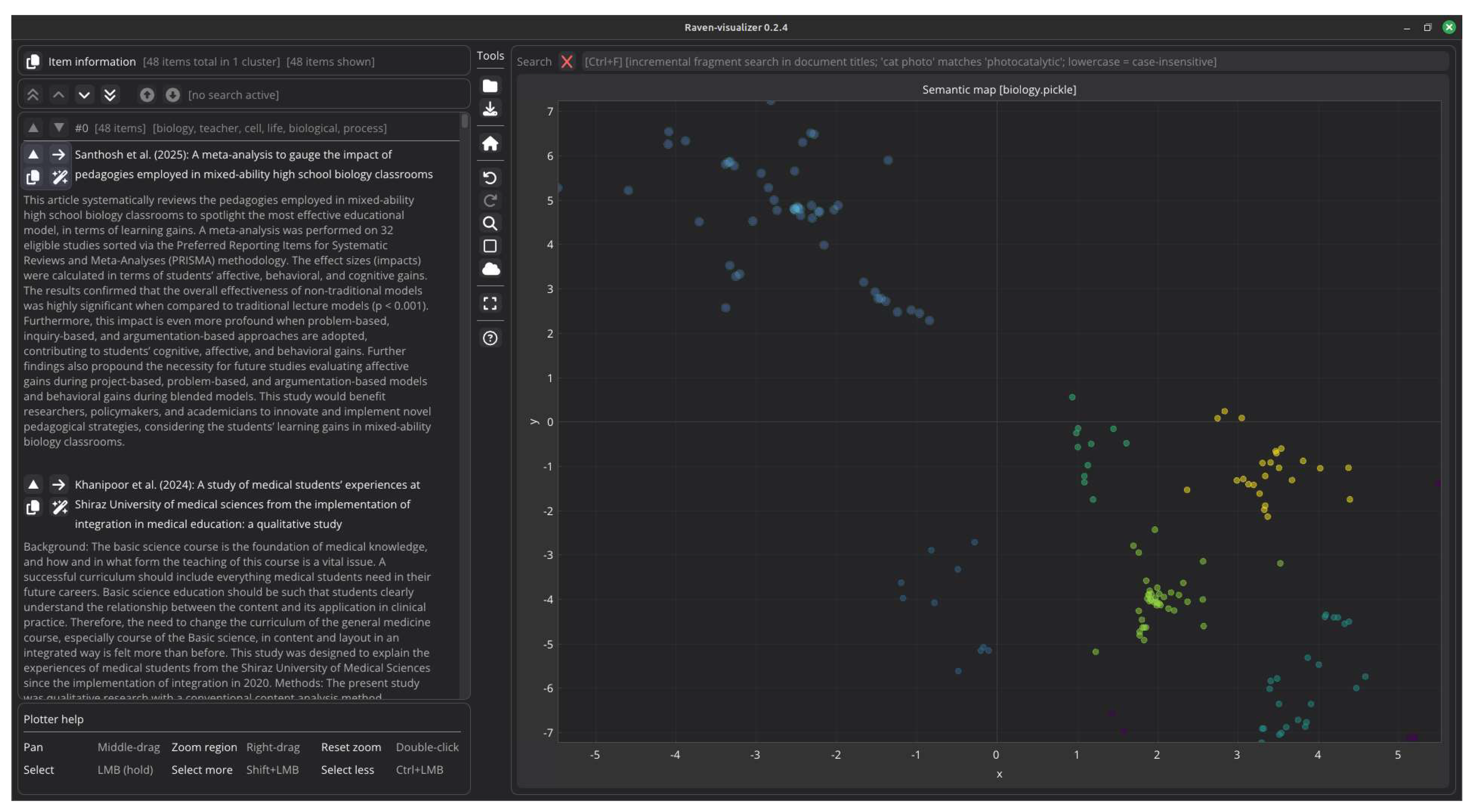
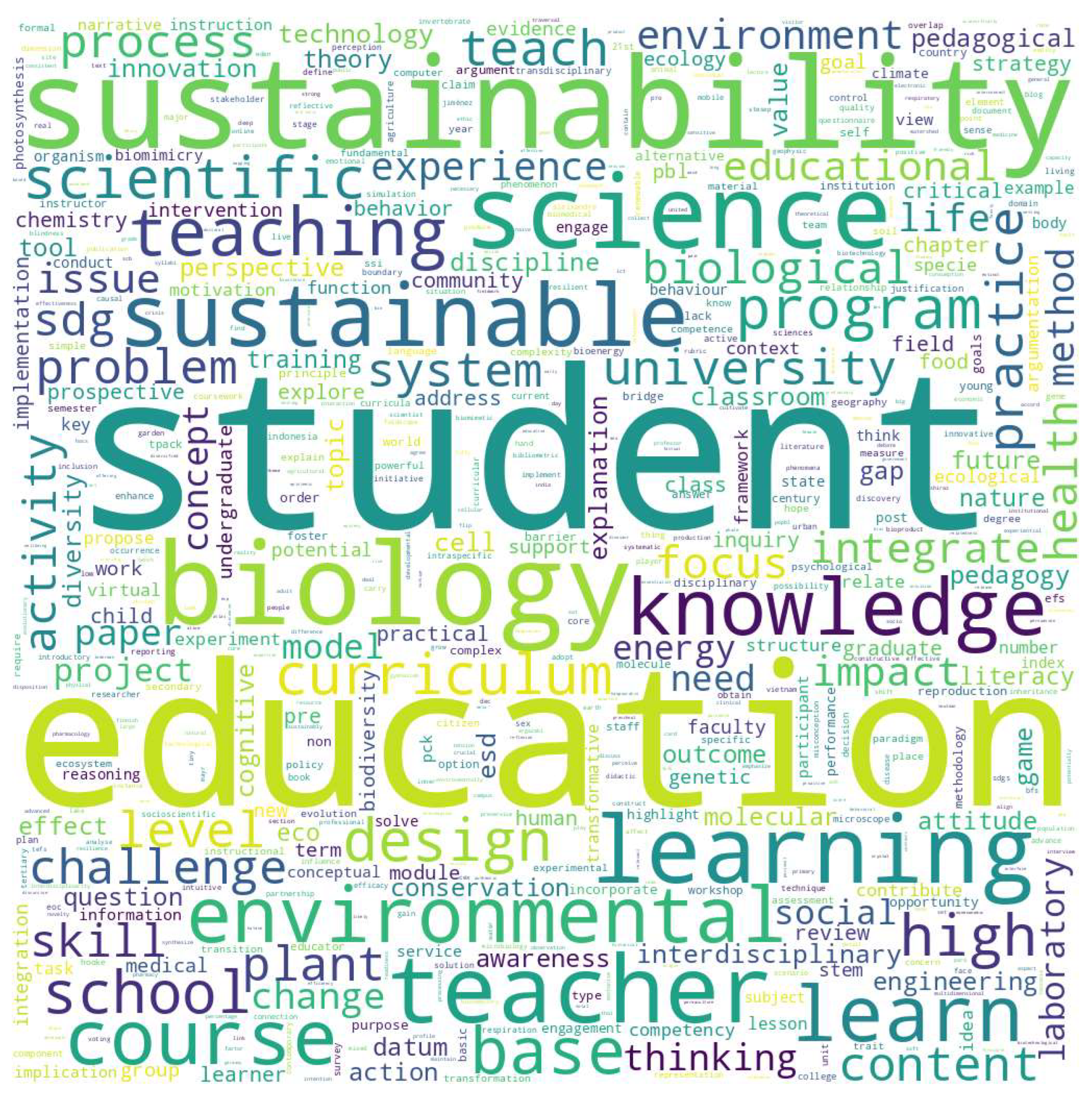

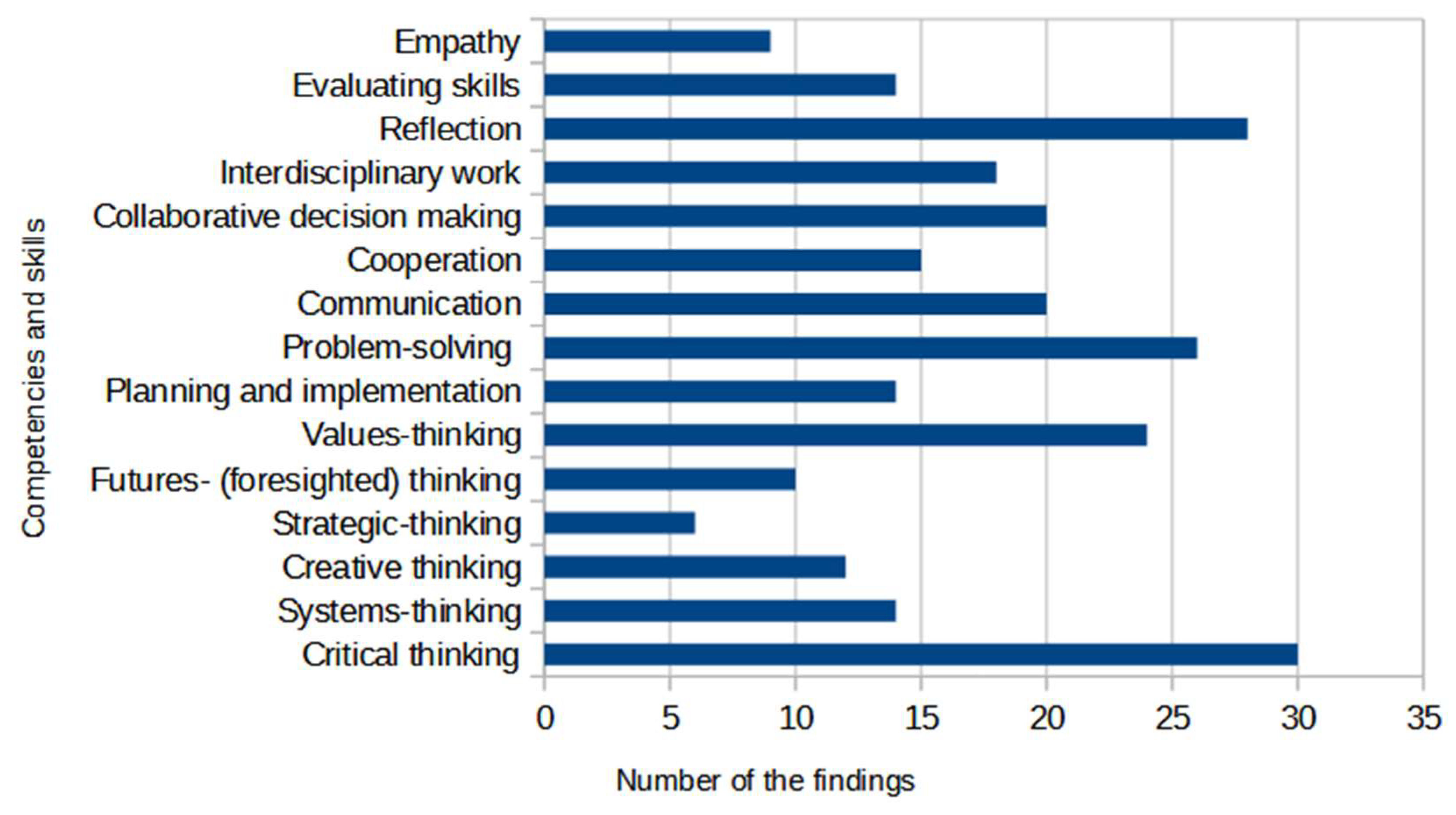
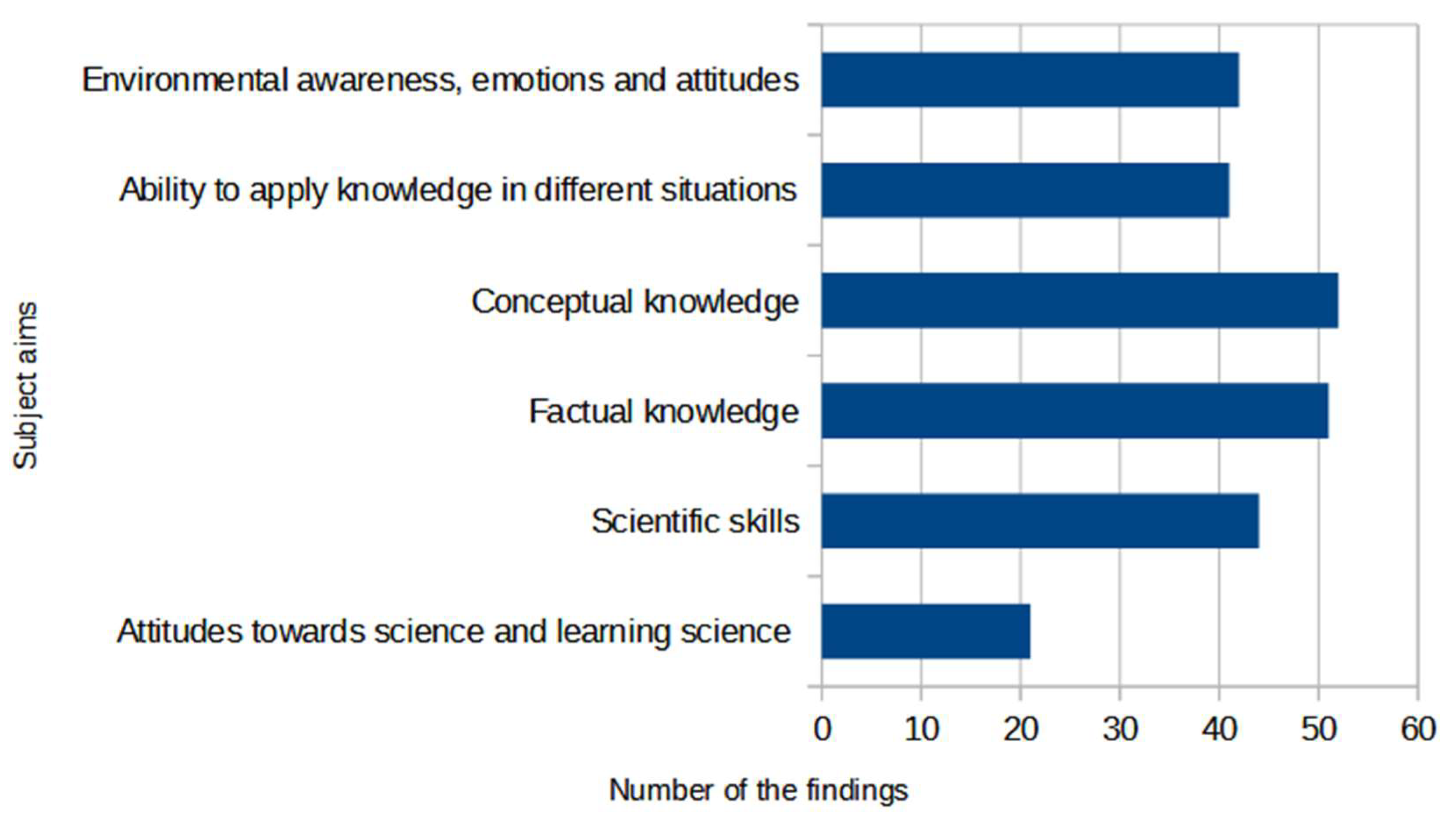


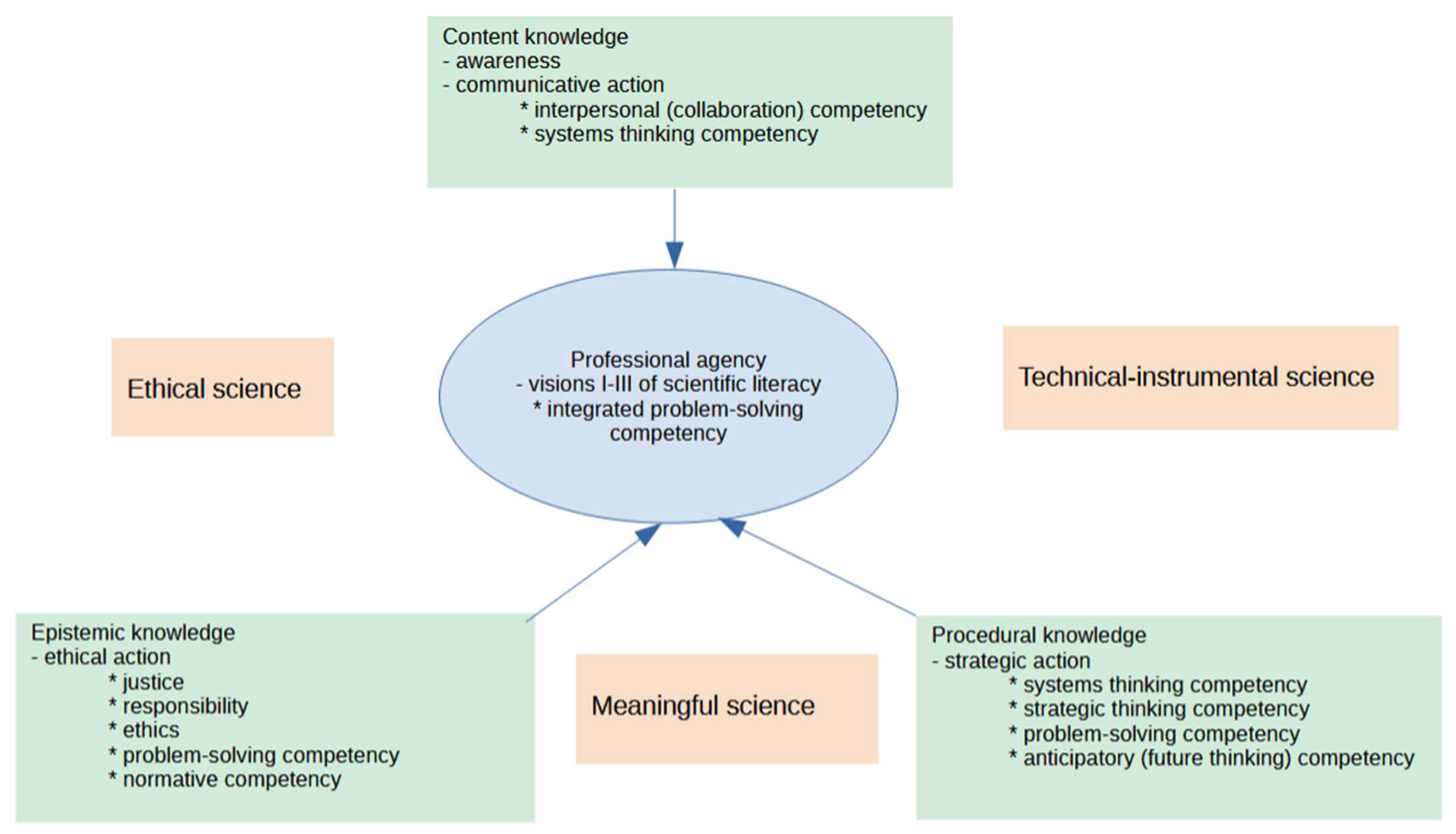

| Main Characteristics | Sub-Characteristics |
|---|---|
| Comprehensive and practical | Interdisciplinary Holistic Applicable |
| Value- and skill-focused | Critical and creative thinking Adopting norms and principles Acquiring 21st century skills |
| Collaborative and participatory | Teamwork with awareness of social sustainability Ability to cooperate socially |
| Key Competencies | Descriptions of the Key Competencies |
|---|---|
| Systems thinking | The ability to understand relationships, analyze complex systems, consider different systems and scales, and deal with uncertainty |
| Anticipatory competency | The ability to understand and assess the possible, probable, and desirable futures, create one’s own future prospects and apply the precautionary principle to them, assess the consequences of actions, and deal with risks and changes |
| Normative competency (competency concerning norms and rules) | The ability to understand and examine the community and societal norms and rules underlying actions, to negotiate values, principles, and goals of sustainable development, and to deal with uncertain information and contradictions |
| Strategic competency (Competency in matters central to the school’s goals) | The ability collectively to develop and implement innovative actions that promote sustainability at the local level and beyond |
| Collaboration competency | The ability to learn from others; understand and respect the needs, perspectives, and actions of others (empathy); understand and be sensitive to others (emphatic leadership) and handle conflicts in a group and facilitate collaboration and participatory problem-solving |
| Critical thinking competency | The ability to question norms, practices, and opinions; examine one’s own values, perceptions, and actions and participate in the sustainable development debate |
| Self-awareness competency | The ability to examine one’s own role in the local community and (global) society to continuously evaluate and motivate actions, and to process emotions and desires |
| Integrated problem-solving competency | The ability to apply different problem-solving frameworks to complex sustainability problems and develop applicable, inclusive, and equitable solutions contributing to sustainable development integrating the above-mentioned competencies |
| Competency Objectives (SDG = Sustainable Development Goal) (UNESCO, 2017a, 2017b) | Examples of Learning Objectives in Biology Education (Uitto et al., 2024a) |
|---|---|
| To develop students’ systems thinking and ethical thinking (SDGs 12–15) | To understand ecological systems and biodiversity and the importance of their conservation in relation to technological, social, and economic systems; understanding the structure, function, and interactions of living nature from the molecular and cellular levels to the biosphere |
| To examine the past, present, and future in terms of evolution, ecological systems, and the preservation of biodiversity, and to reflect on human well-being and responsibility in relation to nature and other people (SDG 17) | To develop capabilities for studying and working in fields that utilize biology; understanding the opportunities offered by life sciences to promote the well-being of humanity, other organisms, and living environments; increasing understanding of how biological knowledge can be utilized in everyday life, in postgraduate studies, and in working life |
| To understand the standards for sustainability education stated in curricula (SDG 17) | To reveal the image of the necessity of a sustainable lifestyle and the importance of a circular economy that saves natural resources |
| To develop and implement activities in the school’s immediate environment to promote student learning and well-being (SDGs 4, 5, and 16) | To develop the student’s capacity to influence and participate from the perspective of developing their own local environment and ensuring its vitality; support a sustainable lifestyle in the student’s own local environment |
| To develop student identity by incorporating collaborative inclusive learning into teaching, promoting collaborative interaction within the school community, and developing collaborative learning environments (SDG 17) | To develop students’ cooperation skills and sense of community by using interactive working and operating methods |
| To develop students’ critical observation skills, critical thinking, and critical reading skills (SDG 17) | To develop an understanding of how biological knowledge and skills can be applied and utilized in one’s own life, in ethical considerations and in following current news related to biology; developing a critical examination of various phenomena and sources of information; developing a critical evaluation of biological information transmitted through the media |
| To support students’ self-assessment skills and ability to reflect on themselves as learners and develop students’ self-regulation skills, sense of competence, self-respect, and self-direction (SDG 5) | To support students in understanding themselves and other people and setting their own goals |
| To develop students’ problem-solving skills and encourage students to engage in problem-solving and argumentation (SDG 17) | To support students’ problem-solving skills; supporting the formulation of questions and research problems regarding the phenomena under study |
| Knowledge Categories | Definition | Knowledge Types | Related to | |
|---|---|---|---|---|
| SCK | PCK | |||
| Factual and Conceptual knowledge | Factual knowledge is common knowledge about what is needed to be successful to meet a goal. Conceptual knowledge consists of knowing how facts can be organized in meaningful ways. | Knowledge of classification | × | |
| Knowledge of principles and generalizations | × | |||
| Knowledge of theory, models, and structures | × | |||
| Knowledge of terminology | × | |||
| Knowledge of details and basic elements | × | |||
| Methodological knowledge | This information concerns how to do something or how to solve a problem, such as a learning task (Osborne et al., 2018). It is also information about research methods, such as how to make observations and study life phenomena. | Knowledge of skills, technical methods concerning subjects | × | |
| Knowledge of usage criteria | × | |||
| Metacognitive knowledge | This is a teacher’s knowledge (Krathwohl, 2002) and student’s knowledge about how they can manage their own learning and plan their studies (Krathwohl, 2002; Pintrich, 2002). | Knowledge of strategies, usage of methods, and self-awareness | × | |
| Evaluative knowledge | This is systematically collecting and analyzing information. It is linked to evaluative thinking, a disciplined approach to inquiry and reflective practice that helps people to make judgements with good evidence by habit (Cole, 2023). | Knowledge of understanding interactions and performance | × | |
| Critical reflection and reflective knowledge | Critical reflection is a ‘meaning-making process’ that helps people to set goals and use what they have learned to inform future actions and consider the real-life implications of their thinking. It links thinking and doing and can be transformative (Rodgers, 2002; Schön, 1992). Reflective knowledge is an actor’s ability to evaluate their epistemic position and the circumstances of knowing. It is part of the belief formation process and confirms the overall process of knowing (Broncano, 2014). | Knowledge of reviewing, reconstructing, re-enacting, and critically analyzing | ||
| Teaching and Learning Methods | ||
|---|---|---|
| Teacher-Centered Methods | Interactive Methods | Student-Centered Methods |
Lecture-based
| Skill-based
| Methods of organizing information and graphics: Visualization
|
| Clustered Studies | Item Topics (n) | Count (n) | Cluster Number and Top-Level Topics |
|---|---|---|---|
| Assaraf and Snapir (2018); Byrne and Grace (2018); Carson et al. (2018); Duncan and Boerwinkel (2018); Gericke and El-Hani (2018); Hamman (2018); Kampourakis and Stasinakis (2018); Korfiatis (2018); McComas (2018); Millstein (2013); Nehm (2018); Reiss (2018); Sanders and Jenkins (2018) | Scientific knowledge (13) | 49 | #0 Biology education |
| Akpınarlı and Turan (2023); Ariely and Yarden (2018); Bass (2012); Cheng et al. (2021); Conde-Caballero et al. (2019); Courter (2012); Danilov and Danilova (2013); Driver et al. (2000); Ergazaki (2018); Evans and Rosengren (2018); Fuentes and Entezari (2020); Förtsch et al. (2018); Hamman (2018); Harland and Wald (2018); Harms and Bertsch (2018); Jiménez-Aleixandre and Evagorou (2018); Kampourakis and Niebert (2018); Khanipoor et al. (2024); Kwiek et al. (2007); Lederman (2018); Ledbetter (2012); López-Fernández et al. (2024); Power (2012); Reiss and Kampourakis (2018); Rozenszajn and Yarden (2015); Rutledge (2008); Schmitt-Harsh and Harsh (2017); Stern (2000); Stover and Mabry (2010); Susman (2015); Wanieck et al. (2020); Yoon et al. (2015) | Subject content knowledge (SCK) and pedagogical content knowledge (PCK) (32) | ||
| Arita (2017); Livotov et al. (2021); Pessoa et al. (2024); Santhosh et al. (2025) | Outlier (4) | ||
| Dönmez (2024); Schlicht-Schmälzle et al. (2024) | Sustainability and sustainable development policy (2) | 13 | #1 Sustainability, sustainable education (SE), and sustainable education goals (SDGs) |
| Brody and Ryu (2006); Capello et al. (2021); da Silva and de Araújo (2022, 2024); Faizah et al. (2024); Ferrer-Estévez and Chalmeta (2021); Ghazian and Lortie (2024); Mikhailova et al. (2024); Prieto-Jiménez et al. (2021); Wieërs et al. (2024) | SE and SDGs (10) | ||
| Stevens et al. (2022) | Outlier (1) | ||
| Abramovich and Loria (2015); Barraza and Castaño (2012); Bezeljak et al. (2020); Biletska et al. (2021); Desa et al. (2021); Edwards et al. (2015); Faizah et al. (2024); Leal Filho et al. (2016); Hartadiyati et al. (2019, 2020); Jeronen et al. (2017); Pimdee (2020); Purwianingsih et al. (2022); Putra et al. (2022); Rasmussen (2017); Sebastián-López and González (2020); Sidiropoulos (2018); Streiling et al. (2021); Suwono (2019); Yli-Panula et al. (2024); Weber et al. (2020) | Teacher education (21) | 37 | #2 Teacher education and school education |
| Al-Muqbil (2024); Amprazis and Papadopoulou (2024); Baena-Morales et al. (2023); Bara et al. (2024); Copeland Solas and Wilson (2015); Day et al. (2013); Fadzil and Saat (2020); Jackson et al. (2023); Mirosavljević et al. (2024); Muñoz-Galván and Padilla (2024); O’Neill et al. (2024); Quinn et al. (2015); Safitri et al. (2017); Thomas et al. (2022) | School education (14) | ||
| Hawa et al. (2021); Wright et al. (2008) | Outlier (2) | ||
| Goi (2024); Galante et al. (2024); Tejedor and Segalas (2018); Warburton (2003) | Inter- and transdisciplinarity (4) | 11 | #3 Holistic view of sustainability education |
| Cabral and Kaivola (2005); Salovaara et al. (2021); Sterling (2004, 2010); Upton (2021); Wamsler (2020) | Transformative education (6) | ||
| Medir et al. (2016) | Outlier (1) | ||
| EI Kharki et al. (2021); Karimov et al. (2024); Kirkpatrick et al. (2019); Nersesian et al. (2021); Rodríguez-Loinaz et al. (2022); Thinh et al. (2024); Zhong and Liu (2022) | ICT (virtual, digital, ICT) (7) | 32 | #4 Learning and teaching methods in biology education |
| Araripe and Zuin Zeidler (2024); Carrió Llach and Llerena Bastida (2023); Hardyanto et al. (2024); Leite et al. (2016); Nkaizirwa et al. (2023); Sundberg et al. (2019) | PBL (6) | ||
| Kennedy et al. (2015); Linder and Huang (2022); Veena Soni (2020) | Problem-solving (3) | ||
| Mitra et al. (2016); Wolff et al. (2018) | PjBL (2) | ||
| Rodríguez-Rey et al. (2024); Zoller (2015) | Inquiry-based learning (2) | ||
| Adeika et al. (2024); Douglas et al. (2024); Gutiérrez-García et al. (2024); Hogan and O’Flaherty (2021); Kulshreshtha et al. (2022); Lebo and Eames (2015); Struminger et al. (2021); Wright et al. (2009); Zimmerman and Weible (2017) | Field work, field trip, and experiential learning (9) | ||
| Gatti et al. (2019) | Game education (1) | ||
| Muslu and Isik (2024) | Role-playing(1) | ||
| Howell (2021) | Flipped classroom (1) | ||
| Bacon et al. (2011); Brandt et al. (2021); Church and Skelton (2013); Chuvieco et al. (2022); Fisher and McAdams (2015); Fox et al. (2009); Gaard et al. (2017); Garibay et al. (2020); Gulikers and Oonk (2019); Kessler (2018); Le et al. (2022); Martens et al. (2010); McSorley et al. (2023); Mintz and Tal (2013); Papageorgiou et al. (2024); Rehman et al. (2023); Sherry (2022); Vandaele and Stålhammar (2022); Wiek et al. (2011) | Teacher education in sustainability, sustainability curricula (19) | 25 | #5 Sustainability competencies and skills |
| Wang et al. (2019); Zilberman et al. (2018) | Sustainability policy (2) | ||
| Alordiah (2023); Du Toit (2024); Fayomi et al. (2019) | Research and teaching gaps (3) | ||
| Paulauskaite-Taraseviciene et al. (2022) | Outlier (1) |
| Countries | Studies in Educational Levels (n) | ||
|---|---|---|---|
| Primary | Secondary | University | |
| Albania | 1 | ||
| Australia | 1 | 2 | 5 |
| Austria | 1 | ||
| Brasília | 2 | ||
| Canada | 2 | ||
| China | 1 | ||
| Greece | 1 | 1 | |
| Croatia | 1 | ||
| Cyprus | 1 | ||
| Denmark | 1 | ||
| Dubai | 1 | ||
| Finland | 2 | 2 | 2 |
| Germany | 2 | 6 | 6 |
| Greece | 1 | ||
| Indonesia | 2 | 6 | |
| India | 1 | 1 | 2 |
| Ireland | 1 | 1 | 1 |
| Israel | 2 | 6 | |
| Italy | 1 | 1 | |
| Malaysia | 1 | 2 | 4 |
| Mexico | 1 | ||
| The Netherlands | 1 | ||
| New Zealand | 1 | 1 | 1 |
| Nigeria | 1 | ||
| Norway | 1 | 1 | 1 |
| Oman | 1 | ||
| Pakistan | 1 | ||
| Portugal | 2 | 2 | 1 |
| Rwanda | 1 | ||
| Saudi Arabia | 1 | ||
| Slovenia | 1 | ||
| Spain | 1 | 5 | 5 |
| Sweden | 2 | 1 | |
| Switzerland | 2 | 1 | |
| Taiwan | 1 | ||
| Thailand | 1 | ||
| Turkey | 1 | 2 | 2 |
| UK | 1 | 5 | 8 |
| Ukraine | 2 | ||
| Uruguay | 1 | ||
| USA | 1 | 7 | 33 |
| Uzbekistan | 1 | ||
| Vietnam | 1 | ||
| Total (n) | 18 | 52 | 106 |
| Criteria | Cognitive Process Dimensions |
|---|---|
| Retrieving relevant knowledge from long-term memory | Remember |
| Determining the meaning of instructional messages, including oral, written, and graphic communication | Understand |
| Carrying out or using a procedure in a given situation | Apply |
| Breaking material into its constituent parts and detecting how the parts relate to one another and to an overall structure or purpose | Analyse |
| Making judgments based on criteria and standards | Evaluate |
| Putting elements together to form a novel, coherent whole or make an original product | Create |
| Criteria | Knowledge Level |
|---|---|
| Terminology of biology | Factual (fact) knowledge |
| Classification of biological knowledge; theories, models, structures | Conceptual (concept) knowledge |
| Problem solving, research methods and techniques | Methodological (procedural) knowledge |
| Making summaries, self-knowledge | Metacognitive knowledge |
| Knowledge | Understand | Apply | Analyze | Evaluate | Create |
|---|---|---|---|---|---|
| Arrange | Articulate | Act | Analyze | Appraise | Arrange |
| Choose | Associate | Adapt | Appraise | Argue | Assemble |
| Cite | Characterizise | Apply | Break | Arrange | Categorize |
| Copy | Cite | Back/back up | Break down | Assess | Choose |
| Define | Clarify | Calculate | Calculate | Attach | Collect |
| Describe | Classify | Change | Categorize | Choose | Combine |
| Draw | Compare | Choose | Classify | Compare | Compile |
| Duplicate | Contrast | Classify | Compare | Conclude | Compose |
| Identify | Convert | Complete | Conclude | Contrast | Construct |
| Indicate | Defend | Compute | Contrast | Core | Create |
| Label | Demonstrate | Construct | Correlate | Counsel | Design |
| List | Describe | Demonstrate | Criticize | Create | Develop |
| Locate | Differentiate | Develop | Debate | Criticize | Devise |
| Match | Discuss | Discover | Deduce | Critique | Estimate |
| Memorize | Distinguish | Dramatize | Detect | Decide | Evaluate |
| Name | Estimate | Employ | Diagnose | Defend | Explain |
| Order | Explain | Experiment | Diagram | Describe | Facilitate |
| Outline | Express | Explain | Differentiate | Design | Formulate |
| Quote | Extend | Generalize | Discover | Determine | Generalize |
| Read | Extrapolate | Identify | Disseminate | Discriminate | Generate |
| Recall | Generalize | Illustrate | Dissect | Estimate | Hypothesize |
| Recite | Give | Implement | Distinguish | Evaluate | Inprove |
| Recognize | Give examples | Interpret | Devide | Explain | Integrate |
| Record | Identify | Interview | Evaluate | Grade | Invent |
| Relate | Illustrate | Manipulate | Examine | Invent | Make |
| Repeat | Indicate | Modify | Experiment | Judge | Manage |
| Reproduce | Infer | Operate | Figure | Manage | Modify |
| Review | Interpolate | Organize | Group | Mediate | Organize |
| Select | Interpret | Paint | Identify | Prepare | Originate |
| State | Locate | Practice | Illustrate | Probe | Plan |
| Tabulate | Match | Predict | Infer | Rate | Predict |
| Tell | Observe | Prepare | Inspect | Rearrange | Prepare |
| Underline | Organize | Produce | Inventory | Reconcile | Produce |
Disclaimer/Publisher’s Note: The statements, opinions and data contained in all publications are solely those of the individual author(s) and contributor(s) and not of MDPI and/or the editor(s). MDPI and/or the editor(s) disclaim responsibility for any injury to people or property resulting from any ideas, methods, instructions or products referred to in the content. |
© 2026 by the authors. Licensee MDPI, Basel, Switzerland. This article is an open access article distributed under the terms and conditions of the Creative Commons Attribution (CC BY) license.
Share and Cite
Jeronen, E.; Jeronen, J. Bibliometric and Content Analysis of Sustainable Education in Biology for Promoting Sustainability at Primary and Secondary Schools and in Teacher Education. Educ. Sci. 2026, 16, 201. https://doi.org/10.3390/educsci16020201
Jeronen E, Jeronen J. Bibliometric and Content Analysis of Sustainable Education in Biology for Promoting Sustainability at Primary and Secondary Schools and in Teacher Education. Education Sciences. 2026; 16(2):201. https://doi.org/10.3390/educsci16020201
Chicago/Turabian StyleJeronen, Eila, and Juha Jeronen. 2026. "Bibliometric and Content Analysis of Sustainable Education in Biology for Promoting Sustainability at Primary and Secondary Schools and in Teacher Education" Education Sciences 16, no. 2: 201. https://doi.org/10.3390/educsci16020201
APA StyleJeronen, E., & Jeronen, J. (2026). Bibliometric and Content Analysis of Sustainable Education in Biology for Promoting Sustainability at Primary and Secondary Schools and in Teacher Education. Education Sciences, 16(2), 201. https://doi.org/10.3390/educsci16020201