Next Article in Journal
Digital Mathematics: Just How Widespread Are Math Apps?
Next Article in Special Issue
Low-Cost Educational Materials and University Student Teachers’ Recycling Knowledge and Attitudes: A Quasi-Experimental Study
Previous Article in Journal
Designing Understandable and Fair AI for Learning: The PEARL Framework for Human-Centered Educational AI
Previous Article in Special Issue
Fostering Action Competence Through Emancipatory, School-Based Environmental Projects: A Bildung Perspective
 
 
Due to scheduled maintenance work on our servers, there may be short service disruptions on this website between 11:00 and 12:00 CEST on March 28th.
Article

Decolonising Environmental Education Pedagogy: A Participatory Action Research Approach
Manchester Institute of Education, University of Manchester, Manchester M13 9PL, UK
Educ. Sci. 2026, 16(2), 199; https://doi.org/10.3390/educsci16020199
Submission received: 8 December 2025 / Revised: 23 January 2026 / Accepted: 26 January 2026 / Published: 28 January 2026

Abstract

The continued marginalisation of Indigenous knowledges and practices in environmental education sustains curricula and pedagogies grounded in Western worldviews. This exclusion reinforces limited or deficit-oriented perceptions of Indigenous cultures, environments, and epistemologies. Therefore, this study draws on the theory of critical consciousness to examine the need for Indigenous peoples and educators to become critically aware of the forces shaping their educational experiences and to use this awareness to transform their lives and teaching practices for a sustainable future. To illustrate how this transformation might occur, a qualitative study was conducted with ten Nigerian secondary school teachers who engaged with the design and implementation of a decolonisation model for environmental education. Findings show that seven participants successfully adopted the model, and several demonstrated notable shifts in their perspectives during the process. The study offers two key contributions: a conceptual framework for understanding decolonisation in environmental education and a practical decolonisation model for teachers. These contributions have broader relevance for educational reform and environmental education in countries with similar contexts to Nigeria and in marginalised communities in the Global North, where learners are often alienated from their local realities in favour of globalist perspectives.

1. Introduction

Many studies have shown that sub-Sahara Africa’s education is generally decontextualised, does not address the continent’s issues, and promotes Western knowledge and cultures (Eten, 2015; Odora-Hoppers, 2002; Zembylas, 2018). For example, Nigeria’s education system is still heavily influenced by British educational policies developed during colonial rule (Hardman et al., 2008; Agbedo et al., 2012). Colonial education relegated Indigenous peoples and their knowledges, cultures, and environment, instilling the belief that these had no place in the imposed education system of the colonialists (Dei Ofori-Attah, 2006). Thus, transforming the colonial education system is essential because of the inseparability of ontology and learning, where learning is grounded in the learners’ own being, their interaction with the world, their concerns, and their visions of what they can become (Freire, 1974; Ushioda, 2011).
This paper is focused on environmental education because of the urgent need for humans to apply all available knowledge, including their Indigenous knowledges, towards the mitigation of and adaptation to the global climate crisis (Noble et al., 2014). Environmental education is education for, about, and in the environment (Tilbury, 1995). It is built on the principles of sustainability, focusing on how people and nature can exist in productive harmony (NAAEE, 2017). In this study, it is defined as the process of empowering individuals and societies to improve their lives and advance their collective ambitions through an understanding of their natural and social environments, the development of problem-solving skills, and the application of ethical solutions. In Nigeria specifically, this process implies the transformation of the current West-centric colonial education system for education to become more focused on the people, their cultures, and their environments, for a more holistic knowledge of Earth’s environment.
Environmental education (EE) is particularly significant in the Nigerian context due to the country’s acute and intersecting environmental challenges, including oil pollution, deforestation, desertification, flooding, waste mismanagement, biodiversity loss, and climate change impacts. These challenges directly affect livelihoods, public health, food security, and social stability, making environmental knowledge and action crucial for sustainable development. Rather than being established as a standalone subject, EE has been infused across the basic and secondary school curriculum through subjects such as Geography, Biology, Agricultural Science, Social Studies, and Civic Education, following directives of the Federal Government implemented by the Nigerian Educational Research and Development Council (NERDC). This diffused and embedded nature of EE makes it both widespread and vulnerable; while most students encounter environmental topics at some point in their schooling, the lack of a coherent, explicit EE framework results in uneven coverage, limited pedagogical depth, and minimal critical engagement.
Empirical studies indicate that while many teachers are aware of EE’s curricular integration and do teach environmental concepts, the effectiveness of implementation varies significantly depending on teachers’ qualifications, experience, and access to resources (Jekayinfa & Yusuf, 2008). At the tertiary level, environmental education is offered through specialised courses and degree programmes in environmental science and related fields, but these remain elective and programme-specific. Recent research further suggests that despite teachers’ recognition of EE’s importance, classroom practice remains largely examination-oriented and content-focused, limiting opportunities for critical engagement and action-oriented learning (Kola-Olusanya et al., 2025). Collectively, this evidence highlights both the widespread presence of EE in Nigerian education and the structural and pedagogical constraints that limit its transformative potential.
Although the transformation of educational systems is applicable to all subjects and disciplines, this study’s scope is limited to environmental education, where the paradox of prioritising foreign environments over local environments and studying environmental concepts without environmental contexts is more obvious. For example, in the geography curriculum of the final year of secondary school in Nigeria, the first four weeks focus on environmental hazards and features that do not affect the country—earthquakes, volcanicity, and karst topography. This kind of focus is not given to Nigeria’s major environmental problems like pollution (air, land, and water) and drought, which are not mentioned in the entire geography curriculum at all, and flooding and erosion, which are only mentioned briefly in the second week of the penultimate year of secondary schooling. This phenomenon has been described as colonised education (Dei Ofori-Attah, 2006), and its transformation is necessary for understanding and solving environmental problems.
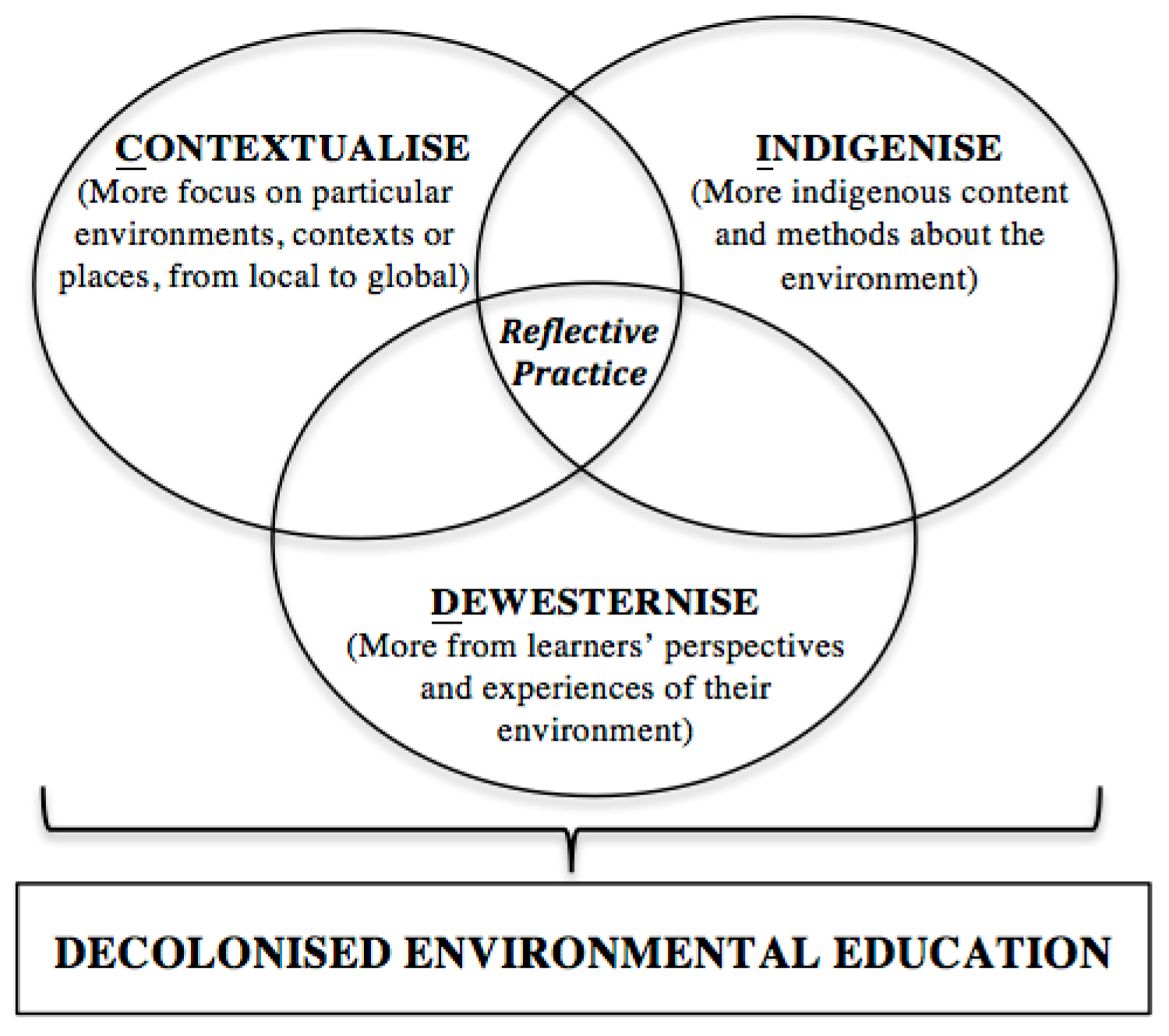
Various terms have been used to describe the requisite transformation described above, which is about making education more about the people involved with it. Decolonising (Higgs, 2012; Adebisi, 2016; Ajaps, 2021; M. F. Mbah & Ezegwu, 2024) is the most common term used to describe this reform, but dewesternising (Gluck, 2015), Indigenising (Gumbo, 2012), Africanising (Msila & Gumbo, 2016), localising (Moland, 2017), and contextualising (Hogan, 2008) are also related terms. I conceptualise ‘decolonising’ as a broad term that includes contextualising (including localising), Indigenising (including Africanising), and dewesternising, also referred to as the CID framework (see Figure 1), to be achieved through reflective practice. Reflective practice is the ability to critically reflect on one’s actions in order to engage in a process of continuous change (Schön, 1983), and there is broad consensus that effective teaching and learning require a reflective approach (Jones & Jones, 2013).
Discourse on decolonising education in Africa is popular, but while literature abounds for the continent as a whole (Adebisi, 2016; Higgs, 2012), and particular countries like South Africa (Heleta, 2016) and Kenya (Owuor, 2008), there is a dearth of information for Nigeria. Although recent studies have begun to address decolonisation of education in Nigeria, these largely focus on general curriculum reform and philosophical debates, with limited empirical attention to environmental education specifically (Ajaps, 2021; Adeyemi & Eugene, 2023). There is also a lot of focus on decolonising education in general, but sparse studies about environmental education (Eten, 2015), despite growing recognition that environmental and climate education in Africa continues to marginalise Indigenous and local knowledge systems (M. F. Mbah & Ezegwu, 2024; Shabalala, 2025).
More importantly, most of the extant literature focuses on the need for a decolonised education (Kaya & Seleti, 2013; Kelbessa, 2008), often emphasising epistemic justice and curriculum transformation without sufficient empirical grounding. Only very few studies have described how it could be achieved (Eten, 2015; Shizha, 2009; Acharibasam, 2022), and there remains a dearth of studies that go beyond descriptions and conceptualisations to empirically show the process of decolonising education, particularly within environmental education contexts in Africa (Ajaps, 2021; M. Mbah et al., 2021).
Therefore, this paper aims to report the findings of an empirical study with Nigerian teachers who participated in the Decolonising Environmental Education Pedagogy (DEEP) project. The goal was to explore how to replace the monoculture of scientific knowledge and Eurocentricity in the colonised education system with an ecology of knowledges (de Sousa Santos, 2009), whereby different kinds of knowledges are granted equal opportunities to maximise their contributions to dealing with environmental problems, including climate change. The research questions of this study are as follows: What are teachers’ experiences with creating and implementing a decolonisation model? How is the model decolonising environmental education?

The Nigerian Context: People, Culture, and Education

Nigeria’s demographics differ significantly from those of Western countries. The country gained independence from Britain in 1960 and consists of 36 states and a federal capital territory. The population is currently estimated at 239 million people (Worldometers, 2025). There are three predominant Indigenous ethnic groups: Hausa-Fulani (29%), Yoruba (20%), and Igbo (18%), and over 250 smaller groups. These smaller groups live in the shadow of the ‘big three’ but still fight for recognition and resources (Mustapha, 2004). In addition, most of the ethnic groups, including the predominant three, are suspicious of each other’s hegemonic tendencies. The resulting mistrust engenders inter-ethnic intolerance and clamours for independence, such as the 1967–1970 Biafra war, when the Igbos wanted to secede.
Geographic segregation exacerbates this inter-ethnic intolerance. Except for a few multicultural cities like Lagos, where the study reported here was conducted, ethnic groups are located within particular geographical boundaries. Thus, a Yoruba person may never meet a Hausa person, and what they know about each other may be from biased secondary sources. This makes it very important for Nigeria’s education to focus on its people and their environment. Nigeria’s governments have used education as a tool to unite the country’s diverse groups into one nation, but many of these efforts have been ineffective and serve to reproduce stereotypes instead (Gambo et al., 2007). Future educational initiatives have to consider approaches that are both effective and non-stereotypical. For example, ensuring that different groups generate pedagogical content.
Moland (2014) demonstrated the complexity of multicultural education in Nigeria. She analysed the use of Sesame Square, the Nigerian adaptation of Sesame Street, to teach intergroup tolerance and found that the country’s peculiar challenges were not adequately considered and there was the risk of creating a divisive type of multicultural education. That is, her analysis of the program’s segments revealed that Sesame Square focused more on representing diversity than on forging national unity, just like the American Sesame Street. Even though Nigeria and the United States consist of multiple groups that will protest if not represented, Moland (2014) argued that the relative strength of the American state and certain uniting ideologies like ‘nation of immigrants’ make the United States strong enough to stay together even when diversity is emphasised. Forging national unity is, therefore, more imperative than emphasising diversity in Nigeria.
Similarly, environmental education’s importation into Nigeria requires contextualisation if it is to achieve its goal of empowering people to transform themselves and their environments. For example, crude oil exploration is polluting the air, land, and water of Nigeria’s southern region. Flooding is also an increasing problem in the coastal regions, especially Lagos. In addition, littering and harmful waste disposal are common features in most parts of the country, as well as low-quality air and water. Almost every household (in cities, especially) uses electricity generators daily, due to erratic power supply. These generators, which emit high amounts of smoke, are usually placed in dangerously close proximity to living areas, sometimes within poorly ventilated apartments, and they frequently result in casualties and fatalities. However, these local environmental problems do not feature in environmental education, and global environmental problems are not adequately presented from Nigerians’ and Africans’ standpoints.
Furthermore, some studies (e.g., Ogunbode, 2013) show that environmental concern is relatively low in Nigeria because economic and political issues overshadow almost everything else. Since environmental issues underlie many of these economic and political challenges, this suggests that the importance of the environment and its interconnections with social life are not well appreciated. This stands in contrast to Indigenous knowledge systems, where environmental knowledge is holistic, relational, and transmitted through lived practice, storytelling, and intergenerational engagement with place, emphasising responsibility, reciprocity, and interconnectedness between people, land, and livelihoods (Smith, 2021). Therefore, environmental education is particularly important in Nigeria, though not necessarily for the same reasons it is prioritised in other parts of the world. Yet, rather than addressing these immediate and locally grounded concerns, environmental education in Nigeria (when infused into school subjects) often focuses on environmental issues that many Nigerians find difficult to relate to or prioritise, particularly as they are not presented through a systems view that reflects how environmental, economic, social, and political realities are interconnected in everyday life. This paper argues that a decolonised education reveals these relationships, enabling learners to appreciate the interdependence of local and global issues and the importance of addressing them for planetary wellbeing.

2. Theoretical Framework: Critical Consciousness

According to Freire (1974, p. 4), critical consciousness is ‘learning to perceive social, political, and economic contradictions and to take action against the oppressive elements of reality.’ This concept has been interpreted and applied in diverse, often contradictory, ways by scholars due to the limited conceptualisation in existence (Jemal, 2017). For example, Freire (1974) noted that critical reflection is also action, so some scholars refer to critical reflection or the awareness of oppression and inequities as the only component of critical consciousness (Mustakova-Possardt, 1998; J. W. Watts & Abdul-Adil, 1998; Diemer & Li, 2011; Shin et al., 2016).
However, others refer to two dimensions by going beyond critical reflection to include a recognition of the capacity to act (Campbell & MacPhail, 2002; Diemer & Blustein, 2006; Getzlaf & Osborne, 2010; Garcia et al., 2009). Still, since the capacity to act is not sufficient to produce change, some scholars ascend beyond capacity to actual action (Diemer et al., 2014; Campbell & MacPhail, 2002; Diemer & Blustein, 2006; Diemer & Li, 2011; Windsor et al., 2014). Furthermore, a few scholars refer to three dimensions of critical consciousness, comprising the cognitive, affective, and behavioural domains (Morrell, 2003; R. J. Watts et al., 2011; Hatcher et al., 2010), with the cognitive being analogous to awareness or critical reflection, the affective represents the recognition of one’s capacity to act, while the behavioural refers to action. This paper aligns with the three-dimensional conception of critical consciousness because it is more encompassing.
A further concern with the critical consciousness theory is the debate about whether critical consciousness is a process or an outcome (Jemal, 2017). While some scholars (Peterson, 2014; Campbell & MacPhail, 2002; R. J. Watts et al., 2011; R. J. Watts & Serrano-Garcia, 2003; Getzlaf & Osborne, 2010) refer to critical consciousness as a process, it is the outcome of what Freire (1974, p. 35) termed conscientizaçāo—‘learning to perceive social, political, and economic contradictions, and to take action against the oppressive elements of reality’. Critical consciousness can arise through a process of consciousness-raising (Gutierrez & Ortega, 1991). Consciousness-raising or critical consciousness development is a continuous process that occurs in the following stages, as adapted from Freire’s ideas: identifying the social problem by a group with shared identity or goals, analysing the underlying causes and effects, identifying pathways for action, and creating and implementing solutions. Thus, although this paper refers to critical consciousness as the outcome of the conscientizaçāo process, it also places emphasis on its continuous or cyclic nature. This means that there is no final outcome or highest point, and there is an infinite scope for critical consciousness development.
Critical consciousness development is important because ignorance, defined as a lack of knowledge and critical thinking skills, is a key tool in the maintenance of oppression (Freire, 1974). Being critically conscious means the ability to apply knowledge and critical thinking skills to examine current situations, develop a deeper understanding of reality, and generate and implement solutions to problems. This should be the purpose of education, rather than the ‘banking model’ (Freire, 1996), where students are regarded as empty vessels to be deposited with knowledge. Gay and Kirkland (2003) discussed the importance of Culturally Responsive Teaching (CRT) through the development of cultural critical consciousness for preservice teachers. They defined CRT as the usage of the cultures, experiences, and perspectives of African, Native, Latino, and Asian American students as filters through which academic knowledge and skills are taught. This means passing academic knowledge and skills through the minority students’ cultures, experiences, and perspectives so that their learning is not alienated from their being. Critical components of CRT also included unpacking unequal distributions of power and privilege, as well as teaching students of colour cultural competence about themselves and each other.
Similarly, this paper highlights the importance of critical consciousness for teachers, how it might be employed, and the associated benefits. The cultures, experiences, and perspectives of teachers were employed as filters through which learning occurs, as participants engaged with the process of developing their critical consciousness and reflected on their teaching practice. Through discourse, participants unpacked the unequal distribution of power and privilege in their curriculum and the need to teach students about themselves and their environments. Engaging this theory enabled this study’s participants to begin to identify previously taken-for-granted inequalities in their school subject content and practice and work towards transforming them.

3. Decolonising Education Through Participatory Action Research

Participatory Action Research (PAR) has increasingly been recognised not only as a methodology but as a practice of decolonising research and educational change because it actively positions participants as co-researchers and co-creators of knowledge, thereby challenging hierarchical, extractive research traditions that reproduce colonial power relations. Empirical scholarship emphasises that participatory approaches can redistribute power in the research process and amplify marginalised voices, fostering not just reflection but action toward structural transformation (Timmis et al., 2024). In a longitudinal participatory project involving 65 undergraduate students across South Africa and the UK, researchers documented how students engaged as co-researchers over 12 months to investigate their own learning contexts, illustrating how participatory methodologies enable students to redefine research agendas, confront epistemic imbalances, and contribute actively to knowledge production rather than being passive subjects of study (Timmis et al., 2024). Although some argue that PAR’s potential for decolonisation remains partly aspirational without sustained structural support, other empirical and conceptual research demonstrates that when PAR practices involve authentic collaboration, reflexive dialogue, and shared decision-making, they disrupt conventional researcher–researched hierarchies and foreground participants’ lived experiences as valid epistemic contributions (Omodan & Dastile, 2023). Such findings underscore PAR’s dual role in decolonising both research practice and educational inquiry, highlighting its capacity to foster agency, co-determined inquiry, and contextualised understandings of teaching and learning within decolonial agendas.
Additional studies have explored decolonising education using other methodologies. Mampane et al. (2018) explored South African university students’ perceptions of approaches for a decolonised curriculum using interviews, focus group discussions, and questionnaires. The need to value and leverage Indigenous languages and culture to address past injustice and marginalisation, and to highlight local versions of realities rather than just accepting the colonisers’ perspectives were among their findings. Moland (2017) engaged ethnographic observation in her study of Nigerian educators’ appropriation of classroom materials intended for localising play-based pedagogy in early childhood classrooms. Sesame Workshop, an international organisation, produced a Nigerian version of Sesame Street called Sesame Square, trained the teachers, and distributed alphabet flashcards, puppet kits, and storytelling games to over 2700 classrooms across Nigeria. However, after the training, these materials that were intended to foster localised, interactive, child-centred learning experiences were often used in ways that reflected more universal, rote-based, teacher-centred approaches. Moland (2017) attributed this to limited training, prior experiences and beliefs about how children learn, and structural factors like large class sizes, limited space, and rigid school timetables.
The last two studies discussed above are typical of the literature, where educational and curriculum reforms usually exclude a vital set of people—the teachers (Carl, 2005). Indeed, many studies on teachers’ perceptions and experiences have revealed that teachers, who are the curriculum implementers, find this exclusion unsatisfactory (Rimal, 2018; Woolman, 2001). Horsdal (2012) suggested that researchers should involve the people being studied in planning, carrying out, and acting upon research so that the people use the research itself as a resource to change their own lives. Participatory Action Research (PAR) is a highly relevant strategy for teaching and learning improvement as it combines action and research, opening up school communities for change, developing agency of practitioners in the process, and generating locally relevant knowledge for improvement, which could also be relevant beyond local contexts (Somekh & Zeichner, 2009).
PAR involves knowledge generated by insiders or in collaboration with outsiders to address what Freire (1996) would call generative themes in their work or lives, has the potential to be a challenge to current hierarchies of knowledge, and by extension, relations of power (Anderson, 2017). In many countries, particularly in Latin America and Spain, those who embraced various forms of dialogical inquiry in the 1970s and 1980s were doing so before, during, and in the aftermath of brutal military dictatorships (Batallán, 1997; Perez-Gomez et al., 2009). This is similar to present-day Nigeria, where the central government still censors educational content, and critical dialogues are often regarded as rebellion. Many important historical national events, such as the Biafran war and the execution of environmental activist Ken Saro-Wiwa, are intentionally omitted from the school curriculum, and educators are aware of the repercussions of not sticking to ‘the script’. This played out vividly in the focus group meetings and interviews described in this study, where participants, including those who were very vocal about other topics, either declined to respond to questions about the government or provided very brief, carefully selected responses.
Consequently, while exploring the potential of PAR to transform teaching and learning in Nigeria towards decolonised pedagogy and effective environmental education, its limitations are also important to note and address. In addition to empowering participants to reflect on and transform their realities and experiences, PAR could also endanger participants who challenge the existing power dynamics, especially if it involves being critical of a curriculum that serves the powerful and keeps the masses compliant. Therefore, the participants of this study will remain anonymous to protect their identities. In addition, Miller (2017) takes PAR to task for the unified notions of identity and voice that PAR sometimes seems to promote. Anti-foundational scholars have long been suspicious of any methodology that claims to empower the other without falling into some form of well-intended, humanist colonising of the other’s voice or experience (Anderson, 2017). Therefore, as a PAR facilitator, it is important to engage communities with questions rather than answers, and this was prioritised in this study. This approach makes PAR well-suited for decolonising education because communities’ voices are centred and drive the narrative and outcomes.
Although studies that show PAR as an effective tool for decolonising education are scarce, there are many studies that show how PAR improved teaching and learning. For example, Idris and Asfaha (2019) discussed the views of school practitioners from challenging contexts of learning on roles and conditions for meaningful improvements of the learning and teaching process in Eritrea. Their study was based on qualitative data following an 18-month participatory action research project conducted with teachers and school leaders on how to effect change in their practice. Qualitative analysis was used to interpret 14 semi-structured interview transcripts of project participants from two study schools. The researchers attempted to make sense of practitioners’ views on critical aspects of managing teaching and learning processes and school practices. Practitioners’ views were synthesised into three main issues: focus on the needs of learners, collaborative commitments, and teacher professionalism. The analysis was based on interview data, longer-term engagements with the practitioners, and a review of relevant documents.
In addition, Phajane’s (2019) study assessed whether school participation in health promotion activity was a reality. Focus group discussions and informal contacts were made with the School Management Team (SMT), teachers, learners, and School Governing Bodies (SGB), consisting of 21 members in the Lehlabile Circuit of Bojanala District in Northwest Province. The level of participation was described using the Health Promoting School (HPS) model, pointing to three key features of community participation: first, participation is active; second, participation involves choice; and third, choice must be potentially effective. Results of this study revealed that the school was able to identify its own health needs and challenges, prioritise them, and plan appropriate strategies to meet the needs identified. Thus, due to the successes of PAR studies for improving teaching and learning in general, this study employed PAR to examine the extent to which teachers can decolonise their curriculum content and practice when they critically reflect and collaborate.

Empirical Studies on Decolonising Environmental Education

Recent empirical research on decolonising environmental education has begun to move beyond conceptual critiques to demonstrate how Indigenous knowledges and epistemologies can be integrated into environmental learning in ways that reshape relationships between learners and their environments. Acharibasam and McVittie’s (2022) qualitative research in Northern Ghana illustrates this shift by embedding Indigenous Ecological Knowledges (IEK) within early childhood environmental education, using a “two-eyed seeing” pedagogy that values Indigenous and Western perspectives simultaneously. Their study engaged Indigenous Elders directly in classroom and outdoor learning activities. Through interviews with teachers, Elders, and children, they found that IEK integration deepened children’s connection with nature, challenged anthropocentric language in the curriculum, and fostered environmental values rooted in respect, reciprocity, and responsibility to the land. This shows that decolonising environmental education in practice involves relational engagement with local ecological understandings, not merely the addition of Indigenous content. Similarly, Acharibasam (2022) employed a community-based research approach to integrate Indigenous Ecological Knowledges into environmental and climate change education in a primary school in Northern Ghana. They found that including holistic Indigenous epistemologies improved children’s local environmental knowledge and acknowledged community-led climate adaptation efforts, offering a practical model for decolonising climate education.
A mixed-methods research in Zambia by Leakey and Kakukwena (2025) provides important empirical insights into how Indigenous Ecological Knowledge (IEK) is (and is not) represented in formal school curricula and what its inclusion means for environmental attitudes and behaviours. By surveying and interviewing students, teachers, curriculum developers, and community elders across urban, peri-urban, and rural settings, this study found that students’ familiarity with local ecological practices strongly correlated with their community context, particularly in rural areas, and that teachers generally supported IEK inclusion but lacked training and curricular support to implement it meaningfully. These findings highlight the systemic barriers to decolonising environmental education, including curriculum design, professional development, and policy frameworks. The findings also point to the need for institutional support structures that empower educators to bring local ecological knowledges into classroom practice in ways that resonate with learners’ lived experiences (Leakey & Kakukwena, 2025).
In Australia, Beasley (2023) conducted an empirical case study with two early childhood classes in metropolitan Perth where Noongar Elder Maarman shared traditional botanical knowledge over the course of a school year. Children engaged in nature-based activities and storytelling that shifted their understanding of plants from Western classification to a multi-dimensional relational system, demonstrating how authentic Indigenous pedagogies can deepen ecological understanding and connectedness to nature. Similarly, Wilks et al. (2025) reported on classroom and on-country learning in rural New South Wales with Gumbaynggirr knowledge holders, showing how Aboriginal cultural narratives and land-based practices acted as co-teachers and enriched climate change education in ways that foregrounded Indigenous worldviews and sustainable land relationships, beyond conventional cognitive models of environmental learning. These Australian cases reveal how Indigenous-led experiences and community partnerships can operationalise decolonial aims in everyday environmental education contexts, centring knowledges that Western curricula often marginalise (Wilks et al., 2025).
In Latin America, although situated more at the higher-education level, Guzmán-Valenzuela et al. (2025) mapped Indigenous-inspired universities that actively integrate Indigenous epistemologies and community languages into environmental and sustainability programmes. Drawing on interviews and institutional documents, this research shows how institutional structures themselves can become sites of decolonial practice by prioritising Indigenous ecological knowledges, intercultural governance models, and community engagement as core elements of environmental education. This effectively expands the epistemic bases of environmental pedagogy beyond Western frameworks. Together, these studies illustrate that decolonising environmental education involves not only the inclusion of Indigenous content but structural and pedagogical transformations that recognise Indigenous ways of knowing as valid and essential to sustainability education.

4. Materials and Methods

Participatory Action Research (PAR; Herr & Anderson, 2014), a methodology derived from critical consciousness theory, is the overarching methodology employed in the general study—the Decolonising Environmental Education Pedagogy (DEEP) project. This methodology draws on critical theory and constructivism. It extends interpretivist confidence in lived experience by examining how such experiences are influenced and sometimes constrained by inherited traditions and dominant cultural voices (Baum et al., 2006). PAR is based on reflection, data collection, and action, which aims to improve the lived experiences of the people involved with it.
According to Herr and Anderson (2014), PAR is a social process that is focused on the interrelationship between an individual and their social environment, helping people to address the constraints of irrational, unproductive, unjust, and unsatisfying social structures that limit their self-determination. Participants are not subjects in the research process, but co-investigators, and the research is conducted by or with them, not to or on them. Thus, action researchers view themselves in relation to other individuals in their social contexts, and the epistemological assumptions underpinning action research embrace knowledge creation as an active process (McNiff & Whitehead, 2006).
However, there are some challenges of PAR that created some limitations in this study. PAR requires time, knowledge of the community, and sensitivity of the researcher to participants’ agendas. It can also be difficult to reach a consensus on what requires attention and how to go about it. Power imbalances between the researchers and participants can influence the research, and all participants need to be sensitive and responsive to the different forms of leadership required at different times. Moreover, it is ideal for all participants to be fully engaged in all aspects of the PAR, from its conception through to the analyses and interpretation phases, to the publication phase.
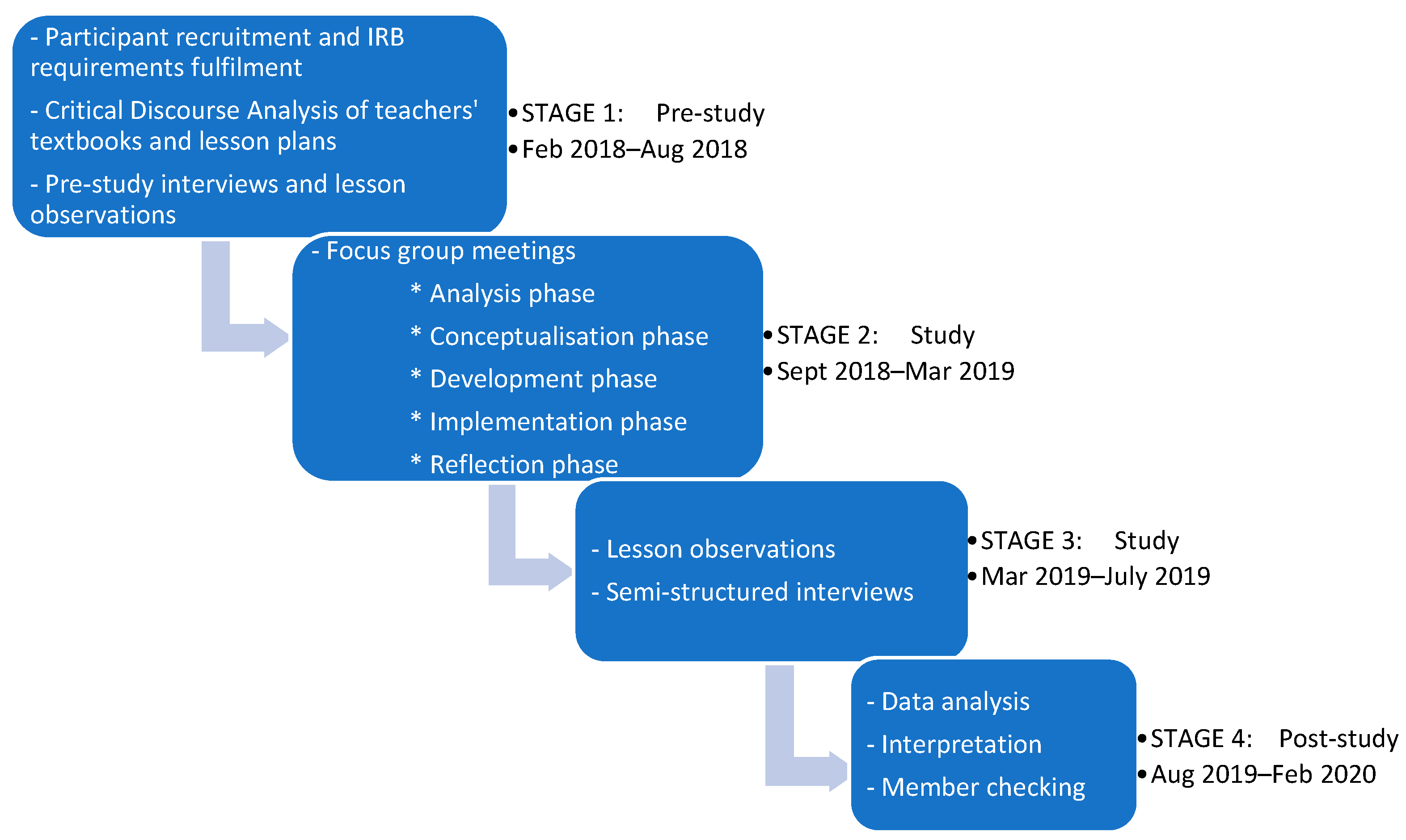
The limitations above were addressed in the following ways. One of the researchers had good knowledge of the community and learnt more about them in the many conversations that were held in the six months (February–August 2018) before the official commencement of the PAR. The participants met and discussed EE pedagogy for six months between September 2018 and March 2019, and lesson observations and interviews were carried out over the next four months until July 2019 (Figure 2). This was a significant time commitment from the teachers, and they were unable to continue with the results analysis and reporting due to time, finance, and other logistics constraints. However, even though the researcher led the analysis, interpretation, and reporting phases of the PAR, the teachers led the problem definition, solution creation, and implementation of their solution.
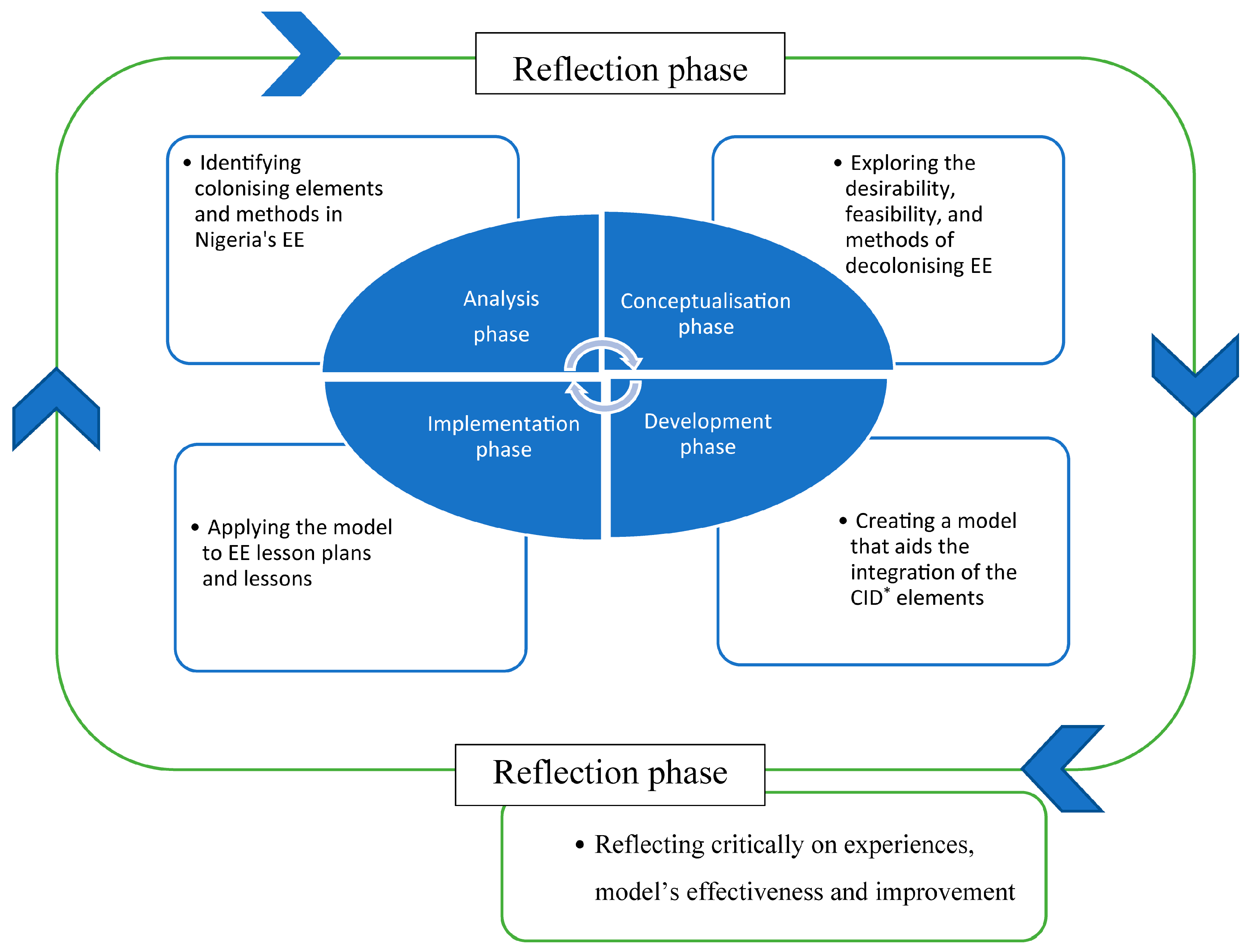
As shown in Figure 3, this paper reports on the development and implementation phases of the study, as well as the reflection phase that encompasses all the phases. This PAR study was conducted with ten teachers from five secondary schools in an urban city in Nigeria. Biology and geography teachers were selected due to the obvious environmental education content in their subjects. The researcher obtained ethical permission from an institutional review board and recruited participants through purposive sampling, where teachers were approached in their schools with information about the study and their rights if they chose to participate. Participants provided written informed consent, and Table 1 shows their profiles. When the teachers were initially engaged, the primary intention was to explore ways of improving the teaching of environmental education (EE) embedded within their subject areas. However, as discussions progressed, significant pedagogical limitations in relation to EE became increasingly apparent. As a result, the focus shifted towards a critical examination of prevailing EE practices. Engagement with scholarly literature and video resources during the focus group meetings fostered a shared interest in decolonising EE pedagogy, which subsequently became the central focus of the group and reflects a key feature of PAR, namely the collective framing of the research agenda by participants.
PAR meetings (also referred to as focus group meetings), field observation, document analysis, and semi-structured interviews were the methods employed. The data comprised PAR meeting videos and video transcripts, lesson observation videos and video transcripts, lesson plans, and interview transcripts. The research questions addressed in this paper are the following: What are teachers’ experiences with creating and implementing a decolonisation model? How is the model decolonising environmental education?

5. Results and Discussion

5.1. What Are Teachers’ Experiences with Creating and Implementing a Decolonisation Model?

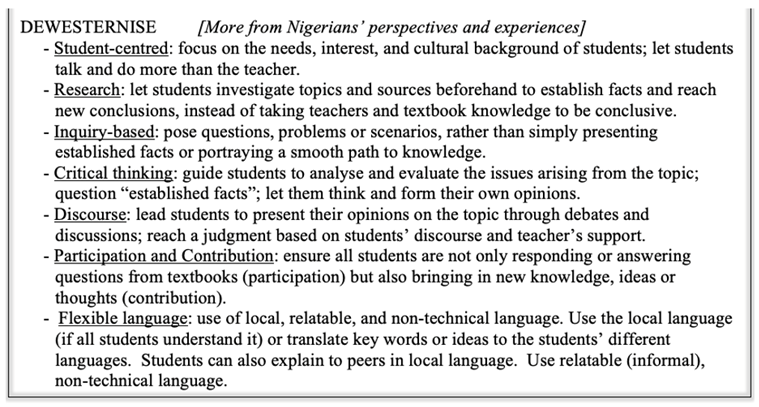
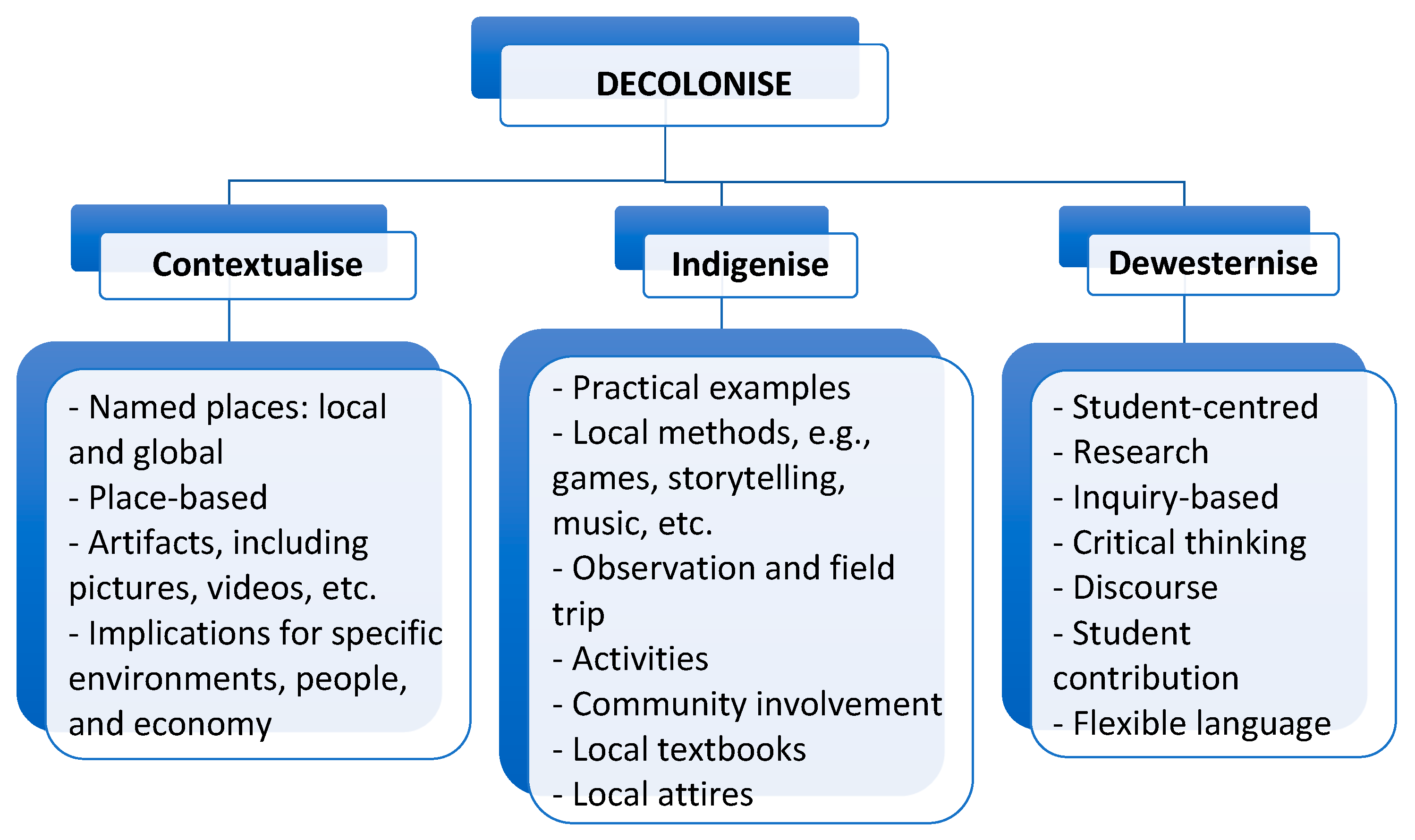
The conceptual framework for decolonising environmental education (Figure 1) was analysed by the study’s participants during the PAR meetings, and there was a unanimous decision to apply the framework to teaching and learning activities. Earlier in the study, participants had identified and analysed some of the colonising elements of Nigeria’s environmental education and discussed how to transform these elements. Using the CID framework, participants began fitting the items they identified as essential to decolonising education under one of the three components. There are some overlaps among the three components, but items were placed where the group believed was the best fit, as shown in Figure 4. Details of the model’s components are in Appendix A below.
Like participatory and classroom-based studies in Ghana (Acharibasam & McVittie, 2022) and Australia (Beasley, 2023; Wilks et al., 2025), participants demonstrated strong engagement during the design phase of the decolonisation process, suggesting that teachers are willing and able to critically interrogate colonial elements of environmental education when provided with dialogic and participatory spaces. Most of the participants were involved in listing and categorising the decolonisation elements, and they were very forthcoming with the items. Only a few participants did not fully engage with the process, as examined later.
Participants’ implementation of the decolonisation model varied widely. Two participants, Ayo and Deen, reported that they were not implementing the model, while the other eight participants reported that they were. Of these eight participants, only three were incorporating most of the model’s items, while four were implementing some, and two were implementing only a very few. This analysis was aided by the researcher’s scoring of an average of six lesson observations of nine participants, based on observed items from the model. Of the 18 items in the model, the presence of only 1–6 items in classroom lessons was scored Low, while 7–12 items scored Medium, and 13–18 items scored High. All items were considered equal, and higher scores or the presence of more items from the model indicated more effective implementation or decolonised to a greater extent. Results are shown in Table 2 below, along with participants’ responses to the interview questions: Are you implementing the model? If yes, how? And if no, why?
Four participants—Deen, Fami, Ola, and Ope—did not fully engage with the model’s design process and were quiet participants during the model’s creation. Among them, only Deen reported not to be implementing the model. Fami and Ola implemented the model to some degree, while Ope is one of the most successful cases of the model’s implementation. Yemi was fully engaged with the design, but with a score of 8, he did not implement the model effectively. Deen was vocal about his resistance to decolonisation, as discussed later, but the other three participants were observed to agree with the decolonisation plan even though they did not contribute much.
Within the Contextualise, Indigenise, Dewesternise (CID) framework of the model, some elements have been implemented more than others, as shown in Table 3 below. Participants integrated local places in their lessons to a large extent, but global places were conspicuously absent. The importance of naming both local and foreign places for holistic knowledge, instead of the usual absence of named places or mention of foreign places at best, was discussed in the focus group, but it appears that participants chose to name only local places. It could be that the increase in their critical consciousness of the colonised curriculum content led them to focus on local places. Being critical of Eurocentricity could result in Afrocentricity, two problematic extremes (Dick, 1995). Thus, a more holistic approach, such as polycentrism (Amin, 1990) or ecology of knowledges (de Sousa Santos, 2009), is necessary in decolonisation efforts because heightened critical consciousness can inadvertently produce new epistemic blind spots if not accompanied by deliberate pluralistic frameworks.
In addition, many of the teachers did not provide opportunities for students to contribute their knowledge, and critical thought was minimal in classroom discourse. This could be because rote learning has been the predominant method for the participants, and breaking away from it requires a lot of effort and time (Moland, 2017). However, a few participants provided opportunities for research and discourse, and there was an obvious effort to make lessons more student-centred.
Although most participants made efforts to integrate the model’s components in their lessons, some evidence of the colonising elements remained. For some participants, there was heavy reliance on textbook information and note-taking without critical discussion of the content. Also, lessons began with the teacher providing ‘factual information’ to be memorised before students had the opportunity to think about the topic and share their knowledge. Again, environmental education lessons retained their anthropogenic orientation with only human benefits mentioned, and no mention of benefits to other living things, non-living things, and the planet. Finally, the assessment section of lessons required regurgitation of learned facts, instead of critical evaluation of the knowledge and activities shared during the lesson. These are explained by participants’ reports of their challenges in implementing the model, as discussed below. In sum, although many participants struggled to fully implement the decolonisation model, most of them had become more critically conscious of previously taken-for-granted inequalities in the environmental education content of their subjects and were making efforts to decolonise their lessons.
Critical consciousness development was evidenced in the participants’ discourse. However, two participants (Deen and Yemi) were not in agreement with the group’s support for decolonising education at the beginning of the meetings. Deen admitted that there were improvements to be made with teaching styles and other structural changes, but argued against decolonising education content, which was unproblematic to him because, as the teachers in Shizha’s (2008) study also reiterated, ‘science is the same everywhere’. This belief in universal or context-free knowledge can be challenged with the idea of the ecology of knowledges (de Sousa Santos, 2009). Towards the end of the study, Yemi appeared to have changed his stance, although there were indications that he still believed that Western knowledge and methods were superior, like the participants in Leakey and Kakukwena’s (2025) study in Zambia. Deen found the ‘decolonisation’ term problematic, and occasionally made comments about his desire for the British to recolonise Nigeria.
“Greediness and selfishness are what’s killing us in this country. At least if [the British people] can recolonise us, they would know how to work things out”.
(Deen, Meeting 12)
However, other participants demonstrated increased knowledge and critical thinking, some of which are captured in their own words below.
“I had not thought of this issue before but the discussions we have been having made me realise we are not doing ourselves any good to be focusing on Western environments when we have no idea of what is around us”.
(Oja, post-study interview)
“My thinking and my teaching have changed now because of the model and the students love it. I am sharing the model with other teachers and explaining to them why we are using it and how to use it”.
(Ade, post-study interview)
“The research has been an eye-opener for me, so I really want to appreciate that. Applying knowledge gained from the meetings has been worthwhile”.
(Oba, post-study interview)
In sum, most participants had not realised that their curriculum and teaching methods were colonised, and were not conscious of making changes, but as the group’s discussion progressed over time, they became vocal about instances of colonised education and how to decolonise them. They also implemented their solutions. These processes show that participants went through the stages of critical consciousness development (Freire, 1974), as described earlier. The results above also show that the concept of decolonisation is more contested than the literature reveals, and further exploration into opposition to decolonising education in Africa is imperative. In Deen’s case, he emphasised the dysfunctional state of the country, which he attributed to selfishness and greed, presumed not to be associated with the British colonists. Fanon (1961) referred to this situation where the colonists have attained a saviour status as servile mentality, and some researchers (e.g., Omolewa, 2006) have reported its high prevalence in sub-Saharan Africa. This mentality obstructs critical consciousness development by making it more difficult to perceive inequalities and oppression, especially those taken for granted.
Furthermore, these results may be explained by some of the challenges participants reported when implementing the decolonisation model:
“State inspectors tell us this is how they want us to do this…so there’s a way you must write [lesson plans] but within my own strategies and activities, I try to include decolonisation. You see them complaining, why do you have to do this? I have taken students out before to other places and some inspectors are saying why am I disturbing the school?”.
[Olu, post-study interview]
“Children are having just 40 min [for lessons], if you want them to understand better your class might be taking a longer time than the designated time”.
[Fami, post-study interview]
“A challenge I had with those methods like maybe using group work, pairing the students to discuss some things, because it’s a large class of 90 students and to bring in that method into the class is always… number one it takes time and it’s not easy to co-ordinate you know? So, students in a class, trying to group them, it’s always rowdy”.
[Ola, post-study interview]
“The students really liked using their local language, it is always very interesting using that in the classroom, but I noticed that sometimes when we were using some of their local dialects to introduce a topic, some take it to be a joke. Also, I taught a topic, and I was trying to explain but they didn’t understand so I used the local dialect. I now set a question for them to answer, would you believe that some of them were now using that local dialect to explain but that is not really accepted in an international standard like WAEC exam”.
[Olu, post-study interview]
“One has to brainstorm, before you think of most of these instructional materials that you can use. That is not always possible due to time and other things”.
[Ade, post-study interview]
These findings reveal how decolonisation unfolds within everyday classrooms shaped by competing ideologies, professional identities, and historical pedagogical norms. The varied engagement levels among participants, including active resistance, underscore that decolonising environmental education is not only an epistemic project but also a political and affective one, requiring time, support, and sustained reflexivity. Thus, this research makes a significant empirical contribution by demonstrating how decolonisation is negotiated, constrained, and partially realised in practice, rather than assuming its inevitability once teachers adopt decolonial principles.

5.2. How Is the Model Decolonising Environmental Education?

The model is decolonising environmental education by operationalising decolonisation through three interrelated components: contextualisation, Indigenisation, and dewesternisation. The presence of elements from any of these components (see Figure 4) signifies movement away from colonised forms of knowledge and pedagogy. Through contextualisation, the model challenges abstract, placeless, and Eurocentric representations of environmental issues by foregrounding named local and global places, place-based learning, and artefacts such as pictures, videos, and local case studies. Many participants became more intentional about including examples from local contexts and using pictures and other visual artefacts like maps in their lessons. This re-anchors environmental knowledge in learners’ lived realities, making visible local environments, people, economies, and ecological challenges that are often marginalised in conventional or globalised curricula.
Indigenisation further decolonises environmental education by legitimising Indigenous and local knowledge systems through practical examples, community involvement, fieldwork, observation, and the use of local textbooks and activities. Some participants started incorporating songs in their lessons, gave students tasks that required their parents’ input, and wore local attires with more frequency, instead of only on Fridays as it used to be. These Indigenous elements disrupt the dominance of Western scientific epistemologies and practices by recognising that valuable environmental knowledge is generated within communities, including among Elders, and everyday practices such as reinforcing identities through clothing. Finally, dewesternisation addresses the pedagogical dimension of colonisation by shifting classroom practice away from teacher-centred transmission and rote learning toward student-centred approaches that emphasise research, inquiry-based learning, critical thinking, discourse, and student contribution, supported by flexible language use. Some participants increasingly adopted student-centred approaches, encouraging student contributions in class. They also used their local language sometimes, although this was constrained by the multicultural and multilingual nature of the city where the study was conducted. However, collectively, the model decolonises environmental education by transforming not only what is taught, but how and from whose perspectives knowledge is produced and validated. Thus, in this study, the extent to which these elements are present in lessons serves as a practical indicator of how far environmental education has been decolonised in classroom practice.
Participants’ previous and current lessons and lesson plans on the same topics were observed to understand the influence of the model and the study in general on participants’ teaching. As described below, results indicated that only a few teachers appeared to have moved from colonised lesson plans to decolonised lesson plans, based on the presence of the decolonisation model’s components in their lesson plans. For most participants, lesson plans did not significantly change, although for some within this group, the lessons themselves were decolonised to varying degrees. This pattern mirrors findings from recent empirical studies in Ghana and Australia, where teachers’ engagement with decolonising frameworks led to greater transformation in classroom interaction and discourse than in formal planning documents (Acharibasam & McVittie, 2022; Beasley, 2023). Ade’s account of deliberately modelling the approach for a colleague also aligns with Leakey & Kakukwena’s (2025) Zambian study, where teacher-led demonstration and peer learning were found to be crucial mechanisms for sustaining decolonising practices.
“[The model] is effective… I’ve been using it with my students… even last week, I told one teacher that I’ll come and show him how we use the model, so I deliberately went to his class to teach that topic which is Conservation of Natural Resources, which is one of the environmental topics and I used most of the things we mentioned in that diagram”.
(Ade, post-study interview)
As discussed earlier, Deen and Ayo were the only participants who reported that they were not implementing the model. Except for Deen, who avoided commenting on it, all participants reported that the model is effective, with Ayo going further to say, ‘it will be effective but a gradual process’ and Yemi added that it is effective ‘only for topics focused on both Nigeria and abroad. Not for topics on Nigeria because it’s not the same with what they have abroad’.
This suggests that Yemi’s understanding of the decolonisation model is that it is effective for decolonising universal topics like Weather and Climate or Environmental Conservation, for example, but not for specific topics like Rivers in Nigeria. However, even localised topics in Nigerian textbooks are presented from Western and deficit perspectives and lack local examples and Indigenous people’s relationships with the phenomena being studied. For example, rivers in Africa are described as dirty, shallow, and narrow, despite the varying nature of the rivers and their value to the people around them. The application of critical consciousness here implies a rejection of deficit narratives or comparisons and an emphasis on the characteristics of these rivers from Indigenous perspectives. Being critical also means questioning the prevailing culture of waste dumping in African rivers and lands by the West, which has been described as environmental racism (Okafor-Yarwood & Adewumi, 2020; Liddick, 2010).
Beyond participants’ self-reports and based on observed lessons, the model, as implemented by seven participants, was decolonising environmental education to varying degrees. As shown in the preceding section and in Table 2, many participants who believed that they were adequately implementing the model were only implementing at medium or low levels. Interestingly, Deen, who said he was not implementing the model, had significant components of the model in his lessons, and his lessons were decolonised to some extent. For Oba, Oja, and Ope, the model was instrumental in decolonising their lessons to a high extent. These show that the PAR study influenced participants, and as Phajane’s (2019) study discussed earlier, teachers were identifying needs and challenges, and applying strategies to resolve them. Even though only three teachers demonstrated obvious transformation, all the participants engaged in critical consciousness development (Diemer et al., 2014) involving learning, critical thinking, and discourse where taken-for-granted inequalities were examined, and plans were developed to decolonise lessons. They also questioned traditions and prevailing culture, which is an important step for decolonising (Adebisi, 2016).
In sum, results of comparing participants’ post-study lessons to pre-study lessons suggest that the decolonisation model enabled some of the teachers to make their lessons more contextualised, Indigenised, and dewesternised. The model’s implementation varied greatly, and for three participants, lessons became significantly decolonised. Four participants’ lessons were also decolonised, although to a lesser degree than the three participants mentioned earlier. For the remaining three participants, there was very little change in their content and practice. Therefore, given that more time and practice could foster proper implementation, a further study will be conducted with the participants. The observable transformation is a testament to the teachers’ motivation and desire for change and improved learning. However, it is important that more aspects of the model, especially the dewesternisation component, which was the least engaged, are implemented consistently. In sum, the model was valuable to many participants as a visual resource for decolonising environmental education pedagogy, spurring creativity and learner-centred activities.

6. Theoretical Implications for Decolonising Environmental Education

This study has several important theoretical implications for the field of decolonising environmental education. First, it advances decolonisation from an abstract or normative aspiration to a practical, theory-informed framework that can be observed, enacted, and evaluated in classroom practice. By conceptualising decolonisation through the interconnected dimensions of contextualisation, Indigenisation, and dewesternisation, the study provides a theoretically grounded yet empirically operationalisable model that bridges critical decolonial theory with everyday pedagogical practice. This contributes to the field by demonstrating that decolonising environmental education is not a singular or symbolic act, but a multi-dimensional and gradual process that can be evidenced through specific curricular and pedagogical elements.
Second, the study reinforces and extends theories of critical consciousness and epistemic justice within environmental education. The findings show that teachers’ engagement with the model fostered heightened awareness of previously normalised Eurocentric assumptions embedded in environmental content and pedagogy, aligning with Freirean conceptions of conscientisation. At the same time, the model foregrounds the legitimacy of Indigenous and local knowledges, supporting decolonial arguments that environmental education must move beyond inclusion toward a reconfiguration of what counts as valid knowledge. The uneven implementation of the model also has theoretical significance, highlighting how decolonisation is mediated by teacher identity, professional socialisation, and contextual constraints rather than being a linear or universal process.
Finally, the study contributes to theoretical debates on pluralism and relationality in environmental knowledge. By cautioning against replacing Eurocentrism with uncritical ethnocentrism or Afrocentrism and instead advocating for polycentrism and an ecology of knowledges, the model aligns decolonising environmental education with relational epistemologies that value multiple, coexisting knowledge systems. This positions decolonising environmental education as an ongoing dialogic practice rather than a fixed end state, thereby expanding the field’s theoretical understanding of decolonisation as a dynamic, contested, and context-dependent educational project.

7. Conclusions

The process and outcome of a participatory action research study—the Decolonising Environmental Education Pedagogy (DEEP) project—have been discussed in this paper, with a focus on teachers’ experiences with creating and implementing a decolonisation model and the model’s influence on transforming environmental education. The results indicated that in general, many participants’ environmental education (EE) lessons became more contextualised, Indigenised, and dewesternised—the three components described as necessary for decolonising education in this study.
However, there were some challenges encountered during the decolonisation process, as discussed earlier. Critical consciousness development requires time and practice over time. A few participants appeared not to have become critically conscious of their colonised education content, and this translated into few changes made to their lesson plans and lessons. For the successful implementation of the decolonisation model, teachers need to be aware of and able to unpack the unequal distribution of power and privilege in their curriculum content and practice so that they can create a balance by integrating contextualised, Indigenised, and dewesternised content and practice that will empower learners to understand and transform themselves and their environments. Furthermore, some participants were afraid of deviating from the set curriculum and recommended textbooks (which do not emphasise local content and methods) for two main reasons: (i) to avoid trouble with school authorities whose duties include ensuring teachers stick to the set curriculum and approved textbooks, and (ii) to ensure their students do not learn something different from what others are learning because of the standardised exams at the end of each school term and at the end of secondary school (West African Senior Secondary Certificate Examination). This challenge is likely because the teachers viewed decolonisation only as an approach that deviates from the set curriculum, rather than as an approach that transforms pedagogy to integrate context, Indigenous content and methods, and Nigerian perspectives within the existing curriculum.
Some participants found it difficult to implement decolonised lessons because of the research and brainstorming involved, crowded classrooms, outdoor activities, and required materials that are not feasible due to legislation or finance, as discussed above. They may need more time and practice to improve the decolonisation of their lessons. Other researchers have also found that these are common obstructions with respect to changing teaching practices. Furthermore, lessons cannot be accurately analysed based on lesson plans because lesson plans were usually not fully implemented during lessons, as this study’s lesson observations revealed. Sometimes, lesson plans were still colonised, but the actual lessons were decolonised. Other times, lesson plans were decolonised, but the actual lessons were not. More commonly, during lessons, teachers did not engage most of the decolonised content and approaches they had stated in their lesson plans. Occasionally, a teacher’s style involved not putting details in the lesson plan, such that only headings and subheadings may appear on the lesson plan. This makes it appear colonised, especially with no reference to contextualised, Indigenised, and dewesternised content. However, the actual lesson in its detailed form contained elements of decolonised EE. This shows that decolonisation is often enacted improvisationally and relationally in practice, rather than systematically embedded in lesson plans, suggesting that pedagogical change frequently precedes curricular formalisation.
In addition, it appears that either an emphasis on ‘global’ was insufficient during the study, or participants were more interested in emphasising ‘local’ only, except for Deen and Yemi. Therefore, as we work through this decolonisation process, it is important to avoid an exclusive focus on the local and ethnocentrism because a truly decolonised education is marked by the absence of hegemony or unicentrism. This study also describes how decolonisation efforts can be actively undermined by internalised colonial hierarchies and epistemic loyalties, not merely by institutional constraints. Decolonising education is a complex and continuous learning process, and future studies should continue to explore diverse approaches to actualising it. It would also be beneficial to conduct longitudinal studies to understand the process of change and how it might be sustained.

Funding

This research received no external funding.

Institutional Review Board Statement

The study was approved by the Institutional Review Board of Steinhardt School of Culture, Education, and Human Development, New York University. (code: IRB-FY2018-1936; date: 21 May 2018).

Informed Consent Statement

Informed consent was obtained from all participants involved in the study.

Data Availability Statement

Data is unavailable due to ethical restrictions.

Acknowledgments

Thank you to the teachers who participated in this study and to New York University’s Steinhardt School for the PhD fellowship that supported this research.

Conflicts of Interest

The author declares no conflicts of interest.

Abbreviations

The following abbreviations are used in this manuscript:
PARParticipatory action research
EEEnvironmental education
DEEPDecolonising environmental education pedagogy
CIDContextualise, Indigenise, Dewesternise

Appendix A. Description of the Decolonisation Model

Education 16 00199 i001
Education 16 00199 i002

References

  1. Acharibasam, J. B. (2022). Decolonizing climate change education: Evidence from an empirical study in Ghana. Journal of Education and Practice, 13(32), 54–63. [Google Scholar]
  2. Acharibasam, J. B., & McVittie, J. (2022). Connecting children to nature through the integration of indigenous ecological knowledge into early childhood environmental education. Australian Journal of Environmental Education, 39(3), 349–361. [Google Scholar] [CrossRef]
  3. Adebisi, F. I. (2016). Decolonising education in Africa: Implementing the right to education by re-appropriating culture and indigeneity. Northern Ireland Legal Quarterly, 67, 433. [Google Scholar] [CrossRef]
  4. Adeyemi, A. I., & Eugene, D. (2023). Decolonising education in Africa: Challenges and prospects for curriculum reform. Journal of Curriculum Studies, 55(4), 605–627. [Google Scholar]
  5. Agbedo, C. U., Krisagbedo, E. C., & Eze, V. O. (2012). Mother tongue education as agency of decolonisation: Implications for national development in Nigeria. Developing Country Studies, 2(11), 170–181. [Google Scholar]
  6. Ajaps, S. O. (2021). Decolonising education for environmental conservation: A participatory action research [Doctoral dissertation, New York University]. [Google Scholar]
  7. Amin, S. (1990). Delinking: Towards a polycentric world. Zed Books. [Google Scholar]
  8. Anderson, G. L. (2017). Can participatory action research (PAR) democratize research, knowledge, and schooling? Experiences from the global South and North. International Journal of Qualitative Studies in Education, 30(5), 427–431. [Google Scholar] [CrossRef]
  9. Batallán, G. (1997). Appropriating ethnography for research in education: Reflections on recent efforts in Argentina and Chile. In G. Anderson, & M. Montero-Sieburth (Eds.), Educational qualitative research in Latin America: The struggle for a new paradigm (pp. 33–50). Garland Pub. [Google Scholar]
  10. Baum, F., MacDougall, C., & Smith, D. (2006). Participatory action research. Journal of Epidemiology and Community Health, 60(10), 854–857. [Google Scholar] [CrossRef]
  11. Beasley, K. (2023). An investigation of the botanical literacies of children and their teachers in the early years of school [Doctoral dissertation, Murdoch University]. [Google Scholar]
  12. Campbell, C., & MacPhail, C. (2002). Peer education, gender and the development of critical consciousness: Participatory HIV prevention by South African youth. Social Science & Medicine, 55, 331–345. [Google Scholar] [CrossRef]
  13. Carl, A. (2005). The “voice of the teacher” in curriculum development: A voice crying in the wilderness? South African Journal of Education, 25(4), 223–228. [Google Scholar]
  14. Dei Ofori-Attah, K. (2006). The British and curriculum development in West Africa: A historical discourse. International Review of Education, 52(5), 409–423. [Google Scholar] [CrossRef]
  15. de Sousa Santos, B. (2009). A non-occidentalist west? Learned ignorance and ecology of knowledge. Theory, Culture & Society, 26(7–8), 103–125. [Google Scholar]
  16. Dick, A. L. (1995). The afrocentric-eurocentric debate in Africa: From a fruitless dichotomy to critical dialogue (Brief Communication). The International Information & Library Review, 27(2), 195–202. [Google Scholar] [CrossRef]
  17. Diemer, M. A., & Blustein, D. L. (2006). Critical consciousness and career development among urban youth. Journal of Vocational Behavior, 68, 220–232. [Google Scholar] [CrossRef]
  18. Diemer, M. A., & Li, C. (2011). Critical consciousness development and political participation among marginalized youth. Child Development, 82(6), 1815–1833. [Google Scholar] [CrossRef]
  19. Diemer, M. A., Rapa, L. J., Park, C. J., & Perry, J. C. (2014). Development and validation of the critical consciousness scale. Youth & Society, 49(4), 461–483. [Google Scholar]
  20. Eten, S. (2015). Indigenising Africa’s environmental education through a development education discourse for combating climate change. Policy & Practice: A Development Education Review, 21, 105–122. Available online: https://www.developmenteducationreview.com/sites/default/files/Issue%2021%20(1).pdf#page=108 (accessed on 5 November 2025).
  21. Fanon, F. (1961). The wretched of the earth [1961] (C. Farrington, Trans.). Grove Weidenfeld. [Google Scholar]
  22. Freire, P. (1974). ‘Conscientisation’. Cross Currents, 24(1), 23–31. [Google Scholar]
  23. Freire, P. (1996). Pedagogy of the oppressed (revised ed.). Continuum. [Google Scholar]
  24. Gambo, A., Danladi, E. N., & Lawal, H. (2007). Amana social studies for junior secondary schools (Universal Basic Education ed., Vol. 1). Amana. [Google Scholar]
  25. Garcia, M., Kosutic, I., McDowell, T., & Anderson, S. A. (2009). Raising critical consciousness in family therapy supervision. Journal of Feminist Family Therapy, 21, 18–38. [Google Scholar] [CrossRef]
  26. Gay, G., & Kirkland, K. (2003). Developing cultural critical consciousness and self-reflection in preservice teacher education. Theory into Practice, 42(3), 181–187. [Google Scholar] [CrossRef]
  27. Getzlaf, B. A., & Osborne, M. (2010). A journey of critical consciousness: An educational strategy for health care leaders. International Journal of Nursing Education Scholarship, 7(1), 1–15. [Google Scholar] [CrossRef] [PubMed]
  28. Gluck, A. (2015). De-westernisation, key concept paper [Unpublished manuscript]. Working Paper. MeCoDEM. [Google Scholar]
  29. Gumbo, M. T. (2012). Indigenising the school curriculum: An alternative approach for ensuring relevance to the context. Indilinga African Journal of Indigenous Knowledge Systems, 11(2), 179–193. [Google Scholar]
  30. Gutierrez, L. M., & Ortega, R. (1991). Developing methods to empower Latinos: The importance of groups. Social Work with Groups, 14(2), 23–43. [Google Scholar] [CrossRef]
  31. Guzmán-Valenzuela, C., Chiappa, R., & Gómez-González, C. (2025). Transforming regional higher education: The decolonising role of Indigenous-inspired universities in Latin America. International Journal of Educational Research, 133, 102731. [Google Scholar] [CrossRef]
  32. Hardman, F., Abd-Kadir, J., & Smith, F. (2008). Pedagogical renewal: Improving the quality of classroom interaction in Nigerian primary schools. International Journal of Educational Development, 28(1), 55–69. [Google Scholar] [CrossRef]
  33. Hatcher, A., de Wet, J., Bonnell, C. P., Strange, V., Phetla, G., Proynk, P. M., Kim, J. C., & Hargreaves, J. R. (2010). Promoting critical consciousness and social mobilization in HIV/AIDS programmes: Lessons and curricular tools from a South African intervention. Health Education Research, 26(3), 542–555. [Google Scholar] [CrossRef]
  34. Heleta, S. (2016). Decolonisation of higher education: Dismantling epistemic violence and Eurocentrism in South Africa. Transformation in Higher Education, 1(1), 1–8. [Google Scholar] [CrossRef]
  35. Herr, K., & Anderson, G. L. (2014). The action research dissertation: A guide for students and faculty. Sage Publications. [Google Scholar]
  36. Higgs, P. (2012). African philosophy and the decolonisation of education in Africa: Some critical reflections. Educational Philosophy and Theory, 44, 37–55. [Google Scholar] [CrossRef]
  37. Hogan, R. (2008). Contextualising formal education for improved relevance: A case from the Rufiji Wetlands, Tanzania. Southern African Journal of Environmental Education, 25, 44–58. [Google Scholar]
  38. Horsdal, M. (2012). Telling lives: Exploring dimensions of narratives. Routledge. [Google Scholar]
  39. Idris, K. M., & Asfaha, Y. M. (2019). Improving school work in challenging context: Practitioners’ views following a participatory action research project from Eritrea. Nordic Journal of Comparative and International Education (NJCIE), 3(2), 72–90. [Google Scholar] [CrossRef]
  40. Jekayinfa, A. A., & Yusuf, A. R. (2008). Teachers’ opinions on the incorporation of environmental education in the Nigerian primary school curriculum. Educational Research and Reviews, 3(11), 334. [Google Scholar]
  41. Jemal, A. (2017). Critical consciousness: A critique and critical analysis of the literature. The Urban Review, 49(4), 602–626. [Google Scholar] [CrossRef]
  42. Jones, J. L., & Jones, K. A. (2013). Teaching reflective practice: Implementation in the teacher- education setting. The Teacher Educator, 48(1), 73–85. [Google Scholar] [CrossRef]
  43. Kaya, H. O., & Seleti, Y. N. (2013). African indigenous knowledge systems and relevance of higher education in South Africa. The International Education Journal: Comparative Perspectives, 12(1), 30–44. [Google Scholar]
  44. Kelbessa, W. (2008). Oral traditions, African philosophical methods, and their contributions to education and our global knowledge. In R. Ames, & P. Hershock (Eds.), Educations and their purposes: A conversations among cultures. University of Hawaii Press. [Google Scholar]
  45. Kola-Olusanya, A., Adewale, P. S., Yusuf, F., & Odekeye, O. T. (2025). Environmental education for nurturing nature: Assessment of environmental education in nature protection in Nigeria. Social Sciences & Humanities Open, 12, 101755. [Google Scholar] [CrossRef]
  46. Leakey, L. M., & Kakukwena, M. (2025). Integrating Indigenous Ecological Knowledge into modern education: A study of its impact on environmental conservation in Zambia. International Journal of Research and Innovation in Social Science, 9(3), 7309–7325. [Google Scholar] [CrossRef]
  47. Liddick, D. (2010). The traffic in garbage and hazardous wastes: An overview. Trends in Organized Crime, 13(2), 134–146. [Google Scholar] [CrossRef]
  48. Mampane, R. M., Omidire, M. F., & Aluko, F. R. (2018). Decolonising higher education in Africa: Arriving at a glocal solution. South African Journal of Education, 38(4), 1–9. [Google Scholar] [CrossRef]
  49. Mbah, M., Ajaps, S., & Molthan-Hill, P. (2021). A systematic review of the deployment of Indigenous knowledge systems toward climate change adaptation in developing world contexts: Implications for climate change education. Sustainability, 13(9), 4811. [Google Scholar] [CrossRef]
  50. Mbah, M. F., & Ezegwu, C. (2024). The decolonisation of climate change and environmental education in Africa. Sustainability, 16(9), 3744. [Google Scholar] [CrossRef]
  51. McNiff, J., & Whitehead, J. (2006). Action research: Living theory. Sage Publications. [Google Scholar]
  52. Miller, J. (2017). Neo-positivist intrusions, post-qualitative challenges, and PAR’s generative indeterminacies. International Journal of Qualitative Studies in Education, 30(5), 488–503. [Google Scholar] [CrossRef]
  53. Moland, N. A. (2014). Can multiculturalism be exported? Dilemmas of diversity on Nigeria’s sesame square. Comparative Education Review, 59(1), 1–23. [Google Scholar] [CrossRef]
  54. Moland, N. A. (2017). Localizing play-based pedagogy: Nigerian educators’ appropriation of sesame classroom materials. Global Education Review, 4(3), 17–36. [Google Scholar]
  55. Morrell, M. E. (2003). Survey and experimental evidence for a reliable and valid measure of internal political efficacy. Public Opinion Quarterly, 67, 589–602. [Google Scholar] [CrossRef]
  56. Msila, V., & Gumbo, M. T. (Eds.). (2016). Africanising the curriculum: Indigenous perspectives and theories. AFRICAN SUN MeDIA. [Google Scholar]
  57. Mustakova-Possardt, E. (1998). Critical consciousness: An alternative pathway for positive personal and social development. Journal of Adult Development, 5, 13–30. [Google Scholar] [CrossRef]
  58. Mustapha, R. A. (2004). Ethnicity and the Politics of Democratization in Nigeria. In B. Berman, D. Eyoh, & W. Kymlicka (Eds.), Ethnicity and democracy in Africa. James Currey. [Google Scholar]
  59. Noble, I. R., Huq, S., Anokhin, Y. A., Carmin, J., Goudou, D., Lansigan, F. P., Osman-Elasha, B., & Villamizar, A. (2014). Adaptation needs and options. In C. B. Field, V. R. Barros, D. J. Dokken, K. J. Mach, M. D. Mastrandrea, T. E. Bilir, M. Chatterjee, K. L. Ebi, Y. O. Estrada, R. C. Genova, B. Girma, E. S. Kissel, A. N. Levy, S. MacCracken, P. R. Mastrandrea, & L. L. White (Eds.), Climate change 2014: Impacts, adaptation, and vulnerability. Part A: Global and sectoral aspects. Contribution of working group II to the fifth assessment report of the intergovernmental panel on climate change (pp. 833–868). Cambridge University Press. [Google Scholar]
  60. North American Association for Environmental Education. (2017). About EE and why it matters. Available online: https://naaee.org/about-us/about-ee-and-why-it-matters (accessed on 30 May 2017).
  61. Odora-Hoppers, C. A. (Ed.). (2002). Indigenous knowledge and the integration of knowledge systems: Towards a philosophy of articulation. New African Books. [Google Scholar]
  62. Ogunbode, C. A. (2013). The NEP scale: Measuring ecological attitudes/worldviews in an African context. Environment, Development and Sustainability, 15(6), 1477–1494. [Google Scholar] [CrossRef]
  63. Okafor-Yarwood, I., & Adewumi, I. J. (2020). Toxic waste dumping in the Global South as a form of environmental racism: Evidence from the Gulf of Guinea. African Studies, 79(3), 285–304. [Google Scholar] [CrossRef]
  64. Omodan, B. I., & Dastile, N. P. (2023). Analysis of participatory action research as a decolonial research methodology. Social Sciences, 12(9), 507. [Google Scholar] [CrossRef]
  65. Omolewa, M. (2006). Educating the” native”: A study of the education adaptation strategy in British colonial Africa, 1910–1936. The Journal of African American History, 91(3), 267–287. [Google Scholar] [CrossRef]
  66. Owuor, J. (2008). Integrating African Indigenous knowledge in Kenya’s formal education system: The potential for sustainable development. Journal of Contemporary Issues in Education, 2(2), 21–37. [Google Scholar] [CrossRef]
  67. Perez-Gomez, A., Sola, M., Soto-Gomez, E., & Murillo, F. (2009). The impact of action research in Spanish schools in the post-Franco era. In S. Noffke, & B. Somekh (Eds.), The Sage handbook of educational action research (pp. 481–494). Sage. [Google Scholar]
  68. Peterson, N. A. (2014). Empowerment theory: Clarifying the nature of higher order multi-dimensional constructs. American Journal of Community Psychology, 53, 96–108. [Google Scholar] [CrossRef] [PubMed]
  69. Phajane, M. H. (2019). Participatory action research with rural primary school teachers: Implications for health promotion. Gender & Behaviour, 17(4), 14534–14540. [Google Scholar]
  70. Rimal, K. (2018). Teacher: An important but less recognized actor of school curriculum development in Nepal. Dhaulagiri Journal of Sociology and Anthropology, 12, 66–71. [Google Scholar] [CrossRef]
  71. Schön, D. A. (1983). The reflective practitioner: How professionals think in action. Harper Collins. [Google Scholar]
  72. Shabalala, N. P. (2025). Decolonising environmental education in Africa through the early integration of indigenous knowledge systems. Discover Sustainability, 6, 892. [Google Scholar] [CrossRef]
  73. Shin, R. Q., Ezeofor, I., Smith, L. C., Welch, J. C., & Goldrich, K. M. (2016). The development and validation of the contemporary critical consciousness measure. Journal of Counseling Psychology, 63(2), 210–223. [Google Scholar] [CrossRef] [PubMed]
  74. Shizha, E. (2008). Indigenous? What Indigenous knowledge? Beliefs and attitudes of rural primary school teachers towards indigenous knowledge in the science curriculum in Zimbabwe. The Australian Journal of Indigenous Education, 37(1), 80–90. [Google Scholar] [CrossRef]
  75. Shizha, E. (2009). Chara chimwe hachitswanyi inda: Indigenizing science education in Zimbabwe. In Education, participatory action research, and social change (pp. 139–153). Palgrave Macmillan. [Google Scholar]
  76. Smith, L. T. (2021). Decolonizing methodologies: Research and indigenous peoples. Bloomsbury Publishing. [Google Scholar]
  77. Somekh, B., & Zeichner, K. (2009). Action research for educational reform: Remodelling action research theories and practices in local contexts. Educational Action Research, 17(1), 5–21. [Google Scholar] [CrossRef]
  78. Tilbury, D. (1995). Environmental education for sustainability: Defining the new focus of environmental education in the 1990s. Environmental Education Research, 1(2), 195–212. [Google Scholar] [CrossRef]
  79. Timmis, S., Mgqwashu, E., Trahar, S., Naidoo, K., Lucas, L., & Muhuro, P. (2024). Students as co-researchers: Participatory methods for decolonising research in teaching and learning in higher education. Teaching in Higher Education, 29(7), 1793–1812. [Google Scholar] [CrossRef]
  80. Ushioda, E. (2011). Motivating learners to speak as themselves. Identity, Motivation and Autonomy in Language Learning, 11, 25. [Google Scholar]
  81. Watts, J. W., & Abdul-Adil, J. K. (1998). Promoting critical consciousness in young, African American men. Journal of Prevention & Intervention, 16(1–2), 63–86. [Google Scholar]
  82. Watts, R. J., Diemer, M. A., & Voight, A. M. (2011). Critical consciousness: Current status and future directions. In C. A. Flanagan, & B. D. Christens (Eds.), Youth civic development: Work at the cutting edge. New directions for child and adolescent development (Vol. 134, pp. 43–57). John Wiley & Sons. [Google Scholar]
  83. Watts, R. J., & Serrano-Garcia, I. (2003). The quest for a liberating community psychology: An overview. American Journal of Community Psychology, 31(1–2), 73–78. [Google Scholar] [CrossRef] [PubMed]
  84. Wilks, J., Turner, A., & Werner, M. (2025). Aboriginal cultural narratives and ecology as co-teachers: Understanding climate change in the sensory classroom on country. Australian Journal of Environmental Education, 41(2), 383–396. [Google Scholar] [CrossRef]
  85. Windsor, L., Jemal, A., & Benoit, E. (2014). Community Wise: Paving the way for empowerment in community re-entry. International Journal of Law and Psychiatry, 37(5), 501–511. [Google Scholar] [CrossRef] [PubMed]
  86. Woolman, D. C. (2001). Educational reconstruction and post-colonial curriculum development: A comparative study of four African countries. International Education Journal, 2(5), 27–46. [Google Scholar]
  87. Worldometers. (2025). Elaboration of data by the United Nations, department of economic and social affairs, population division. World population prospects: The 2024 revision. Available online: http://www.worldometers.info/world-population/nigeria-population/ (accessed on 2 November 2025).
  88. Zembylas, M. (2018). Decolonial possibilities in South African higher education: Reconfiguring humanising pedagogies as/with decolonising pedagogies. South African Journal of Education, 38(4), 1–11. [Google Scholar] [CrossRef]
Figure 1. Conceptual framework for decolonising environmental education.
Education 16 00199 g001
Figure 2. Stages of the DEEP project.
Education 16 00199 g002
Figure 3. Participatory action research cycle for education transformation. * CID refers to Contextualise, Indigenise, Dewesternise (Figure 1).
Education 16 00199 g003
Figure 4. Decolonisation model.
Education 16 00199 g004
Table 1. DEEP project participant profile.
NameAcademic QualificationGenderExperience (Years)Average StudentsSubject
AdeNCE Biology/Chemistry, BSc (Ed) Biology, MSc Cell BiologyM2780Biol.
AyoBSc Microbiology, PGDE, MSc & PhD Guidance and CounsellingF15100Biol.
DeenBSc Biochemistry, MSc Biology education, PhD Biology educationM5120Biol.
FamiBSc Fisheries, PGDE, MSc Fisheries managementF330Biol.
ObaBSc Geological & mineral sci., PGDEF1028Geog.
OjaBSc (Ed) GeographyF12100Geog.
OlaNCE Biology, BSc MicrobiologyF1190Biol.
OluBSc Biochemistry, PGDEF1860Biol.
OpeNCE GeographyF17105Geog.
YemiBSc GeographyM1920Geog.
Table 2. Educators’ implementation of the decolonisation model.
Interviewer: “Are You Implementing the Model?” “How?” *Model Score from Lesson Observations
Ade“Yes. Local examples.”10 (Medium)
Ayo“No. The model cannot be applied in most topics. For example, there is nothing Indigenous about microorganisms, just for evolution and pollution.”Not permitted to observe lessons
Deen“No. I have my own method where I have already been implementing some of what the model contains.”12 (Medium)
Fami“Yes. Songs, student-centredness, and local language.”5 (Low)
Oba“Yes. Research (inquiry projects), local methods, and local places.”14 (High)
Oja“Yes. Local places and local language.”13 (High)
Ola“Yes. But very difficult to contextualise; I don’t understand it. But I use local language.”6 (Low)
Olu“Yes. But many topics cannot work with the model, and I am limited by the state’s lesson plan template.”12 (Medium)
Ope“Yes. Student-centredness, research, discourse, and local places.”14 (High)
Yemi“Yes.” [He did not mention specific items]8 (Medium)
Note: * Only the exact items participants mentioned as being the most prominent in their lessons are reported.
Table 3. Occurrence levels of the CID components.
High OccurrenceLow OccurrenceNo Occurrence
ContextualisedNamed places (local); place-based; artefactsImplicationsNamed places (global)
IndigenisedActivity-based; local textbooks *; local attires; local methods **Practical examples; observationCommunity involvement; field trip
DewesternisedFlexible language; student-centredResearch; discourse; student contribution; inquiry-basedCritical thinking
Note: * Textbook content is not sufficiently decolonised, with most of the content copied from Wikipedia and other internet sources. However, some teachers were able to integrate it with local knowledge. ** This was very broadly defined with many options, such as songs, stories, and U-shaped seating.
Disclaimer/Publisher’s Note: The statements, opinions and data contained in all publications are solely those of the individual author(s) and contributor(s) and not of MDPI and/or the editor(s). MDPI and/or the editor(s) disclaim responsibility for any injury to people or property resulting from any ideas, methods, instructions or products referred to in the content.