1. Introduction
The term “mobile device” refers to portable electronic equipment capable of connecting to communication networks and running software applications (apps), such as smartphones, tablets, e-readers, and smartwatches (
Sahib & Hasan, 2025). Although these devices are used across all age groups, the recent literature identifies them as fundamental tools within the domestic digital ecosystem of children (
Chaudron et al., 2018;
Rideout & Robb, 2021).
The prevalence and meaning of children’s mobile device use are also shaped by contextual factors, such as school policies on digital technologies and access to community and educational services (exosystem), as well as broader societal events such as the COVID-19 pandemic (macrosystem), from a bioecological perspective. For example,
Kim et al. (
2025) report a longitudinal study of children aged 8–11 years in Republic of Korea between 2018 and 2021, showing a significant increase in smart device use from the pre-COVID to the pandemic period, even after controlling for age, household income, and maternal education.
The growing presence of mobile devices in children’s daily lives has prompted extensive debate across the fields of psychology, education, medicine, and neuroscience. A substantial body of work has examined children’s digital media use and parents’ attitudes, including both academic studies (e.g.,
Bergert et al., 2020;
Chaudron et al., 2018;
Legorburu Fernandez et al., 2025;
Livingstone & Helsper, 2008;
Nikken & Schols, 2015;
Papadakis et al., 2019;
Rideout & Robb, 2021) and large-scale national surveys that monitor media access, use, and parental mediation (e.g.,
eSafety Commissioner, 2016;
National Parents Union, 2024;
Ofcom, 2025). These sources suggest that parents typically recognize both opportunities and risks associated with children’s digital engagement. However, much of this evidence either focuses on early childhood (0–6 years) or covers broad age ranges (e.g., 3–17 years), making it difficult to isolate patterns specific to school-aged children. As noted by
Danet (
2020), research that concentrates explicitly on 6–12-year-olds—who are gaining autonomy in their technology use—remains comparatively less developed, particularly with respect to parents’ evaluations of apps on mobile devices.
In this study, we use the term “apps on mobile devices” to refer specifically to children’s app-based activities on these devices, rather than device access or ownership in general. Against this background, the present study extends prior digital parenting research in three ways. First, whereas much of the literature examines parents’ attitudes toward children’s overall screen use or information communication technology (often operationalized as generic “screen time”), we focus specifically on children’s use of apps on mobile devices and ask parents to evaluate app-related impacts in domain-specific developmental areas (motor, cognitive, language and communication, interpersonal, and emotional). Second, we concentrate on primary school-aged children (6–10 years), a group gaining autonomy in everyday technology use but still under strong parental mediation. Third, we provide evidence from a large Italian sample, offering context-specific insight in a European setting where schools increasingly communicate and support learning through app-based tools. These findings are relevant for educational practice and policy because they can inform home–school partnerships, guide age-appropriate recommendations about children’s use of apps on mobile devices and support the design of digital literacy initiatives and school communications that align with families’ concerns and expectations.
The developmental period between ages 6 and 10 is characterized by rapid growth in reasoning, memory, attention, and language. Several studies suggest that mobile technologies and educational apps can scaffold these abilities, fostering creativity and academic skills (
Dorris et al., 2024;
Neumann & Neumann, 2017). At the same time, a growing body of evidence links intensive or poorly regulated device use in childhood to a range of difficulties, including weaker academic outcomes, reduced sleep quality, increased sedentary behavior, and emotional and behavioral problems (
Al-Ajaleen et al., 2024;
Hosokawa & Katsura, 2018;
Liu et al., 2022;
Miyashita et al., 2023;
Zou et al., 2023). Taken together, these findings portray mobile devices as tools that may offer important learning opportunities but also pose non-negligible developmental risks when overused or used without guidance. Understanding how parents weigh these potential benefits and harms is therefore crucial to interpreting children’s everyday use of apps on mobile devices.
Studies show that parental perceptions reflect both beliefs in potential benefits (e.g., cognitive, emotional, and social growth) and concerns about risks to attention, sleep, emotional wellbeing, and family dynamics (
Livingstone, 2007). Digital environments have also created new parenting routines and expectations, with some parents viewing screen access as a normative aspect of modern childhood, whereas others express concern about potential developmental consequences. For example,
Danet (
2020) found that 53.1% of surveyed French parents of children aged 6–12 reported concern about their children’s screen time. Overall, the literature suggests a mixed profile in which perceived opportunities and concerns often co-occur, and their relative salience varies by children’s age, the type of digital activity, and family and contextual factors. Building on this work, the present study examines how parents of primary school-aged children evaluate the balance of perceived positive effects and concerns specifically regarding children’s use of apps on mobile devices across developmental domains.
Parents’ perceptions are not formed in isolation but are shaped by a range of sociodemographic factors, with research yielding somewhat mixed results. Early work by
Healy and Schilmoeller (
1985) already pointed to the role of family socioeconomic background in parents’ views on young children’s computer use. More recent studies likewise highlight socioeconomic characteristics as important. In a sample of 629 Taiwanese parents,
Luo et al. (
2023) showed that parental education, more than household income, predicted young children’s use of information and communication technologies: parents with higher education tended to introduce these technologies earlier while simultaneously applying stricter rules, suggesting a stance that acknowledges both educational value and potential risks. Similarly,
Akgün (
2023) reported no gender differences in perceptions among over 400 Turkish parents, but found that education, occupation, years of computer use, and digital proficiency significantly influenced attitudes, with parents holding higher educational qualifications and professional roles (e.g., teaching or civil service) generally expressing more positive views toward children’s technology use.
Given the growing centrality of mobile devices in children’s developmental environments, understanding parents’ perceptions—both positive and negative—is essential. These perceptions influence how digital technologies are introduced, monitored, and integrated into daily life, ultimately shaping developmental outcomes. Examining how sociodemographic variables predict these perceptions can therefore clarify the social and contextual conditions under which the use of apps on mobile devices is perceived as beneficial or concerning.
From a developmental systems perspective, children’s interactions with digital technologies cannot be understood in isolation from the broader ecological context in which they occur. According to Bronfenbrenner’s bioecological model (
Bronfenbrenner & Morris, 2006), children’s development is shaped by multiple, interrelated environmental systems—ranging from immediate settings such as the family and school (microsystem), to the interactions among these settings (mesosystem), to more distal influences such as community resources, parental employment, and media policies (exosystem), and finally to the broader cultural and societal values surrounding technology (macrosystem).
Applying this framework to digital parenting suggests that parents’ perceptions of children’s use of apps on mobile devices are influenced not only by individual or sociodemographic characteristics, but also by contextual factors that structure family life. For example, school policies regulating device use, availability of community or digital literacy programs, and broader social experiences such as the COVID-19 pandemic may shape how some parents evaluate the potential benefits and risks of children’s technology use. During the COVID-19 school closures, parents’ views of educational technology were mixed; however, survey evidence suggests that many parents recognized digital tools as useful for maintaining instructional continuity and home–school communication, while also reporting substantial burdens and concerns (
Garbe et al., 2020;
Mori et al., 2021;
Pastori et al., 2021).
Considering these contextual influences aligns with Bronfenbrenner’s emphasis on the interplay between proximal processes and nested contextual layers (
Bronfenbrenner & Morris, 2006). This ecological lens supports examining both proximal family characteristics (e.g., education and family structure) and more distal structural and cultural resources (e.g., perceived social status and broader norms) that may shape digital parenting and parental mediation practices (
Livingstone & Byrne, 2018;
Livingstone & Helsper, 2008;
Nikken & Schols, 2015).
This issue is directly relevant to educational practice because the primary-school years are a period in which children’s use of apps on mobile devices increasingly intersects with routines that support learning and wellbeing (e.g., homework habits, sleep, and sustained attention). Evidence syntheses and pediatric guidance highlight that digital media can bring learning and social opportunities but also potential risks for sleep, attention, and learning when use is poorly regulated or displaces key routines (
Hale & Guan, 2015;
Reid Chassiakos et al., 2016). Parents’ beliefs about the benefits and risks of use of apps on mobile devices can therefore shape the rules and mediation strategies implemented at home (
Livingstone & Helsper, 2008;
Nikken & Schols, 2015). Moreover, schools increasingly rely on digital platforms and apps to communicate with families and support home–school partnerships, making parent perceptions an important factor for effective home–school alignment and for the design of digital literacy and prevention initiatives involving both families and schools (
Cho et al., 2025;
Erdreich, 2021;
Patrikakou, 2016).
Consistent with this literature review, the aim of the present study was twofold: (1) to describe parents’ perceptions of the positive effects and concerns associated with children’s use of apps on mobile devices across key developmental domains, and (2) to examine whether parents’ sociodemographic and socioeconomic characteristics are associated with variability in these perceptions. Given the exploratory nature of the study and the heterogeneity of prior findings, we did not formulate directional hypotheses; instead, we addressed the following research questions:
- RQ1:
How do parents perceive the positive effects and potential concerns associated with children’s use of apps on mobile devices across different developmental domains (motor, cognitive, language and communication, interpersonal, and emotional)?
- RQ2:
Do parental sociodemographic and socioeconomic characteristics significantly predict parents’ perceptions of the positive effects and concerns associated with children’s use of apps on mobile devices?
2. Materials and Methods
2.1. Study Design, Participants, and Procedure
This cross-sectional study employed convenience sampling; the final analytic sample comprised 969 Italian parents. Data were collected via a self-administered online survey accessible through a link. Recruitment was conducted through partnerships with primary schools, community organizations, and social media platforms (Facebook, Instagram, WhatsApp). The questionnaire was also distributed in WhatsApp groups and Facebook communities focused on children’s care and development, each with thousands of members, using a snowball sampling strategy.
No a priori power analysis was used to set a target sample size; instead, the sample size was determined pragmatically by the number of eligible parents reached during the data collection window through the participating schools/organizations and online dissemination. Because recruitment relied on convenience and snowball sampling via schools, community groups, and social media, the sample is not a probability sample and should not be considered nationally representative. Parents participated from multiple areas of Italy; however, we did not employ stratified recruitment by region and therefore cannot claim representativeness for specific regions or for the country as a whole.
Inclusion criteria were (a) residence in Italy, (b) sufficient proficiency in Italian, (c) being a parent of a child aged 6–10 years, and (d) voluntary completion of the survey with informed consent to use and publish data in aggregated form. Exclusion criteria were (a) no informed consent and (b) an incomplete survey. Prior to analysis, we defined the analytic sample by additionally excluding parents who endorsed “I don’t know” on at least one item (n = 27; 2.6%) and parents who were not currently employed (n = 42; 4.0%), as occupational status was operationalized as an ordinal continuum among employed parents. No compensation was offered.
Of the 1122 parents recruited, 1038 completed the survey and met the inclusion criteria. After applying these predefined exclusions, the final analytic sample comprised 969 parents: 696 mothers (71.8%) and 273 fathers (28.2%), with a mean age of 43.5 years (SD = 7.18).
2.2. Instruments
2.2.1. Sociodemographic Sheet
Participants reported age, gender, educational level, occupational status, and perceived social status. Education was categorized as: 1 = middle-school diploma or less; 2 = high-school diploma; 3 = university degree; 4 = doctoral/postgraduate degree. Occupational status was classified into four ordered categories reflecting occupational skill level: 1 = unskilled/elementary occupations (e.g., cleaning staff, laborers); 2 = skilled/clerical/service occupations (e.g., office clerks, shop assistants, skilled artisans); 3 = technicians/associate professionals (e.g., technicians, teachers, nurses, mid-level supervisors); and 4 = professionals/managers (e.g., physicians, lawyers, executives, entrepreneurs). Non-employed parents were excluded prior to analysis (see
Section 2.1).
Perceived social status was measured using the MacArthur Subjective Social Status Scale—Adult Version (
Adler et al., 2000), a 10-point ladder indicating perceived social standing. Parents with multiple children aged 6–10 were asked to select one child and report their age and gender, whether the child co-resided with one or both parents, and whether older siblings lived in the household.
2.2.2. Measuring Parents’ Perceived Positive Effects and Concerns
Two parallel scales assessed parents’ perceptions of positive effects and concerns regarding children’s use of apps on mobile devices. The items were developed specifically for this study, drawing conceptually on previous research on media exposure and developmental outcomes in young children (
Cingel & Krcmar, 2013). All items referred to apps available on mobile devices (e.g., smartphones, tablets). Importantly, the items were not a direct translation or formal adaptation of an existing standardized instrument; rather, they were newly written for this study using a parallel format (benefits vs. concerns) and domain-specific content informed by prior literature.
Parents were instructed as follows: “Please indicate to what extent you think apps on mobile devices can have positive effects or negative consequences on your child’s development.” Each scale included five items corresponding to the following developmental domains: (a) motor development; (b) cognitive development (attention, reasoning, intelligence, memory); (c) language and communication; (d) interpersonal skills; and (e) emotional understanding, recognition, and expression. Responses were given on a 5-point Likert scale (1 = no positive effect/concern to 5 = very high positive effect/concern), with an additional “I don’t know” option.
“I don’t know” responses were coded as missing. To maintain a consistent analytic sample, parents who endorsed “I don’t know” on at least one item (
n = 27; 2.6%) were excluded prior to analysis; all analyses were conducted on the resulting analytic sample (
N = 969). This approach is consistent with standard methodological practice for handling sparse missingness in Likert-type data (
DeVellis, 2017;
Tabachnick & Fidell, 2019). This choice was made because “I don’t know” reflects uncertainty rather than a substantive position on the 1–5 evaluation continuum, and including such responses (e.g., by forcing a numeric value) could introduce measurement error in the scale totals. Given the small proportion of excluded cases, we expect minimal impact on estimates; nonetheless, we acknowledge below that this decision may have filtered out parents who feel less informed or less confident in judging app impacts.
A sample item from the positive-effects scale is: “I believe that some apps on mobile devices can help develop my child’s language and communication skills.” A sample item from the concerns scale is: “I am worried about the negative effects that some apps may have on my child’s interpersonal skills.” Total scores were computed by summing item responses, with higher scores indicating stronger perceived positive effects or concerns about the developmental impact of children’s use of apps on mobile devices. Possible total scores ranged from 5 to 25. These summed total scores (positive effects and concerns) were used as the outcome variables in all subsequent analyses (paired-samples t-tests, correlations, and regression models).
Each developmental domain was assessed with a single item; therefore, domain-level results reported in the Results reflect item-level ratings rather than multi-item subscales. Cronbach’s alpha is reported only for the overall five-item positive effects and five-item concerns totals, as internal consistency cannot be estimated at the domain level with single items.
The positive-effects scale (M = 14.08, SD = 3.83, α = 0.81) and the concerns scale (M = 12.11, SD = 3.83, α = 0.80) demonstrated good internal consistency. To support content validity, items were developed based on established literature on children’s media exposure and developmental domains (
Cingel & Krcmar, 2013). Each item was designed to reflect one of five theoretically relevant developmental areas. Two developmental psychology experts reviewed the items for relevance and clarity, and minor revisions were made accordingly. Beyond expert content review and internal consistency of the five-item totals, the measure was not subjected to a full psychometric validation process (e.g., factorial validity, convergent and discriminant validity, test–retest reliability), which should be addressed in future research.
2.3. Statistical Analysis Plan
First, descriptive statistics were computed for all study variables. Second, paired-samples t-tests compared mean positive effects and concerns for each developmental domain. A Bonferroni-adjusted alpha of p = 0.01 (0.05/5) was applied, and effect sizes were reported as Cohen’s dz. Third, Pearson correlations examined associations among variables. In both the correlational and regression analyses, perceived positive effects and perceived concerns were operationalized as summed total scores (range 5–25).
Fourth, two simultaneous multiple regressions were conducted to identify predictors of positive effects and concerns. All demographic and socioeconomic variables were entered in a single step, allowing us to examine the unique contribution of each predictor while controlling for the others. This approach avoids imposing a hierarchical order on the predictors and is consistent with the exploratory aim of the study, providing a clearer picture of how different background characteristics relate to parental perceptions of children’s use of apps on mobile devices.
Education and occupational status were measured as ordered categories and were entered as ordinal predictors (coded with increasing integers reflecting increasing levels). The number of parents in the household was coded as a dichotomous variable (1 = one parent; 2 = two parents). These variables were treated as numeric in Pearson correlations and regression models, a common approach when ordered categories approximate an underlying continuous gradient and the aim is parsimonious modeling. To evaluate the robustness of this decision, we conducted sensitivity analyses in which education and occupational status were represented using dummy variables and the number of parents was entered as a binary indicator; the overall pattern of results was substantively unchanged.
Prior to conducting the main analyses, assumptions were checked. Normality was evaluated using skewness and kurtosis indices following
Hair et al. (
2010); values indicated no substantial departures from normality (skewness range = −1.49 to 1.55; kurtosis range = −1.88 to 3.98 across the key study variables). Linearity was examined via visual inspection of scatterplots. Homoscedasticity was evaluated by inspecting plots of standardized residuals versus standardized predicted values, which showed an approximately constant spread of residuals across the range of fitted values (i.e., no evident funneling), indicating no major violations. Multicollinearity was assessed using tolerance and Variance Inflation Factors (VIF); tolerance values ranged from 0.72 to 0.92 (all > 0.40) and VIF values ranged from 1.09 to 1.39 (all < 2.00), indicating no concerns with multicollinearity (
Hair et al., 2010).
In the inferential analyses, “gender” refers to the respondent parent’s gender (mother/father) and was included as a covariate. Children’s age was restricted to a relatively narrow developmental window (6–10 years), which reduced age heterogeneity and helped focus the study on primary school-aged children. Therefore, age-related differences were not a primary focus in this study’s analyses.
2.4. Ethical Considerations
Participation was entirely voluntary and anonymous. Before accessing the questionnaire, participants viewed an online informed consent page describing the purpose of the study and procedures, the voluntary nature of participation, expected completion time, potential risks (none beyond those of everyday life), data confidentiality, and their right to stop at any time by closing the browser without penalty. Consent was obtained electronically via a mandatory checkbox (“I have read the information and agree to participate”); only participants who provided consent could proceed to the survey. Eligibility was restricted to adults (≥18 years) residing in Italy who were parents of a child aged 6–10 years. Participants were provided with contact details for the research team for questions about the study.
No identifying information (e.g., names, email addresses, IP addresses) was collected, and responses could not be linked to individuals. Data were stored securely on password-protected servers accessible only to the research team and were analyzed and reported in aggregated form. In accordance with university policy for fully anonymous, non-interventional survey research with adult participants, formal ethical approval was not required; nevertheless, all procedures were conducted in line with the ethical principles of the Declaration of Helsinki and complied with the EU General Data Protection Regulation (GDPR; Regulation (EU) 2016/679).
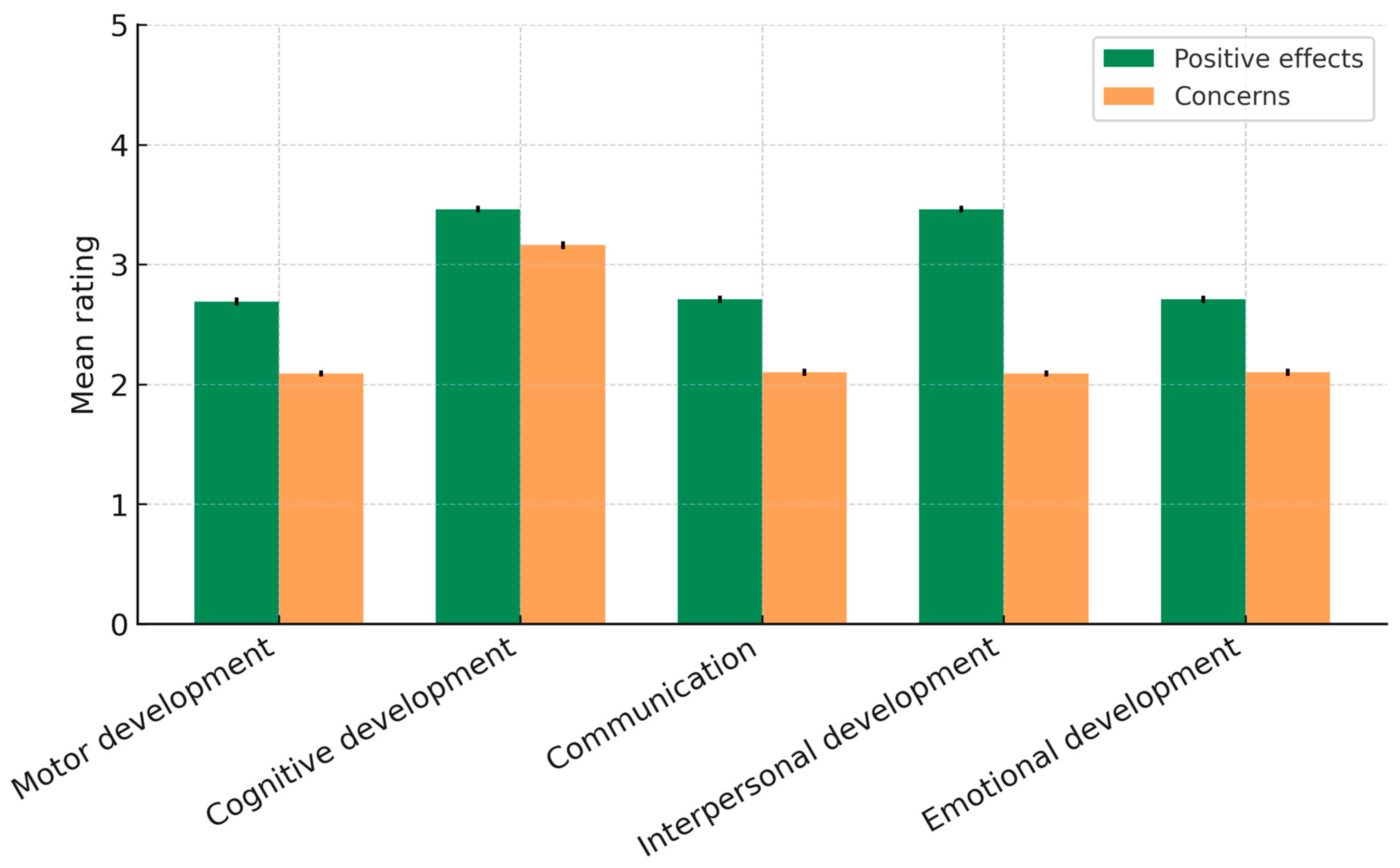
In this section, we disclose the use of generative AI during manuscript preparation, as required by the journal. ChatGPT (GPT-5.2; OpenAI) was used to generate
Figure 1 based on author-provided descriptive statistics (means/standard errors) and to support language editing. GenAI was not used for study design, data collection, statistical analysis, or interpretation of results; all outputs were reviewed and verified by the authors.
5. Conclusions
This study examines how parents perceive both positive and negative developmental implications of children’s use of apps on mobile devices. Overall, parents reported moderate perceived benefits—especially for the interpersonal-domain item—alongside noteworthy concerns, suggesting a complex view of digital technologies. Sociodemographic characteristics played a modest but significant role: parental education and occupational status and the presence of co-residing older siblings showed small associations with perceived effects, with the latter displaying the strongest links.
From an educational standpoint, these findings suggest that schools may benefit from engaging parents through targeted digital literacy and parental mediation initiatives, helping families distinguish between app types (e.g., entertainment vs. learning-oriented) and set developmentally appropriate boundaries. Home–school partnerships could be strengthened by providing consistent, non-alarmist guidance on device routines that support learning (e.g., homework time, bedtime, and attention-friendly practices). Teacher education and school policies may also incorporate practical strategies for communicating with families about children’s use of apps on mobile devices in ways that promote wellbeing and learning while acknowledging parents’ diverse concerns.
Several methodological limitations should be acknowledged. First, the cross-sectional design does not allow for causal inference; therefore, findings should be interpreted as associations, consistent with the study’s aim of identifying sociodemographic correlates of parents’ perceptions. Second, the Italian convenience sample limits generalizability. Participants were mainly parents reached through schools and online networks and were relatively homogeneous (e.g., predominantly mothers and parents with medium-to-high educational levels and perceived socioeconomic status). Snowball sampling may have favored families more engaged with school communication and more comfortable with digital technologies, while parents from more disadvantaged or migrant backgrounds, with lower education or limited internet access, and those less interested in or more skeptical about mobile devices may be underrepresented. Compared with national statistics (
Istituto Nazionale di Statistica, 2024,
2025), our sample appears broadly similar in age, occupational status, and family structure, but shows a slight overrepresentation of higher education and occupational levels and a predominance of mothers, which may reduce representativeness.
Relatedly, our operationalization of occupational status as an ordinal continuum among employed parents required excluding non-employed respondents. This decision may have reduced socioeconomic heterogeneity and underrepresented families facing greater economic precarity, potentially attenuating our ability to capture the full socioeconomic gradient in parents’ perceptions—an issue central to discussions of digital inequality. Future research should include broader socioeconomic indicators (e.g., household income, employment-status categories, material deprivation, or composite indices). In addition, we did not assess parents’ own digital habits, which limits interpretation of how personal technology use may shape perceptions. We also did not collect objective or detailed indicators of children’s actual app use (e.g., time spent, specific app types/activities), restricting our ability to link perceptions to concrete usage patterns and to interpret their practical significance. Finally, although age is theoretically relevant for digital parenting processes, we did not examine age-related variation within the restricted 6–10-year range or test associations with parents’ age; future studies should model child and parent age (and their interaction) to clarify developmental and generational patterns.
The sociodemographic models explained only a small proportion of variance in perceived positive effects and concerns (R2 = 0.04 and 0.07, respectively), suggesting that demographic characteristics alone provide a limited account of these appraisals. Future studies should incorporate more proximal predictors (e.g., parents’ digital literacy and technology-related self-efficacy, parenting style and mediation strategies—active, restrictive, and co-use—and technology-related anxiety/risk perceptions). Child-level indicators (e.g., actual screen time and activity type, self-regulation, and prior online experiences) may further improve explanatory power and clarify why some parents perceive greater benefits or concerns.
Our handling of “I don’t know” responses may also have introduced a subtle selection effect: excluding the small subset of parents who endorsed “I don’t know” on one or more items (2.6%) may slightly underrepresent parents who feel uncertain or less informed about app-related developmental impacts, potentially biasing results toward more confident or digitally engaged respondents. Future work could model uncertainty explicitly and test robustness under alternative missing-data assumptions.
Finally, domain-specific findings rely on single-item indicators for each developmental area, limiting reliability at the domain level and warranting cautious interpretation of between-domain differences. Although the five-item totals showed good internal consistency, the benefit and concern item sets were developed for this study and validated at the content level only; future research should conduct more comprehensive validation (e.g., EFA/CFA, convergent validity) and test measurement invariance across languages/cultural contexts if used internationally. Examining whether perceptions differ by parent or child gender was not an a priori objective; accordingly, we did not conduct gender-stratified analyses. Future studies should investigate potential gender-specific patterns and test whether the magnitude of the benefit–concern discrepancy differs across education levels (and across parent gender and age groups); for example, via interaction terms or stratified models. Child gender was recorded but not included in the present correlational analyses; future research should examine whether parents’ app-related perceptions differ for sons versus daughters (e.g., via stratified or interaction-based models).
Despite these limitations, the findings offer practical implications by highlighting the coexistence of optimism and concern in parents’ app-related appraisals. Rather than framing guidance as purely restrictive or permissive, support for parents may focus on helping families leverage perceived developmental opportunities—especially in interpersonal and communicative aspects—while managing the risks they continue to recognize. By documenting this pattern across multiple developmental domains, the present study offers original evidence that contributes to ongoing debates about how parents conceptualize the role of apps on mobile devices in children’s development and how such perceptions may shape digital parenting practices.
A particularly clear result concerned family structure: the presence of a co-residing older sibling was associated with higher perceived benefits and lower concerns. This pattern is consistent with the idea that older siblings may act as “digital mediators” in everyday family life—modeling norms, assisting with app selection and use, and potentially buffering anxieties—suggesting a potential protective/normalizing role that should be examined more directly in future research.
Taken together, these findings suggest several directions for future research. Because our data provide a detailed map of how parents balance perceived benefits and concerns across multiple developmental domains, future studies can test whether different attitudinal profiles (e.g., more benefit-oriented vs. more concern-oriented parents) predict children’s actual media behaviors, including type and duration of use of apps on mobile devices, co-use with parents, and adherence to family rules. It would also be valuable to examine whether parental attitudes are associated with specific child outcomes, such as academic adjustment, socioemotional functioning, and self-regulation, using multi-informant or mixed-methods designs that integrate parents’ and children’s perspectives with objective indicators of digital use. Prospective or intervention studies following families over time and evaluating digital parenting programs could further clarify whether changes in parents’ perceptions lead to changes in family media practices and child outcomes across sociocultural contexts and levels of parental digital literacy.