Systematic Review

A Systematic Review of Artificial Intelligence in Higher Education Institutions (HEIs): Functionalities, Challenges, and Best Practices

by
Neema Florence Vincent Mosha
,
Josiline Chigwada
*,
Gaelle Fitong Ketchiwou
and
Patrick Ngulube
School of Interdisciplinary Research and Graduate Studies, University of South Africa, Pretoria 0003, South Africa
*
Author to whom correspondence should be addressed.
Educ. Sci. 2026, 16(2), 185; https://doi.org/10.3390/educsci16020185 (registering DOI)
Submission received: 10 December 2025 / Revised: 13 January 2026 / Accepted: 19 January 2026 / Published: 24 January 2026
(This article belongs to the Section Higher Education)

Abstract

The rapid advancement of Artificial Intelligence (AI) technologies has significantly transformed teaching, learning, and research practices within higher education institutions (HEIs). Although a growing body of literature has examined the application of AI in higher education, existing studies remain fragmented, often focusing on isolated tools or outcomes, with limited synthesis of best practices, core functionalities, and implementation challenges across diverse contexts. To address this gap, this systematic review aims to comprehensively examine the best practices, functionalities, and challenges associated with the integration of AI in HEIs. A comprehensive literature search was conducted across major academic databases, including Google Scholar, Scopus, Taylor & Francis, and Web of Science, resulting in the inclusion of 35 peer-reviewed studies published between 2014 and 2024. The findings suggest that effective AI integration is supported by best practices, including promoting student engagement and interaction, providing language support, facilitating collaborative projects, and fostering creativity and idea generation. Key AI functionalities identified include adaptive learning systems that personalize educational experiences, predictive analytics for identifying at-risk students, and automated grading tools that improve assessment efficiency and accuracy. Despite these benefits, significant challenges persist, including limited knowledge and skills, ethical concerns, inadequate infrastructure, insufficient institutional and management support, data privacy risks, inequitable access to technology, and the absence of standardized evaluation metrics. This review provides evidence-based insights to inform educators, institutional leaders, and policymakers on strategies for leveraging AI to enhance teaching, learning, and research in higher education.

1. Introduction

The rapid evolution of Artificial Intelligence (AI) has become a defining force in transforming educational systems, particularly within higher education institutions (HEIs). AI technologies are increasingly supporting lecturers, students, researchers, and professional staff, including administrators, librarians, accountants, and legal officers, by augmenting teaching, learning, research, and administrative processes (Adipat et al., 2022). Although AI has gained renewed prominence in recent years, its application in education dates to the 1970s, when early computer-assisted learning systems sought to replicate selected instructional functions traditionally performed by teachers (Adipat et al., 2022). These foundational developments laid the groundwork for contemporary AI-driven innovations in higher education. The expanding integration of AI has necessitated substantial pedagogical, organizational, and technological changes within educational systems (Jia et al., 2024; Shrivastava, 2023), with HEIs emerging as key sites for experimentation and large-scale adoption (Bearman et al., 2023; Moscardini et al., 2020). Early empirical evidence from implementations between 1982 and 1984 demonstrated that learners who received AI-supported instruction alongside human tutoring achieved higher learning outcomes than those who did not receive such support (Hao, 2019). These findings align with enduring educational objectives that aim to address learner diversity and provide individualized instruction. From a constructivist learning perspective, learning is understood as an active process in which learners construct knowledge through interaction, feedback, and reflection. AI-enabled systems now facilitate forms of instructional differentiation and responsiveness that were previously difficult to achieve at scale, allowing learning content, pacing, and feedback to be dynamically adapted based on learners’ responses, performance patterns, and identified knowledge gaps (UNESCO, 2019). In parallel, self-regulated learning theory provides an additional theoretical lens for understanding AI integration in HEIs (Akinwalere & Ivanov, 2022; Alexander et al., 2019). This framework emphasizes learners’ ability to set goals, monitor progress, and regulate cognitive and motivational strategies (Akinwalere & Ivanov, 2022). AI applications, such as adaptive learning platforms, intelligent tutoring systems, and learning analytics, support these processes by offering real-time feedback, progress visualization, and personalized recommendations that enhance learner autonomy and metacognitive awareness (Frank, 2024; Almusaed et al., 2023). These theoretical perspectives collectively inform the present review by explaining how and why AI tools can enhance personalization, engagement, and learning effectiveness in HEI contexts (Mokoena & Seeletse, 2025). In this review, AI is conceptualized as an umbrella term encompassing a range of educational and institutional applications, including adaptive and intelligent tutoring systems, learning analytics and predictive analytics, automated assessment and feedback tools, decision-support systems for academic and administrative decision-making, and selected forms of generative AI used to support learning and instructional activities (Hao, 2019; Moscardini et al., 2020; Mokoena & Seeletse, 2025). Rather than focusing on the technical development of algorithms, this review concentrates on the pedagogical, functional, and organizational uses of AI within HEIs and their reported outcomes. A wide range of AI applications has gained prominence in HEIs in recent years (Akinwalere & Ivanov, 2022; Moscardini et al., 2020). For example, the MIP Politecnico di Milano Graduate School of Business, in collaboration with Microsoft, has developed FLEXA, an AI-powered digital platform that enables students to assess their professional competencies and receive personalized learning content aligned with their career goals (Alexander et al., 2019). Similarly, Georgia State University has implemented AI-driven systems to address “summer melt,” a phenomenon in which admitted students fail to enroll due to administrative barriers such as incomplete documentation or course registration challenges (Alexander et al., 2019). AI-enabled interventions have been shown to improve student matriculation and retention outcomes by identifying and addressing these barriers at an early stage (Alexander et al., 2019). These cases illustrate how HEIs are increasingly leveraging AI to enhance personalized learning experiences and optimize institutional efficiency (Frank, 2024). Empirical research further demonstrates that AI-supported systems can provide differentiated instruction by identifying learners’ strengths, weaknesses, and misconceptions, enabling targeted feedback and adaptive learning pathways that support improved academic performance (UNESCO, 2019). Recent studies provide robust evidence that adaptive AI tools can enhance personalization and learning effectiveness by continuously adjusting instructional strategies based on learner data and engagement patterns (Bearman et al., 2023). However, instructors remain central to the learning process, utilizing AI-generated insights to design tailored learning experiences, predict academic success, and identify students who require early intervention (Bearman et al., 2023; Chen et al., 2020; Crompton & Burke, 2023; Moscardini et al., 2020). AI is also increasingly applied in curriculum development, instructional delivery, and assessment practices, contributing to more responsive and data-informed educational environments (Jia et al., 2024; Kim et al., 2022; Kong et al., 2021; Shrivastava, 2023).
Beyond core instructional activities, AI applications extend to language learning and communication support. Collaborations between Microsoft Asia Research and the Pearson Group, for instance, have strengthened the integration of AI into English language education through intelligent tutoring systems and automated feedback mechanisms (Churi et al., 2022). Such applications are particularly significant in multilingual and international higher education settings, where AI-mediated language support can contribute to more inclusive learning environments (Du Plooy et al., 2024). Nevertheless, the rapid adoption of AI also raises critical ethical and governance concerns. Issues related to data privacy, algorithmic bias, transparency, accountability, and equitable access to technology are increasingly shaping debates on the responsible use of AI in HEIs (Olatunbosun et al., 2025). The digital divide remains a persistent challenge, as unequal access to digital infrastructure, devices, and reliable internet connectivity continues to disproportionately affect students from low-income and marginalized backgrounds, potentially exacerbating existing educational inequalities (Bearman et al., 2023; Chen et al., 2020; Crompton & Burke, 2023; Mokoena & Seeletse, 2025). As AI systems increasingly influence assessment, feedback, and decision-making processes, HEIs must balance innovation with ethical responsibility to ensure fairness, inclusivity, and academic integrity (Hanum et al., 2024; Marín et al., 2025; Mikroyannidis et al., 2025). Against this backdrop, this systematic review synthesizes existing evidence on the use of AI tools in HEIs by examining publication trends, core functionalities, pedagogical applications, and associated challenges. By situating empirical findings within constructivist and self-regulated learning theories, alongside emerging AI ethics frameworks, the study provides a theoretically informed understanding of how AI is reshaping higher education. The review further aims to identify implications for institutional policy, educational practice, and future research. Table 1 presents an overview of key AI technologies currently employed in HEIs, including their definitions, primary functionalities, and the supporting literature.

2. Statement of the Problem

The integration of AI in HEIs presents significant opportunities (Kasabova et al., 2023), alongside formidable challenges (Churi et al., 2022; Shrivastava, 2023). AI has the potential to enhance teaching, learning, and research experiences, personalize educational pathways, and streamline administrative processes. However, its implementation is frequently constrained by two critical and interrelated issues: the digital divide and ethical considerations (Pisica et al., 2023). Persistent disparities in access to digital infrastructure, devices, and connectivity disproportionately affect students from low-income and marginalized communities, thereby limiting the effectiveness and equitable impact of AI-driven educational solutions (Farooqi et al., 2024). In parallel, ethical concerns related to data privacy, algorithmic bias, transparency, and accountability pose substantial risks to the fair and responsible use of AI in educational settings (Afzal et al., 2023; Pisica et al., 2023). Biased or opaque AI systems may reinforce existing inequalities, while unclear data governance practices can undermine trust among students, educators, and institutions. Although a growing number of studies and reviews have examined AI applications in higher education, existing systematic reviews often focus on specific AI tools (such as intelligent tutoring systems or learning analytics), single educational functions (e.g., teaching or assessment), or limited timeframes and disciplinary contexts. Moreover, many prior reviews emphasize technological capabilities while providing limited synthesis of best practices, institutional challenges, and ethical and equity-related implications across diverse HEI settings. In addition, the rapid acceleration of AI adoption since 2020, particularly with the emergence of advanced data-driven and generative AI tools, has rendered several earlier reviews partially outdated, highlighting the need for an updated and integrative synthesis of recent empirical evidence. Furthermore, despite decades of technological adoption in education, AI-driven approaches continue to face criticism for their insufficient integration of educational theory and for limited consideration of contextual and governance-related factors that influence implementation (Adipat et al., 2022). This gap underscores the need for a comprehensive review that not only maps AI functionalities but also situates them within pedagogical, ethical, and institutional frameworks. Against this backdrop, the present systematic review addresses these limitations by providing a comprehensive and up-to-date synthesis of empirical studies published between 2014 and 2024, examining AI integration in HEIs from a holistic perspective. Unlike previous reviews, this study simultaneously analyzes AI functionalities, best practices, and implementation challenges, with a particular focus on issues of equity, ethics, and institutional readiness. By integrating insights from diverse empirical contexts and grounding the analysis in educational theory and AI ethics frameworks, this review offers a distinct contribution to the literature. The findings aim to inform students, educators, librarians, policymakers, and researchers, and to support more effective, ethical, and inclusive integration of AI in HEIs.

3. Research Questions

Main question:
This review seeks to answer 3 research questions:
(a)
How do different AI functionalities (e.g., adaptive learning, automated grading) specifically enhance the educational experience for students?
(b)
What are the primary challenges to the successful implementation of AI in HEI, particularly regarding access and equity?
(c)
What best practices can be identified for educators and institutions to effectively integrate AI tools into their teaching methodologies?

4. Method

This systematic review employed a structured approach to evaluate the integration of AI in HEIs. The methods consist of the following key steps:

4.1. Literature Search

A comprehensive literature search was conducted across multiple academic databases, including Google Scholar, Scopus, Taylor and Francis, and Web of Science (WoS). The search utilized specific search terms “Artificial Intelligence in higher education,” “AI functionalities,” “AI best practices,” and “challenges of AI in education.” The focus was on publications from 2014 to 2024 to ensure the relevance and timeliness of the findings.

Inclusion and Exclusion Criteria

To refine the selection of studies, the following inclusion and exclusion criteria were established (Table 2).

4.2. Data Extraction

Relevant data were systematically extracted from the included author(s) information, year, journal, country, research design, best practices, functionalities, and challenges that hinder the utilization of AI in HEIs (Table 3).

4.3. Search Strategy

The initial search string (Table 4) and criteria for this systematic review included peer-reviewed research articles in English that reported on AI in HEIs, addressing best practices, functionalities, and challenges at any level. This review focused exclusively on articles published in peer-reviewed journals due to their general trustworthiness in academia and the rigorous review processes involved (Donnell et al., 2024). The following databases were utilized: Web of Science, Scopus, Taylor & Francis, as well as Google Scholar (Table 4). The search was conducted in November 2024, and we utilized CADIMA (the Collaborative Approach to Data and Information Management in Academia), a platform designed to support systematic reviews and research syntheses, particularly in the fields of education and the social sciences (Nicholas et al., 2015).

4.4. Study Selection and Filtering Process

The initial database search yielded a total of 220,387 results, which were subsequently reduced to 35 from peer-reviewed research articles (Donnell et al., 2024) through a structured, multi-stage screening and filtering process in line with established systematic review guidelines. All retrieved records were exported into CADIMA, which was used exclusively as an organizational and screening-support platform to ensure transparent documentation and reproducibility, rather than as a generative or decision-making AI system. Duplicate records were first removed using automatic database functions and CADIMA’s built-in tools, substantially reducing the dataset. The remaining records then underwent manual title and abstract screening by the researchers based on the predefined inclusion and exclusion criteria (Table 2), excluding studies that were not peer-reviewed journal articles, fell outside the 2014–2024 publication period, did not focus on HEIs, addressed AI only at a theoretical level without practical application, or were not published in English. Full-text screening was subsequently conducted manually to confirm eligibility, retaining only empirical studies that explicitly examined AI functionalities, best practices, and/or challenges within HEIs

4.5. Reliability and Limitations of the Study

The reliability of this systematic review was strengthened through the use of a transparent, structured, and reproducible filtering procedure. A multi-stage screening process was applied, beginning with a comprehensive database search followed by duplicate removal using database functions and CADIMA’s built-in tools. Title and abstract screening, as well as full-text eligibility assessment, were conducted manually by the research team based on predefined inclusion and exclusion criteria. To enhance consistency and reduce subjective bias, screening decisions were guided by clearly operationalized criteria, and disagreements were resolved through discussion among the researchers. The use of CADIMA as a review management platform further supported methodological rigor by ensuring systematic documentation, traceability of decisions, and reproducibility of the review process. Importantly, no generative artificial intelligence tools were used in the study selection or decision-making process, thereby maintaining full human oversight throughout the filtering process. Despite these strengths, several limitations should be acknowledged. First, the review was limited to peer-reviewed journal articles published in English between 2014 and 2024, which may have excluded relevant studies published in other languages or high-quality grey literature. Second, although multiple major databases were searched, it is possible that some relevant studies were not captured due to differences in database coverage, variations in indexing, and terminology. Third, the reliance on manual screening introduces the potential for reviewer subjectivity, despite efforts to mitigate this through the use of predefined criteria and consensus discussions. Finally, the rapidly evolving nature of artificial intelligence in higher education means that very recent developments may not be fully reflected in the included studies. These limitations should be considered when interpreting the findings; however, the systematic and transparent methodology adopted enhances the overall reliability and credibility of the review.

5. Results

5.1. Selection Process

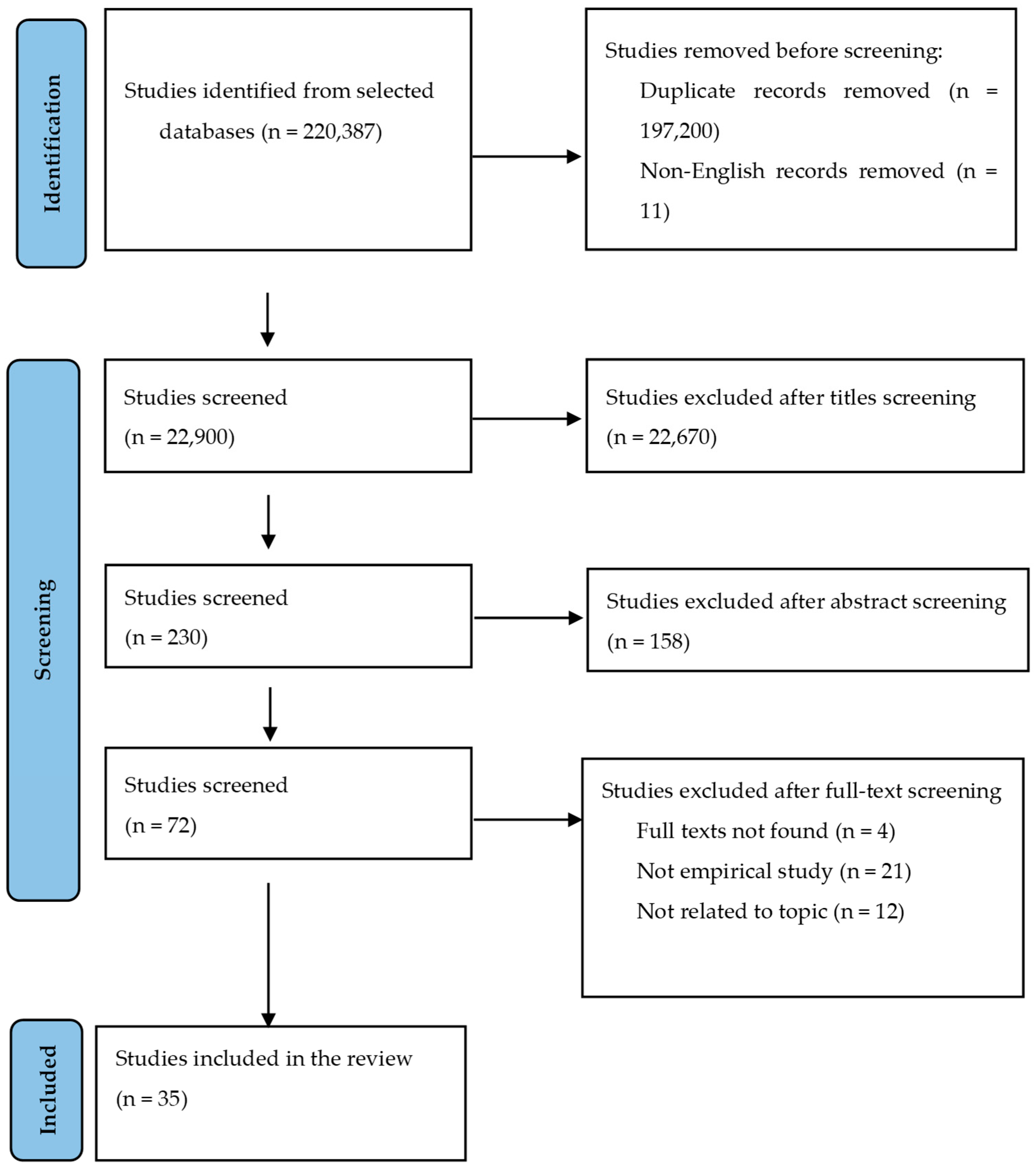
Initially, 220,387 articles were identified through the search. These articles were screened for relevance and rigor, leading to the inclusion of 35 studies that met the established criteria for the final analysis. We utilized PRISMA (Preferred Reporting Items for Systematic Reviews and Meta-Analyses) to ensure standardized, transparent reporting of the current systematic reviews (Figure 1).
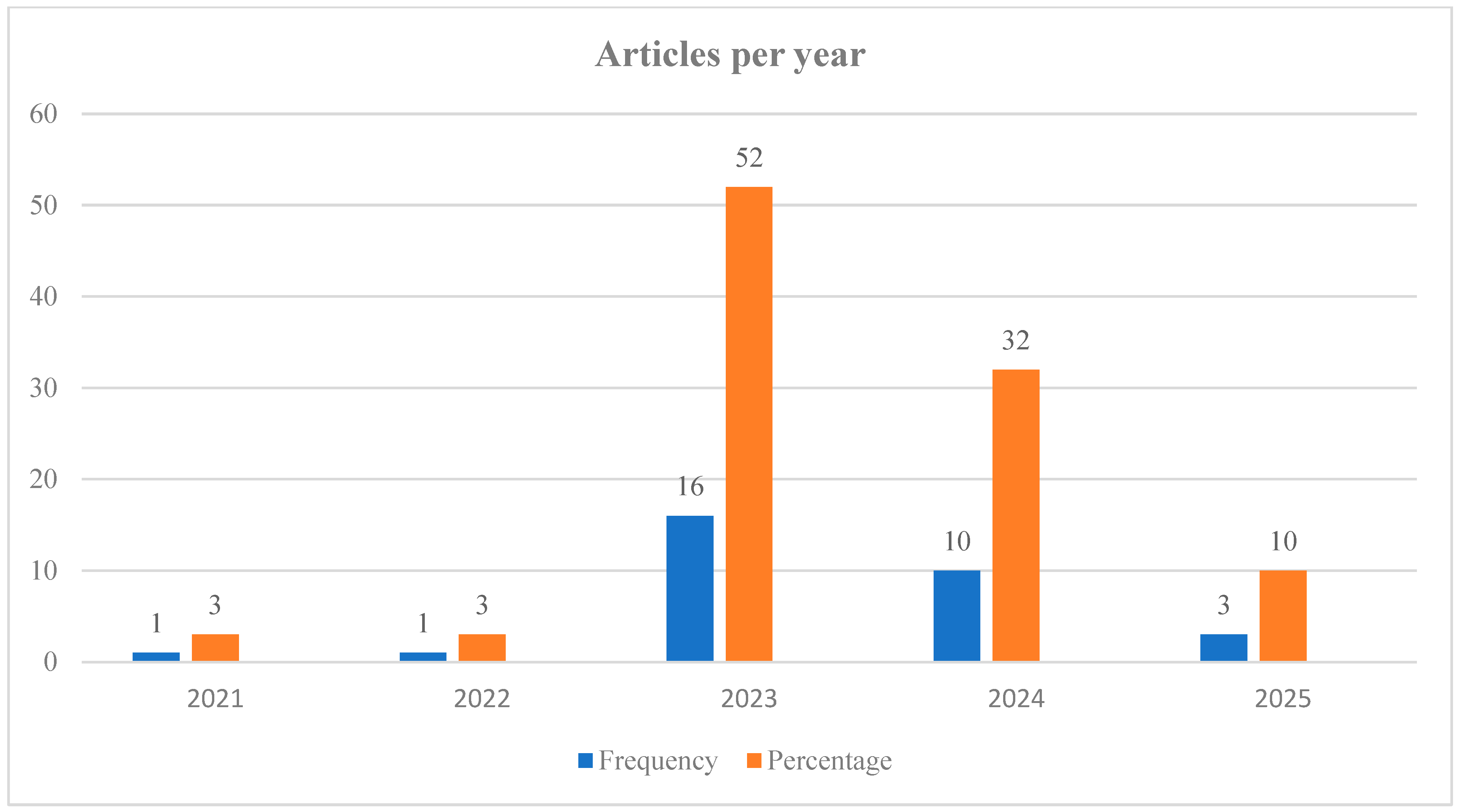
There has been a significant increase in the number of papers published from 2023 onwards. However, the total number of included papers decreases to 10 in 2024 and further to 3 in 2025 (Figure 2).

5.2. Journals

The reviewed articles were published in 35 different journals, with the highest number of publications appearing in Education Sciences (n = 4). Table 5 presents the 35 journals utilized by the authors to publish papers on AI in HEIs.

5.3. Functionalities (RQ1)

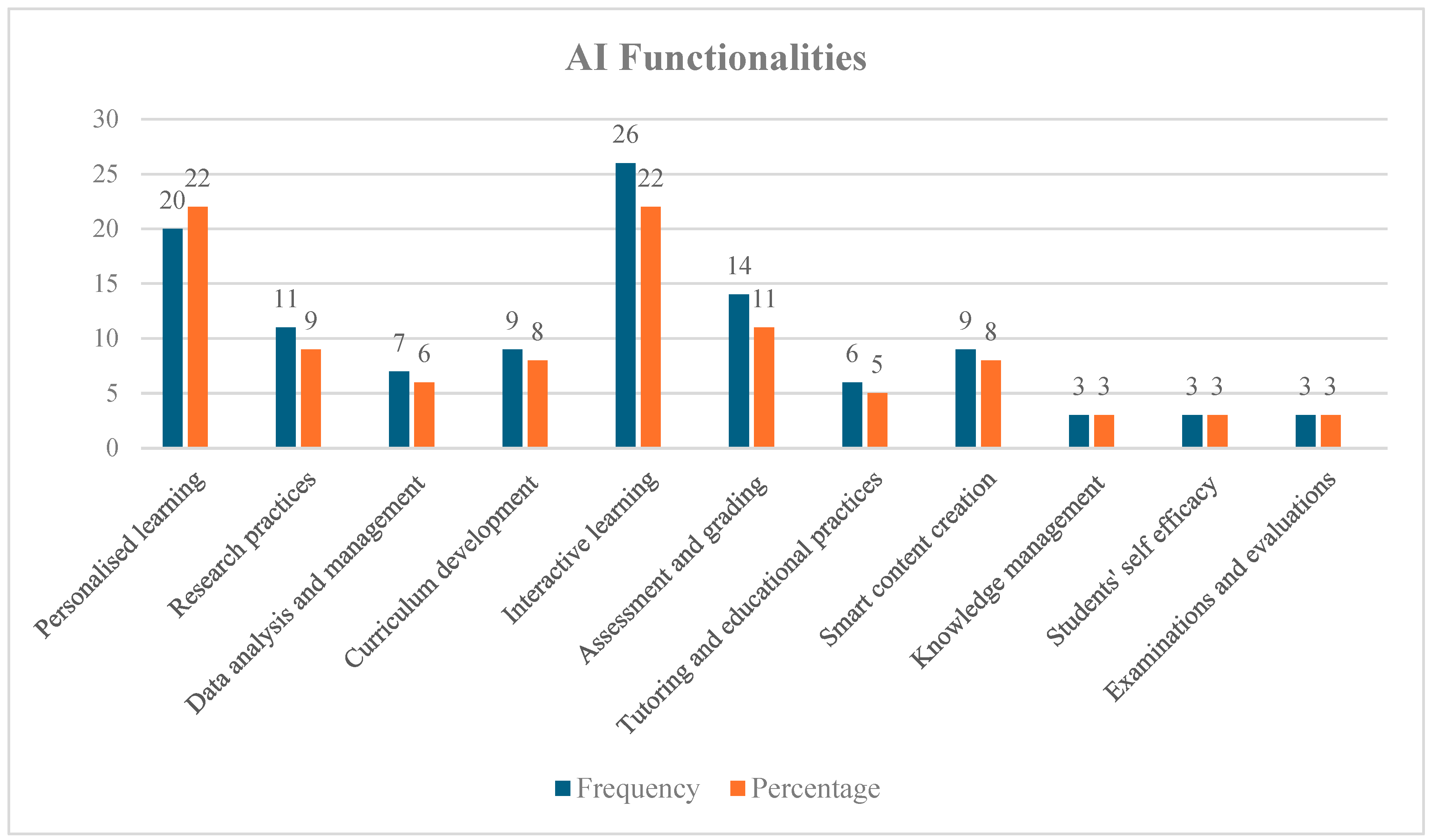
AI facilitates teaching, learning, and research in HEIs. Lee et al. (2024) highlighted that AI facilitates personalized learning (personalized instruction and intelligent tutoring systems), management, and educational planning and learning systems. Fernández Herrero et al. (2023) facilitate personalized learning and deliver personalized learning experiences to meet individual needs. These tools facilitate research practices, provide support for research and analysis, and offer guidance on formulating research questions (Hijón-Neira et al., 2023). For ChatGPT support research (i.e., research writing, data analysis), thus enabling researchers to automate certain tasks (Hijón-Neira et al., 2023). They also facilitate data analysis and management, analyze large volumes of text to extract information, and generate summaries or recommendations for further reading (Fernández Herrero et al., 2023). Additionally, AI data-driven systems can process/analyze complex data streams in real-time (for qualitative and quantitative research) (Michel-Villarreal et al., 2023). Nikolopoulou (2024) highlighted that AI tools facilitate learning activities through adaptive learning platforms and interactive learning tools. ChatGPT can be utilized as a pedagogical tool for exercising, practicing, preparing for exams, summarizing, and analyzing educational content (Nikolopoulou, 2024). ChatGPT also assists educators in assessment and evaluation, as well as in refining existing assessment methods (Hijón-Neira et al., 2023). Fernández Herrero et al. (2023) suggested that students can utilize ChatGPT to obtain assistance with completing learning assignments, clarifying doubts, and reinforcing their learning. They are also used to help teachers automate and track student progress (Michel-Villarreal et al., 2023) and to provide tutoring services utilizing adaptive algorithms, intelligent tutoring systems, and adjustable difficulty levels (Wood & Moss, 2024). Figure 3 indicates more functionalities of AI in HEIs.

5.4. Challenges (RQ2)

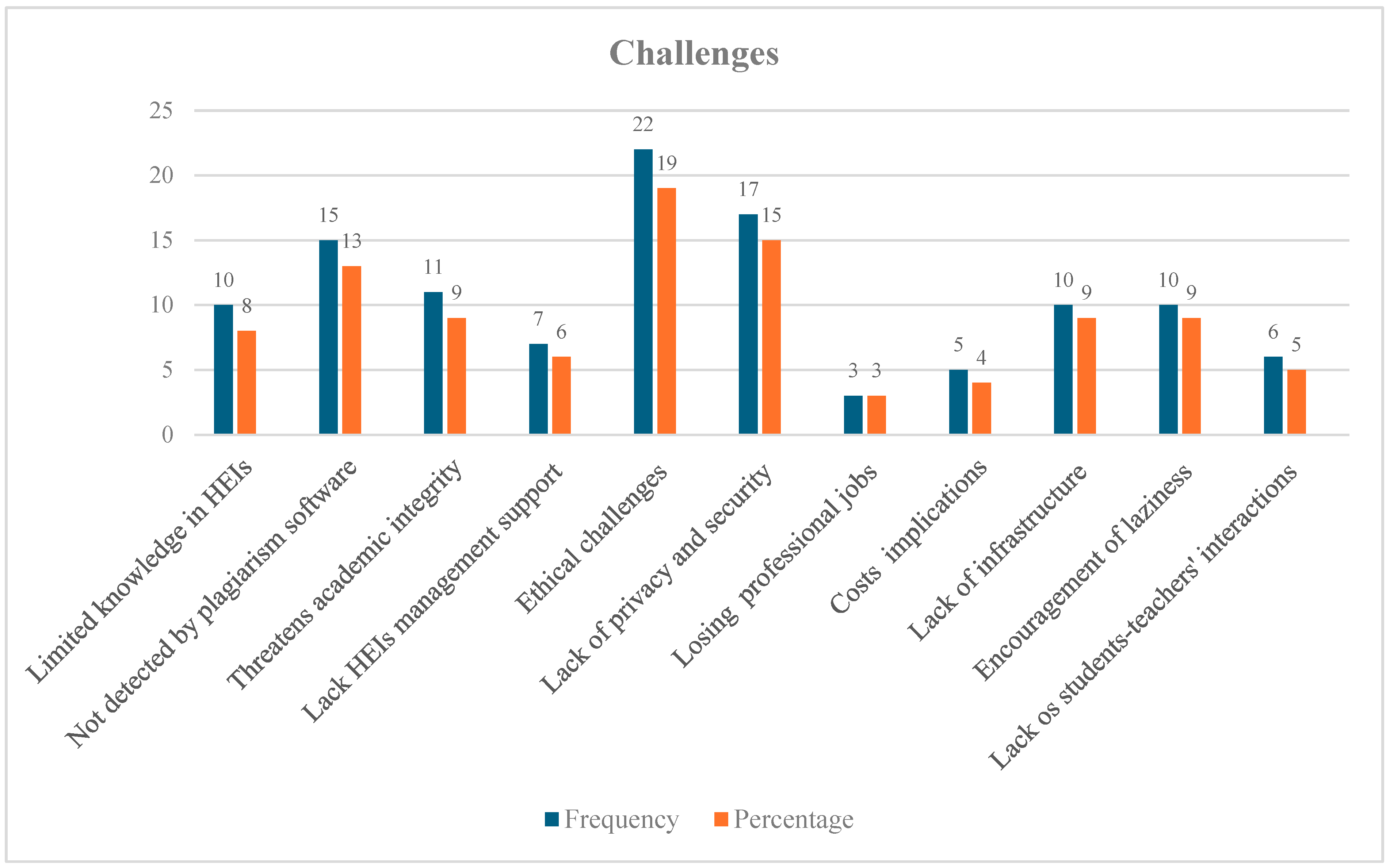
Several challenges were presented. Gaonkar et al. (2020) highlighted a lack of digital and technical skills. Henriksen et al. (2023) insisted on the lack of qualified educators trained to teach programming and computational thinking effectively. The current review highlights the limitations of most AI tools in detecting plagiarism (Erkan, 2023; Fernández Herrero et al., 2023). Erkan (2023) emphasized that AI tools are often undetected by plagiarism tests, which may encourage dishonest behavior. Also, the risk of generating plagiarized content is significant (Fernández Herrero et al., 2023). Plagiarism and plagiarism detection, i.e., ChatGPT can bypass conventional plagiarism detectors (Hijón-Neira et al., 2023). Threatens academic integrity (e.g., ChatGPT can write and pass an exam, essays, and assignments without being detected) (Hijón-Neira et al., 2023). This could compromise academic rigor and the quality of education (Hijón-Neira et al., 2023). Additionally, academic misconduct, including potential misuses such as cheating on assignments and providing inaccurate or false references, was also noted (Jani & Celaj, 2024; Kanyemba et al., 2023). Tapalova and Zhiyenbayeva (2022) highlighted the lack of institutional support in terms of assistance, training, and resources, while Fernández Herrero et al. (2023) added a shortage of resources and management support for developing and implementing AI-driven educational models, programming, and limited access to technology. Not all students may have equal access to technology or the internet, creating disparities in learning opportunities (Fernández Herrero et al., 2023). Kanyemba et al. (2023) highlighted the lack of privacy and security, as well as the importance of privacy considerations (e.g., data privacy, transparency, accessibility, cultural sensitivity). There is also a high possibility that traditional educational jobs will be replaced by AI (Lee et al., 2024). Missing the student-teacher relationships in the classroom was also reported (Akiba & Fraboni, 2023; Al-Abdullatif, 2023; Michel-Villarreal et al., 2023). High costs of implementing AI systems within HEIs were also highlighted (Akiba & Fraboni, 2023; Al-Abdullatif, 2023; Al-Tkhayneh et al., 2023; Jani & Celaj, 2024; Sousa & Cardoso, 2025). Technical issues during usage; The quality of responses mostly depends on the algorithms used, which may sometimes result in awkward or unrelated responses (e.g., Dave) (Fuchs & Aguilos, 2023). Implementing AI or ChatGPT may require technical infrastructure, financial resources, personnel, and other necessary resources, which are costly (Hijón-Neira et al., 2023). Current review also noted technical frustrations, for instance, difficult-to-navigate interfaces cause frustrations (Lin & Chen, 2024), inadequate technological infrastructure can restrict access to AI resources and tools, impacting learning outcomes (Nikolopoulou, 2024), integration of bias in algorithms, whereas AI algorithms can inherit biases from training data, leading to discriminatory outcomes (Lee et al., 2024). Additionally, most of these tools lack policies and guidelines for implementing AI in HEIs (Ajlouni et al., 2023; Gaonkar et al., 2020; Imran et al., 2024; Jani & Celaj, 2024; Michel-Villarreal et al., 2023; Zhang, 2021). Lastly, the current review noted that most AI tools encourage laziness. As students increasingly rely on AI tools, there is a risk of fostering laziness, which can diminish the quality of their learning experience (Arvinth & Geeta, 2024). Nikolopoulou (2024) added that AI tools foster laziness in learning and teaching processes. Figure 4 illustrates the challenges that hinder the utilization of AI in HEIs.

5.5. Best Practices (RQ3)

AI enhances supplementary resources (Adarkwah et al., 2023; Gaonkar et al., 2020) and facilitates collaborative projects and peer review (Gaonkar et al., 2020). Fernández Herrero et al. (2023) highlighted that AI tools are used to assist users in learning new languages and support student learning across various contexts, including language acquisition, research, writing, and general academic inquiry. They are also used to promote language learning and editing, enhance language proficiency, provide grammar assistance, and develop language translation skills (Hijón-Neira et al., 2023). Wood and Moss (2024) added that AI enhances language processing for language learning. Students’ engagement and interaction when using AI were also highlighted (Fernández Herrero et al., 2023; Imran et al., 2024; Wood & Moss, 2024), underscoring that Chatbots facilitate communication by allowing students to ask questions and receive timely feedback from instructors, thereby enhancing the learning experience. Wood and Moss (2024) noted that AI enhances student engagement, supports gamification, and promotes interactive learning by engaging and motivating students. AI facilitates group discussion, enhances community engagement through discussion forums, and mentorship opportunities (Imran et al., 2024; Wood & Moss, 2024). AI tools are valuable for generating new ideas and promoting creativity. For instance, GenAI tools are useful research aids for generating ideas, synthesizing information, and summarizing vast amounts of text data, helping researchers analyze data and compose their writing (Erkan, 2023). They are also used for providing writing assistance to students, especially non-native English-speaking students, and offer grammar and style suggestions to improve writing quality (Ajlouni et al., 2023). They are also providing feedback and evidence for students who may drop out (Cowling et al., 2023), by providing instant feedback and highlighting areas for improvement (Fernández Herrero et al., 2023). AI supports cognitive engagement by increasing students’ attention and cognitive engagement (e.g., CaIcD) (Fuchs & Aguilos, 2023), assisting with problem-solving skills, enabling individuals to solve problems (Ajlouni et al., 2023). One significant benefit is the stimulation of creativity. AI applications can introduce new ideas and enhance problem-solving skills, fostering innovative approaches to learning. This finding is supported by studies showing that AI can provide diverse perspectives and problem-solving techniques that stimulate creative thinking (Arvinth & Geeta, 2024; Imran et al., 2024).
Table 6 presents a summary of AI-enabled best practices implemented in HEIs, organized according to four main theoretical domains: pedagogical, cognitive, collaborative, and institutional functions. The table highlights the range of AI-supported activities that enhance teaching, learning, and administrative processes. Within the pedagogical domain, AI tools are primarily used to foster student engagement and interaction, support collaborative learning, and provide timely feedback. Cognitive functions focus on facilitating higher-order thinking skills, such as critical thinking, problem-solving, and idea generation, while also supporting language inclusivity. Ultimately, the institutional domain highlights the role of AI in enhancing administrative efficiency, facilitating distance learning, and driving productivity gains. Overall, the table shows that AI applications are most frequently applied to feedback provision (15%), student engagement (11%), and collaboration and communication (9%), illustrating the emphasis on interactive and learner-centered practices in contemporary HEIs.

6. Discussion

This systematic review synthesizes current evidence on the adoption and application of AI tools in higher education institutions (HEIs), with particular attention to publication trends, core functionalities, pedagogical value, and implementation challenges. Grounded in constructivist learning theory, self-regulated learning theory, and established AI ethics frameworks, the findings indicate that AI tools primarily function as enablers of teaching, learning, and research, rather than replacements for human academic practices (Churi et al., 2022; Pisica et al., 2023; Shrivastava, 2023). However, their effectiveness is highly contingent on pedagogical design, institutional governance, ethical oversight, and contextual conditions.
The reviewed literature shows a marked increase in publications from 2023 onwards, reflecting the rapid diffusion of generative AI tools and growing institutional interest in AI adoption (Kasabova et al., 2023). Paradoxically, fewer studies met the inclusion criteria in 2024–2025, indicating a maturation of the field, with stricter methodological standards and increased emphasis on empirically robust, theoretically grounded research (Adipat et al., 2022). While the studies span multiple disciplines and countries, theoretical fragmentation persists, as many studies focus on tool performance or user perceptions without explicitly linking to learning theory or socio-technical frameworks (Jia et al., 2024; Shrivastava, 2023). Future research should integrate pedagogical and institutional theory to strengthen conceptual coherence.

6.1. Core Functionalities of AI in HEIs

AI tools consistently enhance teaching, learning, and research processes. Personalized and adaptive learning, delivered through intelligent tutoring systems and adaptive platforms, supports active knowledge construction by responding to learners’ performance, misconceptions, and engagement patterns (Hanum et al., 2024; Lee et al., 2024; UNESCO, 2019). AI also facilitates research tasks such as idea generation, literature synthesis, data analysis, and summarization of large text corpora, enabling students and researchers to navigate complex information landscapes efficiently (Erkan, 2023; Fernández Herrero et al., 2023; Hijón-Neira et al., 2023; Hwang et al., 2020; Michel-Villarreal et al., 2023; Nicholas et al., 2015). Importantly, while these functionalities improve task performance, the literature highlights a persistent gap between efficiency gains and conceptual understanding (Fernández Herrero et al., 2023; Williamson, 2014; Wood & Moss, 2024). Without instructional scaffolding, AI tools may accelerate task completion, but do not automatically enhance deep learning.
AI applications support student engagement, collaboration, and peer learning (Adarkwah et al., 2023; Alves-Oliveira et al., 2017; Gaonkar et al., 2020; Urmeneta & Romero, 2024). Chatbots and interactive systems enable students to ask questions and receive timely feedback, thereby improving their perceived learning support and participation (Fernández Herrero et al., 2023; Wood & Moss, 2024). Generative AI, particularly ChatGPT, is widely recognized and used among students (Williamson, 2014). While students report benefits for completing tasks (86.6–89%), gains in conceptual understanding are lower (39.7%), highlighting the need for pedagogically structured interventions. AI also stimulates creativity by enabling idea generation, drafting, and problem-solving, but can encourage over-reliance or “academic laziness”, where students delegate cognitive effort to AI (Bogina et al., 2022). From a self-regulated learning perspective, scaffolding and reflective exercises are crucial for striking a balance between efficiency, creativity, and critical thinking. AI tools further enhance language learning and writing support (Fernández Herrero et al., 2023; Hijón-Neira et al., 2023; Williamson, 2014), benefiting non-native speakers and promoting inclusive learning environments. Accessibility-oriented applications, such as real-time translation and remote participation tools, also support learners with disabilities and enhance globalized classrooms (Roll & Wylie, 2016).
AI supports administrative efficiency and student services, particularly through virtual assistants and chatbots, as demonstrated in institutions such as Griffith, Sydney, and Canberra (N. Ahmad et al., 2023; Akinwalere & Ivanov, 2022). Feedback systems, including GPT-based tools, offer scalable, consistent, and timely assessment support (Al Mashagbeh et al., 2025). Critically, AI is most effective when used to complement human judgment rather than replace educators, reinforcing the need for institutional governance and ethical oversight.

6.2. Challenges and Ethical Considerations

Despite its potential, AI integration faces several challenges, including limited skills and institutional readiness, inadequate policies, and risks to academic integrity (Adarkwah et al., 2023; Cotton et al., 2023; Sullivan et al., 2023; Tan et al., 2025; Yenduri et al., 2023). Generative AI intensifies ethical concerns regarding data privacy, algorithmic bias, transparency, and fairness (Perera & Aboal, 2020; Y. Yang et al., 2024; S. Yang & Evans, 2019). Evidence suggests demographic bias in AI systems, which may exacerbate inequalities if deployed without critical evaluation (S. Yang & Evans, 2019). The digital divide further limits equitable access, and over-reliance on AI can reduce critical thinking and initiative (Bogina et al., 2022; Kelly, 2014; O’Neil, 2016; Shwedeh et al., 2024). Technical issues, such as system instability, can also negatively affect motivation and engagement (Zhai et al., 2024).
The reviewed studies exhibit both strengths and weaknesses. Most relied on cross-sectional designs and self-reported data, limiting causal inference and generalisability. Longitudinal and multi-context studies remain scarce. Theoretical frameworks were inconsistently applied, constraining interpretative depth. However, increasing use of mixed methods approaches and empirically grounded evaluations demonstrates growing methodological rigor within the field.
AI adoption and outcomes vary by country, discipline, and educational level. High-resource institutions emphasize innovation and efficiency, while resource-constrained contexts face infrastructural and capacity barriers. Disciplines with a strong technology orientation tend to adopt AI more readily than fields that rely on interpretation or discussion. These contextual factors highlight the socio-technical nature of AI integration.

6.3. Implications and Best Practices for HEIs

Effective AI integration requires a balanced, theory-informed approach that aligns technological benefits with pedagogical objectives, inclusivity, and ethical standards (Alser & Waisberg, 2023; Eke, 2023; Welter et al., 2022). Clear policies, assessment guidelines, and training initiatives are crucial for supporting critical and transparent engagement with AI tools. Thoughtful implementation can enhance HEI effectiveness, support inclusive education, and mitigate risks associated with academic performance gaps and over-reliance on AI.

7. Conclusions

This systematic review demonstrates that AI is reshaping HEIs not as a replacement for human academic practice, but as a powerful socio-technical enabler whose impact depends on how it is pedagogically, institutionally, and ethically embedded. When aligned with constructivist learning principles, AI tools can support active knowledge construction, collaboration, and formative feedback. Similarly, from a self-regulated learning perspective, adaptive systems and real-time feedback mechanisms have the potential to enhance learner autonomy, metacognitive awareness, and goal-directed learning. However, these benefits are neither automatic nor universal. The findings reveal persistent tensions within the literature. While AI tools often increase engagement, efficiency, and accessibility (Al-Tkhayneh et al., 2023; Chan & Hu, 2023), they may also encourage surface learning, cognitive offloading, and over-reliance when introduced without appropriate pedagogical scaffolding. Challenges related to academic integrity, particularly the difficulty of distinguishing between human- and machine-generated work, highlight misalignments between traditional assessment practices and the emerging capabilities of AI. These concerns cannot be resolved solely through technical solutions; they require an institutional reevaluation of assessment design, learning outcomes, and academic norms. Ethical challenges, including algorithmic bias, data privacy, transparency, and the digital divide, further underscore that AI adoption in HEIs is inherently a value-laden process (Alexander et al., 2019; Churi et al., 2022Pisica et al., 2023; Shrivastava, 2023). Without deliberate governance, AI systems risk reproducing existing inequalities and excluding already marginalized learners. AI ethics frameworks, therefore, provide a critical lens for guiding responsible implementation, emphasizing fairness, accountability, inclusivity, and human oversight. Based on these insights, this review suggests several implications for HEIs. First, AI integration strategies should be explicitly grounded in educational theory to ensure that technologies enhance, rather than undermine, deep learning and critical thinking. Second, HEIs must invest in capacity building and AI literacy for both educators and students, enabling them to use AI tools in an informed and reflective manner. Third, context-sensitive policies and ethical guidelines are crucial, especially in resource-constrained settings where digital inequalities persist. Ultimately, future research should extend beyond adoption studies to investigate longitudinal learning outcomes, disciplinary differences, and the socio-cultural aspects of AI use in higher education. In conclusion, the educational value of AI in HEIs is not inherent to the technology itself but emerges from the interaction between tools, pedagogical practices, institutional policies, and ethical commitments. A balanced, theoretically informed, and ethically grounded approach to AI adoption is therefore essential for realizing its transformative potential while safeguarding academic integrity, equity, and human agency in HEIs.

8. Implications

The integration of AI in HEIs presents significant opportunities to enhance learning, teaching, research, and institutional efficiency, but it also introduces challenges that must be managed strategically. AI tools can support personalized learning, adaptive tutoring, interactive engagement, and research facilitation, thereby improve educational outcomes when integrated thoughtfully. However, risks such as academic integrity violations, over-reliance on AI, and diminished critical thinking require careful oversight. For educators, actionable strategies include embedding AI within pedagogical designs that promote reflection, problem-solving, and metacognitive skills; using AI to provide timely feedback while complementing human judgment; and training students to critically evaluate AI outputs rather than accepting them uncritically. For institutions, recommendations include investing in digital infrastructure and technical support, developing clear AI policies and ethical guidelines, and providing professional development programs to build faculty capacity for AI-enhanced teaching and assessment. Institutions should also implement safeguards to ensure equitable access to AI tools, bridging the digital divide and supporting inclusive learning environments. For policymakers and AI developers, the implications include creating standards for the ethical deployment of AI in education, ensuring data privacy, transparency, and fairness, as well as monitoring potential biases in AI algorithms. Collaborative efforts among educators, students, administrators, and developers are crucial to aligning AI use with pedagogical goals, maintaining academic integrity, and maximizing the benefits of AI while minimizing risks.

Author Contributions

Conceptualization P.N., J.C., N.F.V.M., and G.F.K.; methodology, N.F.V.M., P.N., J.C., and G.F.K.; software, N.F.V.M.; validation, P.N., J.C., N.F.V.M., and G.F.K.; formal analysis, P.N., J.C., N.F.V.M., and G.F.K.; investigation, P.N., J.C., N.F.V.M., and G.F.K.; resources, P.N.; data curation, N.F.V.M.; writing—original draft preparation, N.F.V.M.; writing—review and editing, P.N., J.C., N.F.V.M., and G.F.K.; visualization, P.N., J.C., N.F.V.M., and G.F.K.; supervision, P.N.; project administration, P.N. All authors have read and agreed to the published version of the manuscript.

Funding

This research received no external funding.

Institutional Review Board Statement

Not applicable.

Informed Consent Statement

Not applicable.

Data Availability Statement

No new data were created or analyzed in this study.

Conflicts of Interest

The authors declare no conflict of interest.

References

  1. Adarkwah, M. A., Amponsah, S., van Wyk, M. M., Huang, R., Tlili, A., Shehata, B., Metwally, A. H. S., & Wang, H. (2023). Awareness and acceptance of ChatGPT as a generative conversational AI for transforming education by Ghanaian academics: A two-phase study. Journal of Applied Learning and Teaching, 6(2), 78–93. [Google Scholar] [CrossRef]
  2. Adipat, S., Laksana, K., Busayanon, K., Piatanom, P., Mahamarn, Y., Pakapol, P., & Ausawasowan, A. (2022). The world of technology: Artificial intelligence in education. Specialusis Ugdymas, 2(43), 2142–2146. [Google Scholar]
  3. Afzal, A., Khan, S., Daud, S., Ahmad, Z., & Butt, A. (2023). Addressing the digital divide: Access and use of technology in education. Journal of Social Sciences Review, 3(2), 883–895. [Google Scholar] [CrossRef]
  4. Ahmad, N., Murugesan, S., & Kshetri, N. (2023). Generative artificial intelligence and the education sector. Computer, 56(6), 72–76. [Google Scholar] [CrossRef]
  5. Ajlouni, A. O., Wahba, F. A. A., & Almahaireh, A. S. (2023). Students’ attitudes towards using ChatGPT as a learning tool: The case of the University of Jordan. International Journal of Interactive Mobile Technologies, 17(18), 99. [Google Scholar] [CrossRef]
  6. Akiba, D., & Fraboni, M. C. (2023). AI-supported academic advising: Exploring ChatGPT’s current state and future potential toward student empowerment. Education Sciences, 13(9), 885. [Google Scholar] [CrossRef]
  7. Akinwalere, S., & Ivanov, V. (2022). Artificial intelligence in higher education: Challenges and opportunities. Border Crossing, 12(1), 1–15. [Google Scholar] [CrossRef]
  8. Al-Abdullatif, A. M. (2023). Modeling students’ perceptions of chatbots in learning: Integrating technology acceptance with the value-based adoption model. Education Sciences, 13(11), 1151. [Google Scholar] [CrossRef]
  9. Alexander, B., Ashford-Rowe, K., Barajas-Murphy, N., Dobbin, G., Knott, J., McCormack, M., Pomerantz, J., Seilhamer, R., & Weber, N. (2019). EDUCAUSE horizon report: 2019 higher education edition. EDUCAUS. Available online: https://library.educause.edu/-/media/files/library/2019/4/2019horizonreport (accessed on 21 November 2025).
  10. Al Mashagbeh, M., Alsharqawi, M., Tudevdagva, U., & Khasawneh, H. (2025). Student engagement with artificial intelligence tools in academia: A survey of Jordanian universities. Frontiers in Education, 10, 1550147. [Google Scholar] [CrossRef]
  11. Almusaed, A., Almssad, A., Yitmen, I., & Homod, R. Z. (2023). Enhancing student engagement: Harnessing “AIED”’s power in hybrid education: A review analysis. Education Sciences, 13(7), 632. [Google Scholar] [CrossRef]
  12. Alser, M., & Waisberg, E. (2023). Concerns with the usage of ChatGPT in academia and medicine: A viewpoint. American Journal of Medicine Open, 9, 100036. [Google Scholar] [CrossRef] [PubMed]
  13. Al-Tkhayneh, K. M., Alghazo, E. M., & Tahat, D. (2023). The advantages and disadvantages of using artificial intelligence in education. Journal of Educational and Social Research, 13(4), 105–117. [Google Scholar] [CrossRef]
  14. Alves-Oliveira, P., Arriaga, P., Paiva, A., & Hoffman, G. (2017). Yolo, a robot for creativity: A co-design study with children. In IDC’17: Proceedings of the 2017 conference on interaction design and children (pp. 423–429). Association for Computer Machinery. [Google Scholar] [CrossRef]
  15. Al-Zahrani, A. M. (2024). The impact of generative AI tools on researchers and research: Implications for academia in higher education. Innovations in Education and Teaching International, 61(5), 1029–1043. [Google Scholar] [CrossRef]
  16. Al-Zahrani, A. M., & Alasmari, T. M. (2024). Exploring the impact of artificial intelligence on higher education: The dynamics of ethical, social, and educational implications. Humanities and Social Sciences Communications, 11(1), 912. [Google Scholar] [CrossRef]
  17. Arvinth, A., & Geeta, D. (2024). Effects of artificial intelligence on academics in higher education in India: An empirical study. International Journal of Novel Research and Development (IJNRD), 9(5), 527–562. [Google Scholar]
  18. Aydın, B., Kışla, T., Elmas, N. T., & Bulut, O. (2025). Automated scoring in the era of artificial intelligence: An empirical study with Turkish essays. Systems, 133, 103784. [Google Scholar] [CrossRef]
  19. Baidoo-Anu, D., & Ansah, L. O. (2023). Education in the era of generative artificial intelligence (AI): Understanding the potential benefits of ChatGPT in promoting teaching and learning. Journal of AI, 7(1), 52–62. [Google Scholar] [CrossRef]
  20. Basheer, V. (2011, July 14–16). Enhancing computer-assisted language learning via the World Wide Web for English language teaching. 2011 IEEE International Conference on Technology for Education (pp. 291–292), Chennai, India. [Google Scholar] [CrossRef]
  21. Bearman, M., Ryan, J., & Ajjawi, R. (2023). Discourses of artificial intelligence in higher education: A critical literature review. Higher Education, 86(2), 369–385. [Google Scholar] [CrossRef]
  22. Bhat, S., Nguyen, H. A., Moore, S., Stamper, J. C., Sakr, M., & Nyberg, E. (2022, July 24–27). Towards automated generation and evaluation of questions in educational domains. 15th International Conference on Educational Data Mining (pp. 701–704), Durham, UK. [Google Scholar]
  23. Bogina, V., Hartman, A., Kuflik, T., & Shulner-Tal, A. (2022). Educating software and AI stakeholders about algorithmic fairness, accountability, transparency, and ethics. International Journal of Artificial Intelligence in Education, 32, 808–833. [Google Scholar] [CrossRef]
  24. Bradley, V. M. (2021). Learning management system (LMS) use with online instruction. International Journal of Technology in Education (IJTE), 4(1), 68–92. [Google Scholar] [CrossRef]
  25. Bruff, D. O., Fisher, D. H., McEwen, K. E., & Smith, B. E. (2013). Wrapping a MOOC: Student perceptions of an experiment in blended learning. Journal of Online Learning and Teaching, 9(2), 187–199. [Google Scholar]
  26. Chan, C. K. Y. (2023). A comprehensive AI policy education framework for university teaching and learning. International Journal of Educational Technology in Higher Education, 20(1), 38. [Google Scholar] [CrossRef]
  27. Chan, C. K. Y., & Hu, W. (2023). Students’ voices on generative AI: Perceptions, benefits, and challenges in higher education. International Journal of Educational Technology in Higher Education, 20, 43. [Google Scholar] [CrossRef]
  28. Chen, L., Chen, P., & Lin, Z. (2020). Artificial intelligence in education: A review. IEEE Access, 8, 75264–75278. [Google Scholar] [CrossRef]
  29. Chisunum, J. I., & Nwadiokwu, C. (2024). Enhancing student engagement through practical production and utilization of instructional materials in an educational technology class: A multifaceted approach. NIU Journal of Educational Research, 10(2), 81–89. [Google Scholar] [CrossRef]
  30. Churi, P. P., Joshi, S., Elhoseny, M., & Omrane, A. (2022). Artificial intelligence in higher education: A practical approach. CRC Press. [Google Scholar]
  31. Cotton, D. R. E., Cotton, P. A., & Shipway, J. R. (2023). Chatting and cheating: Ensuring academic integrity in the era of ChatGPT. Innovations in Education and Teaching International, 61(2), 228–239. [Google Scholar] [CrossRef]
  32. Cowling, M., Crawford, J., Allen, K. A., & Wehmeyer, M. (2023). Using leadership to leverage ChatGPT and artificial intelligence for undergraduate and postgraduate research supervision. Australasian Journal of Educational Technology, 39(4), 89–103. [Google Scholar] [CrossRef]
  33. Crompton, H., & Burke, D. (2023). Artificial intelligence in higher education: The state of the field. International Journal of Educational Technology In Higher Education, 20(1), 22. [Google Scholar] [CrossRef]
  34. Donnell, F. O., Porter, M., & Fitzgerald, S. (2024). The role of artificial intelligence in higher education: Higher education students’ use of AI in academic assignments. Irish Journal of Technology Enhanced Learning, 8(1), 1–11. [Google Scholar] [CrossRef]
  35. Du Plooy, E., Casteleijn, D., & Franzsen, D. (2024). Personalized adaptive learning in higher education: A scoping review of key characteristics and impact on academic performance and engagement. Heliyon, 10(21), e39630. [Google Scholar] [CrossRef]
  36. Dwivedi, Y. K., Kshetri, N., Hughes, L., Slade, E. L., Jeyaraj, A., Kar, A. K., Baabdullah, A. M., Koohang, A., Raghavan, V., Ahuja, M., Albanna, H., Albashrawi, M. A., Al-Busaidi, A. S., Balakrishnan, J., Barlette, Y., Basu, S., Bose, I., Brooks, L., Buhalis, D., … Wright, R. (2023). Opinion paper: “so what if ChatGPT wrote it?” multidisciplinary perspectives on opportunities, challenges and implications of generative conversational AI for research, practice and policy. International Journal of Information Management, 71, 102642. [Google Scholar] [CrossRef]
  37. Eke, D. O. (2023). ChatGPT and the rise of GenAI: Threat to academic integrity? Journal of Responsible Technology, 13, 100060. [Google Scholar] [CrossRef]
  38. Erkan, E. R. (2023). An explainable machine learning approach to predicting and understanding dropouts in MOOCs. Kastamonu Eğitim Dergisi, 31(1), 143–154. [Google Scholar] [CrossRef]
  39. Farooqi, M. T. K., Amanat, I., & Awan, S. M. (2024). Ethical considerations and challenges in the integration of artificial intelligence in education: A systematic review. Journal of Excellence in Management Sciences, 3(4), 35–50. [Google Scholar] [CrossRef]
  40. Fernández Herrero, J., Gómez Donoso, F., & Roig Vila, R. (2023). The first steps for adapting artificial intelligence emotion expression recognition software for emotional management in the educational context. British Journal of Educational Technology, 54(6), 1939–1963. [Google Scholar] [CrossRef]
  41. Frank, E. (2024). The Influence of artificial intelligence on education: Enhancing personalized learning experiences. EasyChair Preprint, 14675. [Google Scholar]
  42. Fuchs, K., & Aguilos, V. (2023). Integrating artificial intelligence in higher education: Empirical insights from students about using ChatGPT. International Journal of Information and Education Technology, 13(9), 1365–1371. [Google Scholar] [CrossRef]
  43. Gambo, I., Abegunde, F. J., Gambo, O., Ogundokun, R. O., Babatunde, A. N., & Lee, C. C. (2025). GRAD-AI: An automated grading tool for code assessment and feedback in programming course. Education and Information Technologies, 30(7), 9859–9899. [Google Scholar] [CrossRef]
  44. Gaonkar, B., Cook, K., & Macyszyn, L. (2020). Ethical issues arising due to bias in training AI algorithms in healthcare and data sharing as a potential solution. The AI Ethics Journal, 1(1), 1–11. [Google Scholar] [CrossRef]
  45. GhorbanTanhaei, H., Boozary, P., Sheykhan, S., Rabiee, M., Rahmani, F., & Hosseini, I. (2024). Predictive analytics in customer behavior: Anticipating trends and preferences. Results in Control and Optimization, 17, 100462. [Google Scholar] [CrossRef]
  46. Gomes, D. (2025). A comprehensive study of advancements in intelligent tutoring systems through artificial intelligent education platforms. In Improving student assessment with emerging AI tools (pp. 213–244). IGI Global Scientific Publishing. [Google Scholar] [CrossRef]
  47. Guo, K., Zhong, Y., Li, D., & Chu, S. K. W. (2023). Effects of chatbot-assisted in-class debates on students’ argumentation skills and task motivation. Computers & Education, 203, 104862. [Google Scholar] [CrossRef]
  48. Haleem, A., Javaid, M., Qadri, M. A., & Suman, R. (2022). Understanding the role of digital technologies in education: A review. Sustainable Operations and Computers, 3, 275–285. [Google Scholar] [CrossRef]
  49. Hanum, G. K., Syahputra, M., Suryono, W., Rukiyanto, B. A., & Hariyadi, S. (2024). The role of AI in scaling global access to quality education in low-resource regions. Journal Emerging Technologies in Education, 2(5), 407–419. [Google Scholar] [CrossRef]
  50. Hao, K. (2019). China has started a grand experiment in AI education. It could reshape how the world learns. MIT Technology Review. Available online: https://www.technologyreview.com/2019/08/02/131198/china-squirrel-has-started-a-grand-experiment-in-ai-education-it-could-reshape-how-the/ (accessed on 21 November 2025).
  51. Henriksen, D., Woo, L. J., & Mishra, P. (2023). Creative uses of ChatGPT for education: A conversation with Ethan Mollick. TechTrends, 67(4), 595–600. [Google Scholar] [CrossRef]
  52. Hijón-Neira, R., Connolly, C., Pizarro, C., & Pérez-Marín, D. (2023). Prototype of a recommendation model with artificial intelligence for computational thinking improvement of secondary education students. Computers, 12(6), 113. [Google Scholar] [CrossRef]
  53. Hwang, G. J., Xie, H., Wah, B. W., & Gasevic, D. (2020). Vision, challenges, roles, and research issues of artificial intelligence in education. Computers & Education: Artificial Intelligence, 1, 100001. [Google Scholar] [CrossRef]
  54. Imran, M., Almusharraf, N., Abdellatif, M. S., & Abbasova, M. Y. (2024). Artificial intelligence in higher education: Enhancing learning systems and transforming educational paradigms. International Journal of Interactive Mobile Technologies, 18(18), 34–48. [Google Scholar] [CrossRef]
  55. Jani, G., & Celaj, D. (2024). Exploring the influence of artificial intelligence on higher education: Case study in University of Brighton. Journal of Educational and Social Research, 14(4), 75–83. [Google Scholar] [CrossRef]
  56. Jereb, E., & Urh, M. (2024). The use of artificial intelligence among students in higher education. Organizacija, 57(4), 333–345. [Google Scholar] [CrossRef]
  57. Jia, F., Sun, D., & Looi, C.-K. (2024). Artificial intelligence in science education (2013–2023): Research trends in ten years. Journal of Science Education and Technology, 33(1), 94–117. [Google Scholar] [CrossRef]
  58. Kanyemba, K., Phiri, F., Munsanje, V. M., & Mwaanga, O. (2023). Exploring the use of artificial intelligence in higher learning institutions: A case of David livingstone college of education. Mulungushi University Multidisciplinary Journal, 4(2), 59–72. [Google Scholar]
  59. Kasabova, G., Parusheva, S., & Bankov, B. (2023). Learning management systems as a tool for learning in higher education. Izvestia Journal of the Union of Scientists-Varna. Economic Sciences Series, 12(2), 224–233. [Google Scholar] [CrossRef]
  60. Kelly, M. A. (2014). Bridging digital and cultural divides: TPCK for equity of access to technology. In Handbook of Technological Pedagogical Content Knowledge (TPCK) for educators (pp. 41–68). Routledge. [Google Scholar]
  61. Khosravi, H., Sadiq, S., & Gasevic, D. (2020, March 11–14). Development and adoption of an adaptive learning system: Reflections and lessons learned. 51st ACM Technical Symposium on Computer Science Education (pp. 58–64), Portland, OR, USA. [Google Scholar] [CrossRef]
  62. Kim, J., Merrill, K., Kun, X., & Sellnow, D. D. (2022). Embracing AI-based education: Perceived social presence of human teachers and expectations about machine teachers in online education. Human-Machine Communication, 4, 169–184. [Google Scholar] [CrossRef]
  63. Kolluru, V., Mungara, S., & Chintakunta, A. N. (2018). Adaptive learning systems: Harnessing AI for customized educational experiences. International Journal of Computational Science and Information Technology, 6(1/2/3), 13–26. [Google Scholar] [CrossRef]
  64. Kong, S. C., Cheung, W. M. Y., & Zhang, G. (2021). Evaluation of an artificial intelligence literacy course for university students with diverse study backgrounds. Computers and Education: Artificial Intelligence, 2, 100026. [Google Scholar] [CrossRef]
  65. Lee, D., Arnold, M., Srivastava, A., Plastow, K., Strelan, P., Ploeckl, F., Lekkas, D., & Palmer, E. (2024). The impact of generative AI on higher education learning and teaching: A study of educators’ perspectives. Computers and Education: Artificial Intelligence, 6, 100221. [Google Scholar] [CrossRef]
  66. Lin, H., & Chen, Q. (2024). Artificial intelligence (AI)-integrated educational applications and college students’ creativity and academic emotions: Students and teachers’ perceptions and attitudes. BMC Psychology, 12, 487. [Google Scholar] [CrossRef]
  67. Luckin, R., Holmes, W., Griffiths, M., & Forcier, L. B. (2016). Intelligence unleashed: An argument for AI in education. Pearson. [Google Scholar]
  68. Marín, Y. R., Caro, O. C., Rituay, A. M. C., Llanos, K. A. G., Perez, D. T., Bardales, E. S., Tuesta, J. N. A., & Santos, R. C. (2025). Ethical challenges associated with the use of artificial intelligence in university education. Journal of Academic Ethics, 23, 2443–2467. [Google Scholar] [CrossRef]
  69. Masters, K., MacNeil, H., Benjamin, J., Carver, T., Nemethy, K., Valanci-Aroesty, S., Taylor, D. C. M., Thoma, B., & Thesen, T. (2025). Artificial intelligence in health professions education assessment: AMEE Guide No. 178. Medical Teacher, 47(9), 1410–1424. [Google Scholar] [CrossRef]
  70. Michel-Villarreal, R., Vilalta-Perdomo, E., Salinas-Navarro, D. E., Thierry-Aguilera, R., & Gerardou, F. S. (2023). Challenges and opportunities of generative AI for higher education as explained by ChatGPT. Education Sciences, 13(9), 856. [Google Scholar] [CrossRef]
  71. Mikroyannidis, A., Perifanou, M., & Economides, A. A. (2025). Enhancing language learning with generative AI: The case of the OpenLang Network Platform. Computers, 14(12), 546. [Google Scholar] [CrossRef]
  72. Mokoena, O. P., & Seeletse, S. M. (2025). AI in rural classrooms: Challenges and perspectives from South African educators. International Journal of Current Educational Studies, 4(2), 30–52. [Google Scholar] [CrossRef]
  73. Moscardini, A. O., Strachan, R., & Vlasova, T. (2020). The role of universities in modern society. Studies in Higher Education, 47(4), 812–830. [Google Scholar] [CrossRef]
  74. Nicholas, D., Watkinson, A., Jamali, H. R., Herman, E., Tenopir, C., Volentine, R., Allard, S., & Levine, K. (2015). Peer review: Still king in the digital age. Learned Publishing, 28(1), 15–21. [Google Scholar] [CrossRef]
  75. Nikolopoulou, K. (2024). Generative artificial intelligence in higher education: Exploring ways of harnessing pedagogical practices with the assistance of ChatGPT. International Journal of Changes in Education, 1(2), 103–111. [Google Scholar] [CrossRef]
  76. O’Dea, X., & O’Dea, M. (2023). Is artificial intelligence really the next big thing in learning and teaching in higher education?: A conceptual paper. Journal of University Teaching and Learning Practice, 20(5), 1–17. [Google Scholar] [CrossRef]
  77. Olatunbosun, A., Ogunjobi, D. T., Esther, A. I., & Ebenezer, O. (2025). A review of ethical and data privacy challenges in the adoption of artificial intelligence technologies in Nigerian Academic Libraries. International Journal of Science and Research Archive, 17(3), 285–297. [Google Scholar] [CrossRef]
  78. O’Neil, C. (2016). Weapons of math destruction: How big data increases inequality and threatens democracy. Crown Publishing Group. [Google Scholar]
  79. Panda, K., & Agrawal, S. (2024). Predictive analytics: An overview of evolving trends and methodologies. The Journal of Scientific and Engineering Research, 8(10), 175–180. [Google Scholar]
  80. Perera, M., & Aboal, D. (2020). The impact of a mathematics computer-assisted learning platform on students’ mathematics test scores. MERIT Working Papers 2019-007. United Nations University—Maastricht Economic and Social Research Institute on Innovation and Technology (MERIT). [Google Scholar]
  81. Pisica, A. I., Edu, T., Zaharia, R. M., & Zaharia, R. (2023). Implementing artificial intelligence in higher education: Pros and cons from the perspectives of academics. Societies, 13(5), 118. [Google Scholar] [CrossRef]
  82. Ray, P. P. (2023). ChatGPT: A comprehensive review on background, applications, key challenges, bias, ethics, limitations and future scope. Internet of Things and Cyber-Physical Systems, 3, 121–154. [Google Scholar] [CrossRef]
  83. Roll, I., & Wylie, R. (2016). Evolution and revolution in artificial intelligence in education. International Journal of Artificial Intelligence in Education, 26(2), 582–599. [Google Scholar] [CrossRef]
  84. Sarker, I. H. (2022). AI-based modeling: Techniques, applications and research issues towards automation, intelligent and smart systems. SN Computer Science, 3(2), 158. [Google Scholar] [CrossRef]
  85. Shrivastava, R. (2023). Role of artificial intelligence in the future of education. International Journal of Professional Business Review, 8(1), 2. [Google Scholar] [CrossRef]
  86. Shwedeh, F., Salloum, S. A., Aburayya, A., Fatin, B., Elbadawi, M. A., Al Ghurabli, Z., & Al Dabbagh, T. (2024). AI adoption and educational sustainability in higher education in the UAE. In A. Al-Marzouqi, S. A. Salloum, M. Al-Saidat, A. Aburayya, & B. Gupta (Eds.), Artificial intelligence in education: The power and dangers of ChatGPT in the classroom (Vol. 144). Studies in Big Data. Springer. [Google Scholar] [CrossRef]
  87. Sousa, A. E., & Cardoso, P. (2025). Use of generative AI by higher education students. Electronics, 14(7), 1258. [Google Scholar] [CrossRef]
  88. Sullivan, M., Kelly, A., & McLaughlan, P. (2023). ChatGPT in higher education: Considerations for academic integrity and student learning. Journal of Applied Learning and Teaching, 6(1), 31–40. [Google Scholar] [CrossRef]
  89. Tan, L. Y., Hu, S., Yeo, D. J., & Cheong, K. H. (2025). A comprehensive review on automated grading systems in STEM using AI techniques. Mathematics, 13(17), 2828. [Google Scholar] [CrossRef]
  90. Tapalova, O., & Zhiyenbayeva, N. (2022). Artificial intelligence in education: AIEd for personalised learning pathways. Electronic Journal of e-Learning, 20(5), 639–653. [Google Scholar] [CrossRef]
  91. UNESCO. (2019). Artificial intelligence in education: Challenges and opportunities for sustainable development. United Nations Educational, Scientific and Cultural Organization. Available online: https://unesdoc.unesco.org/ark:/48223/pf0000366994.locale=en (accessed on 10 November 2025).
  92. Urmeneta, A., & Romero, M. (2024). Creative applications of artificial intelligence in education. Springer Nature. [Google Scholar]
  93. Vieriu, A. M., & Petrea, G. (2025). The impact of artificial intelligence (AI) on students’ academic development. Education Sciences, 15(3), 343. [Google Scholar] [CrossRef]
  94. Welter, V. D. E., Becker, L. B., & Großschedl, J. (2022). Helping learners become their own teachers: The beneficial impact of trained concept-mapping-strategy use on metacognitive regulation in learning. Education Sciences, 12(5), 325. [Google Scholar] [CrossRef]
  95. Williamson, B. (2014). Governing software: Networks, databases and algorithmic power in the digital governance of public education. Learning, Media and Technology, 40(1), 83–105. [Google Scholar] [CrossRef]
  96. Wood, D., & Moss, S. H. (2024). Evaluating the impact of students’ generative AI use in educational contexts. Journal of Research in Innovative Teaching & Learning, 17(2), 152–167. [Google Scholar] [CrossRef]
  97. Yang, S., & Evans, C. (2019, November 5–7). Opportunities and challenges in using AI chatbots in higher education. 2019 3rd International Conference on Education and E-Learning (pp. 79–83), Barcelona, Spain. [Google Scholar] [CrossRef]
  98. Yang, Y., Luo, J., Yang, M., Yang, R., & Chen, J. (2024). From surface to deep learning approaches with generative AI in higher education: An analytical framework of student agency. Studies in Higher Education, 49(5), 817–830. [Google Scholar] [CrossRef]
  99. Yenduri, G., Kaluri, R., Rajput, D. S., Lakshmanna, K., Gadekallu, T. R., Mahmud, M., & Brown, D. J. (2023). From assistive technologies to metaverse technologies in inclusive higher education for students with specific learning difficulties: A review. IEEE Access, 11, 64907–64927. [Google Scholar] [CrossRef]
  100. Zhai, C., Wibowo, S., & Li, L. D. (2024). The effects of over-reliance on AI dialogue systems on students’ cognitive abilities: A systematic review. Smart Learning Environments, 11(1), 28. [Google Scholar] [CrossRef]
  101. Zhang, Y. (2021). An AI-based design of a student performance prediction and evaluation system in college physical education. Journal of Intelligent & Fuzzy System: Applications in Engineering and Technology, 40(2), 3271–3279. [Google Scholar] [CrossRef]
Figure 1. PRISMA flow diagram.
Education 16 00185 g001
Figure 2. Articles per year.
Education 16 00185 g002
Figure 3. Functionalities of AI in HEIs.
Education 16 00185 g003
Figure 4. Challenges that hinder the utilization of AI in HEIs.
Education 16 00185 g004
Table 1. AI technologies used in HEIs.
AI TechnologiesDefinitionsFunctionalitiesReferences
Adaptive learning platforms (ALPs)An ALP is an e-learning system that employs adaptive technologies to customize instructional content in real-time, addressing the unique learning needs of each student.These platforms personalize educational content based on individual student performance and learning styles, allowing for tailored learning experiences. These platforms use algorithms to personalize learning paths based on a student’s performance and preferences.
They are commonly known as AI for customized education experiences
(Hanum et al., 2024; Khosravi et al., 2020; Kolluru et al., 2018; Marín et al., 2025)
ChatGPTChatGPT is an AI language model by OpenAI, created to understand and generate human-like text. It engages in conversations, answers questions, and assists with various tasks. Built on the GPT architecture, it produces coherent responses by predicting subsequent words based on context.Used in language teaching and learning, including creating simulated speaking environments, generating self-test quizzes for students, and providing code explanations to students(Dwivedi et al., 2023; Tan et al., 2025)
Generative Pre-trained Transformer 3 (GPT-3) powered AI text generatorA GPT-3 powered AI text generator is a software application that uses OpenAI’s Generative Pre-trained Transformer 3 (GPT-3) model to produce human-like text based on prompts provided by users, enabling various applications such as content creation, conversation simulation, and language translation.Used to create examination questions, simplify the research process such as data entry, analysis and evaluation, and report.(Bhat et al., 2022; Masters et al., 2025; O’Dea & O’Dea, 2023)
Intelligent tutoring systems (ITS)ITS are computer-based educational platforms that provide personalized instruction and feedback to learners.They use ITS to adapt to individual student needs, learning styles, and progress. ITS can assess a student’s understanding, offer tailored exercises, and guide them through complex concepts, thereby enhancing the learning experience and improving outcomes.(Gomes, 2025; Hwang et al., 2020; Ray, 2023)
Smart contentSmart content refers to digital content that is enhanced by technology to provide personalized, interactive, and contextually relevant experiences for users. It leverages data analytics, artificial intelligence, and user preferences to adapt content dynamically, making it more engaging and effective. Examples include personalized learning materials, adaptive marketing messages, and content recommendations tailored to individual interests.Content technologies have developed a suite of intelligent content services aimed at secondary schools and beyond, with a focus on business process automation and intelligent training design. For instance, Cram101 utilizes AI to distribute textbook information and converts it into a consumable “intelligent” study guide that contains summaries of chapters, quizzes, and flashcards.(Basheer, 2011; Haleem et al., 2022; Luckin et al., 2016)
Predictive analyticsPredictive analytics is the practice of using statistical algorithms and machine learning techniques on both historical and current data to uncover patterns and predict future outcomes, behaviors, or events. This practice employs a range of data mining, statistical modelling, and machine learning methods to analyze information and forecast unknown future occurrences.HEIs use AI to analyze students’ data to predict outcomes, such as retention rates and academic performance, hence, enabling proactive interventions.(GhorbanTanhaei et al., 2024; Sarker, 2022)
Automated gradingAutomated grading refers to the use of technology, often powered by AI and machine learning.Used to evaluate and score student assignments and assessments. This system can analyze written responses, multiple-choice questions, and coding tasks, providing immediate feedback to learners. Automated grading aims to increase efficiency, reduce bias, and allow educators to focus more on instruction and personalized support.(Aydın et al., 2025; Kolluru et al., 2018; Panda & Agrawal, 2024)
Content creation and curationContent curation refers to the process of gathering, organizing, and sharing existing content from various sources.Enhancing content creation and curation significantly improves educational resources, enabling instructors to provide up-to-date articles, research papers, and multimedia content that engage students, ultimately leading to better retention and a deeper understanding of complex topics.(Basheer, 2011; Gambo et al., 2025)
Learning Management Systems (LMS)LMS are software platforms designed to facilitate the administration, documentation, tracking, reporting, and delivery of educational courses and training programs. They provide a centralized environment where educators can create and manage content, monitor student progress, and facilitate communication between instructors and learners.LMS support various learning formats, including online courses, blended learning, and traditional classroom instruction. Features often include course management, assessment tools, discussion forums, and analytics to track student engagement and performance. LMSs enhance the learning experience by offering flexibility, accessibility, and personalized learning pathways, making them essential tools in modern education.(Bradley, 2021; Chisunum & Nwadiokwu, 2024)
Table 2. Inclusion and Exclusion Criteria.
CriteriaInclusion Exclusion
Publication typePeer-reviewed journal articlesNon-peer-reviewed articles
Time framePublications published between 2014 and 2024Publications published before 2014 and after 2024
Focus areaResearch that specifically addresses the following in HEIs:
Functionalities of AI tools in HEIs.
Best practices for implementing AI technologies.
Challenges faced during integration and usage of AI in educational settings.
Studies that focus solely on theoretical aspects without practical applications or real-world implications of AI in HEIs.
Language Articles published in EnglishPublications not in English
Research designBoth qualitative and quantitative studiesNon-peer-reviewed articles, opinion pieces, editorials, and blog posts that lack empirical evidence.
Table 3. Data Extraction Information.
SNAuthor/YearCountryJournalDesignFunctionalitiesChallenges Best Practices
1(Gaonkar et al., 2020)GhanaJournal of Applied Learning and TeachingMixed Methods Research
  • Facilitates teaching (Personalized instruction and intelligent tutoring system)
  • Facilitates learning (Adaptive learning platform and interactive learning tools)
  • Facilitates assessment (Automated grading and predictive analytics)
  • Facilitates assignment designing
  • Improves learning content quality
  • Automates tasks
  • Detects writing errors
  • Facilitates data analysis
  • Provides language support
  • Enhances research productivity
  • Enables discoveries
  • Accelerates scientific progress
  • Use to promote interactive learning
  • Use as a supplementary resource
  • Use for formative assessments
  • Use to encourage personalized learning
  • Use as a study assistant
  • Use in collaborative projects
  • Include peer review
2(Adarkwah et al., 2023)Saudi Arabia Innovations in Education and Teaching InternationalOnline survey questionnaire.
  • Improves content quality
  • Detects writing errors
  • Automates tasks
  • Facilitate information retrieval
  • Facilitates data analysis
  • Enhances research productivity
  • Enables discoveries
  • Accelerates scientific progress.
  • Academic integrity
  • Inability to check plagiarism
  • Lack of institutional support in terms of assistance, training, and resources
  • Incorporate ethics training in research
  • Integrate GenAI tools
  • Seek collaboration for effective academic practices
3(Al-Zahrani, 2024)China Studies in Higher EducationQualitative- Ethnography: Observation and interview
  • Generates content
  • Facilitates data analysis
  • Facilitates coursework and assignments
  • Some are not quite intelligent (e.g., GreatGPT)
  • Potentially hinder the development of critical thinking skills as well as the intellectual growth of the learner or students
  • Lack of human-technology relationship
  • Use for information retrieval
  • Use to facilitate research activities
4(Y. Yang et al., 2024)Bucharest
Romania
Education SciencesQuantitative—Structured questionnaire
  • Saves time in most teaching and learning activities
  • Simplifies complex academic challenges
  • Provides tailored content
  • Provides instant feedback
  • Aids in visualizing data
  • Creates outlines and content
  • Helps learners navigate large volumes of information and focus on key aspects.
  • Need knowledge input
  • Limited thorough understanding of the technology and the learning process
  • Ethical issues
  • Leads to a decline in academic performance
  • Use to facilitate educational process
  • Use it as assistant for homework, projects, and knowledge enhancement
  • Use to improve students results and learning efficiency
  • Use to access to educational resources, information retrieval and organisation,
  • Use it to structure research
5(Vieriu & Petrea, 2025)Pakistan and ChinaHumanities and Social Sciences CommunicationsQualitative methodology using PLS-Smart for the data
analysis. the positivist philosophy of analysis. Questionnaire to collect data.
  • Provides tutoring and educational assistance
  • Provides feedback
  • Performs admissions
  • Provides grading
  • Performs data analytics
  • Loss of decision-making powers by humans
  • Promotes laziness
  • Personal privacy and security issues.
  • Use to encourage personalized
  • Learning
  • Use to improve educational outcomes, and increased student engagement
6(N. Ahmad et al., 2023)United StatesEducation SciencesQuantitative exploratory study _ Questions asked on ChatGPT
  • Facilitates teaching,
  • Facilitates learning
  • Facilitates assessment
  • Ethical concerns
  • Privacy and security risks
  • Students’ negative attitudes toward chatbot use in learning
  • Use to facilitate research practices
7(Akiba & Fraboni, 2023)Saudi Arabia Education SciencesAn online survey, and the proposed hypotheses were evaluated through structural
equation modelling (SEM-PLS).
  • Facilitates course registration
  • Delivers personalized assignment feedback
  • Offers 24/7 support
  • Engages users with tailored interactions
  • Administers evaluation
  • Enhances critical thinking
  • Fosters self-efficacy
  • Promote effective self-management in learning
  • Lack of technical support
  • Lack of skills and knowledge
  • Lack of management support
  • Use for motivation, engagement and interaction,
  • Use to improve academic performance
  • Use as a learning strategy
  • Use for learning self-efficacy in specific domains such as language
  • Use to promote learning and learning programming
  • Use to facilitate discussions
  • Use to automate educational services
  • Use to minimize teachers’ efforts
8(Al-Abdullatif, 2023)United Arab EmiratesJournal of Educational and Social ResearchQuantitative- Descriptive approach. Questionnaire used to collect data.
  • Improves learning experiences
  • Enhances engagement
  • Facilitates data management
  • Provides targeted feedback,
  • Overcomes language barriers
  • Streamlines task management for students and teachers
  • Possible job losses
  • High implementation costs
  • Programming errors
  • Lack of human relationships in classrooms
  • Academic integrity concerns
  • Plagiarism accountability
  • Use to gain interactive experiences
  • Use to enhance engagement
  • Use to foster collaboration
  • Use to improve efficiency
  • Use to support relationships
  • Use for personalized learning
  • Use to facilitate assessment
  • Use to promote feedback
  • Use to encourage social interaction.
9(Al-Tkhayneh et al., 2023)Jeddah, Saudi ArabiaHumanities and Social Sciences CommunicationsQuantitative approach through an online
survey questionnaire
  • Personalizes learning
  • Enhances engagements
  • Improves learning outcomes
  • Fosters collaboration
  • Supports AI skills
  • Provides learning analytics
  • Ensures fair assessments and resources
  • Technical issues during usage
  • Installation difficulties
  • Financial costs
  • Enhance ethical challenges
  • May not detect plagiarism
  • Privacy and security concerns
  • Use within the teaching and learning contexts
  • Use for pedagogical innovations
  • Use to derive learning analytics
  • Use to support students
  • Use for assessment and grading
  • Use for educators’ professional development.
10(Al-Zahrani & Alasmari, 2024) Canada and Ghana Journal of AIExploratory methodology
  • Personalizes learning
  • Automates essay grading
  • Translates languages
  • Provides interactive and adaptive learning
  • Lack of human interactions
  • Limited understanding of AI tools
  • Training data bias that affect output
  • Lack of creativity
  • Dependency on data
  • Lack of contextual understanding by AI
  • Limited ability to personalize instructions
  • Privacy
  • Use for teaching, learning and research
11(Baidoo-Anu & Ansah, 2023)USA Journal of Online Learning and TeachingQualitative (Focus group)
Open-ended survey
  • Supports self-paced learning
  • Enhances productive class discussions
  • Helps to generate new ideas and research projects
  • Ineffective flexibility with time constraints hindering more active participation in online discussions
  • Use for teaching, learning, and research
12(Bruff et al., 2013)Hong KongInternational Journal of Educational Technology in Higher EducationA survey of 399 undergraduate and postgraduate students
  • Facilitates original content generation
  • Assists non-native English speakers
  • Supports brainstorming.
  • Synthesizes information
  • Grades students’ work consistently
  • Offers immediate feedback.
  • Aids in teaching artistic concepts through multimedia support (Text-to-image generators)
  • Struggles with content validity (i.e., GenAI)
  • Lack of detection by plagiarism checkers
  • Concerns about accuracy, transparency, privacy, ethics, and job security,
  • Humans must retain oversight and ensure alignment with values.
  • Use for administrative support
13(Chan & Hu, 2023)Hong KongInternational journal of educational technology in higher educationQuantitative and qualitative research methods.
  • Enhances assessments and assignments
  • Risks of academic misconduct
  • Issues around data privacy, transparency, and accountability,
  • Ethical challenges
  • Use for teaching, learning, and research activities
14(Chan, 2023)AustraliaAustralasian Journal of Educational TechnologyFormative assessment
  • Supports research activities
  • Facilitates academic writing and offers guidance on research questions
  • Enhances student confidence
  • Provides feedback
  • Promotes collaboration and relatedness
  • Improves editing and grammatical skills.
  • Using AI for short-term student social support can lead to data bias
  • Ethical challenges
  • Lack of personal experience
  • May not be effective in handling large data volumes and is
  • Can have subjective judgments about individuals
  • Use to provide information
  • Use to provide feedback
15(Cowling et al., 2023)Turkey Kastamonu Eğitim DergisiThis is a quantitative study performed on a large public dataset containing activity logs in a MOOC.
  • Support teaching systems like MOOCs
  • Enhances personalized learning
  • Provides feedback and serves as evidence for students at risk of dropping out
  • Lack of clarity
  • Ethical concerns
  • Concerns around plagiarism detection
  • Use for teaching and learning activities
16(Erkan, 2023)SpainBritish Journal of Educational TechnologyA mixed-method case study
  • Determines the emotional valences of the students (when good-quality face captures are provided)
  • May not yield significant results in assessing emotional states and the evolution during education
  • Use for teaching and learning activities
17(Fernández Herrero et al., 2023)Thailand International Journal of Information and Education TechnologyQualitative approach: exploratory study using semi-structured interview, thematic analysis.
  • Enhances understanding
  • Stimulates conversations
  • Facilitates communication
  • Assists language learning
  • Streamlines assessments
  • Encourages critical thinking
  • Supports personalized and autonomous learning.
  • Potential plagiarism gaps that undermine academic honesty
  • Diminishes critical thinking,
  • Generates unreliable information, thereby misleading students.
  • Use for teaching and learning activities
18(Fuchs & Aguilos, 2023)China Computers and EducationForty-four Chinese undergraduate students from two classes, pre-test and post-test quasi-experimental design. Quade’s test
  • Enhances learning outside the classroom
  • Supports in-class debates
  • Facilitates communication
  • Increases students’ engagement
  • Supports cognitive interaction
  • Questions about the trustworthiness of information generated and response quality
  • Issues around maintain academic integrity
  • Risks of bias
  • Can challenge less tech-savvy students with specific tasks.
  • Use for teaching and learning activities
19(Guo et al., 2023)USATechTrendsQualitative
  • Provides simulation platforms
  • Facilitates online learning
  • Personalizes experiences
  • Promotes competition
  • Fosters action-oriented learning
  • Minimizes cognitive load
  • Increases productivity
  • Encouraging collaboration among students
  • Limited access and literacy hinder students, thereby impacting their well-being
  • Concerns about data privacy
  • Plagiarism concerns
  • Misalignment with AI system goals.
  • Use for teaching and learning activities
20(Henriksen et al., 2023)Spain and IrelandComputersQualitative
  • Enhances decision-making
  • Grades assessments
  • Personalizes learning experiences
  • Offers simulation platforms for practice
  • Shortage of qualified educators
  • Lack of resources for AI-driven models
  • Difficulty assessing teaching impacts hinders the development of computational thinking skills.
  • Used for teaching and learning activities
21(Hijón-Neira et al., 2023)United KingdomEducation SciencesThing ethnography approach, which was applied to ChatGPT, using semi-structured interview
  • Enhances creativity
  • Supports research
  • Stimulates critical thinking
  • Improves communication
  • Promotes language learning
  • Assists educators with resources
  • Provides personalized feedback
  • Offers 24/7 support for students and instructors
  • Lacks interpersonal skills (e.g., ChatGPT)
  • Issues around domain expertise,
  • May hinder critical thinking
  • Concerns around plagiarism
  • Ethical concerns
  • Data privacy concerns
  • Resistance to AI,
  • Unclear institutional policies impacting academic integrity and collaboration
  • Use for teaching and learning activities
22(Michel-Villarreal et al., 2023)Kazakhstan (Central Asia)Electronic Journal of e-LearningExperimental approach in educational establishments involving the survey of 184 second-year student though group discussions
  • Promotes self-study
  • Simulates communication
  • Provides tutoring
  • Offers personalized feedback.
  • Enhances engagement
  • Facilitates remote learning
  • Automates tasks
  • Supports collaboration
  • Analyses data
  • Improves educational outcomes through tailored learning pathways
  • Security issues
  • Lack of social interactions
  • Ethical challenges
  • Inconsistent public education policies internationally
  • Privacy concerns regarding the use of personal data.
  • Use for teaching and learning activities
23(Tapalova & Zhiyenbayeva, 2022)ChinaJournal of Intelligent & Fuzzy SystemsExperimental /Mathematical sequencing of Recurrent Neural Network (RNN) activation functions—model construction
  • Predicts performance
  • Evaluates outcomes
  • Develops tailored educational programs
  • Assesses educational processes for continuous improvement.
  • Insufficient data for predictions
  • Resistance from faculty
  • Privacy concerns with student data
  • Difficulty in interpreting AI insights
  • Requires resource-intensive updates
  • Unequal access
  • Lack of training for effective AI tool utilization.
  • Use for teaching and learning activities
24(Zhang, 2021)Adelaide, Australia Computers and Education: Artificial IntelligenceOnline survey comprises both open and closed questions
  • Enhances skills development
  • Supports curriculum design
  • Provides assessment and feedback
  • Offers tutoring through chatbots,
  • Improves content creation
  • Use to assist with administrative tasks
  • Use to generate new assessment items, format reference lists, and create code, along with drafting paragraphs for bureaucratic reports.
  • Design policies and ethical ways to use AI to design, conduct, and write up research.
25(Lee et al., 2024)England, Europe Journal of Educational and Social ResearchMixed-method approach
  • Enhances educational planning and management
  • Optimizes the use of resources
  • Improves efficiency by simplifying operational tasks outside the classroom.
  • AI algorithms can inherit biases, leading to unfair treatment of students and exacerbating inequalities,
  • Risks of job replacement.
  • Use to create personalized learning pathways
  • Use to enhance individual engagement
  • Use to support interactive learning methods
  • Use to improve understanding of core concepts
  • Use to strengthen decision-making within HEIs.
26(Jani & Celaj, 2024)Portugal ElectronicsQuantitative study using a survey method
  • Facilitates idea generation
  • Performs literature searches
  • Provides text summarization
  • Does grammar correction
  • Helps with brainstorming and hypothesis formulation
  • Provides instant feedback
  • Saves time
  • Enhances accessibility
  • Boosts confidence
  • Improves academic performance
  • Increases engagements
  • Fosters critical thinking
  • Enhances overall language skills
  • Aids in multimedia creation
  • AI can provide unreliable information
  • Can lead to plagiarism,
  • Privacy risks
  • Reduces interactions
  • Restricts autonomy
  • Require subscription fees
  • Use to clarify concepts
  • Use to assist with assignments
  • Use to enhance translation
  • Use to summarize content
  • Use to facilitate project work
  • Use to improve literature searches, enhance writing quality, and proofread
  • Use to solve numerical problems and support home study
27(Sousa & Cardoso, 2025)Zambia Mulungushi University Multidisciplinary Journal,Quantitative study: cross-sectional design
  • Facilitates teaching
  • Facilitates learning
  • Facilitates research
  • Lack of user skills
  • Inadequate infrastructure
  • Unreliable internet access
  • Low awareness of AI tools
  • Potential to encourage students’ laziness
  • Insufficient institutional support for adopting these technologies.
  • Use to assist in education by creating lesson plans
  • Use to detect plagiarism,
  • Use it to automate tasks
  • Use to aid research, develop questions
  • Use to provide study materials
  • Use to support group work.
28(Kanyemba et al., 2023)Athens, GreeceInternational Journal of Changes in Education,A qualitative approach
  • Research assistance
  • Provides language support and translation
  • Provides virtual assistance through chatbots, simulations and virtual labs.
  • Ethical concerns
  • Data privacy concerns
  • Potential misuses (e.g., to cheat)
  • Overreliance on AI
  • Creates anxiety in students
  • Potential for biases that affect academic integrity.
  • Use to enhances pedagogical practices (e.g., including personalized learning, automated assessment and feedback generation)
  • Use as virtual assistants
  • Use for content creation
  • Use for resource recommendation
  • Use for time management
29(Nikolopoulou, 2024)Amman, JordanInternational Journal of Interactive Mobile TechnologiesQuantitative research methodology utilizing a descriptive
Design
  • Serves as a pedagogical tool for practice and exam readiness
  • Enhances communication
  • Facilitates instant messaging
  • Supports teaching and learning processes
  • Lack of skills among students and lecturers to use the tools
  • Data privacy and security concerns
  • Inadequate technological infrastructure
  • Fosters laziness in the learning and teaching processes, which can significantly impact educational outcomes
  • Use to generating new ideas
  • Use to provide feedback and enhance projects.
30(Ajlouni et al., 2023)SloveniaOrganizacijaA quantitative approach was used for the research using the questioning method.
  • Supports idea generation
  • Provides writing assistance by offering grammar and style suggestions to enhance overall writing quality
  • Lack of understanding and training among students and lecturers,
  • AI’s limited cognitive abilities
  • Inability to reason and absence of general understanding or contextual awareness
  • Use to improves academic self-confidence
  • Use to improve writing skills
  • Use to facilitate information retrieval
  • Use to enhance learning experiences
  • Assists in drafting and refining papers and generates ideas
  • Use to clarify complex concepts
  • Use in completing assignments efficiently
  • Offers problem-solving strategies for academic challenges.
31(Jereb & Urh, 2024)TurkeyBMC PsychologyA mixed-method research design
  • Provides tailored guidance
  • Boosts students’ confidence
  • Fosters positive learning experiences.
  • Technical frustrations
  • Rigid frameworks limit creativity and reduce critical thinking
  • Inequitable access to technology
  • Ethical concerns
  • AI biases concerns
  • Increased anxiety
  • Frequent assessments affecting engagement and motivation
  • Use to introduce new ideas
  • Use as a problem-solving technique
  • Use as an interactive element
  • Use to access tailored guidance
  • Use to incorporate gamified elements
  • Use to foster a positive learning environment.
32(Lin & Chen, 2024)USAJournal of Research in Innovative Teaching & LearningQualitative
data collection methods,
  • Helps to develop instructional design courses,
  • Enhance teaching and learning by automating tasks, personalizing instruction and expanding the accessibility of educational resources
  • Enhances instructional design methodology
  • Enhances time management
  • Plagiarism concerns
  • Bias in generated content
  • Privacy, and the need to ensure that students understand the technology’s limitations and
  • Implications, overcoming
  • Skepticism and learning to use these tools effectively in instructional contexts.
  • Use to promote academic integrity
  • Use to encourage active learning,
  • Provide related training
  • Incorporate feedback
  • Balance technology with tradition
  • Use to support collaborative learning
33(Wood & Moss, 2024)PhilippinesInternational Journal of Interactive Mobile TechnologiesMixed-methods approach
  • Provides 24/7 student assistance
  • Enhances interaction
  • Aids learning
  • Promotes gamification
  • Improves language processing
  • Enables smart content creation
  • Provides personalized and adaptive learning experiences.
  • Privacy and data security issues
  • Ethical issues
  • Use to leverage online learning platforms
  • Use for virtual tutoring services
  • Use to foster community engagement
  • Use to encourage continuous education
34(Imran et al., 2024)India International Journal of Novel Research and Development (IJNRD)Quantitative
Cross sectional
  • Enhances user profiles
  • Supports personalized courses
  • Provides recommendations
  • Tracks academic progress
  • Boosts community engagement
  • Provides feedback
  • Easily integrates with other teaching tools
  • Moral and ethical problems
  • Lack of policies
  • Ethical issues
  • Use to support curriculum development
  • Use to assists homework
  • Use for project recommendation method of learning
  • Use to support learning, personal tutoring, and mentoring methods
35(Arvinth & Geeta, 2024)Saudi ArabiaIrish Journal of Technology Enhanced LearningQualitative inductive approach
  • Improves efficiency
  • Enhances personalized learning, efficiency, brainstorming, and confidence building.
  • Ethical dilemmas in academic honesty
  • Potential student dependency on AI
  • Diminished skills
  • Equity issues
  • Concerns over output quality and reliability
  • Use to enhance study efficiency
  • Use to personalize learning support
  • Use to support research processes
  • Use to assist with time management
  • Use to provide immediate feedback and scaffold learning.
Table 4. Search string.
Database Keywords Results
Google ScholarArtificial Intelligence AND Best Practices AND Functionality AND Challenge AND Higher Learning OR Higher Education200
WoSArtificial Intelligence OR “Expert System*” OR “Machine Learning” OR “Generative AI” OR “Neural Network*” OR “Natural Language Processing” OR “Knowledge Engineer*” AND Function* OR “Use*” OR “Benefit*” OR “Service*” AND Challenge* OR “Difficult*” OR “Problem*” OR “Complex” OR “Complication*” AND Higher Learning OR “Higher Education” OR “Graduate School*” OR “Institute” OR “Tertiary School*” OR “Academic Institution*”2128
ScopusArtificial Intelligence OR “Expert System*” OR “Machine Learning” OR “Generative AI” OR “Neural Network*” OR “Natural Language Processing” OR “Knowledge Engineer*” AND Function* OR “Use*” OR “Benefit*” Or “Service*” And Challenge* OR “Difficult*” OR “Problem*” OR “Complex” OR “Complication*” AND Higher Learning OR “Higher Education” OR “Graduate School*” OR “Institute” OR “Tertiary School*” OR “Academic Institution*” AND PUBYEAR > 2015 and PUBYEAR < 2025 192,984
Taylor and Francis [All: Artificial] AND [[All: Intelligence] OR [All: “Expert System*”] OR [All: “Machine Learning”] OR [All: “Generative AI”] OR [All: “Neural Network*”] OR [All: “Natural Language Processing”] OR [[All: “Knowledge Engineer*”] AND [All: Function*]] OR [All: “Use*”] OR [All: “Benefit*”] OR [[All: “Service*”] AND [All: Challenge*]] OR [All: “Difficult*”] OR [All: “Problem*”] OR [All: “Complex”] OR [[All: “Complication*”] AND [All: Higher]]] AND [[All: Learning] OR [All: “Higher Education”] OR [All: “Graduate School*”] OR [All: “Institute”] OR [All: “Tertiary School*”] OR [All: “Academic Institution*”]] AND [All Subjects: Education] AND [Article Type: Article] AND [Language: English]25,075
TOTAL 220,387
Table 5. Journals.
Table 5. Journals.
Journal Frequency Percentage
Journal of Applied Learning and Teaching13
Innovations in Education and Teaching International13
Studies in Higher Education13
Education Sciences413
Humanities and Social Sciences Communications13
Journal of Educational and Social Research27
Humanities and Social Sciences Communications13
Journal of AI 13
Journal of Online Learning and Teaching13
International Journal of Educational Technology in Higher Education27
Australasian Journal of Educational Technology13
Kastamonu Eğitim Dergisi13
British Journal of Educational Technology13
Computer and Education 13
TechTrends13
Computers 13
Electronic Journal of e-Learning13
Journal of Intelligent & Fuzzy Systems13
Computers and Education: Artificial Intelligence13
Electronics13
Mulungushi University Multidisciplinary Journal, 13
International Journal of Changes in Education, 13
International Journal of Interactive Mobile Technologies27
Organizacija13
BMC Psychology13
Journal of Research in Innovative Teaching & Learning13
International Journal of Information and Education Technology13
International Journal of Novel Research and Development (IJNRD)13
Irish Journal of Technology Enhanced Learning13
Total35100
Table 6. Theory-Aligned Categorization of AI-Enabled Best Practices in Higher Education Institutions.
Practice CategoryAI-Enabled Best Practices Frequency Theoretical Alignment/Analytical Focus
Pedagogical and learning support practicesFeedback provision17Supports self-regulated learning through timely, formative feedback
Student engagement and interaction14Enhances active participation and learner engagement
Create interactive learning experiences9Aligns with constructivist learning principles
Group discussion8Reflects social and collaborative learning
Supplementary learning resources2Extends instructional scaffolding
Distance learning support3Enables flexible and inclusive learning
Cognitive and knowledge-building practicesGenerate new ideas9Supports exploratory and creative cognition
Information retrieval and organisation7Assists cognitive load management
Critical thinking5Limited emphasis on higher-order cognitive skills
Problem-solving4Indicates underutilization for complex reasoning
Cognitive engagement2Suggests minimal focus on deep learning processes
Collaborative and communication practicesCollaboration and communication11Facilitates peer interaction and shared knowledge construction
Collaborative projects1Limited structured collaborative design
Peer reviewing1Supports reflective and evaluative learning
Language and accessibility practicesLanguage translation8Promotes inclusivity and support for diverse learners
Administrative and institutional practicesAdministrative tasks6Improves institutional efficiency
Saves time8Emphasizes efficiency-driven adoption
Research processes5Supports scholarly productivity and workflow efficiency
Total 120
Disclaimer/Publisher’s Note: The statements, opinions and data contained in all publications are solely those of the individual author(s) and contributor(s) and not of MDPI and/or the editor(s). MDPI and/or the editor(s) disclaim responsibility for any injury to people or property resulting from any ideas, methods, instructions or products referred to in the content.