Mapping the Self: Exploring Teachers’ Professional Identity and Development Through Ego-Centred Network Card Analysis


Abstract
1. Introduction
- How do EFL teachers construct and express their professional identity through the analysis of ego-centred network cards?
- Which relational, emotional, and institutional elements play a key role in both forming one’s identity and enhancing professional development?
- In what ways do ego-centred network cards reveal patterns of growth, support, and aspirations that traditional methods might overlook?
2. Literature Review
2.1. Theoretical Foundations of Professional Identity
2.2. Overview of Professional Development Frameworks in EFL Contexts
2.3. Ego-Centred Network Card
3. Methodology
3.1. Research Design
Participants
3.2. Data Collection Tool: Ego-Centred Network Cards
3.3. Procedure
3.4. Ethical Considerations
3.5. Data Analysis
- Visual Pattern Recognition involved studying the cards for repetitive structures, prominent nodes, and cluster formations.
- Thematic coding the interview transcripts and card notes to distinguish themes related to identity, emotional involvement, and developmental factors. Codes were defined deductively from literature (e.g., middle school-college-master’s degree, prior education) and refined into broader categories (e.g., academic trajectories and learning experiences). For example, the initial codes continue study, having a career, smart teacher was subsumed into theme career aspiration and motivation.
- The comparative analysis involved cross-case comparisons to investigate differences in institutional settings, career phases, and emotional tendencies.
4. Results
4.1. Research Question 1
4.1.1. Family Support
“I learned English and became an English teacher now because of my dad, who insisted I learn English since I was in senior high school by attending an English course, which led me to the faculty of teacher training.”(EFL teacher 1)
“I chose this path as an English teacher because I like to see my students’ success, especially in a foreign language. Also, my family are all teachers, it’s just like tradition, but I love it.”(EFL teacher 9)
4.1.2. Academic Trajectory and Learning Experiences
“My learning experience during bachelor’s and master’s inspired me how I am as a teacher now. I got good and inspiring teaching from my lecturers that I sometimes applied in my class today, and sometimes we also got some fellow lecturers from abroad who also enriched our learning experience. The way they taught us is a lesson I can apply now in my teaching.”(EFL teacher 1)
“I think that what really affects us as a lecturer is the way my previous lecturer taught me. It’s not only what they teach me, it’s not only about the knowledge they teach me or the tasks they give, but the most important thing in my career right now is the way they teach. Like, I am not only copying their knowledge, but sometimes I also imitate the way they teach when I am like them. When I become an EFL instructor, for example, I will become like him someday.”(EFL teacher 3).
4.1.3. Career Aspirations and Motivation
‘I think it’s not a sceptical idea, it’s salary. Good salary, I think. I believe other EFL instructors will say so. To be honest, I don’t have a good salary here, it’s only enough salary for me to be a good instructor, since I believe that a good EFL instructor not only focuses on salary, but we have to be a beneficial and meaningful person for others, for our students.”(EFL teacher 2)
4.1.4. Intrinsic and Extrinsic Motivators
‘We are an EFL instructor, we have to compete more with other institutions, to be a professional instructor, especially in the EFL context, to do so, we have to catch up what is left from the other, from other professionals’ instructor, especially from the area of English, particularly in digital devices, we have to be more accessible to digital devices, since this is a digital era, so we have to be adaptable with technology.’(EFL teacher 2)
“I want to be a professor, a professor in education”.(EFL teacher 6)
“I want to be a professor in EFL teaching”.(EFL teacher 9)
4.2. Research Question 2
4.2.1. Relational Elements: Networks of Influence and Support
- Mentorship and Academic Guidance
“I studied in English and from that initiated me to be a good instructor by having experience with our lecturers, and some of the lecturers became my idols. I got inspired by them and became a professional at that time, and also, I studied my master’s in English, which made me prepare and build up my ability in English.”(EFL teacher 2)
“I think as far as I remember, when I was in my bachelor’s degree, and I saw one of the lecturers was very inspiring, very energetic in teaching, and he used a lot of fun techniques, so that maybe inspired me to apply this in my classroom.”(EFL teacher 6)
“Pursuing my study is also to improve my professional development(EFL teachers 3)
“I hope, we hope together we can improve our professionalism, through that training or also workshops. And also, through publications that we annually publish in reputable journals. By doing this, I think we can improve our writing and our research ability for publication.(EFL teacher 2)
- Family as a Fundamental Source of Support
“In my family, I am the only one studying a master’s overseas, and now I am pursuing my doctoral overseas as well. That was initiated by my dad supporting me to learn English in senior high school and also support from the family members. When I got a chance to pursue education, they believed in me. I just need to give it a try. I feel it now; I can teach at the university”(EFL teacher 1)
“It’s so boring, but I have responsibilities to my family. I think that’s the main factor that we stay here. And as humans, we feel bored because …what to say. If there is a better outside, maybe I will try.(EFL teacher 11)
4.2.2. Emotional Elements: Intrinsic Motivators for Development
- Personal and Spiritual Satisfaction
“Through teaching, I am also learning at the same time, and based on my religious values, we cannot stop learning(EFL teacher 5)
- Passion and Motivation
“I cannot stop myself from continuing to learn and improve; it is not enough; I need to survive in this career as a smart teacher in ELT, even having expertise in this field. We are always expected to have good research skills, and it is measured by the publications we have on Scopus and other platforms. I want to make more impact on more people in this area. I think that’s it.”(EFL teacher 1)
- Self-Reflection and Resilience
“It’s not salary, because this is not quite charming in my profession. But the impact is something that makes me stay in this profession because somehow when I teach something to my university students, and later they will become teachers.(EFL teacher 6)
“The salary does not fit”.(EFL teacher 8)
4.2.3. Institutional Elements: Structures That Facilitate or Restrict
- Professional Development Programs
“I think by attending and hearing the information shared by keynote speakers through training or workshop events, I will get some insightful and meaningful information, from them, especially related to my expertise, and in this case, my focus of the study, for example, linguistics or applied linguistics, and also TESOL, by doing so I believe my professionalism beliefs and also knowledge will improve significantly.”(EFL teacher 2)
“Nobody supports this, because we don’t have money. The research fund is limited here. Not even enough for the ticket.”(EFL teacher 7)
- Professional Certifications and Career Progression
“Sometimes, I feel that I am left behind in this field. That’s why I need to study more and have a good educational background. At least, I have to work for a doctoral degree for now; later, I need to think about a professorship.”(EFL teacher 1)
- Constraints and Motivators
4.3. Research Question 3
4.3.1. Growth: Mapping Career Paths
4.3.2. Support: Revealing Hidden and Informal Networks
4.3.3. Aspirations: Envisioning Future Possibilities
5. Discussion
6. Conclusions
Author Contributions
Funding
Institutional Review Board Statement
Informed Consent Statement
Data Availability Statement
Acknowledgments
Conflicts of Interest
References
- Akkerman, S. F., & Meijer, P. C. (2011). A dialogical approach to conceptualizing teacher identity. Teaching and Teacher Education, 27(2), 308–319. [Google Scholar] [CrossRef]
- Antonucci, T. C. (1986). Measuring social support networks: Hierarchical mapping technique. Generations: Journal of the American Society on Aging, 10(4), 10–12. [Google Scholar]
- Beauchamp, C., & Thomas, L. (2009). Understanding teacher identity: An overview of issues in the literature and implications for teacher education. Cambridge Journal of Education, 39(2), 175–189. [Google Scholar] [CrossRef]
- Beijaard, D., Meijer, P. C., & Verloop, N. (2004). Reconsidering research on teachers’ professional identity. Teaching and Teacher Education, 20(2), 107–128. [Google Scholar] [CrossRef]
- Bukor, E. (2011). Exploring teacher identity: Teachers’ transformative experiences of re-constructing and re-connecting personal and professional selves [Unpublished dissertation, Unversity of Toronto]. [Google Scholar]
- Caena, F. (2014). Teacher competence frameworks in Europe: Policy-as-discourse and policy-as-practice. European Journal of Education, 49(3), 311–331. [Google Scholar] [CrossRef]
- Cambridge Assessment International Education. (2021). Teacher professional development factsheet June 2021. Cambridge Assessment International Education. [Google Scholar]
- Clandinin, D. J. (2006). Narrative inquiry: A methodology for studying lived experience. Research Studies in Music Education, 27(1), 44–54. [Google Scholar] [CrossRef]
- Connelly, F. M., & Clandinin, D. J. (1990). Stories of experience and narrative inquiry. Educational Researcher, 19(5), 2. [Google Scholar] [CrossRef]
- Crossley, N., Bellotti, E., Edwards, G., Everett, M. G., Koskinen, J., & Tranmer, M. (2015). Social network analysis for ego-nets. SAGE Publications Ltd. [Google Scholar] [CrossRef]
- Çakmak, M., & Çelik, Ö. C. (2024). A case study on researcher identity development of novice and experienced teacher educators: A different or similar research journey? Social Sciences & Humanities Open, 10, 101005. [Google Scholar] [CrossRef]
- Darling-Hammond, L., Hyler, M., & Gardner, M. (2017). Effective teacher professional development. Learning Policy Institute. [Google Scholar] [CrossRef]
- Desimone, L. M. (2009). Improving impact studies of teachers’ professional development: Toward better conceptualizations and measures. Educational Researcher, 38(3), 181–199. [Google Scholar] [CrossRef]
- Evans, L. (2015). Professionalism and professional development: What these research fields look like today-and what tomorrow should bring (pp. 1–12). Hillary Place Papers, 2. Available online: https://hpp.education.leeds.ac.uk/issues/two/ (accessed on 11 August 2025).
- Farnsworth, V., Kleanthous, I., & Wenger-Trayner, E. (2016). Communities of practice as a social theory of learning: A conversation with etienne wenger. British Journal of Educational Studies, 64(2), 139–160. [Google Scholar] [CrossRef]
- Friedman, A. L. (2023). Continuing professional development as lifelong learning and education. International Journal of Lifelong Education, 42(6), 588–602. [Google Scholar] [CrossRef]
- Gee, J. P. (2000). Chapter 3: Identity as an analytic lens for research in education. Review of Research in Education, 25(1), 99–125. [Google Scholar] [CrossRef]
- Golombek, P., & Doran, M. (2014). Unifying cognition, emotion, and activity in language teacher professional development. Teaching and Teacher Education, 39, 102–111. [Google Scholar] [CrossRef]
- González-Calvo, G., & Arias-Carballal, M. (2017). A teacher’s personal-emotional identity and its reflection upon the development of his professional identity. Qualitative Report, 22(6), 1693–1709. [Google Scholar] [CrossRef]
- Guskey, T. R., & Yoon, K. S. (2009). What works in professional development? Phi Delta Kappan, 90(7), 495–500. [Google Scholar] [CrossRef]
- Hashemi, M. R., Karimi, M. N., & Mofidi, M. (2021). Developing and validating an EFL teacher professional identity inventory: A mixed methods study 1. MEXTESOL Journal, 45(1), 1–18. [Google Scholar] [CrossRef]
- Hayes, N., & Pridham, B. (2019). The Role of Mentoring in Teacher Education. In Oxford research encyclopedia of education. Oxford University Press. [Google Scholar] [CrossRef]
- Hernandez, L., Archambault, L., & McArthur Harris, L. (2024). Examining blended professional development in the aftermath of the COVID-19 pandemic: An action research study. Journal of Online Learning Research, 10(2), 255–280. Available online: https://www.learntechlib.org/primary/p/223860/ (accessed on 4 October 2025).
- Holland, D., Lachicotte, W., Jr., Skinner, D., & Cain, C. (1998). Identity and agency in cultural worlds. Harvard University Press. [Google Scholar]
- Hollstein, B. (2014). Mixed methods social networks research. Design and applications. Available online: https://www.researchgate.net/publication/264971878 (accessed on 19 October 2025).
- Kelchtermans, G. (2009). Who I am in how I teach is the message: Self-understanding, vulnerability and reflection. Teachers and Teaching, 15(2), 257–272. [Google Scholar] [CrossRef]
- Kennedy, M. M. (2016). How does professional development improve teaching? Review of Educational Research, 86(4), 945–980. [Google Scholar] [CrossRef]
- Khatun, M. (2023). Internationalisation and TESOL academics’ professional development: Towards an intercultural model [Unpublished thesis, University of Southern Queensland]. [Google Scholar]
- Lasky, S. (2005). A sociocultural approach to understanding teacher identity, agency and professional vulnerability in a context of secondary school reform. Teaching and Teacher Education, 21(8), 899–916. [Google Scholar] [CrossRef]
- Li, G., Wang, X., Luo, N., Xiong, R., Cao, Y., & Huang, Q. (2024). Photo elicitation and its application in education research. In Looking beyond words (pp. 118–135). BRILL. [Google Scholar] [CrossRef]
- Li, H. (2025). Reflective practice for pre-service teachers’ professional development. SAGE Open, 15(3). [Google Scholar] [CrossRef]
- Macià, M., & García, I. (2016). Informal online communities and networks as a source of teacher professional development: A review. In Teaching and teacher education (Vol. 55, pp. 291–307). Elsevier Ltd. [Google Scholar] [CrossRef]
- Mcvee, M., Brock, C., & Glazier, J. (2011). Positioning theory sociocultural positioning in literacy: Exploring culture, discourse, narrative, & power in diverse educational contexts. Available online: https://www.researchgate.net/publication/277477342 (accessed on 22 August 2025).
- Md Yusop, Y., Ismail, H., & Darmi, R. (2025). Current trends on the English language teacher professional development. International Journal of Language Education and Applied Linguistics, 15(1), 102–118. [Google Scholar] [CrossRef]
- Mena, J., García-Valcárel, A., & Peñalvo, F. G. (2019). Teachers’ professional development in global contexts. In Insights from teacher education (pp. 1–326). Brill. [Google Scholar] [CrossRef]
- Molina González, J. L. (2018). Egocentric network analysis. Foundations, methods, and models. Redes. Revista Hispana Para El Análisis de Redes Sociales, 29(2), 303–306. [Google Scholar] [CrossRef]
- Pennington, L., & Richards, C. (2016). Teacher leadership and professional development: Emerging issues and implications. In D. D. Davis, & K. S. McNamara (Eds.), Advances in educational administration (Vol. 25, pp. 123–145). Emerald Publishing. [Google Scholar] [CrossRef]
- Qamariah, H., & Hercz, M. (2025). How EFL instructors improve their professionalism: The voice from Indonesian higher education institutions. Jurnal Ilmiah Peuradeun, 13(1), 409–436. [Google Scholar] [CrossRef]
- Rienties, B., Divjak, B., Eichhorn, M., Iniesto, F., Saunders-Smits, G., Svetec, B., Tillmann, A., & Zizak, M. (2023). Online professional development across institutions and borders. International Journal of Educational Technology in Higher Education, 20(1), 30. [Google Scholar] [CrossRef] [PubMed]
- Ryan, R. M., & Deci, E. L. (2000). Self-determination theory and the facilitation of intrinsic motivation, social development, and well-being. American Psychologist, 55, 68–78. [Google Scholar] [CrossRef]
- Sántha, K. (2017). Network cards as a way of discovering the reflective thinking of teacher trainees: The relevances of a qualitative analysis. PedActa, 7(1), 13–18. [Google Scholar]
- Sántha, K. (2020). Using unstructured cognitive maps to analyse the reflective thinking of teachers: Results of qualitative research. The New Educational Review, 60(2), 151–164. [Google Scholar] [CrossRef]
- Sántha, K. (2023). Exploring the reflective thinking of teachers with structured unstandardised network cards. The New Educational Review, 72, 253–268. [Google Scholar] [CrossRef]
- Solari, M., & Martín Ortega, E. (2022). Teachers’ professional identity construction: A sociocultural approach to its definition and research. Journal of Constructivist Psychology, 35(2), 626–655. [Google Scholar] [CrossRef]
- Trent, J. (2013). From learner to teacher: Practice, language, and identity in a teaching practicum. Asia-Pacific Journal of Teacher Education, 41(4), 426–440. [Google Scholar] [CrossRef]
- Tsui, A. B. M. (2007). Complexities of identity formation: A narrative inquiry of an EFL teacher. TESOL Quarterly, 41(4), 657–680. [Google Scholar] [CrossRef]
- UNESCO. (2016). Building peace in the minds of women and men organisation des Nations Unies pour l’éducation, la science et la culture United Nations educational, scientific and cultural organization united nations educational, scientific and cultural organization. Available online: http://www.unesco.org/open-access/terms-use-ccbysa-en (accessed on 12 August 2025).
- Wenger, E. (2009). Communities of practice: Learning, meaning and identity. Cambridge University Press. [Google Scholar]
- Widodo, H. P., Fang, F., & Elyas, T. (2020). The construction of language teacher professional identity in the Global Englishes territory: ‘We are legitimate language teachers’. Asian Englishes, 22(3), 309–316. [Google Scholar] [CrossRef]
- Wilson, R. G., & Poulter, M. (2015). Assessing language teachers’ professional skills and knowledge. Cambridge University Press. [Google Scholar]
- Yang, S., & Yin, H. (2024). ‘Good rain nurtures things silently’: A longitudinal study of EFL teacher emotion and identity learning in curriculum reform. European Journal of Education, 59(4), e12763. [Google Scholar] [CrossRef]
- Yazan, B., & Peercy, M. M. (2018). “Pedagogically speaking, I’m doing the right things”: Three preservice ESOL teachers’ identity formation. Teacher Learning and Professional Development, 3(1), 1–18. [Google Scholar]
- Zembylas, M. (2003). Caring for teacher emotion: Reflections on teacher self-development. Studies in Philosophy and Education, 22(2), 103–125. [Google Scholar] [CrossRef]


| Case (N) | |||||||||||
|---|---|---|---|---|---|---|---|---|---|---|---|
| 1 | 2 | 3 | 4 | 5 | 6 | 7 | 8 | 9 | 10 | 11 | |
| Number of circles | 9 | 6 | 5 | 4 | 6 (4) | 7 | 4 (3) | 3 | 3 | 1 | 5 |
| Number of sectors | 8 | 6 | 5 | 5 | 6 | 6 | 4 | 3 | 4 | 4 | 5 |
| Case (N) | Number of Sectors | Main Content Nodes of Sectors |
|---|---|---|
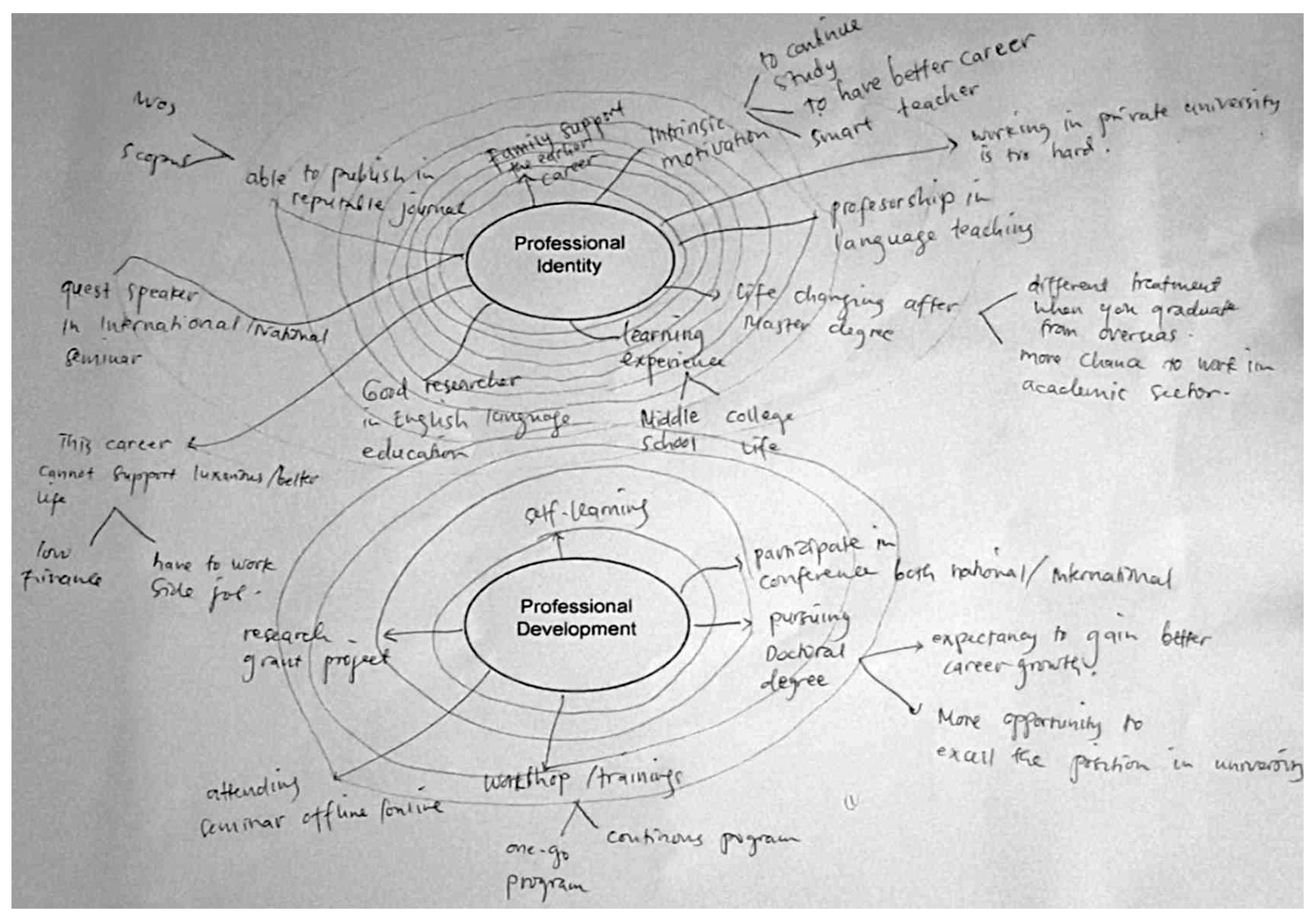
| 1 | 8 | Family support; learning experience—middle school-college-master’s degree; intrinsic motivation—continue study-having a career-smart teacher; good researcher in ELT; professorship in language teaching; publishing article in reputable journals—Scopus-WOS; Working at a private university—career cannot support a better life; guest speaker in international/national seminar |
| 2 | 6 | Opportunity; personal bias; random anomaly; experience in seminar field—encouragement from supervisor/professor; need for stable income/self-motivation |
| 3 | 5 | Exploring speciality choice—post-graduate degree; societal role expectation; professional passion; work experience; opportunity |
| 4 | 5 | Opportunity; prior experience; source of income; challenge; career path |
| 5 | 6 | Passion for teaching; research interest; parental expectation; spiritual career benefit; professional networking; lifelong learning experience |
| 6 | 6 | Prior education; attitude in society; role model; evaluating self-development; upgrading knowledge, following seminars and workshops-following training(government/non-government)—improving self-skill; payment motivation |
| 7 | 4 | Indonesian Malaysian youth exchange programme; work experience—translator during Tsunami in Aceh; family; teaching responsibility |
| 8 | 3 | Teaching reflection, salary, career reflection |
| 9 | 4 | Expectation to have own English course; family background—grandmother, mother, aunt are teachers; teaching experience—teaching assistant during bachelor’s degree—open university teaching staff-English course teacher; teaching young generation in Indonesia—worry about young generation education—preparing young generation in English language skills as communication tool |
| 10 | 4 | Motivation; learning experience; knowledge; teaching experience—early teaching experience—teaching at university—teaching young learners |
| 11 | 5 | Earning money; teacher as a role model; practising English in small group/peer-texting in English; father’s lowest support score in English; early teaching experience after graduating high school |
| Cases (N) | |||||||||||
|---|---|---|---|---|---|---|---|---|---|---|---|
| 1 | 2 | 3 | 4 | 5 | 6 | 7 | 8 | 9 | 10 | 11 | |
| Number of circles | 5 | 4 (5) | 5 | 5 | 4 | 5 | 3 | 2 | 4 | 1 | 5 |
| Number of sectors | 3 | 5 | 5 | 5 | 4 | 5 | 3 | 5 | 5 | 3 | 5 |
| Case (N) | Number of Sectors | Main Content Nodes of Sectors |
|---|---|---|
| 1 | 3 | Self-learning; Participating in professional development programs—conference-workshop/trainings—one-go programme and continuous programme-attending seminar—research grant project; pursuing doctoral degree—expectation for career growth |
| 2 | 5 | Public speaking certification; Professional development program-mastery of pedagogy, andragogy and linguistics field; conducting research in related fields; take doctoral degree; intercontinental relation |
| 3 | 5 | Reflection; doctoral degree; self-study; training; learning and mentoring |
| 4 | 5 | Postgraduate; teaching training; conference; self-directed learning; experience |
| 5 | 4 | Pedagogy training; research methodology workshop; career progression workshop; communication skills |
| 6 | 5 | Experimental learning; learning reflection; teaching reflection; career development; professional development programs—PEKERTI-Lecture certification |
| 7 | 3 | Study; personal learning—on YouTube and Tik-tok; online English seminar |
| 8 | 5 | Skills—improving English skills; teaching upgrading—teaching training; study—lesson study; knowledge—workshop/seminar-lesson study-webinar in English education; reflection |
| 9 | 5 | Proof of English proficiency—TOEFL-TOEIC; exchange language programme; self-learning—teaching application—watching YouTube-teaching website and language learning—books; seminar—offline and online; education/university—bachelor-master’s degree |
| 10 | 3 | Joining conference—attending ESL seminar; giving seminar to students—being a speaker; educating teachers—ESL course |
| 11 | 5 | Involving in international collaboration—workplace demand; teacher training—workshop/seminar; doing research—paper; online English learning application—ELSA—Duolingo—YouTube; peer/colleagues support |
Disclaimer/Publisher’s Note: The statements, opinions and data contained in all publications are solely those of the individual author(s) and contributor(s) and not of MDPI and/or the editor(s). MDPI and/or the editor(s) disclaim responsibility for any injury to people or property resulting from any ideas, methods, instructions or products referred to in the content. |
© 2025 by the authors. Licensee MDPI, Basel, Switzerland. This article is an open access article distributed under the terms and conditions of the Creative Commons Attribution (CC BY) license.
Share and Cite
Qamariah, H.; Hercz, M. Mapping the Self: Exploring Teachers’ Professional Identity and Development Through Ego-Centred Network Card Analysis. Educ. Sci. 2026, 16, 35. https://doi.org/10.3390/educsci16010035
Qamariah H, Hercz M. Mapping the Self: Exploring Teachers’ Professional Identity and Development Through Ego-Centred Network Card Analysis. Education Sciences. 2026; 16(1):35. https://doi.org/10.3390/educsci16010035
Chicago/Turabian StyleQamariah, Hijjatul, and Maria Hercz. 2026. "Mapping the Self: Exploring Teachers’ Professional Identity and Development Through Ego-Centred Network Card Analysis" Education Sciences 16, no. 1: 35. https://doi.org/10.3390/educsci16010035
APA StyleQamariah, H., & Hercz, M. (2026). Mapping the Self: Exploring Teachers’ Professional Identity and Development Through Ego-Centred Network Card Analysis. Education Sciences, 16(1), 35. https://doi.org/10.3390/educsci16010035