
How to Spot an Entrepreneurial University? A Student-Focused Perspective on Competencies—The Case of Greece


Abstract
1. Introduction
2. Background
2.1. The Concept and Scope of the Entrepreneurial University
2.2. Defining the Entrepreneurial University for This Study
A university that strategically and systematically integrates entrepreneurial values, behaviors, and support mechanisms across its educational, research, and societal engagement missions, in order to generate economic and social value through the development of human capital, knowledge transfer, and venture creation.
2.3. Scope and Limits
2.4. Entrepreneurial Competencies: The Link to Institutional Mission
3. Research Methodology
3.1. Quantitative Phase 1: Student Competencies Assessment
3.2. Quantitative Phase 2: Ecosystem Stakeholder Perspectives
3.3. Qualitative Phase 3: Expert Insights and Best Practices
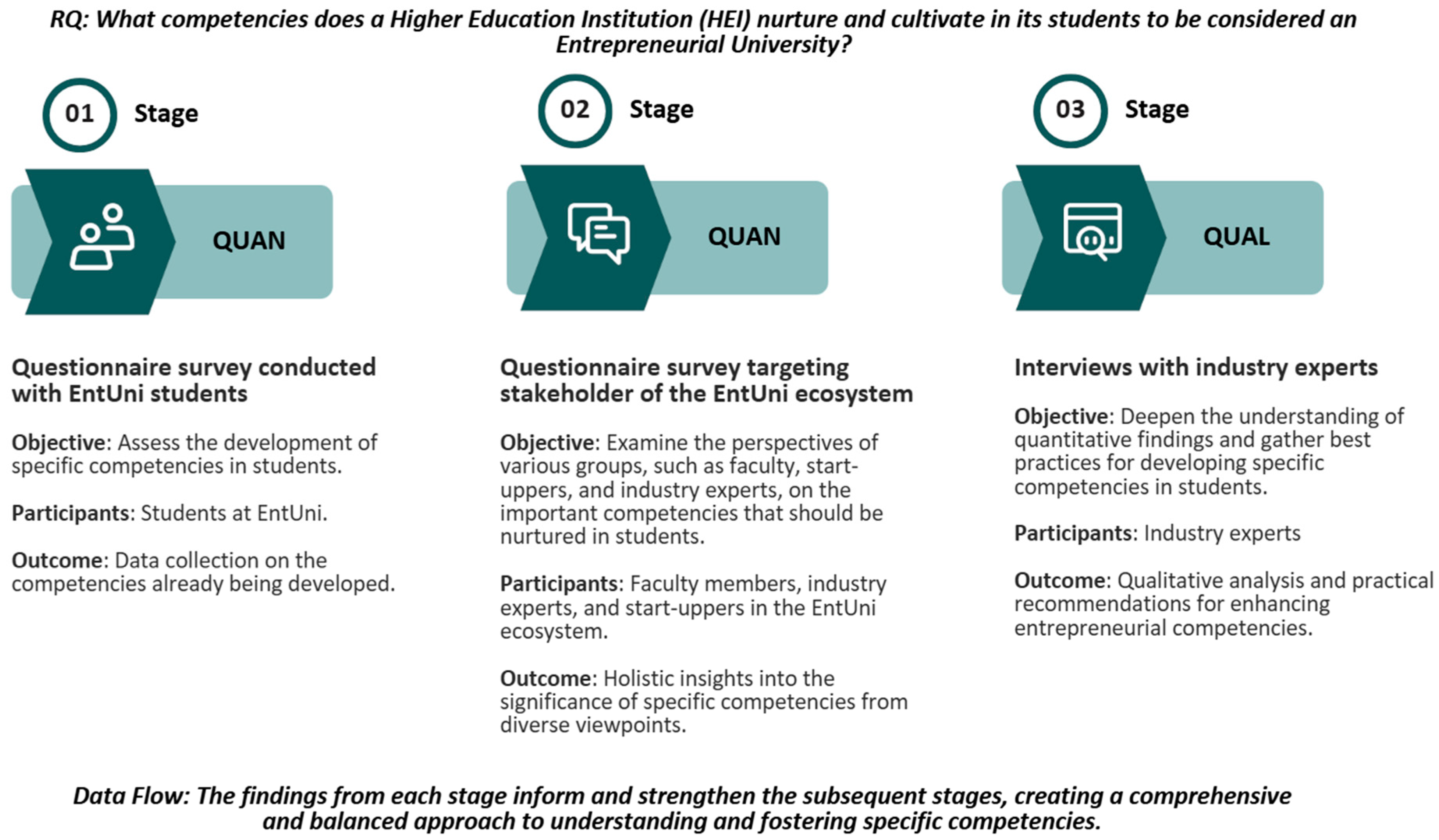
3.4. Integration Across Phases
4. Quantitative Study: Assessing Competencies Among Students of an Entrepreneurial Department
4.1. Research Design
4.1.1. DMST as a Model of Entrepreneurial Excellence
- Interdisciplinary Curriculum: Combining management, technology, and science, DMST equips students with theoretical and practical skills, fostering an entrepreneurial mindset.
- Innovation and Technology Focus: Aligned with global trends, DMST prepares students to launch startups, drive innovation, and leverage cutting-edge technologies.
- Entrepreneurial Ecosystem: Strong ties with incubators, accelerators, and investors provide students with networking, pitching, and real-world entrepreneurial opportunities.
- Startup Support: DMST offers mentorship, specialized courses, and resources, leading to successful student and faculty ventures.
- Entrepreneurship-Oriented Courses: Programs emphasize innovation, business modeling, and venture development.
- Alumni Success: Graduates have launched startups and held leadership roles in innovation-driven firms, proving DMST’s impact in shaping entrepreneurial talent.
4.1.2. Survey Design and Approach
4.2. Results
4.2.1. Sample Characteristics
4.2.2. Descriptive Statistics
4.2.3. Subgroup Analysis: Students in Entrepreneurial Programs
4.3. Key Insights
5. Confirmatory Quantitative Survey with Stakeholders of the Entrepreneurial University’s Ecosystem
5.1. Research Design
Survey Design and Approach
- EntUni Academic Experts: Faculty members employed within an EntUni who develop its curriculum and engage in entrepreneurial initiatives. They provide insights into the university’s entrepreneurial education and internal processes.
- Non-EntUni Academic Experts: Faculty from non-EntUnis who collaborate with EntUni through shared projects. As external observers, they offer an unbiased perspective on EntUni’s functioning and impact.
- Industry Experts: Professionals who actively participate in the design and delivery of EntUni’s extracurricular activities, bridging the gap between academia and the market. Their involvement ensures that entrepreneurial programs align with industry needs.
- Nascent Entrepreneurs: Students who have participated in EntUni’s intra-curricular and/or extracurricular activities, gaining firsthand entrepreneurial experience. They provide a practical perspective on the effectiveness of EntUni’s initiatives, offering insights into what has worked for them and how their acquired competencies have supported their entrepreneurial endeavors.
5.2. Results and Key Findings
5.2.1. Sample Characteristics
5.2.2. Key Findings
- Entrepreneurial Intention: Recognized as a fundamental driver for students to engage in entrepreneurial activities.
- Proactiveness and Grit: Valued for fostering resilience and long-term commitment to entrepreneurial goals.
- Entrepreneurial Self-Efficacy: A key factor in determining whether students feel confident in launching ventures.
- Formal Learning on Entrepreneurship: Despite industry experts placing slightly less emphasis on formal education, all groups acknowledged its importance in providing a foundational knowledge base.
- Market Orientation: While recognized as essential, this competency was rated slightly lower than others, possibly due to the assumption that market awareness develops naturally through entrepreneurial activities.
- Venture Support Mechanisms: Industry experts saw these as less critical than personal traits like risk-taking and resilience, suggesting that while support is valuable, success depends more on individual characteristics.
6. Qualitative Round-Table Discussion with Industry Experts
6.1. Research Design
- Introduction to Research Aim: Establishing links between student competencies and an EntUni’s mission.
- Presentation of Key Findings: Experts reviewed figures illustrating competency importance rankings.
- Discussion of Contradictions: Experts debated competency gaps between industry and academia.
- Exploration of Additional Competencies: Experts suggested missing competencies or necessary curriculum changes.
6.2. Analysis and Discussion of Figures
7. Discussion
7.1. Toward a Competency-Based Definition of Entrepreneurial Universities
7.2. The Profile of EntUni Students
7.3. Enhancing Competency Development
7.4. Addressing the Academia-Industry Gap
8. Conclusions
8.1. Theoretical and Practical Contributions
- Teamwork enhances collaboration, enabling individuals to leverage diverse skills and solve complex challenges effectively.
- Ethics and Sustainability promote responsible entrepreneurship by integrating environmental and social considerations alongside business goals.
- Risk Management equips students with the ability to navigate uncertainty, assess challenges, and make informed decisions.
- Curriculum Design: Universities can implement competency-based educational frameworks that balance theoretical knowledge with practical, hands-on learning opportunities. These frameworks should include real-world scenarios, case studies, and experiential learning activities, ensuring students gain both academic and practical expertise.
- Selection Criteria for Programs and Resources: Identified entrepreneurial competencies can serve as objective benchmarks for selecting students to participate in specialized entrepreneurial programs, such as incubators, accelerators, and innovation contests. These criteria can also help universities allocate resources more effectively to nurture high-potential individuals.
- Policy and Funding Decisions: Governments and funding organizations can use these competencies as measurable indicators to assess and support EntUnis. By adopting these benchmarks, policymakers can ensure targeted funding reaches institutions demonstrating a commitment to cultivating entrepreneurship at the student level.
8.2. Limitations and Future Research
Author Contributions
Funding
Institutional Review Board Statement
Informed Consent Statement
Data Availability Statement
Conflicts of Interest
Abbreviations
| EntUni | Entrepreneurial University |
| DMST | Department of Management Science and Technology |
References
- Ahmed, T., Rehman, I. U., & Sergi, B. S. (2019). A proposed framework on the role of entrepreneurial education and contextual factors. In Entrepreneurship and development in the 21st century (pp. 47–68). Emerald Publishing Limited. [Google Scholar]
- Alsos, G. A., & Kolvereid, L. (1998). The business gestation process of novice, serial, and parallel business founders. Entrepreneurship Theory and Practice, 22(4), 101–114. [Google Scholar] [CrossRef]
- Arroyabe, M. F., Schumann, M., & Arranz, C. F. A. (2022). Mapping the entrepreneurial university literature: A text mining approach. Studies in Higher Education, 47(5), 955–963. [Google Scholar] [CrossRef]
- Balconi, M., Brusoni, S., & Orsenigo, L. (2010). In defence of the linear model: An essay. Research Policy, 39(1), 1–13. [Google Scholar] [CrossRef]
- Baron, R. A., & Markman, G. D. (2000). Beyond social capital: How social skills can enhance entrepreneurs’ success. Academy of Management Perspectives, 14(1), 106–116. [Google Scholar] [CrossRef]
- Bateman, T. S., & Crant, J. M. (1993). The proactive component of organizational-behavior—A measure and correlates. Journal of Organizational Behavior, 14(2), 103–118. [Google Scholar] [CrossRef]
- Baum, J. R., Locke, E. A., & Smith, K. G. (2001). A multidimensional model of venture growth. Academy of Management Journal, 44(2), 292–303. [Google Scholar] [CrossRef]
- Chandler, G. N., & Hanks, S. H. (1994). Market attractiveness, resource-based capabilities, venture strategies, and venture performance. Journal of Business Venturing, 9(4), 331–349. [Google Scholar] [CrossRef]
- Chandler, G. N., & Jansen, E. (1992). The founder’s self-assessed competence and venture performance. Journal of Business Venturing, 7(3), 223–236. [Google Scholar] [CrossRef]
- Chen, C. C., Greene, P. G., & Crick, A. (1998). Does entrepreneurial self-efficacy distinguish entrepreneurs from managers? Journal of Business Venturing, 13(4), 295–316. [Google Scholar] [CrossRef]
- Chrisman, J. J., Hynes, T., & Fraser, S. (1995). Faculty entrepreneurship and economic development: The case of the University of Calgary. Journal of Business Venturing, 10(4), 267–281. [Google Scholar] [CrossRef]
- Clark, B. R. (2004). Delineating the character of the entrepreneurial university. Higher Education Policy, 17(4), 355–370. [Google Scholar] [CrossRef]
- Cortina, J. M. (1993). What is coefficient alpha? Journal of Applied Psychology, 78(1), 98–104. [Google Scholar] [CrossRef]
- Credé, M. (2018). What shall we do about grit? A critical review of what we know and what we don’t know. Educational Researcher, 47(9), 606–611. [Google Scholar] [CrossRef]
- Cui, J., Sun, J., & Bell, R. (2021). The impact of entrepreneurship education on the entrepreneurial mindset of college students in China: The mediating role of inspiration and the role of educational attributes. International Journal of Management Education, 19(1), 100296. [Google Scholar] [CrossRef]
- Cunningham, J. A., & Miller, K. (2021). Entrepreneurial university business models: Core drivers, challenges and consequences. In A research agenda for the entrepreneurial university (pp. 103–128). Edward Elgar Publishing. [Google Scholar]
- Driessen, M. P., & Zwart, P. S. (2007). The entrepreneur scan measuring characteristics and traits of entrepreneurs. Available online: https://entrepreneurscan.com/wp-content/uploads/2016/09/E-Scan-MAB-Article-UK.pdf (accessed on 5 September 2025).
- Duckworth, A. L., Peterson, C., Matthews, M. D., & Kelly, D. R. (2007). Grit: Perseverance and passion for long-term goals. Journal of Personality and Social Psychology, 92(6), 1087–1101. [Google Scholar] [CrossRef]
- Duckworth, A. L., & Quinn, P. D. (2009). Development and validation of the short grit scale (Grit-S). Journal of Personality Assessment, 91(2), 166–174. [Google Scholar] [CrossRef]
- Etzkowitz, H. (1984). Entrepreneurial scientists and entrepreneurial universities in American academic science. Minerva, 21(2–3), 198–233. [Google Scholar] [CrossRef]
- Etzkowitz, H. (2003a). Innovation in innovation: The triple helix of university-industry-government relations. Social Science Information, 42(3), 293–337. [Google Scholar] [CrossRef]
- Etzkowitz, H. (2003b). Research groups as ‘quasi-firms’: The invention of the entrepreneurial university. Research Policy, 32(1), 109–121. [Google Scholar] [CrossRef]
- Etzkowitz, H. (2004). The evolution of the entrepreneurial university. International Journal of Technology and Globalisation, 1(1), 64–77. [Google Scholar] [CrossRef]
- Etzkowitz, H. (2013). Anatomy of the entrepreneurial university. Social Science Information, 52(3), 486–511. [Google Scholar] [CrossRef]
- Etzkowitz, H. (2016). The entrepreneurial university: Vision and metrics. Industry and Higher Education, 30(2), 83–97. [Google Scholar] [CrossRef]
- Etzkowitz, H. (2017). Innovation lodestar: The entrepreneurial university in a stellar knowledge firmament. Technological Forecasting and Social Change, 123, 122–129. [Google Scholar] [CrossRef]
- Etzkowitz, H., Webster, A., Gebhardt, C., & Terra, B. R. C. (2000). The future of the university and the university of the future: Evolution of ivory tower to entrepreneurial paradigm. Research Policy, 29(2), 313–330. [Google Scholar] [CrossRef]
- EU. (2006). Recommendation of the European Parliament and of the Council of 18 December 2006 on key competences for lifelong learning. Available online: https://eur-lex.europa.eu/eli/reco/2006/962/oj/eng (accessed on 5 September 2025).
- Fayolle, A., Gailly, B., & Lassas-Clerc, N. (2006). Assessing the impact of entrepreneurship education programmes: A new methodology. Journal of European Industrial Training, 30(9), 701–720. [Google Scholar] [CrossRef]
- Fernández-Nogueira, D., Arruti, A., Markuerkiaga, L., & Sáenz, N. (2018). The entrepreneurial university: A selection of good practices. Journal of Entrepreneurship Education, 21(3), 1–17. [Google Scholar]
- Fernández-Pérez, V., Montes-Merino, A., Rodríguez-Ariza, L., & Galicia, P. E. A. (2019). Emotional competencies and cognitive antecedents in shaping student’s entrepreneurial intention: The moderating role of entrepreneurship education. International Entrepreneurship and Management Journal, 15(1), 281–305. [Google Scholar] [CrossRef]
- Ferreras-Garcia, R., Sales-Zaguirre, J., & Serradell-López, E. (2021). Developing entrepreneurial competencies in higher education: A structural model approach. Education + Training, 63(5), 720–744. [Google Scholar] [CrossRef]
- Fuller, D., & Pickernell, D. (2018). Identifying groups of entrepreneurial activities at universities. International Journal of Entrepreneurial Behavior & Research, 24(1), 171–190. [Google Scholar]
- Garomssa, H. (2024). The entrepreneurial university concept as a narrative of change in HEIs. Studies in Higher Education, 50(2), 365–386. [Google Scholar] [CrossRef]
- Gaspar Pacheco, A. I., Ferreira, J., Simoes, J., Mota Veiga, P., & Dabic, M. (2024). Mechanisms for facilitating academic entrepreneurship in higher education. International Journal of Entrepreneurial Behavior & Research, 30(6), 1448–1479. [Google Scholar] [CrossRef]
- Gieure, C., Benavides-Espinosa, M. D. M., & Roig-Dobón, S. (2019). Entrepreneurial intentions in an international university environment. International Journal of Entrepreneurial Behavior & Research, 25(8), 1605–1620. [Google Scholar] [CrossRef]
- Gill, P., Stewart, K., Treasure, E., & Chadwick, B. (2008). Methods of data collection in qualitative research: Interviews and focus groups. British Dental Journal, 204, 291–295. [Google Scholar] [CrossRef] [PubMed]
- Gomez-Mejia, L. R., & Balkin, D. B. (1989). Effectiveness of individual and aggregate compensation strategies. Industrial Relations: A Journal of Economy and Society, 28(3), 431–445. [Google Scholar] [CrossRef]
- Guenther, J., & Wagner, K. (2008). Getting out of the ivory tower–new perspectives on the entrepreneurial university. European Journal of International Management, 2(4), 400–417. [Google Scholar] [CrossRef]
- Guerrero, M., & Urbano, D. (2012). The development of an entrepreneurial university. The Journal of Technology Transfer, 37(1), 43–74. [Google Scholar] [CrossRef]
- Guerrero, M., Urbano, D., Cunningham, J., & Organ, D. (2014). Entrepreneurial universities in two European regions: A case study comparison. The Journal of Technology Transfer, 39(3), 415–434. [Google Scholar] [CrossRef]
- Guerrero, M., Urbano, D., Fayolle, A., Klofsten, M., & Mian, S. (2016). Entrepreneurial universities: Emerging models in the new social and economic landscape. Small Business Economics, 47(3), 551–563. [Google Scholar] [CrossRef]
- Gulbrandsen, M., & Slipersaeter, S. (2007). The third mission and the entrepreneurial university model. In Universities and strategic knowledge creation. Edward Elgar Publishing. [Google Scholar]
- Hahn, D., Brumana, M., & Minola, T. (2022). Is it all about creating new firms? A broader look at the impact of the entrepreneurial university on youth employment. Studies in Higher Education, 47(5), 1036–1045. [Google Scholar] [CrossRef]
- Hair, J. F., Black, W. C., Babin, B. J., & Anderson, R. E. (2019). Multivariate data analysis (8th ed.). Cengage Learning. [Google Scholar]
- Harrison, R. L., & Reilly, T. M. (2011). Mixed methods designs in marketing research. Qualitative Market Research: An International Journal, 14(1), 7–26. [Google Scholar] [CrossRef]
- Harrison, R. L., Reilly, T. M., & Creswell, J. W. (2020). Methodological rigor in mixed methods: An application in management studies. Journal of Mixed Methods Research, 14(4), 473–495. [Google Scholar] [CrossRef]
- Hmieleski, K. M., & Baron, R. A. (2008). When does entrepreneurial self-efficacy enhance versus reduce firm performance? Strategic Entrepreneurship Journal, 2(1), 57–72. [Google Scholar] [CrossRef]
- Jacob, M., Lundqvist, M., & Hellsmark, H. (2003). Entrepreneurial transformations in the Swedish university system: The case of chalmers university of technology. Research Policy, 32(9), 1555–1568. [Google Scholar] [CrossRef]
- Kaleniuk, I. S., & Dyachenko, A. L. (2016). Entrepreneurial universities in the global educational space. International Economic Policy, 2(25), 6–22. [Google Scholar]
- Klofsten, M., Fayolle, A., Guerrero, M., Mian, S., Urbano, D., & Wright, M. (2019). The entrepreneurial university as driver for economic growth and social change—Key strategic challenges. Technological Forecasting and Social Change, 141, 149–158. [Google Scholar] [CrossRef]
- Klofsten, M., & Jones-Evans, D. (2000). Comparing academic entrepreneurship in Europe–The case of Sweden and Ireland. Small Business Economics, 14, 299–309. [Google Scholar] [CrossRef]
- Kuratko, D. F. (2017). The evolution of entrepreneurship education: Trends, advancements, and research opportunities. Entrepreneurship Education and Pedagogy, 1(1), 8–36. [Google Scholar]
- Lahti, R. K. (1999). Identifying and integrating individual level and organizational level core competencies. Journal of Business and Psychology, 14(1), 59–75. [Google Scholar] [CrossRef]
- Lambarri Villa, M. (2025). Entrepreneurial competence in higher education. Education Sciences, 6(3), 110. [Google Scholar]
- Liñán, F. (2008). Skill and value perceptions: How do they affect entrepreneurial intentions? International Entrepreneurship and Management Journal, 4(3), 257–272. [Google Scholar] [CrossRef]
- Löbler, H. (2006). Learning entrepreneurship from a constructivist perspective. Technology Analysis and Strategic Management, 18(1), 19–38. [Google Scholar] [CrossRef]
- Lyu, J., Shepherd, D., & Lee, K. (2023). The impact of entrepreneurship pedagogy on nascent student entrepreneurship: An entrepreneurial process perspective. Studies in Higher Education, 49(1), 62–83. [Google Scholar] [CrossRef]
- Mainardes, E. W., Alves, H., & Raposo, M. (2011). The process of change in university management: From the “ivory tower” to Entreprunialism. Transylvanian Review of Administrative Sciences, 7(33), 124–149. [Google Scholar]
- McGee, J. E., Peterson, M., Mueller, S. L., & Sequeira, J. M. (2009). Entrepreneurial self-efficacy: Refining the measure. Entrepreneurship: Theory and Practice, 33(4), 965–988. [Google Scholar] [CrossRef]
- McLafferty, I. (2004). Focus group interviews as a data collecting strategy. Journal of Advanced Nursing, 48(2), 187–194. [Google Scholar] [CrossRef]
- Mulder, M., Gulikers, J., Biemans, H., & Wesselink, R. (2009). The new competence concept in higher education: Error or enrichment? Journal of European Industrial Training, 33(8), 755–770. [Google Scholar] [CrossRef]
- Mullins, J. W. (1996). Early growth decisions of entrepreneurs: The influence of competency and prior performance under changing market conditions. Journal of Business Venturing, 11(2), 89–105. [Google Scholar] [CrossRef]
- Preedy, S., & Beaumont, E. (2024). Extracurricular enterprise and entrepreneurship activities in higher education: Understanding entrepreneurial competencies and capabilities. In Extracurricular enterprise and entrepreneurship activity: A global and holistic perspective (pp. 81–95). Emerald Publishing Limited. [Google Scholar]
- Pugh, R., Hamilton, E., Soetanto, D., Jack, S., Gibbons, A., & Ronan, N. (2022). Nuancing the roles of entrepreneurial universities in regional economic development. Studies in Higher Education, 47(5), 964–972. [Google Scholar] [CrossRef]
- Ridder, H. G. (2017). The theory contribution of case study research designs. Business Research, 10(2), 281–305. [Google Scholar] [CrossRef]
- Roberts, B. W., Lejuez, C., Krueger, R. F., Richards, J. M., & Hill, P. L. (2014). What is conscientiousness and how can it be assessed? Developmental Psychology, 50(5), 1315–1330. [Google Scholar] [CrossRef] [PubMed]
- Rothaermel, F. T., Agung, S. D., & Jiang, L. (2007). University entrepreneurship: A taxonomy of the literature. Industrial and Corporate Change, 16(4), 691–791. [Google Scholar] [CrossRef]
- Runeson, P., & Höst, M. (2009). Guidelines for conducting and reporting case study research in software engineering. Empirical Software Engineering, 14(2), 131–164. [Google Scholar] [CrossRef]
- Salisu, I., Hashim, N., Mashi, M. S., & Aliyu, H. G. (2020). Perseverance of effort and consistency of interest for entrepreneurial career success: Does resilience matter? Journal of Entrepreneurship in Emerging Economies, 12(2), 279–304. [Google Scholar] [CrossRef]
- Sam, C., & Van Der Sijde, P. (2014). Understanding the concept of the entrepreneurial university from the perspective of higher education models. Higher Education, 68, 891–908. [Google Scholar] [CrossRef]
- Shook, C. L., Priem, R. L., & McGee, J. E. (2003). Venture creation and the enterprising individual: A review and synthesis. Journal of Management, 29(3), 379–399. [Google Scholar] [CrossRef]
- Sitkin, S. B., & Weingart, L. R. (1995). Determinants of risky decision-making behavior. Academy of Management Journal, 38(6), 1573–1592. [Google Scholar] [CrossRef]
- Souitaris, V., Zerbinati, S., & Al-Laham, A. (2007). Do entrepreneurship programmes raise entrepreneurial intention of science and engineering students? The effect of learning, inspiration and resources. Journal of Business Venturing, 22(4), 566–591. [Google Scholar] [CrossRef]
- Stoof, A., Martens, R. L., Van Merriënboer, J. J., & Bastiaens, T. J. (2000, May 24–26). What is competence? A constructivist approach as a way out of confusion. Onderwijs Research Dagen (ORD), Leiden, The Netherlands. [Google Scholar]
- Šokčević, S. (2022). Entrepreneurial competencies of university students. Economics & Sociology, 15(4), 89–104. [Google Scholar] [CrossRef]
- Taatila, V. P. (2010). Learning entrepreneurship in higher education. Education + Training, 52(1), 48–61. [Google Scholar] [CrossRef]
- Tavakol, M., & Dennick, R. (2011). Making sense of Cronbach’s alpha. International Journal of Medical Education, 2, 53–55. [Google Scholar] [CrossRef]
- Thompson, E. R. (2007). Development and validation of an internationally reliable short-form of the Positive and Negative Affect Schedule (PANAS). Journal of Cross-Cultural Psychology, 38(2), 227–242. [Google Scholar] [CrossRef]
- Thorp, H., & Goldstein, B. (2013). Engines of innovation: The entrepreneurial university in the twenty-first century. UNC Press Books. [Google Scholar]
- Venkatesh, V., Brown, S. A., & Sullivan, Y. W. (2016). Guidelines for conducting mixed-methods research: An extension and illustration. Journal of the Association for Information Systems, 17(7), 435–495. [Google Scholar] [CrossRef]
- Watson, D., Clark, L. A., & Tellegen, A. (1988). Development and validation of brief measures of positive and negative affect: The PANAS scales. Journal of Personality and So, 54(6), 1063–1070. [Google Scholar] [CrossRef] [PubMed]
- White, R., Hertz, G., & Moore, K. (2016). Competency based education in entrepreneurship: A call to action for the discipline. In M. H. Morris, & E. Liguori (Eds.), Annals of entrepreneurship education and pedagogy (pp. 127–147). Edward Elgar Publishing. [Google Scholar]
- Wickham, P. (2006). Strategic entrepreneurship (4th ed.). Pearson Education, Inc. [Google Scholar]
- Zhao, H., Hills, G. E., & Seibert, S. E. (2005). The mediating role of self-efficacy in the development of entrepreneurial intentions. Journal of Applied Psychology, 90(6), 1265–1272. [Google Scholar] [CrossRef] [PubMed]



| Entrepreneurial University Definition | Source |
|---|---|
| A university contemplating new funding sources such as patents, contract research, and partnerships with commercial businesses. | (Etzkowitz, 1984) |
| A university in which employees, professors, researchers and students create new enterprises. | (Chrisman et al., 1995) |
| A university that can develop a defined strategic direction, both in terms of academic aims and in terms of transforming knowledge generated inside the institution into economic and societal benefit. | (Etzkowitz, 2003b) |
| A university that preserves conventional academic duties such as social reproduction and knowledge expansion, but places them in a larger context as part of its new purpose of promoting innovation. | (Etzkowitz, 2003a) |
| A university with a diverse set of new infrastructural support mechanisms for developing entrepreneurship within the organization and packaging entrepreneurship as a product. | (Jacob et al., 2003) |
| An efflorescence of embryonic characteristics that exist potentially in any academic enterprise. | (Etzkowitz, 2004) |
| A university that has updated its strategies, management, and organizational structure in a variety of ways. | (Gulbrandsen & Slipersaeter, 2007) |
| A university that develops technological innovations and enables the distribution of technology via intermediaries such as technology transfer offices and the establishment of incubators or science parks that spawn new businesses. | (Rothaermel et al., 2007) |
| A university that may be regarded as a multifaceted institution having direct mechanisms to facilitate technology transfer from academia to industry as well as indirect mechanisms to support new business activities through entrepreneurship education. | (Guenther & Wagner, 2008) |
| A university that, via its culture, mission, and regional function, contributes to the transition to a knowledge-based society as a key actor in the formation of new technoeconomic conurbations. | (Balconi et al., 2010) |
| A university that aspires to be as free of governmental control as possible and to connect extensively with the market in order to acquire resources as well as meet society’s knowledge demands, therefore contributing to social progress. | (Mainardes et al., 2011) |
| A university that engages in partnerships, networks, and commercial activities with public and private enterprises and governments in order to find collaboration and interactions with the goal of connecting education, research, and activities with technological, social, and economic growth. | (Guerrero & Urbano, 2012) |
| A university that functions as a tool that not only offers a workforce and adds value via the development or transformation of information, but also changes individuals’ beliefs and attitudes toward these concerns.’ | (Guerrero & Urbano, 2012) |
| A university that emerges as a result of the establishment of an ‘inner logic’ of academic progress that previously stretched the academic enterprise from a conservator to a generator of knowledge. | (Etzkowitz, 2013) |
| A university that incorporates the translation of ideas into actual action, the capitalization of knowledge, the organization of new entities, and the management of risks. | (Etzkowitz, 2013) |
| A university that strives to provide a supportive environment in which the university community may explore, assess, and capitalize on ideas that have the potential to become social and economic entrepreneurial initiatives. | (Guerrero et al., 2014) |
| A university with a complex social and economic framework that includes a wide range of conventional and modern activities. An essential feature of entrepreneurial universities is successful commercial activity aimed at assuring the inflow of diverse internal and external financial development resources. | (Kaleniuk & Dyachenko, 2016) |
| A university that ensures knowledge capitalization, transfer, and commercialization of innovative business initiatives of professors, researchers, students, and partners—organizations. | (Kaleniuk & Dyachenko, 2016) |
| A university that is seen as an institution with an entrepreneurial management style, with its members (faculty, students, and staff) operating entrepreneurially, and that interacts with its external environment (community/region) in an entrepreneurial fashion. | (Guerrero et al., 2016) |
| A university that improves research by combining a reverse linear dynamic that moves from issues in business and society to solutions in academia, to the standard forward linear model that produces fortuitous inventions from the meandering stream of fundamental research. | (Etzkowitz, 2017) |
| A university with diverse academic traditions, decision-making levels, research values, and sub-organizational cultures. | (Klofsten et al., 2019) |
| Construct | Definition | Adapted From |
|---|---|---|
| Entrepreneurial Competencies | ||
| Proactiveness | A personal disposition toward proactive behavior—the relatively stable tendency to effect change | (Bateman & Crant, 1993) |
| Positive Thinking | As expressed through Positive Affect—feeling enthusiastic, active, and alert | (Watson et al., 1988) |
| Personal Ambition | Being driven to succeed or to make a difference in the world | (Duckworth et al., 2007) |
| Grit | Perseverance and passion for long-term goals | (Duckworth et al., 2007) |
| Perseverance of Effort | Withstanding adversity and challenges while maintaining effort and courage to achieve their long-term desires | (Salisu et al., 2020) |
| Risk Propensity | Willingness to take risks, and being more comfortable dealing with situations of risk, in the context of one’s job | (Gomez-Mejia & Balkin, 1989; Sitkin & Weingart, 1995) |
| Entrepreneurial Self-Efficacy | The degree to which students perceive themselves as having the ability to successfully perform the various roles and tasks of entrepreneurship—such as opportunity recognition, evaluation and exploitation | (Hmieleski & Baron, 2008; Shook et al., 2003; Wickham, 2006) |
| Entrepreneurial Intention and Attitudes | ||
| Entrepreneurial Intention | The intention of students to start a business | (Souitaris et al., 2007) |
| Personal Opinion on Entrepreneurship | Positive opinion on entrepreneurship, and on entrepreneurs | |
| Positive Attitude Toward Venturing | Beliefs that starting a new business is worthwhile, rewarding, and positive | (McGee et al., 2009) |
| Consistency of Interest | Continuously focusing on achieving long-term ambitions | (Salisu et al., 2020) |
| Previous Entrepreneurial Experience | ||
| Entrepreneurial Experience | Experience in new venture start-up, new market development, and new product development | (Zhao et al., 2005) |
| Nascent Entrepreneurship Activity | Involvement in evaluating a new business idea, and participation in trying to start a business for real—not just as part of an academic exercise | (Souitaris et al., 2007) |
| Entrepreneurial Extra-Curricular Activities | Attending activities such as a “start your own business planning” seminar/event/bootcamp, writing a business plan, putting together a start-up team, joining a business incubation scheme, developing a product or service, participating in an entrepreneurship and innovation competition, etc. | (McGee et al., 2009) |
| Start-up Activities | Participating in actual real-world entrepreneurial activity involving business planning, financing the new firm, and interaction with the external environment | (Souitaris et al., 2007) |
| Construct | Measurement Tool |
|---|---|
| Proactiveness | Assessed using the Proactive Personality Scale (Bateman & Crant, 1993), a 17-item scale rated on a 7-point Likert scale (1 = strongly disagree, 7 = strongly agree). Sample item: “I am great at turning problems into opportunities.” |
| Positive Thinking | Measured via the I-PANAS-SF scale (Thompson, 2007), which includes 5 positive and 5 negative affect items on a 7-point Likert scale (1 = Never, 7 = Always). Sample item: “Inspired” (positive affect). |
| Personal Ambition | Evaluated using the Ambition subscale of the Grit Scale (Duckworth et al., 2007), a 5-item scale rated on a 5-point Likert scale (1 = Not like me at all, 5 = Very much like me). Sample item: “I aim to be the best in the world at what I do.” |
| Perseverance | Measured with the Short Grit Scale (Duckworth & Quinn, 2009), an 8-item scale assessing perseverance and passion for long-term goals, using a 5-point Likert scale (1 = Not at all like me, 5 = Very much like me). Sample items: “I finish whatever I begin.” |
| Risk Propensity: | Assessed using 6 items from Risk Propensity (Zhao et al., 2005) and Willingness to Take Risks (Gomez-Mejia & Balkin, 1989) scales, rated on a 7-point Likert scale (1 = Strongly Disagree, 7 = Strongly Agree). Sample item: “I enjoy the excitement of uncertainty and risk.” |
| Perceptions of Formal Learning on Entrepreneurship | Measured using Zhao et al. (2005)’s 4-item scale, assessing perceived learning from university studies. Rated on a 5-point Likert scale (1 = Very little, 5 = A great deal). |
| Adequacy of Entrepreneurship Formal Learning | Assessed with a single-item scale: “To what extent have your formal (university) studies prepared you to start a business?” Rated on a 7-point Likert scale (1 = Not at all, 7 = Completely). |
| Entrepreneurial Self-Efficacy (ESE) | Evaluated using the 19-item ESE Scale (McGee et al., 2009) covering 5 dimensions: opportunity recognition, planning, networking, managing people, and financial management. Rated on a 5-point Likert scale (1 = Very little, 5 = Very much). |
| Previous Entrepreneurial Experience | Measured using a 3-item scale (Zhao et al., 2005), rating experience in new venture start-up, market development, and product development. Rated on a 5-point Likert scale (1 = Very little, 5 = A great deal). |
| Personal Opinion on Entrepreneurship | Assessed using a 2-item scale measuring general opinions on entrepreneurship and entrepreneurs. Rated on a 5-point Likert scale (1 = Very negative, 5 = Very positive). |
| Nascent Entrepreneurship Activity: | Adapted from McGee et al. (2009), Souitaris et al. (2007), and Alsos and Kolvereid (1998) to measure engagement in: Extra-curricular activities; Start-up activities Responses recorded as (0) Not initiated, (1) Initiated, (2) Completed. |
| Attitude Toward Venturing | Measured using a 3-item scale (McGee et al., 2009), evaluating perceptions of starting a business (e.g., “Starting a business is… Worthwhile vs. Worthless”), rated on a 7-point Likert scale. |
| Entrepreneurial Intention | Measured using a 4-item scale (Zhao et al., 2005), assessing interest in starting or acquiring a business, rated on a 7-point Likert scale (1 = Not interested, 7 = A great deal interested). |
| Entrepreneurial Decision | Adapted from Chen et al. (1998), a 5-item scale assessing preparedness to start a business (e.g., “I am preparing to set up my own business.”). Rated on a 7-point Likert scale (1 = Strongly Disagree, 7 = Strongly Agree). |
| Seriously Trying to Start a Business | Assessed with 2 items (Souitaris et al., 2007), distinguishing between:
|
| Demographics | Age, Gender, Education Level, Education Relevance to venture, and Years Working on Venture (categorized into: <1, 1–2, 3–4, etc.). |
| Scales | Reliability (α) | N | Min | Max | Mean | Std. Deviation | % of Max Possible (POMP) | |
|---|---|---|---|---|---|---|---|---|
| a. All Participating Students | ||||||||
| Entrepreneurial Competencies | Formal Learning on Entrepreneurship | 0.861 | 190 | 3.59 | 6.88 | 5.63 | 0.63 | 80.4% |
| Positive Thinking | 0.730 | 190 | 3.00 | 7.00 | 5.61 | 0.76 | 80.1% | |
| Personal Ambition | 0.703 | 190 | 2.40 | 5.00 | 4.14 | 0.60 | 82.8% | |
| Consistency of Interest | 0.818 | 190 | 1.00 | 5.00 | 2.57 | 0.89 | 51.4% | |
| Perseverance of Effort | 0.616 | 190 | 2.50 | 5.00 | 4.15 | 0.57 | 83.0% | |
| Risk Propensity | 0.757 | 190 | 2.00 | 7.00 | 5.17 | 1.00 | 73.9% | |
| Entrepreneurial Self-Efficacy (Total) | 0.899 | 190 | 1.58 | 5.00 | 3.71 | 0.58 | 74.1% | |
| Searching | 0.723 | 190 | 2.33 | 5.00 | 3.92 | 0.66 | 78.4% | |
| Planning | 0.752 | 190 | 1.00 | 5.00 | 3.42 | 0.76 | 68.4% | |
| Marshaling | 0.623 | 190 | 1.67 | 5.00 | 3.98 | 0.68 | 79.7% | |
| Implementing People | 0.848 | 190 | 1.50 | 5.00 | 3.89 | 0.71 | 77.7% | |
| Implementing Financial | 0.908 | 190 | 1.00 | 5.00 | 3.23 | 1.08 | 64.5% | |
| Demographics and Attitudes | Previous Entrepreneurial Experience | 0.907 | 190 | 1.00 | 5.00 | 2.48 | 1.16 | 49.7% |
| Personal Opinion on Entrepreneurship | 0.649 | 190 | 2.00 | 5.00 | 4.38 | 0.62 | 87.5% | |
| Attitude Toward Venturing | 0.851 | 190 | 0.00 | 6.00 | 5.11 | 0.95 | 85.1% | |
| b. Subgroup of Students Participating in Entrepreneurial Programs | ||||||||
| Entrepreneurial Intention & Practical Interest | Entrepreneurial Intention | 0.877 | 136 | 1.00 | 7.00 | 5.65 | 1.36 | 80.7% |
| Entrepreneurial Decision | 0.909 | 136 | 1.00 | 7.00 | 5.45 | 1.42 | 77.9% | |
| Currently evaluating a new business idea | - | 136 | “No” | “Yes” | - | - | Yes = 58.8% | |
| Trying to start a business for real, as opposed to just evaluating as part of an academic exercise | - | 136 | “No” | “Yes” | - | - | Yes = 62.5% | |
| Nascent Entrepreneurship Activity | Entrepreneurial Extra-Curricular Activities | 0.726 | 137 | 0.00 | 6.00 | 3.00 | 1.90 | 50.0% |
| Start-up Activities | 0.899 | 137 | 0.00 | 27.00 | 6.78 | 6.44 | 25.1% | |
| Characteristics/Competencies | Experts | Non—Experts | All (n = 38) | ||||||||
|---|---|---|---|---|---|---|---|---|---|---|---|
| Industry (n = 10) | Academic (n = 9) | Entrepreneurs (n = 10) | Academic (n = 9) | ||||||||
| Mean | S.D. | Mean | S.D. | Mean | S.D. | Mean | S.D. | Mean | S.D. | ||
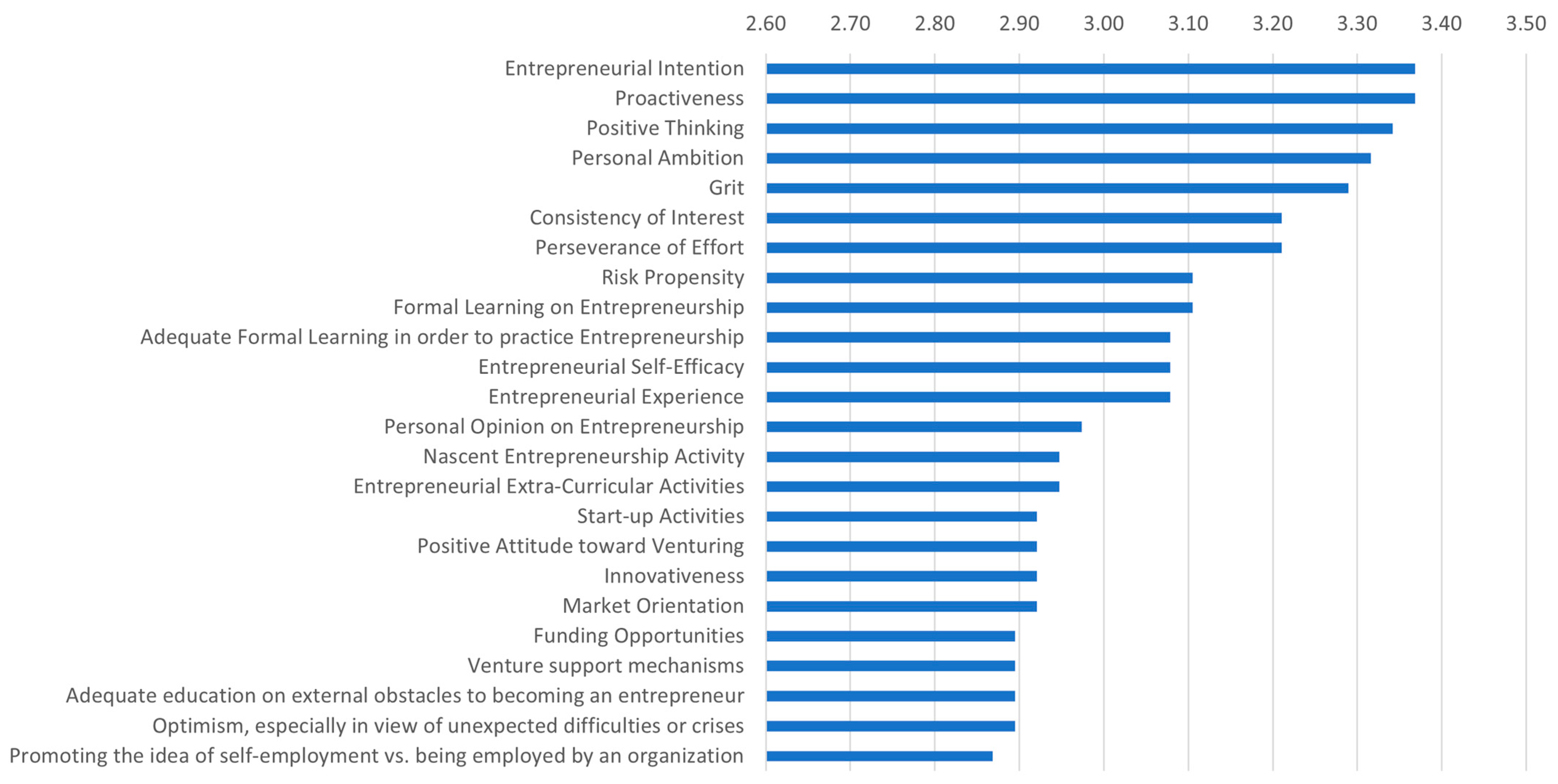
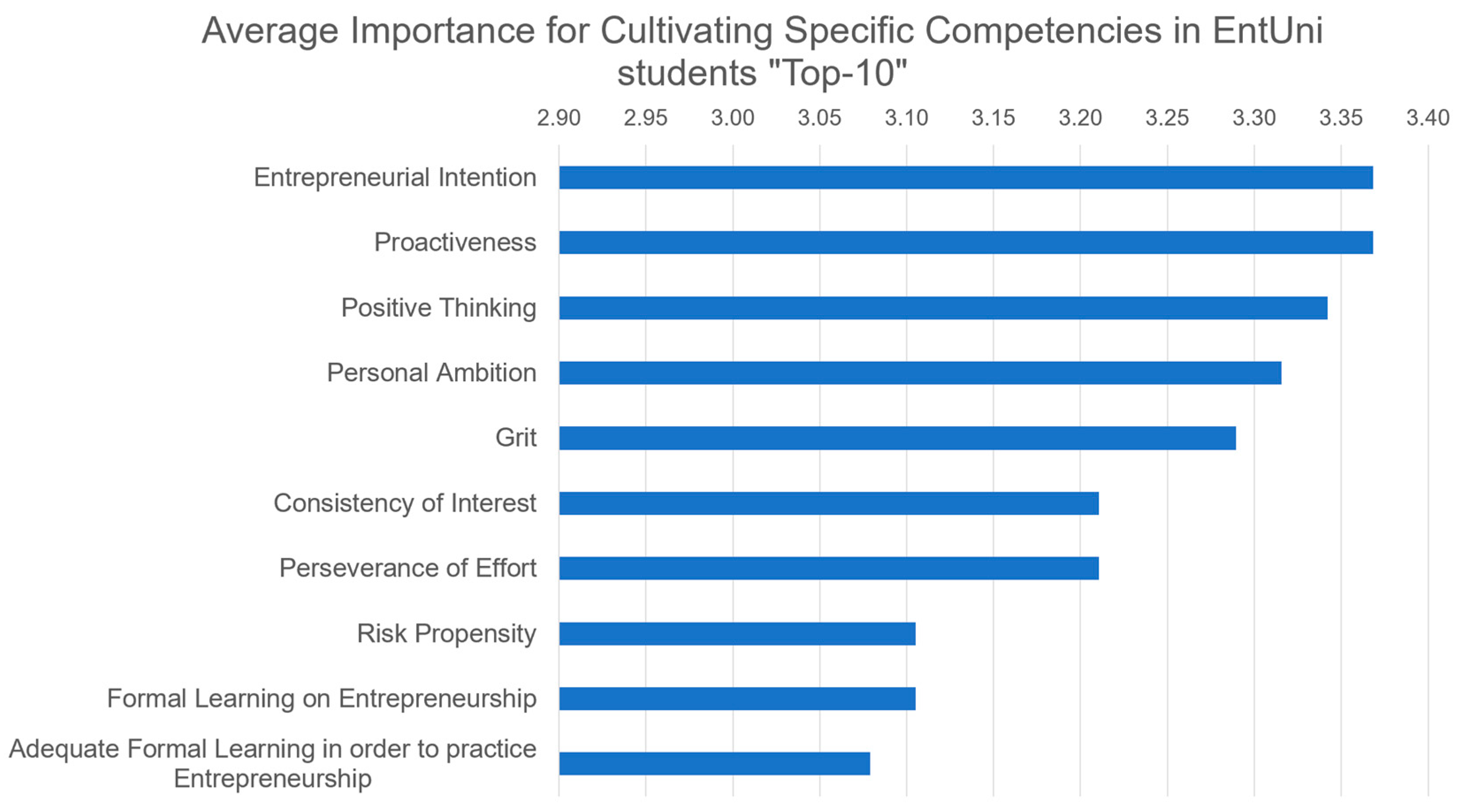
| 1 | Entrepreneurial Intention | 3.80 | 0.42 | 2.89 | 1.27 | 3.10 | 0.88 | 3.00 | 0.71 | 3.37 | 0.67 |
| 2 | Proactiveness | 3.20 | 0.63 | 2.89 | 1.17 | 2.80 | 1.03 | 2.78 | 0.67 | 3.37 | 0.67 |
| 3 | Positive Thinking | 3.50 | 0.97 | 3.11 | 1.27 | 3.10 | 0.88 | 2.56 | 1.13 | 3.34 | 0.75 |
| 4 | Personal Ambition | 3.20 | 1.03 | 2.89 | 1.45 | 2.80 | 1.03 | 2.78 | 1.20 | 3.32 | 0.84 |
| 5 | Grit | 3.40 | 0.70 | 2.78 | 1.30 | 2.80 | 0.92 | 2.56 | 1.01 | 3.29 | 0.80 |
| 6 | Consistency of Interest | 3.30 | 0.48 | 3.11 | 1.36 | 2.70 | 0.82 | 2.33 | 1.12 | 3.21 | 0.91 |
| 7 | Perseverance of Effort | 3.20 | 0.79 | 2.89 | 1.36 | 3.10 | 0.57 | 2.56 | 0.88 | 3.21 | 0.70 |
| 8 | Risk Propensity | 3.30 | 0.82 | 2.67 | 1.32 | 3.00 | 0.82 | 2.67 | 1.22 | 3.11 | 0.92 |
| 9 | Formal Learning on Entrepreneurship | 3.30 | 0.82 | 3.11 | 1.27 | 3.50 | 0.53 | 3.33 | 0.71 | 3.11 | 0.86 |
| 10 | Adequate Formal Learning in order to practice Entrepreneurship | 3.40 | 0.70 | 3.44 | 0.73 | 3.60 | 0.52 | 3.00 | 0.71 | 3.08 | 1.08 |
| 11 | Entrepreneurial Self-Efficacy | 3.70 | 0.48 | 3.00 | 1.22 | 3.00 | 0.67 | 2.56 | 0.73 | 3.08 | 0.88 |
| 12 | Entrepreneurial Experience | 3.50 | 0.71 | 3.00 | 1.22 | 2.80 | 1.03 | 3.11 | 0.60 | 3.08 | 0.78 |
| 13 | Personal Opinion on Entrepreneurship | 3.20 | 0.63 | 2.78 | 1.20 | 3.00 | 1.05 | 2.56 | 1.01 | 2.97 | 0.85 |
| 14 | Nascent Entrepreneurship Activity | 3.10 | 0.74 | 2.67 | 1.32 | 2.80 | 1.14 | 3.00 | 0.71 | 2.95 | 0.93 |
| 15 | Entrepreneurial Extra-Curricular Activities | 3.50 | 0.71 | 3.44 | 0.88 | 3.20 | 0.92 | 3.00 | 0.71 | 2.95 | 0.90 |
| 16 | Start-up Activities | 3.60 | 0.70 | 3.22 | 1.09 | 3.30 | 0.67 | 3.22 | 0.44 | 2.92 | 0.88 |
| 17 | Positive Attitude toward Venturing | 3.30 | 0.67 | 3.33 | 0.71 | 3.10 | 0.88 | 2.67 | 1.12 | 2.92 | 1.15 |
| 18 | Innovativeness | 3.60 | 0.52 | 3.56 | 0.53 | 3.20 | 0.92 | 3.11 | 0.60 | 2.92 | 1.05 |
| 19 | Market Orientation | 3.50 | 0.53 | 3.22 | 0.83 | 3.20 | 0.79 | 2.89 | 0.60 | 2.92 | 1.10 |
| 20 | Funding Opportunities | 3.20 | 0.92 | 2.67 | 0.71 | 2.80 | 0.92 | 3.11 | 1.05 | 2.89 | 1.01 |
| 21 | Venture support mechanisms | 3.20 | 0.79 | 3.11 | 0.93 | 3.00 | 0.82 | 3.00 | 0.71 | 2.89 | 0.98 |
| 22 | Adequate education on external obstacles to becoming an entrepreneur | 2.80 | 1.03 | 3.11 | 0.93 | 3.10 | 0.74 | 2.89 | 0.78 | 2.89 | 0.98 |
| 23 | Optimism, especially in view of unexpected difficulties or crises | 3.30 | 0.95 | 2.78 | 0.97 | 3.20 | 1.03 | 2.33 | 1.32 | 2.89 | 1.09 |
| 24 | Promoting the idea of self-employment vs. employed by an organization | 3.00 | 1.15 | 2.78 | 0.67 | 3.00 | 1.33 | 2.78 | 1.20 | 2.87 | 1.02 |
| Characteristics/Competencies | Experts | ||||||
|---|---|---|---|---|---|---|---|
| Industry (n = 10) | Academic (n = 9) | Industry vs. Academic | |||||
| Mean | S.D. | Mean | S.D. | Δ | Δ% | ||
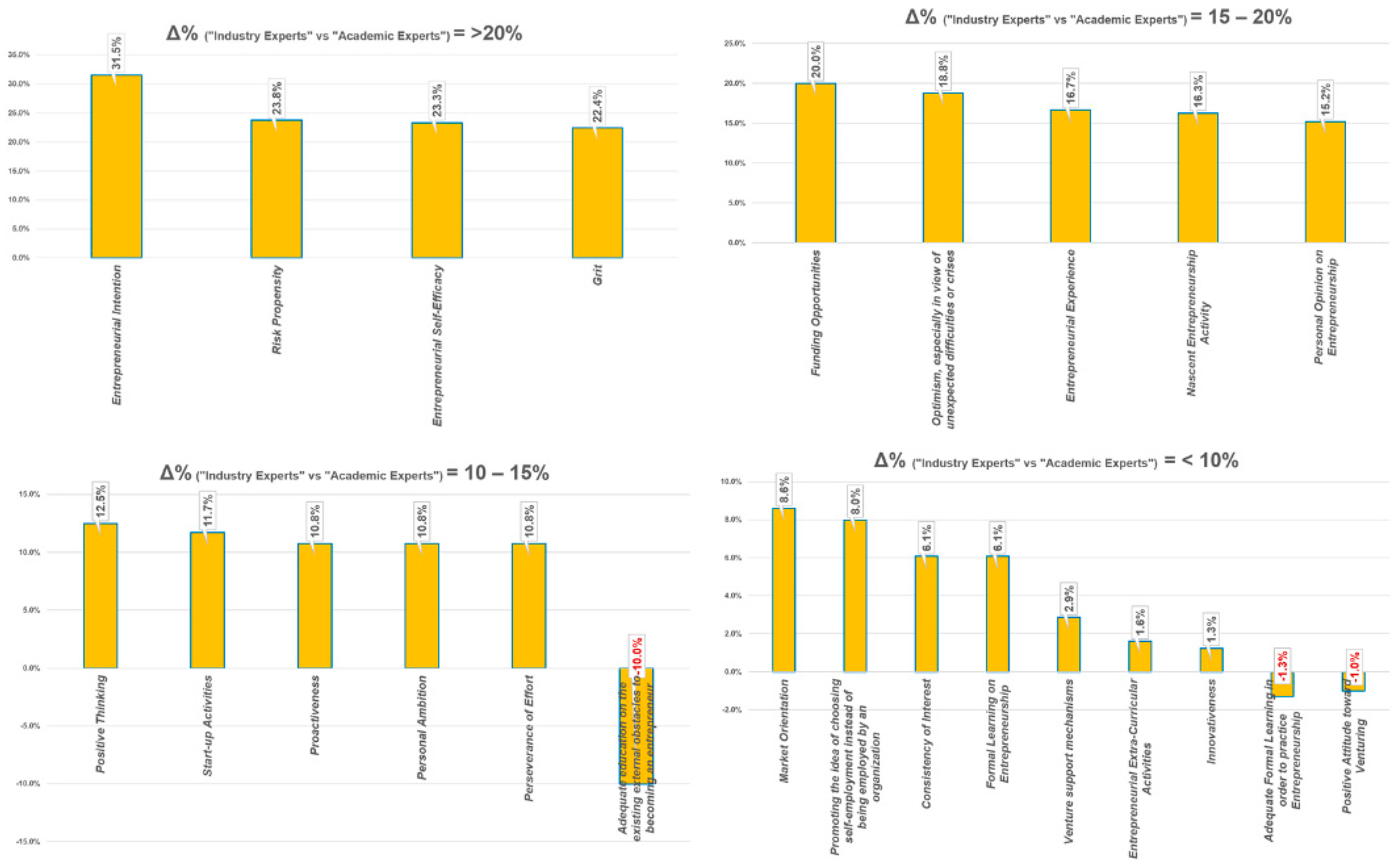
| 1 | Entrepreneurial Intention | 3.80 | 0.42 | 2.89 | 1.27 | 0.91 | 31.5% |
| 2 | Risk Propensity | 3.30 | 0.82 | 2.67 | 1.32 | 0.63 | 23.8% |
| 3 | Entrepreneurial Self-Efficacy | 3.70 | 0.48 | 3.00 | 1.22 | 0.70 | 23.3% |
| 4 | Grit | 3.40 | 0.70 | 2.78 | 1.30 | 0.62 | 22.4% |
| 5 | Funding Opportunities | 3.20 | 0.92 | 2.67 | 0.71 | 0.53 | 20.0% |
| 6 | Optimism, especially in view of unexpected difficulties or crises | 3.30 | 0.95 | 2.78 | 0.97 | 0.52 | 18.8% |
| 7 | Entrepreneurial Experience | 3.50 | 0.71 | 3.00 | 1.22 | 0.50 | 16.7% |
| 8 | Nascent Entrepreneurship Activity | 3.10 | 0.74 | 2.67 | 1.32 | 0.43 | 16.3% |
| 9 | Personal Opinion on Entrepreneurship | 3.20 | 0.63 | 2.78 | 1.20 | 0.42 | 15.2% |
| 10 | Positive Thinking | 3.50 | 0.97 | 3.11 | 1.27 | 0.39 | 12.5% |
| 11 | Start-up Activities | 3.60 | 0.70 | 3.22 | 1.09 | 0.38 | 11.7% |
| 12 | Proactiveness | 3.20 | 0.63 | 2.89 | 1.17 | 0.31 | 10.8% |
| 13 | Personal Ambition | 3.20 | 1.03 | 2.89 | 1.45 | 0.31 | 10.8% |
| 14 | Perseverance of Effort | 3.20 | 0.79 | 2.89 | 1.36 | 0.31 | 10.8% |
| 15 | Adequate education on external obstacles to becoming an entrepreneur | 2.80 | 1.03 | 3.11 | 0.93 | −0.31 | −10.0% |
| 16 | Market Orientation | 3.50 | 0.53 | 3.22 | 0.83 | 0.28 | 8.6% |
| 17 | Promoting the idea of self-employment vs. being employed by an organization | 3.00 | 1.15 | 2.78 | 0.67 | 0.22 | 8.0% |
| 18 | Consistency of Interest | 3.30 | 0.48 | 3.11 | 1.36 | 0.19 | 6.1% |
| 19 | Formal Learning on Entrepreneurship | 3.30 | 0.82 | 3.11 | 1.27 | 0.19 | 6.1% |
| 20 | Venture support mechanisms | 3.20 | 0.79 | 3.11 | 0.93 | 0.09 | 2.9% |
| 21 | Entrepreneurial Extra-Curricular Activities | 3.50 | 0.71 | 3.44 | 0.88 | 0.06 | 1.6% |
| 22 | Adequate Formal Learning in order to practice Entrepreneurship | 3.40 | 0.70 | 3.44 | 0.73 | −0.04 | −1.3% |
| 23 | Innovativeness | 3.60 | 0.52 | 3.56 | 0.53 | 0.04 | 1.3% |
| 24 | Positive Attitude toward Venturing | 3.30 | 0.67 | 3.33 | 0.71 | −0.03 | −1.0% |
| Theme | Key Insights | Verbatim Quotes |
|---|---|---|
| Importance of Teamwork | Experts emphasized that teamwork is often neglected in university training but is essential for entrepreneurship. | “We could have had a much better result and a much bigger impact if some teams worked together”/“Students find it hard to exist in teams. It takes them time to understand their role, what you give, what you take” |
| Lack of Hands-On Learning and Industry Exposure | Universities should integrate experiential learning opportunities to bridge the gap between academia and business reality. | “There is a need to connect academia with the business world. That’s where experience comes from”/“Mistakes will be made, but that’s how learning happens”/Through their training, students should gain experience. Which doesn’t exist and is what we generally say is missing” |
| Collaboration Between Academia and Industry | The disconnect between the two sectors leads to differing competency priorities. Experts suggested proactive collaboration. | “Academics see trends in science, but industry experts experience the market firsthand”/“The academic community should come closer to the industry and not be intimidated by partnerships”/”There are ways to get closer, as long as the academic community endorses it. I can’t say a specific suggestion for it, but it needs initiative from the academic community. I think the industry always has the will to come together”/“I think we’ve made a tentative start and we’re doing some things. We need to do them more methodically” |
| Risk Propensity | Universities should encourage students to take risks and shift from a failure-averse culture. | “We need to normalize risk-taking in universities. Failure should not be seen as punishment”/“Students are often too restrained. Universities should integrate risk-taking workshops”/“Your environment determines how easily you take your risks, so I think at a level of education, universities can show what risk-taking means. Show different risks you can take—some bigger, some smaller”/“As a university, you can teach theoretically why it is worth taking at least one risk in life!”/“A university can see how much students are doing experiments, whether they’re taking initiative on things knowing that the risk is there too. I can only think of one thing that can even slightly influence this part—specific workshops at a targeted point in the process” |
| Self-Efficacy | Experts emphasized building confidence in students through progressive skill development. | “As a soft skill, self-efficacy should be reinforced through structured learning.”/“A student must feel competent and empowered to operate in the real world.”/“Students should feel that they have the tools to be strong and the knowledge to operate.”/“It is something trainable—you start from not knowing anything and, through knowledge, begin to understand the powers you have and how far you can go.” |
| Ethical and Sustainable Thinking | Entrepreneurship education should include social responsibility and sustainability. | “There should be a logic of impact—not as social action, but as an entrepreneurial responsibility.”/“As an entrepreneur, I must be able to see and recognize the impact I have on society. Not to make the solution for the solution’s sake, but a solution for the whole”/“Training should emphasize sustainability in entrepreneurship endeavors” |
| Ambiguity Tolerance | Experts highlighted the need to teach students how to manage uncertainty and failure. | “Universities can’t only give students positive reinforcement. Teaching how to manage failure is crucial”/“I don’t know if that is or isn’t trainable. Management of failure should not conclude with ‘my idea didn’t work.’ Instead, it should be ‘it didn’t work, so let’s find another idea or solution” |
| Self-Control | Developing patience and self-discipline is crucial for entrepreneurial success. | “The ability to cultivate patience and self-control is one of the key skills that even companies look for, and it needs to be developed.”/“Self-control is an important trait that is lacking in our culture and in university training.” |
| Mobilizing Others | The ability to inspire and motivate others is fundamental for entrepreneurial leadership. | “Seeing people who motivate us and actually being inspired by them to do better for ourselves and those around us is very important. But normally the first thing to teach is not being selfish! It is a priority. To motivate yourself first, to show something better. So, accordingly, after that, regardless of what you’ve done first, affects the people you have around you.” |
| Creativity | An entrepreneurial university should aim for a culture of creativity and innovation over quick results. | “An entrepreneurial university should create a mindset of a group of people so that they can move a little bit more collectively and have in their minds more intensively the part of creation and not so much the quick result.” |
Disclaimer/Publisher’s Note: The statements, opinions and data contained in all publications are solely those of the individual author(s) and contributor(s) and not of MDPI and/or the editor(s). MDPI and/or the editor(s) disclaim responsibility for any injury to people or property resulting from any ideas, methods, instructions or products referred to in the content. |
© 2026 by the authors. Licensee MDPI, Basel, Switzerland. This article is an open access article distributed under the terms and conditions of the Creative Commons Attribution (CC BY) license.
Share and Cite
Chronaki, V.; Karagiannaki, A.; Kotsopoulos, D. How to Spot an Entrepreneurial University? A Student-Focused Perspective on Competencies—The Case of Greece. Educ. Sci. 2026, 16, 145. https://doi.org/10.3390/educsci16010145
Chronaki V, Karagiannaki A, Kotsopoulos D. How to Spot an Entrepreneurial University? A Student-Focused Perspective on Competencies—The Case of Greece. Education Sciences. 2026; 16(1):145. https://doi.org/10.3390/educsci16010145
Chicago/Turabian StyleChronaki, Vasiliki, Angeliki Karagiannaki, and Dimosthenis Kotsopoulos. 2026. "How to Spot an Entrepreneurial University? A Student-Focused Perspective on Competencies—The Case of Greece" Education Sciences 16, no. 1: 145. https://doi.org/10.3390/educsci16010145
APA StyleChronaki, V., Karagiannaki, A., & Kotsopoulos, D. (2026). How to Spot an Entrepreneurial University? A Student-Focused Perspective on Competencies—The Case of Greece. Education Sciences, 16(1), 145. https://doi.org/10.3390/educsci16010145