1. Introduction
The idea of corporate social responsibility (CSR) has gradually transitioned from being a minor issue for managers to becoming a core component of sustainable business strategies in developed and developing nations. While CSR has received considerable academic focus, it is still an ever-changing construct, especially when it comes to explaining differences in businesses’ social and environmental activities. The initial literature has mainly concentrated on the effects of firm characteristics such as size, leverage, and profitability on CSR (
Abdeljawad et al., 2026). Nevertheless, this micro approach has been criticized by more recent studies highlighting the crucial part played by macro-institutional contexts in influencing corporations’ actions (
Udayasankar, 2008).
In the context of institutions, governance quality has proved to be an important factor behind CSR practices. Good institutional governance, especially government efficiency and regulatory quality, determines the effectiveness of enforcement measures and regulatory processes. Effective governance is associated with greater accountability and CSR engagement while ineffective governance decreases compliance pressure and allows management discretion that may hinder CSR involvement (
Salem et al., 2025).
In terms of the Palestinian case, there is an increasing emphasis on the need for good governance and transparency by regulatory bodies like the
Palestinian Capital Market Authority (
2023). However, the ability of effective governance is hampered by issues such as fragmentation of institutions, weak enforcement power, as well as political and economic instability. The existing literature on the subject suggests that there is always a tendency for the role of governance structures to be undermined by poor enforcement and institutional weakness. This causes firms in such environments to adopt different strategies (
Salem et al., 2025;
Alia et al., 2025). This brings about the issue of whether governance effectiveness can influence the outcome of CSR activities.
Though significant, the connection between governance and CSR has yet to be adequately explored. This is because the research conducted on this issue relies heavily on institutional settings that do not change easily, which makes the results found in such studies difficult to generalize for fragile environments, whose characteristics make them prone to institutional challenges all the time. At the same time, the concept of governance is often examined through indexes and separate dimensions, thus masking its complexity and interconnectedness as an institutional framework. This is especially true since the connection between governance and CSR is usually viewed statically (
Abdeljawad et al., 2024;
Awwad et al., 2024).
Although previous studies have extensively examined the direct relationship between governance quality and CSR, limited attention has been devoted to explaining how institutional governance quality and digital transformation interact to shape firms’ CSR performance. Existing research has primarily focused on the independent effects of governance quality and digital transformation, while overlooking their potential interaction in influencing CSR outcomes. Moreover, empirical evidence from fragile institutional environments remains scarce, despite their distinctive institutional characteristics and governance challenges, leaving important theoretical, contextual, and empirical questions insufficiently explored.
From this perspective, digital transformation opens up an important but understudied area. With digital technology having the capacity to increase transparency, improve information dissemination, and improve monitoring and enforcement capabilities, digital transformation could play an instrumental role in transforming the effectiveness of institutions and altering how governance impacts firm actions (
Abdelhaq et al., 2025;
Awwad & El Khoury, 2024). Nonetheless, the contribution of digital transformation as a contextual variable in the relationship between corporate governance and CSR is still an unexplored area in the literature, especially in settings characterized by weak institutions. This research gap is particularly important in emerging stock markets such as the Palestine Exchange.
Beyond its governance implications, digital transformation represents a core pillar of the emerging digital economy in developing countries. In fragile institutional environments, digitalization contributes not only to improving corporate transparency and monitoring mechanisms, but also to enhancing economic integration, innovation capacity, and sustainable business competitiveness. Recent literature increasingly recognizes that the digital economy can reshape institutional efficiency and accelerate sustainable development outcomes by facilitating information accessibility, stakeholder connectivity, and organizational adaptability (
Jin et al., 2024;
Wei & Zheng, 2024;
Awwad, 2023;
Awwad & Zaid, 2026;
Alsaffarini & Awwad, 2026b). Therefore, examining the interaction between institutional governance quality and digital transformation provides important insights into how firms in emerging economies can improve CSR performance while simultaneously adapting to the broader transition toward digitally driven economic systems.
Addressing these limitations requires a context-sensitive approach and a robust empirical model capable of identifying both structural and dynamic effects. Accordingly, the present study employs a panel-data approach to analyze the relationship between corporate governance and CSR amongst publicly traded Palestinian corporations.
This study makes three main contributions to the existing literature. First, it extends the governance–CSR literature by examining how digital transformation moderates the relationship between institutional governance quality and CSR performance, an issue that has received limited attention in fragile institutional environments. Second, it contributes methodologically by integrating firm-level panel data with country-level institutional indicators and employing complementary estimation techniques, including fixed-effects, robustness analyses, and dynamic System GMM estimation to enhance the reliability of the findings. Third, it provides novel empirical evidence from Palestine, a fragile emerging economy that remains substantially underrepresented in the international CSR and governance literature, thereby offering context-specific insights for both researchers and policymakers.
The study employs fixed-effects models with year dummies to control for firm-specific heterogeneity and uses clustered standard errors to address serial correlation in the error terms (
Arellano, 1987;
Wooldridge, 2010).
In addition to the static estimations, the study utilizes a dynamic estimation technique by applying the System GMM model to deal with any endogeneity issues and account for the effect of persistence in CSR performance (
Arellano & Bover, 1995;
Blundell & Bond, 1998). The use of this method helps mitigate endogeneity concerns and strengthens the robustness of the empirical analysis. Most notably, the interaction term between institutional governance quality and digital transformation (IGQ × DIG_TRANS) is positive and statistically significant in the baseline fixed-effects model, indicating that digital transformation strengthens the positive association between governance quality and CSR performance. This finding remains robust across alternative static model specifications and clustered standard error estimations. However, the dynamic System GMM estimation yields a different sign for the interaction coefficient after controlling for endogeneity and the persistence of CSR performance, reflecting the ability of dynamic panel estimators to account for these econometric issues and capture the dynamic nature of the relationship (
Arellano & Bover, 1995;
Blundell & Bond, 1998;
Wooldridge, 2010).
Together, the evidence implies that CSR outcomes in fragile institutional environments cannot be attributed solely to governance quality; rather, they are shaped by the interaction between institutional governance and technological change. This research makes an important contribution to the existing body of knowledge in CSR development, especially when institutional weaknesses are considered, as it incorporates institutional, contextual, and technological aspects into one empirical analysis.
2. Literature Review and Hypothesis Development
2.1. Literature Review
The link between institutional governance and corporate social responsibility (CSR) has gained considerable interest among scholars in both theory and practice. Governance quality relates to the adequacy of formal institutions, regulation, and law enforcement processes that impact business activity (
Kaufmann et al., 2011). Meanwhile, CSR is defined as the degree to which organizations incorporate social and ecological factors into their business activities above minimum legal obligations (
European Commission, 2011). An increasing number of studies indicate that governance quality acts as a critical determinant of CSR implementation through incentive, deterrent, and oversight systems (
Lojpur & Draskovic, 2013). In addition, governance facilitates greater transparency and accountability, thus motivating organizations to improve their CSR reporting and stakeholder management activities (
Jain & Jamali, 2016;
Abdeljawad et al., 2026).
There has been growing recognition of the importance of good governance in enhancing CSR performance and disclosure, particularly in emerging and developing countries. For example, Abdeljawad et al., governance factors have an important effect on companies’ disclosures and financial decisions made strategically in emerging countries. In addition, Abdelhaq et al. suggest that good governance can increase the efficiency and effectiveness of the organization by increasing supervision and lowering the tendency for managerial opportunistic behavior.
With regard to CSR disclosure, the previous literature indicates that firms in developing countries are subject to institutional influences that shape their CSR engagement differently from firms operating in developed economies (
Awwad et al., 2026b). For example,
Alia et al. (
2025) found that firm-specific and governance-related factors significantly influence CSR disclosure practices among Palestinian listed firms. Similarly,
Salem et al. (
2025) reported that board and organizational characteristics are important determinants of variations in CSR disclosure among Palestinian firms.
However, despite the growing body of literature on governance and CSR, existing findings remain fragmented, particularly in fragile institutional environments characterized by regulatory instability and weak enforcement mechanisms. In developing countries, CSR research is still considered an emerging field shaped by contextual institutional, economic, and social conditions, which may substantially influence corporate sustainability practices (
Jamali & Karam, 2018;
Awwad, 2022). Therefore, understanding CSR behavior in fragile emerging economies requires greater attention to contextual governance and technological dynamics.
Previous literature has also acknowledged the role of transparency, stakeholder communications, and information technology skills in improving the results of CSR initiatives.
Du et al. (
2010) maintained that proper CSR communication can help in increasing the strategic and reputational gains for the company by enhancing the level of stakeholder trust and communication. Moreover,
Kang and Moon (
2012) noted that there is a difference in the institutional complementarities of the corporate governance system and the CSR framework in different institutional environments, which means that the success of corporate governance mechanisms is largely dependent on institutional conditions.
Taken together, agency theory, stakeholder theory, legitimacy theory, and institutional theory provide complementary explanations for firms’ CSR behavior. Agency theory emphasizes governance mechanisms that reduce information asymmetry and managerial opportunism, whereas stakeholder theory highlights firms’ responsibilities toward diverse stakeholder groups. Legitimacy theory explains CSR as a means of maintaining social acceptance and organizational legitimacy. Institutional theory further suggests that firms operate within broader governance environments that shape organizational behavior through regulatory, normative, and cognitive pressures. Accordingly, improvements in institutional governance quality are expected to create stronger incentives and expectations for firms to engage in CSR activities, particularly in emerging market settings where institutional structures play a critical role in shaping corporate conduct.
Among these theoretical perspectives, institutional theory provides the primary foundation for the present study because the main explanatory variable, institutional governance quality, operates at the national level and reflects the broader institutional environment within which firms operate. Agency theory, stakeholder theory, and legitimacy theory complement this perspective by explaining how firms respond to institutional pressures through governance mechanisms, stakeholder engagement, and legitimacy-seeking behaviors. Consequently, the hypotheses are primarily derived from institutional theory, while the remaining theories provide supporting explanations for the expected firm-level responses.
Although prior studies generally report a positive association between governance quality and CSR performance, the empirical evidence remains far from conclusive. Differences in institutional settings, governance structures, regulatory environments, and CSR measurement approaches have produced mixed findings across developed and emerging economies. These inconsistencies suggest that the governance–CSR relationship may depend on contextual and institutional conditions that have not yet been adequately explored.
Moreover, previous studies have reached inconsistent conclusions regarding the mechanisms through which governance quality influences CSR. While some studies report strong positive effects, others document weak or insignificant relationships, suggesting that contextual factors may condition this relationship. This unresolved debate provides a strong motivation for examining the potential moderating role of digital transformation.
2.2. Hypothesis Development
This study draws on an integrated theoretical framework integrating agency theory, stakeholder theory, and legitimacy theory to provide explanations for the manner through which institutional governance influences CSR behaviors, especially in weak institutional settings.
In terms of the agency theory approach, the governance systems within a country become external checks that limit managerial opportunism as well as minimize information asymmetry (
Jensen & Meckling, 1976;
Awwad & Rimawi, 2025) the existence of effective governance becomes instrumental in ensuring that managers are limited in terms of their discretion, with their decisions being aligned with wider society goals. In essence, CSR becomes the result of effective external control of business entities.
In complement to this theory, stakeholder theory focuses on the fact that companies exist within a system of various stakeholders whose expectations determine the actions taken by corporations (
Freeman, 2010). Good governance impacts both the level of pressure exerted by these stakeholders and its success, thanks to increased levels of transparency, disclosure, and public monitoring of corporate activities. As a result, in cases of good governance, stakeholders, such as regulatory bodies, shareholders, and NGOs, become able to push corporations into being socially responsible (
Marquis & Raynard, 2015).
From the perspective of legitimacy theory, CSR acts as an instrument for companies to align with institutional norms and receive social approval (
Suchman, 1995). Legitimacy, in environments with high levels of governance, can be achieved through conforming to the institutional environment. However, in weak institutions and environments, companies might use CSR as an alternative tool for signaling their legitimacy in the presence of uncertainty (
Palazzo & Scherer, 2006).
Collectively, these approaches offer a synergistic and multi-level model for understanding CSR. The agency approach emphasizes the function of governance in limiting managerial freedom, the stakeholder approach sheds light on how governance intensifies external pressures, and the legitimacy approach underscores firms’ reaction strategies to institutional demands. Such an integrative approach finds its relevance in situations where institutions are weak and where governance mechanisms are fragmented.
Institutional theory provides the primary theoretical foundation for the direct relationship between institutional governance quality and CSR performance, as it explains how the quality of national institutions shapes firms’ strategic behavior. Stakeholder theory and legitimacy theory complement this perspective by explaining why firms respond to institutional pressures through greater CSR engagement to satisfy stakeholder expectations and maintain organizational legitimacy. Agency theory further supports the governance mechanisms through which effective institutional environments reduce managerial opportunism and encourage socially responsible decision-making. Finally, the moderating role of digital transformation is primarily grounded in institutional theory, as digitalization strengthens institutional effectiveness through improved transparency, information accessibility, and regulatory capacity.
2.2.1. Institutional Governance Quality (IGQ) and CSR Performance
In the current investigation, governance quality is defined as an integrated variable that represents the influence exerted by both GE and RQ. The former refers to the effectiveness of governments in designing and implementing good policies, whereas the latter refers to the capability of the government to develop and enforce regulations that promote the functioning of the market (
Abdeljawad et al., 2026).
Instead of studying GE and RQ in isolation, the current analysis will adopt an integrated model by considering IGQ to represent the effect of interactions between policy capacity (GE) and regulatory design (RQ). This approach provides an effective solution to a problem encountered in the previous literature, where governance quality variables were studied in isolation (
Salem et al., 2025).
In theory, the union between GE and RQ offers the capabilities and processes required for good governance. The efficiency of implementation and rule-setting or incentivization are guaranteed by government effectiveness and regulatory quality, respectively. They foster an environment that encourages CSR engagement because accountability, transparency, and compliance are emphasized in this context (
Awwad et al., 2023,
Alsaffarini & Awwad, 2026a).
There is empirical evidence on the connection between governance and CSR, proving that more robust governance systems lead to more significant CSR activity due to better monitoring and enforcement along with increased stakeholder influence (
Ioannou & Serafeim, 2012). Given the weakness of institutional arrangements in Palestine, which is characterized by an inconsistent and dynamic governance system, it is expected that GE and RQ will exert considerable influence in this situation (
Abdelhaq et al., 2026).
H1. Institutional governance quality (IGQ), measured as the combined effect of government effectiveness and regulatory quality, is positively associated with CSR performance among Palestinian-listed firms.
2.2.2. Digital Transformation as a Moderating Mechanism
Whereas good governance is considered the institutional basis for CSR, its effectiveness might be contingent on certain structural prerequisites. Digital transformation emerges as an important contextual variable that affects how governance practices are conducted (
Jin et al., 2024).
Digital transformation enhances transparency, information flows, and monitoring and enforcement capabilities. From the agency theory perspective, digital transformation reduces information asymmetry and strengthens governance processes. From the stakeholder theory perspective, it enhances stakeholder awareness and participation. From the legitimacy theory perspective, it increases reputational pressures on firms to engage in socially responsible behavior (
Awwad et al., 2025,
2026a;
BinSaddig et al., 2026).
It should be noted that the digital transformation process may improve the efficiency of governance through institutional capacity. In conditions where governance practices are weak or restricted, digital technology can balance out by ensuring increased transparency and accountability. Therefore, digital transformation is not only a separate driver of corporate social responsibility but also acts as a conditional factor that increases the effect of governance on CSR (
Jarrar et al., 2026).
Notwithstanding its significance, the conditional effect of digital transformation is poorly explored in academic literature, especially within a fragile institutional environment. In the Palestinian case, which suffers from low governance capacity but experiences growing digital technology penetration, digital transformation should facilitate the governance-CSR association.
The relationship between institutional governance quality and CSR performance is expected to operate through several interrelated mechanisms. Higher governance quality enhances regulatory effectiveness, policy consistency, transparency, and accountability, thereby encouraging firms to adopt socially responsible practices. At the same time, digital transformation can strengthen these mechanisms by facilitating information disclosure, improving stakeholder communication, increasing monitoring capabilities, and reducing information asymmetries. As a result, digitalization may amplify the effectiveness of governance institutions in promoting CSR engagement, making firms more responsive to societal expectations and sustainability objectives.
Digital transformation is expected to strengthen, rather than merely influence, the relationship between institutional governance quality and CSR performance because it improves the effectiveness of institutional governance mechanisms. Digital technologies enhance transparency, facilitate timely information flows, reduce information asymmetry, improve stakeholder participation, and increase monitoring and regulatory efficiency. Consequently, firms operating within digitally advanced institutional environments are expected to translate improvements in governance quality into stronger CSR performance than firms operating in less digitalized environments.
H2. Digital transformation positively moderates the relationship between institutional governance quality (IGQ) and CSR performance, such that the relationship becomes stronger at higher levels of digital transformation.
2.2.3. Conceptual Framework of the Study
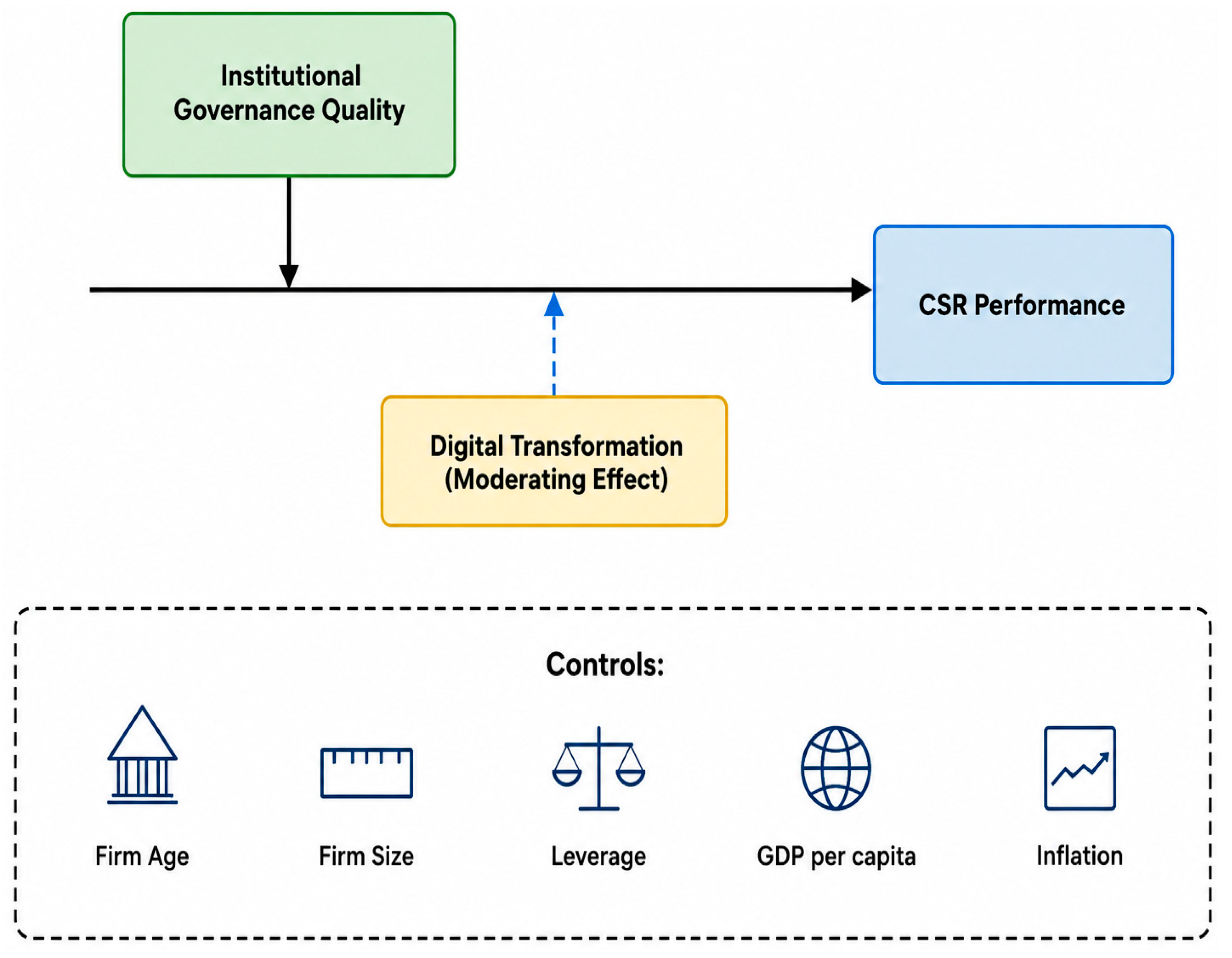
Based on the theoretical foundations and hypothesis development discussed above,
Figure 1 presents the conceptual framework of the study, illustrating the proposed relationships among the independent, moderating, dependent, and control variables.
3. Methodology
3.1. Sample and Population
The empirical context of this research is the Palestine Exchange (PEX), which constitutes the sole organized stock exchange in Palestine and acts as the main arena for corporate financing and disclosures. The data comprises all listed firms, irrespective of their industrial classification, over the period 2014–2024, including financial institutions such as banks, insurers, investments, as well as manufacturing and service providers. The diversity in economic activities makes the selected sample representative and allows us to conduct a thorough examination of CSR practices.
Following the removal of outliers and data inconsistencies, the final dataset consists of an unbalanced panel of 469 firm-year observations from 43 listed firms. The unbalanced nature of the panel reflects the entry and exit of firms from the Palestine Exchange (PEX) during the study period, as well as variations in the availability and consistency of CSR disclosures across firms. In addition, some firms did not consistently report CSR expenditure throughout the study period, resulting in missing observations and, consequently, an unbalanced panel.
It should be noted that the descriptive statistics are based on all available observations in the dataset (473 firm-year observations). However, the regression analyses use a slightly smaller effective sample (469 firm-year observations) due to the automatic exclusion of observations with missing values in one or more variables included in the estimation models.
In order to enhance the credibility of within-firm regressions and mitigate the risk of possible biases due to a lack of observations, those firms that had fewer than two years of data were dropped from the sample. By employing this strategy, it becomes possible to increase the accuracy of fixed-effect estimation because there is enough variability for each individual firm over time. In general, the panel nature of the study allows us to leverage cross-sectional differences between firms and within-firm changes over time.
Differences in the number of observations reported across certain tables arise from the estimation requirements of specific analytical techniques. While the descriptive statistics and baseline regressions are based on the full available sample after data cleaning and outlier treatment, dynamic estimations such as System GMM require lagged variables, which naturally reduce the number of usable observations. Accordingly, variations in sample size across tables reflect methodological requirements rather than inconsistencies in the dataset.
3.2. Data Sources
The data were gathered from several sources for accuracy and reliability. Financial information about each firm as well as their CSR details were collected through manual data extraction from the annual report available at the official website of Palestine Exchange. The data about their CSR was collected through a content analysis method concentrating on expenditures for various social and community initiatives.
The data regarding institutional governance were gathered from the World Bank’s Worldwide Governance Indicators (WGI), which provide yearly data regarding the level of governance. In the current paper, the governance quality is measured through the IGQ, the combined index of government effectiveness and regulatory quality, considering the fact that they are mutually exclusive (
Salem et al., 2025).
Macroeconomic control variables, including INFLATion and GDP per capita, were collected from the World Bank’s World Development Indicators (WDI) database.
3.3. Variables
Dependent Variable: CSR Performance
The level of CSR is estimated using the corporate social responsibility expense, after the line followed by previous empirical research (
Jarrar et al., 2026;
Abdelhaq et al., 2025;
Salem et al., 2025). Specifically, CSR refers to the amount of money spent by companies in relation to corporate social responsibility activities mentioned in their annual reports. These expenses are usually related to donations, corporate community projects, employee welfare activities, and sustainability initiatives, thus creating a numeric proxy for the CSR of companies.
In order to cope with skewness and facilitate comparability between firms, the variable is subjected to natural log transformation (LogCSR). Such an approach is commonly employed within the literature to deal with extremely skewed data and to minimize the impact of outliers. In addition, such a transformation makes it possible to account for potential differences between firms in their size and focus on relative CSR investments rather than the absolute amount of CSR investments.
The use of CSR expenditure as a proxy for CSR performance is particularly appropriate in the Palestinian context, where standardized ESG ratings and comprehensive sustainability performance databases are not available for listed firms. Consistent with prior studies conducted in emerging markets, CSR expenditure provides a tangible and quantifiable measure of a firm’s commitment to social responsibility initiatives because it reflects actual resource allocation toward community development, employee welfare, charitable activities, and sustainability-related programs. Nevertheless, it is acknowledged that CSR performance is inherently multidimensional and extends beyond financial expenditures to include environmental practices, stakeholder engagement, governance quality, sustainability reporting, and broader social impacts. Therefore, the results should be interpreted within the scope of CSR investment behavior rather than as a comprehensive measure of all dimensions of corporate social responsibility.
3.3.1. Independent Variable: Institutional Governance Quality (IGQ)
Institutional governance quality (IGQ) serves as the principal independent variable, measured as the mean of government effectiveness (GE) and regulatory quality (RQ) scores obtained from the Worldwide Governance Indicators (WGI) database. The former measures the efficiency of public institutions in formulating and implementing appropriate policies, whereas the latter evaluates the competence of governments in establishing rules that support markets (
Singh & Pradhan, 2022).
Combining the two indicators in a single measure allows for a comprehensive consideration of governance as an integrated system rather than a collection of individual factors. Such an approach seems quite appropriate in the present context as it enables assessing both the level of development and the quality of governance at once. Higher scores on IGQ suggest more advanced institutional environments where there is greater effectiveness in policy-making and regulation, potentially affecting firm responsibility and CSR activities (
Masyk et al., 2023).
Similarly, institutional governance quality is conceptualized as a country-level institutional characteristic rather than a firm-specific attribute. Since all firms operate under the same national institutional framework in a given year, temporal changes in governance quality reflect changes in the institutional environment affecting all listed firms simultaneously. Accordingly, the estimated coefficients capture the influence of changes in the national governance environment over time rather than differences between firms within the same year.
3.3.2. Moderating Variable: Digital Transformation
Digital transformation (DIG_TRANS) is taken into account as a moderator and is measured for countries using indicators of national digitalization that were taken from the database of World Bank Development Indicators (
World Bank, 2025). The measurement includes indicators of fixed broadband subscriptions, exports/imports of ICT goods, mobile cellular subscriptions, and secure internet servers, and these all characterize the extent to which digitalization exists in an economy.
Taking digital transformation into consideration is due to the significance of this phenomenon in influencing company transparency and corporate governance processes (
Chen & Hao, 2022). The higher digitalization of the nation facilitates better accessibility of information, improves interactions between stakeholders, and increases monitoring and regulation efficiency. In other words, digital transformation is expected not only to have a direct impact on CSR processes but also to moderate the relationship between the quality of institutional governance and the outcomes of CSR processes (
Zhang et al., 2024;
World Bank, 2025).
The digital transformation measure was constructed as a composite index based on five indicators obtained from the World Development Indicators (WDI) database: secure internet servers (per 1 million people), mobile cellular subscriptions, ICT goods imports (% of total goods imports), ICT goods exports (% of total goods exports), and fixed broadband subscriptions (per 100 people). These indicators were selected because they capture different dimensions of national digital infrastructure, connectivity, and technological integration. Following data collection, the indicators were aggregated using an equal-weight averaging approach to generate a single digital transformation index. This approach was adopted due to the limited availability of digitalization indicators for Palestine and has the advantage of providing a comprehensive measure of the country’s overall digital development.
Although digital transformation is ultimately manifested through firms’ digital practices, the present study focuses on the broader national digital environment within which firms operate. The country-level digitalization indicators employed in this study capture the institutional digital infrastructure available to all firms, including internet accessibility, ICT connectivity, digital communication networks, and technological readiness. These national conditions constitute enabling resources that facilitate firms’ digital transformation and shape their capacity to implement governance mechanisms, enhance transparency, and strengthen CSR activities. Therefore, the country-level digital transformation index is interpreted as a contextual institutional characteristic rather than a direct measure of firm-level digital capability.
3.3.3. Control Variables
In order to determine the impact of governance on corporate social responsibility (CSR) performance, control variables are included in the analysis, drawing from past empirical studies.
In the case of the firm-level control variables, size is measured as the natural log of total assets (LnTA). Size measures firms’ resources and public recognition, and these factors are positively correlated with CSR involvement. The variable age is measured using the natural log of years since the formation of the organization (LnAge). This variable measures organizational maturity and the presence of relationships within organizations. The profitability variable is measured using return on assets (ROA). It is a proxy for the performance of firms, implying that firms can distribute their resources towards CSR practices. Leverage is measured using the natural log of total debt (LnLeverage).
In terms of country-level characteristics, the INFLATion rate (INF) is added to address any macroeconomic instabilities that could impact firms’ financial and strategic considerations, especially concerning sustainability and long-term developmental goals (
Bachtijeva et al., 2024). The variable GDP per capita (GDPpc) serves as an indicator of the extent of economic development because it represents macroeconomic factors that can impact organizational behavior and effectiveness and the ability of the country to meet the SDGs (
Bancu & Dăscălu, 2024). In effect, these variables will take care of both firm-level and macroeconomic effects that could affect firms’ performance in terms of CSR initiatives, in accordance with recent findings on the topic (
Yang & Jin, 2024).
3.4. Model Specification
To examine the relationship between institutional governance quality and CSR performance, the following panel regression model is estimated:
where
CSRPRFCEit represents CSR performance for firm i in year t
IGQt denotes institutional governance quality
DIG_TRANSit captures country-level digital transformation
IGQt × DIG_TRANSit represents the interaction term capturing the moderating effect
F_SIZEit is firm size measured by the natural logarithm of total assets
F_AGEit is firm age measured by the natural logarithm of years since establishment
LVRGit represents firm leverage
GDPCt denotes GDP per capita
INFLATt represents the INFLATion rate
αi captures firm-specific fixed effects
δt captures year fixed effects
εit is the error term
It is important to clarify the identification strategy underlying the inclusion of country-level variables in the panel specification. Since the study is conducted within a single-country setting, institutional governance quality, GDP per capita, and INFLATion do not vary across firms in the same year; rather, they vary over time and capture changes in the national institutional and macroeconomic environment faced by all listed firms. Accordingly, the coefficients of these variables should be interpreted as reflecting the effect of temporal changes in the Palestinian institutional and macroeconomic context on firms’ CSR performance, after controlling for unobservable time-invariant firm characteristics. Firm fixed effects are therefore included to absorb stable firm-level heterogeneity, such as managerial culture, ownership structure, and sector-specific reporting tendencies, while the country-level variables are identified through their year-to-year variation. To avoid potential identification problems, the specification was carefully re-examined, and the use of time controls was treated cautiously so that country-year variables would not be fully absorbed by unrestricted year effects. Moreover, multicollinearity was assessed using both the correlation matrix and variance INFLATion factor (VIF) tests. The results indicate that the correlations among the main explanatory variables remain below conventional thresholds and that the VIF statistics do not suggest severe multicollinearity. Therefore, the empirical specification is theoretically justified and econometrically appropriate for examining how changes in national governance quality and macroeconomic conditions are associated with CSR performance among Palestinian listed firms.
The empirical model is estimated using a fixed-effects regression model to take care of unobservable heterogeneity between firms. It becomes important especially since governance variables change over time but remain constant among different firms in any particular year. Fixed effects year is included to take care of shocks due to macroeconomic conditions.
Standard errors are adjusted for clustering at the firm level in order to consider possible serial correlations and heteroskedasticity in firms over time.
Model 1 examines the direct effects of institutional governance quality and digital transformation on CSR performance, whereas Model 2 additionally incorporates the interaction term between IGQ and DIG_TRANS to test the proposed moderating effect.
4. Results
4.1. Descriptive Statistics
From
Table 1 below, we get an initial impression regarding the main characteristics of the variables studied along with variations in their values from firm to institution and from institution to economic context. As for CSR performance (CSRPRFCE), there is high variation based on the high value of standard deviation (5.492) relative to the mean (4.434), which implies heterogeneous involvement in CSR initiatives among Palestinian listed companies (
Alia et al., 2025;
Salem et al., 2025). This can be explained by the fact that CSR initiatives are not mandatory but voluntary in emerging markets (
Zaman et al., 2022).
Regarding the institution dimension, the negative mean value of IGQ (−0.358) indicates poor quality of governance in the country under study relative to the worldwide average. This result agrees with the findings of
Kaufmann et al. (
2011), according to whom governance in fragile and developing economies is always worse than in advanced nations because of institutional constrains. Low variation in IGQ further reveals that conditions for governance in Palestine have remained more or less similar over time due to institutional constrains (
Lojpur & Draskovic, 2013;
Abdelhaq et al., 2025).
The DIG_TRANS variable exhibits relatively low dispersion, indicating that the level of national digital transformation improved gradually over the study period. This pattern is consistent with evidence from developing economies, where digital transformation typically evolves incrementally rather than through abrupt changes. Previous studies also suggest that improvements in the national digital environment enhance transparency, information accessibility, and governance processes, thereby supporting corporate sustainability initiatives (
Wei & Zheng, 2024;
Zhang et al., 2024).
On a firm level, variables like firm size, age, and leverage present acceptable dispersion since there are differences in resource endowment, maturity, and financial risks between organizations (
Udayasankar, 2008;
Abdeljawad et al., 2026). On a macroeconomic level, DPC and INFLAT exhibit acceptable dispersion due to economic fluctuations within the period of research and support the developing state of the Palestinian economy (
Bancu & Dăscălu, 2024;
Bachtijeva et al., 2024).
4.2. Pairwise Correlation Matrix—Discussion
The correlation matrix presented in
Table 2 presents the preliminary relationships amongst the study variables and assesses potential issues of multicollinearity. According to
Gujarati and Porter (
2009) and
Hair et al. (
2019), values above 0.80 might indicate issues of multicollinearity. The findings reveal a positive correlation between the performance of CSR and institutional governance quality (IGQ), digital transformation (DIG_TRANS), and GDP per capita (GDPC), along with a slightly negative correlation with INFLATion. It implies that more favorable economic and institutional environment is linked with greater involvement in CSR activities (
Zhang et al., 2024).
Among the variables, the most significant correlation was found between CSR and IGQ (r = 0.412), indicating that the higher governance quality contributes to superior CSR performance (
Abdeljawad et al., 2024;
Zaman et al., 2022). There is a positive association between GDP per capita and CSR, which is supported by research proving the relationship between economic development and improvements in sustainability and ESG performance (
Bancu & Dăscălu, 2024). There is also a negative association between INFLATion and CSR, which aligns with previous studies (
Yang & Jin, 2024). Importantly, most pairwise correlations among the explanatory variables remain below the conventional threshold of 0.80. However, GDP per capita and INFLATion exhibit a relatively strong negative correlation, suggesting that macroeconomic conditions may move in opposite directions during the study period. Therefore, the correlation matrix was further supported by VIF diagnostics to assess whether this bivariate association creates a serious multicollinearity problem in the multivariate regression setting.
The relatively strong negative correlation between GDP per capita and INFLATion is economically intuitive in the Palestinian context, as periods of stronger economic performance are generally associated with lower INFLATionary pressures and greater macroeconomic stability. Although the pairwise correlation coefficient exceeds the conventional 0.80 threshold, the VIF statistics remain well below critical levels, suggesting that the observed relationship does not generate severe multicollinearity in the multivariate regression models. Nevertheless, the results should be interpreted with awareness of the close association between these two macroeconomic indicators.
4.3. Variance INFLATion Factor (VIF)—Discussion
The VIF test is used for detecting multicollinearity among the independent variables, where according to
Gujarati and Porter (
2009), the cutoff value is considered to be 10 and
Hair et al. (
2019), recommend a more stringent cutoff of 5. In
Table 3, we see that all the variables have VIF value less than 10, thus ruling out any possibility of multicollinearity being a problem. The variables having high VIF values include leverage (LVRG = 8.797) and firm size (F_SIZE = 8.761). This is due to the existence of a moderate relationship between firm size and capital structure, which is supported by evidence from previous studies that large firms tend to finance through external sources (
Albuquerque et al., 2019).
Other variables like IGQ, DIG_TRANS, GDPC, and INFLAT exhibit extremely low VIF values, thus establishing independence among the regressors. The mean VIF value of 3.707 further strengthens our model. On the whole, it can be stated that these findings are in line with previous CSR literature in emerging economies since they do not observe any problem of multicollinearity in their models (
Chen & Hao, 2022;
Jin et al., 2024;
Abdeljawad et al., 2026).
The correlation matrix indicates a strong pairwise association between GDP per capita and INFLATion, the VIF results provide a multivariate assessment of collinearity among all explanatory variables included in the regression model. Since the VIF values remain below the commonly used threshold of 10, the results suggest that multicollinearity is not severe enough to bias the regression estimates. Nevertheless, the interpretation of macroeconomic controls is made cautiously, given the relatively strong bivariate correlation between GDP per capita and INFLATion.
Although firm size and leverage exhibit relatively higher VIF values than the remaining regressors, all VIF statistics remain well below the conventional threshold, indicating that multicollinearity is unlikely to bias the estimated coefficients.
4.4. Fixed-Effects Regression Results
Diagnostic tests were carried out before using the estimated regression model to make sure that both the model’s robustness and validity can be guaranteed. Specifically, the Hausman test was used to decide whether a fixed- or random-effect model should be used, and the result showed that the fixed-effects panel data regression model was the better choice (
Wooldridge, 2010). In addition, other tests of heteroskedasticity and autocorrelation were done, and it was found that there was no severe problem of such problems (
Arellano, 1987). Finally, it was found that the distribution of the residuals in the estimated models was also satisfactory.
In light of these results, the fixed-effects panel regression model was chosen as the estimation technique. Such a choice will make it possible to control for firm-specific time-invariant factors while making more reliable estimations on the relationship between institutional governance quality and the performance in CSR practices. In addition, year-fixed effect terms are included as well, and firm-clustered standard errors are used in the regressions.
The empirical evidence reported in
Table 4 provides convincing support for the research hypotheses analyzing the linkages between institutional governance quality (IGQ), digital transformation, and CSR performance within the Palestinian stock-listed firms.
Regarding hypothesis H1, the empirical data proves that institutional governance quality (IGQ) defined as the joint influence of government effectiveness and regulatory quality has a significant and very highly positive impact on CSR performance in all model estimations (
p < 0.01). The result means that higher IGQ is an important factor in enhancing the involvement in CSR through better regulation enforcement, greater institutional credibility, and increased accountability pressures. The result supports institutional theory, and is supported by empirical evidence that shows governance quality as an important determinant of CSR performance (
Lojpur & Draskovic, 2013;
Kang & Moon, 2012;
Jain & Jamali, 2016).
Beyond statistical significance, the magnitude of the IGQ coefficient suggests meaningful economic relevance. Specifically, a one-unit increase in institutional governance quality is associated with a substantial increase in CSR performance, indicating that improvements in government effectiveness and regulatory quality may be accompanied by noticeable changes in firms’ CSR engagement. This finding highlights the practical importance of institutional conditions in shaping corporate sustainability behavior.
As for Hypothesis H2, the baseline fixed-effects results provide evidence supporting the proposed moderating role of digital transformation. The interaction term (IGQ × DIG_TRANS) is found to be significant and positive, which means that digital transformation increases the impact of institutional governance quality on corporate social responsibility performance. That is, the effectiveness of governance quality on CSR performance increases when companies operate in increasingly digitally developed environments. Digital transformation can be considered a supportive infrastructure in this regard, allowing for better transparency, information exchange, and monitoring (
Chen & Hao, 2022;
Zhang et al., 2024).
Within the baseline fixed-effects model, the magnitude of the interaction coefficient also suggests that digital transformation is not only statistically relevant but also economically meaningful. The positive interaction indicates that the association between governance quality and CSR performance becomes stronger as the level of digital transformation increases, implying that technological development can amplify the practical influence of governance institutions on corporate behavior.
In practical terms, the positive coefficient suggests that improvements in institutional governance quality are associated with economically meaningful increases in CSR performance, highlighting that institutional reforms may generate tangible improvements in firms’ CSR engagement rather than merely statistically significant relationships.
The only control variable found to have a significant effect in the extended model was GDP per capita, which turned out to be positive and significant, showing that good macroeconomic conditions stimulate CSR engagement (
Bancu & Dăscălu, 2024). Size is also significantly positive, implying that companies’ size stimulates them to involve in CSR activities because of the increased exposure to stakeholders (
Udayasankar, 2008;
Abdeljawad et al., 2024). Leverage, age of a company, and INFLATion had no statistically significant impact.
Overall, the empirical findings provide strong evidence that institutional governance quality plays a significant role in enhancing CSR performance among Palestinian listed firms. The baseline fixed-effects, robustness, and alternative static estimations consistently support the proposed positive moderating role of digital transformation, suggesting that digitalization strengthens the positive association between institutional governance quality and CSR performance. However, the dynamic System GMM estimation reveals a different interaction effect after accounting for endogeneity and the persistence of CSR performance, indicating that the moderating role of digital transformation is more nuanced under a dynamic specification. This difference is expected because the System GMM estimator explicitly accounts for dynamic adjustment, endogeneity, and the persistence of CSR performance, whereas the fixed-effects model captures contemporaneous static relationships. Rather than contradicting the baseline findings, this result highlights the importance of distinguishing between contemporaneous static relationships and dynamic adjustment processes when interpreting the governance–CSR relationship in fragile institutional environments.
4.5. Robustness Check (Winsorized Data)
The results obtained for robustness in
Table 5 affirm the reliability of the findings after applying Winsorization to address the impact of extreme values (
Rousseeuw & Leroy, 1987). This strategy guarantees that the relationship estimates are not biased by outliers and represents a more rigorous examination of the model’s validity.
The results align perfectly with the model used. The institutional governance quality index (IGQ) demonstrates a significant positive impact on the CSR performance (
p < 0.01), implying that high-quality governance systems improve corporate social responsibility practices (
Lojpur & Draskovic, 2013). In the same vein, digital transformation (DIG_TRANS) demonstrates a positive impact on CSR performance and is highly significant, meaning that organizations with high levels of digitization perform better in terms of corporate social responsibility (
Chen & Hao, 2022).
Notably, the interaction term (IGQ × DIG_TRANS) is still positive and statistically significant, supporting the moderating effect of digital transformation.
Control variables are discussed next. The GDP per capita (GDPC) variable is found to have a positive and statistically significant effect at the 5% significance level, implying that economic development promotes more CSR engagement (
Bancu & Dăscălu, 2024). On the other hand, the INFLATion (INFLAT) variable is positive, yet it is not statistically significant. Similarly, firm age (F_AGE), firm size (F_SIZE), and leverage (LVRG) variables are found to be statistically insignificant, indicating no direct effect on CSR in this specification (
Jain & Jamali, 2016).
In sum, the similarity in results from the winsorized regression analysis implies that the findings are consistent and reliable despite extreme data points. Consequently, the validity of the empirical evidence is supported. It can be concluded that the effectiveness of CSR is mainly influenced by the quality of institutional governance, while digital transformation plays a reinforcing moderating role (
Abdeljawad et al., 2024;
Salem et al., 2025).
4.6. Robust vs. Clustered Standard Errors
The results reported in
Table 6 compare the baseline fixed-effects estimates with clustered standard errors to assess the robustness of statistical inference. This procedure is important to ensure that the results are not sensitive to heteroskedasticity or within-firm serial correlation (
Arellano, 1987;
Wooldridge, 2010).
The variables IGQ, DIG_TRANS, and IGQ × DIG_TRANS continue to have positive and highly significant estimates in both equations, which verifies the stability of the main relationships in the analysis and substantiates the validity of the study hypotheses (
Chen & Hao, 2022;
Zhang et al., 2024).
In the group of control variables, GDPC shows a high level of significance, but it is slightly sensitive to the standard error modification approach (
Bancu & Dăscălu, 2024). Meanwhile, INFLAT is less likely to be statistically significant when clustered errors are used, whereas F_AGE, F_SIZE, and LVRG retain their insignificance in both specifications.
Thus, identical regression coefficients and significance values further validate that the results cannot be attributed to the selection of the error structure. It allows us to claim that the empirical evidence is reliable and confirms the assumption that corporate social responsibility performance can be mainly influenced by institutional governance quality and its interaction with digital transformation processes (
Salem et al., 2025).
4.7. System GMM Results: Dynamic Relationship Between Governance, Digital Transformation, and CSR: System GMM Results
The findings obtained from the System GMM estimation presented in
Table 7 provide additional support for the robustness of the study’s main results after controlling for endogeneity, dynamic persistence, and unobserved heterogeneity. First, the lagged dependent variable (L.CSRPRFCE) remains positive and highly significant (
p < 0.01), indicating a strong degree of persistence in CSR performance over time. This finding suggests that firms’ current CSR activities are strongly influenced by their previous CSR engagement.
Second, institutional governance quality (IGQ) exhibits a positive and statistically significant association with CSR performance (p < 0.05), reinforcing the evidence obtained from the baseline fixed-effects estimations. This result suggests that improvements in government effectiveness and regulatory quality are associated with higher levels of CSR engagement.
Most importantly, the interaction term between institutional governance quality and digital transformation (IGQ × DIG_TRANS) remains statistically significant (
p < 0.01), but its coefficient becomes negative under the dynamic System GMM specification. This finding indicates that, after controlling for endogeneity and the persistence of CSR performance, the moderating effect of digital transformation differs from that observed in the baseline fixed-effects model. Rather than contradicting the baseline findings, this result suggests that the influence of digital transformation on the governance–CSR relationship becomes more complex once dynamic adjustment processes are taken into account, highlighting the importance of interpreting the moderating effect from both static and dynamic perspectives (
Arellano & Bover, 1995;
Blundell & Bond, 1998).
The validity of the System GMM specification was assessed using standard diagnostic tests. The Arellano–Bond AR(1) test is significant (p = 0.033), whereas the AR(2) test is insignificant (p = 0.090), indicating the absence of second-order serial correlation in the differenced residuals. Furthermore, the Hansen test (p = 0.420) and the Sargan test (p = 0.561) support the validity of the instruments used in the estimation. In addition, the number of instruments (11) remains substantially lower than the number of groups (43), suggesting that instrument proliferation is unlikely to affect the reliability of the results.
The differences between the fixed-effects and System GMM estimates are expected because the dynamic specification explicitly controls for persistence and potential endogeneity, thereby providing more conservative coefficient estimates. Consequently, variables that are statistically significant in the static fixed-effects model may become statistically insignificant once dynamic persistence and endogeneity are appropriately accounted for.
Linking System GMM with the Baseline Fixed-Effects Model
The System GMM estimation is an additional robustness test relative to the main fixed-effects estimation, dealing with endogeneity issues, reverse causality, and dynamic persistence of CSR activity (
Blundell & Bond, 1998;
Roodman, 2009). Although the fixed-effects regression indicates a statistically significant positive association between IGQ, digital transformation, and the level of CSR effectiveness, it makes the assumption about the strict exogeneity of regressors, ignoring the dynamic character of CSR activities (
Wooldridge, 2010).
On the other hand, the inclusion of the lagged dependent variable into the System GMM regression equation enables accounting for the strong dynamics and persistence of CSR activities over time. This way, one may obtain the results more likely to reflect causal relationships because of the control for both previous CSR behavior and time-invariant heterogeneity (
Arellano & Bover, 1995;
Blundell & Bond, 1998). This finding supports the path-dependent nature of CSR activities, which corresponds to the fact that companies gradually build their CSR strategies.
Furthermore, the differences between the baseline fixed-effects and System GMM results should be interpreted in light of the different objectives of the two estimation approaches. While the fixed-effects model captures contemporaneous associations among the study variables, the System GMM estimator explicitly controls for endogeneity, dynamic persistence, and reverse causality. Consequently, the change in the sign of the interaction coefficient does not necessarily indicate contradictory evidence; rather, it suggests that the moderating role of digital transformation becomes more nuanced once firms’ dynamic adjustment processes are taken into account. Therefore, the System GMM results complement rather than invalidate the baseline findings by providing additional insights into the dynamic nature of the governance–CSR relationship (
Arellano & Bover, 1995;
Blundell & Bond, 1998;
Wooldridge, 2010).
Overall, the System GMM results should be interpreted as complementary to the fixed-effects findings rather than as identical evidence. While the fixed-effects model captures contemporaneous associations, the System GMM model highlights the dynamic and path-dependent nature of CSR behavior after accounting for endogeneity and persistence. Therefore, the results provide a more nuanced interpretation of the governance–digital transformation–CSR relationship.
5. Discussion
This paper presents a comprehensive empirical analysis of the relationship between institutional governance quality (IGQ), digital transformation, and corporate social responsibility (CSR) performance in a fragile institutional environment. Overall, the findings from the fixed-effects, robustness, and System GMM estimations reveal consistent patterns that provide deeper insights into the relationship between institutional governance and CSR performance.
From a theoretical perspective, the findings support the view that institutional governance quality provides an enabling environment that encourages firms to adopt stronger CSR practices. In fragile institutional environments such as Palestine, improvements in governance quality become particularly important because they reduce institutional uncertainty, enhance transparency, and strengthen stakeholder confidence. Moreover, the findings suggest that digital transformation complements institutional governance by improving information accessibility and monitoring efficiency, thereby reinforcing the governance–CSR relationship.
Theoretical Implications. The findings extend the governance–CSR literature by demonstrating that institutional governance quality influences CSR performance within fragile institutional environments and that digital transformation reinforces this relationship by improving transparency, information accessibility, and monitoring effectiveness. These findings provide additional support for Institutional Theory while complementing the explanations offered by Agency Theory, Stakeholder Theory, and Legitimacy Theory. More broadly, the study highlights that institutional conditions and digital readiness should be considered jointly when explaining variations in firms’ CSR performance across emerging economies.
Practical Implications. The findings provide useful implications for policymakers, regulators, and corporate managers. Strengthening institutional governance and accelerating national digital transformation initiatives may encourage firms to improve their CSR performance by increasing transparency, accountability, and stakeholder engagement. The results also suggest that investments in digital infrastructure and institutional reforms should be viewed as complementary policy instruments for promoting responsible corporate behavior in fragile emerging economies.
To begin with, the findings obtained in the fixed-effects estimations provide strong support to the hypothesis that IGQ positively influences CSR performance. The result clearly confirms that the higher institutional quality in terms of government effectiveness and regulatory quality positively impacts CSR performance by facilitating institutional pressure, enhancing enforcement, and boosting transparency. This conclusion is consistent with previous cross-country research that highlighted the pivotal role of governance in corporate social responsibility (
Lojpur & Draskovic, 2013;
Kang & Moon, 2012;
Jain & Jamali, 2016).
Second, the results indicate that digital transformation functions as an enabling condition that shapes how institutional governance quality translates into CSR performance. However, this role should be interpreted carefully, as the fixed-effects results support a positive contemporaneous moderating effect, whereas the System GMM results suggest a more complex dynamic pattern (
Chen & Hao, 2022;
Zhang et al., 2024).
Third, the robustness checks using winsorization and alternative measures of standard errors prove that the core findings are insensitive to extreme data and specification issues. The consistency of the coefficients across the different estimation models increases the reliability of the results, suggesting that the structural link between governance and CSR is solid in Palestine (
Rousseeuw & Leroy, 1987;
Arellano, 1987).
Fourth, the findings from the System GMM regression offer a crucial perspective on dynamics, suggesting strong persistence in CSR behavior. A significant lagged CSR variable indicates that CSR is path-dependent, implying that firms develop their CSR policies step-by-step over a period of time. Even though the impact of IGQ and digital transformation is attenuated in dynamic specifications, this finding is not inconsistent with the baseline regressions, which indicate that their impact is long-term in nature (
Blundell & Bond, 1998;
Roodman, 2009).
Lastly, the findings indicate that financial attributes of firms like size, age, and leverage are not very influential when it comes to explaining CSR behavior in light of the impacts of institutions and technology. In other words, it is clear that the development of CSR in fragile institutions is influenced more by external institutional settings than internal financial settings (
Udayasankar, 2008;
Abdeljawad et al., 2024).
In summary, there is sufficient reason to assume that the CSR performance of firms does not emerge as an outcome of discrete decisions made by firms but arises due to an interplay between the quality of institutional governance and digitalization. In this regard, this paper makes contributions to the extant body of knowledge by considering a static, robustness, and dynamic approach to CSR.