


Abstract
This article examines how artificial intelligence (AI), conceptualized as a general-purpose technology (GPT), shapes economic growth and structural transformation through a structured literature review covering the period from 2015 to 2025. The study adopts a structured, mechanism-oriented synthesis approach grounded in transparent search, screening, and thematic classification procedures rather than formal meta-analytic protocols. It develops an integrative innovation ecosystem framework that links three core transmission channels: (i) total factor productivity (TFP), (ii) task reallocation and labor-market restructuring, and (iii) innovation and knowledge-generation dynamics. The findings indicate that AI adoption does not generate uniform or automatic growth effects. Empirical evidence remains heterogeneous, and estimates of AI’s macroeconomic contribution vary across institutional and structural contexts. In most cases, outcomes depend less on the technology itself and more on complementary conditions—human capital formation, digital and data infrastructure, institutional coordination, and governance capacity—that enable effective diffusion. Interpreting task-based automation models alongside endogenous-growth and open-innovation frameworks clarifies why similar AI investments may lead to divergent structural outcomes. Rather than proposing a deterministic growth model, the study advances a conditional and ecosystem-centered interpretation of AI-led development. The study contributes by distinguishing foundational theoretical perspectives from the contemporary 2015–2025 evidence base, clarifying the relationship between task transformation and structural transformation, and emphasizing institutional complementarity as the key mechanism shaping AI-driven growth outcomes.
1. Introduction
Technological change is a central driver of long-run growth and structural transformation (Solow, 1956; Romer, 1990). Past general-purpose technologies—steam power, electricity, and later ICT—did not merely increase productivity; they also reshaped sectoral structures, skill compositions, and organizational forms (Bresnahan & Trajtenberg, 1995). A growing body of literature conceptualizes artificial intelligence (AI) as a general-purpose technology (GPT) due to its cross-sectoral applicability and its capacity to transform multiple layers of economic activity simultaneously (Aghion & Howitt, 1992; Aghion et al., 2017; Goldfarb & Tucker, 2019). Within this perspective, AI is increasingly understood not only as a productivity-enhancing input but also as a coordination and recombination mechanism embedded in innovation ecosystems. However, despite this conceptual expansion, there is still no consensus on whether AI should be modeled primarily as a productivity shock, a driver of structural transformation, or a meta-technology reshaping knowledge production processes.
The research landscape remains fragmented across three dominant analytical traditions. Macroeconomic growth models typically incorporate AI through capital deepening and total factor productivity (TFP) (Solow, 1956; Jorgenson et al., 2008). Task-based approaches emphasize labor displacement and the creation of new tasks, focusing on sectoral reallocation dynamics (Acemoglu & Restrepo, 2019). A third strand—endogenous growth and innovation studies—highlights AI’s role in reducing the cost of experimentation and accelerating knowledge generation, particularly within open innovation systems (Romer, 1990; Bloom et al., 2020). Because these approaches rely on different units of analysis and implicit assumptions, their findings are not easily comparable. This fragmentation complicates the interpretation of AI’s aggregate growth effects and contributes to divergent conclusions regarding its long-run impact.
This study addresses this gap by adopting a structured literature review approach that integrates these three analytical traditions within a unified, mechanism-oriented framework. Rather than treating productivity, labor-market transformation, and innovation dynamics as separate domains, the study conceptualizes them as interdependent transmission channels operating within innovation ecosystems. Specifically, the analysis focuses on three core mechanisms: (i) productivity gains reflected in TFP, (ii) task reallocation and labor-market restructuring, and (iii) the acceleration of innovation and knowledge production. By organizing the literature around these channels, the study seeks to identify the conditions under which AI contributes to sustainable and inclusive growth.
The research gap addressed in this article lies in the limited integration of these three strands within a single analytical framework. Existing studies frequently examine productivity, labor-market change, and innovation dynamics separately, even though AI-driven economic transformation depends on the interaction among these mechanisms. This fragmentation makes it difficult to explain why similar AI investments may produce different economic outcomes across countries, sectors, and institutional contexts.
The study addresses the following research question: How does artificial intelligence, conceptualized as a general-purpose technology, influence economic growth and structural transformation through productivity enhancement, task transformation, and innovation ecosystem dynamics?
To answer this question, the study pursues three objectives. First, it synthesizes the contemporary literature on AI, economic growth, and structural transformation published between 2015 and 2025. Second, it develops an integrated framework linking productivity effects, task transformation, and innovation ecosystem dynamics. Third, it identifies the institutional and organizational conditions that shape the economic outcomes of AI adoption across different contexts.
The scope of the review is limited to English-language academic and institutional publications with explicit relevance to the economic implications of AI. Foundational theoretical contributions published before 2015 are used to establish the conceptual foundations of the analysis and are not treated as part of the contemporary review corpus.
The contribution of the study is threefold. First, it reframes productivity effects as ecosystem-dependent outcomes shaped by complementary factors such as data access, organizational capabilities, and institutional coordination, rather than as purely technological shocks. Second, it links task-based automation models to endogenous-growth dynamics through the concepts of digital capital and economic complexity, thereby clarifying when automation complements—or constrains—knowledge production. Third, it develops a policy-oriented interpretation with a particular focus on developing economies and applies this framework to Türkiye, where diffusion constraints and coordination failures play a critical role.
Methodologically, this study employs a structured and interpretive synthesis strategy. The objective is not to derive a single quantitative estimate but to identify patterns, complementarities, and conditional mechanisms across theoretical, empirical, and policy-oriented contributions published between 2015 and 2025. This positioning aligns the study with a structured literature review tradition that prioritizes conceptual integration, analytical coherence, and transparency of selection and classification procedures.
The analysis also addresses a key empirical tension in the literature. While firm-level studies often report significant productivity gains from AI adoption, macro-level evidence remains mixed and context-dependent. This discrepancy suggests that diffusion constraints, institutional quality, and ecosystem characteristics play a decisive role in determining whether micro-level gains translate into aggregate growth outcomes. Consequently, the study emphasizes that AI-driven transformation should be understood as a conditional process rather than a deterministic trajectory.
The article proceeds as follows. Section 2 outlines the structured literature review methodology and the study selection process. Section 3 develops the theoretical framework and clarifies the relationship between task transformation and structural transformation. Section 4 examines the transmission channels linking AI to economic growth and structural change while addressing evidence heterogeneity. Section 5 evaluates global trends and provides a focused discussion of Türkiye within this framework. Section 6 discusses policy implications, Section 7 considers sectoral implications, and Section 8 concludes with contributions, limitations, and a future research agenda.
This structure enables the review to move beyond a descriptive summary of AI-related studies toward a mechanism-oriented synthesis that explicitly distinguishes between foundational theory, contemporary empirical evidence, conceptual contributions, policy reports, and strategic documents.
It is also important to note that part of the recent optimism surrounding AI may reflect extrapolations from short-term productivity gains rather than robust long-run structural evidence. Many strong claims rely on firm-level case studies whose macroeconomic implications remain uncertain. This reinforces the need for a synthesis that explicitly incorporates institutional and ecosystem-level conditions into the analysis.
2. Literature Review Method
2.1. Research Design
This study adopts a structured literature review approach designed to provide a mechanism-oriented synthesis of the relationship between artificial intelligence (AI), economic growth, structural transformation, and innovation ecosystems. The review approach is appropriate because the relevant literature spans multiple disciplinary traditions, including growth economics, labor economics, innovation studies, technology policy, and digital transformation research.
The objective is not to produce a pooled quantitative estimate of AI’s macroeconomic impact. Instead, the study identifies recurring mechanisms, conditional relationships, and complementarities across theoretical, empirical, and policy-oriented contributions published between 2015 and 2025. The review therefore combines conceptual integration with explicit search, screening, inclusion, exclusion, and classification procedures.
The subject scope of the study is the relationship between artificial intelligence, economic growth, structural transformation, and innovation ecosystems. The object of analysis consists of theoretical, empirical, policy-oriented, and institutional contributions addressing these relationships. The temporal scope covers the period 2015–2025 for the formal review corpus, while earlier foundational studies are used exclusively for conceptual grounding. The geographical scope is global, although particular attention is devoted to implications for developing economies and the illustrative case of Türkiye.
The period 2015–2025 was selected because it captures the emergence of contemporary AI applications, including machine learning, deep learning, generative AI, and data-driven innovation systems. Earlier studies are used only as conceptual foundations and are not considered part of the formal review corpus.
2.2. Search Strategy and Data Sources
The literature search was conducted across major academic and policy-oriented databases during January–March 2026, including Web of Science (WoS), Scopus, Google Scholar, the NBER Working Paper Database, OECD iLibrary, IMF eLibrary, and relevant institutional repositories. The review period (2015–2025) was selected to capture the rapid expansion of AI-related economic research following advances in machine learning, deep learning, and generative AI.
Keyword combinations were applied to titles, abstracts, and keywords. The principal search terms included “Artificial Intelligence” AND “Economic Growth,” “AI” AND “Productivity,” “Artificial Intelligence” AND “Structural Transformation,” “AI” AND “Labor Market,” “Task-Based Automation,” “AI” AND “Innovation Ecosystem,” “AI” AND “Knowledge Production,” and “Generative AI” AND “Productivity.” The initial search yielded approximately 320 records.
2.3. Screening and Selection Procedure
The review followed a multi-stage screening procedure. First, duplicate and overlapping records were removed. Second, titles and abstracts were screened to exclude studies without a clear economic focus, purely technical algorithmic studies, and digitalization studies without explicit relevance to AI. Third, full texts were assessed for analytical relevance to at least one of the study’s three transmission channels: productivity and TFP, task transformation and labor-market restructuring, and innovation and knowledge-generation dynamics.
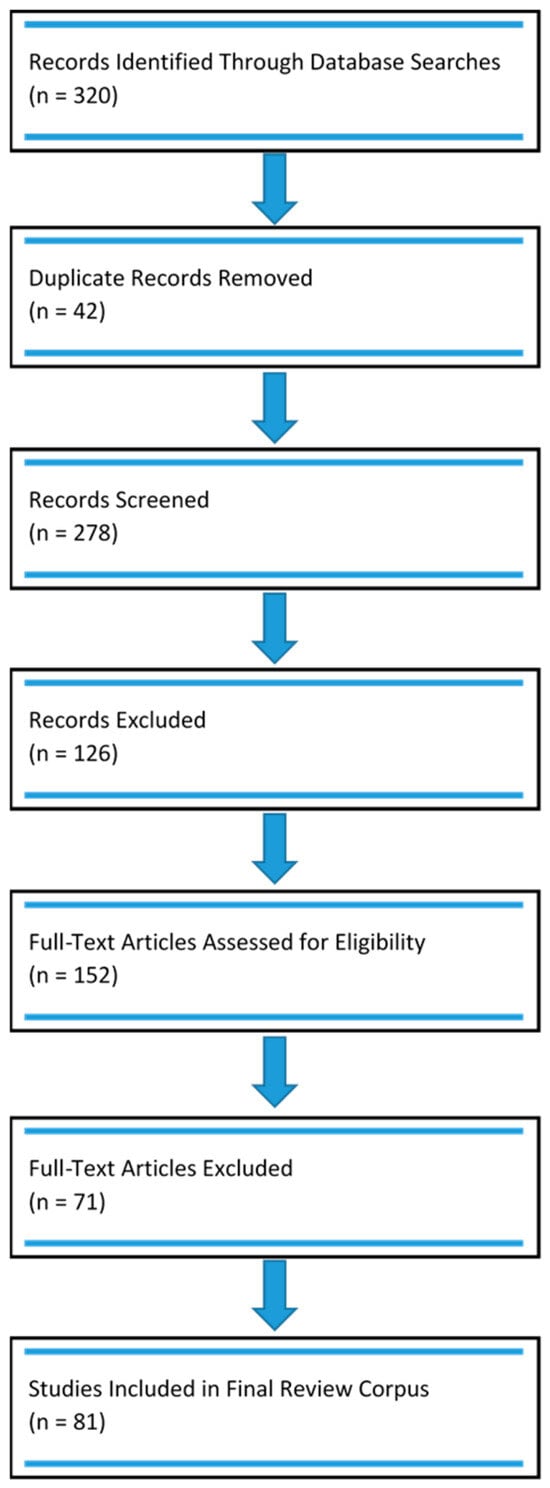
The screening procedure is summarized in Table 1 and Figure 1. The numbers reported in the table are intended to make the structured review process more transparent and replicable while preserving the interpretive orientation of the study.
Table 1.
Review protocol and selection process.
Figure 1.
Review Flow Diagram.
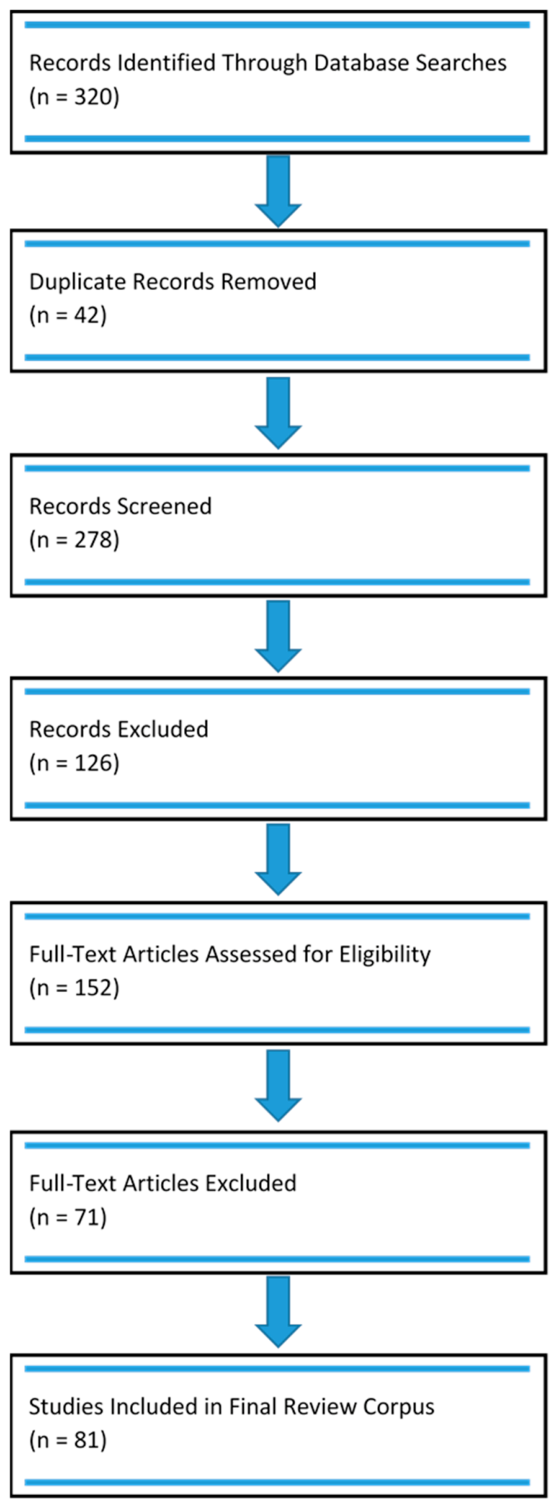
Figure 1 summarizes the structured review process. The initial search yielded 320 records. Following duplicate removal, title and abstract screening, and full-text assessment, 81 studies were retained for thematic coding and synthesis.
In addition to thematic coding, studies were classified according to their evidentiary foundations. Four categories were distinguished: empirical studies, conceptual and theoretical contributions, policy and institutional reports, and regulatory or strategic documents. This additional classification was introduced to improve analytical transparency and to avoid conflating theoretical arguments with empirical evidence.
To reduce interpretive discretion, coding decisions were guided by predefined thematic categories established prior to the full-text review process. Classification decisions were based on the dominant analytical focus of each study, and coding consistency was maintained through repeated cross-checking of category assignments during the review process. While interpretive judgment remains inherent in structured literature reviews, these procedures were implemented to improve consistency and analytical transparency.
Multiple coding was permitted because many studies simultaneously addressed productivity effects, labor-market dynamics, and innovation outcomes. Restricting studies to a single category would have reduced the ability of the review to capture the multidimensional nature of AI-driven transformation.
2.4. Inclusion and Exclusion Criteria
The inclusion criteria prioritized peer-reviewed articles, working papers from major international institutions such as NBER, OECD, and IMF, academic books, policy reports, and strategic documents that explicitly address the macroeconomic implications of AI. Included studies had to engage with at least one of the following themes: productivity effects, labor-market restructuring, innovation-system dynamics, digital capital, structural transformation, or AI-related development policy. Only English-language studies were considered.
Studies were excluded when they focused exclusively on technical AI systems without economic interpretation, addressed digital technologies without explicit AI relevance, consisted primarily of opinion-based commentary without analytical grounding, or provided insufficient information for classification and synthesis.
2.5. Analytical Framework, Coding, and Classification
The selected literature was organized into three primary analytical categories: (i) productivity and total factor productivity effects, (ii) task-based automation and workforce reallocation dynamics, and (iii) innovation, knowledge generation, and open innovation ecosystems. The classification process followed a thematic coding approach in which studies were assigned to one or more categories based on their dominant analytical contribution.
Multiple coding was explicitly allowed because AI-related mechanisms frequently overlap. For example, a study may simultaneously address productivity gains, skill restructuring, and innovation dynamics. Overlapping studies were therefore retained within multiple categories where relevant, and emphasis was placed on identifying complementarities rather than forcing strict separation.
In addition to thematic coding, studies were classified according to their evidentiary foundations. Four categories were distinguished: (i) empirical studies, (ii) conceptual and theoretical contributions, (iii) policy and institutional reports, and (iv) regulatory and strategic documents. This additional classification improves analytical transparency and avoids conflating theoretical arguments with empirical evidence.
Formal inter-rater reliability metrics were not applied, as the review is interpretive rather than statistical in nature. However, classification decisions were repeatedly reassessed for internal consistency and alignment with the conceptual framework.
2.6. Foundational Literature and Contemporary Review Corpus
A distinction is made between foundational theoretical literature and the contemporary review corpus. Foundational contributions, including Solow (1956), Lucas (1988), Romer (1990), Aghion and Howitt (1992), Bresnahan and Trajtenberg (1995), Chesbrough (2003), Jorgenson et al. (2008), and Acemoglu and Autor (2011), are used to establish the theoretical foundations of the study. These works are not treated as part of the formal 2015–2025 review corpus.
The formal review corpus consists of contemporary studies and institutional sources published between 2015 and 2025. This distinction addresses the temporal scope of the review and clarifies the respective roles of foundational theory and contemporary evidence.
Although the study does not employ a formal quality-scoring system, particular attention was given to the credibility and relevance of the included sources. Priority was assigned to peer-reviewed journal articles, major institutional reports (e.g., OECD, IMF, and World Bank), and internationally recognized working paper series. This approach was adopted to ensure that the synthesis was based on sources with established scholarly or policy relevance while remaining consistent with the interpretive nature of a structured literature review.
A detailed classification of the foundational theoretical literature and the contemporary review corpus is presented in Appendix A (Table A1 and Table A2). These appendices provide additional transparency regarding the analytical foundations and evidentiary structure of the review.
2.7. Managing Heterogeneity and Limits of Synthesis
One of the principal challenges of AI-related research is the substantial heterogeneity of the available evidence. The reviewed studies differ in terms of country context, level of economic development, time horizon, methodology, sectoral focus, and level of analysis. Accordingly, the review does not attempt to derive an average effect of AI on economic growth. Instead, it interprets findings as context-dependent mechanisms whose effects vary according to institutional, organizational, and structural conditions.
Particular caution is required when synthesizing evidence across developed and developing economies, short-run and long-run studies, firm-level and macro-level evidence, and empirical studies and policy reports. These distinctions are explicitly considered in the interpretation of the findings.
2.8. Limitations of the Method
Several limitations should be acknowledged. First, because the study does not employ meta-analytic techniques, it does not produce a single quantitative estimate of AI’s macroeconomic impact. Second, although transparent screening and coding procedures were implemented, classification decisions inevitably involve interpretive judgment. Third, given the rapid evolution of AI technologies, some empirical findings—particularly those related to generative AI and investment projections—may become outdated as new evidence emerges.
Another limitation concerns the rapidly evolving nature of AI technologies. Because the field is developing at an exceptional pace, some findings reported in the reviewed literature may require reassessment as new empirical evidence emerges. Consequently, the conclusions of this review should be interpreted as reflecting the current state of knowledge rather than a definitive assessment of long-run outcomes.
3. Theoretical Framework: Artificial Intelligence, Innovation Ecosystems, and Growth Dynamics
The impact of artificial intelligence (AI) on economic growth and structural transformation can be interpreted through three interrelated theoretical perspectives: (i) exogenous technological progress, (ii) endogenous growth and knowledge production, and (iii) task-based automation (Solow, 1956; Aghion & Howitt, 1992; Romer, 1990; Acemoglu & Restrepo, 2019). Rather than representing competing explanations, these approaches capture distinct but complementary mechanisms that operate simultaneously within innovation ecosystems. Accordingly, the analytical challenge is not to select among them but to clarify how their interaction shapes heterogeneous growth outcomes.
3.1. Exogenous and Endogenous Technological Progress Perspectives
In the neoclassical growth model, technological progress is treated as an exogenous factor that enhances total factor productivity (TFP) (Solow, 1956). Within this framework, AI can be interpreted as a productivity-enhancing shock that increases efficiency in the production function, often in conjunction with capital deepening (Jorgenson et al., 2008; Romer, 1990; Lucas, 1988; Aghion & Howitt, 1992). However, this representation abstracts from the internal dynamics of knowledge creation and does not explain how technological capabilities emerge or diffuse across economic systems.
Endogenous growth theories address this limitation by conceptualizing technological change as an outcome of intentional investment in knowledge, human capital, and research and development activities (Romer, 1990; Lucas, 1988; Jones, 2020). From this perspective, AI functions not only as a tool for optimizing production but also as a meta-technology that accelerates knowledge generation, recombination, and diffusion within innovation ecosystems (Bloom et al., 2020; Aghion & Howitt, 1992; Aghion et al., 2021). This implies that AI may affect not only the level of output but also the long-run growth rate, depending on the strength of knowledge networks and institutional complementarities.
A central tension in the literature concerns whether AI should be modeled as an input within the production function or as a structural transformation mechanism that reshapes the knowledge production process itself (Brynjolfsson et al., 2017). Treating AI as capital simplifies formal modeling but risks underestimating its effects on coordination, knowledge recombination, and market structure. Conversely, viewing AI as a systemic transformation mechanism highlights its broader impact but complicates empirical measurement. This tension reflects the dual nature of AI as both an input and an enabling infrastructure.
3.2. Task-Based Approach, Automation, and Structural Transformation Dynamics
Task-based models conceptualize technological change through the reallocation of tasks across labor and capital (Acemoglu & Restrepo, 2019, 2022; Acemoglu & Autor, 2011; Bessen, 2018; DeCanio, 2016). Within this framework, AI generates two opposing but interdependent effects:
- Displacement Effect: Automation reduces demand for labor performing routine or codifiable tasks, potentially leading to sectoral contraction (Acemoglu & Restrepo, 2019; D. H. Autor, 2015).
- Reinstatement Effect: Technological change creates new tasks, occupations, and areas of economic activity, often requiring higher levels of digital and cognitive skills (Acemoglu & Restrepo, 2019).
The net impact on growth and structural transformation depends on the balance between these effects. When task creation lags behind automation, negative distributional consequences and demand-side constraints may emerge (Korinek & Stiglitz, 2018; Acemoglu & Restrepo, 2020). Conversely, when new task generation is sufficiently strong, AI can support structural upgrading and productivity growth through the expansion of knowledge-intensive activities (D. H. Autor, 2015; D. Autor & Salomons, 2018).
Importantly, this balance is not technologically determined but institutionally conditioned. Education systems, labor-market flexibility, digital infrastructure, and the effectiveness of innovation ecosystems shape the capacity to generate and absorb new tasks (Acemoglu & Restrepo, 2022). This implies that similar levels of AI adoption may produce divergent structural outcomes across countries.
3.3. Integrating Growth and Task-Based Perspectives Within Innovation Ecosystems
While exogenous and endogenous growth models emphasize productivity and knowledge accumulation, task-based approaches focus on labor reallocation. These perspectives converge when interpreted within the broader framework of innovation ecosystems. In such systems, productivity gains, task transformation, and knowledge production are not independent processes but mutually reinforcing mechanisms mediated by digital capital, institutional structures, and organizational capabilities.
From this integrative perspective, AI can be understood as a coordination and recombination technology that simultaneously affects production efficiency, labor allocation, and innovation dynamics. This helps explain why empirical findings often appear inconsistent: productivity gains may occur without inclusive employment growth, or innovation outputs may increase without immediate macroeconomic effects.
This integration also clarifies the role of economic complexity. When AI adoption is embedded within dense knowledge networks and supported by complementary capabilities, it can enhance the diversity and sophistication of production structures. However, in the absence of such conditions, AI may lead to partial transformation characterized by sectoral concentration and uneven productivity gains.
3.4. From Task Transformation to Structural Transformation: Clarifying the Conceptual Relationship
A recurring source of ambiguity in the contemporary AI literature concerns the relationship between task transformation and structural transformation. Although these concepts are closely related, they refer to different levels of economic change and should not be treated as interchangeable.
Task transformation operates primarily at the microeconomic level. It refers to changes in the composition, allocation, and organization of tasks performed within occupations, firms, and production processes. AI technologies influence this process by automating certain routine and codifiable activities while simultaneously creating demand for new cognitive, analytical, and digitally intensive tasks (Acemoglu & Restrepo, 2019; D. H. Autor, 2015).
Structural transformation, by contrast, refers to broader changes in the composition of economic activity across sectors, technologies, and production systems. Traditionally, structural transformation has been associated with the movement of labor and resources from lower-productivity activities toward higher-productivity sectors and increasingly knowledge-intensive forms of production (Rodrik, 2018). Such transformations occur over longer time horizons and involve shifts in industrial structures, patterns of specialization, and economic complexity.
The relationship between these concepts can be understood as hierarchical rather than equivalent. Task transformation represents one of the principal mechanisms through which structural transformation occurs. Changes in the allocation of tasks influence skill demand, occupational composition, organizational structures, and production methods. Over time, the accumulation of these micro-level adjustments may generate broader sectoral and structural changes across the economy.
Within the context of artificial intelligence, task transformation therefore constitutes a transmission channel linking technological adoption to structural transformation. The magnitude of this transmission depends on institutional and ecosystem conditions, including human capital development, labor-market adaptability, innovation capacity, and digital infrastructure. Evidence of task transformation should therefore not automatically be interpreted as evidence of structural transformation; broader structural effects depend on whether task-level changes accumulate into durable shifts in production structures and economic complexity.
4. Transmission Channels of Artificial Intelligence to Economic Growth and Innovation Systems
Before presenting the thematic findings, it is important to note that the reviewed evidence includes empirical studies, conceptual contributions, policy reports, and regulatory documents. Consequently, the strength of the evidence varies across themes, and findings should be interpreted in light of the underlying evidentiary foundations.
The impact of artificial intelligence (AI) on economic growth and structural transformation operates through three interrelated transmission channels: productivity, innovation capacity, and the transformation of the capital structure (Solow, 1956; Romer, 1990; Acemoglu & Restrepo, 2019). These channels do not function independently; rather, their interaction—mediated by institutional and ecosystem conditions—determines the direction and magnitude of macroeconomic outcomes. Consequently, the effects of AI should be interpreted as conditional and context-dependent rather than uniform.
4.1. Productivity and Total Factor Productivity Channel
The most direct channel through which AI affects economic growth is productivity enhancement (Brynjolfsson et al., 2017; Bloom et al., 2012; Bajari et al., 2019). At the micro level, AI improves decision-making, reduces error rates, and enables process optimization. At the macro level, these improvements are reflected in increases in total factor productivity (TFP) (Solow, 1956; Jorgenson et al., 2008; Brynjolfsson et al., 2023).
However, empirical evidence consistently shows that these gains are neither automatic nor immediate (Brynjolfsson et al., 2017; Syverson, 2017). Productivity improvements depend critically on complementary factors, including human capital, data quality, organizational practices, and the capacity to redesign production processes (Acemoglu & Restrepo, 2022; Haskel & Westlake, 2018; Corrado et al., 2017). In many cases, firms that invest in AI technologies do not experience productivity gains unless these complementary adjustments are made.
This implies that productivity growth is not embedded in the technology itself but emerges from organizational and institutional adaptation. In several empirical settings, productivity gains appear with a time lag, reflecting the adjustment costs associated with restructuring workflows and managerial practices (Graetz & Michaels, 2018; Basu et al., 2006). Therefore, short-term productivity estimates may underestimate long-run effects while, at the same time, overstating the immediacy of AI-driven growth.
4.2. Innovation and Knowledge Production Channel
From the perspective of endogenous growth theory, AI’s most significant impact lies in its ability to transform the knowledge production process (Romer, 1990). By reducing the cost of experimentation, accelerating data processing, and enabling new forms of knowledge recombination, AI enhances the efficiency of innovation systems (Bloom et al., 2020; Cockburn et al., 2018).
Empirical and conceptual studies suggest that AI strengthens collaboration within innovation ecosystems, particularly between firms, universities, and public research institutions. This contributes to the expansion of open innovation networks and increases the speed of knowledge diffusion (Aghion & Howitt, 1992; Aghion et al., 2021). However, the extent to which these innovation gains translate into measurable productivity growth depends on institutional conditions such as intellectual property regimes, competition policy, and data governance frameworks (Korinek & Stiglitz, 2018).
A key implication is that innovation and productivity do not necessarily evolve simultaneously. In many cases, improvements in innovation metrics precede measurable productivity gains, reflecting the lag between knowledge creation and its diffusion across the economy (Chesbrough, 2003; Chesbrough, 2020). This temporal disconnect complicates the evaluation of AI’s macroeconomic impact and reinforces the need for a multi-channel analytical framework.
4.3. Capital Deepening, Digital Capital, and Structural Transformation
AI investments extend beyond software applications to include data infrastructure, computational capacity, and platform-based business models, collectively forming a new type of digital capital (Brynjolfsson et al., 2017). This transformation redefines traditional capital deepening processes and alters the structure of production by changing the relative importance of intangible assets (Solow, 1956; Goldfarb & Tucker, 2019).
A central debate concerns whether AI-related capital complements or substitutes for labor (Acemoglu & Restrepo, 2022; Korinek & Stiglitz, 2018). When substitution dominates, short-term effects may include wage pressure, increased inequality, and market concentration. When complementarity prevails, AI can support inclusive growth through skill upgrading and the expansion of knowledge-intensive sectors (D. H. Autor, 2015).
This suggests that capital deepening should not be interpreted solely as a technological process but as an institutional and structural transformation. The distributional and growth effects of digital capital depend on market structure, regulatory frameworks, and the capacity of firms to integrate AI into production systems. In this sense, digital capital is not neutral; its impact is mediated by the broader configuration of the innovation ecosystem (Brynjolfsson & McAfee, 2014).
4.4. Cross-Cutting Conditions and Systemic Interaction
The effectiveness of all three transmission channels is conditioned by a set of cross-cutting factors, including human capital, digital infrastructure, data governance, regulatory frameworks, and competitive dynamics. These variables do not act as independent drivers but as enabling or constraining conditions that shape how productivity, innovation, and capital deepening interact.
Recent evidence also highlights significant heterogeneity across firms and sectors in AI adoption and outcomes (McKinsey Global Institute, 2023b; WEF, 2023). This heterogeneity reinforces the argument that AI’s macroeconomic impact cannot be understood without considering the interaction between technological capabilities and the institutional environment.
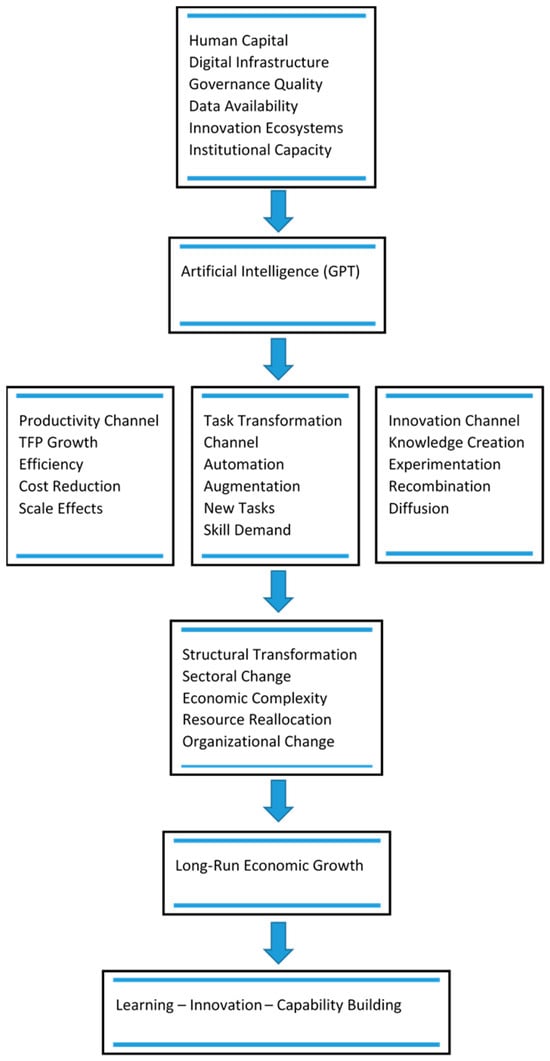
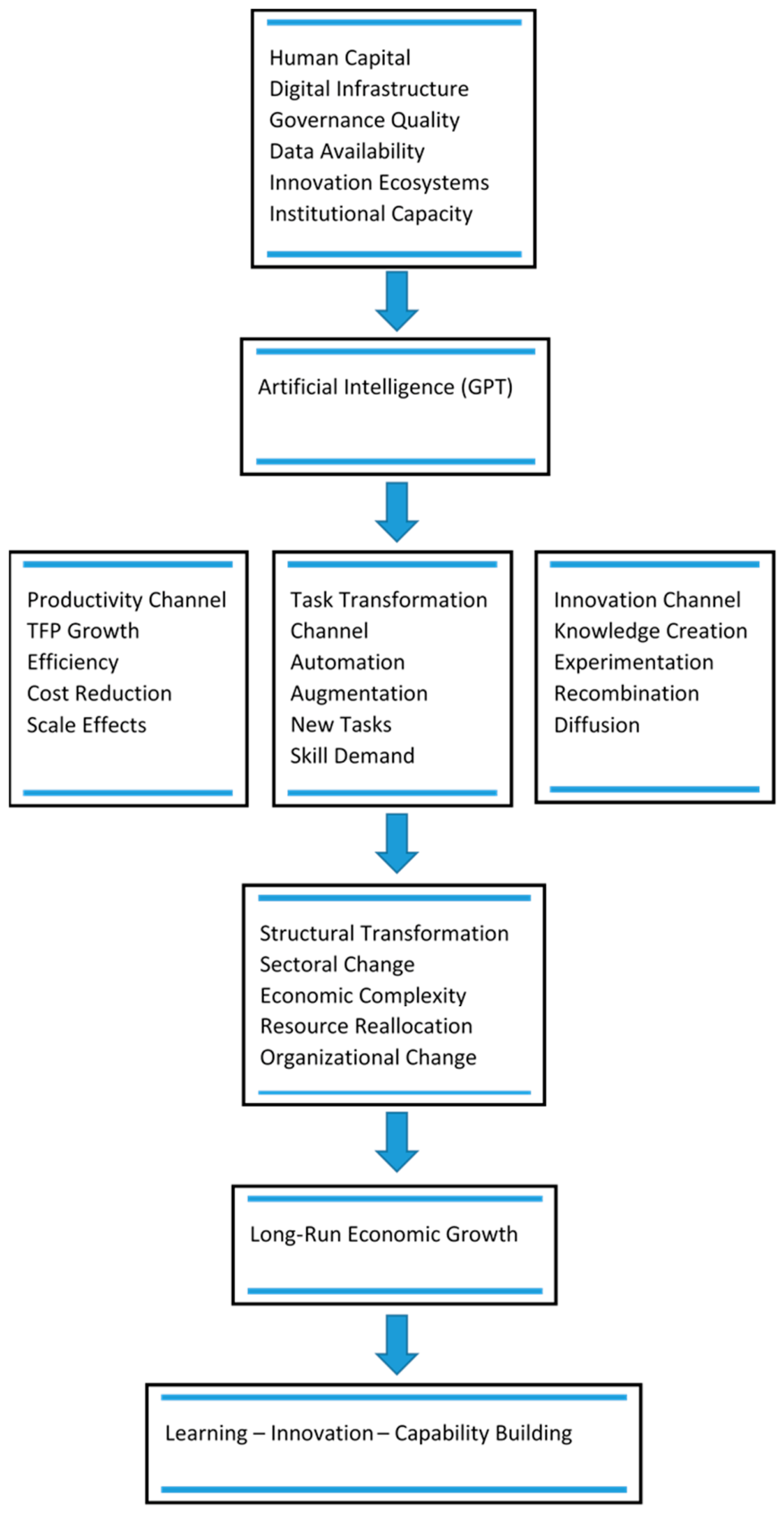
Figure 2 conceptualizes artificial intelligence (AI) as a general-purpose technology (GPT) whose economic effects are transmitted through three interconnected mechanisms: productivity enhancement, task transformation, and innovation dynamics. These mechanisms operate within a broader innovation ecosystem shaped by human capital, digital infrastructure, governance quality, data availability, and institutional capacity. Structural transformation emerges from the interaction of these channels and contributes to long-run economic growth through cumulative feedback effects based on ecosystem-level complementarities.
Figure 2.
Artificial Intelligence as a General-Purpose Technology within an Innovation Ecosystem Framework.
5. Evaluation of Current Findings: Global Trends, Market Dynamics, and the Turkish Context
The recent acceleration in AI-related investments and policy initiatives reflects the growing strategic importance of artificial intelligence within global economic systems (Brynjolfsson et al., 2017). However, much of the available evidence remains based on projections and sectoral reports, implying that the macroeconomic impact of AI on growth and structural transformation is still evolving and subject to uncertainty (Misch et al., 2025; OECD, 2025). This reinforces the need to interpret observed trends through the conditional and ecosystem-based framework developed in the previous sections.
5.1. Global Investment Trends, Market Concentration, and Growth Expectations
Recent reports from international organizations indicate a significant increase in AI investments, particularly in data-intensive and platform-based sectors (Misch et al., 2025; OECD, 2025; IMF, 2024). This trend suggests a transition toward a more capital-intensive technological paradigm, where large firms and platform-based ecosystems play a dominant role (Brynjolfsson et al., 2017).
However, the relationship between investment volume and macroeconomic growth remains ambiguous. Existing evidence shows that increases in digital capital do not automatically translate into total factor productivity growth (Solow, 1956; Jorgenson et al., 2008). Instead, outcomes depend on institutional quality, competitive dynamics, and the capacity of firms to integrate AI into production processes.
This implies that rising investment levels should not be interpreted as a direct indicator of growth acceleration. Rather, they signal potential that materializes only under specific complementary conditions. In this sense, global investment trends highlight the importance of ecosystem-level factors rather than providing conclusive evidence of AI-driven growth.
5.2. AI Ecosystem, Open Innovation, and Structural Conditions in the Turkish Economy
Türkiye was selected as an illustrative case because it represents a large emerging economy undergoing rapid digital transformation while simultaneously facing institutional, organizational, and innovation-system constraints commonly observed across developing economies. This positioning makes Türkiye a useful context for examining the conditional nature of AI-driven growth and structural transformation.
Within this broader framework, Türkiye provides an illustrative case for examining how the economic impact of AI depends on institutional capacity, innovation ecosystem maturity, and diffusion mechanisms. Although policy attention to AI has increased through national strategy documents and digital transformation initiatives, the translation of AI adoption into productivity growth and structural transformation remains constrained by uneven firm-level capabilities, human capital gaps, data governance challenges, and limited diffusion among SMEs.
A major policy milestone was the National Artificial Intelligence Strategy (2021–2025), which identifies human capital development, research capacity, entrepreneurship, data governance, and international cooperation as strategic priorities (Republic of Türkiye, Presidency Digital Transformation Office & Ministry of Industry and Technology, 2021). This strategy reflects the recognition that AI should be treated not merely as a technological tool but as a broader development and competitiveness issue.
Recent national indicators also suggest that AI adoption remains at an early stage. TÜİK’s (2025) Artificial Intelligence Statistics report that 7.5% of enterprises declared that they used AI technologies in 2025, compared with 2.7% in 2021 (TÜİK, 2025). At the individual level, 19.2% of individuals reported using generative AI in 2025, with substantially higher usage among younger age groups (TÜİK, 2025). These indicators point to rapid diffusion potential but also underline that adoption remains far from universal.
Firm-size asymmetries constitute an important constraint. According to the 2025 ICT Usage in Enterprises survey, AI adoption varies across enterprise-size groups, indicating that larger firms are generally better positioned to adopt advanced digital technologies than smaller firms (TÜİK, 2025). This matters because SMEs represent a large share of employment and business activity in Türkiye. Limited data infrastructure, financing constraints, weak organizational readiness, and shortages of specialized digital skills may prevent SME-level AI adoption from translating into broad-based productivity gains.
Human capital remains another binding condition. AI diffusion depends not only on access to software and computing capacity but also on the availability of data scientists, software engineers, digitally skilled workers, and managers capable of redesigning workflows. This is consistent with endogenous growth theory, which emphasizes human capital as a foundation for knowledge production and technological diffusion (Lucas, 1988; Romer, 1990).
Research and development capacity also affects Türkiye’s AI-related growth potential. World Bank data indicate that Türkiye’s R&D expenditure has increased over time but remains below the levels observed in many advanced innovation economies (World Bank Group, 2024). This suggests that AI-related upgrading requires not only adoption incentives but also stronger research commercialization, university–industry collaboration, venture financing, and technology-intensive entrepreneurship.
The sectoral structure of the Turkish economy creates both opportunities and constraints. Manufacturing, finance, logistics, defense industries, and health technologies provide relatively favorable contexts for AI adoption because they increasingly rely on data-intensive processes and digital infrastructure. In manufacturing, for example, AI can support predictive maintenance, quality control, process optimization, and industrial automation. However, the realization of these gains depends on complementary investments in skills, data governance, and organizational transformation.
Regulatory alignment and data governance are also central. The emergence of the European Union Artificial Intelligence Act increases the importance of regulatory compatibility for countries seeking deeper integration into global value chains and digital markets (European Union, 2024). For Türkiye, alignment with evolving international standards may influence foreign investment decisions, technology transfer opportunities, and participation in cross-border innovation networks.
Taken together, these indicators suggest that Türkiye’s AI challenge is not simply a matter of technological access. The central issue is whether AI adoption can diffuse across firms, sectors, and regions in a way that strengthens productivity, creates new tasks, and supports structural upgrading. This interpretation is consistent with the broader argument of the paper: AI-led growth is conditional on institutional complementarity rather than being technologically automatic.
6. Policy Implications: Short-, Medium-, and Long-Term Priorities for Conditional AI-Led Development
The analysis suggests that the economic impact of artificial intelligence (AI) depends less on the level of technological adoption alone and more on the configuration of complementary institutional, organizational, and ecosystem conditions. As a result, policy approaches that treat AI as a standalone growth driver are unlikely to generate sustained or inclusive outcomes. Effective policy design requires sequencing and coordination across human capital formation, data governance, innovation ecosystems, market structure, and regulatory capacity.
6.1. Short-Term Priorities
Short-term priorities should focus on improving the immediate conditions for effective AI diffusion. These include SME digitalization support, basic AI-readiness programs, workforce reskilling, data-quality improvement, cybersecurity capacity, and targeted advisory services for firms. Such measures are particularly important because many firms possess access to AI tools but lack the organizational routines, data infrastructure, and managerial capabilities required to use them productively.
In emerging economies, including Türkiye, short-term policy design should avoid equating technology adoption with productivity growth. Policies should instead reduce practical diffusion barriers by supporting digital diagnostics, training programs, data standardization, and affordable access to cloud and computational infrastructure.
6.2. Medium-Term Priorities
Medium-term priorities should focus on strengthening innovation ecosystem coordination. University–industry collaboration, applied AI research centers, open innovation platforms, sectoral testbeds, and public–private research partnerships can improve knowledge diffusion and reduce fragmentation across the innovation system. These measures help connect AI adoption to knowledge production rather than treating it merely as software deployment.
Medium-term policies should also address financing and scaling constraints. Venture capital mechanisms, innovation grants, digital transformation vouchers, and sector-specific support programs may help technology-intensive firms and SMEs adopt AI in ways that contribute to productivity and structural upgrading.
6.3. Long-Term Priorities
Long-term priorities should focus on building national AI capabilities and institutional complementarities. These include advanced human capital formation, frontier research capacity, trusted data governance frameworks, regulatory alignment with international standards, and integration into global value chains. Without these capabilities, AI adoption may remain limited to isolated efficiency gains rather than generating broad-based structural transformation.
Competition policy and regulatory governance should also be treated as long-term policy dimensions. Because AI may reinforce platform dominance and market concentration, maintaining competitive market conditions is essential for ensuring that productivity gains diffuse across the wider economy.
6.4. Policy Sequencing and Institutional Complementarity
The central policy implication is that complementary investments must be sequenced and coordinated. Investments in digital infrastructure without parallel improvements in skills and data governance may result in underutilized capacity. Similarly, regulatory reforms without sufficient technological readiness may fail to generate meaningful outcomes. Institutional complementarity therefore refers to the mutually reinforcing relationship among skills, infrastructure, governance, innovation networks, and firm-level capabilities that enables AI adoption to generate economic value.
In the context of Türkiye, this implies that the primary policy challenge lies not only in accelerating AI adoption but also in strengthening the ecosystem that supports effective diffusion. Targeted investments in education and training, improvements in data governance, stronger university–industry collaboration, and support for SME capabilities are essential for transforming AI adoption into sustained productivity growth and structural transformation.
7. Sectoral Implications: Complementarity, Market Structure, and Adaptation Dynamics
The contribution of AI to economic growth and structural transformation is not homogeneous across sectors (Acemoglu & Restrepo, 2022). The literature shows that technological impacts differ depending on existing institutional capacity, data intensity, market structure, and human capital levels (Romer, 1990; Aghion & Howitt, 1992). This differentiation is closely related to the sectoral depth of the innovation ecosystem and the effectiveness of open innovation networks. In the Turkish context, three sectors appear relatively advantageous due to their digital complementarity and levels of information intensity (Varian, 2018; Shapiro, 2019).
7.1. Financial Services, FinTech, and Platform Dynamics
The finance sector is one of the areas that can adapt most quickly to AI applications due to its data-intensive structure and digital infrastructure capacity (Brynjolfsson et al., 2017). Processes such as risk modeling, fraud detection, credit scoring, and algorithmic portfolio management are suitable for data-driven optimization. This area is characterized by an ecosystem where knowledge-sharing networks are rapidly expanding through open innovation collaborations and FinTech initiatives.
However, the ability of productivity gains in this area to translate into macro-level growth and financial inclusion depends on the competitive structure, regulatory stability, and data governance standards (Korinek & Stiglitz, 2018). Otherwise, increased technological concentration and platform-based market power can limit the diffusion of productivity gains and reduce the inclusivity of innovation (Aghion & Howitt, 1992). Therefore, the impact of AI on financial sector growth depends not only on technological capacity but also on market design and competition policies. There is also a non-trivial risk that AI-driven financial platforms increase concentration by reinforcing the scale advantages of already dominant actors.
7.2. Manufacturing Industry, Digital Production and Industrial Transformation
In the manufacturing sector, the impact of AI largely manifests itself through production automation, process optimization, and digital production systems (Graetz & Michaels, 2018). Smart factories, sensor-based data collection, and real-time decision systems can boost total factor productivity by improving production efficiency. This process can support a shift to higher-value-added production within the industrial structure and an increase in economic complexity (Graetz & Michaels, 2018; Acemoglu et al., 2021).
However, task-based models indicate that this transformation will change the employment composition and accelerate sectoral reallocation processes (Acemoglu & Restrepo, 2019). The transition to high-value-added production is possible not only through automation investments but also through the dissemination of engineering, software, and data analytics skills (Lucas, 1988). Therefore, industrial policies need to go beyond technology imports and support knowledge production, university–industry collaboration, and open innovation networks (Romer, 1990). Otherwise, digital transformation, even if it increases productivity, can deepen sectoral inequalities. For example, predictive maintenance systems can raise efficiency, yet they simultaneously reduce demand for certain routine maintenance roles.
7.3. Health, Biotechnology, and Knowledge-Intensive Innovation
In health and biotechnology, AI applications in diagnostics, clinical decision support, and drug discovery can accelerate knowledge production and reduce search costs (Bloom et al., 2020). Yet translating these advances into economic value depends heavily on regulatory approval, data privacy standards, research infrastructure, and public–private coordination (Korinek & Stiglitz, 2018). The sector illustrates that technological capability alone is insufficient; ecosystem governance determines whether innovation scales (Cockburn et al., 2018; Bloom et al., 2020).
8. Conclusions, Contributions, Limitations, and Future Research
This study has examined the impact of artificial intelligence (AI) on economic growth and structural transformation through a structured literature review integrating insights from growth theory, task-based models, and innovation ecosystem approaches. Rather than treating these perspectives as competing frameworks, the analysis has emphasized their complementarity and their joint role in shaping heterogeneous and context-dependent outcomes.
The findings suggest that AI should not be conceptualized as an autonomous driver of economic growth. Instead, its effects emerge through three interrelated transmission channels—productivity, task transformation, and innovation dynamics—whose interaction is mediated by institutional, organizational, and ecosystem-level conditions. This implies that similar levels of technological adoption may lead to divergent outcomes across countries and sectors depending on the strength of complementary capabilities such as human capital, data infrastructure, governance frameworks, and innovation-system maturity.
The primary added value of this study lies in its integration of three literature streams that are frequently examined separately: productivity and growth research, task-based automation studies, and innovation ecosystem approaches. By bringing these perspectives together within a common analytical framework, the study provides a more comprehensive explanation of how artificial intelligence influences economic growth and structural transformation. Furthermore, the study highlights institutional complementarity as a central mechanism explaining why similar technologies often generate different outcomes across countries, sectors, and organizational environments.
8.1. Theoretical Contributions
The study makes three theoretical contributions. First, it integrates productivity and growth research, task-based automation studies, and innovation ecosystem approaches within a single mechanism-oriented framework. Second, it clarifies the relationship between task transformation and structural transformation by conceptualizing task transformation as a micro-level transmission mechanism that can contribute to broader structural change. Third, it advances an ecosystem-based interpretation of AI-led development, emphasizing institutional complementarity as a central explanatory mechanism for heterogeneous economic outcomes.
8.2. Methodological Contributions
Methodologically, the study contributes by employing a structured literature review approach designed to synthesize heterogeneous theoretical, empirical, and policy-oriented contributions. The review distinguishes foundational theoretical literature from the contemporary 2015–2025 review corpus and classifies studies by both analytical theme and evidence type. This structure improves transparency and reduces the risk of conflating theoretical propositions, empirical findings, policy reports, and regulatory documents.
8.3. Policy Contributions
The findings suggest that policy effectiveness depends less on the scale of AI adoption and more on the ability to coordinate complementary investments across multiple domains. Policies focused exclusively on technology deployment are unlikely to generate sustainable growth outcomes. Successful AI strategies require simultaneous attention to human capital, digital infrastructure, data governance, innovation ecosystems, competition policy, and institutional capacity. This conclusion is particularly relevant for emerging economies, where diffusion constraints and organizational bottlenecks may limit the translation of technological adoption into productivity gains.
8.4. Limitations
Several limitations should be acknowledged. First, as a structured literature review, the study does not aim to provide exhaustive coverage of all available research, nor does it employ meta-analytic techniques to derive quantitative estimates. Second, although transparent screening and classification procedures were implemented, some degree of interpretive judgment remains unavoidable. Third, the rapid pace of technological change in AI implies that some empirical findings may become outdated as new evidence emerges, particularly in relation to generative AI and large language models. Finally, substantial heterogeneity across countries, sectors, and methodologies limits the possibility of deriving universally applicable conclusions.
8.5. Future Research Agenda
Future research should pursue several directions. First, additional firm-level and sectoral studies are needed to establish clearer causal relationships between AI adoption and productivity growth. Second, the economic effects of generative AI and large language models require systematic empirical investigation. Third, greater attention should be devoted to developing and emerging economies, where institutional constraints may significantly alter the mechanisms identified in advanced economies. Fourth, future studies could operationalize institutional complementarity through measurable indicators related to human capital, governance quality, innovation-system performance, digital infrastructure, and data readiness. Finally, longitudinal research examining the relationship between task transformation, structural transformation, and economic complexity would contribute to a deeper understanding of AI-driven development trajectories.
Overall, the study highlights that understanding the economic implications of AI requires moving beyond technology-centric narratives toward a more integrated perspective that emphasizes institutional complementarity, coordination, and conditional dynamics. This perspective provides a more realistic foundation for both academic analysis and policy design in the context of ongoing digital transformation.
Funding
This research received no external funding.
Institutional Review Board Statement
Not applicable.
Informed Consent Statement
Not applicable.
Data Availability Statement
The original contributions presented in this study are included in the article.
Conflicts of Interest
The author declares no conflict of interest.
Appendix A
Table A1.
Foundational Theoretical Literature. The studies listed below are used to establish the theoretical foundations of the analytical framework and are not treated as part of the formal 2015–2025 review corpus.
Table A2.
Contemporary Review Corpus (2015–2025). The contemporary review corpus consists of 81 studies selected through the review protocol described in Section 2. The table below lists the broader review corpus and classifies studies by theme, evidence type, and key focus. Foundational works listed in Table A1 are retained only as theoretical foundations and should not be interpreted as part of the formal 2015–2025 corpus.
This Appendix A presents the broader body of studies reviewed and considered during the structured literature review. The revised Appendix A distinguishes foundational theoretical literature from the contemporary 2015–2025 review corpus, in line with the methodological scope of the study.
References
- Acemoglu, D. (2021). Harms of AI (NBER working paper No. 29247). National Bureau of Economic Research. [Google Scholar] [CrossRef] [Scilit]
- Acemoglu, D., Akcigit, U., & Kerr, W. (2021). The race between man and machine: Implications of directed technological change for growth and employment. American Economic Review, 111(12), 3799–3842. [Google Scholar]
- Acemoglu, D., & Autor, D. (2011). Skills, tasks, and technologies: Implications for employment and earnings. In Handbook of labor economics (Vol. 4, pp. 1043–1171). Elsevier. [Google Scholar]
- Acemoglu, D., & Restrepo, P. (2019). Automation and new tasks: How technology displaces and reinstates labor. Journal of Economic Perspectives, 33(2), 3–30. [Google Scholar] [CrossRef] [Scilit]
- Acemoglu, D., & Restrepo, P. (2020). Robots and jobs: Evidence from US labor markets. Journal of Political Economy, 128(6), 2188–2244. [Google Scholar] [CrossRef] [Scilit]
- Acemoglu, D., & Restrepo, P. (2022). Tasks, automation, and the rise in U.S. wage inequality. Econometrica, 90(5), 1973–2016. [Google Scholar] [CrossRef] [Scilit]
- Aghion, P., Antonin, C., & Bunel, S. (2021). The power of creative destruction. Harvard University Press. [Google Scholar]
- Aghion, P., & Howitt, P. (1992). A model of growth through creative destruction. Econometrica, 60(2), 323–351. [Google Scholar] [CrossRef] [Scilit]
- Aghion, P., Jones, B. F., & Jones, C. I. (2017). Artificial intelligence and economic growth (NBER working paper No. 23928). National Bureau of Economic Research. [Google Scholar]
- Agrawal, A., Gans, J., & Goldfarb, A. (Eds.). (2019). The economics of artificial intelligence: An agenda. University of Chicago Press. [Google Scholar]
- Agrawal, A., Gans, J. S., & Goldfarb, A. (2024). Prediction machines, insurance, and protection: An alternative perspective on AI’s role in production. Journal of the Japanese and International Economies, 72, 101307. [Google Scholar] [CrossRef] [Scilit]
- Autor, D. (2022). The labor market impacts of technological change: From unbridled enthusiasm to qualified optimism to vast uncertainty (NBER working paper No. 30074). National Bureau of Economic Research. [Google Scholar]
- Autor, D., & Salomons, A. (2018). Is automation labor-displacing? Productivity growth, employment, and the labor share (No. w24871). National Bureau of Economic Research. [Google Scholar]
- Autor, D. H. (2015). Why are there still so many jobs? The history and future of workplace automation. Journal of Economic Perspectives, 29(3), 3–30. [Google Scholar] [CrossRef] [Scilit]
- Bajari, P., Chernozhukov, V., Hortaçsu, A., & Suzuki, J. (2019, May). The impact of big data on firm performance: An empirical investigation. In AEA papers and proceedings (Vol. 109, pp. 33–37). American Economic Association. [Google Scholar]
- Basu, S., Fernald, J., & Kimball, M. (2006). Are technology improvements contractionary? American Economic Review, 96(5), 1418–1448. [Google Scholar] [CrossRef] [Scilit]
- Bessen, J. (2018). AI and jobs: The role of demand (No. 24235). National Bureau of Economic Research, Inc. [Google Scholar]
- Bloom, N., Jones, C. I., Van Reenen, J., & Webb, M. (2020). Are ideas getting harder to find? American Economic Review, 110(4), 1104–1144. [Google Scholar] [CrossRef] [Scilit]
- Bloom, N., Sadun, R., & Van Reenen, J. (2012). Americans do IT better: US multinationals and the productivity miracle. American Economic Review, 102(1), 167–201. [Google Scholar] [CrossRef] [Scilit]
- Bresnahan, T. F., & Trajtenberg, M. (1995). General-purpose technologies: Engines of growth? Journal of Econometrics, 65(1), 83–108. [Google Scholar] [CrossRef] [Scilit]
- Brynjolfsson, E., Li, D., & Raymond, L. (2023). NBER working paper no. w31161. Available online: https://ssrn.com/abstract=4426942 (accessed on 11 June 2026).
- Brynjolfsson, E., & McAfee, A. (2014). The second machine age: Work progress and prosperity in a time of brilliant technologies. WW Norton & Company. [Google Scholar]
- Brynjolfsson, E., Rock, D., & Syverson, C. (2017). Artificial intelligence and the modern productivity paradox (NBER working paper No. 24001). National Bureau of Economic Research. [Google Scholar]
- Brynjolfsson, E., Rock, D., & Syverson, C. (2021). The productivity J-curve: How intangibles complement general purpose technologies. American Economic Journal: Macroeconomics, 13(1), 333–372. [Google Scholar] [CrossRef] [Scilit]
- Chesbrough, H. W. (2003). Open innovation: The new imperative for creating and profiting from technology. Harvard Business Press. [Google Scholar]
- Chesbrough, H. W. (2020). Open innovation results: Going beyond the hype and getting down to business. Oxford University Press. [Google Scholar]
- Cockburn, I. M., Henderson, R., & Stern, S. (2018). The impact of artificial intelligence on innovation (NBER working paper No. 24449). National Bureau of Economic Research. [Google Scholar]
- Corrado, C., Haskel, J., & Jona-Lasinio, C. (2017). Knowledge spillovers, ICT and productivity growth. Oxford Bulletin of Economics and Statistics, 79(4), 592–618. [Google Scholar] [CrossRef] [Scilit]
- DeCanio, S. J. (2016). Robots and humans—Complements or substitutes? Journal of Macroeconomics, 49, 280–291. [Google Scholar]
- European Union. (2024). Regulation (EU) 2024/1689 of the European parliament and of the council of 13 June 2024 on artificial intelligence (AI act). Official Journal of the European Union. [Google Scholar]
- Filippucci, F., Gal, P., & Schief, M. (2024). Miracle or myth? Assessing the macroeconomic productivity gains from artificial intelligence (OECD artificial intelligence papers, No. 29). OECD Publishing. [Google Scholar] [CrossRef] [Scilit]
- Frey, C. B. (2019). The technology trap: Capital, labor, and power in the age of automation. Princeton University Press. [Google Scholar]
- Frey, C. B., & Osborne, M. A. (2017). The future of employment: How susceptible are jobs to computerisation? Technological Forecasting and Social Change, 114, 254–280. [Google Scholar] [CrossRef] [Scilit]
- Gans, J. S. (2025). AI as strategist (NBER working paper No. 33650). National Bureau of Economic Research. [Google Scholar] [CrossRef] [Scilit]
- Gao, X., & Feng, H. (2023). AI-driven productivity gains: Artificial intelligence and firm productivity. Sustainability, 15(11), 8934. [Google Scholar] [CrossRef] [Scilit]
- Goldfarb, A., & Tucker, C. (2019). Digital economics. Journal of Economic Literature, 57(1), 3–43. [Google Scholar] [CrossRef] [Scilit]
- Goolsbee, A. (2018). Public policy in an AI economy (NBER working paper No. 24653). National Bureau of Economic Research. [Google Scholar] [CrossRef] [Scilit]
- Gordon, R. J. (2016). The rise and fall of American growth: The U.S. standard of living since the Civil War. Princeton University Press. [Google Scholar]
- Graetz, G., & Michaels, G. (2018). Robots at work. Review of Economics and Statistics, 100(5), 753–768. [Google Scholar] [CrossRef] [Scilit]
- Grossman, G. M., & Helpman, E. (2015). Globalization and growth. American Economic Review, 105(5), 100–104. [Google Scholar] [CrossRef] [Scilit]
- Haskel, J., & Westlake, S. (2018). Capitalism without capital: The rise of the intangible economy. Princeton University Press. [Google Scholar]
- International Monetary Fund. (2022). Digitalization in Europe: Opportunities and challenges. IMF Staff Discussion Note. International Monetary Fund. [Google Scholar]
- International Monetary Fund. (2023). Republic of Türkiye: Financial system stability assessment (IMF staff country report No. 23/304). International Monetary Fund. [Google Scholar]
- International Monetary Fund. (2024). World economic outlook. IMF. [Google Scholar]
- International Monetary Fund. (2025). World economic outlook. IMF. [Google Scholar]
- Jones, C. I. (2020). Growth and ideas. In P. Aghion, & S. N. Durlauf (Eds.), Handbook of economic growth (Vol. 2, pp. 717–790). Elsevier. [Google Scholar]
- Jorgenson, D. W., Ho, M. S., & Stiroh, K. J. (2008). A retrospective look at the U.S. productivity growth resurgence. Journal of Economic Perspectives, 22(1), 3–24. [Google Scholar] [CrossRef] [Scilit]
- Juhász, R., Lane, N., & Rodrik, D. (2024). The new economics of industrial policy. Annual Review of Economics, 16(1), 213–242. [Google Scholar] [CrossRef] [Scilit]
- Katz, L. F., & Krueger, A. B. (2017). The role of unemployment in the rise in alternative work arrangements. American Economic Review, 107(5), 388–392. [Google Scholar] [CrossRef] [Scilit]
- Kim, P. (2021). AI and inequality. Available online: https://ssrn.com/abstract=3938578 (accessed on 11 June 2026).
- Korinek, A., & Stiglitz, J. E. (2018). Artificial intelligence and its implications for income distribution and unemployment. In The economics of artificial intelligence: An agenda (pp. 349–390). University of Chicago Press. [Google Scholar]
- Korinek, A., & Stiglitz, J. E. (2021). Artificial intelligence, globalization, and strategies for economic development. Institute for new economic thinking working paper series no. 146. Available online: https://ssrn.com/abstract=3812820 (accessed on 11 June 2026).
- Lucas, R. E. (1988). On the mechanics of economic development. Journal of Monetary Economics, 22(1), 3–42. [Google Scholar] [CrossRef] [Scilit]
- Mazzucato, M. (2021). Mission economy: A moonshot guide to changing capitalism. Harper Business. [Google Scholar]
- McAfee, A., & Brynjolfsson, E. (2017). Machine, platform, crowd: Harnessing our digital future. W. W. Norton & Company. [Google Scholar]
- McKinsey Global Institute. (2023a). The economic potential of generative AI: The next productivity frontier. McKinsey & Company. [Google Scholar]
- McKinsey Global Institute. (2023b). The state of AI in 2023: Generative AI’s breakout year. McKinsey & Company. [Google Scholar]
- Misch, F., Park, B., Pizzinelli, C., & Sher, G. (2025). AI and productivity in Europe (IMF working paper No. 2025/067). International Monetary Fund. [Google Scholar]
- OECD. (2020). OECD digital economy outlook 2020. OECD Publishing. [Google Scholar] [CrossRef] [Scilit]
- OECD. (2021). The digital transformation of SMEs. OECD studies on SMEs and entrepreneurship. OECD Publishing. [Google Scholar] [CrossRef] [Scilit]
- OECD. (2023). OECD economic surveys: Türkiye 2023. OECD Publishing. [Google Scholar] [CrossRef] [Scilit]
- OECD. (2025). OECD economic outlook, Volume 2025 Issue 1: Tackling uncertainty, reviving growth. OECD Publishing. [Google Scholar]
- Piketty, T. (2020). Capital and ideology. Harvard University Press. [Google Scholar]
- Republic of Türkiye, Presidency Digital Transformation Office & Ministry of Industry and Technology. (2021). National artificial intelligence strategy (2021–2025). Republic of Türkiye Presidency Digital Transformation Office.
- Rodrik, D. (2018). New technologies, global value chains, and developing economies (No. w25164). National Bureau of Economic Research. [Google Scholar]
- Romer, P. M. (1990). Endogenous technological change. Journal of Political Economy, 98(5), S71–S102. [Google Scholar] [CrossRef] [Scilit]
- Shapiro, C. (2019). Protecting competition in the American economy: Merger control, tech titans, labor markets. Journal of Economic Perspectives, 33(3), 69–93. [Google Scholar] [CrossRef] [Scilit]
- Solow, R. M. (1956). A contribution to the theory of economic growth. Quarterly Journal of Economics, 70(1), 65–94. [Google Scholar] [CrossRef] [Scilit]
- Syverson, C. (2017). Challenges to mismeasurement explanations for the US productivity slowdown. Journal of Economic Perspectives, 31(2), 165–186. [Google Scholar] [CrossRef] [Scilit]
- Tirole, J. (2017). Economics for the common good. Princeton University Press. [Google Scholar]
- TÜİK. (2023). Girişimlerde bilişim teknolojileri kullanım araştırması, 2023. Türkiye İstatistik Kurumu.
- TÜİK. (2025). Yapay Zeka İstatistikleri, 2025. Turkish Statistical Institute.
- United Nations Conference on Trade and Development. (2023). Digital economy report 2023: The role of artificial intelligence in developing countries. United Nations. [Google Scholar]
- Varian, H. (2018). Artificial intelligence, economics, and industrial organization. In The economics of artificial intelligence: An agenda (pp. 399–419). University of Chicago Press. [Google Scholar]
- World Bank. (2021). World development report 2021: Data for better lives. World Bank. [Google Scholar]
- World Bank. (2023). World development report 2023: Migrants, refugees, and societies. World Bank. [Google Scholar]
- World Bank. (2024). Digital progress and trends report 2023. World Bank. [Google Scholar]
- World Bank Group. (2024). FY 2023 Türkiye country opinion survey report. World Bank Group. [Google Scholar]
- World Economic Forum. (2023). The future of jobs report 2023. World Economic Forum. [Google Scholar]
- World Economic Forum. (2025). The future of jobs report 2025. World Economic Forum. [Google Scholar]

Disclaimer/Publisher’s Note: The statements, opinions and data contained in all publications are solely those of the individual author(s) and contributor(s) and not of MDPI and/or the editor(s). MDPI and/or the editor(s) disclaim responsibility for any injury to people or property resulting from any ideas, methods, instructions or products referred to in the content. |
© 2026 by the author. Licensee MDPI, Basel, Switzerland. This article is an open access article distributed under the terms and conditions of the Creative Commons Attribution (CC BY) license.