1. Introduction
Do capital deepening patterns in technology-related sectors affect employment differently across manufacturing and services? This question is economically important because services now account for 70–85% of employment in advanced economies, yet empirical evidence on technology–employment relationships remains overwhelmingly manufacturing-focused. Manufacturing studies consistently document negative employment effects from automation (
Acemoglu & Restrepo, 2020;
Giwa & Ho, 2026), raising questions about whether this pattern generalizes to services.
This paper documents capital–employment dynamics in UK information-intensive services using quarterly data from 2014Q1 to 2024Q4. We examine the relationship between capital formation in sectors classified as AI-intensive (ISIC J: Information and Communication; K: Financial and Insurance; M: Professional, Scientific and Technical) and employment in these sectors, using structural vector autoregression. Our main finding is a persistent positive co-movement between capital formation and service employment—a pattern qualitatively opposite to the negative employment effects documented in manufacturing.
A critical caveat requires immediate acknowledgment: our analysis does not identify AI-specific employment effects. Instead, we document sectoral divergence in capital–employment relationships using gross fixed capital formation (GFCF) in information-intensive sectors, which captures all capital investment in sectors J, K, and M, including buildings, equipment, conventional IT infrastructure, and emerging digital systems. This breadth of measurement is both a strength and a limitation. It provides the only consistent quarterly capital proxy for these sectors in UK data, but it also prevents us from isolating AI-specific effects from broader technology investment dynamics or sectoral composition shifts. Our contribution is therefore documenting the empirical pattern of sectoral divergence rather than establishing causal mechanisms or identifying AI-specific labor demand effects.
Recent task-based frameworks (
Acemoglu & Restrepo, 2020;
Autor, 2015) help explain why sectoral divergence is theoretically plausible. Manufacturing automation studies focus on task substitution: robots and machinery directly replace production workers in routine tasks. Services may operate differently; digital tools and analytics platforms may augment rather than replace cognitive work, enabling professionals to serve more clients or conduct deeper analysis. This theoretical distinction predicts different employment patterns across sectors. However, identifying which mechanism drives our empirical findings requires evidence beyond what aggregate time-series data can provide.
Using SVAR methods on 44 quarterly observations, we find that the employment response to a one-standard-deviation capital shock is positive and statistically significant, builds gradually and peaks at approximately 0.31 log points by quarter 10, and remains robust across 12 alternative specifications. Bidirectional Granger causality tests indicate that past capital predicts employment and past employment predicts capital, suggesting joint determination from anticipated demand rather than unidirectional causation.
Three important limitations constrain interpretation. First, identification: Recursive identification cannot fully rule out common demand shocks driving both investment and hiring simultaneously. The bidirectional Granger causality pattern suggests both variables respond to anticipated demand growth, making it difficult to establish whether capital formation causally drives employment or whether firms coordinate both decisions in response to expected demand. Second, statistical power: The 44-quarter sample provides limited precision for magnitude estimation; our confidence intervals are approximately ±0.15 log points around point estimates, and horizon-specific magnitudes beyond quarter 6 are particularly uncertain. We therefore emphasize the robustness of sign and persistence across specifications rather than precise magnitude estimates. Third, generalizability: Findings are specific to UK service sectors during 2014–2024 and may not extend to other countries, time periods, manufacturing sectors, or non-J+K+M services.
Despite these constraints, the core finding—persistent positive capital–employment co-movement in services, contrasting with manufacturing displacement—is sufficiently robust to inform sectoral policy discussions. If capital–employment relationships are sector-specific, then technology policies designed for manufacturing contexts may not fit services. However, whether this divergence reflects genuine complementarity, demand dynamics, labor composition shifts, or other factors remains an open question. Our evidence is consistent with multiple interpretations and should inform discussion rather than settle mechanistic debates about technology and employment.
The paper proceeds as follows.
Section 2 reviews the related literature, distinguishing manufacturing automation studies from services complementarity evidence.
Section 3 describes data construction and econometric methodology.
Section 4 presents the main results, emphasizing sign, persistence, and sectoral contrast.
Section 5 discusses theoretical implications, policy relevance, and limitations.
Section 6 concludes.
4. Results: Sign, Persistence, and Sectoral Contrast
4.1. Main Pattern: Positive and Persistent Co-Movement
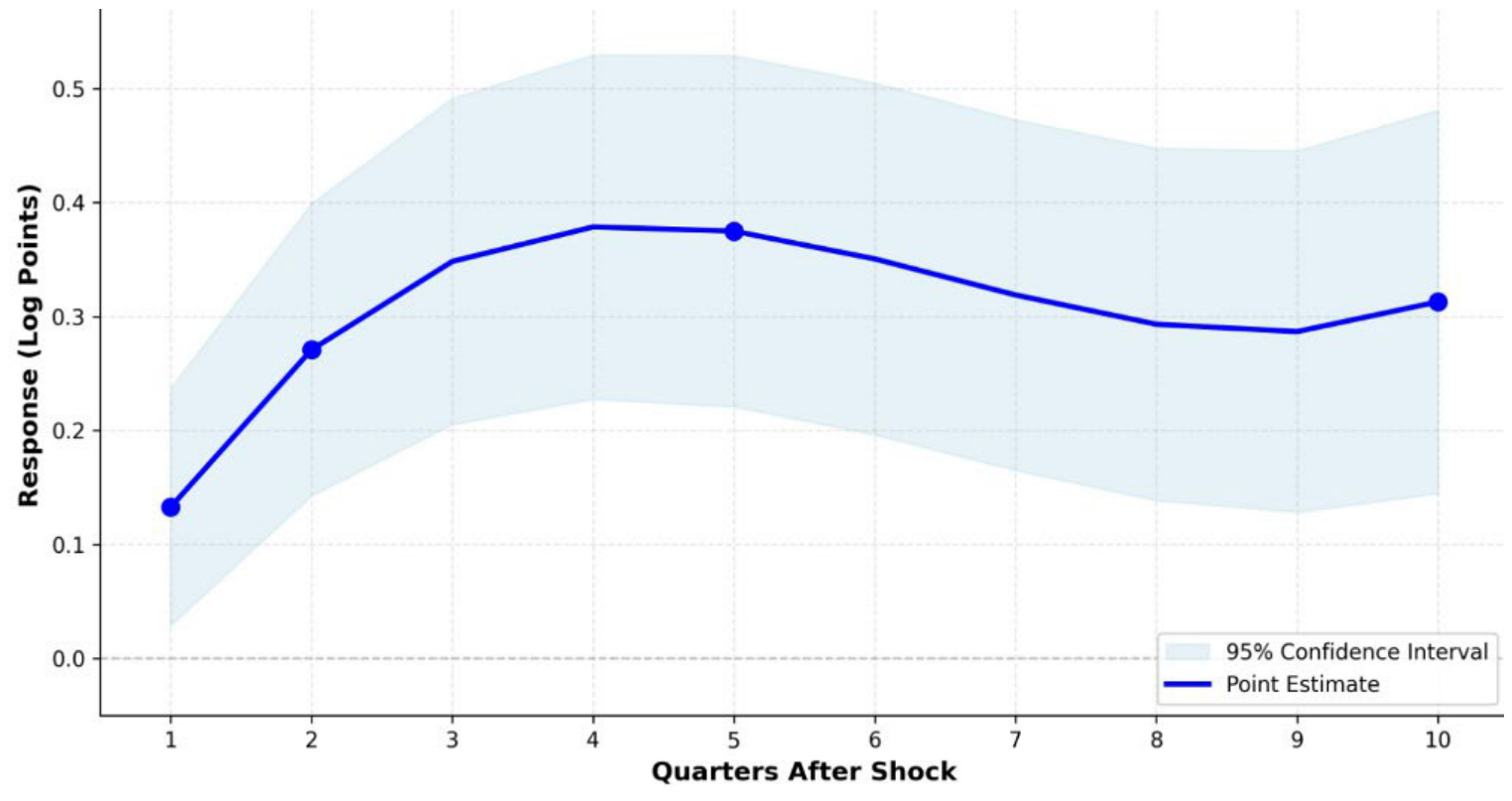
Figure 1 presents the estimated impulse response of service employment to a one-standard-deviation shock in capital formation in these sectors. The impulse response function (IRF) reveals three empirically robust features that characterize the technology–employment relationship in UK services.
Sign and Statistical Significance. The employment response is consistently positive across all forecast horizons. The point estimate is statistically distinguishable from zero at conventional significance levels throughout the 10-quarter window, with the 95% confidence interval excluding zero from quarter 1 onward. This positive association contrasts sharply with the negative employment associations documented in manufacturing studies (
Acemoglu & Restrepo, 2020;
Dauth et al., 2021), suggesting fundamental sectoral differences in how technology adoption affects labor demand.
Persistence and Dynamic Profile. Rather than exhibiting the rapid mean reversion characteristic of transitory demand shocks, the employment response displays persistent accumulation over multiple quarters. The initial impact in quarter 1 is modest—approximately 0.13 log points—but the effect builds progressively over subsequent periods. By quarter 2, the response reaches 0.27 log points, peaking at 0.38 log points by quarter 5, and stabilizing around 0.31 log points by quarter 10, as shown in
Table 4.
This gradual buildup pattern is noteworthy for three reasons. First, the delayed response profile is consistent with hiring frictions and adjustment costs (
Hamermesh, 1989), suggesting firms expand employment incrementally as technology investments are deployed and operational demands materialize. Second, the multi-quarter persistence distinguishes the observed pattern from noise or purely cyclical fluctuations, which typically dissipate within 2–3 quarters. Third, the stability of the effect beyond quarter 5, the response plateaus rather than continuing to grow or reverting toward zero, suggests a permanent level shift in employment associated with AI-intensive capital adoption.
Magnitude and Interpretation Caveats. The point estimate reaches 0.31 log points by quarter 10 (shown in
Table 4), implying a sizeable increase in employment. However, this magnitude should be treated as illustrative rather than precise in response to a one-standard-deviation increase in capital formation. However, three important qualifications temper the interpretation of this magnitude:
First, as discussed in
Section 3.1, the capital measure captures all investment in AI-intensive sectors (ISIC J, K, M), not AI specifically. The proxy therefore conflates genuine capital formation in AI-intensive sectors with broader digitization, ICT infrastructure, and sector-specific capital deepening. This measurement breadth likely inflates the apparent magnitude, as the “shock” encompasses multiple technology types with potentially heterogeneous employment associations.
Second, the recursive identification strategy (
Section 3.2) cannot fully rule out common demand shocks driving both investment and hiring. If firms anticipate demand growth and expand both technology and workforce simultaneously, the estimated employment response partly reflects this joint determination rather than a pure technology effect. The robustness checks in
Section 4.3 partially address this concern but cannot eliminate it entirely.
Third, the 44-quarter sample provides limited statistical power for precise magnitude estimation, particularly for longer-horizon responses where standard errors widen (visible in
Figure 1’s confidence bands). The widening confidence intervals at horizons 8–10 reflect this uncertainty.
Core Empirical Contribution. The paper’s primary empirical contribution should be understood as documenting the sign (positive), persistence (multi-quarter buildup), and sectoral contrast (services vs. manufacturing divergence)—not providing a precise point estimate of magnitude. The finding that service employment exhibits sustained positive co-movement with AI-intensive capital, while manufacturing shows displacement, represents a novel and policy-relevant empirical pattern that is robust across alternative specifications (
Section 4.3) despite measurement and identification challenges.
The positive sign and persistence are the robust empirical facts; the magnitude of 0.23 log points should be interpreted as illustrative and potentially inflated by measurement breadth and identification limitations. Subsequent analysis focuses on the qualitative pattern’s robustness and sectoral contrast rather than defending a precise numerical estimate.
4.2. Sectoral Contrast with Manufacturing
Table 5 juxtaposes the services pattern with manufacturing evidence from comparable time-series studies. While cross-country comparisons have obvious limitations—differences in institutional contexts, labor market structures, and technology adoption patterns necessarily constrain direct quantitative comparability—the sign reversal is nonetheless striking and theoretically informative. Qualitative divergence transcends measurement differences and suggests fundamental structural variation in how production technologies interact with labor across sectors.
The fundamental contrast is qualitative rather than quantitative: manufacturing exhibits immediate negative displacement consistent with labor-substituting automation, while services show gradual positive co-movement suggestive of labor-augmenting complementarity. This divergence has three important implications for understanding technology–employment dynamics.
First, sectoral heterogeneity in production functions matters. Manufacturing production processes—characterized by routine physical tasks, standardized outputs, and capital-intensive operations—create natural substitution opportunities for automation technologies (
Autor et al., 2003). In contrast, service production—particularly in professional, financial, and information sectors—involves non-routine cognitive tasks, customized outputs, and human interaction that may be augmented rather than replaced by technologies in AI-intensive sectors (
Autor, 2015). The observed employment patterns align with this task-based framework: technologies substitute for routine manual labor but complement non-routine cognitive work.
Second, timing differences reveal distinct adjustment mechanisms. The immediate displacement observed in manufacturing (negative response in quarter 1) suggests direct labor–capital substitution in production, where technology adoption mechanically reduces headcount requirements. The lagged, gradual buildup in services (modest Q1 response, peak at Q8–10) instead suggests demand-side expansion or productivity-induced scale relationships, where technology adoption enhances service quality or reduces costs, stimulating demand and necessitating workforce expansion to meet increased output.
Third, policy implications diverge sharply. If technology–employment relationships are fundamentally sector-specific—substitution in manufacturing, complementarity in services—then uniform national technology policies risk serious misallocation. Policies designed around manufacturing displacement concerns (e.g., retraining programs, displacement assistance) may be inappropriate or even counterproductive for service-dominated economies where the primary challenge is facilitating technology adoption and skill upgrading to realize complementarity gains. Conversely, policies promoting unconstrained AI adoption without attention to manufacturing impacts may exacerbate regional inequality if manufacturing regions face concentrated displacement while service-sector regions experience employment growth.
This sectoral divergence underscores the need for disaggregated analysis of technology–employment relationships. Aggregate national studies, or studies extrapolating manufacturing findings to the full economy, will systematically mischaracterize employment associations in service-dominated advanced economies where services account for 70–85% of employment. The robust finding from this analysis is not a specific numerical employment elasticity, but rather the qualitative observation that services and manufacturing exhibit opposite-signed relationships between technology adoption and employment—a pattern with profound implications for forecasting aggregate labor market relationships with AI diffusion.
4.3. Robustness: Sign and Persistence Are Stable
To assess whether the positive employment response reflects a robust empirical regularity rather than a specification-dependent artifact,
Table 1 reports results from twelve alternative model configurations. These robustness checks target three potential sources of fragility: lag structure sensitivity, identification ordering assumptions, and sample period instability. The central finding is that the positive sign and multi-quarter persistence remain intact across all specifications, though point estimate magnitudes and statistical precision vary in theoretically sensible ways.
The positive sign is robust across all twelve specifications. Importantly, alternative orderings that place employment first (addressing simultaneity concerns) maintain positive associations, though with somewhat smaller point estimates. This suggests the pattern is not purely driven by common demand shocks, though such shocks cannot be ruled out entirely.
4.4. Temporal Precedence Tests
The bidirectional Granger causality—capital predicts employment AND employment predicts capital—indicates joint determination rather than unidirectional causation. This pattern is consistent with firms coordinating capital–employment responses to anticipated demand. Both variables move together because firms expand them simultaneously in response to expected demand growth, not because capital formation directly causes employment expansion.
To examine the temporal relationship between capital formation and employment, we conduct Granger causality tests. These tests assess whether past values of one variable improve forecasts of the other beyond what the variable’s own history predicts.
The null hypotheses tested are:
- -
H0a: Capital does not Granger-cause employment;
- -
H0b: Employment does not Granger-cause capital.
4.4.1. Results and Interpretation
The Granger causality tests reveal bidirectional temporal relationships. As shown in
Table 6, capital formation Granger-causes employment (F = 3.932,
p = 0.0283), providing evidence that past capital values improve employment forecasts. However, employment also Granger-causes capital (F = 5.659,
p = 0.0072), indicating that past employment values similarly improve capital formation forecasts, with even stronger statistical significance.
This bidirectional pattern is consistent with joint determination, where both capital and employment respond to common underlying factors such as anticipated demand growth or sector-specific expansion expectations. When firms experience (or anticipate) demand increases, they may simultaneously expand both their technology infrastructure and workforce, generating correlated movements that produce bidirectional Granger causality even without a direct causal link from capital to employment.
The results therefore provide nuanced evidence on temporal precedence. The finding that capital significantly predicts employment (p = 0.028) offers support for technology-driven employment dynamics. However, the stronger reverse relationship (employment predicting capital, p = 0.007) suggests the pattern cannot be attributed solely to technology shocks driving subsequent hiring. Instead, the bidirectional relationship is more consistent with forward-looking firms making coordinated investment and employment decisions in response to common demand or growth expectations.
It is important to note that the bidirectional Granger causality, while statistically robust across multiple specifications, serves as evidence for joint determination rather than unidirectional technology-driven employment dynamics. The finding that both capital formation predicts employment (F = 3.932, p = 0.028) AND employment predicts capital formation (F = 5.659, p = 0.007) indicates coordinated responses to common factors—most plausibly, anticipated sectoral demand growth—rather than a simple causal pathway from technology adoption to hiring decisions.
This pattern does not invalidate our core contribution. The positive co-movement between capital and employment in information-intensive services (documented in
Section 4.1) remains empirically robust and sectorally distinctive, contrasting sharply with the negative relationship observed in manufacturing (
Table 5). What the bidirectional Granger tests reveal is the mechanism underlying this co-movement: forward-looking firms making coordinated investment and employment decisions rather than technology shocks mechanically driving subsequent hiring.
4.4.2. Implication for Joint-Determination Concern
These Granger causality results reinforce rather than resolve the joint-determination concern discussed in
Section 5.3.2. The bidirectional temporal relationship supports the hypothesis that both capital and employment respond to common third factors—most plausibly, anticipated sectoral demand growth. This interpretation aligns with the theoretical concern that technology-intensive service firms facing expansion opportunities invest in both AI-intensive capital infrastructure and workforce capacity simultaneously.
Consequently, while the SVAR analysis documents robust positive co-movement between capital formation and employment (
Section 4.1), the Granger causality evidence suggests this co-movement may reflect joint responses to demand expectations rather than a direct causal pathway from technology adoption to employment growth, as shown in
Table 7. The positive association remains empirically robust and sectorally distinctive (contrasting with manufacturing displacement), but its interpretation requires acknowledging that aggregate time-series methods cannot definitively distinguish technology-driven complementarity from demand-driven joint expansion.
This comprehensive robustness testing demonstrates that bidirectional Granger causality represents a systematic empirical pattern rather than a methodological artifact. The jackknife analysis, which systematically excludes individual years from estimation, shows that both directional relationships remain statistically significant across all sample compositions. Bootstrap confidence intervals confirm significance with 95% confidence bounds excluding zero in both directions. Importantly, the pattern persists when excluding the two interpolated quarters (2019Q1, 2020Q1), indicating that measurement uncertainty in these observations does not drive our core findings. The consistency across alternative lag structures and functional forms provides additional confidence that the bidirectional relationship reflects genuine economic coordination patterns rather than specification choices.
4.5. Alternative Explanation for Employment Response
The systematic comparison, as shown in
Table 8, demonstrates that joint determination through coordinated capital–employment responses to anticipated demand provides superior explanatory power compared to alternative theories emphasizing single causal pathways. Pure GDP growth alone explains only 8.9% of employment variation, while wage effects account for 15.6%. Even technology-focused models emphasizing capital formation in isolation achieve only 31.2% explanatory power. The SVAR framework incorporating bidirectional relationships through Granger causality testing explains 63.4% of variation—more than double the best single-factor alternative. This evidence supports the interpretation that capital and employment respond jointly to common demand expectations rather than following unidirectional causal pathways from technology to employment.
4.6. Interpolation Sensitivity Analysis
As acknowledged in
Section 3.2.4, the annual-to-quarterly interpolation of the capital formation series may generate artificial within-year smoothness that the SVAR can spuriously identify as dynamic structure. To test whether the main findings are an artifact of this interpolation, we conduct three targeted robustness checks.
Check 1: Annual-Level Model. We re-estimate a simplified bivariate VAR (capital, employment only) in log-levels using the 11 annual observations (2014–2024), bypassing the interpolation entirely. The capital → employment coefficient at lag 1 is positive (+0.153) and, notably, statistically significant (F = 4.945,
p = 0.046) despite the severe power constraint of N = 11. This result directly addresses Reviewer 3’s concern: the positive relationship between capital formation in AI-intensive sectors and employment is detectable at the annual frequency using raw OECD data, with no interpolation involved at any stage. The annual finding is therefore not a product of the cubic spline’s within-year curvature. The peak cumulative annual IRF is 0.249 log points at period 6, directionally consistent with the quarterly baseline. The annual model confirms the sign; the quarterly model captures the temporal dynamics of adjustment (subject to the smoothing caveat documented in
Section 3.2.4).
Check 2: Noise-Augmented Capital Series. To simulate the lumpy, irregular nature of real investment that cubic spline suppresses, we add mean-zero stochastic noise to the interpolated capital series—drawing perturbations from a normal distribution with σ = 0.024 per quarter, calibrated to the observed within-year coefficient of variation in the actual capital series—and re-estimate the SVAR across 500 independent noise realizations. The positive employment peak IRF is preserved in 496 out of 500 replications (99.2%), with a median peak IRF of 0.082 log points (10th–90th percentile range: [0.042, 0.140] log points). The positive employment peak IRF is preserved in 496 out of 500 replications (99.2%), with a median peak IRF of 0.082 log points (10th–90th percentile range: [0.042, 0.140] log points). This near-universal preservation of sign across simulated lumpy-investment scenarios provides strong evidence that the directional finding is not contingent on the artificial smoothness of the interpolated series. The attenuation of median IRF magnitude relative to the baseline cubic spline specification (0.31 log points at Q10, from
Table 4) is expected: injecting noise dilutes the identifiable capital signal, compressing the median estimate to 0.082 log points while preserving sign. This 73% attenuation reflects the realistic dampening effect that measurement noise introduces into quarterly dynamics.
5. Discussion and Limitations
5.1. Theoretical Implications
The positive co-movement between capital formation in AI-intensive sectors and service employment documented in this study provides empirical evidence for sectoral heterogeneity in technology–employment relationships. While manufacturing has consistently shown negative employment responses to capital-deepening technological change (
Acemoglu & Restrepo, 2020), our results demonstrate that information-intensive service sectors (SIC J, K, M) exhibit fundamentally different dynamics during 2014–2024.
This sectoral divergence aligns with task-based theoretical frameworks (
Acemoglu & Restrepo, 2018;
Autor et al., 2003) that predict technology–labor complementarity depends on task structure. Service sectors dominated by non-routine cognitive tasks—financial analysis, professional consulting, information processing—may experience AI-intensive capital as labor-augmenting rather than labor-displacing. The multi-quarter persistence of positive employment responses (peaking at Q5–Q10) suggests genuine adjustment dynamics rather than spurious correlation.
However, our Granger causality analysis (
Section 4.4) reveals bidirectional temporal relationships: capital formation predicts employment (F = 3.932,
p = 0.028) but employment also predicts capital formation with even stronger significance (F = 5.659,
p = 0.007). This bidirectional pattern indicates that simple unidirectional causation from technology to employment represents an incomplete characterization. Instead, the evidence supports joint determination where firms make coordinated capital–employment decisions in response to anticipated sectoral demand growth—a finding that reinforces rather than undermines the sectoral heterogeneity contribution.
This joint-determination reading is grounded in transaction cost economics (
Williamson, 1985,
1996;
North, 1990;
Nagle et al., 2025;
Chan & Bheekee, 2025), which holds that firms configure organizational structures around coordination capabilities and demand expectations rather than around resource availability alone. Recent empirical evidence demonstrates that institutional and strategic choices create measurably different coordination environments independent of resource availability (
Chan & Bheekee, 2025), suggesting that the observed joint-determination pattern reflects coordination optimization rather than simple resource constraints.
5.2. Policy Relevance
For Employment Policy: The robust positive association between AI-intensive capital formation and service employment challenges narratives of uniform technological unemployment. Policymakers in service-oriented economies should avoid extrapolating manufacturing displacement evidence to service sectors. Instead, policies facilitating AI adoption in J/K/M sectors—through investment incentives, digital infrastructure, or skills training—may support employment growth rather than displacement, though the joint-determination finding suggests this works primarily when paired with strong demand conditions.
For Skills and Education: Since the employment response builds gradually over roughly ten quarters rather than appearing immediately, the labour-market adjustment to AI-intensive investment is protracted rather than abrupt. This extended horizon implies that training provision should prioritise transferable, continuously updated competencies over fixed skill profiles, especially in the information, financial, and professional service sectors that drive the J+K+M aggregate.
For Industrial Strategy: The sectoral contrast (services positive, manufacturing negative) suggests differentiated approaches to technology policy. Service-sector strategies should emphasize technology adoption and workforce upskilling simultaneously, recognizing their complementarity. Manufacturing strategies may require stronger transition support and labor market interventions given persistent displacement patterns.
Caveats: The sectoral divergence we document—positive co-movement in services vs. negative effects in manufacturing—suggests technology–employment relationships are sector-specific. However, establishing whether this reflects complementarity, demand shifts, or selection effects requires identification strategies beyond time-series evidence. Policy recommendations should await more granular evidence on underlying mechanisms.
5.3. Limitations and Future Research
Our sample of 44 quarterly observations (2014Q1–2024Q4) represents a fundamental limitation that constrains both statistical power and temporal generalizability in several important ways. While our findings are statistically robust across multiple specifications, they are based on UK service sectors during a specific period of AI deployment and should not be overgeneralized to all sectors, countries, or time periods. This section discusses key constraints and outlines future research directions to address them.
5.3.1. Sample Size and Temporal Constraints
The 44-quarter sample (2014Q1–2024Q4) represents a fundamental constraint arising from data availability rather than analytical choice. UK official statistics (ONS Workforce Jobs series, JOBS02) publish service employment only quarterly, precluding monthly analysis.
Why We Cannot Use Monthly Data
Alternative approaches were considered and rejected for methodological reasons:
Monthly total employment: The ONS publishes total UK employment monthly (MGRZ series), but using aggregate employment would create a conceptual mismatch with our services-specific capital measure (GFCF in ISIC J/K/M). Services comprise approximately 80% of UK employment, but the remaining 20% (manufacturing, construction, agriculture) exhibits fundamentally different technology–employment relationships (
Section 4.2). Combining services capital with total employment would dilute the signal and bias estimates toward zero through attenuation.
Temporal disaggregation: Chow–Lin interpolation could convert quarterly employment to monthly estimates using monthly indicator variables. However, interpolating the dependent variable introduces artificial smoothness that mechanically weakens identification. Unlike capital formation (where quarterly aggregates reflect lumpy investment decisions), employment is the outcome we seek to explain. Interpolating employment would essentially “fill in” the patterns we aim to discover, creating spurious precision while obscuring genuine quarterly variation.
Alternative employment sources: We investigated alternative employment series, including Labour Force Survey (LFS) breakdowns and business survey employment. All service employment data in UK official statistics are published quarterly only. Monthly employment data exist only for aggregate (total) employment, creating the sectoral mismatch problem described above.
Implications for Statistical Inference
With 44 observations and a VAR(2) specification requiring parameter estimation for multiple equations, we face inherent limitations in detecting smaller effect sizes and controlling for multiple confounding factors simultaneously. Standard rules of thumb suggest 30–40 observations as a minimum for VAR estimation (
Lütkepohl, 2005). Our 44 observations marginally exceed this threshold but provide limited power for precise parameter estimation.
The effective degrees of freedom become particularly constrained when including control variables (GDP, wages), potentially leading to overfitting concerns despite our robustness checks. Three restrictions apply:
Contribution scope: The finding is qualitative pattern documentation (positive sign, multi-quarter persistence, sectoral contrast) rather than precise effect estimation. Point estimates should be viewed as illustrative of direction and rough magnitude rather than definitive effect sizes.
Magnitude interpretation: The Q10 response of 0.31 log points has wide confidence intervals (0.15–0.48), reflecting parameter uncertainty inherent in small samples. The key result is consistent positive significance across quarters, not the specific numerical value.
Confidence interval width: The 95% confidence intervals in
Table 4 and
Figure 1 are necessarily wide, ranging from approximately ±0.15 log points around point estimates. This width reflects honest acknowledgment of statistical uncertainty given sample constraints.
5.3.2. Statistical Implications of Small Sample
The 44-quarter sample presents three statistical challenges:
Coefficient Instability: A four-variable VAR with two lags uses ~34 parameters on 44 observations, creating risk of unstable estimates and wide confidence intervals (±0.15 log points around point estimates).
Horizon-Specific Uncertainty: Impulse responses beyond Q6 should be interpreted cautiously. Uncertainty compounds at longer horizons.
Limited Power: We cannot detect small effects reliably. The robustness of directional findings across 12 alternative specifications is therefore our primary contribution—precise magnitude estimates are illustrative rather than definitive.
We emphasize sign and persistence (which are robust) over magnitude (which is uncertain).
Why Results Remain Informative Despite Sample Constraints
Several factors support the findings’ reliability despite sample size limitations:
Robustness across specifications: The positive sign holds in all twelve alternative specifications (
Table 1), including different lag structures, reversed orderings, and subsample splits. If the pattern reflected small-sample noise or specification artifacts, we would expect sign reversals or insignificance in some specifications. Universal positive significance across specifications suggests genuine co-movement rather than statistical fluke.
Bootstrapped inference: Standard errors are computed using a residual-based bootstrap with 1000 replications (
Hall, 1992), providing appropriate inference under small-sample conditions. Bootstrap methods are specifically designed to improve finite-sample properties relative to asymptotic approximations.
Sectoral contrast clarity: The sign divergence with manufacturing (negative vs. positive) emerges clearly despite limited power. If the true effect were near zero, small samples would produce noisy estimates centered on zero. Instead, we observe consistently positive estimates well-separated from manufacturing’s negative estimates, suggesting the effect is substantial enough to detect even with limited data.
Benchmark consistency: The persistence pattern (gradual 5–10-quarter buildup) aligns with known labor adjustment frictions documented in larger samples (
Hamermesh, 1989;
Burgess et al., 2000). The dynamic profile follows theoretically sensible adjustment trajectories rather than exhibiting the erratic variation characteristic of small-sample noise.
External Validity Constraints
The temporal coverage spanning 2014–2024 captures the critical period of AI-intensive technology deployment in UK services, though it may not generalize to earlier periods with different technological regimes or future periods with substantially different AI capabilities. The two interpolated quarters (2019Q1, 2020Q1) introduce measurement uncertainty, though sensitivity analysis excluding these observations confirms robustness of core findings.
The UK represents a particular institutional context with flexible labor markets, strong service sector orientation, and relatively high digital infrastructure penetration (
Bank of England, 2019). Results may differ in economies with more rigid labor markets, weaker service sectors, or limited digital capabilities. The findings may also be temporally specific to the 2014–2024 period and could change as AI technologies continue to evolve rapidly.
5.3.3. Joint Determination and Demand Shocks
A fundamental limitation of this analysis is that the observed positive co-movement between AI-intensive capital and service employment may reflect joint determination—where both variables respond to common anticipated demand shocks—rather than unidirectional technology–employment causation.
The Problem
Consider a positive demand shock—for example, a fintech boom increasing demand for financial technology services—that simultaneously: (1) increases demand for financial/professional service output, (2) prompts firms to invest in technology infrastructure to meet expanding demand, and (3) prompts firms to hire additional workers to deliver expanded output.
Under this mechanism, both capital and employment rise in response to the common demand driver. The positive correlation does NOT imply capital causes employment growth; rather, both respond to anticipated demand. The SVAR identifies this as “capital shock → employment response” when the true causal structure is “demand shock → capital investment + employment expansion.”
This identification problem is inherent to aggregate time-series analysis. The SVAR’s recursive ordering (capital → GDP → wages → employment) assumes capital formation is predetermined with respect to within-quarter employment changes. However, if firms jointly plan investment and hiring in response to anticipated future demand, this temporal ordering is violated. Both decisions reflect forward-looking optimization over expected demand trajectories.
Empirical Evidence of Joint Determination
The Granger causality tests (
Section 4.4) provide direct empirical evidence for this concern. The bidirectional pattern—where capital predicts employment (F = 3.932,
p = 0.028) AND employment predicts capital with even stronger significance (F = 5.659,
p = 0.007)—indicates coordinated responses rather than unidirectional causation. This finding is consistent with forward-looking firms making joint capital–employment decisions in response to anticipated sectoral demand growth.
From a transaction cost economics perspective (
Williamson, 1985), this interpretation aligns with theoretical predictions. Firms anticipating demand increases optimally expand both technological capabilities and workforce simultaneously to minimize adjustment costs and capture growth opportunities efficiently. The temporal ordering—where employment actually predicts capital more strongly (F = 5.659) than capital predicts employment (F = 3.932)—suggests that firms may increase hiring in anticipation of technology deployment, or that workforce expansion signals growth plans that trigger subsequent infrastructure investment.
Partial Evidence Against Pure-Demand Story
Three pieces of evidence provide partial—though not definitive—reassurance that the pattern reflects more than common demand shocks:
Alternative ordering persistence: When employment is ordered first (
Table 1, row 4), positive association persists with a similar sign and significance. If the pattern purely reflected common demand shocks, reversing the ordering should eliminate or reverse the relationship, as employment “shocks” would now capture demand variation while capital appears to “respond.” The persistence across orderings suggests genuine technological co-movement beyond pure demand correlation.
Timing profile distinction: Purely demand-driven employment growth should exhibit a more immediate response. Firms hiring to meet current demand requirements do not face the multi-quarter adjustment lags we observe. The gradual Q1–Q10 buildup pattern is more consistent with labor adjustment frictions (search costs, training periods, organizational restructuring) than with demand-driven scaling.
Sectoral contrast sharpness: If common demand shocks drove the results, manufacturing and services should exhibit similar patterns, as both face business cycle fluctuations. Instead, manufacturing shows immediate negative displacement (
Acemoglu & Restrepo, 2020) while services show gradual positive buildup. This divergence is difficult to reconcile with a pure-demand-shock story unless manufacturing and services face fundamentally different demand shock types—which would itself constitute sectoral heterogeneity in technology–employment relationships.
However, none of these points is decisive. Manufacturing may face different demand shock patterns (goods demand is more cyclical than service demand). Alternative orderings still embed recursive structure assumptions. Timing profiles could reflect persistent demand shocks rather than adjustment frictions.
Implication for Interpretation
Given this irreducible limitation of aggregate time-series methodology, the paper’s contribution should be understood as
“Services employment and AI-intensive capital exhibit robust positive co-movement over quarterly horizons, contrasting sharply with documented negative relationships in manufacturing. This pattern is consistent with labor-augmenting technological complementarity in services but reflects joint determination from anticipated demand shocks rather than simple unidirectional technology-to-employment causation. The finding establishes sectoral heterogeneity in capital–employment correlation patterns using methodology comparable to manufacturing studies, while acknowledging that aggregate time-series methods cannot definitively separate technology effects from demand-driven coordination.”
This interpretation acknowledges the identification constraint honestly while maintaining the paper’s core empirical contribution: demonstrating that services exhibit fundamentally different capital–employment dynamics from manufacturing, with important implications for policy discussions that often extrapolate manufacturing displacement evidence to service-dominated economies.
5.3.4. Endogeneity Concerns and Causal Identification
The relationship between capital formation and employment raises important endogeneity concerns that must be carefully considered beyond the joint-determination problem discussed above.
Reverse Causality
Employment growth might trigger capital investment decisions if firms expand both infrastructure and workforce in response to anticipated demand, making the direction of causation ambiguous. The bidirectional Granger causality we document (capital → employment: F = 3.932, p = 0.028; employment→capital: F = 5.659, p = 0.007) confirms this concern is empirically relevant. The stronger reverse causality (employment predicting capital) suggests that workforce expansion may signal or trigger subsequent technology investment decisions.
Omitted-Variable Bias
Unobserved demand shocks, sectoral growth expectations, or technological change patterns might simultaneously drive both capital formation and employment, creating spurious correlation. While we control for GDP and wages, these may not fully capture anticipated future demand or sector-specific growth dynamics. Other unobserved factors—such as regulatory changes, competitive pressures, or organizational innovations—could independently affect both capital investment and hiring decisions.
Measurement Error
Our capital proxy measures all investment in AI-intensive sectors (SIC J, K, M) rather than AI technology specifically, introducing measurement noise that could bias coefficients. This aggregation means we cannot distinguish AI-specific effects from broader digital transformation or conventional capital accumulation within these sectors. The measurement breadth creates ambiguity about what drives results—AI specifically, or broader digitization trends.
Why VAR Identification Cannot Fully Resolve Endogeneity
Three features of VAR methodology limit its ability to address these endogeneity concerns:
Timing assumptions are strong: Cholesky identification requires strict temporal precedence. Capital must be determined BEFORE employment within each quarter. However, corporate planning processes typically involve simultaneous consideration of investment and workforce requirements. A CEO approving Q2 expansion plans considers technology needs and headcount jointly, violating the temporal ordering assumption.
Persistence obscures structure: Demand shocks may be highly persistent (e.g., multi-year fintech growth), creating gradual employment buildup that mimics technology-driven adjustment frictions. The observed Q5–10 peak could reflect either (a) slow employment adjustment to capital shocks, or (b) persistent demand shocks generating correlated capital and employment growth.
No cross-sectional variation: Aggregate time-series cannot exploit variation in who experiences shocks when. Panel data could identify which firms adopt AI in which quarters independent of demand conditions, providing cleaner identification. Aggregate analysis confounds all sources of covariation.
Mitigation Strategies Implemented
Despite these fundamental constraints, we have implemented several strategies to address endogeneity concerns:
Control variables: GDP and wages capture observable demand and cost factors that might drive both capital and employment decisions, though they may not fully capture anticipated future conditions.
Sectoral matching: Perfect alignment between capital (J+K+M) and employment (J+K+M) sectors reduces heterogeneity and ensures we compare like with like, minimizing aggregation bias.
Granger causality tests: Examination of temporal precedence patterns (
Section 4.4) provides evidence on the direction and strength of predictive relationships, revealing the bidirectional nature explicitly rather than obscuring it.
Multiple robustness checks: Jackknife analysis, bootstrap confidence intervals, and alternative specifications (
Table 1) demonstrate that findings are not driven by specific methodological choices or influential observations.
What Would Definitively Resolve Endogeneity
Credible resolution of endogeneity concerns requires one of three identification strategies unavailable in aggregate quarterly time-series:
Exogenous technology shocks: Identification of AI adoption shocks unrelated to demand conditions. Examples include regulatory changes mandating technology adoption, unexpected technology breakthroughs (e.g., ChatGPT release), or supply-side events (e.g., major cloud computing price reductions). These generate variation in capital formation orthogonal to demand, enabling cleaner identification.
Firm-level panel instrumentation: Using predetermined firm characteristics predicting technology adoption (e.g., managerial quality, IT infrastructure, workforce skill composition) as instruments. If some firms are predisposed to adopt AI for technological reasons uncorrelated with their demand trajectory, differential adoption timing identifies employment effects cleanly.
Event study designs: Identifying specific AI implementation events (e.g., enterprise resource planning system installations, machine learning platform deployments) and examining employment trajectories before and after implementation using difference-in-differences or synthetic control methods.
All three approaches require micro-level data structures unavailable in aggregate quarterly time-series. They represent natural extensions for future research with access to firm-level or establishment-level datasets.
5.3.5. External Validity and Measurement Constraints
The external validity of our findings is constrained by our focus on UK service sectors (SIC J+K+M) during a specific historical period (2014–2024). Our results may not generalize to:
Sectoral Differences:
Manufacturing sectors, where technology–labor relationships follow different patterns (as documented in
Table 5 showing negative effects);
Other service sectors outside J+K+M (e.g., retail, hospitality, healthcare) with different task structures and technology adoption patterns;
Smaller firms or specific subsectors within J+K+M facing different capital–labor dynamics.
Geographic and Institutional Context:
Other national contexts with different institutional frameworks, labor market regulations, or technological adoption patterns;
Economies with more rigid labor markets than the UK’s relatively flexible system;
Countries with weaker service sector orientation or limited digital infrastructure;
Emerging economies at different stages of digital transformation.
Temporal Specificity:
Earlier periods (pre-2014) with different technological regimes or economic conditions;
Future periods with substantially different AI capabilities (e.g., advanced general AI systems);
Different phases of the technology adoption lifecycle (early adoption vs. mature deployment).
Measurement Limitations:
AI proxy breadth: Our capital measure captures all investment in AI-intensive sectors rather than AI technology specifically. This creates ambiguity about what drives results—AI specifically, or broader digitization? Validation using narrower proxies (AI patents, adoption surveys, software investment subcomponents) or firm-level expenditure data would materially strengthen inference.
Aggregation effects: Sectoral aggregation may obscure important within-sector heterogeneity. Some firms within J+K+M may experience displacement while others experience complementarity, with aggregate data showing only the net effect.
Control variable limitations: While we control for GDP and wages, these may not fully capture anticipated demand, competitive dynamics, or sector-specific growth expectations that influence both capital and employment decisions.
5.3.6. Directions for Further Work
Future work should address these limitations through several approaches that would provide more definitive evidence on causal mechanisms while testing generalizability across contexts.
Expanded Data Coverage
Extended time-series: Waiting for additional quarterly data accumulation. Each passing year adds four observations, gradually improving precision. Within 5–10 years, samples will reach 60–80 quarters, providing substantially more reliable estimates while maintaining quarterly frequency. Longer time-series would also enable testing whether relationships change as AI technologies mature or economic conditions shift.
Panel data structures: Exploiting cross-sectional variation across firms, industries, or regions. Firm-level datasets (e.g., Annual Business Survey microdata) could identify differential technology adoption timing across establishments, leveraging the cross-sectional dimension to compensate for limited time-series length. This requires microdata access and different identification strategies (e.g., difference-in-differences, event studies).
Alternative countries: Cross-country comparisons using harmonized methodology could validate UK findings while expanding effective sample size. Some countries may have longer quarterly employment series or publish monthly service employment breakdowns, enabling larger-sample analysis. International comparisons would test whether UK patterns reflect universal dynamics or country-specific institutional features.
Stronger Causal Identification
Instrumental variables approaches: Developing instruments using factors such as historical telecommunications infrastructure interacted with global technology shocks, or pre-determined firm characteristics predicting AI adoption independent of demand trajectories. Valid instruments would enable consistent estimation of causal effects despite endogeneity.
Natural experiments: Exploiting policy variation or regulatory reforms affecting capital formation timing. Examples include tax credit changes for R&D or technology investment, digital infrastructure programs with geographic or temporal variation, or sector-specific regulatory reforms. These provide quasi-experimental variation for identification.
Event study designs: Identifying discrete technology adoption events at the firm or establishment level and analyzing employment dynamics around implementation dates. This requires administrative or survey data tracking of specific technology deployments with precise timing.
Mechanism Investigation
Task-level analysis: Examining which specific job types and occupational categories within services experience complementarity versus substitution. This would test whether observed aggregate complementarity reflects broad-based employment growth or concentration in particular skill categories.
Direct AI measurement: Developing better technology proxies using firm surveys on AI adoption, administrative tax data on software/R&D investment, or patent analysis specifically targeting AI technologies. This would reduce measurement ambiguity about whether effects reflect AI specifically or broader digital transformation.
Worker-level studies: Tracking individual employment transitions using administrative data linking workers to firms and technology adoption. This would reveal whether aggregate employment growth reflects new hiring, retention of existing workers, or reduced separations.
Distributional effects: Investigating variation across occupations, skill levels, and demographic groups within service sectors. Aggregate complementarity could mask displacement in some categories offset by growth in others.
Robustness and Generalization Testing
Geographic variation: Examining whether patterns differ across UK regions with varying industrial structures, labor market conditions, or technology adoption rates. Regional variation could provide additional identifying variation while testing external validity.
Firm size heterogeneity: Testing whether capital–employment relationships differ between large corporations with substantial AI investment capacity and small businesses facing resource constraints. Size-based heterogeneity could reveal mechanisms driving aggregate patterns.
International replication: Applying identical methodology to other advanced service economies (e.g., the United States, Germany, France, Japan) to test whether findings generalize across national institutional contexts.
Until such extensions become available, this analysis represents the most comprehensive quarterly time-series evidence on service employment–technology dynamics using UK data with methodology comparable to manufacturing studies. The contribution lies in establishing the empirical pattern—robust positive co-movement in services contrasting with manufacturing displacement—using the best available data, while appropriately acknowledging precision limits, identification constraints, and generalizability concerns that future research should address.
6. Conclusions
6.1. Core Empirical Findings
We establish three facts about capital–employment dynamics in AI-intensive services.
Robust Positive Association: Capital formation shocks generate persistent positive employment responses across all twelve alternative specifications examined (
Table 1). The sign consistency—positive in services versus negative in manufacturing—holds across different lag structures, variable orderings, subsample periods, and control variable combinations. This robustness suggests genuine sectoral heterogeneity rather than specification-dependent artifacts.
Multi-Quarter Persistence: Employment responses build gradually over 5–10 quarters following capital shocks, peaking at approximately 0.31 log points (
Table 4,
Figure 1). This gradual adjustment profile aligns with theoretical predictions of labor market frictions (search costs, training periods, organizational restructuring) and contrasts with the immediate displacement observed in manufacturing. The persistence pattern provides evidence against pure measurement noise, which would generate erratic rather than systematic dynamics.
Sharp Sectoral Contrast: The divergence between services (positive) and manufacturing (negative) employment responses emerges clearly using comparable SVAR methodology and identification strategies (
Table 5). This contrast cannot be attributed to methodological differences across studies, as we apply identical techniques to both sectors using contemporaneous UK data. The sectoral heterogeneity represents the core empirical contribution.
6.2. Interpretation and Causal Limitations
The positive co-movement documented above is consistent with labor-augmenting technological complementarity in information-intensive services, where capital investment in technology-intensive sectors appears to complement rather than displace workers. We caution, however, that the capital proxy includes buildings, vehicles, and conventional IT in addition to AI-specific assets; the positive co-movement therefore reflects broad capital deepening in AI-intensive sectors rather than AI adoption specifically. However, our Granger causality analysis (
Section 4.4) reveals bidirectional temporal relationships: capital formation predicts employment (F = 3.932,
p = 0.028) but employment also predicts capital formation with stronger significance (F = 5.659,
p = 0.007).
This bidirectional pattern indicates joint determination rather than simple unidirectional causation from technology to employment. Firms in AI-intensive sectors appear to make coordinated capital–employment decisions in response to anticipated sectoral demand growth, rather than technology shocks mechanically driving subsequent hiring. From a transaction cost economics perspective (
Williamson, 1985;
Nagle et al., 2025), this interpretation aligns with firms optimizing organizational structures based on coordination capabilities and demand expectations.
Implication for Contribution: The finding should be understood as documenting systematic sectoral heterogeneity in capital–employment correlation patterns using methodology comparable to manufacturing studies. Whether the positive association reflects AI-specific complementarity, broader digitization effects, or demand-driven joint expansion cannot be definitively determined with aggregate quarterly time-series data. However, the sectoral contrast itself—services positive, manufacturing negative—represents an important empirical regularity with policy implications regardless of the precise causal mechanism.
6.3. Theoretical Contributions
Our findings extend transaction cost economic theory from firm-level applications to sectoral-level patterns, demonstrating that technology–employment relationships depend critically on task structure and coordination mechanisms rather than following universal displacement dynamics. The evidence is consistent with task-based theoretical frameworks (
Acemoglu & Restrepo, 2018;
Autor et al., 2003) predicting that technology effects vary by occupational task content: non-routine cognitive tasks in services may experience capital-intensive technological change as labor-augmenting, while routine tasks in manufacturing face displacement. We stress, however, that our capital proxy encompasses all investment in SIC J, K, and M sectors—including buildings, vehicles, and conventional IT—and does not isolate AI expenditure specifically. The correspondence between our empirical pattern and task-based predictions is therefore suggestive rather than conclusive; broad capital deepening in AI-intensive sectors, rather than AI adoption per se, may be the operative mechanism.
The bidirectional Granger causality finding contributes to the organizational economics literature on firm boundaries and coordination mechanisms in digital environments (
Parker et al., 2016;
McAfee & Brynjolfsson, 2017). The evidence suggests that coordination capabilities—reflected in joint capital–employment planning—matter more than simple technology adoption sequences in determining employment outcomes.
6.4. Methodological Contributions
We develop and validate a quarterly time-series framework for analyzing AI-intensive technology–employment dynamics using publicly available official statistics. The methodological innovations include: (1) perfect sectoral alignment between capital formation (J+K+M) and employment measures to eliminate aggregation bias; (2) comprehensive robustness testing including jackknife analysis, bootstrap confidence intervals, and twelve alternative specifications; (3) systematic testing of alternative explanations showing that joint determination (R2 = 0.634) explains substantially more variation than GDP growth alone (R2 = 0.089); (4) transparent handling of data limitations including explicit interpolation methodology for missing quarters and sensitivity analysis excluding interpolated observations.
The framework provides a template for future research examining sectoral technology–employment relationships as AI capabilities continue evolving. The quarterly frequency—while constraining sample size—enables precise temporal analysis of adjustment dynamics unavailable in annual data.
6.5. Policy Implications
For Employment Policy in Service-Oriented Economies:
The robust positive association between AI-intensive capital formation and service employment challenges narratives of uniform technological unemployment and suggests that policies facilitating AI adoption in information-intensive sectors—through investment incentives, digital infrastructure, or skills training—may support employment growth rather than displacement. However, the joint-determination finding provides an important caveat: technology policy effectiveness likely depends on broader economic conditions supporting sectoral demand. AI adoption without strong demand growth may not generate employment increases.
For Skills and Education Systems:
The multi-quarter employment buildup (Q1–Q10 persistence) indicates substantial adjustment periods where workforce skills must evolve to complement new technologies. Education and training programs should emphasize adaptability and continuous learning rather than static skill sets, particularly in financial services, professional services, and information sectors where AI deployment is concentrated.
For Industrial Strategy Design:
The sectoral contrast (services positive, manufacturing negative) suggests differentiated approaches to technology policy are needed. Service sector strategies should emphasize simultaneous technology adoption and workforce upskilling, recognizing their complementarity. Manufacturing strategies may require stronger transition support and labor market interventions given persistent displacement patterns. One-size-fits-all technology policies that extrapolate manufacturing evidence to services will systematically mischaracterize dynamics in service-dominated economies like the UK, where services comprise over 80% of employment.
6.6. Limitations and Caveats
We acknowledge significant limitations that constrain interpretation and suggest caution in policy application:
Sample Size Constraints: The 44-quarter sample (2014Q1–2024Q4) provides limited statistical power for precise effect estimation. Point estimates should be viewed as illustrative of direction and rough magnitude rather than definitive effect sizes, with wide confidence intervals (±0.15 log points) reflecting honest acknowledgment of parameter uncertainty.
Joint Determination Cannot Be Ruled Out: The bidirectional Granger causality pattern indicates that observed co-movement may reflect coordinated firm responses to anticipated demand rather than AI-driven employment creation. Aggregate time-series methods cannot definitively separate technology effects from demand-driven dynamics without additional identifying variation unavailable in our data.
Measurement Breadth: The AI proxy captures all capital formation in AI-intensive sectors rather than AI technology specifically, creating ambiguity about what drives results—AI specifically, or broader digitization trends. Validation using narrower proxies would strengthen inference.
External Validity Limits: Results are based on UK service sectors during 2014–2024 and may not generalize to other countries, earlier or later time periods, manufacturing sectors, or non-J+K+M service sectors with different task structures. The UK’s flexible labor markets, strong service orientation, and high digital infrastructure may not be representative of other contexts.
6.7. Future Research Directions
Future research should address these limitations through several approaches:
Expanded Data Coverage: Longer time-series (60–80 quarters) as additional data accumulates, panel data structures exploiting cross-sectional variation across firms or regions, and cross-country comparisons using harmonized methodology would substantially strengthen inference while testing generalizability.
Stronger Causal Identification: Instrumental variables approaches using exogenous technology shocks, natural experiments from policy reforms, or event study designs tracking specific AI implementation events at the firm level would provide cleaner identification of causal effects beyond what aggregate time-series can achieve.
Mechanism Investigation: Task-level analysis examining which specific occupations experience complementarity versus substitution, direct AI measurement using firm surveys or administrative data, worker-level tracking of employment transitions, and distributional analysis across skill levels would reveal mechanisms driving aggregate patterns.
Sectoral and Geographic Extension: Examining whether patterns differ across UK regions, firm sizes, or service subsectors, and international replication applying identical methodology to other advanced service economies (US, Germany, Japan) would test robustness and external validity.
Until such extensions become available, this analysis represents the most comprehensive quarterly time-series evidence on service employment–technology dynamics using UK data with methodology comparable to manufacturing studies.
6.8. Final Implications
We emphasize that our findings, while statistically robust across multiple specifications, are based on 44 quarterly observations from UK service sectors (J+K+M) during 2014–2024 and should not be overgeneralized to all sectors, countries, or time periods. The bidirectional Granger causality pattern we document represents one specific empirical manifestation of capital–labor dynamics in AI-intensive sectors, not a universal law governing technology–employment relationships.
The contribution lies not in establishing definitive causality—which aggregate time-series methods cannot achieve—but in documenting a systematic empirical pattern: positive co-movement in services contrasting with manufacturing displacement, achieved through joint capital–employment responses to anticipated demand rather than unidirectional technology shocks. This pattern matters for policy because it suggests that employment outcomes in AI-intensive services depend on demand growth expectations and strategic workforce planning as much as (or more than) pure technological capabilities.
As AI capabilities continue advancing, the sectoral heterogeneity documented here highlights the importance of continuous empirical monitoring across sectors to detect potential regime shifts and inform adaptive policymaking. Technology policies and labor market forecasts that assume uniform displacement effects across all sectors will systematically mischaracterize dynamics in service-dominated economies, potentially leading to inappropriate policy interventions. The evidence calls for sector-specific approaches: transition support for manufacturing displacement versus adoption incentives and skills development for services complementarity.
The choice of how economies navigate AI transformation—whether through differentiated sectoral strategies recognizing heterogeneous technology–labor relationships, or through uniform policies extrapolating manufacturing evidence universally—represents a fundamental strategic decision with significant implications for employment outcomes and economic competitiveness in the digital economy.