1. Introduction
Regional convergence in the European Union (EU) has long been a central policy objective, yet persistent income disparities across NUTS-2 regions suggest that cohesion policy has not produced uniform catch-up. Since the early 2000s, EU Structural Funds have channeled substantial resources toward lagging regions (
Becker et al., 2010), yet their growth effects have proven heterogeneous and conditional on regional absorptive capacity.
Rodríguez-Pose (
2018) documents that persistent neglect of structurally weak regions has deepened territorial discontent, while
Crescenzi and Giua (
2020) show that cohesion policy impacts differ markedly across member states. The question is particularly pressing today: the post-COVID recovery has been uneven across EU regions (
Pintera, 2024), and the design of the 2028–2034 cohesion policy framework requires evidence on whether existing instruments are reducing or entrenching regional divides. Against this backdrop, understanding whether regional income dynamics are converging or diverging, how that process has evolved across time and space, and what this implies for cohesion policy design are questions as relevant as ever. This study addresses precisely these questions: rather than seeking to explain the ultimate determinants of divergence, which would require modeling the full range of structural and institutional drivers, it focuses on documenting the structure, pace, and spatial character of convergence across EU NUTS-2 regions from 2000 to 2023.
The empirical literature has progressively moved away from the assumption of uniform convergence toward a more nuanced view of heterogeneous regional dynamics. Early work by
Fischer and Stirböck (
2006) demonstrated, using a spatial econometric framework, that pan-European regional income growth is better characterized by convergence clubs than by a single steady-state path. Subsequent studies using the
Phillips and Sul (
2007,
2009) (PS) log-
t methodology confirmed this picture:
Simionescu (
2015) found no evidence of full EU convergence across 272 NUTS-2 regions, identifying instead five regional clubs separated along structural and institutional lines. More recent contributions, including
Egri (
2025),
Cieślik and Misiak (
2025), and
García-Solanes et al. (
2025), corroborate these findings for updated samples, while
Banyuls and Vides (
2025) and
von Lyncker and Thoennessen (
2017) extend the club convergence evidence to R&D and productivity dynamics, respectively. The PS methodology represents a significant advance over classical
-convergence by modeling heterogeneous transitional dynamics rather than imposing a single steady-state equilibrium, allowing for the endogenous identification of convergence clubs-groups of regions sharing a common long-run growth path.
The theoretical literature identifies several mechanisms driving convergence or divergence at the regional level. The neoclassical framework predicts catch-up through capital deepening, technology diffusion, and factor mobility (
Barro & Sala-i Martin, 1992;
Mankiw et al., 1992), while endogenous growth theory emphasizes human capital and innovation as sources of persistent advantage that can sustain or even widen income gaps (
Lucas, 1988). In the EU context, cohesion policy channels substantial resources toward lagging regions, but its effectiveness is conditioned on absorptive capacity and institutional quality (
Becker et al., 2010;
Rodríguez-Pose & Fratesi, 2004). The composition of regional economic activity also matters: regions with diversified but technologically connected industries grow faster and prove more resilient to shocks than those locked into narrow specializations (
Frenken et al., 2007). Institutional alignment enforced through EU membership conditionality has further contributed to convergence, particularly in post-accession Central and Eastern European economies (
Rodríguez-Pose, 2018). Structural weaknesses, including industrial lock-in, geographic peripherality, and governance deficits, can prevent catch-up even under favorable conditions (
Barca et al., 2012), and these forces do not operate uniformly across the income distribution, which motivates the club convergence and threshold approach adopted in this paper.
What emerges from this literature is that European convergence is fragmented, nonlinear, and sensitive to time period. The early 2000s were marked by strong integration and rapid catch-up following the 2004–2007 enlargements, while the Eurozone crisis and subsequent fiscal consolidation brought renewed divergence and more persistent disparities (
Antonescu & Florescu, 2024). These temporal shifts motivate attention to structural breaks in convergence dynamics, as captured by the
Bai and Perron (
1998,
2003) framework, and to threshold nonlinearities across income regimes (
Hansen, 1999). Beyond the time dimension, convergence in Europe is also inherently spatial: economic growth in one region often affects neighboring areas through labor mobility, trade, and capital flows, and ignoring these linkages can bias convergence estimates (
Furková, 2020). Spatial econometric approaches, particularly the Spatial Durbin Model (SDM), confirm strong positive spatial autocorrelation among EU regions (
Furková & Chocholatá, 2016), with local spillovers shaped by structural linkages and cohesion policy funding (
Manzi et al., 2023;
Oleš & Hudcovský, 2024).
Yet despite growing recognition of these dynamics, the existing literature has addressed structural breaks, spatial interdependence, and nonlinear income thresholds largely in isolation. Studies that detect club structures (
Borsi & Metiu, 2015;
Simionescu, 2015) typically do not account for spatial dependence or income nonlinearities; those incorporating spatial models (
Furková & Chocholatá, 2016) rarely test for structural breaks; and analyses combining clubs with structural change (
Cutrini & Mendez, 2023) do not estimate threshold effects. This fragmentation limits the ability to draw unified conclusions about the mechanisms behind heterogeneous convergence in Europe. This paper fills that gap by integrating all three dimensions for the period 2000–2023, offering a more complete picture of how European regions have converged-or diverged-since EU enlargement. The added value of this integrated approach lies precisely in its comprehensiveness: structural break tests alone cannot reveal whether spatial spillovers sustain or undermine convergence; spatial models without club structures impose a homogeneous steady state that the data reject; and threshold analyses without temporal context cannot distinguish cyclical from structural shifts in the regime-dependent convergence process.
Specifically, the analysis combines: (i) the
Phillips and Sul (
2007,
2009) club convergence methodology; (ii)
-convergence estimation for the full period, two subperiods (2000–2012 and 2013–2023), and separately within each identified club; (iii)
Bai and Perron (
1998,
2003) structural break tests and the
Hansen (
1999) income threshold framework; and (iv) spatial panel models to assess geographic spillovers. This integrated framework provides practical evidence for designing more targeted regional and cohesion policies that reflect Europe’s persistent economic diversity (
Iammarino et al., 2017;
Oleš & Hudcovský, 2024;
Rodríguez-Pose, 2018).
2. Methodology
2.1. Data and Process Framework
The analysis is based on Eurostat data on GDP per capita (euros at constant 2015 prices) for EU NUTS-2 regions, covering the period from 2000 to 2023 (
Eurostat database, 2025). The time frame was chosen to encompass the two major EU enlargement waves (2004 and 2007), the global financial crisis (2008–2009) and the Eurozone debt crisis (2010–2012), and the COVID-19 shock (2020–2022), while exploiting the longest consistent series available from Eurostat at this level of aggregation. The analysis is based on the NUTS 2024 classification, which covers 244 NUTS-2 regions across the EU. The final sample comprises 239 NUTS-2 regions after excluding five Portuguese regions, as described below. Changes in regional boundaries relative to earlier NUTS versions were addressed through the constant share method described below; this approach assumes a region’s share in national GDP remains stable over the relevant transition period, which may introduce modest approximation error in years immediately following reclassification.
To ensure completeness and consistency, missing values were filled using the constant share method, as recommended in the
Eurostat Backcasting Manual (2025 edition) (
Eurostat, 2025). However, five Portuguese regions (PT19, PT1A, PT1B, PT1C, and PT1D) were excluded from the sample because data for them are only available from 2021, and any backcasting over the full period would have introduced unacceptable uncertainty.
The empirical analysis follows a layered approach. Two subperiods are defined on the basis of structural break tests applied to the full sample (as described in
Section 2.5): 2000–2012 and 2013–2023, corresponding to the pre-crisis expansion and post-crisis adjustment phases of European integration. GDP per capita series are log-transformed and trend-cycle filtered, as described in
Section 2.2, to isolate long-run income dynamics. Long-run convergence is then assessed using the PS club convergence methodology, allowing for heterogeneous transitional dynamics and multiple steady-state income paths. Conditional
-convergence is estimated for the full sample, within identified convergence clubs, and separately for each subperiod using two-way fixed-effects panel regressions, controlling for time effects and country-specific trends. Spatial dependence is examined through spatial autocorrelation tests and spatial panel models. Together, this methodology provides estimates of convergence speeds, identifies distinct income convergence clubs, detects structural breaks in convergence dynamics, and quantifies spatial spillover effects across EU NUTS-2 regions.
2.2. Trend and Cycle Decomposition
The
Phillips and Sul (
2007,
2009) club convergence procedure is applied to the long-run component of regional GDP per capita at the EU NUTS-2 level. GDP per capita series are first log-transformed and decomposed using the
Hodrick and Prescott (
1997) (HP) filter with smoothing parameter
, standard for annual data, to separate persistent income dynamics from short-run fluctuations. The resulting trend component, denoted
, constitutes the core variable used throughout the subsequent club convergence,
-convergence, structural break, and spatial analyses.
2.3. Club Convergence Analysis
Following detrending, convergence in regional GDP per capita is analyzed using the PS methodology. Let
denote the trend component of log GDP per capita in region
i at time
t. The PS framework allows for heterogeneous and time-varying transitional dynamics and departs from traditional
- and
-convergence approaches, which impose homogeneous adjustment paths and fixed effects (
Barro & Sala-i Martin, 1992;
Islam, 1995).
The analysis begins by constructing relative transition parameters,
where
N is the total number of regions. The parameter
captures the income position of region
i relative to the cross-sectional mean in period
t; values above unity indicate above-average income, and values below unity indicate below-average income.
Convergence is assessed using the log-
t regression (see
Table 1 for the decision rule),
where
summarizes the degree of cross-sectional dispersion of the transition parameters around unity in period
t. As regions converge,
shrinks toward zero; and
b captures the speed at which this dispersion declines. Because
is already aggregated over the cross-section, the log-
t regression operates purely in the time dimension and carries no individual subscript
i. A non-negative estimate of
b with a one-sided
t-statistic above
indicates convergence toward a common long-run path; a significantly negative estimate (
) implies divergence or the presence of distinct convergence clubs. The regression is estimated over a truncated sample, excluding the initial fraction
, as proposed by PS.
If full-panel convergence is rejected, a data-driven clustering algorithm is applied to identify convergence clubs. This procedure allows regions to converge toward distinct long-run income paths, reflecting persistent structural heterogeneity in regional development (
Corrado et al., 2005;
Hadizadeh, 2019). To avoid excessive fragmentation, adjacent clubs are merged iteratively when the combined group still passes the log-
t test (i.e., the
t-statistic exceeds the critical value of
at the 5% level), regardless of whether the individual clubs exhibit strong or weak convergence as defined in
Table 1.
2.4. -Convergence Analysis
After identifying convergence clubs using the PS approach, the analysis examines whether regional GDP per capita exhibits
-convergence, that is, whether regions with lower initial income tend to grow faster, consistent with income catch-up (
Barro & Sala-i Martin, 1992;
Islam, 1995). The analysis is conducted for the full set of EU NUTS-2 regions, separately within each convergence club, and separately for each subperiod (2000–2012 and 2013–2023), allowing both cross-club heterogeneity and temporal variation in convergence speeds to be assessed. In each case, the subperiod regressions are estimated independently on the respective sub-samples, using the same two-way fixed-effects specification.
The empirical specification relates the growth rate of trend log GDP per capita to its lagged level:
where
is the HP-filtered log GDP per capita of region
i in year
t. The fixed effects
account for time-invariant regional characteristics; the time effects
remove period-specific fluctuations common to all regions; and the country-specific linear trends
absorb gradual national tendencies shared by regions belonging to the same country. A negative estimate of
indicates that lower-income regions grow faster, consistent with convergence.
To ensure reliable inference given the panel structure, standard errors are reported under two specifications: clustered at the regional level as the baseline, accounting for within-region serial correlation and heteroscedasticity; and
Driscoll and Kraay (
1998) standard errors as the primary robustness check, robust to general forms of cross-sectional dependence. To further strengthen inference, the model is also re-estimated using panel-corrected standard errors following
Beck and Katz (
1995), accommodating cross-sectional heteroscedasticity, simultaneous correlation across units, and unit-specific first-order autocorrelation in the residuals; the PCSE results are qualitatively consistent with the baseline cluster-robust estimates and are available upon request.
The conditional -convergence specification does not include explicit time-varying macroeconomic controls at the regional level, such as investment rates, human capital indices, or trade openness, reflecting both the limited availability of consistent long-run NUTS-2 series over 2000–2023 and the methodological choice to rely on region fixed effects, time fixed effects, and country-specific linear trends to absorb persistent structural and cyclical heterogeneity. Incorporating such variables would be a natural extension and could help identify the specific channels through which convergence speed varies across clubs and subperiods.
2.5. Structural Break and Threshold Analysis
A fundamental question is whether the speed of regional income convergence has remained constant over the 2000–2023 period, or whether it has shifted at identifiable points in time corresponding to major EU-level shocks. The enlargement waves of 2004 and 2007 introduced a large cohort of lower-income regions into the single market, potentially accelerating aggregate catch-up; the global financial crisis of 2008–2009 and the subsequent Eurozone sovereign debt crisis interrupted capital flows and triggered fiscal consolidation, conditions under which convergence tends to weaken; and the COVID-19 shock of 2020–2022 hit different types of regions with very different intensity. A single, time-invariant coefficient cannot distinguish between these episodes. Two complementary frameworks are therefore used: a time-based structural break model that allows the convergence rate to shift at discrete dates, and an income-based threshold model that allows it to differ across segments of the income distribution.
2.5.1. Panel Structural Break Analysis
To locate discrete shifts in the convergence relationship, the panel multiple-break procedure of
Bai and Perron (
1998,
2003), as implemented in the panel setting by
Ditzen et al. (
2025), is applied. This approach treats the number and dates of breaks as unknown and estimates them jointly, controlling for cross-sectional dependence via cross-sectional averages. The convergence coefficient
is allowed to take a different value in each of the
regimes defined by
S break dates:
where
is the
s-th time regime and
is the error term. The optimal partition
is selected by minimizing the global residual sum of squares over all admissible segmentations, using dynamic programming. The maximum number of breaks is set to five, and the trimming parameter ensures each regime contains at least 15% of the sample. Following break-date estimation, regime-specific convergence slopes are re-estimated and Wald tests are used to assess whether the shift in
across adjacent regimes is statistically significant.
2.5.2. Panel Threshold Regression
Whereas the structural break model partitions the sample by time, the threshold model asks whether the convergence speed differs systematically by the initial income level of a region. This is a distinct form of heterogeneity: two regions observed in the same year may exhibit different convergence speeds simply because they sit on different sides of an income threshold, not because they belong to different historical episodes. The panel threshold estimator of
Hansen (
1999) is used to test this possibility:
where
are
m unknown income thresholds that divide the support of lagged log GDP per capita into
income regimes, and
is the convergence coefficient specific to regime
j. Each threshold is estimated by minimizing the concentrated residual sum of squares over a grid of candidate values spanning the interior of the observed income distribution. The number of thresholds
m is determined sequentially using bootstrap
F-tests: a single threshold is first tested against the null of no threshold; if accepted, a second is tested given the first; and so on. Inference relies on cluster-robust standard errors throughout.
2.6. Spatial Dependence and Spatial Econometric Models
Spatial autocorrelation in regional GDP per capita is assessed prior to model estimation using Moran’s
I (
Moran, 1950) and Geary’s
c (
Geary, 1954), computed annually for both the level
and the growth rate
. All statistics are based on a row-standardized queen contiguity weights matrix W of dimension
.
To account for spatial interdependence, a Spatial Durbin Model (SDM) is estimated. The SDM is particularly well suited to this setting because it allows for spatial interaction in both the outcome variable and the regressors, and its impact decomposition yields interpretable direct and indirect (spillover) effects (
Elhorst, 2014;
LeSage & Pace, 2009). Both static and dynamic specifications are estimated to assess the robustness of spatial effects over time.
The static SDM is specified as:
where
captures contemporaneous spatial dependence in growth rates across neighboring regions,
measures the own-region convergence speed,
is the Durbin term reflecting the influence of neighbors’ initial income on own growth, and
,
, and
are the same region, time, and country-trend controls as in the
-convergence specification. The dynamic extension additionally controls for temporal and spatial feedback effects. In the SDM estimation framework, the dlag option determines which lagged terms enter the specification: dlag = 1 includes the temporal lag
, capturing own-region growth persistence; dlag = 2 adds the spatially lagged growth
, capturing spatial feedback from neighbors’ past growth; and dlag = 3 includes both simultaneously. The dynamic SDM thus takes the form:
Estimated effects are decomposed into direct, indirect, and total impacts using simulation-based methods. Inference is based on
Driscoll and Kraay (
1998) standard errors throughout.
Taken together, the methodology combines trend filtering, club convergence analysis, panel regression, structural break and threshold models, and spatial econometrics to provide a comprehensive assessment of regional GDP per capita convergence in the EU. This integrated framework allows identification of long-run income convergence clubs, quantification of average and regime-dependent convergence speeds, detection of structural changes in convergence dynamics over time, and evaluation of the role of spatial spillovers across EU NUTS-2 regions. The following section presents the empirical results.
3. Results
This section presents the empirical findings in five stages, following the layered structure of the methodology: club convergence tests, -convergence estimates, structural break and threshold analysis, spatial autocorrelation tests, and spatial panel models.
3.1. Europe-Wide Convergence and Convergence Clubs
The PS log-t test applied to the full panel of EU NUTS-2 regions yields a t-statistic well below the critical value of , and thus rejects the null hypothesis of overall convergence in GDP per capita. Hence, European regions do not converge to a single common long-run equilibrium path over the sample period. Consistent with the methodology, the analysis therefore proceeds by endogenously identifying convergence clubs.
The final clustering and merge-check procedure yields four convergent clubs and one non-convergent unit. The club-specific log-t statistics indicate that convergence is not rejected within Clubs 1–4 (all club-level t-statistics exceed the one-sided critical value ), while a single region (EL63: Dytiki Ellada) is not assigned to any convergent club.
The existence of four distinct clubs rather than a single convergence path implies that EU regions are not simply catching up to a common income level. Instead, they are gravitating toward different long-run equilibria, shaped by differences in industrial structure, institutional quality, human capital, and access to agglomeration economies. For ease of interpretation, the clubs are henceforth referred to by their dominant income profile (see also
Appendix A Table A1):
Club 1-Core and Converging Economies (213 regions): The large majority of EU NUTS-2 regions, including most of Western and Northern Europe alongside higher-income Central and Eastern European regions that have substantially caught up since EU accession. While Club 1 is heterogeneous in absolute income levels, these regions share a common long-run growth trajectory, reflecting the broad “European mainstream” of market integration and institutional convergence.
Club 2-Upper-Peripheral Regions (10 regions): A smaller group of upper-middle-income regions, predominantly in Southern and Eastern Europe, growing more slowly than the Club 1 average. Mean GDP per capita rose from approximately €14,800 in 2000 to €21,000 in 2023, a growth factor of 1.42, compared with 1.92 for Club 1.
Club 3-Lower-Peripheral Regions (12 regions): Regions with below-average income levels and notably weaker growth. With a growth factor of just 1.22 over the full period, these regions have fallen further behind the European core in relative terms.
Club 4-Structurally Lagging Regions (3 regions): A small group of regions characterized by near-stagnant income growth (growth factor of 1.05), suggesting persistent structural barriers, including limited productive diversification, weak institutional capacity, and geographic peripherality, that prevent self-sustaining catch-up even over a horizon of more than two decades. Given the very small group size, the
-convergence results for Club 4 (
Section 3.2) should be interpreted with considerable caution, as three observations provide insufficient degrees of freedom for reliable panel inference.
While the preponderance of regions in Club 1 may appear to limit the practical value of the classification, it reflects a genuine structural feature of the European income landscape: the broad mainstream of convergence co-exists with a small but persistent periphery. The policy significance of the club structure lies precisely in identifying which regions fall outside this mainstream and require targeted attention. The geographic distribution of club membership is illustrated in
Figure 1.
Table 2 summarizes the final club classification and the corresponding log-
t test statistics.
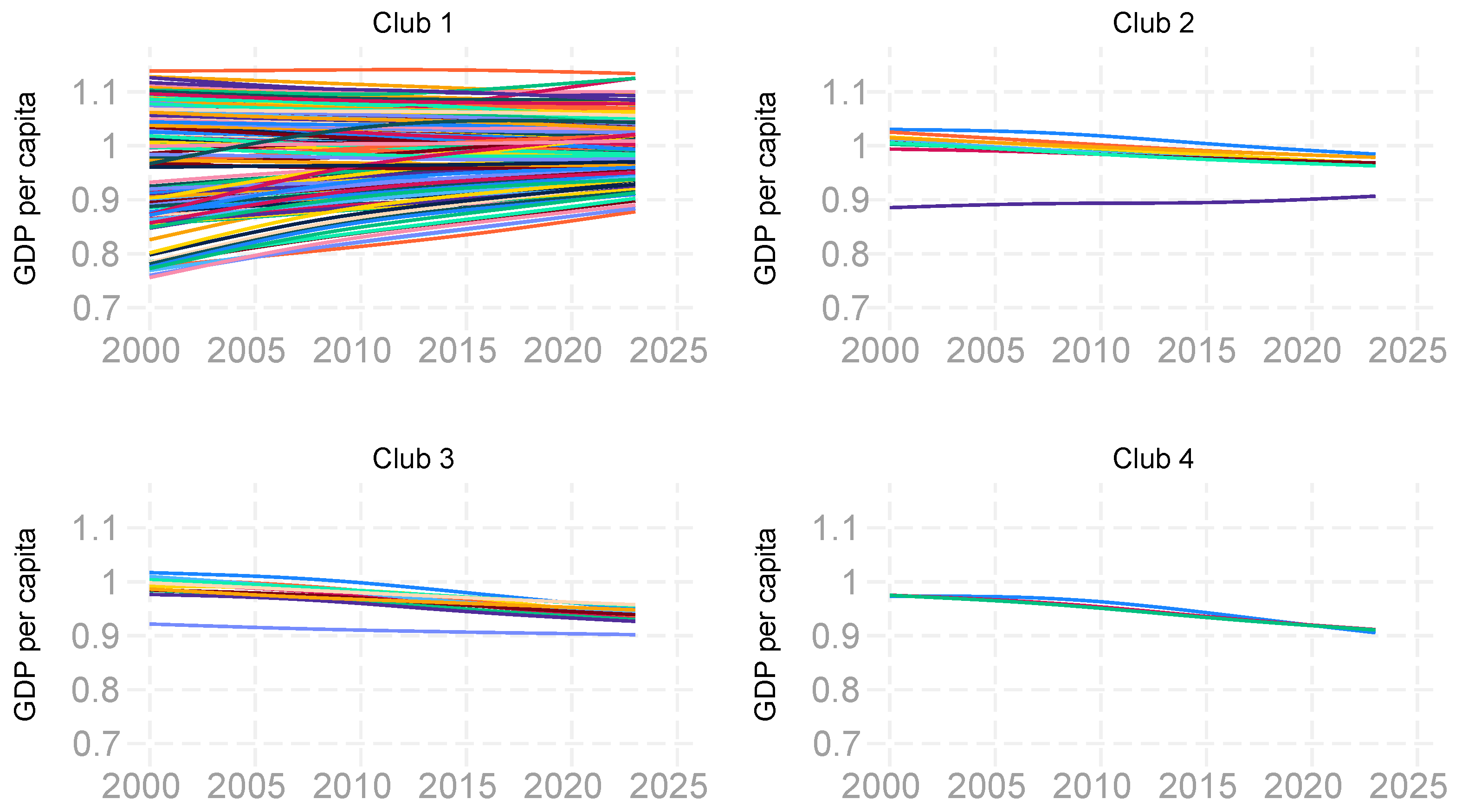
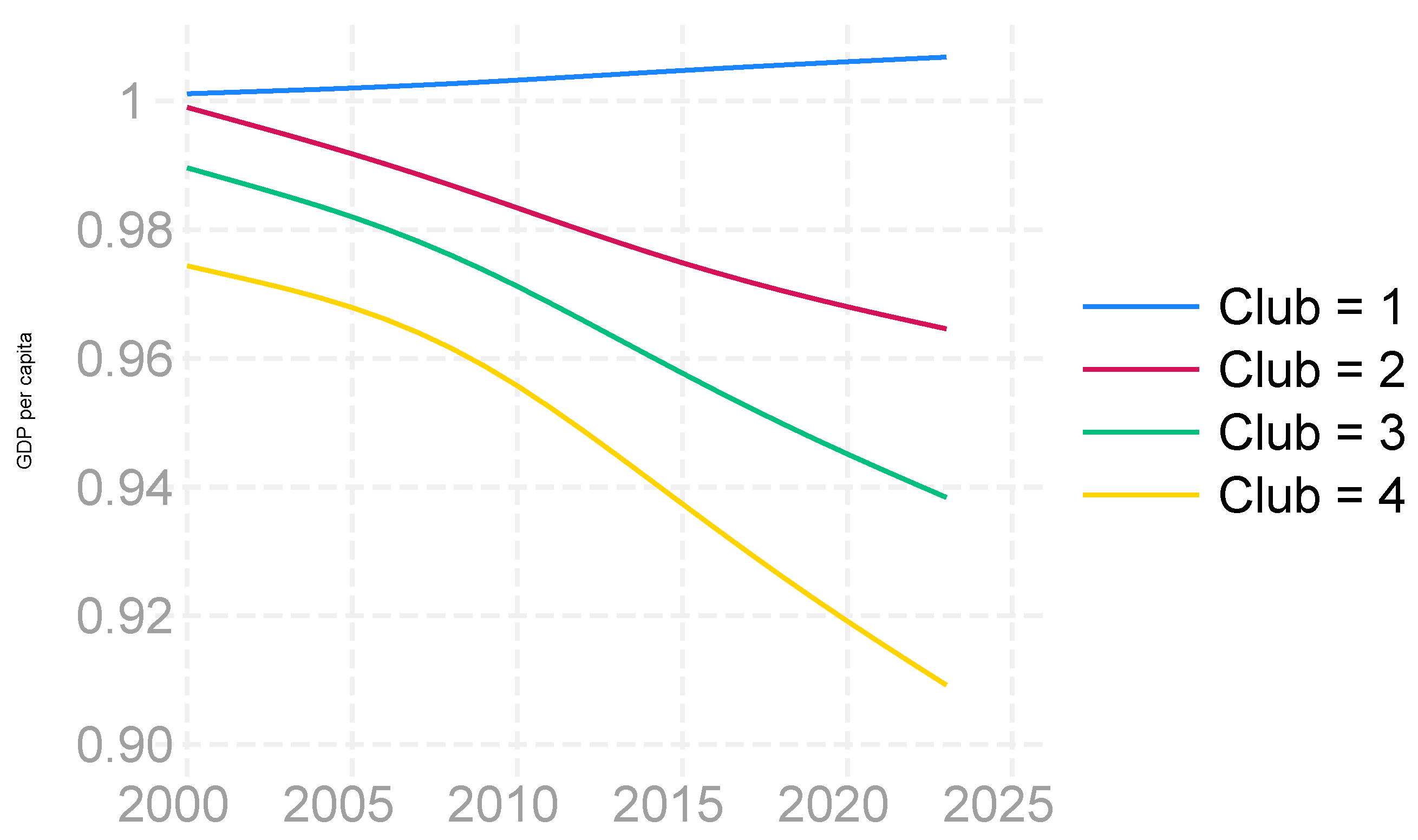
To visualize the heterogeneous adjustment dynamics underlying the club classification,
Figure 2 plots the relative transition paths of GDP per capita for regions grouped by the final club assignment. Descriptive statistics by final convergence club are reported in
Appendix A Table A1.
Figure 2 confirms persistent separation between the four convergence clubs: regions in Club 1 maintained stable income growth, while Clubs 2–4 exhibited slower and more heterogeneous trajectories, indicating that regional disparities have remained entrenched over time. This pattern is consistent with the presence of structural barriers, including limited innovation capacity, weak institutional frameworks, and poor transport connectivity, that prevent lower-income regions from fully exploiting catch-up potential even within a single integrated market (
Barca et al., 2012;
Iammarino et al., 2017).
3.2. -Convergence Within and Across Convergence Clubs
Following the identification of convergence clubs, this section examines the presence of -convergence in regional GDP per capita growth. The analysis is conducted for the full panel of EU regions and separately for each PS convergence club, using a two-way fixed effects specification with year effects and country-specific linear time trends.
For the full sample of 239 regions, the estimated coefficient on lagged log GDP per capita is negative and statistically significant. In the baseline fixed-effects model, the coefficient equals (), indicating conditional -convergence at the European level. This result remains statistically significant when cluster-robust standard errors are applied, confirming that the negative relationship between growth and initial income is not driven by heteroscedasticity or serial correlation.
Estimating the model separately by convergence club reveals substantial heterogeneity in convergence dynamics. Club 1, which contains the majority of EU regions, exhibits a negative and statistically significant coefficient on lagged income (, ), indicating moderate within-club convergence. In comparison, Clubs 2 and 3 display substantially larger coefficients in absolute value ( and , respectively, both significant at conventional levels), implying faster convergence within these smaller groups of regions.
At the same time, no evidence of -convergence is found for Club 4. The estimated coefficient on lagged income is positive and statistically insignificant (, ), indicating the absence of systematic catch-up dynamics within this club.
In sum, the evidence suggests that although conditional
-convergence exists across European regions on average, the convergence process differs sharply across groups of regions. This underscores the heterogeneous nature of income convergence in Europe. Economically, the faster convergence observed in Clubs 2 and 3 may reflect stronger catch-up forces in regions that, while lagging behind Club 1, still possess sufficient institutional and human capital capacity to absorb investment and technology (
Oleš & Hudcovský, 2024;
Stoica et al., 2019). The existing literature identifies investment and trade openness as the primary macroeconomic drivers of growth and convergence within EU countries, operating through capital deepening and productivity spillovers across borders (
Stoica et al., 2019). Institutional quality represents a further key mechanism, and crucially one that is asymmetric across the EU:
Stoica et al. (
2019) document that institutions play a more important role for economic growth in the New Member States (EU13) than in the EU15, implying that regions in Clubs 2 and 3-predominantly drawn from post-accession economies-have relatively more to gain from institutional improvements than regions already embedded in Club 1’s high-income convergence path (
Table 3). The absence of convergence in Club 4, by contrast, points to a group of regions caught in a low-income trap, where structural weaknesses and limited institutional capacity prevent self-sustaining growth even over a two-decade horizon.
To assess whether the speed of convergence changed over time, the
-convergence analysis was also performed separately for the two subperiods (2000–2012 and 2013–2023), estimated as independent regressions on the respective sub-samples. The results are summarized in
Table 4.
The results confirm that convergence was faster before 2012 and slowed slightly in the later period, suggesting that post-crisis regional growth became more heterogeneous. From an economic perspective, the pre-2012 period benefited from strong credit availability, expanding EU trade networks, and the integration momentum of the 2004–2007 enlargements, all of which facilitated capital flows toward lower-income regions. After 2012, fiscal austerity, tighter credit conditions, and persistent unemployment in Southern and Eastern Europe constrained the catch-up process, contributing to the observed slowdown in convergence speed.
3.3. Structural Breaks and Threshold Effects in -Convergence
Given the heterogeneity observed across convergence clubs, the
-convergence relationship was further examined for potential shifts and nonlinearities. Using the multiple-break procedure of
Bai and Perron (
1998,
2003), two statistically significant structural breaks were detected in 2005 and 2012, corresponding to the EU enlargement episode and the Eurozone crisis. These breaks partition the sample into three structural regimes: 2000–2005, 2006–2012, and 2013–2023, with regime-specific convergence coefficients reported in
Appendix A Table A2. For the main subperiod comparison in
Table 4, the 2012 break is used as the primary dividing point-separating the pre-crisis expansion (2000–2012) from the post-crisis adjustment phase (2013–2023), since it marks the more economically decisive structural shift in European growth dynamics. The 2005 break, linked to EU enlargement, is best understood as a change in convergence pace within the broader pre-crisis phase and is captured by the three-regime lens of the structural break analysis.
Regime-specific estimates, reported in
Appendix A Table A2, reveal that convergence was fastest in the first regime (2000–2005,
), moderated during the enlargement-driven expansion (2006–2012,
), and then partially recovered in the post-crisis period (2013–2023,
), approaching but not fully returning to the pre-enlargement pace. The broadly similar coefficients across regimes suggest that while the level of integration shifted-associated with EU enlargement and the Eurozone crisis-the overall catch-up process was not reversed.
To capture possible nonlinear adjustment beyond discrete breaks, a panel threshold regression following
Hansen (
1999) was estimated, allowing the speed of convergence to vary across income regimes. Bootstrap tests strongly supported a single-threshold specification, while models with two or more thresholds were rejected. As shown in
Table 5, the null hypothesis of no threshold was rejected at the 5% significance level for the single-threshold model (
,
).
The estimated threshold value equals 9.68 in lagged log GDP per capita, dividing regions into two income regimes. In absolute terms, this threshold corresponds to approximately €16,000 in GDP per capita (at constant prices), broadly separating lower-income transition and peripheral regions from more advanced European economies. As reported in
Table 6, the coefficient on lagged income is negative and statistically significant in both regimes (
,
below the threshold;
,
above), confirming conditional convergence throughout the sample. The similarity of coefficients suggests that the threshold captures level effects rather than a reversal of convergence dynamics. That both income regimes exhibit comparable convergence speeds implies that the mechanisms driving catch-up, namely capital deepening, technology diffusion, and institutional alignment, operate with broadly similar intensity across the income distribution, even if the absolute income gaps between clubs remain large. This finding suggests that the threshold demarcates a level effect, not a structural break in the catch-up process itself.
Overall, the results indicate that European regional income convergence is shaped by both structural and nonlinear adjustment processes, with distinct phases linked to major institutional and macroeconomic changes.
3.4. Spatial Autocorrelation Tests
Global spatial autocorrelation tests based on Moran’s
I and Geary’s
c are applied to
and
for each year over the period 2001–2023 (
Table 7). Moran’s
I statistics are positive and statistically significant in all 23 years for both income levels and growth, indicating strong and persistent global spatial clustering across EU NUTS-2 regions throughout the entire sample period. Geary’s
c values are consistently below unity and statistically significant throughout the sample period, confirming the presence of strong local spatial dependence in both variables. The consistency of these results across all years suggests that spatial clustering is a stable structural feature of the EU regional income distribution rather than a cyclical phenomenon.
These results indicate that European regions with similar levels and growth rates of GDP per capita tend to be geographically clustered, motivating the use of spatial panel models in the following section.
3.5. Spatial Econometric Models
Given the strong and statistically significant spatial autocorrelation in both GDP per capita levels and growth (
Section 3.4), spatial panel models were estimated to account for cross-regional spillover effects.
All specifications employ a row-normalized contiguity weights matrix W of dimension . The matrix contains 1040 non-zero links, with an average of 4.35 neighbors per region and a maximum of 11. Two regions with no contiguous neighbors (islands) were retained in the sample and treated accordingly during estimation.
Table 8 reports the key results from the static and dynamic SDM estimations with region and year fixed effects. In the static specification, the spatial autoregressive coefficient is positive and highly significant (
,
), confirming substantive spatial dependence in regional growth. The coefficient on initial income is negative and statistically significant (
,
), consistent with conditional
-convergence once spatial dependence and country-specific trends are controlled for.
The spatially lagged income term is positive (, ), suggesting that proximity to initially wealthier neighbors fosters faster regional growth. Long-run impact decomposition reveals a negative and significant direct convergence effect (LR direct , ) and a positive and significant indirect spillover effect (LR indirect , ), yielding an overall neutral total effect (LR total , ). This implies that local convergence is partly offset by positive spatial spillovers.
The dynamic SDM dlag = 3, which includes both own-region growth persistence
and spatial feedback
simultaneously, see
Section 2.5) was also estimated as a robustness check. The results confirm strong own-region growth persistence (
,
) and significant spatial feedback from neighbors’ past growth (
,
). In the dynamic specification, the coefficient on initial income turns slightly positive (
,
), which should not be interpreted as evidence of divergence: in dynamic panel models, the inclusion of lagged dependent variables absorbs part of the convergence effect into the temporal lag, altering the interpretation of the level coefficient. The estimated spatial dependence remains positive and significant (
,
). While the dynamic model yields consistent qualitative patterns for the spatial parameters, the long-run simulated effects are statistically imprecise; therefore, the static SDM is retained as the preferred specification.
The spatial estimates indicate clear and robust spatial dependence in regional income growth across the EU. In the static SDM, neighboring regions influence each other’s performance (, ), with poorer regions catching up locally (LR direct , ) but convergence partly offset by positive spillovers from richer neighbors (LR indirect , ). Economically, this pattern is consistent with a core-periphery dynamic: proximity to high-income regions generates positive externalities through knowledge diffusion, labor market integration, and supply chain linkages, which partially offset the local convergence effect. The near-zero total effect suggests that at the EU level, these opposing forces largely cancel out, implying that spatial interconnectedness redistributes rather than amplifies aggregate convergence. The dynamic SDM confirms that these interactions persist over time (, ). Overall, regional growth and convergence in Europe are shaped by strong cross-regional linkages rather than isolated local dynamics.
4. Discussion and Conclusions
Taken together, the empirical results confirm that regional convergence across the EU is heterogeneous, nonlinear, and spatially embedded. The PS analysis identifies four stable convergence clubs and one non-convergent region, corroborating a well-established finding in the literature that EU regions are not converging to a single common income level (
Phillips & Sul,
2007,
2009;
Simionescu, 2015). The club structure reflects deep-seated economic geography: the Core and Converging Economies of Club 1 are characterized by diversified service sectors, high human capital, and strong institutional frameworks, while the Structurally Lagging Regions of Club 4 display near-stagnant income growth over more than two decades-a pattern inconsistent with the self-reinforcing catch-up dynamics that neoclassical theory would predict. The persistence of these clubs suggests that market integration alone has not dissolved structural divergences rooted in history, geography, and institutions.
-convergence analysis confirms that conditional convergence holds at the European level as a whole-the estimated coefficient on lagged income is negative and highly significant-but the speed of adjustment differs sharply across groups. Consistent with
Borsi and Metiu (
2015) and
Simionescu (
2015), regions with stronger industrial bases and greater innovation capacity converge more rapidly, while peripheral and structurally weaker regions show limited progress. Subperiod analysis reveals a clear deceleration in convergence speed after 2012 relative to the pre-crisis phase (
Cutrini & Mendez, 2023;
Pintera, 2024;
Stoica et al., 2019). This is consistent with the broader narrative of a post-crisis “new normal” in Europe.
Stoica et al. (
2019) document that the 2008 global crisis had a particularly severe negative impact on conditional convergence within the New Member States group-precisely the economies that dominate the lower convergence clubs-compounding the direct shock with the withdrawal of investment flows and a contraction of trade that had previously been key growth drivers for these regions. The deceleration observed after 2012 thus reflects not merely aggregate fiscal consolidation and deleveraging, but a structurally asymmetric shock that hit the most investment-dependent and trade-exposed regions hardest.
A panel threshold test confirms the presence of nonlinear dynamics in the convergence process, indicating that adjustment mechanisms operate differently across the income distribution (
Hansen, 1999). Rather than producing a sharp reversal, the estimated threshold demarcates a structural level effect: regions on either side converge at broadly similar speeds, but from very different income positions, so absolute income gaps narrow only slowly. This finding has direct policy relevance: income transfers alone are unlikely to close the gap rapidly, and structural reforms that raise productive capacity and institutional quality are needed to shift the long-run income equilibrium of lower-club regions.
Spatial analysis further reveals that regional growth is not independent across space. The Spatial Durbin Model detects strong and statistically significant positive spatial spillovers: the direct convergence effect is negative and significant (reflecting local catch-up), while the indirect spillover effect is positive and significant, reflecting the growth stimulus generated by proximity to richer neighbors (
Furková & Chocholatá, 2016;
Manzi et al., 2023). The near-neutral total effect implies that spatial interconnectedness redistributes rather than amplifies aggregate convergence. This pattern reveals a spatial equity tension inherent in the EU growth process: regions adjacent to high-income cores benefit from knowledge diffusion, labor market integration, and supply chain linkages, while geographically remote peripheral regions-lacking such neighborhood advantages-face a compounded disadvantage of structural weakness and geographic isolation. Cohesion policy that ignores this spatial dimension risks reinforcing rather than reducing the core-periphery divide.
Several limitations of this study should be acknowledged. The use of the HP filter, while standard, has known end-point sensitivity and may generate spurious cycles. The static SDM is retained as the preferred specification for interpretability, but does not fully capture dynamic spatial adjustment; the dynamic extension yields imprecise long-run estimates. The backcasting procedure assumes stable regional income shares, which may not hold in periods of rapid structural transformation. The conditional convergence specification does not include explicit time-varying regional controls-such as investment rates, human capital, or trade openness-reflecting both data availability constraints at the NUTS-2 level and the methodological reliance on fixed effects to absorb structural heterogeneity; incorporating such variables in future work could more precisely identify the mechanisms driving heterogeneous convergence speeds. Finally, the NUTS-2 level of analysis may miss within-region disparities relevant to finer-grained policy design. Future research could incorporate firm-level or NUTS-3 data, examine how specific cohesion policy instruments shape club membership, and apply this integrated framework to other multi-country settings.
These findings carry several important implications for cohesion policy. The club-based, spatially embedded nature of European convergence makes a compelling case against uniform policy instruments. Instead, effective cohesion policy requires differentiated, place-sensitive interventions calibrated to regional structural conditions (
Becker et al., 2010;
Crescenzi & Giua, 2020;
Rodríguez-Pose, 2018).
Several contested policy questions follow directly from these results. The first concerns the spatial allocation of support: should cohesion policy prioritize peripheral regions to reduce disparities, or concentrate on growth poles capable of generating broader spillovers? The finding of positive spatial spillovers suggests that proximity to high-income cores already confers growth advantages; a strategic rebalancing toward genuinely remote and lagging regions-those lacking neighborhood externalities-therefore appears justified from both an equity and an efficiency standpoint (
Rodríguez-Pose, 2018). The second question concerns the sectoral focus of investment: whether to support frontier innovation activities, which drive productivity but may widen within-region inequality, or more inclusive economic activities that generate broadly shared employment and income growth. The heterogeneous club structure documented here suggests that the needs of Structurally Lagging Regions differ fundamentally from those of Upper-Peripheral Regions that are already on a convergence path: one-size-fits-all sectoral strategies are unlikely to be effective. A third question concerns the balance between market mechanisms and active state intervention. The uneven returns to cohesion policy transfers documented in the literature (
Becker et al., 2010;
Crescenzi & Giua, 2020) suggest that the effectiveness of public investment depends heavily on regional absorptive capacity and institutional quality-reinforcing the case for place-based, institution-building approaches over purely redistributive transfers and for a policy stance that is neither uniformly interventionist nor passively reliant on market forces alone.