1. Introduction
Over the past decade, China’s new energy sector has undergone a marked transition from policy-driven expansion to intensified market competition. In the early stage, supported by subsidies, industrial policies, and sustained capital inflows, the new energy supply chain expanded rapidly, the number of listed firms increased, and valuation and investment activities remained active across different segments of the industry. In recent years, however, the operating environment of the sector has changed substantially, as subsidies have been gradually withdrawn, overcapacity pressures have intensified, product homogeneity has increased, and external uncertainty has risen.
Yu et al. (
2021) show that renewable energy firms in China generally suffer from varying degrees of overcapacity, with government subsidies and market structure being important determinants.
Lin and Xie (
2023) further find that government subsidies significantly reduce capacity utilization in Chinese new energy firms, while technological innovation can only partially offset this effect.
Lin and Xie (
2024) also show that subsidy policies may weaken total factor productivity by reducing capacity utilization and increasing rent-seeking costs. The rapid changes in industrial structure and inter-firm relations have raised growing concerns over industry risk. When a particular firm is hit by a specific shock, does this localized risk remain confined to the firm itself, or does it spread further through supply chain linkages, competitive relations, and capital market connections, eventually affecting the overall risk level of the industry? This question remains underexplored in the existing literature.
Existing studies suggest that industry risk is not simply the average of individual firm risks, but rather the joint outcome of common factors and heterogeneous shocks.
Campbell et al. (
2001) and
Forni et al. (
2000) both show that industry volatility lies between aggregate common shocks and micro-level heterogeneous shocks, and that its formation mechanism is essentially a combination of common components and cross-sectional heterogeneity rather than a simple aggregation of firm-level risk. The literature on production networks and supply chain networks further suggests that connections among micro-level agents can alter the aggregation of shocks, allowing local disturbances to propagate through the network and evolve into higher-level fluctuations (
Carvalho, 2014;
Acemoglu et al., 2017;
Acemoglu & Azar, 2020). However, in the context of the stock market, it remains unclear whether the transmission of firm-specific risk across firms can accumulate into industry-wide risk. This study therefore examines whether, after removing market-wide and industry-wide common factors, endogenous volatility spillovers across firms can be amplified through the inter-firm network and ultimately raise industry risk.
To address this question, this study uses a sample of 48 listed firms in China’s new energy sector and daily stock price data spanning 14 February 2019 to 28 November 2025. First, under a market–industry two-factor framework, a leave-one-out industry index is constructed to extract residual stock returns, from which firm-level residual conditional volatilities are then estimated. Based on these volatility series, the LASSO-VAR connectedness approach is employed to identify the direction, magnitude, and structure of firm-specific volatility spillovers across firms. Total spillovers, total within-group spillovers, and total between-group spillovers are then separately introduced into a GARCH-X model to test whether endogenous inter-firm risk transmission amplifies the conditional volatility of the industry.
The contribution of this study is threefold. First, unlike existing studies on risk in China’s new energy sector, which have predominantly focused on external drivers such as subsidy policies, crude oil prices, carbon markets, and aggregate market fluctuations, this study redirects attention to endogenous risk transmission operating within the inter-firm network after common shocks have been removed. The conceptual novelty lies in the residualization step: by constructing a leave-one-out industry index under a market–industry two-factor framework, we strip away market-wide and industry-wide co-movement that would otherwise confound firm-level interactions. What remains in the residual volatilities is risk variation that cannot be attributed to market-wide or industry-wide common co-movement. Any subsequent cross-firm connectedness built upon these residuals therefore captures inter-firm transmission that is net of these common exposures. Although the residualization step does not fully eliminate the possibility that some remaining co-movement reflects unobserved common factors beyond those modeled, this distinction is nonetheless consequential: without the filtering step, observed spillovers would be heavily confounded by firms’ simultaneous responses to the same external shocks, offering little insight into the internal transmission structure of the industry. Second, the study introduces a two-stage empirical design that links network-based spillover measurement to conditional volatility modeling in a way that has not been previously applied in this literature. The LASSO-VAR connectedness framework is well suited to recovering directional spillover relationships in a high-dimensional setting while avoiding overfitting, but it does not by itself speak to whether the identified spillovers translate into elevated industry-level risk. The subsequent GARCH-X specification directly tests this amplification hypothesis by entering estimated spillover measures as explanatory variables in the conditional variance equation of an industry index. The combination is therefore not additive but functionally integrated: LASSO-VAR provides the network inputs that GARCH-X uses to evaluate macro-level consequences, allowing the paper to move from describing the topology of risk transmission to quantifying its aggregate impact. Third, this study improves the spillover network decomposition method proposed by
Gabauer and Gupta (
2018) to correct for mechanical bias arising from differences in subgroup sample size, enabling a more reliable comparison of within-group and between-group spillover effects across upstream, midstream, and downstream segments of the supply chain.
The main findings are as follows. Even after removing market-wide and industry-wide common factors, firm-level residual volatilities in China’s new energy sector remain widely and significantly interconnected, suggesting the presence of inter-firm risk transmission that goes beyond shared factor exposure. These spillovers, referred to throughout this paper as endogenous spillovers, exhibit clear time-varying characteristics and become markedly stronger around 2024. The GARCH-X results further show that total spillovers, total within-group spillovers, and total between-group spillovers all significantly increase industry volatility, and that the amplifying effect of within-group spillovers is at least as strong as that of between-group spillovers. These findings suggest that industry risk in China’s new energy sector is driven not only by external shocks, but also by amplification mechanisms operating within the inter-firm network that cannot be captured by common factor models alone.
The remainder of this paper is organized as follows.
Section 2 reviews the relevant literature.
Section 3 presents the methodology.
Section 4 describes the data.
Section 5 reports the empirical results.
Section 6 concludes and discusses the policy implications.
2. Literature Review
Existing studies on the sources and volatility mechanisms of industry-level risk generally argue that industry risk is first driven by common macroeconomic factors and is then transformed into industry-level volatility through industry exposure structures, cash-flow sensitivity, and risk-pricing mechanisms. Early studies show that macro variables such as industrial production, inflation, the term structure, and risk premia systematically affect stock returns and risk. Industry-level volatility therefore does not arise solely from firm-specific conditions, but is shaped by a broader macro-financial environment (
Chen et al., 1986;
Schwert, 1989). From the perspective of the three layers of risk—market, industry, and firm characteristics—industry volatility lies between aggregate macro shocks and heterogeneous idiosyncratic shocks. In this sense, industry risk is essentially the joint outcome of common factors and cross-sectional heterogeneity, rather than a simple aggregation of averages (
Campbell et al., 2001;
Forni et al., 2000). In dynamic terms, stock market volatility contains both a slow-moving and persistent component shaped by the macroeconomic environment and a faster-moving component that is more easily disturbed by sentiment and financial conditions (
Engle & Rangel, 2008;
Engle et al., 2013;
Chiu et al., 2018). On this basis, the uncertainty literature further shows that macroeconomic uncertainty, policy uncertainty, and political uncertainty not only raise overall risk aversion and discount rates, but also intensify asset price volatility by compressing investment, altering expectations, and increasing co-movement, thereby causing industry risk to rise significantly during periods of shock (
Bekaert et al., 2009;
Bloom, 2009;
Baker et al., 2016;
Pástor & Veronesi, 2012). In addition, commodity shocks, especially oil price shocks, have also been shown to be an important exogenous source of risk for many industries. However, their effects are not evenly distributed, but depend on differences across industries in cost structures, demand elasticities, and positions in the supply chain. The same external shock can therefore generate markedly heterogeneous risk responses across industries, and evidence for this has been documented in international stock markets, the U.S. market, and Chinese industry indices (
Jones & Kaul, 1996;
Sadorsky, 1999;
Kilian & Park, 2009;
You et al., 2017).
Building on the identification of external sources of industry risk, some studies have examined why risk diffuses across firms and accumulates over time. This literature argues that firms do not bear shocks in isolation. Linkages such as supplier relationships, production dependence, information transmission, and credit constraints allow local shocks to propagate along firm networks to upstream and downstream firms, thereby generating broader operational consequences and capital market reactions. With respect to supply chain mechanisms,
Barrot and Sauvagnat (
2016) show that natural disaster shocks hitting suppliers significantly impair the operating performance of customer firms. Using firm-level evidence from the Great East Japan Earthquake,
Boehm et al. (
2019) demonstrate that input linkages constitute an important channel through which shocks are transmitted across firms.
Inoue and Todo (
2019) further show that negative firm-level shocks can diffuse through supply chain networks and generate aggregate losses far exceeding the initial shock.
Kashiwagi et al. (
2021) also show that such propagation is not confined to a single domestic region, but can continue to spread along broader supply chain structures. The capital market consequences of supply chain risk are also supported by substantial evidence.
Gofman et al. (
2020) show that a firm’s position in the production network significantly affects its stock returns.
Dhaliwal et al. (
2016) find that greater customer concentration increases suppliers’ cost of equity capital.
Mihov and Naranjo (
2017) further show that customer concentration strengthens the transmission of idiosyncratic volatility along vertical chains.
Y. Li et al. (
2021) find that qualitative risk information disclosed by customers is absorbed by suppliers’ investors and reflected in suppliers’ stock prices.
Sun et al. (
2023) show that customer financial risk spills over to suppliers’ accounting behavior.
Qiu et al. (
2024) further confirm that stock price crash risk can also spread along the supply chain. Beyond direct trading relationships, inter-firm risk transmission is also shaped by broader production complementarities and industry linkages.
Lee et al. (
2024) find that cross-industry production complementarity strengthens information transmission and asset price co-movement, suggesting that the basis of inter-firm risk diffusion lies not only in direct transactions but also in deeper technological and production linkages. Consistent with these findings, the volatility spillover network literature provides a more systematic set of tools for characterizing inter-firm risk transmission.
Diebold and Yilmaz (
2012), within the generalized forecast error variance decomposition framework, propose total and directional spillover measures, allowing researchers to distinguish the source, destination, and net transmission role of risk.
Diebold and Yilmaz (
2014) further embed variance decomposition results into a network topology framework, so that risk transmission can be explicitly represented as directed relationships between nodes. Subsequent studies extend this line of research to frequency-domain settings, inter-industry linkages, and multilayer networks.
Baruník and Křehlík (
2018) decompose connectedness across different frequency bands and show that risk transmission is not identical in the short and long run. The results of
Mensi et al. (
2018) and
Laborda and Olmo (
2021) show that cross-market and cross-sector volatility connectedness rises significantly during crisis periods.
Ouyang et al. (
2023), from the perspective of a multilayer frequency-domain network, further show that coupling across different market layers amplifies aggregate risk transmission. The existing literature provides the foundation for the present study in two respects. On the one hand, supply chain and production linkages allow firm-level shocks to be transmitted across micro-level agents. On the other hand, volatility spillovers make such transmission directional and structured.
Firm-level idiosyncratic volatility reflects micro-level idiosyncratic shocks. A number of studies, from the perspectives of both the real economy and financial risk, argue that such micro-level idiosyncratic shocks do not remain confined to the micro level, but may also generate amplification effects on aggregate fluctuations. In the real economy, the production network literature shows that input–output linkages alter the way micro shocks are aggregated, so that they cannot be simply averaged out.
Acemoglu et al. (
2012) argue that whether micro idiosyncratic shocks translate into aggregate fluctuations depends not on whether the economy is sufficiently disaggregated, but on asymmetries and higher-order connections in the network structure.
Carvalho (
2014) further shows from a production network perspective that local shocks can have aggregate consequences because network position determines the range of spillovers and the cascading capacity of different sectors.
Acemoglu et al. (
2017) further demonstrate that the interaction between sectoral heterogeneity and network structure affects not only ordinary fluctuations but also significantly increases the probability of macroeconomic tail risk. Along the same line,
Acemoglu and Azar (
2020) show that production networks are themselves endogenously formed in equilibrium, and that concentration and hierarchical structures in the network further alter the propagation path of shocks.
Baqaee and Farhi (
2019) show that, in the presence of input–output linkages and nonlinear constraints, even small shocks to key sectors can generate disproportionate macroeconomic effects.
Baqaee and Farhi (
2022) further show that supply shocks and demand shocks can amplify each other in disaggregated production networks, making micro disturbances more likely to emerge as synchronized fluctuations at the industry or even macro level. Consistent with these theoretical studies, the empirical literature also provides evidence of network cascade effects.
Carvalho et al. (
2021) show that exogenous shocks affect not only the directly exposed firms themselves, but also propagate along upstream and downstream linkages to direct and indirect customers and suppliers, thereby generating cascading effects. Research on financial networks reaches a similar conclusion from another perspective, namely that network structure is not merely a background condition for risk exposure, but an important mechanism determining whether micro-level financial shocks evolve into systemic instability.
Elliott et al. (
2014) show that the degree of integration and diversification in financial networks has a non-monotonic effect on cascading defaults, so that denser networks are not necessarily more stable.
Acemoglu et al. (
2015) show that financial networks exhibit a clear phase-transition property: under small shocks, tighter connections help diversify risk, whereas once shocks exceed a threshold, the same connections become channels of risk amplification.
Glasserman and Young (
2016) argue that the core issue in financial contagion is never simply the fragility of an individual node itself, but rather how local losses are re-amplified through balance-sheet linkages, liquidity channels, and expectation-based responses.
Bardoscia et al. (
2017) further show that even when each individual institution satisfies stability conditions, cyclic structures and feedback loops in the network may still cause the system as a whole to shift from stability to instability. Taken together, these studies suggest that once micro-level agents are embedded in networks characterized by uneven connectivity, key nodes, and multilayer feedback, idiosyncratic shocks are no longer merely local noise, but may be transformed into industry-level aggregate fluctuations through cascading effects and structural amplification. For the present study, if the firm-level idiosyncratic volatility identified after removing common market and industry factors still exhibits significant inter-firm network transmission, such transmission may constitute a potential endogenous amplification mechanism of industry risk rather than a purely random firm-level disturbance.
To examine firm-level shocks arising from supply chains and inter-firm relationships, it is necessary to remove common market factors from volatility series (
Herskovic et al., 2016). The existing literature usually begins with return decomposition by stripping out the component of individual stock returns explained by market or style factors and treating the remaining part as residual returns or firm-specific returns that are closer to the firm level.
Blitz et al. (
2011) and
Blitz et al. (
2013) show that using factor-adjusted residual returns instead of raw returns can substantially reduce the interference of common factor exposure in empirical results.
Chae and Kim (
2020) find that strategies based on residual stock returns extract the firm-specific component more effectively than those based on total returns. Volatility derived from residual returns is usually defined as the component of total volatility that cannot be explained by the market or other common factors.
Berrada and Hugonnier (
2013), from the perspective of an incomplete information model, show that the relationship between idiosyncratic volatility and expected returns depends on investors’ perception errors regarding firm-specific shocks.
Peterson and Smedema (
2011) distinguish between realized and expected idiosyncratic volatility and show that the two do not affect returns in the same way.
Liu (
2022) further decomposes idiosyncratic volatility into short-term and long-term components and finds that their relationships with expected returns differ in sign.
Siddiqui et al. (
2024) find that energy uncertainty significantly increases idiosyncratic volatility among Chinese firms.
Over the past decade, China’s new energy industry has undergone a pronounced structural transformation, shifting from rapid expansion driven by industrial policy in the early stage to intense market competition in recent years. This provides an ideal real-world setting for examining whether micro-level idiosyncratic shocks amplify industry risk.
Yu et al. (
2021) find that Chinese non-hydro renewable energy firms generally exhibit varying degrees of overcapacity, and that government subsidies and market structure are important determinants.
Lin and Xie (
2023) show that government subsidies significantly reduce capacity utilization in Chinese renewable energy firms, while technological innovation can only partially offset this effect.
Lin and Xie (
2024) further show that subsidy policies weaken firms’ total factor productivity by lowering capacity utilization and increasing rent-seeking costs.
Zhang and Chiu (
2023) find that country risk and government subsidies jointly affect the performance of Chinese renewable energy firms, indicating that firm outcomes in this sector are constrained not only by internal resource allocation but are also highly exposed to external uncertainty shocks. At the same time, the rapid evolution of the industry structure has also been reflected in the securities market, in the form of higher volatility and stronger cross-market risk linkages.
Wu and Jiang (
2023) find significant time-varying and asymmetric volatility spillovers among China’s carbon market, new energy market, and stock market, with negative volatility transmission being stronger under major event shocks.
J. Li et al. (
2023) further document clear return and volatility spillovers between China’s crude oil futures market and the green energy stock market, suggesting that risk in the new energy sector is not confined within the industry itself but remains linked to traditional energy price shocks.
G. Li et al. (
2023) directly show that there are significant volatility spillovers and dynamic correlations between China’s new energy market and the stock market, indicating that the new energy sector has become an important node in the transmission of risk in the securities market. The existing literature shows that overcapacity expansion, subsidy dependence, and intensified competition within China’s new energy industry have jointly shaped its industrial structure and accelerated its reconfiguration. The industry also exhibits high volatility and significant external linkages in capital markets. However, most existing studies focus on the external effects of subsidy policy, country risk, crude oil prices, the carbon market, or the overall stock market on the new energy sector. Much less attention has been paid to whether, after removing common market and industry shocks, endogenous risk spillovers among firms within the new energy industry are amplified through inter-firm networks and ultimately manifest themselves as a rise in industry-level risk.
3. Methodology
3.1. Estimation of Idiosyncratic Volatility
To examine the idiosyncratic risk of new energy firms, this study first removes common market and industry shocks from raw stock returns in order to obtain a residual return series that captures firm-specific information (
Blitz et al., 2011). Residual return is obtained by explaining individual stock returns with a benchmark model that includes common factors and then treating the unexplained component as the firm-specific return. Compared with the direct use of raw returns, residual returns purified of common factors are more useful for identifying the individual component in stock returns (
Blitz et al., 2013). In addition, when constructing industry indicators, excluding the focal firm itself from the industry portfolio, helps avoid mechanical correlation and reverse contamination. Accordingly, this study constructs a leave-one-out (LOO) industry index separately for each sample firm within a two-factor market-industry framework. The LOO industry index is constructed by assigning transaction-amount weights to all firms in the same industry group except the focal firm.
On this basis, this study employs the following regression equation to estimate the residual return of firm
i:
where
is the residual return of firm
i in period
t. The term
captures systematic co-movement at the market level, while
captures common variation within the industry. The residual term
therefore represents the firm-specific return disturbance that remains after these two common components have been removed.
Financial time series exhibit volatility clustering (
Engle, 1982). Accordingly, after obtaining the residual return series, this study further employs a GARCH (1,1) model to estimate the conditional volatility series for each firm. Let
denote an independently and identically distributed disturbance term. Then, we have:
where
denotes the conditional residual volatility of firm
i in period
t. This study uses the resulting
as the input variables for the subsequent high-dimensional spillover network analysis. The volatility spillovers identified in this way are no longer mixed contagion among raw stock price volatilities, but rather the interactions among firm-specific volatilities after common market and industry factors have been removed.
It should be noted that the two-factor residualization adopted here reduces, but does not fully eliminate, the possibility that remaining co-movement among residual volatilities reflects unobserved common factors beyond those explicitly modeled. For instance, sub-industry factors, size-related commonalities, or simultaneous responses to the same unobserved event could in principle generate correlated residual volatilities without involving direct inter-firm transmission. Therefore, the residual conditional volatilities identified in this study should be interpreted as firm-level risk measures after removing the two most prominent sources of common variation, namely market-wide and industry-wide factors; the spillover network constructed from these measures captures inter-firm connectedness that is not mechanically driven by these common exposures.
3.2. LASSO-VAR Spillover Approach
After obtaining the residual conditional volatility series for
N firms, this study employs the LASSO-VAR connectedness approach to identify the network of endogenous volatility spillovers among firms. A standard VAR faces the dimensionality problem in high-dimensional systems, whereas LASSO shrinkage compresses redundant parameters while retaining the key transmission links, thereby improving the feasibility and robustness of high-dimensional network estimation.
Demirer et al. (
2018) incorporate LASSO into the Diebold–Yılmaz connectedness framework and provide a standard approach for estimating connectedness in high-dimensional settings.
Let
denote the vector of residual conditional volatilities for
N firms in period
t, where
. This study assumes that
follows a VAR process of order
p:
Since
N is large, directly estimating all
would cause the number of parameters to increase rapidly. This study therefore adopts equation-by-equation LASSO estimation. For the
i-th equation, this can be written as:
where
is the vector containing the
p lagged terms of all variables
,
is the shrinkage parameter, and
is the
norm. LASSO shrinks unimportant lag coefficients to zero and retains the cross-firm volatility transmission links that have predictive power. For each equation within each rolling window, the penalty parameter is selected by cross-validation so as to minimize the out-of-sample prediction error.
After estimating the sparse VAR, it can be rewritten as a VMA process:
where
, and the recursive relation is given by:
Next, this study employs the generalized forecast error variance decomposition (GFEVD) to calculate the share of forecast error variance explained by shocks from other firms. Following the generalized connectedness framework of
Diebold and Yilmaz (
2012,
2014), the contribution of shocks from firm
j to the H-step-ahead forecast error variance of firm
i is defined as:
where
is the
i-th unit vector and
is the
j-th diagonal element of
. To ensure that each row sums to one, the decomposition is further normalized as follows:
On this basis, the various spillover measures used in this study can be defined.
First, TS (total spillover) is defined as the share of the sum of all off-diagonal contributions in the system relative to the total forecast error variance:
Second, for an individual firm
i, the spillover received from other firms (FROM) is defined as:
The spillover transmitted to other firms (
TO) is defined as:
Net spillover (
NET) is defined as:
If , firm i is a net transmitter of risk; if , firm i is a net receiver of risk.
The net pairwise spillover is defined as:
If , the net risk transmitted from firm i to firm j is stronger than the risk received by firm i from firm j. It captures the net dominant direction in the bilateral relationship between the two firms.
To identify transmission mechanisms across supply chain positions, this study further classifies firms into three groups—upstream, midstream, and downstream—and constructs within-group and between-group spillover measures based on
Gabauer and Gupta (
2018). Suppose that the system contains
G groups in total, and that group
g contains
firms. The aggregated spillover transmitted from group
h to group
g is defined as:
The aggregated within-group spillover is defined as:
The total between-group spillover and the total within-group spillover are then defined, respectively, as:
where
captures the intensity of risk transmission across different supply chain layers, and
captures the intensity of risk transmission within the same supply chain layer, with
.
Since the numbers of upstream, midstream, and downstream firms are not equal, simple aggregated measures may be mechanically affected by group size. To eliminate this size effect, this study further constructs average within-group and average between-group measures based on
Gabauer and Gupta (
2018). The average within-group spillover (
AW) is defined as:
The average between-group spillover (
AB) is defined as:
The average net between-group spillover (
ANB) is defined as:
measures the average intensity of risk transmission between any two firms within the same supply chain layer. measures the average risk effect of firms in group h on firms in group g. measures the average net dominant relationship of group g relative to group h.
The lag order of the VAR process is determined on the basis of the AIC and BIC criteria. A rolling-window approach is employed to obtain the dynamic spillover series and the average dynamic spillover measures. To ensure robustness, the model is estimated using window lengths of 200, 250, and 300 trading days, respectively, and the results based on the 200-trading-day window are reported in the main text. The spillover measures obtained through the above procedure can be interpreted as the directional transmission of firm-specific volatility through the firm network after removing common market and industry factors. They capture not general co-movement, but rather the extent, direction, and structure of the diffusion of heterogeneous endogenous risk across firms.
3.3. GARCH-X Model
The central question of this study is whether the transmission of heterogeneous firm-level risk further amplifies industry-level volatility.
He et al. (
2023) show that the spillover index across industry volatilities has significant in-sample and out-of-sample predictive power for aggregate stock market volatility, and that its explanatory power is even stronger than that of individual industry volatility measures. This suggests that volatility spillovers are not merely network characteristics unrelated to higher-level risk, but an important mechanism that can materially affect aggregate or industry-level volatility. The production network and supply chain literature similarly suggests that, because firms are linked through input–output relations, trading relationships, and risk exposures, local firm-level shocks can accumulate through networks and manifest themselves as broader volatility fluctuations (
Barrot & Sauvagnat, 2016;
Acemoglu et al., 2012). In the case of China’s new energy industry, the sector has in recent years experienced subsidy-driven expansion, concentrated investment in similar segments, rapid capacity growth, and intensified price competition. In such an industrial environment, firms within the same supply chain layer tend to share more similar cost structures, technological paths, competitors, and policy exposures, and are therefore more likely to respond synchronously to similar information and similar shocks (
G. Li et al., 2023;
J. Li et al., 2023). To examine whether firm-specific volatility spillovers amplify industry risk, this study proposes the following two hypotheses:
Hypothesis 1. System’ s total spillovers have a significantly positive effect on industry volatility.
Hypothesis 2. In China’ s new energy industry, the effect of total within-group spillovers on industry volatility is greater than that of total between-group spillovers.
This study employs the GARCH-X model to examine whether inter-firm spillovers further amplify industry-level risk. The core idea of the GARCH-X model is to introduce exogenous explanatory variables into the conditional variance equation, so that volatility depends not only on its own ARCH and GARCH components but also on additional information external to the system (
Han & Kristensen, 2014).
De Melo Mendes and Accioly (
2017) show that GARCH-X can effectively capture the incremental explanatory power of exogenous variables for conditional volatility and has been widely used to incorporate cross-market volatility or other external state variables into volatility modeling.
Let denote the return on the CSI New Energy Industry Index, and let denote its conditional volatility. Let denote the conditional volatility of the market index. This study constructs three groups of GARCH-X models to examine the effects of total spillovers, total within-group spillovers, and total between-group spillovers on industry risk.
First, the mean equation for industry index returns is specified as:
Then, different spillover measures and the market control variable are introduced into the variance equation. The lag order of the model is selected on the basis of the AIC and BIC criteria. The model 1 using total spillovers as the explanatory variable is given by:
The model 2 using total within-group spillovers as the explanatory variable is given by:
The model 3 using total between-group spillovers as the explanatory variable is given by:
This study includes the lagged conditional volatility of the market index , as a control variable in order to further account for the broader market-wide volatility environment when examining the effect of endogenous inter-firm risk transmission on industry risk. In this way, the estimate of can be directly interpreted as the marginal effect of endogenous inter-firm spillovers on industry-level conditional volatility, conditional on the industry’ s own volatility persistence and the overall market volatility environment. If and is statistically significant, this implies that the transmission of heterogeneous risk across firms amplifies industry risk. By comparing the results for and , it is possible to determine whether this amplification mainly arises from within-layer transmission or from between-layer transmission along the supply chain.
Because the spillover measures entering the GARCH-X specification are themselves constructed from a first-stage LASSO-VAR estimation rather than directly observed, the standard errors in the second stage may understate the true estimation uncertainty, potentially overstating the precision of the reported coefficients. While a full two-stage correction is not straightforward in a GARCH setting, two features of the design mitigate this concern. The spillover measures are constructed from rolling-window variance decompositions over 200 trading days, which means each observation aggregates a substantial amount of information and is estimated with relatively high precision at each point in time. Moreover, the LASSO regularization in the first stage reduces overfitting and stabilizes the variance decomposition estimates. A further concern is that industry-level volatility and firm-level spillovers may be jointly determined, so that the positive coefficient on spillovers in the GARCH-X equation reflects reverse causation rather than a unidirectional amplification effect. We address this from two directions. Conceptually, the spillover measures are constructed from firm-level residual conditional volatilities after stripping out the industry index component through the leave-one-out procedure, which reduces the mechanical overlap between the regressor and the dependent variable. Empirically, the spillover measures entering the GARCH-X equation are lagged by one period relative to the conditional variance being modeled, so that the explanatory variable is predetermined with respect to the current innovation in industry volatility. This temporal ordering is consistent with interpreting the spillover measures as inputs to the industry volatility process rather than outcomes of it. In addition, because each spillover observation is computed over a backward-looking window of 200 trading days, it summarizes the average connectedness structure over the preceding period rather than a contemporaneous snapshot. Entering this variable into the conditional variance equation therefore captures the effect of the prevailing connectedness regime on current industry volatility, which is the economically relevant question: does a period in which inter-firm risk transmission is more intense coincide with higher industry-level conditional variance, even after controlling for the persistence of volatility itself?
4. Data
The focus of this study is on listed firms in China’s new energy industry. The constituent stocks of the CSI New Energy Index are used as the initial sample. The CSI New Energy Index provides relatively comprehensive coverage of the major listed firms along China’s new energy industrial chain and is therefore well suited to capturing the overall stock market performance of the sector, as well as the characteristics of inter-firm risk linkages within the industry (
J. Li et al., 2023). The sample screening procedure involves two steps. First, firms listed after 1 January 2019 are excluded, as their limited trading history would result in an insufficient number of observations to reliably estimate residual conditional volatility over the full sample period. Second, firms that experienced prolonged trading suspensions are excluded, where prolonged suspension is defined as cumulative suspended trading days exceeding 30 trading days within any single calendar year during the sample period. Such suspensions would introduce structural gaps in the daily return series and compromise the continuity of the volatility estimation. The resulting sample is continuous throughout the full sample period, and the final sample consists of 48 firms. A complete list of the sample firms and their supply chain classifications is provided in
Appendix A.
The daily stock market data used in this study are obtained mainly from the RQData database, including the daily closing prices and daily trading values of the 48 sample firms. The sample period spans from 14 February 2019 to 28 November 2025. In addition, daily data for the CSI 300 Index and the CSI New Energy Index are also collected from RQData to construct the market return, industry return, and industry volatility measures used in the subsequent analysis.
To identify firm-level idiosyncratic return components, this study first constructs a corresponding leave-one-out (LOO) industry index for each sample firm. After the LOO industry indices are constructed, logarithmic first differences are used to calculate stock returns for individual firms, market index returns, and LOO industry index returns. Let
Pi,t denote the closing price of firm
i on day
t. Its daily return is defined as
On this basis, stock returns are regressed on market index returns and LOO industry index returns, and the component that cannot be explained by these common factors is defined as the residual return series.
After obtaining the residual return series for the 48 sample firms, this study further estimates the conditional volatility series of residual returns for each firm. The construction of conditional volatility is intended to capture the dynamic evolution of firm-specific risk.
To further examine the mechanisms of risk transmission across different supply chain positions, the 48 sample firms are classified into three groups—upstream, midstream, and downstream—based on the supply chain position labels provided in the CSMAR database for Chinese new energy firms. The supply chain position labels provided in the CSMAR database are used as the primary basis for grouping. These labels assign each listed firm to a position along the new energy industrial chain, based on its principal registered business scope and the segment that contributes the largest share of its operating revenue. For firms whose activities span multiple segments, the classification is verified against the firm’s annual report, with the group assignment determined by the business segment described therein as the core business or primary source of operating revenue. Specifically, the upstream group consists of 19 firms, which are mainly engaged in the extraction and processing of resources such as lithium, cobalt, and nickel, as well as the supply of basic materials. The midstream group consists of 23 firms, which are mainly engaged in the manufacturing and processing of photovoltaic materials, lithium battery materials, wind power components, energy storage equipment, and power batteries. The downstream group consists of 6 firms, which are mainly engaged in terminal application businesses such as new energy power generation and operation. Although only a very small number of firms operate across multiple segments of the new energy industrial chain, it is not feasible to assign these firms to more than one group simultaneously. This may influence the within-group and between-group spillover results. Therefore, for these firms, we refer to their annual reports and use the primary source of operating revenue as the basis for group assignment, in order to minimize the potential interference of cross-segment operations on the results. We acknowledge, however, that this approach may not fully capture the operational complexity of firms with significant cross-segment business activities. This classification scheme provides a reasonable representation of the basic structure of the new energy industrial chain, spanning resource supply, equipment manufacturing, and terminal application.
To maintain the stationarity of the volatility series, this study takes the first difference in the conditional volatility series for all sample firms. After this transformation, the economic meaning of the variable shifts from the level of risk to the change in the risk level relative to the previous period, thereby capturing the dynamic fluctuations in firm-specific risk shocks. This treatment helps improve the stationarity of the series and makes the subsequent estimation of the VAR-type network model more robust.
Unit root tests conducted on the differenced conditional volatility series following
Dickey and Fuller (
1979) show that the differenced volatility series of all sample firms pass the stationarity test. The test statistics are all significantly negative, and the null hypothesis of a unit root is rejected at the 1% significance level in all cases. Jarque–Bera tests based on
Jarque and Bera (
1987) indicate that the differenced volatility series of most sample firms do not satisfy the normality assumption. This suggests that the sample series still retain the asymmetry and fat-tailed features commonly observed in financial time series. Autocorrelation tests based on
Ljung and Box (
1978) further show that the differenced volatility series of the sample firms still exhibit a certain degree of dynamic dependence. The Ljung–Box Q (20) test indicates that a considerable number of firms continue to display significant autocorrelation within 20 lags, implying that changes in firm risk are not entirely random but instead exhibit some short-term persistence. Applying the Ljung–Box test to the squared differenced volatility series further reveals that significant correlation remains at the level of the squared series for some firms. This indicates that, even after conditional volatility estimation and first differencing, the risk-change series still preserve a certain degree of higher-order dynamic dependence and volatility clustering. These statistical properties are consistent with the typical characteristics of risk processes in financial markets.
6. Conclusions
China’s new energy industry has undergone a marked structural transformation in recent years, shifting from an early stage of policy-driven expansion to a stage characterized by intensified market competition, overcapacity pressure, technological adjustment, and rising uncertainty. In such an environment, the industry’s risk dynamics are no longer determined only by external macro-financial shocks or common industry-wide factors. As firms are increasingly connected through supply chain relationships, similar technological paths, and shared market expectations, firm-level heterogeneous shocks may no longer remain purely local disturbances, but may instead diffuse through the inter-firm network in ways that are not fully captured by common factor models, contributing to broader industry-wide instability. Against this background, this study examines whether endogenous inter-firm volatility spillovers within China’s new energy sector amplify industry risk.
Using daily stock price data for 48 listed firms in China’s new energy industry from 14 February 2019 to 28 November 2025, this study first removes common market and industry factors from individual stock returns and estimates firm-level residual conditional volatility. Based on these residual volatility series, it then employs the LASSO-VAR connectedness approach to identify the network structure and dynamic evolution of idiosyncratic volatility spillovers across firms. Finally, it introduces total spillovers, total within-group spillovers, and total between-group spillovers separately into a GARCH-X model in order to test whether endogenous inter-firm spillovers exert an amplifying effect on industry-level volatility. In this way, the analysis links firm-level heterogeneous risk transmission to the formation of higher-level industry risk within a unified empirical framework.
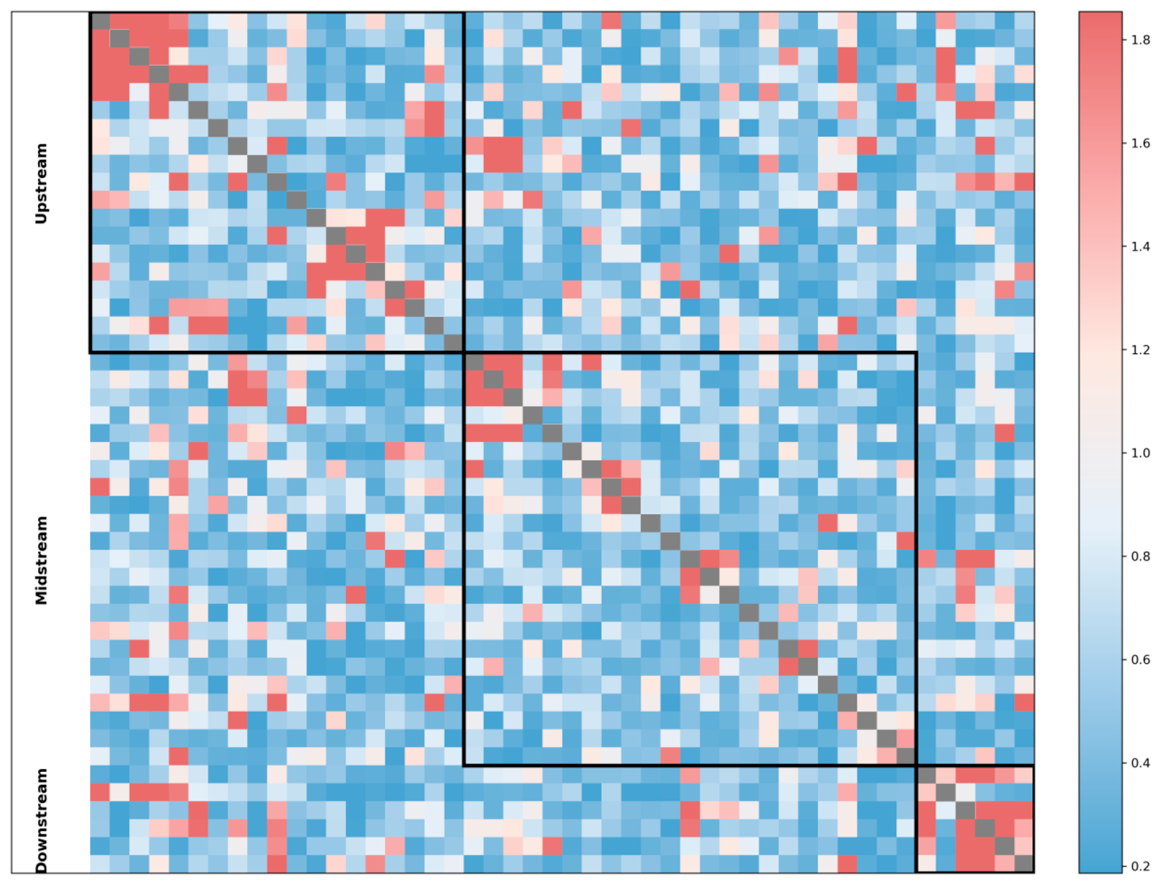
First, even after removing both market-wide and industry-wide common factors, firm-level residual volatilities remain widely and significantly interconnected after common factor controls. The average spillover heatmap reveals that this inter-firm connectedness exhibits a clear network structure rather than random dispersion. More importantly, the spillover matrix displays pronounced block clustering along supply chain tiers, indicating that within-tier transmission is generally stronger than cross-tier transmission during the sample period. At the same time, cross-group spillovers remain clearly present, implying that the industry’s endogenous risk network is characterized by the coexistence of within-tier resonance and cross-tier propagation. The matrix also suggests a certain degree of concentration, with some firms occupying more important positions in the process of risk transmission. This finding is consistent with the production network and financial contagion literature, which argues that micro-level shocks may propagate through uneven network structures and, under certain conditions, accumulate into broader aggregate fluctuations, as in
Acemoglu et al. (
2012) and
Barrot and Sauvagnat (
2016).
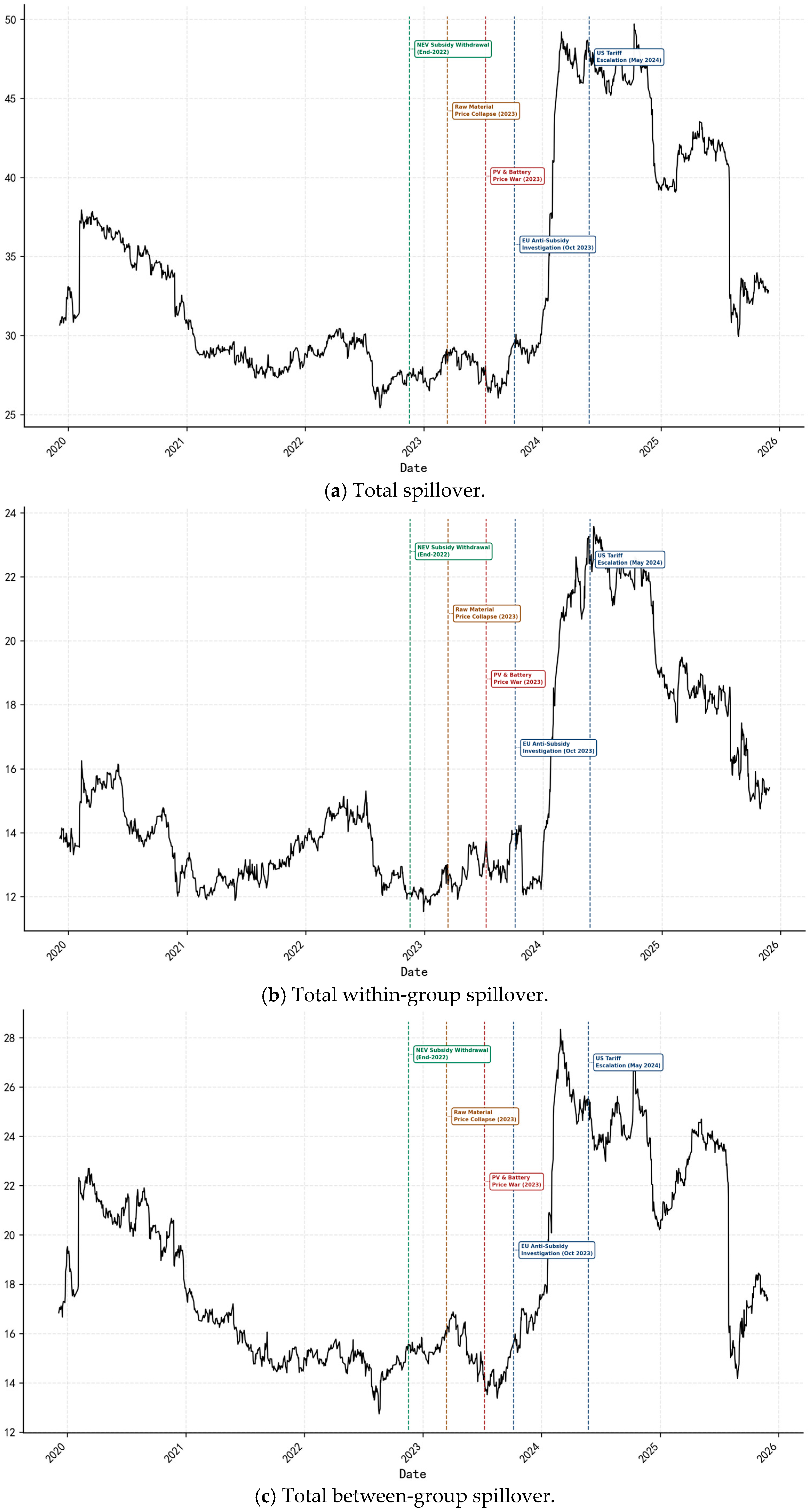
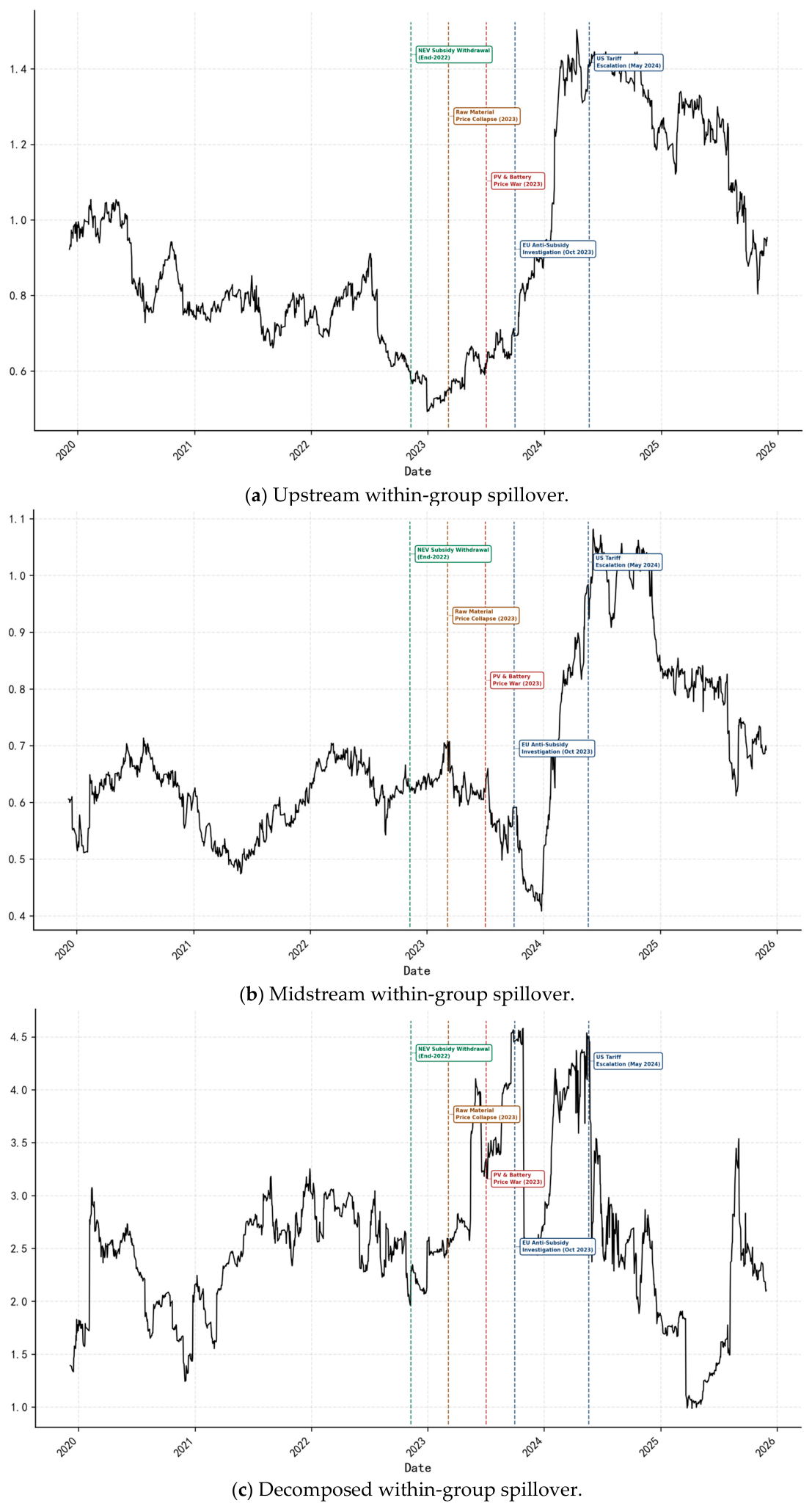
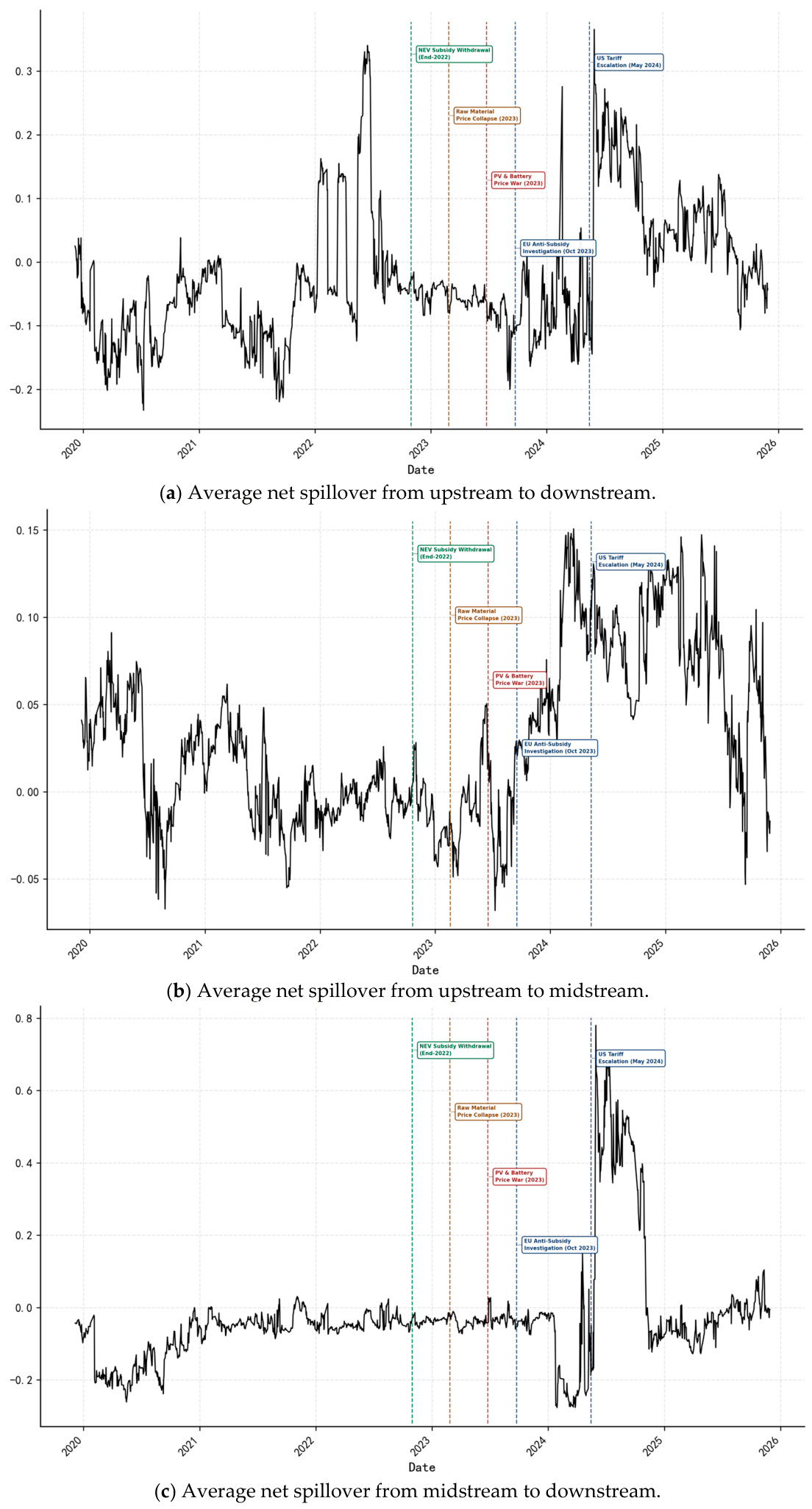
Next, we find that endogenous volatility spillovers exhibit clear time-varying characteristics. The total spillover index remains relatively subdued during most of the period from 2021 to 2023, but rises sharply around 2024 and stays elevated for a considerable time. Both total within-group spillovers and total between-group spillovers move in the same direction and increase significantly during this period, indicating that the strengthening of risk transmission was broad-based rather than limited to one part of the supply chain. The decomposition by supply chain position further shows that upstream and midstream within-group spillovers rise synchronously from late 2023 to early 2024, while downstream within-group spillovers remain at a relatively high level and fluctuate more strongly. In addition, the net spillover results reveal a directional shift around 2024: the dominant direction of transmission gradually changes toward risk output from the upstream and midstream segments to the downstream segment. These results suggest that the inter-firm connectedness in residual volatilities became substantially stronger during the period of deeper market competition and industrial restructuring. This dynamic pattern is consistent with previous studies showing that risk connectedness tends to intensify in periods of structural stress and that supply chain structures can reshape both the intensity and direction of shock propagation, as discussed by
Carvalho et al. (
2021),
Wu and Jiang (
2023), and
J. Li et al. (
2023).
Finally, the findings are consistent with the interpretation that endogenous inter-firm volatility spillovers may amplify industry-level risk. In the GARCH-X estimations, total spillovers, total within-group spillovers, and total between-group spillovers all have positive and statistically significant effects on the conditional volatility of the CSI New Energy Index. This indicates that, even after controlling for the persistence of industry volatility itself and the overall market volatility environment, inter-firm risk transmission that survives common factor controls still significantly increases industry-level risk. Moreover, the coefficient of within-group spillovers is clearly larger than that of between-group spillovers, implying that the amplifying effect of risk resonance among firms within the same supply chain tier is stronger than that of cross-tier transmission. This result supports both of the study’s hypotheses. It also extends the network amplification argument in the literature from the real economy and financial systems to the stock market context. The findings suggest that micro-level residual shocks are not simply diversified away, but appear to be amplified through inter-firm connections in ways consistent with a network transmission mechanism, eventually manifesting themselves as higher industry-wide volatility.
The findings of this study suggest that industry risk in China’s new energy sector should be understood not only as the outcome of external shocks, but also as the result of endogenous amplification generated within the inter-firm network itself. Once firm-specific shocks are embedded in a supply chain structure characterized by uneven connectivity, within-tier clustering, and directional transmission, they can accumulate into broader industry-wide instability. This has several policy implications. First, policymakers should not focus exclusively on macroeconomic shocks, subsidy policies, or external market conditions when assessing industry risk, but should also pay attention to risk transmission channels operating within the industrial chain that go beyond common factor exposure. Second, since within-group spillovers have a stronger marginal effect on industry volatility than between-group spillovers, greater policy attention should be paid to segments in which firms share highly similar production structures, cost conditions, and competitive pressures, especially in upstream and midstream segments during periods of adjustment. More generally, the results indicate that managing industry risk in strategic emerging sectors requires a network perspective. A more effective policy framework should therefore combine industrial policy, financial risk monitoring, and supply chain governance in order to reduce the possibility that firm-level heterogeneous shocks evolve into sector-wide instability.
This study has several limitations that point to directions for future research. First, the sample is restricted to publicly listed firms in China’s new energy sector, as the analysis relies on daily stock price data to construct residual conditional volatilities. While listed firms account for a substantial share of production capacity and market activity in this industry, they do not represent the full population of firms in the supply chain. Privately held enterprises, which may occupy important positions in certain upstream or midstream segments, are necessarily excluded, and the dynamics of risk transmission among unlisted firms or between listed and unlisted firms remain beyond the scope of this study. Additionally, although only a small number of firms in the sample operate across multiple segments of the new energy industrial chain, it is not feasible to assign these firms to more than one group simultaneously. In this study, such firms are classified based on their primary source of operating revenue as reported in their annual reports; however, this single-label assignment may not fully capture the operational complexity of firms with significant cross-segment activities, and may accordingly introduce some imprecision into the within-group and between-group spillover estimates. Future research could explore whether alternative data sources—such as firm-level financial statements, trade credit records, or supplier–buyer relationship databases—can be used to extend the analysis to a broader set of participants in the supply chain. Second, the spillover measures constructed in this study are derived from market-based volatility series rather than from observed physical supply chain flows. Market prices aggregate a wide range of information and expectations, but they may not perfectly reflect the actual structure of input–output linkages or the true intensity of operational interdependencies among firms. Incorporating real supply chain data, such as procurement records or logistics flows, would allow for a more direct mapping between financial risk transmission and underlying production network relationships. Third, the empirical analysis is confined to China’s new energy sector, which has distinctive features in terms of industrial policy, market structure, and supply chain organization. Whether the endogenous amplification mechanism documented here generalizes to new energy industries in other countries, or to other sectors characterized by similar supply chain structures and competitive dynamics, remains an open question. Furthermore, the supply chain structure of China’s new energy industry is inherently unbalanced in terms of the number of listed firms across tiers, with the downstream segment containing considerably fewer publicly listed firms than the upstream and midstream segments. This compositional feature means that the downstream within-group spillover estimates may be more susceptible to the influence of idiosyncratic firm-level shocks, and should therefore be interpreted with appropriate caution. Extending the analysis to other industries with a more balanced distribution of listed firms across supply chain tiers would help mitigate this limitation and enable more reliable cross-tier comparisons of spillover dynamics. Cross-country or cross-industry comparisons would more broadly help establish the broader applicability of the findings and identify the conditions under which within-network risk amplification is most likely to emerge.