1. Introduction
The rapid expansion of the digital economy has profoundly reshaped the structure of modern economic systems, transforming how transactions are conducted, financial services are delivered, and consumption patterns evolve. Digital technologies, particularly internet-based platforms, mobile connectivity, and electronic payment systems, have accelerated the transition toward cashless and platform-driven economies, thereby redefining the mechanisms by which economic activity is generated. This transformation has been further reinforced by recent global shocks, including the COVID-19 pandemic, which significantly increased reliance on digital transactions and remote economic interactions (
Cull et al., 2023;
Yadav & Das, 2025).
A growing body of literature highlights the role of digitalization in enhancing economic performance. Advances in payment technologies contribute to more efficient transactions by reducing operational frictions and improving the speed of economic exchanges (
Humphrey et al., 2006;
Hasan et al., 2012;
Liu & Liu, 2022). Empirical studies further show that digital finance and online payment systems are associated with increased household consumption through improved access to goods and services and simplified transaction processes (
J. Li et al., 2020;
Zhou, 2022;
Chen et al., 2024). At the macroeconomic level, digital payments and fintech adoption have been linked to broader economic outcomes, including growth, financial inclusion, and participation in economic activity (
Azeez et al., 2022;
Patra & Sethi, 2024;
Birigozzi et al., 2025;
Wibowo et al., 2025). In addition, digital infrastructure plays a key role in supporting consumption-oriented economic systems, particularly within the expansion of e-commerce and digital platforms (
Fernández-Portillo et al., 2020;
Szabó et al., 2024).
In parallel, financial development remains a central driver of economic activity. Well-developed financial systems facilitate credit allocation, reduce information asymmetries, and enable households to smooth consumption over time (
Beck et al., 2018). Empirical evidence consistently shows that financial inclusion and financial deepening contribute to economic growth and welfare improvements (
Demirgüç-Kunt et al., 2018;
Kim et al., 2018;
Daud & Ahmad, 2023;
Flores Segovia & Torre Cepeda, 2024). The expansion of financial services allows economic agents to access funding, manage risks, and participate more effectively in economic activity. More recently, the integration of digital technologies into financial systems has further transformed this relationship, with digital finance strengthening access and efficiency in financial intermediation (
Ozili, 2018;
Saleem et al., 2026).
Despite these advances, existing research has predominantly examined digitalization and financial development as separate determinants of economic activity. This separation overlooks the increasing interdependence between digital technologies and financial systems. Digital transactions rely on financial infrastructures, while financial services are increasingly delivered through digital platforms and fintech innovations (
Khan et al., 2026;
Chen et al., 2024). As a result, the economic effects of digitalization may depend on the level of financial development, suggesting a more complex relationship than previously assumed.
Moreover, much of the empirical literature relies on linear frameworks that implicitly assume a uniform effect of digitalization across countries. However, recent evidence indicates that the benefits of digital transformation are shaped by structural conditions and may vary across economic environments (
Cull et al., 2023;
Jain et al., 2026). In particular, the effectiveness of digital infrastructure may differ depending on the maturity of financial systems, which influences access to financial services and the efficiency of transaction processes. Ignoring such interactions may therefore lead to an incomplete understanding of the role of digitalization in shaping economic outcomes.
Another limitation concerns the predominant focus on aggregate output indicators such as GDP. While informative, these measures may not fully capture the transaction-based nature of the digital economy. Digital payments and e-commerce primarily affect consumption behavior and domestic demand, suggesting that consumption-based indicators provide a more appropriate measure of the economic impact of digitalization (
J. Li et al., 2020;
Chen et al., 2024). Recent studies also indicate that the effects of digital payments are more closely linked to internal economic dynamics than to external trade flows (
Frost et al., 2025).
Against this backdrop, this study examines the relationship between digital infrastructure, financial development, and economic activity within a unified empirical framework that explicitly incorporates interaction effects. By focusing on household consumption as a proxy for economic activity, the analysis captures the demand-side mechanisms through which digitalization operates. Using panel data for G20 countries over the period 2005–2023, the study employs second-generation panel econometric techniques that account for cross-sectional dependence and heterogeneity.
This study contributes to the growing literature on digital infrastructure and economic activity by examining how the relationship between digital infrastructure and household consumption varies across different levels of financial development within G20 countries. Rather than treating digital infrastructure and financial development as independent drivers of economic activity, the analysis focuses on their interaction and conditional dynamics across different financial environments.
The study’s contribution is primarily empirical and methodological. Empirically, the paper provides evidence of a heterogeneous relationship between digital infrastructure and household consumption, using household consumption as a transaction-based measure of economic activity closely linked to digital payments, e-commerce, and platform-based interactions. This perspective complements the predominant focus in the literature on aggregate output indicators such as GDP.
Methodologically, the study applies second-generation panel techniques that explicitly account for cross-sectional dependence and slope heterogeneity across highly interconnected G20 economies. By combining interaction effects with heterogeneous panel estimation, the analysis provides additional evidence on how digital infrastructure and financial development jointly shape economic activity under different structural and financial conditions.
The study, therefore, aims to provide a more nuanced understanding of the conditional role of digital infrastructure while accounting for heterogeneity across countries and financial systems.
The findings provide additional insights into how technological and financial factors jointly shape economic activity in an increasingly digitalized global environment. The results also suggest that the effectiveness of digitalization strategies depends on the broader financial context in which they are implemented.
The paper is organized as follows.
Section 2 presents the theoretical background and literature review.
Section 3 describes the data and empirical methodology, with emphasis on cross-sectional dependence and heterogeneity.
Section 4 presents the empirical results, including baseline estimates, interaction effects, and robustness checks.
Section 5 discusses the findings in relation to the literature, and
Section 6 concludes with policy implications and avenues for future research.
2. Theoretical Background and Literature Review
2.1. Digital Infrastructure and Economic Activity
The relationship between digital infrastructure and economic activity can be interpreted through the lens of endogenous growth theory, which emphasizes the role of technological innovation in enhancing productivity and economic performance (
Romer, 1990;
Aghion & Howitt, 1992). Digital technologies, such as internet connectivity, mobile communication, and secure online systems, facilitate the organization of economic exchanges by reducing coordination costs and expanding market access (
Brynjolfsson & Kahin, 2000). From a transaction-based perspective, digital infrastructure improves the efficiency of economic activity by enabling faster and more reliable payment processes. Early contributions show that improvements in payment technologies enhance transaction efficiency and support economic exchanges (
Humphrey et al., 2006;
Hasan et al., 2012). More recent studies highlight that digital payment systems contribute to smoother economic interactions by increasing the velocity of money, transforming transaction behavior in the digital era, and reducing transaction frictions (
Putra et al., 2021;
Liu & Liu, 2022;
Anwar et al., 2024).
At the microeconomic level, digital finance influences consumption behavior by expanding access to goods and services and simplifying transaction processes (
J. Li et al., 2020;
Zhou, 2022;
Chen et al., 2024). At the macroeconomic level, digitalization is associated with broader economic outcomes, including increased financial inclusion, improved market integration, and higher economic participation (
Azeez et al., 2022;
Patra & Sethi, 2024;
Birigozzi et al., 2025;
Wibowo et al., 2025). Furthermore, the expansion of digital infrastructure supports the development of e-commerce and platform-based economic systems, reinforcing consumption-driven growth patterns (
Fernández-Portillo et al., 2020;
Szabó et al., 2024;
Nguyen, 2025;
Yuan, 2025).
However, the economic impact of digital infrastructure is shaped by country-specific conditions. Its effectiveness depends on complementary factors such as institutional quality, technological readiness, and digital literacy (
Lo Prete, 2022;
Cull et al., 2023). These considerations suggest that the returns to digitalization are likely to vary across economic environments.
2.2. Financial Development and Economic Activity
Financial development plays a central role in economic activity through its capacity to facilitate efficient allocation of resources and support intertemporal decision-making. According to the financial intermediation framework, financial systems enhance economic efficiency by reducing information asymmetries and channeling funds toward productive uses (
Beck et al., 2018).
The integration of digital technologies into financial systems has further reshaped this relationship. Digital finance, mobile banking, and fintech innovations expand access to financial services and improve the efficiency of financial intermediation (
Ozili, 2018;
Hegde & Guruprasad, 2026;
Saleem et al., 2026). These developments are particularly relevant in contexts where traditional banking infrastructure is limited, as they enable broader participation in economic activity (
Akpa & Gnidehou, 2025).
At the same time, the contribution of financial development may not be linear. In highly developed financial systems, additional financial deepening may yield smaller incremental benefits and, in some cases, introduce inefficiencies. This suggests that the role of financial development depends on the broader structural and technological context.
2.3. The Interaction Between Digital Infrastructure and Financial Development
The relationship between digital infrastructure and financial development cannot be fully understood through their independent effects alone, as both dimensions jointly shape transaction efficiency, access to financial services, and participation in economic activity. This interaction can be interpreted through three complementary perspectives: complementarity, substitution, and conditional effectiveness.
The complementarity perspective suggests that digital infrastructure enhances the functioning of financial systems. Digital payment technologies and online financial platforms improve access to financial services, reduce transaction costs, and facilitate financial intermediation. In this context, digitalization strengthens the transmission of financial development to economic activity (
Patra & Sethi, 2024;
Hegde & Guruprasad, 2026). Empirical evidence indicates that digital financial inclusion reinforces the positive effects of financial development on economic performance (
Daud & Ahmad, 2023;
Akpa & Gnidehou, 2025).
In contrast, the substitution perspective highlights the potential for digital technologies to partially replace traditional financial intermediation. Digital payment systems, peer-to-peer platforms, and fintech solutions enable direct transactions, reducing reliance on conventional banking institutions (
Marmora & Mason, 2021). Similarly, fintech innovations replicate functions traditionally performed by financial intermediaries, thereby altering the structure of financial systems (
Khan et al., 2026). Under this mechanism, the marginal contribution of financial development may decrease as digitalization expands.
A third perspective emphasizes that the interaction between digital infrastructure and financial development is conditional on structural characteristics, particularly the level of financial development. Recent studies highlight that the economic impact of digital technologies depends on pre-existing conditions and varies across countries (
Cull et al., 2023;
Jain et al., 2026).
From a theoretical standpoint, digital infrastructure is likely to have stronger effects in environments where financial systems are less developed, as it reduces access barriers and facilitates participation in economic activity. In contrast, in more advanced financial systems, where access to financial services is already widespread, the incremental benefits associated with digitalization are expected to be smaller. This reflects the presence of diminishing marginal returns to technological adoption and the overlap between digital systems and financial intermediation.
The theoretical considerations outlined above imply that the effect of digital infrastructure on economic activity cannot be assumed to be uniform across countries. Instead, it is likely to vary with the level of financial development, reflecting a nonlinear, context-dependent relationship.
This provides a direct rationale for adopting an empirical framework that allows for interaction effects between digital infrastructure and financial development. By explicitly modeling this interaction, it becomes possible to capture how the contribution of digitalization changes across different financial environments.
Despite the growing importance of digital transformation, empirical studies that incorporate such interaction effects remain limited. Most existing research focuses on the independent roles of digitalization and financial development, without accounting for their joint dynamics (
H. Li et al., 2026;
Chen et al., 2024).
In addition, the predominant reliance on aggregate output indicators, such as GDP, may not fully capture the mechanisms by which digital technologies influence economic activity. Given the transaction-based nature of digital platforms and payment systems, focusing on consumption-based measures provides a more appropriate framework for analyzing these dynamics.
Building on the theoretical framework outlined above, the following subsection formulates the study’s main hypotheses before presenting the data and econometric methodology.
2.4. Hypotheses Development
Based on the theoretical framework discussed above, digital infrastructure is expected to facilitate transaction efficiency, improve access to digital platforms, and support consumption-oriented economic activity. Previous studies suggest that internet connectivity and digital financial technologies reduce transaction frictions, improve market accessibility, and expand participation in economic exchanges. In this context, digital infrastructure may strengthen household consumption by simplifying transactions and increasing access to goods and services.
H1. Digital infrastructure positively affects household consumption dynamics.
Financial development is also expected to support economic activity through improved credit allocation, financial inclusion, and consumption-smoothing mechanisms. Well-developed financial systems facilitate access to financing, reduce liquidity constraints, and enable households to participate more effectively in economic activity. Accordingly, deeper financial systems are expected to contribute positively to household consumption dynamics.
H2. Financial development positively affects household consumption dynamics.
The theoretical discussion further suggests that the relationship between digital infrastructure and economic activity may depend on the level of financial development. In less financially developed environments, digital technologies may compensate for limited access to finance by improving transaction efficiency and facilitating participation in economic exchanges. In contrast, in more mature financial systems, the incremental contribution of digital infrastructure may become smaller due to saturation effects and overlap between digital and traditional financial services. This implies a conditional and potentially nonlinear relationship between digital infrastructure and financial development.
H3. The effect of digital infrastructure on household consumption is conditional on the level of financial development, with diminishing marginal effects at higher levels of financial development.
The following section presents the data, variable definitions, and econometric strategy used to empirically examine these relationships.
3. Data and Methodology
3.1. Data and Sample Description
This study employs an unbalanced panel dataset covering the G20 countries over the period 2005–2023. The sample includes Argentina, Australia, Brazil, Canada, China, France, Germany, India, Indonesia, Italy, Japan, Mexico, Russia, Saudi Arabia, South Africa, South Korea, Türkiye, the United Kingdom, and the United States.
The sample includes both advanced and emerging economies, providing substantial cross-country variation in digital infrastructure, financial development, and economic activity. Data are obtained from the World Development Indicators (WDI) database. The use of an unbalanced panel reflects data availability constraints, particularly for digital infrastructure indicators, while preserving the maximum number of observations and countries.
3.2. Variable Definition and Measurement
Household final consumption expenditure as a percentage of GDP is used as a demand-side indicator reflecting household consumption dynamics closely associated with transaction-based economic activity. Given the strong relationship between digital technologies, electronic payments, online transactions, and consumption-oriented exchanges, household consumption provides a relevant framework for examining the economic role of digital infrastructure. Nevertheless, the findings should be interpreted specifically in terms of household consumption dynamics rather than overall macroeconomic performance. As a robustness measure, trade openness is used to reflect broader commercial activity. Digital infrastructure is measured using internet penetration, mobile subscriptions, and secure internet servers, the latter serving as a proxy for the capacity to conduct secure online transactions. Financial development is captured by domestic credit to the private sector, reflecting the depth of financial intermediation. For robustness checks, stock market capitalization as a percentage of GDP (SMC) is also used as an alternative market-based proxy for financial development. Control variables include GDP per capita, inflation, and urbanization.
Table 1 presents the variables employed in the study.
The selection of control variables is guided by the literature on household consumption and macroeconomic activity. GDP per capita is included to capture differences in income levels and purchasing capacity across countries. Inflation is incorporated to account for macroeconomic instability and changes in real purchasing power that may affect household consumption decisions. Urbanization is included because urban concentration is generally associated with differences in access to infrastructure, market integration, and consumption patterns. Together, these variables help isolate the relationship between digital infrastructure, financial development, and economic activity while controlling for key macroeconomic and structural factors.
3.3. Model Specification
The empirical framework builds on interaction-based panel specifications commonly used in the macroeconomic and financial development literature to examine conditional relationships between economic variables. In the present study, the specification is adapted to analyze how the relationship between digital infrastructure and household consumption varies across different levels of financial development within G20 economies.
To examine the relationship between digital infrastructure, financial development, and economic activity, this study specifies a panel data model in which economic activity is modeled as a function of digitalization, financial development, and a set of control variables. The empirical framework allows for both direct effects and interaction effects, capturing the transmission mechanism through which digital infrastructure operates.
3.3.1. Baseline Model
The baseline specification evaluates the direct effects of digital infrastructure and financial development on economic activity:
where
represents household final consumption expenditure (% of GDP) in the country at time , used as a proxy for economic activity.
, , and capture different dimensions of digital infrastructure, namely internet usage, mobile connectivity, and secure internet servers.
denotes financial development, measured by domestic credit to the private sector.
is a vector of control variables, including GDP per capita, inflation, and urbanization.
represents unobserved country-specific effects, controlling for time-invariant heterogeneity.
captures time-specific effects common to all countries, such as global shocks.
is the error term.
This specification allows for assessing the independent contribution of digital infrastructure and financial development to economic activity.
3.3.2. Interaction Specification
To capture the conditional relationship between digitalization and financial development, the model is extended by introducing an interaction term. In the interaction specification, internet usage (INT) is retained as the principal indicator of digital infrastructure because it most directly captures participation in digital platforms and online economic activity. The interaction framework, therefore, focuses specifically on the conditional relationship between internet-based digitalization and financial development, while alternative digital infrastructure indicators are considered in the baseline and robustness analyses.
The interaction term allows the effect of digital infrastructure to vary depending on the level of financial development. Specifically, captures the effect of digitalization when financial development is zero. reflects the direct effect of financial development. measures how financial development moderates the impact of digitalization. A negative and significant would indicate diminishing marginal effects of digitalization as financial systems become more developed, consistent with nonlinear dynamics in the digitalization-finance nexus.
3.3.3. Interpretation Framework
The marginal effect of digital infrastructure on economic activity can be expressed as:
This formulation illustrates that the effect of digital infrastructure is conditional on the level of financial development. Although the marginal effect is not computed explicitly, this expression provides a framework for interpreting the interaction term in the empirical results. In particular, the sign and significance of β3 indicate whether the contribution of digital infrastructure increases or decreases with financial development.
The baseline specification is designed to test Hypotheses H1 and H2 concerning the direct effects of digital infrastructure and financial development on economic activity. The interaction model is intended to test Hypothesis H3 regarding the conditional effect of digital infrastructure across different levels of financial development.
3.4. Econometric Strategy
Given the cross-country nature of the dataset and the high degree of global integration in digital and financial systems, the empirical strategy explicitly accounts for cross-sectional dependence, heterogeneity, and mixed integration properties.
First, cross-sectional dependence is assessed using the approach of
Pesaran and Timmermann (
2005), which is particularly suitable for macro-panel data where countries are exposed to common shocks such as technological diffusion and global financial cycles. The presence of strong cross-sectional dependence implies that conventional panel estimators assuming independence may yield biased and inconsistent results.
Second, the stationarity properties of the variables are examined using the cross-sectionally augmented IPS (CIPS) unit root test proposed by
Pesaran (
2007). This second-generation test controls for unobserved common factors by augmenting standard unit root regressions with cross-sectional averages, making it appropriate in the presence of cross-country interdependence.
Third, the existence of a long-run relationship among the variables is evaluated using the cointegration framework of
Westerlund (
2007), which is based on error-correction dynamics and is robust to cross-sectional dependence and heterogeneity. Establishing cointegration ensures that the estimated relationships are not spurious and reflect meaningful long-run associations.
Given these characteristics, the analysis employs the Common Correlated Effects Mean Group (CCE-MG) estimator developed by
Pesaran (
2006) as the primary estimation technique. The CCE-MG estimator addresses cross-sectional dependence by incorporating cross-sectional averages of the dependent and independent variables as proxies for unobserved common factors. At the same time, it allows slope coefficients to vary across countries, thereby capturing heterogeneity in the digitalization–finance relationship.
Although the dataset includes a combination of I(0) and I(1) variables, the use of the CCE-MG estimator remains appropriate in this context. As discussed by
Pesaran (
2006), the estimator is designed for heterogeneous panels with multifactor error structures and does not require all variables to share identical integration orders. In the presence of stable long-run co-movement and cross-sectional dependence, the CCE-MG framework provides consistent estimates by controlling for unobserved common factors through cross-sectional averages.
Formally, the CCE-MG specification can be expressed as:
where
represents cross-sectional averages capturing common shocks. Country-specific coefficients are estimated separately and then averaged, yielding mean group estimates that reflect the average long-run relationship across heterogeneous panel units.
To ensure robustness, the analysis also employs a fixed-effects estimator with Driscoll–Kraay standard errors, which are robust to cross-sectional dependence, heteroskedasticity, and serial correlation. This complementary approach provides a benchmark comparison with conventional panel estimators while maintaining consistency under cross-sectional dependence.
3.5. Robustness Checks
To assess the robustness of the empirical findings, the analysis is extended using alternative specifications and estimation strategies. The model is first re-estimated using trade openness as an alternative dependent variable to capture broader economic activity beyond domestic consumption. The sensitivity of the results is also evaluated by modifying the set of explanatory variables, including the exclusion of specific digital infrastructure indicators to account for potential measurement limitations. In addition to these specification-based checks, the robustness of the results is further assessed using an alternative estimation approach. While the baseline results rely on the CCE-MG estimator, a fixed-effects specification with Driscoll–Kraay standard errors is employed as a complementary method to ensure that the findings are not driven by the choice of estimator.
Together, these robustness checks provide a comprehensive assessment of the stability and reliability of the estimated relationships.
4. Empirical Results
4.1. Data Overview
To provide an overview of the data and assess the distributional properties of the variables,
Table 2 reports the descriptive statistics for the full sample.
The descriptive statistics indicate substantial heterogeneity among G20 countries in digital infrastructure, financial development, and economic activity. Household consumption (HFC) averages 56.4% of GDP, ranging from 26.0% to 71.2%, while trade openness (TRADE) shows wider dispersion, with a maximum exceeding 100%, reflecting differences in economic integration. Digital indicators vary markedly. Internet usage (INT) ranges from 2.4% to 100% with a mean of 63.5%, highlighting the digital divide. Mobile subscriptions (MOB) average 109.9 per 100 people, indicating widespread connectivity. Secure internet servers (SEC) also show dispersion (mean 7.17, range 0.79–12.14) and fewer observations, reflecting uneven development of e-commerce infrastructure. Financial development (FD) ranges from 10.7% to 223.8% of GDP, pointing to significant differences in financial depth. Among controls, inflation (INF) exhibits high variability (maximum 133.5%), while urbanization (URB) remains relatively high across countries (mean 74.9%), supporting digital adoption.
4.2. Bivariate Relationships
To examine the pairwise relationships among the variables and assess potential multicollinearity concerns,
Table 3 presents the correlation matrix.
Missing observations arise from differences in data availability across countries and years, particularly for digital infrastructure indicators such as secure internet servers. These limitations are inherent to cross-country datasets. The analysis is therefore conducted using an unbalanced panel, which allows the inclusion of all available observations without introducing bias through artificial imputation.
The correlation matrix indicates moderate relationships among explanatory variables. Digital infrastructure indicators are positively correlated, particularly internet usage and secure servers (0.775), reflecting their complementary roles in supporting electronic transactions. Internet usage is also strongly associated with GDP per capita (0.774), suggesting that digital adoption increases with economic development. Financial development shows moderate correlations with digital variables, supporting its role as a transmission channel. Importantly, no pairwise correlations exceed the critical threshold (e.g., 0.90), indicating the absence of severe multicollinearity.
To further assess potential multicollinearity concerns, a Variance Inflation Factor (VIF) analysis was conducted.
As reported in
Table 4, the VIF values remain below the conventional threshold of 10, indicating that multicollinearity is not severe despite the relatively high correlations observed among some digital and macroeconomic variables. These results suggest that the estimated coefficients are sufficiently stable for regression analysis.
4.3. Cross-Sectional Dependence Test
Given the global nature of the sample and the potential exposure to common shocks, it is essential to test for cross-sectional dependence. The results are reported in
Table 5.
The results of the Pesaran cross-sectional dependence (CD) test indicate strong evidence of cross-country interdependence across all variables. The null hypothesis of cross-sectional independence is rejected at the 1% significance level, as reflected by highly significant p-values (p = 0.000) for all series.
The magnitude of the CD statistics is particularly high for digital infrastructure variables such as internet usage (INT) and secure internet servers (SEC), suggesting that digital adoption and e-commerce infrastructure evolve in a highly interconnected global environment. This pattern is consistent with the diffusion of technology and common global shocks affecting multiple economies simultaneously.
These findings imply that countries in the sample are not independent but influenced by shared economic, technological, and financial dynamics. Consequently, econometric approaches that account for cross-sectional dependence are required to obtain consistent and reliable estimates.
4.4. Unit Root Results (CIPS)
Prior to estimating the model, the stationarity properties of the variables are examined using second-generation panel unit root tests that account for cross-sectional dependence. The results are presented in
Table 6 and
Table 7.
The panel unit root results indicate a mixed order of integration across variables. At levels, the results show that household consumption (HFC), trade openness (TRADE), secure internet servers (SEC), and financial development (FD) are non-stationary, as the null hypothesis of a unit root cannot be rejected. In contrast, internet usage (INT), mobile subscriptions (MOB), GDP per capita (GDPPC), inflation (INF), and urbanization (URB) are stationary in levels, indicating they are integrated of order zero, I(0). At first differences, all variables become stationary, as evidenced by highly significant test statistics. This confirms that the non-stationary variables identified at levels are integrated of order one, I(1).
These findings imply that the dataset consists of a combination of I(0) and I(1) variables, reflecting differences in the dynamic properties of digital, financial, and macroeconomic indicators across countries. This mixed integration structure has important implications for model selection, suggesting the need for econometric approaches that accommodate variables with different orders of integration and account for cross-sectional dependence.
4.5. Panel Cointegration Analysis
To examine the existence of a long-run relationship among digital infrastructure, financial development, and economic activity, this study employs the panel cointegration test developed by
Westerlund (
2007), which is appropriate in the presence of cross-sectional dependence and heterogeneity.
Following the unit root analysis, the next step is to assess whether a long-run relationship exists among the variables.
Table 8 reports the results of the panel cointegration test.
As reported in
Table 8, all four statistics reject the null hypothesis of no cointegration. Specifically, the group-mean statistic Gt (−3.421,
p = 0.004) and the panel statistic Pt (−4.105,
p = 0.006) are significant at the 1% level, while Ga (−12.784,
p = 0.013) and Pa (−13.672,
p = 0.018) are significant at the 5% level. These results provide strong evidence of a long-run relationship among the variables.
Given the presence of both I(0) and I(1) variables, the results are interpreted as evidence of long-run co-movement rather than strict cointegration in the conventional sense. This interpretation is consistent with heterogeneous panel settings in which variables may exhibit different integration properties while still maintaining stable long-run associations.
4.6. Long-Run Estimation Results (CCE-MG)
4.6.1. Benchmark Results
Having established the presence of a long-run relationship, the analysis proceeds with the estimation of the baseline model using the CCE-MG estimator. The results are presented in
Table 9.
Table 9 reports the long-run estimates obtained using the CCE-MG estimator, capturing the average relationship between digital infrastructure, financial development, and economic activity across countries while accounting for cross-sectional dependence and heterogeneity.
Internet usage (INT) is positively and statistically significant (0.0823, p = 0.0002), indicating that higher levels of digital access are associated with stronger household consumption. This result is consistent with the role of digital infrastructure in facilitating transaction-based economic activity and expanding access to consumption opportunities.
Financial development (FD) also exhibits a positive and significant effect (0.0380, p = 0.0052), suggesting that deeper financial systems support economic activity through improved credit availability and consumption smoothing mechanisms.
In contrast, mobile subscriptions (MOB) and secure internet servers (SEC) are negatively associated with household consumption (−0.0329, p = 0.0102; −0.4366, p = 0.0030, respectively). These results suggest that the effects of digital infrastructure are not homogeneous across indicators and may depend on the specific dimension of digitalization being captured.
One possible explanation is that mobile subscriptions and secure server density primarily reflect the availability and expansion of digital infrastructure rather than the effective intensity of digital transactions directly associated with household consumption. In highly connected and financially mature economies, further expansion of certain digital infrastructure components may yield smaller incremental effects on domestic demand due to saturation and overlap with existing transaction and financial intermediation systems.
These findings therefore suggest that the relationship between digital infrastructure and economic activity is more complex than a uniformly positive linear association and may vary across different forms of digitalization and stages of financial development.
Among the control variables, inflation (INF) and urbanization (URB) are both negative and statistically significant, indicating that macroeconomic instability and structural pressures may constrain consumption dynamics. GDP per capita (GDPPC) is not statistically significant, suggesting that income effects are partly absorbed by digital and financial variables in this specification.
The baseline results indicate that digital access and financial development contribute positively to household consumption dynamics, while highlighting heterogeneity across different dimensions of digital infrastructure. Overall, the baseline estimates provide empirical support for Hypotheses H1 and H2 concerning the positive effects of digital infrastructure and financial development on household consumption dynamics.
4.6.2. Interaction Results
To examine the conditional relationship between digital infrastructure and financial development, the model is extended to include an interaction term. The corresponding results are reported in
Table 10.
Table 10 presents the results of the interaction model, which examines whether the effect of digital infrastructure depends on the level of financial development. To provide a more economically meaningful interpretation of the interaction effect, the marginal effect of digital infrastructure on household consumption can be expressed as:
where the effect of internet usage depends on the level of financial development. A negative interaction coefficient implies that the positive contribution of digital infrastructure to household consumption progressively weakens as financial systems become more developed.
Internet usage (INT) remains positive and significant (0.0708, p = 0.0030), and financial development (FD) continues to exhibit a positive effect (0.0737, p = 0.0058), confirming the importance of both factors in supporting household consumption dynamics. The interaction term (INT × FD) is negative and statistically significant (−0.0006, p = 0.0186). This implies that the marginal effect of digital infrastructure, expressed as β1 + β3FDit, decreases with higher levels of financial development. This result suggests that digital infrastructure exerts a stronger positive effect on household consumption in economies characterized by lower levels of financial development, where digital technologies may reduce transaction frictions, improve payment accessibility, and facilitate participation in digital consumption channels. As financial systems become more mature, however, the incremental contribution of digital infrastructure becomes comparatively smaller. This pattern may reflect diminishing marginal complementarities between digitalization and financial intermediation, as financially advanced economies already possess relatively efficient transaction and credit mechanisms that partially substitute for additional digital expansion.
This result reflects a conditional relationship between digital infrastructure and financial development, indicating that their effects are structurally interdependent rather than purely additive. The negative interaction coefficient suggests that the consumption-enhancing role of digital infrastructure becomes weaker as financial systems become more developed. From an economic perspective, this pattern may reflect diminishing marginal complementarities between digitalization and financial intermediation. In economies with lower levels of financial development, digital technologies may play a stronger role in reducing transaction frictions, expanding access to payment systems, and facilitating household participation in digital consumption channels. By contrast, in financially mature economies, where credit allocation and transaction mechanisms are already relatively efficient, the incremental contribution of additional digital infrastructure may become comparatively smaller. To further assess the economic significance of the interaction effect,
Table 11 reports the marginal effect of internet usage at representative levels of financial development.
The marginal effect estimates reported in
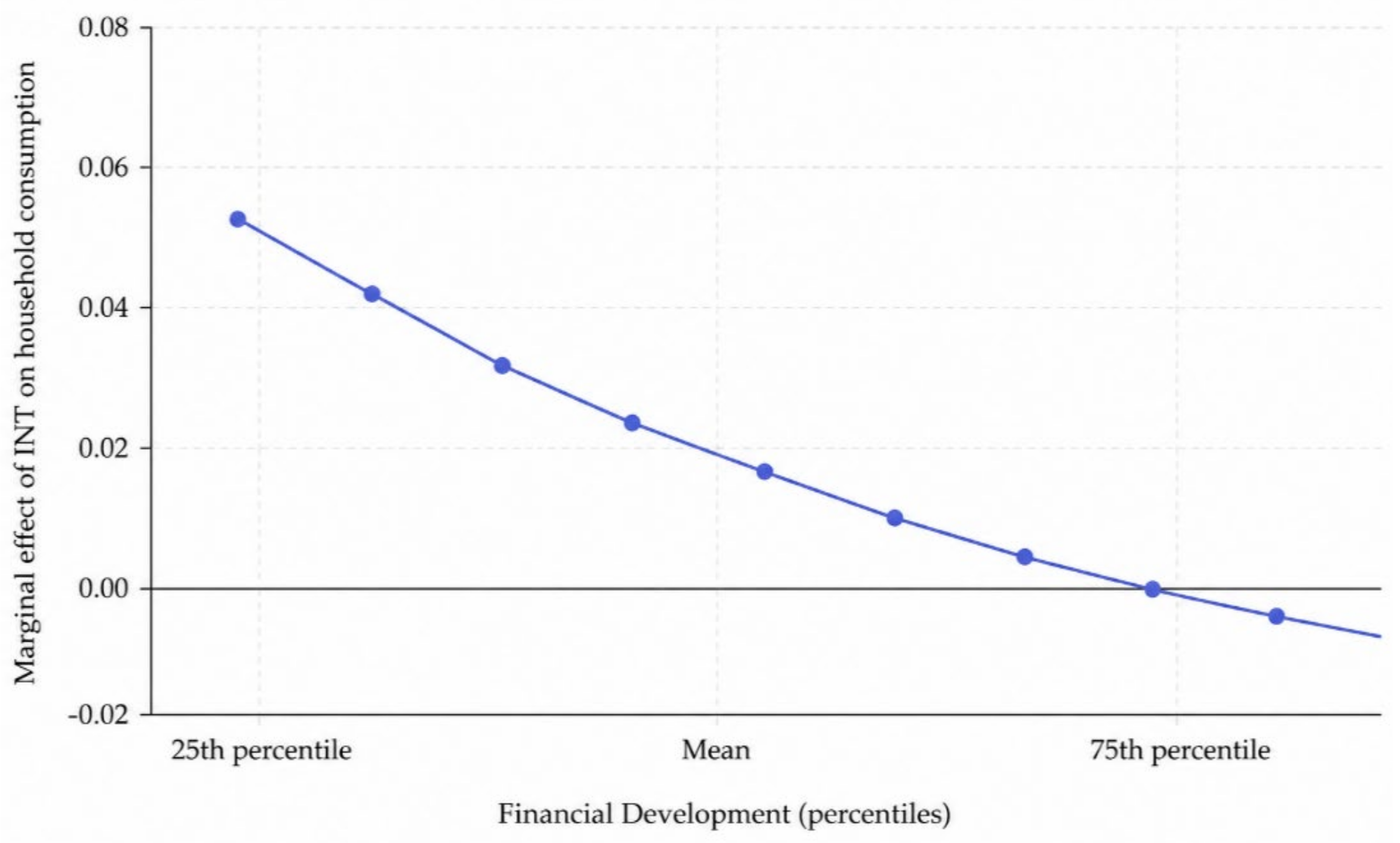
Table 11 reinforce the heterogeneous nature of the interaction effect across different levels of financial development. The positive contribution of internet usage to household consumption remains relatively strong at lower levels of financial development but gradually weakens as financial systems deepen. At higher levels of financial development, the marginal effect becomes substantially smaller and slightly negative, suggesting that the incremental contribution of additional digital infrastructure diminishes in financially mature environments. This pattern indicates that digital infrastructure may be particularly important in economies where financial access and transaction efficiency remain relatively constrained. To further illustrate the economic significance of the interaction effect,
Figure 1 presents the marginal effect of internet usage across different levels of financial development.
Figure 1 provides a visual representation of the conditional relationship between digital infrastructure and financial development. The downward-sloping marginal effect curve indicates that the positive contribution of internet usage to household consumption gradually weakens as financial systems become more developed, supporting the interpretation of diminishing marginal effects. From an economic perspective, this pattern may reflect declining complementarities between digital infrastructure and financial intermediation across different stages of financial development. In relatively less financially developed environments, digital technologies may compensate for limited access to traditional financial services by improving transaction efficiency, facilitating digital payments, and expanding participation in consumption-oriented economic exchanges. By contrast, in financially mature economies, where access to financial services is already widespread, the incremental contribution of additional digital infrastructure may become comparatively smaller due to saturation effects and overlap with existing financial mechanisms. These findings highlight the heterogeneous role of digital infrastructure across different financial environments and provide support for Hypothesis H3.
4.7. Robustness Results
To assess the reliability of the baseline findings, a series of robustness checks is conducted using alternative model specifications and estimation strategies. In particular, the analysis evaluates whether the results are sensitive to changes in the dependent variable, the set of explanatory variables, and the choice of estimator.
The primary estimations are based on the CCE-MG framework, which accounts for cross-sectional dependence and heterogeneity across countries. To further strengthen the validity of the findings, an additional robustness test is performed using a fixed-effects specification with Driscoll–Kraay standard errors, which provides a complementary approach that is robust to cross-sectional dependence, heteroskedasticity, and serial correlation.
Together, these robustness checks help verify that the main findings are not driven by a specific econometric specification or estimation method, thereby strengthening the credibility of the empirical results.
4.7.1. Alternative Dependent Variable
Robustness is further assessed by re-estimating the model using trade openness as the dependent variable. This specification captures broader economic activity and international commercial integration, providing a complementary perspective to household consumption.
As an additional robustness test, the model is re-estimated using a fixed-effects specification with Driscoll–Kraay standard errors to assess whether the results are sensitive to the choice of estimator. The corresponding results are reported in
Table 12.
The results show that internet usage, financial development, and their interaction are not statistically significant when trade openness is used as the dependent variable. This indicates that the relationship identified in the baseline model may be more closely associated with domestic consumption dynamics than with external economic activity. At the same time, the absence of significant effects should be interpreted cautiously, as trade openness may be influenced by additional structural and policy-related factors not explicitly captured in the model specification.
Among the control variables, GDP per capita is negative and significant, while inflation is positive and significant. Urbanization remains insignificant.
These findings support the interpretation that the main results are specific to consumption dynamics and reflect transaction-based mechanisms rather than broader macroeconomic effects.
4.7.2. Robustness Check: Excluding Alternative Digital Infrastructure Indicators
To evaluate the stability of the results, the model is re-estimated after excluding alternative digital infrastructure indicators, namely mobile subscriptions (MOB) and secure internet servers (SEC). This specification focuses on the core relationship between internet usage and financial development while assessing whether the main findings are sensitive to the inclusion of additional digital infrastructure proxies. The results are reported in
Table 13.
The results in
Table 13 remain broadly consistent with the baseline estimations. Internet usage (0.064,
p < 0.001) and financial development (0.056,
p = 0.0004) continue to exhibit positive and significant effects, while the interaction term remains negative and highly significant (−0.0005,
p = 0.0010).
The persistence of the interaction effect suggests that the estimated relationship is not driven by a specific digital infrastructure indicator. Instead, it reflects a consistent pattern across model specifications.
Control variables behave similarly to previous estimations, with inflation and urbanization remaining negative and significant, and GDP per capita remaining insignificant.
4.7.3. Alternative Financial Development Proxy
To further assess the robustness of the interaction effect, the baseline model is re-estimated using stock market capitalization as an alternative proxy for financial development. This additional specification assesses whether the conditional relationship between digital infrastructure and household consumption remains consistent when financial development is measured with a market-based indicator rather than the baseline measure. The results are reported in
Table 14.
The results remain broadly consistent with the baseline estimates. Internet usage continues to exhibit a positive association with household consumption, while the interaction term between digital infrastructure and stock market development remains negative and statistically significant. These findings reinforce the interpretation that the marginal contribution of digital infrastructure weakens as financial systems become more developed, regardless of the financial development proxy employed. Overall, the results support the robustness of the main interaction effect identified in the baseline model.
The robustness checks confirm the robustness of the main findings across alternative specifications and estimation approaches.
5. Discussion
The empirical findings highlight that the relationship between digital infrastructure, financial development, and household consumption dynamics is inherently conditional rather than uniform across countries. By construction, the CCE-MG estimator captures average effects while allowing for cross-country heterogeneity, implying that the estimated relationships should be interpreted as general patterns rather than universal outcomes. The heterogeneous signs observed across digital infrastructure indicators further suggest that different dimensions of digitalization may affect the consumption-related activity through distinct channels. While internet usage appears more directly associated with household participation in digital transactions and platform-based consumption, indicators such as mobile subscriptions and secure internet servers may partly capture broader infrastructure expansion whose economic effects depend on the maturity of financial systems and the saturation level of digital markets.
The positive association between internet usage and household consumption underscores the role of digital infrastructure in supporting transaction-based economic activity. This finding is consistent with studies showing that digital payment systems and online platforms facilitate economic exchanges by improving access to goods and services and reducing transaction frictions (
J. Li et al., 2020;
Chen et al., 2024). More broadly, it aligns with the literature emphasizing the importance of digital technologies in enabling demand-side dynamics within increasingly platform-based economies (
Fernández-Portillo et al., 2020;
Szabó et al., 2024).
At the same time, the positive contribution of financial development reinforces the central role of financial systems in supporting household consumption dynamics through credit provision and consumption smoothing. This result is in line with the financial intermediation framework and empirical evidence documenting the role of financial inclusion and financial deepening in enhancing economic participation (
Beck et al., 2018;
Daud & Ahmad, 2023). The findings also support recent research suggesting that digital finance complements, rather than replaces, core financial functions in facilitating consumption-related activity (
Ozili, 2018;
Saleem et al., 2026).
The interaction between digital infrastructure and financial development provides a more nuanced perspective on the role of digitalization in shaping household consumption dynamics. The results indicate that the contribution of digital infrastructure varies across financial environments, suggesting that the effectiveness of digitalization is conditional on the maturity of financial systems. This finding is consistent with recent studies emphasizing context-dependent outcomes in the digital economy (
Cull et al., 2023;
Jain et al., 2026).
From a structural perspective, the results suggest that digital infrastructure may play different economic roles depending on the level of financial development. In relatively less financially developed economies, digital technologies may complement traditional financial systems by reducing transaction barriers, facilitating access to digital payments, and expanding participation in household consumption dynamics. In more mature financial systems, however, the marginal contribution of additional digital infrastructure may diminish because many transaction and intermediation functions are already efficiently performed within existing financial frameworks.
This interpretation is also consistent with the presence of saturation effects in highly digitalized and financially developed environments, where further expansion of digital infrastructure generates smaller incremental gains in household consumption. Rather than implying that digitalization becomes unimportant, the findings indicate that its economic contribution evolves with the financial system’s structural characteristics.
From an economic perspective, this finding can be interpreted through the coexistence of complementary and overlapping mechanisms. In environments with lower levels of financial development, digital infrastructure can play a facilitating role by expanding access to financial services and enabling participation in consumption-related activity. In contrast, in more developed financial systems, where access to financial services is already widespread, the incremental gains associated with digitalization may be more limited. This interpretation is consistent with the notion of diminishing marginal returns to technological adoption and the partial overlap between digital platforms and traditional financial intermediation (
Marmora & Mason, 2021).
The robustness analysis further refines this interpretation. The absence of significant effects when trade openness is the dependent variable indicates that the influence of digital infrastructure and financial development is primarily concentrated on domestic demand rather than on external consumption-related activity. This result is consistent with evidence suggesting that digital payments and platform-based transactions predominantly affect internal consumption dynamics rather than international trade flows (
Frost et al., 2025). It also supports the argument that consumption-based indicators provide a more appropriate framework for capturing the economic effects of digitalization.
Importantly, the persistence of the interaction effect across alternative specifications suggests that the identified relationship reflects a stable empirical pattern rather than a model-specific outcome. This reinforces the interpretation that the interaction between digital infrastructure and financial development is a structural feature of the digital economy, rather than a result driven by variable selection or estimation strategy.
Taken together, these findings contribute to the literature by providing empirical evidence that the economic impact of digitalization depends on the financial context in which it operates. Rather than viewing digital infrastructure and financial development as independent drivers of consumption-oriented economic exchanges, the results highlight the importance of considering their joint dynamics. This perspective extends existing research by emphasizing that the effectiveness of digital transformation is shaped by underlying structural conditions, thereby offering a more nuanced understanding of how digital and financial systems interact in shaping economic outcomes.
6. Conclusions
The expansion of the digital economy has transformed the mechanisms through which economic exchanges are conducted, placing digital technologies and financial systems at the center of modern consumption dynamics. This study examined the joint relationship between digital infrastructure, financial development, and household consumption using panel data for G20 countries over the period 2005–2023.
The empirical results indicate that both digital infrastructure and financial development are positively associated with household consumption. However, the interaction analysis reveals that the contribution of digital infrastructure varies across financial environments. Specifically, the marginal effect of digitalization weakens as financial development increases, suggesting that the economic role of digital technologies depends on the structural characteristics and maturity of financial systems.
The study contributes to the literature in several ways. First, by explicitly incorporating interaction effects, the analysis moves beyond conventional linear approaches and provides evidence of a conditional relationship between digital infrastructure and financial development. Second, by focusing on household consumption rather than aggregate output indicators, the study adopts a transaction-based perspective that is more closely aligned with the functioning of digital platforms, electronic payments, and online economic exchanges. Third, the use of second-generation panel techniques allows the analysis to account for cross-sectional dependence and heterogeneity across highly interconnected economies. The robustness analysis using an alternative market-based financial development proxy further confirms the stability of the main interaction effect across alternative specifications.
From a policy perspective, the findings suggest that digitalization strategies should be tailored to each economy’s level of financial development and institutional characteristics. In relatively less financially developed environments, improvements in digital infrastructure may facilitate access to financial services, reduce transaction frictions, and strengthen participation in consumption-related activities. In more financially mature economies, where digital and financial systems are already highly developed, policy priorities may shift toward improving efficiency, interoperability, and the security of digital financial services rather than expanding infrastructure alone. These results, therefore, highlight the importance of avoiding uniform policy approaches to digital transformation.
Several limitations should nevertheless be acknowledged. First, the use of aggregate country-level data may conceal important heterogeneity at the firm or household level. Second, the available indicators may not fully capture the complexity of digital ecosystems, including fintech adoption and platform-based business models. Third, although the empirical framework controls for cross-sectional dependence and heterogeneity, potential endogeneity concerns, including reverse causality between digital infrastructure and household consumption, cannot be entirely excluded.
Future research could extend the analysis by employing micro-level data, incorporating broader measures of digitalization, and applying identification strategies that strengthen causal interpretation. Additional research could also explore threshold- or regime-dependent frameworks to better capture nonlinear dynamics across different financial and institutional contexts.
Our findings emphasize that the economic implications of digitalization depend not only on technological expansion itself, but also on the broader financial environment in which digital transformation takes place.