1. Introduction
International capital mobility is a central issue because the degree of mobility has major consequences for domestic economies. Limited capital mobility restricts the prospects for economic growth by limiting its savings capacity, resulting in a fiscal deficit that crowds out investment. Conversely, when capital mobility becomes greater, countries become incapable of carrying out their own monetary policy independently. The degree of capital mobility plays a decisive role in shaping the effectiveness of macroeconomic policy. For developing countries, the mobility of capital is a key factor shaping the effects of stabilization policies (
Haque & Montiel, 1991).
Feldstein and Horioka (
1980) proposed measuring the mobility of capital by testing the correlation between savings and investment. Their justification for employing this criterion is that in a globally connected financial market, theoretically boundless capital flows eradicate disparities between the return rates for real and nominal on comparable assets. This situation reveals that the savings deficiency within any economy is improbable for impeding domestic investment. This holds because under perfect capital mobility, the link between investment and saving is severed, meaning that a fall in private saving or a current account deficit is unlikely to constrain investment by raising the cost of capital. The economy in question will procure an adequate sum of money at the “global interest rate” to cover the funds needed. This suggests that deviations from real interest parity (RIP)—which is crucial for breaking the saving–investment link—can also serve as indicators of capital mobility. Further explanations contend that the saving–investment correlation does not serve as a sufficient gauge of capital mobility.
Obstfeld (
1993) presented an approach that measures capital mobility through a comparative analysis of consumption behaviours across nations. His rationale for this approach is that with integrated capital markets, consumption behaviours should converge, as individuals seek to smooth consumption.
This study contributes to the literature by applying a consumption-based framework, originally proposed by
Obstfeld (
1993) and extended by
Bayoumi and MacDonald (
1995), to assess capital mobility in six APEC economies. Unlike the traditional saving–investment correlation approach, it evaluates capital mobility through the sensitivity of domestic consumption to external versus domestic income influences. The central research question of this study is whether capital mobility differs systematically between developed and developing economies when assessed using a consumption-based approach. In particular, the study examines whether developing economies exhibit higher effective capital mobility than is commonly suggested by standard measures of financial openness. The main contribution of the paper lies in providing a comparative analysis of capital mobility across different levels of economic development using an alternative measurement framework. By doing so, the study offers new insights into the relationship between formal financial openness and actual capital movements. The remainder of the paper is organized as follows.
Section 2 reviews the relevant literature and outlines the theoretical framework.
Section 3 presents the empirical methodology.
Section 4 reports the empirical results.
Section 5 discusses the findings, and
Section 6 concludes.
2. Literature Review and Theoretical Concepts
Research on market integration and capital mobility has long been characterized by mixed findings, often reflecting differences in how capital mobility is defined and measured. As
Frankel (
1989) points out, part of this confusion arises from treating capital as a single concept, whereas in practice it takes many forms—such as net versus gross flows, portfolio versus physical investment, and short-term versus long-term movements. Recognizing these distinctions helps explain why empirical studies sometimes arrive at different conclusions regarding the degree of capital mobility. The debate intensified following the Feldstein–Horioka approach, which uses saving–investment correlations as an indicator of capital mobility. While this approach has been highly influential, it has also been widely questioned for relying on aggregate macroeconomic data that may overlook the complexity of cross-border financial flows. In particular, focusing on net flows can be misleading, as gross flows may be substantial even when net flows appear limited. This has led researchers to reconsider whether traditional measures fully capture the true extent of international capital mobility. It is also important to distinguish between capital mobility and market integration, as the two concepts are often used interchangeably.
Frankel (
1989) and
Folkerts-Landau et al. (
1991) emphasize that financial integration does not necessarily imply high capital mobility, and that structural and institutional factors may play a significant role. In this sense, the relationship between integration and mobility is more nuanced than is often assumed.
More recent contributions have revisited the Feldstein–Horioka puzzle and offered alternative interpretations of the saving–investment relationship.
Pal (
2009), for example, shows that the traditionally observed low capital mobility may weaken under alternative empirical specifications, suggesting that capital could be more mobile than previously assumed. Similarly,
Yersh (
2025) re-examines the saving–investment relationship and finds that its interpretation is sensitive to model specification and country characteristics, indicating that capital mobility is not uniform across economies. From a broader perspective,
Ziesemer (
2026) links international capital movements with trade and long-run growth, emphasizing that financial integration and cross-border capital flows play a central role in shaping economic performance over time. As a result, these contributions highlight that conventional measures may not fully capture the true extent and dynamics of capital mobility.
Building on these foundations, as well as more recent contributions, later studies have focused on measuring financial openness more directly.
Chinn and Ito (
2006,
2008) develop a widely used index that captures the degree of capital account openness based on legal and regulatory restrictions. Rather than tracking actual flows, their index reflects how easy it is—at least formally—for capital to move across borders. Their findings show that advanced economies tend to be more open, while developing economies often maintain tighter controls, although openness has generally increased over time. At the same time, a broader perspective on financial globalization has emerged.
Kose et al. (
2007) argue that financial integration should not be viewed as inherently beneficial or harmful, but rather as a process whose outcomes depend on institutional quality and policy frameworks. In a later contribution,
Kose et al. (
2009) show that while capital mobility does not automatically lead to higher economic growth, it can enhance international risk-sharing and improve consumption smoothing when supported by strong institutions. More recent research has continued to refine how capital mobility is assessed.
Everaert and Pozzi (
2022), for example, develop more comprehensive measures of international consumption risk-sharing that account for time variation and cross-country differences. Their results suggest that economies may be more financially connected than earlier studies indicated, particularly when both trade and financial integration are considered together. Overall, the literature makes it clear that capital mobility is a multifaceted concept that cannot be captured by a single measure. Different approaches—ranging from saving–investment correlations to regulatory indices and consumption-based frameworks—offer complementary insights. This naturally leads to the use of alternative measurement strategies that go beyond traditional indicators and focus more directly on financial integration mechanisms and market behavior.
The literature also discloses many measurement criteria. The integration of markets and the mobility of capital can be evaluated by examining the diverging away from conditions of the international party rather than the saving-investment correlation. Beyond covered interest parity (CIP), two additional approaches are proposed to measure the mobility of capital: uncovered interest parity (UIP) and real interest parity (RIP).
Frankel and MacArthur (
1988) suggested that CIP is a convenient method to assess the mobility of capital and oppose the use of RIP. Frankel and MacArthur argued that CIP is a practical tool for evaluating capital mobility and rejected using RIP. Particularly, RIP may be compromised by the uneven integration of goods markets. The use of CIP as a proxy for capital mobility may suffer from confirmation bias. The presumption that capital is extremely mobile in a globalized economy can generate distorted results, as researchers might—deliberately or inadvertently—select data or methods that reinforce this assumption. The reported strong level of capital mobility was not validated using conventional RIP tests, for instance
Mishkin (
1984), which shows a significant deviation from this parity condition. Nevertheless, the CIP test has shown insignificant deviations from the parity condition (
Taylor, 1987). The issue is that CIP cannot be regarded as a testable hypothesis; rather, it is a tool used by banks to set forward rates for their clients. UIP is a combination of CIP and the unbiased efficiency hypothesis, which has been refuted repeatedly. It is also a simplistic and naive representation of the behaviour of exchange rates.
The mobility of capital can be assessed through indicators like the nominal interest differential between onshore and offshore markets, political risk considerations, and international asset diversification. International diversification of assets is regarded as a measure of capital mobility. Market integration should facilitate risk-sharing by allowing savers and borrowers to diversify their portfolios beyond their domestic markets, thereby mitigating local risks. Research indicates that international diversification is not as widespread as might be expected, likely due to the expectations of the benefits, which may not be as significant as once thought. Political risk becomes a key consideration, as investors try to avoid conducting financial transactions with economies that have international debt problems (
Dooley & Isard, 1987). The difference in nominal interest rates between onshore and offshore markets is used as an indicator of capital mobility, particularly between major financial centres. With unrestricted capital mobility, the values of interest rates between onshore and offshore should be nearly identical, thereby preventing arbitrage. Nonetheless, deregulation has removed the lines between onshore and offshore financial markets, making the difference less clear-cut.
Recent literature converges on a unified view that capital mobility, financial openness, and policy frameworks jointly determine the degree of international consumption smoothing. Contemporary analyses emphasize that capital-flow management instruments, macroprudential tools, and exchange-rate policies are increasingly treated within integrated frameworks that account for spillovers, volatility, and policy trade-offs in open economies (
European Central Bank, 2023). Parallel institutional assessments underscore a shift toward greater flexibility in the management and liberalization of capital flows, highlighting that well-designed capital-flow measures—whether precautionary or reactive—can mitigate external shocks and preserve stability in consumption dynamics across countries (
IMF, 2022).
Methodological developments introduce encompassing measures of consumption risk-sharing that capture time-varying responses, heterogeneous exposures, and multiple channels of cross-border financial integration. These approaches uncover higher levels of underlying risk-sharing than previously estimated and establish strong links between improved consumption smoothing, deeper trade relations, and broader financial globalization (
Everaert & Pozzi, 2022). Empirical investigations reinforce that financial integration generally enhances international consumption co-movement, while the influence of real economic integration varies across income groups and institutional environments (
Donadelli & Gufler, 2024).
3. Methods
Bayoumi and MacDonald (
1995) argue that earlier tests of capital mobility may have been misspecified, prompting them to suggest a more robust methodological framework for assessing it more accurately. The hypothesis implies that in integrated capital markets, consumers can engage in international borrowing and lending to stabilize their consumption in response to income fluctuations. This hypothesis implies that consumption forms should converge across economies. Building on
Hall (
1978), the model assumes that a forward-looking consumer seeks to maximize expected lifetime utility, subject to an intertemporal budget constraint. Under rational expectations, this framework leads to the following equation.
where
C is consumption,
E is the expected value operator,
is a subjective discount factor,
is the information set attainable at time
t − 1,
R represents real interest rate and
represents the intertemporal elasticity of substitution. Since the model involves expressing the logarithms of variables in lowercase, Equation (1) can be expressed as follows.
where
is orthogonal to the available set of information at time
t − 1—that is,
. By assuming identical utility functions and constant discount rates, Equation (2) is extended to a multi-country framework, represented in a matrix form that includes
n countries. By taking utility functions as identical and discount rates as constant, Equation (2) is generalized to a multi-country setting and represented in matrix form for
n countries. So, Equation (2) can be written as
Equation (3) suggests that differences in consumption behaviour across economies are linked to variations in the real interest rates faced by consumers. In integrated capital markets, cross-border capital flows tend to equalize these rates. However, the empirical approach adopted in this study does not rely on directly including real interest rates in the estimation. Instead, the model follows a consumption-based framework in which the degree of capital mobility is inferred from the relationship between domestic consumption, external consumption, and domestic income. Under this approach, the implications of real interest rate equalization are captured indirectly through consumption co-movements rather than through the explicit inclusion of interest rate variables. This interpretation is consistent with the theoretical framework proposed by
Obstfeld (
1993) and extended by
Bayoumi and MacDonald (
1995), where consumption smoothing across countries serves as an indicator of financial integration and effective capital mobility. In this case, the equation below works for countries,
j and
i, such that
where
. Equation (4) imposes a random walk model that is a reasonable representation of consumption behaviour in countries
i and
j. As an alternative,
Campbell and Mankiw (
1989,
1990) propose a model in which consumption is the average of two components: (i) forward-looking consumers and (ii) consumers who base their decisions on a “rule of thumb”. If these two components have the weights (
) and
respectively, total consumption will be given by
where
y is income. Equation (5) indicates that the portion of consumption linked to “rule-of-thumb” consumers fluctuates with income variations. Accordingly, Equation (5) can be formulated as
When capital markets are sufficiently integrated for capital flows to immediately correct deviations in real interest rates, then
Then,
where
is expressed in terms of
and
.
In its unrestricted version, Equation (8) takes the following form.
In Equation (9),
is the constant and is added to reflect positive variations in the subjective discount factor,
. The value of the coefficient
captures how influential the “rule-of-thumb” consumers are in determining consumption behaviour. If the restriction
is rejected in favour of
, then this would imply excess sensitivity of consumption to domestic income. The coefficient
is a measure of correlation between domestic consumption and foreign consumption. Rejecting the restriction
in favour of
suggests high sensitivity of consumption to income, while the coefficient
serves as a degree of the linkage between domestic and external consumption. Thus, the restriction
denotes the null hypothesis of real interest rate equalisation. If the null hypothesis is rejected, it reflects the breakdown of real interest equalization and shows a sign to non-integration of capital markets. As shown in
Table 1, free capital mobility may not prevail, since it can be hindered by limited consumer access to capital markets, excessive responsiveness to domestic income, or incomplete integration of capital markets.
Equation (10) represents the perfect mobility of capital by , while the alternative extreme situation, , shows autarky. This specification is criticized by Bayoumi & MacDonald on two points. The first criticism is that excluding biases the coefficients downward, as it is positively related to and . The second is that “rule-of-thumb” consumers suggest the constraint need not hold for perfect capital mobility.
The multilateral versions of Equations (9) and (10) are
and
where
m represents the number of countries considered for determining external consumption.
Bayoumi and MacDonald (
1995) restricted their testing of the model to the multilateral level only. Nonetheless, applying the model bilaterally is appropriate for three main reasons. First, it aligns with the derivation of the model; second, evidence shows that investors may avoid some economies while favoring others; and third, it helps prevent measurement errors that stem from cross-sectional aggregation. For robustness, the models are analyzed from two perspectives: bilaterally, focusing on relationships between two countries, and multilaterally, considering interactions among multiple countries.
The empirical analysis is conducted using both bilateral and multilateral model specifications to examine how domestic consumption responds to movements in domestic income and external consumption. The estimation begins with Equations (9)–(12), which form the basis for evaluating the degree of capital mobility across countries. To capture the relationships more clearly, the analysis is approached from two complementary angles. The bilateral framework focuses on country-pair interactions, allowing for a more detailed view of cross-country dynamics. In contrast, the multilateral framework considers broader external influences by incorporating aggregated consumption across countries. This helps ensure that the results are not driven by a particular specification or data construction. To assess the reliability of the findings, a set of standard diagnostic tests is employed, including tests for serial correlation, functional form, and heteroscedasticity. In addition, Wald tests are used to evaluate the joint restrictions implied by the model, providing a direct way to assess the extent of capital mobility and to examine whether the assumption of autarky can be rejected.
4. Empirical Results
The empirical analysis is based on a quarterly sample covering the period 2000:1 to 2023:4 for six APEC economies—Chile, Thailand, Indonesia, Canada, Australia, and the United States. These economies are particularly relevant as they provide a balanced representation of both developed and developing countries within a common regional and institutional framework. This allows for a meaningful comparison of capital mobility across different levels of economic development while maintaining a degree of structural comparability. In addition, APEC economies are characterized by increasing economic integration, active participation in international trade and financial flows, and diverse policy frameworks, making them a suitable setting for examining cross-country differences in capital mobility. Focusing on this group therefore offers both analytical clarity and empirical relevance, while avoiding the heterogeneity that would arise in a broader global sample.
The variables used in the analysis follow standard macroeconomic patterns, with consumption and income exhibiting both trend behaviour and cyclical movements over time. These patterns are consistent with the expected dynamics of open economies and support the validity of the empirical framework. While detailed descriptive statistics and graphical presentations are not reported here, the underlying data are well-behaved and consistent with established findings in the literature.
The choice of the post-2000 period reflects both practical and economic considerations. Over this period, financial integration has become more pronounced, and data availability and consistency have improved across countries. Limiting the analysis to economies with reliable quarterly data also helps ensure that the empirical results are based on comparable and consistent information. For the multilateral specification, Japan and the Philippines are included to construct aggregate measures of external consumption and income, following standard practice in the literature. The data are obtained from the IMF’s International Financial Statistics. The study measures consumption as consumption expenditure by household, which encompasses spending by non-profit institutions that serve households. Income is proxied by GDP.
Table 2 presents the estimation results of Equations (9) and (11), reporting the coefficients with t-statistics in parentheses, along with the coefficient of determination. The table also reports diagnostic tests, including statistics for functional form (FF), serial correlation (SC), and heteroscedasticity (HS), each distributed as
with four, one, and one degree of freedom, respectively. The findings indicate that the model demonstrates a strong goodness of fit and successfully passes the diagnostic tests. In all cases, the null hypotheses
and
are rejected in favour of the alternative hypotheses
and
, respectively. These results imply excess sensitivity of consumption to domestic income and the failure of real interest rate equalisation, suggesting imperfect capital mobility.
To determine whether capital mobility is perfectly absent (i.e., autarky), we test the restrictions
and
in Equations (10) and (12), as reported in
Table 3. The results show that both restrictions are rejected by a Wald test, suggesting that capital is mobile, though remains imperfect. The rationale for using consumption behaviours to assess capital mobility is that capital is considered mobile if domestic consumption depends more on external consumption than on domestic income. The tests of the of selection of the non-nested model can help to determine whether domestic income or external consumption is a more appropriate explanatory variable for domestic consumption. The selection tests of the non-nested model help identify whether domestic income or external consumption provides a better explanation of domestic consumption. Models M1 and M2, the two non-nested specifications, can be formally expressed as follows:
We employ two non-nested model selection tests. The NT test corresponds to the adjusted Cox test introduced by
Godfrey and Pesaran (
1983), while the EN test refers to the encompassing test first proposed by
Mizon and Richard (
1986). NT is distributed as
t, while EN is F-distributed.
Pesaran and Pesaran (
2009) provide full details for the two tests. The tests are carried out by comparing M1 against M2 and M2 against M1. Substantial test statistics in both comparisons indicate that the two previous models are misspecified. If the test statistic for M1 versus M2 is insignificant while the statistic for M2 versus M1 is significant, this indicates a preference for M1 over M2. The opposite conclusion applies when the reverse pattern holds. The results presented in
Table 4 indicate that M1 outperforms M2 in the case of developed countries (US, Australia and Canada), while M2 is better than M1 for emerging countries (Indonesia, Thailand and Chile). Thus, domestic consumption is more dependent on domestic income in developed economies, while it is more dependent on external consumption in developing economies. This result implies that mobility of capital is higher in developing nations than in developed economies, implying that capital can flow more easily across borders in developing nations.
The results show that capital is mobile across all the economies considered, although not to a perfect extent. More importantly, a clear pattern emerges from the analysis: capital mobility appears to be relatively stronger in developing economies than in developed ones. This finding stands out as a central contribution of the study, as it challenges the common expectation that higher levels of financial openness in advanced economies automatically translate into greater capital mobility. At first glance, this result may seem at odds with standard indicators of financial openness, such as the Chinn–Ito index, which assigns higher openness scores to advanced economies. However, this apparent contrast can be explained by distinguishing between formal (de jure) openness and actual (de facto) capital mobility. While the Chinn–Ito index captures the regulatory framework governing capital flows, the consumption-based approach used in this study reflects how capital movements are effectively transmitted into domestic consumption. This distinction suggests that higher formal openness does not necessarily imply stronger effective capital mobility. In this sense, conventional indicators may not fully capture how capital moves in practice. By contrast, consumption-based measures can provide a more informative perspective on financial integration. Taken together, the findings point to the possibility that developing economies may be more financially connected than is typically assumed, particularly in terms of how consumption responds to external influences.
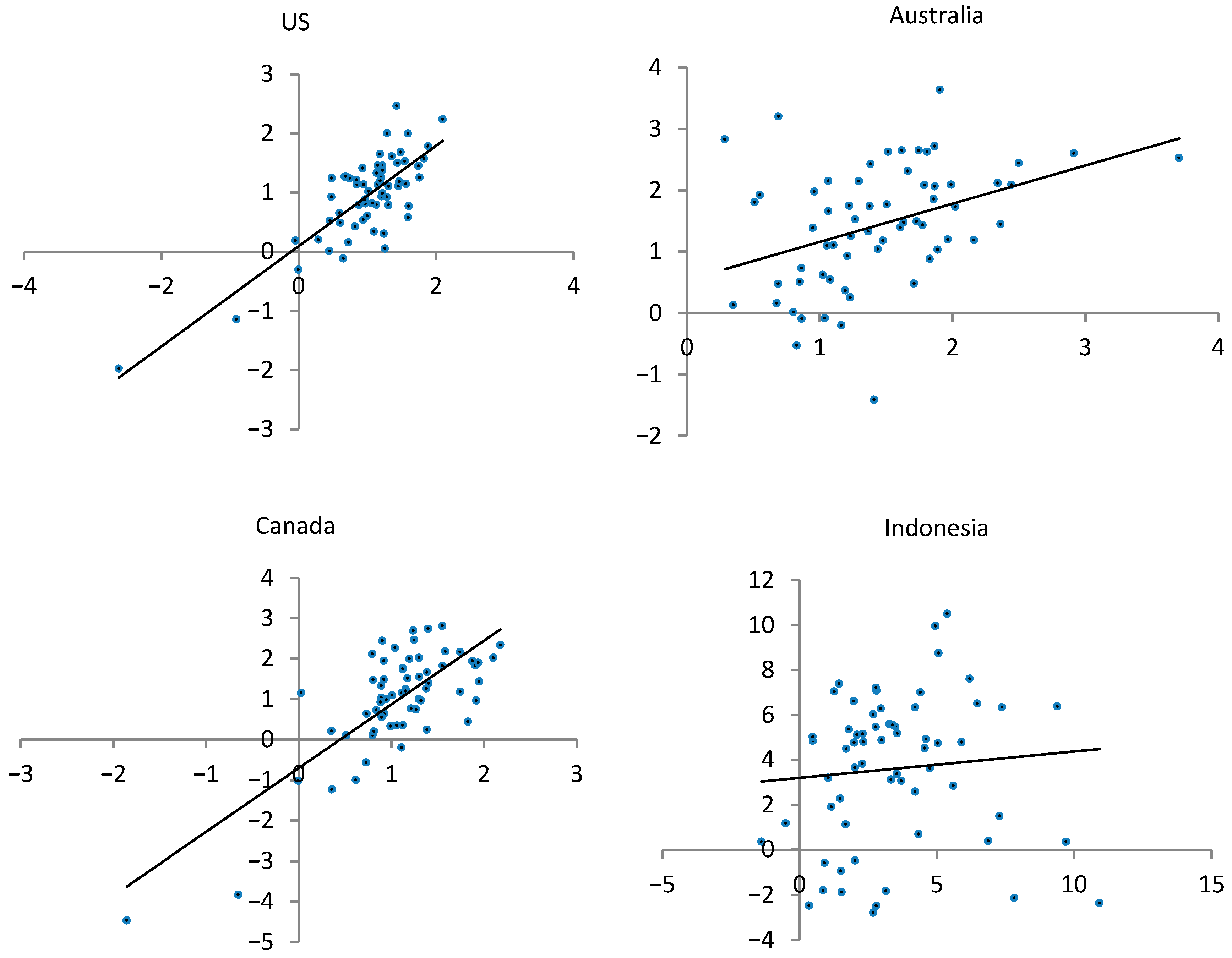
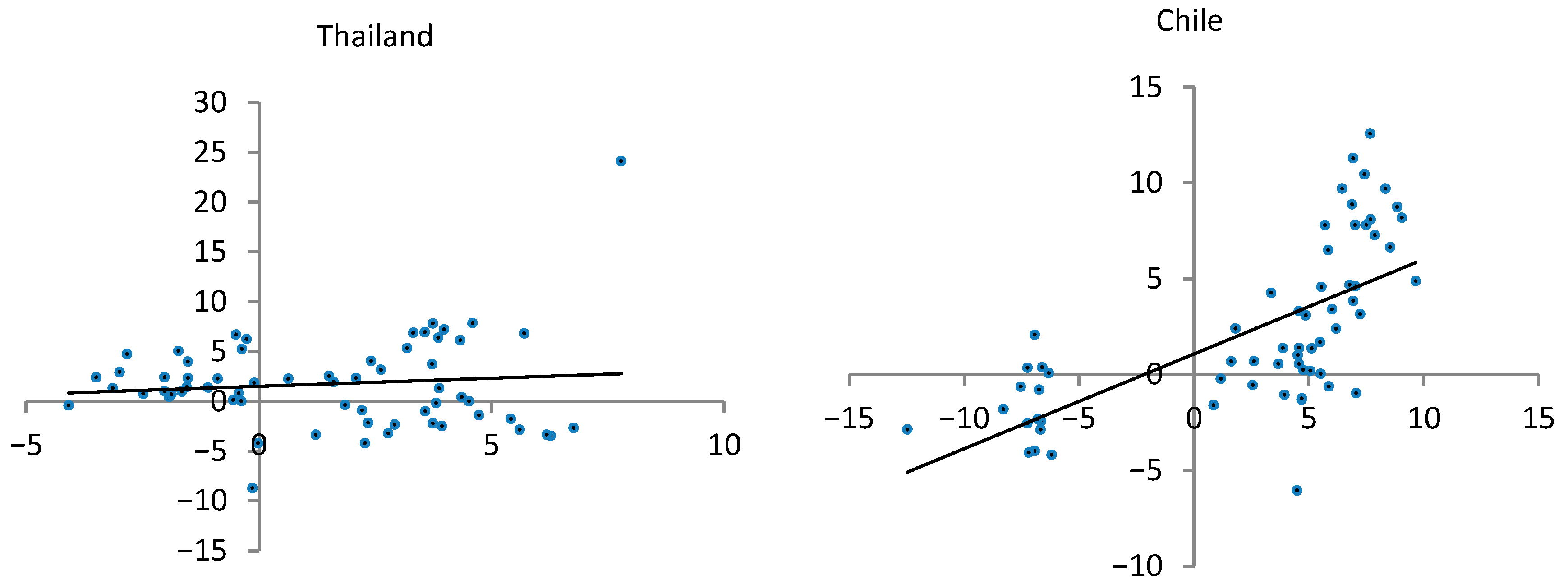
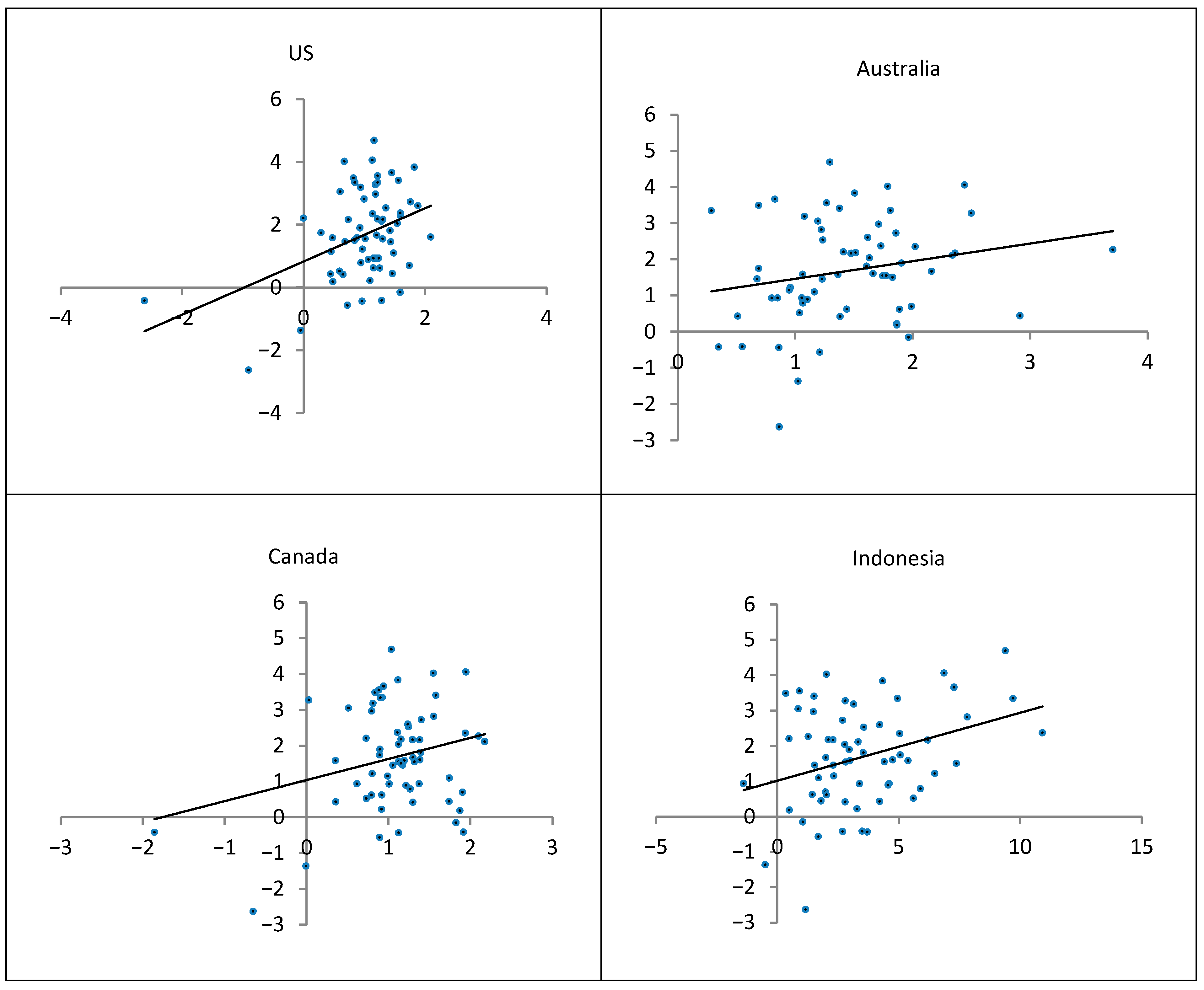
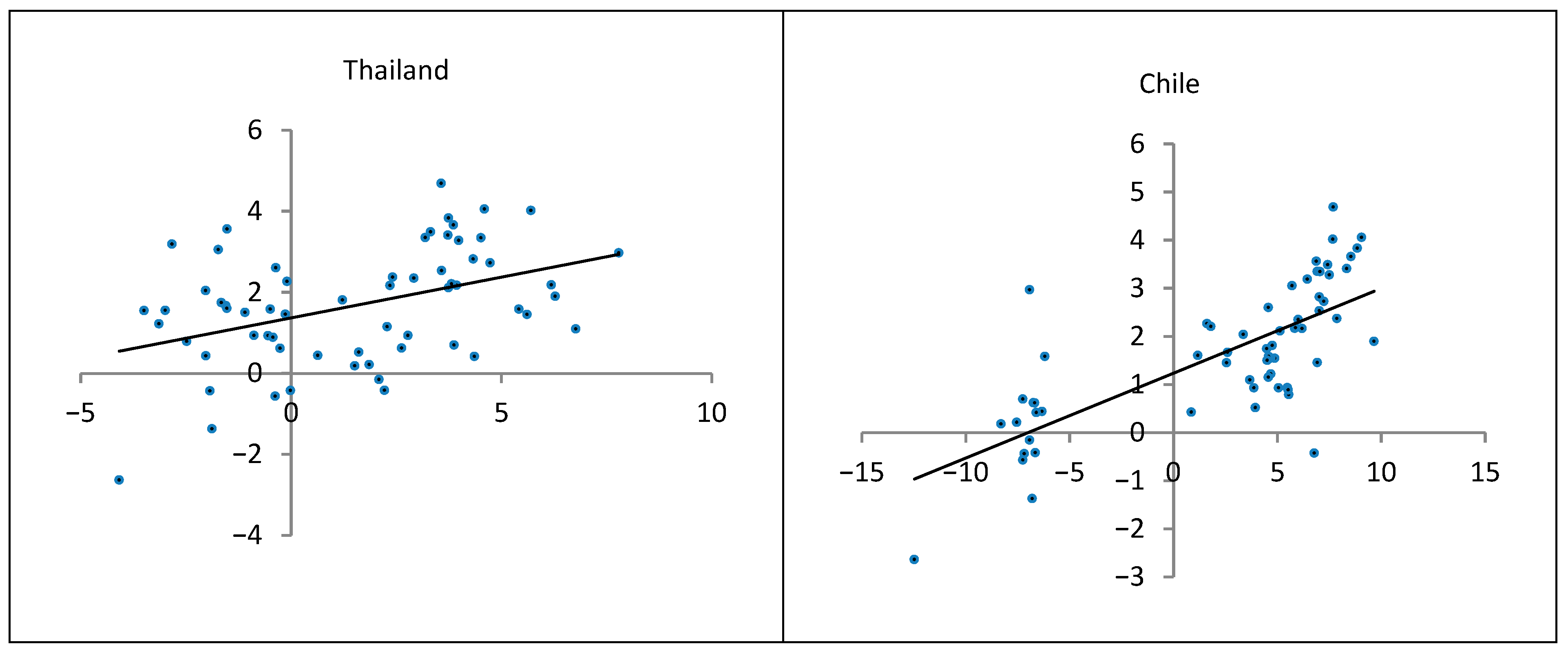
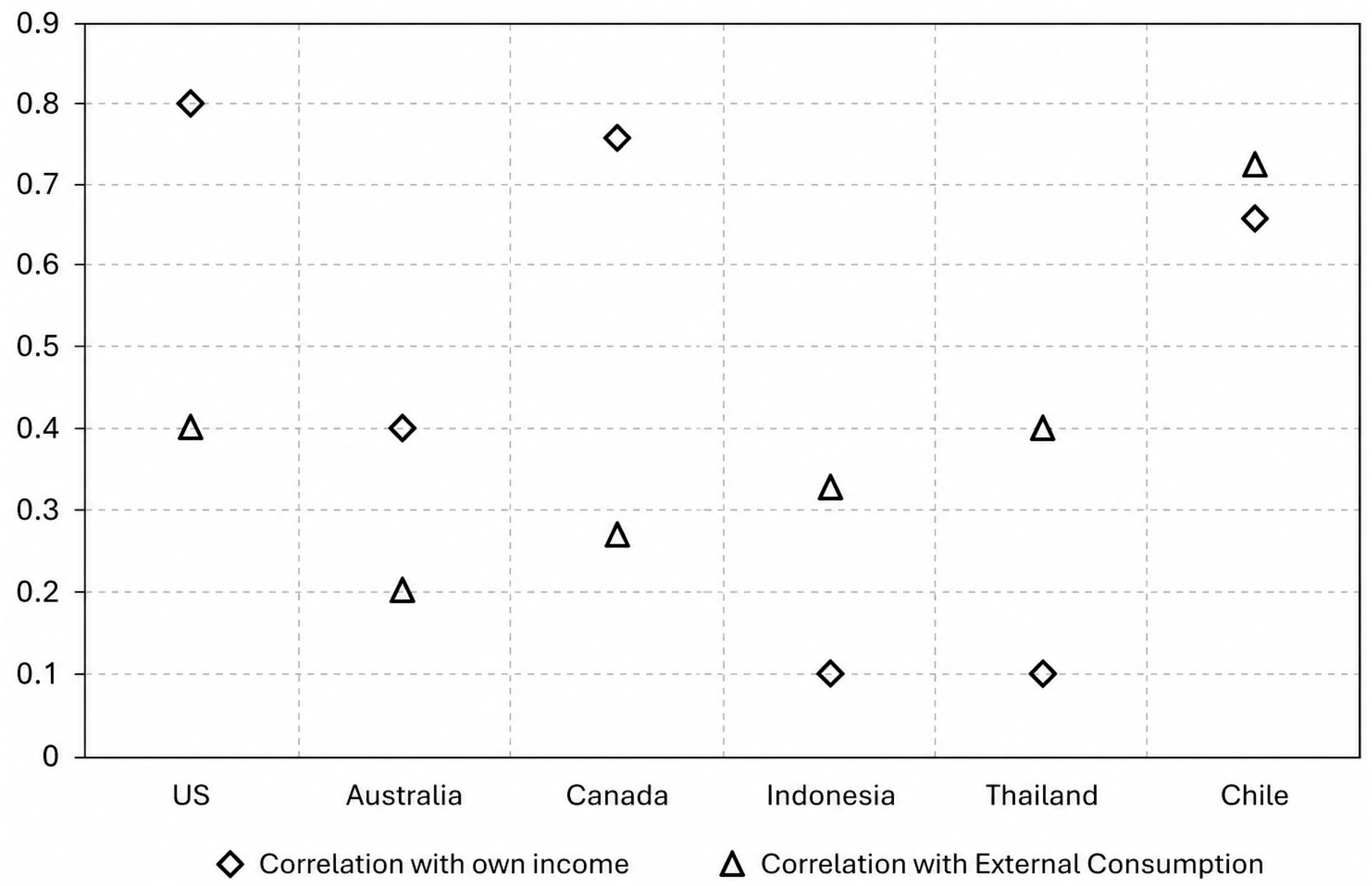
Figure 1 and
Figure 2 present scatterplots of the data. These figures provide an initial visual overview of the relationships between the variables and are intended as exploratory evidence. Some observations appear as outliers, which may reflect country-specific shocks, structural differences, or periods of economic volatility. Such patterns are common in cross-country macroeconomic data and are taken into account in the interpretation. Importantly, the analysis does not rely on these bivariate relationships alone. The scatterplots serve as a starting point for the econometric analysis presented in the subsequent sections.
Domestic consumption appears to be more strongly correlated with domestic income in some countries, while in others it is more closely associated with external consumption.
Figure 3 presents the correlation between domestic and external consumption over time. The smoothed solid line is included to highlight the underlying trend in the correlation series and to reduce short-term fluctuations that may obscure the broader pattern. The correlations are computed over the sample period and are presented in a way that captures their evolution rather than relying on a single summary measure for the entire sample. This allows for a clearer illustration of changes in the degree of co-movement over time. It is important to note that these correlations are intended to provide descriptive insight. The main conclusions of the study are based on the econometric model estimates presented in the subsequent sections, which offer a more comprehensive assessment of capital mobility.
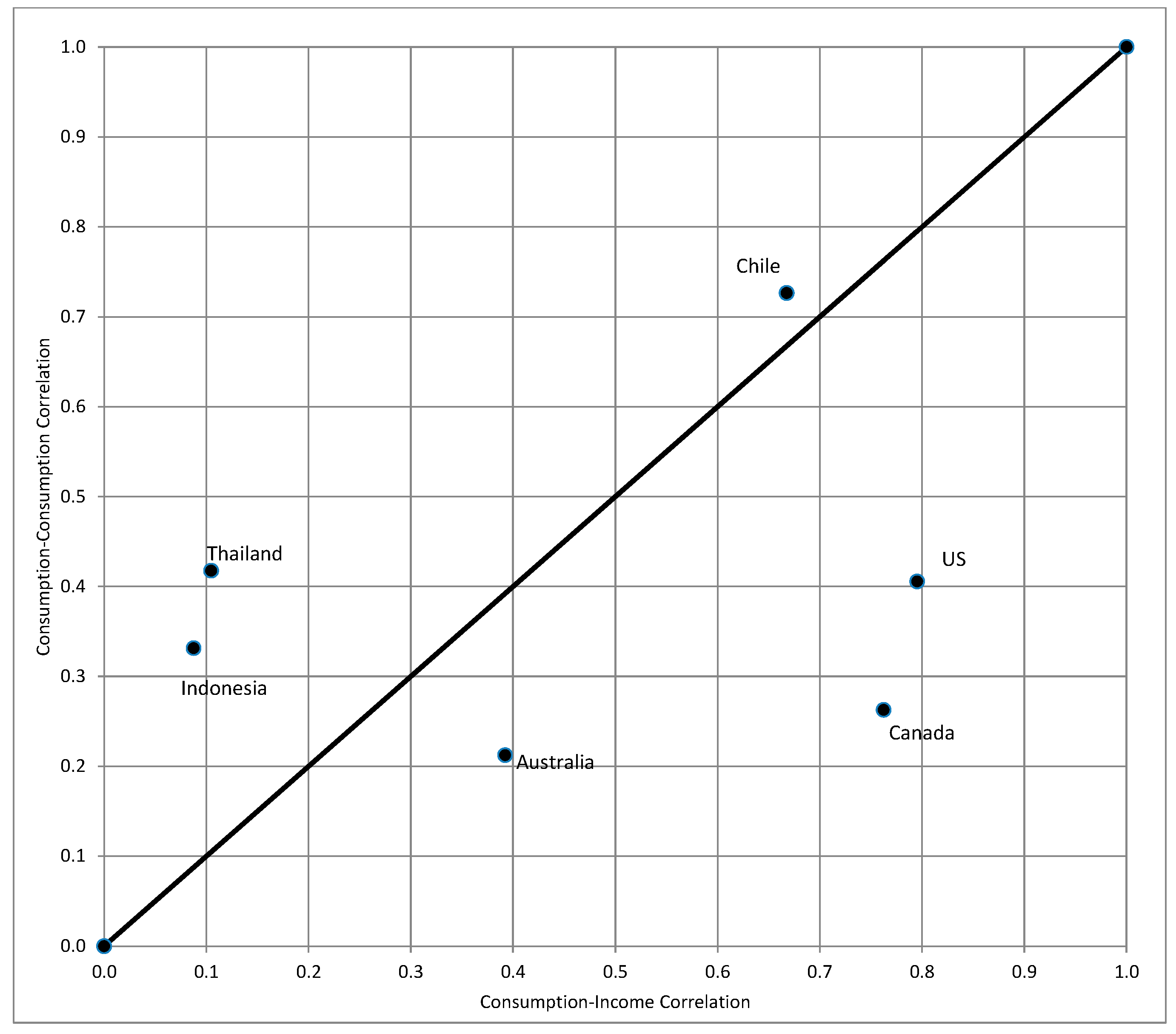
A measure of capital mobility can be constructed from consumption-consumption and consumption-income correlations.
Figure 4 is a scatterplot that has horizontal and vertical axes that represent consumption-income correlation and consumption-consumption correlation, respectively. The figure illustrates the relationship between the variables and is intended to provide a descriptive overview of the data patterns. For clarity, this figure is interpreted as a preliminary illustration that complements the empirical analysis rather than following from it. It is therefore best understood as part of the descriptive context underlying the estimation results. In the figure, the 45-degree line represents the set of points where domestic consumption shows equal sensitivity to both domestic income and external consumption. Thus, any point on this line, or close to it, may be taken to imply that capital is “moderately” mobile—neither highly immobile nor highly mobile. Points lying below the 45-degree line signify a high degree of capital immobility, because they are closer to the point (1,0), which represents perfect capital immobility or autarky. Conversely, points above the 45-degree line denote high capital mobility, as they lie closer to the point (0,1), which represents strong capital mobility. As illustrated in
Figure 4, developed countries fall below the 45-degree line and developing countries fall above the line, suggesting that developing economies exhibit greater capital mobility.
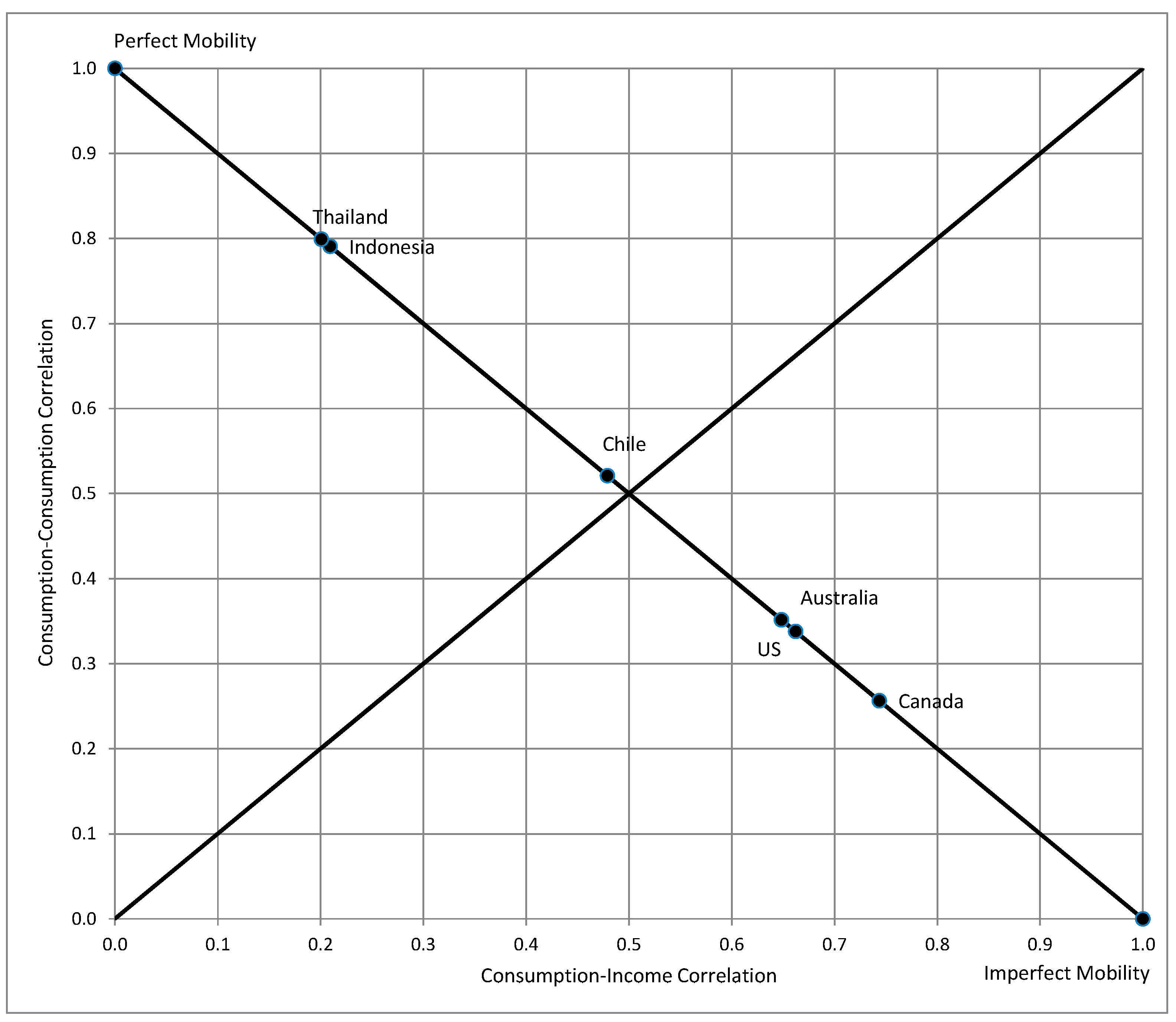
Figure 5 presents normalized correlation coefficients between domestic and external consumption. In this context, normalization refers to expressing the correlation coefficients on a comparable scale to facilitate interpretation across countries and over time. This ensures that the reported correlations are directly comparable and not driven by differences in scale or volatility across the underlying series. By construction, the two correlations for each country sum to one, which explains why all points lie along a 45-degree line with a negative slope.
Once again, proximity to the point (0, 1) reflects high capital mobility, whereas closeness to the point (1, 0) reflects low mobility. As illustrated in
Figure 5, Thailand shows the highest degree of capital mobility, while Canada exhibits the lowest. These results are explained in the following section.
5. Discussion
The results presented in this paper suggest that: (i) the results reject the hypothesis of perfect capital mobility across all economies; (ii) for every economy, the hypothesis of autarky (imperfect capital mobility) is ruled out; and (iii) developing economies exhibit higher capital mobility compared to developed economies. The first result is reasonable and straightforward to interpret, as perfect capital mobility is not to be anticipated. The mobility of capital is imperfect, so real interest rates may fail to converge across economies, restricting capital flows because of foreign investment concerns such as risk and reduced control. In addition,
MacDonald (
1995) critiques the notion of perfect capital mobility, arguing it is implausible because it suggests that nations could indefinitely build up or run-down foreign assets without limitation.
The findings indicate that capital is mobile across countries; however, this mobility is not complete. This happens due to two opposing forces: the gains from diversifying internationally, encouraging capital movements, versus home bias, which discourages them. According to
Baxter and Jermann (
1995), although international diversification has increased recently, domestic asset holdings remain higher than expected, contradicting the predictions of portfolio choice theory. According to
Wright and McCarthy (
2002), Australian investors do not diversify internationally because they view foreign shares as risky assets.
Wright and McCarthy (
2002) question whether investors can truly capture the benefits of international diversification by buying shares in universal companies.
French and Poterba (
1991) concluded that factors such as capital controls, taxation, and transaction costs do not fully explain the pronounced home bias in investment portfolios. Nonetheless, home bias was explained in a variety of ways. Those include international investment barriers, purchasing power parity deviations, hedging of non-tradable assets, and factors related to stock market development.
It is possible that home bias happens because international diversification yields are insufficient in return or ineffective in lowering risk levels. According to
Kalra et al. (
2004), the benefits of international diversification appear to be more limited than previously assumed. Their results imply a modest 10% allocation to international securities might be warranted, but benefits may diminish when tax issues are considered. In addition, they emphasize that sustaining the target weights of domestic and international capital components requires regular portfolio rebalancing and adherence to the recommended diversification, consistent with
Rowland (
1999) and
Laker (
2003). Furthermore, international investment—especially in developing economies—entails considerable transaction costs that affect portfolio performance estimates. Thus, with the need for regular portfolio rebalancing and the burden of transaction costs, international diversification might not produce notable gains.
Moreover, enthusiasm for international capital mobility began to fade in the wake of the international financial crisis. As
Palley (
2009) states “there are good economic reasons for restoring to capital controls as a standard part of the policy arsenal”. The evidence in support of the claim that capital mobility boosts growth is relatively weak (
Kose et al., 2009).
Palley (
2009) notes that economies with the most significant growth rates have often applied capital controls. Additionally, there is growing public discontent with globalization, leading to a political shift toward restricting the flows of capital. All these considerations strongly indicate that capital mobility may not be as broad as once assumed.
The result showing greater capital mobility in developing economies compared to developed ones calls further clarification. The dominant view is that developing economies experience low capital mobility, possibly due to their inclination to impose capital controls. There may be three possible reasons indicating that capital mobility in developing countries is actually greater than generally assumed. First, Foreign Direct Investment inflows are encouraged by cheap labour and less stringent regulation than in developed countries. Second, investors from developed countries may find it beneficial to diversify into developing countries, because stock returns are less highly correlated. The third reason pertains to financial capital outflows from developing into developed countries. Investors may be seeking investment in more developed financial markets because of perceived lower levels of political risk.
Indeed, a growing body of evidence suggests that capital mobility in developing economies may be higher than previously perceived.
Haque and Montiel (
1991) argue that the true extent of capital mobility in less developed countries may exceed common assumptions. Similarly,
Rocha (
2007) finds evidence of meaningful capital mobility in developing economies, while the
IMF (
1990) reports that actual capital flows in these countries may be stronger than typically assumed. Importantly,
Frankel et al. (
1986), using saving–investment correlations, provide direct comparative evidence showing that capital mobility can be higher in developing economies than in industrialized countries. As a result, these findings place the findings of this study within a broader empirical context and reinforce the conclusion that capital mobility in developing economies is not only higher than previously thought, but may also exceed that observed in developed economies.