1. Introduction
Rethinking domestic health financing in Sub-Saharan Africa has become critical, amid a sustained decline in donor support, attributed to economic constraints in donor countries, shifting global priorities, climate-related emergencies, and evolving geopolitical dynamics (
Onabowale, 2020;
Ifeagwu et al., 2021). Foreign aid, which for decades has been a primary source for health system financing across the region, decreased by approximately 30 percent between 2013 and 2020, with continued reduction anticipated (
Apeagyei et al., 2025). This decline has placed unprecedented financial pressure on African health systems facing mounting pressures from a dual disease burden: persistent infectious diseases such as malaria and HIV/AIDS together with rapidly rising non-communicable diseases (NCDs) including diabetes, hypertension, and cardiovascular conditions (
Karamagi et al., 2023). The COVID-19 pandemic further exposed critical vulnerabilities in health-financing mechanisms characterized by high out-of-pocket expenditures averaging 36 percent of total health spending (
Brikci, 2024), and persistent failure to meet the Abuja Declaration commitment of allocating 15 percent of government budgets to health (
Chilunjika & Chilunjika, 2023). In the face of these converging challenges, a paradigm shift toward sustainable domestic resource mobilization becomes imperative.
Innovative taxation represents a particularly promising avenue to broaden revenue bases, enhance fiscal sustainability and promote equity in health financing (
WHO, 2023;
Loewenson & Mukumba, 2023;
Taheri et al., 2025). Unlike traditional revenue mobilization strategies, innovative tax instruments including health taxes, environmental levies and digital taxation can yield double dividend (
Doherty, 2014;
Loewenson & Mukumba, 2023). There is evidence to demonstrate that innovative taxation can generate revenue while simultaneously discouraging harmful consumption and behaviors that contribute to disease burden and environmental degradation (
Tavengwa et al., 2023;
Taheri et al., 2025). International experiences from Thailand and Mexico demonstrate feasibility. A study by
Tangcharoensathien et al. (
2020) highlighted that Thailand achieved 98.5 percent Universal Health Coverage (UHC) through progressive tax reforms, while Mexico’s sugary tax reduced consumption by 7.6 percent within two years, while generating significant revenue (
Colchero et al., 2017).
Despite growing recognition and potential of innovative taxation, their adoption raises important questions about equity, administrative feasibility, and political acceptability, particularly in economies with large informal sectors and constrained tax capacity. Some SSA countries have made initial strides in implementing innovative health taxes, for instance South Africa’s sugar-sweetened beverages levy (
Cejka et al., 2025), Zimbabwe’s fast-food tax (
Zimbabwe Revenue Authority, 2024), Botswana’s alcohol tax (
Seleke, 2021) and Kenya’s plastic bag tax; however, systematic analyses of these diverse approaches remain inadequate. The existing literature on SSA is limited and fragmented from isolated case studies, lacking in-depth analysis of innovative tax models prevalent in SSA and implementation barriers specific to the region (
Doherty, 2014;
Tavengwa et al., 2023). This narrative review addresses these gaps through synthesis and critical analysis of tax models prevalent in SSA and their implementation challenges. Furthermore, the review advocates for evidence-informed policy actions by demonstrating the viability and potential of innovative taxation as a sustainable domestic revenue source, while simultaneously providing actionable, context-specific recommendations for tax policy design that balance revenue, equity considerations and feasibility. The synthesis generates actionable, context-specific recommendations for tax policy design that balance revenue, equity considerations and feasibility.
This review is guided by the following research questions:
What innovative tax models are currently being implemented for DRM for health financing in SSA?
What implementation challenges do SSA countries face in implementing innovative tax models for health financing?
2. Theoretical Framework and Literature Review
2.1. Theoretical Framework: Fiscal Space for Health
This review employs the Fiscal Space for Health framework developed by
Heller (
2006) and adopted for health financing by
Tandon and Cashin (
2010). Fiscal for health is defined as the availability of budgetary room that allows a government to allocate resources for health objectives without compromising it is the long-term financial stability (
Tandon & Cashin, 2010). The framework identifies six key pathways for creating fiscal space for health: (i) reprioritization of budget allocation toward health; (ii) improved efficiency in health spending; (iii) economic growth and revenue expansion; (iv) improved governance and accountability mechanisms; (v) increased development assistance; (vi) innovative financing mechanisms including DRM through taxation.
The framework is particularly pertinent for examining innovative tax models in SSA for several reasons. First it clearly situates revenue mobilization within broader macroeconomic and fiscal sustainability contexts, highlighting the structural constraints that African countries face including narrow tax bases, substantial debt burdens and competing expenditure priorities (
Tandon & Cashin, 2010). Second, the framework recognizes the interconnectedness of various fiscal space instruments, highlighting that tax reforms cannot be examined in isolation, but through a comprehensive analysis that accounts for their opportunity costs relative to other fiscal instruments and efficiency improvements (
Barroy et al., 2016). This according to
Barroy et al. (
2016) will ensure that tax policy choices align with a country’s overall fiscal sustainability objectives. Third, it further emphasizes that newly generated revenue should not merely be mobilized but must be systematically translated into tangible gains in health service delivery, demonstratable improvements in quality of care and more equitable access across populations (
Tandon & Cashin, 2010).
Applied to this review, the framework provides a theoretical lens for examining how innovative tax instruments including earmarked health taxes, environmental taxes and digital service levies can expand DRM for health financing in SSA. Specifically, this framework facilitates systematic analysis across four key dimensions: revenue generation potential and sustainability, administrative capacity given existing tax collection infrastructure, the distributional and equity implications for different income groups, particularly vulnerable populations and the extent to which such tax reforms compromise or reinforce broader macroeconomic stability and fiscal sustainability goals. Through this theoretical framework, this review moves beyond a narrow focus on revenue mobilization to examine the complex trade-offs between alternative financing mechanisms, the institutional and political dynamics shaping reform trajectories and contextual factors that influence implementation outcomes across diverse SSA contexts. This theoretical approach thus enables the development of contextually grounded, evidence-based policy recommendations for strengthening the fiscal architecture underpinning public health system financing on the SSA region.
2.2. The Current State of Health Financing in Africa
2.2.1. Dependence on Foreign Aid and Implications of Declining Funding
Historically, foreign aid has constituted a significant component of health financing across SSA, with development assistance accounting for approximately 25–30 percent of total health expenditure in many developing countries (
Apeagyei et al., 2025). Development partners including the Global Fund to fight AIDS, Tuberculosis and Malaria, the United States of America through PEPFAR and the President’s Malaria Initiative and bilateral development agencies have financed crucial programs ranging from disease control to maternal and child health initiatives (
Ly et al., 2017;
Karamagi et al., 2023). Research demonstrates that substantial donor support enables developing countries to scale up antiretroviral therapy access, expand immunization coverage and strengthen disease surveillance systems during periods of constrained domestic fiscal capacity (
Ifeagwu et al., 2021;
WHO, 2023;
Apeagyei et al., 2025).
Nonetheless, evidence indicates a marked reduction in development assistance for health to SSA, with aggregate flows plateauing since 2013 and declining in real terms when adjusted for inflation and population growth (
Onabowale, 2020;
WHO, 2023). Several studies highlight political and structural dynamics underpinning this trajectory.
Apeagyei et al. (
2025) suggest that fiscal pressures in traditional donor countries in the aftermath of the 2008 global financial recession and the COVID-19 pandemic have constrained aid budgets.
Onabowale (
2020) note that shifting geopolitical priorities including counterterrorism, migration management and climate adaptation have redirected development finance away from health. According to
Ifeagwu et al. (
2021), donor fatigue with long-term aid commitments and the graduation of some middle-income African countries from concessional financing eligibility have further reduced available resources. Concurrently, the global health landscape is increasingly emphasizing “country ownership” and “sustainability transition”, placing stronger expectations on recipient nations to assume greater financial responsibility for their health programs (
Zeng et al., 2020;
WHO, 2023). This confluence of shifting donor priorities, declining external support and increased emphasis on country ownership fundamentally reshapes health financing is SSA. These factors create both fiscal pressure and policy momentum for SSA countries to reduce aid dependency; donor funds, while still valuable, can no longer serve as a reliable foundation for sustainable health system development. Addressing this challenge necessitates strengthened DRM, an imperative that has gained renewed urgency in the post COVID-19 era (
Apeagyei et al., 2025).
2.2.2. The Need for Domestic Resource Mobilization
Stenberg et al. (
2017) note that persistent health financing gasps in developing nations, with additional annual investments (estimated at USD
$274 billion) needed by 2030 to achieve SDG 3 targets, cannot be adequately addressed through donor funds alone. This reality has catalyzed growing policy and scholarly consensus that DRM is the most viable pathway toward equitable and sustainable health financing (
OECD, 2015;
WHO, 2023;
Brikci, 2024). This imperative is reinforced by growing recognition of the structural challenges inherent in donor-dependent financing models. For instance,
OECD (
2015) notes that overdependence on donor funds raises concerns regarding fiscal autonomy, sustainability and alignment with national priorities. Similarly,
Stenberg et al. (
2017) denote that foreign aid often comes with conditions that may not align with national health objectives, resulting in fragmentation in service delivery and parallel systems that may weaken overall health governance. In their study,
Zeng et al. (
2020) state that aid unpredictability, characterized by delayed disbursements, short funding cycles and sudden terminations complicates planning and undermines efforts to build resilient health systems. Additionally, as African economies grow and demographic transitions advance, health needs are evolving beyond traditional communicable illness toward complex, resource-intensive NCDs and health system strengthening obligations that development agencies are less willing to finance (
Ifeagwu et al., 2021).
Current fiscal realities in developing countries compound the challenges. Many countries in SSA face debt sustainability concerns, with public debt to Gross Domestic Product (GDP) ratios exceeding approximately 60 percent (
Ye & Guo, 2025), significantly constraining fiscal space for health investments. Competing demands for infrastructure, education and social protection further limit health financing, with most nations on the region falling short of the Abuja Declaration commitment (
Chilunjika, 2024). Furthermore,
Ye and Guo (
2025) denote that tax revenue to GDP ratios in SSA average 15–17 percent, figures significantly below the 20–25 percent threshold considered essential for sustainable development financing. These intersecting constraints create a challenging environment for expanding health financing through traditional budgetary mechanisms. Consequently, DRM through innovative taxation has emerged as a viable strategy for generating revenue streams needed to build fiscally sustainable health systems.
3. Methodology
3.1. Rationale for a Narrative Review
This paper employs a narrative review methodology to explore and provide a scholarly summary of innovative tax models as strategies for DRM for health financing in SSA. A narrative review is a form of knowledge synthesis that provides a broad, integrated overview of a research topic by critically examining, interpreting and synthesizing the literature from multiple disciplines and methodological traditions (
Ferrari, 2015). Unlike systematic reviews which follow a rigid protocol designed to minimize bias in answering a precise clinical or epidemiological question, narrative reviews are well suited to exploratory, conceptually complex questions where the goal is to map a field, identify emerging themes and generate policy-relevant insights from heterogeneous evidence (
Greenhalgh et al., 2018). A narrative review approach was selected as most appropriate for synthesizing the diverse literature across multiple disciplines, including public finance, health economics, taxation policy, and development studies. By incorporating such a range, we capture the complex, multilayered dimensions of fiscal space in health including how different tax instruments perform across varied economic structures, political contexts and administrative capacities. Additionally, given the heterogeneity of countries in SSA and the relatively nascent implementation of innovative health taxes in the region, a narrative approach offers methodological flexibility, allowing us to integrate peer-reviewed empirical studies, theoretical frameworks, grey literature and policy documents; these are source types that would be normally excluded under the strict inclusion protocols of systematic reviews. Furthermore, the narrative review allows for contextualized interpretation of evidence while identifying critical knowledge gaps and implementation lessons requiring future inquiry.
3.2. Literature Search Strategy
We conducted a comprehensive literature search across multiple academic databases, including Scopus, Web of Science, EconLit and Google Scholar to retrieve literature published between 2010 to 2025. This timeframe captures developments in health financing challenges, the DRM initiatives following the Abuja Declaration commitments and recent innovations in taxation models amid declining development assistance for health. While health financing studies exist for several countries in SSA, studies specifically investigating innovative tax models including digital taxation, health specific taxes and environmental levies for health financing remain relatively limited and geographically concentrated. A preliminary database search revealed uneven research coverage across the region; countries such as South Africa, Rwanda, Kenya, and Zimbabwe receive significant scholarly attention, while others remain underexplored. Thus, the search strategy deliberately incorporated both country-specific and regional terms to identify relevant studies with transferable policy insights across diverse SSA contexts. Supplementary search strategies included manual reference list screening in key articles and consultation of grey literature sources: internet sources, theses, reports, working papers from WHO, African Tax Administration, OECD and other relevant international development organizations. Government policy documents from selected SSA countries were also reviewed. Boolean operators “AND” and “OR” were used to combine search terms in various ways to retrieve the relevant literature: health financing, health taxes, domestic resource mobilization, innovative taxation, sin taxes, sugar tax, digital taxation, environmental taxes, tax reform, donor aid decline, Sub-Saharan Africa and specific country names.
3.3. Inclusion and Exclusion Criteria
Papers were was included if they met the following criteria: (1) addressed health financing, tax policy, fiscal space creation or DRM in SSA or comparable developing contexts; (2) addressed innovative tax instruments for health financing; (3) addressed implementation experiences, equity implications, revenue performances, administrative feasibility or political economy factors affecting tax adoption and sustainability; (4) published in English language between 2010 and 2025. Paper types comprised empirical research, case studies and theoretical frameworks. Studies were excluded if they focused exclusively on high-income countries without transferable insights to SSA settings, addressed general taxation or public finance without substantive discussion of health financing, were non-English-language publications, or were published before 2010.
Following the inclusion and exclusion criteria, a total of 65 sources were included in the review, comprising 39 peer-reviewed empirical studies and 26 grey literature items including policy documents, working papers, newspaper articles and reports from international organizations.
3.4. Data Synthesis and Analysis
The review employed a thematic synthesis approach through an iterative, interpretive process informed by the fiscal space for health framework. The primary author conducted the initial coding process, with regular verification and collaborative discussion with the co-author to maintain analytical rigor and minimize interpretive bias. Coding decisions and theme development were subject to iterative review and refinement through collaborative discussions until consensus was reached. Key themes were identified in line with the two guiding research questions: types of innovative models currently being implemented in SSA and implementation challenges affecting innovative tax policies. Case studies from countries including Zimbabwe, South Africa and Kenya were analyzed to extract practical lessons and contextual considerations.
4. Discussion of Findings
4.1. Innovative Tax Models for Health Financing in Sub-Saharan Countries
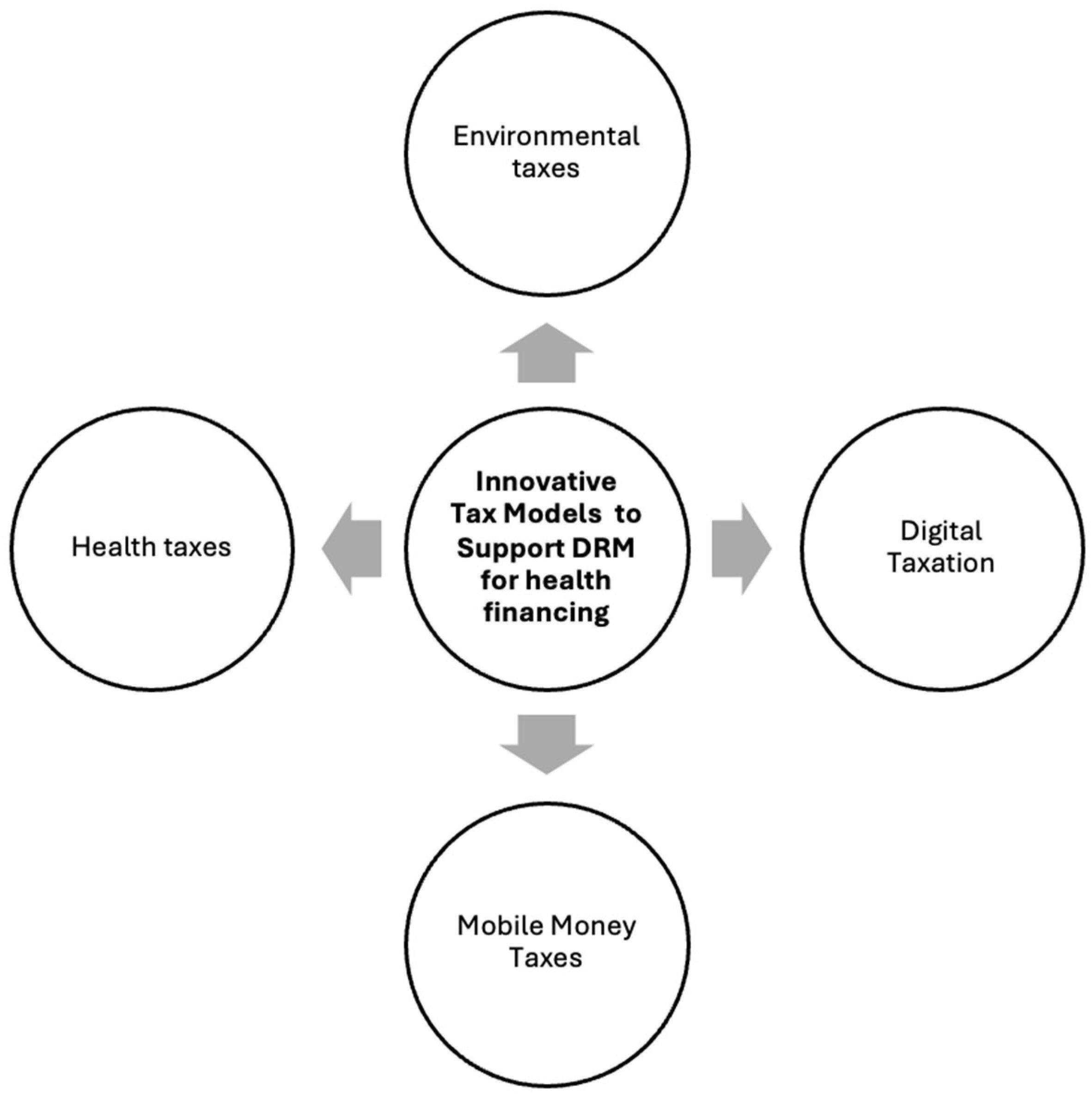
In the quest to find sustainable DRMs for health financing, several innovative tax models have been considered as possible viable options. This section discusses specific tax models that have emerged in the literature as showing significant promise to widen domestic revenue mobilization in SSA countries. These are schematically presented in
Figure 1.
4.1.1. Health Taxes an Overview
Health taxes represent a strategic policy instrument capable of simultaneously discouraging consumption of unhealthy products while generating revenue (
Ghebreyesus & Clark, 2023). This dual function is particularly significant given the profound health and economic challenges facing SSA. With evidence suggesting that products such as alcohol, tobacco and sugar-sweetened beverages contribute to over three million preventable deaths annually globally (
Burki, 2023), the health imperative is clear. Concurrently, the region faces declining health financing, narrowing fiscal spaces and COVID-19-induced shocks that threaten SDG attainment. In this context, health taxes emerge as a key policy consideration for addressing public health challenges and revenue shortfalls.
As a core instrument of health economics, these taxes are designed to increase the costs associated with products detrimental to public health across the entire supply chain (
Ghebreyesus & Clark, 2023). Consequently, current policy debates are extending beyond traditional targets such as alcohol, tobacco and sugar-sweetened beverages to encompass a wider range of health-harming products, including sugary drinks containing natural sugar and foods high in salt (
Doherty, 2014;
WHO, 2023). There is evidence to suggest that the revenue potential of these taxes is substantial.
Tangcharoensathien et al. (
2019) project that a one-time 50 percent price increase on alcohol, tobacco and sugary beverages could generate USD 3.7 trillion over five years, with USD 2.1 trillion accruing in low- and middle-income countries. This revenue presents a direct opportunity to strengthen health financing. Additionally, evidence from countries including Mexico, the Philippines, and Thailand demonstrate that well-designed taxes can successfully alter consumption patterns and contribute to improved public health outcomes. In Mexico, the implementation of a peso-per-liter excise tax on sugar-sweetened beverages in 2014, led to a 6 percent decline in purchases in the first year and 9.7 percent in the second year, with the most significant reductions occurring among low-income households who face the highest risk of obesity-related diseases (
Colchero et al., 2017). In the Philippines, tobacco tax reforms implemented in 2012 contributed to a decline in smoking prevalence from 28.3 percent in 2009 to 23.8 percent in 2015, while state revenue nearly tripled from PHP 32.9 billion in 2009 to PHP 106 billion in 2016, with earmarked funds enabling 8 million additional low-income families to access healthcare coverage (
Kaiser et al., 2019).
Despite promising indicators, health taxes remain significantly underutilized globally.
Ghebreyesus and Clark (
2023) portend that only 13 percent of the world’s population benefit from best-practice tobacco taxes, with taxation rates for alcohol and sugary drinks being even lower. With over 40 million people dying from NCDs in 2021 alone, (
WHO, 2025) this underutilization represents a missed opportunity for governments to improve healthcare, generate revenue, and advance equity. Evidence suggests that this underutilization stems from several barriers that impede wider adoption and effective implementation.
Phonsuk et al. (
2021) highlight resistance from powerful industry actors, limited public policy acceptance and political challenges as key barriers. These are further compounded by concerns about anticipated costs to industries and consumers (
Kaiser et al., 2019). Additionally, ministries of finance in some contexts remain unconvinced of the long-term benefits when weighed against short-term economic losses (
Ghebreyesus & Clark, 2023). These challenges highlight the necessity for context-specific analysis of each country’s economic, political, legal and tax environment as critical determinants of successful tax policy formulation and implementation. This context-specific imperative is particularly salient in SSA, where countries have begun implementing various health tax models, each reflecting unique political economics, institutional capacities and public health priorities. Subsequent sections examine specific health tax implementations across the region, providing empirical insights of their viability as innovative financing mechanisms.
4.1.2. Tobacco and Alcohol Taxes
Health taxes demonstrate widespread adoption across the WHO African region, with tobacco excise taxes implemented in 43 of 47 member states and alcohol excise taxes in 41 member states (
Nabyonga-Orem et al., 2023). However, the design, level and use of these taxes vary across the SSA region. Empirical studies confirm their significant revenue-generating capacity on the region. For example, South Africa represents one of the region’s most established example of tobacco taxation.
Cejka et al. (
2025) state that the country generates approximately R 14.4–15 billion annually in tobacco excise tax revenue. Ghana’s experience, conversely, illustrates the revenue mobilization potential of health taxes. In 2023, the country implemented the Excise duty amendment act, transitioning from a purely ad valorem system to a hybrid structure comprising a 50 percent ad valorem rate plus a specific duty of 28 pesewas (approximately USD 0.02) per cigarette stick (
Government of Ghana, 2023). According to
Boachie (
2025), this reform yielded immediate fiscal returns, with tobacco excise revenue increasing from GHS 220.8 million (approximately USD 23 million) in 2022–2023 to GHS 454.5 million (approximately USD 40 million) in 2023–2024.
Earmarked alcohol taxes have also shown significant revenue generation capacity in countries such as Kenya and Botswana. According to the
Institute of Economic Affairs Kenya (
2024) Kenya’s alcohol excise contributed approximately Ksh 51.01 billion in 2023 (USD 395.49 million) which was been directed to fund public programs including health. Botswana has also successfully implemented alcohol taxes to reduce harmful alcohol consumption and generate revenue for public health programs (
Pitso & Obot, 2011). Beginning with a 30 percent levy on alcoholic beverages in 2008, Botswana progressively increased the rate to 55 percent by 2015, generating cumulative revenue of P 1.87 billion (approximately USD 157 million) by September 2015 (
Seleke, 2021). The policy’s impact extended beyond revenue mobilization to tangible health outcomes (
Seleke, 2021). According to
Malawige et al. (
2025), alcohol-related traffic crashes declined by approximately 12 percent seven months after the initial levy implementation, with similar reductions following subsequent rate increases, showcasing dual benefits. Despite this initial success, Botswana’s levy was reduced to 35 percent in 2018 in response to industry pressure and economic development concerns, where it currently remains (
Seleke, 2021). This policy reversal reflects broader systematic challenges that undermine the effectiveness of tobacco and alcohol taxes across SSA. Other barriers including illicit trade, industry resistance, insufficient tax administration capacity and political pressures to prioritize economic development over health objectives also significantly compromise implementation effectiveness on the region (
Malawige et al., 2025;
Moyo et al., 2025). There is thus a need to strengthen the political economy foundations of health taxation, combat illicit trade and cultivate sustained political commitment to transform health taxes from policy aspiration into viable sustainable health-financing mechanisms in SSA.
4.1.3. Sugars Sweetened Beverages or Sugar Taxes and Fast Food Tax
With rising prevalence of NCDs linked to unhealthy foods, sugar-sweetened beverage taxes have emerged as a promising yet politically contested innovative health-financing mechanism in both developed and developing contexts (
World Health Organization Regional Office for Africa, 2019;
Burton et al., 2024). In SSA, evidence from Ghana, South Africa, Mauritius, Gabon and Zimbabwe demonstrate measurable public health and fiscal impacts (
World Health Organization Regional Office for Africa, 2019;
Cejka et al., 2025;
Zwinoira, 2025). South Africa’s Health Promotion Levy introduced in 2018 for instance, has proved effective. Within two years, sugar consumption through taxable beverages declined by 33 percent (
Cejka et al., 2025) and per capita beverage purchases decreased from 518.99 mL to 443.39 mL daily (
Cejka et al., 2025). Additionally,
Cejka et al. (
2025) reports that the levy generated R 3.2 billion in its first year and averaged R 2.34 billion annually over five years. Ghana has also implemented a 20 percent tax on sugar-sweetened beverages, which was projected to generate approximately GHS 455 million in its first year (
International Development Research Centre, 2023). Zimbabwe introduced a sugar tax in 2024 at a rate of USD 0.02 per gram of sugar content, which was however reduced to USD 0.001 per gram in January 2025 after resistance from industry and other stakeholders (
Tunhira, 2025). Despite this policy adjustment, the government reportedly generated ZIG 685.8 million (approximately USD 25.4 million) between January and May 2025, with revenue earmarked specifically for procurement of critical cancer treatment equipment and medicines (
Tunhira, 2025). This case highlights the potential for health taxes to translate into improved revenue mobilization, even in contexts where tax rates are revised downward.
Additionally, Zimbabwe has pioneered fast food taxation in SSA, introducing a 1 percent surcharge in January 2025 on items including pizza, hot dogs, French fries and similar products (
Zimbabwe Revenue Authority, 2024). Early evidence indicates moderate revenue generation, with Simbisa Brands Limited, the country’s largest fast-food operator paying USD 1 million in fast food tax during the first half of 2025 (
Zwinoira, 2025). Despite its potential benefits, the long-term fiscal yield and its effectiveness in curbing the consumption of ultra-processed food remain to be verified. This is particularly because Simbisa Brands Limited has absorbed the tax rather than passing the costs to consumers, which could potentially undermine the intended health objectives (
Zwinoira, 2025). Taken together, the three countries’ experiences indicate that sugar taxes can generate significant revenue for health systems while contributing to reductions in the consumption of unhealthy products. However, their effectiveness is highly dependent on sustained political commitment, clear policy objectives, transparent use of revenue and consistent implementation.
Mexico’s sugar tax experience offers valuable lessons for SSA. Implemented at 1 peso per liter in 2014, it achieved 7.6 percent consumption reduction within two years while generating USD 2.6 billion annually (
Colchero et al., 2017). Furthermore, Thailand’s earmarked health fund model, where sugar tax revenue directly finance UHC, provides a replicable framework for transparent revenue utilization in SSA. These international experiences demonstrate that SSA sugar tax effectiveness requires stricter enforcement, adequate tax rates, sustained political commitment despite industry opposition and institutionalized earmarking frameworks ensuring transparent revenue allocation to health system strengthening.
4.1.4. Environmental Taxes or Green Taxes
Environmental Taxes including pollution levies, carbon taxes and plastic bag charges, represent potential innovative fiscal instruments that countries can leverage for health financing and promotion of sustainable environmental practices (
Omodero, 2022;
Ben Youssef & Dahmani, 2024). In the context of declining donor aid and limited fiscal space for health, these “green taxes” can provide a dual dividend for SSA countries.
Mpofu (
2022) state that environmental taxes can generate revenue for public services, including healthcare, and create incentives for behavioral and industrial change that reduce environmental health risks such as air pollution, plastic waste and contaminated water. Carbon taxes were found to be the most prevalent green taxes in SSA with South Africa, Zimbabwe, Rwanda and Burkina Faso having implemented or announced carbon pricing mechanisms (
Ben Youssef & Dahmani, 2024). However, the literature suggests that implementation stages, tax rates and coverage vary significantly across these countries (
Omodero, 2022;
Mpofu, 2022).
Plastic bag levies have also been adopted in several SSA countries, including Zimbabwe, Kenya, Rwanda and South Africa, with varying approaches (
Mpofu, 2022;
Kok, 2024). South Africa for instance, generated approximately R 235 million from its plastic bag levy between 2023–2024, demonstrating the levy’s potential to generate revenue that can expand overall fiscal space, including for health (
Naidoo, 2022). Kenya adopted stringent measures, prohibiting the manufacture, importation and sale of plastic carrier bags in 2017, with substantial penalties for violations (
Behuria, 2021). Similarly, Rwanda combines a strict prohibition on single use-plastics with a 0.2 percent tax on imported plastic packaging designed to discourage consumption and promote biodegradable alternatives (
Behuria, 2021).
Taxes on natural resource extraction including mining, lithium, oil, and gas are also increasing being recognized as strategic tools to restructure sovereign health financing and build fiscal resilience globally (
Mawejje, 2019;
Omodero, 2022). This potential is particularly salient in Sub-Saharan countries including Zimbabwe, DRC, Zambia and Ghana where mining activities are often accompanied by documented environmental degradation, pollution-related diseases and community displacement (
Mawejje, 2019;
Mpofu, 2022).
Amidu et al. (
2024) state that these environmental and social impacts place significant pressure on already limited health budgets and infrastructure in mining-affected communities. Similarly,
Omodero (
2022) suggests that by strategically directing a portion of this revenue toward targeted investments, including environmental remediation, public health education initiatives and improving healthcare services in mining affected communities, governments can operationalize a compensatory model. Within the fiscal space framework, resource extraction taxes present an innovative strategy that can expand fiscal space without exacerbating debt or overreliance on donor funds.
Collectively, evidence from SSA suggests that environmental taxes, though still limited in scope and financial yield, can contribute to revenue diversification while producing co-benefits for population health. Realizing their full potential as health-financing mechanisms will, however, depend on transparent revenue use, strong administrative systems, addressing critical equity concerns and alignment with broader sustainability and public health policies.
4.1.5. Digital Service Taxes (DSTs)
Over the past decade, Africa’s digital economy has expanded rapidly, with Nigeria, Southa Africa and Egypt reportedly generating over USD 6 billion in e-commerce transactions (
Mhlanga & Hofisi, 2023). According to
Munyengera et al. (
2025) this growth presents a novel opportunity to expand fiscal space for countries in SSA through innovative digital taxation. Consequently, taxing the digital economy has become a strategic policy focus for several countries on the region to expand the DRM base and generate significant revenue streams (
ATAF, 2024). Countries including Zimbabwe, South Africa, Nigeria and Kenya are pioneering innovative models, including digital services taxes, VAT on digital services and taxes on mobile money transactions (
Tavengwa et al., 2023;
Munyengera et al., 2025). Examples of services that are subjected to DSTs include video production, search engine optimization, web design, content marketing, digital marketing and branding, among others.
In Kenya, DSTs have begun to yield measurable revenue.
Omondi (
2025) reported that, by the end of August 2025, the Kenya Revenue Authority (KRA) collected Sh 2.3 billion (approximately USD 17 million) from 454 foreign digital service providers under its DST act. Zimbabwe and South Africa are also modernizing tax frameworks to capture digital service flows, including mobile money taxes and levies (
Mhlanga & Hofisi, 2023;
OECD, 2021).
Kouladoum et al. (
2025) discussed the revenue generation possibilities of mobile money taxes in SSA as well as their contribution to inclusive development and the attainment of the SDGs. The statistical evidence to assess the effectiveness of these taxes is limited since the implementation is still in its infancy, necessitating future studies to address this gap. The implementation of such taxes is however, shrouded in controversies, particularly those concerning digital financial inclusion, financial inclusion, economic inclusion, social inclusion and the perpetuation of gender disparities (
Rukundo, 2020;
Munyengera et al., 2025). Moreover,
Kouladoum et al. (
2025) argue that technology giants including YouTube, Google, Netflix and Amazon operate without physical presence in African countries, facilitating tax evasion, avoidance and Base erosion and profit shifting. Despite these challenges, digital economy taxation represents a critical avenue for expanding fiscal space which countries in SSA can channel toward health financing.
4.2. Challenges in Implementing Innovative Tax Models for Health Financing in Sub-Saharan Africa
While innovative tax models are considered strategic tools to restructure sovereign health financing and build fiscal resilience, their implementation faces considerable challenges shaped by the diverse economic, governance, political and social contexts across SSA. An in-depth comprehension of these challenges is critical in the development of tax reforms that are both sustainable and effective.
4.2.1. Informality and Economic Diversity
Most African countries are characterized by large informal sectors, where businesses operate outside the purview of both formal and tax regulation (
Medina & Schneider, 2017). The informal economy IN SSA remains among the largest globally, with informality ranging from 20–25 percent of GDP in Mauritius, South Africa and Nambia, to 50–65 percent in Nigeria, Benin, Zimbabwe and Tanzania (
OECD, 2021;
Moyo et al., 2025). The presence of the significant informal economy complicates the implementation and enforcement of tax models, considering a greater portion of both the population and economic activity may escape tax assessments (
Kouladoum et al., 2025) Consequently, similar to the traditional tax systems, innovative tax models may fail to generate the anticipated revenue, given SSA’s huge informal sector; it is conventionally problematic to identify this sector and effectively subject it to taxation (
Moyo et al., 2025). Furthermore, without robust administrative capacity, digital infrastructure and compliance mechanisms, taxing the informal sector remains challenging (
OECD, 2021).
4.2.2. Governance Quality and Tax Morale
Governance quality and tax morale are widely recognized in the tax literature as key drivers of tax compliance, yet many countries in SSA continue to struggle with weakness in governance structure (
Wright et al., 2017).
Eukeria and Mpofu (
2024) describe tax morale as the least understood but fundamental dimension of tax compliance, encompassing perceived tax system fairness, institutional legitimacy and state credibility. Evidence shows that weak institutional frameworks, mismanagement of public resources, high levels of corruption and ineffective taxation of wealthy individuals undermine public trust and erode tax morale among taxpayers in SSA (
Wright et al., 2017).
Eukeria and Mpofu (
2024) allude to political interference as another impediment to effective taxation in African countries. Additionally,
Wright et al. (
2017) note that generous tax incentives in SSA erode the tax base, enabling aggressive transfer pricing, tax evasion and avoidance, especially in the extractive sector. Affirming the governance concerns,
Hassan (
2025) states that weak capacities and political agendas compromise effective revenue mobilization as well as the development of sound and inclusive tax legislation in African countries. Collectively, these governance challenges weaken SSA governmental ability to mobilize adequate resources to finance developmental projects, including health.
4.2.3. Weak Administrative Capacity
Effective taxation hinges on the availability of adequate administrative capacity and infrastructure (
Moyo et al., 2025). However, many SSA countries face persistent challenges in tax administration and enforcement, largely due to weak institutional capacities (
Rukundo, 2020).
Amidu et al. (
2024) associate the ineffectiveness of DRM, the prevalence of tax evasion and avoidance, and the difficulties of taxing the informal sector with weak administrative capacity and limited training for tax officials. In the current era of digitalization,
Rukundo (
2020) note that limited administrative capacity constrains tax authorities’ ability to audit complex digital transactions, identify non-compliant entities and effectively enforce tax laws. These administrative weaknesses are further exacerbated by inadequate infrastructure. Unreliable internet connectivity, outdated tax administration systems and limited interoperability between government databases, were found to hamper efficient tax collection and monitoring in SSA (
Amidu et al., 2024). Consequently, addressing administrative capacity and digital infrastructure gaps is important for innovative tax models to achieve their revenue potential. Without this investment, efforts to expand fiscal space for health through taxation will remain constrained.
Global best practices suggest that these capacity gasps are surmountable. Singapore’s automated tax systems achieve 98 percent compliance rates, while Estonia’s e-government infrastructure enables real-time digital taxation (
OECD, 2019). Brazil reduced informality from 40 percent to 28 percent through targeted formalization programs (
OECD, 2019)
4.2.4. Equity and Fairness Concerns
While innovative tax models are a potential tool for increasing revenue for health financing in SSA, they raise equity and fairness concerns (
Mawejje, 2019). Evidence suggests that consumption-based taxes including health taxes, VAT on digital financial services and mobile money taxes have regressive distributional effects (
Tavengwa et al., 2023;
Hassan, 2025). In accord,
Mawejje (
2019) states that consumption-based taxes levy uniform amounts regardless of income-earning capacity, consequently placing heavier burdens on low-income households. Within the fiscal space for health framework, the equity dimension mandates that revenue mobilization strategies neither exacerbate health inequalities nor establish financial impediments to healthcare access (
Tandon & Cashin, 2010). Tax reforms that generate revenue while impoverishing vulnerable populations contradict the framework’s fundamental objective of achieving UHC through sustainable financing. Consequently, addressing equity concerns is imperative to ensure that expanded fiscal space translates into enhanced health outcomes for all population segments.
4.2.5. Global Economic Trends and Influences
This review found that global economic trends including competition for foreign direct investments, international trade patterns and evolving global tax laws can hinder domestic policy options, including the adoption of innovative tax models for health financing (
Hassan, 2025). In line with this,
Taheri et al. (
2025) recommend that policymakers in SSA must balance global expectation with domestic priorities by navigating complex international dynamics while ensuring that DRM strategies remain contextually relevant and equitable. This navigation has become increasingly important as declining official development assistance and unsustainable debt burdens intensify the imperative for African countries to expand fiscal space through domestically generated revenues.
5. Conclusions
This review demonstrates that innovative tax models are a viable yet complex pathway for expanding fiscal space for health financing in SSA. The fiscal space for the health framework that this study employs highlights that supporting DRM through taxation is a critical pillar for sustainable health system financing, particularly as donor funds continue to decline and debt burdens mount across the region. Evidence from diverse countries highlights that health taxes (alcohol, tobacco, sugar-sweetened beverages), digital taxation and environmental levies can generate significant revenue, simultaneously achieving public health and environmental objectives. Global best practices validate these approaches, with evidence from Mexico and Thailand demonstrating the dual fiscal and public health dividends achievable through well-designed health taxation. Nonetheless, the study reveals that weak administrative capacity, poor governance quality, equity and fairness concerns and contextual diversity hinder the effectiveness of innovative tax models in SSA. These barriers are not merely technical; they reveal deeper structural issues within tax systems and the broader state–society relationship. Successful implementation in SSA demands deliberate institutional strengthening, robust governance reforms and the implementation of context responsive frameworks that align revenue mobilization with inclusion and equity. Furthermore, these counties should commit unequivocally to building fiscally sustainable health systems anchored in DRM, reducing dependency on volatile external funding models that compromise sovereignty and perpetuate financial vulnerability.
6. Recommendations
Based on the findings, this review presents the following recommendations:
Governments in SSA are encouraged to prioritize the modernization of tax administration systems, including the gradual adoption of integrated tax management information systems, taxpayer identification systems linked to national databases and mobile money monitoring platforms for informal sectors (
OECD, 2021;
ATAF, 2024). The establishment of specialized units for high-net-worth individuals and large taxpayers, where institutional readiness permits, may also strengthen enforcement capacity (
Kouladoum et al., 2025).
It is recommended that efforts be made to establish clearer linkages between tax revenue and visible healthcare services delivery as such transparency may strengthen the social contract between the state and citizens. Measures such as participatory budgeting, independent oversight committees with civil society presentation and digital tax tracking tools could contribute to improving public trust and compliance over time (
Ghebreyesus & Clark, 2023).
Within the fiscal space for health frameworks, it is advisable that policymakers in SSA consider progressive tax designs which incorporate graduated tax brackets (
Sebele-Mpofu, 2023), targeted VAT exemptions on essential goods and services, luxury goods surtaxes and complementary social protection measures to mitigate regressive impacts on vulnerable populations (
OECD, 2019).
In line with the literature, it is suggested that governments in SSA explore regional cooperation frameworks through platforms such as the African Tax Administration Forum to address cross-border tax challenges, specifically for digital economy taxation and multinational corporation profit shifting (
Rukundo, 2020). This can be achieved through adopting common digital services tax rates and implementing automatic exchange of tax information agreements (
Eukeria & Mpofu, 2024).
Countries in SSA are encouraged to tailor innovative tax models to their unique economic, sociopolitical contexts and institutional capacities. To ensure success, they should consider conducting fiscal capacity assessments, pilot-test innovative models and developing phased implementation roadmaps with institutional maturity rather than adopting one-size-fits-all approaches.
7. Limitations
We acknowledge several limitations in this review that shape the interpretation of the findings. First, the narrative review methodology, while comprehensive, lacks the systematic rigor of systematic reviews and meta-analyses, and may have inadvertently omitted relevant studies. Second, empirical evidence on innovative tax model effectiveness in SSA remains scarce, with most studies concentrated in a few countries, potentially limiting generalizability across the region’s diverse contexts. Third, the uneven quantitative data across sections reflects data constraints, as disaggregated revenue figures for several tax models are not systematically published across SSA, itself a barrier to evidence-based policy.
Fourth, the dynamic nature of digital economy taxation suggests that findings may rapidly become outdated as technologies evolve and regulatory frameworks adapt. Lastly, the review did not adequately address political economic factors, including lobbying activities and power dynamics that fundamentally shape tax policy adoption and implementation. Future research should employ mixed-methods approaches, explore political economic factors and conduct longitudinal studies to track implementation outcomes.
Author Contributions
Conceptualization, S.R.T.C. and F.Y.M.; methodology S.R.T.C. and F.Y.M.; validation, S.R.T.C.; formal analysis, S.R.T.C.; writing—original draft preparation, S.R.T.C.; writing—review and editing, F.Y.M.; visualization, F.Y.M.; supervision, F.Y.M. All authors have read and agreed to the published version of the manuscript.
Funding
This research received no external funding.
Institutional Review Board Statement
Not applicable.
Informed Consent Statement
Not applicable.
Data Availability Statement
Data is contained within the article.
Conflicts of Interest
The authors declare no conflicts of interest.
References
- African Tax Administration Forum (ATAF). (2024). Taxing digital firms in Africa. ATAF policy brief. Available online: https://events.ataftax.org/index.php?page=documents&func=view&document_id=232 (accessed on 17 September 2025).
- Amidu, M., Togormey, R., & Naab, D. D. (2024). Natural resources tax administration and reforms in Africa. In Taxation and management of natural resources in Africa (pp. 15–44). Springer Nature Switzerland. [Google Scholar]
- Apeagyei, A. E., Bisignano, C., Elliott, H., Hay, S. I., Lidral-Porter, B., Nam, S., Shyong, C., Tsakalos, G., Zlavog, B. S., Barış, E., Murray, C. J. L., & Dieleman, J. L. (2025). Tracking development assistance for health, 1990–2030: Historical trends, recent cuts, and outlook. The Lancet, 406(10501), 337–348. [Google Scholar] [CrossRef] [PubMed]
- Barroy, H., Sparkes, S., Dale, E., & World Health Organization. (2016). Assessing fiscal space for health expansion in low-and-middle income countries: A review of the evidence. World Health Organization. [Google Scholar]
- Behuria, P. (2021). Ban the (plastic) bag? Explaining variation in the implementation of plastic bag bans in Rwanda, Kenya and Uganda. Environment and Planning C: Politics and Space, 39(8), 1791–1808. [Google Scholar] [CrossRef]
- Ben Youssef, A., & Dahmani, M. (2024). Evaluating environmental sustainability in Africa: The role of environmental taxes, productive capacities, and urbanization dynamics. Economies, 12(4), 80. [Google Scholar] [CrossRef]
- Boachie, M. K. (2025, January). Post-assessment of tobacco taxation in Ghana 2024 (Stakeholder Dissemination Report). SAMRC/Wits Centre for Health Economics and Decision Science–PRICELESS SA; Vision for Alternative Development (VALD-Ghana). Available online: https://gna.org.gh/2025/01/stakeholders-receive-post-assessment-taxation-report-to-improve-tobacco-excise-tax/ (accessed on 3 October 2025).
- Brikci, N. (2024). Innovative domestic financing mechanisms for health in Africa: An evidence review. Journal of Health Services Research & Policy, 29(2), 132–140. [Google Scholar]
- Burki, T. (2023). The double burden of poor diets. The Lancet Diabetes & Endocrinology, 11(3), 157. [Google Scholar] [CrossRef]
- Burton, R., Sharpe, C., Bhuptani, S., Clarke, Z., Hendy, A., Adara, L., McCambridge, J., Angus, C., Brennan, A., Meier, P., & Holmes, J. (2024). The relationship between the price and demand of alcohol, tobacco, unhealthy food, sugar-sweetened beverages, and gambling: An umbrella review of systematic reviews. BMC Public Health, 24(1), 1286. [Google Scholar] [CrossRef]
- Cejka, T., Piek, M., & Waseem, M. (2025). Shifting sweetness, Impacts of South Africa’s health promotion levy on sugar-sweetened beverages. Available online: https://sa-tied.wider.unu.edu/sites/default/files/Working%20Paper%20251.pdf (accessed on 4 November 2025).
- Chilunjika, S. R. T. (2024). Reforming public health systems through electronic health in Zimbabwe [Doctoral dissertation, University of Johannesburg]. [Google Scholar]
- Chilunjika, S. R. T., & Chilunjika, A. (2023). Embracing e-health systems in managing the COVID-19 pandemic in SSA. Social Science and Humanities Open, 8(2023), 1–8. [Google Scholar]
- Colchero, M. A., Rivera-Dommarco, J., Popkin, B. M., & Ng, S. W. (2017). In Mexico, evidence of sustained consumer response two years after implementing a sugar-sweetened beverage tax. Health Affairs, 36(3), 564–571. [Google Scholar] [CrossRef] [PubMed]
- Doherty, J. (2014). Increasing tax revenue and its impact on financing public health care in South Africa. RESYST Consortium. [Google Scholar]
- Eukeria, W., & Mpofu, F. Y. (2024). Manipulation of transfer pricing rules by multinational enterprises in developing countries: The challenges and solutions. Journal of Tax Reform, 10(1), 181–207. [Google Scholar] [CrossRef]
- Ferrari, R. (2015). Writing narrative style literature reviews. Medical Writing, 24(4), 230–235. [Google Scholar] [CrossRef]
- Ghebreyesus, T. A., & Clark, H. (2023). Health taxes for healthier lives: An opportunity for all governments. BMJ Global Health, 8(Suppl. S8), e013761. [Google Scholar] [CrossRef]
- Government of Ghana. (2023). Excise duty (amendment) (No. 2) act, 2023 (act 1108). Government of Ghana.
- Greenhalgh, T., Thorne, S., & Malterud, K. (2018). Time to challenge the spurious hierarchy of systematic over narrative reviews? European Journal of Clinical Investigation, 48(6), e12931. [Google Scholar] [CrossRef]
- Hassan, M. (2025). Mitigating tax evasion by improving the organizational structure of VAT on digital imports into South Africa. Journal of Risk and Financial Management, 18(10), 574. [Google Scholar] [CrossRef]
- Heller, P. S. (2006). The prospects of creating fiscal space for the health sector. Health Policy and Planning, 21(12), 75–79. [Google Scholar] [CrossRef] [PubMed]
- Ifeagwu, S. C., Yang, J. C., Parkes-Ratanshi, R., & Brayne, C. (2021). Health financing for universal health coverage in Sub-Saharan Africa: A systematic review. Global Health Research and Policy, 6(1), 8. [Google Scholar] [CrossRef] [PubMed]
- Institute of Economic Affairs Kenya. (2024). Finance bill 2024 landscape: Kenya’s alcoholic industry. Available online: https://ieakenya.or.ke/blog/finance-bill-2024-landscape-kenyas-alcoholic-industry/ (accessed on 4 October 2025).
- International Development Research Centre. (2023, June 9). Taxation of sugar-sweetened beverages a win-win for Ghana’s public health strategy. Available online: https://idrc-crdi.ca/en/news/taxation-sugar-sweetened-beverages-win-win-ghanas-public-health-strategy (accessed on 3 September 2025).
- Kaiser, K., Bredenkamp, C., & Iglesias, R. (2019). Sin tax reform in the Philippines: Transforming public finance, health, and governance for more inclusive development. World Bank. [Google Scholar] [CrossRef]
- Karamagi, H. C., Njuguna, D., Kidane, S. N., Djossou, H., Kipruto, H. K., Seydi, A. B. W., Nabyonga-Orem, J., Muhongerwa, D. K., Frimpong, K. A., & Nganda, B. M. (2023). Financing health system elements in Africa: A scoping review. PLoS ONE, 18(9), e0291371. [Google Scholar] [CrossRef] [PubMed]
- Kok, M. (2024). Is SA’s plastic bag levy effective in curbing pollution? Available online: https://www.news24.com/citypress/business/is-sas-plastic-bag-levy-effective-in-curbing-pollution-20240324 (accessed on 4 September 2025).
- Kouladoum, J. C. M., Ngameni, J. P., Mosunga, G. M., & Ndinga, M. M. A. (2025). Can ICT enhance tax income revenue in Sub-Saharan Africa? Journal of Social and Economic Development, 1–23. [Google Scholar] [CrossRef]
- Loewenson, R., & Mukumba, C. (2023). Recovering lost tax to meet the health financing gap for universal public sector health systems in East and Southern Africa. BMJ Global Health, 8(Suppl. S8), e011820. [Google Scholar] [CrossRef]
- Ly, C., Eozenou, P., Nandakumar, A., Pablos-Mendez, A., Evans, T., & Adeyi, O. (2017). The economic transition of health in Africa: A call for progressive pragmatism to shape the future of health financing. Health Systems & Reform, 3(4), 290–300. [Google Scholar] [CrossRef]
- Malawige, A. S., Aminde, L. N., Weeratunga, G. U., Weerakoon, K., & Veerman, J. L. (2025). Health impact of alcohol regulatory interventions: A systematic review of policies in low-and middle-income countries. Health Policy and Planning, 40(7), 780–804. [Google Scholar] [CrossRef]
- Mawejje, J. (2019). Natural resources governance and tax revenue mobilization in Sub-Saharan Africa: The role of EITI. Resources Policy, 62, 176–183. [Google Scholar]
- Medina, L., & Schneider, F. (2017). The informal economy in Sub-Saharan Africa: Size and determinants (IMF Working Paper No. 17/156). International Monetary Fund. Available online: https://www.imf.org/en/Publications/WP/Issues/2017/07/10/The-Informal-Economy-in-Sub-Saharan-Africa-Size-and-Determinants-45017 (accessed on 15 October 2025).
- Mhlanga, D., & Hofisi, M. (2023). The digital economy, digital financial inclusion, and digital taxation in the industry 4.0: A South African perspective. In Economic inclusion in post-independence Africa: An inclusive approach to economic development (pp. 329–345). Springer Nature Switzerland. [Google Scholar]
- Moyo, M., Chirwa, G. C., Nyirenda, T., & Matanje, B. L. (2025). Tax and noncommunicable diseases attributable to tobacco and alcohol consumption in 5 Sub-Saharan African countries. Frontiers in Public Health, 12, 1464897. [Google Scholar] [CrossRef]
- Mpofu, F. Y. (2022). Green taxes in Africa: Opportunities and challenges for environmental protection, sustainability, and the attainment of sustainable development goals. Sustainability, 14(16), 10239. [Google Scholar] [CrossRef]
- Munyengera, G. K., Agnes, M., Seth, K., & Precious, A. (2025). From cash to cashless: Leveraging the potential of digital financial services in Rwanda (No. b37c4ced-2a36-4e7e-8c3c-2ed0552a17ce). African Economic Research Consortium. [Google Scholar]
- Nabyonga-Orem, J., Christmals, C. D., Addai, K. F., Mwinga, K., Karenzi-Muhongerwa, D., Namuli, S., & Asamani, J. A. (2023). The nature and contribution of innovative health financing mechanisms in the World Health Organization African region: A scoping review. Journal of Global Health, 13, 04153. [Google Scholar] [CrossRef]
- Naidoo, D. (2022). Has South Africa’s plastic bag levy been effective in reducing pollution? The African. Available online: https://theafrican.co.za/environment/2022-09-30-has-south-africas-plastic-bag-levy-been-effective-in-reducing-pollution/ (accessed on 1 September 2025).
- OECD. (2015). Fiscal sustainability of health systems: Bridging health and finance perspectives. OECD. [Google Scholar]
- OECD. (2019). Tax administration 2019: Comparative information on OECD and other advanced and emerging economies. OECD Publishing. [Google Scholar] [CrossRef]
- OECD. (2021). Tax challenges arising from the digitalisation of the economy. Organisation for Economic Co-operation and Development. Available online: https://www.oecd.org/en/publications/tax-challenges-arising-from-digitalisation-of-the-economy-global-anti-base-erosion-model-rules-pillar-two_782bac33-en.html (accessed on 3 September 2025).
- Omodero, C. O. (2022). Environmental taxation and public health issues. International Journal of Digital Networks and Economics, 17(1), 131–136. [Google Scholar] [CrossRef]
- Omondi, D. (2025). KRA nets Sh2.3bn from tech giants without local units. Available online: https://www.businessdailyafrica.com/bd/economy/kra-nets-sh2-3bn-from-tech-giants-without-local-units-5206490 (accessed on 2 September 2025).
- Onabowale, O. (2020). Innovative financing models for bridging the healthcare access gap in developing economies. World Journal of Advanced Research & Reviews, 5(3), 200–218. [Google Scholar]
- Phonsuk, P., Vongmongkol, V., Suphanchaimat, R., Virgwongkit, N., Tangcharoensathien, V., & Tisayaticom, K. (2021). Impacts of a sugar sweetened beverage tax on body mass index and obesity in Thailand: A modelling study. PLoS ONE, 16(4), e0250841. [Google Scholar] [CrossRef]
- Pitso, J. M. N., & Obot, I. S. (2011). Botswana alcohol policy and the presidential levy controversy. Addiction, 106(5), 898–905. [Google Scholar] [CrossRef]
- Rukundo, S. (2020). Addressing the challenges of taxation of the digital economy: Lessons for African countries (ICTD Working Paper 105). IDS. Available online: https://opendocs.ids.ac.uk/articles/report/Addressing_the_Challenges_of_Taxation_of_the_Digital_Economy_Lessons_for_African_Countries/26436508?file=48085516 (accessed on 15 September 2025).
- Sebele-Mpofu, F. Y. (2023). The informal sector, the “implicit” social contract, the willingness to pay taxes and tax compliance in Zimbabwe. Accounting, Economics, and Law: A Convivium, 13(3), 299–342. [Google Scholar] [CrossRef]
- Seleke, T. (2021). Botswana’s alcohol levy under the radar. Available online: https://www.sundaystandard.info/botswanas-alcohol-levy-under-the-radar/ (accessed on 3 October 2025).
- Stenberg, K., Hanssen, O., Edejer, T. T. T., Bertram, M., Brindley, C., Meshreky, A., Rosen, J. E., Stover, J., Verboom, P., Sanders, R., & Soucat, A. (2017). Financing transformative health systems towards achievement of the health Sustainable Development Goals: A model for projected resource needs in 67 low-income and middle-income countries. The Lancet Global Health, 5(9), e875–e887. [Google Scholar]
- Taheri, G., Gorji, H. A., Rezapor, A., Sirizi, M. J., & Behzadifar, M. (2025). Sustainable tax-based financing strategies in the health care system: A scoping review. Medical Journal of the Islamic Republic of Iran, 39, 115. [Google Scholar] [CrossRef] [PubMed]
- Tandon, A., & Cashin, C. (2010). Assessing public expenditure on health from a fiscal space perspective. World Bank. [Google Scholar]
- Tangcharoensathien, V., Patcharanarumol, W., Kulthanmanusorn, A., Saengruang, N., & Kosiyaporn, H. (2019). The political economy of UHC reform in Thailand: Lessons for low- and middle-income countries. Health Systems and Reform, 5(3), 195–208. [Google Scholar] [CrossRef] [PubMed]
- Tangcharoensathien, V., Tisayaticom, K., Suphanchaimat, R., Vongmongkol, V., Viriyathorn, S., & Limwattananon, S. (2020). Financial risk protection of Thailand’s universal health coverage: Results from series of national household surveys between 1996 and 2015. International Journal for Equity in Health, 19(1), 163. [Google Scholar] [CrossRef] [PubMed]
- Tavengwa, M., Mensah, K. B., Marume, A., Yamoah, P., Padayachee, N., & Bangalee, V. (2023). A pilot study to explore societal, patient, and public authority perception on ‘Value-Added Tax’ system for healthcare financing in Zimbabwe: A case for cancer treatment. Journal of Oncology Pharmacy Practice, 29(3), 603–612. [Google Scholar] [CrossRef]
- Tunhira, G. (2025). Doctors rap government over sugar tax payout delay. Available online: https://www.newsday.co.zw/local-news/article/200046947/doctors-rap-govt-over-sugar-tax-payout-delay (accessed on 1 December 2025).
- World Health Organization (WHO). (2023). Analysis of the nature and contribution of innovative health financing mechanisms in the WHO African Region. World Health Organization. [Google Scholar]
- World Health Organization (WHO). (2025, September 25). Noncommunicable diseases [Fact sheet]. Available online: https://www.who.int/news-room/fact-sheets/detail/noncommunicable-diseases (accessed on 3 September 2025).
- World Health Organization Regional Office for Africa. (2019). South Africa’s sugar tax: Success amid controversy. Available online: https://www.afro.who.int/countries/south-africa/news/south-africas-sugar-tax-success-amid-controversy (accessed on 4 October 2025).
- Wright, A., Smith, K. E., & Hellowell, M. (2017). Policy lessons from health taxes: A systematic review of empirical studies. BMC Public Health, 17, 583. [Google Scholar] [CrossRef]
- Ye, F., & Guo, Y. (2025). The public debt sustainability and its determinants in Sub-Sahara African countries. Kybernetes, 54(9), 5357–5377. [Google Scholar] [CrossRef]
- Zeng, W., Yao, Y., Barroy, H., Cylus, J., & Li, G. (2020). Improving fiscal space for health from the perspective of efficiency in low-and middle-income countries: What is the evidence? Journal of Global Health, 10(2), 020421. [Google Scholar] [CrossRef]
- Zimbabwe Revenue Authority. (2024). Public notice: Fast food tax. Available online: https://www.zimra.co.zw/public-notices?download=4163:public-notice-97-of-2024-fast-foods-tax (accessed on 1 November 2025).
- Zwinoira, T. (2025). Simbisa absorbs US$1m fast food tax to shield consumers. Available online: https://www.newsday.co.zw/business/article/200046746/simbisa-absorbs-us1m-fast-food-tax-to-shield-consumers (accessed on 23 September 2025).
| Disclaimer/Publisher’s Note: The statements, opinions and data contained in all publications are solely those of the individual author(s) and contributor(s) and not of MDPI and/or the editor(s). MDPI and/or the editor(s) disclaim responsibility for any injury to people or property resulting from any ideas, methods, instructions or products referred to in the content. |