1. Introduction
Transport infrastructure plays a fundamental role in a country’s economic development by facilitating the mobility of people and goods, reducing production and transaction costs, and enhancing overall economic competitiveness. Solid transport systems improve the smooth movement of goods, services, and labor across regions, thereby improving productivity and supporting economic integration. Likewise,
Mohmand et al. (
2017) showed that advanced transport infrastructure plays a major role in economic growth by promoting connectivity and optimal use of knowledge and communication resources.
Transport infrastructure, including roads, railways, ports, and airports, is a vital component of business operations, easing labor mobility and improving supply chain efficiency. Efficient transport systems also facilitate the movement of goods across domestic and international markets, thereby reducing logistics costs and improving business efficiency. Furthermore, modern transport networks can attract foreign investment by facilitating market access and lowering operating costs for businesses. According to
Alstadt et al. (
2012), improved transportation networks increase the efficiency of moving goods, services, and labor, directly contributing to higher productivity.
The Kingdom of Saudi Arabia has adopted a strategy to diversify its economy, reduce its dependence on oil revenues, expand income sources, and enhance competitiveness. Within this framework, Saudi Vision 2030, launched in 2016, is a national strategy aimed at diversifying the economy away from oil, enhancing private-sector participation, developing modern infrastructure, and attracting foreign investment to support sustainable economic growth. Enhancing transport infrastructure and networks has become a key policy focus for the Kingdom. Investments in roads, railways, ports, and airports are intended to improve logistical efficiency, facilitate trade, and support the development of key sectors, including tourism, manufacturing, and logistics. As indicated by
Kumar and Albashrawi (
2022), these significant infrastructure developments highlight Saudi Arabia’s commitment to strengthening its economic competitiveness and integrating more effectively into the worldwide economy.
Human capital formation and development, trade openness, and institutional quality are important determinants of economic development. However, new economic structural transformations have focused on advanced infrastructure, particularly digital infrastructure, foreign direct investment, and digital trade to boost productivity and achieve economic diversification. Saudi Arabia aims to achieve a comprehensive economic transformation through ongoing reforms and significant investments in digital infrastructure and ICTs to support innovation and e-commerce, all of which are designed to bolster long-term economic growth.
In this context, endogenous growth theory underscores the importance of technological progress, knowledge diffusion, and international investment as major contributors to long-term economic growth (
Lucas, 1988;
Romer, 1990;
Aghion & Howitt, 1990).
Foreign direct investment is widely recognized as a principal channel through which recipient economies benefit from technology transfer, managerial skills, and greater integration into global markets. Empirical investigations show that FDI can stimulate economic growth by enhancing productivity, creating employment opportunities, and strengthening industrial capacity (
Qazi et al., 2017). In parallel, the expansion of information and communication technology (ICT) trade has become an important factor of modern economic development, facilitating digital connectivity, improving market efficiency, and supporting innovation. As mentioned by
Asongu and Nwachukwu (
2018), the development of digital infrastructure and ICT-related activities can attract foreign investment and reduce operational costs associated with international production and trade.
Several studies have examined the relationship between infrastructure development and economic growth in distinct economic conditions. However, limited attention has been paid to the joint interactions among transportation infrastructure, ICT trade, and foreign direct investment in shaping economic growth, particularly in Saudi Arabia. Despite the country’s ongoing economic transformation and its strategic focus on infrastructure and digital development, empirical evidence on how these factors interact to influence economic growth remains insufficient.
The transport infrastructure variable was chosen due to its crucial role in improving market connectivity, reducing transaction costs, and enhancing productivity across various sectors. The ICT trade variable was included because of its importance in knowledge dissemination, its support for innovation, and its role as an indicator of technological openness and digital advancement. The FDI variable was also added because it contributes to increased capital inflows and the transfer of managerial and technological expertise, which, in turn, supports economic development. Finally, PM2.5, a proxy for fine particulate matter emissions, was selected to examine the long-term negative effects of environmental degradation on labor productivity.
Whilst human capital is generally accepted as a crucial factor in economic progress, this investigation concentrates on structural and external elements such as infrastructure, ICT trade, and FDI, which are highly backed by both neoclassical and endogenous growth models and are especially significant in the context of Saudi Arabia’s ongoing economic transformation.
Therefore, this study aims to examine the dynamic relationship between transportation infrastructure, ICT trade, foreign direct investment, and economic growth in Saudi Arabia over the period 1990–2023. By focusing on the Saudi economy, which is currently undergoing a major structural transformation within the framework of Saudi Vision 2030, this research aims to provide new empirical insights into the roles of infrastructure, digital trade, and international investment in supporting long-term economic development.
This research adds to the existing literature in multiple aspects. First, to the best of our knowledge, it is among the first studies to empirically examine the interaction between transportation infrastructure, ICT trade, and foreign direct investment in elucidating economic growth in Saudi Arabia. Second, unlike many past investigations that rely on linear econometric models, this study employs both the Autoregressive Distributed Lag (ARDL) model and a Threshold Regression model. This approach enables the capture of both linear and nonlinear relationships among the variables. Third, the empirical findings reveal a threshold effect in the relationship between ICT trade and economic growth, suggesting that the positive contribution of ICT trade becomes significant only after a certain level of development is reached. These results offer valuable insights for policymakers seeking to strengthen economic diversification and improve infrastructure and digital capabilities in Saudi Arabia.
Section 2 reviews the relevant literature.
Section 3 describes the data, variables, and methodological framework used in the analysis.
Section 4 presents the empirical results, while
Section 5 discusses the findings. Finally,
Section 6 offers conclusions and concrete policy recommendations for Saudi policymakers.
2. Literature Review and Development of Hypotheses
Understanding neoclassical and endogenous growth theories of factors influencing economic growth is centered within the traditional framework.
Solow (
1974) focused on capital accumulation, labor, and technological progress as key drivers of long-term economic growth. However, in response to rapid global economic changes, traditional growth frameworks have been adapted to include more structural and technological factors.
Romer (
1990) highlights the need to update the approach used in economic advancement. Developments in endogenous growth theory have also shown the importance of knowledge accumulation, innovation, and technology diffusion in achieving sustainable economic success. Empirical contributions, such as
Aschauer (
1989) and
Calderón and Servén (
2010), have demonstrated that developing basic infrastructure is vital for supporting economic progress by improving market connectivity, reducing transaction costs, and boosting productivity. Moreover, empirical evidence indicates that FDI supports economic development by transferring managerial expertise, new technologies, and capital. This contribution depends on the readiness of recipient countries (
Borensztein et al., 1998;
Alfaro et al., 2004). Simultaneously, the role of trade in information and communication technology has become an important driver of growth by spreading technology and innovation, facilitating knowledge diffusion, enhancing business operations, increasing demand, and lowering production costs (
Freund & Weinhold, 2004;
Vu, 2011;
Chukwuemeka Ogugua, 2024). Additionally, human capital is an effective element in economic growth, as it supports productivity and contributes to the assimilation of new technologies. Furthermore, environmental quality is gaining recognition as an element of the production function (
Solow, 1974;
Dasgupta & Heal, 2013), as environmental degradation negatively influences productivity through its impact on human health (
Hallegatte et al., 2012).
Based on these theoretical and empirical findings, studies have focused on the role of transport infrastructure in fueling economic growth.
2.1. The Nexus Between Transportation Infrastructure and Economic Growth
Many studies point to a link between the transportation sector and economic growth. For example,
Maparu and Mazumder (
2017) examined different transportation infrastructure sectors in India between 1990 and 2011 using different econometric techniques. They found that there is a long-term relationship between transportation infrastructure and the country’s economic development. Similarly,
Banerjee et al. (
2020) estimated the impact of transportation networks on economic growth in China over 30 years of rapid income growth. The authors found that transportation networks have a moderately significant positive causal effect on GDP levels in all sectors, but no effect on GDP growth. Furthermore,
Ghosh and Dinda (
2022) analyzed the relationship between transport infrastructure and economic growth in India from 1990 to 2017 using multivariate dynamic models. The results showed that road and air transport made significant positive contributions to long-term economic growth, while rail transport had no significant impact. In addition,
Zhu et al. (
2022) investigated the relationship between transport and economic growth in 31 provinces and municipalities in China from 1980 to 2015 using Granger causality. The authors identified a bidirectional causal relationship between transportation and economic development in China.
Zhang and Cheng (
2023) used various techniques to examine the relationship between the development of transport infrastructure and economic growth in the UK between 1970 and 2017. The authors pointed out that transportation infrastructure had a long-term positive effect on economic development.
Mohmand et al. (
2017), for example, tested the relationship between transport infrastructure and economic growth in Pakistan from 1982 to 2010 using various econometric methods. Their findings identify a unidirectional causal relationship from economic growth to transportation infrastructure in the long run, indicating that greater economic prosperity tends to stimulate greater infrastructure investment.
In the same line of research,
Mohmand et al. (
2021) examined the relationship among transportation infrastructure, economic growth, and transportation emissions in Pakistan from 1971 to 2017 using various econometric techniques. The authors found a short-term causality between transportation infrastructure and economic growth. The results also showed a bidirectional link between economic growth and infrastructure in the long run. Furthermore,
Alam et al. (
2021) analyzed the causal relationship between transport infrastructure and economic development in Pakistan from 1971 to 2017 using ARDL and VECM. The results indicated a unidirectional long-term causality between transportation infrastructure and economic development. In addition,
Wang et al. (
2021) used different statistical methods for China from 2000 to 2017. They showed that logistics infrastructure supported the economy and international trade in the long run, particularly through maritime transport. Various cross-country studies have confirmed the importance of transport infrastructure in economic growth. For example,
Farhadi (
2015) studied a sample of 18 OECD countries from 1870 to 2009 and found that improvements in transport infrastructure increased labor productivity and total factor productivity, thereby supporting long-term economic growth. Likewise,
Park et al. (
2019) examined the roles of maritime, land, and air transport in both OECD and non-OECD regions and found that transportation infrastructure, particularly maritime transport, contributed significantly to economic progress across countries. Furthermore,
Maciulyte-Sniukiene and Butkus (
2022) indicated that investment in distinct infrastructure sectors, such as transport, ICT, and energy, significantly boosted economic growth in European Union countries from 2000 to 2019.
Moreover, the authors found that the association between air transportation infrastructure and economic development was not statistically significant in either the long or the short run.
In Saudi Arabia,
Pawar (
2019) examined the causal relationships between innovative road transportation infrastructure and economic growth from 1989 to 2018 using a VAR model. The results indicated a unidirectional causal effect from real GDP on transportation infrastructure. Additionally,
Alotaibi et al. (
2022) employed GMM models to investigate the effect of substantial transportation investments on the Kingdom of Saudi Arabia’s gross domestic product between 1999 and 2018. They showed a positive relationship between GDP growth and transportation.
Yousif (
2023) examined the relationship between road land and economic growth in Saudi Arabia from 1988 to 2017 and used a VAR model to analyze this relationship. The results indicated unidirectional causality from real GDP to roads. While some research found that economic growth drove infrastructure development, other research emphasized the role of transportation infrastructure as a primary driver of economic performance. These mixed results indicated that the relationship may be more complex and potentially nonlinear. Simultaneously, multiple studies suggested that this relationship might also be bidirectional, where economic growth can affect infrastructure development, suggesting the existence of potential reverse causality.
These conflicting results motivated further empirical investigation into the nature of this relationship. Specifically, the possibility of nonlinear dynamics between transportation infrastructure and economic growth requires further research.
Hypothesis 1. Transportation infrastructure has a nonlinear effect on economic growth in Saudi Arabia.
2.2. The Nexus Between ICT Trade, FDI, and Economic Growth
Empirical studies confirmed the positive effects of ICT trade and foreign direct investment on economic growth. These studies emphasized that developing telecommunications infrastructure was key to stimulating productivity and economic growth. For example,
Hassan (
2005) used the pool estimation technique to examine the relationship between foreign direct investment, information technology, and economic growth in the MENA region from 1980 to 2001. The author found that economic growth and FDI were related to several macroeconomic, ICT, and globalization variables. In addition,
Koutroumpis (
2009) examined the relationship between ICT and economic growth across 15 European Union countries, using data from 2003 to 2006 and a simultaneous approach. The authors showed that the impact of ICT on economic growth was positive and statistically significant. Similarly,
Aghaei and Rezagholizadeh (
2017) examined the impact of ICT on economic growth in some countries from 1990 to 2014 using a panel approach. The results showed a significant positive effect of ICT investment on economic growth in these countries.
Latif et al. (
2018) analyzed the dynamics of ICT, foreign direct investment, globalization, and economic growth from 2000 to 2014 using various econometric techniques. The authors found long-run elasticities between ICT and economic growth, suggesting that ICT contributed positively to economic growth. They also found that foreign direct investment and globalization had a long-term impact on economic growth. Bidirectional causality was found among GDP growth and FDI, globalization and economic growth, and trade and economic growth.
Bahrini and Qaffas (
2019) analyzed the impact of ICT on the economic growth of 45 developing countries from 2007 to 2016 and showed positive and statistically significant effects.
Bhujabal and Sethi (
2020) examined the relationship between foreign direct investment, information and communication technology, trade, and economic growth in some Asian countries from 2000 to 2017. The authors found unidirectional causality from FDI to ICT and bidirectional causality from trade to ICT. Additionally, cross-country evidence also confirms ICT’s contribution to economic performance. For instance,
Cheng et al. (
2021) examined panel data from various countries and found that ICT diffusion boosted economic growth, particularly when it interacts with other economic factors such as financial development.
Belloumi and Touati (
2022) investigated the impact of FDI and ICT on the economic growth of some Arab countries from 1995 to 2019. The results suggested that ICT and FDI had positive and significant effects on economic growth in the long run, and that ICT indicators also had positive effects on FDI inflows in the long run. Similarly,
Soomro et al. (
2022) examined the dynamic relationship between FDI, ICT, trade openness, and economic growth in BRICS countries from 2000 to 2018 using the GMM model. The study concluded that ICT had a positive impact on economic growth in some countries, whereas trade openness and FDI had negative effects.
Iqbal et al. (
2023) analyzed the role of information and communication technology, trade, and foreign direct investment in promoting sustainable economic growth for several countries in 1990 and 2020. The results indicated that the interaction terms between ICT and trade, as well as between ICT and foreign direct investment, accelerated economic growth. They also showed a positive and significant relationship between trade and economic growth. The findings also indicated a positive and significant impact on FDI and its influence on long-term economic growth.
For Saudi Arabia, only a few studies have examined the dynamic relationship between transportation infrastructure, ICT trade, FDI, and economic growth. For example,
Mahran and Al Meshall (
2014) analyzed the impact of FDI and trade on Saudi Arabia’s growth in 1970–2010 using different methodologies. The results suggested that trade openness and infrastructure were important determinants of long-term growth in Saudi Arabia. In contrast, the findings indicated that foreign direct investment and domestic private investment had a negative impact on real GDP in Saudi Arabia during the study period. In general, earlier research indicated that ICT development and foreign direct investment played significant roles in economic development across countries. Empirical analyses across developed and developing economies generally suggest that ICT development enhanced productivity and promoted international trade. In contrast, foreign direct investment contributed to technology transfer, capital accumulation, and integration into global markets.
The literature also confirmed that the impact of FDI on economic performance was mixed and may operate through various means, including technology spillovers, vertical and horizontal linkages between foreign and domestic firms, and the absorptive capacity of the local economy (
Borensztein et al., 1998;
Crespo & Fontoura, 2007;
Iršová & Havránek, 2013).
Nevertheless, the empirical results remain mixed, as the magnitude and direction of these impacts often depend on local factors such as institutional quality, technological readiness, and the local economy’s absorptive capacity. Furthermore, only a few studies have tested these relationships simultaneously in the context of Saudi Arabia. Consequently, further empirical examination is needed to better understand the combined and potentially nonlinear effects of ICT trade and foreign direct investment on economic growth.
Hypothesis 2. ICT trade and foreign direct investment have a nonlinear effect on economic growth in Saudi Arabia.
3. Empirical Strategy
3.1. Model Specification
The model draws on the theoretical and empirical literature, which underscores the roles of transportation infrastructure, ICT trade, FDI, and environmental factors as drivers of economic growth.
Therefore, the empirical model is intended to capture the connection among these variables in one framework.
The basic empirical model can be identified as follows:
where:
represents GDP growth variable;
represents the transportation infrastructure variable;
represents information and communication technology trade openness variable;
represents foreign direct investment variable;
represents a variable that captures environmental quality (matter air pollution);
, , , and represent coefficients that capture the marginal effects of the explanatory variables on economic growth.
represents the intercept term, capturing the baseline level of economic growth when all explanatory variables are held constant.
is an error term.
To examine the relationships among the variables, this research employs two complementary econometric methods: the Autoregressive Distributed Lag Model and a nonlinear threshold regression model.
3.2. Data
This empirical study assesses the relationships among transportation infrastructure, ICT trade, FDI, PM2.5 air pollution, and economic growth in Saudi Arabia from 1990 to 2023. The study period was selected based on the availability of consistent, reliable data for all variables. See
Table 1 for details of the data used.
3.3. Econometrics Methodology
3.3.1. ARDL Approach
To examine the relationship between transportation infrastructure, ICT trade, foreign direct investment (FDI), PM2.5 air pollution, and economic growth in Saudi Arabia, this study employs the Autoregressive Distributed Lag Model developed by
Pesaran and Shin (
1995) and
Pesaran et al. (
2001). This econometric approach is suitable for analyzing both long-run and short-run relationships among variables when the underlying time series are integrated of order I (0) or I (1), but not I (2). In addition, the ARDL framework is particularly appropriate for small samples, making it well-suited to the present study.
Although reverse causality cannot be entirely excluded, the ARDL approach contributes to minimizing endogeneity concerns.
The ARDL model combines an autoregressive (AR) structure with distributed lags of the explanatory variables. It can be formally expressed as follows:
where:
indicates the first difference operator;
, , , indicate the optimal lag lengths of the variables;
, , , are coefficients that capture the long-run relationships among the variables;
is the error term.
The model is based on the empirical growth literature, emphasizing the importance of infrastructure, foreign investment, technology, and environmental factors as key drivers of economic performance. Nevertheless, linear models may not fully capture nonlinear relationships among variables.
The optimal lag length is determined using standard information criteria, and the Bounds Testing approach is applied to test for the presence of a long-run relationship between the variables.
3.3.2. Non-Linear Threshold Regression
The linear specification of economic growth models is widely used; however, the ARDL model indicates that the effects of variables on economic growth may differ across the short and long term. Indeed, most results indicate mixed and unstable effects across the period studied, both in the short and long term. For this reason, this study shifts from a linear analysis based on ARDL models to a series of empirical tests of the nonlinear effects of ICT trade on economic growth using the Nonlinear Threshold Regression approach.
Consequently, we reformulate our equation, which becomes:
The threshold regression model used in this research follows
Hansen’s (
1999) method, which allows estimation of endogenous threshold effects and identification of different regimes based on the threshold variable’s level. The threshold value is fixed endogenously, enabling the detection of multiple regimes based on the ICT trade level. The ICT trade variable was chosen as an appropriate proxy for regime-dependent nonlinear effects on economic growth. This selection is driven by the idea that the effects of ICT trade on economic growth depend on the level of ICT trade, reflecting varying absorption capacities and levels of digital integration.
The fundamental rationale is that the economic impact of infrastructure evolution and foreign investment varies across tech readiness levels. When ICT trade is low, this may lead to difficulty in accessing digital technologies and a lack of integration in global information and communication technology networks and, consequently, the economy’s inability to absorb investments and effectively convert them into productive gains. However, when the volume of ICT trade increases, this leads to the diffusion of technology and digital interconnection and the integration of ICT, infrastructure, and capital flows, contributing to economic growth.
This argument aligns with the literature proposing that ICT diffusion increases investment growth impacts and drives productivity gains (
Sassi & Goaied, 2013;
Nguyen et al., 2022). In other words, the ICT trade reflects a structural aspect of the economy that affects the passage between different growth regimes. This selection is especially significant given the context of Saudi Arabia, where continuous economic adjustments and the Vision 2030 program focus on digital transformation and enhanced integration into the global digital economy. Accordingly, the ICT trade not only works as a threshold variable within the econometric framework but also shows significant economic differences that affect the relationship between explanatory variables and economic growth.
4. Empirical Results
4.1. Descriptive Analysis
Table 2 describes the descriptive statistics of the variables used in the analysis. The results demonstrate a clear contrast among the variables examined. GDP growth has a negative mean (−0.284) and high volatility (standard deviation of 3.622), indicating a general trend of recession or low growth during the period, with significant fluctuations ranging from −8.130 to 6.087. Likewise, ICT trade shows a negative mean (−0.337) and relatively high dispersion (1.592), reflecting irregular and sometimes declining performance. Contrarily, FDI exhibits a positive mean (0.581) but considerable variability (1.029), indicating generally favorable inflows but punctuated by episodes of disinvestment. TI and PM2.5 air pollution are distinguished by their stability and their systematically positive values (respective means of 2.150 and 1.741), with very low standard deviations (0.171 and 0.049). At the distributional level, the coefficients of skewness and kurtosis indicate distributions that approach normality, as confirmed by the Jarque–Bera test, which yields probabilities exceeding the 5% critical threshold.
Table 3 displays the findings of the correlation matrix between the variables. The results serve as a strong analytical tool that allows us to understand the connections between distinct variables. The results indicate that GDP growth has a positive but weak association with the other variables, with coefficients not exceeding 0.22. FDI also shows modest correlations, mainly with transport infrastructure (0.23). In contrast, a strong positive correlation exists between ICT trade and TI (0.94), implying relative complementarity between technological diffusion and infrastructure evolution. These two variables are also positively associated with air pollution (PM2.5), with coefficients close to 0.69. This implies that technological and infrastructure progress, while helpful in many ways, can also have significant adverse environmental impacts, a fact that should not be overlooked.
4.2. Series Stationarity
Table 4 presents the outcomes of the Augmented Dickey–Fuller (ADF) and Phillips–Perron (PP) unit root test applied to the variables considered. The results show that all variables become stationary after first differencing. Specifically, GDP growth, FDI, TI, and PM2.5 are significant at the 1% level according to both tests, confirming their first-order integration [I (1)]. ICT trade, for its part, exhibits stationarity in first difference, statistically significant at the 10% level for both tests, also indicating first-order integration. Overall, these results confirm that all the variables studied are first-order integrated [I (1)]. Consequently, the application of the ARDL model is appropriate, as this approach is suitable for analyzing long-term and short-term links between mixed variables of dissimilar orders, given that none of them is of order two [I (2)].
4.3. Selecting the Number of Lags
Table 5 presents the results for selecting the optimal number of lags in the model. The Akaike Information Criterion (AIC), Final Prediction Error (FPE), Likelihood Ratio (LR), and Hannan–Quinn (HQ) criteria show that the optimal choice corresponds to two lags (lag = 2). At the same time, the Schwarz Criterion (SC) selects a single lag (lag = 1). Providing that most criteria favor the two-lag option, this work selects lag = 2 as the optimal order for estimating the ARDL model. Based on this result, the ARDL model is estimated using two lags, which better capture short-term dynamics and ensure robust identification of long-term relationships between variables.
4.4. Bound Test Results
Table 6 presents the findings of the cointegration test using the bounds test of
Pesaran et al. (
2001). The Fisher statistic is 6.114, which elevates the upper critical bound at the 1% threshold (5.06). The null hypothesis of no long-term association is therefore rejected. These results confirm the existence of cointegration among GDP growth, FDI, ICT trade, IT, and PM2.5.
4.5. ARDL Short- and Long-Run Evaluation Results
Table 7 reports the estimated short-run and long-run coefficients obtained from the ARDL model. In the short term, ICT trade positively impacts GDP growth, though the impact is statistically insignificant. However, in the long term, ICT trade has a statistically positive effect on GDP growth. Thus, a 10% increase in ICT trade increases GDP growth by 3.134%. The transportation infrastructure (TI) variable indicated a negative, but statistically insignificant, impact in the long run. However, in the short term, TI (−1) has a statistically significant negative effect on GDP growth. Thus, a 5% rise in TI reduces GDP growth by 48.528. The results also showed that FDI has a positive but statistically insignificant impact on economic growth in both the short and long term. Finally, the PM2.5 variable has a negative, but statistically insignificant, effect on GDP growth in both the short and long term.
It is crucial to indicate that these findings are aligned with the optimal ARDL specification selected based on the Akaike Information Criterion (AIC), which indicates that ICT trade and FDI enter the model without lagged terms, suggesting a contemporaneous impact.
4.6. Robustness Tests
To ensure the robustness of the findings, robustness tests were performed, including stability tests and alternative evaluation techniques.
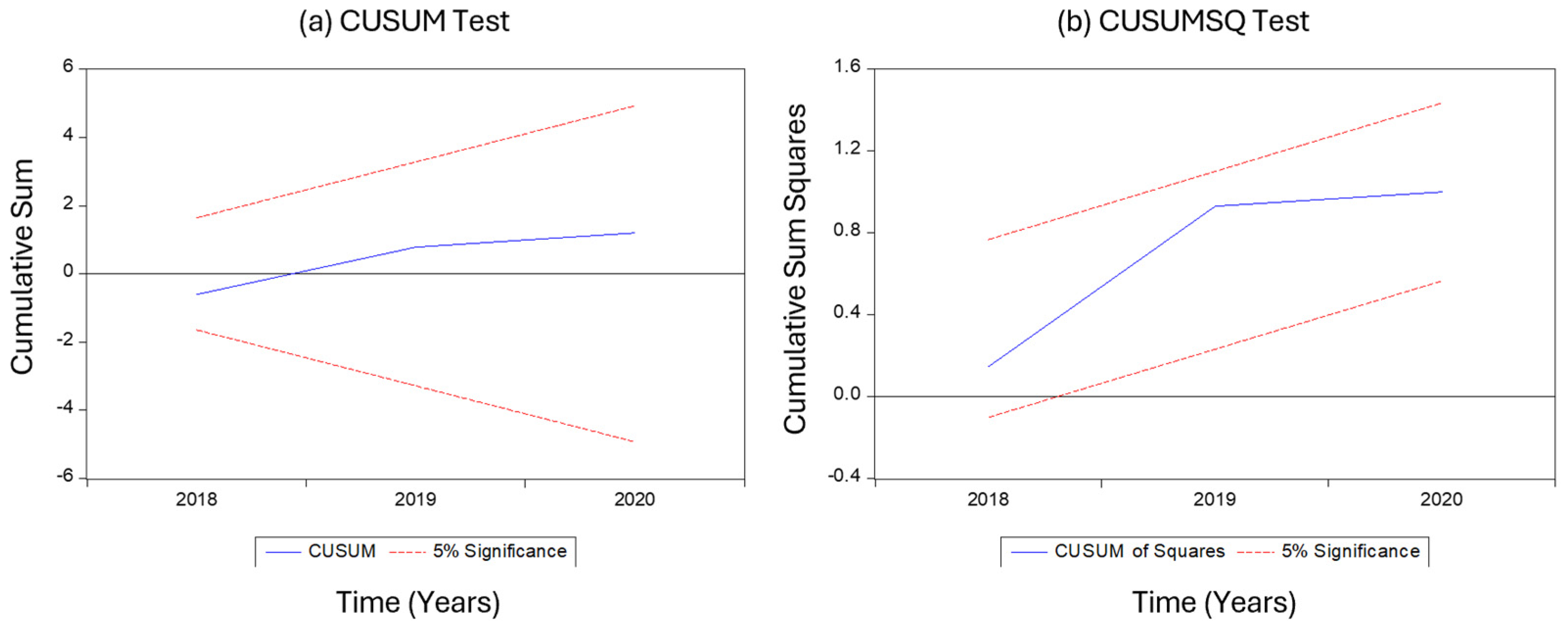
The CUSUM and CUSUMSQ tests were first used to evaluate the model’s stability.
The CUSUM and CUSUMSQ tests are frequently presented in graphic form, as shown in
Figure 1a,b. The validity of the statistic must then be examined under the null hypothesis, which shows the stability of the link curve in an interval (
Brown et al., 1975) defined by two straight lines.
In the context of time-series analysis, stability tests, such as structural change tests, are used to examine the stability of the estimated coefficients in a model and to detect potential structural breaks in the relationships between variables. In this regard, the CUSUM test is employed to assess the stability of the model over time. The results indicate that the CUSUM and CUSUMSQ curves remain within the critical bounds of the 5% confidence interval. This finding suggests that the estimated model is stable and appropriate for evaluating the relationship among the variables considered.
Furthermore, the Dynamic Ordinary Least Squares (DOLS) method was used to assess the robustness of the long-run results.
The findings presented in
Table 8 reveal that the coefficients are not statistically significant, but their signs remain broadly consistent with those obtained from the ARDL model estimation, which provides additional support for the robustness of the results. In general, robustness tests ensure that the key results of the investigation are stable and consistent across various model specifications and techniques.
4.7. Non-Linear Threshold Regression Model Results
Table 9 presents the test results for the presence of the threshold.
Table 9 presents the test results for the presence of a threshold. At the estimated threshold level, the values of SSR, AIC, and BIC are minimized, with the ICT trade threshold estimated at 0.4051 for m = 1.
The main findings of the non-linear Threshold Regression model are presented in
Table 10, with ICT trade acting as the threshold or transition variable. In the low regime, ICT trade has a positive but not statistically significant effect on economic growth, with a coefficient of 3.189. In the high regime, where ICT trade exceeds the 0.4 threshold, the impact on economic growth is positive and significant, with a coefficient of 7.935. Additionally, in regime 1, TI negatively and significantly influences GDP growth, with a coefficient of −0.331. In the second regime, where ICT trade surpasses 0.405, the effect of TI on GDP growth is positive and statistically significant, with a coefficient of 0.018. Also, as shown in the same table, the marginal coefficient for FDI in regime 1 is 0.691, which is positive but not statistically significant for economic growth. However, in regime 2, FDI has a positive and significant impact on economic growth, with a coefficient of 1.694. Concerning PM2.5, the results indicate a negative and statistically significant effect on economic growth in both regimes, with coefficients of −0.066 in the first regime and −0.011 in the second regime.
5. Discussion
The significant positive impact of ICT trade on long-run GDP growth is attributable to the strengthening of innovation activities within higher education institutions and the adoption of imported technologies, which increase patent registrations. These results support Vision 2030, which aims to diversify the country’s economy, reduce its dependence on oil, and develop its infrastructure, particularly in transportation and information and communication technology. These results are consistent with a study by
Soomro et al. (
2022), which shows a positive effect of ICT trade in some BRICS countries. Also,
Alsabhan and Tahir (
2026) indicate a positive link between technology trade openness and economic growth in the long run. Furthermore,
Abdulgahni et al. (
2014) highlighted that Saudi Arabia’s substantial investments in ICT and infrastructure development have contributed to GDP growth.
Alzeer (
2025) found that ICT trade supports organizational performance and promotes economic productivity. According to Towards System-Level Reform through National Skills Strategies (
Alzahrani et al., 2025), investment in this sector creates new job opportunities and enhances competitiveness across Saudi Arabia’s industrial and service sectors. In contrast,
Islam et al. (
2024) reported mixed effects of the ICT sector on economic growth in Saudi Arabia, which may be attributable to a lack of skilled personnel to use this technology.
For the transport infrastructure sector, the negative short-term results have demonstrated the sector’s weakness and its failure to support economic growth. This result is consistent with
Alam et al. (
2021), who indicate that the role of infrastructure is influenced by its efficiency and integration within the economy.
The results also indicate that the impact of FDI on the economy was weak, which may be due to the concentration of foreign investment in the Kingdom in a few capital-intensive sectors with limited capacity for job creation and knowledge transfer, such as oil, gas, and petrochemicals. Additionally, foreign companies in the Kingdom exhibit limited integration with the local economy and supply chains, as they import all their resources and labor from abroad. These factors contribute to weak productivity growth and limited knowledge and technology transfer, thus keeping the impact of FDI secondary. To enhance the contribution of FDI to the Saudi economy, the Kingdom should offer more investment incentives to attract foreign investors in non-oil sectors, including industry, technology, education, and scientific research. In addition, exports should be encouraged, and international exhibitions should be hosted to showcase local products.
Finally, the negative impact of PM2.5 on economic growth stems from Saudi Arabia’s heavy reliance on the oil sector, which has led to increased pollution and adverse effects on human health, thereby increasing healthcare costs and reducing productivity. A World Bank report indicated that pollution costs approximately 4.8% of global GDP.
In addition to the ARDL model results, which showed the existence of short and long-term linear relationships among the variables, the threshold regression model revealed important nonlinear dynamics, indicating that the role of ICT trade in economic growth is linked to a critical level of digital integration.
The threshold findings show that the effect of ICT trade on economic growth is conditional on achieving a specific level of technological advancements. For example, when ICT trade is below the threshold of 0.405, its influence is limited, indicating sectoral unpreparedness. However, once this threshold is exceeded, ICT trade has a positive impact on economic growth, implying that greater digital integration improves productivity and economic performance. The results also show that the effect of transport infrastructure changes with ICT trade levels. In the low regime, when ICT trade falls below a threshold of 0.405, transport infrastructure does not support economic growth, which may indicate a mismatch between infrastructure and technological capabilities. However, in the high regime, when ICT trade reaches the threshold, transport infrastructure becomes positively associated with economic growth, reflecting the complementarity between infrastructure growth and technological advancement. This outcome is consistent with
Calderón and Servén (
2010), who emphasized the importance of infrastructure in supporting productivity and economic performance.
Therefore, transport infrastructure can support economic growth by reducing transaction costs, increasing market efficiency, and facilitating connectivity between production and consumption areas. According to the Ministry of Finance report, the Kingdom of Saudi Arabia’s government spending allocated to the infrastructure and transportation sector in the 2025 budget was approximately SAR 42 billion. This spending was directed toward the overall development of the transportation sector. Developing road, port, airport, and railway networks is intended to improve supply chain efficiency and foster the competitiveness of the national economy, especially in non-oil districts such as tourism, logistics, and industry, which is consistent with the objectives of Saudi Vision 2030 aimed at diversifying the economy (
Chattha et al., 2025). This, in turn, certainly brings sustainable economic growth (
OECD, 2020). Investing in transport infrastructure in Saudi Arabia can be a means of achieving economic growth while simultaneously developing the ICT trade sector.
Furthermore, the results show that FDI is ineffective when ICT trade falls below this threshold, indicating the weak indirect contribution of the digital commerce sector. Once this sector surpasses this threshold, FDI supports economic growth. This explains why improvements in the ICT trade sector enhance FDI participation in economic growth.
Environmental quality (PM2.5 air pollution) does not support economic growth in either regime, demonstrating that particulate matter emissions pose a risk to human health and, consequently, increase healthcare expenditures and reduce productivity. This negative impact of PM2.5 persists even when ICT trade exceeds this threshold. This reflects the fact that improvements in digital capabilities cannot enhance environmental quality unless environmentally friendly technologies are introduced and environmental and economic sustainability in the Kingdom is supported.
6. Conclusions and Policy Implications
The present study examined the relationship between transportation infrastructure, ICT trade, FDI, environmental quality (PM2.5), and economic growth in Saudi Arabia for the period 1990–2023. The results indicate the existence of linear and non-linear relationships, demonstrating the complexity of growth dynamics in a changing economy.
The findings indicate that ICT trade contributes to economic growth, particularly in the long term, consistent with endogenous growth theory, which posits that technological progress, innovation, and knowledge dissemination drive economic development. However, the results also show that the role of ICT trade in economic growth is not automatic but rather contingent on the degree of technological progress and the capacity for adaptation. Furthermore, the results of the nonlinear threshold regression model revealed that the effect of ICT trade on economic growth becomes positive only after a certain threshold is crossed.
Furthermore, the findings suggest that the role of transportation infrastructure and FDI depends on the level of technological advancement, indicating that coordination among digitalization, investment, and infrastructure is necessary to promote sustainable economic development. However, the continued adverse effects of PM2.5 underscore the importance of transitioning toward environmental sustainability to support economic development.
Based on the results of this study, sensible policy recommendations are proposed. Firstly, the focus should be on strengthening the ICT trade sector through digital exports, the development of digital infrastructure, the introduction of advanced technologies, and their adoption across sectors to exceed the expected threshold and thereby enhance the Kingdom’s economic growth. Secondly, the study recommends developing transport infrastructure, improving investment efficiency, and implementing large-scale, high-quality projects that serve other sectors and foster an environment conducive to attracting foreign investment in sectors capable of generating new job opportunities, thereby supporting economic growth. Finally, the environmental dimension must be addressed by maintaining a balance between increased investment in environmentally friendly projects and economic development.
Like any human effort, this study, regardless of its results, has limitations and is subject to critique. For instance, it focused on just one country and involved a relatively small sample size, which could restrict how broadly the findings apply. Additionally, it did not include many common variables, such as human capital, institutional quality, and trade openness.
This critique could open new avenues for future research. For example, expanding the scope of the research to include countries like the Gulf Cooperation Council (GCC) states or nations in the Middle East and North Africa (MENA) region could enhance the robustness and generalizability of the results by adding more variables and employing new techniques.