1. Introduction
The Bitcoin market has emerged as a significant component of the global financial system, capturing the interest of retail and institutional investors alike. Since its launch in 2008 by the pseudonymous Satoshi Nakamoto, Bitcoin has evolved from a niche digital currency into the dominant cryptocurrency by market capitalisation, holding over 50% of the market share as of early 2021 (
Statista, 2024). Its growing adoption, decentralised nature, and independence from central banks have positioned it as both a speculative investment and an alternative store of value.
Bitcoin operates on a decentralised blockchain network and is not backed by physical assets or government guarantees. Its security is ensured by cryptographic protocols, in which users rely on public and private keys to validate transactions (
De Filippi & Loveluck, 2016). Unlike traditional currencies, Bitcoin is not subject to government control, regulation, or oversight, contributing to its pronounced price volatility. Its peer-to-peer structure enables low-cost global transactions and is independent of traditional banking systems. However, this operational freedom also introduces risks, as seen in early exchange failures such as Mt. Gox (
Brito et al., 2014) and the lack of consumer protection on unregulated trading platforms (
Bryans, 2014). Bitcoin exhibits several well-documented stylised facts, including high volatility, clustering volatility, and heavy-tailed return distributions (
Baur et al., 2018;
Corbet et al., 2018). These characteristics set cryptocurrency markets apart from traditional financial assets and underscore their distinct risk-return profile (
Phillip et al., 2018).
Bitcoin’s high volatility, global adoption, and technological foundation set it apart from traditional financial assets. These attributes make it particularly sensitive to macroeconomic shocks, such as the COVID-19 pandemic. Beginning in early 2020, the pandemic disrupted economies worldwide, prompting government interventions through economic lockdowns and other measures, fiscal stimulus packages, and shifts in investor sentiment. These developments impacted the informational efficiency of cryptocurrency markets. Thus, understanding how Bitcoin returns were affected during and after this period is crucial.
This study first employs the Variance Ratio (VR) test to formally assess weak-form market efficiency by examining whether Bitcoin returns follow a random walk. The VR test directly evaluates return independence and serves as the primary statistical tool for determining whether past price information can predict future returns. To complement this efficiency assessment, the study further employs Interrupted Time Series (ITS) analysis, a technique commonly used in epidemiology and public policy but less frequently applied in financial research, to investigate potential structural shifts in daily Bitcoin returns around the COVID-19 pandemic. ITS is particularly useful for evaluating the effects of global, time-specific interventions by detecting both immediate level changes and longer-term trend adjustments (
Chaudhuri & Carillo, 2023). In this context, the COVID-19 pandemic is treated as an exogenous intervention that may have influenced return behaviour in the Bitcoin market, thereby dividing the time series into pre- and post-intervention periods for structural comparison.
In modelling the underlying time-series dynamics and evaluating changes in return patterns, the ITS framework is applied within the
Box and Jenkins (
1970) methodology. This approach enables modelling of autocorrelation structures and improves inference robustness by accounting for serial dependencies. The ITS, in the context of the Box-Jenkins methods, offers a rigorous basis for identifying shifts in return behaviour and assessing market responses to the pandemic.
This research aims to determine whether the Efficient Market Hypothesis (EMH) applies to daily Bitcoin returns and to examine if the market’s informational efficiency was affected during the pre- and post-COVID-19 periods. The study tests weak-form efficiency using a time-series framework to identify structural and behavioural changes induced by a major global shock. Testing the semi-strong and strong-form efficiency presents challenges because isolating the market’s response to public announcements and events (semi-strong form) is difficult, and accessing private or insider information necessary to assess strong-form efficiency is often unavailable.
Unlike traditional econometric approaches such as GARCH or purely fundamental time-series analysis, the Interrupted Time Series (ITS) framework allows simultaneous estimation of level and trend changes following a clearly defined exogenous shock, while constructing a counterfactual trajectory based on pre-intervention dynamics (
Bernal et al., 2017). Its application in economic and financial crisis contexts has demonstrated strong potential for identifying dynamic policy effects and market responses, offering a more transparent and interpretable framework than volatility-focused models such as GARCH (
Nakatani & Teräsvirta, 2009). However, modelling conditional variance dynamics (e.g., GARCH) is not the primary objective of this study; instead, the analysis focuses on return predictability and structural breaks in the conditional mean process rather than volatility forecasting.
The integration of VR and ITS with the Box–Jenkins methodology further strengthens the analytical framework. ITS facilitates the identification of structural changes associated with external interventions, while Box–Jenkins techniques, implemented through ARIMA models, provide a rigorous treatment of autocorrelation and time-series dependence. Together, these methods offer a coherent and statistically robust approach to examining market efficiency and return behaviour during periods of disruption, including the COVID-19 pandemic.
Despite a growing literature on Bitcoin market efficiency, there remains limited consensus on whether major global shocks fundamentally alter weak-form efficiency or instead induce temporary deviations driven by heightened volatility. While prior studies frequently document increased volatility and abnormal returns during crisis periods, evidence regarding the persistence and structural nature of efficiency changes remains inconclusive.
This study examines the informational efficiency of daily Bitcoin returns and the impact of the COVID-19 pandemic on market behaviour. The analysis focuses on two main objectives: assessing weak-form market efficiency over the full sample period and evaluating the transitory versus persistent effects of major shocks on return dynamics.
Research Objectives
To assess whether daily Bitcoin returns exhibit weak-form market efficiency, with particular emphasis on the random walk hypothesis over the full sample period (January 2013–February 2026).
To determine whether the COVID-19 pandemic caused persistent structural changes in Bitcoin return dynamics, or whether any observed effects were transitory disturbances, using Interrupted Time Series (ITS) and ARIMAX intervention models.
Research Questions
Do daily Bitcoin returns follow a random walk, consistent with weak-form market efficiency, over the full sample period?
Did the COVID-19 pandemic induce structural shifts in Bitcoin return dynamics, or did the market absorb the shock without generating persistent inefficiencies?
Research Hypotheses
H1: Daily Bitcoin returns follow a random walk and therefore exhibit weak-form market efficiency.
H2: The COVID-19 pandemic did not generate persistent structural inefficiencies in daily Bitcoin returns.
These objectives and hypotheses guide subsequent analyses using the Variance Ratio (VR) test and ITS, combined with ARIMA-based modelling, allowing for a robust evaluation of market efficiency and the structural effects of the COVID-19 pandemic on Bitcoin returns.
The central premise of the paper is that large exogenous shocks may amplify volatility without necessarily violating market efficiency. By employing a combined ITS and ARIMA-based random walk framework, the study aims to distinguish transitory market disturbances from structural inefficiencies, while explicitly linking pandemic-related shocks to the theoretical implications of the Efficient Market Hypothesis (EMH).
This study contributes to the literature in three ways. First, it extends the application of ITS to cryptocurrency markets, providing a structured framework for evaluating the effects of global shocks on market efficiency rather than focusing solely on volatility. Second, it integrates ITS with ARIMA-based random-walk tests, thereby strengthening the empirical connection between structural interventions and the theoretical foundations of the EMH. Third, it offers a systematic examination of Bitcoin market behaviour during an unprecedented global disruption, thereby contributing to ongoing debates on the maturity and informational efficiency of cryptocurrency markets.
3. Methodology
This study adopts a multi-stage empirical strategy to assess both weak-form market efficiency and potential structural changes associated with the COVID-19 pandemic. The analysis begins with the Variance Ratio (VR) test proposed by
Lo and MacKinlay (
1988) to directly evaluate the random walk hypothesis, before proceeding to structural break analysis using Interrupted Time Series (ITS) and ARIMAX modelling.
An Interrupted Time Series (ITS) analysis is employed to investigate structural changes in daily Bitcoin returns surrounding the COVID-19 pandemic. ITS is well-suited for assessing the effects of clearly defined, time-bound interventions on financial time series, making it appropriate for capturing potential shifts in return behaviour associated with the pandemic.
The COVID-19 pandemic represents a clearly identifiable, exogenous shock that simultaneously affected global financial markets, thereby satisfying a key requirement of ITS analysis (
Bernal et al., 2017). Unlike simple pre-post comparisons or volatility-based approaches, the ITS framework explicitly models both immediate level changes and longer-term trend adjustments, allowing for a more nuanced assessment of how markets respond and adapt over time.
In the context of market efficiency, ITS facilitates constructing a counterfactual return path based on pre-intervention dynamics. This enables an evaluation of whether post-pandemic return behaviour deviates meaningfully from what would have been expected in the absence of the COVID-19 shock. Importantly, ITS is used to detect structural breaks in return dynamics and does not, by itself, constitute a test of market efficiency.
To model the underlying time series dynamics within the ITS framework, the
Box and Jenkins (
1970) methodology, a well-established approach for identifying and estimating suitable ARIMA models, is employed. An ARIMAX specification incorporating COVID-19 intervention variables is then estimated to control for autoregressive and moving average components while testing the statistical significance of pandemic-related effects on Bitcoin returns.
3.1. Tests for Weak-Form Market Efficiency
To complement the structural break analysis, weak-form market efficiency is examined using established random walk tests. According to
Fama (
1970), a market is weak-form efficient if current asset prices fully reflect all information contained in past prices. Under this framework, returns should follow a martingale difference sequence, implying that price changes are unpredictable based on historical information. The weak-form efficiency condition can be expressed as
where
denotes the return at time
, and
represents the information set available at the time
. The martingale difference condition does not require returns to follow a strict random walk with independent and identically distributed increments. Weak-form efficiency allows for time-varying volatility, conditional heteroskedasticity, and predictable risk premiums, provided that such predictability does not produce abnormal risk-adjusted profits. Thus, a random walk is sufficient but not necessary for weak-form efficiency. This study uses the random walk hypothesis as a practical benchmark for testing return independence, not as a full definition of market efficiency.
Under the strict random walk model, returns are independently and identically distributed with constant variance. However, within the broader martingale framework consistent with weak-form efficiency, returns may exhibit changing conditional variance (e.g., volatility clustering) without violating efficiency, as long as the conditional mean remains unpredictable given past price information.
To test the random walk hypothesis, the Variance Ratio (
VR) test proposed by
Lo and MacKinlay (
1988) is used. The test is based on the property that, under a random walk, the variance of
-period returns should be equal to
times the variance of one-period returns. The variance ratio is defined as
Under the null hypothesis of a random walk, . If , returns exhibit serial correlation. A rejection of the random walk hypothesis indicates linear serial dependence in returns, which may be inconsistent with weak-form efficiency if economically exploitable. However, failure to reject the random-walk null is interpreted as evidence consistent with weak-form efficiency in its return-independence dimension, while recognising that efficiency is ultimately a joint hypothesis involving both return dynamics and equilibrium asset-pricing considerations.
The null and alternative hypotheses are, therefore,
H0: (Random walk with constant expected returns),
H1: (Serial dependence; potential deviation from weak-form efficiency).
3.2. Segmented Regression Under Interrupted Time Series (ITS) Analysis
To formally evaluate the impact of the COVID-19 pandemic on Bitcoin return dynamics, we implement a segmented regression within an Interrupted Time Series (ITS) framework. ITS allows for the estimation of both immediate (level) and gradual (trend) structural changes following an exogenous intervention.
The model specification is
where
denotes the daily Bitcoin returns at time
;
represents a continuous time trend from the beginning of the sample;
is a dummy variable equal to 0 for the pre-COVID period and 1 for the post-COVID period;
captures the post-intervention slope change;
is the error term.
To account for potential heteroskedasticity and serial correlation in daily financial returns, Newey–West heteroskedasticity-and autocorrelation-consistent (HAC) standard errors are used in statistical inference.
3.3. Structural Break Timing and Causality
Following standard interrupted time-series (ITS) methodology, the structural break is specified a priori on 31 March 2020, corresponding to the onset of the global COVID-19 pandemic (
Bernal et al., 2017;
Wagner et al., 2002).
The break date is fixed ex ante to avoid data-driven selection and preserve causal interpretation. Daily Bitcoin returns are divided into pre- and post-intervention periods relative to this fixed break. While subsequent events (e.g., the 2021 bull market and regulatory developments) also affected Bitcoin prices, the ITS framework isolates structural changes specifically linked to the onset of the pandemic.
3.4. ARIMAX Modelling Within the ITS Framework
To account for potential serial dependence in Bitcoin returns while simultaneously estimating the impact of the COVID-19 intervention, the segmented ITS regression is extended to an autoregressive integrated moving average (ARIMA) model with exogenous regressors (ARIMAX). This specification allows the deterministic intervention components to enter the conditional mean equation while modelling the stochastic error structure dynamically. Let
denote daily Bitcoin log returns. The ARIMAX (
) model is specified as
where
is the unconditional mean return,
are autoregressive parameters,
are moving-average parameters,
is a post-COVID dummy variable,
captures the change in slope after the intervention,
measures the immediate level shift,
measures the post-intervention trend change,
is a white noise innovation. Because the analysis is conducted on log returns rather than price levels, the series is stationary by construction; therefore, the differencing parameter
, and the model reduces to an ARMA process with exogenous regressors. Model orders
and
are selected using inspection of ACF and PACF plots. The AIC is used for model selection. Residual diagnostics, including the Ljung–Box test, are applied to ensure that remaining serial correlation is adequately filtered. The ARIMAX model nests the baseline ITS regression as the restricted case with
. The coefficients
and
therefore retain their interpretation as level and slope shifts but are estimated while controlling for autoregressive dynamics.
4. Results
4.1. Data
Daily Bitcoin data from
https://za.investing.com/crypto/Bitcoin/historical-data (accessed on 1 March 2026), covering 1 January 2013 to 27 February 2026, are used. The analysis is conducted exclusively at the daily frequency to preserve short-run return dynamics and volatility clustering that are central to financial time-series modelling and tests of weak-form efficiency. Bitcoin is employed as a representative large-cap cryptocurrency; however, the findings are explicitly limited to Bitcoin and are not generalised to the entire cryptocurrency market.
The use of daily data is particularly appropriate in cryptocurrency markets, where return dependence and volatility clustering are most pronounced at higher frequencies. Prior studies document that Bitcoin returns exhibit substantial volatility, structural breaks, and speculative dynamics (
Baur et al., 2018). Volatility clustering and conditional heteroskedasticity are well-established features of Bitcoin returns (
Katsiampa, 2017), and weak-form efficiency has primarily been examined using daily data (
Urquhart, 2016;
Bariviera, 2017). Aggregating to lower frequencies may attenuate economically meaningful autocorrelation patterns and obscure short-term market dynamics.
Bitcoin prices exhibit non-stationarity, as is typical for financial asset prices. Following standard practice in financial econometrics, prices are transformed into continuously compounded (log) returns to remove stochastic trends and stabilise variance (
Campbell et al., 1997;
Tsay, 2010). Log returns are more statistically tractable than raw prices and are consistent with the empirical framework used in tests of weak-form market efficiency (
Fama, 1970).
The formula for calculating log returns is
where
is the Bitcoin price at the time
and
represents the Bitcoin price at the time
.
4.2. Descriptive Statistics
The summary statistics for the daily Bitcoin prices
and the daily Bitcoin returns
are shown in
Table 1.
Bitcoin price data () exhibits substantial growth and dispersion over the sample period, ranging from $13.30 to $124,725.10. The average price of $24,046.98, alongside a high standard deviation of $31,290.64, indicates pronounced variability around the mean. Positive skewness (1.44) reflects occasional extreme price surges, while the relatively low kurtosis (1.08) suggests the price distribution is moderately flatter than a normal distribution.
Bitcoin returns () capture the high-frequency fluctuations typical of cryptocurrency markets, ranging from −0.85 to 1.47. The mean return of 0.00 indicates a roughly neutral average return over the entire period. Returns exhibit pronounced volatility (standard deviation = 0.05), strong positive skewness (4.63), and extremely high kurtosis (199.66), consistent with leptokurtic behaviour. This distribution implies a heavy tail and a heightened likelihood of extreme positive or negative returns, reflecting the well-known episodic surges and crashes in the Bitcoin market.
4.3. Bitcoin Returns Time Series Plot
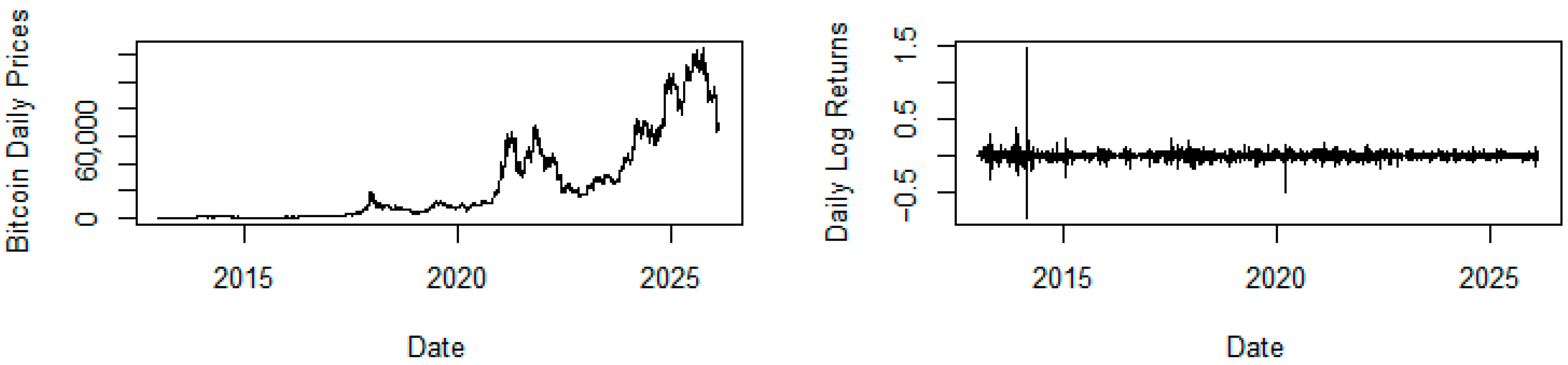
Figure 1 illustrates the historical daily Bitcoin price and return movements from 1 January 2013 to 27 February 2026, before transforming Bitcoin prices into log returns.
Bitcoin prices show a long-term upward trajectory with pronounced volatility throughout the sample period. Major price surges occurred during 2017–2018, 2020–2021, and 2023–2025, reflecting the asset’s cyclical boom–bust behaviour. The upward trend post-March 2020 aligns with the global onset of the COVID-19 pandemic. It may be linked to heightened investor demand for alternative assets, concerns over fiat currency devaluation, expansionary monetary policies, and increased institutional adoption of Bitcoin as a store of value.
Daily returns exhibit substantial variability, with several notable spikes visible in the series. February 2014 shows both a significant upward and downward spike, reflecting market reactions to the collapse of Mt. Gox, which suspended withdrawals and later declared bankruptcy, generating severe market uncertainty (
Baur et al., 2018). Another pronounced downward spike occurs in March 2020, coinciding with the COVID-19 market shock and widespread financial turmoil. These spikes illustrate episodic structural shocks superimposed on an otherwise highly volatile, largely unpredictable return series.
4.4. Weak-Form Market Efficiency Results
The Variance Ratio (VR) Test, as proposed by
Lo and MacKinlay (
1988), was employed to test the random walk hypothesis for Bitcoin returns. This test evaluates whether the variance of k-period returns equals k times the variance of one-period returns. If the returns follow a random walk, the variance ratio should be close to 1. Deviations from 1 suggest serial correlation, and thus inefficiency in the market. The M1 and M2 statistics were used for this analysis as they are robust to heteroskedasticity.
Table 2 presents the findings.
The results in
Table 2 suggest that daily Bitcoin returns generally follow a random walk across various holding periods. The VR(k) values are close to 1 for most periods, indicating weak-form market efficiency, in which returns are unpredictable and exhibit no significant serial correlation. Although some deviations from 1 are observed at certain lags (e.g., k = 5, k = 50, and k = 100), these are not substantial enough to reject the random walk hypothesis. The M1 and M2 statistics, which are robust to heteroskedasticity, show no significant values beyond the critical threshold of ±1.96, supporting the conclusion that daily Bitcoin returns do not exhibit predictable trends across the tested aggregation horizons. The results indicate that Bitcoin returns are consistent with weak-form efficiency, in which historical returns do not provide reliable information for predicting future movements.
4.5. Scatter Plots
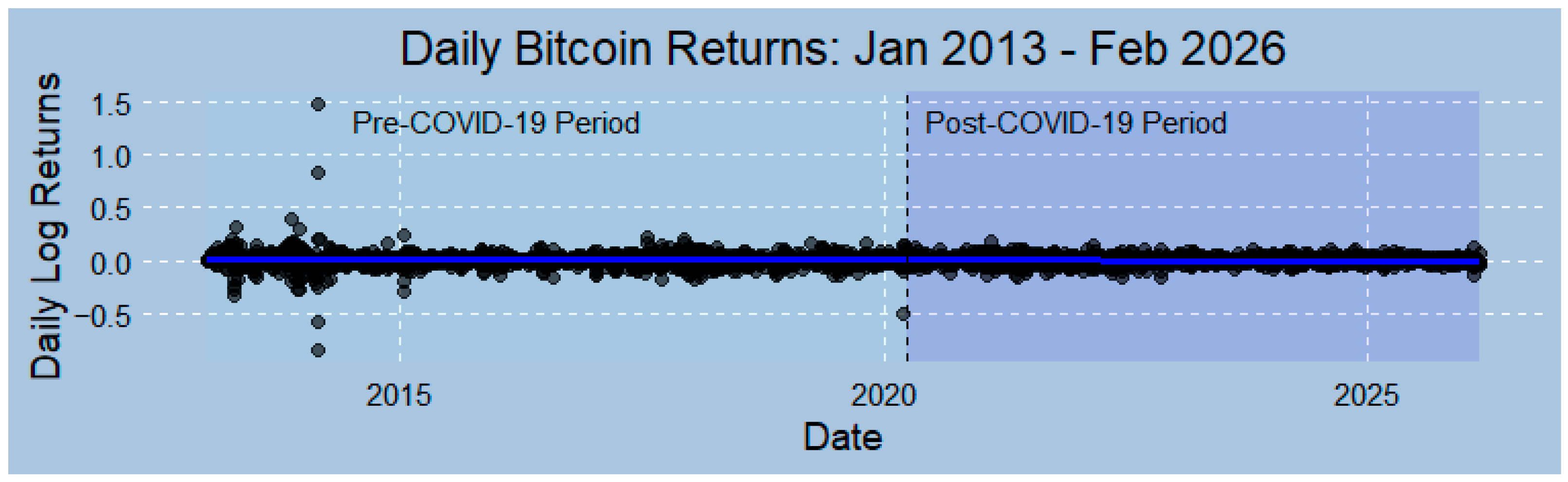
To visually examine potential changes in daily Bitcoin return behaviour, scatter plots were generated for two distinct periods: 1 January 2013 to 31 March 2020 (pre-COVID-19 period) and 1 April 2020 to 27 February 2026 (post-COVID-19 period). The post-COVID period encompasses the entire COVID-19 era, including immediate market reactions, subsequent recovery, and later pandemic-related developments in the cryptocurrency market. This division, based on the structural break identified in March 2020, facilitates an ITS analysis to assess whether the pandemic had a measurable impact on Bitcoin returns.
Figure 2 presents the results.
Figure 2 displays daily Bitcoin log returns from January 2013 to February 2026, with individual returns represented by black dots and linear trends for the pre- and post-COVID-19 periods indicated by blue lines. A vertical dashed line marks the structural break on 31 March 2020, separating the two periods. While the pre-pandemic phase shows higher volatility with pronounced positive and negative returns, the post-pandemic period appears more stable, though volatility remains inherent. The lack of an abrupt level shift at the breakpoint and the gradual change in trend slope suggest that Bitcoin returns did not experience a sudden disruption but rather a gradual adjustment following the onset of the pandemic. The figure highlights the enduring volatility of Bitcoin returns while suggesting a subtle stabilisation post-COVID-19.
4.6. Interrupted Time Series (ITS) Estimation
To formally assess the potential impact of the COVID-19 pandemic on daily Bitcoin returns, the segmented regression ITS model was estimated. The model allows for the evaluation of both an immediate level change and a change in slope following the pandemic breakpoint in March 2020. Newey–West (HAC) robust standard errors were used to account for potential autocorrelation and heteroskedasticity in the daily returns.
Table 3 presents the ITS parameters.
The results indicate no statistically significant immediate change in daily returns following the onset of the pandemic (β2, p = 0.691), nor in the slope of returns thereafter (β3, p = 0.781). The pre-pandemic time trend (β1) is also not significant (p = 0.200), reflecting Bitcoin’s volatile yet largely unpredictable return dynamics. The joint test for structural break significance (β2 = β3 = 0) fails to reject the null hypothesis (F = 1.04, p = 0.354), further supporting the absence of a detectable structural change in daily returns due to COVID-19.
Residual diagnostics reveal significant autocorrelation (Ljung–Box test, p < 0.001) and strong deviations from normality (Shapiro–Wilk test, p < 0.001), indicating model residuals are not white noise and display non-normality. Moreover, volatility clustering is confirmed by significant ARCH effects (as documented in earlier volatility analyses), justifying the use of ARIMAX modelling to appropriately account for autocorrelation and conditional heteroskedasticity when estimating intervention effects.
The ITS analysis suggests that daily Bitcoin returns did not experience a statistically significant structural shift attributable to the COVID-19 pandemic, consistent with the asset’s inherently volatile and complex market behaviour. The ITS equation is expressed as
4.7. ARIMAX Model with Intervention Variables
Following the ITS analysis, which failed to detect a statistically significant structural break in daily Bitcoin returns due to the COVID-19 pandemic, the analysis is extended by fitting an ARIMAX model. The ARIMAX model explicitly accounts for time-series autocorrelation and volatility clustering, which were identified as significant in the ITS model’s residual diagnostics.
The Augmented Dickey–Fuller (ADF) test results support the assumption that Bitcoin daily returns are stationary and do not exhibit a unit root (
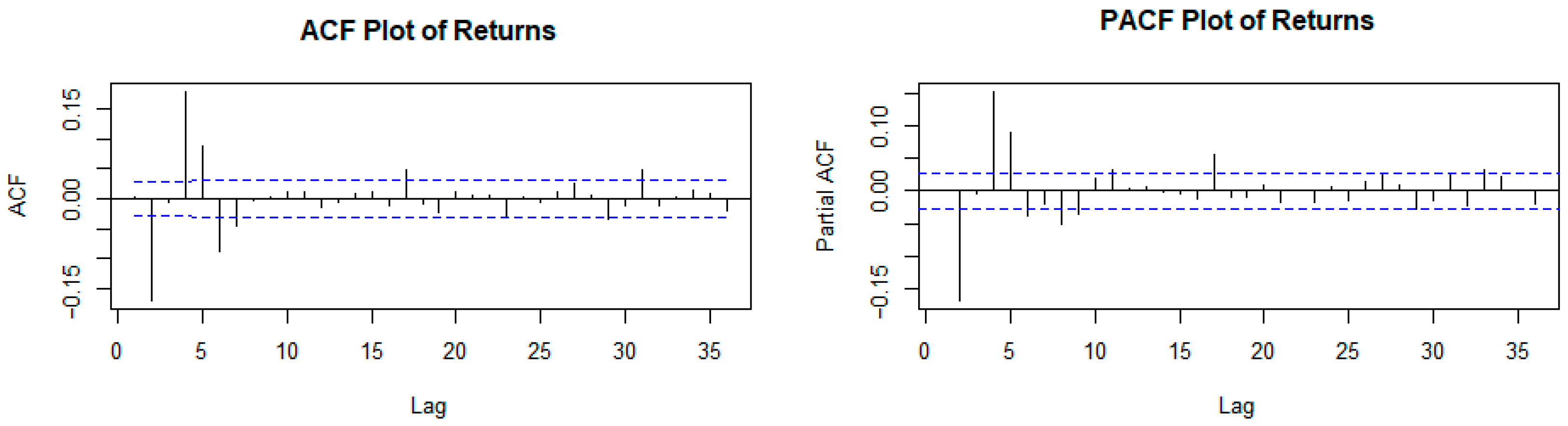
p < 0.001). The ACF and PACF plots are shown in
Figure 3 to determine the proposed model for daily Bitcoin returns.
The ACF and PACF plots suggest an ARIMA (0, 0, 0) model as the tentative model for the daily returns. The EACF plot is presented in
Table 4 to confirm the suggested models.
The EACF analysis indicated that an ARIMA (0, 0, 7) model is appropriate for modelling Bitcoin daily returns. To ensure robustness, this model is compared with alternative ARIMA models to assess the risk of overfitting. Model selection criteria, specifically the AIC, were employed to identify the most suitable model. The AIC values for various fitted models are presented in
Table 5.
Among the baseline models, the ARIMA (0, 0, 7) model with a non-zero mean showed better performance on daily returns, as evidenced by its lower AIC values.
Table 6 provides detailed model parameters estimated using maximum likelihood.
The ARIMAX (0, 0, 7) model results indicate that the COVID-19 pandemic’s intervention did not have a statistically significant impact on daily Bitcoin returns. The coefficient for the COVID dummy () is 0.0046898 (p = 0.4501), and the interaction term () has a coefficient of −0.0000016 (p = 0.9119), both of which are not significant. This suggests that, after accounting for autoregressive dynamics, the pandemic did not cause a measurable shift in the returns.
In contrast, the MA terms at lags 2, 4, 5, 6, and 7 were significant (p < 0.001), indicating that past error terms at these lags significantly influence current returns. Significant MA coefficients indicate short-term dependencies in shocks, reflecting temporary reversals or corrections rather than exploitable trends. The 7-day lag likely captures weekly trading cycles in cryptocurrency markets: although Bitcoin trades continuously, investor behaviour often follows calendar regularities linked to settlement cycles, liquidity patterns, and weekend–weekday differences in trading volume. This structure suggests that shocks dissipate over approximately one trading week, influencing immediate price adjustments without creating systematic predictability over longer horizons. Thus, the significant MA terms reflect transient shock propagation and gradual information absorption, consistent with short-term market dynamics rather than a violation of weak-form efficiency.
These results are consistent with the ITS analysis, where the coefficients for the level shift (β2 = 0.00205, p = 0.691) and slope change (β3 = 0.00000057, p = 0.781) were also not significant, further supporting the finding that there was no structural shift in Bitcoin’s return dynamics following the pandemic. The time trend (β1 = −0.0000023, p = 0.200) was also insignificant, confirming the volatile but largely unpredictable nature of Bitcoin returns. The ARIMAX residual diagnostics revealed insignificant autocorrelation (Ljung–Box test, p = 0.9961), and the Shapiro–Wilk test indicated that model residuals were white noise.
From the results of the ARIMAX (0, 0, 7) model, we have the following equation:
This expression represents the logarithmic return dynamics of Bitcoin, accounting for intervention variables, moving-average processes, and the dependence of current returns on past shocks. The significant MA terms capture short-term shock propagation and potential weekly cyclical effects without contradicting the overall unpredictability of returns over longer horizons.
5. Discussion
A key distinction in financial economics is that heightened volatility does not automatically imply market inefficiency. Market efficiency, as outlined by
Fama (
1991), concerns the predictability of asset prices and the ability to generate abnormal returns using past information, whereas volatility reflects the magnitude of price fluctuations. During periods of high volatility, such as the COVID-19 pandemic, markets may experience significant price swings amid heightened uncertainty. However, the critical question remains whether these fluctuations introduce systematic predictability into returns.
The findings of this study suggest that, at the daily frequency, Bitcoin returns behave as a white noise process, meaning there is no detectable pattern or predictability in returns. This result indicates that while COVID-19 significantly increased uncertainty and trading activity, it did not create discernible linear predictability in Bitcoin’s returns. This observation is consistent with
Fama’s (
1991) definition of weak-form market efficiency, which posits that asset prices already incorporate all available past information, making it impossible to predict future returns from historical price data.
The results from the Variance Ratio (VR) test further support this conclusion. The test indicates that Bitcoin returns follow a random walk, meaning that price movements over time are independent and exhibit no serial correlation. This is consistent with the concept of weak-form efficiency, where the presence of a random walk implies that past price information is already reflected in the current price, and therefore no predictable patterns can be extracted (
Lo, 2004;
Lo & MacKinlay, 1988). The lack of significant serial correlations suggests that, even during the COVID-19 crisis, Bitcoin’s price movements remained unpredictable at the daily level.
Further support comes from the Interrupted Time Series (ITS) analysis, where the level shift and slope change parameters also failed to show statistically significant changes. These findings reinforce the notion that the pandemic did not introduce lasting changes in the underlying dynamics of Bitcoin’s return series. Notably, the significant MA (Moving Average) terms at lags 2, 4, 5, 6, and 7 suggest that past error terms continue to exert a substantial influence on current returns. This indicates that while Bitcoin’s returns are not predictable at the daily frequency, past errors (or shocks) continue to affect its price. However, this influence does not introduce a clear, exploitable pattern.
Additionally, the ARIMAX (0, 0, 7) analysis found no statistically significant impact of the COVID-19 pandemic on Bitcoin returns. Both the COVID dummy variable and the interaction term were found to be statistically insignificant, implying that after controlling for autoregressive dynamics, there was no meaningful structural break in Bitcoin’s return patterns during the pandemic. This finding is consistent with
Takaishi (
2025), who shows that the COVID-19 crisis did not fundamentally alter the efficiency or return behaviour of Bitcoin even as market volatility increased. It was observed that, despite heightened volatility, Bitcoin’s return process remained consistent with weak-form efficiency.
While the COVID-19 pandemic undeniably led to increased volatility and uncertainty in financial markets, it did not induce predictable patterns in Bitcoin returns. The results suggest that, even amidst these turbulent conditions, Bitcoin’s market continued to exhibit weak-form efficiency at the daily level. As the literature has shown (e.g.,
Fama, 1991;
Lo, 2004;
Takaishi, 2025), volatility does not necessarily imply inefficiency, and this study’s findings further contribute to the understanding of how Bitcoin’s market reacts under stress.
6. Conclusions
This study investigated whether the COVID-19 pandemic affected Bitcoin’s market efficiency using multiple complementary methodologies, including Interrupted Time Series (ITS) analysis, ARIMAX modelling with intervention variables, and Variance Ratio (VR) tests. With these approaches, the study assessed both structural shifts and return predictability within the weak-form efficiency framework.
The VR test results indicated that Bitcoin returns follow a random walk process. The VR statistics were close to unity across multiple holding periods, supporting the weak-form efficiency hypothesis. Furthermore, the M2 test statistics did not exceed the critical bounds of ±1.96, meaning the null hypothesis of a random walk could not be rejected. This suggests that Bitcoin returns at the daily frequency are not predictable using historical price information. These findings are consistent with the theoretical expectation that in weak-form efficient markets, successive price changes are independent and identically distributed.
The ITS analysis found no statistically significant structural shift in daily Bitcoin returns following the outbreak of COVID-19. Both the COVID dummy variable and the interaction (slope change) term were statistically insignificant. This indicates that the pandemic did not introduce a persistent change in the level or trend of Bitcoin returns. The ARIMAX (0, 0, 7) model confirmed these results, showing no measurable impact of COVID-19 on return dynamics after controlling for autoregressive and moving average components. The Ljung–Box Q-statistic indicated no remaining autocorrelation in the residuals, while the Shapiro–Wilk test results suggested that residuals behaved as white noise. Together, these diagnostic checks confirm the adequacy and robustness of the specified model.
Importantly, although the pandemic period was characterised by heightened volatility and uncertainty, increased volatility alone does not imply market inefficiency. Efficiency concerns predictability rather than the magnitude of price movements. The findings therefore suggest that while COVID-19 amplified volatility in Bitcoin markets, it did not generate exploitable return predictability at the daily frequency. Thus, the market rapidly absorbed pandemic-related information, maintaining weak-form efficiency despite turbulent conditions.
The results contribute to the growing body of literature suggesting that Bitcoin markets exhibit weak-form efficiency, particularly at higher frequencies. The absence of predictable return patterns during an unprecedented global shock strengthens the argument that Bitcoin markets, despite being relatively young and decentralised, may process information efficiently under stress.
Future research could extend this analysis by employing volatility-focused models, such as GARCH-type frameworks, to model time-varying volatility explicitly, or by employing machine learning techniques that detect nonlinear dependencies and regime shifts. Such approaches may uncover higher-order dynamics or conditional inefficiencies not observable within linear daily return models. Additionally, examining intraday data could provide further insights into whether efficiency holds at higher sampling frequencies during crisis periods.