Article

How Can New Quality Productive Forces Reshape the Industrial Landscape?—The Dual Enabling Effects of Factor Endowments and Synergies

1
School of Economics and Business Administration, Chongqing University, Chongqing 400044, China
2
Guangdong Provincial Key Laboratory of Silviculture Protection and Utilization, Guangdong Academy of Forestry, Guangzhou 510520, China
*
Author to whom correspondence should be addressed.
These authors contributed equally to this work.
Economies 2026, 14(3), 83; https://doi.org/10.3390/economies14030083
Submission received: 8 February 2026 / Revised: 2 March 2026 / Accepted: 3 March 2026 / Published: 6 March 2026

Abstract

China’s economy has shifted from high-speed development to high-quality development as the marginal benefits of the traditional growth model decline. This study explores how new quality productive forces (NQPFs) drive industrial structure upgrading via factor endowment upgrading and factor synergy, with the goal of addressing development bottlenecks. Using 2013–2024 provincial panel data, NQPFs are measured through the entropy weight-TOPSIS method (factor endowment upgrading) and a coupled coordination model (factor synergy), integrated into a comprehensive index, and analyzed via two-stage least squares (2SLS) regression. The empirical results show that China’s NQPFs are in their initial stage, with factors still in the process of accumulation and adaptation. NQPFs significantly promote industrial structure advancement and rationalization, with factor synergy outperforming factor endowment upgrading. Its promotion of advancement is universal, but its impact on rationalization is regionally heterogeneous, with inadequate transmission in underdeveloped and high-environmental-regulation provinces and ineffective dual mechanisms in manufacturing-led provinces. Notably, the driving effect of NQPFs on manufacturing upgrading is stronger than that on services. This study provides guidance for NQPF cultivation and contributes to the theory and Chinese practice of industrial structure upgrading from a dual-factor perspective.

1. Introduction

At present, China’s economy is undergoing a critical transition from high-speed growth to high-quality development, thus making industrial restructuring imperative. Domestically, China’s industrial structure has long been characterized by structural imbalances. According to data from China’s National Bureau of Statistics, 2024 Chinese manufacturing value added accounted for 24.9% of GDP—its share has ranked globally for 15 straight years. However, high-technology manufacturing value added makes up just 18.5% of total manufacturing, far below the levels of Germany and the U.S., indicating insufficient competitiveness in core technologies and high-end segments. Separately, 2024 productive services accounted for 52.9% of total service output, notably lagging behind the average of developed countries (J. Zhao & Tang, 2018; T. Zheng et al., 2019). Internationally, the reconstruction of global value chains is accelerating. Developed countries erect technical barriers through strategies such as technological blockades and a “small yard, high fence” approach; in turn, emerging economies leverage their advantages of lower factor costs to accelerate the acceptance of low- and medium-end industrial transfers. This dynamic has trapped China’s industrial sector in a competitive pattern of “being squeezed from both above and below” (Barro, 2016).
New Quality Productive Forces (NQPFs) are advanced productive forces driven by revolutionary technological breakthroughs and the rise in emerging industries, which transcend traditional growth boundaries and innovate value creation modes via the reconfiguration of production factor combinations (F. Gao, 2023; Huang et al., 2024). Distinct from old productive forces reliant on the extensive accumulation of traditional tangible factors, NQPFs are characterized by factor endowment upgrading and factor synergy enhancement: it takes scientific and technological innovation as the core driver, highlights data’s value as a new production factor and marks a fundamental shift in core production input composition (Oztemel & Gursev, 2020; X. Zhao & Wang, 2020), and leverages digital and intelligent technologies to build an inter-factor “strong linkage” network, thus unleashing multiplicative synergistic effects (Heo & Lee, 2019).
New Structural Economics serves as the core theoretical foundation for understanding NQPF’s generation and evolution. A central proposition of NSE is that an economy’s industrial structure and technological level are endogenously determined by its factor endowment structure, and sustainable growth is achieved only when industrial and technological choices align with the comparative advantages embedded in this structure (J. Y. Lin, 2009, 2011). A key insight is that productivity upgrading hinges on factor endowment upgrading. NSE further emphasizes that factor endowments cannot be directly converted into productive capacity, with the efficient linkage and allocation of factors acting as the critical intermediary (J. Lin & Monga, 2011)—a principle that underpins the efficient linkage of new factors in NQPF cultivation.
While partial consensus has been reached on NQPFs and industrial structure upgrading, D. Zhang and Li (2025) have demonstrated via threshold regression a significant nonlinear relationship between NQPFs and export structure upgrading, underscored by the lag and asynchrony inherent in industrial structure upgrading. In practice, talent mismatches and inefficient technology transfer constrain the driving efficiency of NQPFs (Bai et al., 2020; Jiang & Guo, 2022), and China’s regional imbalance presents both nationwide empowerment challenges and differentiated upgrading opportunities. Accordingly, this study addresses three core questions. What is the actual level of China’s NQPFs? Can the dual mechanism of factor endowment upgrading and synergy effectively drive industrial structure upgrading? What heterogeneities exist in the effects of this dual mechanism across regional contexts?
The literature falls primarily into two categories. The first category examines the drivers of industrial structure upgrading across multiple dimensions. With respect to capital factors, the accumulation scale and allocation efficiency are key enablers—facilitating industrial shifts toward capital- and technology-intensive sectors via equipment renewal, scale expansion, and high-value-added area layout. Policy factors operate via environmental regulation, industrial support, and factor market reform. Technological upgrading is the core driver—disruptive breakthroughs catalyze emerging industries, with technological transformation and spillovers reshaping traditional sectors and driving full industrial chain upgrading and intelligence. External factors focus on global value chain restructuring and international demand shifts—global division of labor adjustments drive local industries toward independent, controllable, high-value-added transformation, while international demand and regional industrial transfer guide industrial structures to match the external environment and comparative advantages.
The second category examines the mechanisms by which NQPFs influence industrial structure upgrading. Scholars argue that NQPF-driven industrial structure upgrading has the following three key characteristics: first, a shift in the interindustry structure from being dominated by traditional manufacturing to coordinated advanced manufacturing–modern service development, with strategic emerging and future industries expanding quickly (F. Gao, 2023); second, the formation of a high-efficiency, low-consumption intensive model by industrial production systems through deep integration of intelligent equipment and clean production tools (B. Zhu et al., 2019); and third, the digital-intelligent transformation of traditional industries and backward capacity elimination drive structural rationalization and upgrading (Y. Xu et al., 2024). From a research perspective, most existing theories focus on factor endowment upgrading (Shi et al., 2025) and local government attention allocation (Y. Xu et al., 2024). The importance of factor synergy for industrial upgrading is underscored by the reshaping of factor links by digital intelligence technologies (Ghasemaghaei & Calic, 2020). However, existing studies overlook inter-factor coupled relationships, rendering them ill-suited for complex system analysis.
To summarize, the literature has three key limitations. First, most studies focus only on factor endowment upgrading and lack a two-dimensional integrated “factor endowment–factor synergy” framework, making it difficult to explain the complex systematic logic of NQPF-driven industrial structure upgrading; second, methodologically, when measuring NQPFs, the effects of factor synergy are excluded, causing measurement bias and undermining mechanism testing accuracy; and third, contextually, inattention to regional development imbalance results in failure to identify the dual mechanism’s heterogeneous characteristics, causing misalignment with China’s regional development realities.
This study differs from and extends prior research in the following three key ways: (1) theoretically, factor endowment upgrading and synergy are first integrated into a unified framework, revealing the dual-mechanism logic of NQPFs for industrial structure upgrading and addressing single-mechanism limitations; (2) entropy weight-TOPSIS and coupled coordination models are innovatively combined, overcoming prior neglect of factor synergy during measurement to enable precise quantification of NQPFs; and (3) empirically, the elasticity coefficients of the two factors on industrial structure upgrading are estimated to clarify effect magnitudes aiding countries in overcoming traditional factor-driven bottlenecks, and the heterogeneous regional effects of the dual mechanism are examined, enhancing empirical generalizability.

2. Theoretical Analysis and Research Hypotheses

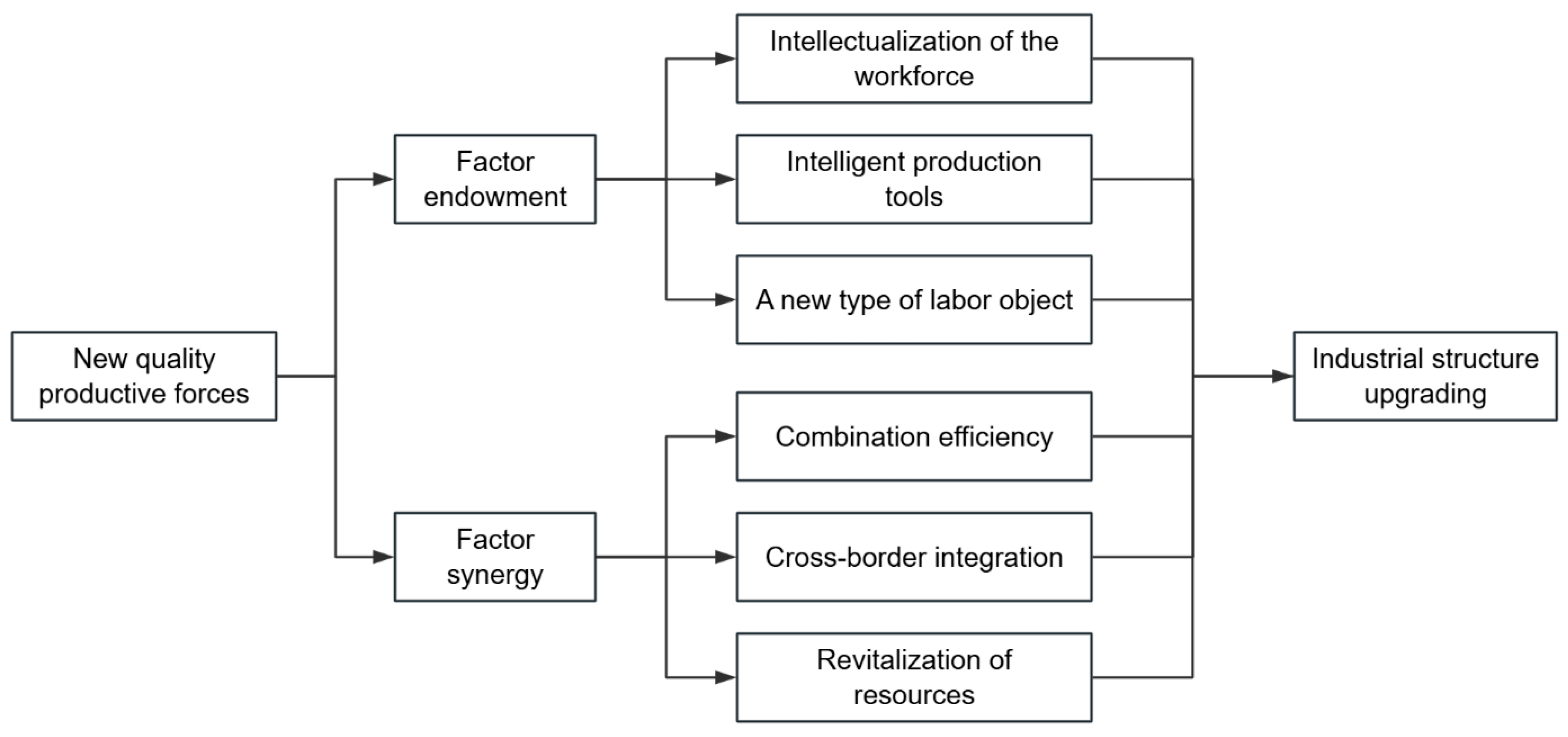
The essence of NQPFs lies in the two-dimensional superimposed effect of factor endowment upgrading and factor synergy enhancement, and its mechanism of action in driving industrial structure upgrading depends on the coordinated development of these two dimensions (Figure 1).

2.1. Mechanism of Upgrading NQPF Factor Endowments for Industrial Structure Upgrading

According to factor endowment theory and new structural economics, industrial structure upgrading evolves in tandem with changes in factor endowments. The scope of factor endowments has expanded to include profound shifts in their internal advantage structures, with the driving logic transitioning from factor quantity accumulation to the leapfrog improvement of factor quality and combination efficiency.
Upgrading the labor quality structure is pivotal to industrial restructuring. Historically, a large low-quality labor force has fueled China’s “demographic dividend,” enabling labor-intensive and rough-processing industries (Fu et al., 2020). Today, digitally skilled workers drive the quality and efficiency of traditional industries (Acemoglu & Restrepo, 2020; Peng & Feng, 2025); creative-thinking workers foster strategic emerging and future industries (Georgieff & Hyee, 2022); and highly knowledgeable, skilled workers handle complex professional tasks, propelling the rapid development of technology- and knowledge-intensive sectors (Acemoglu & Restrepo, 2018; Sheng & Montgomery, 2025).
New types of labor objects advance industrial structure upgrading through the following three key pathways: first, enterprises use in-depth data analysis to shift production from standardized to flexible, customized models—increasing resource utilization (Ghasemaghaei & Calic, 2020) and extending value chains toward “smile curve” ends to facilitate servitization (Chen & Srinivasan, 2024); second, digital products and services, with near-zero marginal costs and strong radiation capabilities, overcome traditional business logic and address “Baumol’s cost disease” in services (Paiola & Gebauer, 2020; Rong & Luo, 2023); and third, clean, renewable new factors (e.g., new energy and new materials) drive industries toward intensification, energy efficiency, and green development (Fan et al., 2019).
Intelligent production materials drive industrial upgrading multidimensionally—intelligent equipment optimizes processes and enhances efficiency/quality via autonomous regulation (Raisch & Krakowski, 2021) while helping enterprises cope with changes in the external environment, anticipate the direction of innovation, and cultivate new industries (Duan et al., 2019); high-precision equipment (e.g., integrated circuits) enables the deep processing of labor objects and the upgrading of value chains (Yuan et al., 2025); and digital platforms (e.g., the industrial internet) allow for building efficient information networks, fostering of virtual industrial clusters (L. Zhang et al., 2022), and strengthening of service penetration for productive services (Coreynen et al., 2017).
H1. 
Factor endowment upgrading by new quality productive forces (NQPFs) significantly promotes industrial structure upgrading.

2.2. Mechanism Through Which New Quality Productivity Factors Create Synergy to Promote Industrial Structure Upgrading

Productivity level and growth rate are not simple sums of factor endowments’ production capacity but are the result of factor aggregation and adaptation. Factor synergy is essentially a modern manifestation of Marx’s “wholeness of the labor process.” Unlike traditional productivity’s extensive growth via scale expansion, NQPFs rely on cutting-edge technological integration, which reshapes factor connections and allocation through new technologies, imposing greater demands on factor synergy.
First, technology acts as a key hub linking factors, building a multifactor collaborative industrial network for dynamic adaptation and precision production. Unlike traditional loose, linear factor connections, where technology merely serves as a production link (Acemoglu & Zilibotti, 2001), enterprises use digital–intelligent tools to digitize business information; laborers analyze these data to adaptively regulate production factors, uniting dispersed new factors into synergy (Ghasemaghaei & Calic, 2020). This situation shifts the factors from passive use to active adaptation, driving high-quality industrial upgrading.
Second, platform openness creates new factor synergy scenarios. Digital platforms (e.g., the industrial internet) break enterprise boundaries (Oztemel & Gursev, 2020); shared manufacturing allows idle factors to be leased on demand, transcending geographical/organizational limits, accelerating matching, reducing mismatches, and promoting industrial structure rationalization.
Finally, cross-domain convergence deepens factor synergy and reconfiguration. Single-domain factor combinations are replaced by interdisciplinary architectures, with cross-domain integration enabling functional complementarity (Han & Sohn, 2016)—e.g., manufacturing–information technology integration, spawning intelligent manufacturing. This approach overcomes disciplinary/industrial boundaries, shifting factors from single-functional application to multi-value creation and pushing industries up the value chain, facilitating industrial structure advancement (Cheng et al., 2025).
H2. 
The factor synergy of new quality productive forces (NQPFs) promotes industrial structure upgrading.
Figure 1. Mechanism of the effect of new quality productive forces on industrial structure upgrading.
Economies 14 00083 g001

3. Methodology

3.1. Econometric Model Setting

To address the endogeneity between NQPFs and industrial structure upgrading, research by Qiao et al. (2024) is drawn on, and an instrumental variable (IV) is used as the interaction of a province’s lagged internet users and 1984 telephone sets per 10,000 people. For relevance, this IV integrates historical communication endowments with current digital penetration, closely aligning with NQPF’s connotation. For exogeneity, the 1984 telephone data are considered a historical exogenous variable, satisfying the exclusion restriction. Two-stage least squares (2SLS) regression reveals the causal effect, with the model specifications detailed below:
In the first stage, ordinary least squares (OLS) regression is employed to isolate the exogenous component of the core explanatory variables. The regression equation is specified as follows:
N Q P i t = α 0 + γ 1 I V i t + γ c X i t + u i + δ t + ε i t
where i denotes the region, t denotes time, and I V i t is the instrumental variable. N Q P i t represents the original values of the core explanatory variables, including the comprehensive NQPF level n q p i t , factor endowment upgrading f e i t , and factor synergy f s i t . X i t denotes other control variables; u i and δ t denote province and year fixed effects, respectively; and ε i t is the random error term.
In the second stage, an equation is subsequently constructed based on the fitted value N Q P i t ^ to estimate the impact on industrial structure upgrading as follows:
i n d 1 , i t = α 0 + α 1 N Q P i t ^ + α c X i t + u i + δ t + ε i t
i n d 2 , i t = α 0 + β 1 N Q P i t ^ + β c X i t + u i + δ t + ε i t
where i n d 1 denotes industrial structure advancement and i n d 2 denotes industrial structure rationalization. Coefficients α 1 and β 1 are used to measure the effects of the core explanatory variables on industrial structure upgrading.

3.2. Variable Selection

3.2.1. Core Explanatory Variables

In most studies, NQPFs are measured solely as factor endowment upgrading, failing to fully capture the NQPFs’ intrinsic characteristics and leading to potential measurement bias. To mitigate this bias, research by Y. Gao et al. (2025) and Liu and He (2024) is drawn on in this study to construct an NQPF indicator system (encompassing labor, means of production, and objects of production) and comprehensively measure NQPFs from the dual dimensions of factor endowment upgrading and synergy. Following Shao et al. (2024), the entropy weight-TOPSIS method is employed to measure factor endowment upgrading (fe), in which indicators are objectively weighted by variability and their enabling effect on productivity is reflected. Drawing on the methods of L. Guo and Liu (2025), the three factors are treated as subsystems; on the basis of entropy-derived subsystem scores, factor synergy (fs) is measured via the coupled coordination model, and the impact of inter-subsystem interactions and synergy on productivity system performance is quantified. Finally, the two indicators are multiplied (nqp = fe × fs) to obtain the comprehensive NQPF level (nqp), with the economic connotation of synergizing factor quality improvement and allocation efficiency optimization. This value reflects the regional NQPF’s actual capacity to drive industrial upgrading—a high fe with a low fs limits the effectiveness of new quality factors (low nqp), and a simultaneous improvement in fe-fs results in a significant increase in nqp, corresponding to the NQPF that truly drives industrial upgrading (Table 1).

3.2.2. Dependent Variable: Industrial Structure Upgrading

This study examines industrial structure upgrading from two dimensions: industrial structure advancement and industrial structure rationalization. With respect to industrial structure advancement, as factor quality improves, the industrial structure not only undergoes overall upgrading but also experiences enhanced internal efficiency across individual industries. Traditional indicators, such as changes in the proportion of the three major industries, fail to accurately capture this dynamic process. Therefore, in accordance with the work of Xia et al. (2024), the structural efficiency index is used as the indicator for measuring industrial structure advancement and is represented by Equation (4). For industrial structure rationalization, the methodology of J. Zheng et al. (2021) is followed, and the Theil index is used for measurement. Since the Theil index is a negative indicator, its inverse is used in subsequent analyses to facilitate interpretation and is presented in Equation (5).
i n d 1 i , t = m = 1 3 Y i , m , t Y × Y i , m , t L i , m , t , m = 1,2 , 3
i n d 2 i , t = 1 1 / 3 ( m = 1 3 | y i m t l i m t | )
where y i m t denotes the share of value added of industry m in province i in period t and l i m t denotes the share of employment in industry m in province i in period t.

3.2.3. Control Variables

Drawing on the prior literature, the following control variables are included to mitigate confounding effects: foreign direct investment (FDI) as a share of GDP, which measures openness (fdi); the urban population as a share of the total population, which proxies the urbanization level (urb); the logarithm of per capita GDP, which captures the economic development level (lngdp); government public expenditure as a share of GDP, which reflects the government intervention level (gov); financial sector GDP as a share of regional GDP, which gauges the financial development level (fin); and nonstate economy fixed asset investment as a share of total fixed asset investment, which reflects the marketization level (mar).

3.3. Data Sources and Descriptive Analysis

Thirty Chinese provinces (excluding Tibet, Hong Kong, Macao, and Taiwan) are selected for this study, with a sample period of 2013–2024. The data are sourced from the CSMAR Database, China Statistical Yearbook, China Environmental Statistical Yearbook, China Industrial Statistical Yearbook, China Tertiary Industry Statistical Yearbook, High-Technology Industry Statistical Yearbook, China Regional Innovation Capability Evaluation Report, International Federation of Robotics (IFR), and Air Quality Online Monitoring and Analysis Platform.
For the 2024 provincial panel data, linear interpolation is used to estimate select variables for which official figures have not yet been released. Interpolated observations account for 0.49% of the full sample. Descriptive statistics are presented in Table 2, with variables showing a reasonable distribution and no significant outlier issues.

4. Results

4.1. Measurement of the Level of NQPFs

Table 3 shows NQPFs, factor endowment upgrading (fe), and factor synergy (fs), which are all less than 0.5. In accordance with L. Guo and Liu’s (2025) factor synergy classification, China’s NQPFs remain in early development, with low factor synergy and factor endowment in an adjustment phase.
NQPF ranking shifts are concentrated in central–western provinces—those with improved rankings (e.g., Shanxi and Hebei) have strong fs despite moderate fe. These shifts are supported by central fiscal transfers for digital infrastructure (e.g., Shanxi’s 5G/base stations for coal mine digitalization) and regional policies enabling precise factor synergy (e.g., Hebei’s talent/equipment sharing via the Beijing–Tianjin–Hebei Strategy) that offset endowment shortcomings.
In contrast, central–western provinces with declining rankings (e.g., Gansu and Qinghai) face dual-fs constraints: (1) inadequate digital infrastructure with supply-demand mismatches (e.g., Qinghai’s capital-concentrated infrastructure misaligning with industrial needs); (2) weak industrial foundations (e.g., Gansu’s underdeveloped integrated circuit industry lacking core clusters), hindering synergy policies and limiting fe’s amplification effect.
Eastern coastal provinces exhibit balanced development, strong new quality factor absorption, sound institutions, and targeted policies. Fe and fs advance in tandem, ensuring stable rankings (Liu & He, 2024).
In conclusion, the asymmetry between fe and fs constitutes the key constraint on NQPF-driven industrial structure upgrading effectiveness.
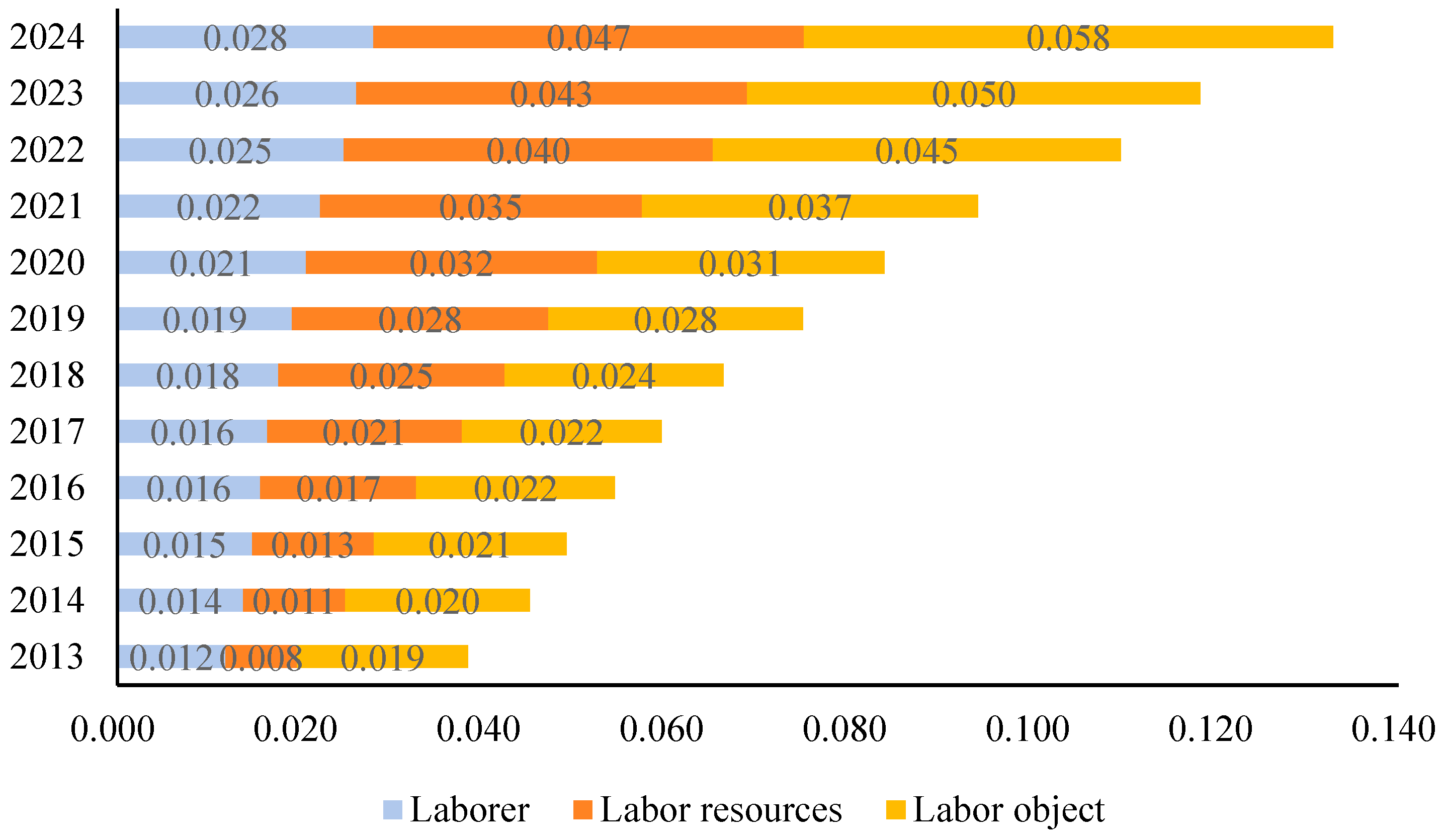
NQPF factor development in 30 Chinese provinces is shown in Figure 2. In-depth analysis reveals significant disparities in factor levels, again indicating that factor synergy remains in a transitional phase.
A further analysis of the development rates of each factor reveals distinct disparities: the absolute levels of all three factors exhibit a sustained growth trend. Among these, the means of labor register the most prominent growth, rising steadily from approximately 0.008 in 2013 to 0.047 in 2024, a nearly 4.9-fold increase, and thus are identified as the most dynamic factor in the development of New Quality Productive Forces (NQPFs). The subject of labor shows the second-highest growth margin, surging from around 0.019 in 2013 to 0.058 in 2024, an increase of about 2.1 times. In contrast, the labor force records a relatively moderate growth, climbing from roughly 0.012 in 2013 to 0.028 in 2024, a mere 1.3-fold rise, which indicates a significant growth lag in the labor force.
This phenomenon stems from the following three key factors: (1) skilled labor cultivation’s long “education–practical training–on-the-job adaptation” cycle lags digital technology/smart manufacturing iteration (Graetz & Michaels, 2018); (2) insufficient vocational education investment and low social recognition limit skilled personnel scale/quality (Zeng, 2021); and (3) regional household registration/social security divisions worsen labor mobility imbalances and skilled talent outflows from central/western regions, trapping local labor skill upgrading in “unable to retain or attract talent (Stainback & Tang, 2019).

4.2. Benchmark Regression

Table 4 presents the results for empirical models (1)–(3). The Kleibergen–Paap rk Wald F statistic (16.38) from the first-stage instrumental variable (IV) regression confirms the absence of weak IV issues.
Columns (4)–(6) show significantly positive coefficients for industrial structure upgrading at the 1% level—comprehensive NQPF (nqp = 3.158), factor endowment upgrading (fe = 1.261), and factor synergy (fs = 5.026). A one-standard-deviation increase in each drive increases by 0.20, 0.25, and 0.58 standard deviations, respectively. These results support Hypothesis 1, with the coefficient of fs being significantly greater than that of fe, indicating that factor synergy has a more prominent marginal contribution.
For industrial structure rationalization, Columns (7)–(9) report 1% significantly positive coefficients as follows: nqp = 195.551, fe = 80.376, and fs = 274.640. The corresponding one-standard-deviation increases drive rationalization by 0.30, 0.38, and 0.75 standard deviations. These findings confirm Hypothesis 2 and reinforce factor synergy as the key driver of industrial structure optimization, given its largest coefficient and standard deviation effect.
A comparison of the core variables reveals that the marginal contribution of factor synergy outperforms that of fe in terms of both upgrading and rationalization. Comprehensive NQPF is constrained by asynchrony between fe and fs development, which highlights that addressing this asymmetry is critical to unlocking the effectiveness of NQPFs.

4.3. Robustness Tests

(1) The core explanatory variables are replaced with their first-order lags, and OLS regression is performed. The results are not significantly different from those of the benchmark, confirming the robustness of the main conclusions (Table 5).
(2) OLS regression with all explanatory variables lagged one period yields results consistent with the benchmark (Table 6).
(3) Instrumental variable placebo test: Historical communication infrastructure may directly affect industrial upgrading through unobserved regional advantages. Coastal provincial and municipal samples are thus excluded, and IV regression is re-estimated for inland provinces. The results are highly consistent with the baseline regression, effectively invalidating the alternative explanation that instrumental variables impact industrial upgrading via omitted factors such as coastal advantages. The exogeneity of the 1984 telephone data is further verified: the National Bureau of Statistics of China reports a national average of only 0.53 telephones per 100 people in 1984. The highly administrative allocation of fixed-line telephones and their layout reflecting planned-economy resource priorities render this historical data largely uncorrelated with contemporary unobserved drivers of industrial structure upgrading, thereby satisfying the exclusion restriction (Table 7).
(4) Variable replacement: Core explanatory variables are remeasured via criterion importance through the intercriteria correlation (CRITIC) weighting method, with 2SLS re-regression. The core coefficients are positive and 1% significant, confirming robustness (Table 8).
(5) Estimation method replacement: The generalized method of moments (GMM) addresses potential 2SLS heteroskedasticity. The results align with the benchmark, passing robustness tests (Table 9).
(6) Descriptive statistics show generally reasonable variable distributions, but ind2’s maximum (163.898) may affect regression robustness. To address this concern, 1% and 2% winsorization are performed, as presented in Table 10, and reverse winsorization is also conducted, as shown in Table 11. The core coefficients align with the baseline in sign and significance, with no substantial outlier distortion, further confirming NQPFs’ robustness in promoting industrial structure upgrading.
(7) Robustness to interpolated data: To gauge the potential influence of interpolated values on the core results, the 2024 observations are excluded from the analysis, and the model is re-estimated. The coefficients for the core explanatory variables remain consistent with the baseline regression in terms of sign, statistical significance, and economic magnitude. These results confirm that the smoothing bias from linear interpolation does not materially alter the conclusions (Table 12).

4.4. Heterogeneity Test

4.4.1. Heterogeneity Analysis at the Level of Economic Development

The level of economic development influences NQPFs, which in turn impacts industrial structure upgrading. Using the provincial average per capita GDP median and average (sample period) as a cutoff, the sample is split into developed and less developed sub-samples (Table 13).
For industrial structure advancement, the coefficient of nqp on ind1 in less developed provinces (5.847, p < 0.05) is 2.2 times greater than that in developed provinces (2.669, p < 0.01), indicating a stronger marginal effect of NQPFs. This finding may stem from the following two factors: first, less developed provinces have a low industrial upgrading base, and thus, new industries driven by NQPFs can more rapidly alter the composition of industrial structure, generating a more pronounced marginal improvement, and second, when undertaking industrial transfers from eastern regions, these provinces can leverage the NQPFs to skip certain traditional upgrading stages, accelerating the shift to high-value-added industries and fostering a “latecomer advantage” (Z. Gao et al., 2024).
With respect to rationalization, nqp has a significant positive effect in developed provinces but a nonsignificant effect in less developed provinces. Mechanistically, the coefficient of fe (−20.890) suggests that factor endowment upgrading hinders rationalization in less developed provinces, reflecting a weak foundation for NQPF cultivation that limits the realization of its benefits (Z. Guo et al., 2026).

4.4.2. Heterogeneity Analysis at the Level of Dominant Types of Regional Industries

The existing foundation of regional industrial development serves as the fundamental driver of industrial structure upgrading. The GDP ratio of the secondary and tertiary industries in each province is used as the sample classification criterion (Bi et al., 2025)—provinces with the highest share of secondary industry are classified as manufacturing-led, while those with the highest share of tertiary industry are considered service-led (Table 14).
For industrial structure advancement, nqp’s coefficients on ind1 are positive and significant for both subsamples, with a stronger marginal effect observed in manufacturing-led provinces. In contrast, service-led provinces exhibit a smaller marginal effect because of their already higher overall industrial level, which limits the space for NQPF-driven improvement.
For industrial structure rationalization, nqp’s coefficient on ind2 in manufacturing-led provinces is −22.821 (p > 0.1), with similarly insignificant coefficients for fe (−13.455) and fs (11.861). This finding contrasts with service-led provinces, where the nqp coefficient is positive and significant (191.988, p < 0.01), indicating that factor endowment upgrades and factor synergy mechanisms do not operate effectively in manufacturing-led provinces. The reason for this is likely that long-term manufacturing dominance has rendered their industrial structure and production organization mature and rigid, with high adjustment costs that hinder the rapid integration of new technologies and production tools, limiting the marginal effect of the release of NQPFs (Jia et al., 2025).

4.4.3. Heterogeneity Analysis at the Level of Regional Environmental Regulatory Intensity

Environmental regulation, a key government industrial intervention tool, varies regionally in terms of intensity, influencing industrial survival thresholds and new quality factor input directions, and serves as a critical contextual variable for industrial upgrading heterogeneity. Drawing on Pan et al. (2019), environmental regulation intensity is measured as the ratio of regional industrial pollution control investment to industrial value added. The sample is split into provinces with high and low levels of environmental regulation on the basis of the indicator’s median and average accordingly (Table 15).
With respect to industrial structure advancement, the nqp coefficients are significantly positive across both subsamples, with a stronger marginal effect in provinces with high levels of environmental regulation. The reason for this is that strict environmental standards in high-regulation provinces impose pressure on the survival of high-energy-consumption, high-pollution, and low-end industries, accelerating the phase-out of low-end capacity and freeing up resource space for high-value industries (Dagestani et al., 2023).
With respect to industrial structure rationalization, nqp has a positive effect only in provinces with low levels of environmental regulation and has no significant effect in provinces with high levels of regulation. Specifically, the fe coefficient on ind2 in high-regulation provinces is −14.417 (p > 0.1). The reason for this is likely that low-regulation provinces face fewer constraints, with active innovation and flexible industrial development paths (Yu et al., 2017), which provide space for the convergence and synergy of new quality factors, effectively promoting structural rationalization. In contrast, enterprises in high-regulation provinces must invest substantial resources to meet environmental requirements; rising compliance costs crowd out new factor input allocation, weakening the effectiveness of NQPFs in driving structural rationalization (You et al., 2019).

4.5. Further Analysis: Industry Heterogeneity

Having confirmed the ability of NPQFs to promote industrial structure upgrading, it is noted that the role of NPQFs extends beyond interindustry transitional leaps to intra-industry structural dynamic evolution. To fully reveal the effectiveness of industrial structure upgrading, the heterogeneous impact of the NQPFs on intra-industry upgrading is examined. Notably, the primary industry (agriculture, forestry, animal husbandry, and fisheries) lacks a clear structural hierarchy, with NQPFs manifesting more production efficiency improvement than does intra-industry upgrading. Thus, this study focuses on manufacturing and services, builds empirical models (6) and (7), and employs 2SLS regression.
m a n u i t = α 0 + φ 1 N Q P i t ^ + φ c X i t + u i + δ t + ε i t
s e r v i t = α 0 + τ 1 N Q P i t ^ + τ c X i t + u i + δ t + ε i t
Here, m a n u i t denotes manufacturing sector structural upgrading, and s e r v i t denotes service sector structural upgrading. Coefficients φ 1 and τ 1 are the core estimators of interest and reflect the impact of NQPFs on structural upgrading in the manufacturing and service sectors, respectively.
With respect to the selection of dependent variables, the work of F. Xu and Hu (2025) is drawn on in this study, and the share of operating income of technology-intensive manufacturing industries is used to measure manufacturing structural upgrading. Following the suggestions of C. Guan et al. (2023), the share of employment in producer services relative to the tertiary industry is adopted to measure service sector structural upgrading (Table 16).
The regression results indicate that the coefficients of the NQPF composite level (nqp) on manufacturing industry structural upgrading (manu) and service industry structural upgrading (serv) are 0.472 and 0.141, respectively (both p < 0.01). This finding confirms that NQPFs promote the internal structure upgrading of both industries, with a more pronounced effect observed in manufacturing.
This disparity stems primarily from two factors. First, manufacturing features clear production processes and technologies, enabling more readily achievable automated and intelligent transformation. Its strong upstream–downstream industrial chain linkages also facilitate the diffusion of upgrading effects (T. Zhu et al., 2025). Second, the service industry adopts more flexible service models, as NQPFs tend to enhance service efficiency rather than alter internal structural proportions. Additionally, producer services rely on manufacturing demand, with their upgrading pace constrained by manufacturing development, further limiting the magnitude of NQPFs’ impact on the internal structural upgrading of the service industry (Schiavone et al., 2022).

5. Discussion

5.1. Theoretical Framework Breakthroughs and Paradigm Contributions

Most of the literature focuses on a single dimension of factor endowment upgrading, reducing the NQPF mechanism to a linear logic of “factor quality upgrading drives industrial upgrading” (Shao et al., 2024). This finding fails to explain why industrial upgrading lags despite significant progress in factor endowment upgrading. Drawing on Marx’s holistic labor process theory and the factor allocation logic of new structural economics, this study incorporates factor synergy into the analytical framework for the first time, proposing a two-dimensional mechanism of “factor quality enhancement and factor relationship optimization.” The former serves as the foundational support for NQPFs, while the latter acts as its amplification mechanism—its degree of synergy determines the level of industrial upgrading momentum released. This framework aligns with the inherent nature of NQPFs and overcomes the limitations of existing studies that focus solely on factor quantity and quality, providing a systematic paradigm for understanding the complex relationship between NQPFs and industrial structure upgrading.

5.2. Commonalities and Differences in Empirical Findings

The core conclusion—that NQPFs significantly promote industrial structure upgrading and rationalization—aligns with the literature, confirming the universal value of NQPF.
Nevertheless, the following three core differences emerge in the empirical findings. (1) The literature simplifies the mechanism to “factor endowment upgrading drives industrial upgrading” (Shao et al., 2024), while this study confirms that the marginal contribution of factor synergy significantly outperforms that of factor endowment upgrading. These findings reveal that insufficient factor synergy is the key reason industrial upgrading lags despite advances in factor endowment upgrading. (2) Y. Zhu et al. (2025) only report that NQPF levels are higher in eastern China, but this study further reveals that the core distinction across the eastern, central, and western regions lies in the alignment between factor endowment upgrading and factor synergy. The two factors advance in tandem in the eastern region, whereas the central and western regions face greater asymmetric development rather than merely an insufficient single-factor scale. (3) Most prior studies argue that environmental regulation can drive industrial structure upgrading (S. Guan et al., 2022), but this study reveals that the impact of NQPFs is nonsignificant in provinces with high environmental regulation intensity. This finding is rooted in the lack of alignment between environmental and industrial policies—high compliance costs crowd out enterprise investments in factor cultivation, thereby weakening the effectiveness of institutional support.

5.3. Implications for Non-Chinese Emerging Economies

This study’s framework and conclusions provide the following key path guidance for emerging economies grappling with fading factor dividends and industrial low-end lock-in: these economies should abandon the traditional single-factor catch-up path and adopt a two-pronged “factor endowment upgrading and factor synergy” driving model. While new factors accumulate, they should concurrently establish factor synergy platforms to avoid the predicament of “possessing factors but failing to unlock their effective potential.”
This path is particularly critical for low-cost factor-dependent economies such as those in Southeast Asia and Latin America. These economies have long been trapped in low-end manufacturing (Kikuchi, 2018), with the root cause likely lying in their focus solely on the quantitative accumulation of factors (e.g., labor and capital) while neglecting the need to adapt and link these factors. The dual-mechanism framework demonstrates that only when new factor endowment upgrading and synergy mechanisms are implemented in tandem can factor advantages be converted into momentum for industrial upgrading—providing both theoretical and practical guidance for breaking free from “low-end lock-in”.

6. Conclusions

6.1. Conclusions and Recommendations

This study presents a two-dimensional integrated framework of factor endowment upgrading and factor synergy, filling the gap in systematic theories of NQPF-driven industrial structure upgrading and offering insights for emerging economies facing fading factor dividends and low-end lock-in. The key findings are as follows. (1) China’s NQPF, factor endowment upgrading, and factor synergy scores are all below 0.5, remaining in the initial development stage; thus, the development of labor lags behind that of objects of labor and means of production. (2) NQPFs significantly promote industrial structure upgrading and rationalization, with factor synergy outperforming factor endowment upgrading in terms of effectiveness. (3) There is regional heterogeneity in the effect of industrial structure rationalization—the factor endowment upgrading path is uneven in economically underdeveloped and highly environmentally regulated provinces, while the dual mechanism fails to operate effectively in manufacturing-led provinces. (4) NQPFs have a relatively stronger marginal effect on manufacturing structure upgrading, but the long-term potential of service industry upgrading remains to be further explored.
Relevant policy implications are proposed accordingly.
First, governments should promote supply-side reforms in education and skills training; establish a tripartite collaborative mechanism involving governments, enterprises, and educational institutions; develop talent catalogs aligned with industrial planning; design modular, short-cycle training programs for key industries; and introduce incentives and support policies, such as by providing tuition subsidies for individuals who participate in skills training for the labor force in short supply.
Second, cross-industry and cross-regional platforms for the dynamic matching of factor supply and demand, alongside dynamic evaluation systems for factor synergy indices, should be established to form a closed loop of early warning, deployment, and optimization. Early warnings are triggered when an index falls below a specified threshold, government-led joint platforms initiate cross-regional factor deployment, and evaluation outcomes are incorporated into the assessment of local industrial policies.
Third, region-specific measures should be implemented to address transmission barriers. For economically less developed provinces, financial transfer payments should increase, infrastructure development in the transportation and digital sectors should be enhanced, and factor collaboration channels should be established to introduce high-quality factor resources and technical expertise from eastern regions. For provinces with strict environmental regulations, the design of environmental regulation policies should be optimized—industrial rationalization should be incorporated into policy assessment frameworks, differentiated regulatory measures should be implemented, and subsidy schemes should be established to support factor upgrading. For manufacturing-dominated provinces, the expansion of new infrastructure, such as industrial internet and intelligent computing centers, to key industrial clusters should be accelerated; factors should be guided to concentrate in high-end manufacturing; and gradual transformation incentive policies should be implemented to encourage the shortening of industrial adjustment cycles.

6.2. Research Limitations and Future Perspectives

China’s industrial structure upgrading is deeply embedded in the global production network; however, this study has four key limitations. First, in this work, a domestic-only perspective is adopted, and international factors (e.g., GVC position and technological dependence) are excluded, leading to an incomplete portrayal of NQPF’s external constraints. Second, endogeneity handling needs refinement—the interaction between digital economy support policies and NQPFs is unaddressed, potentially biasing core coefficients and hindering accurate identification of the net effect. Third, this study is limited to a single country without cross-country comparisons and fails to reveal international commonalities/heterogeneities, thus restricting its reference value internationally. Finally, in this study, between-group heterogeneity is identified via median split, but its single-threshold reliance must be noted, as it fails to fully capture intensity’s continuous properties.
Future research could be extended in three directions. First, international factors could be incorporated to analyze the moderating effect of global production network changes on the NQPF–industrial structure upgrading nexus, and the effects of GVC position and technological dependence could be explored. Second, the cross-country comparative perspective could be expanded; countries with diverse income levels and industrial bases could be selected as samples, the institutional environment’s moderating role in the dual mechanism could be tested, typical paths could be refined, and targeted insights could be offered for emerging economies trapped in “low-end lock-in.” Third, continuous interaction terms—e.g., interaction regressions between core explanatory and moderating variables—could be applied to precisely capture heterogeneity nuances and enhance the robustness of the results.


Author Contributions

Conceptualization, Q.W.; data curation, Q.W.; formal analysis, Q.W.; writing—original draft, Q.W. and M.H.; methodology, Q.W. and M.H.; visualization, Q.W.; validation, M.H.; writing—review & editing, M.H.; investigation, M.H. and Y.L.; project administration, Y.L.; funding acquisition, B.Z. All authors have read and agreed to the published version of the manuscript.

Funding

This research was funded by Forestry Science and Technology Innovation Program of Guangdong Province, grant number 2025KJCX009.

Institutional Review Board Statement

Not applicable.

Informed Consent Statement

Not applicable.

Data Availability Statement

This study uses publicly available historical secondary data. The data are available through publicly accessible archival sources (https://www.stats.gov.cn/sj/ndsj/, accessed on 15 November 2025). No new data were created for this study.

Conflicts of Interest

The authors declare no conflicts of interest.

References

  1. Acemoglu, D., & Restrepo, P. (2018). The race between man and machine: Implications of technology for growth, factor shares, and employment. American Economic Review, 108(6), 1488–1542. [Google Scholar] [CrossRef]
  2. Acemoglu, D., & Restrepo, P. (2020). Robots and jobs: Evidence from US labor markets. Journal of Political Economy, 128(6), 2188–2244. [Google Scholar] [CrossRef]
  3. Acemoglu, D., & Zilibotti, F. (2001). Productivity differences. The Quarterly Journal of Economics, 116(2), 563–606. [Google Scholar] [CrossRef]
  4. Bai, X.-J., Li, Z.-Y., & Zeng, J. (2020). Performance evaluation of China’s innovation during the industry-university-research collaboration process—An analysis basis on the dynamic network slacks-based measurement model. Technology in Society, 62, 101310. [Google Scholar] [CrossRef]
  5. Barro, R. (2016). Economic growth and convergence, applied especially to China. National Bureau of Economic Research Working Paper Series, No. 21872. National Bureau of Economic Research. [Google Scholar] [CrossRef]
  6. Bi, S., Zhang, X., Xiao, G., & Li, H. (2025). Marketization, digital economy, and industrial structure transformation: Mechanisms and regional variations. International Review of Economics & Finance, 102, 104228. [Google Scholar] [CrossRef]
  7. Chen, W., & Srinivasan, S. (2024). Going digital: Implications for firm value and performance. Review of Accounting Studies, 29(2), 1619–1665. [Google Scholar] [CrossRef]
  8. Cheng, D., Zhao, Y., & Guo, Y. (2025). Research on the mechanism of digital-real economic integration enhancing industrial structure upgrading. Economies, 13(9), 253. [Google Scholar] [CrossRef]
  9. Coreynen, W., Matthyssens, P., & Van Bockhaven, W. (2017). Boosting servitization through digitization: Pathways and dynamic resource configurations for manufacturers. Industrial Marketing Management, 60, 42–53. [Google Scholar] [CrossRef]
  10. Dagestani, A. A., Shang, Y., Schneider, N., Cifuentes-Faura, J., & Zhao, X. (2023). Porter in China: A quasi-experimental view of market-based environmental regulation effects on firm performance. Energy Economics, 126, 106966. [Google Scholar] [CrossRef]
  11. Duan, Y., Edwards, J. S., & Dwivedi, Y. K. (2019). Artificial intelligence for decision making in the era of big data–evolution, challenges and research agenda. International Journal of Information Management, 48, 63–71. [Google Scholar] [CrossRef]
  12. Fan, Y., Wu, S., Lu, Y., & Zhao, Y. (2019). Study on the effect of the environmental protection industry and investment for the national economy: An input-output perspective. Journal of Cleaner Production, 227, 1093–1106. [Google Scholar] [CrossRef]
  13. Fu, L., Wang, Y., & He, L. (2020). Age composition change and inter-provincial labor productivity: A study from the perspective of population dividend and population urbanization. Journal of Applied Economics, 23(1), 183–198. [Google Scholar] [CrossRef]
  14. Gao, F. (2023). The logic, multidimensional connotation and current significance of “new quality productivity”. China Review of Political Economy, 14(6), 127–145. Available online: http://dx.chinadoi.cn/10.3969/j.issn.1674-7542.2023.06.007 (accessed on 2 March 2026). (In Chinese)
  15. Gao, Y., Liu, C., Chen, Q., & Li, H. (2025). New quality productive forces and forestry economic resilience: Coordinated development, regional differences, and predictive analysis. Sustainability, 17(11), 5043. [Google Scholar] [CrossRef]
  16. Gao, Z., Li, L., & Hao, Y. (2024). Resource industry dependence and high-quality economic development of Chinese style: Reexamining the effect of the “Resource Curse”. Structural Change and Economic Dynamics, 68, 1–16. [Google Scholar] [CrossRef]
  17. Georgieff, A., & Hyee, R. (2022). Artificial intelligence and employment: New cross-country evidence. Frontiers in Artificial Intelligence, 5, 832736. [Google Scholar] [CrossRef]
  18. Ghasemaghaei, M., & Calic, G. (2020). Assessing the impact of big data on firm innovation performance: Big data is not always better data. Journal of Business Research, 108, 147–162. [Google Scholar] [CrossRef]
  19. Graetz, G., & Michaels, G. (2018). Robots at work. The Review of Economics and Statistics, 100(5), 753–768. [Google Scholar] [CrossRef]
  20. Guan, C., Huang, J., Jiang, R., & Xu, W. (2023). The impact of pilot free trade zone on service industry structure upgrading. Economic Analysis and Policy, 78, 472–491. [Google Scholar] [CrossRef]
  21. Guan, S., Liu, J., Liu, Y., & Du, M. (2022). The nonlinear influence of environmental regulation on the transformation and upgrading of industrial structure. International Journal of Environmental Research and Public Health, 19(14), 8378. [Google Scholar] [CrossRef]
  22. Guo, L., & Liu, K. (2025). Spatiotemporal patterns and drivers of coupling coordination between digital technological innovation and economic resilience in the Yangtze river economic belt. Scientific Reports, 15(1), 30975. [Google Scholar] [CrossRef] [PubMed]
  23. Guo, Z., Yang, G., & Wu, W. (2026). Automatic synthesis of econometric empirical research results using large language model: A case study of digitalization-greening relationships. Technological Forecasting and Social Change, 222, 124370. [Google Scholar] [CrossRef]
  24. Han, E. J., & Sohn, S. Y. (2016). Technological convergence in standards for information and communication technologies. Technological Forecasting and Social Change, 106, 1–10. [Google Scholar] [CrossRef]
  25. Heo, P. S., & Lee, D. H. (2019). Evolution of the linkage structure of ICT industry and its role in the economic system: The case of Korea. Information Technology for Development, 25(3), 424–454. [Google Scholar] [CrossRef]
  26. Huang, Q., Yang, Y., Yang, H., & Nan, Y. (2024). Structure changes, efficiency changes and development of new quality productive forces. Economic Research Journal, 59, 4–23. Available online: https://kns.cnki.net/kcms2/article/abstract?v=iwDheDcO5w5F--fhMDcl9KtOHUHx2PCRZ57fe3fCxf6CX2PCuqp2ckq7i0MffRS12GaCYuyWTd3PyPDXb8wpnF6meVIKQgmw5EwRsXYj068VLGxo3UGPkV4sP7ok2vX2posqv2TNxgFNgjYSXqrnon2ha1rkZ-9uKbhaFHUddtTQkcyCT4YxIw==&uniplatform=NZKPT&language=CHS (accessed on 2 March 2026). (In Chinese)
  27. Jia, Z., Li, Y., Wang, J., Wang, Z., & Zhao, G. (2025). A study on the measurement of China’s manufacturing industry chain toughness and regional heterogeneity from a dynamic perspective. International Review of Economics & Finance, 102, 104329. [Google Scholar] [CrossRef]
  28. Jiang, S., & Guo, Y. (2022). Reasons for college major-job mismatch and labor market outcomes: Evidence from China. China Economic Review, 74, 101822. [Google Scholar] [CrossRef]
  29. Kikuchi, T. (2018). Introduction: Trade, industrialization, and structural reform in southeast Asia. Journal of Asian Economics, 55, 1–3. [Google Scholar] [CrossRef]
  30. Lin, J., & Monga, C. (2011). Growth identification and facilitation: The role of the state in the dynamics of structural change. Development Policy Review, 29(3), 264–290. [Google Scholar] [CrossRef]
  31. Lin, J. Y. (2009). Economic development and transition: Thought, strategy, and viability. Cambridge University Press. [Google Scholar]
  32. Lin, J. Y. (2011). New structural economics: A framework for rethinking development. The World Bank Research Observer, 26(2), 193–221. [Google Scholar] [CrossRef]
  33. Liu, Y., & He, Z. (2024). Synergistic industrial agglomeration, new quality productive forces and high-quality development of the manufacturing industry. International Review of Economics & Finance, 94, 103373. [Google Scholar] [CrossRef]
  34. Oztemel, E., & Gursev, S. (2020). Literature review of industry 4.0 and related technologies. Journal of Intelligent Manufacturing, 31(1), 127–182. [Google Scholar] [CrossRef]
  35. Paiola, M., & Gebauer, H. (2020). Internet of things technologies, digital servitization and business model innovation in BtoB manufacturing firms. Industrial Marketing Management, 89, 245–264. [Google Scholar] [CrossRef]
  36. Pan, X., Ai, B., Li, C., Pan, X., & Yan, Y. (2019). Dynamic relationship among environmental regulation, technological innovation and energy efficiency based on large scale provincial panel data in China. Technological Forecasting and Social Change, 144, 428–435. [Google Scholar] [CrossRef]
  37. Peng, S., & Feng, X. (2025). The impact of digital literacy on rural women’s non-agricultural employment-evidence from China. Economies, 13(11), 309. [Google Scholar] [CrossRef]
  38. Qiao, P., Liu, S., Fung, H.-G., & Wang, C. (2024). Corporate green innovation in a digital economy. International Review of Economics & Finance, 92, 870–883. [Google Scholar] [CrossRef]
  39. Raisch, S., & Krakowski, S. (2021). Artificial intelligence and management: The automation–augmentation paradox. Academy of Management Review, 46(1), 192–210. [Google Scholar] [CrossRef]
  40. Rong, K., & Luo, Y. (2023). Toward born sharing: The sharing economy evolution enabled by the digital ecosystems. Technological Forecasting and Social Change, 196, 122776. [Google Scholar] [CrossRef]
  41. Schiavone, F., Leone, D., Caporuscio, A., & Lan, S. (2022). Digital servitization and new sustainable configurations of manufacturing systems. Technological Forecasting and Social Change, 176, 121441. [Google Scholar] [CrossRef]
  42. Shao, C., Dong, H., & Gao, Y. (2024). New quality productivity and industrial structure in China: The moderating effect of environmental regulation. Sustainability, 16(16), 6796. [Google Scholar] [CrossRef]
  43. Sheng, D., & Montgomery, H. A. (2025). When does skilled labor affect the growth of secondary sector value added in emerging markets? Economies, 14(1), 1. [Google Scholar] [CrossRef]
  44. Shi, Y., Wang, X., & Zhang, T. (2025). Dynamic evolution and trend forecasting of new quality productive forces development levels in Chinese urban agglomerations. Sustainability, 17(4), 1559. [Google Scholar] [CrossRef]
  45. Stainback, K., & Tang, Z. (2019). Between state and market: Hukou, nonstandard employment, and bad jobs in urban China. Chinese Sociological Review, 51(3), 271–310. [Google Scholar] [CrossRef]
  46. Xia, L., Han, Q., & Yu, S. (2024). Industrial intelligence and industrial structure change: Effect and mechanism. International Review of Economics & Finance, 93, 1494–1506. [Google Scholar] [CrossRef]
  47. Xu, F., & Hu, H. (2025). Digital finance, labor productivity and manufacturing structural upgrading. Finance Research Letters, 85, 107975. [Google Scholar] [CrossRef]
  48. Xu, Y., Du, F., & Xu, Z. (2024). The impact of local government’s attention to new quality productive forces on the upgrading of urban industrial structure: Analysis based on empirical evidences from seven major urban agglomerations in China. Urban Problems, (7), 46–57. Available online: https://kns.cnki.net/kcms2/article/abstract?v=iMwhGHIyCLZp3VOXa5orF8QO_javij65a3lta_XSbSHS7fiiHUTUAeopB1K5fdrKKJwHPoG6P1Te-f96Z04Rlie4BsJ3uYqPcuiRCKFDiWTBP8bbJzwiDat-uQXpNaiYZfiD80oszvwtNYgbW_o7BW7FZ31XN8elaL-1viyT1JW8VD-bQn1dzw==&uniplatform=NZKPT&language=CHS (accessed on 2 March 2026). (In Chinese)
  49. You, D., Zhang, Y., & Yuan, B. (2019). Environmental regulation and firm eco-innovation: Evidence of moderating effects of fiscal decentralization and political competition from listed Chinese industrial companies. Journal of Cleaner Production, 207, 1072–1083. [Google Scholar] [CrossRef]
  50. Yu, W., Ramanathan, R., & Nath, P. (2017). Environmental pressures and performance: An analysis of the roles of environmental innovation strategy and marketing capability. Technological Forecasting and Social Change, 117, 160–169. [Google Scholar] [CrossRef]
  51. Yuan, X., Guo, L., Lv, Q., Zhao, D., Liao, H., Ma, W., Jiang, Q., Xie, G., Hou, Y., & Shen, J. (2025). Product quality research in the industrialized preparation of electronic grade polysilicon: A review of impurity sources and control strategies. Renewable and Sustainable Energy Reviews, 214, 115569. [Google Scholar] [CrossRef]
  52. Zeng, T. (2021). The acceleration of the establishment of a modern vocational education system serving to high-quality development. Journal of National Academy of Education Administration, 5(5), 45–48. Available online: http://dx.chinadoi.cn/10.3969/j.issn.1672-4038.2021.05.008 (accessed on 2 March 2026). (In Chinese)
  53. Zhang, D., & Li, H. (2025). Research on the influence mechanism and non-linear effect of new quality productive forces on export structure upgrading in China. Journal of Xi’an University of Finance and Economics, 38(05), 72–87. Available online: http://dx.chinadoi.cn/10.3969/j.issn.2096-7454.2025.05.008 (accessed on 2 March 2026). (In Chinese)
  54. Zhang, L., Tao, Y., & Nie, C. (2022). Does broadband infrastructure boost firm productivity? Evidence from a quasi-natural experiment in China. Finance Research Letters, 48, 102886. [Google Scholar] [CrossRef]
  55. Zhao, J., & Tang, J. (2018). Industrial structure change and economic growth: A China-Russia comparison. China Economic Review, 47, 219–233. [Google Scholar] [CrossRef]
  56. Zhao, X., & Wang, W. (2020). Driving force for China’s photovoltaic industry output growth: Factor-driven or technological innovation-driven? Journal of Cleaner Production, 274, 122848. [Google Scholar] [CrossRef]
  57. Zheng, J., Shao, X., Liu, W., Kong, J., & Zuo, G. (2021). The impact of the pilot program on industrial structure upgrading in low-carbon cities. Journal of Cleaner Production, 290, 125868. [Google Scholar] [CrossRef]
  58. Zheng, T., Zhao, Y., & Li, J. (2019). Rising labour cost, environmental regulation and manufacturing restructuring of Chinese cities. Journal of Cleaner Production, 214, 583–592. [Google Scholar] [CrossRef]
  59. Zhu, B., Zhang, M., Zhou, Y., Wang, P., Sheng, J., He, K., Wei, Y.-M., & Xie, R. (2019). Exploring the effect of industrial structure adjustment on interprovincial green development efficiency in China: A novel integrated approach. Energy Policy, 134, 110946. [Google Scholar] [CrossRef]
  60. Zhu, T., Zhu, T., & Zhao, L. (2025). The impact of new quality productive forces on the resilience of industrial chains: The moderating role of digital finance. International Review of Economics & Finance, 102, 104333. [Google Scholar] [CrossRef]
  61. Zhu, Y., Song, Z., & Xu, X. (2025). Factors influencing data elements empowering new quality productive forces and their spatiotemporal evolution: A study based on panel data from 31 provinces in China. World Journal of Economics and Business Research, 3(3), 61–68. [Google Scholar] [CrossRef]
Figure 2. Development of elements of new quality productive forces in China, 2013–2024.
Economies 14 00083 g002
Table 1. Indicator system used to measure the level of new quality productive forces.
FactorSubfactorIndicatorDescriptionFeatures
LaborerWorker skillsEducational attainmentAverage number of years of education per capita+
Human capital structureAverage number of students enrolled in higher education per 100,000 people+
Number of R&D personnel in industrial enterprises above scale+
Employed persons in urban units in information transmission, software and information technology services/employed persons in urban units+
Labor efficiencyPer capita incomeAverage wage of private sector workers+
Worker awarenessEmployment structureTertiary employment/total employment+
Enterprising spiritInnovation and Entrepreneurship Index+
Labor resourcesDigital infrastructureDigital infrastructureLength of fiber optic cable lines/area+
Number of cell phone base stations/area+
Digital penetrationDigital userNumber of mobile internet users per 10,000 people+
Digital platformNumber of domains per 10,000 people+
Degree of enterprise digitizationNumber of enterprises with e-commerce trading activities+
New production toolsIndustrial robot penetrationNumber of robots installed in each industry nationwide × percent of employment in each province+
Electronic information manufacturingIntegrated circuit (IC) production+
Energy consumptionEnergy intensityEnergy consumption/GDP
Energy consumption structureNew energy generation/total generation, where new energy includes nuclear, wind, and solar+
Labor objectData elementsBig data generationMobile internet access data traffic+
Number of internet broadband access ports per 10,000 people+
Ecological environmentGreen coveragePercentage of forest cover+
Air qualityAir quality index (AQI)+
Industrial waste managementComprehensive utilization rate of general industrial solid waste+
Note: The “+” sign indicates that the indicator is positively correlated with the level of new quality productive forces, while the “−” sign indicates a negative correlation.
Table 2. Descriptive statistics.
VariableObservationsMeanStd. Dev.MinMax
nqp3600.0230.0320.0020.223
fe3600.1170.0990.0290.610
fs3600.1510.0570.0570.365
ind13601.2020.4990.3823.348
ind236014.69121.0322.075163.898
manu3600.2120.1090.0410.581
serv3600.0940.0610.0320.377
lngdp36010.9420.4539.84912.207
gov3600.2580.1100.1050.758
fin3600.0730.0320.0200.201
fdi3600.0160.0160.0000.121
mar3600.5970.0950.3470.860
urb3600.6120.1160.3640.896
Table 3. Levels of new quality productive forces in China.
ProvincefefsnqpSorting Changes
Shanxi0.0570.1180.0074
Hebei0.0770.1390.0112
Anhui0.0940.2000.0152
Inner Mongolia0.0530.1040.0061
Liaoning0.0880.1500.0141
Hubei0.0950.1560.0161
Hunan0.0870.1450.0141
Guizhou0.0570.1110.0071
Shaanxi0.0850.1450.0131
Beijing0.3520.2630.0950
Tianjin0.1120.1640.0190
Jilin0.0640.1220.0080
Heilongjiang0.0590.1150.0070
Shanghai Municipality0.2390.2350.0580
Jiangsu0.2860.2520.0770
Zhejiang0.2030.2220.0480
Fujian0.1360.1730.0250
Jiangxi0.0740.1310.0100
Shandong0.1570.1890.0320
Henan0.1020.1540.0170
Guangdong0.3810.2760.1140
Guangxi Zhuang Autonomous Region0.0670.1170.0080
Chongqing Municipality0.0780.1400.0110
Sichuan0.0950.1500.0150
Xinjiang Uygur Autonomous Region0.0490.0940.0050
Yunnan0.0580.1080.007−1
Ningxia Hui Autonomous Region0.0530.1010.006−1
Hainan0.0820.1220.011−2
Qinghai0.0600.0900.006−4
Gansu0.0980.1090.011−6
Average0.1170.1530.023
Table 4. Impact of new quality productive forces on advanced industrial structure.
Variablenqpfefsind1ind1ind1ind2ind2ind2
(1)(2)(3)(4)(5)(6)(7)(8)(9)
IV1.089 ***
(0.035)
IV 1.017 ***
(0.032)
IV 1.015 ***
(0.021)
nqp 3.158 *** 195.551 ***
(0.720) (42.456)
fe 1.261 *** 80.376 ***
(0.265) (17.644)
fs 5.026 *** 274.640 ***
(0.784) (58.307)
Province ControlYESYESYESYESYESYESYESYESYES
Year ControlYESYESYESYESYESYESYESYESYES
KP-LM20.67627.19049.473------
KP-F969.887999.0962377.757------
N360360360360360360360360360
R2---0.9530.9520.9550.7620.7600.764
Note: *** indicate significance at 1% levels, respectively.
Table 5. Regressions using lagged terms of new quality productive forces as explanatory variables.
Variableind1ind1ind1ind2ind2ind2
(1)(2)(3)(4)(5)(6)
nqp3.518 *** 224.714 ***
(0.889) (57.748)
fe 1.336 *** 88.951 ***
(0.308) (22.743)
fs 5.363 *** 290.423 ***
(0.896) (71.643)
ControlsYESYESYESYESYESYES
Province ControlYESYESYESYESYESYES
Year ControlYESYESYESYESYESYES
N330330330330330330
R20.9540.9530.9580.7810.7790.782
Note: *** indicate significance at 1% levels, respectively.
Table 6. All explanatory variables lagged one period.
Variableind1ind1ind1ind2ind2ind2
(1)(2)(3)(4)(5)(6)
nqp2.892 *** 226.801 ***
(0.776) (54.368)
fe 1.091 *** 92.028 ***
(0.279) (22.077)
fs 4.042 *** 320.776 ***
(0.800) (72.852)
ControlsYESYESYESYESYESYES
Province ControlYESYESYESYESYESYES
Year ControlYESYESYESYESYESYES
N330330330330330330
R20.9560.9550.9570.7720.7720.776
Note: *** indicate significance at 1% levels, respectively.
Table 7. Instrumental variables falsification test.
Variableind1ind2ind1ind2ind1ind2
(1)(2)(3)(4)(5)(6)
nqp4.654 ***72.720 *
(0.890)(42.539)
fe 22.509 **44.647 ***
(20.734)(12.367)
fs 8.337 ***1.528 **
(1.956)(0.604)
ControlsYESYESYESYESYESYES
Province ControlYESYESYESYESYESYES
Year ControlYESYESYESYESYESYES
KP-LM47.76356.94866.312
KP-F507.671140.0571008.832
N204204204204204204
R20.9580.8170.9570.8260.9600.818
Note: *, **, *** indicate significance at 10%, 5%, and 1% levels, respectively.
Table 8. Regressions after replacing the new quality productive forces measures.
Variableind1ind1ind1ind2ind2ind2
(1)(2)(3)(4)(5)(6)
nqp8.439 *** 522.571 ***
(1.837) (110.336)
fe 6.448 *** 411.128 ***
(1.466) (92.824)
fs 10.572 *** 577.622 ***
(1.641) (125.288)
Province ControlYESYESYESYESYESYES
Year ControlYESYESYESYESYESYES
KP-LM24.02022.88551.41524.02022.88551.415
KP-F300.446203.826669.859300.446203.826669.859
N360360360360360360
R20.9550.9450.9520.7620.7320.748
Note: *** indicate significance at 1% levels, respectively.
Table 9. GMM regression with lagged terms of new quality productive forces as instrumental variables.
Variableind1ind1ind1ind2ind2ind2
(1)(2)(3)(4)(5)(6)
nqp3.158 *** 195.551 ***
(0.720) (42.456)
fe 1.261 *** 80.376 ***
(0.265) (17.644)
fs 5.026 *** 274.642 ***
(0.784) (58.307)
Province ControlYESYESYESYESYESYES
Year ControlYESYESYESYESYESYES
N360360360360360360
R20.9530.9520.9550.7620.7600.764
Note: *** indicate significance at 1% levels, respectively.
Table 10. Regression with sample outliers removed.
Variable1% Before and After Indent2% Before and After Indent
ind2ind2ind2ind2ind2ind2
(1)(2)(3)(4)(5)(6)
nqp184.169 *** 133.180 ***
(35.796) (21.077)
fe 75.638 *** 52.755 ***
(15.118) (9.416)
fs 264.217 *** 174.765 ***
(53.258) (28.949)
Province ControlYESYESYESYESYESYES
Year ControlYESYESYESYESYESYES
KP-LM20.67627.19049.47320.67627.19049.473
KP-F969.887999.0962377.757969.887999.0962377.757
N360360360360360360
R20.7970.7950.8000.9110.9090.913
Note: *** indicate significance at 10%, 5%, and 1% levels, respectively.
Table 11. Logarithmic regression on ind2.
Variable(1)(2)(3)
ln(ind2)ln(ind2)ln(ind2)
Nqp3.488 ***
(1.036)
Fe 1.294 ***
(0.480)
Fs 4.861 ***
(1.303)
Province ControlYESYESYES
Year ControlYESYESYES
KP-LM20.67627.19049.473
KP-F969.887999.0962377.757
N360360360
R20.9520.9510.952
Note: *** indicate significance at 1% levels, respectively.
Table 12. Smoothing deviation test for interpolation.
Variableind1ind1ind1ind2ind2ind2
(1)(2)(3)(4)(5)(6)
nqp3.652 *** 231.419 ***
(0.854) (62.789)
fe 1.487 *** 97.020 ***
(0.317) (25.773)
fs 5.943 *** 334.244 ***
(0.988) (87.162)
ControlsYESYESYESYESYESYES
Province ControlYESYESYESYESYESYES
Year ControlYESYESYESYESYESYES
KP-LM15.42919.97137.64715.42919.97137.647
KP-F457.485520.1401269.995457.485520.1401269.995
N330330330330330330
R20.9540.9530.9570.7720.7700.774
Note: *** indicate significance at 1% levels, respectively.
Table 13. Heterogeneity analysis of regional economic development.
VariableMedian GroupingAverage Value Grouping
Economically Developed ProvincesLess Economically Developed ProvincesEconomically Developed ProvincesLess Economically Developed Provinces
ind1ind2ind1ind2ind2ind2ind1ind2ind1ind2ind2ind2
(1)(2)(3)(4)(5)(6)(7)(8)(9)(10)(11)(12)
nqp2.669 ***182.330 ***5.847 **61.975 2.534 ***206.632 ***7.581 ***−59.316
(0.774)(58.276)(2.553)(78.712) (0.722)(56.795)(2.290)(85.466)
fe −20.890 −44.177
(19.028) (20.164)
fs 133.696 *** 104.614 ***
(33.403) (36.726)
ControlsYESYESYESYESYESYESYESYESYESYESYESYES
Province ControlYESYESYESYESYESYESYESYESYESYESYESYES
Year ControlYESYESYESYESYESYESYESYESYESYESYESYES
KP-LM23.19023.19035.61135.61141.84658.96522.84522.84534.67634.67641.33656.174
KP-F824.406824.406211.700211.700106.916604.329844.411844.411173.596173.59698.271490.323
N180180180180180180192192168168168168
R20.9430.7470.9620.8390.8390.8580.9440.7500.9670.8470.8520.858
Note: **, *** indicate significance at 5% and 1% levels, respectively.
Table 14. Heterogeneity analysis of the dominant types of regional industries.
VariableMedian GroupingAverage Value Grouping
Manufacturing-Led ProvincesService-Led ProvincesManufacturing-Led ProvincesService-Led Provinces
ind1ind2ind2ind2ind1ind2ind1ind2ind2ind2ind1ind2
(1)(2)(3)(4)(5)(6)(7)(8)(9)(10)(11)(12)
nqp13.693 ***−22.821 2.699 ***191.988 ***12.162 ***−42.953 2.479 ***180.546 ***
(2.237)(50.501) (0.676)(50.476)(2.090)(47.850) (0.666)(51.560)
fe −13.455 −18.002
(12.784) (12.333)
fs 11.861 −2.072
(25.845) (24.212)
ControlsYESYESYESYESYESYESYESYESYESYESYESYES
Province ControlYESYESYESYESYESYESYESYESYESYESYESYES
Year ControlYESYESYESYESYESYESYESYESYESYESYESYES
KP-LM35.83935.83929.51650.03120.14620.14647.45547.45539.34163.98119.81919.819
KP-F170.715170.71598.672576.818992.009992.009218.296218.296124.802762.6221016.8711016.871
N180180180180180180204204204204156156
R20.9620.8690.8690.8690.9560.7480.9610.8690.8690.8680.9540.745
Note: *** indicate significance at 1% levels, respectively.
Table 15. Heterogeneity analysis of regional environmental regulatory intensity.
VariableMedian GroupingAverage Value Grouping
Provinces with High Levels of
Environmental Regulation
Provinces With Low Levels of Environmental
Regulation
Provinces with High Levels of
Environmental Regulation
Provinces with Low Levels of Environmental
Regulation
ind1ind2ind2ind2ind1ind2ind1ind2ind2ind2ind1ind2
(1)(2)(3)(4)(5)(6)(7)(8)(9)(10)(11)(12)
nqp2.779 **23.612 1.876 ***253.714 ***4.639 ***8.989 2.242 ***214.349 ***
(1.233)(49.964) (0.586)(55.796)(1.498)(48.408) (0.602)(51.732)
fe −14.417 −3.996
(14.456) (14.377)
fs 110.531 ** 49.817 *
(45.213) (30.088)
ControlsYESYESYESYESYESYESYESYESYESYESYESYES
Province ControlYESYESYESYESYESYESYESYESYESYESYESYES
Year ControlYESYESYESYESYESYESYESYESYESYESYESYES
KP-LM15.57815.57819.94517.20820.09720.09719.17619.17623.52433.21019.62819.628
KP-F402.156402.156468.795430.741882.264882.264390.387390.387476.800845.217975.196975.196
N180180180180180180168168168168192192
R20.9640.8900.8910.8930.9710.7630.9600.8970.8980.8980.9700.773
Note: *, **, *** indicate significance at 10%, 5%, and 1% levels, respectively.
Table 16. Role of new quality productivity in structural upgrading within industries.
VariablemanuManumanuservservserv
(1)(2)(3)(4)(5)(6)
nqp0.472 *** 0.141 ***
(0.145) (0.040)
fe 0.194 *** 0.042 **
(0.052) (0.017)
fs 0.761 *** 0.305 ***
(0.164) (0.057)
Province ControlYESYESYESYESYESYES
Year ControlYESYESYESYESYESYES
KP-LM20.67627.19049.47320.67627.19049.473
KP-F969.887999.0962377.757969.887999.0962377.757
N360360360360360360
R20.9450.9450.9460.9760.9750.977
Note: **, *** indicate significance at 5% and 1% levels, respectively.
Disclaimer/Publisher’s Note: The statements, opinions and data contained in all publications are solely those of the individual author(s) and contributor(s) and not of MDPI and/or the editor(s). MDPI and/or the editor(s) disclaim responsibility for any injury to people or property resulting from any ideas, methods, instructions or products referred to in the content.