


Abstract
The paper aims to provide spatial evidence on where to prioritize place-based support for women’s entrepreneurship by linking the geography of female founders to the proximity of formal support infrastructure in Germany. To pursue this objective, we assemble nationwide venture microdata covering founding cohorts 2015–2021 and geocoded locations of support infrastructure. Using GIS-based (Geographic Information System) spatial analysis, in particular kernel density and hot/cold-spot mapping and bivariate correlations, we quantify proximity-entrepreneurship associations and identify policy-relevant hot- and cold-spots. Our findings reveal female entrepreneurship clusters in major urban corridors. Proximity to support infrastructure is positively associated with women founders. At 10 km buffers, correlations reach r = 0.26 for women and r = 0.31 for men. Effects attenuate at 20 km (r = 0.15 and r = 0.14). We map actionable cold-spots, i.e., places with sparse infrastructure and low female-founder presence, alongside high-performing hot-spots. As a practical implication, we propose a spatial targeting logic: resources should be concentrated in identified cold-spots via women-focused hubs, mobile advisory, and improved last-mile accessibility. Progress through a compact KPI set should be monitored. Targeted spatial support can advance gender equity in entrepreneurship while strengthening regional cohesion and efficient public spending.
1. Introduction
Women remain underrepresented among founders across advanced economies. This is not only an equity concern but also constrains innovation, jobs and regional development. Governments have responded with place-based programs to inform, finance, and mentor aspiring entrepreneurs. However, budgets are finite and effects vary across space. To raise the return on public spending, policymakers need to know where female entrepreneurship is weak and whether proximity to formal support infrastructure matters in those places (GEM, 2024; Glaeser & Gottlieb, 2008; Kline & Moretti, 2014).
Entrepreneurship is embedded in local ecosystems. Formal support institutions, such as universities, innovation centers (including women-focused hubs) and business angel (BA) networks, shape information flows, mentoring, finance, and role-model visibility. However, they are unevenly distributed. Therefore, a spatial lens helps assess whether the geography of support aligns with the geography of women entrepreneurship and how policy might correct mismatches (Audretsch & Feldman, 1996; Brown & Mason, 2014; Welter, 2011; Spigel, 2017; Stam & van de Ven, 2021). Moreover, gendered resource constraints make access to proximate support particularly salient for women (Brush et al., 2009; Henry et al., 2016). This does not imply a simple causal effect of institutions on founding. Rather, proximity to formal ecosystem entry points can be understood as an observable proxy for lower participation costs and higher exposure to mentoring, brokerage, and early financing pipelines, which are expected to weaken with distance due to spatial frictions and distance decay (Acs et al., 2009; Audretsch & Feldman, 1996; Spigel, 2017; Stam & van de Ven, 2021).
Research on women’s entrepreneurship has documented persistent participation and resource gaps and has largely focused on gendered differences in access to finance, networks, and institutional constraints (Henry et al., 2016; Guzman & Kacperczyk, 2019). At the same time, entrepreneurship and ecosystem research stresses that entrepreneurial resources are context-dependent and spatially embedded, implying distance-related frictions in access and interaction (Acs et al., 2009; Audretsch & Feldman, 1996; Welter, 2011). Yet much of the evidence on ecosystem conditions and gender is reported at national or broad regional scales, which is less suited for operational place-based targeting and monitoring (Hechavarría & Ingram, 2019; Kline & Moretti, 2014; Neumeyer et al., 2019; Neumark & Simpson, 2015). Micro-geographic evidence on whether women’s founding activity aligns with the geography of formal ecosystem entry points remains limited, even though ecosystem theory stresses place-specific bundles of resources and interaction frictions (Spigel, 2017; Stam & van de Ven, 2021; Welter, 2011) and spatial innovation research predicts distance decay in knowledge flows and network formation (Acs et al., 2009; Audretsch & Feldman, 1996). We address this spatial alignment gap by providing a nationwide diagnostic of where women founders and formal support nodes co-locate within everyday distance bands and where policy-relevant mismatches persist.
This paper asks the following policy question: Where should place-based support be prioritized to strengthen women’s entrepreneurship in Germany? Place-based programs typically operate through local entry points such as universities, innovation centers, and business angel (BA) networks, which can lower search and coordination costs, provide mentoring and role-model visibility, and facilitate access to early financing and networks (Spigel, 2017; Stam & van de Ven, 2021; Neumeyer et al., 2019). These channels are particularly policy-relevant given documented gendered frictions in access to finance and networks, and constraints on time budgets that can raise the value of nearby, trusted entry points (Brush et al., 2009; Guzman & Kacperczyk, 2019; Henry et al., 2016). Importantly, this motivates a spatial analysis. It does not imply that the proximate presence of institutions causes founding in a cross-sectional setting.
To operationalize this diagnostic, we link the spatial distribution of women-founded ventures to proximity to formal support infrastructure. Using nationwide venture microdata (founding cohorts 2015–2021) and geocoded locations of support infrastructure, we measure local accessibility at the PLZ (“Postleitzahl” = postal code) level by counting how many support nodes fall within 10 km and 20 km (Euclidean distance) of each PLZ centroid. We then provide a layered evidence package: (i) descriptive maps that highlight clustering and mismatches, and (ii) transparent association statistics (correlations with robustness checks) that quantify whether proximity patterns attenuate with distance, consistent with distance-decay arguments (Acs et al., 2009; Audretsch & Feldman, 1996). The result is a policy-ready picture of where women founders are scarce, where support is sparse, and where the two conditions coincide, which can be used to prioritize outreach and program design and then be paired with monitoring and evaluation in line with place-based policy guidance (Glaeser & Gottlieb, 2008; Kline & Moretti, 2014; Neumark & Simpson, 2015).
Given the cross-sectional design, we interpret all estimates as associations suitable for targeting and monitoring, not as causal effects of institutions (Kline & Moretti, 2014; Neumark & Simpson, 2015).
Our findings have the following policy implications: First, proximity to support infrastructure is positively associated with women’s entrepreneurship, with associations attenuating by distance, consistent with access mechanisms. Second, spatial clustering is pronounced in major urban corridors, while cold-spots, i.e., areas with low female-founder presence and weak local support, are clearly identifiable. Third, women’s and men’s patterns are similar overall, i.e., distance bands matter for both, and we do not find a uniformly stronger proximity association for women at the 10 km level. These nuances matter for program design as targeting must be spatially explicit without one-size-fits-all claims about gender-specific distance sensitivity.
We contribute along three dimensions. Empirically, we provide a nationwide, GIS-based diagnostic of the spatial match between women’s entrepreneurship and proximate support infrastructure, highlighting alignment and policy-relevant mismatches at a micro-geographic level. Conceptually, we treat this as an ecosystem alignment problem, consistent with process views that emphasize how ecosystem resources emerge and diffuse in space (Spigel & Harrison, 2018; Stam & van de Ven, 2021).
Building on calls to contextualize entrepreneurship and to explicitly model spatiality in ecosystems (Schäfer, 2021; Welter, 2011), we operationalize ecosystem access as a proximity-based alignment between founders and formal entry points. This connects evidence on gendered ecosystem conditions and differences in network entry to micro-geographic targeting questions (Hechavarría & Ingram, 2019; Neumeyer et al., 2019; Farr-Wharton & Brunetto, 2007; Weis & Lay, 2019). Methodologically, we integrate kernel-density and hot/cold-spot mapping with transparent proximity metrics (10/20 km buffers) and association measures that are easy to audit and replicate for policy monitoring. For policy, we translate spatial evidence into a prioritization logic for place-based support: cold-spots need to be identified, nearby hubs strengthened (or mobile/virtual access granted), and a compact KPI set (such as female-founder share, accessibility scores, mentoring matches) tracked.
Our approach is intentionally pragmatic. The design is cross-sectional. Associations should not be read as causal effects of institutions. Euclidean distance may overstate accessibility, and infrastructure is not yet weighted by capacity or specialization. We address these limits by reporting distance-band sensitivity, providing auditable workflows and outlining feasible next steps for administrations (e.g., travel-time isochrones, capacity-weighted infrastructure, sectoral breakouts). These steps align with best practice in place-based policy analysis (Kline & Moretti, 2014; Neumark & Simpson, 2015).
2. Theory and Hypotheses
This section develops a spatial access argument for entrepreneurial ecosystems. We treat proximity to formal support nodes as a proxy for lower search and coordination costs and for higher exposure to mentoring, brokerage, and early financing pipelines (Spigel, 2017; Stam & van de Ven, 2021; Welter, 2011). Because many ecosystem interactions rely on repeated contact and local network formation, spatial frictions imply distance decay, meaning that associations should weaken with increasing distance (Acs et al., 2009; Audretsch & Feldman, 1996). In line with place-based policy guidance, we interpret these patterns as diagnostic associations suitable for targeting and monitoring, not as causal estimates of institutional effects (Glaeser & Gottlieb, 2008; Kline & Moretti, 2014; Neumark & Simpson, 2015).
We conceptualize proximity to formal support infrastructure as a spatial-friction mechanism within entrepreneurial ecosystems. Ecosystem resources are relational and place-bound, so local entry points can reduce search and coordination costs and increase repeated interactions that support mentoring, brokerage, and early financing (Spigel, 2017; Stam & van de Ven, 2021). Spatial innovation research suggests that such interactions exhibit distance decay, implying that associations should be strongest at short ranges that approximate everyday mobility (Acs et al., 2009; Audretsch & Feldman, 1996). This framing motivates our proximity operationalization using 10 km and 20 km distance bands and guides the interpretation of attenuation with distance as consistent with access mechanisms rather than as a purely cartographic artifact.
2.1. Entrepreneurship and Entrepreneurial Support Infrastructure
Entrepreneurship unfolds within institutional and spatial contexts that shape incentives, information flows, and access to resources, and the perception of opportunities and feasibility (Fritsch et al., 2018; Stuetzer et al., 2014; Welter, 2011). We conceptualize entrepreneurial support infrastructure as formal ecosystem entry points that can reduce search, coordination, and legitimacy costs for nascent ventures and connect founders to local resource bundles (Spigel, 2017; Stam & van de Ven, 2021).
Beyond tangible services, support infrastructure can also shape local entrepreneurial culture and cognition. Repeated exposure to entrepreneurship education, peer communities and events, mentors, and investors can strengthen entrepreneurial self-efficacy and opportunity recognition and can normalize entrepreneurship as a legitimate and feasible career option, lowering perceived barriers alongside actual search and coordination costs (Bae et al., 2014; Souitaris et al., 2007). Regional evidence links such cultural-cognitive conditions to opportunity perception and to persistent spatial differences in entrepreneurial activity over long horizons (Fritsch & Wyrwich, 2014; Stuetzer et al., 2014; Stuetzer et al., 2018). Therefore, we treat proximity to formal support nodes as capturing both resource access and cultural-cognitive exposure channels, without implying causal effects in our cross-sectional design.
In this paper, we focus on three pillars for support infrastructure: universities, innovation centers, and business angel (BA) networks. These functions reduce discovery and evaluation frictions because they combine relatively stable physical anchors with high-leverage functions for early-stage capability building, network access, and first financing steps.
Universities build human capital, diffuse knowledge, and provide legitimacy for first-time founders through entrepreneurship education, mentoring, and role-model exposure (Avolio et al., 2025; Laudano et al., 2019; Meeralam & Adeinat, 2022; Tiberius et al., 2023). These functions can reduce discovery and evaluation frictions and are strongest where universities maintain dense links to local organizations and industry. Evidence on advisor matching shows that relatable role models influence intentions and early career trajectories (Gaule & Piacentini, 2018). In operational terms, universities are comparatively stable anchor institutions, which makes them a practical baseline entry point in spatial diagnostics of ecosystem access (GEM, 2024).
Innovation centers assemble services that are difficult to obtain in thin markets. Space, coaching, investor days, acceleration, and peer learning compress time to validation and facilitate early network entry. Prior research suggests that incubator and accelerator services can be associated with venture outcomes such as survival and growth, with heterogeneity by design and context (Deyanova et al., 2022; Schwartz, 2009). Accelerator models add structure, speed, and visibility and can concentrate attention from mentors and investors in ways that amplify local spillovers (Hochberg, 2016). Geography is consequential in each case. A dense, proximate configuration implies shorter travel times, faster feedback loops, and more frequent serendipitous encounters. These mechanisms imply that founder activity is more likely to co-locate with accessible support nodes, especially at short distances.
BA networks complement education and services with risk capital and hands-on expertise at the earliest stages (Avdeitchikova et al., 2008; Brettel, 2003). BAs contribute money, market knowledge, and reputational endorsements that help overcome the liability of newness. Proximity reduces search costs, raises match quality, and enables repeated interactions that build trust. Evidence on investor pipelines documents persistent access gaps, including for women entrepreneurs, which motivates treating proximate and visible entry points as a relevant access condition in a spatial diagnostic (Guzman & Kacperczyk, 2019; Mason et al., 2022). In ecosystem terms, BA groups operate as high-leverage connectors that turn local information into investable opportunities and that benefit from tight coupling to universities and centers (Hochberg, 2016).
When universities, innovation centers, and BA networks operate as complementary nodes that lower entry barriers both through resource channels and through cultural-cognitive exposure, then the place where they are located and how close founders live and work to these nodes becomes policy-relevant for targeting and monitoring (Stuetzer et al., 2014; Stuetzer et al., 2018). Strengthening coverage in weakly served places, improving connections to nearby hubs, and tailoring center services to the needs of women founders are feasible interventions within existing regional policy toolkits (GEM, 2024; Kuckertz & Brem, 2023; Nor, 2024). This logic motivates our first hypothesis and sets the stage for a spatial test based on proximity metrics.
Hypothesis 1.
Regions with a higher density of entrepreneurial support institutions have a higher absolute number of founders.
Hypothesis 1a.
The association between support infrastructure and founder presence attenuates with distance, such that proximity measures at 10 km show stronger associations than at 20 km.
This infrastructure-based access argument motivates our baseline hypothesis on founder counts and sets up the gender-comparative expectation in Section 2.2.
2.2. Gendered Mechanisms and Spatial Expectations
These pillars interact with women’s entrepreneurship in specific ways. Studies document asymmetric access to finance and expert networks, stereotype-consistent evaluation, and tighter time constraints linked to care responsibilities in many contexts. Each mechanism increases the value of proximate and trusted support that reduces search effort, coordinates introductions, and provides legitimacy in early stages (Bates, 2002; Brush et al., 2009; Coleman & Robb, 2016; Jennings & McDougald, 2007; Klyver & Grant, 2010; Neumeyer et al., 2019; Rosenbaum, 2017). Context matters for the size and direction of gender gaps. Differences in risk preferences and evaluative responses are not uniform, yet marginal disadvantages in selection environments can cumulate when local access is weak. Proximity to formal support can therefore mitigate small but consequential frictions in discovery, preparation, and first financing steps (Booth & Nolen, 2012; Jamali, 2009; Koellinger et al., 2013).
Proximity to formal support infrastructure can benefit nascent ventures in general, but several mechanisms suggest that access frictions may be more salient for women in some contexts. Prior research documents gendered gaps in finance and networks and constraints on time budgets, which can increase the value of nearby, trusted institutions that reduce search effort, coordinate introductions, and provide legitimacy in early stages (Brush et al., 2009; Buss et al., 2025; Coleman & Robb, 2016; D’Andrea, 2023; Henry et al., 2016; Jennings & McDougald, 2007; Neumeyer et al., 2019). At the same time, gender differences are context dependent and do not imply uniform or universal distance sensitivity (Booth & Nolen, 2012; Gimenez-Jimenez et al., 2022; Koellinger et al., 2013).
A spatial perspective renders these mechanisms observable. Support nodes are unevenly distributed across regions. Metropolitan areas concentrate nodes and connectors, while peripheral places show sparser coverage and thinner pipelines. Where infrastructure is proximate, information arrives earlier, referral chains shorten, and repeated interactions become feasible within everyday schedules. These are the conditions under which formal support translates into higher founder presence. Ecosystem research consistently traces local patterns of knowledge flows, role-model visibility, and network formation that emerge from place-specific bundles of institutions and actors. Spatial innovation research adds the logic of localized externalities and distance-related decay in interaction intensity (Audretsch & Feldman, 1996; Brown & Mason, 2014; Isenberg, 2010; Spigel, 2017; Welter, 2011).
The three pillars address gendered frictions through complementary channels. Universities build capability and exposure through education and mentoring. They also provide relatable role models that shape intentions and confidence at the point of entry, especially when ties to local organizations are strong (Gaule & Piacentini, 2018; Hägg & Schölin, 2018; Hoppe, 2016). Innovation centers assemble services that compress time to first validation and facilitate early network entry through structured coaching, space, and peer learning. Effectiveness depends on design and regional fit rather than the label, which makes geographic alignment with local demand critical for uptake by women founders who face tighter time budgets (Deyanova et al., 2022; Hochberg, 2016; Schwartz, 2009). BA networks add early capital and hands-on expertise. Proximity reduces search costs, improves match quality, and enables the repeated interactions that build trust and reputational lift. Evidence on investor pipelines shows that unequal access can translate into funding gaps for women, which increases the value of visible local entry points and connectors (Gupta & Mirchandani, 2018; Mason et al., 2022; Maxwell et al., 2011).
Gender differences in risk preferences, sector choices, and evaluative responses are context dependent. Some experiments report lower average risk-taking by women, while field studies often find small or no differences once opportunity quality is held constant. The aggregate picture is nuanced and does not support one-size-fits-all claims about distance sensitivity. This motivates a comparative approach that reports effects for women and men in parallel and that interprets contrasts carefully (Booth & Nolen, 2012; Henry et al., 2016; Jamali, 2009; Koellinger et al., 2013). Accordingly, we report all proximity associations for women-founded ventures and, as a comparator, for male-only ventures in parallel, while keeping the substantive focus on women’s entrepreneurship (Gimenez-Jimenez et al., 2022; Henry et al., 2016).
We therefore expect distance decay in the association between infrastructure and founder presence, with the clearest patterns at short ranges that approximate everyday mobility (Acs et al., 2009; Audretsch & Feldman, 1996). This motivates reporting proximity measures at 10 and 20 km and comparing attenuation with distance. Building on the gendered access-friction argument above, we test whether the proximity association differs between women-founded and male-only ventures. The policy corollary follows. Target places where women’s founder presence and proximate support are both weak, strengthen local nodes or build bridges to nearby hubs, and monitor progress with compact indicators that capture access and uptake (GEM, 2024; Kuckertz & Brem, 2023; Nor, 2024).
Hypothesis 2.
The spatial correlation between an entrepreneurial support infrastructure and founders is stronger among women than among men.
3. Methods
3.1. Data
Our empirical setting combines one nationwide venture dataset with four infrastructure inventories. The venture data come from the IAB/ZEW Founding Panel 2021 (in the following: IAB/ZEW), which records newly established businesses in Germany together with location and founder attributes for start-ups founded between 2015 and 2021. We restrict analysis to firms with valid founder-gender information and to observations with plausible characteristics. This restriction affects only a small share of observations and is unlikely to be spatially systematic. Extreme outliers had already been removed by the data provider. Because access to microdata follows a release lag, the 2021 wave was the most recent dataset available. We therefore use 2021 as our cross-sectional reference year. Importantly, the venture layer covers multiple founding cohorts (2015–2021), which reduces year-specific noise and makes the spatial patterns less sensitive to short-term shocks. Given the inertia of many ecosystem components, we expect the qualitative proximity gradient to be reasonably stable over a short horizon, even though local changes may occur. Because the mapping pipeline is fully script-based, the indicators can be updated as soon as newer microdata waves become available.
The resulting analytical sample comprises 4957 firms. Of these, 935 have at least one female founder or are founded by a woman only. This corresponds to ≈19% of firms. The remaining 4022 firms are male-only. 805 PLZs host at least one business founded by a woman alone or within a mixed-gender team, whereas 2586 PLZs include at least one male-founded business. At the founder level, the dataset lists 7278 individuals, of whom 1031 are women (≈14%) and 6247 are men. Team size varies. Many ventures are started by a single person, which is reflected in a mean of 1.47 founders per firm and a median of 1. For spatial analysis we aggregate counts to PLZ areas and construct variables for the number of women-founded firms (defined as firms with ≥1 female founder), male-founded firms, and the gender composition of founders per PLZ (IAB/ZEW).
Because the focus of this study is women’s entrepreneurship, our primary outcome is the number of women-founded ventures per PLZ. We define a venture as women-founded if at least one founder is female, which includes female-only and mixed-gender teams. This inclusive definition captures women’s participation in entrepreneurial teams and avoids classifying mixed-gender ventures as ‘male’, despite women being part of the founding team (Brush et al., 2009; Guzman & Kacperczyk, 2019; Gimenez-Jimenez et al., 2022). The complementary category ‘male-founded ventures’ therefore refers to male-only founding teams. We report male-only results solely as a benchmark to assess whether proximity patterns are gender-specific or reflect general ecosystem access, and because our second hypothesis is explicitly comparative (Hechavarría & Ingram, 2019; Neumeyer et al., 2019). The two outcome categories are mutually exclusive by construction.
To characterize formal support infrastructure, we assemble three geocoded inventories. University locations and addresses are obtained from Hochschulkompass, the official directory of accredited higher-education institutions in Germany (HRK, n.d.). A national list of innovation and business incubation centers is compiled from the website of the German Innovation, Technology, and Business Incubation Centres association (BDITGB, n.d.). We further identify seven centers dedicated to female entrepreneurship, provided by WeiberWirtschaft eG (WeiberWirtschaft eG, n.d.). Finally, we add the locations of business angel networks from BAND (n.d.). All infrastructure records include names and addresses and are cleaned for duplicates before geocoding. The infrastructure inventories were compiled and cleaned in 2025 to reflect the contemporary support landscape.
The unit of spatial aggregation is the PLZ centroid. Venture records are matched to their PLZ. Infrastructure nodes are mapped as points. These choices allow a transparent construction of 10 and 20 km proximity measures in the subsequent procedure section and produce policy-auditable inputs for hot- and cold-spot mapping.
3.2. Procedure
We transform all source files into a common geospatial workflow that yields policy-auditable proximity measures and maps. Infrastructure addresses are geocoded and re-projected from WGS84 to ETRS89/UTM 32N to preserve metric distances. Venture records are aggregated to PLZ centroids as spatial units. We remove duplicates, harmonize naming, and resolve ambiguous addresses before geocoding. These steps align the venture data and the three infrastructure inventories mentioned above for subsequent analysis.
Our methodological choices prioritize transparency and auditability to support place-based targeting and monitoring. Therefore, we rely on simple, replicable GIS operations (projection, buffers, point-in-buffer counts, kernel density, and rule-based classification) that can be re-run with standard administrative toolchains, consistent with best practice discussions on place-based policy evaluation and monitoring (Kline & Moretti, 2014; Neumark & Simpson, 2015) and with guidance on the potentials and constraints of geodata in applied labor market and regional research (Ostermann et al., 2022). To enhance replicability, we provide a complete workflow description, including QGIS processing steps and R scripts in Appendix A.
For each PLZ centroid, we draw 10 and 20 km buffers and count the number of universities, innovation centers, and BA networks located in each buffer. The 10 km band is intended to approximate everyday local reachability and provides the most actionable scale for place-based program design. The 20 km band serves as a sensitivity range capturing wider catchments and allows us to test attenuation with distance. This design is consistent with the distance-decay logic in spatial innovation and knowledge spillover research, which predicts that interaction intensity declines with distance (Audretsch & Feldman, 1996; Acs et al., 2009), and it aligns with policy work that emphasizes transparent, auditable indicators for spatial targeting (Kline & Moretti, 2014; Neumark & Simpson, 2015). This yields PLZ-level coverage measures used in the correlation analysis and in the hot-/cold-spot classification. The buffers are a pragmatic proxy for everyday reachability and do not represent a substantive zoning of Germany. Distances are Euclidean after re-projection to a metric CRS, which supports reproducibility with standard GIS tools, and we discuss travel-time alternatives as a limitation and extension.
For heatmaps and hot-/cold-spot mapping, we generate kernel-density surfaces for founders and for infrastructure to visualize spatial concentration and potential mismatches. Surfaces are classified with Jenks’ natural breaks and exported as layered maps to support visual inspection by policy teams. For a discrete policy view, we classify PLZs into hot- and cold-spots by combining founder presence with proximity counts in the 10 km band. We discretize founder counts and infrastructure coverage into ordinal classes using a fixed classification rule. Hot-spots are PLZs in the highest class for both founders and coverage. Cold-spots are PLZs in the lowest class for both dimensions. This rule-based approach is simple to audit and can be mapped to administrative thresholds for program eligibility, in line with place-based policy monitoring practice (Kline & Moretti, 2014; Neumark & Simpson, 2015). Kernel density is used as a descriptive smoothing device for visualization, whereas the policy classification is based on discrete PLZ-level counts within buffers. This separation between descriptive smoothing and rule-based classification is intentional to keep the actionable targeting logic auditable (Kline & Moretti, 2014; Neumark & Simpson, 2015).
For the association analysis, we quantify proximity-entrepreneurship associations using Pearson correlations between founder counts and infrastructure coverage within the 10 km and 20 km buffers, reported separately for women and men to enable a direct gender comparison. As a robustness check we replicate correlations with Spearman’s rho and test sensitivity to the alternative buffer size. We also examine pillar-specific associations to separate the roles of universities, centers, and BA networks. Significance tests use conventional two-sided thresholds. We do not claim causality.
We made the following operationalization choices: Proximity is operationalized using PLZ centroids and Euclidean 10 km and 20 km buffers, and infrastructure coverage is measured as unweighted point counts of universities, innovation centers, and BA networks within each band. These choices prioritize transparency and auditability for place-based targeting, but they abstract from travel-time frictions and from heterogeneity in node capacity and specialization. Outcomes are modeled as absolute PLZ-level founder counts, complemented by population-weighted hot-spot scores in the city analysis. The infrastructure layer captures physical anchor institutions and does not measure actual utilization intensity or purely digital programs, so the indicators should be interpreted as accessibility proxies in an increasingly hybrid support landscape (Kline & Moretti, 2014; Neumark & Simpson, 2015).
GIS operations are conducted in QGIS and statistical analyses are run in R. For replicability, we provide the annotated script in Appendix A.
4. Results
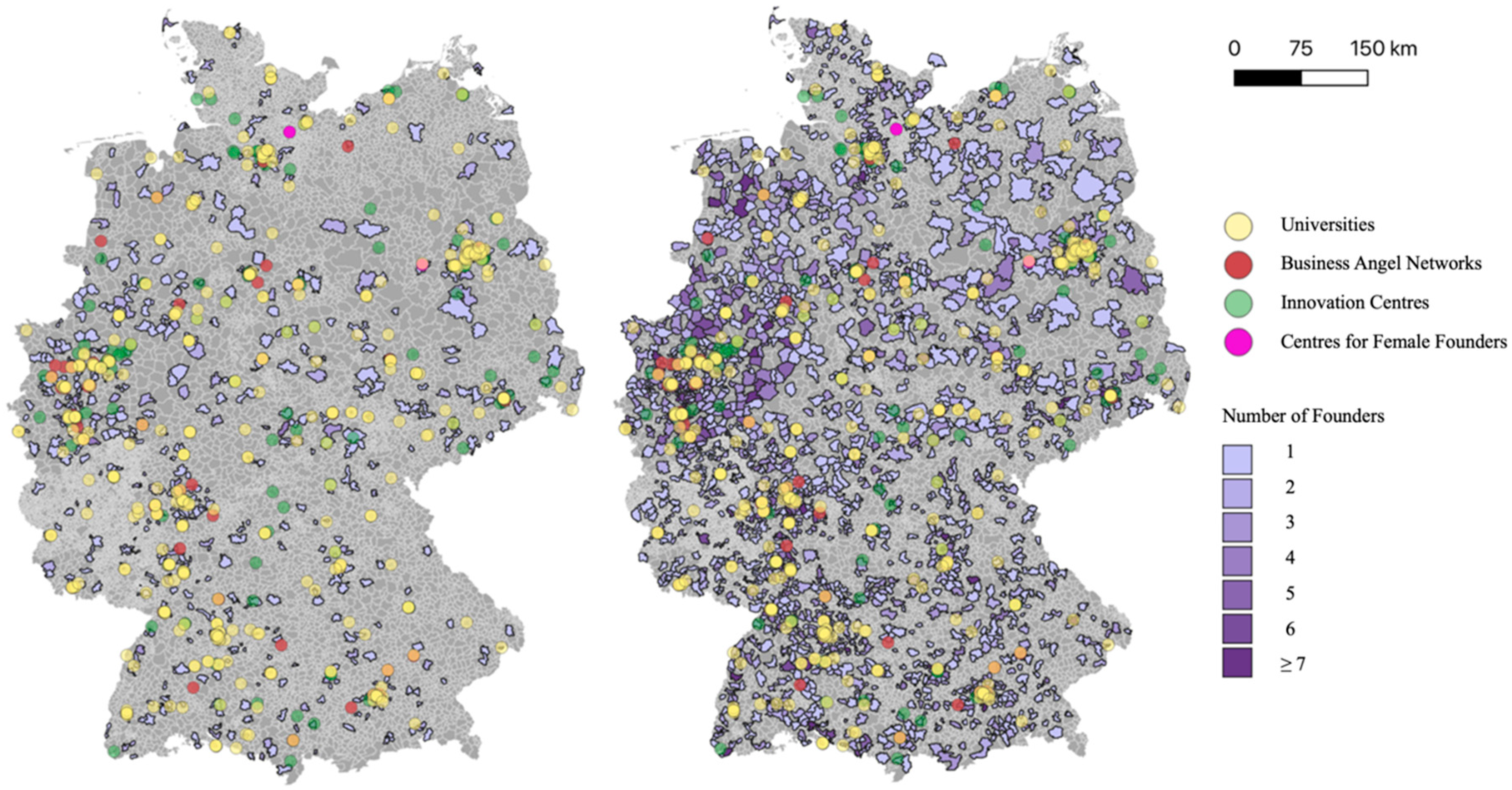
To aid readability, we use a layered visualization strategy. Figure 1 and Figure 4 show the underlying point data, namely founder and infrastructure locations, for transparency and to preserve micro-geographic detail that is relevant for place-based targeting. The synthetic interpretation should primarily rely on the density-based and classified maps in Figure 2 and Figure 3, i.e., kernel density and hot/cold-spot mapping, complemented by the statistical evidence in Table 1 and Table 2. The point overlays are therefore not intended to be assessed point-by-point, but to document the raw spatial configuration that underlies the proximity measures.
Figure 1.
Distribution of Female and Male Founders with Infrastructure Points. Note. Overlay map (left) shows the distribution of female founders. Overlay map (right) shows the distribution of male founders. This point overlay is included to document the raw spatial distribution at micro-geographic resolution. For a more synthetic view, see the kernel-density and hot/cold-spot maps in Figure 2 and Figure 3. Scale: 1:250,000. Projection: UTM Zone 32N (ETRS89/GRS80). Source: (BKG, 2025). The scale, projection, and source apply to all figures unless otherwise stated.
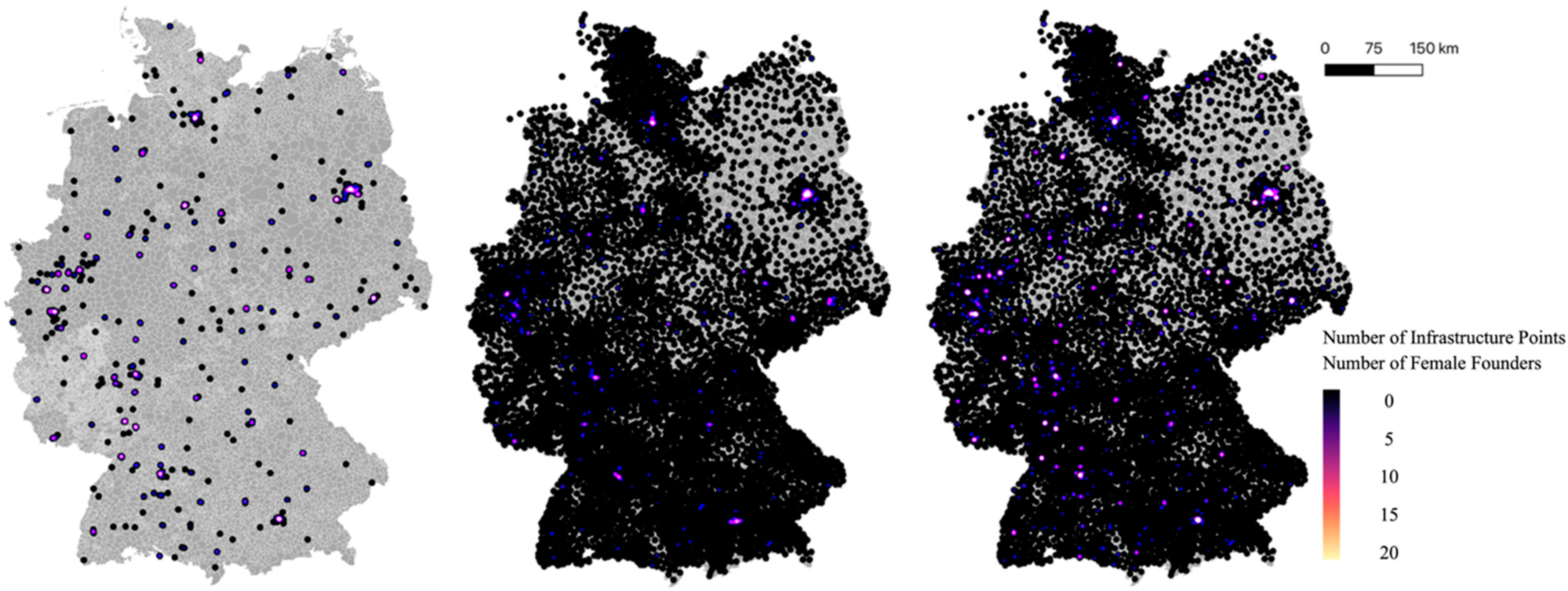
Figure 2.
Heatmaps of Infrastructure and Female Founders. Note. Heatmap (left) shows the density of infrastructure points. Heatmap (middle) shows the density of female founders. Heatmap (right) shows the overlay of both heatmaps.
Figure 3.
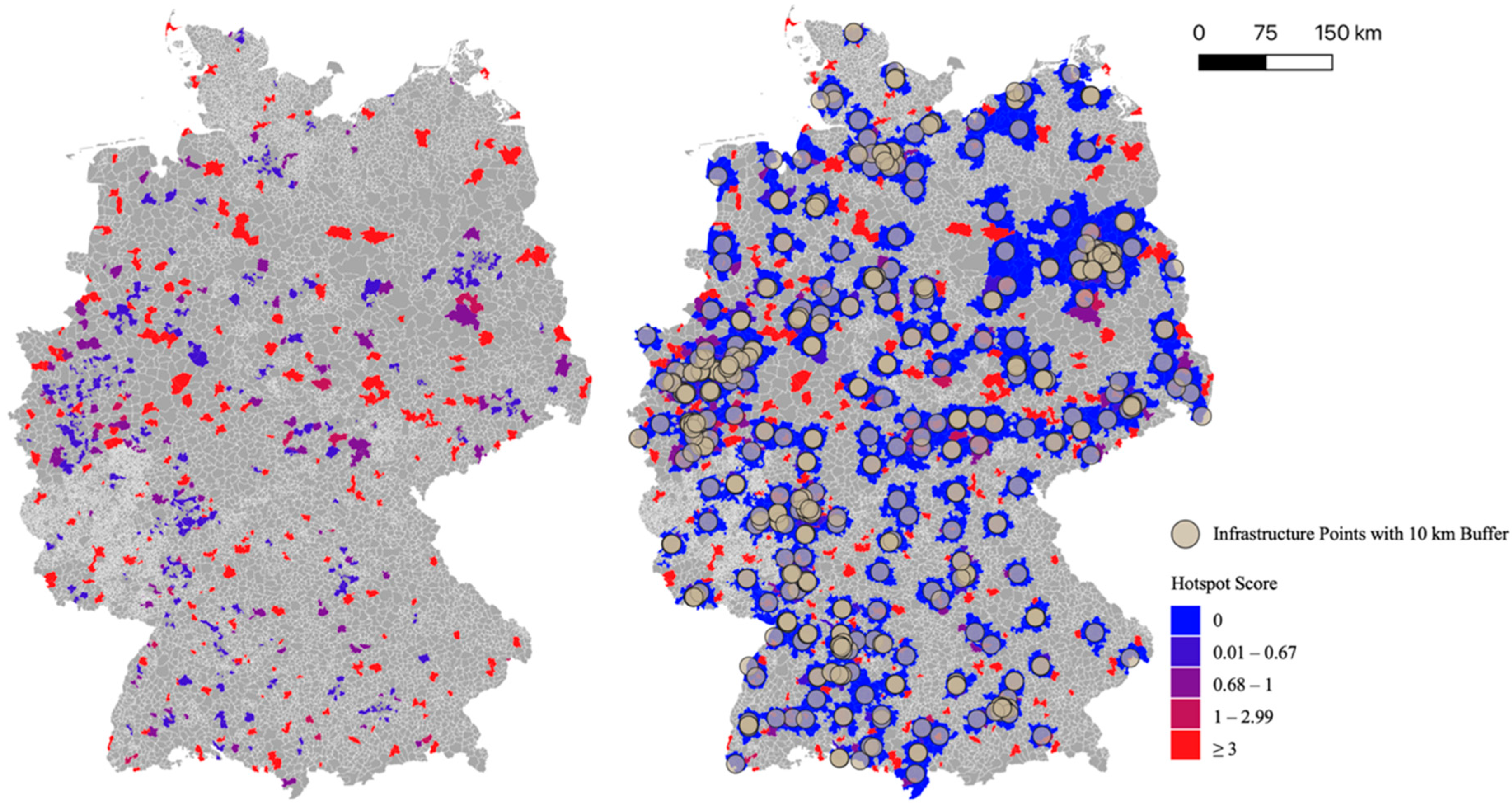
Hot-spot–Cold-Spot Analysis of Female Founders and Infrastructure. Note. Map (left) shows red hot-spots and blue cold-spots within a 10 km buffer considering PLZ areas with female founders and infrastructure. Map (right) shows, in addition, PLZ areas with infrastructure points but no female founders as cold-spots.
Table 1.
Means, Standard Deviations and Correlations.
Table 2.
Additional correlation and regression results.
Figure 1 compares the spatial distribution of founders and support infrastructure. The male-only layer is shown as a comparator to contextualize the female patterns and to assess whether proximity gradients are general or gender-specific. The left map shows female founders and the right map shows male founders. Male-led ventures appear across Germany, including regions with sparse infrastructure such as Mecklenburg-Vorpommern. Female founders are more concentrated and rarely located in low-density areas. Both groups cluster around major urban hubs with abundant support nodes: Berlin, Hamburg, Frankfurt am Main, and the Ruhr Area.
Figure 2 visualizes kernel density patterns for support infrastructure and female founders. The left heatmap highlights areas with dense infrastructure, and the middle map shows concentrations of female founders. The right overlay identifies regions where both factors coincide. Berlin, Hamburg, Munich, and the Ruhr Area exhibit the highest combined densities. In cities, hot-spots are compact, while in the Ruhr Area, they cover a broader corridor. Black centroids mark PLZ areas without infrastructure or female founders to emphasize spatial variation and enhance readability.
Figure 3 classifies PLZ areas into three categories. Hot-spots (purple) show strong female founding activity where support infrastructure is also dense. Founder-only areas (red) indicate female founders without proximate infrastructure. Cold-spots (blue) mark places with good infrastructure but comparatively few female founders. Both maps use a 10 km buffer. The left map considers only areas with female founders. The right map additionally flags PLZs that host infrastructure nodes but no female founders.
Policy signals differ by class. Hot-spots may warrant incremental capacity, targeted mentoring, or bridge programs to nearby districts. Cold-spots call for demand activation, awareness, and tailored entry points for women founders.
We examine German cities above 500,000 inhabitants using a population-weighted hot-spot score. For each city, we sum the product of each PLZ’score and its resident count, then divide by the city’s total residents. This weights each area by population and avoids over- or underrepresentation.
The five lowest-scoring large cities are Dortmund (0.0087), Berlin (0.0118), Munich (0.0125), Bremen (0.0126), and Essen (0.0135). Duisburg is the only large city with no female founders in the observation window. These cities host substantial infrastructure yet trail the national benchmark of 0.0368, indicating untapped potential. In Berlin, for example, the score would need to more than triple to reach the benchmark.
The benchmark is a relative indicator, which does not quantify how many additional women founders each node could support within 10 km. Some capacity may already serve male-led ventures. Cold-spots, therefore, highlight gaps between infrastructure availability and female founder presence, helping policymakers prioritize outreach, programming, and connection strategies.
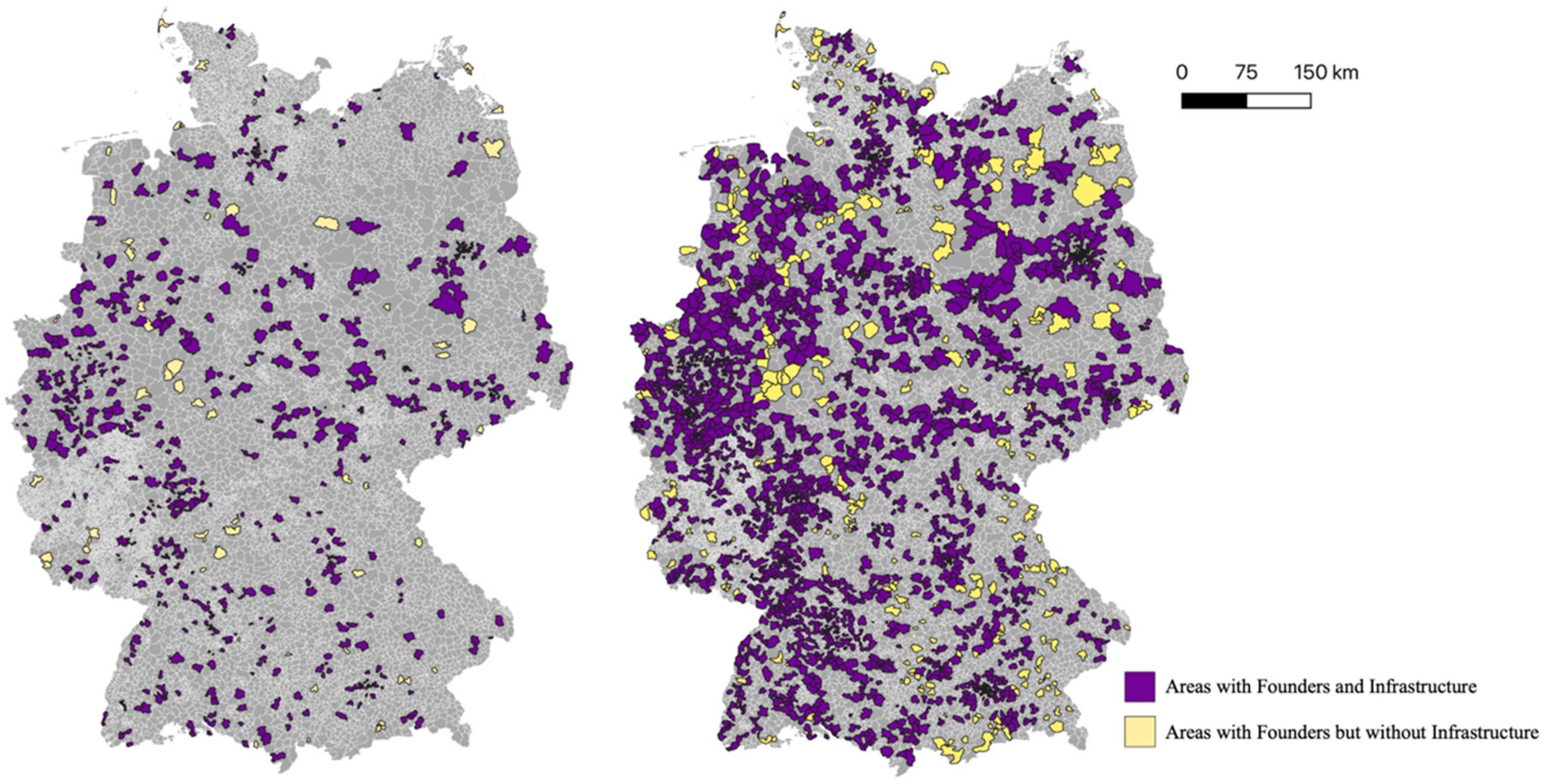
Overlays of infrastructure points with female and male founder locations are depicted in Figure 4. Since the analysis uses PLZ areas as spatial units, we represent each PLZ by its centroid and approximate reachability with 10 and 20 km distance bands (buffers). This accounts for founders benefiting from nearby infrastructure even if the facility is located in a neighboring PLZ area.
Figure 4.
Joined Layers Female/Male Founders and Infrastructure with Buffer. Note. Map (left) shows areas with female founders. Map (right) shows areas with male founders. A buffer of 20 km is used. The figure visualizes the full set of mapped points to preserve spatial granularity. The policy-relevant synthesis is provided by the hot-spot/cold-spot classification (Figure 3) and the correlation/regression tables.
The descriptive statistics are presented in Table 1. The results show that spatial patterns of female entrepreneurship correspond to the distribution of entrepreneurial support infrastructure in Germany to a small extent, as shown in Figure 1, Figure 2, Figure 3 and Figure 4 and in Table 1.
The additional analyses support our main findings. Spearman rank correlations confirm the positive association between support infrastructure and female founders (ρ = 0.316, p < 0.001 for 10 km buffers) and show similar patterns for male founders (ρ = 0.591, p < 0.001). Permutation tests indicate that the observed Pearson correlations (r = 0.26 for women, r = 0.31 for men within 10 km) are highly unlikely under random spatial assignments (p ≈ 0.0005). Partial correlations controlling for overall entrepreneurial activity reduce the magnitude but remain positive and significant for women (r = 0.109, p < 0.001). Negative binomial models indicate that, within the model specification, each additional support point within 10 km is associated with a 2.4% increase in expected female founders (IRR = 1.024) versus a 1.3% increase for male founders (IRR = 1.013), with the interaction term indicating a significantly stronger effect for women (p = 0.011). Interpreted as model-implied associations rather than causal effects, a difference of ten extra points corresponds to approximately 26.6% higher expected female founder counts compared with 13.5% for males. The 20 km models become insignificant once the population is controlled. The binomial model indicates that ten additional support nodes (10 km) are associated with 12.1% higher odds that a venture is women-founded (OR = 1.121, p < 0.001).
Hypothesis 1 predicted that regions with denser entrepreneurial infrastructure host more founders. Overlay and buffer analyses are consistent with this relationship. Within a 10 km radius, female founders show a small positive correlation with infrastructure (r = 0.26, p < 0.001). At 20 km, the association weakens (r = 0.15, p < 0.001). Male founders display a moderate correlation at 10 km (r = 0.31, p < 0.001) and a small correlation at 20 km (r = 0.14, p < 0.001). In both cases, stronger correlations at shorter distances are consistent with distance decay in ecosystem access, as suggested by spatial interaction and knowledge spillover arguments (Acs et al., 2009; Audretsch & Feldman, 1996). These geospatial patterns visually support Hypothesis 1.
Hypothesis 2 proposed a stronger spatial correlation for women than for men. Kernel-density, overlay, and correlation analyses provide partial support. At 20 km, the correlation for women (r = 0.15) slightly exceeds that for men (r = 0.14), and heatmaps show tighter clustering of female founders near support nodes. However, within 10 km the male correlation (r = 0.31) surpasses the female value (r = 0.26), contradicting the hypothesis. Overall, women founders appear more concentrated around infrastructure, yet proximity effects are not uniformly stronger for women across all distances.
5. Discussion
Our discussion interprets the results as policy-relevant spatial diagnostics rather than as causal estimates. The observed associations are small to moderate in magnitude and attenuate with distance, and gender differences are nuanced across specifications. This is consistent with the cross-sectional, correlational design and with the view that place-based tools should be targeted using transparent indicators and then tested and refined through evaluation and iterative learning (Glaeser & Gottlieb, 2008; Kline & Moretti, 2014; Neumark & Simpson, 2015).
5.1. Contributions
This study extends research on women’s entrepreneurship by foregrounding formal support infrastructure within entrepreneurial ecosystems. Prior work highlights networks as a core ecosystem feature (Isenberg, 2010; Neumeyer et al., 2019; Spigel, 2017). Much of the gender literature contrasts women with men, yet gives less attention to what enables women to found and grow ventures (Chatterjee et al., 2018; Deng et al., 2021). We address this gap by analyzing how the proximate presence of universities, innovation centers—including women-focused hubs—and business angel (BA) networks relates to female founding. Universities matter because education can strengthen entrepreneurial intentions and behaviors (Salamzadeh et al., 2022; Sampene et al., 2023). Innovation centers provide space, coaching, and structured pathways that are critical in the early stages. BA networks add early risk capital, market knowledge, and reputational lift that catalyze first customers and follow-on finance (Giglio, 2021). While prior studies often examine these institutions in isolation, our approach integrates them as a composite support infrastructure, offering a more holistic view of how the proximate presence of formal nodes covaries with women’s founding activity in space, while remaining agnostic about causal direction in a cross-sectional setting (Kline & Moretti, 2014; Neumark & Simpson, 2015).
By mapping the distribution of founders and support nodes and quantifying proximity–entrepreneurship associations, we document that spatial alignment between women’s founder presence and proximate support infrastructure is positively associated with female founding activity. The hot-spot and cold-spot patterns provide a transparent way to prioritize places for outreach, program design, and subsequent evaluation, rather than a ranking of guaranteed returns (Glaeser & Gottlieb, 2008; Kline & Moretti, 2014; Neumark & Simpson, 2015). This micro-geographic lens can advance ecosystem research by adding place-based categories that may remain hidden in higher-level aggregates (Schäfer, 2021). The hot-spot patterns align with innovation-driven clustering logics that support benchmarking and targeted learning across regions (Alqararah & Alnafrah, 2024).
Finally, the paper offers context-specific insights by focusing on Germany. European approaches to supporting women entrepreneurs vary with national institutions and social norms (Welter, 2004). A single-country design reduces confounding from cross-national heterogeneity (cultural, religious, and policy differences) that complicate identification and interpretation. This focus enables a tighter dialog between evidence and policy instruments, producing findings that are both theoretically informative and operational for practitioners (Henry et al., 2017). The framework is portable. Future work can replicate the spatial indicators in other countries and compare patterns to build a more granular global picture of women’s entrepreneurial networks.
5.2. Limitations and Future Research
This study provides a policy-oriented spatial analysis, yet several limitations qualify the interpretation and guide next steps.
First, temporal alignment is imperfect. The venture microdata cover founding cohorts 2015–2021 due to release lags, while infrastructure inventories were compiled in 2025. Pooling multiple cohorts dampens short-term volatility and many anchor institutions change slowly, so the qualitative proximity gradient is expected to be relatively stable in the near term, but local post-2021 shifts cannot be ruled out. Updating the venture layer when newer waves become available is therefore a priority.
Second, measurement choices prioritize auditability but imply abstraction. Proximity is measured via Euclidean buffers around PLZ centroids and infrastructure is counted as unweighted nodes. This supports replicability but does not capture travel-time frictions or heterogeneity in capacity and specialization. Future work should implement travel-time isochrones and capacity- or activity-weighted infrastructure measures, potentially combined with explicit distance-decay functions (Kline & Moretti, 2014; Neumark & Simpson, 2015).
Third, the analysis is based on absolute PLZ-level counts. Normalizing by population, labor force, or business density, and stratifying by sector, would refine benchmarking and reduce scale effects linked to urbanity. Moreover, we do not observe actual uptake of support services or the mode of access. In an increasingly hybrid support landscape, digital delivery may expand reach for some services, yet several high-friction mechanisms remain place-bound. Measuring usage intensity and hybridization is an important next step.
Finally, inference remains associational. The maps and correlations are suited for diagnostics and targeting but do not identify causal effects of institutions on founding. Quasi-experimental designs around openings or closures of support nodes and spatial econometric approaches can complement the diagnostic, and linking proximity measures to survival and growth outcomes would broaden the policy relevance.
In sum, the study’s choices favor clarity, auditability, and national coverage. They also point to concrete extensions. A future research agenda would compile time-aligned venture and infrastructure panels, introduce capacity weights and distance-decay, report normalized indicators next to absolute counts, experiment with travel-time isochrones, stratify by sector, and integrate qualitative interviews with women founders to trace how support is actually accessed and where frictions persist. These additions would refine spatial targeting and help administrations convert underused infrastructure into visible gains in women’s entrepreneurship.
5.3. Practical and Political Implications
Our results can inform place-based support of women entrepreneurship by identifying where founder presence and proximate support infrastructure are aligned and where they are not. The maps provide a prioritization heuristic for targeting outreach and program delivery, but they do not identify causal effects of infrastructure on founding. Consistent with place-based policy guidance, the appropriate next step is to pair targeting with monitoring and, where feasible, evaluation designs that test which instruments work best in which places (Glaeser & Gottlieb, 2008; Kline & Moretti, 2014; Neumark & Simpson, 2015).
State and municipal governments may consider using cold-spots as priority candidates for near-term activation, particularly where infrastructure is present but women’s founder presence is comparatively low. We outline three candidate instruments that are feasible within existing policy toolkits and can be piloted and evaluated locally: First, part-time Women-in-Residence connectors embedded in universities or innovation centers can be funded to curate mentoring, host open office hours, and coordinate investor introductions. Evidence from ecosystem research highlights the central role of relational brokerage and locally grounded ties (Brown & Mason, 2014; Mueller, 2024; Spigel, 2017). Second, access vouchers could be offered in the form of time-limited vouchers for coaching, legal and financial advice, and prototype support redeemable at accredited centers. Vouchers reduce search and price frictions without having to build new facilities and are compatible with municipal procurement rules. Program design should go hand in hand with regulatory housekeeping, because scaling barriers often arise from complex, multi-level rules (McArdle et al., 2024). Third, mobility and timing disadvantages could be fixed by extended center opening hours, providing childcare support during evening events and piloted micro-mobility or public transport passes tied to program participation. These reduce the effective distance that often constrains participation.
In a digitizing support environment, the most realistic policy lever is not to focus on digital instead of place-based measures, but to foster hybrid access on top of local anchors. For cold-spots, this implies a bridge-to-hubs design, such as regular virtual office hours, remote mentoring matches, and online investor days, combined with periodic in-person pop-up formats hosted by nearby universities or centers. This reduces time and travel frictions without abandoning the anchoring and trust functions of physical nodes. Our maps can be used to prioritize where such hybrid bridges should be deployed first.
Federal governments could use the indicators to allocate and monitor funding within a place-based policy logic. Two moves are immediate: First, an activation fund focusing on cold-spots could be introduced that matches state or municipal spending in priority zones on a two-to-one basis for eighteen months. Second, a gender-responsive co-investment window with BA networks that rewards investments in cold-spots could be installed, while keeping selection private and merit-based. Place-based policy guidance underscores the gains from targeting and rigorous monitoring of local development tools (Glaeser & Gottlieb, 2008; Kline & Moretti, 2014; Neumark & Simpson, 2015).
Local agencies should also co-sponsor events with regional BA networks to widen pipelines and publish rolling calendars of center events to raise uptake. Implementation should be light on paperwork and deliberately visible.
For founders and intermediaries, the evidence gives women practical guidance on where to start a business. Hot-spots offer dense peer effects, visible role models, and faster introductions. Cold-spots combine underused infrastructure with low female-founder presence. They can yield outsized attention from local providers and room to shape programs. Founder associations and chambers can use the maps to organize initiatives in cold-spots, match newcomers to local mentors and angels, and broker short residency periods in nearby hubs. Peer reinforcement matters for persistence and field choices, which strengthens the case for visible, proximate networks (Gaule & Piacentini, 2018).
In times of digital entrepreneurship, remote support expands reach. However, trust building, sensitive negotiations, and access to physical resources remain place-bound. Program design should combine hybrid delivery with in-person anchors to protect the benefits of proximity while widening access. This is especially relevant for founders with tighter time budgets.
In short, the findings enable targeted, auditable action. They point to practical levers at municipal, state, and federal levels and to a monitoring architecture that fits established guidance on place-based economic policy while addressing the specific access frictions women founders face (Brush et al., 2009; Henry et al., 2016; Kline & Moretti, 2014; Neumark & Simpson, 2015; Spigel, 2017).
6. Conclusions
This paper examines the geography of women entrepreneurship in Germany and links founders’ locations to local entrepreneurial support. We examine whether proximity to formal support infrastructure is associated with women entrepreneurship, given gendered access frictions discussed in prior work (Brush et al., 2009; Gimenez-Jimenez et al., 2022; Hampton et al., 2011; Henry et al., 2016; Sarin & Wieland, 2016). The evidence supports our hypothesis that regions with denser support infrastructure tend to host more founders. For the second hypothesis, results are mixed: At short distances, the association is stronger for men. At wider distances, the association becomes slightly stronger for women. Overall, proximity is relevant for both groups, with distance bands shaping the pattern. Accordingly, we avoid one-size-fits-all claims about gender-specific distance sensitivity and emphasize the distance-decay pattern and the diagnostic value of identifying spatial mismatches.
The contribution is twofold. Theoretically, we add a spatial lens to the literature on women’s entrepreneurship, clarifying how formal nodes relate to founder presence. Practically, the maps and indicators offer a policy-ready toolkit. Authorities can pinpoint places where resources are well used, where support is thin, and where existing capacity is under-utilized. This enables more strategic allocation, targeted activation of local institutions, and monitoring of progress toward gender-inclusive entrepreneurial ecosystems.
From a policymaker perspective, the results can be used as a simple three-step playbook. First, using the hot-spot and cold-spot maps, with the 10 km band as the most actionable distance for local programming, policymakers can diagnose where women’s founder presence and proximate support are misaligned. Second, instruments conditional on the type of mismatch can be selected. Where infrastructure exists, but female founder presence is low, policymakers may prioritize demand activation, visibility, and women-tailored programming at existing nodes. Where both founder presence and infrastructure are weak, a pragmatic option is to strengthen coverage by building bridges to nearby hubs through mobile or pop-up formats and hybrid access that reduces time and travel frictions. Third, progress can be monitored by re-running the indicators periodically and tracking a compact KPI set that is compatible with administrative reporting.
Because the venture layer aggregates several cohorts and many infrastructure anchors are structurally stable, the mapped proximity gradients are likely to remain informative for near-term spatial targeting decisions. The indicators are intentionally simple and auditable so that policy teams can re-run the mapping exercise periodically and track changes as newer venture microdata become available.
Author Contributions
Conceptualization, J.T. and V.T.; methodology, J.T.; software, J.T.; validation, J.T.; formal analysis, J.T.; investigation, J.T.; resources, J.T.; data curation, J.T.; writing—original draft preparation, J.T. and V.T.; writing—review and editing, J.T. and V.T.; visualization, J.T.; supervision, V.T. The authors used the support of AI tools to improve the argumentation and wording of the manuscript that was originally written by the authors. All authors have read and agreed to the published version of the manuscript.
Funding
This research received no external funding.
Institutional Review Board Statement
Not applicable.
Informed Consent Statement
Not applicable.
Data Availability Statement
The data used in this study (IAB/ZEW Start-up Panel) were obtained from ZEW-Leibniz-Zentrum für Europäische Wirtschaftsforschung, Mannheim, Germany and are available from ZEW with the permission of the data provider and subject to a data use agreement. Requests to access these datasets can be directed to ZEW.
Conflicts of Interest
The authors declare no conflict of interest.
Appendix A
- R-Code
- #cleaning workspace
- rm(list = ls())
- if (is.null(dev.list()) == FALSE) dev.off()
- cat (“\014”)
- #load packages
- library(openxlsx)
- library(apaTables)
- install.packages(“psych”)
- #read data
- df <- read.xlsx(“/Users/josephintieze/Desktop/correlation/Datacorrel.xlsx”, sheet = “Datages”)
- #new labels assigned as vector names
- cor_data <- df[, c(“numwomen_10km”, “numwomen_20km”,
- “nummen_10km”, “nummen_20km”,
- “infracount_10km”, “infracount_20km”)]
- #set labels
- colnames(cor_data) <- c(
- “Female Founders (10 km)”,
- “Female Founders (20 km)”,
- “Male Founders (10 km)”,
- “Male Founders (20 km)”,
- “Infrastructure (10 km)”,
- “Infrastructure (20 km)”
- )
- #create an APA correlation table
- apa.cor.table(cor_data,
- filename = “/Users/josephintieze/Desktop/correlation/correlationtable.doc”, table.number = 1)
- # calculate correlations
- cor_results <- corr.test(cor_data, use = “pairwise”)
- # show results
- cor_results$r # correlations
- cor_results$p # p-values
- cor_results$ci # CI
- cor_results$n # N per correlation
References
- Acs, Z. J., Braunerhjelm, P., Audretsch, D. B., & Carlsson, B. (2009). The knowledge spillover theory of entrepreneurship. Small Business Economics, 32(1), 15–30. [Google Scholar] [CrossRef] [Scilit]
- Alqararah, K., & Alnafrah, I. (2024). Innovation-driven clustering for better national innovation benchmarking. Journal of Entrepreneurship and Public Policy, 13(2), 234–254. [Google Scholar] [CrossRef] [Scilit]
- Audretsch, D. B., & Feldman, M. P. (1996). R&D spillovers and the geography of innovation and production. American Economic Review, 86(3), 630–640. [Google Scholar]
- Avdeitchikova, S., Landström, H., & Månsson, N. (2008). What do we mean when we talk about business angels? Some reflections on definitions and sampling. Venture Capital, 10(4), 371–394. [Google Scholar] [CrossRef] [Scilit]
- Avolio, B., Prados Peña, M. B., & Fuentes-Fuentes, M. d. M. (2025). Family environment and entrepreneurial intention: The moderating effect of university environment among university students in Spain. Journal of Entrepreneurship and Public Policy, 14(4), 693–714. [Google Scholar] [CrossRef] [Scilit]
- Bae, T. J., Qian, S., Miao, C., & Fiet, J. O. (2014). The relationship between entrepreneurship education and entrepreneurial intentions: A meta-analytic review. Entrepreneurship Theory and Practice, 38(2), 217–254. [Google Scholar] [CrossRef] [Scilit]
- BAND (Business Angels Netzwerk Deutschland). (n.d.). Mitgliederverzeichnis. Available online: https://www.business-angels.de/mitglieder/ (accessed on 15 June 2025).
- Bates, T. (2002). Restricted access to markets characterizes women-owned businesses. Journal of Business Venturing, 17(4), 313–324. [Google Scholar] [CrossRef] [Scilit]
- BDITGB (Bundesverband Deutscher Innovations-, Technologie- und Gründerzentren e. V.). (n.d.). Mitglieder/Zentren. Innovationszentren in Deutschland. Available online: https://www.innovationszentren.de/mitglieder-zentren/mitglieder-zentren/ (accessed on 15 June 2025).
- BKG (Bundesamt für Kartographie und Geodäsie). (2025). Verwaltungsgebiete 1:250,000, stand 01.01. (VG250 01.01) [Shapefile dataset]. Available online: https://gdz.bkg.bund.de/index.php/default/verwaltungsgebiete-1-250-000-stand-01-01-vg250-01-01.html (accessed on 15 June 2025).
- Booth, A. L., & Nolen, P. (2012). Gender differences in risk behaviour: Does nurture matter? The Economic Journal, 122(558), F56–F78. [Google Scholar] [CrossRef] [Scilit]
- Brettel, M. (2003). Business angels in Germany: A research note. Venture Capital, 5(3), 251–268. [Google Scholar] [CrossRef] [Scilit]
- Brown, R., & Mason, C. (2014). Entrepreneurial ecosystems and growth-oriented entrepreneurship. OECD LEED Programme Background Paper, The Hague, Netherlands, 7 November 2013, Final Version: January 2014. OECD. [Google Scholar]
- Brush, C. G., De Bruin, A., & Welter, F. (2009). A gender-aware framework for women’s entrepreneurship. International Journal of Gender and Entrepreneurship, 1(1), 8–24. [Google Scholar] [CrossRef] [Scilit]
- Buss, M., Andler, S., & Tiberius, V. (2025). Female Leadership: An integrative review and research framework. The Leadership Quarterly, 36(3), 101858. [Google Scholar] [CrossRef] [Scilit]
- Chatterjee, S., Dutta Gupta, S., & Upadhyay, P. (2018). Empowering women and stimulating development at bottom of pyramid through micro-entrepreneurship. Management Decision, 56(1), 160–174. [Google Scholar] [CrossRef] [Scilit]
- Cohen, J. (1988). Statistical power analysis for the behavioral sciences (2nd ed.). Routledge. [Google Scholar] [CrossRef] [Scilit]
- Coleman, S., & Robb, A. (2016). Financing high growth women-owned enterprises: Evidence from the United States. In Women’s entrepreneurship in global and local contexts (pp. 183–202). Edward Elgar Publishing. [Google Scholar] [CrossRef] [Scilit]
- D’Andrea, F. A. M. C. (2023). Entrepreneurship and institutional uncertainty. Journal of Entrepreneurship and Public Policy, 12(1), 10–31. [Google Scholar] [CrossRef] [Scilit]
- Deng, W., Liang, Q., Li, J., & Wang, W. (2021). Science mapping: A bibliometric analysis of female entrepreneurship studies. Gender in Management, 36(1), 61–86. [Google Scholar] [CrossRef] [Scilit]
- Deyanova, K., Brehmer, N., Lapidus, A., Tiberius, V., & Walsh, S. (2022). Hatching start-ups for sustainable growth: A bibliometric review on business incubators. Review of Managerial Science, 16(7), 2083–2109. [Google Scholar] [CrossRef] [Scilit]
- Farr-Wharton, R., & Brunetto, Y. (2007). Women entrepreneurs, opportunity recognition and government-sponsored business networks: A social capital perspective. Women in Management Review, 22(3), 187–207. [Google Scholar] [CrossRef] [Scilit]
- Fritsch, M., Obschonka, M., & Wyrwich, M. (2018). Historical roots of entrepreneurship-facilitating culture and innovation activity: An analysis for German regions. Small Business Economics, 51(3), 645–664. [Google Scholar] [CrossRef] [Scilit]
- Fritsch, M., & Wyrwich, M. (2014). The long persistence of regional entrepreneurship culture: Germany 1925 to 2005. Regional Studies, 48(6), 955–973. [Google Scholar] [CrossRef] [Scilit]
- Gaule, P., & Piacentini, M. (2018). An advisor like me? Advisor gender and post-graduate careers in science. Research Policy, 47(4), 805–813. [Google Scholar] [CrossRef] [Scilit]
- GEM (Global Entrepreneurship Monitor). (2024). 2023/24 women’s entrepreneurship report: Reshaping economies and communities. Global Entrepreneurship Research Association. Available online: https://www.gemconsortium.org/reports/womens-entrepreneurship (accessed on 28 June 2025).
- Giglio, F. (2021). Women entrepreneurs and business angel: A difficult relationship. International Journal of Economics and Finance, 13(11), 25–33. [Google Scholar] [CrossRef] [Scilit]
- Gimenez-Jimenez, D., Edelman, L. F., Dawson, A., & Calabrò, A. (2022). Women entrepreneurs’ progress in the venturing process: The impact of risk aversion and culture. Small Business Economics, 58(2), 1091–1111. [Google Scholar] [CrossRef] [Scilit]
- Glaeser, E. L., & Gottlieb, J. D. (2008). The economics of place-making policies. Brookings Papers on Economic Activity, 2008(1), 155–239. [Google Scholar] [CrossRef] [Scilit]
- Gupta, N., & Mirchandani, A. (2018). Investigating entrepreneurial success factors of women-owned SMEs in UAE. Management Decision, 56(1), 219–232. [Google Scholar] [CrossRef] [Scilit]
- Guzman, J., & Kacperczyk, A. (2019). Gender gap in entrepreneurship. Research Policy, 48(7), 1666–1680. [Google Scholar] [CrossRef] [Scilit]
- Hampton, A., McGowan, P., & Cooper, S. (2011). Developing quality in female high-technology entrepreneurs’ networks. International Journal of Entrepreneurial Behavior & Research, 17(6), 588–606. [Google Scholar] [CrossRef] [Scilit]
- Hägg, G., & Schölin, T. (2018). The policy influence on the development of entrepreneurship in higher education: A Swedish perspective. Education+ Training, 60(7/8), 656–673. [Google Scholar] [CrossRef] [Scilit]
- Hechavarría, D. M., & Ingram, A. E. (2019). Entrepreneurial ecosystem conditions and gendered national-level entrepreneurial activity: A 14-year panel study of GEM. Small Business Economics, 53(2), 431–458. [Google Scholar] [CrossRef] [Scilit]
- Henry, C., Foss, L., & Ahl, H. (2016). Gender and entrepreneurship research: A review of methodological approaches. International Small Business Journal, 34(3), 217–241. [Google Scholar] [CrossRef] [Scilit]
- Henry, C., Orser, B., Coleman, S., Foss, L., & Welter, F. (2017). Women’s entrepreneurship policy: A 13-nation cross-country comparison. In Entrepreneurial ecosystems and growth of women’s entrepreneurship (pp. 244–278). Edward Elgar Publishing. [Google Scholar] [CrossRef] [Scilit]
- Hochberg, Y. V. (2016). Accelerating entrepreneurs and ecosystems: The seed accelerator model. Innovation Policy and the Economy, 16(1), 25–51. [Google Scholar] [CrossRef] [Scilit]
- Hoppe, M. (2016). Policy and entrepreneurship education. Small Business Economics, 46(1), 13–29. [Google Scholar] [CrossRef] [Scilit]
- HRK (Hochschulrektorenkonferenz). (n.d.). Download hochschullisten. Hochschulkompass. Available online: https://www.hochschulkompass.de/hochschulen/downloads.html (accessed on 15 June 2025).
- Isenberg, D. J. (2010). How to start an entrepreneurial revolution. Harvard Business Review, 88(6), 40–50. Available online: https://dhriiti.com/wp-content/uploads/2017/11/Isenberg-How-to-Start-an-Entrepreneurial-Revolution.pdf (accessed on 15 June 2025).
- Jamali, D. (2009). Constraints and opportunities facing women entrepreneurs in developing countries: A relational perspective. Gender in Management, 24(4), 232–251. [Google Scholar] [CrossRef] [Scilit]
- Jennings, J. E., & McDougald, M. S. (2007). Work-family interface experiences and coping strategies: Implications for entrepreneurship research and practice. Academy of Management Review, 32(3), 747–760. [Google Scholar] [CrossRef] [Scilit]
- Kline, P., & Moretti, E. (2014). People, places, and public policy: Some simple welfare economics of local economic development programs. Annual Review of Economics, 6(1), 629–662. [Google Scholar] [CrossRef] [Scilit]
- Klyver, K., & Grant, S. (2010). Gender differences in entrepreneurial networking and participation. International Journal of Gender and Entrepreneurship, 2(3), 213–227. [Google Scholar] [CrossRef] [Scilit]
- Koellinger, P., Minniti, M., & Schade, C. (2013). Gender differences in entrepreneurial propensity. Oxford Bulletin of Economics and Statistics, 75(2), 213–234. [Google Scholar] [CrossRef] [Scilit]
- Kuckertz, A., & Brem, A. (2023). Supporting innovation and growth through entrepreneurship: Reflections on the German Federal Government’s “startup strategy”. Journal of Entrepreneurship and Public Policy, 12(3/4), 197–208. [Google Scholar] [CrossRef] [Scilit]
- Laudano, M. C., Zollo, L., Ciappei, C., & Zampi, V. (2019). Entrepreneurial universities and women entrepreneurship: A cross-cultural study. Management Decision, 57(9), 2541–2554. [Google Scholar] [CrossRef] [Scilit]
- Mason, C., Botelho, T., & Duggett, J. (2022). Promoting cross-border investing by business angels in the European Union. Regional Studies, 56(8), 1391–1403. [Google Scholar] [CrossRef] [Scilit]
- Maxwell, A. L., Jeffrey, S. A., & Lévesque, M. (2011). Business angel early stage decision making. Journal of Business Venturing, 26(2), 212–225. [Google Scholar] [CrossRef] [Scilit]
- McArdle, J. F., de Koning, A. J., & Sherifi, A. (2024). Barriers to scale: The effect of regulations on entrepreneurial strategies in a nascent industry. Journal of Entrepreneurship and Public Policy, 13(4), 618–647. [Google Scholar] [CrossRef] [Scilit]
- Meeralam, E. A., & Adeinat, I. (2022). Understanding the role of universities in fostering female entrepreneurship in the emerging ecosystem. Gender in Management, 37(3), 388–404. [Google Scholar] [CrossRef] [Scilit]
- Mueller, C. E. (2024). What drives the effectiveness of public startup support programs? Journal of Entrepreneurship and Public Policy, 13(1), 111–133. [Google Scholar] [CrossRef] [Scilit]
- Neumark, D., & Simpson, H. (2015). Place-based policies. In G. Duranton, J. V. Henderson, & W. C. Strange (Eds.), Handbook of regional and urban economics (Vol. 5, pp. 1197–1287). Elsevier. [Google Scholar] [CrossRef] [Scilit]
- Neumeyer, X., Santos, S. C., Caetano, A., & Kalbfleisch, P. (2019). Entrepreneurship ecosystems and women entrepreneurs: A social capital and network approach. Small Business Economics, 53(2), 475–489. [Google Scholar] [CrossRef] [Scilit]
- Nor, A. I. (2024). Entrepreneurship development as a tool for employment creation, income generation, and poverty reduction for the youth and women. Journal of the Knowledge Economy, 15(4), 19387–19410. [Google Scholar] [CrossRef] [Scilit]
- Ostermann, K., Eppelsheimer, J., Gläser, N., Haller, P., & Oertel, M. (2022). Geodata in labor market research: Trends, potentials and perspectives. Journal for Labour Market Research, 56(1), 5. [Google Scholar] [CrossRef] [Scilit]
- Rosenbaum, G. O. (2017). Female entrepreneurial networks and foreign market entry. Journal of Small Business and Enterprise Development, 24(1), 119–135. [Google Scholar] [CrossRef] [Scilit]
- Salamzadeh, Y., Sangosanya, T. A., Salamzadeh, A., & Braga, V. (2022). Entrepreneurial universities and social capital: The moderating role of entrepreneurial intention in the Malaysian context. The International Journal of Management Education, 20(1), 100609. [Google Scholar] [CrossRef] [Scilit]
- Sampene, A. K., Li, C., Khan, A., Agyeman, F. O., & Opoku, R. K. (2023). Yes! I want to be an entrepreneur: A study on university students’ entrepreneurship intentions through the theory of planned behavior. Current Psychology, 42(25), 21578–21596. [Google Scholar] [CrossRef] [Scilit]
- Sarin, R., & Wieland, A. (2016). Risk aversion for decisions under uncertainty: Are there gender differences? Journal of Behavioral and Experimental Economics, 60, 1–8. [Google Scholar] [CrossRef] [Scilit]
- Schäfer, S. (2021). Spatialities of entrepreneurial ecosystems. Geography Compass, 15(9), e12591. [Google Scholar] [CrossRef] [Scilit]
- Schwartz, M. (2009). Beyond incubation: An analysis of firm survival and exit dynamics in the post-graduation period. The Journal of Technology Transfer, 34(4), 403–421. [Google Scholar] [CrossRef] [Scilit]
- Souitaris, V., Zerbinati, S., & Al-Laham, A. (2007). Do entrepreneurship programmes raise entrepreneurial intention of science and engineering students? The effect of learning, inspiration and resources. Journal of Business Venturing, 22(4), 566–591. [Google Scholar] [CrossRef] [Scilit]
- Spigel, B. (2017). The relational organization of entrepreneurial ecosystems. Entrepreneurship Theory and Practice, 41(1), 49–72. [Google Scholar] [CrossRef] [Scilit]
- Spigel, B., & Harrison, R. T. (2018). Toward a process theory of entrepreneurial ecosystems. Strategic Entrepreneurship Journal, 12(1), 151–168. [Google Scholar] [CrossRef] [Scilit]
- Stam, E., & van de Ven, A. (2021). Entrepreneurial ecosystem elements. Small Business Economics, 56(2), 809–832. [Google Scholar] [CrossRef] [Scilit]
- Stuetzer, M., Audretsch, D. B., Obschonka, M., Gosling, S. D., Rentfrow, P. J., & Potter, J. (2018). Entrepreneurship culture, knowledge spillovers and the growth of regions. Regional Studies, 52(5), 608–618. [Google Scholar] [CrossRef] [Scilit]
- Stuetzer, M., Obschonka, M., Brixy, U., Cantner, U., & Sternberg, R. (2014). Regional characteristics, opportunity perception and entrepreneurial activities. Small Business Economics, 42(2), 221–244. [Google Scholar] [CrossRef] [Scilit]
- Tiberius, V., Weyland, M., & Mahto, R. V. (2023). Best of entrepreneurship education? A curriculum analysis of the highest-ranking entrepreneurship MBA programs. The International Journal of Management Education, 21(1), 100753. [Google Scholar] [CrossRef] [Scilit]
- WeiberWirtschaft eG. (n.d.). Gründerinnen-/unternehmerinnenzentren in Deutschland. Available online: https://weiberwirtschaft.de/gewerberaeume-mieten/andere-gruenderinnenzentren/gruenderinnen-/unternehmerinnenzentren/ (accessed on 15 June 2025).
- Weis, L., & Lay, A. (2019). Gender-specific networking: Mind the gap. In Women, business and leadership (pp. 174–198). Edward Elgar Publishing. [Google Scholar] [CrossRef] [Scilit]
- Welter, F. (2004). The environment for female entrepreneurship in Germany. Journal of Small Business and Enterprise Development, 11(2), 212–221. [Google Scholar] [CrossRef] [Scilit]
- Welter, F. (2011). Contextualizing entrepreneurship—Conceptual challenges and ways forward. Entrepreneurship Theory and Practice, 35(1), 165–184. [Google Scholar] [CrossRef] [Scilit]

Disclaimer/Publisher’s Note: The statements, opinions and data contained in all publications are solely those of the individual author(s) and contributor(s) and not of MDPI and/or the editor(s). MDPI and/or the editor(s) disclaim responsibility for any injury to people or property resulting from any ideas, methods, instructions or products referred to in the content. |
© 2026 by the authors. Licensee MDPI, Basel, Switzerland. This article is an open access article distributed under the terms and conditions of the Creative Commons Attribution (CC BY) license.