1. Introduction
Firm size distributions provide fundamental insights into how economies allocate resources across productive units. Classical theories of firm growth, rooted in Gibrat’s Law and its stochastic extensions, conceptualize growth as a continuous process in which growth rates are independent of initial size, leading in the long run to smooth lognormal or Pareto distributions (
Gibrat, 1931;
Simon & Bonini, 1958). However, a large empirical literature documents systematic departures from these predictions. Across countries and institutional contexts, firm size distributions exhibit sharp discontinuities, excess mass, and abrupt density drops precisely at employment levels where labor regulations, tax obligations, or administrative requirements change discretely (
Schivardi & Torrini, 2008;
Martins, 2009;
Garicano et al., 2016). These patterns challenge standard growth models and raise a central policy-relevant question: do regulatory thresholds act as efficient screening mechanisms that sort firms by productivity, or do they constitute arbitrary barriers that constrain firm growth and generate aggregate misallocation?
The theoretical distinction between these mechanisms is critical. If regulatory thresholds function as efficient screens, only low-productivity firms should bunch below cutoffs, while more productive firms optimally absorb compliance costs to expand, generating positive productivity selection at regulatory boundaries. Conversely, if thresholds impose binding constraints regardless of productivity, even highly productive firms may remain trapped below efficient scale, leading to inefficient firm size distributions and growth-reducing misallocation (
Garicano et al., 2016). Canonical evidence from France illustrates this tension: although approximately one quarter of firms cluster just below the 50-employee threshold, no corresponding productivity discontinuity is observed at the cutoff (
Garicano et al., 2016). Similar patterns have been documented in Italy (
Schivardi & Torrini, 2008) and Portugal (
Martins, 2009). This absence of productivity-based selection contradicts standard theoretical predictions and remains one of the most persistent unresolved puzzles in the threshold literature.
Despite extensive documentation of threshold effects in advanced economies, three important gaps limit existing understanding. First, the mechanisms underlying absent productivity selection remain ambiguous. Observed bunching may reflect uniform avoidance across the productivity distribution, compositional effects whereby high-productivity firms strategically avoid approaching thresholds altogether, or local dynamics in which productivity does not predict crossing among firms near regulatory cutoffs. Distinguishing among these explanations requires combining full-distribution evidence with firm-level analysis of threshold-crossing behavior, yet most studies examine either aggregate bunching patterns or local crossing outcomes in isolation (
Garicano et al., 2016).
Second, the drivers of sectoral heterogeneity in threshold responses remain contested. Evidence from Colombia shows stark variation across industries, with some sectors strongly avoiding regulatory cutoffs while others actively seek them (
Caicedo et al., 2022). However, these patterns are consistent with both technological explanations—emphasizing production functions, labor substitutability, and minimum efficient scale—and institutional explanations that stress enforcement intensity and compliance costs relative to profit margins. Without jointly analyzing sectoral responses and firm behavior at thresholds, existing studies cannot conclusively adjudicate between these competing interpretations.
Third, and most critically for policy generalization, systematic evidence from developing and emerging economies—particularly in Latin America—remains scarce. Institutional environments in the region differ markedly from those in Europe, where most prior evidence originates. High levels of informality, affecting 50–70 percent of employment, may attenuate threshold effects by enabling firms to rely on hybrid formal–informal labor arrangements (
Mancellari, 2025). Enforcement is highly heterogeneous, with urban formal firms subject to regular inspections while rural or small firms often face limited oversight (
Lucas & Boudreaux, 2020). Moreover, multiple regulatory thresholds at 10, 15, 25, and 50 employees interact in ways not typically observed in European settings, while weak state capacity and enforcement uncertainty may further alter firms’ behavioral responses (
Amirapu & Gechter, 2020). These features suggest that threshold effects may operate through distinct mechanisms in developing contexts, yet existing theory largely assumes uniform enforcement and binary formality.
Although the international literature on firm size distributions, regulatory thresholds, and firm growth is substantial, most empirical evidence still comes from European economies. This concentration limits the external validity of existing findings, since the institutional environments, regulatory structures, and development trajectories of Latin American and other developing economies may shape firm growth dynamics in different ways.
This study addresses these gaps by providing the first comprehensive analysis of regulatory employment thresholds in Ecuador, a middle-income Latin American economy characterized by moderate informality, heterogeneous enforcement, and multiple regulatory cutoffs. Using a census of formal firms, we make four contributions. First, we extend threshold analysis beyond high-income settings by documenting firm size distortions in a developing economy and assessing whether patterns previously identified in European contexts also emerge under weaker institutional environments. Second, we integrate bunching estimation with regression discontinuity design and conditional crossing models, allowing us to distinguish between compositional selection on the extensive margin and local crossing behavior on the intensive margin, thereby shedding new light on the puzzle of absent productivity selection. Third, we examine cross-sectoral variation in bunching across technologically diverse industries to assess whether threshold effects are more consistent with institutional frictions or technological constraints. Fourth, we show that threshold crossing among proximate firms is more strongly associated with sales variation than with productivity advantages, helping clarify the mechanisms through which firms respond to nonlinear regulation. Against this background, the purpose of this study is to examine whether size-contingent employment regulations in Ecuador are associated with distortions in firm size distribution and whether these patterns are more consistent with productivity-based selection or with broader constraints on firm scaling, using a complementary empirical strategy that combines bunching analysis, regression discontinuity design, and threshold-crossing models.
By linking firm-level behavior to regulatory design, this analysis contributes to broader debates on firm growth, misallocation, and policy-induced distortions in emerging economies. If threshold effects persist even in contexts characterized by informality and weak enforcement, size-contingent regulations may impose meaningful constraints on firm scaling, underscoring the potential relevance of regulatory reform and improved regulatory design.
2. Literature Review
2.1. Regulatory Thresholds and Firm Size: Empirical Evidence and the Puzzle
Twentieth-century theories of firm growth, rooted in Gibrat’s Law and its stochastic extensions, conceptualize growth as an essentially continuous process in which growth rates are independent of initial size, leading in the long run to smooth lognormal or Pareto-type firm size distributions (
Gibrat, 1931;
Simon & Bonini, 1958;
Artige & Bignandi, 2023). Empirical evidence has consistently challenged this idealized view. Across countries, firm size distributions exhibit discontinuities, excess mass, and abrupt density drops—features closely linked to the relative scarcity of medium-sized firms (the “missing middle”)—that contradict proportional growth dynamics (
Cabral & Mata, 2003;
Tybout, 2000).
A key empirical regularity is that these discontinuities concentrate at employment levels where regulations change discretely. Firm size distributions display pronounced bunching and density drops precisely at thresholds tied to labor rules, tax obligations, or administrative requirements, suggesting that institutional discontinuities may actively distort size choices rather than merely reflect underlying technology (
Schivardi & Torrini, 2008;
Garicano et al., 2016). The central question is therefore whether employment thresholds proxy pre-existing technological or organizational constraints on growth, or whether they operate as policy-induced barriers that restrict economically efficient expansion. Addressing this issue requires separating two margins of adjustment: whether productive firms strategically avoid approaching thresholds (compositional selection on the extensive margin) and, among firms that reach threshold proximity, what distinguishes those that cross from those that bunch (local selection on the intensive margin).
The European evidence is particularly influential in establishing the magnitude of these distortions. In France, firms crossing the 50-employee threshold face multiple simultaneous regulatory obligations, including mandatory works councils, stricter dismissal protections, and expanded reporting requirements.
Garicano et al. (
2016) document substantial excess mass immediately below this cutoff, with roughly 25% more firms than predicted under a smooth counterfactual density clustering at 48–49 employees. These patterns disappear at employment levels without regulatory discontinuities, making technological economies of scale or market structure an unlikely explanation.
A central—and unresolved—insight from the French case concerns productivity-based selection. Standard compliance models predict that only sufficiently productive firms should find it optimal to absorb fixed regulatory costs and cross thresholds, implying a positive productivity discontinuity at the cutoff. However,
Garicano et al. (
2016) find no such discontinuity: firms with just above 50 employees are not systematically more productive than those with just below. This null result challenges the view that thresholds function as efficient screening mechanisms and instead suggests that threshold avoidance may be widespread across the productivity distribution. The implied welfare consequences can be substantial:
Garicano et al. (
2016) estimate that eliminating the French 50-employee threshold would increase GDP by 3.2%, consistent with significant efficiency losses from productive firms being constrained below their optimal scale.
Cross-country comparisons reinforce the relevance of institutional design while underscoring limits to inference from high-income settings. Italy’s 15-employee threshold generates more modest bunching of approximately 18% (
Schivardi & Torrini, 2008), while Portugal’s 50-employee cutoff produces intermediate effects around 22% (
Martins, 2009). Such variation indicates that nominal threshold levels alone do not determine behavioral responses. Instead, the literature points to differences in regulatory stringency and the cumulative burden of obligations triggered at thresholds, heterogeneity in enforcement intensity, and broader institutional factors related to state capacity and development. Importantly, these mechanisms are difficult to disentangle in European settings where regulatory design, enforcement capacity, and development level are tightly intertwined, complicating attempts to generalize findings to developing economies characterized by informality and heterogeneous enforcement.
2.2. Mechanisms and the Absence of Productivity Selection
The literature identifies three main mechanisms through which regulatory thresholds distort firms’ size choices: fixed compliance costs, labor adjustment costs, and the strategic use of informality. While each mechanism has been studied in isolation, its implications for productivity-based selection at regulatory cutoffs remain theoretically unresolved.
The first explanation emphasizes fixed compliance costs triggered discretely at employment thresholds, such as the establishment of worker committees, expanded reporting obligations, or formal human resource systems. Because these costs do not scale proportionally with firm size, they generate strong disincentives for firms operating near thresholds (
Huq et al., 2021). Evidence from reforms eliminating mandatory audits shows that affected firms increased employment growth by 0.59% in the subsequent year, confirming that compliance requirements constitute real barriers to expansion rather than mere administrative frictions (
Huq et al., 2021). However, if such costs were purely fixed, standard theory would predict rapid growth through thresholds to amortize them over a larger scale. The persistence of bunching, therefore, suggests that additional constraints limit adjustment or that compliance costs include components that intensify near regulatory cutoffs.
A second mechanism highlights labor adjustment costs and the quasi-fixed nature of employment. Building on
Oi’s (
1962) insight, recent studies show that regulatory thresholds amplify hiring and firing costs by intensifying dismissal protections and benefit obligations at specific employment levels (
Boustanifar & Verriest, 2023;
Karpuz et al., 2020). Reductions in dismissal costs have been shown to increase innovation and firm responsiveness by lowering adjustment frictions under demand uncertainty (
García-Vega et al., 2021). In this framework, firms delay hiring as they approach regulatory thresholds because adding workers becomes an increasingly irreversible commitment. Crossing occurs not when productivity rises sufficiently to justify fixed costs, but when exogenous demand shocks—such as large contracts or market expansions—make adjustment unavoidable (
Dossche et al., 2023). This mechanism predicts that threshold crossing is driven primarily by demand fluctuations rather than productivity advantages.
A third mechanism, particularly relevant in developing and emerging economies, involves the strategic use of informal employment to evade regulatory thresholds. Structural evidence shows that formal firms use informal labor not only to reduce tax burdens but also to circumvent labor adjustment costs, implying that ignoring informality substantially overstates formal adjustment frictions (
Mancellari, 2025). In Latin America, where informality often exceeds 50% of employment (
Coşkun, 2022), firms may maintain hybrid formal–informal workforces, keeping reported employment just below regulatory cutoffs while expanding informally. However, informality is an imperfect substitute for formal employment, especially for visible and established firms that face greater inspection risk. This helps explain why bunching persists even in contexts with widespread informality: informal labor can buffer adjustment costs but cannot fully replace formal expansion as firms approach regulatory thresholds.
These mechanisms generate distinct empirical predictions. If fixed compliance costs dominate, threshold crossing should be associated with positive productivity selection, as only sufficiently productive firms absorb regulatory costs. If labor adjustment costs are central, crossing should be predicted by exogenous demand shocks rather than productivity, with firms delaying hiring until adjustment becomes unavoidable. If informality plays a primary role, bunching should be more pronounced where enforcement is lax and weaker where informal employment is riskier.
Empirically, however, a robust and persistent finding contradicts the standard prediction of productivity-based selection. Evidence from France (
Garicano et al., 2016), Italy (
Schivardi & Torrini, 2008), and other contexts consistently shows significant bunching below regulatory thresholds without corresponding productivity discontinuities at the cutoff. In the French case,
Garicano et al. (
2016) find no detectable productivity difference between firms just below and just above the 50-employee threshold, even with narrow bandwidths and large samples, ruling out insufficient statistical power. This absence of productivity selection poses a fundamental challenge to models in which thresholds function as efficient screening devices.
Several interpretations have been proposed, but existing evidence cannot conclusively discriminate among them. One possibility is uniform threshold evasion, whereby regulatory costs are sufficiently high that even highly productive firms find it unprofitable to cross. Another emphasizes alternative selection dimensions orthogonal to productivity, such as demand shocks, access to finance, managerial capacity, or exposure to enforcement. A third interpretation distinguishes between compositional and local selection effects: highly productive firms may strategically avoid approaching thresholds altogether, generating compositional selection on the extensive margin, while among firms that do reach threshold proximity, productivity does not predict crossing on the intensive margin. In this case, locally null productivity effects may coexist with global selection patterns.
Distinguishing among these mechanisms requires integrating evidence from the full firm size distribution with firm-level analysis of threshold-crossing behavior. Most existing studies examine these dimensions separately, leaving unresolved whether bunching reflects uniform evasion across the productivity distribution or heterogeneous responses driven by factors orthogonal to productivity. Addressing this gap is central to understanding whether regulatory thresholds operate as efficient screening mechanisms or as non-linear policy distortions that constrain firm growth.
2.3. Thresholds in Developing Economies and Latin America
Evidence from developing economies suggests that size-based regulatory thresholds may generate larger and more complex distortions than those observed in advanced countries, as institutional frictions fundamentally mediate effective compliance costs.
Amirapu and Gechter (
2020) extend threshold analysis to India, where the Industrial Disputes Act imposes strict labor regulations on firms with more than 100 employees. Using structural estimation combined with bunching analysis, they estimate that these regulations increase unit labor costs by approximately 35%, substantially exceeding European estimates. Crucially, they document a strong association between regulatory costs and exposure to corruption, indicating that poor institutional quality amplifies the effective burden of size-based regulation beyond formal requirements.
This evidence highlights a dimension largely absent from European studies: in contexts characterized by a weak rule of law and pervasive rent-seeking, regulatory compliance entails not only formal administrative costs but also informal payments, delays, and strategic harassment by enforcement officials. These institutional frictions operate as an additional “corruption tax”, helping to explain why threshold effects may be particularly pronounced in developing economies (
Amirapu & Gechter, 2020).
Complementary evidence on sectoral heterogeneity comes from Colombia.
Caicedo et al. (
2022) analyze apprenticeship regulations that impose discontinuous training quotas based on firm size and document striking variation across sectors. High-skill industries—such as technology, finance, and professional services—exhibit strong bunching and actively avoid regulatory thresholds, whereas low-skill sectors—including retail, hospitality, and construction—show weak bunching or even seek apprentices to access subsidized labor. While these findings underscore that uniform threshold policies can generate heterogeneous responses, their interpretation remains contested. Sectoral variation may reflect technological differences in production functions and labor substitutability, or institutional factors such as enforcement intensity and compliance costs relative to profit margins. Existing single-country studies cannot conclusively disentangle these mechanisms.
These issues are particularly salient in Latin America, where systematic evidence on regulatory threshold effects remains scarce. Institutional conditions in the region differ markedly from those underpinning most existing studies. High levels of informality—often affecting 50–70% of employment—allow firms to operate hybrid formal–informal workforces, potentially reshaping threshold responses by enabling informal expansion while reported employment remains below regulatory cutoffs (
Mancellari, 2025). Enforcement is highly heterogeneous across regions, sectors, and firm sizes, with urban formal firms subject to more frequent inspections and small or rural firms often facing limited oversight (
Lucas & Boudreaux, 2020). Moreover, regulatory regimes typically feature multiple employment thresholds—commonly around 10, 15, 25, and 50 workers—whose interaction may generate reinforcing incentives to avoid formal growth rather than responses concentrated at a single cutoff.
Ecuador provides a particularly suitable setting for examining these dynamics. Unlike some European labor codes, Ecuadorian employment thresholds do not generate sharp discontinuities in dismissal costs or collective representation rights, which are defined uniformly in the Labor Code. Instead, thresholds operate primarily through occupational health and safety requirements, internal labor-management obligations, and administrative reporting rules established through secondary regulation. Informality remains substantial but not overwhelming, typically estimated at 45–50% of employment, placing Ecuador between highly informal economies in the region and advanced economies with near-universal formalization. Labor law enforcement is heterogeneous, with relatively frequent inspections in major urban centers such as Quito and Guayaquil and much weaker oversight in rural areas. In addition, Ecuador’s sectoral diversity—spanning agriculture, manufacturing, services, construction, and trade—allows examination of heterogeneous responses across production technologies and compliance environments.
Together, these features allow testing whether threshold effects observed in high-income economies generalize to developing contexts characterized by informality, enforcement heterogeneity, and multiple interacting regulations, and whether institutional conditions fundamentally alter the mechanisms through which regulatory thresholds shape firm growth.
2.4. Methodological Approaches and This Study’s Contribution
While the literature on regulatory thresholds has made substantial progress in documenting employment bunching and estimating compliance costs, several methodological limitations constrain its ability to resolve core theoretical questions. In particular, most studies analyze aggregate distributional responses or local behavior at thresholds in isolation, making it difficult to determine whether observed bunching reflects productivity-based selection, uniform evasion, or heterogeneous mechanisms operating across firms and sectors.
A major advance in this literature comes from the application of bunching methods originally developed in public economics.
Saez (
2010) formalized how nonlinear policy schedules generate excess mass just below regulatory cutoffs, and subsequent work by
Chetty et al. (
2011) and
Kleven and Waseem (
2013) provided robust empirical tools to estimate the magnitude of bunching and infer behavioral responses from observed distributions. Although initially applied to taxation, these methods have been extended to a range of non-fiscal regulatory settings, including audit thresholds (
Klimsa & Ullmann, 2023), VAT registration (
Liu et al., 2021), energy performance certification (
Collins & Curtis, 2018), public procurement (
Tas, 2023), and income taxation in developing economies (
Adu-Ababio et al., 2025). This evidence demonstrates that bunching can arise across diverse institutional contexts and that the absence of bunching does not necessarily imply the absence of regulatory frictions, as organizational and optimization constraints may limit firms’ ability to adjust size even when incentives exist (
Klimsa & Ullmann, 2023).
Despite these advances, systematic applications of bunching methods to firm growth and employment-based regulation remain limited, particularly in developing economies. Moreover, bunching estimates are often interpreted in isolation, without integration with complementary empirical strategies that can test productivity selection or identify the microeconomic drivers of threshold crossing. As a result, key questions remain unresolved: whether thresholds function as efficient screening devices, why productivity discontinuities are typically absent, and what mechanisms determine which firms cross regulatory cutoffs.
This study addresses these limitations by integrating bunching analysis with regression discontinuity design and firm-level threshold-crossing models within a unified empirical framework. Exploiting Ecuador’s multiple employment thresholds, comprehensive administrative data, and sectoral diversity, we jointly examine aggregate bunching patterns, productivity-based selection, sectoral heterogeneity, and crossing determinants conditional on proximity. This combined approach allows us to move beyond documenting distributional distortions to identify the behavioral and institutional mechanisms through which regulatory thresholds shape firm growth in a developing economy context.
2.5. Research Hypotheses
Building on the theoretical mechanisms, the evidence from developing economies, and the methodological gaps identified above, the empirical analysis is guided by three research hypotheses.
H1. Employment-based regulatory thresholds are associated with excess bunching below the relevant cutoffs in the Ecuadorian firm-size distribution.
H2. If regulatory thresholds operate as efficient screening mechanisms, firms crossing the 50-employee threshold should exhibit higher productivity than firms immediately below the cutoff.
H3. If threshold effects are primarily institutional rather than technological, bunching should be observed across multiple sectors rather than being confined to specific industries.
These hypotheses translate the competing theoretical expectations in the literature into testable empirical propositions and provide the basis for the complementary empirical strategy developed in the following section.
3. Methodology
This study employs a cross-sectional, observational, quantitative design to identify and analyze nonlinear patterns in the firm-size distribution and critical growth thresholds. The methodological strategy integrates complementary approaches to detect structural discontinuities and evaluate their local effects on productivity performance variables.
3.1. Data Sources and Study Population
The analytical universe comprises all active firms registered in Ecuador during the fiscal year 2024. The data were obtained from the business registry of the National Institute of Statistics and Censuses (INEC), which constitutes the official registry of formal firms in the country. This source provides detailed information on full-time equivalent positions, annual sales, economic sector, and structural firm characteristics.
A rigorous filtering protocol was applied to ensure the quality and relevance of the observations included in the analysis:
Operational status: Only firms with an “active” status as of 31 December 2024 were included, excluding those in liquidation, bankruptcy, or temporary suspension of activities.
Minimum relevant size: Units with fewer than one full-time equivalent position were excluded, maintaining a focus on firms with formally registered labor presence.
Data consistency: Observations with missing values in critical variables (full-time equivalents, total sales) or logical inconsistencies (zero or negative sales with positive employment) were removed.
Treatment of extreme values: A winsorization procedure at the 99.9th percentile was applied to the productivity variable to mitigate the influence of outliers without discarding valuable information (
Bickel & Lehmann, 2012).
Relevant analytical range: The primary analysis focused on micro, small, and medium-sized enterprises (MSMEs), defined as firms with fewer than 100 full-time equivalent positions, where the literature suggests regulatory distortions are most pronounced (
Tybout, 2000).
The final analytical sample comprises 86,758 firms (see
Table 1).
3.2. Variables and Measures
The primary size variable is defined as Full-Time Equivalent (FTE) positions, calculated as the sum of full-time employees plus the equivalent proportion of part-time employees:
where
denotes the hours worked by employee
in firm
, and
corresponds to the legally mandated full-time weekly schedule in the country (40 h). Resulting values were rounded to the nearest integer for the main analysis, preserving the discrete nature of hiring decisions (
Hamermesh, 1989).
Two primary variables were used to assess discontinuities
These outcome variables enable a dual assessment of threshold effects: first, by capturing structural distortions in the firm-size distribution through density patterns, and second, by testing whether these distortions are associated with efficiency losses via productivity discontinuities.
To account for sectoral and geographic heterogeneity in firms’ responses to regulatory thresholds, the analysis includes the following control and stratification variables.
Economic sector: Classified according to the International Standard Industrial Classification (ISIC) Revision 4 at the two-digit level. For robustness checks, sectors were aggregated into five broad categories: (1) Manufacturing, (2) Construction, (3) Trade, (4) Knowledge-intensive services, and (5) Other services.
Geographic region: Firms were grouped by administrative planning zones to evaluate spatial heterogeneity in observed patterns.
By stratifying the analysis by sectoral and geographic dimensions, this design enables a nuanced evaluation of whether regulatory thresholds operate uniformly across heterogeneous economic contexts or are mediated by institutional and technological factors.
3.3. Analytical Strategy
The analysis was implemented in three sequential stages designed to identify critical thresholds, quantify discontinuities, and evaluate underlying mechanisms.
Stage 1: Threshold Identification via Density Analysis. This stage employs nonparametric techniques to detect discontinuities in the firm size distribution:
Local density estimation: The local polynomial density estimator proposed by
Cattaneo et al. (
2020a) was used, providing robust density estimates without assuming a specific functional form.
Discontinuity detection: Potential cutoff points were identified using two complementary criteria:
Analysis window: The analysis was restricted to the range [1, 200] FTE, where the literature suggests regulatory thresholds are most relevant for MSMEs (
Kleven & Waseem, 2013).
Institutional validation: Empirically detected thresholds were cross-referenced with known regulatory thresholds in Ecuadorian law, particularly those related to labor, tax, and social security obligations that activate at discrete size levels.
This nonparametric, data-driven approach ensures that detected thresholds reflect genuine empirical discontinuities rather than assumptions imposed by institutional priors, thereby strengthening the internal validity of subsequent analyses.
Stage 2: Bunching and Strategic Manipulation Analysis. This stage applies advanced methodologies to quantify anomalous accumulation of firms just below critical thresholds:
Bunching estimation: For each threshold identified in Stage 1, we implemented the methodology developed by
Saez (
2010) and refined by
Kleven and Waseem (
2013) to measure excess mass in the distribution. The procedure consists of:
Estimating a smooth counterfactual distribution using local polynomial regressions, excluding a window around the threshold.
Calculating the observed excess mass relative to the counterfactual within the bunching window.
Estimating the bunching statistic to quantify the magnitude of accumulation.
Bunching window determination: The data-driven algorithm proposed by
Bosch et al. (
2020) was applied to automatically identify the optimal window where excess mass concentrates, avoiding bias from subjective selection.
McCrary test: The
McCrary (
2008) manipulation test for the running variable was implemented to formally assess whether there is statistical evidence of strategic firm size manipulation at identified thresholds.
Together, the bunching estimator and the McCrary test provide complementary evidence on whether firms exhibit real behavioral responses to regulatory costs rather than merely reporting artifacts, a critical distinction for policy interpretation.
Stage 3: Discontinuity Analysis in Productive Outcomes. This stage uses regression discontinuity designs (RDD) to evaluate the local effects of crossing regulatory thresholds:
Local RDD: For each critical threshold identified, a sharp regression discontinuity design with optimal bandwidth was implemented following the robust approach of
Calonico et al. (
2014). The baseline specification is:
where
denotes log productivity for firm
,
is the assignment variable (FTE),
is a binary indicator equal to 1 when the firm exceeds threshold
,
is a flexible polynomial function capturing the relationship between size and productivity on either side of the cutoff, and
is the error term.
Bandwidth selection: The mean-squared error (MSE)-minimization procedure proposed by
Calonico et al. (
2014) was used to determine the optimal bandwidth around each threshold, ensuring a balanced trade-off between bias and variance.
Design validation: The following validity tests were conducted:
Density continuity test: Assessment of the assignment variable (FTE) distribution at thresholds using
McCrary (
2008) test.
Pre-determined covariate balance: Verification that variables such as firm age show no discontinuities at cutoffs, using the local propensity approach described in
Cattaneo et al. (
2020b).
Heterogeneity analysis: The analysis was replicated across sectoral and regional subsamples to evaluate the robustness and generality of identified patterns.
The RDD framework leverages the quasi-experimental variation induced by regulatory thresholds to identify local causal effects on productivity, while robustness checks safeguard against confounding influences from pre-existing firm characteristics.
3.4. Ethical Considerations and Methodological Limitations
All data used in this study were anonymized and aggregated at the firm level. No individually identifiable firm information is reported. The analysis relies exclusively on publicly available administrative records, complying with ethical standards for research using administrative data (
OECD, 2007).
The cross-sectional design of the study imposes certain limitations that must be considered when interpreting results:
Local causal inference: Regression discontinuity estimators yield valid estimates only in the immediate neighborhood of identified thresholds, limiting generalizability to other size ranges (
Lee & Lemieux, 2010).
Static vs. dynamic effects: The cross-sectional design does not allow observation of growth trajectories or long-term effects of crossing regulatory thresholds—issues requiring longitudinal panel data (
Autor, 2003).
Potential endogeneity: Although the RDD mitigates endogeneity by comparing similar units on either side of the threshold, unobserved factors that vary discretely with size could bias estimates (
Thistlethwaite & Campbell, 1960).
Although the cross-sectional design limits dynamic inference, it remains well-suited to detecting contemporaneous distortions in the firm-size distribution and provides a necessary foundation for future longitudinal studies.
3.5. Computational Implementation
All analyses were conducted using the R programming language (version 4.5.2, 31 October 2025). The primary statistical packages employed were:
rdrobust (
Calonico et al., 2014): For robust regression discontinuity implementation with optimal bandwidth and validity tests.
bunchr (
Bosch et al., 2020): For bunching estimation and behavioral elasticity calculation.
The reliance on state-of-the-art, peer-reviewed R packages guarantees methodological transparency, reproducibility, and alignment with best practices in modern empirical microeconomics.
All analytical procedures were implemented with strict adherence to established best practices in empirical microeconomics. The methodological choices, including bandwidth selection, polynomial order, exclusion windows, and robustness checks, were guided by recent advances in nonparametric inference and validated against benchmarks from the international literature on regulatory thresholds. This approach ensures that the findings are not only statistically sound but also comparable across institutional contexts.
4. Results
4.1. Firm Size Distribution and Threshold Identification
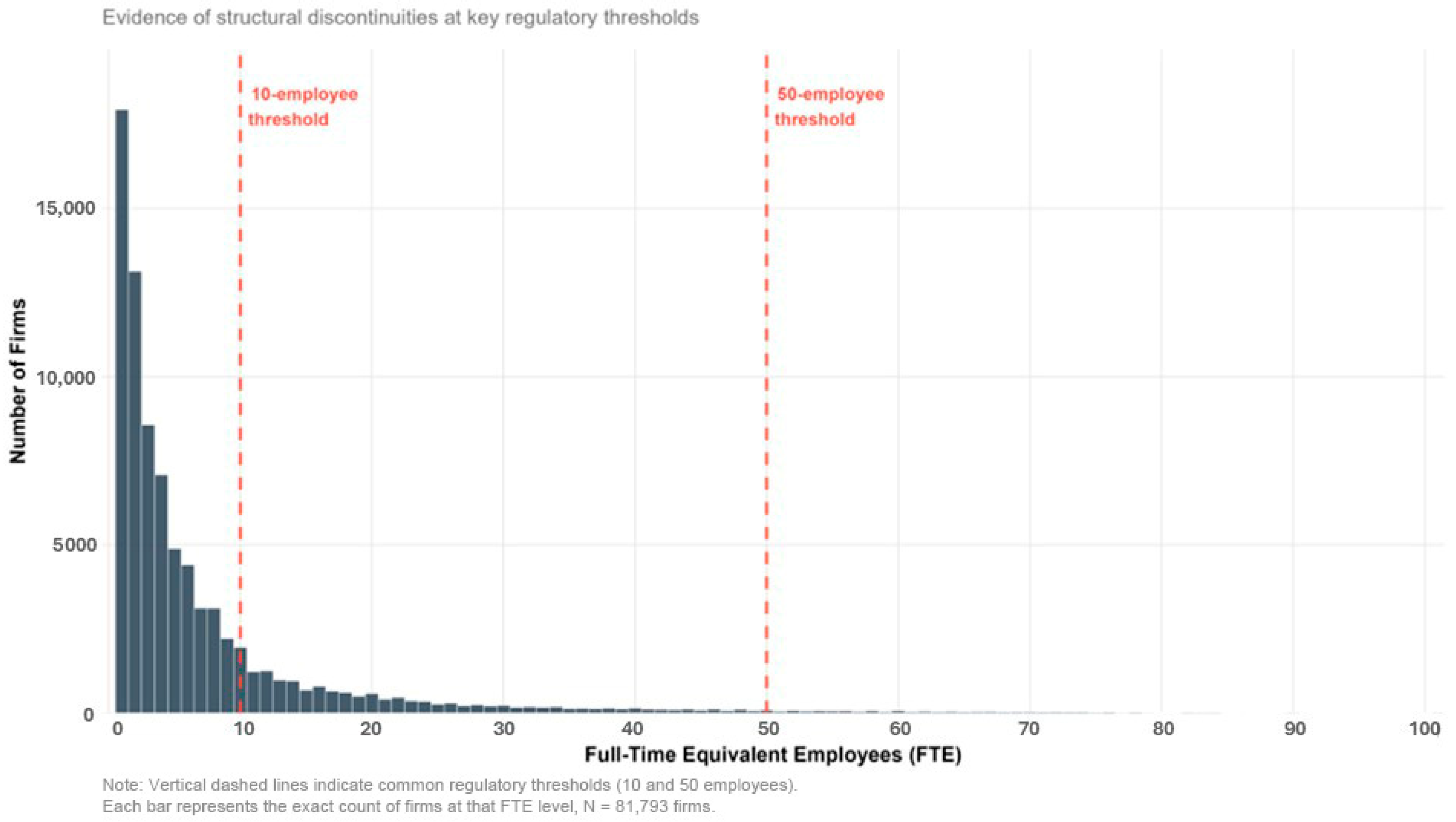
Figure 1 shows the empirical distribution of firm size measured by full-time equivalent (FTE) employment across 82,399 firms. As in other economies, the distribution is strongly right-skewed, but it also exhibits pronounced discontinuities at specific employment levels. In particular, visible density drops occur at 10 and 50 employees, with a sharp compression of the distribution immediately below these regulatory thresholds.
Table 2 quantifies these discontinuities. The most pronounced drop occurs at the 50-employee threshold, where the number of firms falls from 170 in the [48, 49] bin to 88 firms exactly at the threshold, corresponding to a 48.2% decline in density. This discontinuity is substantially larger than that observed at 10 employees and suggests a strong behavioral response at higher regulatory cutoffs.
To assess whether these patterns reflect manipulation of reported firm size, we implement the
McCrary (
2008) density test at the 50-employee threshold. The estimated discontinuity is negative but statistically insignificant (
θ = −1.122, SE = 0.894,
p = 0.262), indicating no evidence of precise manipulation of the running variable. This result supports the validity of the empirical design and suggests that the observed clustering reflects genuine employment choices rather than reporting artifacts.
4.2. Bunching Estimation: Quantifying Strategic Threshold Avoidance
We quantify the magnitude of firms’ behavioral responses at the 50-employee threshold using bunching estimation following
Kleven and Waseem (
2013).
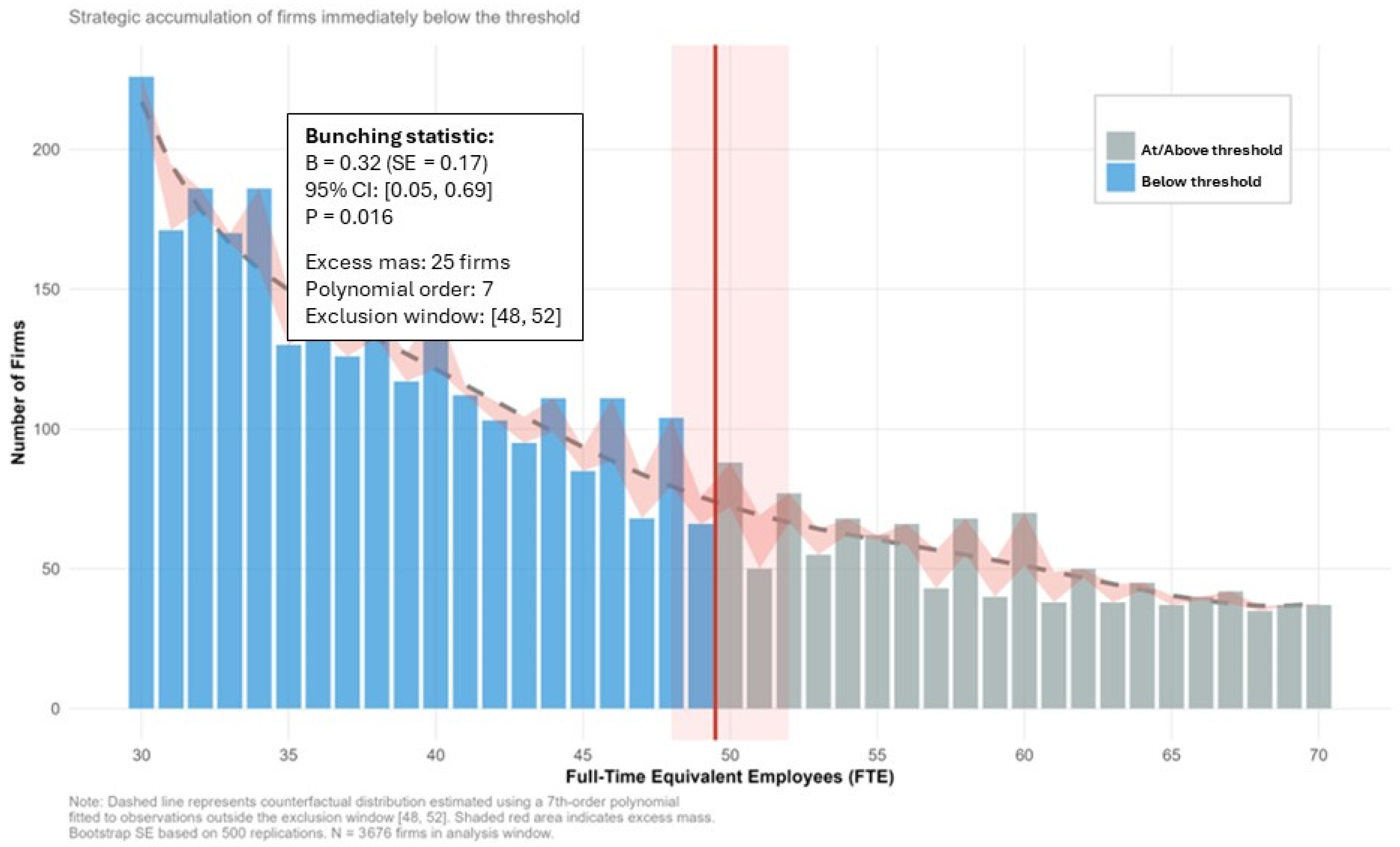
Figure 2 illustrates the estimation strategy, comparing the observed firm-size distribution with a smooth counterfactual density fitted outside the exclusion window [48, 52] FTE.
Table 3 reports the baseline results. We estimate a statistically significant bunching coefficient of
b = 0.316 (bootstrap SE = 0.166,
p = 0.016), indicating that approximately 32% more firms than expected under a smooth counterfactual locate just below the regulatory cutoff. This corresponds to an implicit regulatory tax of 24.0%, calculated as
t =
b/(1 +
b).
This estimate implies that roughly 25 excess firms remain below the 50-employee threshold relative to the counterfactual distribution. While precise welfare calculations require strong structural assumptions, the magnitude of the estimated implicit tax indicates that regulatory compliance costs at this threshold are economically meaningful.
4.2.1. International Comparison
Table 4 places this estimate in an international context. The estimated bunching coefficient for Ecuador exceeds those reported for France (
b = 0.25), Italy (
b = 0.18), and Portugal (
b = 0.22), situating Ecuador at the upper end of the distribution of documented threshold effects despite its lower income level.
Bunching coefficients measure excess mass below the regulatory threshold. Our estimate is 26% higher than that of France (
Garicano et al., 2016), suggesting a relatively stringent regulatory environment. All studies use a similar bunching estimation methodology (
Kleven & Waseem, 2013) with polynomial counterfactuals, making estimates comparable. The “Multiple” regulation category indicates that crossing the threshold activates several compliance requirements simultaneously (worker representation, dismissal protections, health/safety obligations, reporting requirements).
4.2.2. Robustness: Sensitivity to Specification Choices
Table 5 shows that the estimated bunching effect is robust to alternative exclusion windows. As expected, narrower windows yield larger estimates, while wider windows attenuate the magnitude of bunching. The baseline estimate lies centrally within this range, consistent with standard practice in the bunching literature.
4.3. Productivity Discontinuity: Testing for Selection Effects
A central question for policy evaluation is whether regulatory thresholds function as selection devices that filter firms by productivity. If only high-productivity firms find it profitable to absorb regulatory costs and cross the threshold, a positive productivity discontinuity should emerge at the cutoff. Conversely, if firms across the productivity distribution avoid the threshold, bunching should occur without productivity selection.
We test for productivity discontinuities at the 50-employee threshold using a sharp regression discontinuity design (RDD) with local linear regression and MSE-optimal bandwidth selection, following
Calonico et al. (
2014).
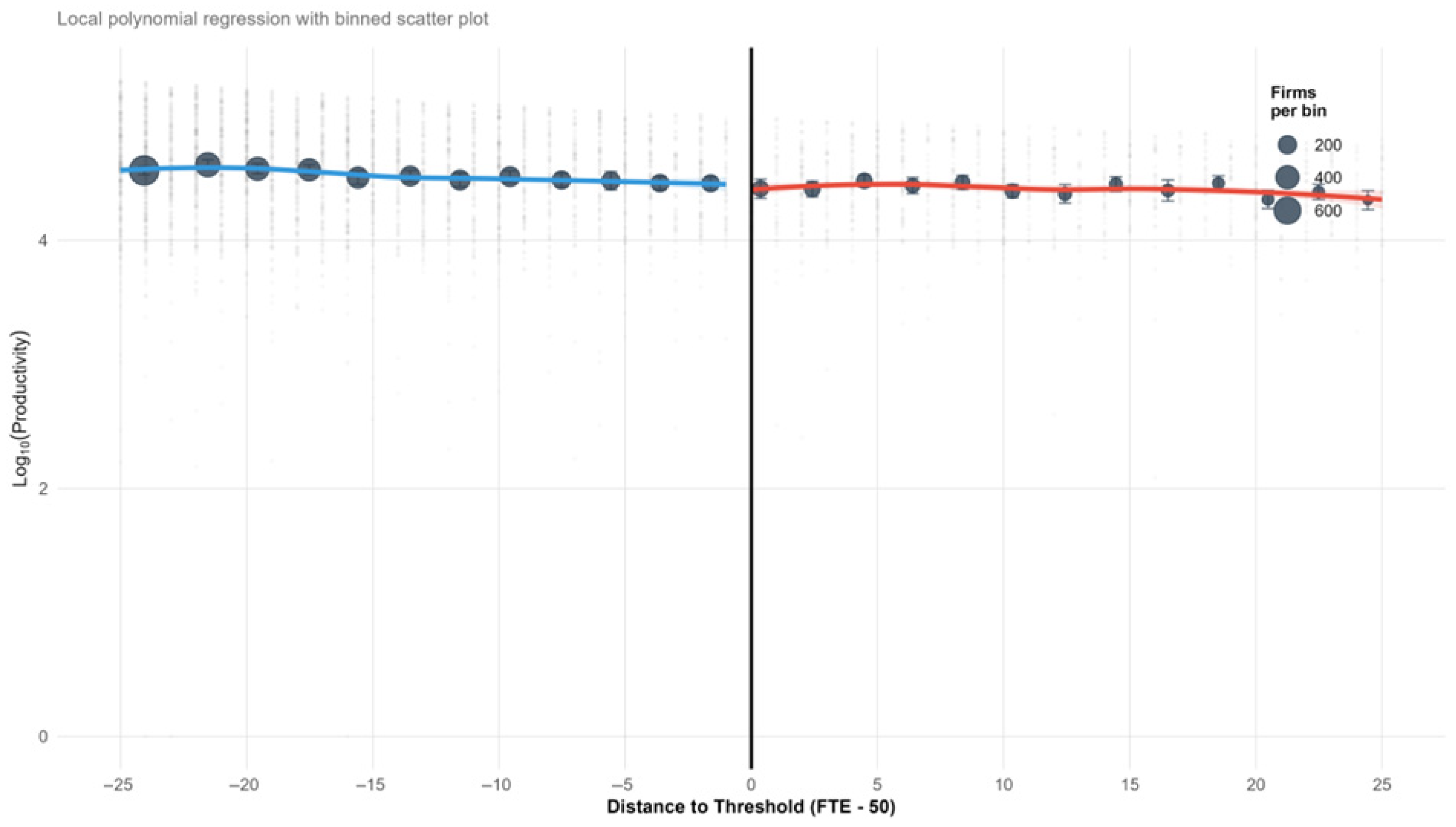
Figure 3 presents the RDD graph, plotting log productivity against firm size with local linear fits on either side of the threshold.
Formal estimates are reported in
Table 6. At the 50-employee threshold, we estimate a productivity discontinuity of
β = −0.036 (robust bias-corrected SE = 0.067,
p = 0.510), with a 95% confidence interval of [−0.176, 0.087]. The point estimate is close to zero and statistically indistinguishable from zero, indicating no detectable increase in productivity at the regulatory cutoff. Although the finite sample size limits power to detect very small productivity differences, the estimated confidence interval excludes economically large selection effects. In particular, productivity gaps exceeding approximately 18% in absolute value can be excluded. Thus, while modest selection effects cannot be statistically rejected, any productivity-based selection at the threshold must be economically small.
This finding contrasts with standard models in which fixed regulatory costs generate strong positive selection at size cutoffs, and instead suggests that threshold avoidance is a widespread behavioral response across the productivity distribution rather than a strategy confined to low-productivity firms.
Robustness: Bandwidth Sensitivity
The null result is robust to alternative bandwidth choices.
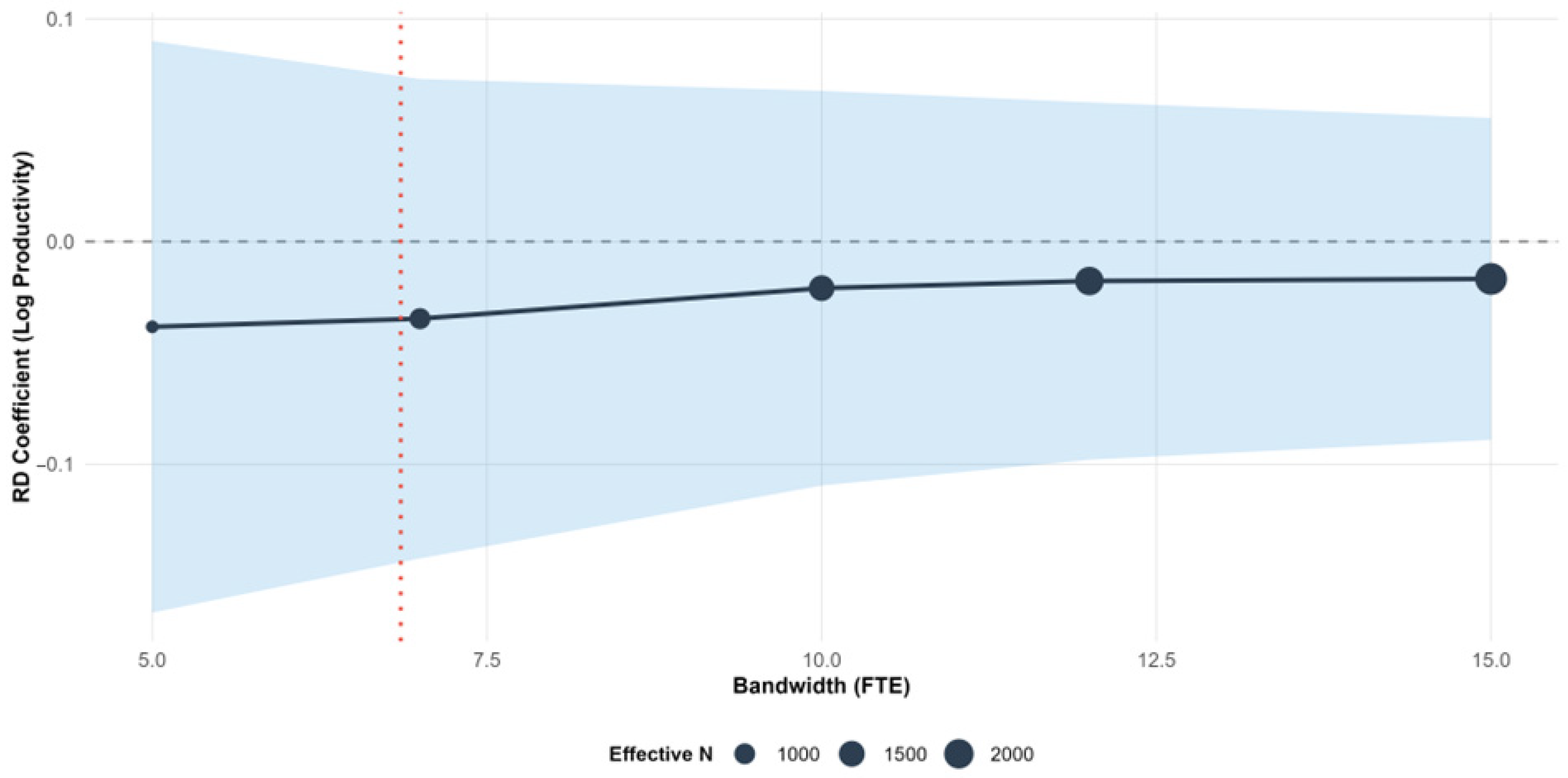
Table 7 reports RDD estimates using fixed bandwidths ranging from 5 to 15 FTE. Across all specifications, point estimates remain close to zero and statistically insignificant, confirming that the absence of productivity discontinuity is not driven by a particular bandwidth choice.
Figure 4 confirms that RDD estimates remain close to zero and statistically insignificant across a wide range of bandwidth choices.
4.4. Validation: Placebo Tests and Covariate Balance
A key identifying assumption is that observed discontinuities at 10 and 50 employees reflect regulatory effects rather than spurious features of the firm size distribution. We assess this assumption using placebo tests at employment levels where no regulatory changes occur and by examining covariate balance around the true threshold.
4.4.1. Placebo Tests at False Thresholds
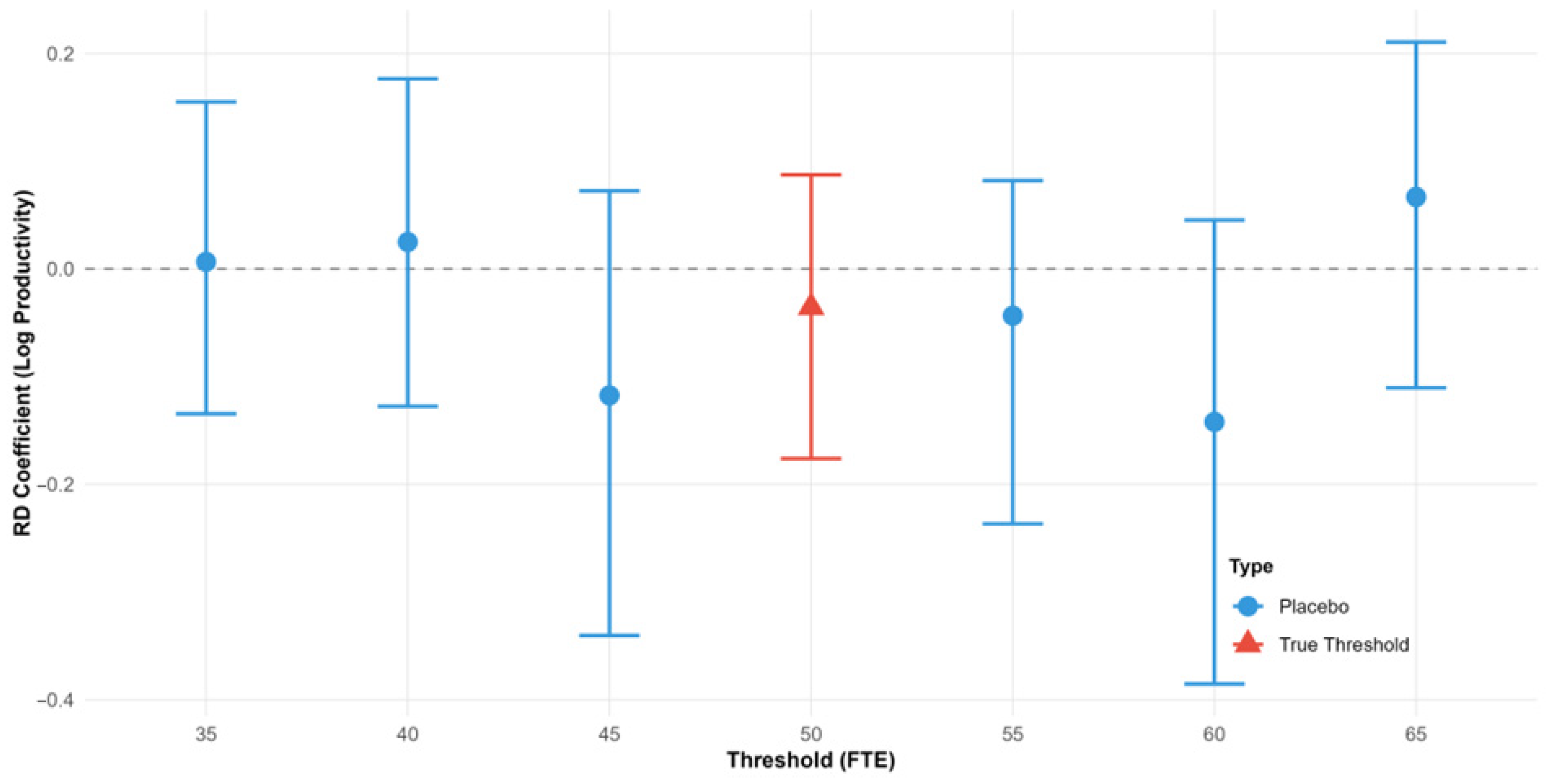
We implement placebo RDD tests at six false thresholds (35, 40, 45, 55, 60, and 65 employees).
Figure 5 summarizes the estimated productivity discontinuities at these cutoffs. Consistent with correct identification, none of the placebo thresholds exhibit statistically significant discontinuities (all
p-values > 0.10).
Table 8 reports the corresponding numerical estimates. All placebo coefficients are small and statistically indistinguishable from zero.
The absence of significant effects across all placebo thresholds supports the interpretation that the observed patterns at 50 employees reflect regulatory discontinuities rather than spurious variation in the firm-size distribution.
4.4.2. Covariate Balance Tests
RDD validity also requires that firms on either side of the threshold be comparable with respect to predetermined characteristics. We test this assumption by estimating an RDD specification for the capital–labor ratio, a key proxy for production technology, using the same MSE-optimal bandwidth as in the main productivity analysis (see
Table 9).
The estimated discontinuity in capital intensity is small and statistically insignificant, indicating that firms just below and above the threshold are comparable in production technology. Together with the McCrary density test (
Section 4.1) and the placebo results, these balance tests support the internal validity of the RDD.
4.5. Sectoral Heterogeneity: Pervasiveness of Threshold Effects
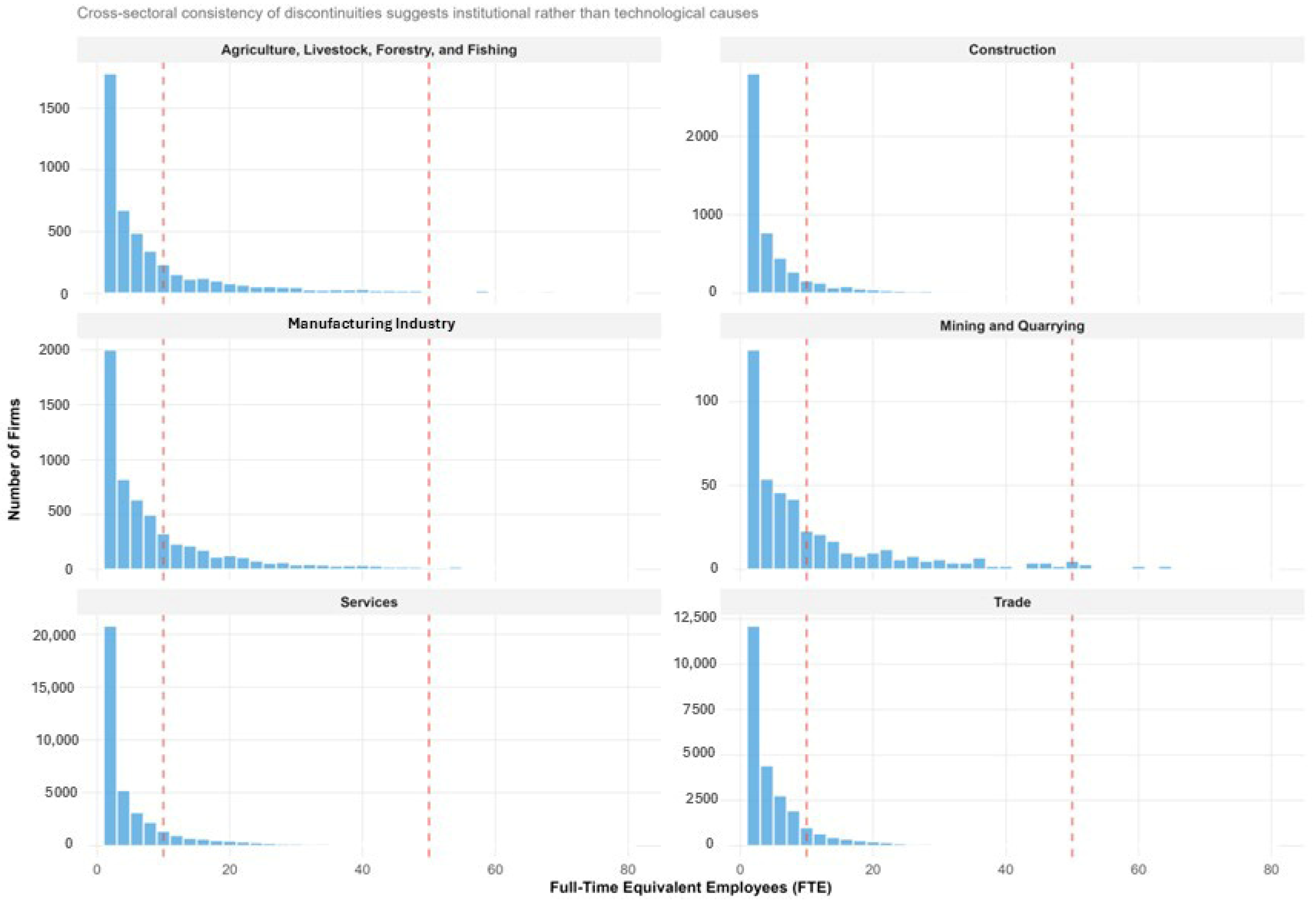
A natural question is whether regulatory threshold effects vary systematically across industries. If bunching were confined to specific sectors, this would suggest technological explanations related to production functions or minimum efficient scale. Conversely, if threshold avoidance appears across technologically diverse sectors, this would support an institutional interpretation driven by common regulatory requirements.
Figure 6 presents firm-size distributions for five major economic sectors: Services, Trade, Manufacturing, Construction, and Agriculture. Across all sectors, a pronounced decline in density occurs at the 50-employee threshold, although the magnitude of this decline varies substantially across industries.
Table 10 reports sector-specific bunching estimates. While point estimates range from 0.06 in Manufacturing to 0.85 in Agriculture, all sectors display positive bunching coefficients, indicating excess mass below the regulatory threshold. Only Services and Agriculture exhibit statistically significant bunching at conventional levels, reflecting larger sample sizes and stronger behavioral responses.
The magnitude of bunching varies markedly across sectors, but the direction of the effect is uniform: all sectors exhibit avoidance of crossing the 50-employee threshold, and none show excess mass above it. This directional consistency is striking, given the substantial technological differences across sectors. Services are labor-intensive with high flexibility; Manufacturing relies on capital-intensive production lines; Agriculture faces biological and seasonal constraints. The presence of threshold avoidance across all these contexts strongly supports an institutional interpretation, whereby common regulatory requirements generate disincentives to firm growth regardless of technology.
Differences in magnitude likely reflect how sector-specific characteristics mediate firms’ ability to respond to regulatory costs. Services and Agriculture—where outsourcing, contracting, or seasonal labor are more feasible—exhibit the strongest bunching. Manufacturing shows minimal bunching, plausibly because production-line indivisibilities make operating just below 50 employees technologically difficult, forcing firms to either remain well below the threshold or cross it. Smaller sectors, such as Trade and Construction, yield imprecise estimates, limiting statistical power but not altering the qualitative pattern.
Overall, the key result is not the ranking of sectors by bunching intensity but the universality of the response: firms in all major sectors systematically avoid crossing the same regulatory threshold. This pattern is inconsistent with purely technological explanations and indicates that regulatory thresholds impose binding constraints across diverse production technologies, with sectoral heterogeneity reflecting differential capacity to adjust rather than the absence of regulatory effects.
4.6. Mechanisms of Threshold Crossing: Reconciling Selection and Demand Shocks
The absence of a productivity discontinuity at the 50-employee threshold raises a natural question: if firms across the productivity distribution avoid the threshold, what distinguishes those that nevertheless cross it? To address this question, we estimate a logistic regression to predict threshold crossing among firms in the [45, 55] FTE window.
The dependent variable equals 1 if the firm has more than 50 employees. Explanatory variables include productivity quartiles, log sales, and sector fixed effects:
Table 11 reports the results. Two patterns stand out. First, higher productivity is associated with a lower probability of crossing the threshold. Firms in the highest productivity quartile are 73% less likely to cross relative to the lowest quartile (OR = 0.269,
p = 0.004). Second, sales strongly predict crossing: a one-unit increase in log sales increases the odds of crossing by a factor of four (OR = 4.02,
p = 0.002), indicating that demand expansions rather than efficiency advantages drive threshold crossing.
Reconciling Logit and RDD Evidence
The logit and RDD results are complementary rather than contradictory, as they capture selection at different margins. The logit estimates reflect compositional selection on the extensive margin: high-productivity firms strategically avoid approaching the regulatory threshold, often by relying on outsourcing or subcontracting, and are therefore underrepresented in the 45–55-employee range. This induces negative selection among firms that approach the threshold.
In contrast, the RDD captures local selection on the intensive margin. Among firms that do reach the immediate vicinity of the cutoff, productivity does not predict crossing. Instead, threshold crossing is driven by idiosyncratic demand shocks—such as winning a large contract—that require rapid workforce expansion despite regulatory costs. This explains why sales strongly predict crossing while productivity does not.
Together, these findings resolve the apparent puzzle of significant bunching without productivity discontinuity. Regulatory thresholds distort firm growth across the entire size distribution: productive firms avoid proximity to thresholds altogether, whereas firms that reach them cross due to exogenous demand shocks rather than superior efficiency. As a result, the threshold does not function as an efficient screening device and instead generates allocative inefficiencies by constraining productive firms below their optimal scale.
4.7. Robustness: Donut-Hole Specification
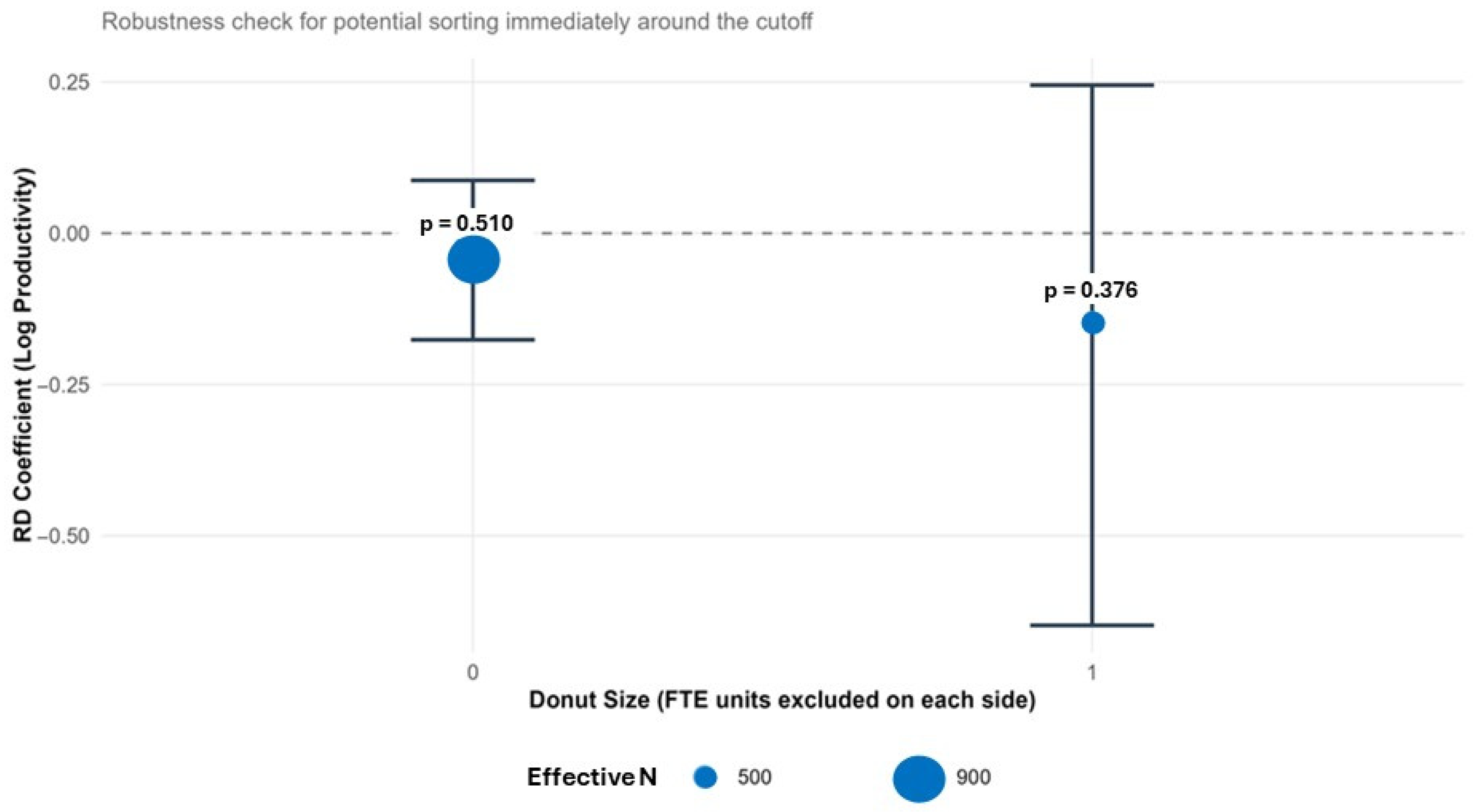
As a final robustness check, we estimate donut-hole RDD specifications that exclude observations immediately surrounding the 50-employee threshold. This approach assesses whether the results are driven by sorting or measurement issues at the cutoff.
Figure 7 presents donut-hole RDD estimates excluding ±1 FTE position around the threshold.
The largest absolute estimate occurs at the 60-employee cutoff (−0.142), but it remains statistically insignificant (p = 0.122) and is based on the smallest effective sample size (N = 347), suggesting it reflects sampling variability rather than a genuine discontinuity. A review of Ecuador’s labor regulations confirms that no regulatory changes occur at this employment level.
Table 12 reports the corresponding numerical results. Excluding firms with 49–51 employees yields a coefficient of −0.144 (
p = 0.376), compared to −0.036 in the baseline specification. The increase in standard errors reflects the substantial reduction in effective observations but does not alter the qualitative conclusion.
Overall, the stability of estimates under the donut-hole specification confirms that the absence of a productivity discontinuity is not driven by manipulation or measurement error at the threshold.
4.8. Summary of Results
Our empirical analysis yields four main findings regarding the impact of regulatory employment thresholds on firm size distribution.
First, we document statistically significant bunching immediately below the 50-employee threshold. The estimated bunching coefficient (b = 0.316, p = 0.016) implies approximately 32% excess firm mass below the cutoff relative to a smooth counterfactual, corresponding to an implicit regulatory tax of 24.0%. This magnitude suggests economically meaningful barriers to firm scaling and is robust across alternative specifications.
Second, regression discontinuity estimates reveal no evidence of large productivity-based selection at the threshold (β = −0.036, p = 0.510). While small productivity differences cannot be ruled out, the confidence interval excludes economically large gaps, indicating that threshold avoidance is not confined to low-productivity firms and that the threshold does not function as an efficient screening mechanism.
Third, threshold effects are observed across all major economic sectors—Services, Trade, Manufacturing, Construction, and Agriculture—despite pronounced technological heterogeneity. Although the magnitude of bunching varies across sectors, the direction of the effect is uniform, supporting an institutional interpretation in which common regulatory requirements distort firm size choices across diverse production technologies.
Fourth, analysis of threshold-crossing mechanisms indicates that expansion beyond 50 employees is more strongly associated with sales-related demand conditions than with productivity advantages. Sales are a strong predictor of crossing, while productivity is not at the local margin, helping explain the absence of productivity discontinuities despite pronounced bunching through a dual mechanism of compositional avoidance and crossing associated with demand-related conditions.
Taken together, these results provide consistent evidence that regulatory thresholds are associated with substantial distortions in the firm-size distribution and may be associated with efficiency losses by keeping some productive firms below their potentially efficient scale.
5. Discussion
Our findings provide robust empirical evidence that regulatory thresholds create substantial distortions in firm size distribution in Ecuador, a middle-income Latin American economy characterized by moderate informality and heterogeneous enforcement. This section situates our results within the existing literature, derives policy implications, acknowledges limitations, and identifies directions for future research.
5.1. Relationship to Existing Literature
The empirical results also allow a direct assessment of the study’s research hypotheses. Firstly, the evidence supports H1, which predicted that employment-based regulatory thresholds would be associated with excess bunching below the relevant cutoffs in the firm size distribution. The bunching analysis reveals a statistically significant concentration of firms immediately below the 50-employee threshold, consistent with the presence of regulatory distortions. Secondly, the results do not support H2, which predicted that threshold crossing would reflect productivity-based selection. The regression discontinuity estimates show no significant productivity discontinuity at the cutoff, suggesting that firms above and below the threshold do not differ systematically in productivity. Thirdly, the findings support H3, which predicted that threshold effects would appear across multiple sectors rather than being confined to a small set of industries. The sectoral analysis reveals a broadly consistent pattern of bunching across technologically diverse sectors, reinforcing the interpretation that these effects are primarily institutional rather than technological.
Our estimated bunching coefficient of 0.316 at the 50-employee threshold exceeds canonical estimates from France (0.25), Italy (0.18), and Portugal (0.22) reported by
Garicano et al. (
2016),
Schivardi and Torrini (
2008), and
Martins (
2009), respectively. This finding directly challenges the common presumption that threshold effects should be attenuated in developing or middle-income economies due to informality escape margins or weaker enforcement capacity. Instead, our results indicate that size-contingent regulation in such contexts can generate behavioral responses at the upper end of the international distribution. One plausible explanation is that compliance costs, even when formally similar, impose larger proportional burdens on firms operating at lower average productivity levels and narrower profit margins than their counterparts in advanced economies. Interpreted through a policy lens, the estimated implicit regulatory tax of 24.0% constitutes a sizable nonlinear policy wedge that distorts firm scaling decisions, imposing economically meaningful growth constraints even in environments with moderate formalization rates of approximately 45–50%.
Our null result for productivity-based selection closely mirrors the puzzling pattern documented by
Garicano et al. (
2016) for France: significant bunching at regulatory thresholds without a corresponding productivity discontinuity. However, our integrated empirical strategy allows us to resolve the theoretical ambiguity surrounding this finding. By combining full-distribution bunching analysis with conditional models of threshold crossing, we show that local regression discontinuity estimates obscure two distinct selection mechanisms operating at different margins. On the extensive margin, high-productivity firms strategically avoid approaching the regulatory threshold altogether—often through subcontracting and outsourcing—thereby generating negative compositional selection among firms that reach the 45–55 employee range. On the intensive margin, conditional on proximity to the threshold, firm crossing is more strongly associated with sales-related demand conditions than with productivity advantages, which helps explain the absence of local productivity discontinuities. This dual-mechanism interpretation reconciles the coexistence of strong behavioral responses with null productivity selection and extends the literature beyond single-margin analyses that implicitly assume symmetric adjustment incentives.
Finally, our evidence contributes directly to the technology-versus-institutions debate emphasized by
Caicedo et al. (
2022). We document consistent bunching behavior across economically and technologically diverse sectors, including human-capital-intensive services, capital-intensive manufacturing, and biologically constrained agricultural activities. The uniform direction of these responses strongly supports an institutional interpretation of size distortions: common regulatory thresholds generate disincentives to firm growth regardless of underlying production technology. At the same time, the substantial heterogeneity in bunching magnitudes—ranging from 0.57 in Services and 0.85 in Agriculture to just 0.06 in Manufacturing—suggests that technological constraints shape firms’ capacity to respond to non-linear regulation. In particular, production-line indivisibilities in manufacturing limit the feasibility of operating precisely below regulatory cutoffs, forcing firms either to remain well below the threshold or to absorb compliance costs, whereas firms in Services and Agriculture can more readily substitute formal employment with contractors or seasonal labor. These patterns indicate that while institutional design determines the presence of distortions, sector-specific technologies mediate their intensity.
5.2. Policy Implications
Our findings yield three central policy implications. First, eliminating or substantially raising the 50-employee regulatory threshold could enable firms currently clustered below that cutoff to expand, with potentially positive implications for productive efficiency. The estimated implicit regulatory tax of 24.0% indicates that compliance costs constitute a sizable nonlinear policy wedge, creating economically meaningful barriers to firm scaling. In this sense, size-contingent regulation appears to affect scaling decisions rather than merely increasing administrative burdens. Consistent with
Garicano et al. (
2016), who estimate that removing France’s 50-employee threshold would increase GDP by 3.2%, similar reforms in Ecuador may improve productive efficiency by allowing firms clustered at 48–49 employees to expand toward a larger scale. At the same time, precise welfare quantification would require strong assumptions regarding counterfactual firm growth paths and general equilibrium adjustments that cannot be credibly supported with cross-sectional data, and we therefore refrain from such calculations.
Second, regulatory design should explicitly account for sectoral heterogeneity in firms’ capacity to absorb compliance costs. Our evidence that Services and Agriculture exhibit substantially stronger bunching responses than Manufacturing indicates that uniform size thresholds generate uneven distortions across the economy. This suggests that one-size-fits-all regulatory cutoffs are unlikely to be optimal. Sector-specific threshold calibration, graduated compliance requirements, or smooth phase-in mechanisms could reduce distortions by aligning regulatory intensity with sectors’ technological and organizational characteristics, while still preserving objectives related to worker protection and occupational health and safety.
Third, policymakers should recognize that threshold crossing is more strongly associated with sales-related demand conditions than with productivity advantages, implying that size-based thresholds do not appear to function as efficient screening mechanisms in this setting. The strong predictive role of sales growth (odds ratio 4.02), combined with the absence of productivity discontinuities at the threshold, indicates that firm expansion beyond regulatory cutoffs is more closely associated with favorable market conditions than with systematic efficiency differences. As a result, regulatory thresholds may contribute to allocative inefficiencies by keeping some productive firms below a larger scale while allowing expansion by firms experiencing favorable demand conditions. Policy responses should therefore prioritize reducing non-linear compliance costs, smoothing regulatory discontinuities, or providing transition support around thresholds, rather than relying on size-based rules as proxies for firm capability or productivity.
5.3. Limitations and Directions for Future Research
This study is subject to several limitations that also point to promising avenues for future research. First, the cross-sectional nature of the data precludes observing firms’ dynamic growth trajectories and the medium- to long-term consequences of crossing regulatory thresholds. Accordingly, the results should be interpreted as evidence of contemporaneous distributional distortions and local associations around regulatory cutoffs rather than as direct evidence of dynamic adjustment processes over time. Firms may temporarily bunch while accumulating financial resources and organizational capabilities before eventually expanding, or they may remain persistently constrained below regulatory thresholds. Distinguishing between transitory and persistent bunching, as well as assessing post-crossing adjustments in productivity, employment composition, and organizational structure, requires longitudinal firm-level panel data, which are not currently available for Ecuador.
Second, while our regression discontinuity design allows us to credibly rule out large productivity-based selection effects at the threshold, it has limited statistical power to detect moderate productivity differences below approximately 10 percent due to finite sample sizes within optimal bandwidths. Although our confidence intervals exclude economically large productivity gaps exceeding roughly 18 percent, smaller selection effects may exist but fall below our detection threshold. Future studies with larger samples or pooled multi-country data could improve precision and further refine estimates of local productivity responses to regulatory thresholds.
Third, although our sectoral analysis documents substantial heterogeneity in the magnitude of bunching, we cannot fully disentangle technological from institutional drivers of this heterogeneity within a single-country setting. Identifying whether sectoral differences primarily reflect production technologies, enforcement intensity, or the relative burden of compliance costs requires comparative evidence across regulatory environments. Cross-country studies in Latin America that exploit variation in threshold design, enforcement regimes, or labor regulation stringency would be particularly valuable for adjudicating among these competing mechanisms.
More broadly, future research could exploit quasi-experimental variation arising from regulatory reforms that modify, eliminate, or smooth size-based thresholds. Policy changes affecting employment cutoffs—such as increases in threshold levels or the introduction of gradual phase-in mechanisms—would provide natural experiments to estimate causal effects on firm growth, employment composition, and aggregate productivity using difference-in-differences or synthetic control approaches. Such evidence would complement the static patterns documented here and deepen understanding of how non-linear regulation shapes firm dynamics and economic growth over time.
6. Conclusions
This study provides robust empirical evidence that size-contingent employment regulations are associated with substantial distortions in firm size distribution in a middle-income economy. Using comprehensive administrative data and a complementary combination of bunching analysis, regression discontinuity design, and threshold-crossing models, we show that regulatory employment cutoffs are associated with significant clustering of firms below the 50-employee threshold in Ecuador, with magnitudes that exceed those documented in several advanced European economies. These patterns indicate that non-linear regulation can create economically meaningful barriers to firm scaling even in contexts characterized by moderate informality and heterogeneous enforcement.
A central contribution of the paper is to shed new light on the longstanding puzzle of the absence of productivity-based selection at regulatory thresholds. Our evidence suggests that this null result does not reflect the absence of behavioral responses but rather the coexistence of two distinct patterns operating at different margins. On the extensive margin, high-productivity firms appear to strategically avoid approaching regulatory cutoffs altogether, while on the intensive margin, threshold crossing among nearby firms is more strongly associated with sales-related demand conditions than with systematic productivity advantages. As a result, size-based thresholds do not appear to function as efficient screening devices and are instead consistent with non-linear policy distortions in firm scaling decisions without clear evidence of productivity-enhancing selection.
The consistency of bunching behavior across technologically diverse sectors further supports an institutional interpretation of firm-size distortions, whereas variation in its magnitude highlights how sector-specific technologies may mediate firms’ capacity to respond to regulatory incentives. Together, these findings suggest that regulatory design, rather than underlying production technology, is the main factor associated with the presence of threshold-induced distortions, while technological constraints shape their intensity.
By extending rigorous threshold analysis to a Latin American middle-income economy, this study contributes new evidence to debates on firm growth, misallocation, and regulatory policy in developing contexts. Our results suggest that informality and weak enforcement do not neutralize the behavioral effects of non-linear regulation and may instead coexist with sizable distortions in firm size distribution. From a policy perspective, reforms that eliminate discrete size thresholds, smooth regulatory transitions, or reduce non-linear compliance costs could alleviate these distortions and allow firms clustered below regulatory cutoffs to expand toward larger scale, with potentially positive implications for productive efficiency and economic growth.




 ,
,