1. Introduction
Exchange rates can influence trade flows on a global scale. Exchange rates facilitate international trade by simplifying imports and exports and by serving as a means of transferring funds between countries (
Doidge et al., 2006;
Kayani et al., 2023;
Martins et al., 2023). However, exchange rates have been highly volatile since 1973, when the currencies of major industrialized countries were allowed to float. Exchange rate volatility can have positive, negative, or ambiguous effects on trade flows, depending on the countries involved, the assumptions used, the availability of funds, and the timing of transactions.
Theoretically, as exchange rate volatility increases, so does the degree of uncertainty and the cost of hedging, thereby reducing the volume of international trade, as businesses tend to avoid risk (
Clark, 1973;
Hooper & Kohlhagen, 1978). Conversely,
Franke (
1991) argued that when cash flows move in line with exchange rates, the present value of these cash flows increases more rapidly than the costs a firm incurs to enter or exit a market. Hence, firms may benefit from higher exchange rate volatility, as they are more likely to enter markets earlier and exit later as the exchange rate risk rises. This also increases the number of trading firms. Accordingly, trade seems to benefit from exchange rate volatility.
Sercu and Vanhulle (
1992) showed that under perfect competition conditions, increased exchange rate volatility has a similar effect on prices and production to that of a tariff reduction. Therefore, the impact of exchange rate volatility on trade is not monotonic, but depends on the degree of volatility as well as the behavioral characteristics of businesses. Empirical studies by
Bahmani-Oskooee (
1996),
McKenzie and Brooks (
1997),
Kasman and Kasman (
2005), and
Chi and Cheng (
2016) have evidenced the positive impact of exchange rate volatility on exports, as traders may increase export volumes to offset potential revenue losses. Thus, volatility in the exchange rate system can affect trade by boosting a country’s import and export activities.
Nevertheless, an opposing view argues that exchange rate volatility harms the economy in various ways. The reduced international trade volume resulting from exchange rate fluctuations decreases the expected returns from international transactions, changing prices and output, and hampering economic growth (
Heriqbaldi et al., 2020). In addition, exchange rate volatility may limit international capital flows by reducing direct investment in foreign operations and portfolio investment. Speculative capital flows can also be generated by exchange rate volatility under a flexible regime, contributing to economic instability. Potential investors will be attracted to a foreign location as long as the expected returns are high enough to compensate for the currency risk. Furthermore, exchange rate volatility affects international specialization in production, reducing output. This, in turn, lowers living standards (i.e., income and consumption). Volatility can thus lead to higher prices for internationally traded goods because traders have to add risk premiums to cover unforeseen exchange rate volatility. As a result, the competitiveness of exports is hampered (
Alper, 2017).
Risk-averse traders are likely to react negatively to currency fluctuations that affect trade flows. However, risk-tolerant exporters may accept some degree of currency uncertainty, suggesting that exchange rate fluctuations have an ambiguous effect on cross-border trade, rather than a negative one. This is because traders may react asymmetrically to exchange rate fluctuations (
Bahmani-Oskooee & Rahman, 2017;
Heriqbaldi et al., 2023;
Nishimura & Hirayama, 2013).
Most empirical studies on the impact of exchange rate volatility on trade focus on developed countries because of the abundant data sources for those locations. By contrast, there are few studies on exchange rate volatility in developing countries, such as Vietnam. Nonetheless, developing countries often rely on natural resource exports and are likely to face trade imbalances because of strong exchange rate volatility. These countries may face 2- to 2.5-fold higher volatility than industrialized countries, and the volatility experienced there also lasts longer (
Hausmann et al., 2006). Furthermore, these countries often lack access to hedging instruments, increasing traders’ risk perception and making these countries more vulnerable to volatility (
Fang et al., 2009;
Hall et al., 2010). Therefore, the impact of exchange rate volatility on Vietnam’s trade flows should be considered.
Vietnam’s economy became a hot topic in 2015 because of concerns about China’s devaluation of the yuan, the Federal Reserve raising the federal funds rate, and the appreciation of the US dollar (USD) against many other currencies worldwide. The Vietnamese dong (VND) is pegged to the USD, so it became more expensive than many other foreign currencies, hampering the competitiveness and trade balance of Vietnamese goods (
Thuy & Thuy, 2019). Moreover, Vietnam has often faced trade deficits, with imports exceeding exports. Thus, Vietnam’s exchange rate policy, aimed at stabilizing the macroeconomic situation, includes managing the exchange rate under state control. Nonetheless, because the USD is the primary currency for transactions, some firms consider that the questions of whether such exchange rate policies are appropriate and whether fluctuations in the exchange rate may hurt the company should be explored. Therefore, research on Vietnam’s exchange rate volatility is needed to help policymakers develop a more comprehensive understanding of the country’s trade balance and formulate appropriate policies to manage its exchange rate.
Most studies related to Vietnam have focused on symmetric effects (
Huynh & Hoang, 2019;
Thuy & Thuy, 2019;
Van Nga et al., 2024;
Vo et al., 2019). By contrast, asymmetric effects have been neglected. Furthermore, the abovementioned studies primarily used aggregate data for Vietnam’s trade with the rest of the world, an approach that may lead to aggregation bias in the results. According to
Baek and Nam (
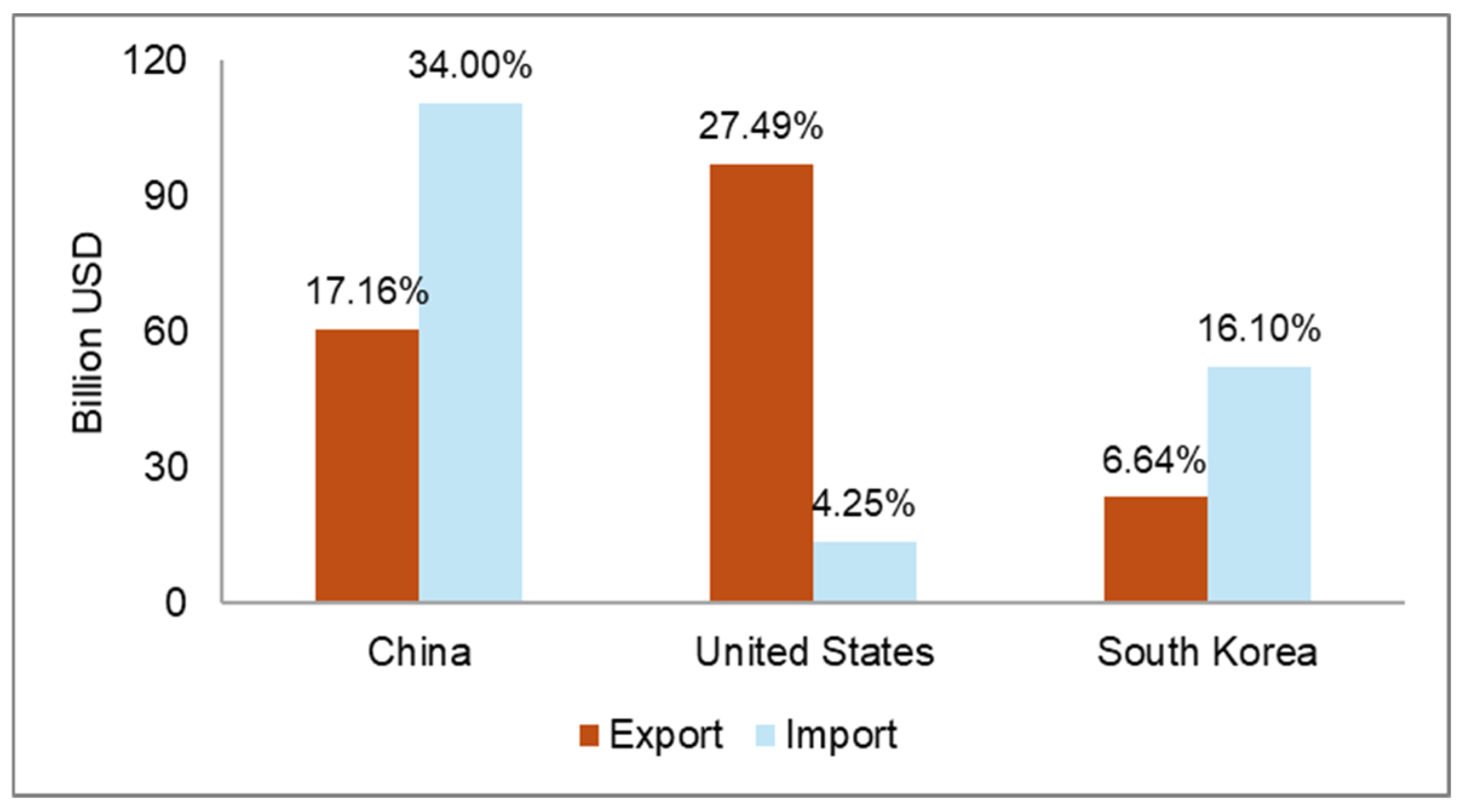
2025), a country’s trade balance varies with each trading partner: the country may have a surplus with one partner and a deficit with another. Thus, bilateral trade data between Vietnam and each partner were used in the present study to minimize this bias. This study analyzes the asymmetric impact of real exchange rate volatility on Vietnam’s exports and imports at the bilateral level. However, aggregate trade data may obscure partner-specific asymmetric responses to exchange rate volatility, as Vietnam’s exports and imports can adjust differently across trading partners. Our strategy involves several steps. First, we use Vietnam’s export and import data with the country’s three largest trading partners: China, the United States (US), and South Korea (
Figure 1). Second, the real exchange rate volatility is divided into five threshold levels, allowing for asymmetric responses to changes in exchange rate volatility. Finally, we apply the multiple threshold nonlinear autoregressive distributed lag (MTNARDL) model to measure the short- and long-term effects of real exchange rate volatility across these thresholds, and test whether asymmetric responses exist.
In bilateral trade among emerging economies, asymmetric trade responses to exchange rate volatility across intensity levels can be explained by standard micro-level mechanisms. Exchange rate uncertainty affects trade decisions through risk considerations and firms’ ability to absorb shocks (
Clark, 1973;
De Grauwe, 1988). When volatility is moderate, exporters and importers may partially offset exchange rate risk through pricing-to-market behavior or short-term contractual arrangements (
Goldberg & Tille, 2008). However, as volatility increases beyond certain levels, risk-averse firms, particularly those facing limited access to hedging instruments and rigid contract structures, are more likely to postpone transactions, adjust trade volumes, or reallocate markets (
De Grauwe, 1988). Such intensity-dependent and regime-specific adjustments provide a strong rationale for employing a multiple-threshold nonlinear framework.
2. Methodology
This study adopts the empirical research model proposed by
Bahmani-Oskooee and Baek (
2021) to investigate the impact of exchange rate volatility on Vietnam’s exports and imports with its top three trading partners. Additionally, a dummy variable (
) representing the COVID-19 pandemic was included to capture potential structural changes in the data. Equations (1) and (2) correspond to the long-term export and import functions, respectively:
where
and
represent the real value of Vietnam’s exports to and imports from trading partner
i, respectively. Similarly,
and
denote the real income of Vietnam and trading partner
i, respectively. In addition,
is the real exchange rate between the VND and the currency of trading partner
i, and
symbolizes the real exchange rate volatility. All variables are in the logarithmic form. The variable
takes the value 1 for 2020M01–2021M12 and 0 for all other periods.
In Equations (1) and (2), the coefficients and are expected to be positive if the real income of trading partner i and Vietnam drives exports and imports, respectively. The estimated coefficients () are expected to be positive (negative) if a depreciation of the VND (i.e., an increase in ) reduces the price of exported goods (i.e., increasing the price of imported goods), increasing the quantity of exports (and decreasing the quantity of imports). Finally, the coefficients and may be either negative or positive, depending on the responses and expectations of importers and exporters.
Pesaran et al. (
2001) proposed incorporating the short-term dynamics into the long-term equation to better capture both the short- and long-term effects of the explanatory variables on the dependent variable. Therefore, the autoregressive distributed lag error correction model (ARDL-ECM) is applied to Equations (1) and (2), resulting in Equations (3) and (4).
The long-term estimates are given by
to
in Equation (3), and by
to
in Equation (4). By contrast, the short-term estimates are represented by
to
in Equation (3), and
to
in Equation (4);
, and
to
, denote the optimal lag lengths.
1The ARDL framework has limitations, as it can only measure the symmetrical relationship between exchange rate volatility and trade flows; thus, it cannot quantify asymmetrical effects. In practice, however, exporters and importers often react differently to exchange rate volatility (
Kim, 2024). Therefore, ignoring the asymmetric nature of exchange rate movements may lead to inaccurate conclusions. To address this limitation,
Shin et al. (
2014) proposed the nonlinear ARDL (NARDL) model, which captures asymmetry by decomposing the independent variable into positive and negative changes. However, the NARDL model cannot account for the magnitude of changes in the explanatory variable. In other words, the NARDL model is not integrable when analyzing multiple thresholds simultaneously (
Kim, 2024). Thus,
Pal and Mitra (
2015) developed the MTNARDL model to incorporate multiple thresholds. This model provides comprehensive estimates across a continuum of changes in exchange rate volatility (from small to large) and their effects on exports and imports. Given that the research question concerns how exports and imports adjust not only to the direction but also to the intensity of exchange rate volatility, a multiple-threshold framework such as the MTNARDL model is required. In this study, the distribution of real exchange rate volatility is divided into five quantile-based regimes, determined at the 20th, 40th, 60th, and 80th percentiles. This approach allows us to capture nonlinear and asymmetric trade responses across different intensities of exchange rate volatility, distinguishing the effects of small, medium, and large shocks. At the same time, it preserves enough observations within each regime to ensure reliable empirical estimation. Equation (5) breaks down the real exchange rate volatility into five partial sum series:
In Equation (5),
,
,
,
, and
represent five partial sum series, constructed using four threshold values corresponding to the 20th (
, 40th (
, 60th (
, and 80th (
quantiles of the exchange rate, as specified in Equations (6)–(10):
where
I(∙) is an indicator function; it takes the value of one when the conditions in ( ) in Equations (6)–(10) are satisfied, and zero otherwise. Based on the MTNARDL model, Equations (11) and (12) represent the cointegration between trade flows and decomposed exchange rate volatility:
where
.
Therefore, cointegration is confirmed through the F-test and
t-test
2 (
Pesaran et al., 2001;
Shin et al., 2014). In addition, the Wald test is used to examine the asymmetry of exchange rate volatility.
3 3. Data Strategy
This study uses monthly data from 2008:M1 to 2024:M10. The period from 2010:M1 to 2024:M10 was applied in China’s case because industrial production index data for this trading partner were available only from January 2010. Export and import price indices are required when calculating the real value of exports and imports. However, these indices are unavailable for Vietnam. Therefore, the import (export) values of trading partner
i were used in Vietnam’s export (import) functions. These nominal export (import) values were deflated using the composite export (import) price index (2010 = 100) of trading partner
i.
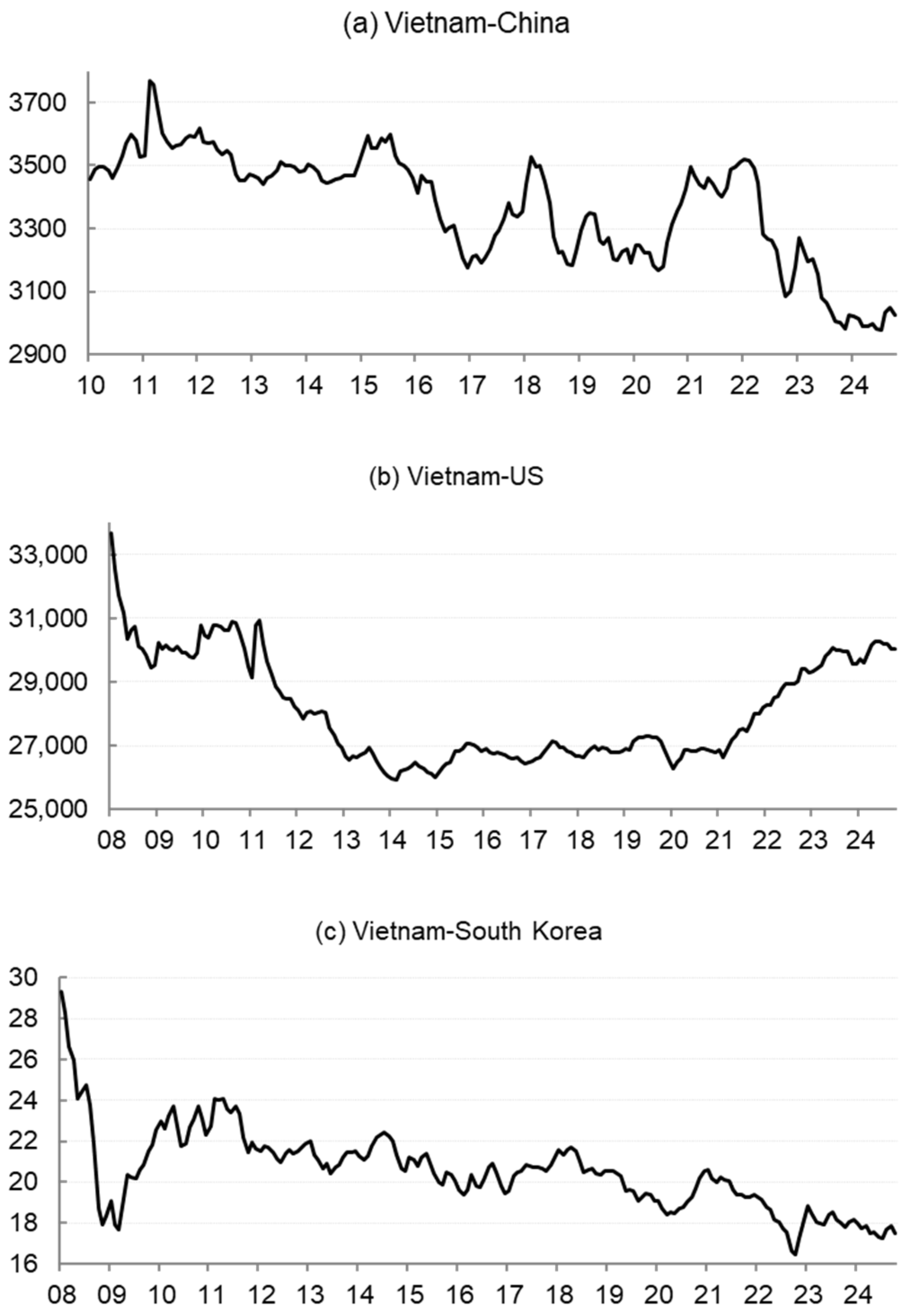
4 Nominal export and import data were expressed in USD, collected from the International Monetary Fund (IMF). Composite import and export prices were obtained from the IMF and the Federal Reserve Bank of St. Louis (FRED). The real exchange rate between the VND and the currencies of trading partners was defined as
(
Figure 2).
(
) is the consumer price index of trading partner
i (Vietnam; all indexed to 2010 = 100) and
represents the nominal exchange rate. A decline in
reflects an appreciation of the VND. Both
and consumer price index data were collected from the IMF. The industrial production index (IPI, 2010 = 100) was used as a proxy for the real income of Vietnam and its trading partners, with data sourced from the IMF and FRED and seasonally adjusted. Finally, real exchange rate volatility was estimated using the generalized autoregressive conditional heteroskedasticity (GARCH) model.
5 4. Empirical Analysis
We address two fundamental conditions for applying the MTNARDL model before presenting the results for the export and import function cases. First, similar to the basic ARDL model, the MTNARDL model requires that the variables in the empirical model be integrated in order I(0) and/or I(1). We used the Dickey–Fuller GLS (DF–GLS) test to verify this (
Table 1). The results confirmed that all variables were either I(0) or I(1), satisfying the requirements of the MTNARDL model. Second, we confirmed the existence of cointegration through the F-test and
t-test (Panel A of
Table 2 and Table 4). The results showed that at least one coefficient of the F-statistic or t-statistic was statistically significant at the 10% level, confirming cointegration for all of Vietnam’s trading partners in both export and import cases.
6 4.1. Results for Export Models
We begin our discussion with the long-term results (Panel B of
Table 2). For exchange rate volatility, the estimated coefficients of
,
,
, and
were all positive and significant at the 5% or 10% level, except for
, which did not affect Vietnamese exports to China. This result implies that increasing exchange rate volatility boosts Vietnam’s exports to China. On the other hand, the estimated coefficients of
and
were negative and significant (at the 5% level) for the US, indicating that increasing exchange rate volatility decreases Vietnam’s exports to that country. Interestingly, in the case of South Korea, the impact of exchange rate volatility appeared mixed and mostly negative. In particular, the estimated coefficients of
,
, and
were negative and significant at the 5% or 10% level. On the other hand,
showed a significant positive impact (at the 5% level), while
had no effect on Vietnam’s exports to South Korea. The export results reveal partner-specific and regime-dependent responses to exchange rate volatility. For China, higher volatility is generally associated with increased Vietnamese exports. This suggests that exporters may benefit from volatility-induced adjustments that enhance export performance. In contrast, exports to the US decline under higher volatility. The result indicates that uncertainty-related costs tend to dominate potential gains from exchange rate movements. The case of South Korea exhibits mixed effects, reflecting the coexistence of offsetting channels. These effects depend on the intensity of exchange rate volatility. This pattern is consistent with the view that moderate volatility can be absorbed by firms, while larger shocks are more disruptive to trade relationships.
The estimated coefficient of was not significant, even at the 10% level, implying that Vietnam’s exports to China, the US, and South Korea are not sensitive to long-term fluctuations in bilateral real exchange rates. Finally, regarding foreign income, had a negative and significant (at the 5% level) effect only in the case of South Korea and no impact in the other cases. This negative effect contradicts economic theory, which posits that an increase in foreign income should stimulate demand for Vietnamese goods. However, this result may reflect the characteristics of Vietnam’s trade within the global value chain, which relies heavily on processing, assembly, and production through networks of foreign direct investment (FDI) enterprises. In this context, income growth may coincide with import substitution, upgrading of domestic production capacity, or a reallocation of supply among trading partners, leading to different long-run income effects across markets. Overall, the economic activities of Vietnam’s main trading partners do not appear to be the primary determinants of Vietnam’s export volume.
Table 2.
Long-run estimates from the MTNARDL model for exports.
Table 2.
Long-run estimates from the MTNARDL model for exports.
| | China | US | South Korea |
|---|
| Panel A: Cointegration tests |
| F-statistic | 5.608 ** | 3.030 | 3.384 * |
| −0.390 (6.855) ** | −0.514 (5.018) ** | −0.199 (5.317) ** |
| Panel B: Long-run results | | |
| 0.831 (2.817) ** | −0.072 (0.831) | −0.785 (3.483) ** |
| 0.444 (1.912) * | −0.679 (3.155) ** | −3.151 (1.903) * |
| −0.031 (0.076) | −0.386 (0.964) | 0.449 (0.286) |
| 0.614 (2.540) ** | −1.459 (4.126) ** | 1.790 (3.422) ** |
| 0.877 (2.917) ** | 0.014 (0.149) | −1.418 (2.420) ** |
| 0.262 (0.309) | 0.096 (0.107) | 1.769 (1.622) |
| −0.440 (0.759) | −0.076 (0.102) | −10.764 (2.633) ** |
| Constant | 0.759 (6.822) ** | 0.786 (5.193) ** | 8.557 (5.332) ** |
Regarding the short-term results (
Table 3), there is evidence that
,
,
, and
have a positive and significant impact on Vietnam’s exports to China, unlike
. This pattern is also noticeable in the long-term results. Meanwhile, only
,
, and
show significant but mixed effects on exports to South Korea. However, there is no evidence that exchange rate volatility affects Vietnam’s exports to the US in the short run. The estimated coefficient of
was negative and significant for both China and South Korea, implying that a depreciation of the VND tends to reduce Vietnam’s exports to these two partners. Nonetheless,
had no significant impact in the case of the US. Regarding foreign income,
had a positive and significant effect on exports to all three trading partners (China, the US, and South Korea), indicating that increased economic activity in these countries boosts Vietnam’s exports in the short run. The COVID-19 pandemic resulted in a significant, positive coefficient for Vietnam’s exports to China and the US, but a negative coefficient for exports to South Korea. This result suggests that the impact of COVID-19 depended on Vietnam’s ability to maintain production and the characteristics of each market. These differences may reflect variations in the structure of export goods, participation in regional supply chains, and the ability to maintain production and logistics operations during the pandemic.
4.2. Results for Import Models
We now turn our discussion to the import models, starting with the long-term estimates (Panel B of
Table 4). Real exchange rate volatility did not affect Vietnam’s imports from China and had only a limited effect on imports from South Korea. The estimated coefficients
and
were significant at the 5% and 10% levels, respectively. Conversely, the impact of real exchange rate volatility was clearly observed for imports from the US, as all estimated coefficients from
through
were significant at the 5% or 10% levels. Notably, all significant coefficients for the US were negative, indicating that real exchange rate volatility reduced Vietnam’s total imports from this trading partner. Meanwhile, for South Korea, the impact was either negative or positive depending on the threshold. Vietnam’s import behavior exhibits distinct partner-specific and regime-dependent responses to exchange rate volatility. Imports from the US are consistently and negatively affected by higher volatility across all thresholds. This suggests that exchange rate uncertainty plays a particularly important role in shaping Vietnam’s import demand from this partner. In contrast, imports from China appear largely insensitive to exchange rate volatility in the long run. The effects for South Korea vary across volatility regimes, indicating the presence of offsetting channels depending on the intensity of exchange rate fluctuations.
Regarding exchange rates, did not affect Vietnam’s imports from these three trading partners. This finding was similar to that for exports, implying that Vietnam’s imports were not sensitive to bilateral real exchange rates in the long run. The insignificant role of the bilateral real exchange rate suggests that non-price factors—such as contract structures or a slow adjustment of exchange rates—may reduce its direct impact on bilateral trade between Vietnam and the three trading partners. In contrast, the results indicate that exchange rate volatility is the key factor shaping trade adjustment responses. As for Vietnam’s income, had a positive and significant impact on US imports, suggesting that as Vietnam’s economy grows, its imports from the US increase. However, does not affect Vietnam’s long-term import patterns from China or South Korea. This result may reflect the specific structure of Vietnam’s imports, in which imports from each partner depend on the type of goods, the supply chain, and the degree of integration within the production network.
Next, we discuss the short-term estimation results (
Table 5). Real exchange rate volatility had a weak negative impact in China’s case, but a mixed impact with a wider range in the cases of the US and South Korea. Regarding the exchange rate,
had a significant negative effect in China’s case, but no impact in the cases of the US or South Korea, even at the 10% significance level. By contrast, Vietnam’s income had a significant positive impact on imports from all three trading partners. This outcome suggests that, in the short run, Vietnam’s income is a decisive factor in determining the size of its imports from its top three trading partners. Furthermore, the estimated coefficient of
was not significant in any case, suggesting that the COVID-19 pandemic had a heterogeneous impact depending on the context. COVID-19 did not significantly affect imports, implying that demand for both final goods and intermediate inputs for export production remained relatively stable.
Note that this paper primarily aims to investigate whether real exchange rate volatility has asymmetric effects on Vietnam’s trade flows with its top three trading partners. We used the Wald test to examine short- (Wald-R) and long-term (Wald-L) asymmetric effects (
Table 6). For exports, the results confirmed that real exchange rate volatility has asymmetric effects on exports only in the long run. We found no evidence of asymmetric short-term effects for any trading partner. This suggests that firms adjust to exchange rate volatility gradually rather than instantaneously. The absence of short-run asymmetry indicates that trade flows do not adjust differentially across volatility regimes within a short horizon. For imports, the results confirmed a strong asymmetric impact of real exchange rate volatility on Vietnam’s imports from all three trading partners in the long run. However, a short-term asymmetric impact was observed only for the US. This pattern suggests that the impact of exchange rate volatility on import behavior becomes regime-dependent once longer-term adjustments have taken place. For most partners, short-run import responses remain relatively uniform across volatility levels. Combined with the export results, these findings underscore that long-term asymmetries in exchange rate volatility significantly affect Vietnam’s trade with its major partners. They also emphasize the need to account for these effects when analyzing trade flows. Finally, several diagnostic tests were conducted.
5. Conclusions
This study explored the asymmetric impact of real exchange rate volatility on bilateral trade flows between Vietnam and its three largest trading partners: China, the United States (US), and South Korea. Real exchange rate volatility was measured using a GARCH (1,1) model based on the exchange rate between the Vietnamese dong and the currencies of these three partners. Monthly data from 2008:M1 to 2024:M10, along with the MTNARDL model, were employed to achieve this objective.
The empirical results indicate that real exchange rate volatility affects Vietnam’s bilateral trade flows in a heterogeneous and horizon-dependent manner. Asymmetric effects are observed primarily in the long run for both exports and imports, while short-run asymmetry is limited and appears only in specific cases, notably US imports. These findings suggest that trade responses to exchange rate volatility are neither uniform across partners nor immediate, but instead depend on the intensity of volatility and the structure of bilateral trade relationships.
The decomposition of real exchange rate volatility into multiple thresholds is a key contribution of this study. This approach reveals the potential impacts of volatility that are often obscured in linear or single-threshold nonlinear models. Additionally, using disaggregated bilateral import and export data helps mitigate the aggregation bias commonly present in studies that rely on aggregate trade data or overall trade balances.
For policymakers and stakeholders, the findings of this study offer valuable insights into the complex effects of real exchange rate volatility on bilateral trade flows. In particular, the results suggest that the effects of exchange rate volatility are partner-specific and mainly materialize in the long run. Thus, the Vietnamese government should incorporate the asymmetric nature of exchange rate volatility into its trade modeling, especially when assessing trade relationships with major partners characterized by persistent volatility exposure. This approach would enable the development and implementation of more effective strategic policies to stabilize the exchange rate and mitigate the adverse effects of volatility in trade with each partner. Moreover, Vietnamese importers and exporters could better assess and respond to the positive and negative impacts of increasing or decreasing real exchange rate volatility, primarily in their long-term planning and contract design, thereby adjusting their production accordingly.
While offering important contributions, this study also has some limitations. First, real exchange rate volatility is measured using a GARCH(1,1) model, which captures conditional variance well but does not fully account for structural shocks or changes in policy regimes. Second, the analysis is conducted at the level of aggregate bilateral trade, which does not reflect differences in sensitivity across industries or commodity groups. Future studies could employ alternative measures of volatility and exploit sectoral data to better clarify the mechanisms through which trade adjusts to different levels of exchange rate volatility.