
Article

External Shocks, Fiscal Transmission Mechanisms, and Macroeconomic Volatility: Evidence from Ecuador

by
Igor Ernesto Diaz-Kovalenko
Escuela de Economía, Facultad de CC. Sociales, Educación Comercial y Derecho, Universidad Estatal de Milagro, Av. Principal vía al km 26 km 1.5, Milagro 091706, Ecuador
Economies 2026, 14(2), 36; https://doi.org/10.3390/economies14020036
Submission received: 21 December 2025 / Revised: 14 January 2026 / Accepted: 16 January 2026 / Published: 23 January 2026
(This article belongs to the Special Issue Dynamic Macroeconomics: Methods, Models and Analysis)

Abstract

This paper investigates how external shocks propagate through fiscal transmission mechanisms in a commodity-dependent economy within a dynamic macroeconomic framework. The study contributes to the literature on macroeconomic fluctuations by examining the interaction between external revenue volatility, fiscal behavior, and institutional features in shaping short-run dynamics and medium-term outcomes. A Dynamic Stochastic General Equilibrium (DSGE) model is developed and calibrated to the Ecuadorian economy. The framework explicitly incorporates procyclical fiscal behavior, public capital accumulation, and endogenous spending efficiency, allowing for a structural analysis of fiscal transmission channels under external and productivity shocks. Counterfactual simulations are employed to assess the role of fiscal policy design and institutional constraints. The results show that while productivity shocks remain a key driver of output fluctuations, external revenue shocks significantly influence macroeconomic volatility through fiscal channels. Procyclical fiscal responses amplify fluctuations by reducing public investment and spending efficiency, slowing public capital accumulation and prolonging output contractions. Alternative fiscal configurations mitigate short-run volatility, although their effectiveness depends critically on institutional features governing spending efficiency. Overall, the analysis highlights that macroeconomic dynamics in resource-dependent economies are shaped not only by external shocks, but also by the interaction between fiscal policy design and institutional capacity. Integrating these elements into DSGE models provides a more comprehensive understanding of fiscal transmission mechanisms and macroeconomic volatility.

1. Introduction

Macroeconomic volatility remains a defining feature of many resource-dependent emerging economies. Despite decades of institutional reforms and the widespread adoption of fiscal rules, these economies continue to experience pronounced business cycle fluctuations driven by external shocks, weak institutional frameworks, and constrained policy credibility. In contrast to advanced economies—where countercyclical fiscal policy has gradually become the norm—developing countries frequently exhibit procyclical fiscal behavior that amplifies rather than smooths economic fluctuations (Talvi & Végh, 2005; Frankel et al., 2013). Understanding how fiscal policy interacts with external shocks under institutional constraints is therefore central to the analysis of macroeconomic instability in these contexts.
The case of Ecuador offers a particularly illustrative example. As a small open economy highly dependent on commodity exports—most notably oil—Ecuador’s macroeconomic performance has historically been shaped by fluctuations in international prices rather than by domestic demand management. Empirical evidence indicates that output growth, public revenues, and fiscal expenditure closely follow commodity price cycles, transmitting external volatility directly into the domestic economy. At the same time, Ecuador exhibits persistent institutional fragility, characterized by limited fiscal credibility, political instability, and recurrent disruptions in governance. These features place the country within the category of “imperfect” or “flawed” democracies, where formal democratic mechanisms coexist with strong structural and political constraints (F. Gonzalez, 2000; Economist Intelligence Unit, 2019).
A substantial body of literature on political business cycles (PBC) argues that governments may manipulate fiscal or monetary policy prior to elections to increase re-election prospects (Nordhaus, 1975; Rogoff & Sibert, 1988; Alesina et al., 1997). However, this framework has limited explanatory power in countries where re-election is rare, political mandates are frequently interrupted, and institutional instability dominates electoral incentives. In the case of Ecuador, historical and empirical analyses provide little evidence in favor of conventional opportunistic or partisan political business cycles. Instead, political survival and policy outcomes appear to be tightly linked to macroeconomic conditions that are themselves largely determined by external factors rather than discretionary policy actions (Brender & Drazen, 2008; Torres & Diaz-Kovalenko, 2022).
Recent political economy contributions emphasize that, under such institutional environments, political actors face binding constraints that limit their ability to strategically influence the business cycle. The interaction between voters, interest groups, and limited fiscal space often forces governments to prioritize short-term political survival over long-term economic efficiency. As a result, fiscal policy becomes reactive rather than strategic, adjusting endogenously to external shocks rather than driving macroeconomic dynamics (Drazen & Eslava, 2010; Eslava, 2011). This perspective highlights the role of institutional frictions and governance weaknesses in shaping fiscal outcomes, particularly in developing economies.
Parallel to this literature, a growing number of studies have employed dynamic stochastic general equilibrium (DSGE) models to analyze fiscal policy and macroeconomic fluctuations in emerging economies. DSGE frameworks provide a coherent structural environment to study the transmission of shocks and the interaction between fiscal instruments, expectations, and real activity. While early applications focused on optimal fiscal rules and welfare comparisons, more recent work has shifted toward understanding how fiscal institutions, credibility constraints, and external shocks jointly shape macroeconomic dynamics (Schmitt-Grohé & Uribe, 2007; García-Cicco et al., 2010). In resource-dependent economies, DSGE models have been particularly useful in showing how commodity price shocks propagate through fiscal channels, affecting investment, consumption, and labor markets.
Recent contributions have further refined this analysis by emphasizing the interaction between external shocks, fiscal institutions, and state capacity. Fernández et al. (2020) document that global commodity cycles remain a dominant source of macroeconomic fluctuations even after controlling for domestic policy frameworks. More recent DSGE-based studies incorporate public investment efficiency, fiscal credibility, and institutional frictions as key amplification channels, demonstrating that weak governance can significantly magnify the real effects of revenue shocks (Berg et al., 2018, 2012). In the context of Latin America, García-Albán et al. (2021) and M. D. L. A. Gonzalez (2002) show that fiscal volatility and political constraints jointly shape macroeconomic outcomes, particularly in economies where stabilization relies predominantly on fiscal rather than monetary policy. These findings reinforce the relevance of modeling fiscal policy as an endogenous transmission mechanism rather than as a purely stabilizing instrument in imperfect democracies exposed to volatile external conditions.
In contrast to standard DSGE models of fiscal policy in resource-dependent economies—which typically assume countercyclical or rule-based fiscal behavior and abstract from institutional constraints—this paper models fiscal policy as explicitly procyclical and embeds institutional capacity directly into the fiscal transmission mechanism.
Building on this strand of research, this paper adopts a DSGE political economy perspective to study the Ecuadorian business cycle. Rather than evaluating alternative fiscal rules in a normative sense, the analysis focuses on fiscal policy as a transmission mechanism through which external shocks are amplified under institutional constraints. Commodity price fluctuations are modeled as exogenous disturbances, while fiscal architecture, procyclicality, and limited policy credibility determine the magnitude and persistence of macroeconomic responses. This approach allows the reconciliation of two stylized facts observed in Ecuador: the absence of a conventional political business cycle and the strong procyclicality of fiscal policy driven by external conditions.
The contribution of this paper is threefold. First, it provides a structural interpretation of Ecuador’s business cycle by explicitly incorporating institutional and political economy constraints into a DSGE framework tailored to a resource-dependent and dollarized economy. In contrast to standard fiscal DSGE models that assume countercyclical or rule-based fiscal behavior, fiscal policy is modeled as explicitly procyclical, consistent with empirical evidence for emerging and commodity-exporting countries. Second, the paper reinterprets fiscal policy not as an instrument of electoral manipulation, but as an endogenous transmission channel through which external revenue shocks propagate and are amplified. This mechanism operates not only through expenditure levels but also through endogenous variations in public spending efficiency linked to institutional capacity and state effectiveness (Acemoglu et al., 2019). Third, the analysis offers policy-relevant insights into the limits of formal fiscal rules in environments characterized by weak credibility and institutional constraints, highlighting the conditions under which fiscal stabilization policies may fail and external shocks dominate macroeconomic dynamics.
The remainder of the paper is organized as follows. Section 2 presents the institutional and economic background of Ecuador. Section 3 describes the DSGE model and calibration strategy. Section 4 reports the main simulation results. Section 5 discusses the findings in light of the existing literature and outlines their policy implications. Section 6 concludes the paper.

2. Institutional and Economic Background

Ecuador’s macroeconomic dynamics cannot be adequately understood without explicit consideration of its institutional structure and historical economic configuration. As a small open economy with a high degree of dependence on primary commodity exports, Ecuador has long exhibited a business cycle that is strongly conditioned by external factors. Commodity price fluctuations—particularly those associated with oil—have played a dominant role in shaping output growth, fiscal revenues, and public expenditure, effectively transmitting international volatility into the domestic economy (Talvi & Végh, 2005).
This structural dependence has important fiscal implications. Public revenues in Ecuador are highly sensitive to external price movements, while the scope for countercyclical fiscal intervention remains limited. During periods of favorable external conditions, revenue windfalls tend to translate into increased public spending and investment, whereas adverse shocks quickly constrain fiscal space, forcing abrupt adjustments. Empirical evidence consistently shows that public spending and public investment in Ecuador follow a procyclical pattern, closely aligned with export revenues rather than with domestic stabilization objectives (Frankel et al., 2013; Torres & Diaz-Kovalenko, 2022).
Beyond its economic structure, Ecuador’s institutional environment further constrains macroeconomic policy. The country has experienced persistent political instability throughout much of its modern history, characterized by frequent changes in government, interrupted presidential terms, and limited continuity in policy implementation. Over the last century, re-election of incumbent presidents has been an exceptional event, while a significant share of elected presidents have failed to complete their constitutional mandates. This historical pattern reflects a political system in which electoral incentives are weak and political survival is shaped by factors extending well beyond voter preferences alone (F. Gonzalez, 2000).
Such institutional fragility places Ecuador within the broader category of “imperfect” or “flawed” democracies. In these systems, formal democratic procedures coexist with strong informal constraints, including the influence of organized interest groups, weak party structures, and limited enforcement of institutional rules. Political authority is often contested outside electoral channels, reducing the effectiveness of traditional accountability mechanisms and limiting the ability of governments to commit credibly to long-term policy strategies (Drazen, 2000; Economist Intelligence Unit, 2019). As a consequence, fiscal policy tends to be reactive, adjusting to immediate constraints rather than pursuing intertemporal optimization.
These institutional features have direct implications for the relevance of standard political business cycle theories. In environments where re-election is rare and political mandates are frequently disrupted, the incentives underlying opportunistic or partisan policy manipulation are substantially weakened. Empirical analyses for Ecuador find no robust evidence of systematic electoral cycles in output, public spending, or public investment. Instead, political outcomes appear to be strongly correlated with overall economic performance, which itself depends primarily on external conditions rather than on discretionary policy actions (Brender & Drazen, 2008).
In this context, the interaction between voters, interest groups, and fiscal policy becomes central to understanding macroeconomic dynamics. Political economy models emphasizing the role of interest groups suggest that governments in developing economies often face binding trade-offs between satisfying powerful organized groups and maintaining popular support. When fiscal resources are abundant, it may be possible to accommodate multiple constituencies simultaneously. However, during adverse economic conditions, limited fiscal space exacerbates distributional conflicts, increasing political instability and constraining policy choices (Grossman & Helpman, 1996; Drazen & Eslava, 2010).
In parallel, a related strand of the literature emphasizes that fiscal dynamics in developing economies are deeply shaped by the quality of democratic institutions rather than electoral timing alone. Empirical evidence for Latin America shows that changes in democratic accountability and institutional consolidation significantly affect the magnitude and persistence of political budget cycles, altering expenditure composition and fiscal discipline. In weaker democratic environments, fiscal policy tends to exhibit higher volatility and procyclicality, even in the absence of explicit electoral manipulation. These findings highlight the importance of institutional constraints as a structural determinant of fiscal behavior in emerging economies, complementing traditional political business cycle explanations (M. D. L. A. Gonzalez, 2002).
Ecuador’s experience is consistent with this framework. Periods of strong economic performance—typically associated with commodity booms—have coincided with greater political stability and longer presidential tenures. Conversely, negative external shocks have often preceded political crises, social unrest, and premature terminations of government mandates. This pattern reinforces the view that macroeconomic volatility and political instability are jointly determined, mediated through fiscal capacity and institutional constraints rather than through electoral manipulation (Talvi & Végh, 2005).
Taken together, Ecuador’s economic and institutional characteristics suggest that fiscal policy operates less as a strategic stabilization instrument and more as a transmission channel through which external shocks affect the domestic economy. The combination of resource dependence, procyclical revenues, and limited institutional credibility amplifies business cycle fluctuations, constraining the effectiveness of conventional fiscal rules and policy prescriptions. These features motivate the use of a structural modeling framework capable of capturing both the macroeconomic transmission mechanisms and the underlying institutional constraints.
Accordingly, the next section develops a dynamic stochastic general equilibrium model tailored to these characteristics. The model explicitly incorporates the fiscal transmission of external shocks under institutional limitations, providing a coherent framework to analyze macroeconomic volatility in an imperfect democracy such as Ecuador.

3. Methodology

3.1. Model Structure

To analyze the interaction between external shocks, fiscal policy, and institutional constraints in Ecuador, this paper develops a dynamic stochastic general equilibrium (DSGE) model tailored to the structural characteristics of a small open, resource-dependent economy operating under conditions of limited policy credibility. The model is designed to capture the transmission mechanisms through which external disturbances affect domestic macroeconomic dynamics, with particular emphasis on the fiscal channel. In this institutional setting, macroeconomic adjustment relies predominantly on fiscal policy rather than monetary instruments, consistent with theoretical frameworks emphasizing fiscal dominance in environments where monetary policy is constrained or absent (Leeper, 1991).
The economy is populated by a representative household, a productive sector composed of private firms, and a government sector that collects revenues and conducts fiscal policy. Time is discrete and the horizon is infinite. All agents are forward-looking and form rational expectations. The economy is assumed to be perfectly competitive in goods and factor markets, abstracting from nominal rigidities in order to focus on real and fiscal transmission mechanisms, consistent with standard real DSGE frameworks applied to emerging economies (Schmitt-Grohé & Uribe, 2007; García-Cicco et al., 2010).
The model is purposefully parsimonious and focuses on real and fiscal transmission mechanisms, as is common in structural analyses of emerging economies (Schmitt-Grohé & Uribe, 2007; García-Cicco et al., 2010).
While the model abstracts from nominal rigidities and financial frictions, introducing such features would likely interact with fiscal transmission mechanisms by affecting adjustment speeds and intertemporal trade-offs, without altering the paper’s central conclusion that external shocks are primarily amplified through procyclical fiscal behavior under institutional constraints.

3.1.1. Households

The representative household derives utility from consumption and disutility from labor supply. Preferences are defined over consumption and hours worked, with standard functional forms ensuring interior solutions and balanced growth. Households supply labor elastically to firms and accumulate private capital, which they rent to firms at a competitive rate. Capital accumulation is subject to depreciation and convex adjustment costs, capturing investment frictions commonly observed in developing economies.
Households receive income from labor wages, capital rents, and transfers from the government, and allocate resources between consumption, investment, and asset holdings. Given the dollarized nature of the Ecuadorian economy, the model abstracts from an active monetary authority and nominal exchange rate dynamics. This assumption reflects the institutional reality of Ecuador and allows the analysis to concentrate on fiscal and real channels of adjustment rather than monetary policy interactions. A representative household maximizes expected lifetime utility:
m a x { C t , N t , K t + 1 , B t + 1 } t = 0 E 0 t = 0 β t C t 1 σ 1 1 σ χ N t 1 + φ 1 + φ
where C t denotes consumption, N t labor, K t private capital, B t one-period risk-free bonds, 0 < β < 1 the discount factor, σ the inverse of the intertemporal elasticity of substitution, and φ the inverse Frisch elasticity. The household budget constraint is:
C t + I t + B t + 1 = W t N t + R t K K t + 1 + r t B t + T R t T t
with I t private investment, W t wage, R t K the rental rate of capital, r t the real interest rate on bonds, T R t lump-sum transfers from the government, and T t lump-sum taxes.
Capital accumulates according to:
K t + 1 = 1 δ K t + I t 1 ϕ I 2 I t I t 1 1 2
where δ is the depreciation rate and φ I governs investment adjustment costs.
First-order conditions yield (i) the Euler equation for bonds:
1 = β E t C t + 1 C t σ 1 + r t + 1
(ii) the labor supply condition:
χ N t φ = C t σ W t
and (iii) the optimality condition for capital (with Q t as Tobin’s q , defined by the marginal value of installed capital):
Q t = β E t C t + 1 C t σ R t + 1 K + 1 δ Q t + 1
together with the standard adjustment-cost linkage between Q t and investment growth (omitted here for brevity and reported in Appendix A).

3.1.2. Firms

The productive sector consists of a representative firm operating under a constant return to scale production technology. Output is produced using private capital and labor as inputs. Total factor productivity follows an exogenous stochastic process, capturing fluctuations in production efficiency. In addition to productivity shocks, the economy is subject to external disturbances that affect fiscal revenues, reflecting variations in international commodity prices and external demand conditions.
While the model does not explicitly model multiple production sectors, the impact of resource dependence is introduced through the government revenue structure rather than through the production technology itself. This modeling choice reflects the fact that, in Ecuador, the primary macroeconomic impact of commodity price fluctuations operates through the fiscal channel rather than through direct effects on private sector production (Frankel et al., 2013; Klomp & de Haan, 2016). A representative competitive firm produces output using a Cobb–Douglas technology:
Y t = A t K t α N t 1 α
where A t is total factor productivity (TFP) and α 0 ,   1 is the capital share.
Profit maximization implies factor prices:
W t = 1 α Y t N t , R t K = α Y t K t
TFP follows an AR(1) process:
l n A t = 1 ρ A l n A + ρ A l n A t 1 + ε A , t , ε A , t N 0 , σ A 2

3.1.3. Government and Fiscal Policy

The government plays a central role in the model. It collects revenues from two sources: non-resource-based taxes and resource-related revenues that are subject to external shocks. Total government revenues are therefore volatile and highly sensitive to external conditions. Government spending consists of public consumption and public investment, both of which enter the economy through aggregate demand and, in the case of investment, through the accumulation of public capital.
Fiscal policy is characterized by a simple rule linking government expenditure to current revenues. Unlike normative fiscal rule analyses, the rule is not interpreted as an optimal policy choice but rather as a reduced-form representation of observed fiscal behavior in resource-dependent economies with limited institutional credibility. The degree of procyclicality embedded in the rule reflects the inability of the government to fully smooth expenditure over the business cycle, a feature well documented in emerging markets (Talvi & Végh, 2005; Frankel et al., 2013).
Institutional constraints are incorporated by allowing the efficiency of public spending and investment to vary with fiscal conditions. In periods of adverse external shocks, reduced fiscal space and political pressures lower the effectiveness of public expenditure, amplifying the macroeconomic impact of shocks. This mechanism captures the idea that institutional fragility and political economy constraints limit the government’s capacity to implement countercyclical policies effectively (Drazen & Eslava, 2010; Eslava, 2011).
Government revenues have two components: (i) non-resource revenues R t N R (e.g., taxes), and (ii) resource-related revenues R t R E S , which are driven by an external shock (commodity price or resource rent shock). Total revenues are
R t = R t N R + R t R E S
We model non-resource revenues as proportional to output:
R t N R = τ Y t
with τ as an effective average tax rate. Resource-related revenues depend on an exogenous process Z t capturing external conditions:
R t R E S = ω Z t
where ω scales the importance of resource revenues. The external process follows:
l n Z t = 1 ρ Z l n Z + ρ Z l n Z t 1 + ε Z , t , ε Z , t N 0 , σ Z 2
Government expenditures are composed of public consumption G t and public investment I t G :
E t = G t + I t G
The government budget constraint is
E t + T R t + 1 + r t D t = R t + D t + 1
where D t denotes one-period public debt. In a baseline balanced-budget variant, D t 0 , and (15) collapses to E t + T R t = R t .
To represent the fiscal transmission mechanism in a reduced-form way, we specify a revenue-linked fiscal rule for expenditures:
E t E = R t R γ e x p ε E , t , ε E , t N 0 , σ E 2
where γ > 0 measures the degree of procyclicality (higher γ implies stronger amplification through fiscal spending), consistent with the empirical procyclicality observed in developing economies (Talvi & Végh, 2005; Frankel et al., 2013).
Institutional constraints are introduced through a time-varying “effective spending” channel. Specifically, only a fraction η t ( 0,1 ] of expenditure is effective in producing demand and/or productive public capital services:
G ~ t = η t G t , I ~ t G = η t I t G
where η t captures implementation efficiency, governance capacity, and credibility-related frictions (Drazen & Eslava, 2010; Eslava, 2011). A parsimonious specification links η t to fiscal stress:
η t = η R t R κ , κ > 0
so that negative revenue shocks reduce spending efficiency and strengthen amplification.
To capture the medium- and long-run effects of fiscal policy on productive capacity, the model explicitly distinguishes between private and public capital. This distinction is particularly relevant in resource-dependent economies, where public investment constitutes a significant share of total capital formation and plays a central role in infrastructure provision, connectivity, and productive efficiency. Public capital evolves according to a standard law of motion:
K t + 1 G = 1 δ G K t G + I ~ t G
where K t G denotes the stock of public capital, δ G is the depreciation rate of public capital, and I ~ t G represents effective public investment. Effective public investment differs from announced investment expenditures due to institutional and governance constraints. Specifically, only a fraction of government investment spending translates into productive public capital, as captured by the efficiency-adjusted investment term I ~ t G = η t I t G , where η t ( 0 , 1 ] reflects implementation capacity, administrative efficiency, and institutional quality.
Public Capital enters the production function as a positive externality:
Y t = A t K t α N t 1 α K t G ψ , ψ 0
where ψ measures the elasticity of output with respect to public capital. This formulation reflects the idea that infrastructure and public investment enhance private sector productivity by improving transport networks, reducing transaction costs, and facilitating market integration, without being directly chosen by private firms. The externality assumption is standard in DSGE models with public capital and avoids double counting in factor remuneration while preserving tractability.
The explicit modeling of public capital serves two key purposes in the context of this paper. First, it allows public investment to affect economic activity not only through short-run aggregate demand but also through the accumulation of productive capacity, generating persistence in the response of output to fiscal shocks. Second, by linking effective public investment to institutional efficiency, the model captures how governance constraints amplify macroeconomic volatility. Negative external revenue shocks reduce both the level and effectiveness of public investment, slowing the accumulation of public capital and weakening future output, thereby reinforcing fiscal and business cycle fluctuations.
This specification is particularly suitable for the Ecuadorian context, where public investment has historically played a dominant role in infrastructure development and where fiscal contractions have often resulted in abrupt investment cuts and implementation inefficiencies. By separating private and public capital, the model provides a more realistic representation of fiscal transmission mechanisms in an imperfect democracy and strengthens the connection between institutional constraints and macroeconomic outcomes.

3.1.4. Equilibrium

A competitive equilibrium in this economy is defined as a set of sequences for quantities and prices such that households maximize utility subject to their budget constraint, firms maximize profits, the government budget constraint is satisfied, and all markets clear. The model is log-linearized around a deterministic steady state and solved using standard numerical techniques for DSGE models. This approach allows for the analysis of impulse response functions and simulated moments, which are later used to assess the dynamic properties of the economy under different institutional scenarios.
By explicitly modeling fiscal revenues as the main conduit through which external shocks affect domestic activity, the framework provides a coherent structure to study macroeconomic volatility in an imperfect democracy. The next subsection details the fiscal transmission mechanism more formally, clarifying how external disturbances propagate through government revenues, expenditure, and aggregate economic activity. Aggregate resource constraint (goods market clearing) is
Y t = C t + I t + G ~ t + I ~ t G
A competitive equilibrium is defined as sequences { C t , N t , I t , K t + 1 , B t + 1 , Y t , W t , R t K , r t } and fiscal variables { R t , E t , G t , I t G , T R t , D t + 1 } satisfying: (i) household optimality conditions (4)–(6), (ii) firm optimality conditions (8), (iii) fiscal block (10)–(18) (and optionally (19)–(20)), and (iv) market clearing (21), given stochastic processes (9) and (13).
The model is log-linearized around its deterministic steady state and solved with standard methods for linear rational expectations systems (Schmitt-Grohé & Uribe, 2007; García-Cicco et al., 2010). The next subsection formalizes the fiscal transmission mechanism and clarifies the institutional scenarios considered.

3.2. Fiscal Transmission Mechanism

The central mechanism analyzed in this paper operates through the fiscal channel, whereby external shocks affect domestic macroeconomic dynamics primarily via government revenues, expenditure decisions, and institutional constraints on policy implementation. This structure reflects the empirical regularity observed in resource-dependent economies, where fiscal variables respond endogenously to external conditions and, in turn, shape aggregate demand and investment dynamics (Talvi & Végh, 2005; Frankel et al., 2013).
Government revenues combine non-resource income and resource-related revenues, the latter being directly exposed to external disturbances. Formally, total revenues are given by
R t = τ Y t + ω Z t
where τ denotes the effective average tax rate on domestic output, ω captures the relative importance of resource-related revenues, and Z t represents an exogenous external factor associated with international commodity prices or resource rents. The external component follows a stochastic autoregressive process:
l n Z t = 1 ρ Z l n Z + ρ Z l n Z t 1 + ε Z , t , ε Z , t N 0 , σ Z 2
capturing the high persistence and volatility characteristic of international commodity markets. Given the fiscal structure of Ecuador, fluctuations in Z t translate almost mechanically into changes in total government revenues.
Fiscal policy is modeled through a reduced-form expenditure rule that links total government spending to contemporaneous revenues. Rather than representing an optimal policy choice, this rule captures observed fiscal behavior under limited credibility and constrained access to intertemporal borrowing. Government expenditure evolves according to
E t E = R t R γ
where γ > 0 measures the degree of fiscal procyclicality. Values of γ greater than unity imply that expenditure responds more than proportionally to revenue fluctuations, generating amplification of external shocks, while values below unity still imply incomplete fiscal smoothing. This specification is consistent with extensive empirical evidence documenting procyclical fiscal behavior in developing economies (Gavin & Perotti, 1997; Talvi & Végh, 2005).
A key contribution of the model lies in the explicit incorporation of institutional constraints through time-varying spending efficiency. Public expenditure does not fully translate into effective demand or productive investment, particularly during periods of fiscal stress. This mechanism is captured by an efficiency parameter η t , which scales effective government spending:
E ~ t = η t E t
The efficiency parameter is endogenously linked to fiscal conditions:
η t = η R t R κ , κ > 0
implying that adverse revenue shocks not only reduce the level of public spending but also weaken its effectiveness. This formulation reflects the idea that periods of fiscal contraction are associated with lower implementation capacity, heightened political pressures, and governance frictions that reduce the productivity of public expenditure (Drazen & Eslava, 2010; Eslava, 2011).
Through this channel, external shocks propagate to the real economy along multiple margins. A negative realization of Z t lowers government revenues, triggering a contraction in public expenditure via Equation (24). Simultaneously, reduced revenues deteriorate spending efficiency through Equation (26), further diminishing the impact of fiscal outlays on aggregate demand and investment. The interaction between these effects generates an amplification mechanism that strengthens the procyclicality of fiscal policy and magnifies macroeconomic volatility.
Importantly, this fiscal transmission mechanism differs fundamentally from the predictions of conventional political business cycle models. In the absence of strong re-election incentives and under conditions of institutional fragility, fiscal policy is not actively manipulated for electoral purposes. Instead, it responds endogenously to external constraints, with political economy frictions shaping the effectiveness rather than the timing of fiscal interventions. This distinction is particularly relevant for Ecuador, where empirical evidence points to the absence of systematic electoral cycles and highlights the dominant role of external shocks in driving both economic and political outcomes (Brender & Drazen, 2008; Torres & Diaz-Kovalenko, 2022).
By embedding this transmission structure within a DSGE framework, the model provides a coherent structural interpretation of how identical external shocks can generate markedly different macroeconomic outcomes depending on fiscal procyclicality and institutional effectiveness. The next subsection describes the calibration strategy and data sources used to quantify these mechanisms for the Ecuadorian economy.

3.3. Calibration and Data

The model is calibrated to capture the main structural, fiscal, and institutional features of the Ecuadorian economy. Given the objective of the paper—to analyze fiscal transmission mechanisms under institutional constraints rather than to conduct structural inference—the analysis follows a calibration-based approach, consistent with standard practice in applied DSGE studies for emerging and developing economies (Schmitt-Grohé & Uribe, 2007; García-Cicco et al., 2010). No Bayesian estimation is performed. While estimation techniques are useful for statistical inference, they are not required for the purpose of this paper, which focuses on understanding the qualitative and quantitative properties of fiscal amplification under alternative institutional configurations. Robustness is instead assessed through sensitivity analysis around key fiscal and institutional parameters.
The calibration strategy relies on a combination of Ecuador-specific fiscal and macroeconomic indicators and standard parameter values commonly used in the DSGE literature. Whenever possible, parameters are calibrated using publicly available data for Ecuador covering the period from the early 2000s to the late 2010s, a timeframe that captures both commodity boom and bust episodes as well as changes in the institutional and fiscal environment. We use data starting in 2000, due mostly to data availability restrictions and to the fact that the Ecuadorian economy experienced a structural change in 1999 with a dollarization process.
Most macroeconomic and fiscal indicators are originally available at an annual frequency and are transformed into quarterly series using standard interpolation methods. This transformation is required to ensure consistency with the quarterly structure of the DSGE model and follows established practice in applied macroeconomic modeling, particularly for emerging and resource-dependent economies with limited high-frequency data availability (Fernández et al., 2020; Berg et al., 2012; Besley et al., 2013). The resulting calibrated parameters are chosen to match long-run averages, steady-state ratios, volatility patterns, and persistence properties observed in the data, providing a transparent and disciplined benchmark for the quantitative analysis. All Dynare model files, simulation scripts, calibration routines, and output files underlying the figures and tables reported in this study are provided as Supplementary Materials.

3.3.1. Calibration of Parameters

The baseline calibration is summarized in Table 1, which reports the structural, fiscal, and institutional parameters used in the simulations, along with their economic interpretation and calibration criteria.
Preference parameters are calibrated to ensure plausible intertemporal behavior. The discount factor β is chosen to be consistent with a long-run real interest rate r , such that:
β = 1 1 + r
The coefficient of relative risk aversion σ and the inverse Frisch elasticity of labor supply φ take conventional values commonly used in DSGE models applied to small open economies, ensuring realistic consumption smoothing and labor supply responses.
On the production side, the capital share α is calibrated to match the labor income share observed in national accounts data, while the depreciation rate δ is set to standard quarterly values. Output is normalized to unity in the deterministic steady state:
Y = 1
which allows all real variables to be interpreted as deviations from steady-state output.
Fiscal parameters are central to the analysis. The effective tax rate τ is calibrated to reproduce the average ratio of non-resource revenues to GDP:
τ = R N R Y
while the parameter ω governs the importance of resource-related revenues and is calibrated to match their average contribution to total government income:
ω = R R E S Z
The fiscal procyclicality parameter γ measures the elasticity of government expenditure with respect to revenues. Its baseline value reflects empirical evidence documenting strong procyclical fiscal behavior in developing and resource-dependent economies (Talvi & Végh, 2005; Frankel et al., 2013). Alternative values of γ are explored to assess how different degrees of fiscal responsiveness affect macroeconomic dynamics.
Institutional constraints are parameterized through the spending efficiency channel. The steady-state efficiency level is normalized to unity:
η = 1
while the elasticity parameter κ governs the sensitivity of spending efficiency to revenue fluctuations. Positive values of κ imply that adverse fiscal shocks not only reduce spending levels but also weaken their effectiveness, reflecting implementation failures and governance frictions documented in developing economies (Drazen & Eslava, 2010; Eslava, 2011).
Stochastic processes are calibrated to reproduce observed persistence and volatility. Autoregressive parameters capture the persistence of productivity and external revenue shocks, while shock variances are chosen to match the relative volatility of output and fiscal revenues:
Var ε Z , t = σ Z 2 , Var ε A , t = σ A 2

3.3.2. Data Sources and Implementation

Calibration targets are constructed using data from the Central Bank of Ecuador, national accounts, fiscal reports, and international commodity price indices. Nominal series are deflated using appropriate price indices to ensure consistency with the real model framework. When necessary, annual data are converted to quarterly frequency using standard temporal disaggregation methods.
The model is log-linearized around its deterministic steady state and solved using standard numerical techniques for linear rational expectations systems. Simulations are conducted under the baseline calibration and alternative institutional scenarios, allowing for a systematic assessment of how fiscal procyclicality and spending efficiency shape macroeconomic dynamics.
The next section presents the simulation results and discusses the dynamic responses of key macroeconomic variables to external shocks under different fiscal and institutional configurations.

4. Results

Before discussing the dynamic results, it is worth clarifying the calibration strategy underlying the simulations. The parameter values are chosen to ensure consistency with standard DSGE practices while capturing key fiscal and institutional features of the Ecuadorian economy. Preference and technology parameters follow conventional values widely used in the macroeconomic literature, as they are not easily identified from aggregate data and mainly serve to generate plausible household and firm behavior. In contrast, fiscal and institutional parameters are calibrated to match observable fiscal ratios and empirical evidence on fiscal procyclicality and spending efficiency. Finally, the persistence and volatility of the stochastic processes are selected to reproduce key moments of the data, such as output autocorrelation and revenue volatility. Given the calibration-based nature of the exercise, uncertainty is assessed through parameter/scenario sensitivity rather than statistical confidence intervals. A detailed discussion of the calibration choices and the justification for each parameter is provided in Appendix A. This calibration approach allows the model to provide a disciplined and transparent benchmark for analyzing fiscal transmission mechanisms under external shocks.

4.1. Baseline Dynamics Under External Revenue Shocks

This section analyzes the dynamic responses of the economy to a negative external revenue shock under the baseline calibration. Figure 1 reports the impulse response functions of key macroeconomic variables following a negative shock to external revenues Z t , which directly affects fiscal resources through the government budget constraint.
Figure 1 reports the impulse response functions to an adverse external revenue shock under the baseline institutional configuration. The shock triggers an immediate contraction in output, reflecting the direct impact of reduced external revenues on fiscal resources in a commodity-dependent economy. Government spending and public investment decline sharply on impact, transmitting the shock to private activity through reduced aggregate demand and lower public capital accumulation. Consumption and investment fall in tandem, while labor supply adjusts as households respond to lower real income and weakened fiscal support.
The dynamic responses highlight the procyclical nature of fiscal policy embedded in the model. Rather than smoothing the shock, fiscal adjustments amplify its real effects, particularly in the short run. Public investment responds more strongly and persistently than current spending, reflecting its sensitivity to revenue fluctuations and its role in shaping future productive capacity. As a consequence, the accumulation of public capital slows down, reinforcing the persistence of the output response.
Over time, the economy gradually converges back to its steady state as the external shock dissipates. However, the adjustment is slow due to the interaction between fiscal procyclicality and capital accumulation dynamics. In the absence of monetary policy—consistent with Ecuador’s dollarized institutional setting—macroeconomic adjustment relies almost exclusively on real and fiscal channels, which explains the relatively prolonged recovery path observed in the impulse responses.

4.2. Scenario Comparison: Lower Fiscal Procyclicality and Lower Institutional Sensitivity

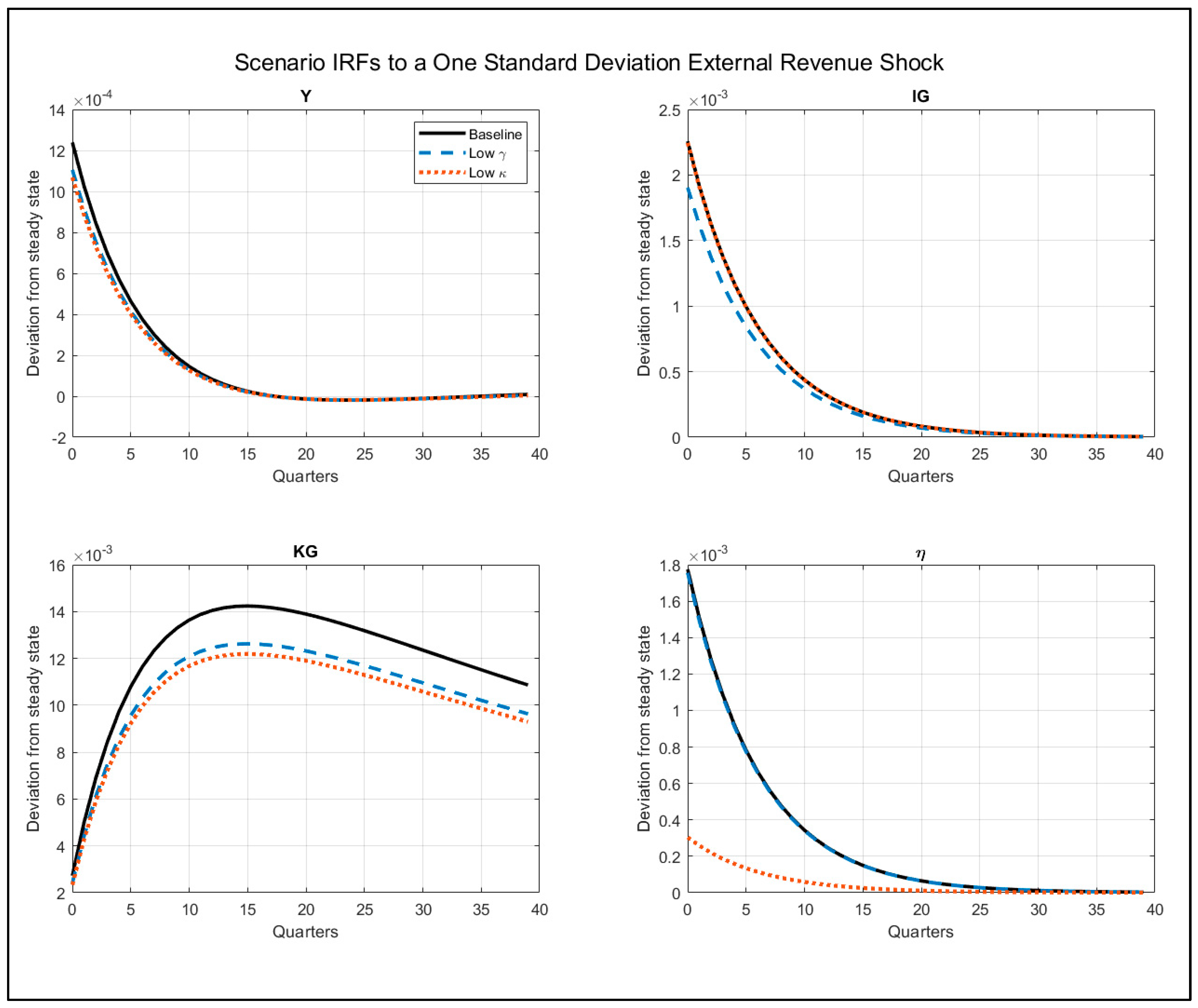
Figure 2 compares the impulse responses of selected variables under alternative institutional and fiscal configurations. In particular, the figure contrasts the baseline scenario with two counterfactual cases: a lower degree of fiscal procyclicality and an improved institutional environment characterized by a weaker sensitivity of spending efficiency to revenue fluctuations.
Figure 2 compares the impulse responses across alternative institutional scenarios, highlighting how fiscal procyclicality and spending efficiency shape the transmission of external revenue shocks. Relative to the baseline, reducing fiscal procyclicality (Low γ) substantially dampens the volatility of fiscal aggregates and weakens the short-run output contraction. Government spending and public investment adjust less aggressively, limiting the amplification of the shock through aggregate demand and capital accumulation.
By contrast, the Low κ scenario—capturing weaker sensitivity of spending efficiency to institutional constraints—primarily affects the persistence and medium-term impact of the shock. While the initial output response is similar to the baseline, the recovery path differs markedly as efficiency losses are mitigated. This results in a faster stabilization of public capital accumulation and a smoother convergence toward the steady state.
Taken together, the scenario analysis shows that institutional parameters operate through distinct but complementary channels. Fiscal procyclicality governs the immediate transmission of external shocks, whereas spending efficiency shapes their persistence and long-run consequences. These results underscore that improving institutional capacity can yield significant stabilization gains even in the absence of formal countercyclical fiscal rules, particularly in economies where policy credibility and enforcement remain weak.
The scenario analysis therefore serves as a sensitivity check, showing that the qualitative transmission mechanisms and policy conclusions are robust to plausible alternative values of key institutional parameters.

4.3. Simulated Moments and Variance Decomposition

Table 2 reports key second moments and persistence properties implied by the simulated economy, providing an informal check of whether the calibrated model reproduces stylized dynamics typically observed in resource-dependent emerging economies. In the baseline scenario, output, consumption, and investment display sizeable volatility and strong persistence, while capital stocks (private and public) are highly persistent by construction, reflecting gradual accumulation dynamics. Fiscal aggregates and related variables (government spending and public investment) comove with output, consistent with a procyclical fiscal transmission mechanism. Across alternative scenarios, the moments confirm the qualitative predictions of the model: lowering fiscal procyclicality (Low γ) dampens the volatility of fiscal aggregates and reduces the propagation of the external revenue shock through public investment, whereas lowering institutional sensitivity (Low κ) mitigates the amplification channel operating through endogenous spending efficiency. Overall, the simulated moments support the interpretation that institutional parameters primarily shape the strength of fiscal propagation and persistence rather than generating fluctuations independently.
Table 3 presents the variance decomposition of simulated variables into productivity shocks (eA) and external revenue shocks (eZ), which helps identify the dominant sources of fluctuations in the model. As expected in a real DSGE environment where productivity is a key primitive disturbance, productivity shocks account for the vast majority of output variability in the baseline. By contrast, the external revenue shock is mechanically the main driver of the revenue process itself, and it contributes non-trivially to the variance of fiscal and institutional transmission variables (including fiscal aggregates and the efficiency-related channel), consistent with the paper’s mechanism.
Importantly, minor deviations from 100% reflect numerical tolerance and finite-sample simulation in Dynare. In population (i.e., with large samples and orthogonal shocks), contributions would sum to 100% up to numerical tolerance. The decomposition therefore reinforces the central message: external revenue disturbances propagate primarily through fiscal decisions and institutional efficiency, while productivity shocks remain the main driver of aggregate output variance in this real model.
Taken together, Table 2 and Table 3 provide a disciplined quantitative benchmark for the model’s fiscal transmission mechanism: institutional constraints and spending-efficiency dynamics shape the magnitude and persistence of the fiscal response to external revenue shocks, thereby affecting macroeconomic volatility even when the primary source of output variance remains productivity.
Quantitatively, the simulated moments reported in Table 2 show that output and fiscal aggregates display sizable volatility and high persistence, consistent with the gradual adjustment paths observed in the IRFs. In the counterfactual scenarios, the Low γ calibration reduces the volatility of fiscal aggregates and weakens short-run propagation, while the Low κ calibration primarily reduces the persistence of the shock by mitigating efficiency losses. These quantitative patterns are consistent with Table 3, where external revenue shocks explain a non-trivial share of the variance of fiscal variables and the efficiency channel, while productivity shocks remain the dominant driver of output variance in the real model.
Overall, the results indicate that external revenue shocks are transmitted to the real economy primarily through fiscal channels, with institutional constraints shaping both the magnitude and persistence of macroeconomic responses. While productivity shocks remain the dominant source of aggregate output variance in this real DSGE framework, fiscal procyclicality and spending efficiency play a critical role in amplifying external disturbances and prolonging their effects. These findings motivate a broader discussion of how institutional quality and fiscal design interact in shaping macroeconomic volatility in resource-dependent and dollarized economies.

5. Discussion and Policy Implications

This section discusses the main results of the paper by situating them within the broader literature on fiscal procyclicality, external shocks, and institutional constraints in emerging and commodity-dependent economies. Rather than focusing exclusively on quantitative outcomes, the discussion emphasizes the mechanisms through which fiscal behavior and institutional capacity shape business cycle dynamics, and how these mechanisms relate to previous empirical and theoretical findings.

5.1. External Shocks, Fiscal Policy, and Business Cycle Amplification

A central result of the model is that external revenue shocks generate persistent macroeconomic effects primarily through fiscal transmission mechanisms. While productivity shocks account for the largest share of output volatility, fluctuations in external revenues exert a disproportionate influence on fiscal aggregates, public investment, and spending efficiency. This pattern is consistent with a growing body of evidence showing that, in developing and resource-rich economies, fiscal policy often amplifies rather than smooths business cycle fluctuations.
Early cross-country evidence by Talvi and Végh (2005) documents how volatility in the tax base induces procyclical fiscal behavior, particularly in economies with weak fiscal institutions and limited access to financial markets. Subsequent contributions confirm that this pattern is especially pronounced in commodity-exporting countries, where fiscal revenues are closely tied to external price movements (Frankel, 2011; Ilzetzki & Vegh, 2008). More recent empirical work shows that global commodity cycles remain a dominant driver of macroeconomic volatility even after controlling for domestic policy frameworks (Fernández et al., 2020).
The baseline dynamics generated by the model replicate these empirical regularities. Negative external revenue shocks lead to immediate fiscal contractions that propagate to output and private investment, reinforcing cyclical downturns. From a DSGE perspective, these results support the view that fiscal policy should be modeled as an endogenous propagation channel rather than as a purely stabilizing component. In line with recent DSGE applications for emerging economies, the sensitivity of macroeconomic outcomes to fiscal parameters highlights the importance of institutional and fiscal design in shaping the transmission of external shocks.

5.2. Public Investment, Capital Accumulation, and Medium-Term Dynamics

An important feature of the model is the explicit treatment of public investment and public capital accumulation. The results indicate that public investment responds more strongly to fiscal shocks than aggregate output, generating pronounced medium-term effects on productive capacity. This finding is consistent with empirical evidence showing that public investment is often the most volatile component of fiscal expenditure in developing economies (Alesina et al., 2008; Mendoza & Oviedo, 2006).
The contraction in public investment following adverse revenue shocks slows the accumulation of public capital, which in turn dampens productivity and output in subsequent periods. This mechanism aligns with the arguments advanced by Pieschacón (2012), who shows that fiscal discipline in resource-exporting economies yields long-run benefits precisely because it protects public investment during downturns. More recent quantitative studies confirm that smoothing public investment over the cycle can reduce macroeconomic volatility without compromising long-run growth, particularly when public capital enters production as a complementary input (Berg et al., 2018, 2012). These results are consistent with DSGE-based analyses showing that simple and implementable fiscal rules in small open economies can reduce macroeconomic volatility without undermining medium-term growth, particularly when public investment plays a productive role in the economy (Kumhof & Laxton, 2013).
By embedding public capital as an externality in the production function, the model provides a structural explanation for why fiscal adjustments can have persistent real effects. This channel is especially relevant for economies such as Ecuador, where public investment has historically played a central role in infrastructure provision and growth strategies, and where fiscal retrenchment during downturns can have lasting consequences.

5.3. Institutional Constraints and Spending Efficiency

Beyond expenditure levels, the model highlights the macroeconomic relevance of spending efficiency as an endogenous process. When institutional constraints cause efficiency to deteriorate in response to revenue shocks, the effectiveness of public spending declines precisely during periods of fiscal stress. This mechanism complements a growing literature emphasizing that the quality of institutions and public investment management is as important as the scale of fiscal intervention.
Empirical studies document that weak governance, limited administrative capacity, and poor project selection substantially reduce the growth impact of public investment and increase macroeconomic volatility (Gupta et al., 2014; Berg et al., 2018). More recent work stresses that absorptive capacity constraints and implementation bottlenecks can offset the potential stabilizing role of fiscal expansions, particularly in low- and middle-income economies (Berg et al., 2012).
From a political economy perspective, Drazen and Eslava (2010) and M. D. L. A. Gonzalez (2002) argue that fiscal outcomes in developing democracies are shaped by electoral incentives and institutional frictions that undermine countercyclical intentions. The endogenous efficiency channel incorporated in the model captures these insights in a reduced-form manner, linking institutional fragility directly to macroeconomic dynamics. In this sense, institutions emerge as a mediating factor between fiscal policy and real economic outcomes, rather than as a background condition.

5.4. Policy Implications and Relevance in a Broader Context

The results have implications that extend beyond the specific case analyzed. First, they reinforce the argument that fiscal procyclicality is not merely a discretionary policy choice, but often the outcome of structural and institutional constraints. Without mechanisms to smooth revenues or protect key expenditure items, governments may be forced into contractionary adjustments during downturns, exacerbating macroeconomic instability.
Second, the comparison of alternative scenarios suggests that reducing fiscal procyclicality can mitigate short-run volatility, but that larger and more persistent gains arise when institutional capacity improves. These results align with evidence showing that fiscal rules are most effective when embedded in broader institutional frameworks that enhance credibility, transparency, and enforcement (Debrun & Kumar, 2007; Frankel, 2011; Berg et al., 2012).
Finally, the results speak to the broader debate on macroeconomic stabilization in emerging economies with limited monetary autonomy. In such contexts, fiscal policy bears the primary burden of adjustment, making the design and implementation of fiscal institutions central to macroeconomic performance. The analysis suggests that strengthening institutional capacity may yield more durable stabilization benefits than marginal adjustments to fiscal parameters alone.

5.5. Further Research

The framework developed in this paper opens several avenues for future research. One natural extension would be to incorporate endogenous political cycles or regime changes in fiscal behavior, allowing for a more explicit link between electoral incentives and fiscal procyclicality. Another extension would involve introducing financial frictions or sovereign risk premia, which could interact with fiscal policy and external shocks to generate nonlinear dynamics. Finally, extending the model to a multi-country setting could shed light on regional spillovers and coordinated fiscal responses among commodity-exporting economies.

6. Conclusions

This paper has examined the transmission of external revenue shocks in a resource-dependent and institutionally constrained economy, using a calibrated DSGE framework tailored to the case of Ecuador. The analysis departs from standard fiscal DSGE models by explicitly incorporating procyclical fiscal behavior, public capital accumulation, and endogenous spending efficiency as key channels through which external shocks propagate and persist over the business cycle.
The results show that macroeconomic volatility in Ecuador is shaped not only by productivity disturbances, but also by the interaction between external revenue fluctuations and fiscal institutions. External shocks exert a disproportionate influence on fiscal aggregates, public investment, and spending efficiency, thereby amplifying their impact on output and private economic activity. Even when productivity shocks dominate output variance, fiscal transmission mechanisms play a central role in determining the persistence and magnitude of macroeconomic responses.
A key finding is that public investment and public capital accumulation constitute an important medium-term propagation channel. Fiscal contractions triggered by adverse revenue shocks reduce public investment, slowing the accumulation of productive public capital and generating lasting effects on output. These dynamics highlight how fiscal adjustments in resource-dependent economies can have persistent real consequences, particularly when public capital plays a complementary role in production.
Beyond expenditure levels, the model underscores the macroeconomic relevance of institutional capacity and spending efficiency. When institutional constraints cause efficiency to deteriorate in response to revenue shocks, fiscal expansions become less effective precisely when they are most needed. This mechanism provides a structural interpretation of why fiscal policy may fail to stabilize the business cycle in imperfect democracies, even in the presence of formal fiscal rules.
From a broader perspective, the findings suggest that fiscal procyclicality should be understood as an endogenous outcome of institutional and structural constraints rather than as a purely discretionary policy choice. In economies with limited monetary autonomy and volatile external revenues, fiscal policy becomes a primary transmission channel for external shocks. Improvements in institutional capacity and spending efficiency appear to be as important as adjustments in fiscal parameters for mitigating macroeconomic volatility.
Overall, the paper contributes to the literature on dynamic macroeconomics by offering a coherent structural framework to analyze fiscal transmission mechanisms in emerging and commodity-dependent economies. By focusing on the interaction between external shocks, fiscal behavior, and institutional constraints, the analysis provides insights that are relevant not only for Ecuador but also for other economies facing similar structural conditions. Future research could extend the framework by incorporating endogenous political dynamics, financial frictions, or sovereign risk, as well as by exploring cross-country spillovers in multi-economy settings.

Supplementary Materials

The following supporting information can be downloaded at: https://www.mdpi.com/article/10.3390/economies14020036/s1. File S1: Dynare model files for the baseline scenario and alternative institutional configurations (low fiscal procyclicality and improved spending efficiency); File S2: MATLAB and Dynare scripts used to run the simulations, generate impulse response functions, and compute simulated moments and variance decompositions; File S3: Output files containing simulated data used to construct Table 2 and Table 3 and Figure 1 and Figure 2; File S4: README file describing the folder structure, execution order of scripts, and instructions to reproduce all results reported in the manuscript.

Funding

This research received no external funding.

Institutional Review Board Statement

Not applicable.

Informed Consent Statement

Not applicable.

Data Availability Statement

The data supporting the findings of this study consist of model-generated simulation outputs. The Dynare model files, simulation scripts, and output data necessary to reproduce the results are provided as Supplementary Material. Additional details are available from the author upon reasonable request.

Conflicts of Interest

The author declares no conflicts of interest.

Abbreviations

The following abbreviations are used in this manuscript:
TFPTotal Factor Productivity
ARAutoregressive
DSGEDynamic Stochastic General Equilibrium
GDPGross Domestic Product
LACLatin America and the Caribbean
RBCReal Business Cycle
VARVector Autoregression

Appendix A. Calibration Strategy and Parameter Justification

Appendix A.1. Preference Parameters

The discount factor β is set to 0.99, which corresponds to an annualized real interest rate close to 4 percent under quarterly frequency. This value is standard in DSGE models and ensures a realistic intertemporal trade-off between consumption and saving.
The coefficient of relative risk aversion σ is set to 2.0, a conventional value in the literature that implies moderate consumption smoothing and is consistent with empirical estimates used in business cycle analysis.
The inverse Frisch elasticity of labor supply φ is set to 1.0, implying a Frisch elasticity of unity. This choice lies within the range commonly adopted in DSGE studies and allows for a realistic response of hours worked to wage fluctuations.
The labor disutility parameter χ is calibrated to ensure that steady-state labor supply matches the observed average employment level, normalized in the model.

Appendix A.2. Technology and Production Parameters

The capital share in production α is set to 0.33, consistent with national accounts data and standard estimates of factor income shares in developing economies.
The capital depreciation rate δ is fixed at 0.025 per quarter, corresponding to an annual depreciation rate of approximately 10 percent, a commonly used value in quarterly DSGE models.

Appendix A.3. Fiscal Parameters

The effective tax rate τ is set to 0.18, reflecting average effective taxation levels based on fiscal data reported by Ecuadorian authorities and international sources.
The resource revenue weight ω is calibrated to 0.25, capturing the average share of oil-related revenues in total government revenues over the sample period. This parameter governs the exposure of fiscal revenues to external conditions.
Fiscal procyclicality is captured by the parameter γ, set to 1.1. This value reflects empirical evidence documenting strong procyclical fiscal behavior in developing and commodity-dependent economies, as reported in the literature.

Appendix A.4. Institutional and Efficiency Parameters

Steady-state spending efficiency η is normalized to unity without loss of generality.
The elasticity of spending efficiency with respect to revenue shocks κ is set to 0.3, reflecting the idea that institutional constraints and implementation capacity deteriorate during fiscal stress. This parameter is motivated by the political economy literature linking fiscal volatility, governance quality, and spending effectiveness.

Appendix A.5. Stochastic Processes

Total factor productivity follows an AR(1) process with persistence ρ A = 0.90, chosen to match the observed autocorrelation of output.
External revenue shocks are modeled as an AR(1) process with persistence ρ Z = 0.85, consistent with the cyclical behavior of commodity prices.
The standard deviations of productivity and external shocks, σ A and σ Z , are calibrated to reproduce the volatility of output and fiscal revenues observed in the data.

Appendix A.6. Summary

Overall, the calibration strategy balances standard parameter choices with country-specific fiscal and institutional features. While preference and technology parameters follow well-established conventions, fiscal and institutional parameters are selected to capture the distinctive transmission mechanisms relevant for a commodity-dependent economy. This approach ensures that the results are both comparable to existing DSGE studies and informative about the role of fiscal policy and institutions in shaping macroeconomic dynamics.

References

  1. Acemoglu, D., Naidu, S., Restrepo, P., & Robinson, J. A. (2019). Democracy does cause growth. Journal of Political Economy, 127(1), 47–100. [Google Scholar] [CrossRef]
  2. Alesina, A., Campante, F. R., & Tabellini, G. (2008). Why is fiscal policy often procyclical? Journal of the European Economic Association, 6(5), 1006–1036. [Google Scholar] [CrossRef]
  3. Alesina, A., Roubini, N., & Cohen, G. D. (1997). Political cycles and the macroeconomy. MIT Press. [Google Scholar] [CrossRef]
  4. Berg, A., Buffie, E. F., Pattillo, C., Portillo, R., Presbitero, A. F., & Zanna, L.-F. (2018). Some misconceptions about public investment efficiency and growth. Economica, 86(342), 409–443. [Google Scholar] [CrossRef]
  5. Berg, A., Portillo, R. A., Buffie, E. F., Pattillo, C. A., & Zanna, L.-F. (2012). Public investment, growth, and debt sustainability: Putting together the pieces. International Monetary Fund. [Google Scholar] [CrossRef]
  6. Besley, T., Ilzetzki, E., & Persson, T. (2013). Weak states and steady states: The dynamics of fiscal capacity. American Economic Journal: Macroeconomics, 5(4), 205–235. [Google Scholar] [CrossRef][Green Version]
  7. Brender, A., & Drazen, A. (2008). How do budget deficits and economic growth affect reelection prospects? Evidence from a large panel of countries. American Economic Review, 98(5), 2203–2220. [Google Scholar] [CrossRef]
  8. Debrun, X., & Kumar, M. (2007, March 29). Fiscal rules, fiscal councils and all that: Commitment devices, signaling tools or smokescreens? Available online: https://ssrn.com/abstract=2004371 (accessed on 20 December 2025). [CrossRef][Green Version]
  9. Drazen, A. (2000). Political economy in macroeconomics. Princeton University Press. [Google Scholar] [CrossRef]
  10. Drazen, A., & Eslava, M. (2010). Electoral manipulation via expenditure composition: Theory and evidence. Journal of Development Economics, 92(1), 39–52. [Google Scholar] [CrossRef]
  11. Economist Intelligence Unit. (2019). Democracy index 2019: A year of democratic setbacks and popular protest. Economist Intelligence Unit. Available online: https://www.eiu.com/n/campaigns/democracy-index-2019/ (accessed on 15 December 2025).
  12. Eslava, M. (2011). The political economy of fiscal policy: A survey. In Inter-American development bank working paper (No. IDB-WP-211). Inter-American Development Bank. [Google Scholar] [CrossRef]
  13. Fernández, A., Schmitt-Grohé, S., & Uribe, M. (2020). Does the commodity super cycle matter? (No. w27589). National Bureau of Economic Research. [Google Scholar] [CrossRef]
  14. Frankel, J. A. (2011). A solution to fiscal procyclicality: The structural budget institutions pioneered by Chile (No. w16945). National Bureau of Economic Research. Available online: https://www.nber.org/papers/w16945 (accessed on 15 December 2025).
  15. Frankel, J. A., Végh, C. A., & Vuletin, G. (2013). On graduation from fiscal procyclicality. Journal of Development Economics, 100(1), 32–47. [Google Scholar] [CrossRef]
  16. García-Albán, F., González-Astudillo, M., & Vera-Avellán, C. (2021). Good policy or good luck? Analyzing the effects of fiscal policy and oil revenue shocks in Ecuador. Energy Economics, 100, 105321. [Google Scholar] [CrossRef]
  17. García-Cicco, J., Pancrazi, R., & Uribe, M. (2010). Real business cycles in emerging countries? American Economic Review, 100(5), 2510–2531. [Google Scholar] [CrossRef]
  18. Gavin, M., & Perotti, R. (1997). Fiscal policy in Latin America. NBER Macroeconomics Annual, 12, 11–61. [Google Scholar] [CrossRef]
  19. Gonzalez, F. (2000). Political instability and economic growth in Latin America. Cambridge University Press. [Google Scholar]
  20. Gonzalez, M. D. L. A. (2002). Do changes in democracy affect the political budget cycle? Evidence from Mexico. Review of Development Economics, 6(2), 204–224. [Google Scholar] [CrossRef]
  21. Grossman, G. M., & Helpman, E. (1996). Electoral competition and special interest politics. Review of Economic Studies, 63(2), 265–286. [Google Scholar] [CrossRef]
  22. Gupta, S., Kangur, A., Papageorgiou, C., & Wane, A. (2014). Efficiency-adjusted public capital and growth. World Development, 57, 164–178. [Google Scholar] [CrossRef]
  23. Ilzetzki, E., & Vegh, C. A. (2008, July). Procyclical fiscal policy in developing countries: Truth or fiction? (NBER working paper No. w14191). Available online: https://ssrn.com/abstract=1165519 (accessed on 20 December 2025).
  24. Klomp, J., & de Haan, J. (2016). Banking risk and regulation: Does one size fit all? Journal of Banking & Finance, 70, 181–195. [Google Scholar] [CrossRef]
  25. Kumhof, M., & Laxton, D. (2013). Simple fiscal policy rules for small open economies. Journal of International Economics, 91(1), 113–127. [Google Scholar] [CrossRef]
  26. Leeper, E. M. (1991). Equilibria under active and passive monetary and fiscal policies. Journal of Monetary Economics, 27(1), 129–147. [Google Scholar] [CrossRef]
  27. Mendoza, E. G., & Oviedo, P. M. (2006). Fiscal policy and macroeconomic uncertainty in developing countries: The tale of the tormented insurer. Journal of Monetary Economics, 53(5), 1029–1050. [Google Scholar] [CrossRef]
  28. Nordhaus, W. D. (1975). The political business cycle. Review of Economic Studies, 42(2), 169–190. [Google Scholar] [CrossRef]
  29. Pieschacón, A. (2012). The value of fiscal discipline in oil-exporting countries. Journal of Monetary Economics, 59(3), 250–268. [Google Scholar] [CrossRef]
  30. Rogoff, K., & Sibert, A. (1988). Elections and macroeconomic policy cycles. Review of Economic Studies, 55(1), 1–16. [Google Scholar] [CrossRef]
  31. Schmitt-Grohé, S., & Uribe, M. (2007). Optimal simple and implementable monetary and fiscal rules. Journal of Monetary Economics, 54(6), 1702–1725. [Google Scholar] [CrossRef]
  32. Talvi, E., & Végh, C. A. (2005). Tax base variability and procyclicality of fiscal policy in developing countries. Journal of Development Economics, 78(1), 156–190. [Google Scholar] [CrossRef]
  33. Torres, J. L., & Diaz-Kovalenko, I. E. (2022). Oil price shocks, government revenues, and public investment: The case of Ecuador. Available online: https://ssrn.com/abstract=4115270 (accessed on 20 December 2025). [CrossRef]
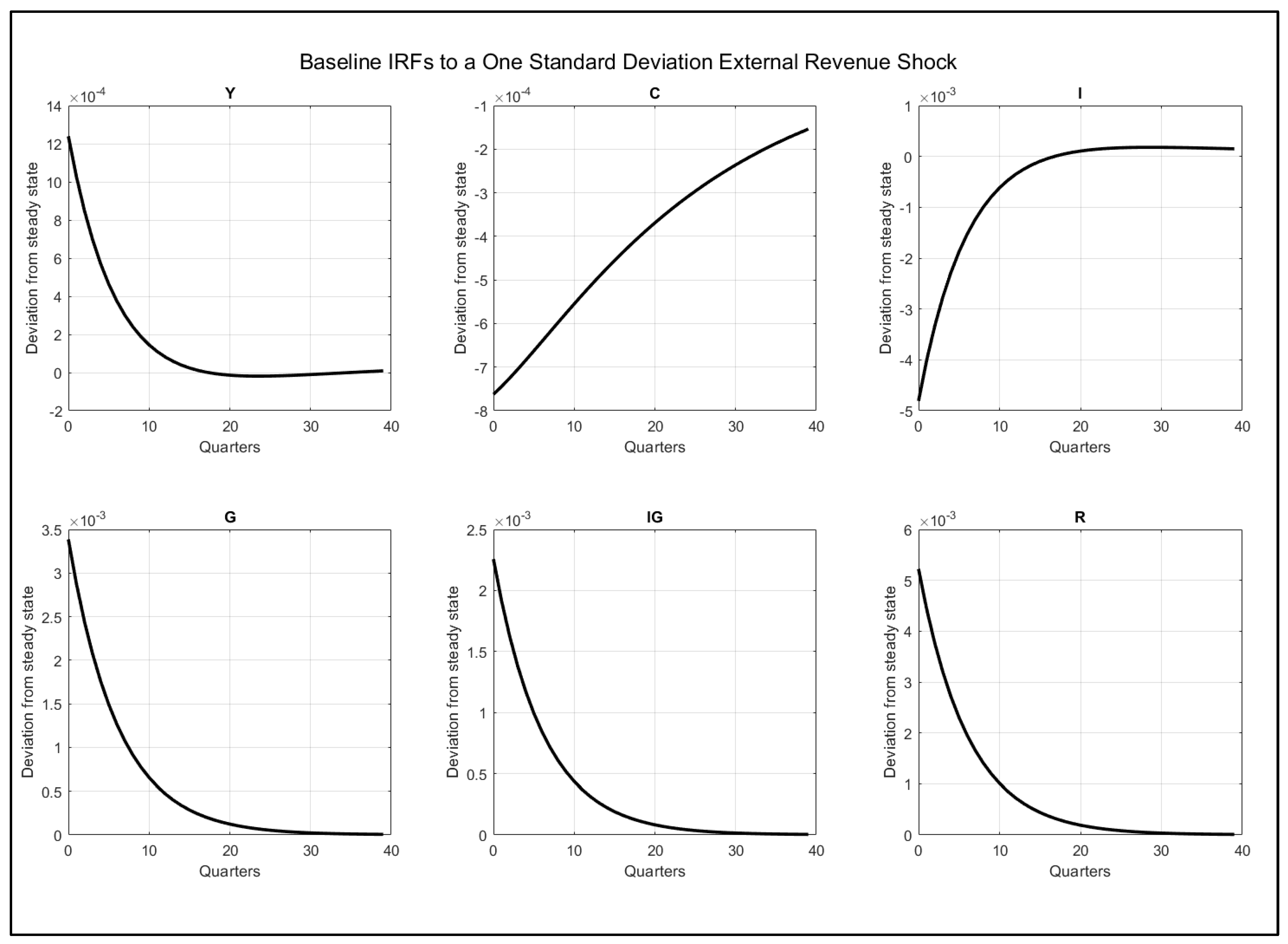
Figure 1. Baseline impulse response functions to a one standard deviation negative external revenue shock.
Economies 14 00036 g001
Figure 2. Scenario-based impulse response functions to a one standard deviation external revenue shock.
Economies 14 00036 g002
Table 1. Baseline Calibration of Parameters.
ParameterDescriptionValueSource/Criterion
β Discount factor0.99Long-run real interest rate
σ Relative risk aversion2.0Standard DSGE literature
φ Inverse Frisch elasticity1.0Standard DSGE literature
χ Labor disutility parameterCalibratedSteady-state labor supply
α Capital share0.33National accounts
δ Capital depreciation0.025Quarterly standard
τ Effective tax rate0.18Fiscal data (ECB/MEF)
ω Resource revenue weight0.25Share of oil revenues
γ Fiscal procyclicality1.1Talvi and Végh (2005)
η Steady-state efficiency1.0Normalization
κ Efficiency elasticity0.3Drazen and Eslava (2010)
ρ A TFP persistence0.90Output autocorrelation
ρ Z External shock persistence0.85Commodity price cycles
σ A TFP shock std. dev.CalibratedOutput volatility
σ Z External shock std. dev.CalibratedRevenue volatility
Note: Structural parameters follow standard values used in DSGE applications to emerging economies. Fiscal and institutional parameters are calibrated to reproduce Ecuadorian revenue composition, expenditure behavior, and observed procyclicality. Sources: Central Bank of Ecuador; Ministry of Economy and Finance; Talvi and Végh (2005); Frankel et al. (2013); Drazen and Eslava (2010).
Table 2. Second Moments and Autocorrelation of Simulated Variables.
VariableStd. Dev. (A)AC(1) (A)Std. Dev. (B)AC(1) (B)Std. Dev. (C)AC(1) (C)
Y0.1050.9050.1060.9050.1060.905
C0.0250.7680.0250.7720.0260.773
I0.0640.8340.0660.8380.0670.838
N0.0090.3310.0090.2770.0090.263
K0.9320.6520.9630.6510.9710.650
W0.0730.8960.0740.8950.0740.895
RK0.0010.3400.0010.3140.0010.307
R0.0210.8230.0210.8230.0210.823
E0.0230.8230.0190.8230.0230.823
G0.0140.8230.0120.8230.0140.823
IG0.0090.8230.0080.8230.0090.823
KG0.2670.3840.2370.3820.2290.382
η0.0070.8230.0070.8230.0010.823
This table reports standard deviations and first-order autocorrelations for the baseline model (A) and alternative scenarios B (Low γ) and C (Low κ).
Table 3. Variance Decomposition of Simulated Variables.
VariableeA (%)eZ (%)
Y99.910.04
C99.371.08
I98.991.59
N99.032.60
K99.360.87
W99.760.20
RK100.071.27
R79.5918.85
E79.5918.85
G79.5918.85
IG79.5918.85
KG88.1010.65
η79.5918.85
Percentage contribution of productivity shocks (eA) and external revenue shocks (eZ). Note: Due to finite-sample simulation and numerical approximation, variance shares may not sum exactly to 100%.
Disclaimer/Publisher’s Note: The statements, opinions and data contained in all publications are solely those of the individual author(s) and contributor(s) and not of MDPI and/or the editor(s). MDPI and/or the editor(s) disclaim responsibility for any injury to people or property resulting from any ideas, methods, instructions or products referred to in the content.