1. Introduction
E-commerce has become an integral part of the commercial landscape in European Union (EU) countries. The development of digital technology has catalyzed a revolution in how companies interact with customers and deliver products and services. E-commerce has experienced exponential growth in the EU, primarily due to digital technologies. Digital technologies such as artificial intelligence (AI); the Internet of Things (IoT), which is a specific application or subset of Information and Communication Technology (ICT); big data (BD); and cloud computing (CC) have been powerful drivers of innovation and development in EU e-commerce over the past few decades. These technologies have brought profound changes in how businesses operate and how consumers interact with them, significantly impacting the economy and society.
Artificial intelligence (AI) has significantly innovated e-commerce by enabling companies to enhance customer interaction through personalized experiences (like product recommendations, chatbots, and voice assistance based on advanced behavioral data analysis) and by optimizing supply chains. Separately, IoT has expanded the framework of interconnectivity, allowing products and devices to communicate with each other and users. In e-commerce, this translates into smart objects like refrigerators or cars that can automatically place restocking orders or provide real-time data about product status. This level of real-time connectivity enhances the customer experience and business efficiency. BD has become an essential tool in e-commerce. Companies can collect and analyze customer data, buying behavior, and market trends. This enables personalized and segmented offerings, as well as demand anticipation. BD also helps identify fraud and optimize operational processes. Cloud computing has brought greater flexibility and scalability to e-commerce. Companies can host their websites and manage their data in the cloud, making adapting to changing online traffic demands and reducing infrastructure costs easier. Furthermore, the cloud facilitates global collaboration and enables access to data from anywhere.
The primary objective of this article is to deeply investigate and analyze the impact of digital technologies on the e-commerce sector in European Union (EU) countries. This article aims to provide a comprehensive understanding of how these technologies influence how businesses operate and how consumers interact with them within the specific context of the EU. This paper seeks to contribute significantly to understanding the complexity and dynamics of e-commerce in EU countries in the era of digital technologies. By using neural network analysis and cluster analysis, as well as focusing on the EU-specific context, this study aims to reveal innovative trends and insights for research and practice in e-commerce and digital technologies.
A series of studies deals with digitalization variables and their impact on financial performance. For example,
Lutfi et al. (
2022) present, in their study, the strong relationship established between the decision to adopt BDA at the enterprise level and the performance of the respective enterprise at the level of the hotel industry in Jordan. Another study shows the importance of adopting digital technologies to ensure interconnection at the organizational level between different services, thus ensuring the quality of organizational activity (
Ali et al., 2022). That study is particularly relevant because it focuses on the medical field, where any type of innovation must be integrated quickly to ensure the well-being of those who use these medical services. The same positive correlation between the digital transformation process and the company’s performance is also analyzed in the study “How does digital technology usage benefit from performance? Digital transformation strategy and organizational innovation as mediators” with reference to Taiwan (
Tsou & Chen, 2023).
While the literature review confirms a solid foundation regarding the interaction between digital technology, e-commerce, and sustainability, three critical gaps are identified that limit current understanding and underpin our study. Research is fragmented, lacking integrated predictive models capable of assessing the combined and non-linear effect of a portfolio of technologies (AI, big data, IoT, and cloud). Furthermore, there is a methodological limitation, with most studies relying on linear regressions, and consequently, a gap in applying machine learning techniques (such as neural networks) to precisely quantify these complex relationships. Finally, there is a noticeable lack of regional differentiation, with few studies utilizing cluster analysis to classify EU member states into distinct performance groups and formulate tailored policy recommendations. While the existing literature (
Lutfi et al., 2022;
Ali et al., 2022;
Tsou & Chen, 2023) consistently confirms the role of digital technologies in stimulating organizational performance, these studies are often limited to single-country, single-sector, or single-technology contexts. Our study addresses this research gap by offering an integrated perspective.
To create this case study, the SPSS program was used in order to perform an analysis at the level of the neural networks that are established between different variables. Considering the analyzed variables—artificial intelligence; data analytics; IoT; cloud computing; e-commerce; and GDP—we later proceeded to highlight some groups of countries that form homogeneous clusters (hierarchical clustering) from the point of view of the relationships established between these variables. The obtained results show an important influence of digital technologies on electronic commerce with respect to GDP.
Drawing on the existing literature and identifying gaps, we formulated the study’s research question and objectives. How do artificial intelligence, big data analytics, the Internet of Things, and cloud computing collectively influence e-commerce development and sustainable economic performance (GDP) across European Union member states?
This study employed a mix of predictive, causal/correlational, and descriptive/comparative analysis (using neural networks and cluster analysis).
The research focuses on three core objectives:
Objective 1 (Causal Objective): To quantify the directional impact of the four emerging digital technologies (AI, CC, DA, and IoT) on e-commerce across EU member states.
Objective 2 (Descriptive Objective): To analyze the extent to which the intensity of e-commerce usage, in direct connection with digital technology, correlates with the economic performance indicator GDP in member states, and to use cluster analysis to identify homogeneous groups of EU countries based on the degree of adoption of these technologies, aiming to highlight the heterogeneity within the Union.
Objective 3 (Predictive/Modeling Objective): The final objective of this research is the construction of a robust model capable of estimating the interaction between e-commerce and GDP, taking into account the degree of digital technology adoption across the EU.
Many authors (
Bocean & Vărzaru, 2023;
Vărzaru et al., 2024,
2025) use HCA (hierarchical cluster analysis) in their studies as a preliminary step for segmenting and typologizing EU member countries. The main purpose is to identify natural groupings (clusters) of countries that share similar characteristics regarding a specific phenomenon (e.g., degree of digital transformation or economic performance). Also, MLP (multilayer perceptron) is employed throughout these studies as an advanced method for non-linear prediction and causal modeling. Its goal is to evaluate the influence and importance of the input variables on the output variables by modeling the complex relationships between them.
The structure of the paper consists of six sections. The first two sections present the theme and state of the art in digital technology-based e-commerce. The following two sections include the research methodology and results. The final two sections discuss the findings and conclude the paper.
2. Literature Review and Hypotheses Development
Digital technology includes technological devices or platforms that use and process a series of data, these being connected to the Internet or to other devices or applications (
Mannheim et al., 2019). Digital transformation is indispensable in modern societies, with this process being strongly accelerated after the COVID-19 pandemic. The notion of digital transformation aims at the development of digital technologies, with the aim of creating an efficient business model (
J. Chen & Yang, 2019). Digital transformation has its roots in digital technologies such as BD, AI, and CC and aims to generate new technologies and create new products so that companies benefit from an efficient digital support that ensures sustainable performance (
Teng et al., 2022). Another paper by
Verhoef et al. (
2021) serves as a foundational guide for understanding digital transformation (DT), arguing that DT and the resulting changes in business models have fundamentally changed customer behavior. The authors present 3 clear steps that characterize DT, namely digitization, digitalization, and digital transformation.
The specialized literature (
Samara et al., 2020;
Brodeur et al., 2022;
Wang et al., 2020;
Lutfi et al., 2023) confirms the role of digital technologies in stimulating competitiveness and organizational performance while also validating the use of advanced methodologies in quantifying these effects. Our study distinguishes itself by applying this methodological rigor exclusively to the e-commerce sector of the EU-27, integrally testing the influence of a set of four key digital technologies (AI, big data, IoT, and CC) on sustainable performance. This specific sectoral focus represents the core novelty of this work.
E-commerce has become the domain of powerful states, offering an optimal solution for the procurement process for nearly all types of products. Innovative software solutions are essential to supporting e-commerce operations (
Sulova, 2023). AI in e-commerce enables user personalization and enhances marketing efficiency. Thus, AI can be viewed as the catalyst for e-commerce success, facilitating operations such as electronic payments, logistics management, and network marketing (
Khrais, 2020). By implementing machine learning-based recommendation systems, relevant product suggestions tailored to individual preferences can be provided to customers, increasing customer satisfaction and boosting sales. Machine learning techniques are useful since they employ algorithms for data processing, linguistic data classification, and vector representation, enabling the identification of pricing or product issues and significantly assisting e-commerce companies (
Patel & Passi, 2020).
Machine learning (ML) is a crucial component of digitization, aiding in shaping forecasting systems, studying customer behavior, and formulating recommendations, among other applications (
X. Chen et al., 2023). Big data in e-commerce provides valuable insights into user behavior and preferences. By analyzing vast datasets, online retailers can better understand customer needs and adapt marketing strategies accordingly. The increasing volume of data necessitates the implementation of an extensive data system for efficient capture, storage, and analysis, considering the data generated by various devices such as computers, mobile phones, and social networks (
Manyika et al., 2011). IoT offers extensive opportunities in e-commerce by connecting smart devices to the network. This interconnectivity allows for real-time data collection about products and users, providing relevant and personalized information. For instance, online retailers can continuously monitor stock levels, delivery conditions, and user preferences through IoT devices. By connecting IoT devices to e-commerce platforms and utilizing the cloud to manage and analyze generated data, delivery and inventory management processes can be optimized, reducing costs and delivery times. The Internet of Things (IoT) is a fitting representative for the Information and Communication Technology industry because it captures the sector’s essence: connecting devices to capture, transmit, and display electronic data.
Since 2020, especially during the COVID-19 pandemic, e-commerce has recently shifted online, with a slight return to physical retail. Official data indicates that in 2012, 55% of buyers used online services for purchasing, while in 2022, the proportion of online shoppers rose to 75% (
X. Chen et al., 2023). Since there is not enough data to be able to offer a comparison between the two time periods (the pre-pandemic and post-pandemic periods) for the digital technologies that influence e-commerce, this study only followed the e-commerce variable to identify the trend in terms of its evolution. As such, we have identified an upward evolution at the e-commerce level that has strengthened, especially after the outbreak of the COVID-19 pandemic. Thus, if in the years 2018 and 2019 the EU average for companies receiving online orders was 16.8% and 17.2%, respectively, then in 2021, this average increased significantly, reaching 18.9% in 2021 and 19.7 in 2022 (
Eurostat, 2023). Predictions of online sales are optimistic, following an upward trend in the coming years (
Shepherd, 2023). Consequently, any business activity can now occur online, from product and service purchases to dispute resolution, clarification of issues, scheduling industrial product viewings, or appointments for testing. CC, AI, and blockchain offer entrepreneurs opportunities and facilitate interaction between organizations and consumers (
Soni et al., 2020).
In e-commerce, the choice of the application type plays a crucial role in determining success. Selecting the right solution for a business should consider the type of activity, existing software systems within the company, and the ability to integrate them (
Sulova, 2023). Technology allows industries to deliver higher-quality, cost-effective services (
Soni et al., 2020). E-commerce is empowered by various software programs that streamline activities, reduce human errors, minimize waiting times for different tasks, ensure product and service delivery professionalism, and maintain constant communication with customers. AI plays a vital role in developing new concepts based on demand forecasting mechanisms, often surpassing human intelligence’s limitations in e-commerce (
Soni et al., 2019).
Businesses use marketing to differentiate themselves in a world where products no longer exhibit significant differences compared to competitors. Marketing becomes the optimal solution for distancing oneself from the competition. AI is particularly important in shaping marketing, which needs to be dynamic, customer-centric, and adaptable to changes, customer needs, and competition. AI presents new strategies and facilitates segmentation, thus enabling more efficient marketing (
Tussyadiah & Miller, 2018).
Modern e-commerce-related procurement issues are now addressed with the help of chatbots. A chatbot is an artificial intelligence-powered program that facilitates human–robot-type conversations (
Needle, 2021;
Oguntosin & Olomo, 2021). This creates the impression of an online human-to-human conversation to solve sales-related problems. Applications like these are essential for current managers (
Helfat & Raubitschek, 2018).
Artificial intelligence and other software systems that simplify transaction processes support e-commerce. Recent studies focusing on big data analytics have examined factors influencing organizational performance. In addition to management and talent, technology emerges as an essential factor in defining organizational performance (
Adrian et al., 2018). Broadly, BD encompasses significant volumes of structured, unstructured, and semi-structured data, which, by surpassing the analytical capabilities of traditional databases, also represent the “new oil” of the digital economy due to the strategic and innovation opportunities they offer (
Lungu et al., 2025). Due to the vast amount of information related to extensive data systems and their wide range of applications in businesses and industries, no standardized definition leads to confusion among specialists (
Ward & Barker, 2013;
Bertot & Choi, 2013).
In a broad sense, big data encompasses structured, unstructured, and semi-structured data in significant volumes that cannot be analyzed using traditional databases. BD is an organizational infrastructure using advanced technologies to capture, store, manage, and analyze various data types. It represents a modern structure capable of extracting essential insights from large datasets quickly and cost-effectively (
Kaka, 2015) and is often referred to as the “new oil” in the digital economy due to the opportunities it offers (
Al-sai et al., 2022).
Recent studies with BDA as the central element focus on factors influencing organizational performance. In addition to management and talent, technology emerges as an essential factor in defining organizational performance (
Adrian et al., 2018).
Le and Liaw (
2017) conducted a study on the effectiveness of applying the big data model based on the AIDA model, which tracks consumer behavior in the four stages—attention, interest, desire, and action. According to this model, e-commerce needs to find optimal ways to attract attention; generate interest leading to desire; and trigger action, which refers to purchasing a product or service. The study explores consumers’ responses, categorizing them into two categories—intention and behavior. Responses are interpreted using big data within the context of B2C e-commerce.
The TOE Framework, developed by Tornatzky and Fleischer, provides the structure for justifying our research hypotheses by analyzing technological innovation adoption at the national level. The Technology–Organization–Environment (TOE) Theoretical Framework divides influences into three major contexts, providing the tripartite structure necessary to justify the three hypotheses. The Technological Context is analyzed through the prism of the four key pillars of digital transformation, AI, DA, IoT, and CC, which allows us to assess the intensity of technological innovation utilization essential for the e-commerce sector. The Organizational Context is identified directly by the e-commerce variable itself, reflecting the capacity and readiness of enterprises to adapt their processes and successfully conduct transactions in the online environment. Finally, the Environmental Context is highlighted by the gross domestic product (GDP) variable, enabling us to evaluate how the successful interactions and advancements within the Technological and Organizational Contexts translate into broader, positive economic effects at the levels of the entire business environment and national economy.
Based on these considerations, this paper presents the first research hypothesis:
Hypothesis H1. Digital technologies positively impact e-commerce in EU member countries.
In the current economy, where customer satisfaction prevails, AI systems capable of meeting consumer needs are in high demand (
Bertot & Choi, 2013;
Kaka, 2015). AI-based customer service is becoming increasingly attractive (
Adam et al., 2021;
Mosa, 2022;
Klumpp, 2018) due to the desire to provide real-time solutions to users. Consequently, the growth of enterprises will be ensured by their level of integration with AI services, which is an essential element in today’s society. The expansion of e-commerce contributes to the prosperity of enterprises, which substantially impacts a country’s GDP.
A study during the pandemic (
Charm et al., 2025) demonstrated the continued increase in online purchases in the post-COVID period, with notable growth observed in economies already built around e-commerce. The prospects for e-commerce are encouraging, largely dependent on technological progress (
Keenan, 2023).
Contemporary e-commerce is continually undergoing modernization, employing increasingly complex strategies such as voice commands (
Jang et al., 2022;
Racat et al., 2021), augmented reality (
Javornik, 2016), social networks (
Nilashi et al., 2022;
Liu et al., 2022;
Herzallah et al., 2022;
Cao et al., 2022), and more. Machine learning techniques play a decisive role in this amalgamation of ideas, solutions, and proposals, as these applications would not be possible without such software.
AI appears to be the most attractive asset in modern society, considering data from the World Robotics Report in 2020, which reported a significant increase of approximately 85% in artificial intelligence sales (
Carsten, 2021). Predictions for 2025 indicate tremendous market expansion for AI. Various forms of online customer communication, such as text, voice, or video-based services, are developing depending on customer preferences (
Verhagen & Van Dolen, 2011). Thomas introduces a new typology of customer services, differentiating between human and machine services (
Thomas, 1981).
E-commerce has become a significant driving force in the economies of EU member countries. While not a new phenomenon, its development in recent decades has profoundly impacted sustainable economic performance in the region. E-commerce has positively influenced the economic performance of EU countries in several ways. It has contributed to overall economic growth. The development of online sales platforms and increased sales have stimulated economic activity and created jobs in logistics, IT, and digital marketing (
Chaffey, 2007). E-commerce has opened doors for small- and medium-sized enterprises to access global markets. EU companies can reach customers worldwide through the Internet, creating business opportunities and expansion. E-commerce has enabled companies to streamline their operations. Inventory management, order processing, and customer interactions can be automated and optimized, reducing costs and improving efficiency. Competitive pressure in e-commerce has driven innovation. Companies are compelled to offer better products and services and quickly adapt to market demands, benefiting consumers and the economy as a whole.
However, there are also considerations when analyzing the effects of e-commerce on sustainable economic performance. The growth of e-commerce has led to intense competition for traditional businesses, especially in retail (
Hoffman & Novak, 2018). This can lead to the closing of physical stores and job losses in these sectors. As more transactions occur online, protecting users’ personal and financial data becomes increasingly important (
Bezos, 2020). Emphasis is placed on the need for strict security measures and regulations to ensure consumer trust. The transportation and packaging of products for customer delivery can hurt the environment. In this regard, promoting more sustainable practices is essential.
E-commerce has had a significant impact on sustainable economic performance in EU countries. While it brings evident benefits, such as economic growth and operational efficiency, challenges, such as job losses in traditional retail and environmental impact, must be addressed (
Laudon & Traver, 2016). To ensure sustainable economic development, governments, companies, and society must collaborate in finding solutions that maximize the benefits of e-commerce and minimize adverse effects (
Turban et al., 2015). Thus, a balance between innovation, efficiency, and sustainability can be achieved in the economies of EU countries.
Based on these considerations, this paper proposes the second research hypothesis:
Hypothesis H2. There is a strong, direct, and positive relationship between digital technologies, e-commerce, and GDP.
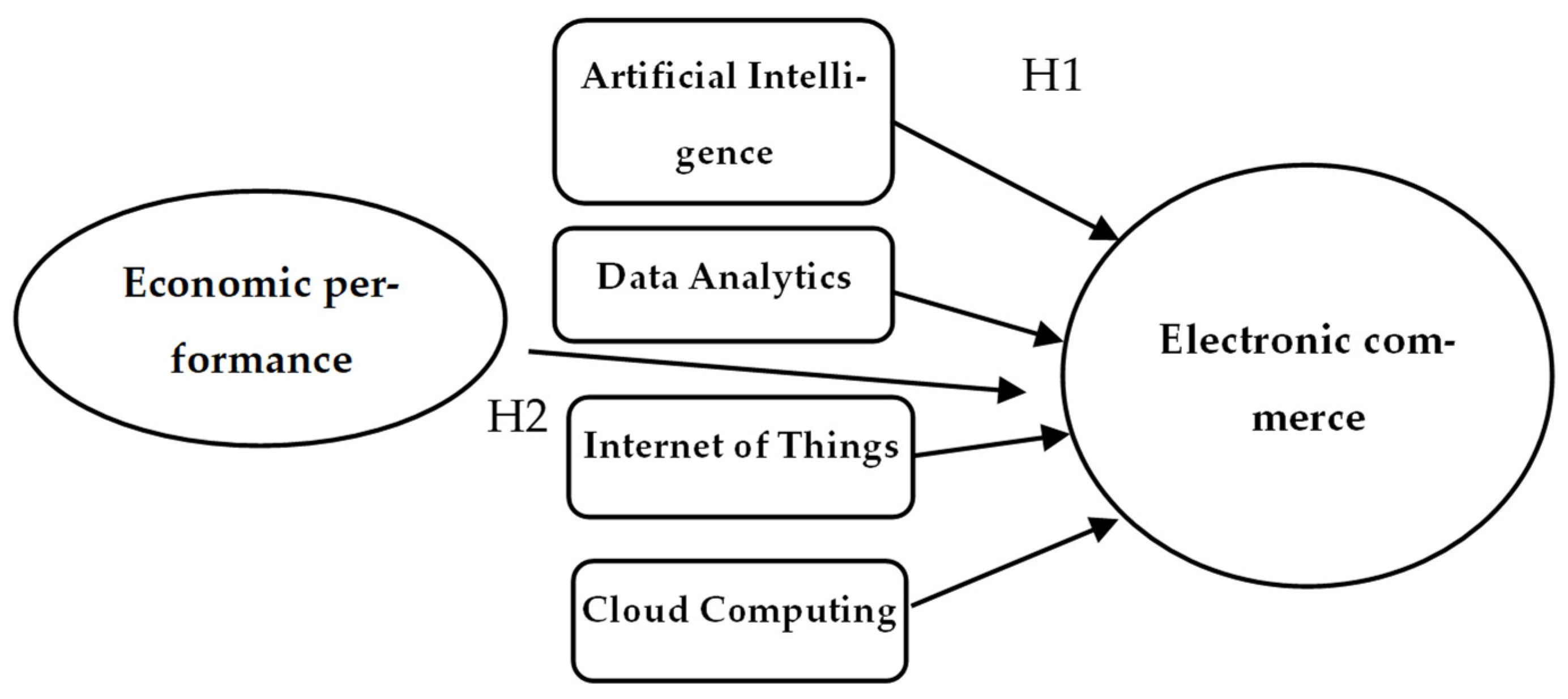
The conceptual model of the research for the two hypotheses is depicted in
Figure 1.
The rapid technological evolution of digital technologies, such as CC, IoT, AI, and BD, has had a significant impact on the business environment and society worldwide. In the European Union (EU) context, these technologies have transformed businesses’ operations, influencing online merchants, consumers, and economic growth. Concerning the impact of digital technologies on e-commerce,
Kotler and Armstrong (
2010) emphasized that digital technologies have reshaped how consumers research and purchase products and services. This transformation in consumer behavior is supported by the evolution of technologies like the Internet of Things and artificial intelligence, enabling personalized offerings and more efficient customer interactions. To understand the connection between digital technologies and economic growth, we can consider the research by
Brynjolfsson and McAfee (
2014), who highlighted that “digital technologies can lead to economic growth through increased productivity, innovation, and the creation of new markets.” This perspective supports the idea that the development and adoption of digital technologies can play a significant role in stimulating economic growth in EU countries.
Our study aims to analyze how variables associated with digital technologies (CC, IoT, AI, and BD) influence e-commerce and economic growth in EU member countries. This involves evaluating data regarding the adoption and usage of these technologies in member states and measuring the associated economic outcomes, leading to the grouping of EU countries based on these indicators.
Based on these considerations, this paper proposes the third research hypothesis:
Hypothesis H3. Depending on the variables characterizing digital technologies (CC, IoT, AI, and DA), e-commerce, and economic growth, EU member countries can be grouped into homogeneous clusters.
The impact of digital technologies on e-commerce and economic growth in EU member countries is a complex and dynamic subject that requires in-depth analyses and empirical evaluations. Hypothesis H3, which suggests that EU member countries can be grouped into homogeneous clusters based on variables related to digital technologies, involves exploring the complex connections between these variables and economic outcomes. Detailed analyses based on relevant data are necessary to validate or reject this hypothesis, integrating perspectives from economics and digital technology.
4. Results
To highlight the links that are established among the variables proposed in this research, an analysis was performed to establish the correlations between variables with the help of the SPSS program (
Table 3), which established the type of relationship between the analyzed indicators.
To comment on the relationships established between the variables proposed for the analysis, we used the Pearson correlation and the significance value (Sig.) to identify a clear perspective on the linear relationships between the analyzed variables.
Thus, starting from these relationships, statistically significant relationships are identified between these variables. Strong and significant relationships (p < 0.01) are noted between AI and CC, AI and GDP, e-commerce and DA, and e-commerce and CC:
AI and CC: r = 0.559. There is a strong positive correlation. Countries with a high adoption of AI also tend to have a high level of adoption of cloud computing services.
AI and GDP: r = 0.545. There is a strong positive correlation. An increase in AI adoption is associated with a higher GDP.
E-commerce and DA: r = 0.550. There is a strong positive correlation. Countries with a high level of e-commerce also have a high level of data analytics adoption.
E-commerce and CC: r = 0.521. There is a strong positive correlation. E-commerce and CC are closely related.
In the same register, significant but moderate relationships (p < 0.05) are highlighted between the variables AI and e-commerce; AI adoption is associated, to a lesser extent, with the growth of e-commerce. Although the link between the two is significant, direct, and positive, the mutual influence between the variables remains moderate.
IoT: This variable has no significant correlation with any of the other variables (p > 0.05 in all cases). The non-significant inverse correlations for IoT suggest that obstacles in its use may be hindering the assimilation of other tools. However, a significant linear relationship could not be confirmed.
Regarding GDP, it is noted that, apart from the strong correlation with AI, GDP does not have a significant linear relationship with e-commerce, IoT, (inverse relationship) DA, or CC. Although the correlation with CC is r = 0.311, this is not statistically significant (p = 0.115). This can be explained by the fact that, within GDP, there is a multitude of factors and variables that influence its evolution, the variables analyzed not being representative as a result of the very different degrees of assimilation within the EU member countries. Moreover, these are new, innovative tools that have only recently started to impact economic developments at the EU and even global levels.
Therefore, the correlation matrix presents a very clear overview, linking a network of strong relationships between AI, e-commerce, CC, and DA. These technologies seem to develop in tandem, suggesting that an increase in one is often associated with an increase in the others. In contrast, IoT is an “isolated” variable that does not seem to be linearly related to the others, even having an inverse and, therefore, indirect relationship, suggesting that any obstacle to the use of IoT determines a blockage in the assimilation of the other tools. An important result is the strong and significant relationship that is established between AI and GDP, indicating that, among the variables studied, AI is the best linear predictor of GDP.
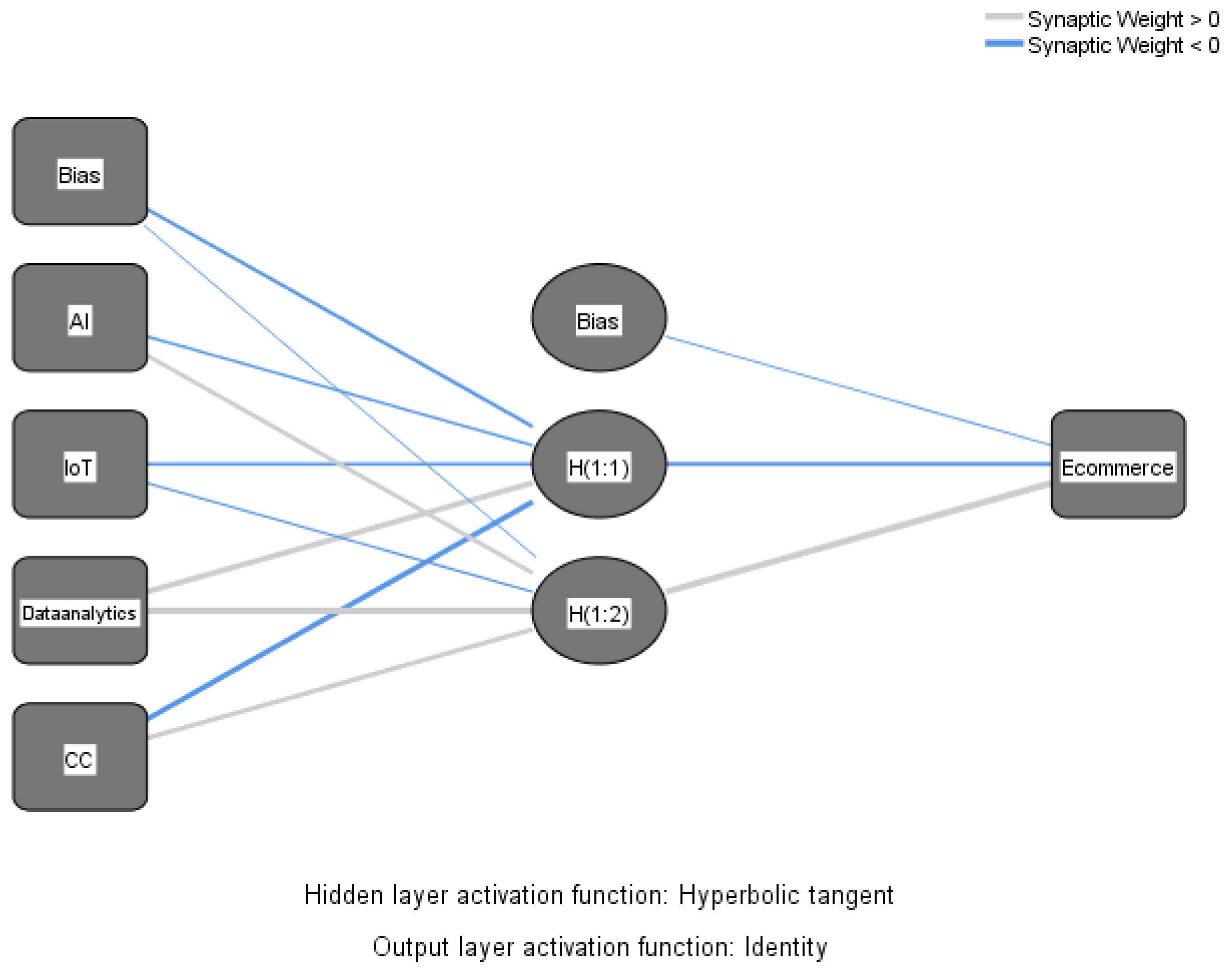
To investigate hypothesis H1, an analysis using the artificial neural network method was performed. This paper used the MLP (multilayer perceptron) model to identify the influences that are established between the input layer (CC, AI, DA, and IoT) and the output variable (e-commerce). Other variables are placed between the two layers to influence these links, that is, variables protected by a hidden layer, as shown in
Figure 2. This diagram illustrates the structure of the “digital brain” we constructed for our analysis. The input layer collects the cause variables (digital technologies). The hidden layer performs the complex calculations and is crucial for capturing non-linear relationships (meaning the influence is not purely proportional). Finally, the output layer provides our results (e-commerce and sustainable performance). The visual interpretation of synaptic weights relies on a dual encoding: color (dark/light) indicates the direction (positive/negative) of the influence, while the bold formatting indicates its strong magnitude, allowing for immediate identification of critical accelerating factors (dark and bold) or inhibiting factors (light and bold) on e-commerce performance.
The primary purpose is to show, with statistical precision, which technology most influences the success and sustainability of online businesses in the EU. The connection lines (synaptic weights) demonstrate the strength of influence of each technology in the prediction process, showcasing a transparent methodology that surpasses simple linear regression.
Table 4 presents a summary of the neural network model to demonstrate its usefulness and relevance. From the analysis of the indicators, it appears that the Relative Training Error is 0.631, indicating a very good result. The reduced error demonstrates an ideal balance between training and generalization and confirms the performance of the model. This is explained by training the model and assimilating the training data, thus identifying an efficient model to explain the relationships between variables. Also, in order to establish the relevance of the analyzed model, we studied the Relative Testing Error. The value of 0.096 is a small testing error, which shows us that the model has generalized impeccably on new, unknown data, demonstrating that it has not suffered from over-training (overfitting). From this, we can conclude that the model is over 90% better than a basic prediction, being appreciated as a final and robust model for making predictions.
The parameters of the MLP model describing the influences of digital technologies on e-commerce are shown in
Table 5.
Table 5 (parameter estimates) reveals the influences of digital technologies on e-commerce with a detailed analysis of weights. Given the complex layout of the model, which suggests the existence of two neurons that significantly contribute to the prediction of the e-commerce element, we proceeded to analyze the two layers, as highlighted by the model.
Contribution to the first hidden neuron (H(1:1)): This neuron is positively influenced by the DA variable (+0.419) and negatively by CC (−0.341). The influence of the other variables (AI and IoT) is smaller.
Contribution to the second hidden neuron (H(1:2)): This neuron is most strongly influenced by DA (+0.468), having the highest positive weight. CC (+0.322) and AI (+0.221) also have a significant positive influence. IoT has a negative influence, but it is much smaller.
Regarding the impact on the final prediction (e-commerce variable), it is confirmed that both neurons in the hidden layer contribute to the final prediction, but in different ways, as follows:
H(1:1) has a negative weight (−0.206), which means that its activation will reduce the final value of the prediction. Conversely, H(1:2) has a positive and very large weight (+1.110), which indicates that it is the most important factor in determining the final result.
In conclusion, we can state that there are two main “paths” through which the input variables influence the output variable e-commerce, but one is dominant. The main path is represented by the H(1:2) neuron, which relies heavily on the DA and CC variables to contribute positively to the prediction. Thus, although DA is the most influential predictor in both cases, its positive contribution, mediated by the H(1:2) neuron, is the one that largely dictates the final result. Although our analysis with the neural network confirmed an overall positive correlation, technical factors positioned the IoT as having a relatively low predictive weight in e-commerce development compared to AI and BDA. This discrepancy does not indicate a lack of value in IoT but rather reflects the presence of significant organizational and environmental barriers that limit the transformation of IoT potential into aggregate performance, as foreseen by the TOE Framework. Thus, organizational barriers, such as the need for significant initial investments or a lack of internal competencies, can hinder IoT adoption. At the same time, the lack of interoperability between different IoT systems can generate significant obstacles, with environmental barriers thus becoming a critical braking factor.
Hypothesis H1 is validated. Digital technologies have a positive impact on e-commerce across EU member states.
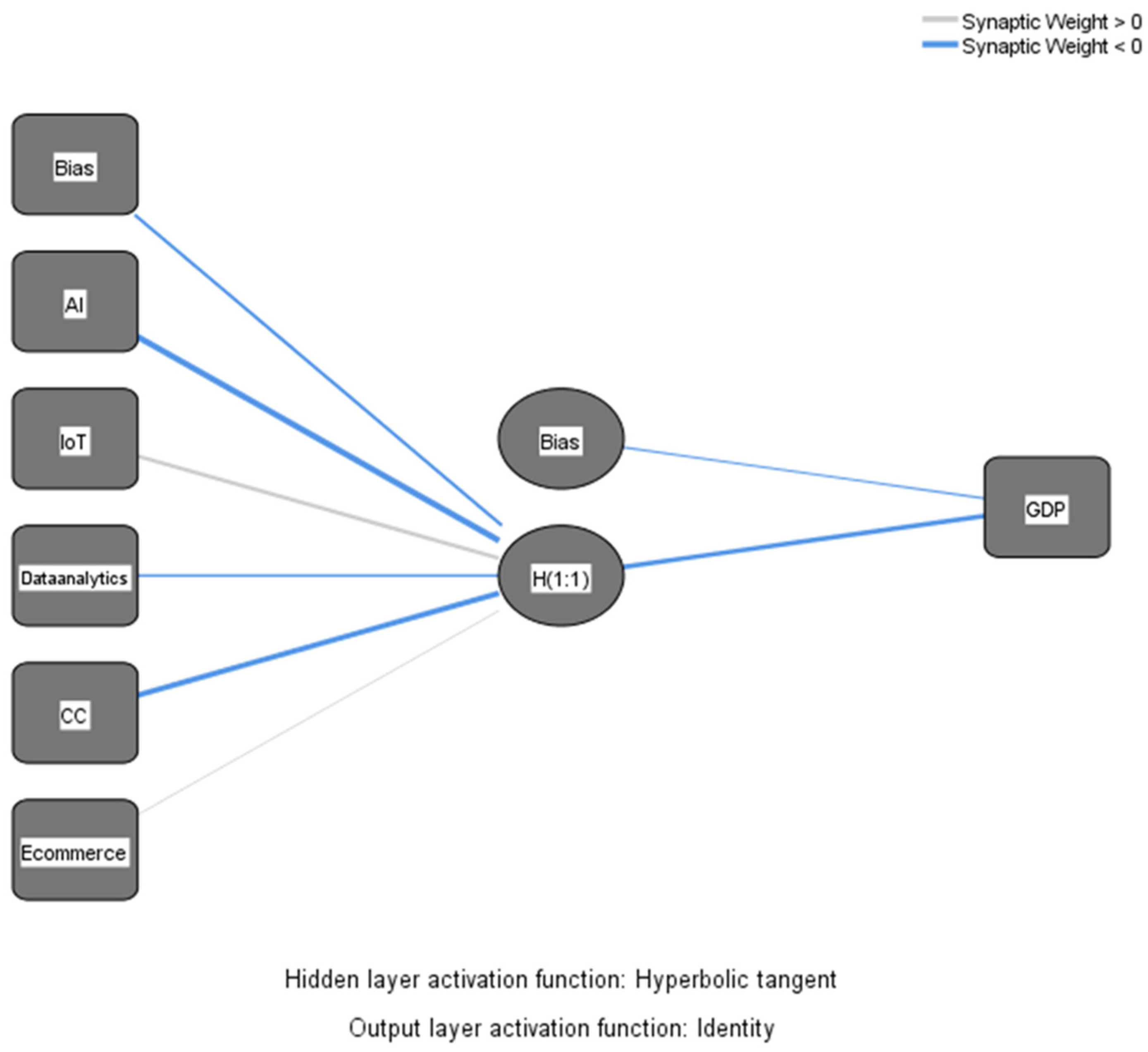
To investigate hypothesis H2, we analyzed artificial neural networks (
Figure 3) using the MLP (multilayer perceptron) model, in which electronic commerce was included among the input variables. GDP per capita was defined as the output variable measuring economic growth.
Thus, to determine if the model used is optimal, we analyzed the summary configured in this scenario (
Table 6). From the analysis of key indicators (Relative Training Error and Relative Testing Error), it was found that we have a high-performance model, with a remarkable degree of generalization, which is a sign of reliability and accuracy.
The Relative Training Error, with a value of 0.640, shows that the model fits well with the training data, meaning that it has effectively learned the relationships between the variables. At the same time, the Relative Testing Error, with a value of 0.071, is very low and indicates that the model has generalized almost perfectly on new, unknown data, avoiding over-training. Basically, the model is over 90% better than a prediction based on the average of the dependent variable.
Having obtained a model summary confirming the relevance of the model, we proceeded to analyze the parameters considered for GDP prediction. The parameters of the MLP model describing the influences of digital technologies and e-commerce on economic performance are shown in
Table 7.
Table 7 reveals the influences of digital technologies and e-commerce on economic performance. In addition to digital technologies, e-commerce positively impacts the economic performance of EU member countries. The analysis of these parameters shows how the neural network processes the input data to predict GDP. In this case, a simple network is built, with a single neuron in the hidden layer (H(1:1)). From the analysis of the weights of the analyzed variables, we identified the importance and type (positive or negative) of influence of each variable on the hidden neuron.
AI (−1.548): This has the highest absolute negative weight. This means that AI is the strongest factor. An increase in AI will significantly reduce the activation of the hidden neuron. IoT (+0.625): This has a substantial positive weight. An increase in IoT will strongly activate the hidden neuron. CC (−0.808): This has a significant negative weight. Data Analytics (−0.253): This has a negative weight but with a much smaller influence. E-Commerce (+0.025): The weight is close to zero, indicating a negligible influence on the hidden neuron. The weights in the output layer show how the hidden neuron activation is transformed into the final GDP prediction. Thus, in the output layer, H(1:1) (−0.661), the negative weight shows that an increase in the hidden neuron activation will lead to a decrease in GDP.
In conclusion, we can state that the tested model found a complex but effective relationship. Since the input weights of AI and CC are negative, and the hidden neuron weight is also negative, they cancel each other out. Thus, an increase in AI and CC will reduce the hidden neuron activation, and this, in turn, will lead to an increase in the GDP value. In contrast, an increase in IoT will positively activate the hidden neuron, and this will lead to a decrease in GDP. This model suggests that, for GDP prediction, AI and CC are the most important positive factors, and IoT is the most important negative factor.
Hypothesis H2 is validated. A positive, direct, and robust relationship exists between digital technologies, e-commerce, and GDP.
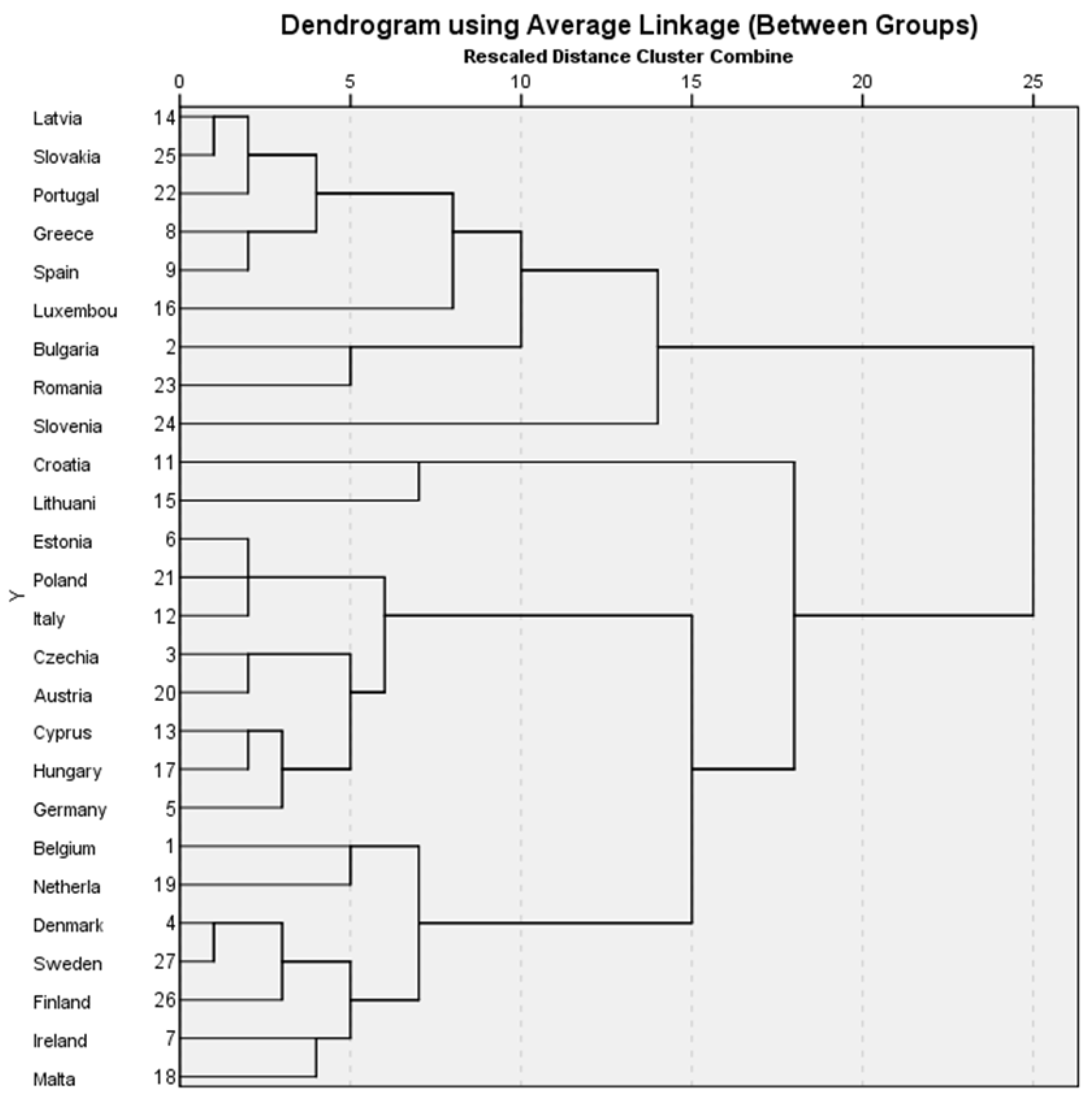
To investigate hypothesis H3, cluster analysis was used, which aims to group EU countries into homogeneous groups depending on the research variables. In
Figure 4, the paper presents a dendrogram created after processing the data extracted from Eurostat. This figure serves as a “genealogical map” of EU countries, where the distance on the Y-axis represents the level of difference. Countries that join closest to the base of the graph (small distance) are the most similar in terms of our performance variables (e.g., both have developed e-commerce and high efficiency). Long horizontal lines indicate large differences. By “cutting” this tree, we define distinct groups (clusters) of countries that share comparable performance characteristics. The lower the height at which two countries merge, the more similar they are regarding the analyzed digital and economic variables.
The dendrogram displayed in
Figure 4 presents the results of a hierarchical cluster analysis, which groups European countries based on their similarities, using the variables provided (e-commerce, AI, CC, IoT, and DA). The groups (clusters) are formed by joining similar countries in terms of their position on the variables mentioned above. From the dendrogram analysis, three main clusters and several subclusters within them can be identified.
Cluster Analysis
As shown in
Table 8, Cluster 1 consists of elements with a high degree of similarity, joined at a short distance.
All the countries presented in cluster 1 bring together states with diverse economic profiles but with many common points, such as the fact that they are all at a stage of development of digital economies, being countries that responsibly assume the need to adopt digital technologies; however, this cannot be found in the situation of recognized countries in this segment. These countries share similar challenges, such as the need to improve digital infrastructure by attracting investments and developing public policies that ensure the transition to a competitive digital economy.
Regarding the more specific similarity of the countries in subcluster 1, we note three categories of countries that are associated with similar characteristics. Thus, Latvia and Slovakia, the two countries in the first subcluster, are countries with relatively small populations but are similar in terms of the level of investment in digital public services. In principle, the two countries stand out for the way in which citizens manage to interact with banks or the state in the online environment.
In subcluster number 2, we find Mediterranean countries, characterized in particular by a significant rate of tourism, which has created the need to develop e-commerce and digital payment methods. In such regions, a significant number of SMEs develop that respond more slowly to the digitalization process, in contrast to multinational organizations.
Subcluster 3: Luxembourg, Bulgaria, Romania, and Slovenia
Regarding subcluster number 2, there are three Eastern European countries with a young population that immediately embraced the IT field. Even though these countries are significantly inferior to Luxembourg in terms of digital economies, the four are characterized by pronounced dynamism, demonstrated by the rapid pace of digital innovation.
At the level of cluster 2 (
Table 9), we find countries with a higher level of development than the countries in cluster number 1. Within this group, the countries show a certain degree of digital maturity, using digital technologies more intensively.
These countries have exceeded the status of countries that are being initiated in this digitalization process; they enjoy a robust digital infrastructure and are constantly investing in innovations. The great challenge of the countries in this cluster refers to the discrepancies between rural and urban areas in terms of the adoption of digital solutions or the differences in skills between the two areas.
Subcluster 2.1: Croatia, Lithuania, and Estonia
The first subcluster is characterized by the presence of relatively small Baltic and Adriatic countries recognized for their efforts in developing e-government. All three countries have adopted similar strategies to ensure more efficient online public services.
Subcluster 2.2: Poland and Italy
The second subcluster seems slightly atypical considering the differences between them at the geographical and economic levels. However, each of the two has become an important center in the e-commerce sector for the regions they belong to, with Poland becoming a representative country for e-commerce in Eastern Europe and Italy an e-commerce center, especially due to the traditional manufacturing sector. Thus, both countries have constantly adapted to the challenges of digital economies.
Subcluster 2.3: Czech Republic, Austria, Cyprus, and Hungary
The third subcluster presents countries with a similar digital profile, although they are located in different geographical areas. Austria and the Czech Republic are countries with a tradition in the field of engineering and technology, while Hungary and Cyprus are constantly investing in the development of digital technology.
Cluster 3
The third and last cluster (
Table 10) is predominantly formed by Western European and Nordic countries, being, in fact, a true group of digital leaders characterized by an extensive use of technologies. At the same time, within this group of countries, we can talk about a mature digital economy. Unlike cluster number 2, this cluster is formed by groups of countries with a population with high digital skills, with economies in which digital services predominate, and with e-commerce being one of the pillars of these economies. Regarding the issue of digital infrastructure, these countries are characterized by significant performance with wide coverage for 5G and fiber optic networks. This has made it possible to adopt advanced technologies.
Specific similarities by subcluster
Subcluster 3.1: Germany and Belgium
Germany and Belgium have strong industrial sectors, giving real importance to cross-border trade, which means the immediate adoption of digital technologies capable of optimizing production or the supply chain.
Subcluster 3.2: Netherlands and Denmark
The Netherlands and Denmark present a number of similarities in terms of the high share of the population that makes online purchases but also in the rate of use of online banking services.
Subcluster 3.3: Sweden and Finland
Sweden and Finland are characterized by their appetite for novelty, having a very well-developed culture of innovation. Moreover, the two countries, with very high-performance education systems, have focused on digital education and the development of digital skills among young people and beyond.
Subcluster 3.4: Ireland and Malta
Ireland and Malta constitute the last digital subcluster, being two European islands that have become digital hubs. Although both are small economies, both countries are focused on attracting foreign investment in the digital sector.
The dendrogram created using the SPSS hierarchical cluster function shows a logical division of countries into groups based on their digital and e-commerce profiles. Although in most cases countries with a common history or geographical proximity (e.g., Baltic countries; Nordic countries) tend to group together, there are exceptions (e.g., Poland and Italy). This shows us that countries can regroup according to economic and technological factors, learning strategies that are not theirs, and thus leaving behind cultural elements that could shape the approach to the digital transition.
The dendrogram confirms that there are distinct groups of countries in Europe with similar levels of digital development. Hypothesis 3 is validated.
5. Discussion
Modern society has transitioned from homo sapiens to homo technium by integrating information systems into all aspects of life. Digitalization significantly facilitates these activities, whether in education, industry, commerce, leisure time, or connecting with friends. The most significant component of today’s economy is undoubtedly electronic commerce, gradually taking over traditional transactions and moving them into the online environment.
Any transaction conducted through the World Wide Web falls under electronic commerce (
Nicolescu & Vărzaru, 2020;
Vărzaru et al., 2022;
Puiu et al., 2022;
Vărzaru, 2022a,
2022b;
Mohapatra, 2013). Electronic commerce is significantly influenced by technological changes (
Dimitrova & Kaneva, 2018). Therefore, decisions regarding investments in systems like big data or knowledge management (KM) are influenced by the type of inputs that organizations possess and their analytical structure. In this context, decision-makers must gather specific information to opt for certain systems (
Rothberg & Erickson, 2017).
Organizations are trying to maintain their positions while aiming to develop increasingly competitive new markets. Hence, improving quality, reducing time to market, and cutting costs are the objectives of any modern organization (
De Bruin et al., 2005). Therefore, new technologies can provide the competitive advantage organizations need (
Rialti et al., 2019;
Al-Sai et al., 2019a,
2019b;
Zulkarnain et al., 2019). Organizations are shifting their focus toward future-oriented platforms (
Malik, 2013), leaving behind the practice of product- or service-oriented data analysis.
Following the research on hypothesis H1, which evaluated the impact of CC, IoT, AI, and DA on the development of electronic commerce, it was found that the hypothesis is validated. According to the Pearson correlations, variables like CC and DA exhibit strong correlations with e-commerce, with AI having a significant relationship with e-commerce, GDP, and CC. In contrast, IoT does not significantly influence the proposed variables in the analysis. CC is essential for storing and preserving the information needed for digital transformation and AI—making both meaningless without it. However, in this case, there is a weak relationship with GDP, as mere data interpretation is insignificant in a country’s economy if these interpretations are not used for commercial purposes but only to attract investments. BD represents a modern technology based on business analytics and business intelligence. Thus, extensive data systems create value for businesses by making forecasts and significantly contributing to decision-making by processing information that other techniques cannot handle (
Sun et al., 2016;
J. Chen et al., 2013). It also represents a new and modern structure capable of extracting the essence from large volumes of data very rapidly and cost-effectively (
Kaka, 2015). However, BD requires attention to generate adverse effects, including concerns about confidentiality and security (
Bose, 2009) and group influences (
Chu & Chen, 2016). The beneficial effects of using BD in analyzing online reviews to shape strategies are also mentioned (
Zhao et al., 2019). Therefore, it is the role of management to successfully implement extensive data systems, which, when acquired without a beneficial management strategy, will only generate costs. According to correlational analysis, BD positively influences electronic commerce but not GDP.
AI is a revolutionary variable that, by integrating BD and CC systems, significantly influences e-commerce and is notably the only variable analyzed with a direct and singular impact on GDP. Although intensely contested socially (e.g., job displacement), its positive effects are major, mitigating human errors (
Khrais, 2020) and establishing it as an essential asset in the current economy (
Di Vaio et al., 2020a,
2020b). An example of its efficiency is its dual role in the food industry: supporting production safety (hygienic cleaning) (
Davenport et al., 2020) and commercial success (marketing optimization) (
Khrais, 2020). The next step in analyzing hypothesis H1 was to perform an artificial neural network analysis in order to identify networks established between variables. After running SPSS, a robust relationship was revealed between digital technologies and e-commerce. With hypothesis H1 being validated, it can be concluded that the digitization process has a beneficial effect on e-commerce, which continues to be the success formula for organizations focused on online transactions. However, electronic commerce should not be analyzed solely from the perspective of financial transactions. It involves various non-financial interactions (
Chaffey, 2007). The idea that digitization positively influences industrial firm sales is supported by Martin-Peña et al. as well (
Martín-Peña et al., 2019). Customers ensure the success of companies by participating in the development of digitized services (
Saunila et al., 2018). Several studies confirm that technology positively impacts customer satisfaction (
Spiess et al., 2014;
Huseynov, 2021), demonstrating the beneficial relationship between these two variables (
Saunila et al., 2018;
Immonen & Sintonen, 2015;
Sasmoko et al., 2019). However, there are also dissenters to this hypothesis (
Chae et al., 2014), who, at the study level, find that technological influence does not positively affect financial performance.
Regarding hypothesis H2, it was demonstrated that there is a strong and robust relationship between digital technologies, e-commerce, and GDP, as revealed after running the artificial neural network analysis. As a result, EU member states must implement effective systems in order to speed up the digital transformation process, having a direct impact on economic growth. Moreover, it must be taken into account that these digital transformations generate new transformations of current societies, so that the discrepancies between the EU member countries can be accentuated in time. This must be improved by offering the chance for all EU member countries to access funds related to the digitization process. Another aspect that must be addressed refers to the cultural differences between these states. Thus, there are states where people show aversion to change, as well as states that accept change as necessary in the development process. As such, not only are funds for investments in digital infrastructure useful, but also funds for training the population to change the current vision regarding digitalization. A shift in mentality is necessary in order to prevent a disruption between EU member states.
According to the study conducted, hypothesis H3 is fully validated. Within the analysis, three main clusters were identified based on the analyzed variables, and several subclusters highlighted groups of countries characterized by homogeneity. The creation of clusters led to the idea that countries with GDPs above average usually have values above average for the analyzed variables. Therefore, although the correlational analysis indicated that isolated variables do not correlate with GDP, the cluster analysis shows that cumulative investments in CC, BD, IoT, and AI lead to significant economic growth. According to Shehadeh’s study (
Shehadeh et al., 2023), digital transformation influences competitive advantage and entrepreneurial orientation (
Monton, 2021). Focusing more on entrepreneurship is evident with DT (
Hess et al., 2016). Therefore, the entrepreneurial environment, supported by DT, will generate positive influences at the national economic level. The importance of e-commerce sparked interest, especially during the COVID-19 pandemic (
Iordache et al., 2023).
While our findings confirm the significant positive impact of core digital technologies (AI, BD, IoT, and CC) on e-commerce development, effective adoption is significantly moderated by non-technical factors. It is important to consider not only the benefits and positive aspects concerning the adoption of digital technologies but also the path, which is often fraught with obstacles, toward achieving this objective. For example, organizational barriers—such as an organizational culture often resistant to change or significant differences in the low level of employee readiness regarding new digital technologies—frequently prevent firms from capitalizing on the advantages of these technologies, even following substantial investments in this area. For a comparative perspective, studies such as
Jahanbakht and Ahmadi (
2025) highlight the pivotal role of external enablers, like supportive institutional policies, in promoting digital entrepreneurship in developing economies.
5.1. Practical Implications
The practical implications of such a study are complex and extensive, with profound impacts on various aspects of society, the economy, and the business environment in EU member countries. This research emphasizes the need for organizations to invest in digital technologies to remain competitive in an ever-changing business environment. This involves developing digital competencies within the workforce and adopting innovation strategies to maximize the potential of digital technologies.
This study underscores the importance of continuous innovation and adaptation regarding the business environment. Companies must be willing to invest in digital technologies, explore new business models, and adjust their strategies in response to rapid market changes. The study of the effects of digital technologies on e-commerce and sustainable economic growth in EU countries demonstrates that these technologies have immense potential but also significant challenges. A strategic approach, collaboration across sectors, and increased attention to sustainability issues are necessary to maximize their benefits and minimize risks.
Another aspect that can generate quick and implicit actions and considerable effects refers to analyzing the degree of implementation of digital technologies from the point of view of country clusters. These groups of countries, usually geographically neighboring, have similar organizational and governmental policies. At the same time, the population shares the same values, showing a coherent predisposition regarding innovation. Thus, “model” countries can offer practical solutions in terms of increasing investments in digital technologies by sharing policies aimed at the digital transformation strategy. Moreover, these countries can offer consultancy for familiarization with such technologies as quickly as possible and can transmit valuable information regarding the fields of applicability of these technologies. Thus, less developed countries will benefit from the experience of modern countries, making profitable investments.
To fully unlock the potential of digital transformation in the EU, our policy implications focus on clear, actionable pillars, such as investments in digital skills or investments in IoT infrastructure.
Targeted Investments in Digital Skills: This will ensure that training programs align with the Digital Compass 2030 Goals. In this regard, PNRR and ESF+ funds can be allocated to programs targeting data analysis and AI engineering.
IoT Infrastructure: The European Commission must create mandatory technical interoperability standards for devices used in e-commerce, in particular for lagging regions identified through cluster analysis.
In conclusion, we can establish that the use of IoT and, implicitly, the lack of barriers in its use would have a positive impact and, therefore, a direct and positive relationship with the rest of the variables. The adoption of IoT is essential for e-commerce optimization, but its success is often undermined by significant operational complexities. Interoperability is one such barrier.
Tondro et al. (
2025) emphasize that cost and interoperability are fundamental strategic obstacles, while
Dalenogare et al. (
2018), analyzing the Industry 4.0 context, identify critical non-technical barriers such as a lack of internal organizational skills or high investment costs.
5.2. Theoretical Implications
Our study extends the Technological Context of the TOE Framework by empirically demonstrating that it is not just the general adoption of technology but the degree of influence of each specific technology that is paramount. The confirmation of the essential role of IoT in optimizing e-commerce supply chains offers a granular specificity compared to prior studies. We thus contribute evidence showing that, in the e-commerce sector, technologies optimizing physical operations (IoT) are at least as relevant as those optimizing customer interactions (AI).
Contribution 1: Technological Specificity in E-Commerce
Through this analysis, we bring substantial clarification to the e-commerce literature, empirically confirming that the Internet of Things (IoT) holds an essential role in optimizing supply chains. Our key contribution highlights that, in the e-commerce domain, technologies focused on optimizing physical operations (IoT) are at least as relevant as those targeting the optimization of customer interactions (AI). This contribution more clearly defines the relevance of specific technological levers driving the development of online commerce.
Contribution 2: Extension of the TOE Framework and Regional Heterogeneity
The hierarchical cluster analysis (HCA) introduces a new theoretical dimension to the Environmental Context of the Technology–Organization–Environment (TOE) Framework. The regional grouping demonstrates a pronounced heterogeneity in the capacity to translate technological adoption into macroeconomic performance. This finding provides a concrete theoretical mechanism to explain how the Environmental Context modulates the success of technological implementation at the macroeconomic level. Furthermore, such a discovery opens the door to future research aimed at identifying the environmental factors, particularly the cultural factors, that influence this heterogeneity, as well as solutions for mitigating these environmental differences.
5.3. Limitations and Future Research
The limitations of the study on the effects of digital technologies (AI, IoT, BD, and CC) on e-commerce and sustainable economic growth in EU countries, using artificial neural network analysis and cluster analysis, are essential aspects to consider for future research. The fundamental limitation concerns the causal modeling issue. While there is a strong correlation between the adoption of digital technology and economic performance, this study does not definitively prove causality. Therefore, future research must move beyond mere correlation to formally establish a causal relationship.
Future research can extend the analysis period to evaluate long-term trends and the long-term impact of digital technologies on e-commerce and economic growth. Investigating regional differentiation is crucial, and studies focusing on the specific impact of digital technologies in different EU regions are needed. Future research could benefit from interdisciplinary approaches integrating economic, technological, and social aspects to understand the phenomenon better.
This study represents a significant step in understanding the complex interactions between digital technologies, e-commerce, and economic growth in EU countries. However, to develop a more complete understanding and address the mentioned limitations, future research should continue to explore these aspects to contribute to sustainable development and economic prosperity in the EU economies.
Considering the time horizon analyzed in this work—specifically, the data analysis only covered the post-COVID-19 period—we propose that in future studies analyzing the evolution of the digitalization phenomenon, referring to a larger time horizon, which will ensure the analysis of the time period from the moment of the outbreak of the COVID-19 pandemic, as well as the post-COVID-19 period. A limitation in this sense also refers to the Eurostat database, which provides information only for recent years for some variables. This is due to the fact that heavy digital transformations took place immediately after the outbreak of the COVID-19 pandemic, so these indicators began to be measured relatively recently.
Another limitation of this study refers to the use of indicators related to the degree of technological adoption as if they represent a homogeneous set of firms, without, however, highlighting the differences between them, such as firm size, sector of activity, or digital maturity level. Such a macro-level, aggregated approach deliberately ignores the heterogeneity that may exist at the level of individual firms. As highlighted by
Li et al. (
2018), a firm’s internal capabilities directly influence the effectiveness of technology adoption strategies. Therefore, future research should address this limitation by performing a segmented analysis.
Considering the data collected for this research, a limitation inherent to our study stems from the nature of the dataset, especially in the context of our advanced modeling methodology. In this regard, we acknowledge that future research should aim to use larger country samples, including non-EU countries, to test the robustness of the ANN model.