
Article

The Environmental Kuznets Curve and CO2 Emissions Under Policy Uncertainty in G7 Countries

1
Department of Economics, Marketing, Entrepreneurship & Analytics, Thomas College of Business & Economics, Pembroke, NC 28372-1510, USA
2
Department of Economics, Luter Hall 227A, Christopher Newport University, Newport News, VA 23606, USA
*
Author to whom correspondence should be addressed.
Economies 2025, 13(12), 363; https://doi.org/10.3390/economies13120363
Submission received: 25 October 2025 / Revised: 17 November 2025 / Accepted: 25 November 2025 / Published: 9 December 2025
(This article belongs to the Section Growth, and Natural Resources (Environment + Agriculture))

Abstract

This study examines the Environmental Kuznets Curve (EKC) relationship between per capita CO2 emissions and GDP per capita in G7 countries in the presence of uncertainty using 1960–2022 panel data. Our results confirm the existence of an EKC relationship for CO2 emissions in G7 countries. Furthermore, we find evidence that uncertainty may contribute to lower carbon emissions, as higher uncertainty is associated with lower levels of investment and capital accumulation, with negative implications for long-term growth, although favorable effects on emissions may result. This tradeoff suggests that while investment is critical for economic growth, it is also imperative that growth is environmentally sustainable and inclusive. Finally, this study estimates an income turning point of $47,843.73 in 2023 prices to decouple the CO2 emissions from GDP per capita; this level of income is an attainable level of GDP per capita for all but two G7 countries.

1. Introduction

Our world today faces several economic and policy uncertainties. These challenges have been exacerbated by political polarizations, including those between democratic and autocratic governments, industrialized and developing (and emerging) economies, and conservative and liberal political philosophies. These divisions have contributed to the inability to come up with effective solutions in addressing the critical climate change issues affecting the planet. The combined policy and economic uncertainties have led to global uncertainty with adverse consequences for investment and economic growth around the world. More importantly, the world faces environmental policy uncertainty in institutionalizing the environmental Kuznets curve (EKC) hypothesis as a strategy to curb anthropogenic CO2 emissions at a time when the severe impacts of climate change are clearly evident. These effects include rising temperatures, harsh and changing weather patterns, warming and rising sea levels, increased droughts, loss of species, food insecurity, health risks, and poverty and displacement.
Although scientific research has irrefutably affirmed that anthropogenic CO2 emissions are one of the main causes of global warming, a review of academic research relating to theorizing the EKC hypothesis appears to provide mixed results. For instance, a meta-analysis of the EKC (Saqib & Benhmad, 2021) reports that only about 57% of published articles find empirical evidence for the EKC hypothesis and about 43% of them point to mixed results, reporting either a very weak EKC type relationship or no discernible relationship (Apergis & Ozturk, 2015; Moutinho et al., 2017; Pata, 2018). Some studies refute the existence of the EKC type relationship and suggest that this connection cannot be considered for environmental policy implications (Stern, 2004; Begum et al., 2015; Al-Mulali et al., 2016; X. Liu et al., 2017). However, one study finds that while economic growth could initially cause a deterioration in environmental quality, the trend later reverses, leading to environmental improvement (Grossman & Krueger, 1995). This provides evidence that economic growth ultimately leads to environmental sustainability, which makes the EKC hypothesis an important consideration for environmental policy. On the other hand, an examination of 74 countries over the 1994–2012 period reports some complex results, such as an N-shaped EKC relationship for low-income and middle-income countries, but a consistent inverted U-shaped relationship for CO2 emissions (Allard et al., 2018). Similarly, a study of Nordic countries shows the existence of EKC for CO2 emissions for Denmark and Iceland, but not for other countries (Kar, 2023). Despite the mixed results, proponents of the EKC suggest that countries must institutionalize it as one of the environmental policies to curb the burgeoning effects of climate change (Grossman & Krueger, 1991).
The World Uncertainty Index, a single variable index, reflects the frequency of the word “uncertainty” in the Economist Intelligence Unit (EIU) country reports (Ahir et al., 2022). The single variable index provides a comparable unit of overall uncertainty in a country. It is argued that the level of uncertainty varies depending on the economic status of a nation and that developing countries are characterized by a higher level of uncertainty, while uncertainty is more harmonized across developed economies. This synchronization is an outcome of existing restrictive trade policies with financial connections to international trade. Uncertainty can have wide-ranging impacts on macroeconomic variables associated with government policy formulation, including investment in renewable energy, economic development, military budgets, foreign investment, and trade (Khan et al., 2022; Matzner et al., 2023). Further, according to the European Central Bank, global uncertainty has severe impacts on government funding policies with climate goals on directing the flow of public capital toward sustainable investments (ECB Economic Bulletin, 2020). As such, it follows that there must be some aspects of global uncertainty that affect the conflicting relationship between CO2 emissions and income per capita. To this end, this study aims to investigate the EKC-type relationship between CO2 emissions and GDP per capita in G7 countries in the presence of global uncertainty, measured by the World Uncertainty Index (WUI).
While some researchers insist that the EKC type relationship cannot be applied in establishing a relationship between pollutants and the environment (Stern, 2004), others assert that there are some macroeconomic factors such as financial development, foreign direct investment, population growth, international trade, and technological development that affect the EKC type relationships, and that these factors are influenced by global uncertainty (Nasir et al., 2019; Pham et al., 2020). Several studies that have examined the inverted-U-shaped relationship between CO2 emissions and income per capita in G7 countries in the absence of policy uncertainty report mixed results. More specifically, no EKC-type relationship was found between CO2 emissions and GDP per capita for Canada, Germany, Italy, Japan, and the United States (P. Liu et al., 2022). Moreover, while there appears to exist an EKC-type relationship for France and the United Kingdom, this association was found to be true only for certain economic threshold points (Fosten et al., 2012; Sephton & Mann, 2016). Our survey of the literature on the dynamics between the EKC and CO2 emissions for countries revealed a dearth of studies investigating the role of the WUI in establishing this relationship. One exception is the study by Wang and Xiao (2020), which reports that both per capita income and the WUI are positively associated with CO2 emissions in the United States in the long run. This study also explicitly incorporates policy uncertainty in its examination of the EKC hypothesis, which would make a meaningful contribution to the existing literature on the subject. In addition, this study differs from previous ones in that it investigates the effects of the WUI in explaining an EKC-type relationship in G7 countries using panel data. Furthermore, the contribution of this study is quite unique as it considers the impact of consumption-based data on CO2 emissions in G7 countries. The primary objective of this study; therefore, is to investigate the nature of the EKC relationship with CO2 emissions under conditions of uncertainty and then estimate the income turning point at which it would be crucial to control CO2 emissions for G7 countries.
The rest of the paper is organized as follows. After a discussion of the WUI, the methodology is discussed, after which the data for the study are presented. The following section presents the empirical approach and results. The income turning point is discussed in the subsequent section, and the conclusion and recommendations are provided in the final section.

2. World Uncertainty Index

The WUI includes quarterly data for 143 individual countries and has been published since 1996 (Ahir et al., 2022). The construction of this index is based on the frequency of the word “uncertainty” in the quarterly Economist Intelligence Unit country reports, which considers forecasts and developments of major political and economic events in each country. Since its introduction, the WUI data have been revised and updated annually. This paper utilizes data from 2022. There have been significant fluctuations in the WUI globally, influenced by major incidents such as the September 11th attacks, SARS outbreak, second Gulf War, global financial crisis, Euro debt crisis, European border crisis, U.K. Brexit, 2016 United States elections, COVID-19 pandemic, and, more recently, the Russia–Ukraine conflict. Additionally, political and/or economic uncertainty in large countries such as the United States and other G7 countries (Canada, France, Germany, Italy, Japan, and the United Kingdom) has significant uncertainty spillover effects around the world. Uncertainty tends to be more harmonized within countries with advanced economies and between countries with similar finance and trade policies (Ahir et al., 2022). However, the average uncertainty for both advanced and developing economies is larger during recessions than in non-recession years. The value of this index tends to vary extensively. The time variant of the WUI for all G7 countries is presented in Figure 1, which suggests that the WUI for G7 countries tends to fluctuate over time. Although this study focuses on G7 countries, the procedure could be replicated for other countries, including developing economies and emerging markets.
Since uncertainty affects decisions regarding capital investment, it can be expected to affect economic growth and emissions of CO2. A study that uses survey data for the European Union estimates that uncertainty will have negative effects on investment, employment, and growth (Kolev & Randall, 2024). Another study based on 1998–2014 time series data finds strong evidence that uncertainty reduces corporate investment in Spain (Dejuan-Bitria & Ghirelli, 2021). Although there is no specific published study on the impact of the WUI on CO2 emissions, several published articles dedicated to testing the impact of economic policy uncertainty (EPU) empirically find effects on economic growth as well as on CO2 emissions that are both positive and negative. On the positive side, recently published articles (e.g., Iqbal et al., 2023; Amin & Dogan, 2021; Anser et al., 2021; Ulucak & Khan, 2020) argue that EPU increases investment and thereby increases emissions of CO2. On the other side of the findings, several papers refute the positive impacts of economic policy uncertainty on emission of CO2, pointing to further ambiguity on the findings (Anser et al., 2021; Romano & Fumagalli, 2018; Adedoyin & Zakari, 2020; W. Liu, 2020). A recent study concludes that the impact of EPU is ambiguous and emphasizes the need for further examination of the role of investment in the relationship between EPU and CO2 emissions in various economies (Mushtaq et al., 2024). However, there has been no study that examines the effects of WUI on CO2 emissions.

3. Methodology

The EKC hypothesis applied to CO2 emissions suggests an inverted-U relationship between carbon emissions and economic growth; economic growth initially leads to an increase in carbon emissions, but after a certain level of economic growth, carbon emissions decline. Our analysis uses a quadratic income function following the seminal paper on the EKC (Grossman & Krueger, 1995). We employ this model to test the EKC hypothesis by estimating the effect of the WUI on per capita CO2 emissions. The quadratic form of the GDP per capita estimation model has been transformed into the natural logarithmic form, which can be written as:
l n C O 2 i t = β 0 + β 1 l n G D P P i t + β 2 ( l n G D P P i t ) 2 + β 3 l n W U I i t + ε i t
In Equation (1), lnCO2, the dependent variable, is the natural log of per capita emissions of carbon dioxide of country i in year t. The explanatory variables lnGDPP, (lnGDPP)2, and lnWUI are the natural logs of gross domestic product per capita, the square of the natural log of gross domestic product per capita, and the natural log of the World Uncertainty Index of country i in year t. The inclusion of (lnGDPP)2 in the model is based on standard EKC models that use a quadratic income function, as indicated earlier. Similarly, β0 (which represents other factors that influence the emissions of CO2), β1, β2, β3, and εit are, respectively, the intercept and corresponding coefficient parameters of the explanatory variables and the error term [ε ~ n (µ, σ2)].
The effect of the WUI variable is captured by its coefficient β3 if it is significant in predicting CO2 emissions. A negative coefficient indicates that the WUI creates a situation that reduces investment, which helps to reduce the emissions of CO2, but a positive coefficient implies that the WUI contributes to emitting more CO2, suggesting that the country invests more under uncertainty or does not apply measures to reduce CO2 emissions. The findings will provide important policy implications regarding improvements in investment or the effectiveness of managing CO2 emissions at a time of significant global warming and climate change. After estimating Equation (1), the EKC hypothesis can be analyzed based on the following scenarios: β1 = 0 and β2 = 0 implies no relationship; β1 > 0 and β2 = 0, implies a monotonically increasing relationship; β1 < 0 and β2 = 0 implies a monotonically decreasing relationship; β1 > 0 and β2 < 0 implies an inverted U-shaped relationship (EKC hypothesis); and β1 < 0 and β2 > 0 implies a U-shaped relationship.
After estimating CO2 emissions using the econometric model, the income turning point (ITP), which is represented by (τ), can be estimated using Equation (2) below:
τ = exp ( β 1 2 β 2 )
The estimated value of the ITP provides a required income threshold point beyond which further economic growth is essential to effectively control CO2 emissions. This provides a benchmark for determining the desired level of sustainable economic growth within a nation.

4. Data and Descriptive Statistics

The data used in this study were obtained from two sources: the World Development Indicators (WDI)1, and Economic Policy Uncertainty2. Data for GDP per capita (GDPP) and CO2 emissions per capita were obtained from the WDI, and the WUI were obtained from the EPU. A panel data set comprising 427 observations obtained for the G7 countries from 1960 to 2022 was utilized for analysis in this study.
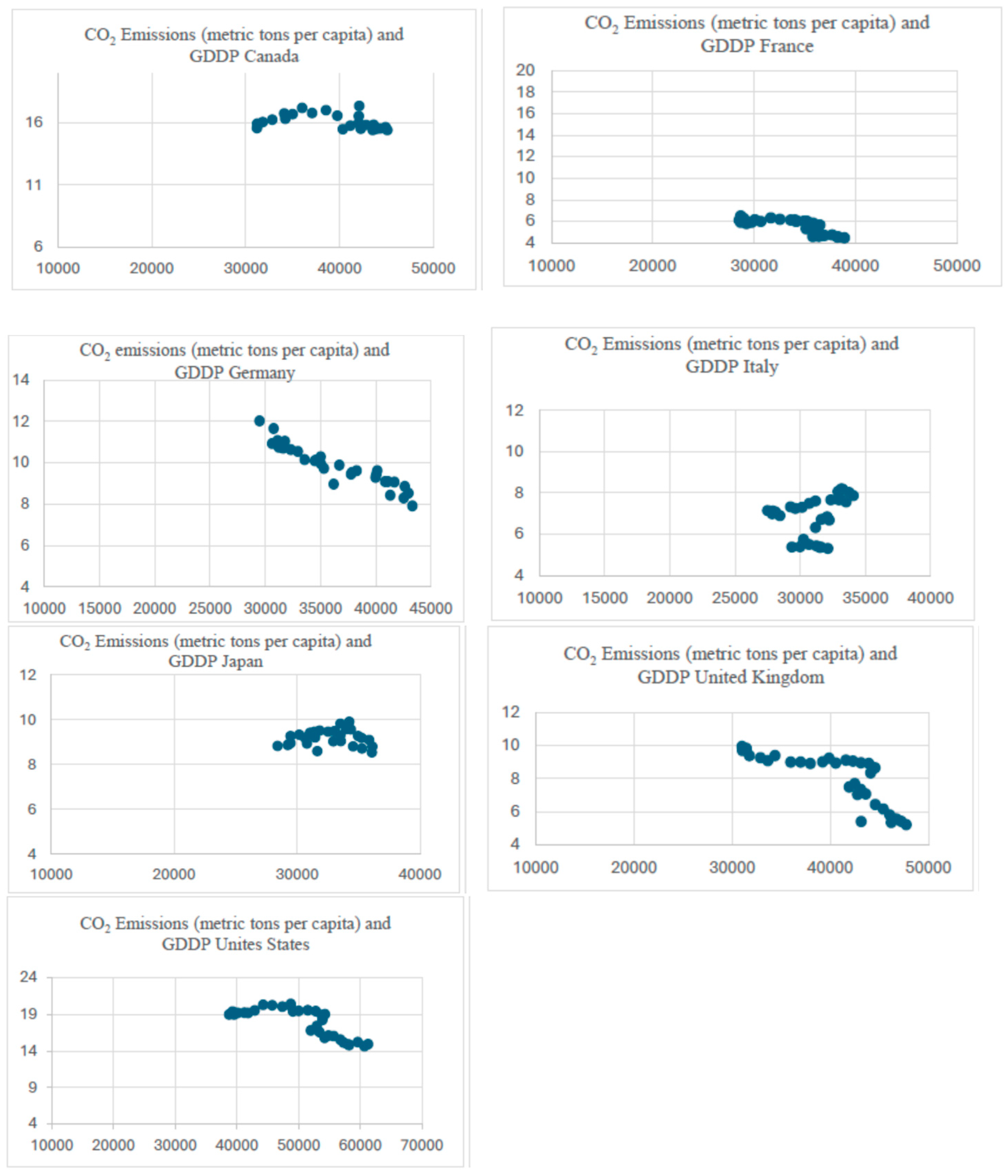
Variable definitions and descriptive statistics are presented in Table 1. The dependent variable, total carbon dioxide (CO2) emissions per capita, is measured in metric tons per capita at the country level and transformed into the natural log of per capita CO2 emissions (lnCO2PC). The lowest quantity of lnCO2PC is 1.162, the mean is 2.425, and the highest value is 3.145, suggesting a wide variation in emissions. To characterize the income-CO2 relationship for the G7 countries and test the EKC hypothesis, GDP per capita estimated in 2015 constant prices has been transformed into the natural logarithm of GDP per capita (lnGDPP) and its square term (lnGDPP)2, which allows us to verify and confirm the EKC type relationship. The scatter plots between CO2 emissions per capita and GDP per capita measured in US dollars at 2015 prices also show a quadratic relationship for all G7 countries (See Figure 2 for details).
The data shows that GDP per capita varies extensively. The lowest value of lnGDPP is 8.761, the mean is 10.191, and the highest value is 10.923. Similarly, the WUI, the variable of interest which captures the EKC type relationship between CO2 emissions and GDPP, has been transformed into the natural log of WUI (lnWUI). The mean value of lnWUI is 0.461, the lowest is 0, and the highest is 1.743 (see Table 1).

5. Empirical Approach and Results

Prior to examining the EKC-type relationship, several diagnostic tests were performed in order to find the best-fitting estimation technique. Panel unit root tests have become commonplace in empirical analysis when employing panel data. There are several prevalent methods for testing for unit roots (e.g., Levin et al., 2002; Breitung & Das, 2005) with the null hypothesis that all panels contain a unit root, but ignore structural breaks in the longitudinal panel data. Ignorance of structural breaks can distort the power of tests and lead to misleading conclusions. To accommodate any possible structural break in the data set, we employ a method developed to test for a unit root, which allows for such breaks (Karavias & Tzavalis, 2014). This is an important assumption as the data used in this study considers world uncertainty as a critical explanatory variable, and the time span under consideration covers data both before and after the COVID-19 pandemic. The Karavias and Tzavalis method confirms that all panel time series that are unit root processes have been rejected [for lnCO2PP, Z = −20.07, P = 0; for lnGDPP, Z = −46.09, P = 0; and for lnWUI, Z = −37.00, P = 0], indicating that the longitudinal panel data are stationary.
Although unit root tests for all variables reported are stationary, we also employed the Kao test for cointegration to investigate the degree of sensitivity of the variables in the data set. The results did not reject the null hypothesis of “no co-integration” for the variables used in this investigation, suggesting that all variables are free of co-integration. After conducting the unit root and co-integration tests, we investigated whether to use a fixed-effects or a random-effects model. We performed the Hausman test to examine whether the error terms in the fixed-effects model were correlated. We find that the fixed-effects model is superior to the random-effects model (Ho: difference in coefficients not systematic, is rejected with probability > chi2 = 0.010 for chi2 (3) = 11.16) (Borenstein et al., 2007; Green, 2008). Therefore, although we report the results from the random-effects estimation model for comparison, the fixed-effects results presented in Table 2 are discussed in this study.
The result of this investigation confirms the existence of an EKC relationship for CO2 emissions. In other words, both the natural log of GDP per capita (lnGDPP) and its square term (lnGDPP)2 were found to be significant. In both the fixed and random-effects models, the variable lnGDPP is positive and highly significant, with coefficient values of 11.735 (significant at one percent, fixed-effects model) and 11.697 (significant at one percent, random-effects model), which indicates that the results are consistent for the two models. The positive coefficient of lnGDPP (the income elasticity of CO2 emissions) implies that a one percent change in GDPP will increase CO2 emissions per capita by 11.735%. On the other hand, the coefficient of (lnGDPP)2 was found to be negative and significant, with a coefficient value of −0.557 (significant at one percent, fixed-effects model), and −0.549 (significant at one percent, random-effects model). Thus, both estimations provide consistent results. The negative sign of the square of the natural log of GDP per capita (lnGDDP)2 suggests that the rate of change in emissions of per capita CO2 is negatively related to the rate of change in GDP per capita, which will ultimately result in a turning point of per capita CO2 emissions, as per capita GDP increases, the rate at which CO2 emissions increase and decreases at some point. This finding provides an important policy insight regarding the regulation of CO2 emissions in the context of global warming and climate change. More specifically, where the EKC hypothesis exists for CO2 emissions, economic growth, which could spur increases in income, would likely help to improve a wide array of environmental indicators.
The results of this study are consistent with the findings of other studies that utilize different data sets. For example, three studies use longitudinal state-level data (Shafik & Bandyopadhyay, 1992; Aldy, 2005; Burnett & Bergstrom, 2010). A study conducted for the United States reports the existence of an EKC hypothesis (an inverted-U relationship between CO2 emissions and income) at the state level based on an application of a spatial econometric regression (Burnett & Bergstrom, 2010). Earlier, two studies that use cross-sectional data for the United States also find an EKC relationship (B. Koirala & Mysami, 2015; Lee et al., 2009). Similarly, the existence of an EKC relationship for CO2 emissions is confirmed for Asian countries (Apergis & Ozturk, 2015), Bangladesh (Rabbi et al., 2015), Tunisia (Jebli & Youssef, 2015), the European Union (28 countries) (Armeanu et al., 2018), and a group of eleven countries (Bangladesh, Egypt, Indonesia, Iran, Mexico, Nigeria, Pakistan, Philippines, South Korea, Turkey, and Vietnam) (Sultana et al., 2023). While a study using panel data from 1890 to 2015 reports a non-existent EKC relationship for the United States, Germany, Italy, Canada, and Japan (P. Liu et al., 2022), a more recent study finds that the United States and Canada exhibit an EKC-type relationship for CO2 emissions (Pirgaip et al., 2023). Further, a recent meta-analysis based on 101 published research papers between 2006 and 2019 on the EKC hypothesis (the largest meta-analysis ever on the EKC) documents strong evidence of an EKC relationship (Saqib & Benhmad, 2021).
The consistent findings from all these studies conducted at different times with different data sets serve to validate the finding of our study that there exists an EKC relationship for CO2 emissions in G7 countries in the presence of uncertainty. Earlier, critics (for example, Arrow et al., 1995; Stern, 2004) maintained that the EKC hypothesis is incorrect, and as such, this relationship is not useful as an environmental policy guide to curb CO2 emissions. Nevertheless, researchers have continued to explore the EKC hypothesis for various countries using different data sets and a variety of models and variables. This study is unique in that it controls for uncertainty using the World Uncertainty Index variable, lnWUI. The estimation results indicate that the variable is significant at the five percent level with a negative coefficient of −0.059. Since both the dependent variable and the World Uncertainty Index variable are in log form, the result is a measure of elasticity and suggests that a one percent increase in the WUI will reduce CO2 emissions by 0.059 percent. It can be inferred from the negative sign of the coefficient that an increase in uncertainty leads to a decrease in investment demand and a decline in economic activity, resulting in a reduction in CO2 emissions. Hence, uncertainty may contribute to reducing emissions of CO2 in G7 countries. On the flip side; however, higher uncertainty also lowers the responsiveness of market demand (Bloom et al., 2007). For instance, an estimation using survey data reports that high uncertainty is associated with a three percent reduction in investment (Kolev & Randall, 2024). The presence of uncertainty also results in a significant reduction in capital accumulation in the long run (Bond et al., 2024), which ultimately reduces economic growth, an obviously undesirable outcome. In contrast, an increase in CO2 emissions could result when countries face economic policy uncertainty (Mushtaq et al., 2024). However, as our findings suggest, when countries face climate policy uncertainty, which is a subset of the WUI, emissions of CO2 will decrease (Gavriilidis, 2021; Guesmi et al., 2023). While it is clearly important to increase investment because it contributes to economic growth, it is also critical for this growth to be environmentally sustainable and inclusive in order to truly improve the quality of life and living standards.

6. Income Turning Point

Given that this study confirms the existence of an EKC-type relationship for G7 countries, it is worth establishing the income threshold at which controlling CO2 emissions is imperative. Finding the income turning point (ITP) is therefore one of the main objectives of this research; we do so by estimating the threshold GDP per capita point that starts the decoupling of emissions of CO2 as economic growth continues. The estimated income turning point is obtained from Equation (2), which is given as exp ( β 1 2 β 2 ) . To calculate the ITP, the results of the panel fixed effects can be considered. The estimated ITP for G7 countries is $47,843.73 in 2023 prices.
The 2023 GDP per capita of G7 countries indicates that only Japan, with a GDP per capita of $33,806, and Italy, with a GDP per capita of $38,326, are below the estimated ITP for CO2 emissions, while the remaining G7 countries are on course to attain or surpass the estimated ITP. Earlier meta-analyses report fairly high ITP—far from an attainable range—considering globally published results (see, for instance, Cavlovic et al., 2000; B. S. Koirala et al., 2011). Further, another study also estimates a slightly higher ITP than the average income per capita but within an attainable range based on 2002 county-level data in the United States (B. Koirala & Mysami, 2015). Along these lines, the existence of the EKC hypothesis is reported for the United States with an ITP of $50,981 using data from 1965 to 2016 (Song et al., 2019). Similarly, another estimate suggests an ITP of $44,000 at the 2011 price level for CO2 emissions based on a panel of 161 countries over the period of 1992–2012 (Kacprzyk & Kuchta, 2020). Hence, ITPs estimated prior to 2015 appear to be higher than the average income per capita.
The results of our estimation point to an attainable ITP for G7 countries of $47,843.73 at the 2023 price level using updated data (based on the fixed-effects model), which is consistent with previous findings for CO2 emissions where the EKC relationship exists. To our knowledge, this is the first study that has incorporated the World Uncertainty Index in the calculation of the slope of GDP per capita and its square term.

7. Conclusions and Recommendations

This paper examines the environmental Kuznets curve relationship between CO2 emissions and GDP per capita in G7 Countries in the presence of uncertainty using data from 1960 to 2022. After a series of diagnostic tests, the relationship is estimated using a quadratic income model and the World Uncertainty Index as a proxy for uncertainty. The income turning point is also estimated.
Our estimation results based on fixed-effects and random-effects models confirm the existence of an EKC relationship for CO2 emissions in G7 countries. Our findings suggest that uncertainty may contribute to lower carbon emissions. Higher uncertainty is associated with lower levels of investment and capital accumulation, with negative implications for long-term growth, but favorable effects in terms of emissions. This tradeoff suggests that while investment is critical for economic growth and development, it is also imperative that growth is environmentally sustainable and inclusive in order to improve human welfare.
A comparison of our income turning point estimated for G7 countries and their GDP per capita reveals that, with the exception of two countries, the income turning point is achievable for G7 countries.
In light of our findings, a few economic and environmental policies could be pursued to help strike a balance between leveraging the positive impact of uncertainty on CO2 emissions while instituting measures to mitigate the long-term impact of economic uncertainty on growth in G7 countries that were found to be below the critical income threshold. By promoting economic and environmental policies that prioritize the adoption of cleaner technologies, and increasing investments in energy-efficient technologies and renewable energy to limit the volume of CO2 pollutants that are emitted at the earlier stages of economic growth, the retrenched impact of uncertainty on growth could be reduced, and the EKC turning point could be attained much quicker. It will also be prudent for economies to strengthen environmental regulatory frameworks by encouraging the implementation of stricter emissions standards to ensure that CO2 emissions decline with growth. Thus, governments in G7 countries could expand their collaboration with the private sector to invest in research and development for green technologies, and provide subsidies and tax incentives to encourage the adoption of clean energy technologies. Further, ending producer subsidies for fossil fuels in Canada and the United States, which are major producers of fossil fuels among G7 countries, will be helpful. Similarly, other G7 countries should follow the lead of Japan and Germany in promoting green energy production. These steps will help mitigate the initial challenges associated with economic growth as G7 economies transition to lower CO2 emissions.
One limitation of this study is that it is restricted to G7 countries, which are all developed economies. As such, one possible direction for future research is to incorporate both developing and developed economies in examining the effects of world uncertainty on CO2 emissions and the existence of the EKC hypothesis.

Author Contributions

Conceptualization, B.K. and G.P.; Methodology, B.K. and E.C.M.; Software, B.K.; Validation, B.K., G.P. and E.C.M.; Formal analysis, B.K.; Investigation, B.K. and G.P.; Resources, B.K.; Data Curation, B.K.; Writing—Original draft preparation, B.K. and G.P.; Writing—Reviewing and Editing, B.K., G.P. and E.C.M.; Visualization, B.K.; Supervision, B.K., G.P. and E.C.M.; Project Administration, B.K.; Funding Acquisition, None. All authors have read and agreed to the published version of the manuscript.

Funding

This research received no external funding.

Institutional Review Board Statement

Not applicable.

Informed Consent Statement

Not applicable.

Data Availability Statement

The data used in this study were obtained from two sources: (1) Data for GDP per capita and CO2 emissions were obtained online from the World Bank’s World Development Indicators; they were accessed on 13 August 2024 and are available at: https://databank.worldbank.org/source/world-development-indicators. (2) Data for World Uncertainty Index were obtained online from the Economic Policy Uncertainty Index; they were accessed on 13 August 2024 and are available at: https://www.policyuncertainty.com/wui_quarterly.html.

Acknowledgments

We thank the anonymous reviewers for their constructive comments and suggestions, which have helped improve the manuscript.

Conflicts of Interest

The authors declare no conflict of interest.

Notes

1
2
https://www.policyuncertainty.com/wui_quarterly.html (accessed on 13 August 2024). Note: Data used in this study are available in the links provided.

References

  1. Adedoyin, F., & Zakari, A. (2020). Energy consumption, economic expansion, and CO2 emission in the UK: The role of economic policy uncertainty. Science of the Total Environment, 738, 140014. [Google Scholar] [CrossRef] [PubMed]
  2. Ahir, H., Bloom, N., & Furceri, D. (2022). The world uncertainty index (NBER Working Papers 29763). National Bureau of Economic Research. [Google Scholar]
  3. Aldy, J. E. (2005). An environmental Kuznets curve analysis of U.S. state-level carbon dioxide emissions. The Journal of Environment & Development, 14(1), 48–72. [Google Scholar]
  4. Allard, A., Takman, J., Uddin, G. S., & Ahmed, A. (2018). The N-shaped environmental Kuznets curve: An empirical evaluation using a panel quantile regression approach. Environmental Science and Pollution Research, 25, 5848–5861. [Google Scholar] [CrossRef]
  5. Al-Mulali, U., Solarin, S. A., & Ozturk, I. (2016). Investigating the presence of the environmental Kuznets curve (EKC) hypothesis in Kenya: An autoregressive distributed lag (ARDL) approach. Natural Hazards, 80, 1729–1747. [Google Scholar] [CrossRef]
  6. Amin, A., & Dogan, E. (2021). The role of economic policy uncertainty in the energy-environment nexus for China: Evidence from the novel dynamic simulations method. Journal of Environmental Science and Management, 292, 112865. [Google Scholar] [CrossRef] [PubMed]
  7. Anser, M. K., Apergis, N., & Syed, Q. R. (2021). Impact of economic policy uncertainty on CO2 emissions: Evidence from top ten carbon emitter countries. Environmental Science and Pollution Research, 28(23), 29369–29378. [Google Scholar] [CrossRef] [PubMed]
  8. Apergis, N., & Ozturk, I. (2015). Testing environmental Kuznets curve hypothesis in Asian countries. Ecological Indicators, 52, 16–22. [Google Scholar] [CrossRef]
  9. Armeanu, D., Vintilă, G., Andrei, J., Gherghina, Ş., Drăgoi, M., & Teodor, C. (2018). Exploring the link between environmental pollution and economic growth in EU-28 countries: Is there an environmental Kuznets curve? PLoS ONE, 13(5), e0195708. [Google Scholar] [CrossRef]
  10. Arrow, K., Bolin, B., Costanza, R., Dasgupta, P., Folke, C., Holling, C. S., Jansson, B.-O., Levin, S., Mäler, K.-G., Perrings, C., & Pimentel, D. (1995). Economic growth, carrying capacity, and the environment. Science, 268, 520–521. [Google Scholar] [CrossRef]
  11. Begum, R., Sohag, K., Abdullah, S., & Jaafar, M. (2015). CO2 emissions, energy consumption, economic and population growth in Malaysia. Renewable and Sustainable Energy Reviews, 41, 594–601. [Google Scholar] [CrossRef]
  12. Bloom, N., Bond, S., & Van Reenen, J. (2007). Uncertainty and investment dynamics. The Review of Economic Studies, 74(2), 391–415. [Google Scholar] [CrossRef]
  13. Bond, M., Khosravi, H., De Laat, M., Bergdahl, N., Negrea, V., Oxley, E., Pham, P., Chong, S. W., & Siemens, G. (2024). A meta systematic review of artificial intelligence in higher education: A call for increased ethics, collaboration, and rigour. International Journal of Educational Technology in Higher Education, 21, 4. [Google Scholar] [CrossRef]
  14. Borenstein, M., Hedges, L., & Rothstein, H. (2007). Meta-analysis fixed effects vs. random effects. Biostat. [Google Scholar]
  15. Breitung, J., & Das, S. (2005). Panel unit root tests under cross-sectional dependence. Statistica Neerlandica, 59, 414–433. [Google Scholar]
  16. Burnett, J. W., & Bergstrom, J. C. (2010). U.S. state-level carbon dioxide emissions: A spatial-temporal econometric approach of the environmental Kuznets curve (Faculty Series 96031). University of Georgia, Department of Agricultural and Applied Economics.
  17. Cavlovic, T., Baker, K., Berrens, R., & Gawande, K. (2000). A meta-analysis of environmental Kuznets curve studies. Agricultural and Resource Economics Review, 29(1), 32–42. [Google Scholar] [CrossRef]
  18. Dejuan-Bitria, D., & Ghirelli, C. (2021). Economic policy uncertainty and investment in Spain. SERIEs, 12, 351–388. [Google Scholar] [CrossRef]
  19. ECB Economic Bulletin. (2020). Issue 6. Available online: https://www.ecb.europa.eu/press/economic-bulletin/html/eb202006.en.html (accessed on 13 August 2024).
  20. Fosten, J., Morley, B., & Taylor, T. (2012). Dynamic misspecification in the environmental Kuznets curve: Evidence from CO2 and SO2 emissions in the United Kingdom. Ecological Economics, 76, 25–33. [Google Scholar] [CrossRef]
  21. Gavriilidis, K. (2021). Measuring climate policy uncertainty. Available online: https://ssrn.com/abstract=3847388 (accessed on 4 September 2024).
  22. Green, W. H. (2008). Econometric analysis (6th ed.). Prentice Hall. [Google Scholar]
  23. Grossman, G. M., & Krueger, A. B. (1991). Environmental impacts of the North American Free Trade Agreement (NBER Working Paper 3914). National Bureau of Economic Research, Inc. [Google Scholar]
  24. Grossman, G. M., & Krueger, A. B. (1995). Economic growth and the environment. Quarterly Journal of Economics, 110(2), 353–377. [Google Scholar]
  25. Guesmi, K., Makrychoriti, P., & Spyrou, S. (2023). The relationship between climate risk, climate policy uncertainty, and CO2 emissions: Empirical evidence from the U.S. Journal of Economic Behavior and Organization, 212, 610–628. [Google Scholar] [CrossRef]
  26. Iqbal, M., Chand, S., & Ul Haq, Z. (2023). Economic policy uncertainty and CO2 emissions: A comparative analysis of developed and developing nations. Environmental Science and Pollution Research, 30, 15034–15043. [Google Scholar] [CrossRef] [PubMed]
  27. Jebli, M., & Youssef, S. (2015). The environmental Kuznets curve, economic growth, renewable and non-renewable energy, and trade in Tunisia. Renewable and Sustainable Energy Reviews, 47, 173–185. [Google Scholar] [CrossRef]
  28. Kacprzyk, A., & Kuchta, Z. (2020). Shining a new light on the environmental Kuznets curve for CO2 emissions. Energy Economics, 87, 104704. [Google Scholar] [CrossRef]
  29. Kar, A. K. (2023). Investigating the environmental Kuznets curve hypothesis for CO2 emissions in Nordic countries. International Journal of Environmental Studies, 81(4), 1637–1652. [Google Scholar] [CrossRef]
  30. Karavias, Y., & Tzavalis, E. (2014). Testing for unit roots in short panels allowing for a structural break. Computational Statistics and Data Analysis, 76, 391–404. [Google Scholar] [CrossRef]
  31. Khan, S., Ullah, M., Shahzad, M., Khan, U., Khan, U., Eldin, S., & Alotaibi, A. (2022). Spillover connectedness among global uncertainties and sectorial indices of Pakistan: Evidence from quantile connectedness approach. Sustainability, 14(23), 15908. [Google Scholar] [CrossRef]
  32. Koirala, B., & Mysami, R. (2015). Investigating the effect of forest per capita in explaining the EKC hypothesis for CO2 in the U.S. Journal of Environmental Economics and Policy, 4(3), 304–314. [Google Scholar] [CrossRef]
  33. Koirala, B. S., Li, H., & Berrens, R. P. (2011). Further investigation of environmental Kuznets curve studies using meta-analysis. International Journal of Economics and Statistics, 22(S11), 13–32. [Google Scholar]
  34. Kolev, A., & Randall, T. (2024). The effect of uncertainty on investment: Evidence from EU survey data (EIB Working Paper 2024/02). European Investment Bank. [Google Scholar]
  35. Lee, C. C., Chiu, Y. B., & Sun, C. H. (2009). Does one size fit all? A reexamination of the environmental Kuznets curve using the dynamic panel data approach. Applied Economic Perspectives and Policy, 31(4), 751–778. [Google Scholar] [CrossRef]
  36. Levin, A., Lin, F., & Chu, J. (2002). Unit root tests in panel data: Asymptotic and finite-sample properties. Journal of Econometrics, 108, 1–24. [Google Scholar] [CrossRef]
  37. Liu, P., Narayan, S., Ren, Y., Jiang, Y., Baltas, K., & Sharp, B. (2022). Re-examining the income–CO2 emissions nexus using the new kink regression model: Does the Kuznets curve exist in G7 countries? Sustainability, 14, 3955. [Google Scholar] [CrossRef]
  38. Liu, W. (2020). EKC test study on the relationship between carbon dioxide emission and regional economic growth. Carbon Management, 11(4), 415–425. [Google Scholar] [CrossRef]
  39. Liu, X., Zhang, S., & Bae, J. (2017). The impact of renewable energy and agriculture on carbon dioxide emissions: Investigating the environmental Kuznets curve in four selected Asian countries. Journal of Cleaner Production, 164, 239–1247. [Google Scholar] [CrossRef]
  40. Matzner, A., Meyer, B., & Oberhofer, H. (2023). Trade in times of uncertainty. The World Economy, 46(9), 2564–2597. [Google Scholar] [CrossRef]
  41. Moutinho, V., Varum, C., & Madaleno, M. (2017). How economic growth affects emissions? An investigation of the environmental Kuznets curve in Portuguese and Spanish economic activity sectors. Energy Policy, 106, 326–344. [Google Scholar] [CrossRef]
  42. Mushtaq, M., Hameed, G., Ahmed, S., Fahlevi, M., Aljuaid, M., & Saniuk, S. (2024). How does economic policy uncertainty impact CO2 emissions? Investigating investment’s role across 22 economies (1997–2021). Energy Reports, 11, 5083–5091. [Google Scholar] [CrossRef]
  43. Nasir, M. A., Huynh, T. L. D., & Tram, H. T. X. (2019). Role of financial development, economic growth & foreign direct investment in driving climate change: A case of emerging ASEAN. Journal of Environmental Management, 242, 131–141. [Google Scholar] [CrossRef]
  44. Pata, U. (2018). Renewable energy consumption, urbanization, financial development, income and CO2 emissions in Turkey: Testing EKC hypothesis with structural breaks. Journal of Cleaner Production, 187, 770–779. [Google Scholar] [CrossRef]
  45. Pham, N., Pham, T., Cao, V., Tran, H., & Vo, X. (2020). The impact of international trade on environmental quality: Implications for law. Asian Journal of Law and Economics, 11(1), 20200001. [Google Scholar] [CrossRef]
  46. Pirgaip, B., Bayrakdar, S., & Kaya, M. (2023). The role of government spending within the environmental Kuznets curve framework: Evidence from G7 countries. Environmental Science and Pollution Research, 30, 81513–81530. [Google Scholar] [CrossRef]
  47. Rabbi, F., Akbar, D., & Kabir, S. (2015). Environmental Kuznets curve for carbon emissions: A cointegration analysis for Bangladesh. International Journal of Energy Economics and Policy, 5(1), 45–53. [Google Scholar]
  48. Romano, T., & Fumagalli, E. (2018). Greening the power generation sector: Understanding the role of uncertainty. Renewable and Sustainable Energy Reviews, 91, 272–286. [Google Scholar] [CrossRef]
  49. Saqib, M., & Benhmad, F. (2021). Updated meta-analysis of environmental Kuznets curve: Where do we stand? Environmental Impact Assessment Review, 86, 106503. [Google Scholar] [CrossRef]
  50. Sephton, P., & Mann, J. (2016). Compelling evidence of an environmental Kuznets curve in the United Kingdom. Environmental and Resource Economics, 64(2), 301–315. [Google Scholar] [CrossRef]
  51. Shafik, N., & Bandyopadhyay, S. (1992). Economic growth and environmental quality: Time series and cross-country evidence (Policy Research Working Paper Series 904). The World Bank. [Google Scholar]
  52. Song, Y., Zhang, M., & Zhou, M. (2019). Study on the decoupling relationship between CO2 emissions and economic development based on two-dimensional decoupling theory: A case between China and the United States. Ecological Indicators, 102, 230–236. [Google Scholar] [CrossRef]
  53. Stern, D. (2004). The rise and fall of the environmental Kuznets curve. World Development, 32(8), 1419–1439. [Google Scholar] [CrossRef]
  54. Sultana, T., Hossain, M. S., Voumik, L. C., & Raihan, A. (2023). Does globalization escalate the carbon emissions? Empirical evidence from selected next-11 countries. Energy Reports, (10), 86–98. [Google Scholar] [CrossRef]
  55. Ulucak, D. R., & Khan, S. (2020). Determinants of the ecological footprint: Role of renewable energy, natural resources, and urbanization. Sustainable Cities and Society, 54, 101996. [Google Scholar] [CrossRef]
  56. Wang, Q., & Xiao, K. (2020). Does economic policy uncertainty affect CO2 emissions? Empirical Evidence from the United States. Sustainability, 12(21), 9108. [Google Scholar] [CrossRef]
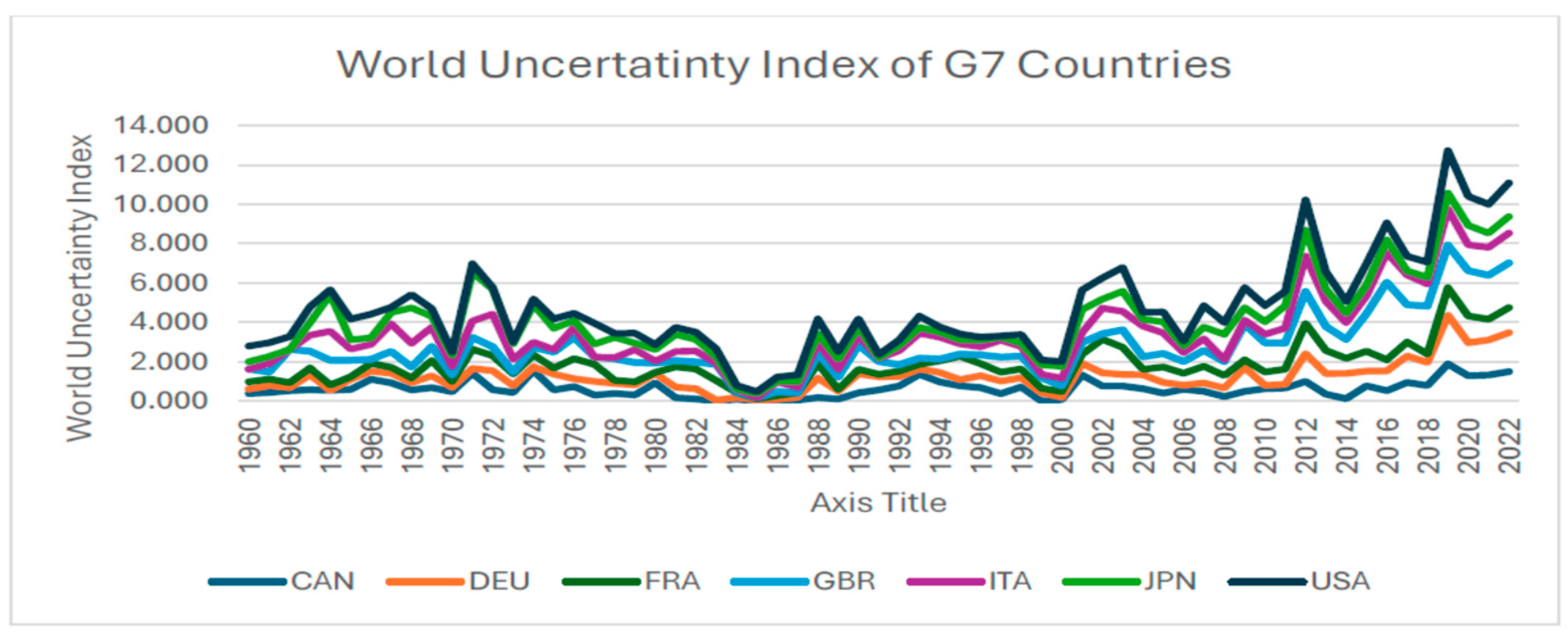
Figure 1. The World Uncertainty Index of G7 Countries by Year.
Economies 13 00363 g001
Figure 2. Scatter Plots of CO2 Emission and GDDP by Country.
Economies 13 00363 g002
Table 1. Variable Definitions and Descriptive Statistics.
VariablesDescriptionMeanSt. DeviationMin.Max.
lnPPCO2Natural log of per capita carbon emissions (dependent variable)2.4250.4041.1623.146
lnGDPPNatural log of GDP per capita measured (US dollars in 2015 prices)10.1920.3978.76110.923
(lnGDPP)2Square of natural log of GDP per capita (US dollar in 2015 prices) 104.0258.00176.763119.321
lnWUINatural log of World Uncertainty Index0.4610.2780.0001.744
N = 427.
Table 2. Results of fixed-effects and random-effects models.
VariablesFE ModelRE Model
CoefficientsCoefficients
lnGDPP11.735 ***11.697 ***
(0.704)(0.711)
(lnGDPP)2−0.555 ***−0.535 ***
(0.035)(0.035)
lnWUI−0.059 **−0.060 **
(0.026)(0.026)
INTERCEPT−57.074 ***−56.889 ***
(3.536)(3.571)
σu0.3870.249
σe0.1410.141
ρ (fraction of variance due to u_i)0.8810.755
R2 = 0.4519. n = 427. Values in parentheses are standard errors. **, and *** represent significance at 10%, 5%, and 1% levels.
Disclaimer/Publisher’s Note: The statements, opinions and data contained in all publications are solely those of the individual author(s) and contributor(s) and not of MDPI and/or the editor(s). MDPI and/or the editor(s) disclaim responsibility for any injury to people or property resulting from any ideas, methods, instructions or products referred to in the content.