Article

A Robust Tunable Simulator of Atmospheric Turbulence for Performance Analysis of Wireless Optical Links


by
Ilya Galaktionov
1,2,3
1
Quantum Center, Moscow Technical University of Communications and Informatics, Aviamotornaya Str., Bld. 8a, 111024 Moscow, Russia
2
Physics Department, Moscow Polytechnic University, Bolshaya Semenovskaya Str., Bld. 38, 107023 Moscow, Russia
3
Space Technologies Design Department, Moscow Institute of Physics and Technology, Institutskiy Per., Bld. 9, 141700 Dolgoprudny, Russia
Technologies 2026, 14(7), 427; https://doi.org/10.3390/technologies14070427

Submission received: 1 June 2026 / Revised: 7 July 2026 / Accepted: 12 July 2026 / Published: 14 July 2026

Abstract

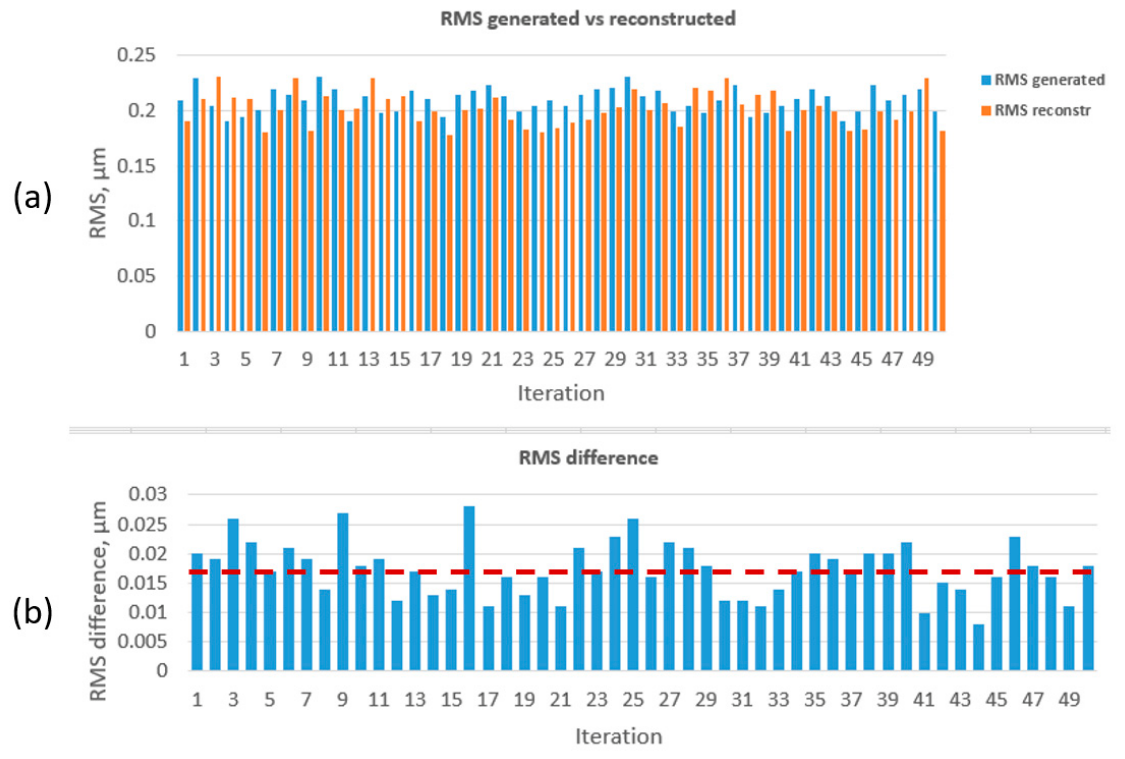
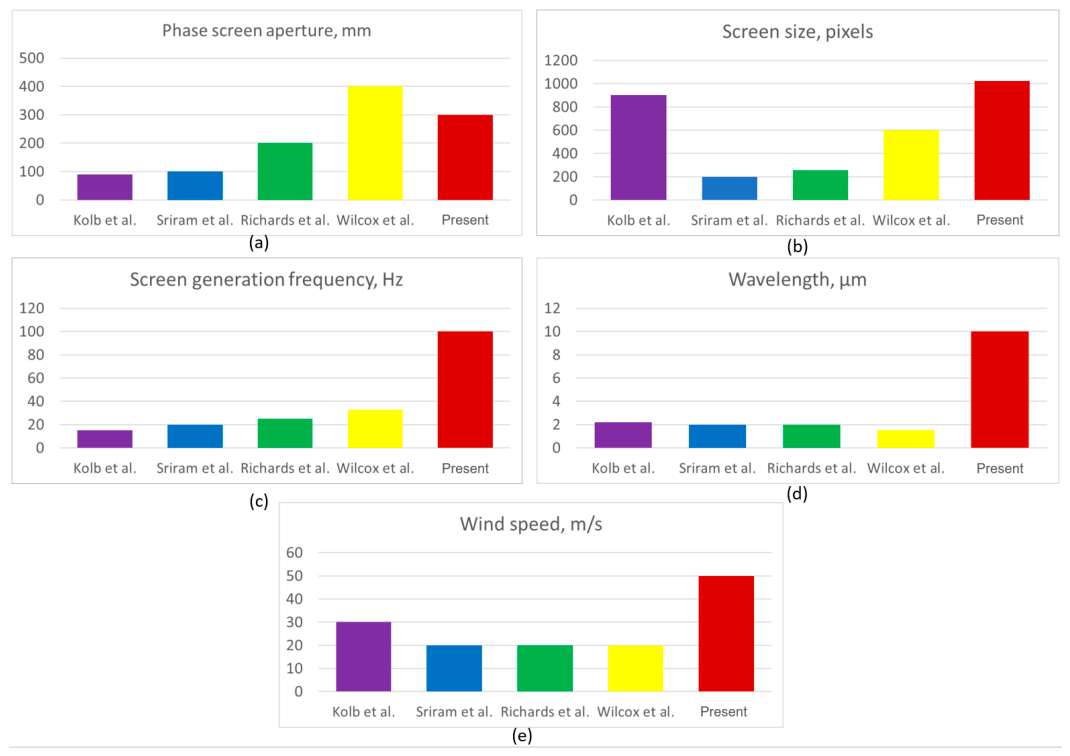
Atmospheric turbulence distorts the wavefront of propagating optical radiation, degrading image resolution in astronomical telescopes and reducing power density at the target in focusing applications. These effects can be studied under controlled laboratory conditions using turbulence-generating devices—such as fan heaters (rough control), phase plates, or active mirrors (fine control)—in combination with a wavefront sensor for measurements. To support this research, we developed a software simulator for reconstructing atmospheric phase fluctuations. The integrated software–hardware system can generate phase screens following Kolmogorov turbulence statistics, incorporating parameters for wind velocity and the D/r0 ratio. Phase screens were produced with an average approximation error of 0.01 µm (less than 5%). The average reconstruction error was 0.017 µm, corresponding to approximately 8%. The newly developed phase screen simulator outperforms the fastest existing version in several key aspects. Its aperture size is doubled, increasing from 400 mm to 800 mm, while the phase screen generation resolution expands by half, from 700 × 700 pixels to 1024 × 1024 pixels. The operating wavelength range also broadens significantly—from a maximum of 2.2 µm in the existing tool to 10 µm in the new one. Additionally, the wind velocity range becomes 1.5 times wider, extending from 30 m/s to 50 m/s. The developed tool might be useful for the performance analysis of wireless links, particularly in the estimation of bit error rate and quantum efficiency using the wavefront root mean square error.
Keywords: atmospheric turbulence; Kolmogorov spectra; wavefront reconstruction; phase maps; Zernike polynomials; parallel computing; CPU computing atmospheric turbulence; Kolmogorov spectra; wavefront reconstruction; phase maps; Zernike polynomials; parallel computing; CPU computing