Article

A Voltage Regulation Strategy Based on Coordinated Control of Multiple Heterogeneous Devices Using Multi-Strategy Integrated Rime Optimization Algorithm

1
State Grid Anhui Electric Power Research Institute, State Grid Anhui Electric Power Co., Ltd., Hefei 230601, China
2
School of Mechanical and Electrical Engineering, China University of Mining and Technology (Beijing), Beijing 100083, China
3
State Grid Anhui Electric Power Co., Ltd., Hefei 230022, China
*
Author to whom correspondence should be addressed.
Technologies 2026, 14(6), 378; https://doi.org/10.3390/technologies14060378 (registering DOI)
Submission received: 5 May 2026 / Revised: 11 June 2026 / Accepted: 18 June 2026 / Published: 20 June 2026

Abstract

The large-scale integration of distributed photovoltaics (DPVs) into the distribution network exacerbates voltage fluctuations and substantially increases network losses. To improve the voltage quality and economic efficiency of distribution networks, a Volt/Var optimization (VVO) model is established. Coordinating multiple heterogeneous devices, the model aims to minimize the total voltage deviation, the total network losses, and the regulation cost of discrete equipment simultaneously. Considering multi-constraint coupling characteristics, a quantitative method is proposed to evaluate the reactive power regulation potential of DPVs under intricate operating conditions. Then, the multi-strategy integrated rime optimization algorithm (MSIRIME) is utilized for the model solution. Fuch chaotic mapping generates uniformly distributed and ergodic initial populations. A dual-branch search mechanism combining the snow ablation optimizer with the rime optimization significantly enhances global exploration capabilities. The guided learning strategy balances exploration and exploitation for high-dimensional VVO, preventing local optima. Case tests on a modified IEEE 33-bus system demonstrate that the proposed model exhibits excellent effectiveness and robustness. Moreover, MSIRIME exhibits better optimization performance than some classic and recently proposed strategies, reducing the average network losses and voltage deviation over 30 independent runs by at least 5.87% and 52.22%, respectively, relative to those of the compared methods.

1. Introduction

Driven by the “dual carbon” goal, the installed capacity of renewable energy in China has developed rapidly in recent years, resulting in the characteristics of high-penetration renewable energy and power electronics becoming increasingly prominent. In 2025, China’s new grid-connected photovoltaic (PV) capacity reached 317 million kilowatts, of which distributed PV capacity accounted for 153 million kilowatts [1]. Although the rapid growth in the installed capacity of distributed photovoltaics (DPVs) has promoted the green transition of the energy structure, the randomness of and fluctuation in PV power outputs as well as the mismatch between photovoltaics (PVs) and loads considering time and space conditions have led to several severe problems, such as deteriorated voltage fluctuations in distribution networks and a sharp rise in network losses [2,3,4]. Traditional reactive power control methods are no longer capable of adapting to the rapid changes in the operating conditions of the new power system, posing a serious challenge to the stability and economic efficiency of distribution networks. Therefore, it is of great importance to enhance the reliability and efficiency of the power system through the coordination of DPVs and other reactive power compensation devices. In addition, an approach to accurately assessing the reactive power control potential of DPVs considering intricate operating conditions is also worth studying.
Recently, various Volt/Var optimization (VVO) methods of distribution networks utilizing the reactive power compensation capability of DPVs have been proposed. Concentrating on improving droop control strategies, references [5,6,7] improved the voltage regulation ability of DPVs and reduced losses or the amount of curtailed PV generation by optimizing parameters of droop control strategies. However, they focus on local compensation schemes of DPVs, which do not optimize the system from the perspective of the whole distribution network. References [8,9,10,11,12,13] integrated DPVs and other controllable resources in the distribution network, such as energy storage systems (ESSs), shunt capacitor banks (SCBs), and an on-load tap-changer (OLTC) for VVO. However, only the capacity constraints of DPVs were taken into account in these studies, with no a comprehensive assessment of the reactive power regulation potential of DPVs based on actual operating conditions. Power factor restrictions were taken into consideration in references [14,15]. Moreover, reference [16] provided a detailed analysis of the impact of variation in voltage on the reactive power compensation capability of inverters. Given the discrepancy in the reactive power reserve under diverse operating conditions, reference [17] defined the voltage margin and flexible reactive power margin, which served as indicators for assessing the adequacy of reactive power and switching operational modes, ensuring the voltage security and efficiency of systems under various conditions. In summary, it is necessary to establish a VVO model to coordinate DPVs with other adjustable resources to achieve unified integration between the facility itself and the overall network. Meanwhile, the remaining reactive power capacity of DPVs ought to be calculated by comprehensively analyzing the crucial factors affecting the reactive power regulation capability of PV inverters.
The model solution method is also a critical factor influencing the performance of VVO. Deep reinforcement learning (DRL) [18,19,20,21], second-order cone programming (SOCP) [22,23], and heuristic optimization algorithms [24,25,26,27] are among the most commonly adopted solution schemes in existing studies. DRL possesses tremendous adaptability, but it suffers from limited interpretability and an excessively long training time in certain scenarios. Compared with DRL, heuristic optimization algorithms offer evident advantages: they do not require time-consuming offline training and provide stronger interpretability as well as easier integration of physical constraints. SOCP can guarantee a globally optimal solution when the relaxation is sufficiently tight, but the solution quality may degrade for optimization models containing discrete variables or non-convex characteristics. In contrast, a heuristic optimization algorithm offers a flexible and robust approach to addressing the non-convexity of reactive power optimization in distribution networks. Nevertheless, existing optimization algorithms still encounter critical difficulties in VVO, including premature local convergence and the curse of dimensionality when the distribution network scale increases. Accordingly, selecting an appropriate optimization algorithm and enhancing its performance to efficiently achieve voltage regulation and loss reduction under complex operating conditions remains an urgent research challenge.
The key contributions of this investigation are outlined as follows: (1) Different from existing coordinated VVO studies that use simplified inverter models, this article proposes a unified and refined model that systematically considers the dynamic coupling relationship among capacity, active power, current, the point of common coupling (PCC) voltage, and power factor constraints. It provides a more accurate foundation for coordinated control, ensuring that the inverter’s reactive power output strictly complies with all operational constraints while maximizing the utilization of its regulation capability. The reactive power regulation potential of a PV inverter is dynamically calculated based on various operating conditions. (2) Considering the high-dimensional characteristics of the VVO problem, this paper develops a multi-strategy integrated rime optimization algorithm (MSIRIME). Specifically, Fuch chaotic mapping is introduced to enhance the diversity of the initial population, thereby alleviating the insufficient early-stage exploration capability of the RIME algorithm. In addition, the snow ablation optimizer is incorporated into the soft-rime search stage to construct a dual-branch search mechanism, which significantly improves the global exploration capability of the algorithm in high-dimensional search spaces. Furthermore, the guided learning strategy dynamically balances global exploration and local exploitation by timely correction of search bias during the optimization process, thus preventing premature convergence to local optima. This feature is particularly effective for high-dimensional VVO problems involving numerous decision variables. Overall, MSIRIME demonstrates strong performance in enhancing the operational quality and economic efficiency of distribution networks. (3) Compared to some classic heuristic algorithms as well as a solver-based method, the proposed strategy demonstrates significant advantages in terms of optimized voltage deviation, network losses, and the ability to avoid local optima. It reduces the average network losses and voltage deviation over 30 independent runs by at least 5.87% and 52.22%, respectively, relative to those of the compared strategies. Moreover, the enhancement is highly significant across various PV/load scenarios and in different distribution networks.
The remaining part of this article is structured as follows. The analysis of the reactive power regulation potential of DPVs is described in Section 2. Section 3 establishes a Volt/Var optimization model for multiple pieces of reactive power compensation equipment in distribution networks, including DPVs. Section 4 elaborates on rime optimization and its improvement strategies. The performance of the proposed optimization method and its comparison with several other optimization algorithms are illustrated in Section 5. Finally, Section 6 provides the conclusion.

2. Reactive Power Regulation Potential Analysis of DPVs

Considering that DPVs possess substantial remaining reactive power capacity during most periods of the day, the residual capacity of PV inverters can be utilized for voltage regulation and loss reduction in distribution networks. Meanwhile, since DPVs are integrated into the distribution network via inverters, it is essential to account for the operational constraints of inverters in order to accurately evaluate the reactive power regulation capability of DPVs. Rather than treating each constraint independently, not only does the proposed analytical model comprehensively consider various key factors affecting the remaining reactive power, such as voltage and power factor, but it also analyzes the coupling mechanisms between them. The analytical results provide a more reliable and practical reference for evaluating the reactive power regulation potential of PV inverters under complex operating conditions.

2.1. Capacity Constraints

During operating conditions of a PV inverter, its output must be strictly confined within the rated capacity. Moreover, the active power flow of an inverter is unidirectional, meaning that the inverter only generates active power. However, the inverter can both absorb and generate reactive power. Thus, the permissible operating range of the inverter output under the capacity constraints can be expressed as follows:
0 P pv S N S N Q pv S N
where SN is the rated capacity of the PV inverter, and Ppv and Qpv are the active and reactive power outputs of the PV inverter, respectively.

2.2. Active Power Constraints

The maximum allowable reactive power outputs of DPVs are also constrained by active power outputs, such that their apparent power does not exceed the rated capacity, which can be shown as:
P pv 2 + Q pv 2 S N
Considering the active power output constraint, Equation (1) can be modified as follows:
0 P pv S N S N 2 P pv 2 Q pv S N 2 P pv 2

2.3. Current Constraints

The PV inverter inherently contains semiconductor devices; therefore, it is necessary to account for the overcurrent capability of these semiconductor components. Consequently, when evaluating the reactive power regulation potential of PV inverters, current constraints of the inverter must also be taken into consideration.
I pv = P pv 2 + Q pv 2 / V p I max
where Ipv is the output current of the PV inverter, Vp is the PCC voltage of DPVs, and Imax denotes the maximum allowable current of the PV inverter considering overcurrent capacity constraints, and is set to 1.1 p.u. in this study. The selection of 1.1 p.u. is technically justified by its compliance with the Chinese National Standard GB/T 29319–2024 [28], which stipulates that the maximum reactive current output capability of PV systems should not be less than 1.1 times the rated current. Furthermore, this value aligns with mainstream manufacturer specifications and established literature [29], where a 10% current headroom is typically reserved to ensure operational reliability. It is important to emphasize that the effectiveness of the proposed coordinated regulation strategy and the MSIRIME algorithm is independent of the specific numerical value of Imax. Variations in this parameter primarily influence the available reactive power regulation margin without altering the underlying mathematical formulation or logical framework of the optimization model. In conclusion, the 1.1 p.u. benchmark adopted in this study provides a realistic and robust basis for evaluating the reactive power regulation potential, and its effectiveness has been rigorously validated through simulations.

2.4. PCC Voltage Constraints

It can be observed from Equation (4) that the PCC voltage of the distributed photovoltaic (DPV) is also a critical factor determining the reactive power regulation capability of the PV inverter. A relatively low PCC voltage of DPVs will significantly restrict the maximum output power of PV inverters. With the PCC voltage of DPV taken into account, the expression for the permissible reactive power output range in Equation (3) can be rewritten as follows:
( V p I max ) 2 P pv 2 Q pv ( V p I max ) 2 P pv 2
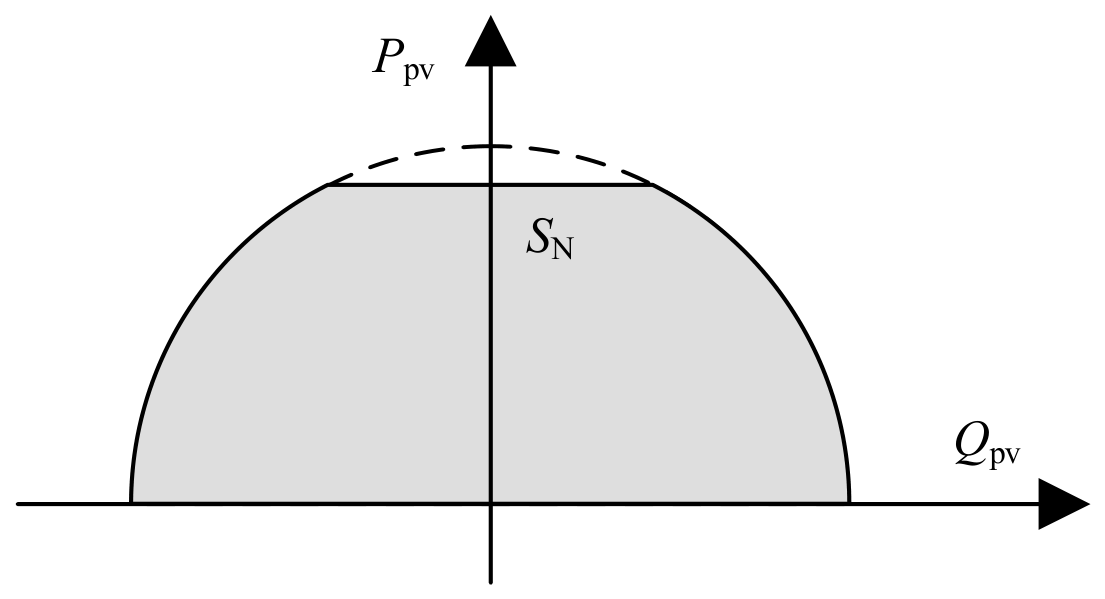
Under this condition, the operating range of the PV inverter output can be delineated as the shaded area illustrated in Figure 1.

2.5. Power Factor Constraints

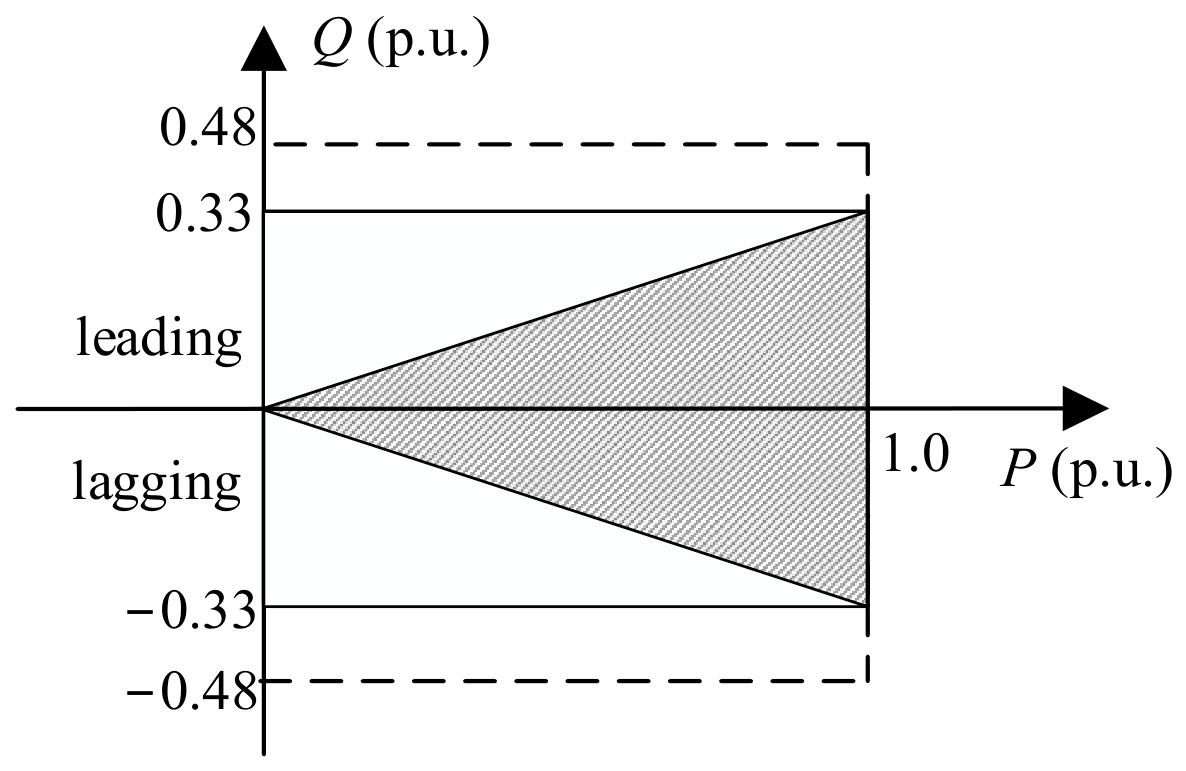
The power factor limits for PV inverters adopted in this section are derived from the Chinese National Standard GB/T 37408-2019 [30]. To enhance the versatility of the model, the proposed reactive power potential evaluation framework integrates both Type A and Type B inverters. The core difference between these two types lies in the geometric profiles of their reactive power capability boundaries and the decoupling characteristics between their reactive and active power outputs. Specifically, the adjustable reactive power range for standard Type A inverters is defined by the solid rectangular boundary in Figure 2, whereas Type A units with grid-supporting capabilities can operate within the dashed rectangular boundary. In contrast, the reactive power regulation interval for Type B inverters is represented by the shaded region illustrated in Figure 2. By comprehensively modeling the distinct external characteristics of both inverter types, this study can more accurately characterize operational constraints under real-world conditions.

2.6. Active–Reactive Power Feasible Region of DPVs

Based on the above constraints, the active–reactive power feasible region of PV inverters under various operating conditions can be ultimately determined. Combined with the aforementioned operation constraints, this section elaborates the method of determining the active–reactive power feasible region for Type A inverters with reactive power support capability and Type B inverters, respectively.
(1)
Type A inverters
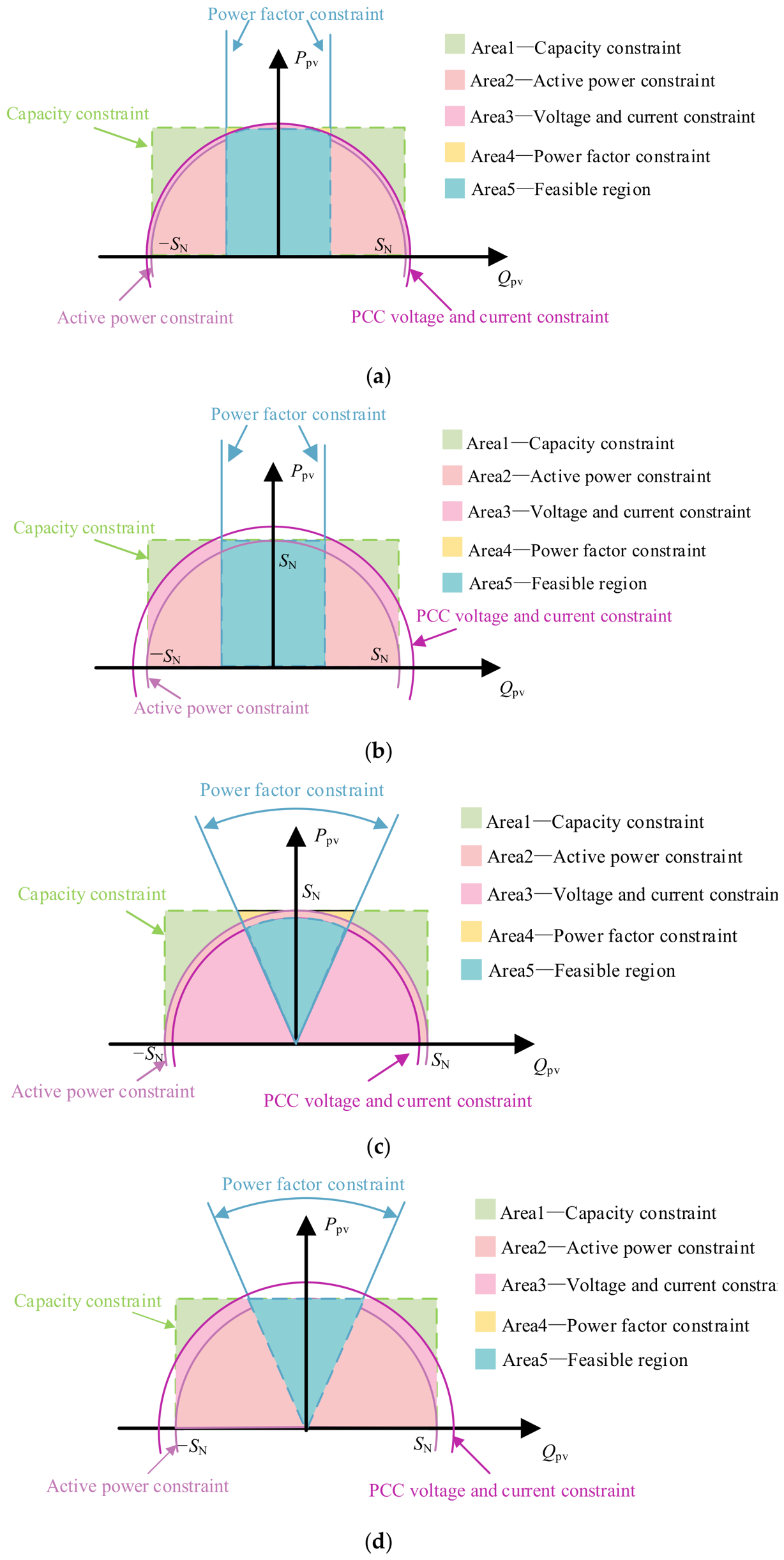
For Type A PV inverters, when the PCC voltage is relatively low, the allowable operating range restricted by PCC voltage and current constraints may not fully encompass the permissible reactive power output range under the power factor constraints. When the active power output is large, an overcurrent risk occurs. Therefore, the maximum allowable reactive power output must be quantified in conjunction with the current constraints. Under such circumstances, if the inverter satisfies the power factor constraints without violating other operational constraints, the following holds:
0 P pv S N P pv 2 + Q max _ PF 2 V p I max
where Qmax_PF is the maximum allowable reactive power of the Type A inverters under the power factor constraints, which is taken as 0.48 p.u. in accordance with the national standard. Based on Equation (6), the critical active power value Pth at which the Type A inverters satisfy all operational constraints under low PCC voltage conditions can be expressed as follows:
P th = ( I max V p ) 2 Q max _ PF 2
When PpvPth, the allowable reactive power output region under the power factor constraints is entirely encompassed within the illustrated area shown in Figure 1. In this case, the boundary of the active–reactive power feasible region for the Type A inverters is determined by the power factor constraints. When Ppv > Pth, the feasible region boundary is restricted by the current constraints shown in Figure 1. In summary, the active–reactive power feasible region of Type A inverters under low PCC voltage conditions is as shown in Figure 3a.
When the PCC voltage reaches a certain level, the operating region of Type A inverters shown in Figure 1 can completely encompass the allowable reactive power output range specified by the power factor constraints. This implies that a voltage threshold can be obtained to judge whether there is a risk of overcurrent when a Type A inverter generates power based on capacity constraints, active power constraints, and power factor constraints, which is given by:
V p I max S N 2 + Q max _ PF 2
Substituting the values of Imax and Qmax_PF, which are 1.1 p.u. and 0.48 p.u., respectively, it can be calculated that Vp ≥ 1.008 p.u. In this case, even when reaching the maximum allowable power output, a Type A inverter can still meet all other constraints, as shown in Figure 3b.
(2)
Type B inverters
The main difference between Type B inverters and Type A inverters lies in the power factor constraints. According to the national standard specifications on the power factor of Type B inverters, when Type B inverters provide reactive power compensation at the maximum allowable reactive power output permitted by power factor constraints, the corresponding reactive power output satisfies Qmax_PF = ±0.33 Ppv.
The feasible region analysis of Type B inverters is similar to that of Type A inverters. The corresponding feasible regions are illustrated in Figure 3c,d, and the details are not reiterated here.
Based on the analysis above, the reactive power regulation capability of DPVs is not a fixed value but is mutually constrained by multiple operational factors. Therefore, the active–reactive power feasible operating region formulated in Section 2 effectively reflects the true boundary of the reactive power regulation available from DPVs under diverse operating conditions. To fully exploit the reactive power support potential of DPVs while strictly respecting the operational constraints of the inverters, this study incorporates the aforementioned feasible operating region into the VVO model as the reactive power output constraint for the DPVs. On this basis, a VVO model featuring the coordinated control of multiple reactive power regulation devices is established to optimize the voltage profile and minimize network losses in the distribution network.

3. VVO Model Coordinating Multiple Reactive Power Compensation Devices in Distribution Networks Considering DPVs

Conventional reactive power compensation devices in distribution networks mainly include static var generator (SVG), SCBs and OLTC. Additionally, DPVs possess inherent reactive power regulation capability. In this paper, a multi-objective optimization model is established based on voltage deviation, network losses and the number of switching operations of OLTC and SCBs. Superior optimization results are obtained, thereby achieving an overall enhancement in distribution network operational performance through the coordinated participation of multiple devices. It should be noted that the proposed optimization model adopts a day-ahead global optimization approach over a 24 h horizon.

3.1. Objective Function

3.1.1. Network Losses

The total network losses in distribution networks include line losses and transformer losses, and the corresponding active power loss is expressed as:
F 1 = t = 1 24 i = 1 N G i j ( U j , t 2 + U i , t 2 2 U j , t U i , t cos θ i j )
where Ui,t and Uj,t denote the voltage magnitudes at nodes i and j at time t, respectively; Gij and θij are the conductance and the phase angle difference between nodes i and j, respectively; and N is the total number of nodes.

3.1.2. Voltage Deviation

In distribution networks, the voltage deviation of a node is defined as the absolute value of the difference between the actual voltage and the rated voltage, and the total voltage deviation of a distribution network can be expressed as:
F 2 = t = 1 24 i = 1 N U i , t U std
where Ustd denotes the rated voltage of the distribution network.

3.1.3. The Number of Switching State Changes of OLTC and SCBs

The service life of OLTC and SCBs is closely related to the number of switching operations. Frequent operations can substantially shorten their service life, leading to increased operation and maintenance costs and undermining the economic operation of distribution networks. Considering these factors, the objective function corresponding to the number of switching state changes is defined as:
F 3 = t = 1 24 m N CB ( k m , t + 1 k m , t ) + n N tap ( O n , t + 1 O n , t )
where NCB and Ntap represent the total numbers of SCBs and OLTC, respectively; km,t represents the number of capacitor banks in service of the m-th shunt capacitor bank at time t; and On,t is the tap position of the n-th OLTC at time t. ⊕ denotes the exclusive OR operation, whose output is 1 when the two inputs are different, and 0 otherwise. When the switching status of OLTC or SCBs changes between adjacent time points, the output of (km,tkm,t+1) or (On,tOn,t+1) will increment the switching state change counts by 1. Accumulating these results across all time points yields the total number of switching state changes of discrete devices over the day.

3.2. Constraints

3.2.1. Power Flow Constraints

The equations for the equality power flow constraints are given by Equation (12).
P i = U i , t j = 1 N U j , t ( G i j cos θ i j B i j sin θ i j ) Q i = U i , t j = 1 N U j , t ( G i j sin θ i j B i j cos θ i j )
where Pi and Qi denote the active and reactive power injected into distribution networks at node i, respectively, and Bij represents the susceptance between nodes i and j.

3.2.2. Node Voltage Constraints

To ensure safe and stable operation of the distribution system, the voltage amplitude of each node must remain within the allowable range across all scheduling periods, which is formulated as:
U i , min U i , t U i , max
where Ui,max and Ui,min denote the upper and lower voltage limits of node i, respectively.

3.2.3. OLTC Tap Position Constraints

As a typical voltage regulation device in distribution networks, OLTC adjusts its tap position to change the transformation ratio and maintain node voltage within the qualified range. Limited by its mechanical structure and design parameters, the tap position can only vary within a predefined interval, as described by:
K min K i K max
where Ki is the tap position of the i-th OLTC, and Kmin and Kmax represent the minimum and maximum allowable tap positions of the OLTC, respectively.

3.2.4. SVG Operational Constraints

SVG can rapidly and continuously output inductive or capacitive reactive power to provide fast voltage support and suppress voltage fluctuation. Subject to the rated capacity of its converter, the reactive power output of each SVG must be restricted within its allowable operating range, which is expressed as follows:
Q SVG , i min Q SVG , i Q SVG , i max
where QSVG,i is the reactive power output of the i-th SVG, and QSVG,imin and QSVG,imax denote the lower and upper limits of the reactive power generated by the i-th SVG, respectively.

3.2.5. DPV Reactive Power Output Constraints

DPV can participate in system voltage regulation by flexibly adjusting their reactive power output. The corresponding constraint can be written as:
Q DPV , i min t Q DPV , i t Q DPV , i max t
where Q DPV , i t denotes the reactive power output of the i-th DPV at time step t, and Q DPV , i max t and Q DPV , i min t represent the dynamic upper and lower reactive power regulation thresholds of the i-th DPV at time step t, respectively. Rather than being fixed constants, these time-varying boundaries are dynamically determined at each interval based on the multi-constraint coupling evaluation method derived in Section 2.

3.2.6. Switching Number Constraints of SCBs

SCBs realize stepped reactive power compensation through switching operations. Considering that frequent switching will aggravate the mechanical wear of switching devices and reduce equipment service life, it is necessary to limit the number of switched capacitor banks. The constraint is described as:
Q sc = N sc Q sc , step 0 N sc N sc , max
where Qsc is the actual reactive power of the SCBs in operation, Qsc,step is the compensation power of each capacitor bank, Nsc is the number of SCBs actually switched in, and Nsc,max is the maximum allowable number of SCB switching groups.
To eliminate the influences of disparate physical dimensions and orders of magnitude among different sub-objectives, a baseline-value normalization method is employed before formulating the comprehensive objective function. Specifically, the objective function values under the initial system operating state before optimization are selected as the baseline value of voltage deviation as well as network losses. The normalized results are then defined as the ratios of the optimized objective values to their corresponding pre-optimization baseline values. The number of switching state changes of OLTC and SCBs is divided by the maximum number of adjustments allowed by the equipment to achieve normalization. Meanwhile, the analytic hierarchy process (AHP) is adopted to determine the weight coefficients of each objective function, and a heuristic optimization algorithm is utilized to solve the objective function J, which is expressed as:
min J = w 1 F 1 _ norm + w 2 F 2 _ norm + w 3 F 3 _ norm
where Fi_norm denotes the normalized value of the i-th sub-objective, and w1, w2, and w3 are the weight coefficients of each objective, satisfying w1 + w2 + w3 = 1.

4. Multi-Strategy Integrated Rime Optimization Algorithm

4.1. Rime Optimization Algorithm

Su Hang et al. [31] proposed the rime optimization algorithm (RIME) in 2023, which is inspired by the natural phenomenon of rime and simulates the growth processes of soft rime and hard rime. In the RIME algorithm, the optimal solution is obtained by iteratively updating the positions of rime particles. The RIME algorithm mainly consists of three phases: population initialization, soft-rime search strategy, and the hard-rime puncture mechanism.

4.1.1. Initialization Stage

When solving the optimization problem, Np individuals are randomly generated within the feasible range of each decision variable to generate the initial population X0.
X i 0 = l b + r 1 ( u b l b ) , i = 1 , 2 N p
where r1 is a random number in the interval (0,1), and ub and lb are the upper and lower bounds of the decision variables, respectively.

4.1.2. Soft-Rime Search Strategy

By simulating the random movement of soft-rime particles in a breeze environment, a soft-rime search strategy with strong randomness and global coverage is proposed to generate the new population Xnew:
X i new = X best + r 2 β cos θ h ( u b l b ) ,   r 3 < E θ = π i t e r 10 M a x F E S , E = i t e r / M a x F E S β = 1 [ ( w i t e r ) / M a x F E S ] / w
where Xbest is the global optimal rime particle; r2 and r3 are random numbers within the interval (−1,1), respectively; β is the environmental factor, which is used to reflect the influence of external conditions on the search process of rime particles; iter is the current iteration number; MaxFES is the maximum number of iterations of the algorithm; h is a random number within the interval (0,1); E is the adhesion coefficient, which gradually increases with the iteration process; and w is a constant equal to 5.

4.1.3. Hard-Rime Puncture Mechanism

A hard-rime puncture mechanism that simulates the puncturing phenomenon is proposed for the process of hard-rime particle condensation:
X i new = X best , r 4 < F normr ( S i )
where Fnormr() represents the normalized fitness value of the current particle, which reflects the crossover probability between the i-th rime particle and the global optimal solution, and r4 is a random number in the interval (−1,1).

4.2. Improvement Strategies

Compared with swarm intelligence optimization algorithms such as the genetic algorithm (GA), the RIME algorithm demonstrates prominent advantages in optimization efficiency and exploitation. However, it also suffers from certain shortcomings, including poor population diversity and insufficient global exploration in the early stage [32,33,34]. These deficiencies become particularly pronounced when addressing the distribution network VVO model, which is characterized by high dimensionality, non-convexity, and complex coupled constraints. Consequently, they can easily cause the algorithm to become trapped in local optima or trigger the curse of dimensionality, thereby hindering the effective search for the globally optimal solutions to the optimization objectives. To address these deficiencies, this paper integrates Fuch chaotic mapping, the snow ablation optimizer (SAO), and the guided learning strategy (GLS) into the RIME algorithm, thereby effectively enhancing its optimization performance.

4.2.1. Fuch Chaotic Mapping Initialization

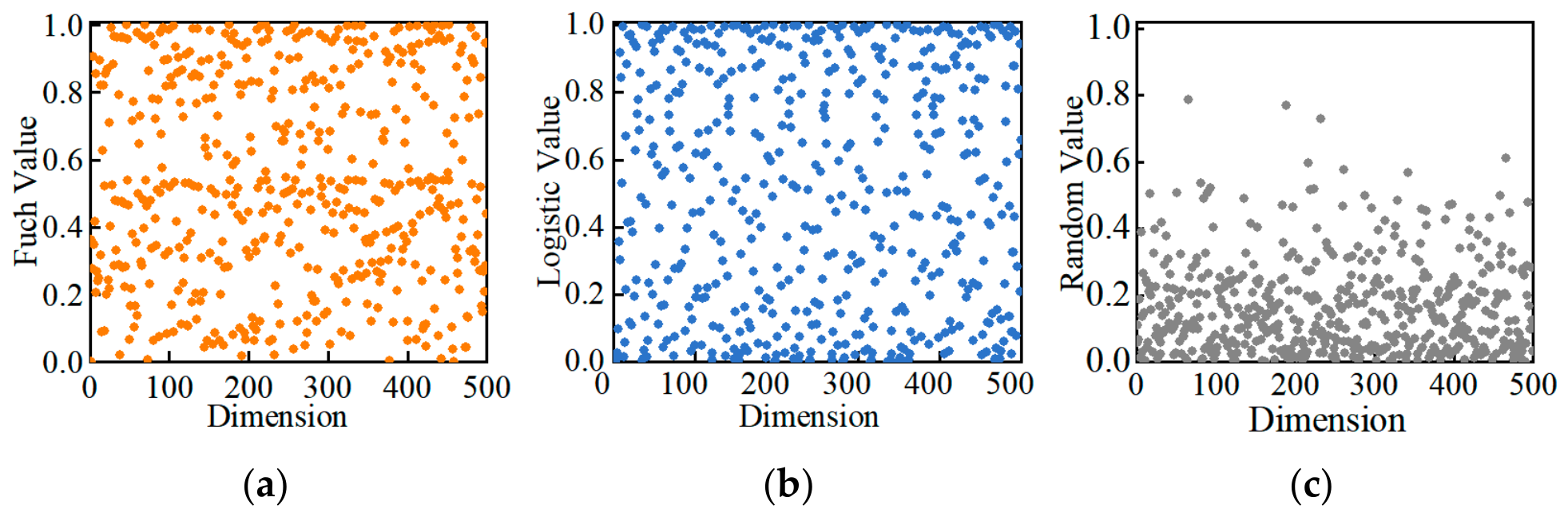
In the RIME algorithm, the population is initialized randomly. In this paper, Fuch chaotic mapping is introduced to replace random initialization so that the initial population can be more uniformly distributed in the feasible solution space. Fuch mapping is characterized by fast convergence and uniform ergodicity, and the mathematical expression is given as follows:
X Fuch , i + 1 = cos ( 1 / X i 2 )
To quantitatively and intuitively evaluate the spatial distribution characteristics of different initialization strategies, comparative experiments were conducted for random initialization, logistic chaotic mapping, and Fuch chaotic mapping under the same population size and dimensional setting. The spatial distributions of the three methods in the feasible search space are shown in Figure 4.
Meanwhile, frequency variance and normalized Shannon entropy are introduced as metrics to evaluate distribution uniformity. A smaller variance and a larger normalized Shannon entropy signify a more uniform population distribution across the search space. The quantitative comparison of different initialization methods is summarized in Table 1.
As shown in Table 1, Fuch mapping achieves the lowest variance of 0.889 and the highest normalized Shannon entropy of 0.9783, indicating that it provides the most uniform population distribution. In contrast, random initialization has a relatively low entropy value, suggesting poor distribution uniformity. Although logistic mapping also obtains a high entropy value, it has the largest frequency variance, indicating significant distribution fluctuations. Therefore, Fuch chaotic mapping can generate a higher-quality initial population, which is beneficial for improving the global search capability of the algorithm.

4.2.2. Snow Ablation Optimizer

The SAO is a novel metaheuristic technique proposed in 2023 that simulates the sublimation and melting behaviors of snow [35]. In the exploration stage of the SAO, Brownian motion is utilized to mimic the irregular process of snow or liquid water converting to water vapor. This motion presents a highly decentralized characteristic, which enhances the algorithm’s ability to escape from local optima and achieve rapid convergence.
X i new = E l i t e + B M i ( θ 1 ( X best X i ) + ( 1 θ 1 ) ( X ¯ X i ) )
where BMi indicates a random number vector including random numbers on the basis of Gaussian distribution denoting the Brownian motion, θ1 is a random number in the interval [−1,1], Elite is an individual randomly selected from a set of several elites, and X ¯ denotes the centroid position of the whole swarm.
According to Equation (20), the soft-rime search strategy in the RIME algorithm is activated when r3 < E, where E = i t e r / M a x F E S is a control parameter that gradually increases with the number of iterations. In the early stage of the optimization process, since the current iteration number iter is small, the value of E remains relatively low, resulting in a low probability of activating the soft-rime search strategy. If no alternative search mechanism is introduced when r3E, the exploration of the search space will be insufficient during the early iterations, thereby reducing the algorithm’s capability to escape from local optima. To remedy this drawback, the SAO search strategy is introduced when r3E, establishing a dual-branch search mechanism that complements the soft-rime search strategy. The Brownian motion embedded in the SAO possesses strong random perturbation and decentralized search characteristics, which can expand the swarm’s search coverage and enhance the global exploration capability during early iterations. Consequently, this dual-branch search mechanism effectively strengthens the exploration capability of the MSIRIME algorithm, ultimately improving its optimization performance when resolving the high-dimensional VVO problem.

4.2.3. Guided Learning Strategy

To balance the exploration and exploitation processes and avoid trapping into local optima, the GLS is introduced into the RIME algorithm. The basic principle is to evaluate the dispersion degree by calculating the standard deviation of the historical positions of individuals in recent generations, and infer what guidance the algorithm currently needs. The GLS mainly consists of a feedback stage and a guidance stage [36]. In the feedback stage, the dispersion level of historical individuals in recent iterations is used to judge whether the algorithm is biased toward exploration or exploitation, thereby providing a reference for the guidance stage. The calculation formula is defined as follows:
V o = std ( S t ) B B = 200 / ( u b l b )
where Vo is the feedback result, which is used to determine the current demands of the algorithm; std() is the function to calculate standard deviation; and St is used to store the learning experience of historical individuals. The parameter B is adopted to normalize Vo and eliminate the influence of boundary variation. Afterwards, the guiding result obtained from the feedback stage is introduced into the algorithm to execute the guidance stage, and the parameter α is utilized to select the corresponding update formula, which is presented by Equation (25).
X new = X best + tan ( r π ) ( u b l b ) / V o , V o > α r ( u b l b )   , V o α
where r is a random number within the interval (0,1), and α is set to 30 based on the parameter sensitivity analysis method presented in reference [35]. As can be seen from Equation (25), the GLS is able to flexibly adjust the population’s update direction during the iterative process, thereby preventing the algorithm from premature convergence. This feature is particularly well suited for VVO models, as they are prone to getting stuck in local optima due to their high dimensionality and numerous variables.
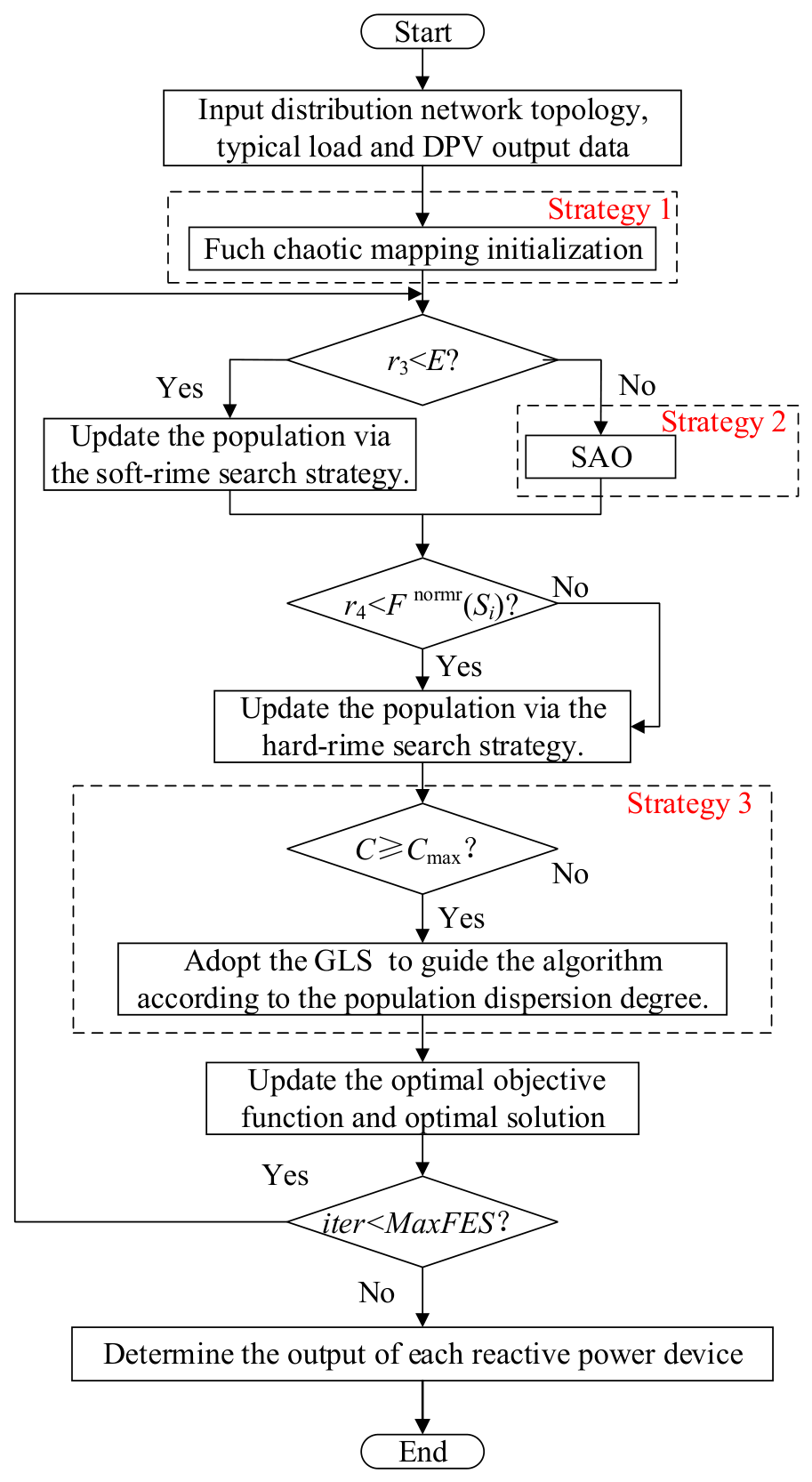
The flowchart of the MSIRIME algorithm is illustrated in Figure 5. The detailed procedure of the proposed algorithm is described as follows:
Step1: Parameter Initialization
Define the parameters of a distribution system, such as the topology of the distribution network, the permissible output range of each reactive power source and the outputs of DPVs and loads.
Step2: Strategy 1—Fuch Chaotic Mapping Initialization
Generate the initial population using Fuch chaotic mapping to enhance population diversity and uniformity according to Equation (22).
Step3: Population Update via Dual Search Branches
Compare the random number r3 with the parameter E:
If r3 < E, update the population via the soft-rime search strategy following Equation (20);
If r3E, regenerate the population using the SAO (Strategy 2), as described in Equation (23).
Step4: Hard-Rime Puncture Mechanism
The hard-rime puncture strategy is implemented via Equation (21), and parameter C is updated.
Step5: Strategy 3—GLS
Activate the GLS when CCmax, guiding the algorithm based on the population dispersion degree following Equations (24) and (25).
Step6: Optimal Solution Update
Evaluate the objective function values for all individuals and update the current optimal objective function value and solution.
Step7: Termination Check
Stop the process if iterMaxFES, outputting the optimal control settings for all reactive power compensation devices. Otherwise, return to Step 3.

5. Case Study

5.1. Test System and Parameter Settings

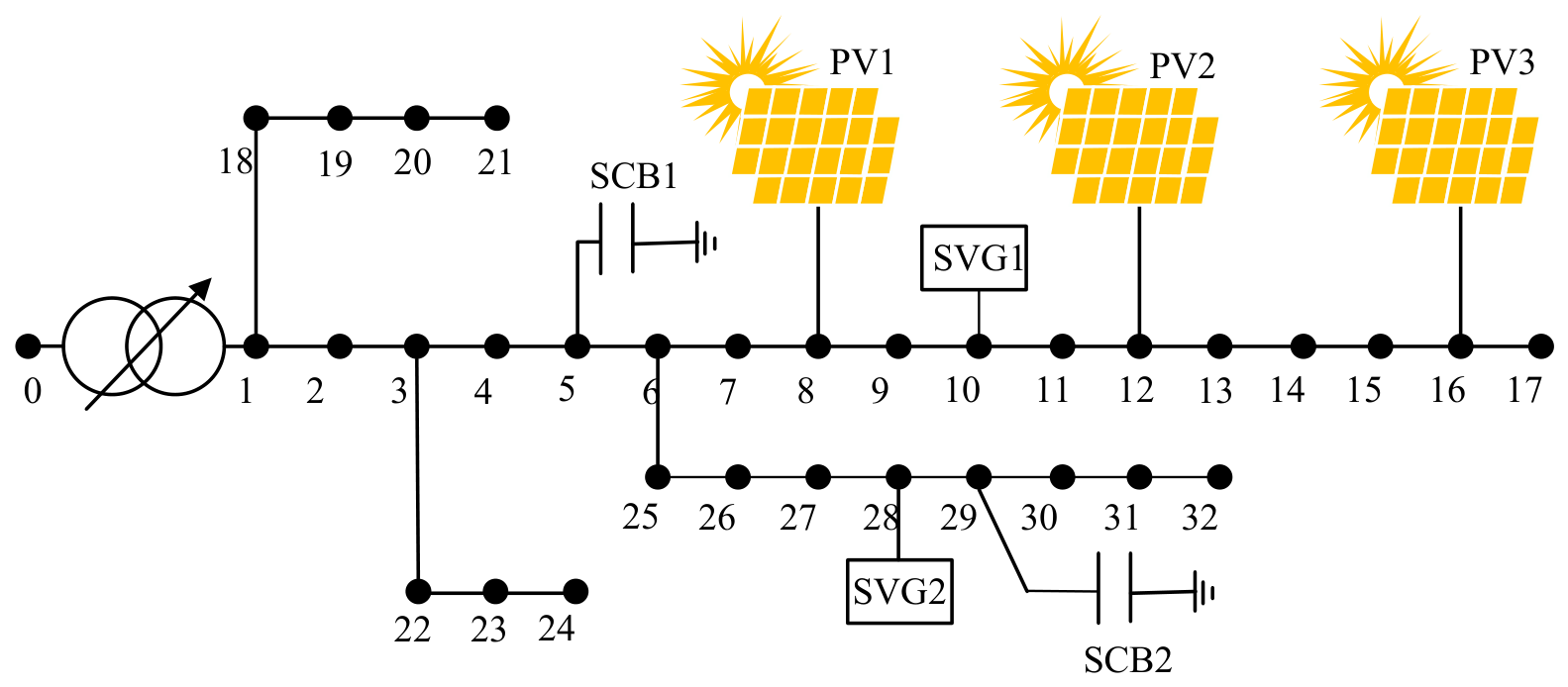
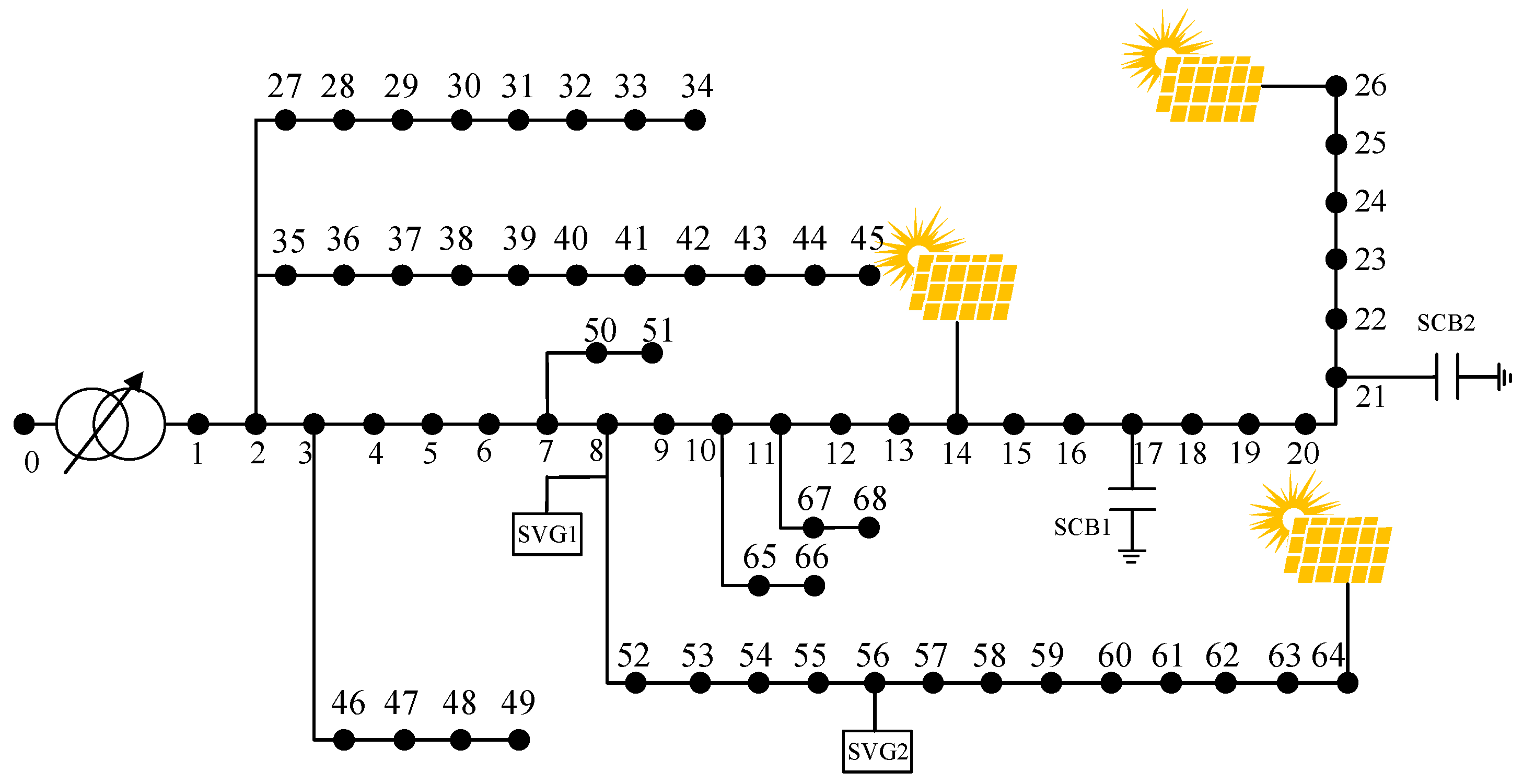
The effectiveness and superiority of the proposed method are validated on a modified IEEE 33-bus system, and the system structure is shown in Figure 6. The base power and base voltage of the system are 10 MV·A and 12.66 kV, respectively. The total standard load of the IEEE 33-bus network is 3.715 MW + j2.3 MVAr, and the line parameters and load distribution at each bus can be found in reference [37]. The OLTC is configured between nodes 0 and 1, with a voltage regulation range of 0.90~1.10 p.u. The transformer tap adjustment step is 1.25% p.u., and the tap position is limited to within the range of [−4, 4]. PV1, PV2, and PV3 are configured to nodes 8, 12, and 16, respectively. Their capacities are set to 0.3 MW, 0.3 MW, and 0.4 MW, and their inverter types are Type A, Type A, and Type B, respectively. SCB1 and SCB2 are configured to nodes 5 and 29, with compensation capacities of 150 kVar × 4 and 150 kVar × 7, respectively. SVG1 and SVG2 are configured to nodes 12 and 28, each with a capacity of 200 kVar.
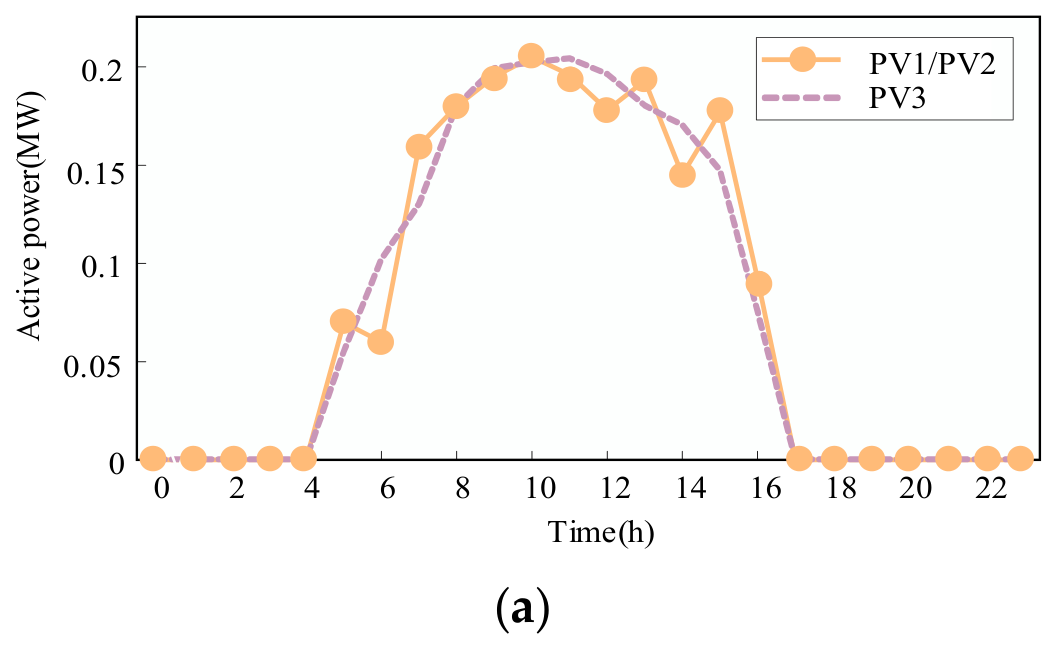
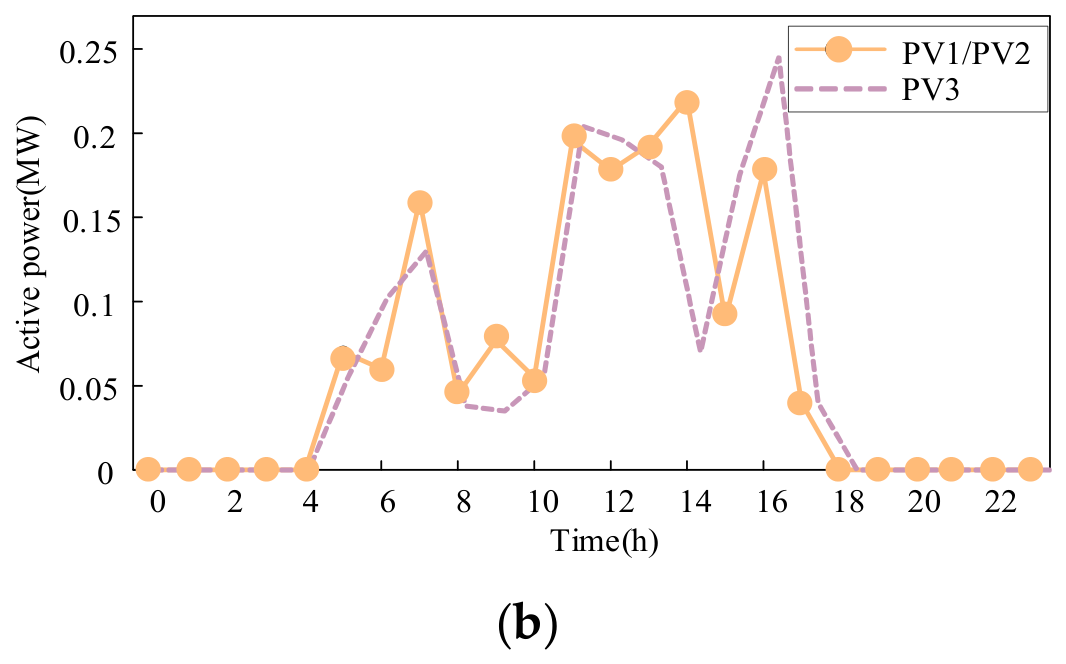
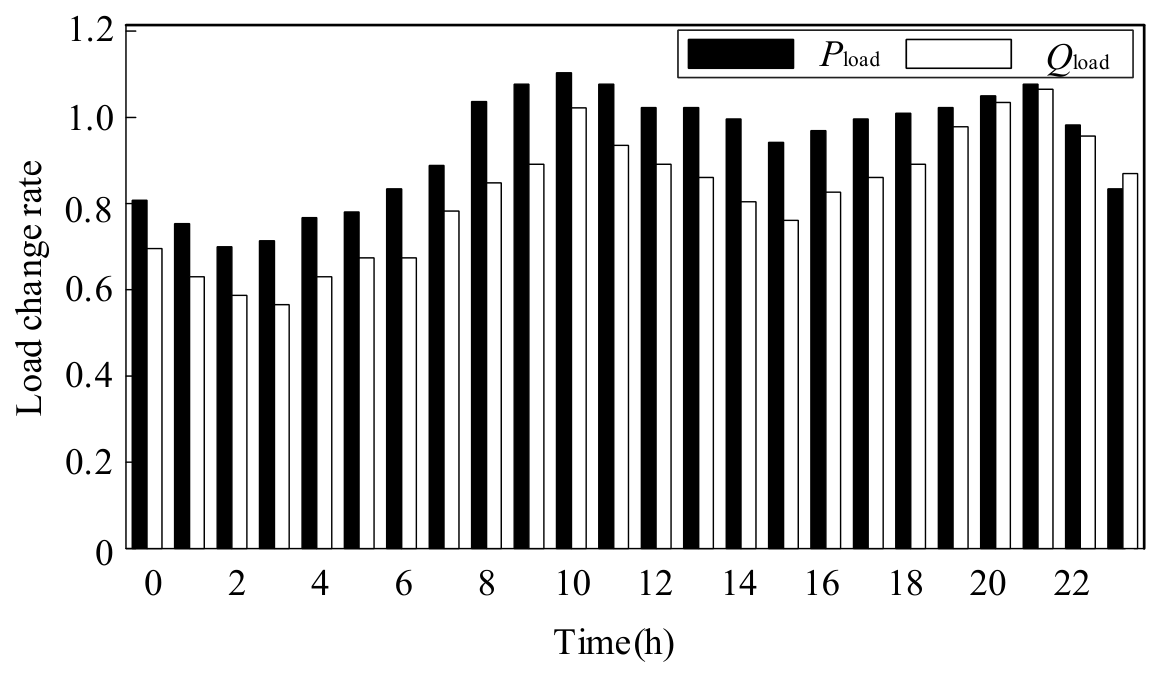
Considering that the active power output of DPVs is significantly affected by weather conditions within a day, and that the load level also varies noticeably across different time periods, the 24 h dynamic variations of DPV outputs and loads are considered in the VVO model, as shown in Figure 7 and Figure 8. Figure 7 presents the 24 h active power output curves of DPVs under two different weather scenarios. Figure 7a represents a typical PV output scenario, reflecting the general daily variation pattern of PV generation under normal weather conditions. Figure 7b represents a rapidly fluctuating PV output scenario under complex weather conditions. In this scenario, the PV output decreases significantly during 7:00–10:00 due to rainy weather, while noticeable fluctuations occur during 14:00–17:00 due to cloudy weather. This scenario reflects the uncertainty and intermittency of DPV generation under complex weather conditions.
Figure 8 shows the 24 h load variation profile of the distribution system. The load demand varies among different time periods, resulting in time-varying voltage regulation requirements, reactive power demand, and network losses. Therefore, the PV output profiles in Figure 7 and the load variation profile in Figure 8 jointly constitute the time-series input data for the proposed VVO model. By considering both PV output fluctuations and load variations, the proposed MSIRIME-based VVO strategy can be evaluated under more realistic daily operating conditions, thereby verifying its effectiveness and adaptability in voltage regulation and loss reduction.

5.2. Effectiveness Analysis of the Proposed Strategy

To verify the effectiveness of the proposed coordinated optimization strategy integrating multiple reactive power compensation devices and DPVs, three different cases are designed for comparison and analysis. Case 1 represents the scenario without any optimization, Case 2 involves optimization based on reactive power compensation devices excluding DPVs, and Case 3 considers coordinated optimization between DPVs and the other compensation devices.

5.2.1. For Test System 1 (IEEE33)

The cumulative 24 h operation results under different cases are listed in Table 2. Compared with Case 1, Case 3 reduces the total network losses by 1.006 MW and the total voltage deviation by 17.467 p.u. Compared with Case 2, Case 3 further reduces the total network losses by 0.048 MW and the total voltage deviation by 1.025 p.u., while significantly decreasing the number of OLTC and SCBs switching operations. These results verify the effectiveness of the coordinated optimization strategy between DPVs and the reactive power compensation devices. It is demonstrated that, under the background of high-penetration DPV integration into distribution networks, coordinated reactive power optimization involving DPVs and other reactive power compensation devices can achieve better voltage regulation and loss reduction while simultaneously extending the service lives of OLTC and SCBs, thus significantly enhancing the economic efficiency of distribution networks.
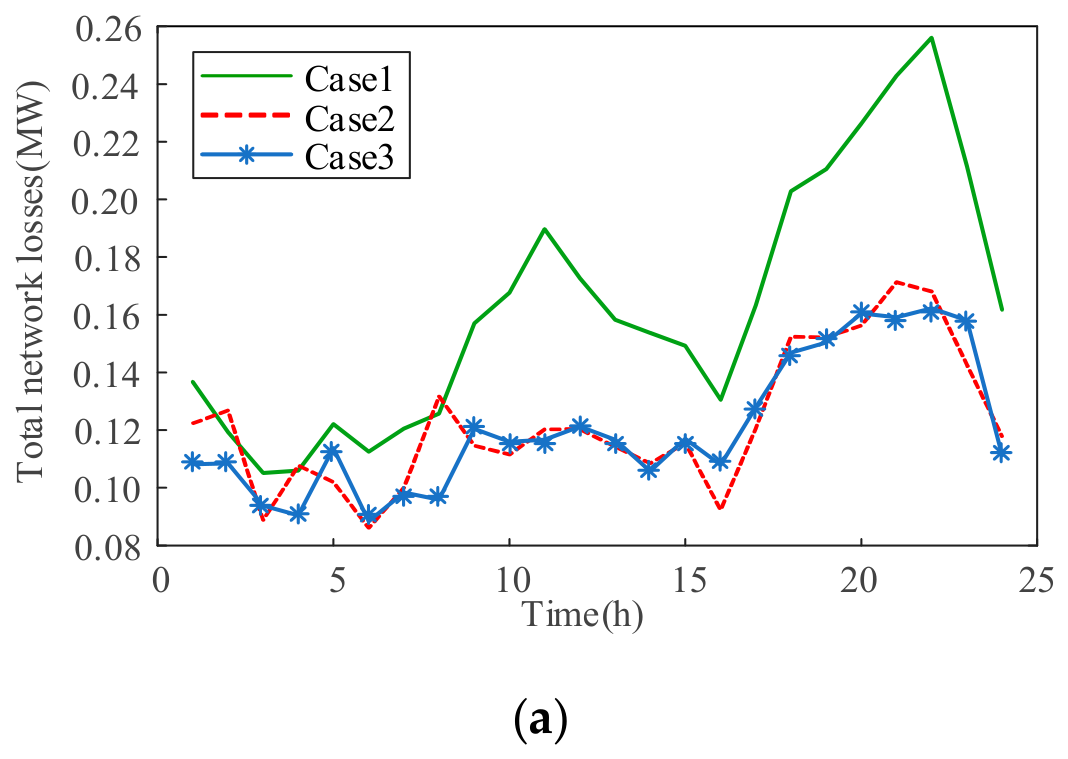
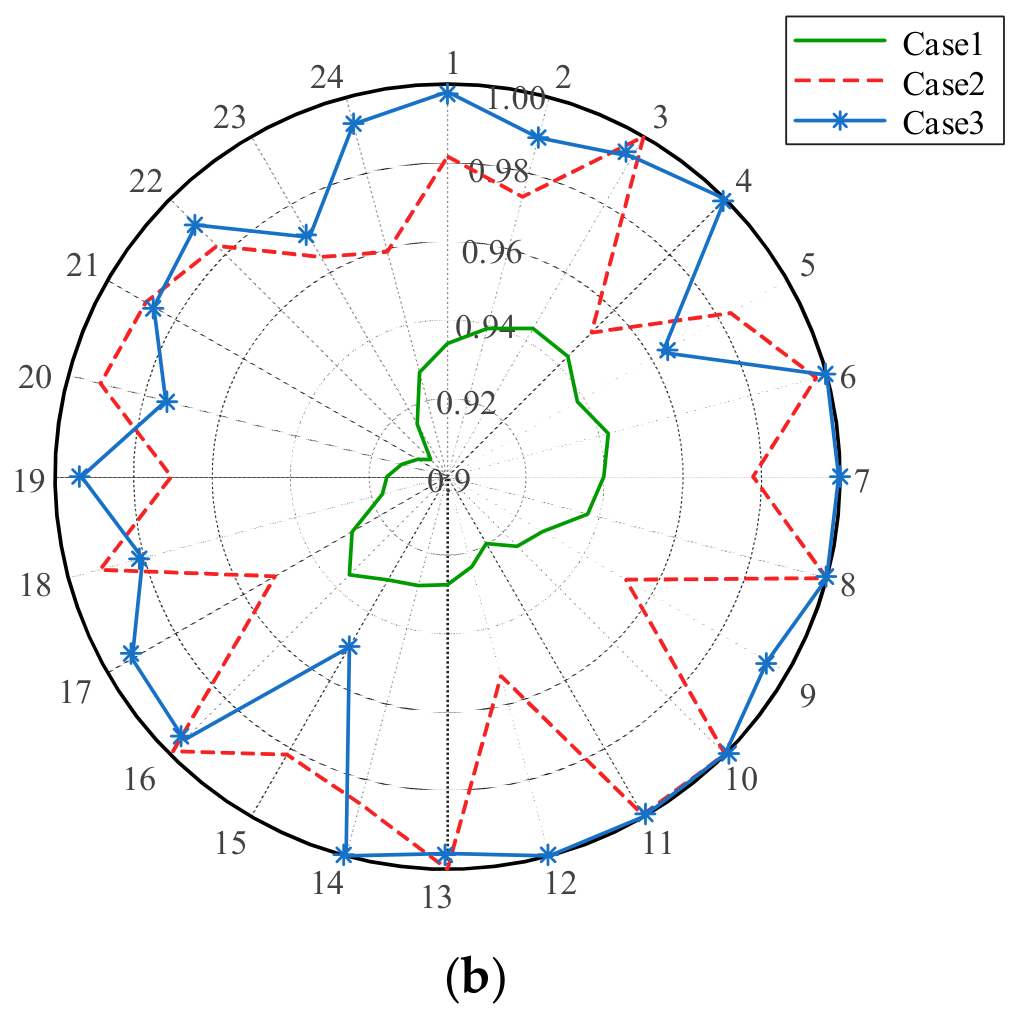
The total network loss curves and the minimum voltage curves at each time period under the three cases are shown in Figure 9. As observed in Figure 9a, the total network losses in Case 2 and Case 3 are significantly reduced compared with those in Case 1. Moreover, Case 3 alleviates the sudden spikes in network losses at certain moments in Case 2. This indicates that the coordinated optimization of DPVs and other reactive power compensation devices delivers a more stable performance, achieving smoother network loss control at the entire time horizon and effectively promoting the economic operation of distribution networks. From Figure 9b, it can be observed that the minimum voltage in all periods of Case 1 consistently remains below 0.95 p.u., suggesting that the initial state is severely affected by the random fluctuations in DPVs and loads, resulting in serious under-voltage violations throughout the day. Compared with Case 2, the coordinated optimization involving DPVs and various reactive power compensation devices in Case 3 improves the voltage level at most nodes.
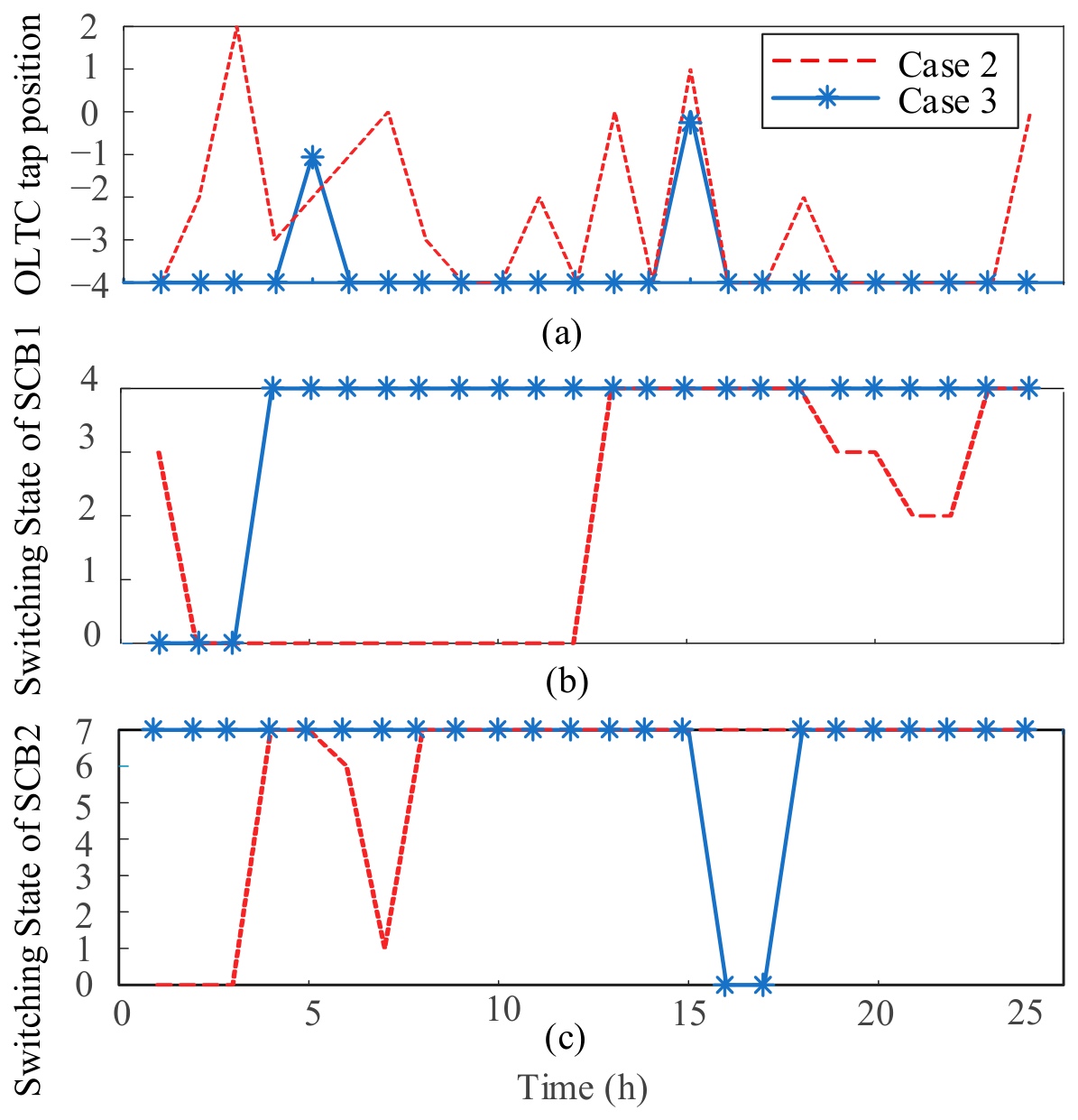
In order to prevent the adverse effects of continuous and frequent operations on the useful life of discrete devices, the number of operations for SCBs is restricted to no more than six per day. Figure 10 illustrates the switching status of discrete devices after optimization of Case 2 and Case 3. It is apparent that the number of operations for discrete devices substantially decreases from Case 2 to Case 3. This indicates that the coordinated operation of DPVs and other reactive power compensation devices can effectively reduce the switching frequency of discrete devices and considerably lower operating costs.
On the basis of the analysis of the typical cases above, the power output curves of DPVs, accounting for the effects of complicated weather conditions such as rain and cloudy skies, are introduced to assess the robustness of the proposed method, as shown in Figure 7b. Under the circumstance, the system’s total network losses are 3.994 MW, and the total voltage deviation is 33.635 p.u. before optimization. After optimization based on the proposed algorithm, both the total network losses and voltage deviation improved remarkably. The system’s total network losses decrease by 28.815%, amounting to 2.923 MW, and the total voltage deviation reaches 19.085 p.u., with a reduction of 43.259%. In summary, the method achieves the optimization objectives while demonstrating excellent adaptability to various scenarios.

5.2.2. For Test System 2 (IEEE33)

To evaluate the robustness of the coordinated voltage regulation strategy under diverse DPV integration scenarios, this subsection presents a sensitivity analysis based on the IEEE 33-bus system by altering the connection locations and capacities of the DPVs. In this scenario, three DPV units are relocated to buses 11, 17, and 32, with the capacity of each unit uniformly set to 0.5 MW. Compared with the base configuration in Section 5.1, this setup not only modifies the spatial distribution of DPVs but also increases the total installed capacity to 1.5 MW, representing a significantly higher PV penetration level. The cumulative optimization results for this scenario over a 24 h operational cycle are summarized in Table 3.
It can be observed from Table 3 that Case 3 achieves the best performance under scenarios with increased PV penetration and modified connection locations. Specifically, the total network loss value in Case 3 is 1.128 MW lower than that in Case 1 and 0.152 MW lower than that in Case 2. Regarding voltage quality, the total voltage deviation in Case 3 is reduced by 22.406 p.u. and 6.201 p.u. compared with Case 1 and Case 2, respectively. Moreover, the switching frequency of discrete devices is effectively controlled. These results demonstrate that the proposed evaluation model and optimization strategy can adapt to variations in PV integration locations and penetration levels, showing high robustness in distribution networks with high-penetration photovoltaics.

5.2.3. For Test System 3 (IEEE 69)

To further evaluate the effectiveness of the coordinated voltage regulation strategy across different network topologies, the structurally complex IEEE 69-bus radial distribution system is introduced for simulation testing. The base power and base voltage of the system are 10 MV·A and 12.66 kV, respectively. The total standard load of the IEEE 69-bus network is 3.8021 MW + j2.6947 MVAr. Compared with the IEEE 33-bus system, the IEEE 69-bus system features a significant increase in node count and branch complexity. In the simulation setup, the device configurations are as follows: DPVs are connected to buses 14, 26, and 64, with capacities of 0.8 MW, 1.0 MW, and 0.4 MW, respectively. SVGs are integrated at buses 8 and 56, each with a capacity of 0.2 MW. SCBs are placed at buses 5 and 29, each consisting of four switching steps, with a capacity of 150 kVar per step. The OLTC is located between buses 0 and 1, with its parameter settings identical to those described in Section 5.1. The IEEE 69-bus system structure is shown in Figure 11.
The operational performance of the three cases is compared within the IEEE 69-bus system, and the cumulative optimization results over a 24 h operational cycle are summarized in Table 4. The analysis of the simulation results demonstrates that the proposed coordinated optimization strategy continues to exhibit superior performance in the IEEE 69 system. Compared with Case 1, Case 3 reduces the total network losses by 0.47 MW and the total voltage deviation by 7.365 p.u. over the 24 h period. Furthermore, compared with Case 2, Case 3 achieves additional reductions of 0.146 MW in total network losses and 3.84 p.u. in total voltage deviation, respectively. Despite the increased complexity of reactive power flow relationships resulting from the higher number of nodes, the strategy effectively realizes efficient synergy among multiple heterogeneous devices, including SVGs, SCBs, and the OLTC. Consequently, voltages across all nodes are maintained within the security limits even during periods of high volatility, and the switching frequency of discrete devices is kept under reasonable control.

5.3. Superiority Verification of the MSIRIME Algorithm

To verify the superiority of the MSIRIME algorithm in solving the VVO model in distribution networks that consist of DPVs and other reactive power compensation devices, the mixed-integer second-order cone programming (MISOCP) relaxation model, the particle swarm optimization (PSO), the whale optimization algorithm (WOA), the RRT-based optimizer (RRTO), the RIME and the MSIRIME algorithm mentioned in this paper are all employed in this VVO model, and a contrastive analysis of their results is conducted. The population size for all algorithms is uniformly set to 50, and the maximum number of iterations is 500. Other parameters consistent for all the comparison algorithms are set to their default values, which are defined in their original publications. The references and values of different algorithms’ key parameters are shown in Table 5.
To eliminate the impact of stochastic heuristic behaviors and ensure the fairness of the algorithm comparison, each algorithm is tested independently 30 times, and the comprehensive statistical results (best, worst, mean, standard deviation and computational time) are adopted for evaluation. Table 6 and Table 7 depict the statistical values of the total 24 h network losses and the total voltage deviation after optimization based on the five algorithms. As shown in the tables, the RIME algorithm yields the highest average network losses of 3.253 MW, whereas the RRTO algorithm presents the poorest voltage regulation performance, with an average voltage deviation of 32.569 p.u. The optimization performance of the other three algorithms lies between those of the aforementioned algorithms and the MSIRIME algorithm.
The MSIRIME algorithm achieves the best optimization results compared with those before optimization, with an average total network loss value of only 2.855 MW and an average voltage deviation of only 12.099 p.u., representing reductions of 26.83% and 63.41%, respectively. Furthermore, the Wilcoxon signed-rank test at a 5% significance level confirms that the performance enhancements delivered by MSIRIME are statistically significant (p < 0.05). In terms of the deterministic benchmark, the MISOCP method obtains a 24 h total network loss value of 3.033 MW and a total voltage deviation of 38.666 p.u. By contrast, MSIRIME successfully surpasses the MISOCP benchmark across both evaluation metrics, further validating the prominent superiority of the proposed MSIRIME algorithm. Additionally, regarding computational efficiency, although the multi-strategy integration introduces a slight computational overhead, with a total execution time of 16,665.47 s per run, it remains highly competitive against peer metaheuristics and fully satisfies the temporal requirements of day-ahead scheduling.
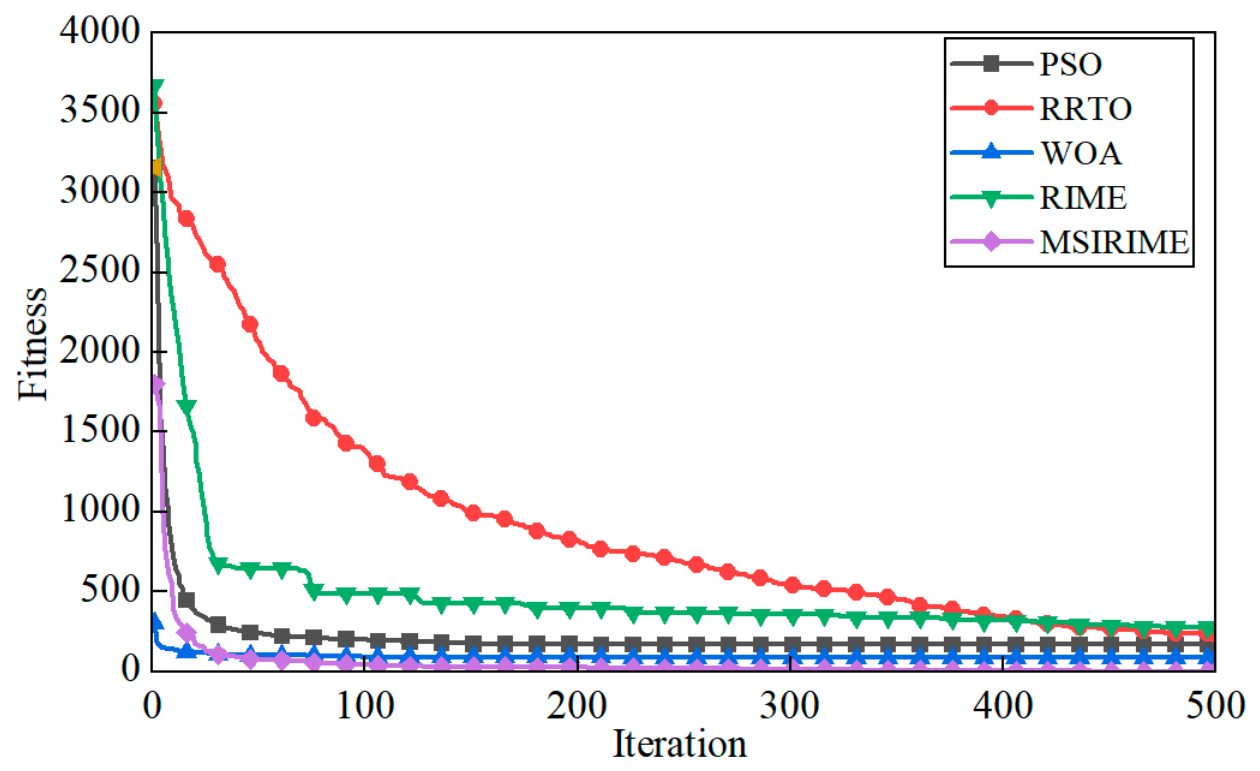
Figure 12 illustrates the average convergence curves of the five compared algorithms over 30 independent runs. To enhance visual clarity and prevent clutter caused by an excessive number of data points, distinct markers are plotted at an interval of every 15 iterations. It can be observed from Figure 12 that, by virtue of the dual-branch search mechanism integrated with the SAO and the GLS strategy, MSIRIME demonstrates a significantly accelerated convergence rate during the early exploration phase and a superior capability to escape local optima, ultimately converging to the minimum objective function value. This validates its superior global search efficiency when tackling high-dimensional and non-convex VVO problems. It should be noted that the fitness values in Figure 12 include not only the actual objective function values but also a penalty term, which is accumulated whenever the solution violates the constraints mentioned in Section 3.
Among all comparative strategies, PSO obtains the minimum average voltage deviation of 25.324 p.u., while MISOCP achieves an optimal average network loss value of 3.033 MW. By contrast, the proposed MSIRIME reduces the average total voltage deviation by 52.22% versus PSO’s optimal voltage level and lowers the average 24 h network losses by 5.87% in comparison with MISOCP’s best loss result. Meanwhile, MSIRIME yields the optimal fitness function value. Therefore, it can be concluded that with the execution time being approximately the same as with other strategies, the results obtained by MSIRIME exhibit significant superiority in voltage deviation, network losses, and fitness values.
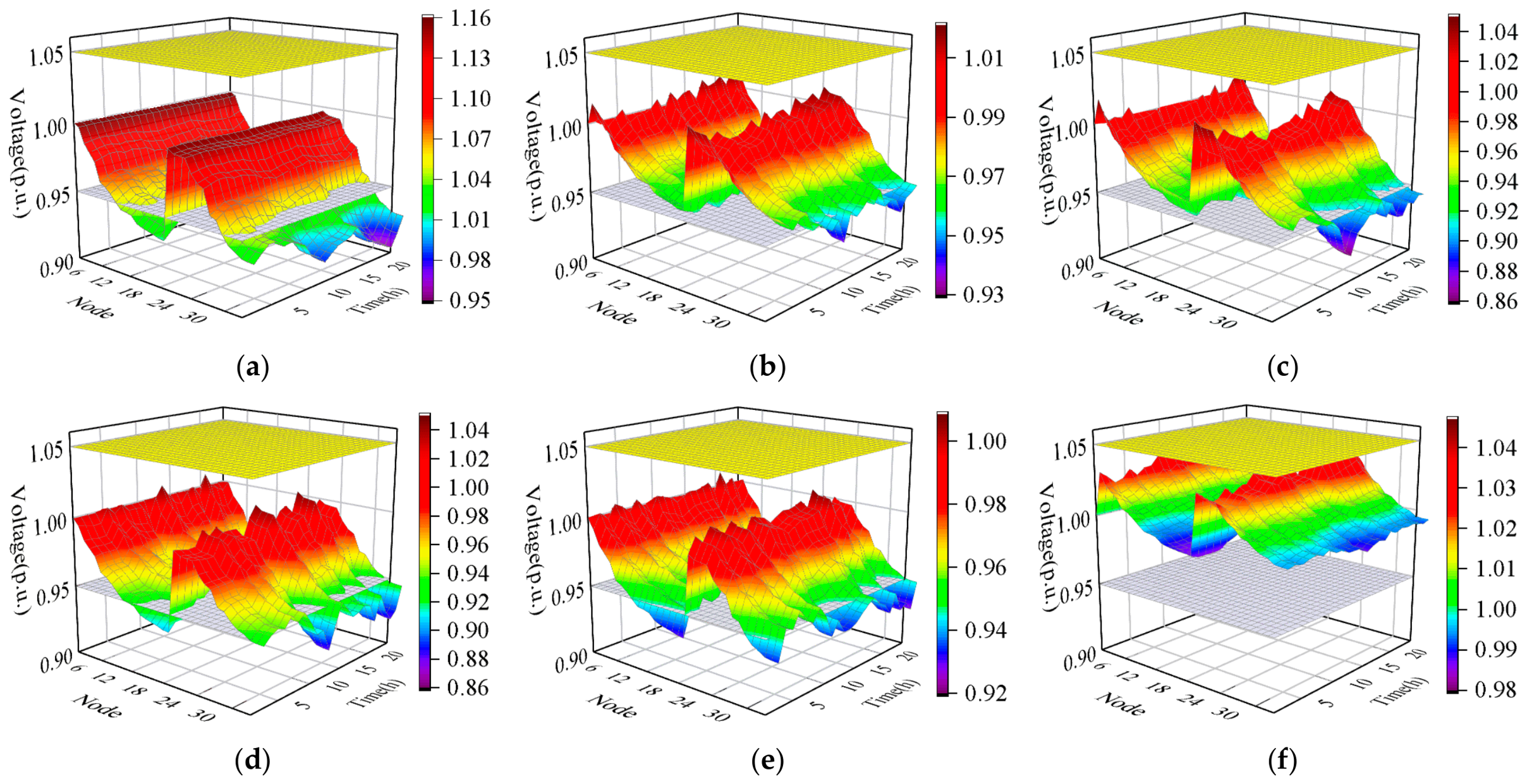
The hourly node voltage profiles before and after optimization by each algorithm are illustrated in Figure 13a–f, where the secure operational voltage range of the distribution network is set to [0.95, 1.05] p.u. The figure effectively visualizes global voltage fluctuations through color gradients, with 0.95 p.u. and 1.05 p.u. serving as the thresholds for the secure interval. As shown in Figure 13a, the unoptimized initial state exhibits prominent dark depressions across various nodes and time intervals, with the minimum voltage falling to 0.906 p.u., indicating a significant risk of undervoltage violations. The optimization results yielded by the PSO, RRTO, WOA, and RIME algorithms are presented in Figure 13b–e, respectively. Although these four algorithms improve the voltage profile to some extent, undervoltage violation regions persist because these metaheuristics are susceptible to converging toward local optima when addressing high-dimensional complex variables. In contrast, the voltage surface optimized by the MSIRIME algorithm in Figure 13f is the most stable and uniform, with all nodal voltages throughout the day strictly maintained within the secure range of [0.95, 1.05] p.u. This demonstrates that the improved algorithm proposed in this study offers superior global search accuracy, making it highly effective for multi-device coordinated control in high-dimensional VVO problems.

5.4. Sensitivity Analysis of Weighting Coefficients

As is depicted in Section 3.2, the weight coefficients of each objective function are obtained through AHP. Given that AHP is a subjective weighting method, it is necessary to assess the impact of subjective experience on the weights, as well as the effect of different weighting schemes on the solution results.
In order to test the impact of weighting on the conclusions, this article presents three distinct weighting schemes based on different judgment matrixes. The weight settings and consistency test results for the three schemes are shown in Table 8, where w1, w2, and w3 are the weights for voltage deviation, network losses, and the number of switching state changes of OLTC and SCBs, respectively.
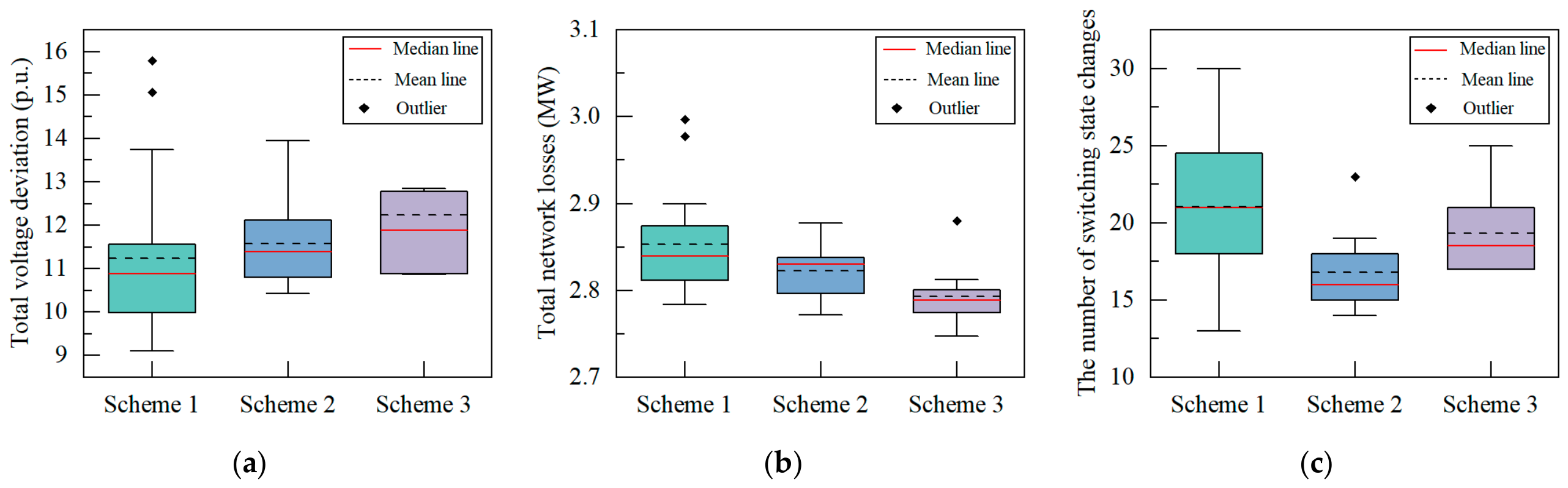
Figure 14 presents the box-and-whisker plots comparing the statistical performance of three different optimization schemes on three key evaluation metrics: (a) total voltage deviation, (b) total network losses, and (c) the total number of switching state changes of OLTC and SCBs. The box represents the interquartile range (IQR, 25th to 75th percentiles), the red solid line inside the box indicates the median value, the dashed line denotes the mean value, the whiskers extend from the box to the smallest and largest data values that are within 1.5 times the IQR of the quartiles, and the diamond markers represent outliers.
The average optimized total voltage deviation values for Schemes 1, 2, and 3 are 11.238, 11.58, and 12.24 p.u., respectively. The average total network losses values for Schemes 1, 2, and 3 after optimization are 2.853, 2.822, and 2.793 MW, respectively. As can be observed, Scheme 1 achieves the lowest total voltage deviation among the three schemes, and Scheme 3 obtains the best performance on total network losses, while Scheme 2 exhibits the minimum number of switching state changes. From the comparison results, it can be concluded that subjective experience clearly influences optimization results; that is, when the weight of a certain indicator is increased, the optimization results for that indicator improve remarkably, and vice versa.
Although different weight settings can lead to variations in the optimization results, the total voltage deviation and the total network losses are still significantly reduced compared to the results of Case 1 and Case 2 in Section 5.2. The results for the three sub-objectives are also substantially superior to those obtained using other comparison algorithms. Therefore, the variations caused by the weights are acceptable. They do not impact the effectiveness of the proposed VVO method. The proposed model in this article adopts the weights stipulated by Scheme 1.

6. Conclusions

To mitigate the exacerbated voltage deviations and network losses in distribution networks with high PV penetration, this article proposes a reactive power control potential assessment method for DPVs considering multi-constraint coupling. An optimization model is established for the IEEE 33 distribution network, with objective functions aimed at comprehensively minimizing voltage deviations, network losses, and the number of switching operations of discrete devices. The model is solved by a multi-strategy combined rime optimization algorithm. Based on the research above, the following conclusions can be drawn:
(1)
Considering that the reactive power capacity of different types of PV inverters is constrained by various operational factors, such as capacity, power factor and overcurrent capability, a comprehensive evaluation method for the dispatchable capacity of PV inverters under complex operating conditions is proposed based on the coupled multi-constraint mechanism. It provides an accurate and practical quantitative principle for the participation of DPVs in voltage regulation.
(2)
Traditional reactive power compensation equipment fails to reliably maintain the stability of distribution networks with high PV penetration. By accurately assessing the reactive power capacity of DPVs and coordinating DPVs with other devices, the proposed method can not only suppress the voltage fluctuations, but also significantly diminish network losses and the number of switching operations of discrete devices. A comparison of performance under three different circumstances validates the effectiveness of the collaborative optimization strategy. Meanwhile, the strategy also performs well under various operational conditions.
(3)
To address the shortcomings of the RIME algorithm, such as poor population diversity and insufficient exploration in the early stage of iterations, this paper proposes the MSIRIME algorithm, incorporating Fuch chaotic mapping, the SAO, and GLS. In contrast to PSO, WOA, RRTO and RIME, the MSIRIME algorithm demonstrates superior global optimization capabilities when resolving the coordinated optimization of DPVs and various reactive power compensation devices, exhibiting high-dimensional characteristics with numerous variables. By applying the algorithm, the system’s average total network losses and the total voltage deviation decrease by 26.83% and 63.41%, respectively, compared to those before optimization.
However, this study still has certain limitations. The current work mainly focuses on the coordinated optimization of reactive power regulation resources, including DPVs, SVG, SCBs, and OLTC, while the participation of flexible resources such as energy storage systems and electric vehicle charging stations has not been fully considered. Therefore, the applicability of the proposed method to more complex source–grid–load–storage coordinated operation scenarios requires further extension. Future work will incorporate more dispatchable resources, such as energy storage systems and electric vehicles, to develop a more comprehensive multi-resource coordinated optimization framework and further improve the adaptability and applicability of the proposed method in practical distribution network operation.

Author Contributions

Conceptualization, X.W. and W.Z.; methodology, Y.L.; software, M.D.; validation, X.W. and W.Z.; formal analysis, Z.M.; investigation, H.Z.; resources, X.W.; data curation, M.D. and Z.M.; writing—original draft preparation, M.D. and Z.M.; writing—review and editing, Y.L.; visualization, H.Z.; supervision, X.W. and W.Z.; project administration, X.W. and W.Z.; funding acquisition, X.W. All authors have read and agreed to the published version of the manuscript.

Funding

This research was funded by the Science and Technology Project of State Grid Anhui Electric Power Co., Ltd., grant number AHDLKJXMRWS2025063.

Data Availability Statement

All the data used in this study are included in the article. Further inquiries can be directed to the corresponding authors.

Conflicts of Interest

Authors Xiaoming Wang and Wenguang Zhao were employed by Electric Power Research Institute of State Grid Anhui Electric Power Co., Ltd. The author Hao Zheng was employed by the company State Grid Anhui Electric Power Co., Ltd. The remaining authors declare that the research was conducted in the absence of any commercial or financial relationships that could be construed as a potential conflict of interest.

References

  1. National Energy Administration of China. Grid-Connected Operation of Renewable Energy in China, 2025. 12 February 2026. Available online: https://www.nea.gov.cn/20260212/742b8c6a078347b0b39de676c05c5d58/c.html (accessed on 29 April 2026).
  2. Alboaouh, K.; Mohagheghi, S. Voltage, Var and Watt Optimization for a Distribution System with High PV Penetration: A Probabilistic Study. Electr. Power Syst. Res. 2020, 180, 106159. [Google Scholar] [CrossRef]
  3. Xu, S.; Wu, W. Tractable Reformulation of Two-Side Chance-Constrained Economic Dispatch. IEEE Trans. Power Syst. 2022, 37, 796–799. [Google Scholar] [CrossRef]
  4. Girigoudar, K.; Yao, M.; Mathieu, J.L.; Roald, L.A. Integration of Centralized and Distributed Methods to Mitigate Voltage Unbalance Using Solar Inverters. IEEE Trans. Smart Grid 2023, 14, 2034–2046. [Google Scholar] [CrossRef]
  5. Mai, T.T.; Haque, A.N.M.M.; Vergara, P.P.; Nguyen, P.H.; Pemen, G. Adaptive Coordination of Sequential Droop Control for PV Inverters to Mitigate Voltage Rise in PV-Rich LV Distribution Networks. Electr. Power Syst. Res. 2021, 192, 106931. [Google Scholar] [CrossRef]
  6. Alwez, M.A.; Jasni, J.; MohdRadzi, M.A.; Azis, N. Adaptive Reactive Power Control for Voltage Rise Mitigation on Distribution Network with High Photovoltaic Penetration. Renew. Sust. Energ. Rev. 2025, 207, 114948. [Google Scholar] [CrossRef]
  7. Xiong, K.; Cao, D.; Zhang, G.; Chen, Z.; Hu, W. Coordinated Volt/VAR Control for Photovoltaic Inverters: A Soft Actor-Critic Enhanced Droop Control Approach. Int. J. Electr. Power Energy Syst. 2023, 149, 109019. [Google Scholar] [CrossRef]
  8. Zhou, H.; Liang, J.; Du, X.; Wu, M. Multi-Timescale Reactive Power Optimization and Regulation Method for Distribution Networks Under a Multi-Source Interaction Environment. Processes 2024, 12, 2254. [Google Scholar] [CrossRef]
  9. Gush, T.; Kim, C.-H.; Admasie, S.; Kim, J.-S.; Song, J.-S. Optimal Smart Inverter Control for PV and BESS to Improve PV Hosting Capacity of Distribution Networks Using Slime Mould Algorithm. IEEE Access 2021, 9, 52164–52176. [Google Scholar] [CrossRef]
  10. Xu, R.; Zhang, C.; Xu, Y.; Dong, Z.; Zhang, R. Multi-Objective Hierarchically-Coordinated Volt/Var Control for Active Distribution Networks with Droop-Controlled PV Inverters. IEEE Trans. Smart Grid 2022, 13, 998–1011. [Google Scholar] [CrossRef]
  11. Wang, S.; Zhu, X.; Yu, P.; Yu, R. Research on a Double-Layer Voltage and Reactive Power Control Strategy for Regional Distribution Networks Based on Edge Computing. Electr. Power Syst. Res. 2025, 249, 112052. [Google Scholar] [CrossRef]
  12. Pamshetti, V.B.; Singh, S.P. Optimal Coordination of PV Smart Inverter and Traditional Volt-VAR Control Devices for Energy Cost Savings and Voltage Regulation. Int. Trans. Electr. Energy Syst. 2019, 29, e12042. [Google Scholar] [CrossRef]
  13. Zhang, J.; Wang, J.; Yan, J.; Cheng, P. Research on Multi-Time Scale Volt/VAR Optimization in Active Distribution Networks Based on NSDBO and MPC Approach. Electr. Power Syst. Res. 2025, 238, 111141. [Google Scholar] [CrossRef]
  14. Jafari, M.R.; Parniani, M.; Ravanji, M.H. Decentralized Control of OLTC and PV Inverters for Voltage Regulation in Radial Distribution Networks with High PV Penetration. IEEE Trans. Power Deliv. 2022, 37, 4827–4837. [Google Scholar] [CrossRef]
  15. Shahin, M.; Topriska, E.; Gormley, M.; Nour, M. Design and Field Implementation of Smart Grid-Integrated Control of PV Inverters for Autonomous Voltage Regulation and VAR Ancillary Services. Electr. Power Syst. Res. 2022, 208, 107862. [Google Scholar] [CrossRef]
  16. Silva-Quiñonez, R.A.; Sánchez-Sainz, H.; Garcia-Triviño, P.; Sarrias-Mena, R.; Carrasco-González, D.; Fernández-Ramírez, L.M. Optimal Control for On-Load Tap-Changers and Inverters in Photovoltaic Plants Applying Teaching Learning Based Optimization. Electronics 2025, 14, 3989. [Google Scholar] [CrossRef]
  17. Sun, X.; Qiu, J.; Tao, Y.; Ma, Y.; Zhao, J. A Multi-Mode Data-Driven Volt/Var Control Strategy with Conservation Voltage Reduction in Active Distribution Networks. IEEE Trans. Sustain. Energy 2022, 13, 1073–1085. [Google Scholar] [CrossRef]
  18. Huang, J.; Zhang, H.; Tian, D.; Zhang, Z.; Yu, C.; Hancke, G.P. Multi-Agent Deep Reinforcement Learning with Enhanced Collaboration for Distribution Network Voltage Control. Eng. Appl. Artif. Intell. 2024, 134, 108677. [Google Scholar] [CrossRef]
  19. Li, X.; Han, X.; Yang, M. Day-Ahead Optimal Dispatch Strategy for Active Distribution Network Based on Improved Deep Reinforcement Learning. IEEE Access 2022, 10, 9357–9370. [Google Scholar] [CrossRef]
  20. Xu, J.; Gao, H.; Wang, R.; Liu, J. Real-Time Operation Optimization in Active Distribution Networks Based on Multi-Agent Deep Reinforcement Learning. J. Mod. Power Syst. Clean Energy 2024, 12, 886–899. [Google Scholar] [CrossRef]
  21. Hossain, R.; Gautam, M.; Thapa, J.; Livani, H.; Benidris, M. Deep Reinforcement Learning Assisted Co-Optimization of Volt-VAR Grid Service in Distribution Networks. Sustain. Energy Grids Netw. 2023, 35, 101086. [Google Scholar] [CrossRef]
  22. Xu, Y.; Han, J.; Yin, Z.; Liu, Q.; Dai, C.; Ji, Z. Voltage and Reactive Power-Optimization Model for Active Distribution Networks Based on Second-Order Cone Algorithm. Computers 2024, 13, 95. [Google Scholar] [CrossRef]
  23. Xiang, X.; Gao, S. Reactive Power Optimization for Power Distribution Networks Using Mixed-Integer Second-Order Cone Programming. J. Phys. Conf. Ser. 2024, 2803, 012012. [Google Scholar] [CrossRef]
  24. Li, Y.; Sun, B.; Zeng, Y.; Dong, S.; Ma, S.; Zhang, X. Active Distribution Network Active and Reactive Power Coordinated Dispatching Method Based on Discrete Monkey Algorithm. Int. J. Electr. Power Energy Syst. 2022, 143, 108425. [Google Scholar] [CrossRef]
  25. Li, L.-L.; Ji, B.-X.; Lim, M.K.; Tseng, M.-L. Active Distribution Network Operational Optimization Problem: A Multi-Objective Tuna Swarm Optimization Model. Appl. Soft. Comput. 2024, 150, 111087. [Google Scholar] [CrossRef]
  26. Papadimitrakis, M.; Kapnopoulos, A.; Tsavartzidis, S.; Alexandridis, A. A Cooperative PSO Algorithm for Volt-VAR Optimization in Smart Distribution Grids. Electr. Power Syst. Res. 2022, 212, 108618. [Google Scholar] [CrossRef]
  27. Honghai, K.; Fuqing, S.; Yurui, C.; Kai, W.; Zhiyi, H. Reactive Power Optimization for Distribution Network System with Wind Power Based on Improved Multi-Objective Particle Swarm Optimization Algorithm. Electr. Power Syst. Res. 2022, 213, 108731. [Google Scholar] [CrossRef]
  28. GB/T 29319-2024; Technical Requirements for Connecting Photovoltaic Power System to Distribution Network. Standardization Administration of China: Beijing, China, 2024.
  29. Jia, K.; Gu, C.; Xuan, Z.; Li, L.; Lin, Y. Fault Characteristics Analysis and Line Protection Design Within a Large-Scale Photovoltaic Power Plant. IEEE Trans. Smart Grid 2018, 9, 4099–4108. [Google Scholar] [CrossRef]
  30. GB/T 37408-2019; Technical Requirements for Photovoltaic Grid-Connected Inverter. Standardization Administration of the People’s Republic of China: Beijing, China, 2019.
  31. Su, H.; Zhao, D.; Heidari, A.A.; Liu, L.; Zhang, X.; Mafarja, M.; Chen, H. RIME: A Physics-Based Optimization. Neurocomputing 2023, 532, 183–214. [Google Scholar] [CrossRef]
  32. Lv, H.; Qian, Q.; Pan, J.; Song, M.; Feng, Y.; Li, Y. Application of Multi-Strategy Controlled Rime Algorithm in Path Planning for Delivery Robots. Biomimetics 2025, 10, 476. [Google Scholar] [CrossRef] [PubMed]
  33. Gu, G.; Lou, J.; Wan, H. A Multi-Strategy Improved Rime Optimization Algorithm for Three-Dimensional USV Path Planning and Global Optimization. Sci. Rep. 2024, 14, 12603. [Google Scholar] [CrossRef] [PubMed]
  34. Li, W.; Yang, X.; Yin, Y.; Wang, Q. A Novel Hybrid Improved RIME Algorithm for Global Optimization Problems. Biomimetics 2025, 10, 14. [Google Scholar] [CrossRef] [PubMed]
  35. Deng, L.; Liu, S. Snow Ablation Optimizer: A Novel Metaheuristic Technique for Numerical Optimization and Engineering Design. Expert Syst. Appl. 2023, 225, 120069. [Google Scholar] [CrossRef]
  36. Jia, H.; Lu, C. Guided Learning Strategy: A Novel Update Mechanism for Metaheuristic Algorithms Design and Improvement. Knowledge-Based Syst. 2024, 286, 111402. [Google Scholar] [CrossRef]
  37. Baran, M.E.; Wu, F.F. Network Reconfiguration in Distribution Systems for Loss Reduction and Load Balancing. IEEE Trans. Power Deliv. 1989, 4, 1401–1407. [Google Scholar] [CrossRef]
  38. Shi, Y.; Eberhart, R.C. Empirical Study of Particle Swarm Optimization. In Proceedings of the 1999 Congress on Evolutionary Computation-CEC99 (Cat. No. 99TH8406), Washington, DC, USA, 6–9 July 1999. [Google Scholar]
  39. Mirjalili, S.; Lewis, A. The Whale Optimization Algorithm. Adv. Eng. Softw. 2016, 95, 51–67. [Google Scholar] [CrossRef]
  40. Lai, G.-J.; Li, T.; Shi, B.-J. RRT-Based Optimizer: A Novel Metaheuristic Algorithm Based on Rapidly-Exploring Random Trees Algorithm. IEEE Access 2025, 13, 42744–42776. [Google Scholar] [CrossRef]
Figure 1. Operating range of the inverter considering voltage, current and capacity constraints.
Technologies 14 00378 g001
Figure 2. Reactive power range of inverters considering power factor constraints.
Technologies 14 00378 g002
Figure 3. Feasible active–reactive power operating region of PV inverters. (a) Type A inverter, Vp < 1.008. (b) Type A inverter, Vp ≥ 1.008. (c) Type B inverter, Vp < 0.957. (d) Type B inverter, Vp ≥ 0.957.
Technologies 14 00378 g003
Figure 4. Spatial distributions generated by three population initialization methods. (a) Fuch mapping. (b) Logistic mapping. (c) Random initialization.
Technologies 14 00378 g004
Figure 5. Flow chart of the MSIRIME algorithm.
Technologies 14 00378 g005
Figure 6. Structural diagram of the IEEE 33-bus distribution system.
Technologies 14 00378 g006
Figure 7. The 24 h active power output curves of PVs. (a) Typical output curves. (b) Output curves affected by rapidly changing weather.
Technologies 14 00378 g007aTechnologies 14 00378 g007b
Figure 8. The 24 h load variation bar chart.
Technologies 14 00378 g008
Figure 9. Total network losses and minimum voltage curves under different scenarios. (a) Total network loss curves. (b) Minimum voltage curves.
Technologies 14 00378 g009aTechnologies 14 00378 g009b
Figure 10. Switching state of discrete devices under different cases. (a) OLTC. (b) SCB1. (c) SCB2.
Technologies 14 00378 g010
Figure 11. Structural diagram of the IEEE 69-bus distribution system.
Technologies 14 00378 g011
Figure 12. The average fitness convergence curves of the five algorithms.
Technologies 14 00378 g012
Figure 13. Voltage optimization results comparison among different algorithms. (a) Before optimization. (b) PSO. (c) RRTO. (d) WOA. (e) RIME. (f) MSIRIME.
Technologies 14 00378 g013
Figure 14. Comparison of results from different weighting schemes. (a) The total voltage deviation. (b) The total network losses. (c) The number of switching state changes.
Technologies 14 00378 g014
Table 1. Statistics of three population initialization methods.
Initialization MethodFrequency VarianceNormalized Shannon Entropy
Random initialization7.5560.6524
Logistic mapping17.5560.9463
Fuch mapping0.8890.9783
Table 2. The 24 h cumulative results under different cases.
CasesTotal Network Losses (MW)Total Voltage
Deviation (p.u.)
The Number of Switching State Changes
OLTCSCB1SCB2
Case 13.90233.069---
Case 22.94416.6271653
Case 32.89615.602412
Table 3. The 24 h cumulative results under different cases for test system 2.
CasesTotal Network Losses (MW)Total Voltage
Deviation (p.u.)
The Number of Switching State Changes
OLTCCB1CB2
Case 13.86133.149---
Case 22.88516.9442065
Case 32.73310.743965
Table 4. The 24 h cumulative results under different cases for test system 3.
CasesTotal Network Losses (MW)Total Voltage
Deviation (p.u.)
The Number of Switching State Changes
OLTCCB1CB2
Case 14.06634.630---
Case 23.74231.1051266
Case 33.59627.265756
Table 5. Parameter settings of all compared algorithms.
AlgorithmsKey ParametersValues
PSO [38]c1—Cognitive learning factor2.0
c2—Social learning factor2.0
wmax—Upper limit of the linearly decreasing inertial weight0.9
wmin—Lower limit of the linearly decreasing inertial weight0.4
vmax—Maximum velocity0.5
WOA [39]b—A constant for defining the shape of the logarithmic spiral1.0
RRTO [40]C—The step size penalty factor10.0
RIME [31]w—A constant for controlling the segments of the step function5.0
Table 6. Statistical results of 24 h total network losses (MW).
AlgorithmAverageMaximumMinimumStandard DeviationWilcoxon
p-Value
Time(s)
PSO3.1213.2993.0110.0652.794 × 10−914,112.47
RRTO3.1673.3163.0210.0701.863 × 10−914,064.51
WOA3.1773.2993.0090.0649.313 × 10−1014,066.21
RIME3.2533.4792.9980.1169.313 × 10−1014,103.75
MSIRIME2.8553.1922.7700.084-16,665.47
Table 7. Statistical results of 24 h total voltage deviation (p.u.).
AlgorithmAverageMaximumMinimumStandard DeviationWilcoxon
p-Value
PSO25.32429.07022.3002.0639.313 × 10−10
RRTO32.56938.38724.1903.6739.313 × 10−10
WOA31.40539.07521.5173.8299.313 × 10−10
RIME31.21239.89323.9913.6069.313 × 10−10
MSIRIME12.09918.1219.1102.074-
Table 8. Weighting schemes and consistency test results.
Schemesw1w2w3Consistency RatioConsistency Test
Scheme 10.5820.3090.1090.00318Pass
Scheme 20.40.40.20Pass
Scheme 30.2860.5710.1430Pass
Disclaimer/Publisher’s Note: The statements, opinions and data contained in all publications are solely those of the individual author(s) and contributor(s) and not of MDPI and/or the editor(s). MDPI and/or the editor(s) disclaim responsibility for any injury to people or property resulting from any ideas, methods, instructions or products referred to in the content.