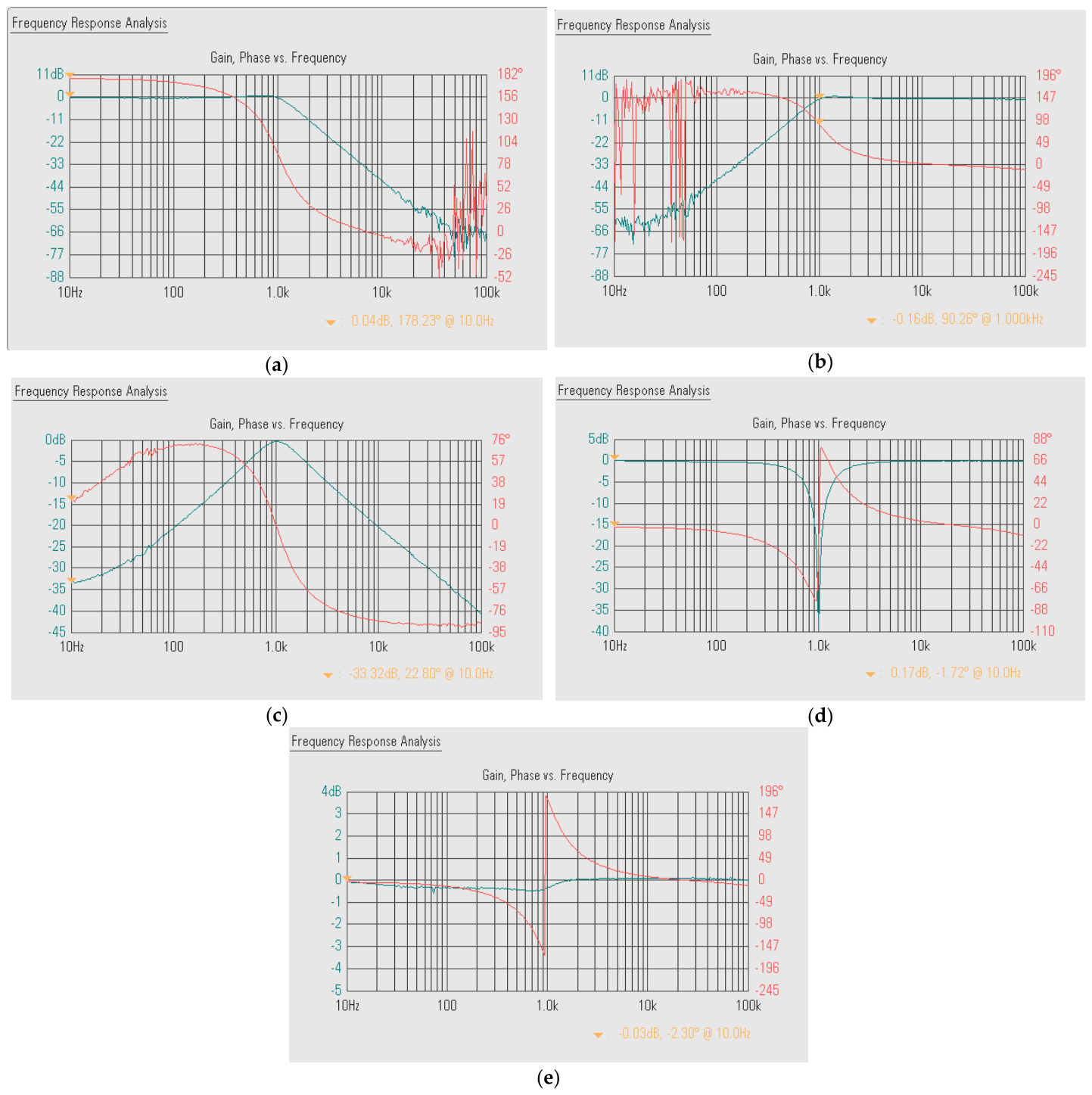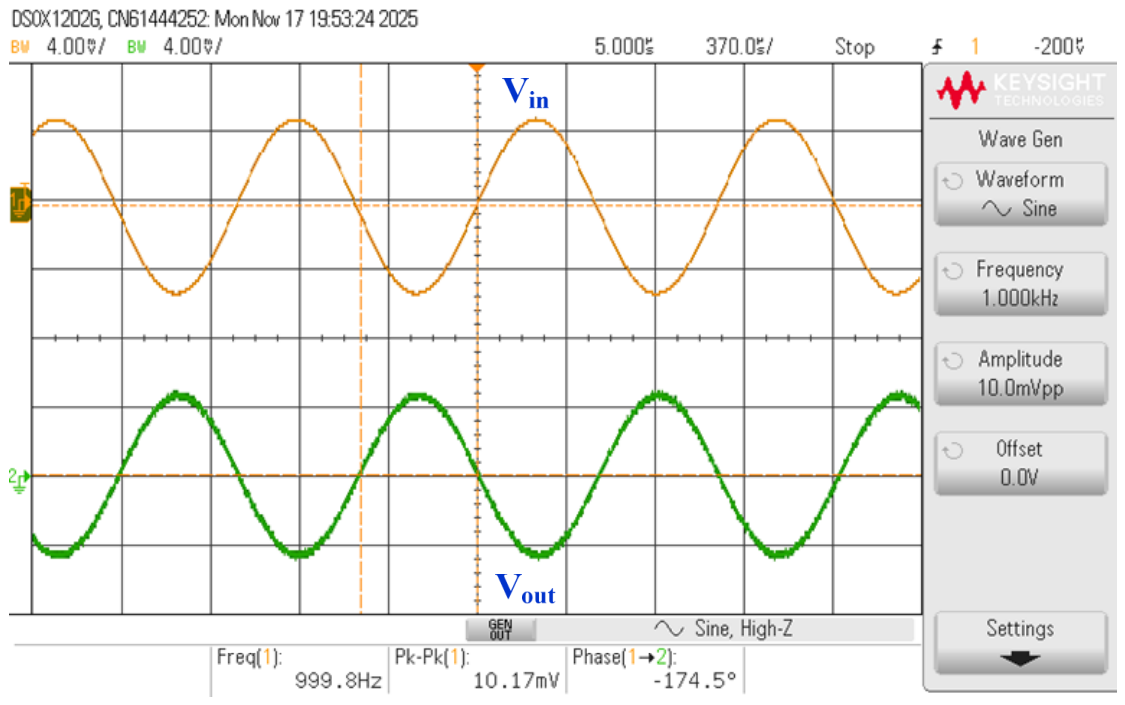

A Novel Low-Power Mixed-Mode Universal Filter Design Using Multiple-Input Operational Transconductance Amplifiers




Abstract
1. Introduction
2. Proposed Circuit
2.1. Multiple-Input Operational Transconductance Amplifier
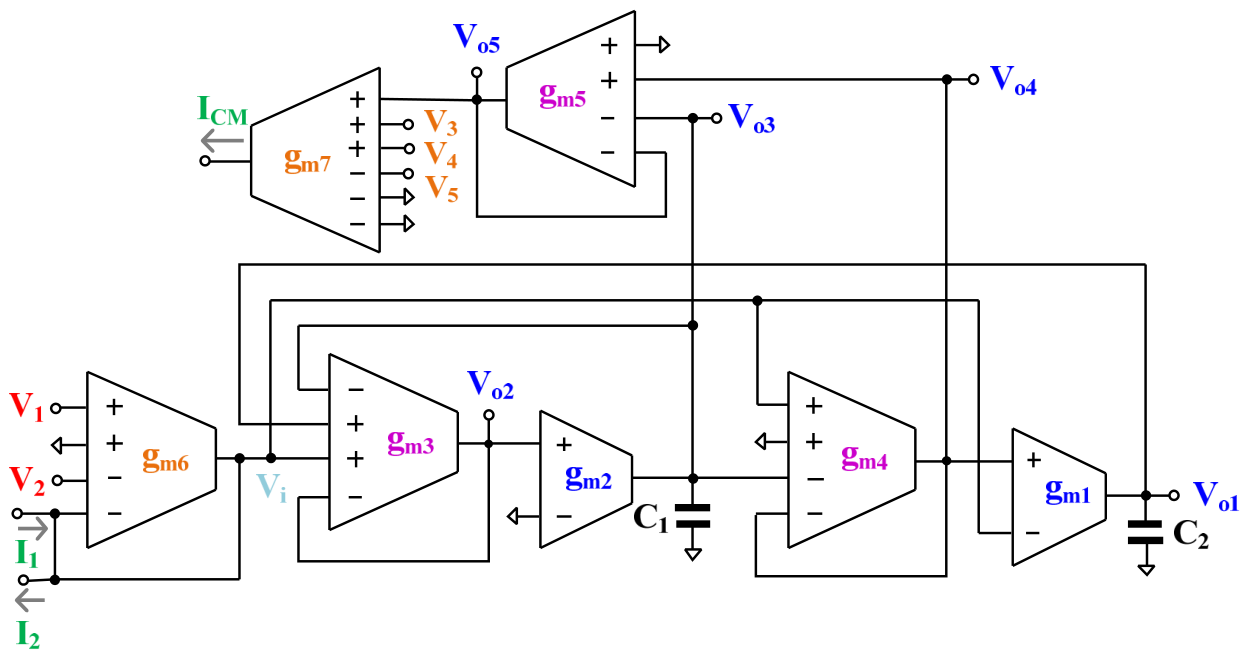
2.2. Proposed Mixed-Mode Universal Filter
- •
- Voltage-mode
- •
- Transimpedance-mode
- •
- Transadmittance-mode:
- •
- Current-mode
2.3. Non-Idealities Analysis
3. Results
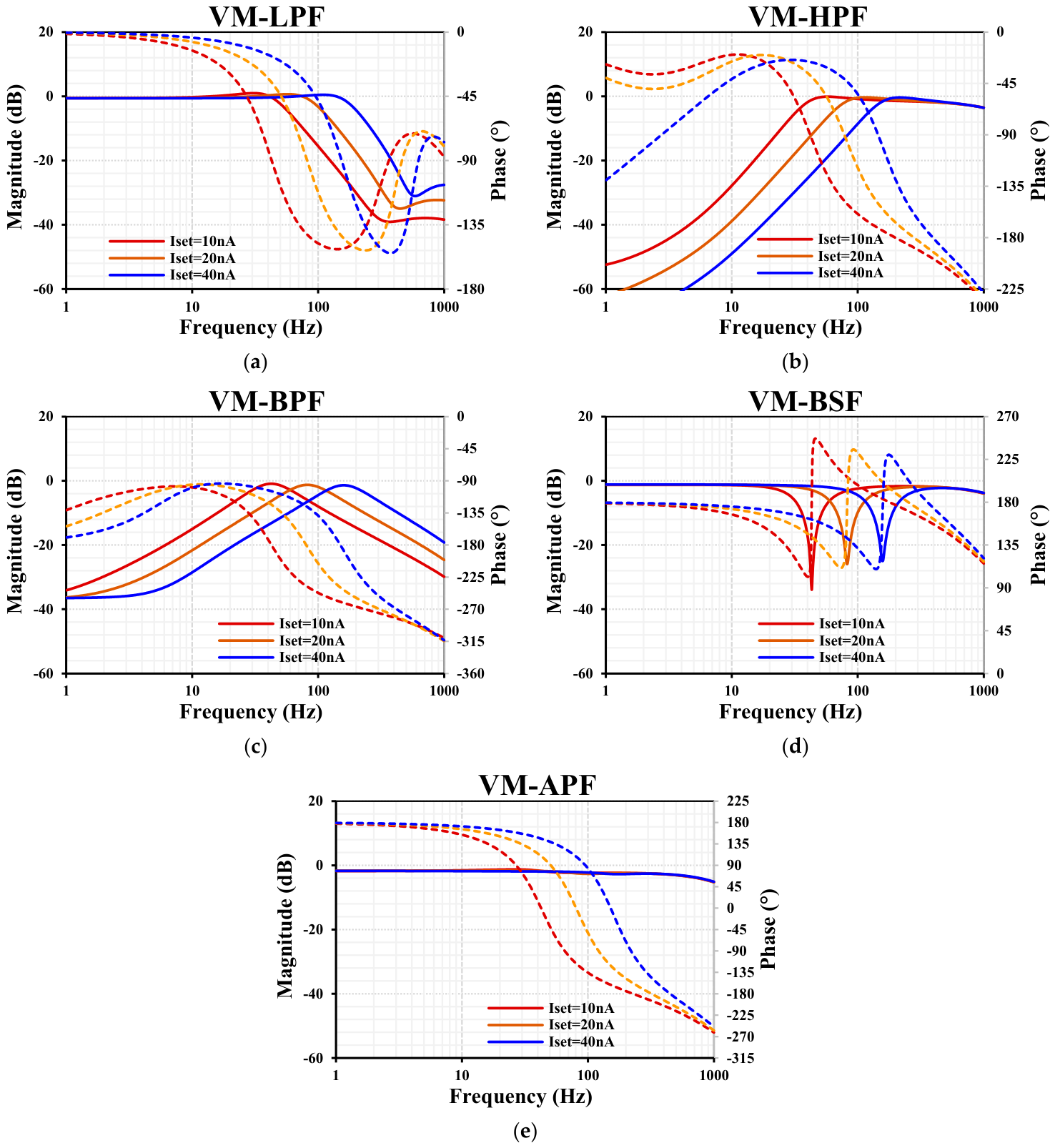
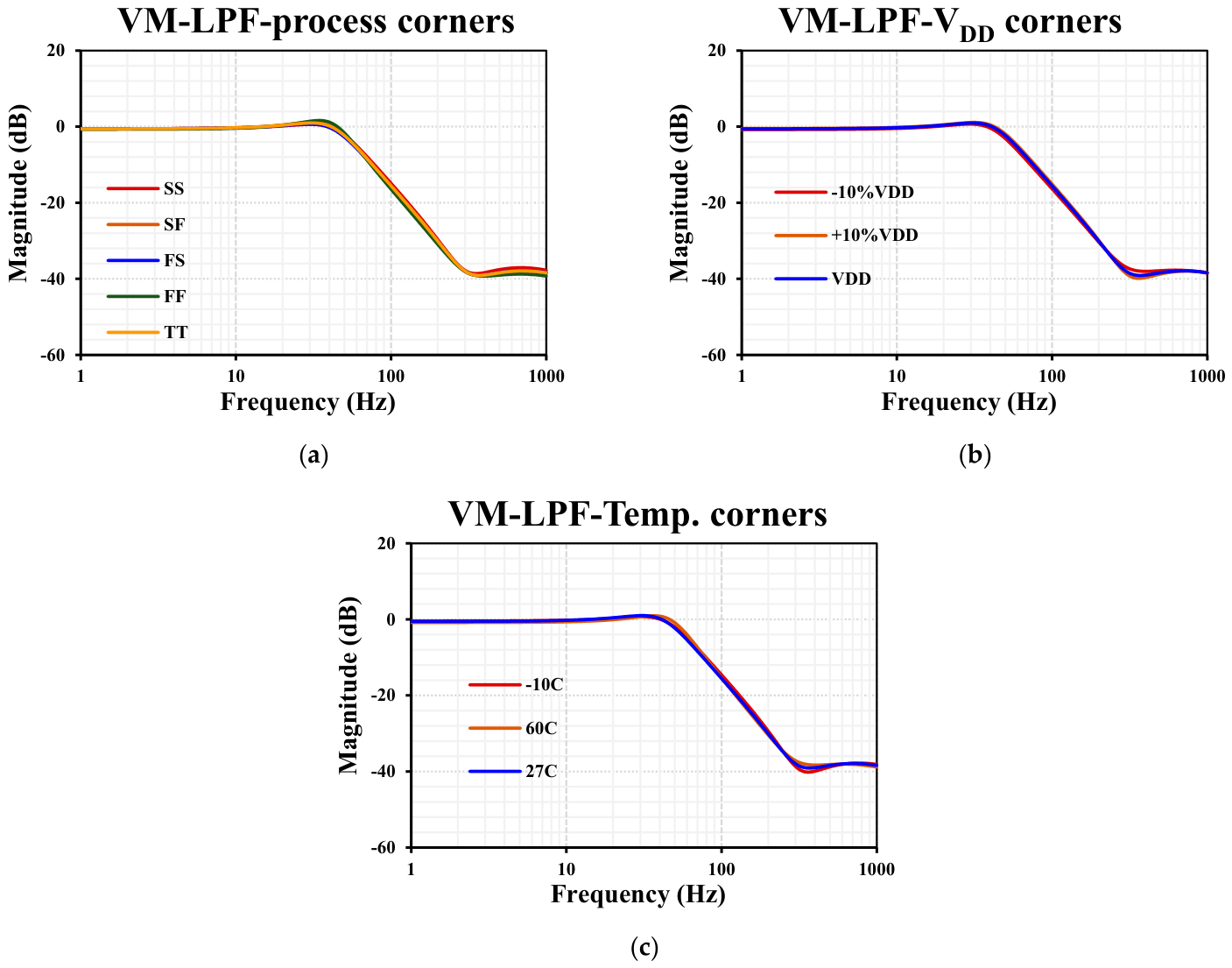
3.1. Simulation Result
3.2. Applications
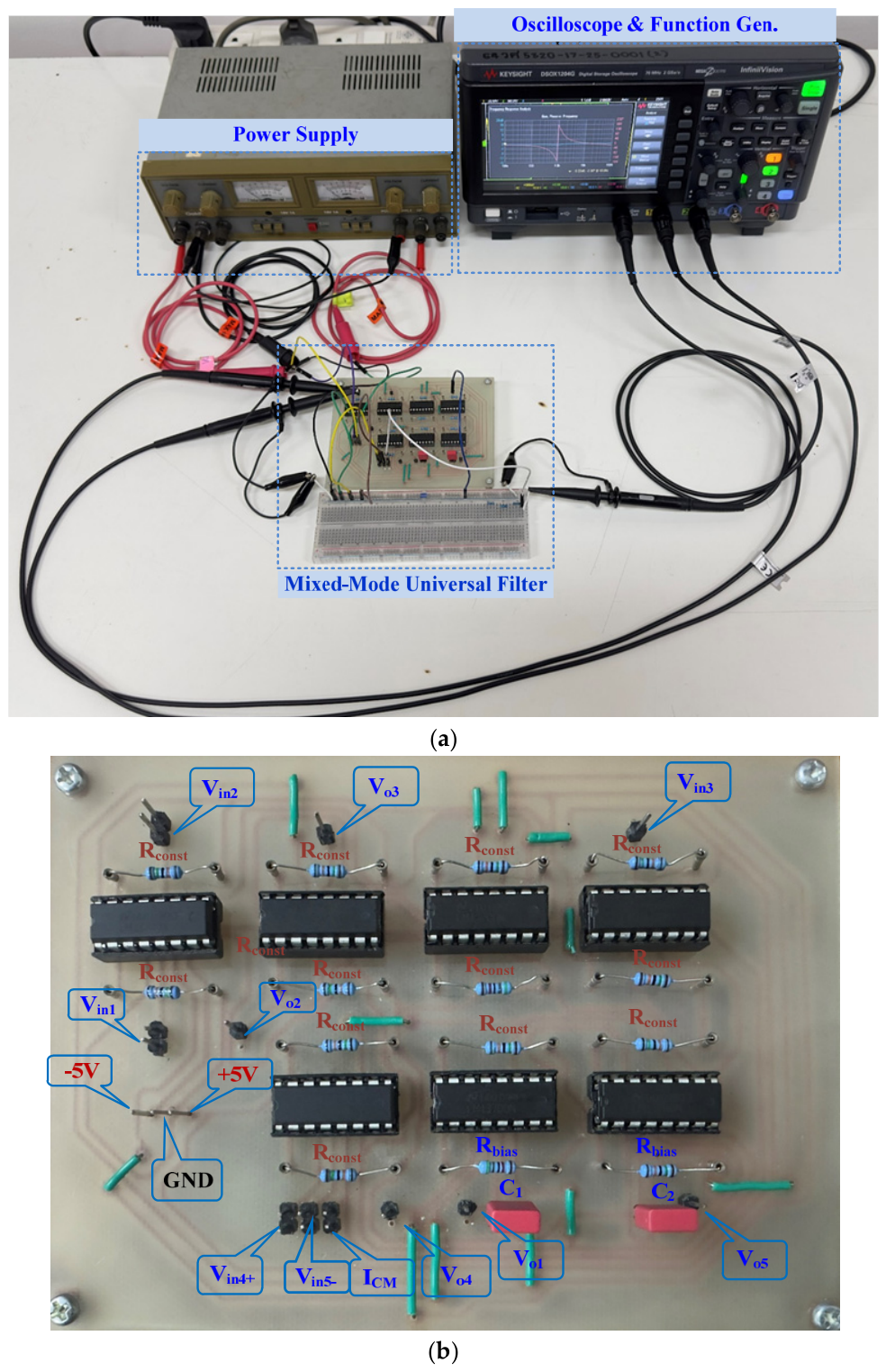
3.3. Experimental Result
4. Discussion and Comparison
- •
- Sensitivity to Process and Temperature Variations: Because the transistors operate in the subthreshold region, the circuit is inherently sensitive to temperature-induced exponential current variations. However, for targeted biomedical applications (such as wearable or implantable medical devices), the ambient temperature environment remains highly stable. To verify robustness against unpredictable variations, the design functionality was thoroughly validated across rigorous Process–Voltage–Temperature (PVT) corners, with a specific focus on temperature corners, proving stable filter operation under realistic deployment conditions.
- •
- Scalability to Higher Frequencies: The proposed circuit is specifically optimized for low-frequency biomedical applications (ranging from sub-Hertz up to 10 kHz). In this low-frequency domain, the small bulk-driven transconductance () is highly beneficial for achieving ultra-low cutoff frequencies without requiring excessively large capacitors. If scaling to higher operating frequencies is required for other applications, the multiple-input (MI) technique can be readily adapted to a conventional gate-driven MOS architecture to leverage its higher transconductance ().
- •
- Noise Performance: The bulk-driven architecture experiences a higher input-referred noise floor compared to conventional gate-driven topologies due to the lower value of . However, the capacitive division of the multiple-input network simultaneously expands the linear input voltage range by the exact same scaling ratio. As a result, the signal-handling capacity increases proportionally with the noise floor, ensuring that the overall Dynamic Range (DR) remains unaffected and fully compliant with system requirements.
- •
- Limitations Associated with Bulk-Driven MOS Transistors: While the reduced transconductance () of bulk-driven devices relative to gate-driven devices is traditionally viewed as a limitation, it serves as a core design advantage in this application. Minimizing the filter cutoff frequency (fc) fundamentally requires establishing an exceptionally low transconductance-to-capacitance ratio (). Utilizing the smaller offers an ideal architectural solution, enabling sub-Hertz pole realization while maintaining highly manageable on-chip capacitance values.
- •
- Implementation Complexity in Integrated Circuits: The proposed design exhibits lower overall circuit complexity compared to conventional highly linearized low-frequency filters. Although the multiple-input (MI) capacitive network marginally increases the silicon area of the input stage, it uses the exact same compact core amplifier circuit. By using a single differential pair combined with the MI network rather than complex multi-stage distortion cancellation techniques, the structural complexity of the integrated circuit is significantly minimized.
5. Conclusions
Author Contributions
Funding
Institutional Review Board Statement
Informed Consent Statement
Data Availability Statement
Acknowledgments
Conflicts of Interest
Appendix A
References
- Lee, C.-N. Fully Cascadable Mixed-Mode Universal Filter Biquad Using DDCCs and Grounded Passive Components. J. Circuits Syst. Comput. 2011, 20, 607–620. [Google Scholar] [CrossRef]
- Abuelma’atti, M.T.; Bentrcia, A.; Al-Shahrani, S.M. A novel mixed-mode current-conveyor-based filter. Int. J. Electron. 2004, 91, 191–197. [Google Scholar] [CrossRef]
- Lee, C.-N.; Chang, C.-M. Single FDCCII-Based Mixed-Mode Biquad Filter with Eight Outputs. AEU-Int. J. Electron. Commun. 2008, 63, 736–742. [Google Scholar] [CrossRef]
- Ghosh, K.; Ray, B.N. CCII-Based Nth-Order Mixed Mode Elliptic Filter with Grounded R and C. J. Circuits Syst. Comput. 2015, 24, 1550035. [Google Scholar] [CrossRef]
- Lee, C.-N. Independently tunable plus-type DDCC-based voltage-mode universal biquad filter with MISO and SIMO types. Microelectron. J. 2017, 67, 71–81. [Google Scholar] [CrossRef]
- Faseehuddin, M.; Herencsar, N.; Albrni, M.A.; Sampe, J. Electronically Tunable Mixed-Mode Universal Filter Employing a Single Active Block and a Minimum Number of Passive Components. Appl. Sci. 2021, 11, 55. [Google Scholar] [CrossRef]
- Mishra, R.; Mishra, G.R.; Faseehuddin, M.; Sampe, J. VD-EXCCII Based Mixed Mode Biquadratic Universal Filter Employing Grounded Capacitors. Inf. MIDREM 2022, 52, 227–237. [Google Scholar] [CrossRef]
- Agrawal, D.; Maheshwari, S. Electronically Tunable Mixed-Mode Third-Order Universal Filter Using a Single EX-CCCII. Aust. J. Electr. Electron. Eng. 2022, 19, 307–323. [Google Scholar] [CrossRef]
- Mishra, R.; Mishra, G.R.; Mishra, S.O.; Faseehuddin, M. Electronically Tunable Mixed Mode Universal Filter Employing Grounded Passive Components. Inf. MIDEM 2022, 52, 105–115. [Google Scholar] [CrossRef]
- Faseehuddin, M.; Herencsar, N.; Albrni, M.A.; Shireen, S.; Sampe, J. Electronically Tunable Mixed Mode Universal Filter Employing Grounded Capacitors Utilizing Highly Versatile VD-DVCC. Circuit World 2022, 48, 511–528. [Google Scholar] [CrossRef]
- Pandey, N.; Paul, S.K. Mixed Mode Universal Filter. J. Circuits Syst. Comput. 2013, 22, 1250064. [Google Scholar] [CrossRef]
- Li, Z. Mixed-mode universal filter using MCCCII. AEU-Int. J. Electron. Commun. 2009, 63, 1072–1075. [Google Scholar] [CrossRef]
- Chen, H.P.; Liao, Y.Z.; Lee, W.T. Tunable mixed-mode OTA-C universal filter. Analog. Integr. Circuits Signal Process. 2009, 58, 135–141. [Google Scholar] [CrossRef]
- Lee, C.N. Multiple-Mode OTA-C Universal Biquad Filters. Circuits Syst. Signal Process. 2010, 29, 263–274. [Google Scholar] [CrossRef]
- Zanjani, S.M.A.; Dousti, M.; Dolatshahi, M. Inverter-based, low-power and low-voltage, new mixed-mode Gm-C filter in subthreshold CNTFET technology. IET Circuits Devices Syst. 2018, 12, 681–688. [Google Scholar] [CrossRef]
- Parvizi, M.; Taghizadeh, A.; Mahmoodian, H.; Kozehkanani, Z.D. A Low-Power Mixed-Mode SIMO Universal Gm-C Filter. J. Circuits Syst. Comput. 2017, 26, 1750164. [Google Scholar] [CrossRef]
- Bhaskar, D.R.; Raj, A.; Kumar, P. Mixed-Mode Universal Biquad Filter Using OTAs. J. Circuits Syst. Comput. 2020, 29, 2050162. [Google Scholar] [CrossRef]
- Namdari, A.; Dolatshahi, M. Design of a Low-Voltage and Low-Power, Reconfigurable Universal OTA-C Filter. Analog. Integr. Circuits Signal Process. 2022, 111, 169–188. [Google Scholar] [CrossRef]
- Namdari, A.; Aiello, O.; Dolatshahi, M.; Caviglia, D.D. A 48 nW, Universal, Multi-Mode Gm-C Filter with a Frequency Range Tunability. Electronics 2025, 14, 1334. [Google Scholar] [CrossRef]
- Yesil, A.; Kacar, F. Electronically Tunable Resistorless Mixed-Mode Biquad Filters. Radioengineering 2013, 22, 1016–1125. [Google Scholar]
- Chamnanphai, V.; Sa-ngiamvibool, W. Electronically Tunable SIMO Mixed-mode Universal Filter using VDTAs. Przegląd Elektrotechniczny 2017, 2017, 209–213. [Google Scholar] [CrossRef]
- Roongmuanpha, N.; Faseehuddin, M.; Herencsar, N.; Tangsrirat, W. Tunable Mixed-Mode Voltage Differencing Buffered Amplifier-Based Universal Filter with Independently High-Q Factor Controllability. Appl. Sci. 2021, 11, 9606. [Google Scholar] [CrossRef]
- Faseehuddin, M.; Herencsar, N.; Shireen, S.; Tangsrirat, W.; Ali, S.H.M. Voltage Differencing Buffered Amplifier-Based Novel Truly Mixed-Mode Biquadratic Universal Filter with Versatile Input/Output Features. Appl. Sci. 2022, 12, 1229. [Google Scholar] [CrossRef]
- Maheshwari, S.; Singh, S.V.; Chauhan, D.S. Electronically Tunable Low-Voltage Mixed-Mode Universal Biquad Filter. IET Circuits Devices Syst. 2011, 5, 149–158. [Google Scholar] [CrossRef]
- Chen, H.-P.; Yang, W.-S. Electronically Tunable Current Controlled Current Conveyor Transconductance Amplifier-Based Mixed-Mode Biquadratic Filter with Resistorless and Grounded Capacitors. Appl. Sci. 2017, 7, 244. [Google Scholar] [CrossRef]
- Singh, S.V.; Tomar, R.S.; Chauhan, D.S. A New Electronically Tunable Universal Mixed-Mode Biquad Filter. J. Eng. Res. 2016, 4, 44–64. [Google Scholar] [CrossRef]
- Albrni, M.I.A.; Mohammad, F.; Herenscar, N.; Sampe, J.; Ali, S.H.M. Novel Electronically Tunable Biquadratic Mixed-Mode Universal Filter Capable of Operating in MISO and SIMO Configurations. Inf. MIDREM 2020, 50, 189–203. [Google Scholar] [CrossRef]
- Shankar, C.; Singh, S.V.; Imam, R. SIFO–VM/TIM Universal Biquad Filter Using Single DVCCTA with Fully CMOS Realization. Analog. Integr. Circuits Signal Process. 2021, 109, 33–46. [Google Scholar] [CrossRef]
- Faseehuddin, M.; Sivagami, P.; Shireen, S.; Tangsrirat, W. Truly Mixed-Mode Universal Filter Capable of Operation in MISO and SIMO Configurations with Quadrature Oscillator as an Application. Circuits Syst. Signal Process. 2026, 45, 74–115. [Google Scholar] [CrossRef]
- Roongmuanpha, N.; Tangsrirat, W.; Pukkalanun, T. Single VDGA-based mixed-mode universal filter and dual-mode quadrature oscillator. Sensors 2022, 22, 5303. [Google Scholar] [CrossRef] [PubMed]
- Channumsin, O.; Tangjit, J.; Pukkalanun, T.; Tangsrirat, W. VDGA-Based Resistorless Mixed-Mode Universal Filter and Dual-Mode Quadrature Oscillator. Appl. Sci. 2025, 15, 5594. [Google Scholar] [CrossRef]
- Kumngern, M.; Suksaibul, P.; Khateb, F.; Kulej, T. 1.2 V differential difference transconductance amplifier and its application in mixed-mode universal filter. Sensors 2022, 22, 3535. [Google Scholar] [CrossRef] [PubMed]
- Khateb, F.; Kumngern, M.; Kulej, T. 58-nW 0.5-V mixed-mode universal filter using multiple-input multiple-output OTAs. IEEE Access 2023, 11, 130345–130357. [Google Scholar] [CrossRef]
- Khateb, F.; Kumngern, M.; Kulej, T. 0.5-V 281-nW versatile mixed-mode filter using multiple-input/output differential difference transconductance amplifiers. Sensors 2024, 24, 32. [Google Scholar] [CrossRef]
- Kumngern, M.; Khateb, F.; Kulej, T. 1-V Mixed-Mode Universal Filter Using Differential Difference Current Conveyor Transconductance Amplifiers. Appl. Sci. 2024, 14, 9422. [Google Scholar] [CrossRef]
- Kumngern, M.; Khateb, F.; Kulej, T. Low-Voltage Mixed-Mode Analog Filter Using Multiple-Input Multiple-Output Operational Transconductance Amplifiers. IEEE Access 2024, 12, 51073–51085. [Google Scholar] [CrossRef]
- Krummenacher, F.; Joehl, N. A 4-MHz CMOS continuous-time filter with on-chip automatic tuning. IEEE J. Solid-State Circuits 1988, 23, 750–758. [Google Scholar] [CrossRef]
- Khateb, F.; Kulej, T.; Kumngern, M.; Psychalinos, C. Multiple-input bulk-driven MOS transistor for low-voltage low-frequency applications. Circuits Syst. Signal Process. 2019, 38, 2829–2845. [Google Scholar] [CrossRef]
- Khateb, F.; Kulej, T.; Akbari, M.; Tang, K.-T. A 0.5-V multiple-input bulk-driven OTA in 0.18-μm CMOS. IEEE Trans. Very Large Scale Integr. (VLSI) Syst. 2022, 30, 1739–1747. [Google Scholar] [CrossRef]
- Shah, M.O.; Privitera, M.; Ballo, A.; Alioto, M.; Pennisi, S. 0.4-V nW-Power High-Gain Bulk-Driven Two-Stage OTA with Self-Cascode Composite Transistors and Intrinsic Current-Buffer Miller Compensation. IEEE Trans. Circuits Syst. I Regul. Pap. 2025, 72, 7553–7564. [Google Scholar] [CrossRef]
- Pevarez-Lozano, H.; Sanchez-Sinencio, E. Minimum parasitic effects biquadratic OTA-C filter architectures. Analog. Integr. Circuits Signal Process. 1991, 1, 297–319. [Google Scholar] [CrossRef]
- Ozer, E.; Yesil, A.; Kacar, F. A novel topology voltage-mode instrumentation amplifier based on CFOAs. Microsyst. Technol. 2025, 31, 533–546. [Google Scholar] [CrossRef]
- Yuce, E. Various Current-Mode and Voltage-Mode Instrumentation Amplifier Topologies Suitable for Integration. J. Circuits Syst. Comput. 2010, 19, 689–699. [Google Scholar] [CrossRef]
- Dikbaş, M.C.; Ayten, U.E. Current and transimpedance mode instrumentation amplifier using a single new active component named CDTRA. AEU-Int. J. Electron. Commun. 2018, 91, 24–36. [Google Scholar] [CrossRef]
- Raj, N.; Dutta, S.; Ranjan, R.K.; Das, P.K.; Singh, D.K.; Kuntman, H. VDTA based transadmittance mode instrumentation amplifier with experimental results. Int. J. Electron. 2025, 112, 2194–2211. [Google Scholar] [CrossRef]
- Sagbas, M.; Ayten, U.E. Design of Wide Bandwidth, High-CMRR Voltage and Transadmittance-Mode Instrumentation Amplifier Using a Single CBTA. J. Circuits Syst. Comput. 2020, 29, 2050060. [Google Scholar] [CrossRef]
- Pandey, R.; Pandey, N.; Paul, S.K. Electronically Tunable Transimpedance Instrumentation Amplifier Based on OTRA. J. Eng. 2020, 2013, 648540. [Google Scholar] [CrossRef]
- Safari, L.; Yuce, E.; Minaei, S. A New Transresistance-Mode Instrumentation Amplifier with Low Number of MOS Transistors and Electronic Tuning Opportunity. J. Circuits Syst. Comput. 2016, 25, 1650022. [Google Scholar] [CrossRef]
- Pamu, H.; Kumar, P.K.; Gurrala, K.K. A Novel Single DVCCTA Based Electronically Tunable, Wideband, Four-Mode Instrumentation Amplifier. Radio Sci. 2025, 60, e2025RS008241. [Google Scholar] [CrossRef]
- National Semiconductor. LM13700 Operational Amplifier/Transistor Array, Datasheet. 2000. Available online: https://www.ti.com/lit/ds/symlink/lm13700.pdf (accessed on 5 June 2026).
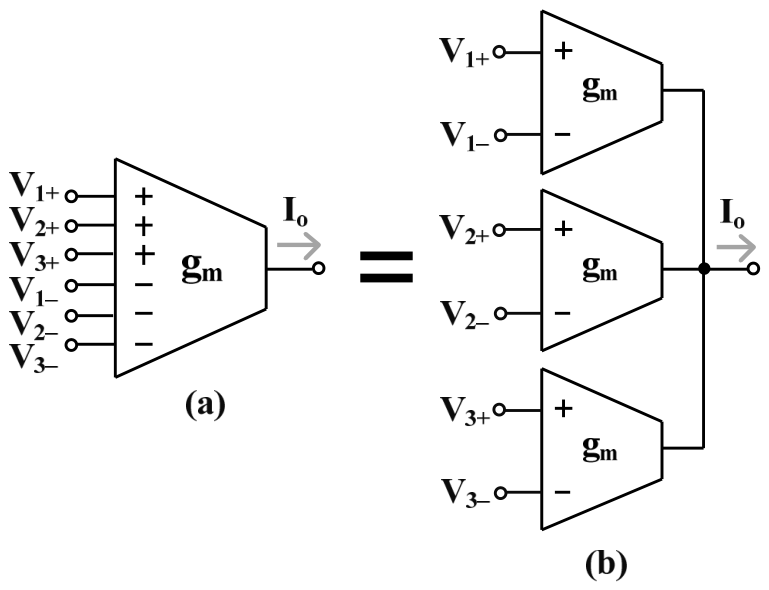
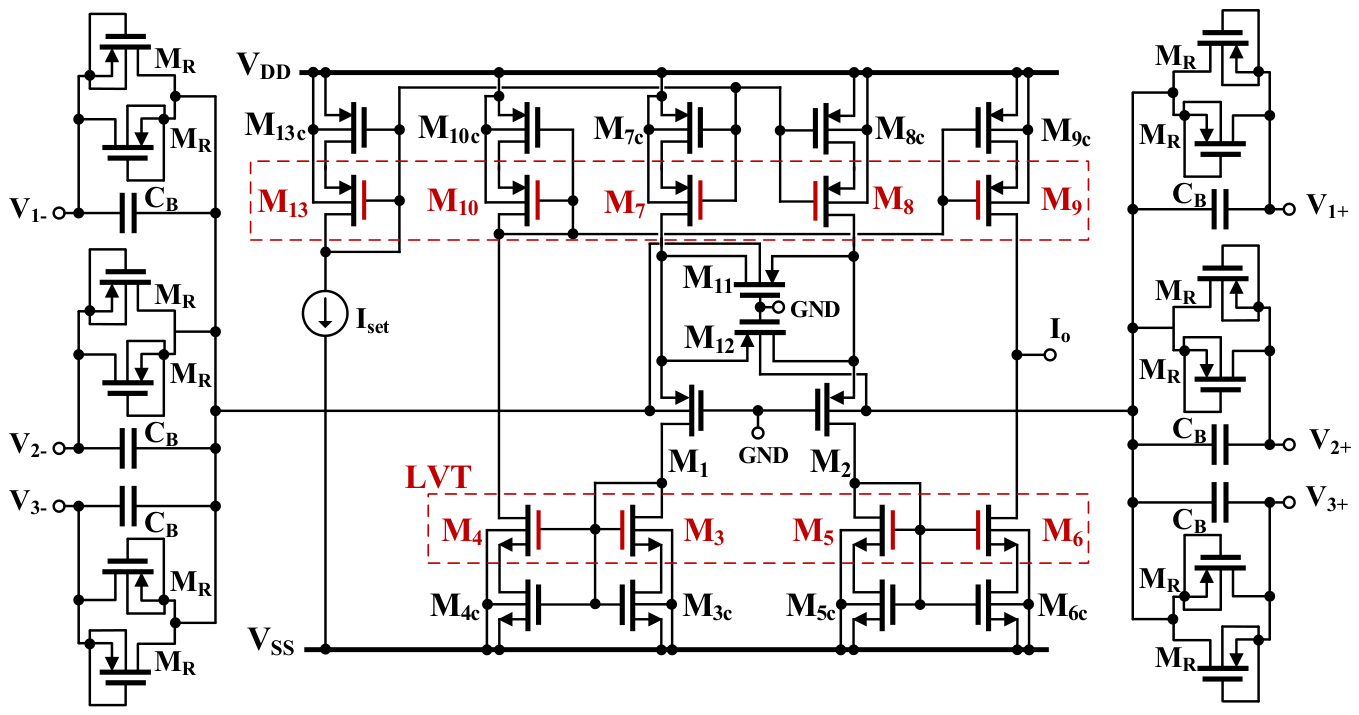
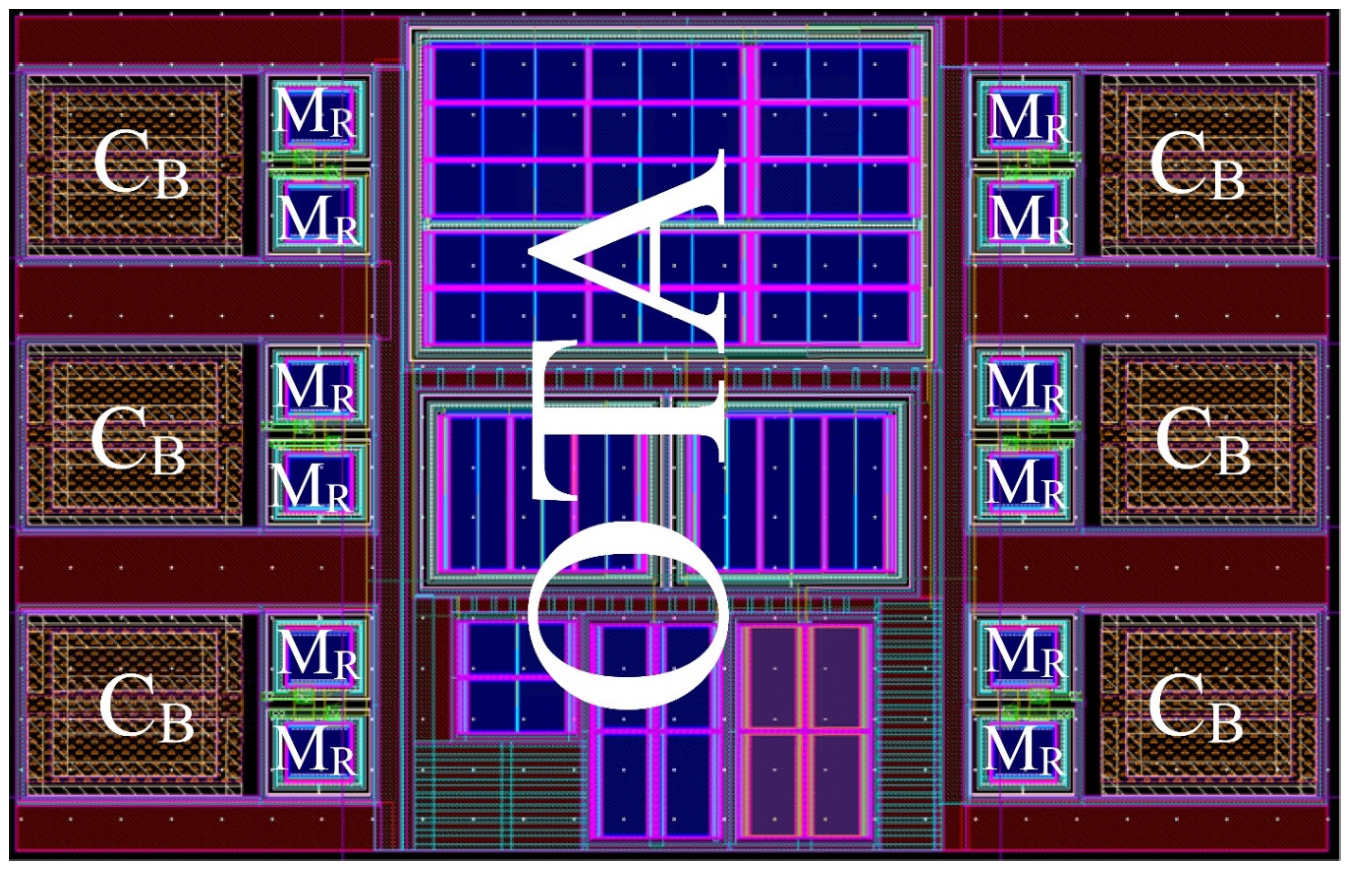


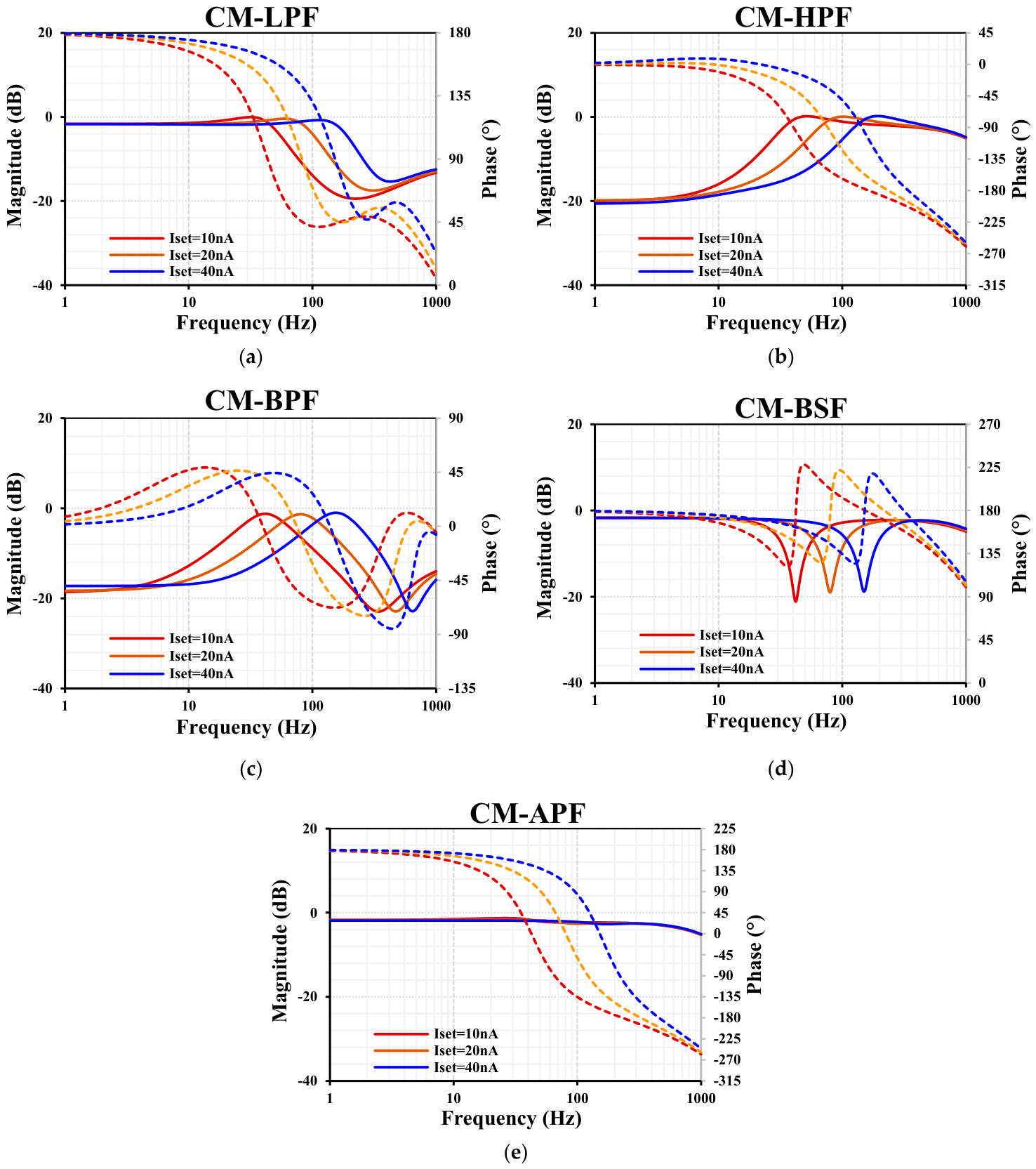

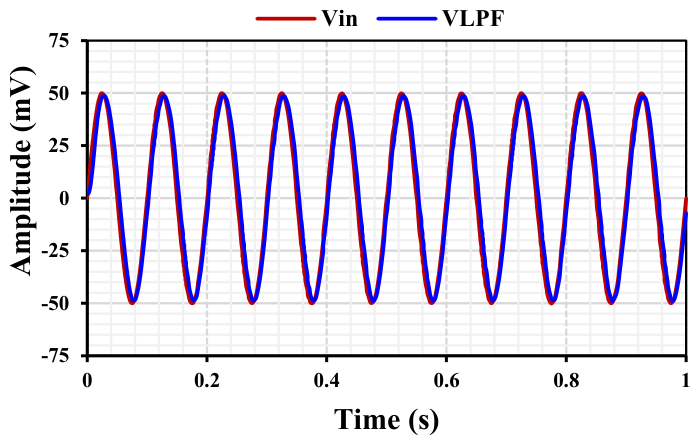
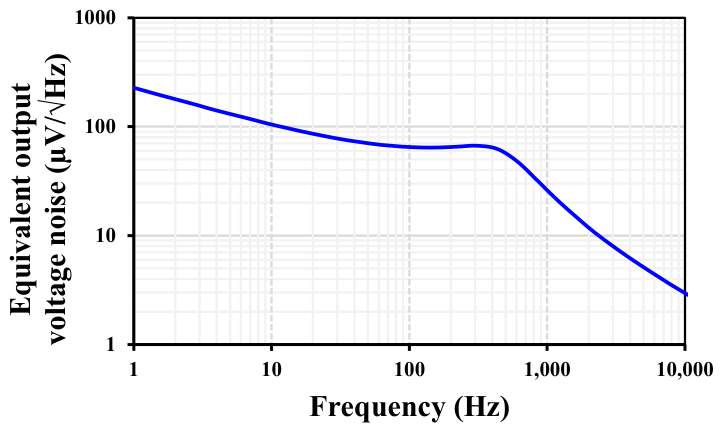




| Mode | Filtering Function | Input | Output | Condition | |
|---|---|---|---|---|---|
| VM | LPF | Non-inverting | = = = = 0, = = 0 | ||
| Inverting | = = = = 0, = = 0 | ||||
| HPF | Non-inverting | = = = = 0, = = 0 | |||
| Inverting | = = = = 0, = = 0 | ||||
| BPF | Non-inverting | = = = = 0, = = 0 | |||
| Inverting | = = = = 0, = = 0 | ||||
| BSF | Non-inverting | = = = = 0, = = 0 | |||
| Inverting | = = = = 0, = = 0 | ||||
| APF | Non-inverting | = = = = 0, = = 0 | |||
| Inverting | = = = = 0, = = 0 | ||||
| TIM | LPF | Non-inverting | = = = = = 0, = 0 | ||
| Inverting | = = = = = 0, = 0 | ||||
| HPF | Non-inverting | = = = = = 0, = 0 | |||
| Inverting | = = = = = 0, = 0 | ||||
| BPF | Non-inverting | = = = = = 0, = 0 | |||
| Inverting | = = = = = 0, = 0 | ||||
| BSF | Non-inverting | = = = = = 0, = 0 | |||
| Inverting | = = = = = 0, = 0 | ||||
| APF | Non-inverting | = = = = = 0, = 0 | |||
| Inverting | = = = = = 0, = 0 | ||||
| TAM | LPF | Non-inverting | = 0, = , = 0, = , = = 0 | ||
| Inverting | = 0, = , = 0, = , = = 0 | ||||
| HPF | Non-inverting | = 0, = , = , = 0, = = 0 | |||
| Inverting | = 0, = , = , = 0, = = 0 | ||||
| BPF | Non-inverting | = 0, = , = , = , = = 0 | |||
| Inverting | = 0, = , = , = , = = 0 | ||||
| BSF | Non-inverting | = 0, = , = = 0, = = 0 | |||
| Inverting | = 0, = , = = 0, = = 0 | ||||
| APF | Non-inverting | = = = = 0, = = 0 | |||
| Inverting | = = = = 0, = = 0 | ||||
| CM | LPF | Non-inverting | = = 0, = , = 0, = , = 0 | ||
| Inverting | = = 0, = , = 0, = , = 0 | ||||
| HPF | Non-inverting | = = 0, = , = , = 0, = 0 | |||
| Inverting | = = 0, = , = , = 0, = 0 | ||||
| BPF | Non-inverting | = = 0, = , = , = , = 0 | |||
| Inverting | = = 0, = , = , = , = 0 | ||||
| BSF | Non-inverting | = = 0, = , = = 0, = 0 | |||
| Inverting | = = 0, = , = = 0, = 0 | ||||
| APF | Non-inverting | = = = = = 0, = 0 | |||
| Inverting | = = = = = 0, = 0 | ||||
| Component | W/L (µm/µm) |
|---|---|
| M1,2 | 2 × 30/3 |
| M11,12 | 30/3 |
| M3–6, M3c–6c | 10/5 |
| M7–10, M13 | 15/5 |
| M7c–10c, M13c | 2 × 15/5 |
| MR | 6/5 |
| CB = 0.4 pF | |
| Factor | Proposed | [17] 2020 | [19] 2025 | [22] 2021 | [25] 2017 | [29] 2025 | [31] 2025 |
|---|---|---|---|---|---|---|---|
| Number of active devices | 7-MI-OTA | 5-OTA | 10-OTA | 2-VDBA | 3-CCCCTA | 2-DVCCTA | 1-VDGA |
| Realization | 65 nm CMOS | 0.35 µm CMOS | 0.18 µm CMOS | 0.18 µm CMOS | 0.18 µm CMOS | 0.18 µm CMOS | 0.18 µm CMOS |
| Passive components | 2-C | 2-C | 2-C | 2-C, 2-R | 2-C | 2-C, 6-R | 2-C |
| Number of offered responses | 40 | 20 | 5 | 17 | 18 | 20 | 13 |
| Offer five standard responses of VM, TAM, CM, TIM | Yes | Yes | Yes | No | No | Yes | No |
| All grounded passive components | Yes | Yes | Yes | No | Yes | No | No |
| High input impedances for VM | Yes | Yes | Yes | No | Yes | No | Yes |
| Electronic tunning capability | Yes | Yes | Yes | Yes | Yes | Yes | Yes |
| Natural frequency (Hz) | 156 | 3.39 × 10⁶ | 50.6–1270 | 1.44 × 10⁶ | 3.183 × 10⁶ | 3.98 × 10⁶ | 1.59 × 10⁶ |
| Power supply (V) | 0.5 | ±0.9 | 0.5–1.2 | ±0.75 | ±0.9 | ±0.9 | ±0.9 |
| Power dissipation (W) | 450 × 10−9 | - | 48 × 10−9 | 0.373 × 10⁻³ | 1.99 × 10⁻³ | 4.69 × 10⁻³ | 2.84 × 10⁻³ |
| THD ([%]@mV) | 1@50 | - | 0.93@50 | 2.2@100 | 2.16@200 | <6@120 | - |
| Dynamic range (dB) | 37 | - | 53.46 | - | - | - | - |
| Verification of result | Sim/Exp | Sim/Post-Layout | Sim/Post-Layout | Sim/Exp | Sim/Post-Layout | Sim/Post-Layout | Sim/Exp |
| Application area | Bio. | Comm. | Bio. | Comm. | Comm. | Comm. | Comm. |
| Factor | Proposed | [32] 2022 | [33] 2023 | [34] 2024 | [35] 2024 | [36] 2024 |
|---|---|---|---|---|---|---|
| Number of active devices | 7-MI-OTA | 5-DDTA | 2-MO-OTA, 2-MIMO-OTA | 2-DDTA, 2 MO-DDTA | 3-MIMO-DDCCTA | 3-MI-OTA, 1-MIMO-OTA |
| Realization | 65 nm CMOS | 0.18 µm CMOS | 0.18 µm CMOS | 0.18 µm CMOS | 0.18 µm CMOS | 0.18 µm CMOS |
| Passive components | 2-C | 2-C | 2-C | 2-C | 2-C, 3-R | 2-C, 1-R |
| Number of offered responses | 40 | 36 | 35 | 61 | 179 | 40 |
| Offer five standard responses of VM, TAM, CM, TIM | Yes | Yes | Yes | Yes | Yes | Yes |
| Offer both non-inverting and inverting transfer functions | Yes | No | No | No | Yes | Yes |
| Without dual/triple input current signals | Yes | Yes | No | No | No | No |
| Natural frequency (Hz) | 156 | 1.04 × 10³ | 114 | 211 | 1.59 × 10³ | 5.95 × 10³ |
| Power supply (V) | 0.5 | 1.2 | 0.5 | 0.5 | 1 | 1 |
| Power dissipation (W) | 450 × 10−9 | 330 × 10−6 | 58 × 10−9 | 281 × 10−9 | 374 × 10−3 | 156.8 × 10⁻⁶ |
| THD ([%]@mV) | 1@50 | 1.09@325 | 1@85 | 1@150 | 0.983@170 | 1@220 |
| Dynamic range (dB) | 37 | 63.69 | 53.2 | 58.23 | 57.7 | 40.2 |
Disclaimer/Publisher’s Note: The statements, opinions and data contained in all publications are solely those of the individual author(s) and contributor(s) and not of MDPI and/or the editor(s). MDPI and/or the editor(s) disclaim responsibility for any injury to people or property resulting from any ideas, methods, instructions or products referred to in the content. |
© 2026 by the authors. Licensee MDPI, Basel, Switzerland. This article is an open access article distributed under the terms and conditions of the Creative Commons Attribution (CC BY) license.
Share and Cite
Khateb, F.; Suksaibul, P.; Kulej, T.; Kumngern, M. A Novel Low-Power Mixed-Mode Universal Filter Design Using Multiple-Input Operational Transconductance Amplifiers. Technologies 2026, 14, 352. https://doi.org/10.3390/technologies14060352
Khateb F, Suksaibul P, Kulej T, Kumngern M. A Novel Low-Power Mixed-Mode Universal Filter Design Using Multiple-Input Operational Transconductance Amplifiers. Technologies. 2026; 14(6):352. https://doi.org/10.3390/technologies14060352
Chicago/Turabian StyleKhateb, Fabian, Pichai Suksaibul, Tomasz Kulej, and Montree Kumngern. 2026. "A Novel Low-Power Mixed-Mode Universal Filter Design Using Multiple-Input Operational Transconductance Amplifiers" Technologies 14, no. 6: 352. https://doi.org/10.3390/technologies14060352
APA StyleKhateb, F., Suksaibul, P., Kulej, T., & Kumngern, M. (2026). A Novel Low-Power Mixed-Mode Universal Filter Design Using Multiple-Input Operational Transconductance Amplifiers. Technologies, 14(6), 352. https://doi.org/10.3390/technologies14060352