1. Introduction
Textiles and clothing have become essential commodities in modern society, positioning the textile and apparel industry among the largest global economic sectors [
1]. According to recent market analyses, the global apparel market reached a value of approximately 1.66 trillion euros in 2025 and is expected to grow to around 2.12 trillion euros by 2032, highlighting the considerable scale and continued expansion of textile production and consumption worldwide [
2]. This economic magnitude reflects the central role of the apparel industry in global value chains and, importantly, implies significant material flows across garment manufacturing, consumer wear, and end-of-life management. The rapid expansion of the textile and apparel sector has been driven by population growth, globalization, and the widespread adoption of fast fashion consumption models [
3,
4]. These trends have contributed to making the textile industry one of the most resource-intensive and environmentally impactful industries worldwide [
1,
3]. Global fiber production has continued to rise, reaching an all-time high of approximately 132 million tonnes in 2024, according to the latest Materials Market Report by Textile Exchange [
5], an annual analysis of fiber and materials production volumes across applications, including apparel, home textiles, and footwear. The report shows that this tonnage represents 5.6% growth relative to 2023 and reflects the continued dominance of virgin, fossil-based synthetic fibers, particularly polyester, despite modest increases in recycled fiber volumes. Less than 1% of the total fiber market was derived from post-consumer recycled textiles in 2024, underscoring the current limitations of textile-to-textile recycling technologies and the urgent need for improved material separation and contaminant reduction strategies. Such growth has intensified concerns related to water and energy consumption, greenhouse gas emissions, and the generation of textile waste [
6]. Consequently, textile waste has emerged as a critical environmental challenge. In Europe, more than 15 kg of textile waste per capita is generated annually, with this value expected to increase in the coming years [
7]. Household textiles and clothing account for the largest share of this waste stream, with a significant proportion of discarded garments still ending up in landfills or incineration. Despite the substantial material value embedded in post-consumer textiles, less than 1% of textile waste is currently recycled back into new fibers [
8]. This low recycling rate is particularly concerning given the continued dominance of virgin fossil-based synthetic fibers in global fiber production, which accounts for the majority of total output, while natural fibers and other bio-based materials represent a substantially smaller share [
5]. Improving textile recovery, recycling, and reuse is therefore a key objective in the transition toward a more sustainable and circular textile economy.
Textile recycling involves the reprocessing of pre- and post-consumer textile waste into new materials or products for use within the textile sector or other industries [
9]. However, the efficiency and scalability of recycling processes are strongly constrained by upstream pre-processing stages. These stages typically include material/fiber identification, sorting (i.e., the routing of items into distinct output streams based on identification outcomes), and contaminant and non-recyclable item detection and removal. In this context, a clear distinction between identification and sorting is essential: identification refers to the recognition or classification of textile properties (e.g., fiber type, composition, or color), whereas sorting involves the physical or operational separation of items into distinct output streams based on these identified attributes. Inadequate pre-processing remains one of the main bottlenecks in textile recycling, as contaminants and composite structures can damage recycling equipment, reduce fiber quality, and limit the applicability of recycled outputs [
1]. It is estimated that approximately 70% of currently discarded textile waste could be mechanically recycled under suitable conditions, while the remaining fraction would require more advanced recycling pathways once the overall process is further developed [
1]. Traditionally, many textile recycling pre-processing operations rely heavily on manual labor, particularly for physical sorting/separation and for the detection and removal of non-recyclable components. Although manual approaches can be effective, they are labor-intensive, costly, and difficult to scale for industrial recycling facilities [
10]. In response to these limitations, increasing attention has been directed towards the application of artificial intelligence (AI), computer vision, robotics, and automation to textile recycling pre-processing. Recent industry analyses emphasize the need for technological innovation to improve efficiency, consistency, and scalability across the textile value chain [
11]. Advances in sensing technologies, machine learning, and robotic systems have enabled new approaches for automated sorting, material classification, contaminant detection, and handling of textile waste streams. These technologies offer the potential to reduce operational costs and reliance on manual labor while improving the quality of recycled outputs. Despite the growing body of research in this area, existing studies remain fragmented, often focusing on isolated tasks, specific materials, or limited experimental setups. The diversity of datasets, methodologies, validation strategies, and levels of technological maturity makes it challenging to assess the overall state of the field and to identify persistent research gaps, particularly in contaminant detection and automated handling, which remain critical barriers to large-scale deployment.
Several reviews have addressed textile recycling from a broader perspective, typically emphasizing downstream recycling routes (e.g., mechanical and chemical recycling), material sustainability, policy aspects, or general circular-economy frameworks [
12,
13,
14]. While these studies provide valuable context, they often treat pre-processing as a secondary step and do not offer a task-level synthesis of the intelligent and automated solutions required to operationalize textile-to-textile recycling at scale [
12,
13]. In addition, existing surveys frequently focus on a single technological axis (e.g., sensing or machine learning) and provide limited discussion of system integration aspects such as perception-to-action coupling, robotic manipulation, and the physical constraints of handling deformable garments, which remain central to industrial feasibility [
15,
16].
This review differs from prior work in three key ways:
Scope focus: It explicitly narrows the scope to upstream textile recycling pre-processing, structured around three core task families:
- -
Identification: material, fiber, and composition inference;
- -
Sorting: explicit routing into output streams, i.e., a separation strategy that operationalizes identification results into distinct routes/bins rather than merely reporting class/group labels;
- -
Contaminant detection and/or removal: localization and removal of non-recyclable elements (e.g., buttons, rivets, zippers).
In addition, the review systematically analyses physical handling and automation mechanisms as a cross-cutting operational dimension, conditioning whether pre-processing tasks can be executed reliably under real waste-stream variability.
Integration perspective: It jointly synthesises AI-driven, computer-vision, robotics, and automation approaches as components of an integrated pre-processing pipeline, rather than as isolated techniques.
Comparison depth: It systematically compares the literature not only in terms of algorithmic performance, but also through sensing modalities, dataset characteristics, validation protocols, and reported technological maturity.
By consolidating fragmented evidence across tasks and maturity levels, this review provides a structured map of the state-of-the-art and highlights the key gaps that currently prevent robust, scalable, and economically viable pre-processing solutions for textile recycling.
In this context, this paper presents a systematic literature review on intelligent and automated technologies for textile recycling pre-processing, conducted in accordance with the PRISMA guidelines [
17] (checklist available in
Supplementary File). This systematic approach promotes transparency, reproducibility, and consistency in the paper selection process, enabling future updates and comparative analyses. The review consolidates relevant studies addressing key pre-processing stages, including sorting, material and fiber identification, and the detection and removal of contaminants and other non-recyclable items. While several existing reviews have provided valuable insights into textile recycling technologies and downstream recycling processes, this review focuses specifically on upstream pre-processing stages, which play a critical role in determining the efficiency, scalability, and quality of textile recycling systems. The review discusses recent advances in AI, computer vision, robotics, and automation, evaluating their application to textile recycling pre-processing tasks and assessing their effectiveness, limitations, and levels of technological maturity. Particular attention is given to sensing modalities, data acquisition strategies, algorithmic approaches, validation methodologies, and experimental environments reported in the literature.
The main contributions of this review are threefold: (i) a structured synthesis of challenges associated with textile recycling pre-processing; (ii) a comparative analysis of AI-driven and automated approaches across different tasks and application contexts; and (iii) the identification of research gaps and open challenges, especially in non-recyclable item detection, automated handling, and scalable system integration that must be addressed to enable industrial-scale textile recycling.
Research Questions
This systematic review is guided by the following research questions:
RQ1: How are AI, computer vision, robotics, and automation technologies applied to textile recycling pre-processing, from perception and identification to routing decisions and physical execution under the constraints of deformable textiles?
RQ2: Which textile recycling pre-processing tasks are most frequently addressed in the literature?
RQ3: What types of AI-driven and automated approaches are employed for textile recycling pre-processing?
RQ4: What datasets, sensing modalities, and validation strategies are used to develop and evaluate pre-processing solutions?
RQ5: To what extent have proposed approaches been validated beyond offline evaluation, and what levels of technological maturity are reported?
RQ6: What limitations, challenges, and research gaps are identified in existing studies?
The remainder of this paper is organized as follows.
Section 2 describes the systematic review methodology, including the search strategy, study selection process, inclusion and exclusion criteria, and quality assessment framework following PRISMA guidelines.
Section 3 presents the classification and synthesis of the selected studies.
Section 4 discusses the main findings, limitations, and research gaps, while
Section 5 concludes the paper and outlines directions for future research.
2. Systematic Review Methodology
This systematic review was conducted in accordance with the PRISMA guidelines to ensure transparency, reproducibility, and methodological rigor throughout the literature selection and analysis process. A structured review protocol was defined before the search was conducted, specifying the scope of the review, the research questions, the eligibility criteria, and the quality assessment framework applied to all candidate studies. This predefined protocol was intended to minimize selection bias and ensure consistency throughout screening, evaluation, and synthesis. The methodology comprised a systematic search across multiple scientific databases, a multi-stage study selection process, and a structured quality assessment to evaluate the relevance, technical soundness, and maturity of the selected contributions.
2.1. Scope Definition
The scope of this systematic review was defined using the Population, Intervention, Comparison, Outcome, and Context (PICOC) framework. This framework was used to explicitly define the population under study, the technological interventions considered, the expected outcomes, and the application context relevant to textile recycling pre-processing. PICOC provides a structured and transparent basis for defining review boundaries, supporting reproducible search strategies and reducing the risk of including studies outside the intended scope. Rather than imposing strict comparative assumptions, the PICOC elements were specified to accommodate the diversity of approaches reported in the literature while maintaining a clear focus on upstream textile recycling pre-processing. The resulting scope definition is summarized in
Table 1.
2.2. Search Strategy
A systematic literature search was designed to identify peer-reviewed studies addressing intelligent and automated technologies applied to textile recycling pre-processing. The search was restricted to publications from the last ten years (2015–2025), a period corresponding to major technological advances in artificial intelligence, computer vision, robotics, and automation relevant to industrial textile processing. Only studies written in English were considered. Eligible document types included journal articles and conference papers. The final database search was conducted on 17 December 2025. It should be noted that database indexing delays may affect the coverage of very recent publications released close to the search date, and therefore some late-2025 records may not have been captured at the time of retrieval.
2.2.1. General Search Configuration
Four complementary bibliographic databases were selected: Dimensions, IEEE Xplore, Web of Science, and Scopus. Together, these platforms provide broad coverage of peer-reviewed research in engineering, computer science, automation, robotics, and applied AI, aligning with the interdisciplinary scope of textile recycling automation. The combination of multidisciplinary indexing services (Web of Science, Scopus, Dimensions) and a domain-specific repository (IEEE Xplore) was intended to maximize retrieval breadth while reducing database-specific bias.
Dimensions was included as a multidisciplinary database to complement the coverage of engineering-focused repositories and to broaden retrieval across related research domains. The search was applied to the Title and Abstract fields, restricting results to journal articles and conference proceedings published between 2015 and 2025.
In IEEE Xplore the search was executed using the general search interface without restricting the query to specific metadata fields (e.g., title or abstract). Applying field-level restrictions resulted in a substantial reduction in retrieved records and the exclusion of relevant studies. This was particularly evident for conference proceedings, where indexing practices are heterogeneous and key terms are not always consistently reflected in titles or abstracts. For this reason, the default search configuration was retained to reduce the risk of false negatives, and thematic relevance was subsequently ensured through PRISMA-based screening.
In Web of Science, the search was performed using the full-record option (titles, abstracts, author keywords, and indexed keywords), restricting results to articles and proceeding papers published between 2015 and 2025 in English.
In Scopus the search string was applied to the Title, Abstract, and Keywords fields, with filters limiting results to journal articles and conference papers published between 2015 and 2025 in English.
2.2.2. Search String Refinement
An initial exploratory search was conducted to support the definition and refinement of the final search string. This preliminary search was intentionally broad and aimed to identify dominant research themes, commonly used terminology, and keyword co-occurrence patterns related to textile recycling and intelligent automation technologies. The exploratory search was performed across IEEE Xplore, Web of Science, and Scopus. Dimensions was not included at this stage because of its limited support for wildcard operators.
The initial search string used during this exploratory phase was defined as:
((textil* AND (recycl* OR wast*)) OR (post-consum* AND textil*)) AND (“computer vision” OR “machine learning” OR “deep learning” OR “image processing” OR robot? OR robotic?)
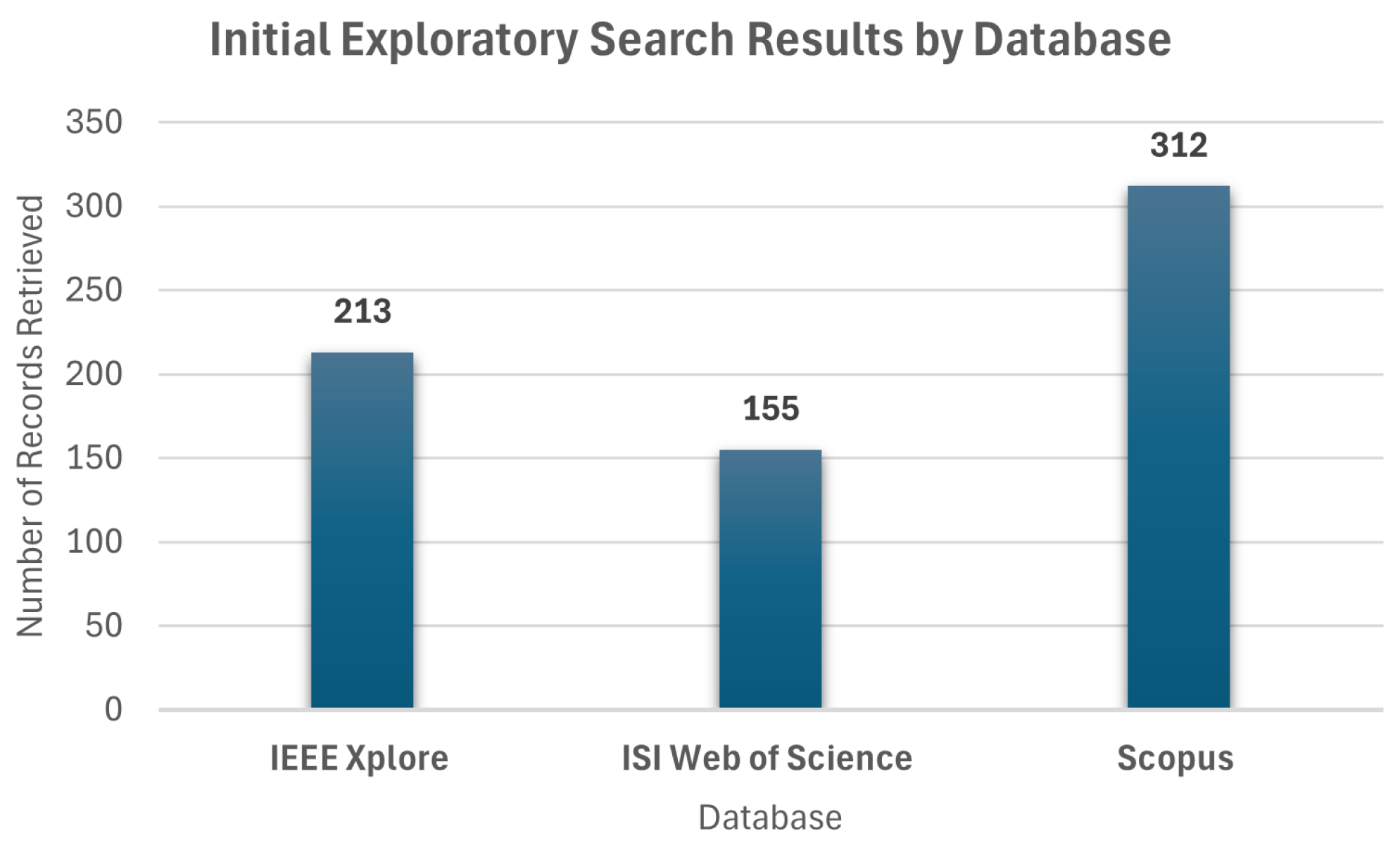
Figure 1 reports the number of records retrieved from each database during the initial exploratory search using the preliminary search string, with 213 records identified in IEEE Xplore, 155 in Web of Science, and 312 in Scopus. These results illustrate the broad scope of the initial query and motivated the subsequent refinement process.
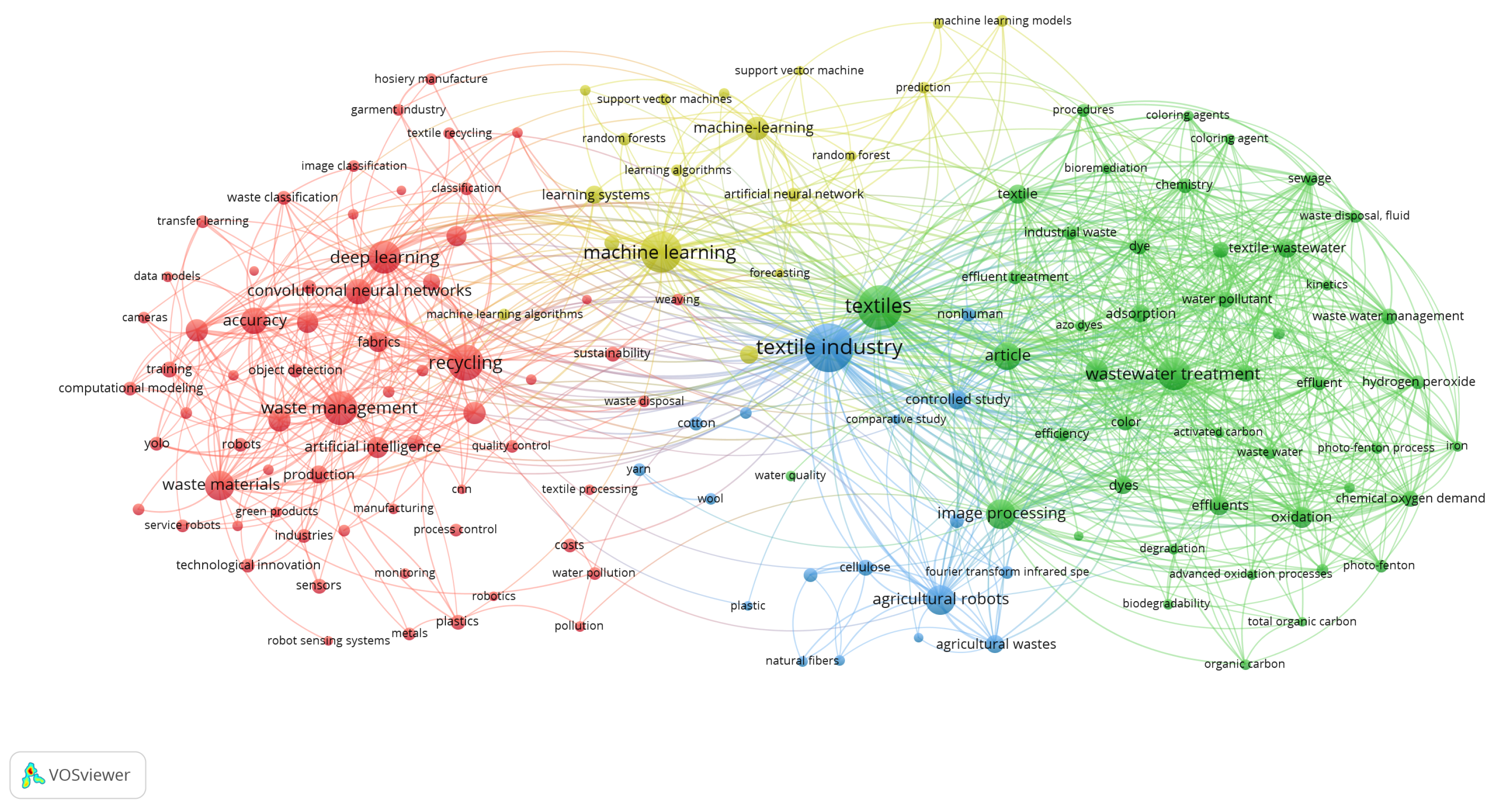
Figure 2 shows the keyword co-occurrence network derived from the exploratory search and analyzed using VOSviewer (version 1.6.20). The visualization reveals several distinct thematic clusters, reflecting the breadth of research topics captured by the preliminary search string. Prominent clusters are centered around machine learning, deep learning, textile-related applications, and waste management, indicating a strong presence of data-driven and perception-oriented approaches in the retrieved literature. Alongside these, clusters associated with wastewater treatment, dye degradation, agricultural robotics, and chemical processing are also observed. These latter themes fall outside the scope of textile recycling pre-processing. Their presence indicates that the initial search string was overly broad and motivated the refinement of the query to improve thematic relevance while preserving coverage of intelligent and automated approaches applicable to textile recycling pre-processing. These observations highlight the importance of carefully constraining search strategies in systematic reviews, as overly broad queries may introduce significant thematic noise and reduce the interpretability of the retrieved literature.
Based on the insights obtained from the keyword co-occurrence analysis, the search string was refined to improve thematic relevance while preserving broad coverage of intelligent and automated approaches for textile recycling pre-processing. Terms associated with wastewater treatment and agricultural waste were explicitly excluded because these domains formed prominent out-of-scope clusters. In addition, variations in the representation of learning-related terminology were addressed. In the literature, concepts such as machine learning and deep learning frequently appear in both hyphenated (e.g., “machine-learning”) and non-hyphenated forms. To ensure consistent retrieval across databases and indexing practices, these terms were reformulated using logical operators, replacing explicit phrases with the expression (machine OR deep) AND learning. This reduced sensitivity to lexical variation while maintaining semantic equivalence across databases.
The refined search string was defined as:
(((textil* AND (recycl* OR wast*)) OR (post-consum* AND textil*)) AND (“computer vision” OR ((machine OR deep) AND learning) OR “image processing” OR robot? OR robotic?) AND NOT wastewater AND NOT “agricultural robots”)
2.2.3. Final Search Execution
The final systematic search was executed using the refined search string across Dimensions, IEEE Xplore, Web of Science, and Scopus. Although Dimensions was not used during the exploratory phase because of its limited support for wildcard operators, it was included in the final search through a reformulated query based on the most relevant co-occurring keywords identified in
Figure 2. This adaptation preserved thematic consistency with the refined search strategy while complying with the query syntax constraints of the Dimensions platform.
The search string applied in Dimensions was defined as:
( ( ( textiles AND ( recycling OR waste ) ) OR ( post-consumer AND textiles ) ) AND ( “computer vision” OR ( ( machine OR deep ) AND learning ) OR “image processing” OR robot ) AND NOT wastewater AND NOT “agricultural robots” )
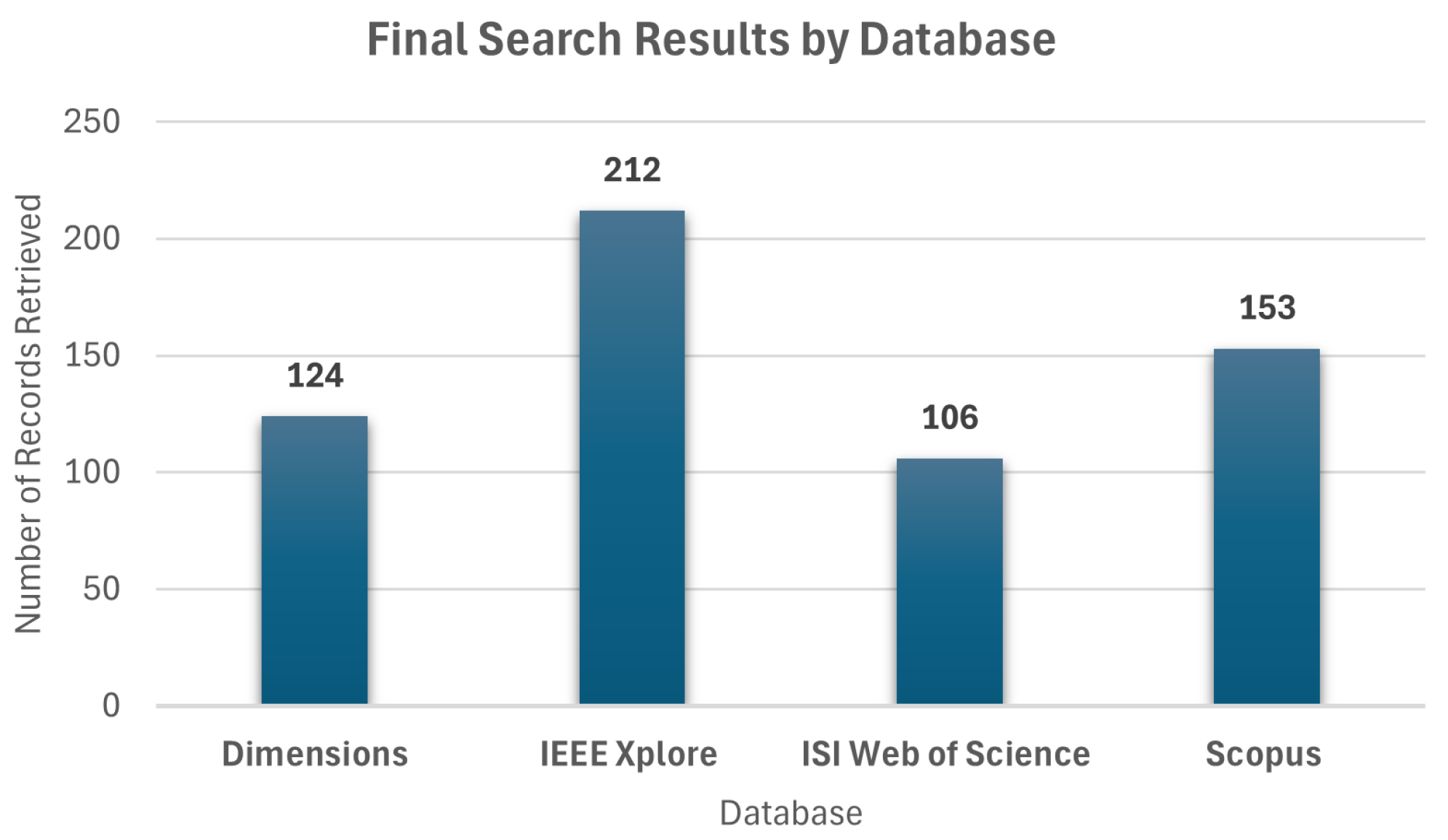
Figure 3 presents the number of records retrieved from each database during the final systematic search using the refined search string. A total of 124 records were retrieved from Dimensions, 212 from IEEE Xplore, 106 from Web of Science, and 153 from Scopus. Compared to the exploratory phase, the refined query resulted in a more balanced and thematically focused set of publications across the selected databases, reflecting the application of a more focused search query that reduced the presence of clearly out-of-scope research areas while retaining a broad set of publications potentially relevant to intelligent and automated textile recycling pre-processing.
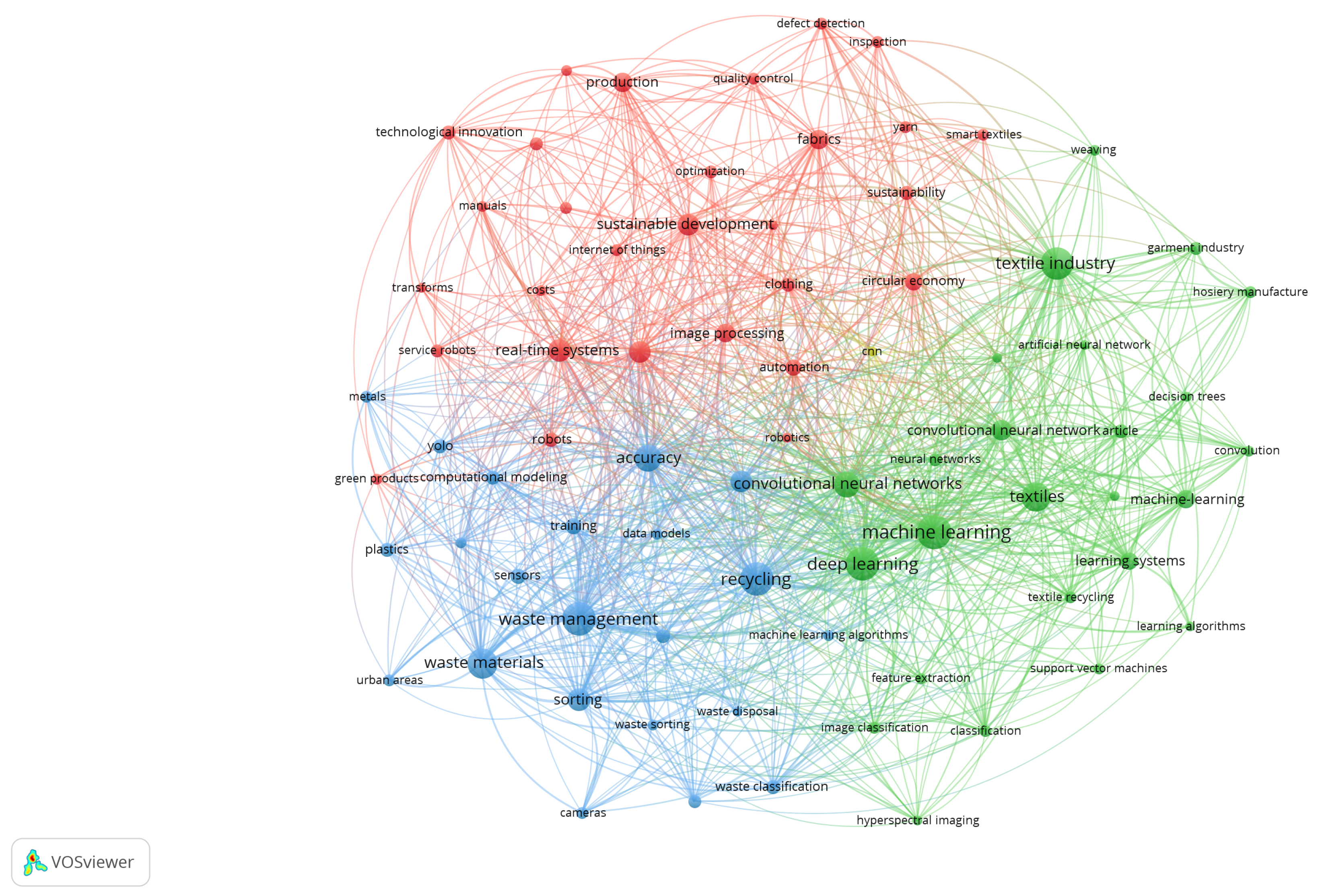
Figure 4 illustrates the keyword co-occurrence network obtained from the final search and analyzed using VOSviewer. Compared to the exploratory analysis, the refined network shows a clearer concentration of keywords related to textile recycling, waste sorting, machine learning, deep learning, computer vision, robotics, and automation. The dominant clusters are now centered around machine learning and textile-related applications, with connections to waste management and sorting-related terms, although these appear less central compared to machine learning and perception-oriented concepts. Out-of-scope thematic clusters previously associated with wastewater treatment and agricultural robotics are no longer prominent, indicating that the refinement process improved the thematic specificity of the search while maintaining coverage of the core research topics addressed in this review. Overall, the refined network exhibits a more compact and interconnected structure, supporting the effectiveness of the search strategy in capturing relevant literature for textile recycling pre-processing.
2.3. Study Selection Process
The study selection process followed a multi-stage screening procedure in accordance with the PRISMA guidelines. After merging the records retrieved from all databases, duplicate entries were identified and removed, resulting in 416 unique records. These studies were then screened based on titles and abstracts to exclude publications that clearly fell outside the scope defined in
Section 2.1 or did not meet the eligibility criteria described in
Section 2.4.
Studies retained after the initial screening were subsequently assessed through full-text review to determine final eligibility. At this stage, the relevance of each study to textile recycling pre-processing and the application of intelligent or automated technologies were evaluated in greater detail, and only studies satisfying all inclusion criteria were retained for quality assessment and synthesis. The study selection and screening process was supported by the Parsifal (Parsifal,
Online tool designed to support the management and documentation of systematic literature reviews.
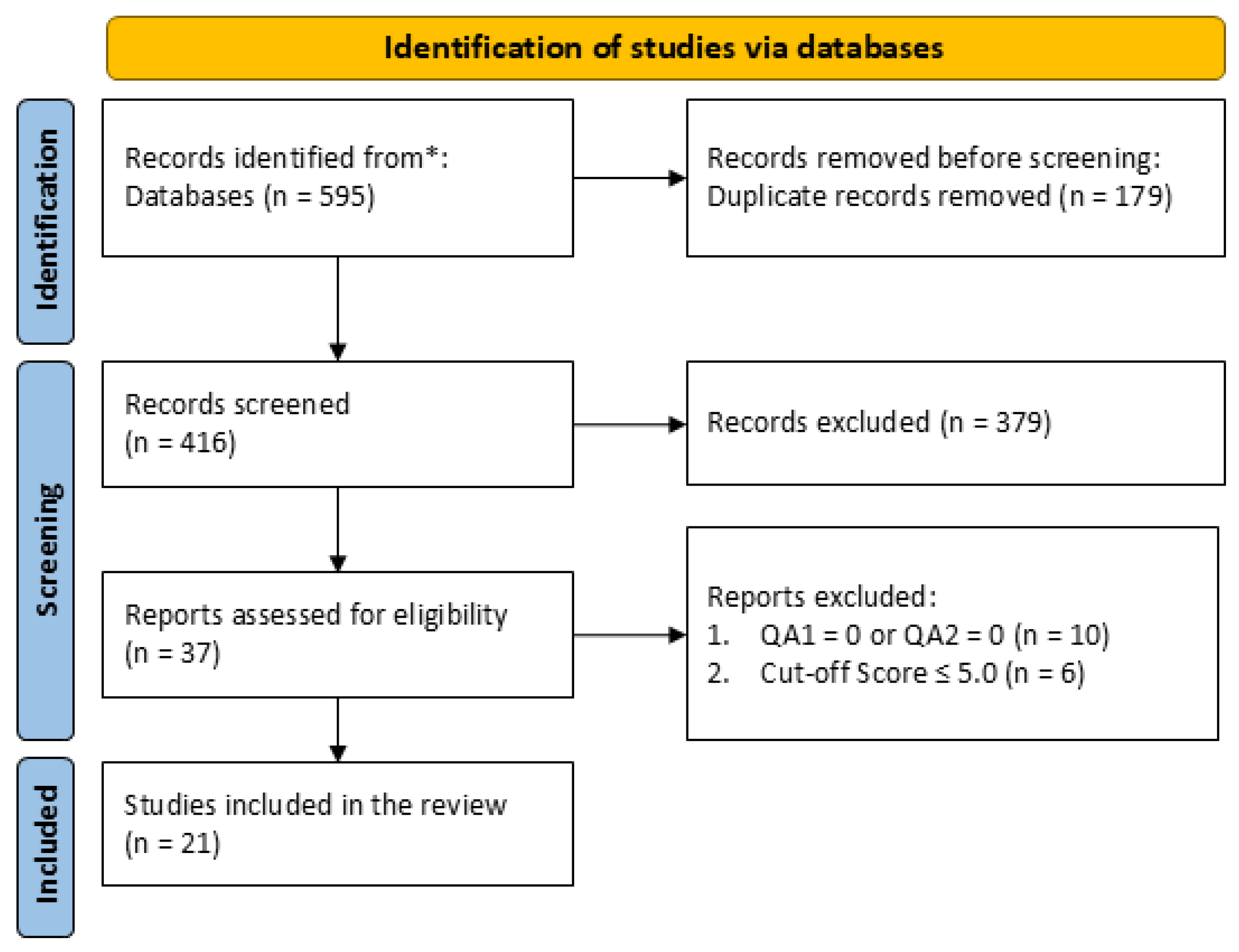
https://parsif.al/ (accessed on 19 March 2026)) platform, which was used as an organizational aid without influencing the scientific judgement applied during study selection. The number of records included and excluded at each stage of the selection process is summarized in the PRISMA flow diagram shown in
Figure 5. Overall, the PRISMA flow shows a substantial reduction from 595 initially identified records to 21 included studies, reflecting the strict application of eligibility criteria. The large number of exclusions during the screening stage highlights the breadth of the initial search and the limited number of studies specifically addressing intelligent and automated textile recycling pre-processing.
2.4. Inclusion and Exclusion Criteria
A set of predefined inclusion and exclusion criteria was established to ensure consistency, transparency, and methodological rigor throughout the study selection process. Criteria related to publication year, language, and document type were operationally enforced during the database search phase through the application of explicit search filters (
Section 2.2). As a result, records not meeting these criteria were largely excluded prior to the screening stage.
For completeness and reproducibility, these criteria are still reported as part of the overall exclusion framework. The exclusion criteria defined in this section primarily focus on the scientific relevance, methodological adequacy, and applicability of the studies to textile recycling pre-processing. These criteria were applied during the title and abstract screening stage to identify and exclude studies that clearly fell outside the defined scope. Studies retained after this screening stage were subsequently subjected to full-text analysis for quality assessment and data extraction. The complete set of exclusion criteria is summarized in
Table 2.
2.5. Quality Assessment
The quality assessment (QA) was conducted to evaluate the methodological rigor, scientific relevance, and technological maturity of the studies retained after screening. Its objective was twofold: (i) to ensure that only studies meeting a minimum level of relevance and quality were included in the synthesis, and (ii) to enable a structured and transparent comparison of heterogeneous approaches to textile recycling pre-processing. Each study was evaluated using a predefined set of quality assessment criteria designed to capture dimensions relevant to intelligent and automated textile recycling pre-processing. These dimensions include clarity of research objectives, direct relevance to pre-processing tasks, data quality and dataset transparency, methodological rigor and reproducibility, experimental validation, technological maturity, and critical discussion of limitations and future research directions. Each criterion was scored using a discrete ordinal scale, with higher scores indicating stronger compliance with the corresponding quality dimension. The complete set of criteria and scoring schemes is reported in
Table 3. The maximum achievable total quality score is 8.0.
To improve scoring consistency and reduce subjectivity in criteria where reporting practices are heterogeneous, additional clarifications were defined for QA5 and QA6. Although all criteria were evaluated using ordinal scales, QA5 (experimental validation and performance evaluation) was assigned a higher maximum score (2.0) than the remaining criteria (maximum 1.0). This decision reflects the importance of quantitative validation in assessing the strength and credibility of the proposed approaches. Since this review aims not only to map existing work but also to evaluate methodological rigor and technological maturity, the quality of experimental validation was treated as a key differentiating factor. Assigning a higher weight to QA5 allows a clearer distinction between studies with no quantitative evidence, those reporting basic performance metrics, and those providing stronger validation through comparisons with baselines, state-of-the-art methods, manual procedures, or ablation studies. For QA6 (technological maturity), the assessment considers whether the proposed system was tested beyond simulation. Higher scores indicate validation under more realistic conditions, such as laboratory-scale prototypes or semi-industrial environments, reflecting a higher level of practical readiness.
To ensure a clear focus on studies that explicitly address textile recycling pre-processing, exclusion thresholds were applied at the quality assessment stage. Specifically, studies scoring 0 in either QA1 (clarity of objectives and scope) or QA2 (relevance to textile recycling pre-processing) were excluded from further analysis, regardless of their total quality score. This decision reflects the central role of these two criteria in defining the scope and intent of the present review.
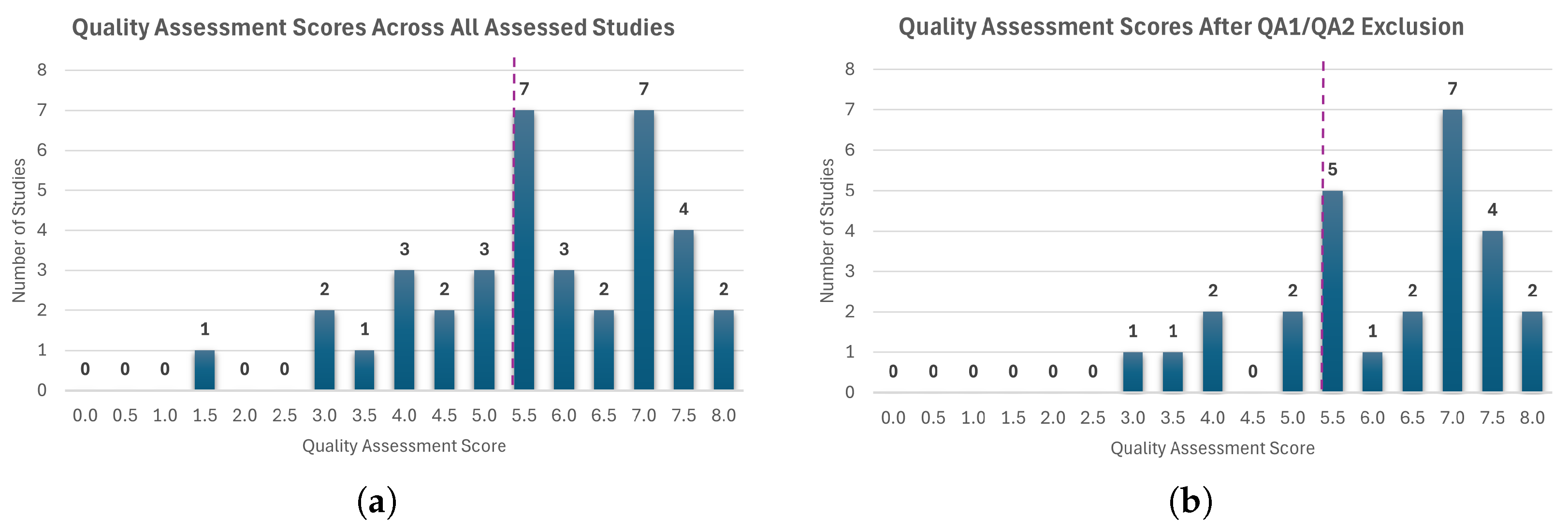
Figure 6a presents the distribution of quality assessment scores across all assessed studies, including those excluded due to scoring 0 in QA1 or QA2.
Figure 6b illustrates the distribution of quality scores after applying the exclusion thresholds, providing a clearer view of the quality profile of the studies retained for synthesis.
In addition to the QA1/QA2 exclusion rule, a minimum total QA score threshold of 5.5 (out of 8.0) was adopted to retain studies for the final synthesis. This threshold corresponds to approximately 68.75% of the maximum achievable score and was selected to ensure that included studies demonstrate at least moderate methodological rigor and validation completeness across multiple QA dimensions. In practice, this cut-off enables the exclusion of contributions with limited experimental evidence, insufficient methodological transparency, or weak dataset reporting, which would otherwise hinder reliable comparison and synthesis. A moderate threshold was adopted to balance methodological rigor with coverage, acknowledging that reporting practices and experimental maturity remain heterogeneous in this research area.
It is also noted that the distribution of QA scores exhibits pronounced peaks at specific values (notably 5.5 and 7.0). This pattern is primarily explained by the discrete and ordinal scoring scheme adopted for the QA criteria (i.e., 0/0.5/1.0 and 0/1.0/2.0), which naturally leads to score quantization and the clustering of studies around common combinations of methodological strengths and weaknesses. These peaks indicate the existence of two dominant groups in the current literature: one group of studies that demonstrate clear relevance and a functional proof-of-concept but still limited dataset reporting or validation maturity (typically scoring around 5.5), and another group of more mature contributions with stronger dataset documentation, experimental validation, and more comprehensive methodological reporting (typically scoring around 7.0). The resulting quality assessment therefore provides a quantitative overview of both the strengths and the maturity gap of current research on intelligent and automated textile recycling pre-processing. These results form the basis for the subsequent data synthesis and comparative analysis presented in the following sections.
To enhance transparency and ensure a rigorous and verifiable quality assessment process, the individual QA scores (QA1–QA7), total scores, inclusion decisions, and corresponding reasons for exclusion are reported for all evaluated studies in
Table 4. While the preceding analysis provides an aggregated view of the score distribution, this detailed table allows for full traceability of the evaluation process and enables readers to examine how individual studies contribute to the observed quality patterns across the literature.
Overall, the table confirms that most included studies achieve moderate to high QA scores, with common limitations associated with dataset transparency, validation under realistic conditions, and technological maturity. These patterns are consistent with the distribution trends discussed above and further highlight the gap between methodological performance and system-level readiness in textile recycling pre-processing.
2.6. Data Extraction and Synthesis
For each selected study, relevant information was systematically extracted using a predefined data extraction form. The extracted fields included: (i) bibliographic metadata (year, venue); (ii) targeted textile recycling pre-processing task(s); (iii) sensing modalities and acquisition setup; (iv) AI/computer vision and automation methods; (v) datasets (size, composition, number of classes, availability); (vi) experimental environment (offline, simulation, laboratory-scale, semi-industrial); (vii) validation protocol and performance metrics; and (viii) reported limitations and assumptions. When available, additional implementation details were recorded, including computational requirements, real-time constraints, and the degree of integration with downstream actuation (e.g., robotic platforms, end-effectors, conveyor mechanisms, ejection devices, and other components enabling physical execution).
To enable a structured synthesis across heterogeneous contributions, each study was mapped onto a pre-processing task taxonomy aligned with the scope defined in
Section 1. Three primary task families were considered:
Identification: material, fiber, and composition inference (e.g., fiber class recognition, blend discrimination, or content estimation).
Sorting: operational separation strategies in which the study specifies how identified textiles are physically separated into distinct outputs. This includes cases where the routing principle is explicitly defined (e.g., ejection-based separation, bin switching mechanisms, or robot-mediated placement), rather than studies that only assign labels or composition groups without describing the separation logic.
Contaminant detection and/or removal: localization and separation of accessories and non-recyclable elements (e.g., buttons and zippers), including both detection-oriented pipelines and removal-oriented setups.
In addition to task family assignment, physical handling and perception-to-action coupling were analyzed as cross-cutting implementation dimensions. Specifically, the analysis recorded whether and how sensing outputs were connected to actuation (e.g., pick-and-place manipulation, conveyor-timed execution, mechanised routing, tool-based disassembly), and whether the contribution addressed timing, synchronisation, or constraints relevant to real-world execution.
Studies addressing multiple tasks were classified under all applicable task families in order to capture multi-stage solutions and integrated system proposals. The extracted evidence was synthesized qualitatively and organized by task family and technological approach. Methods were grouped according to their dominant technical focus (e.g., traditional machine learning, deep learning-based classification and detection, spectroscopy-driven identification, and robotic automation). Due to differences in datasets, evaluation metrics, and experimental conditions, a meta-analysis was not conducted. Instead, comparisons were performed through task-level aggregation of reported performance indicators, validation practices, and maturity levels, supported by comparative tables and figures.
This synthesis strategy enabled the identification of dominant research directions, underexplored pre-processing tasks, recurring technical limitations, and key gaps that currently hinder robust scalability and industrial deployment of automated textile recycling pre-processing systems.
3. Results
This section reports the results of the systematic review based on the final set of included primary studies (S1–S21). Although the database search covered the period 2015–2025, the eligible studies retained after screening and quality assessment were published between 2020 and 2025. Evidence is synthesized using the structured extraction form described in
Section 2.6. The results are organized around (i) coverage of textile recycling pre-processing tasks, (ii) handling, manipulation, and automation mechanisms (perception-to-action integration), (iii) methodological approach families, (iv) sensing modalities, acquisition setups, and dataset characteristics, (v) validation environments and technological maturity indicators, and (vi) a task-level synthesis of reported performance, in alignment with the research questions in
Section 1.
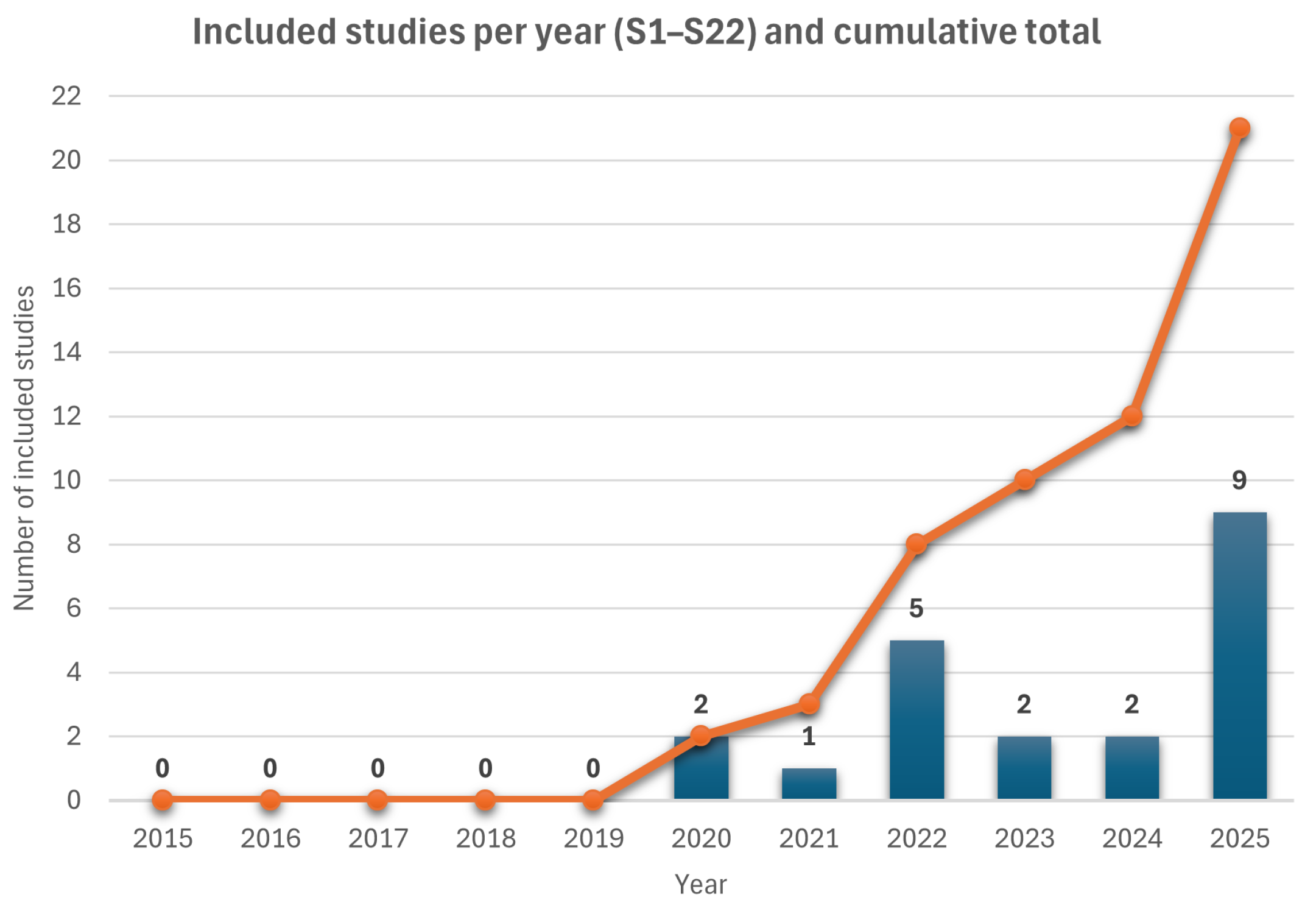
Figure 7 provides the temporal distribution of the included studies.
3.1. Coverage of Pre-Processing Tasks
To answer RQ1 and RQ2, each study was mapped to the pre-processing task taxonomy defined in
Section 1.
Table 5 reports the task mapping per study, and
Table 6 summarizes the overall distribution across the included corpus (
).
Taken together,
Table 5 and
Table 6 show a clear concentration of the literature on identification tasks, while explicit sorting and contaminant-related operations remain significantly less frequent. This imbalance suggests that most contributions are still focused on perception-level capabilities rather than end-to-end pre-processing workflows with physical execution.
Identification is the most prevalent research focus in the reviewed literature, appearing in 19 of the 21 included studies (90.5%). This dominance reflects a broader pattern in textile recycling automation: before physical separation can be attempted, systems typically require reliable inference of fiber composition, garment characteristics, or surface attributes that can act as proxies for recyclability. In most cases, identification is formulated as a supervised learning problem, spanning both classification (e.g., fiber type recognition, blend group discrimination, or color category assignment) and regression (e.g., estimating fiber content proportions). Importantly, identification targets vary considerably across studies, ranging from coarse groupings such as natural/synthetic/blended fibers to fine-grained multi-class recognition and composition estimation. This variation shapes not only model complexity, but also the extent to which results can be interpreted as applicable to real sorting lines, where decision boundaries must remain stable under strong intra-class variability.
Although identification is the most common task in the reviewed studies, it is rarely independent of how textiles are physically presented during acquisition. Imaging-based approaches typically rely on visible surface characteristics such as texture, weave patterns, and color information. As a result, their performance can be affected by factors that do not change the actual fiber composition, including printed patterns, folds, shadows, wrinkles, and finishing treatments. Spectroscopy-based identification methods, such as near-infrared (NIR), hyperspectral imaging (HSI), and Raman spectroscopy are more directly related to the chemical composition of the material. However, their performance is still affected by practical factors, including moisture content, multiple fabric layers, and the presence of dyes that modify absorption or fluorescence signals. For both imaging and spectral approaches, reported performance should therefore not be viewed as an intrinsic property of the model alone. Instead, it depends on how the data were acquired and on how much real-world variability is represented in the dataset.
However, beyond data acquisition and representation effects, classification accuracy alone is not a sufficient indicator of effective sorting or routing performance. In operational pre-processing systems, identification outputs must be translated into decision-making processes under uncertainty, where threshold selection, confidence calibration, and class-dependent misrouting costs critically influence downstream outcomes. Consequently, models exhibiting comparable accuracy may lead to substantially different system-level performance, depending on how decision boundaries are defined and how uncertainty is managed. This highlights that the gap between identification and sorting is not only driven by sensing and data variability, but is also fundamentally decision-theoretic. From a pipeline perspective, the reviewed literature applies AI and computer vision predominantly as perception and inference modules (classification, regression, detection, segmentation), while automation and robotics appear less frequently and primarily in the form of execution mechanisms that operationalize separation actions (e.g., routing, binning, ejection, or disassembly).
In contrast, sorting is addressed in a substantially smaller subset of the corpus, being explicitly reported in only 4 studies (19.0%). In this review, sorting is counted only when a work goes beyond recognizing a label and defines a concrete separation action or routing outcome (e.g., binning, ejection into sorting boxes, or pick-and-place grouping), thereby operationalising classification into a pre-processing step with physical consequence. Although Tsai and Yuan [
54] evaluate online Raman spectroscopy-based textile classification on a moving conveyor with explicit throughput (items processed per second) reporting, their study does not describe an associated physical separation or actuation mechanism and was therefore not counted as a sorting study in this review. Based on this interpretation, sorting emerges in two main forms. First, color-based sorting systems translate appearance categories into physical separation streams, typically by directing textiles into predefined output bins. Second, fiber- or material-driven sorting integrates identification outcomes into routing decisions that aim to preserve recyclability constraints (e.g., separating pure fibers and blends into distinct output channels). Compared to identification-only pipelines, sorting-oriented studies tend to surface more practical constraints, such as conveyor timing, cycle time, routing reliability, and system-level failure modes driven by presentation variability.
Finally, contaminant detection and/or removal remains sparsely covered, appearing in only 3 studies (14.3%). These works focus primarily on garment accessories and fasteners, such as buttons, rivets, and zippers, and typically frame the problem as detection and localization through bounding boxes or segmentation masks. One study goes a step beyond by explicitly targeting a removal action (robotic zipper removal), whereas the remaining contributions treat contaminant detection as a prerequisite step rather than a closed-loop separation process. Taken together, this distribution reinforces a recurring maturity pattern across the literature: identification is extensively studied and comparatively well benchmarked, while contaminant-related tasks remain less explored and are often validated under constrained assumptions and limited accessory diversity.
3.2. Handling, Manipulation, and Automation Mechanisms
While sensing defines what can be observed, the pre-processing stage of textile recycling ultimately requires acting on those observations under the constraints of deformable objects, cluttered streams, and throughput-driven line operation. To address RQ1 and complement the sensing-focused analysis in
Section 3.4, this section examines how the included studies instantiate physical handling and automation mechanisms, i.e., how perception outputs are translated into separation actions (routing, binning, ejection), pick-and-place execution, or disassembly operations. In this domain, handling is not a secondary implementation detail: it is often the locus where otherwise high-performing perception pipelines encounter cloth dynamics, occlusions, entanglement, and timing constraints imposed by conveyor-driven process flow.
Table 7 summarizes the handling mechanisms and integration assumptions reported across the included studies. The reviewed literature reveals several distinct automation configurations, including conveyorized routing without grasping, robotic manipulation (pick-and-place), physical disassembly actions, and flow-integrated inspection systems. These configurations differ not only in their actuation mechanisms, but also in the types of system-level constraints and failure modes they introduce. Conveyorized routing systems are typically constrained by timing, item spacing, and ejection reliability under continuous flow. Robotic manipulation systems introduce additional uncertainties related to grasp success, cloth deformation, and perception–action coupling. Disassembly-oriented setups depend on localization accuracy, tool-contact stability, and safe execution under compliance. In contrast, flow-integrated inspection systems embed sensing into conveyor-based pipelines without explicit separation actions, shifting the technical emphasis toward measurement stability, acquisition timing, and signal robustness during motion.
Overall,
Table 7 highlights that only a small subset of studies implement explicit actuation mechanisms, with most contributions either relying on simplified routing assumptions or focusing on sensing without closed-loop execution.
This observation is consistent with the broader trend that closed-loop physical handling remains comparatively sparse relative to the abundance of perception-centric contributions. The majority of studies validate identification outcomes at the classification level, but stop short of demonstrating reliable end-to-end execution in which textiles are physically transported, separated, or processed under representative variability. This imbalance is not merely a matter of missing engineering effort; it reflects the fact that textile waste introduces forms of uncertainty that cannot be fully resolved at the sensing stage. Garments deform and self-occlude, accessories may be partially hidden, and items frequently appear in states that violate the single-layer or single-object assumptions of curated datasets.
Within the subset of studies that integrate automation, two contrasting integration patterns emerge. The first is conveyorized routing without grasping, exemplified by online sorting devices [
28,
54]. In these systems, the interaction problem is reduced by constraining presentation geometry and relying on rapid routing mechanisms (e.g., air-jet purge sorting) to operationalize separation decisions. This approach is compatible with industrial throughput requirements, but depends on stable item spacing, consistent conveyor kinematics, and predictable textile trajectories during ejection, all of which become challenging when textiles are lightweight, folded, or aerodynamically irregular.
The second pattern is robotic manipulation, represented by [
20,
22], which provides greater flexibility in handling heterogeneous garments but introduces a more complex set of coupled uncertainties: grasp planning on deformable objects, perception–action delays, and failure recovery strategies. In robotic contexts, perception accuracy alone is insufficient, as successful separation depends on whether the garment can be reliably isolated, grasped, transported, and released into the intended output stream without entanglement or slip. The relatively limited number of robotic demonstrations in the corpus therefore reinforces the view that manipulation remains a key bottleneck for scaling AI-driven textile pre-processing beyond constrained laboratory scenarios.
Finally, Bonci et al. [
31] illustrate a third automation pathway: disassembly or contaminant separation actions, instantiated as robotic zipper removal. Such approaches are particularly relevant for contaminant removal and recycling purity, yet demand precise localization and safe tool execution under textile compliance. As a result, disassembly-oriented work tends to require stronger presentation assumptions and more constrained experimental setups, suggesting that it remains at an earlier maturity stage than identification- or routing-centric systems.
Overall, the handling evidence in the included literature indicates a recurring perception-to-action gap: while sensing and recognition capabilities have advanced substantially, robust physical execution under waste-stream variability remains underrepresented. This gap motivates future research directions focused not only on improved recognition accuracy, but also on integration strategies that explicitly account for deformable object handling, throughput constraints, and failure-tolerant system design.
3.3. Method and Algorithmic Trends
To address RQ3, the included studies were grouped according to their main methodological approaches. The results show that algorithm choices are not independent technical decisions, but are intrinsically linked to the sensing modality and the degree of control in the data acquisition process. In many cases, observed algorithmic trends reflect underlying constraints, such as the type of signal being analyzed, for example Red–Green–Blue (RGB) images versus spectral data, the size and representativeness of the datasets, and the operational requirements of pre-processing lines. In practical settings, factors such as throughput, calibration stability, and predictable failure behavior can be as important as small improvements in classification accuracy.
Across the corpus, deep learning emerges as a unifying methodological substrate, spanning both imaging and spectral contexts. In appearance-driven pipelines (RGB/RGB-D), convolutional neural network (CNN)-based architectures are widely adopted for garment and fabric recognition as well as color-based categorization [
27,
38,
47,
48,
50,
51], while deep models are also prominent in spectral settings (HSI/NIR) for fiber identification and grading [
24,
37,
40,
42]. Importantly, deep learning is not confined to offline recognition: it is also embedded in end-to-end demonstrations that couple perception to execution, such as conveyor-timed pick-and-place separation with timed actions [
22] and pile-based inspection pipelines combining vision and tactile feedback [
20]. Beyond reported accuracy values, these studies reflect a broader trend: when textile variability (such as differences in color, texture, wear, and folds) becomes significant, deep learning methods are better able to handle this variability than handcrafted features, which often struggle to model such complex and irregular patterns explicitly.
At the same time, the reliability of many deep learning results depends strongly on how the data were collected. In many studies, complex waste-stream conditions are simplified into controlled and well-structured datasets. Controlled lighting, carefully arranged textile presentation, limited class definitions, and curated samples can lead to high accuracy within the test setting. However, these conditions may not reflect real post-consumer waste streams, where garments are layered, contaminated, affected by surface treatments, and show high variability within the same material class. This suggests that the main limitation is not the modelling approach itself, but the gap between benchmark performance and real-world generalization.
In parallel, traditional machine learning and chemometric modelling continue to occupy a prominent role, particularly in spectroscopy-driven identification. Here, methodological choices often reflect a preference for physically interpretable transformations and stable decision boundaries grounded in material signatures. Representative examples include matched-filter template strategies for coarse fiber grouping [
35] and regression pipelines explicitly designed to mitigate confounders such as moisture regain [
36]. These approaches align closely with process-facing requirements, where the value of a model may lie not only in predictive accuracy but also in traceability, calibration maintainability, and predictable failure behavior under distribution shift.
Regression-based contributions deserve special attention because they connect perception outputs to recycling-relevant decisions: composition estimation can be directly actionable for separation planning and route selection, blend management, and purity control. Studies targeting quantitative composition inference commonly anchor evaluation in physically meaningful ground-truth procedures (e.g., standardized dissolution protocols or laboratory reference measurements) [
34,
36,
52]. However, the reviewed evidence also highlights an interpretability gap at the system level: low regression error does not automatically translate into robust routing decisions unless the operational thresholds, error tolerances, and economic consequences of misrouting are explicitly modelled. In other words, composition estimation is necessary for intelligent routing, but not sufficient to guarantee that a line will produce consistent recycled outputs at scale.
Finally, classical computer vision methods are most commonly used for color-based classification and multicolour evaluation under controlled conditions [
23,
38]. These approaches are relatively simple and computationally efficient, which makes them attractive for conveyor-based systems. However, they are often sensitive to practical issues such as shiny fabrics, printed patterns, and partial occlusions. This reflects a broader pattern in the literature: methods that are lightweight and easy to deploy tend to be more vulnerable to the variability found in real waste streams. Overall, the methodological landscape should not be seen as a competition between approaches, but as a set of trade-offs between chemical information, visual robustness, interpretability, and practical feasibility in real pre-processing environments.
3.4. Sensing and Acquisition Setups
To address RQ4, sensing modalities and acquisition setups reported across the included studies are analyzed, treating sensing as a defining constraint on what can be inferred, under which sources of variability, and with what prospects for deployment at industrial throughput. Two broad sensing paradigms dominate the included corpus. The first is appearance-driven perception, centred on conventional color imaging based on the RGB representation or on its depth-augmented extension, namely RGB-D imaging, which naturally supports color sorting, garment-level categorization, accessory localization, and manipulation assistance. The second is material-signature sensing, primarily implemented through NIR spectroscopy and NIR/visible–NIR hyperspectral imaging, where fiber identity and composition are inferred from reflectance fingerprints rather than visual appearance alone. In addition, more chemically specific spectral channels such as Raman appear in a small number of studies, suggesting alternative routes toward fiber discrimination under challenging surface conditions.
Table 8 provides a frequency-level overview of sensing modalities across the included studies (categories are not mutually exclusive).
Overall,
Table 8 shows a predominance of appearance-based sensing approaches (RGB/RGB-D), while material-signature techniques such as NIR and HSI are less frequent but more directly aligned with fiber composition inference. This distribution highlights a trade-off between practical deployability and chemical specificity in textile recycling pre-processing.
While these modality-level results provide a high-level overview, operational implications for textile pre-processing are better understood when the sensor type and acquisition format are made explicit. In particular, NIR and HSI should not be interpreted as competing labels of equal granularity: NIR refers primarily to the spectral region being measured, whereas HSI denotes a spatially resolved acquisition format in which a spectrum is captured for each pixel or region. As a consequence, NIR measurements may be implemented as point/probe/process spectroscopy (one spectrum per sample or per measurement spot), or as NIR hyperspectral imaging (spectral cubes with spatial structure). This distinction is further detailed through the sensor types and acquisition setups reported for each included study (
Table 9).
Table 9 highlights the strong diversity of sensing configurations, ranging from controlled laboratory setups to conveyor-integrated acquisition systems. This variability reflects differing assumptions regarding textile presentation, environmental control, and system integration, which directly influence the robustness and transferability of the reported results.
RGB and RGB-D components are widely adopted (12/21 studies, 57.1%), spanning both imaging-only pipelines and multimodal configurations that use imaging for region discovery or handling-related perception [
20,
22,
23,
27,
31,
38,
39,
47,
48,
50,
51,
52]. Their prevalence reflects low cost, high availability, and relatively direct integration into conveyor-like workflows. Yet, reliance on surface appearance also means that performance is frequently conditioned by acquisition constraints: controlled illumination, limited occlusion, and simplified presentation assumptions. These constraints are rarely benign in real waste streams, where garments are deformable, frequently layered, and visually heterogeneous. In this sense, imaging pipelines can be interpreted as high-throughput perceptual front-ends whose robustness depends not only on model choice, but also on how textiles are physically presented to the sensing system.
Material-signature sensing is most prominently represented through NIR measurements (8/21 studies, 38.1%), frequently implemented as probe-based or process-integrated spectroscopy [
28,
35,
36,
40,
42] and through hybrid configurations in which RGB perception guides where and how measurements are taken [
52]. In contrast to purely appearance-based cues, NIR reflectance provides a more direct proxy for chemistry, making it attractive for fiber identification and blend-oriented routing decisions. However, NIR-based inference remains intertwined with confounding factors that are structural to textile waste, including moisture regain, layered garments, and surface treatments that modulate reflectance. The recurrent emphasis on controlled measurement conditions across several NIR studies can therefore be read both as evidence of technical maturity and as a reminder that chemical discriminability does not automatically translate into waste-stream robustness.
HSI appears in three studies (14.3%) and provides a distinct sensing proposition: rather than producing a single spectrum per textile, hyperspectral acquisition retains spatial structure, enabling region-level or pixel-level spectral inference for heterogeneous textiles [
24,
34,
37]. This increased information content makes HSI particularly compelling for scenarios where textiles exhibit local heterogeneity (e.g., multi-fabric garments, coatings, or compositional gradients). At the same time, the move from point spectroscopy to high-dimensional spectral cubes introduces additional burdens: calibration stability, illumination uniformity, scanning geometry constraints, and increased computational requirements, which must be addressed at the system level if HSI is to operate reliably at scale.
Raman spectroscopy is represented by [
54] through a conveyor-integrated configuration with explicit throughput claims, illustrating that strong chemical specificity is achievable even in line-based settings. At the same time, Raman highlights integration tensions that are not easily resolved algorithmically, such as dye-related fluorescence backgrounds and the dependence of signal quality on textile surface treatments. This approach suggest that spectral sensing in textile recycling is best understood as a family of measurement compromises rather than a single technological pathway.
Finally, multimodal sensing configurations (6/21 studies, 28.6%) reflect an implicit acknowledgement that textile pre-processing is not solely a matter of recognizing material properties, but of doing so under the geometric and photometric variability introduced by deformable, cluttered garments. In this corpus, multimodality is primarily expressed at the acquisition level, combining complementary information channels (e.g., RGB-D with tactile feedback in [
20], or RGB-based segmentation guiding multi-point Fourier Transform Near-Infrared (FT-NIR) measurements in [
52]) to reduce ambiguity in either geometry or material inference. While such configurations can increase robustness by compensating for the weaknesses of individual sensors, they also introduce additional system-level dependencies, including sensor co-registration, calibration drift, fusion latency, and the risk that errors in earlier perception stages affect subsequent measurement or classification steps. In this sense, multimodality should be interpreted less as a universal solution and more as a shift toward pipeline designs where integration quality becomes a first-order determinant of performance.
3.5. Datasets and Evaluation Protocols
To complement RQ4, dataset characteristics and evaluation protocols were synthesized across the included studies. A central observation is that heterogeneity is not a secondary inconvenience but a defining feature of this literature: datasets differ not only in scale, but also in what constitutes a sample, how ground truth is defined, and which sources of variability are represented. Dataset sizes range from very small, task-specific collections (e.g., 50 zipper images in [
31] and 112 RGB garment images in [
47]) to thousands of spectroscopy measurements (e.g., 2764 spectra used to build an identification library in [
28]) and large volumes of ROI-derived instances extracted from hyperspectral cubes (e.g., 600,404 spectral instances in [
37]). This variability directly impacts the interpretability of reported results, as performance is often evaluated at different semantic levels, including garment-level classification, fabric-level analysis, or pixel-level spectral inference.
Dataset origin and acquisition conditions further complicate cross-study comparison. Several studies rely on curated datasets acquired under controlled conditions [
24,
27,
35,
37], where textiles are typically clean, isolated, and measured under stable illumination or sensing configurations. In contrast, a subset of works incorporates real waste samples obtained from industrial or post-consumer sources [
23,
28,
40,
42,
54], providing a closer approximation to operational conditions. A third category of mixed datasets combines real textile samples with partially controlled acquisition protocols [
47,
48,
52], resulting in only partial representation of real-world variability. This distinction is critical, as dataset realism strongly influences external validity: high performance on curated datasets does not necessarily translate to robust operation under the variability of real textile waste streams. This categorization is not merely descriptive, as dataset type directly influences the interpretation of reported performance, with curated datasets typically yielding more stable and optimistic results than those obtained under real waste conditions. This is because post-consumer textiles frequently exhibit variability not captured in controlled datasets, including stains, wear and tear, wrinkles, color fading, and multi-layer occlusions, all of which introduce noise and ambiguity in both visual and spectral measurements.
Evaluation practices are similarly heterogeneous. Common strategies include fixed train/test splits [
24,
37], cross-validation protocols [
27,
47,
48,
50], and explicit external validation sets [
28]. However, only a limited subset of studies explicitly accounts for confounding factors inherent to textile waste, such as moisture regain in NIR measurements [
36]. These robustness-oriented evaluation strategies remain the exception rather than the norm, despite their importance for real-world deployment. As a result, reported performance should be interpreted as conditional on the represented variability and acquisition setup, rather than as a universal indicator of system capability.
A structured comparison of the included studies based on these attributes is provided in
Table 10. To support consistent interpretation, the attributes reported in
Table 10 are defined as follows. Modality refers to the primary sensing technology used for perception (e.g., RGB, RGB-D, NIR, HSI, Raman). Dataset size denotes the number of samples or measurements used for training (train), validation (val), testing (test), or evaluation (eval), as reported in each study, noting that the definition of a sample varies (e.g., images, spectra, or ROI-derived instances). Dataset type categorizes the origin and acquisition conditions of the data as curated (acquired under controlled conditions, typically involving clean, isolated samples), real waste (post-consumer or industrial textile streams with inherent variability), or mixed. Validation indicates the evaluation environment, including offline/laboratory testing, simulation, semi-industrial setups, or full industrial deployment. Task describes the primary objective addressed by the system (e.g., fiber identification, color identification, contaminants detection, or sorting). Finally, actuation specifies whether the study demonstrates physical execution of actions such as robotic manipulation or conveyor-based sorting, beyond perception-only evaluation.
This consolidated view highlights how differences in dataset realism, validation conditions, and system integration complicate direct comparison between studies. In particular, only a limited subset of works combines real waste datasets with system-level validation and physical actuation, indicating that most contributions remain focused on perception-level performance under controlled conditions rather than end-to-end operational deployment. Direct comparison of reported metrics is further hindered by differences in problem formulation (e.g., classification, regression, detection, segmentation), dataset composition, and evaluation protocols. Consequently, aggregating numerical performance indicators would risk conflating fundamentally different tasks and experimental conditions. Instead, comparability is better established at the level of system design, dataset realism, and validation context.
3.6. Validation Environments and Technological Maturity
To address RQ5, the included studies were examined with respect to their validation environments and system-level maturity, acknowledging that high algorithmic performance does not necessarily translate into operational readiness. In textile recycling pre-processing, deployment feasibility is primarily constrained by system-level factors that are rarely captured by conventional offline metrics, including throughput requirements, variability in textile presentation (e.g., folds, occlusions, and entanglement), long-term sensor drift and re-calibration demands, robustness to contamination and mixed-material garments, failure detection and recovery, and, for handling-intensive tasks, safe and reliable interaction with deformable objects.
A structured overview of validation environments and system-level maturity indicators is provided in
Table 11. Overall, the literature is predominantly concentrated in controlled validation settings (85.7%), including offline, simulation, and laboratory-based evaluations, reflecting a predominant focus on constrained experimental setups, particularly at the sensing and perception level, rather than fully integrated processing lines. While such controlled studies play a necessary role in establishing measurement repeatability and benchmarking classification performance, they provide limited evidence of robustness under the temporal, mechanical, and organizational constraints characteristic of industrial waste-stream operations.
Semi-industrial or online validation is comparatively uncommon (9.5%), and is largely concentrated in spectroscopy-driven systems that explicitly operate under continuous-flow constraints. Notably, Du et al. [
28] report an online NIR-based recognition and sorting device with decision times below 2 s per sample, while Tsai and Yuan [
54] describe an online Raman spectroscopy setup achieving a throughput of approximately one item per second on a conveyor. These studies are particularly informative because they expose critical real-world bottlenecks, including sensing latency, material presentation stability, and actuation timing, which can fundamentally shape the feasibility of specific sensing modalities and modelling strategies when scaled beyond controlled laboratory conditions.
Only one contribution reports industrial deployment (4.8%), underscoring a persistent translational gap between prototype-level demonstrations and validated adoption in operational settings. In Zhou et al. [
23] study, the system was implemented in a factory environment for color-based textile sorting, operating under continuous-flow conditions with controlled illumination and industrial camera setups. The deployment context required attention not only to classification accuracy, but also to cycle time stability, robustness to fabric presentation variability, and integration with existing line infrastructure. Notably, performance was evaluated under production-relevant constraints, including throughput and multi-class color discrimination in realistic factory conditions.
Closed-loop physical actuation is documented in a limited subset of the corpus, including robotic manipulation scenarios such as pile-picking with inspection and binning [
20], and conveyor-synchronised pick-and-place sorting [
22], as well as non-robotic actuation mechanisms such as conveyor-based routing and air-jet ejection systems [
28,
39]. In contrast, Bonci et al. [
31] present a simulation-based disassembly pipeline for zipper removal, without physical execution, highlighting the gap between perception-driven planning and real-world deployment. In such settings, failure modes extend beyond classification errors to perception–action coupling challenges, including localization drift, timing uncertainty under moving targets, grasp instability, and compounding error accumulation induced by textile deformation. Collectively, these observations highlight a systematic imbalance in the field: textile identification and composition inference are widely investigated and often yield strong in-domain performance, whereas upstream contaminant removal remains comparatively underrepresented and weakly validated, largely due to the demanding requirements of robust physical interaction under unstructured waste-stream variability.
3.7. Task-Level Performance Synthesis
Due to heterogeneity in datasets, sensing modalities, evaluation metrics, and validation environments, a quantitative meta-analysis was not conducted. Instead, performance is synthesized at the task level, interpreting reported results in light of each study’s assumptions, acquisition regime, and operational framing. This approach privileges external validity over raw numerical aggregation, which would otherwise risk conflating fundamentally different problem formulations.
Across the included studies, fiber and material identification is frequently associated with high in-domain performance, particularly in spectroscopy- and hyperspectral-driven pipelines evaluated under controlled acquisition. For example, Hao et al. [
24] report 98.31% overall accuracy in six-class hyperspectral waste textile classification, while Huang et al. [
37] report 98.6% test accuracy across 25 fiber categories using fused ROI spectra. Composition estimation tasks further illustrate the potential of spectral approaches to support recycling-relevant decisions: Mäkelä et al. [
34] report average errors of 2.2–4.5% when estimating polyester content in blended textiles. Yet, several studies underscore that such performance is conditional on confounders that define real waste streams rather than exceptional cases, including moisture regain [
36], multi-layer presentation, and absorption artefacts in dark textiles [
54]. These findings suggest that the identification problem cannot be considered fully resolved; rather, it remains sensitive to the extension of domain variability captured during acquisition and validation.
Separation-oriented outcomes are reported under two broad framings: appearance-driven categorization (often color-based) and material-driven routing informed by identification outputs. Color-based categorization can achieve strong performance in controlled factory-like settings, as demonstrated by Zhou et al. [
23] with 96.57% accuracy across ten color classes, and by Schrøder et al. [
38] with 88.3% adjusted accuracy under multi-color scenarios and sub-second computation time. However, these results also reveal a conceptual boundary: high categorization accuracy does not necessarily imply reliable recycling-relevant routing, particularly when garments overlap, carry prints, or include multi-material constructions for which color is a weak proxy for process selection. Material-driven routing is most convincingly supported by system-level demonstrations using online spectroscopy. In particular, Du et al. [
28] report online identification and sorting accuracy exceeding 95%, with a sub-2-second sorting cycle, while Tsai and Yuan [
54] report approximately 1 piece per second throughput for online Raman-based textile classification on a moving conveyor. These studies are informative because they move beyond offline metrics and engage explicitly with decision latency, throughput constraints, and line dynamics.
Accessory and contaminant-related tasks remain underrepresented, and the quantitative evidence indicates that this area is still emerging. Fastener detection and segmentation are addressed in [
47,
51]. While Spyridis and Argyriou [
47] report strong segmentation performance under constrained conditions (mask mIoU of 0.90), Lopes et al. [
51] report markedly lower performance for zipper detection in lab-domain evaluation (F1-score of 0.474), reflecting both dataset limitations and the practical difficulty of detecting elongated, deformable, and partially occluded elements on garments. More broadly, most contributions remain at the stage of localization rather than end-to-end physical removal, leaving unresolved how detection uncertainty propagates to actuation decisions under deformation, occlusion, and garment variability.
Only a small subset of the literature demonstrates explicit perception-to-action coupling, including robotic manipulation [
20,
22], tool-based disassembly actions [
31], and mechanised routing mechanisms [
28,
39]. These studies collectively suggest that, once physical execution enters the loop, system performance becomes dominated by factors that are not captured by classification scores alone, including grasp stability, timing uncertainty, calibration drift, and the dynamics of cloth interaction. In conveyor settings, throughput is bounded by cycle times and by the predictability of item trajectories; in pile-based manipulation, it is constrained by entanglement and deformability; and in disassembly scenarios, localization errors can directly translate into unsafe or ineffective tool execution. Consequently, while handling-oriented contributions are fewer in number, they provide essential insight into what limits industrial deployment beyond model accuracy.
Overall, the corpus indicates that identification is comparatively mature under controlled conditions, whereas contaminant-related tasks and end-to-end physical separation under waste-stream variability remain both underexplored and weakly validated. These limitations and research gaps are further discussed in
Section 4.
4. Discussion
This systematic review synthesized recent research on intelligent and automated technologies for textile recycling pre-processing, focusing on upstream stages that condition the feasibility and efficiency of textile-to-textile recycling. The findings reveal a strong research concentration on perception and identification problems, while comparatively fewer studies address end-to-end separation actions, contaminant removal, and robust handling under waste-stream variability. In addition, the reviewed evidence indicates that reported performance is highly dependent on sensing assumptions, dataset representativeness, and the degree of control imposed on textile presentation.
A further observation concerns the temporal concentration of the included studies between 2020 and 2025 (
Figure 7). This recency suggests that AI-enabled textile recycling pre-processing remains an emerging research area, with rapid growth in proof-of-concept sensing and recognition pipelines. At the same time, the short publication window likely contributes to the limited number of studies reporting semi-industrial validation, industrial deployment, and closed-loop handling demonstrations, indicating that translational maturity has not yet caught up with methodological progress.
4.1. Dominance of Identification and the Limits of In-Domain Performance
Identification is the most consistently addressed task family across the included studies, spanning fiber classification, composition estimation, color categorization, and garment-type recognition. This dominance reflects the role of identification as an enabling layer for downstream routing decisions and recycling-route selection. However, the literature also shows that high identification accuracy frequently arises under controlled acquisition regimes and narrowly defined class sets. In practice, post-consumer textile streams exhibit sources of variation that are structural rather than exceptional, including heavy intra-class diversity, wear and aging artifacts, dyeing and finishing treatments, mixed garments, and frequent multi-layer occlusions. Consequently, strong in-domain results should be interpreted as conditional on the acquisition and dataset constraints rather than as guarantees of waste-stream generalization.
Spectroscopy based approaches (NIR, HSI, Raman) provide a more direct link to material chemistry and often report strong identification performance under controlled acquisition compared to cues based purely on visual appearance. Nevertheless, spectral pipelines also face confounders that are specific to the domain, such as moisture regain, absorption or fluorescence effects related to dyes, and thickness or layering effects, which can distort reflectance and emission signatures. The reviewed studies suggest that modeling strategies oriented toward robustness, such as pre-processing designed to account for confounders or calibration strategies tailored to the application domain, remain underexplored relative to performance focused optimization, despite being central to deployment in realistic recycling lines.
From an operational perspective, sensing modalities also differ in their robustness to real waste variability, scalability, throughput, and industrial feasibility. RGB-based approaches are generally low-cost and scalable, but remain sensitive to surface-level variations such as color, texture, and deformation. Spectral methods such as NIR provide a more direct link to material composition while maintaining compatibility with high-throughput industrial systems. In contrast, HSI and Raman spectroscopy offer richer material characterization but typically come with higher acquisition complexity, lower throughput, and increased system cost, which may constrain large-scale deployment. These trade-offs indicate that the selection of sensing modality is not determined solely by identification accuracy, but by system-level constraints related to robustness, cost, and operational performance.
4.2. Sorting as an Operational Step: From Labels to Separation Strategies
A key observation is that many works produce outputs that are sorting-relevant (i.e., classes or composition groups aligned with recycling decisions), yet do not explicitly formulate sorting as an operational separation problem. In this review, sorting is therefore distinguished from identification by requiring an explicit separation strategy or separation action, such as binning, conveyor-timed pick-and-place, ejection into sorting boxes, or mechanized routing. This distinction is important because several studies report line-based classification or throughput but do not explicitly evaluate downstream physical separation, which limits their interpretability as sorting demonstrations. Under this framing, sorting-oriented studies expose constraints that are often absent from identification-only evaluations, including decision latency, timing synchronization, routing reliability, and failure propagation from perception to actuation.
The limited number of sorting-oriented demonstrations indicates that the field remains primarily perception-centric, with fewer works addressing the engineering realities of implementing separation at throughput. This imbalance contributes to a maturity gap between recognizing textile attributes and operationalizing them in a stable, scalable pipeline. Bridging this gap likely requires closer attention to system-level design choices such as item presentation, flow control, actuation timing, and error-handling policies, rather than relying solely on improvements in model-level accuracy.
4.3. Underrepresentation of Contaminant Removal and Disassembly
Only a small subset of studies addresses contaminant detection and/or removal, focusing mainly on fasteners such as buttons and zippers. Although the few available studies report promising detection and segmentation performance under constrained conditions, the evidence remains limited in scale and diversity. Importantly, two of the three studies stop at localization rather than demonstrating closed-loop removal. This gap is consequential, as contaminant removal is a key precondition for high quality recycling outcomes and for protecting downstream equipment.
The scarcity of contaminant-removal and disassembly research appears to be driven by practical difficulty rather than limited relevance. Unlike identification, which can be benchmarked on curated datasets, disassembly and removal require robust physical interaction with deformable garments, tool-contact uncertainty management, safe execution constraints, and failure recovery strategies. These requirements substantially raise the experimental barrier and partially explain why the literature remains dense in perception results but sparse in operational removal demonstrations.
4.4. The Perception-to-Action Gap as a Central Bottleneck
Across the reviewed corpus, an overarching limitation is the persistent gap between perception outputs and reliable physical execution. In robotic or conveyorized settings, the dominant failure sources often shift from classification errors to perception–action coupling errors, including timing uncertainty, localization drift, grasp instability, garment deformation, and unpredictable textile dynamics during transport or ejection. This observation suggests that textile recycling automation cannot be framed purely as a recognition problem; it is fundamentally a systems problem involving sensing, decision-making, and actuation under uncertainty. This is consistent with the maturity distribution observed in
Section 3.6, where laboratory-scale studies dominate and comparatively few contributions report online validation or closed-loop execution.
The relatively small number of end-to-end demonstrations also limits the field’s ability to define realistic benchmarks for throughput, reliability, and operational robustness. As a result, reported metrics often remain weakly connected to industrial performance indicators such as throughput, routing precision, contamination rates, misrouting cost, system downtime (including downtime induced by failure recovery), and long-term calibration stability. To further formalize this gap,
Figure 8 illustrates a conceptual perception-to-action pipeline, highlighting stage-dependent failure modes across sensing, perception, decision-making, actuation, and outcome.
4.5. Dataset Limitations, Reproducibility, and the Need for Shared Benchmarks
The dataset synthesis highlights substantial heterogeneity in dataset scale, sample definition, and availability. Many datasets are private, developed internally, or proprietary, which limits reproducibility and slows convergence toward shared benchmarks. Furthermore, dataset size alone is not a sufficient indicator of dataset quality. Representativeness is more critical, particularly in relation to variability in post-consumer textiles and to distribution shifts between commercial samples and waste textiles. This limitation has direct implications for reported performance, as models trained and evaluated on curated or weakly representative datasets may overestimate robustness and fail to generalize to the variability of real post-consumer waste streams.
Future progress would benefit from the development of public datasets that explicitly capture confounders relevant to recycling lines, including dyed and dark textiles, multi-layer garments, mixed materials, and accessories under occlusion. In addition, benchmark protocols that link recognition outcomes to separation-relevant objectives (e.g., route purity, misrouting cost, and process constraints) would better align evaluation with deployment needs.
4.6. Broader Implications for Circular Textile Systems
Beyond technical considerations, the observed maturity gap has direct implications for textile-to-textile circularity. Reliable fiber separation, contaminant removal, and routing stability are preconditions for producing secondary raw materials of consistent purity and traceable composition. In closed-loop recycling systems, variability at the pre-processing stage propagates downstream, affecting mechanical recycling efficiency, chemical recovery yield, process stability, and ultimately the quality of regenerated fibers.
Without robust upstream automation, downstream recycling processes remain constrained by feedstock uncertainty. Inconsistent material streams increase the risk of contamination, reduce achievable purity levels, and may require conservative process settings that lower overall recovery efficiency. This, in turn, limits scalability and weakens the economic competitiveness of textile-to-textile recycling compared to virgin fiber production. In industrial contexts, uncertainty in input composition also complicates quality assurance, supply-chain planning, and contractual specifications for recycled materials.
The findings of this review suggest that the primary bottleneck in circular textile systems is not solely the absence of advanced recognition algorithms, but the limited integration of sensing, decision-making, and actuation under realistic waste-stream conditions. Achieving true circularity therefore requires moving beyond laboratory-grade identification accuracy toward system-level reliability, repeatability, and throughput consistency. Metrics such as routing precision, contamination carryover rates, long-term calibration stability, and operational uptime may be more consequential for circular performance than marginal improvements in classification accuracy.
As regulatory pressure, extended producer responsibility schemes, and sustainability reporting requirements intensify, the demand for traceable and high purity recycled fibers is expected to grow. In this context, solutions that are ready for deployment and validated at the industrial level become not only a technical objective but also a strategic enabler of circular textile value chains. Strengthening the connection between AI-driven perception systems and robust, scalable physical execution will therefore be central to translating methodological advances into measurable environmental and economic impact.
4.7. Research Gaps and Future Directions
To address RQ6, which concerns the identification of current limitations, open challenges, and future research directions in intelligent textile recycling pre-processing, the reviewed evidence indicates several recurring gaps across sensing, modeling, handling, and system-level validation. The main limitations and challenges can be summarized as follows:
Limited end-to-end validation: Most studies report recognition-level metrics but lack demonstrations of stable separation actions under continuous-flow conditions.
Weak robustness to waste-stream variability: Confounding factors such as moisture, dyeing, surface treatments, and layering remain insufficiently represented in datasets and validation protocols.
Scarcity of contaminant removal and disassembly: Accessory detection is emerging, but closed-loop removal remains weakly validated and dataset-limited.
Insufficient handling integration: Deformable-object manipulation introduces failure modes that are rarely quantified, including grasp reliability, entanglement, and failure recovery time.
Reproducibility barriers: Heavy reliance on private datasets and custom sensing rigs reduces comparability and slows consolidation of best practices.
Lack of deployment-oriented metrics: Throughput, routing reliability, cost of misclassification, and line-level purity are not consistently reported, limiting industrial interpretability.
4.8. Limitations of This Review
This review is subject to several limitations. The defined time window and database selection may have excluded relevant industrial reports, technical white papers, or non-indexed contributions. In addition, heterogeneity in task definitions, sensing setups, and evaluation metrics limited direct cross-study comparability. While the structured extraction framework aimed to ensure systematic synthesis, the rapidly evolving nature of the field implies that new deployment-oriented evidence may emerge beyond the scope of the present analysis.
Overall, the evidence suggests that future advances in textile recycling pre-processing automation will require not only improved recognition methods, but also stronger system-level integration, standardized evaluation practices, and validation under realistic waste-stream conditions.
5. Conclusions
This paper presented a systematic literature review of intelligent and automated technologies for textile recycling pre-processing, conducted in accordance with PRISMA guidelines and focused on upstream stages that constrain the scalability of textile-to-textile recycling. The review synthesized 21 primary studies published between 2020 and 2025, covering identification, sorting-oriented separation strategies, contaminant detection and/or removal, and physical handling mechanisms.
The findings show that research in textile recycling automation remains predominantly centered on identification tasks, particularly fiber classification and composition estimation using imaging- and spectroscopy-based sensing. Spectral methods (NIR, HSI, and Raman) frequently report high in-domain performance, reinforcing the relevance of material-signature sensing for recycling-oriented decision-making. However, reported performance is strongly conditioned by acquisition regimes and dataset representativeness. Many studies operate under controlled presentation assumptions that only partially reflect the variability of post-consumer textile streams, thereby limiting external validity. In contrast, comparatively few contributions define sorting as an operational separation process, and even fewer demonstrate integrated, end-to-end systems combining perception with physical actuation (e.g., robotic pick-and-place, mechanized routing, or conveyorized ejection). Contaminant-related tasks remain particularly underexplored, with limited large-scale validation and scarce evidence of robust closed-loop removal or disassembly. Collectively, these findings reveal a persistent perception-to-action gap: advances in recognition accuracy have outpaced progress in reliable physical execution under realistic waste-stream conditions.
Beyond improvements at the model level, advancing automation in textile recycling pre-processing will require integration at the system level, validation under continuous flow constraints, and evaluation metrics aligned with industrial performance indicators. Future research should prioritize the development of representative datasets that capture variability in real waste streams, metrics oriented toward deployment such as throughput and routing reliability, and robust handling strategies for deformable and cluttered garments. Addressing these gaps is essential to enable pipelines that are scalable, economically viable, and operationally reliable, and that can support high-purity textile-to-textile recycling within circular value chains.




 ,
,