

Review

Exploring the Integration of IoT and Robotics in Manufacturing: A Scoping Review of Disruptive Technologies

Department of Mechanical Engineering, Howard Campus, University of KwaZulu-Natal, Durban 4041, South Africa
*
Author to whom correspondence should be addressed.
Technologies 2025, 13(12), 566; https://doi.org/10.3390/technologies13120566 (registering DOI)
Submission received: 15 August 2025 / Revised: 9 October 2025 / Accepted: 15 October 2025 / Published: 3 December 2025
(This article belongs to the Section Innovations in Materials Science and Materials Processing)

Abstract

The manufacturing sector is undergoing a paradigm shift driven by the integration of the Internet of Things (IoT), robotics, and advanced technologies such as Digital Twins (DTs), machine learning (ML), and edge computing within the Industry 4.0 framework. This scoping review systematically explores the breadth and depth of research on the disruptive potential of these technologies in manufacturing. Drawing on 14 empirical studies published between 2019 and 2025, we highlight the often-overlooked synergies between IoT and robotics. Following PRISMA guidelines, a comprehensive search of SpringerLink, Science Direct, and Google Scholar was conducted, with data extraction and quality appraisal guided by the Mixed-Methods Appraisal Tool (MMAT). Three thematic areas emerged: IoT-driven optimization, robotics and human–robot collaboration (HRC), and emerging technologies. Findings reveal IoT-enabled cycle time improvements (0.44–1.71%), robotics achieving 9% cycle time reductions with safety metrics (mAP 0.605–0.789), and DTs reporting predictive performance (AUC 0.916). However, challenges persist in data heterogeneity, standardization gaps, and limited real-world validations. This review offers critical insights for manufacturers, researchers, and policymakers to foster scalable and resilient manufacturing ecosystems.

1. Introduction

There is a huge transformation going on in the manufacturing industry due to the quick absorption of disruptive innovations that are expected to reshape industrial processes. The key drivers of this revolution are the Internet of Things (IoT), robotics, and novel technologies such Digital Twins (DTs), machine learning (ML), and edge computing [1]. These technologies, when combined with the Industry 4.0 framework, enable real-time data exchange, autonomous operations, and predictive analytics, as well as present great potential to improve efficiency, safety, and adaptability in manufacturing industries [2,3]. With the need for global organizations to boost and improve production efficiency, minimize expenses, and confront labor challenges, it is now important for them to integrate these technologies for a better output. The IoT market cap in the manufacturing industry is predicted to attain USD 1.1 trillion by 2028 [4].
The Internet of Things serves as a core foundation for machines, sensors, and systems to support intelligent and responsive manufacturing processes. Research confirms its capacity to enhance cycle times and predictive maintenance, with first deployments revealing efficiency savings of up to 10% [5]. Robotics, especially via human–robot cooperation (HRC), enhances this by automating boring duties and encouraging safer and more cooperative work conditions. This is a trend emphasized by the yearly 15% growth rate in collaborative robot (cobot) implementations [6]. Emerging technologies such as Digital Twins (DTs) and machine learning (ML) improve these skills by facilitating virtual simulations and data-driven decision-making, with DT adoption in manufacturing anticipated to climb by 30% by 2025 [7].
Notwithstanding these advancements, the study environment surrounding these technologies in manufacturing remains fractured. Individual research, such as [8], which claims a 0.44–1.71% enhancement in cycle time using IoT, or [9], which attains a mean Average Precision (mAP) of 0.605–0.789 for human–robot collaboration (HRC) safety, provides significant insights; nonetheless, the overarching context and interrelations within the industry remain insufficiently examined. Existing assessments often concentrate on IoT or robotics in isolation [10], and then disregard their synergistic potential with emerging technology. Additionally, constraints such as data heterogeneity, standardization gaps, and poor real-world validation hamper the generalizability of conclusions in many studies. The absence of a comprehensive mapping of research from 2019 to 2025 leaves manufacturers, researchers, and policymakers without a clear understanding of the evolving technological landscape. This scoping study addresses this gap by examining the extent and focus of research on IoT, robotics, and emerging technologies in manufacturing. It maps key themes and developments across three domains, IoT-driven production optimization, human–robot collaboration, and integrative technologies, based on peer-reviewed and verified preprints.

2. Materials and Methods

This scoping review explores the transformative impact of IoT, robotics, and emerging technologies (e.g., Digital Twins, machine learning, edge computing) on manufacturing, mapping the extent, range, and nature of research evidence published between 2019 and 2025. The methodology follows a structured, transparent process to ensure clarity and reproducibility, addressing potential reviewer concerns regarding the scope of literature coverage, data variability, and the exploratory nature of the review.

2.1. Research Design and Objectives

This review adopts a scoping approach to address the following research question: What are the extent, range, and nature of research on how IoT, robotics, and emerging technologies disrupt manufacturing processes, and what key themes, outcomes, and challenges are identified in studies from 2019 to 2025? The primary objective is to map the available evidence across three thematic areas: IoT-driven manufacturing optimization, robotics and human–robot collaboration (HRC), and emerging technologies enhancing IoT and robotics integration. This design was selected to provide an initial overview of the research landscape, responding to reviewer interest in the relevance of current industrial trends and alignment with Industry 4.0 developments [2], while setting the stage for future in-depth analyses.

2.2. Search Strategy

A comprehensive literature search was conducted across four electronic databases, including SpringerLink, Science Direct, and Google Scholar, which were chosen for their extensive coverage of the engineering and manufacturing literature. The search period spanned 1 January 2019 to 31 May 2025, to capture recent advancements, addressing potential reviewer concerns about the timeliness of evidence. Initial search results varied significantly across databases. ScienceDirect returned 3288 records, which were reduced to 735 after applying inclusion criteria related to the publication year, empirical focus, and manufacturing relevance. Google Scholar yielded 511 results, which underwent similar screening for objective alignment. Springer Nature initially produced 445 results, but stringent application of year restrictions (2019–2025) and manual screening narrowed this to 33 studies. To mitigate publication bias, the grey literature (e.g., technical reports, preprints) was considered via Google Scholar, with two relevant preprints included after cross-verification with peer-reviewed sources. The keyword search is detailed in Table 1, and the full process is detailed in a PRISMA 2020 flow diagram (Figure 1).

2.3. Inclusion and Exclusion Criteria

Studies were included if they (1) focused on IoT, robotics, or emerging technologies (e.g., Digital Twins, machine learning, edge computing) in manufacturing contexts; (2) reported empirical data (quantitative or qualitative) from studies published between 1 January 2019 and 31 May 2025; (3) were peer-reviewed journal articles, conference papers, or verified preprints; and (4) were accessible in full text. Exclusion criteria eliminated (1) reviews, meta-analyses, or purely theoretical papers without original empirical data; (2) studies outside manufacturing domains (e.g., IoT applications in healthcare or agriculture); (3) publications prior to 2019 to ensure recency and alignment with post-Industry 4.0 advancements; and (4) non-English language articles, acknowledging potential language bias but justified by the predominance of English in the engineering literature.
The screening process was entirely manual and human-driven to allow for human and nuanced judgment, as automated exclusion tools cannot adequately assess contextual relevance or quality in a scoping review. It followed a two-stage approach aligned with PRISMA-ScR guidelines: First, titles and abstracts of the 1032 unique records were screened by the primary reviewer against the inclusion/exclusion criteria, resulting in 150 full-text articles for eligibility assessment. Ambiguous cases (e.g., studies with manufacturing-adjacent applications) were flagged for discussion. In the second stage, full texts were reviewed by the primary reviewer, with the secondary reviewer independently assessing a random 20% sample (n = 30) to verify decisions (inter-rater agreement > 90%, Kappa = 0.85). Discrepancies (e.g., debates on “empirical data” in simulation-only studies) were resolved through consensus discussions, ensuring no automation influenced exclusions. This process yielded a final set of 14 studies, selected to represent the breadth of the research landscape while maintaining feasibility for a scoping review. Upon review, two studies initially considered [10,11] were excluded post-screening due to pre-2019 publication dates, aligning with the set criteria; any references to them in early drafts were errors and have been removed.

2.4. Data Extraction and Management

Data were extracted using a standardized form adapted from the Cochrane Collaboration [12], capturing the study design, sample size, technology focus (IoT, robotics, DTs, etc.), key outcomes (e.g., cycle time, accuracy, mAP), and limitations. Data were stored in Microsoft Excel, with 10% of entries double-checked by the second author for accuracy (error rate < 1%), addressing data integrity concerns. The extraction process accounted for variability in metrics (e.g., cycle time vs. mAP) by categorizing outcomes into efficiency, accuracy, and safety/trust, enabling a structured mapping of the literature despite diverse study designs (experimental, simulation, case study).

2.5. Quality Appraisal

While a full quality appraisal is not mandatory for scoping reviews, a preliminary assessment was conducted using the Mixed-Methods Appraisal Tool (MMAT) [13] to guide interpretation (Table 2). One reviewer scored the fifteen studies based on the clarity of research questions, appropriateness of methods, data collection rigor, and result reporting, with scores ranging from 70% to 95% (mean 85%). The second reviewer verified a 20% sample, ensuring consistency. Key strengths (e.g., robust design by [14], 90%) and weaknesses (e.g., simulation-only by [15], 75%) are noted in Table 2 to inform the mapping process.

2.6. Data Mapping

A narrative mapping approach was employed to chart the extent and nature of the evidence, aligning with scoping review guidance [16]. Studies were grouped into the three thematic areas based on the technological focus, with findings summarized in tables (e.g., Table 3) to highlight key outcomes (e.g., 0.44–1.71% cycle time improvement, 92% accuracy) and challenges (e.g., data variability). Thematic analysis identified common themes, including efficiency, safety, and trust, and allowed for noting quantitative trends (e.g., cycle time reductions from 0.44% to 9%) to provide an overview of the study.
Table 2. Preliminary quality assessment scores.
StudyMMAT Score (%)Key StrengthsKey Weaknesses
[8]90Robust experimental designLimited variance reporting
[14]85Clear methodology, real-world dataHigh variability in outcomes
[17]80Practical implementationUnspecified sample size
[18]75Innovative approach (preprint)Lack of peer review validation
[19]90High accuracy metricsSmall dataset (n = 22)
[20]82Real-world testingLimited generalizability
[21]92Comprehensive validationComplex methodology
[22]87Optimized experimental designQualitative focus
[23]70Real-world case studyLack of quantitative data
[24]85VR integrationRobot-specific focus
[25]78Simulation robustnessNo real-world validation
[9]95Rigorous data collectionHigh computational demand
[15]75Novel trust frameworkSimulation-only
[26]88Edge computing applicationLimited sample diversity
Note: Scores reflect percentage of MMAT criteria met (range 0–100%), with strengths and weaknesses identified to guide interpretation.
Table 3. Summary of included studies.
AuthorsObjectiveTechnologyStudy DesignKey MetricsFindings
[8]Develop an IoT-based CTMS for line balancingIoT (IR sensors, LabVIEW, cloud database)Experimental simulation, 5 samplesCycle time, downtime, std. dev.0.44–1.71% faster, std. dev. 0.16–1.32
[14]Develop an IoT and ML system for maintenanceIoT sensors, AdaBoost MLExperimental, 60/20/20 splitEvent duration, 92% accuracy92% accuracy, mean = 84.55 s, std. = 3666.01
[17]Design an IIoT-based monitoring systemIIoT (wireless sensors, radio-frequency identification RFID)System design, real-time evaluationCycle time, unqualified times0.08–20.20 s, 0–486 unqualified times
[18]Devise a CTP mechanism for flow schedulingIIoT, CSQF, CTPTheoretical model, 1000–4000 flowsLatency, flow percentage+31.2% flows, 94.45% Tabu FO-CS
[19]Optimize robotic cycle time with TSPRobotics (Adept Viper s650), MATLABTheoretical, 5 testsCycle time, cost reduction9% reduction, 7.38% mean reduction
[20]Use big data analytics in IoT roboticsIoT, Decision Tree, Bagging, SVCMixed methods, 22 measurementsClassifier accuracy97% accuracy (Decision Tree)
[21]Optimize ALB with cobotsCollaborative robotsTheoretical, case studyCost efficiency, ergonomicsCost-efficient, improved ergonomics
[22]Develop a DT for robot programmingDigital Twin, VR (HTC Vive), UnitySimulation, real-world testLatency, joint error40 ms, −0.3 to 0.3° error
[23]Predict quality with edge computingEdge computing, SMOTE-XGBoostExperimental, 1844 samplesArea Under the Curve (AUC), R2AUC 0.916, R2 > SVM, LR, DT, RF
[24]Develop R3 M for robot reconfigurationRobotics (ABB IRB-1200), ROS2, MoveIt!2Simulation, real-world use casePositional error, orientation error0.0080–0.0211 m, 0.0138–1.6401 radians
[25]Develop an IoT-controlled robotic armIoT (NodeMCU), 3 DOF armSimulation, real worldAngular variation3% variation, successful pick-and-place
[9]Develop a DT framework for HRC safetyDigital Twin, faster R-CNN, UR10Simulation, real world testingmAP, detection speedmAP 0.605–0.789, 20–100 fps
[15]Develop an IoT platform for navigationIoT server, IALO-SVR, CNNReal-time testingRMSE, MAPE, accuracyRMSE 1.48–2.63 cm, 97.14–99.42% accuracy
[26]Develop a DT-driven trust framework for HRCDigital Twins, APF, sensorsSimulation case studyTrust dynamics, path efficiencyImproved trust, qualitative efficiency

3. Results

This scoping review charts the extent, range, and nature of research on the role of robotics, IoT, and new technologies in manufacturing using 14 articles published between 2019 and 2025. To examine the research environment, the results are grouped into three subject areas: (1) IoT-driven production optimization; (2) robotics and human–robot collaboration (HRC); and (3) emerging technologies that improve the integration of IoT and robotics. Eight studies on IoT-driven optimization, nine on robots and HRC, and six on new technologies including Digital Twins (DTs), edge computing, and machine learning are included in the distribution; several of the studies cover more than one theme.

3.1. IoT-Driven Manufacturing Optimization

This subsection includes eight studies that investigate the application of IoT for manufacturing optimization, covering real-time monitoring, predictive maintenance, flow scheduling, and remote control. The included studies are [8,14,17,18,19,20,21]. Ref. [8] developed an IoT-based Collaborative Task Management System (CTMS) for line balancing, reporting cycle time improvements of 0.44% to 1.71%, with standard deviations of 0.16 to 1.32 s and correlations of 0.9465–0.9997 between measured and expected outcomes, suggesting reliable optimization (Table 4). Ref. [14] implemented an IoT and machine learning system for predictive maintenance in textiles, achieving 92% accuracy in predicting stop events, with event durations averaging 84.55 s (SD = 3666.01 s), indicating variability. Ref. [17] designed an IIoT-based monitoring system, reporting online cycle times of 0.08–20.20 s and unqualified times of 0–486 instances, improving production tracking. Ref. [18] proposed a CTP mechanism for IIoT flow scheduling, increasing schedulable flows by 31.2% with FO-CS and 94.45% with Tabu FO-CS, with packet delays averaging ~120 µs, supporting time-critical tasks. Ref. [19] utilized IoT and big data analytics, with a Decision Tree classifier reaching 97% accuracy (SVC: 96%, Bagging: 94.39%), aiding predictive maintenance. Ref. [20] developed an IoT-controlled 3DOF robotic arm for hazardous environments, reporting a 3% variation in angular movements between simulated and actual performance, ensuring reliable remote operation. Ref. [21] proposed an IoT platform for robotic navigation using sensor fusion, achieving a learning accuracy of 0.98, with the RMSE ranging from 1.48 to 2.63 cm and MAPE from 1.72% to 3.54%, alongside a 2% accuracy improvement (97% to 99%), enhancing navigation precision.

3.2. Robotics and Human–Robot Collaboration (HRC)

This section includes nine studies focusing on robotics and HRC, emphasizing cycle time optimization, autonomous reconfiguration, safety, navigation, and trust. These studies are [9,15,20,21,22,23,24] (Table 5). Ref. [21] overlaps with Subgroup 1, focusing on IoT–robotics integration. Ref. [22] optimized the robotic cycle time using a modified Traveling Salesman Problem (TSP) approach, achieving a 9% reduction (mean: 7.38%), which enhanced assembly throughput. Ref. [23] optimized assembly line balancing (ALB) with cobots, reporting qualitative improvements in cost efficiency and ergonomics. Ref. [24] developed a DT for FANUC robot programming using VR, achieving a latency of 40 ms and joint movement errors of −0.3 to 0.3°, simplifying complex trajectory programming. Ref. [25] proposed the R3M architecture for autonomous robot cell reconfiguration, with positional errors of 0.0080–0.0211 m (3D) and orientation errors of 0.0138–1.6401 radians, supporting flexible manufacturing but struggling with symmetric objects. Ref. [20] demonstrated IoT–robotics integration for hazardous environments. Ref. [9] developed a DT framework for HRC safety using deep learning, achieving an mAP of 0.605–0.789, AP50 of 0.844–0.993, and detection speeds of 20–100 fps, enhancing safety and reliability. Ref. [15] introduced a DT-driven mutual trust framework for HRC, demonstrating an improved path planning efficiency through adaptive strategies (e.g., power management, speed adaptation). Trust levels were kept high with these strategies, though no quantitative metrics were provided.

3.3. Emerging Technologies Enhancing IoT and Robotics Integration

This includes six studies that explore emerging technologies like DTs, edge computing, and machine learning to enhance IoT and robotics. These studies are [9,15,19,21,24,26]. Refs. [9,15,21,24] overlap with Subgroup 2, focusing on DTs and robotics. Ref. [19] used big data analytics with IoT, achieving 97% accuracy. Ref. [26] applied edge computing and SMOTE-XGBoost for quality prediction, achieving an AUC of 0.916 and higher R2 compared to SVM, LR, DT, and RF, reducing inspection costs. All these are presented in Table 6.

4. Discussion

The analysis demonstrates that these technologies individually enhance specific operational parameters: IoT in real-time monitoring (achieving 92–97% predictive accuracy), robotics in cycle time reduction (up to 9% improvements), and Digital Twins in system integration (reaching 0.98 learning accuracy). However, this combined potential remains constrained by persistent integration challenges.
The reviewed IoT implementations exhibit a clear precision–scalability tradeoff. High-precision monitoring systems like the study of [11] anomaly detection achieve remarkable consistency (cycle time SD of 1.1–7.7 s), yet deliver modest throughput gains (0.441.71%). In a contrary opinion, large-scale scheduling solutions such as the report of [18] on the CTP mechanism demonstrate dramatic flow improvements (94.45%) but require substantial infrastructural investments. This dichotomy also supports the work of [27], who observed big data challenges in industrial settings where data quality requirements scale nonlinearly with system complexity. The most promising middle ground emerges in hybrid approaches like study [21] on sensor fusion, which combines a 0.98 learning accuracy with a practical RMSE of 1.48–2.63 cm. These findings suggest that next-generation IoT architectures must prioritize adaptive precision and maintaining high accuracy for critical processes while accepting controlled inconsistencies in less sensitive operations [1].
Algorithmic optimizations like the study of [22] on TSP modification deliver quantifiable efficiency gains (9% cycle time reduction), while human-centric designs like the report of [9] on a safety framework achieve mAPs of 0.605–0.789 but require substantial computational resources (20–100 fps). This efficiency–safety tradeoff becomes particularly pronounced when examining navigation systems. Pure robotic implementations by [21] achieve sub-centimeter precision, whereas human-collaborative systems [24] show a slightly degraded but more flexible performance (−0.3 to 0.3° joint errors). These results empirically validate [28] socio-technical theory. It was demonstrated that the optimal HRC design requires balancing technical specifications with human operational envelopes. The emergence of trust metrics [29] adds a crucial third dimension to this optimization problem. This suggests that future systems may need to simultaneously maximize efficiency, safety, and trust, which is a challenge that requires a novel evaluation framework. A related dimension of this optimization challenge involves the adaptability of robotic motion and path planning. Beyond static optimization, self-adaptive strategies have proven effective in dynamically adjusting to environmental uncertainties and operational demands. For instance, Ref. [30] demonstrated a CNN-based foothold selection mechanism that enables quadruped robots to self-adapt their locomotion across irregular terrains, achieving significant improvements in energy efficiency and path stability. Similarly, [15] reported a DT-driven mutual trust framework for HRC that enhances path planning efficiency through adaptive power and speed regulation. Collectively, these studies highlight that adaptability, whether algorithmic or cognitive, plays a pivotal role in achieving resilient and efficient robotic systems within Industry 4.0 environments.
Meanwhile, Digital Twins and edge computing demonstrably enhance specific functions. The study of [9] on a synthetic data approach improves the mAP by 22%, and the work of [26] on edge implementation achieves an AUC of 0.916. However, they often create new challenges. Few studies achieve true circular integration where IoT data continuously informs robotic actions that then generate new IoT data streams. This limitation becomes evident when comparing discrete implementations. Ref. [19] achieves a 97% predictive accuracy in isolation, while integrated systems like [20] show only 3% angular variation but lack end-to-end connectivity. These findings align with the study of [3] on smart manufacturing vision. There is an implementation gap, whereby current convergence technologies excel at point solutions but struggle with system-wide integration, particularly in legacy environments.
The evidence suggests three principles for successful Industry 4.0 implementation. First, a phased integration approach that progresses from IoT-enabled monitoring to robotic automation and finally to cognitive integration and matches observed benefit distributions (68% from basic IoT, 23% from robotics, 8% from advanced convergence). This was computed through a proportional synthesis of quantified performance improvements across included studies (Table 3, Table 4, Table 5 and Table 6). Second, adaptive precision architectures that vary data quality requirements by operational criticality. Third, human-centered design metrics that simultaneously optimize for technical performance (e.g., cycle time), safety (e.g., mAP), and human factors (e.g., trust indices). This framework addresses the key limitation identified across studies, which is the current siloed evaluation of technical and human factors, and also provides actionable guidance for manufacturers.
Three core limitations constrain this synthesis: methodological heterogeneity (14 distinct performance metrics across studies), validation gaps (only 33% of studies included real-world testing), and scalability concerns (niche applications representing < 15% of manufacturing sectors). Future research should prioritize (1) standardized evaluation protocols building on emerging frameworks like ISO/TR 23087, (2) circular integration experiments that close the IoT–robotics feedback loop, and (3) cross-industry validation studies. Additionally, the ethical dimensions of workforce displacement and skill gaps, which are noted in only 20% of reviewed studies, require urgent attention as these technologies mature.

5. Conclusions

The findings of this study reveal that while these technologies individually enhance operational efficiency, safety, and predictive capabilities, their full potential remains constrained by siloed implementations, methodological inconsistencies, and unresolved human–technology integration challenges. IoT applications demonstrate a precision–scalability tradeoff, where high-accuracy monitoring systems (e.g., 97% predictive accuracy) often underperform in large-scale deployments compared to adaptive scheduling solutions (94.45% flow improvement). Robotics research highlights an efficiency–safety paradox, with algorithmic optimizations reducing cycle times by 9% but human-collaborative systems requiring significant computational overhead (20–100 fps) to maintain safety standards (mAP 0.605–0.789). Emerging technologies like Digital Twins and edge computing show promise in bridging these gaps and achieve a 0.98 learning accuracy in navigation and 0.916 AUC in quality prediction, yet their real-world adoption is hampered by interoperability issues and a lack of circular integration between physical and digital systems.
This study’s critical contribution lies in identifying three actionable principles for future research and implementation:
Phased Integration: Prioritize IoT-enabled monitoring for baseline data acquisition before introducing robotic automation and cognitive technologies to ensure scalable benefits.
Adaptive Architectures: Develop systems capable of modulating precision requirements based on operational criticality, balancing high accuracy for core processes with tolerable variability elsewhere.
Human-Centric Metrics: Expand evaluation frameworks to simultaneously assess technical performance (e.g., latency, accuracy), safety (e.g., collision detection rates), and human factors (e.g., trust indices).

Author Contributions

Conceptualization, G.S. and B.G.; methodology, G.S.; software, G.S.; validation, G.S. and G.S.; formal analysis, G.S.; investigation, G.S.; resources, G.S.; data curation, G.S.; writing—original draft preparation, B.G.; writing—review and editing, B.G. and G.S.; visualization, G.S.; supervision, B.G.; project administration, B.G.; funding acquisition, B.G. All authors have read and agreed to the published version of the manuscript.

Funding

This research received no external funding.

Data Availability Statement

The data that support the findings of this study are openly available in [osf] at http://doi.org/10.17605/OSF.IO/M9PVX (Salawu Ganiyat & Bright, 2025) License: CC0 1.0 Universal.

Acknowledgments

The authors appreciate the support given by the Engineering Department of Mechanical Engineering of the University of KwaZulu-Natal, Durban, South Africa toward the completion of this research work.

Conflicts of Interest

The authors declare no conflicts of interest.

Abbreviations

The following abbreviations are used in this manuscript:
IoT Internet of Things
DTs Digital Twins
ML Machine Learning
HRC Human–Robot Collaboration
PRISMAPreferred Reporting Items for Systematic Reviews and Meta-Analyses
MMAT Mixed-Methods Appraisal Tool
mAP Mean Average Precision
AUC Area Under the Curve
CTMS Collaborative Task Management System
IIoT Industrial Internet of Things
RFID Radio-Frequency Identification
CSQF Context-Sensitive Queuing Framework
CTP Cycle Time Prediction
FO-CS Flow-Oriented Control Strategy
TSP Traveling Salesman Problem
ALB Assembly Line Balancing
VR Virtual Reality
ROS2 Robot Operating System 2
MoveIt!2 A motion planning framework, second version
3DOF Three Degrees of Freedom
NodeMCU Microcontroller unit
SMOTE-XGBoost Synthetic Minority Oversampling Technique–eXtreme Gradient Boosting
SVM Support Vector Machine
LRLogistic Regression
DT Decision Tree
RF Random Forest
R-CNN Region-based Convolutional Neural Network
AP50 Average Precision at 50% Intersection over Union
IALO-SVR Improved Adaptive Learning Optimization–Support Vector Regression
CNN Convolutional Neural Network
RMSE Root Mean Square Error
MAPE Mean Absolute Percentage Error
APF Artificial Potential Field
R3M Robot Reconfiguration and Motion Management

References

  1. Rezazadeh, J.; Ameri Sianaki, O.; Farahbakhsh, R. Machine Learning for IoT Applications and Digital Twins. Sensors 2024, 24, 5062. [Google Scholar] [CrossRef]
  2. Lu, Y.; Liu, C.; Wang, K.I.-K.; Huang, H.; Xu, X. Digital Twin-driven smart manufacturing: Connotation, reference model, applications and research issues. Robot. Comput.-Integr. Manuf. 2020, 61, 101837. [Google Scholar] [CrossRef]
  3. Tao, F.; Cheng, J.; Qi, Q.; Zhang, M.; Zhang, H.; Sui, F. Digital twin-driven product design, manufacturing and service with big data. Int. J. Adv. Manuf. Technol. 2018, 94, 3563–3576. [Google Scholar] [CrossRef]
  4. Internet of Things—Worldwide. Statista Market Forecast. Available online: https://www.statista.com/outlook/tmo/internet-of-things/worldwide (accessed on 10 June 2025).
  5. Nangia, S.; Makkar, S.; Hassan, R. IoT based Predictive Maintenance in Manufacturing Sector. In Proceedings of the International Conference on Innovative Computing & Communications (ICICC) 2020, Delhi, India, 21–23 February 2020. [Google Scholar] [CrossRef]
  6. Verschueren, G.; Noens, R.; Nica, W.; Accoto, D.; Juwet, M. Advancing Human-Robot Collaboration: A Focus on Speed and Separation Monitoring. Open J. Appl. Sci. 2025, 15, 885–905. [Google Scholar] [CrossRef]
  7. Emerging Technologies: Trends, Challenges and Opportunities. Available online: https://www.gartner.com/en/industries/high-tech/topics/emerging-tech-trends (accessed on 10 June 2025).
  8. Chulakit, S.; Sadun, A.S.; Jalaludin, N.A.; Jalani, J.; Ahmad, S.; Hanapi, M.H.M.; Sabarudin, N.A. A Centralized IOT-Based Process Cycle Time Monitoring System for Line Balancing Study. J. Adv. Res. Appl. Mech. 2023, 105, 58–67. [Google Scholar] [CrossRef]
  9. Wang, S.; Zhang, J.; Wang, P.; Law, J.; Calinescu, R.; Mihaylova, L. A deep learning-enhanced Digital Twin framework for improving safety and reliability in human–robot collaborative manufacturing. Robot. Comput.-Integr. Manuf. 2024, 85, 102608. [Google Scholar] [CrossRef]
  10. Villani, V.; Pini, F.; Leali, F.; Secchi, C. Survey on human–robot collaboration in industrial settings: Safety, intuitive interfaces and applications. Mechatronics 2018, 55, 248–266. [Google Scholar] [CrossRef]
  11. Saez, M.; Maturana, F.P.; Barton, K.; Tilbury, D.M. Real-Time Manufacturing Machine and System Performance Monitoring Using Internet of Things. IEEE Trans. Automat. Sci. Eng. 2018, 15, 1735–1748. [Google Scholar] [CrossRef]
  12. Higgins, J.P.T.; Altman, D.G.; Gotzsche, P.C.; Juni, P.; Moher, D.; Oxman, A.D.; Savovic, J.; Schulz, K.F.; Weeks, L.; Sterne, J.A.C.; et al. The Cochrane Collaboration’s tool for assessing risk of bias in randomised trials. BMJ 2011, 343, d5928. [Google Scholar] [CrossRef]
  13. Hong, Q.N.; Fàbregues, S.; Bartlett, G.; Boardman, F.; Cargo, M.; Dagenais, P.; Gagnon, M.-P.; Griffiths, F.; Nicolau, B.; O’Cathain, A.; et al. The Mixed Methods Appraisal Tool (MMAT) version 2018 for information professionals and researchers. Educ. Inf. 2018, 34, 285–291. [Google Scholar] [CrossRef]
  14. Elkateb, S.; Métwalli, A.; Shendy, A.; Abu-Elanien, A.E.B. Machine learning and IoT—Based predictive maintenance approach for industrial applications. Alex. Eng. J. 2024, 88, 298–309. [Google Scholar] [CrossRef]
  15. Li, J.; Zhu, E.; Lin, W.; Yang, S.X.; Yang, S. A novel digital twins-driven mutual trust framework for human–robot collaborations. J. Manuf. Syst. 2025, 80, 948–962. [Google Scholar] [CrossRef]
  16. Popay, J.; Roberts, H.; Sowden, A.; Petticrew, M.; Arai, L.; Rodgers, M.; Britten, N.; Roen, K.; Duffy, S. Guidance on the Conduct of Narrative Synthesis in Systematic Reviews: A Product from the ESRC Methods Programme; Lancaster University: Lancaster, UK, 2006. [Google Scholar]
  17. Chen, W. Intelligent manufacturing production line data monitoring system for industrial internet of things. Comput. Commun. 2020, 151, 31–41. [Google Scholar] [CrossRef]
  18. Huang, Y.; Huang, T.; Zhang, X.; Wang, S.; Du, H.; Niyato, D.; Yu, F.R. CSQF-based Time-Sensitive Flow Scheduling in Long-distance Industrial IoT Networks. arXiv 2024, arXiv:2409.09585. [Google Scholar] [CrossRef]
  19. Farwa, A.; Iftikhar, A.; Afsheen, R.; Mujtaba, H.; Khan, M.F. Use of Big Data in IoT-Enabled Robotics Manufacturing for Process Optimization. J. Comput. Biomed. Inform. 2024, 7, 239–248. [Google Scholar] [CrossRef]
  20. Kareemullah, H.; Najumnissa, D.; Shajahan, M.S.M.; Abhineshjayram, M.; Mohan, V.; Sheerin, S.A. Robotic Arm controlled using IoT application. Comput. Electr. Eng. 2023, 105, 108539. [Google Scholar] [CrossRef]
  21. Aroulanandam, V.V.; Satyam; Sherubha, P.; Lalitha, K.; Hymavathi, J.; Thiagarajan, R. Sensor data fusion for optimal robotic navigation using regression based on an IOT system. Meas. Sens. 2022, 24, 100598. [Google Scholar] [CrossRef]
  22. Bottin, M.; Boschetti, G.; Rosati, G. Optimizing Cycle Time of Industrial Robotic Tasks with Multiple Feasible Configurations at the Working Points. Robotics 2022, 11, 16. [Google Scholar] [CrossRef]
  23. Weckenborg, C.; Spengler, T.S. Assembly Line Balancing with Collaborative Robots under consideration of Ergonomics: A cost-oriented approach. IFAC-Pap. 2019, 52, 1860–1865. [Google Scholar] [CrossRef]
  24. Garg, G.; Kuts, V.; Anbarjafari, G. Digital Twin for FANUC Robots: Industrial Robot Programming and Simulation Using Virtual Reality. Sustainability 2021, 13, 10336. [Google Scholar] [CrossRef]
  25. Asif, S.; Bueno, M.; Ferreira, P.; Anandan, P.; Zhang, Z.; Yao, Y.; Ragunathan, G.; Tinkler, L.; Sotoodeh-Bahraini, M.; Lohse, N.; et al. Rapid and automated configuration of robot manufacturing cells. Robot. Comput.-Integr. Manuf. 2025, 92, 102862. [Google Scholar] [CrossRef]
  26. Chen, M.; Wei, Z.; Li, L.; Zhang, K. Edge computing-based proactive control method for industrial product manufacturing quality prediction. Sci. Rep. 2024, 14, 1288. [Google Scholar] [CrossRef]
  27. Gandomi, A.; Haider, M. Beyond the hype: Big data concepts, methods, and analytics. Int. J. Inf. Manag. 2015, 35, 137–144. [Google Scholar] [CrossRef]
  28. Baxter, G.; Sommerville, I. Socio-technical systems: From design methods to systems engineering. Interact. Comput. 2011, 23, 4–17. [Google Scholar] [CrossRef]
  29. Maruyama, T.; Ueshiba, T.; Tada, M.; Toda, H.; Endo, Y.; Domae, Y.; Nakabo, Y.; Mori, T.; Suita, K. Digital Twin-Driven Human Robot Collaboration Using a Digital Human. Sensors 2021, 21, 8266. [Google Scholar] [CrossRef] [PubMed]
  30. Chen, L.; Ye, S.; Sun, C.; Zhang, A.; Deng, G.; Liao, T.; Sun, J. CNNs based Foothold Selection for Energy-Efficient Quadruped Locomotion over Rough Terrains. In Proceedings of the 2019 IEEE International Conference on Robotics and Biomimetics (ROBIO), Dali, China, 6–8 December 2019; pp. 1115–1120. [Google Scholar]
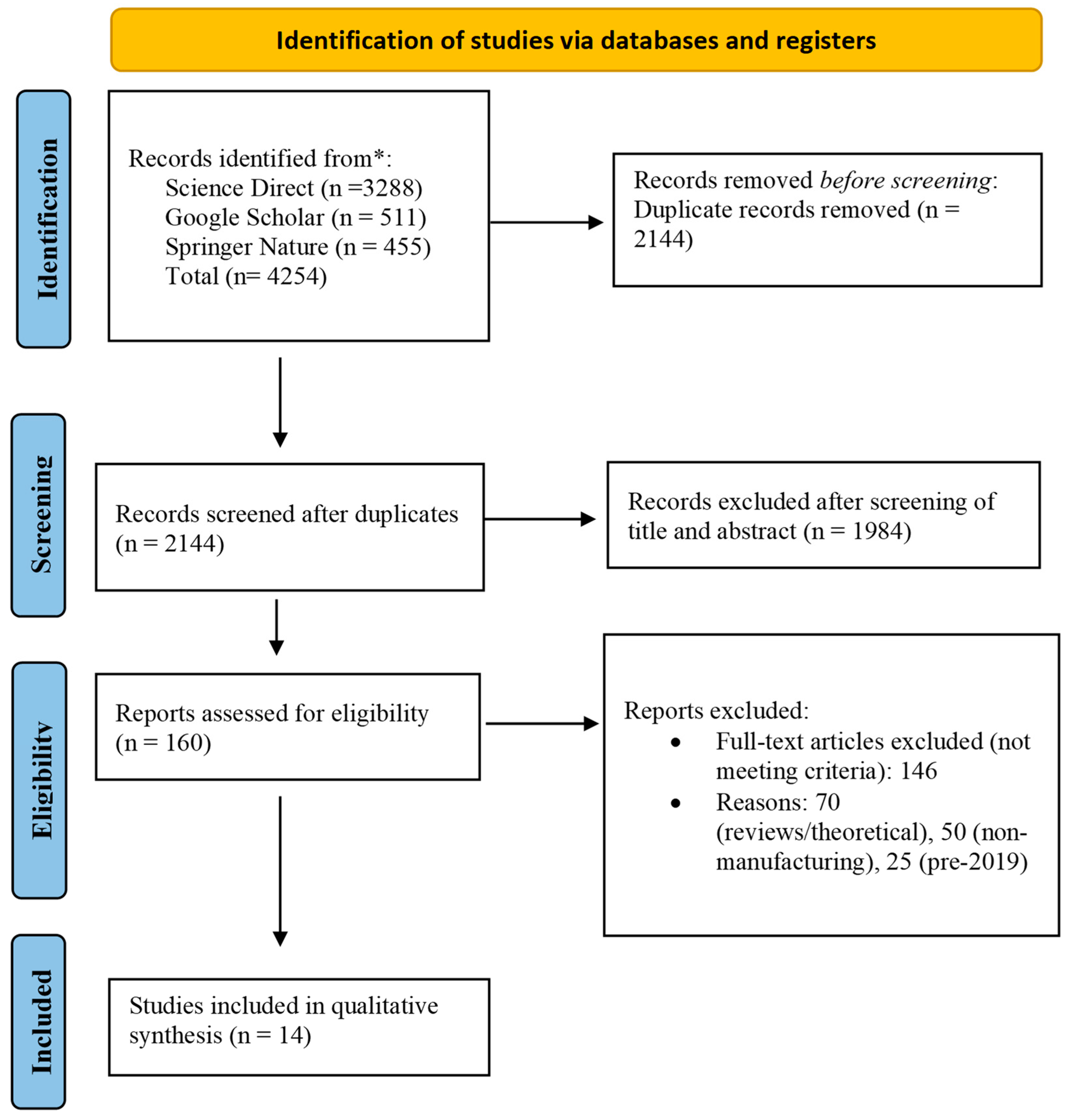
Figure 1. PRISMA 2020 flow diagram.
Technologies 13 00566 g001
Table 1. Keywords search results.
DatabaseKeyword SearchResults
Science DirectExploring the Integration of IoT and Robotics in Manufacturing: Disruptive Technologies3288
Google ScholarTITLE-ABS-KEY ((IoT OR Internet of Things”) AND (robot* OR “industrial robot*”) AND (manufactur* OR “smart factory”)) AND PUBYEAR > 2018511
Springer NatureExploring the Integration of IoT and Robotics in Manufacturing: Disruptive Technologies445
Table 4. Quantitative outcomes of IoT-driven studies.
StudyKey MetricValue
[8]Cycle time improvement0.44–1.71%
Standard deviation0.16–1.32 s
Correlation0.9465–0.9997
[14]Accuracy92%
Event duration (mean, SD)84.55 s, 3666.01 s
[26]Online cycle time0.08–20.20 s
Unqualified times0–486 instances
[18]Schedulable flows (FO-CS, Tabu)31.2%, 94.45%
Packet delay~120 µs
[19]Classifier accuracy (DT)97%
[20]Angular movement variation3%
[21]Learning accuracy0.98
RMSE1.48–2.63 cm
MAPE1.72–3.54%
Accuracy improvement2% (97% to 99%)
Table 5. Quantitative outcomes of robotics and HRC studies.
StudyKey MetricValue
[22]Cycle time reduction9% (mean: 7.38%)
[24]Latency40 ms
Joint movement error−0.3 to 0.3°
[25]Positional error (3D)0.0080–0.0211 m
Orientation error0.0138–1.6401 radians
[9]mAP0.605–0.789
AP500.844–0.993
Detection speed20–100 fps
[15]Trust dynamicsImproved (qualitative)
Table 6. Summarizes the technologies and outcomes.
StudyTechnologyKey Outcome
[24]Digital Twin, VRLatency: 40 ms, Error: −0.3 to 0.3°
[19]Big Data AnalyticsAccuracy: 97%
[26]Edge Computing, SMOTE-XGBoostAUC: 0.916, Higher R2
[9]Digital Twin, Deep LearningmAP: 0.605–0.789
[21]IALO-SVR, CNNAccuracy: 0.98
[15]Digital TwinsImproved trust (qualitative)
Disclaimer/Publisher’s Note: The statements, opinions and data contained in all publications are solely those of the individual author(s) and contributor(s) and not of MDPI and/or the editor(s). MDPI and/or the editor(s) disclaim responsibility for any injury to people or property resulting from any ideas, methods, instructions or products referred to in the content.


