Article

XRD Characterization of Activated Carbons Synthesized from Tyre Pyrolysis Char via KOH Activation

1
Centre for Hydrogen and Renewable Energy (CHRE), School of Engineering and Technology, Central Queensland University, Rockhampton, QLD 4701, Australia
2
Microscopy and Microanalysis Facility, John de Laeter Centre, Curtin University, Perth, WA 6845, Australia
3
School of Science, Technology and Engineering, University of the Sunshine Coast, Sippy Downs, QLD 4556, Australia
*
Author to whom correspondence should be addressed.
Technologies 2025, 13(12), 565; https://doi.org/10.3390/technologies13120565 (registering DOI)
Submission received: 10 October 2025 / Revised: 28 November 2025 / Accepted: 29 November 2025 / Published: 3 December 2025
(This article belongs to the Section Environmental Technology)

Abstract

The structural modification of tyre-derived activated carbon (TDAC) after chemical activation is not sufficiently recognised yet, especially regarding its crystallinity and porosity. This study examined the development of the crystal structure of TDAC by X-ray diffraction (XRD) analysis, concentrating on critical parameters like interplanar distance (d(002)), crystallite size (Lc), and crystalline percentage. Mixed tyres were pyrolysed at 550 °C to produce char and then chemically activated with KOH at different ratios and temperatures, thereafter undergoing structural characterisation. The results indicate that TDAC is mostly non-graphitizing, maintaining a disordered turbostratic structure even after activation. The widening of the (002) XRD peak and the lack of distinct (hkl) diffraction peaks validate its amorphous characteristics. Higher activation levels lead to an expanded surface area with decreasing crystallite size, signifying a shift towards higher disorder. This research examined the relationship among activation factors, porosity, and structural alterations, emphasising the compromise between crystallinity and surface area.

1. Introduction

Carbon materials exists in graphitic and non-graphitic forms, each exhibiting distinct structural and functional properties. Pyrolysis is a widely used method for producing carbonaceous solids, including pyrolytic char (rich in carbon; typically, 70–90%), which serves as precursor for activated carbon (AC). However, the crystal structure of pyrolytic char varies significantly based on the feedstock, temperature, and reaction conditions, affecting its functionality in various applications [1].
Carbon obtained from pyrolysis can be categorized as either graphitizing or non-graphitizing [2]. Graphitizing carbons, when subjected to high-temperature heat treatment (above 2500 °C), undergo structural transformation into ordered graphite-like structures [3]. In contrast, non-graphitizing carbons retain a more disordered structure, even at high temperatures.
To understand these structural differences, various analytical techniques are employed. X-ray diffraction (XRD) is widely used to analyze the crystalline structure of carbon materials by measuring interplanar spacing (d(002)), crystallite size (Lc), and stacking orientation [4,5]. Additionally, Transmission Electron Microscopy (TEM) provides direct imaging of carbon layers, and Raman Spectroscopy is used to assess structural disorder by analyzing vibrational modes. These techniques collectively help distinguish between crystalline and amorphous carbon domains in pyrolytic char and activated carbon.
Activated carbon (AC) is an advanced form of pyrolytic char that undergoes chemical or physical activation to enhance its surface area and porosity. The activation process plays a significant role in altering its structural properties, particularly the development of microporous and mesoporous structures. Chemical activation, typically involving potassium hydroxide (KOH) or phosphoric acid (H3PO4), has been found to be highly effective in increasing the surface area (400–900 m2/g) within a shorter activation time [6]. The development of porous structures during activation significantly influences the crystal structure, affecting AC’s adsorption capacity and electrochemical behavior [7,8,9]. In the context of energy applications, tyre-derived activated carbon (TDAC) has gained significant attention due to its potential use in supercapacitors, batteries, and fuel cells. The electrochemical performance of TDAC is closely linked to its crystal structure, which determines its conductivity and ion transport properties. Studies have shown that TDAC with a well-developed porous network and controlled crystallinity can exhibit high specific capacitance, good rate performance, and long cycling stability in energy storage applications.
This study investigates the crystallographic evolution of TDAC during KOH activation. It evaluates key parameters, including interplanar distance (d(002)), crystallite size (Lc), and crystalline fraction, to understand the relationship between activation conditions and structural transformation. Additionally, the impact of porous structure development on TDAC’s crystallinity is examined. This research contributes to the advancement of high-performance carbon materials for environmental and energy applications. The findings provide a foundation for optimizing the conversion of waste tyres into value-added carbon materials, promoting sustainable waste management and innovative carbon-based solutions.

2. Carbon Material from Pyrolysis Process

One of the outputs of pyrolysis process is pyrochar, which is highly valuable and primarily consists of carbon, with concentrations varying from 50% to over 90%. This variation is influenced by factors such as the type of feedstock used in pyrolysis and the specific operating conditions, including heating rate, residence time, and temperature. On average, pyrolytic char has a complex crystal structure. The crystal structure can be improved through a range of heat treatment processes, such as carbon activation. In a study of carbons derived from the pyrolysis process at extremely high temperatures (ranging from 1000 to 3000 °C), researchers identified two distinct categories: graphitizing carbons and non-graphitizing carbons [2,3].
The structural variation between these two forms of carbon becomes noticeable even at the initial stages of heating. Non-graphitizing carbons possess parallel layers similar to graphite; however, these layers lack the orientation characteristic of graphite. Even at higher temperatures (typically exceeding 2500 °C), non-graphitizing carbon fails to form a crystalline graphite structure [10]. When carbon material experiences to higher temperatures (typically exceeding 2500 °C), it undergoes a structural transformation to form crystalline graphite, commonly referred to as graphitizing carbon. Warren (1934) initially revealed the distinction between these two forms of carbon through crystal structure analysis [11]. In 1942, Biscoe and Warren [12] identified that carbon blacks possess a two-dimensional, or cross-lattice, structure had graphite-like layers arranged in parallel groups with incomplete alignment among them. X-ray studies revealed (001) reflections and two-dimensional (hk) bands, yet (hkl) lines were absent, suggesting a lack of the three-dimensional crystalline structure typically associated with graphite [13]. This structural difference leads to the classification of these materials as non-graphitic carbons.
X-ray diffraction images are analyzed to determine how heating transforms the crystal structure of non-graphitizing and graphitizing carbon into a structure similar to graphite, through the analysis of X-ray diffraction images [14]. The images illustrate that non-graphitic carbon generally comprises small well-structured graphite-like layers in addition to large amount disordered carbon. The disordered carbon exhibits a random arrangement of atoms and does not possess the organized layer structure as like in graphite. The primary distinction in non-graphitic carbon involves the dimensions of the layers, their arrangement, the spacing between the layers, and the quantity of disordered carbon present. Carbon produced through the thermal treatment of organic materials exhibits clusters of 2 to 4 graphite-like layers, with each layer having a diameter of less than 20 Å [15]. Additionally, they include a certain amount of disordered carbon.
For transforming pyrolysis char into graphite with an increase in heating temperature, the length of the graphite-like layers (L) expands, whereas the quantity of disordered carbon (A) reduces. Nonetheless, the average number of layers per group (M) remains relatively suitable during the initial phases. During this phase, the primary structural changes involved the development of small graphite-like layers, which occurs at the expense of the disordered carbon. When carbons are subjected to reach high temperature for graphitization, the diameter of the layers expands to approximately 70 Å, with the parallel-layer groups comprising around 30 layers. As the temperature rises further, there is a more substantial rise in both the layer diameter (L) and the number of layers per group (M). Graphitizing carbons can be deferred from non-graphitizing ones early in the carbonization process. Graphitizing carbons generally exhibit approximately four layers per group, whereas non-graphitizing carbons display between 2 and 2.5 layers per group. When the layer diameter (L) remains below approximately 25 Å and disordered carbon is present, raising the temperature primarily leads to an increase in the layer diameter, while the number of layers (M) experiences minimal variation. Nonetheless, as the layer diameter surpasses 25 Å, the increase in M is considerably greater for graphitizing carbons in comparison to non-graphitizing carbons. Typically, if the carbon material obtained from the pyrolysis process is non-graphitic, subsequent heating treatments cannot significantly enhance its crystalline structure to resemble graphite. On the other hand, if the carbon material undergoes graphitization, heat treatment can improve its structure to that of graphite. Certain characteristics develop in pyrolytic char during the initial stages of the carbonization process. These either impede or facilitate the formation of graphite structure at higher temperatures.
Initially in the carbonization process, solid cross-linking between nearby carbon nuclei must have formed, resulting in these tiny pores. The cross-linking, which is maintained when heated to higher temperatures, keeps nearby crystallites apart and oriented randomly in relation to one another. It also prevents coming nuclei together, which is essential for graphitization. For graphite-like crystal growth, carbon nuclei must remain mobile, and cross-linking in graphitizing carbons should be weaker. A more compact graphitizing carbon is more likely to develop when the raw material contains a lot of hydrogen. When hydrogen-rich materials undergo pyrolysis, hydrocarbon breakdown products are created inside the structure, preventing the carbon from solidifying at low temperatures. The carbon can develop in a more compact form since any cross-links that may have formed between neighboring carbon nuclei are probably broken. In contrast, when the raw material contains oxygen or lacks hydrogen, a strongly cross-linked, open-structured, non-graphitizing carbon emerges [10].
The formation of crystals in both kinds of carbons has been extensively researched. It has been suggested by some researchers that the simple movement of individual carbon atoms or small groups of atoms cannot account for the creation of crystallites (tiny crystal-like structures) in carbon materials after the disordered carbon is used up [16]. Although it may appear possible that these atoms could migrate by surface migration, vapor movement, or interactions with minor amounts of contaminants (such as hydrogen), this is not compatible with what scientists actually witness. Growth would only occur at very high temperatures within a limited range if it happened in this manner, which would involve breaking strong carbon-carbon bonds. Crystallite development, on the other hand, occurs consistently over a broad temperature range (1000–3000 °C), indicating a distinct mechanism at work [17]. The movement of complete layers or groups of layers of carbon atoms is more likely to be the cause of crystallite formation. As crystallites get bigger, development slows down because more heat is required to move these layers as they grow. Small pores (created at low temperatures) and strong cross-links in non-graphitizing carbons hinder the movement of these massive layers, which affects the formation of crystallites. If growth were caused by individual atoms moving, the pores and cross-links would not be as effective in inhibiting the process, which is not the case here. It is also common for large layers to adhere to the flat surfaces (basal planes) of other layers instead of their edges when they move. In graphitizing carbons, crystallites grow higher (in height) more quickly than they grow wider (in diameter). This is because aligning flat surfaces is simpler than aligning edges. They would probably attach to the margins if growth happened through single atoms, but that is not usually seen.
A significant distinction between graphitizing and non-graphitizing carbons can be seen when comparing the X-ray diagrams of various pyrolyzed carbons. At small angles, non-graphitizing carbons exhibit a wide, intense scattering, indicating that the electron density of the material varies significantly. Non-graphitizing carbons commonly result from materials characterized by low hydrogen or enhanced oxygen levels [18]. While heating, these substances establish a strong cross-linking network at lower temperatures, effectively immobilizing the structure and combining the crystallites into a solid mass [19]. These carbons present significant hardness, possess extensive fine-structure porosity, and retain this porosity even under higher temperatures [20]. The crystallites within the mass show a random orientation, and the fine structure remains consistent even when subjected to temperatures as high as 3000 °C. The graphite-like layers in these carbons are constrained to a diameter of approximately 70 Å, with the number of layers per crystallite capped at around twelve. The inability of these carbons to graphitize can be attributed to their porous structure and the random arrangement of the crystallites. Non-graphitizing carbons have pore diameters of no more than a few tens of Ångströms and fine-structure porosity between 20 and 50%. In contrast, graphitizing carbons originate from substances abundant in hydrogen. In the initial phases of carbonization, the crystallites exhibit mobility, and the cross-linking is relatively weak [21]. The carbons in question exhibit a softer texture and reduced porosity compared to non-graphitizing varieties, featuring more advanced crystallite structures, especially oriented perpendicular to the layers. The crystallites show a tendency to align in parallel orientation, resulting in minor gaps between their basal planes. Graphitization initiates at approximately 1700 °C and grows quickly with rising temperatures [20]. The growth of crystallites in graphitizing carbons takes place via the movement of complete layers or clusters of layers, rather than through the moving of individual atoms. The nearly parallel arrangement of crystallites plays a crucial role in influencing both crystallite growth and the process of graphitization.

3. Experimental Processes

3.1. Raw Material

In this study, mixed tyre material with particle sizes less than 4 mm was utilized as the raw material. The mix was pyrolyzed in a fixed bed 20 L reactor at a temperature of 550 °C with a heating rate of 6 °C/min for three hours. Pyrolytic char obtained from the reactor was collected for subsequent chemical activation to produce activated carbon. The proximate and ultimate analyses of the tyre-derived char are provided in Table 1.

3.2. Activation

Initially, tyre pyrolytic char (TPC) was ground into a fine powder and mixed with KOH at ratios ranging from 0 to 3 under dry conditions. The mixture was placed in a crucible and heated in a furnace using Eurotherm programming with a controlled heating rate of 10 °C/min. The temperature was raised in stages: 300 °C for 5 min, 600 °C for another 5 min, and finally 800 °C, where it was maintained for an activation time of 30–90 min (RTx). The heat transfer profile of the process is illustrated in Figure 1 and Table 2. After activation, the sample cooled to 40 °C. The mixture was soaked in vinegar for 24 h, then repeatedly washed with distilled water. The washing process, monitored using a pH meter, was continued until a neutral pH of 7 was achieved. The activated carbon was dried at 80 °C to obtain a powdered form Suitable for further analysis.

3.3. Crystal Structure Analysis of Activated Carbon

For the XRD analysis, calcium fluoride was incorporated into the powdered mixture as an internal standard. The preparation process began with grinding the paste in a ring mill for 20 s, followed by the addition of 10 wt.% internal standard. The mixture was then micronized in an ethanol solution using a micronizing mill for 10 min. The resulting suspension was dried on a hot plate at 40 °C for 24 h. Finally, the dried powder was packed into an acrylic sample holder and subjected to XRD analysis. Diffraction data were collected using a Bruker D8 Advance diffractometer with Cu Kα radiation (40 kV, 40 mA) and a LYNXEYE XE-T detector over the range of 10–60° 2θ, with a step size of 0.015° at 0.85 s per step. The XRD measurement was conducted in the range of 10–60° (2θ), which encompasses the principal (002) and (101) diffraction peaks characteristic of carbon-based materials. This range was selected to allow for direct comparison between tyre-derived activated carbon and standard graphitic carbon. Calibration of the diffractometer was performed using a silicon standard, and calcium fluoride (CaF2) was added as an internal reference to correct for instrumental shifts. The activated carbon (002) peak was detected in the angle range between 15° and 35° 2θ. The (002) diffraction peak of activated carbon was fitted using the Fundamental Parameter Approach in TOPAS v7, which accounts for both instrumental and sample-induced broadening. The fitting data were extracted from TOPAS and replotted using EVA 6.0. The full width at half maximum (FWHM) values obtained from the fitted peaks were used to estimate crystallite size (Lc) using the Scherrer equation. All XRD measurements were performed in triplicate to evaluate reproducibility. The calculated d(002), Lc, and crystalline fraction values represent mean results from three independent runs. The variation among replicates was low (±2–4%), indicating good consistency in sample preparation and peak-fitting. Because XRD peak parameters are derived from deterministic peak-fitting rather than statistical sampling, traditional error bars are not typically applied; however, replicate variability has been reported to ensure transparency and reproducibility. Peak asymmetry was also visually examined to evaluate turbostratic disorder and amorphous contributions. The broad and asymmetric nature of the (002) peak indicates overlapping contributions from disordered carbon layers and small graphitic domains, confirming the pre-dominantly non-graphitizing nature of the samples. The obtained values from fitted data were used for the calculation of the crystalline and amorphous fractions, as well as the crystalline size of the activated carbon. The crystalline and amorphous fractions and crystalline size (Lc) of each sample were calculated using the following equation. In these equations, the crystalline fraction and amorphous fraction are determined from the area under XRD peaks. Lc represents crystallite size, calculated by the Scherrer equation. Here, K is the shape factor (typically 0.9), λ is the X-ray wavelength (1.5406 Å for Cu Kα radiation), β is the full width at half maximum (FWHM) of the diffraction peak in radians, and θ is the Bragg angle.
Crystalline fraction = Icrystalline/Itotal × 100
Amorphous fraction = Iamorphous/Itotal × 100
Lc = K/(β cosθ)

4. Results and Discussion

4.1. Shape of XRD Diffraction Pick

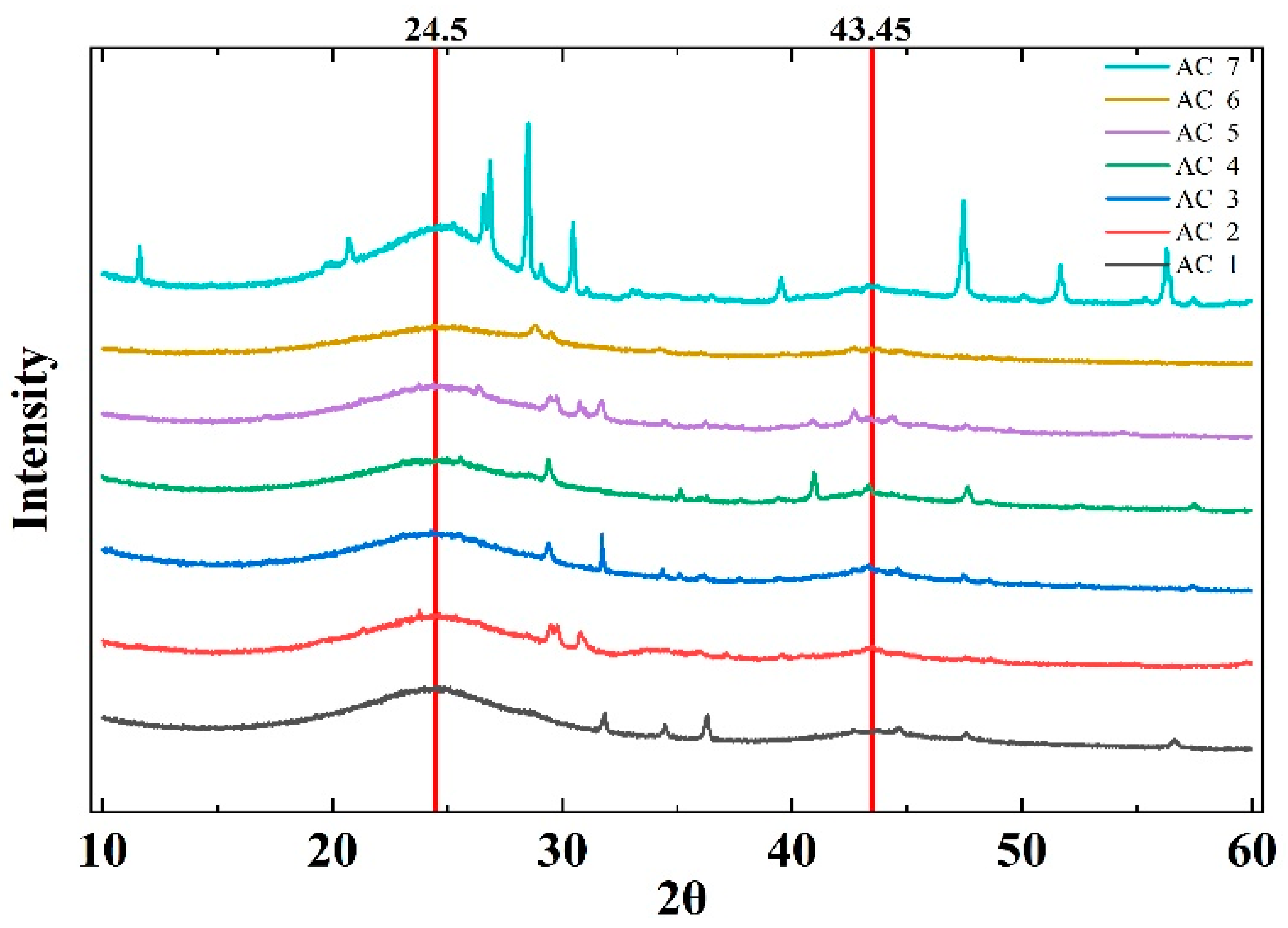
Figure 2 presents the X-ray diffraction (XRD) patterns of activated carbons (ACs), revealing a high baseline and broad peak widths, which indicate that AC has amorphous carbon structures with limited crystalline ordering. The diffraction angle (2θ) of the 002 peak, typically observed at 26.56° for crystalline graphite, is shifted to 24.1° in these AC samples, signifying micro-crystallites distinct from those of graphite and confirming a predominantly turbostratic carbon structure. However, the 101 peak, which normally arises from the overlapping 100 and 101 peaks, appears as a single broad peak due to fragmentary stacking of carbon atom layers. The activation process significantly influences the structure of the ACs, as evidenced by clear changes in the 002 peak, with increased activation leading to micro-crystallites. It was also observed that the crystallite of ACs is decreased with increasing its surface area. However, the shape of the 101 peak remains relatively unchanged throughout the activation process. Some additional sharp peaks were observed in the XRD patterns. As tyres are composed of a complex mixture of substances, impurities such as zinc, potassium, and oxygen were detected alongside carbon, resulting in the appearance of these peaks. These results demonstrate that the AC samples are primarily composed of disordered carbon with turbostratic features, and their structural properties are heavily influenced by its surface morphology.

4.2. Interplanar Distance and Crystal Size of Raw Carbon Black

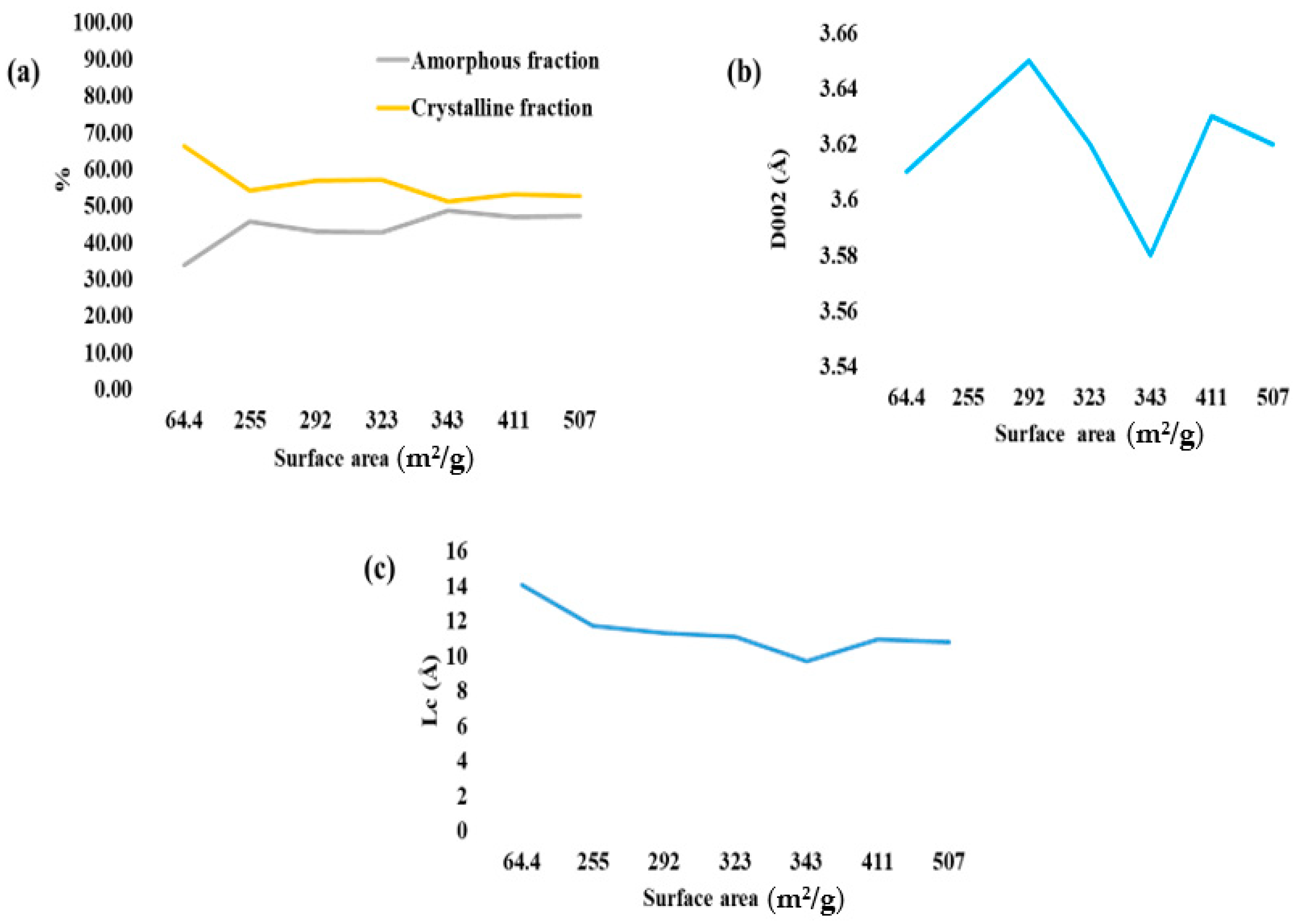
The structural parameters of tyre-derived activated carbon, analysed via X-ray diffraction, reveal a correlation between specific surface area and crystal structure [Table 3]. As the surface area increases, a slight decrease in D002 and Lc values is observed, indicating reduced interlayer spacing and crystallite size, respectively, which suggest a less ordered structure. The crystalline fraction also shows a decline with higher surface area highlighting the formation of disordered carbon during activation. Compared to graphite, the derived materials exhibit higher D002 (~3.58–3.65 Å vs. ~3.35 Å for graphite) and significantly lower Lc values (~9.71–14.06 Å vs. >100 Å for graphite), indicating a predominantly amorphous structure with limited graphitic domains.

4.3. Effects of Activation Process on Structural Parameters of the Material

Variation in crystalline fractions: Figure 3a demonstrates the relationship between surface area and the percentages of crystalline and amorphous fractions. As surface area increases from 64.4 m2/g to 507 m2/g, the crystalline fraction generally decreases, stabilizing around 50–60%. Meanwhile, the amorphous fraction rises, indicating that higher surface areas favour increased amorphous characteristics over crystalline structure. A study revealed that biochar produced from coconut shells at 400 °C with heating rate of 5 C/min for 2, has a crystallinity index of 25.8% and a surface area of 2.0827 m2/g [22]. Compared to activated carbon, biochar exhibited a lower crystalline index. In another study, carbon black was produced from Sugarcane bagasse, which crystallinity index was around 20% [23]. Carbon black activation by CO2 was examined via XRD to evaluate that initial activation targeted the amorphous surface fraction, followed by less-developed crystalline carbon regions [24]. The study found that Increasing burn-off ratios (0–80%) reduced crystalline fraction from 85% to 70% and increased amorphous fraction from 15% to 30%, promoting a more disordered carbon structure.
Variation in the interplanar distance: Figure 3b illustrates the influence of TDAC’s surface area on interplanar distance. The interplanar distance (D002) shows a non-linear relationship with surface area. Initially, as the surface area increases from 64.4 to 292 m2/g, D002 rises to 3.66 Å. However, further increases in surface area to 343 m2/g reduce D002 to 3.56 Å, followed by a slight increase at higher surface areas. Compared to graphite, which has a fixed D002 of ~3.35 Å, these values indicate a more disordered carbon structure with reduced crystallinity as surface area changes. In a study, CBp was mixed with KOH (1:4 ratio) and activated at 850 °C for 2 h under nitrogen. The activated material had a surface area of 415 m2/g [9]. XRD analysis of the carbon revealed two broad peaks at 24° and 43°, indicating graphite-like (002) and amorphous carbon (100) structures. Veldevi, Raghu [25] synthesized Carbon materials from waste tyre powder at 1000, 1300, and 1600 °C. XRD analysis showed peaks at ~25° and ~43°, indicating a turbostratic nature. The study also showed that, as the temperature increased, the (002) d-spacing decreased from 3.60 to 3.49 Å. Meanwhile, negligible changed in FWHM values suggested nanocrystalline graphite within a disordered matrix. The asymmetric (002) peak further confirmed the coexistence of both graphitic and disordered phases across all temperatures. In a study, Pulverized tyre rubber powder was pyrolysed from room temperature to 400 °C at 1 °C/min, followed by heating to 1100 °C, 1400 °C, and 1600 °C [26]. X-ray diffraction (XRD) analysis of the samples revealed that the tyre-derived carbons are predominantly composed of poorly crystalline carbonaceous materials. A broad diffraction peak near 20–26.6°, corresponding to the (002) plane, indicates a lack of significant structural order. The R values, defined as the ratio of peak height to background height, were found to be 1.58, 2.27, and 2.67 for TC1100, TC1400, and TC1600, respectively. These increasing R values suggested a higher fraction of graphene-like structures with increasing pyrolysis temperature, with TC1600 exhibiting the highest graphene content.
Variation in crystallite size: Figure 3c illustrates the relationship between surface area (m2/g) and crystallite size (Lc in Å), showing a general decreasing trend in Lc as the surface area increases from 64.4 to 343 m2/g, with Lc dropping from around 14 Å to approximately 10 Å. Beyond 343 m2/g, Lc stabilizes with slight fluctuations between 10 and 11 Å as the surface area reaches up to 507 m2/g. This trend suggests that increasing the surface area initially leads to a reduction in crystallite thickness, indicating decreased structural order, but further increases in surface area have minimal impact on Lc, reflecting structural stabilization. Kawahara, Ishibashi [27] pyrolyzed feathers at 800 °C with a heating rate of 3.4 °C/min for 60 min. the XRD found the crystallite size for d(002) was 9 Å. Most of the cases, charcoal found from biowaste has small crystallite size compared to graphite.
The correlation between surface area and crystallinity arises from the structural disruption caused by KOH activation. As activation progresses, the formation of micropores and mesopores physically breaks the stacking continuity of carbon layers, limiting coherent scattering domains. This results in broader (002) peaks, reduced Lc, and higher amorphous content. Increased porosity therefore corresponds to lower structural order, which explains the inverse relationship between BET surface area and crystalline parameters observed in this study.
The structural evolution observed in TDAC aligns with established behaviour reported for other non-graphitizing carbons. The decrease in crystallite thickness (Lc) and crystalline fraction increasing surface area reflects the disruptive effects of chemical activation, where pore formation breaks the continuity of turbostratic layers. Similar trends have been reported for activated biochar and carbon blacks, where KOH activation enhances microporosity at the expense of structural order. The relatively high d(002) values (3.58–3.66 Å) further confirm the dominance of disordered stacking, well above the 3.35 Å characteristics of crystalline graphite. These results highlight a fundamental trade-off: activation conditions that maximize adsorption capacity also promote disorder and suppress graphite domain growth. For applications such as supercapacitors, this increased disorder can be beneficial by improving ion accessibility, whereas technologies requiring high electrical conductivity may require milder activation to preserve structural order. Thus, tuning activation severity offers a pathway to engineer TDAC properties for specific environmental or electrochemical applications.

5. Conclusions

This study investigated the crystallographic evolution of tyre-derived activated carbon (TDAC) during pyrolysis and KOH activation, revealing how activation severity influences structural order. XRD analysis confirmed that TDAC belongs to the class of non-graphitizing carbons, as evidenced by the broad and asymmetric (002) peak, large interlayer spacing (3.58–3.66 Å), and small crystallite thickness (Lc ≈ 9–14 Å). These features indicate a predominantly turbostratic and amorphous structure that persists despite activation. Increasing the activation ratio and temperature enhanced the BET surface area but simultaneously reduced crystallite size and crystalline fraction, demonstrating a clear trade-off between porosity and structural ordering. This behaviour reflects the physical impact of KOH activation, where pore development disrupts the stacking continuity of carbon layers.
A key finding of this study is the relationship between BET surface area and TDAC’s crystal parameters. The results show that as the surface area increases, crystallite size (Lc) decreases, indicating a transition towards a more disordered structure. The interplanar distance (d(002)) also increases with surface area, deviating from the standard graphite spacing of 3.35 Å. This suggests that the activation process introduces defects and irregularities in the carbon layers, disrupting crystallite growth and enhancing porosity. Higher activation temperatures and increased KOH ratios lead to the development of micropores and mesopores, which further contribute to the amorphous nature of TDAC.
Despite its non-graphitic nature, TDAC demonstrates favorable properties for adsorption and electrochemical applications. The increased surface area, combined with the presence of functional groups introduced during activation, enhances its adsorption capacity, making it suitable for water treatment and gas separation. Additionally, its structural characteristics, including high porosity and turbostratic features, make it a promising material for supercapacitors and batteries, where ion storage and transport are crucial. This study confirms that higher BET surface area correlates with increased disorder and reduced crystallite size, emphasizing the trade-off between porosity and crystallinity. While this study emphasized XRD-based crystallographic analysis, future work will employ Raman and TEM techniques to provide deeper insight into the disorder and microstructure of tyre-derived activated carbon. Further research should focus on optimizing activation conditions to tailor TDAC’s properties for specific applications, particularly in energy storage and environmental remediation.

Author Contributions

Methodology, N.H.Z.; Analysis, N.H.Z.; XRD Characterization, N.H.Z.; Writing—original draft, N.H.Z., Z.Q. and R.H.; Writing—review and editing, M.G.R., M.I.J., R.H. and A.S.M.S.; Supervision, M.G.R. All authors have read and agreed to the published version of the manuscript.

Funding

This research received no external funding.

Institutional Review Board Statement

Not applicable.

Informed Consent Statement

Not applicable.

Data Availability Statement

The original contributions presented in this study are included in this article. Further inquiries can be directed to the corresponding author.

Acknowledgments

The authors would like to thank CQUniversity, Australia for the financial support provided to Nusrat Hossain Zerin through elevate scholarship. The authors also acknowledge the John de Laeter Centre in Curtin University for their technical support to perform XRD analysis.

Conflicts of Interest

The authors declare no conflicts of interest.

Abbreviations

The following abbreviations are used in this manuscript:
Lccrystallite size
XRDX-ray diffraction
TDACtyre-derived activated carbon
ACsactivated carbons

References

  1. Stein, I.Y.; Constable, A.J.; Morales-Medina, N.; Sackier, C.V.; Devoe, M.E.; Vincent, H.M.; Wardle, B.L. Structure-mechanical property relations of non-graphitizing pyrolytic carbon synthesized at low temperatures. Carbon 2017, 117, 411–420. [Google Scholar] [CrossRef]
  2. Franklin, R.E. Crystallite growth in graphitizing and non-graphitizing carbons. Proc. R. Soc. Lond. Ser. A Math. Phys. Sci. 1951, 209, 196–218. [Google Scholar]
  3. Fischbach, D.B. The graphitization process. Tanso 1971, 1970, 115–120. [Google Scholar] [CrossRef]
  4. Appiah, E.S.; Mensah-Darkwa, K.; Agyemang, F.O.; Agbo, P.; Nashiru, M.N.; Andrews, A.; Adom-Asamoah, M. Performance evaluation of waste tyre-activated carbon as a hybrid supercapacitor electrode. Mater. Chem. Phys. 2022, 289, 126476. [Google Scholar] [CrossRef]
  5. Rao, H.J. Characterization Studies on Adsorption of Lead and Cadmium Using Activated Carbon Prepared from Waste Tyres. Nat. Environ. Pollut. Technol. 2021, 20, 561–568. [Google Scholar] [CrossRef]
  6. Acosta, R.; Fierro, V.; De Yuso, A.M.; Nabarlatz, D.; Celzard, A. Tetracycline adsorption onto activated carbons produced by KOH activation of tyre pyrolysis char. Chemosphere 2016, 149, 168–176. [Google Scholar] [CrossRef]
  7. Muttil, N.; Jagadeesan, S.; Chanda, A.; Duke, M.; Singh, S.K. Production, types, and applications of activated carbon derived from waste tyres: An overview. Appl. Sci. 2022, 13, 257. [Google Scholar] [CrossRef]
  8. Mui, E.L.; Ko, D.C.; McKay, G. Production of active carbons from waste tyres—A review. Carbon 2004, 42, 2789–2805. [Google Scholar] [CrossRef]
  9. Hou, S.; Zhang, D.; Xie, Z.; Kang, Y.; Tang, Z.; Dai, Y.; Lei, Y.; Chen, J.; Liang, F. Activated carbon prepared from waste tire pyrolysis carbon black via CO2/KOH activation used as supercapacitor electrode. Sci. China Technol. Sci. 2022, 65, 2337–2347. [Google Scholar] [CrossRef]
  10. Harris, P.J. Non-graphitizing carbon: Its structure and formation from organic precursors. Eurasian Chem.-Technol. J. 2019, 21, 227–234. [Google Scholar] [CrossRef]
  11. Warren, B.E. X-Ray Diffraction Study of Carbon Black. J. Chem. Phys. 1934, 2, 551–553. [Google Scholar] [CrossRef]
  12. Biscoe, J.; Warren, B.E. An X-Ray Study of Carbon Black. J. Appl. Phys. 1942, 13, 364–377. [Google Scholar] [CrossRef]
  13. Fan, C.; Yan, J.; Huang, Y.; Han, X.; Jiang, X. XRD and TG-FTIR study of the effect of mineral matrix on the pyrolysis and combustion of organic matter in shale char. Fuel 2015, 139, 502–510. [Google Scholar] [CrossRef]
  14. Liu, M.; Bai, J.; Yu, J.; Kong, L.; Bai, Z.; Li, H.; He, C.; Ge, Z.; Cao, X.; Li, W. Correlation between char gasification characteristics at different stages and microstructure of char by combining X-ray diffraction and Raman spectroscopy. Energy Fuels 2020, 34, 4162–4172. [Google Scholar] [CrossRef]
  15. Bernard, S.; Beyssac, O.; Benzerara, K.; Findling, N.; Tzvetkov, G.; Brown, G., Jr. XANES, Raman and XRD study of anthracene-based cokes and saccharose-based chars submitted to high-temperature pyrolysis. Carbon 2010, 48, 2506–2516. [Google Scholar] [CrossRef]
  16. Frusteri, L.; Cannilla, C.; Barbera, K.; Perathoner, S.; Centi, G.; Frusteri, F. Carbon growth evidences as a result of benzene pyrolysis. Carbon 2013, 59, 296–307. [Google Scholar] [CrossRef]
  17. Yoshikawa, A.; Satonaga, T.; Kamada, K.; Sato, H.; Nikl, M.; Solovieva, N.; Fukuda, T. Crystal growth of Ce: PrF3 by micro-pulling-down method. J. Cryst. Growth 2004, 270, 427–432. [Google Scholar] [CrossRef]
  18. Tonnoir, H.; Huo, D.; Davoisne, C.; Celzard, A.; Fierro, V.; Saurel, D.; El Marssi, M.; Benyoussef, M.; Meunier, P.; Janot, R. Pyrolysis temperature dependence of sodium storage mechanism in non-graphitizing carbons. Carbon 2023, 208, 216–226. [Google Scholar] [CrossRef]
  19. McDonald-Wharry, J.S.; Manley-Harris, M.; Pickering, K.L. Reviewing, combining, and updating the models for the nanostructure of non-graphitizing carbons produced from oxygen-containing precursors. Energy Fuels 2016, 30, 7811–7826. [Google Scholar] [CrossRef]
  20. Antil, B.; Elkasabi, Y.; Strahan, G.D.; Vander Wal, R.L. Development of graphitic and non-graphitic carbons using different grade biopitch sources. Carbon 2025, 232, 119770. [Google Scholar] [CrossRef]
  21. Rellick, G.S.; Chang, D.J.; Zaldivar, R.J. Mechanisms of orientation and graphitization of hard-carbon matrices in carbon/carbon composites. J. Mater. Res. 1992, 7, 2798–2809. [Google Scholar] [CrossRef]
  22. Nisa, Z.U.; Chuan, L.K.; Guan, B.H.; Ahmad, F.; Ayub, S. A comparative study on the crystalline and surface properties of carbonized mesoporous coconut shell chars. Sustainability 2023, 15, 6464. [Google Scholar] [CrossRef]
  23. Kurniati, M.; Nurhayati, D.; Maddu, A. Study of Structural and Electrical Conductivity of Sugarcane Bagasse-Carbon with Hydrothermal Carbonization; IOP Conference Series: Earth and Environmental Science; IOP Publishing: Bristol, UK, 2017; p. 012049. [Google Scholar]
  24. Lee, S.-M.; Lee, S.-H.; Roh, J.-S. Analysis of activation process of carbon black based on structural parameters obtained by XRD analysis. Crystals 2021, 11, 153. [Google Scholar] [CrossRef]
  25. Veldevi, T.; Raghu, S.; Kalaivani, R.; Shanmugharaj, A. Waste tire derived carbon as potential anode for lithium-ion batteries. Chemosphere 2022, 288, 132438. [Google Scholar] [CrossRef]
  26. Li, Y.; Paranthaman, M.P.; Akato, K.; Naskar, A.K.; Levine, A.M.; Lee, R.J.; Kim, S.-O.; Zhang, J.; Dai, S.; Manthiram, A. Tire-derived carbon composite anodes for sodium-ion batteries. J. Power Sources 2016, 316, 232–238. [Google Scholar] [CrossRef]
  27. Kawahara, Y.; Ishibashi, N.; Yamamoto, K.; Wakizaka, H.; Iwashita, N.; Kenjo, S.; Nishikawa, G. Activated carbon production by co-carbonization of feathers using water-soluble phenolic resin under controlled graphitization. Sustain. Mater. Technol. 2015, 4, 18–23. [Google Scholar] [CrossRef]
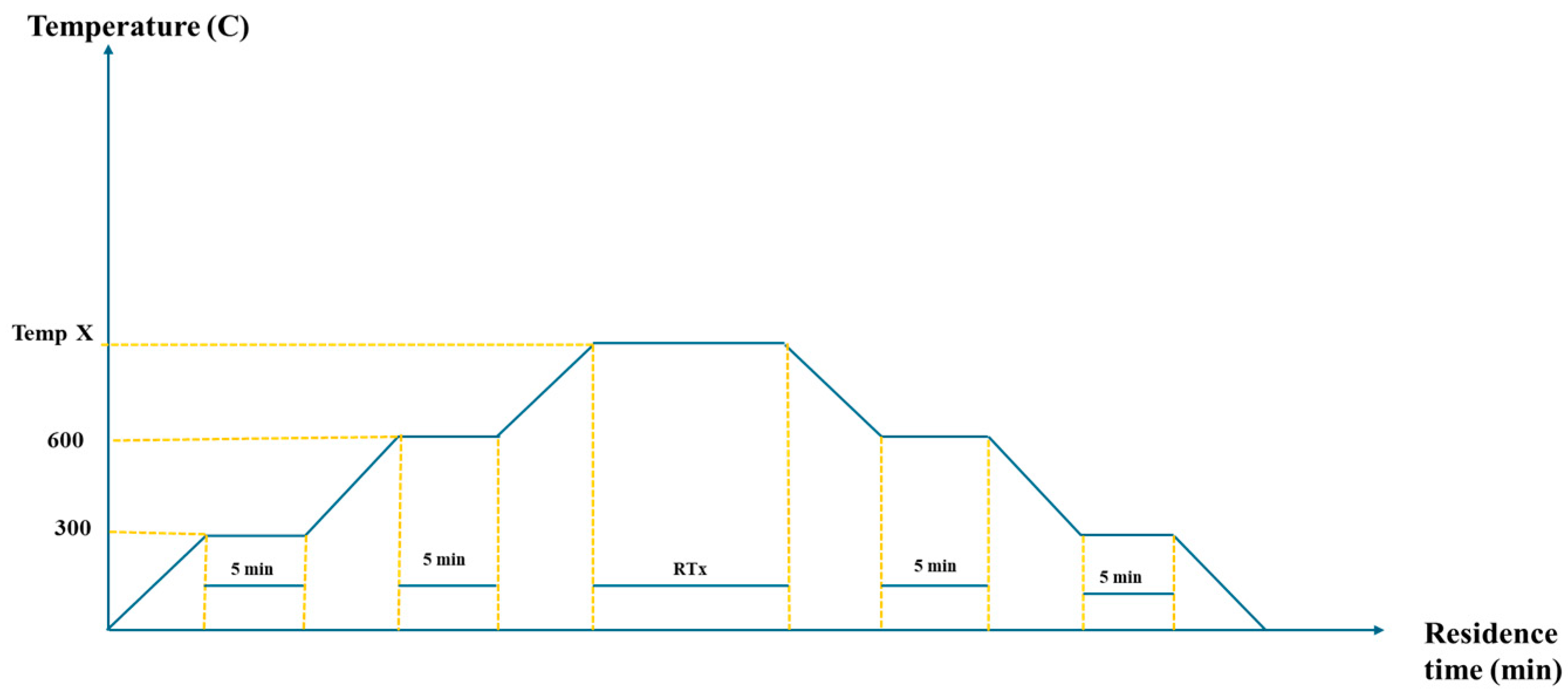
Figure 1. Time-temperature profile for the activation of TDC in a heating reactor.
Technologies 13 00565 g001
Figure 2. XRD Patterns of Activated Carbon Samples at Different Activation Conditions.
Technologies 13 00565 g002
Figure 3. Variation in Crystallographic Parameters of activated carbon. (a) Variation in amorphous and crystalline fractions, (b) Variation in the interplanar distance, and (c) Variation in crystallite size (Lc, La).
Technologies 13 00565 g003
Table 1. The chemical composition of the Tyre pyrolytic char.
Proximate Analysis (%)Ultimate Analysis (%)
Moisture1.8Carbon76.1
Ash16.6Sulphur2.24
Volatile Matter18.8Hydrogen2.52
Fixed Carbon62.8Nitrogen0.47
Oxygen0.3
Table 2. Influence of Activation Parameters on Specific Surface Area of Activated Carbon.
SamplesPyrolysis
Condition
Activation ConditionSpecific Surface Area
(m2/g)
Ratio
TPC: KOH
Temperature
°C
Time
min
AC 1550 °C temperature with a heating rate of 6 °C/min for three hours1:280030292
AC 21:180060255
AC 31:280060411
AC 41:280090507
AC 51:270060323
AC 61:380060343
AC 71:08006064.4
Table 3. Crystallographic Parameters and Surface Area of tyre derived activated carbon Samples.
SamplesSpecific Surface Area (m2/g)2θ (°)D002 (Å)Lc (Å)Crystalline Fraction (%)Amorphous Fraction (%)
AC 129224.373.6511.3156.8843.12
AC 225524.523.6311.7054.2145.79
AC 341124.513.6310.9353.1446.86
AC 450724.543.6210.7952.7747.23
AC 532324.603.6211.1057.1742.83
AC 634324.883.589.7151.1848.82
AC 764.424.663.6114.0666.2933.71
Disclaimer/Publisher’s Note: The statements, opinions and data contained in all publications are solely those of the individual author(s) and contributor(s) and not of MDPI and/or the editor(s). MDPI and/or the editor(s) disclaim responsibility for any injury to people or property resulting from any ideas, methods, instructions or products referred to in the content.